
Back to Journals » Drug Design, Development and Therapy » Volume 20
Timing of Effect Onset After Restarting Anti CGRP-(Receptor)-Monoclonal Antibodies Following a Mandatory Cessation After One year of Use–A Single Center Retrospective Cohort Study
Authors Panos LD  , Scutelnic A, Plüss SE, Bracher J, Rossel JB , Branca M , Riederer F, Schankin CJ
Received 15 September 2025
Accepted for publication 23 January 2026
Published 28 January 2026 Volume 2026:20 567680
DOI https://doi.org/10.2147/DDDT.S567680
Checked for plagiarism Yes
Review by Single anonymous peer review
Peer reviewer comments 2
Editor who approved publication: Dr Tuo Deng
Leonidas D Panos,1– 3,* Adrian Scutelnic,1,* Susan E Plüss,1 Jacqueline Bracher,1 Jean-Benoît Rossel,4 Mattia Branca,4 Franz Riederer,1 Christoph J Schankin1,5
1Department of Neurology, Inselspital, University Hospital Bern, University of Bern, Bern, Switzerland; 2Department of Neurology, Spitalzentrum Biel, Centre Hospitalier Bienne, Biel/Bienne, Switzerland; 3Department of Neurology, School of Medicine, Democritus University of Thrace, Alexandroupoli, Greece; 4Department of Clinical Research, University of Bern, Bern, Switzerland; 5Centre for Migraine and Headache, Department of Neurology, Bellevue Medical Group, Zurich, Switzerland
*These authors contributed equally to this work
Correspondence: Christoph J Schankin, Centre for Migraine and Headache, Department of Neurology, Bellevue Medical Group, Bellevue Medical Group AG, Theaterstrasse 8, Zurich, 8001, Switzerland, Tel +41442953045, Email [email protected]
Background: Calcitonin gene-related peptide (CGRP)-targeted monoclonal antibodies (CGRP-mAbs) effectively prevent migraine, but treatment interruption often leads to symptom recurrence. We evaluated the onset and magnitude of response after restarting CGRP-mAbs following an insurer-mandated cessation after one year of use.
Methods: In this single-center retrospective cohort study, we analyzed 42 patients who restarted the same CGRP-mAb after a median pause of 140 days. The main outcomes were change in monthly migraine days (MMD) versus baseline (pre-treatment) and time to achieve a 50% reduction in MMD.
Results: Across months 1– 12, reductions in MMD during the second treatment year were comparable to those during the first year (no statistically significant year-by-month differences). Mean time to achieve a 50% reduction in MMD was also comparable in both years (1.84 months in year 2 vs 2.20 months in year 1; P=0.41).
Conclusion: In this exploratory cohort, restarting the same CGRP-mAb after an insurer-mandated pause was associated with a comparable reduction in MMD and comparable time to response as during the first treatment year.
Keywords: migraine, calcitonin gene-related peptide, monoclonal antibodies, monthly migraine days, treatment interruption, retreatment
Introduction
Calcitonin gene related peptide (CGRP)-targeted therapies were developed to specifically treat migraine. CGRP is a neuropeptide that plays a crucial role in the pathogenesis of migraine by different potential mechanisms, such as promoting inflammation and vasodilation in the brain.1 CGRP-targeting agents, such as CGRP-mAbs, have shown greater effectiveness and fewer adverse effects compared to conventional preventive medications.2
With regard to the duration of treatment with CGRP-mAbs, recommendations differ across countries and have evolved over time. The majority of national guidelines historically recommended continuing treatment for 6–12 months followed by a pause.3–8 Nevertheless, discontinuing these treatments leads to a return of the headache within a few months after discontinuation.9–14 More recent guidance from the European Headache Federation suggests continuing CGRP-mAb therapy for as long as clinically needed without mandatory discontinuation,15 and the International Headache Society/Italian Society for the Study of Headache evidence-based guideline also discusses individualized decisions on treatment duration and discontinuation.16 Despite these recommendations, Swiss health insurers mandate discontinuation of CGRP-mAb therapy after 12 months, with reinitiation permitted if patients again experience high migraine frequency.
Methods
This study is a single-center retrospective observational cohort study based on the Bernese Headache Registry (KEK 2021–01628). We evaluated patients treated with CGRP-mAbs (galcanezumab, fremanezumab, or erenumab) from May 2019 to August 2021.
In Switzerland, reimbursement requires discontinuation after 12 months and allows restart if patients relapse. We defined the treatment pause as the time (days) between the last documented injection in treatment year 1 and the first injection after restart in treatment year 2.
Inclusion criteria were: (a) age >18 years; (b) episodic high-frequency migraine (≥8 monthly migraine days [MMD]) or chronic migraine treated with CGRP-mAb according to the summary of product characteristics; (c) ≥50% reduction in MMD during the first three months after treatment initiation (reflecting Swiss reimbursement criteria for continuation); and (d) use of the same CGRP-mAb during both treatment years to reduce heterogeneity. Patients who were lost to follow-up, had missing or incomplete documentation (baseline, first year, or second year), or discontinued therapy due to side effects, pregnancy, or other reasons were excluded.
We extracted demographic data and MMD from medical records and headache diaries for the three months before treatment (Baseline 1), the first 12 months of treatment (Cycle 1), the month(s) immediately before reinitiation (Baseline 2), and the 12 months after reinitiating treatment (Cycle 2). Medication adherence was assessed through documented administration dates; pharmacy refill-level adherence data were not available.
Outcomes
The main outcome was the mean change in MMD in the first and second treatment year compared with Baseline 1.
CGRP-mAbs have long half-lives (up to 32 days)17 and residual effects after the last dose may theoretically influence early measurements after a short interruption. Notably, in the subset with documented pause duration (n=10), 6/10 patients restarted within <150 days (approximately <5 half-lives for several anti‑CGRP mAbs), so residual pharmacologic carry‑over cannot be excluded. Conversely, Baseline 2 is measured after treatment interruption in patients who qualified for restart, and therefore may reflect a relapse-driven, selected time point rather than the pre-treatment disease state. For these reasons, Baseline 2 was reported descriptively but was not used as the primary comparator.
The secondary outcome was the time in months between the first injection of the respective year and the first month in which the patient achieved a ≥50% reduction in MMD compared to Baseline 1.
Statistical Analysis
We summarized patient characteristics using counts and proportions or medians (IQR) as appropriate. For the longitudinal analyses, we fitted a linear mixed-effects regression model with monthly migraine days (MMD) as the dependent variable (months 1–12 in both years).
Fixed effects included: (a) Baseline 1 (mean MMD during the three months prior to the first treatment year), (b) month (1–12; categorical), (c) treatment year (first vs second), and (d) a month-by-year interaction to allow the monthly trajectory to differ between years.
Random effects included a participant-specific intercept to account for repeated monthly observations within participants. In addition, we included a random effect for year nested within participant to model participant-specific deviations between years and to further account for correlation of repeated measures within each year. Fixed effects provide population-average estimates, whereas random effects capture individual-level variability; they therefore serve different roles and can be included simultaneously. Model fit was compared with and without the year random effect; the model including the year random effect showed improved fit (likelihood ratio test p<0.001 and lower information criteria), supporting its inclusion (see Gelman and Hill, Data Analysis Using Regression and Multilevel/Hierarchical Models).
Because mixed-effects models use all available observations, participants contributed data for months with available diary information; no imputation was performed. Residuals were checked using Q-Q plots. Models were fitted using restricted maximum likelihood; two-tailed P-values <0.05 were considered statistically significant. Statistical analyses were performed with Stata version 18.0. Given the modest sample size and limited covariate availability beyond the variables reported in Table 1, we did not include additional confounders in the primary mixed-effects model.
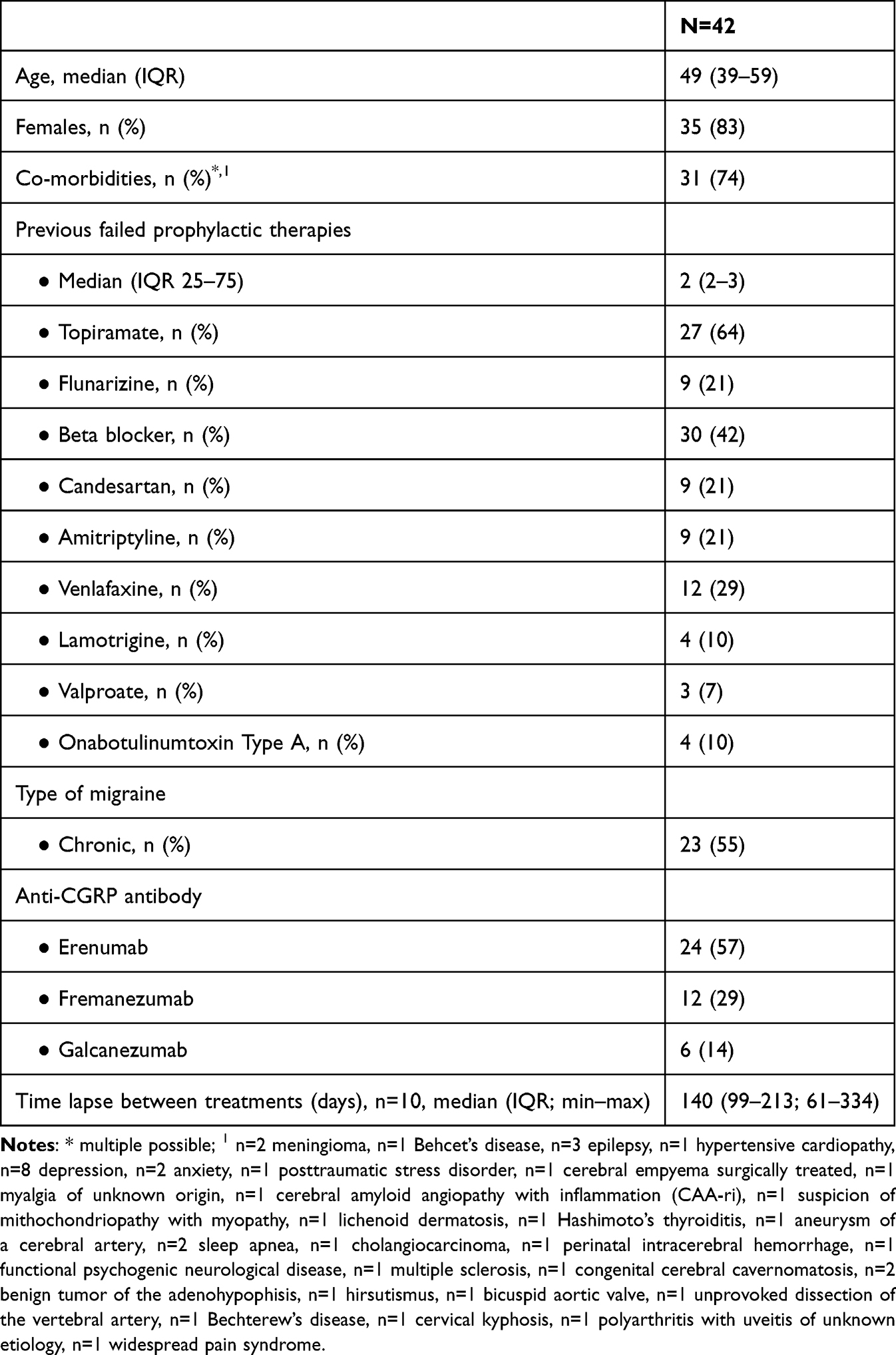 |
Table 1 Baseline Characteristics, Co-Morbidities and Previous Prophylactic Treatments |
Results
Forty-two patients treated from May 2019 to August 2021 were identified, fulfilled the inclusion criteria, and were included in the analysis. The median age was 49 years (IQR 39–59) and 35/42 (83%) were women. Patients had failed a median of 2 preventive therapies (IQR 2–3), most commonly topiramate (27/42, 64%), beta‑blockers (30/42, 42%) and venlafaxine (12/42, 29%). Chronic migraine was present in 23/42 (55%). The anti‑CGRP mAb used was erenumab in 24/42 (57%), fremanezumab in 12/42 (29%) and galcanezumab in 6/42 (14%). Pause duration data were available for 10 patients (mean 161.6 days [SD 87.2]; median 140 days [IQR 99–213]; range 61–334). Baseline characteristics are summarized in Table 1.
The mean number of monthly migraine days (MMD) at Baseline 1 was 13.6 days (SD 7.1). At Baseline 2 (immediately before reinitiating CGRP-mAb), mean MMD was 10.7 days (SD 6.8).
Month-by-month results are shown in Table 2. In year 1, mean MMD decreased from 13.6 (SD 7.1) at Baseline 1 to 7.7 (SD 6.9) at month 1 and remained between 4.4 and 6.8 days across months 2–12. Model‑based reductions from Baseline 1 were statistically significant at each month, ranging from 5.92 to 8.54 days. In year 2, mean MMD decreased from 10.7 (SD 6.8) at restart (Baseline 2) to 6.1 (SD 5.4) at month 1 and remained between 4.7 and 6.4 days across months 2–12; model‑based reductions ranged from 7.15 to 10.65 days. The estimated difference in reduction between year 2 and year 1 was not statistically significant at any month (range −0.34 to 2.08 days; all p≥0.07).
 |
Table 2 Mean Reduction of Monthly Migraine Days (MMD) for Years 1 and 2, According to Our Model |
Overall, the reduction in MMD during the second year of treatment was comparable to the first year (Table 2 and Figure 1; raw model coefficients with 95% CI are provided in Supplemental Table S1).
 |
Figure 1 Change in monthly migraine days (MMD) over months 1–12 in treatment year 1 and treatment year 2. Reductions are expressed as absolute change in number of days compared with Baseline 1; error bars indicate 95% confidence intervals from the mixed-effects model. |
The mean time for achieving a 50% reduction in MMD was 2.2 months (SD: 2.35 months) in the first year and 1.84 months (SD: 1.59 months) in the second year (P=0.41).
Discussion
Our study aimed to evaluate the effectiveness of CGRP-mAb treatment in the second year compared to the first year by analyzing the reduction in MMD and the time to achieve a 50% reduction in MMD. The main findings of our study are 1) the mean reduction in MMD was similar in the second year compared to the first year, 2) the time taken to achieve a 50% reduction in MMD was similar in both treatment years.
In this exploratory cohort, we did not observe evidence of a reduced or delayed response after restarting CGRP-mAbs. Instead, the overall effectiveness appeared similar across both treatment years. We did not find evidence suggestive of disease modification after the first treatment year; however, the study was not designed to directly measure disease modification, Given the retrospective design and the limited sample size, these findings should be interpreted as associations rather than implying causality.
Our results align with previous real-world prospective studies, which have shown that the effectiveness of CGRP-mAbs persist in patients reinitiated after their discontinuation. Vernieri et al conducted a multicenter prospective observational cohort study with 226 patients and concluded that CGRP-mAbs are as effective in the second year as in the first year.18 The SQUARE study examined 172 patients after restarting erenumab, with an average interruption duration of 4 months, and concluded that treatment interruption leads to a temporary worsening of migraine symptoms, which improve again once therapy is resumed.19 Similarly, Raffaelli et al included 39 patients who had a three-month pause after one year of therapy and found that the improvement three months after treatment resumption was similar to the response during the initial treatment period.14
Recent longer-term evidence (2–3 years) supports sustained effectiveness of anti-CGRP monoclonal antibodies in routine care and extension settings, but also shows that relapse can occur during discontinuation and that results depend on selection and treatment policies. In the prospective, multicenter I-GRAINE registry, three consecutive 12-month treatment cycles were associated with progressive improvement and higher responder rates during the first month after each discontinuation period.20 Similarly, an intention-to-treat real-world analysis across three consecutive one-year cycles reported consistent reductions in monthly migraine days.21 In clinical trial extensions, erenumab demonstrated sustained efficacy over 2 years in the LIBERTY open-label extension and over 3 years of exposure in a subsequent LIBERTY report.22,23 Additional long term datasets further support durability of treatment effects: in the 128‑week APOLLON open‑label study of erenumab, monthly migraine/headache days worsened during a planned drug holiday and improved rapidly after treatment resumption, highlighting reversibility after interruption.24 These data provide important context for interpreting our findings and underscore the need for adequately powered prospective studies that can address carry-over and potential disease-course effects.
The strength of our study is that we quantified effectiveness by comparing changes in MMD as well as the time to achieve a 50% reduction in MMD across CGRP-mAbs.
Key limitations are the small sample size, retrospective design, and potential selection bias toward responders in the second year of treatment. In addition, we did not have granular pharmacy refill-level adherence data, and we could not adjust the primary model for all potential confounders (eg, chronic vs episodic status, prior preventives, CGRP-mAb type, or pause duration) because of limited sample size and incomplete availability of some variables. Pause duration could not be included as a covariate because it was available only for a subset of patients (n=10). In addition, because pause duration and relapse timing varied and pause duration was available only for a small subset, a robust Baseline‑2 sensitivity analysis could not be performed and residual carry‑over (particularly in pauses <150 days) cannot be excluded.
Conclusion
In conclusion, in this retrospective exploratory cohort, restarting anti-CGRP mAb therapy after an insurer-mandated pause was associated with similar response rates and time to response compared with the first treatment year; larger prospective studies are needed to better address potential disease-modifying effects and confounding factors.
Data Sharing Statement
De-identified data and code are available from the corresponding author (C.J. Schankin) upon reasonable request, subject to institutional and ethical policies.
Ethics Approval and Informed Consent
The study was approved by the Canton of Bern Ethics Committee (KEK 2021-01628) and was conducted in accordance with the Declaration of Helsinki; participants provided general consent per registry procedures. The manuscript is original, not under consideration elsewhere, and all authors approve its submission.
Consent for Publication
Not applicable. This study reports only anonymized, aggregate data from the Bernese Headache Registry; no individual person’s data (including images or videos) are included.
Funding
AS received research support from the International Headache Society, Gottfried&Julia Bangerter Rhyner Foundation, Swiss Heart Foundation and TEVA.
Disclosure
Franz Riederer reports personal fees from Teva, grants from Lundbeck, personal fees from Abbvie, during the conduct of the study. Christoph Schankin reports institutional grants from AbbVie, Pfizer, and Grünenthal; grants from Lundbeck and Teva; and grants from the Eye on Vision Foundation, the Visual Snow Initiative, and Visual Snow Syndrome Germany e.V. He is a part-time employee of Zynnon and Cefalognos. These relationships are outside the submitted work. The authors declare no competing interests.
References
1. Durham PL. Calcitonin gene-related peptide (CGRP) and migraine. Headache. 2006;46(Suppl s1):S3–7. doi:10.1111/j.1526-4610.2006.00483.x
2. Reuter U, Ehrlich M, Gendolla A, et al. Erenumab versus topiramate for the prevention of migraine – a randomised, double-blind, active-controlled Phase 4 trial. Cephalalgia Int J Headache. 2022;42(2):108–118. doi:10.1177/03331024211053571
3. Ducros A, de Gaalon S, Roos C, et al. Revised guidelines of the French headache society for the diagnosis and management of migraine in adults. Part 2: pharmacological treatment. Rev Neurol. 2021;177(7):734–752. doi:10.1016/j.neurol.2021.07.006
4. Diener HC, Förderreuther S, Gaul C, et al. Prevention of migraine with monoclonal antibodies against CGRP or the CGRP receptor: addition to the S1 guideline: therapy of migraine attacks and prevention of migraine. Recommendations of the Germany Society of Neurology and the German Migraine and Headache Society. Neurol Res Pract. 2020;2:11.
5. Schytz HW, Amin FM, Jensen RH, et al. Reference programme: diagnosis and treatment of headache disorders and facial pain. Danish Headache Society, 3rd edition, 2020. J Headache Pain. 2021;22(1):22. doi:10.1186/s10194-021-01228-4
6. Domitrz I, Kozubski W, Rożniecki JJ, Stępień A, Boczarska-Jedynak M. The Polish Headache Society and the Headache Section of the Polish Neurological Society Consensus Statement: update on new pharmacological therapies for migraine in clinical practice and public medication reimbursement program for chronic migraine. Arch Med Sci AMS. 2022;18(6):1705–1707. doi:10.5114/aoms/153955
7. Ailani J, Burch RC, Robbins MS. Board of Directors of the American Headache Society. The American Headache Society Consensus Statement: update on integrating new migraine treatments into clinical practice. Headache. 2021;61(7):1021–1039. doi:10.1111/head.14153
8. Alsaadi T, Kayed DM, Al-Madani A, et al. Consensus-based recommendations on the use of CGRP-based therapies for migraine prevention in the UAE. Neurol Ther. 2023;12(6):1845–1865. doi:10.1007/s40120-023-00550-0
9. Raffaelli B, Mussetto V, Israel H, Neeb L, Reuter U. Erenumab and galcanezumab in chronic migraine prevention: effects after treatment termination. J Headache Pain. 2019;20(1):66. doi:10.1186/s10194-019-1018-8
10. Gantenbein AR, Agosti R, Gobbi C, et al. Impact on monthly migraine days of discontinuing anti-CGRP antibodies after one year of treatment – a real-life cohort study. Cephalalgia Int J Headache. 2021;41(11–12):1181–1186. doi:10.1177/03331024211014616
11. Iannone LF, Fattori D, Benemei S, Chiarugi A, Geppetti P, De Cesaris F. Predictors of sustained response and effects of the discontinuation of anti-calcitonin gene related peptide antibodies and reinitiation in resistant chronic migraine. Eur J Neurol. 2022;29(5):1505–1513. doi:10.1111/ene.15260
12. Raffaelli B, Terhart M, Overeem LH, et al. Migraine evolution after the cessation of CGRP(-receptor) antibody prophylaxis: a prospective, longitudinal cohort study. Cephalalgia Int J Headache. 2022;42(4–5):326–334. doi:10.1177/03331024211046617
13. Nsaka M, Scheffler A, Wurthmann S, et al. Real-world evidence following a mandatory treatment break after a 1-year prophylactic treatment with calcitonin gene-related peptide (pathway) monoclonal antibodies. Brain Behav. 2022;12(7):e2662. doi:10.1002/brb3.2662
14. Raffaelli B, Terhart M, Mecklenburg J, et al. Resumption of migraine preventive treatment with CGRP(-receptor) antibodies after a 3-month drug holiday: a real-world experience. J Headache Pain. 2022;23(1):40. doi:10.1186/s10194-022-01417-9
15. Sacco S, Amin FM, Ashina M, et al. European Headache Federation guideline on the use of monoclonal antibodies targeting the calcitonin gene related peptide pathway for migraine prevention – 2022 update. J Headache Pain. 2022;23(1):67. doi:10.1186/s10194-022-01431-x
16. Ornello R, Caponnetto V, Ahmed F, et al. Evidence-based guidelines for the pharmacological treatment of migraine, summary version. Cephalalgia Int J Headache. 2025;45(4):3331024251321500. doi:10.1177/03331024251321500
17. Nicol KS, Burkett JG. Review: an update on CGRP monoclonal antibodies for the preventive treatment of episodic migraine. Curr Pain Headache Rep. 2025;29(1):55. doi:10.1007/s11916-025-01365-4
18. Vernieri F, Brunelli N, Guerzoni S, et al. Retreating migraine patients in the second year with monoclonal antibodies anti-CGRP pathway: the multicenter prospective cohort RE-DO study. J Neurol. 2023;270(11):5436–5448. doi:10.1007/s00415-023-11872-2
19. Gantenbein AR, Bonvin C, Kamm CP, et al. Implications of therapy interruption on monthly migraine days and modified migraine disability assessment in patients treated with erenumab for chronic and episodic migraine: SQUARE study interim results. J Neurol. 2024;271(8):5402–5410. doi:10.1007/s00415-024-12470-6
20. Barbanti P, Aurilia C, Torelli P, et al. Three-year treatment with anti-CGRP monoclonal antibodies modifies migraine course: the prospective, multicenter I-GRAINE study. J Neurol. 2025;272(2):170. doi:10.1007/s00415-025-12911-w
21. Vaghi G, Corrado M, Pocora MM, et al. Real world effectiveness of anti-CGRP monoclonal antibodies over three consecutive one-year treatment cycles: an intention-to-treat analysis. Cephalalgia Int J Headache. 2025;45(8):3331024251353421. doi:10.1177/03331024251353421
22. Ferrari MD, Reuter U, Goadsby PJ, et al. Two-year efficacy and safety of erenumab in participants with episodic migraine and 2–4 prior preventive treatment failures: results from the LIBERTY study. J Neurol Neurosurg Psychiatry. 2022;93(3):254–262. doi:10.1136/jnnp-2021-327480
23. Reuter U, Goadsby PJ, Ferrari MD, et al. Efficacy and safety of erenumab in participants with episodic migraine in whom 2–4 prior preventive treatments had failed. Neurology. 2024;102(10):e209349. doi:10.1212/WNL.0000000000209349
24. Göbel H, Schlegel E, Jaeger K, Ortler S, Leist L. Assessment of prolonged safety and tolerability of erenumab in migraine patients in a long-term open-label study (APOLLON). J Headache Pain. 2024;25(1):157. doi:10.1186/s10194-024-01860-w
 © 2026 The Author(s). This work is published and licensed by Dove Medical Press Limited. The
full terms of this license are available at https://www.dovepress.com/terms
and incorporate the Creative Commons Attribution
- Non Commercial (unported, 4.0) License.
By accessing the work you hereby accept the Terms. Non-commercial uses of the work are permitted
without any further permission from Dove Medical Press Limited, provided the work is properly
attributed. For permission for commercial use of this work, please see paragraphs 4.2 and 5 of our Terms.
© 2026 The Author(s). This work is published and licensed by Dove Medical Press Limited. The
full terms of this license are available at https://www.dovepress.com/terms
and incorporate the Creative Commons Attribution
- Non Commercial (unported, 4.0) License.
By accessing the work you hereby accept the Terms. Non-commercial uses of the work are permitted
without any further permission from Dove Medical Press Limited, provided the work is properly
attributed. For permission for commercial use of this work, please see paragraphs 4.2 and 5 of our Terms.
Recommended articles

Health Technology Assessment: Evaluation of 8 CGRP-Targeted Therapy Drugs for the Treatment of Migraine
Li M, Huang S, Li J, Hu X, Chen J
Drug Design, Development and Therapy 2025, 19:1231-1247
Published Date: 19 February 2025