
Back to Journals » Patient Preference and Adherence » Volume 20
The Effect of Medical Robot Information Transfer on Information Adherence of Cancer Patients: Evidence from a Scenario Experiment

Received 14 February 2025
Accepted for publication 28 June 2025
Published 15 May 2026 Volume 2026:20 522694
DOI https://doi.org/10.2147/PPA.S522694
Checked for plagiarism Yes
Review by Single anonymous peer review
Peer reviewer comments 2
Editor who approved publication: Dr Johnny Chen
Fuqiang Tan,1 Dajun Yang,2,3 Gui Gui2,4
1Research Institute of Culture and Health Behavior, Huainan, People’s Republic of China; 2Key Laboratory of Digital-Intelligent Disease Surveillance and Health Governance, Nanchong, People’s Republic of China; 3School of Management, North Sichuan Medical College, Nanchong, People’s Republic of China; 4School of Clinical Medicine, North Sichuan Medical College, Nanchong, People’s Republic of China
Correspondence: Dajun Yang, Email [email protected]
Purpose: Previous studies have explored the impact of medical robots on patient care, but few studies have looked at the impact of information delivery by medical robots on patient information compliance.
Patients and Methods: In this study, 290 subjects were recruited on a professional data collection platform from November 21 to December 10, 2024 to conduct scenario experiments to explore the effect of medical robot information transmission on cancer patients’ information compliance and its mechanism.
Results: The experimental results show that medical robot information transmission has a significant impact on patient information compliance. Among them, patients’ preference for emotional information transmission by medical robots was higher than that for professional information transmission. At the same time, we found that information processing fluency and perceived psychological stress have a chain mediating effect on medical robot and patient information compliance.
Conclusion: This study further expands the extension of information processing theory, strengthens the role of emotional factors and cognitive factors in human-computer interaction, and provides a new program for effective clinical nursing.
Keywords: medical robot, information transfer, information processing fluency, perceived psychological stress, information adherence
Introduction
As Dupont, Nelson, Goldfarb, Hannaford, Menciassi, O’Malley, Simaan, Valdastri and Yang1 mentioned, the integration of information technology with healthcare has undergone revolutionary changes over the past decade, particularly with the emergence of medical robots. These robots, with their precision, reliability, and ability to handle repetitive tasks, have been widely applied in various medical environments, such as surgical procedures, rehabilitation, and patient care.2 For instance, Soto, Wang, Ahmed and Demirci3 explored the vast potential of nanorobots in precision medicine. In recent years, as the healthcare sector has shifted towards a more patient-centered direction, the role of medical robots in facilitating effective information transfer has become crucial, especially in caring for cancer patients.4 Cancer, being a leading cause of incidence and mortality worldwide, requires comprehensive care that encompasses not only medical treatment but also effective communication of information.5 Oncology patients often need to process a vast amount of information regarding diagnosis, treatment options, potential side effects, and lifestyle adjustments. This information overload, coupled with the psychological burden of a cancer diagnosis, can lead to psychological stress in patients, affecting their ability to comply with medical advice. Therefore, how to enhance patients’ acceptance of information while reducing their psychological stress has become a challenge. However, medical robots equipped with advanced artificial intelligence and machine learning algorithms have the potential to provide information in a way that is both easily understandable and emotionally supportive, thus addressing these challenges.6 They can offer consistent, tailored communication without the variability inherent in human interactions, making them an important tool for improving patient adherence with medical information. Despite the plausible suspicion of a close relationship between medical robots’ information transfer and oncology patients’ information adherence, it is interesting that scholars in the field of patient care and human-robot interaction have seldom provided targeted evidence to argue this point.
Patient information adherence refers to the consistency with which patients follow the advice provided by healthcare providers, including medication, diet, and lifestyle adjustments. It is certain that there is an extensive body of literature on patient information adherence, which has propelled patient adherence behavior to become a research focus and trend in the field of patient care. Although previous studies have focused on the impact of robots on patient care, for instance, a study by Beran, Ramirez-Serrano, Vanderkooi and Kuhn7 discussed how humanoid robots can serve as a medium in pediatric care, enhancing children’s health recovery rates. However, there remains a significant gap regarding whether medical robot information transfer can become an augmentative tool for nursing outcomes. A study found that medical robot companions have a therapeutic effect on patients’ pain and anxiety.8 Yet, the relationship between medical robot information transfer and oncology patients’ information adherence has not received adequate attention, and its theoretical value has not been fully recognized. This neglect is regrettable because medical robots, through precise and consistent professional information transfer, can help patients better understand complex medical information, thereby improving their adherence with treatment. Moreover, these robots can also alleviate the psychological pressure caused by information overload during treatment through the conveyance of emotional information, promoting more active treatment participation. However, based on current literature surveys, the mechanisms and boundary conditions of the impact of medical robot information transfer on oncology patients’ information adherence are still unclear. Therefore, this study attempts to answer: Does medical robot information transfer have a positive effect on oncology patients’ information adherence? What is the internal mechanism between medical robot information transfer and oncology patients’ information adherence?
To address the shortcomings of the aforementioned research, this study conducted a scenario experiment. We constructed two experimental scenarios where medical robots remind oncology patients to take their medication on time and recruited 290 participants for the scenario experiment. Specifically, guided by information processing theory, we emphasized that medical robots, through precise language and image communication, can reduce the complexity of information, enhance the fluency of information processing, decrease psychological stress, and reduce the additional allocation of cognitive resources, thereby making it easier for oncology patients to understand treatment plans and health advice. Based on this, first, we discussed the impact of medical robot information transfer on oncology patients’ information adherence; second, from the perspective of oncology patients’ information processing, we proposed the mediating role of patients’ information processing fluency between medical robot information transfer and oncology patients’ information adherence. Then, from the perspective of oncology patients’ cognitive load, we proposed the mediating role of perceived psychological stress between medical robot information transfer and oncology patients’ information adherence. Finally, we discussed the serial mediating roles of information processing fluency and perceived psychological stress.
This study makes the following significant contributions to patient care and human-robot interaction. Firstly, this study introduces the Information Processing Theory into the interaction between medical robots and oncology patients, specifically exploring the role of information processing fluency in patient adherence. This not only enriches the application scope of the Information Processing Theory but also provides a theoretical foundation for its further development in digital healthcare and smart device interaction. Secondly, we delve into how patients’ smoother processing of information conveyed by medical robots enhances their understanding and adherence to treatment plans. This finding deepens the understanding of the information processing process, further illustrating how fluency affects patients’ decision-making processes and behavioral responses, and promotes the application development of the Information Processing Theory in medical contexts. Lastly, by introducing the dimension of perceived psychological stress, we offer a novel cognitive load model, revealing how psychological stress, under high-pressure environments, interferes with information processing by affecting the allocation of cognitive resources, thereby influencing patient adherence. This model provides a new perspective for further understanding how psychological burden interferes with information processing. Practically, this study also offers insights for developers of medical robots in creating service-oriented medical devices that better meet the real-world needs of patients.
Literature Review and Theoretical Derivation
Medical Robot Information Transfer and Patient Information Adherence
This study conceptualizes a medical robot as an intelligent device that leverages artificial intelligence (AI) technology within healthcare settings to deliver both professional information and emotional support to patients, thereby enhancing information processing fluency, alleviating psychological stress, and promoting information adherence. The application of medical robots in healthcare is expanding, showing potential in areas like information transfer and patient education.9,10 Robots can deliver complex medical information accurately and potentially in personalized ways,11 which may improve patient understanding and reduce communication misunderstandings.12 Information conveyed in healthcare settings can be broadly categorized into professional (knowledge-based) and emotional (support-based). Professional information enhances informed decision-making,13 while emotional information alleviates stress and builds confidence,14 both contributing to treatment adherence.
However, much existing research on medical robots focuses on technical capabilities rather than the content of the information delivered. Specifically, there is limited research comparing how different types of information (eg, emotional vs. professional) delivered by robots impact patient adherence, particularly among vulnerable groups like oncology patients who face significant information needs and psychological stress.15 Both emotional support and clear professional guidance are known to influence adherence in this population.16–18 Yet, how medical robots can effectively deliver these information types and their overall impact on adherence remains an area needing investigation. Therefore, building on the established link between information provision and adherence, we posit that robot-delivered information can positively influence this outcomes.
Based on the above analysis, this study proposes the following hypotheses:
H1: Medical robot information transfer has a positive impact on oncology patients’ information adherence.
The Mediating Role of Information Processing Fluency
Information processing fluency is the subjective ease of processing information, which affects information acceptance and trust.19 In healthcare, higher fluency aids understanding and decision-making, especially when information is complex.20,21 For oncology patients dealing with intricate medical details, fluency is crucial. Medical robots, through design features like simplified language, visual aids, or multimodal presentation,22,23 have the potential to enhance the processing fluency of the information they deliver. By reducing cognitive burden, increased fluency should make patients more receptive to the information and thus more likely to adhere to related recommendations. This suggests fluency could be a key mechanism linking robot information transfer to adherence.
Based on the above analysis, this study proposes the following hypotheses:
H2: Information processing fluency mediates the relationship between medical robot information transfer and oncology patients’ information adherence.
The Mediating Role of Perceived Psychological Stress
Oncology patients often experience high perceived psychological stress due to the disease, treatment complexity, and uncertainty, which negatively impacts emotional states, cognitive function, and treatment adherence.24,25 Effectively managing this stress is vital. Medical robots may offer a novel approach by providing not only information but also elements of psychosocial support through interaction.26 Gentle speech, simulated empathy, and continuous monitoring could potentially reduce patient anxiety and tension. According to stress theories, perceived stress depends on cognitive appraisal of the situation and available coping resources.27 By delivering clear information (reducing uncertainty) and simulated emotional support (bolstering coping resources), medical robots might lower patients’ perceived psychological stress.28 Reduced stress, in turn, facilitates better engagement with treatment. Thus, stress reduction may be another pathway through which robot information impacts adherence.
Based on the above analysis, this study proposes the following hypotheses:
H3: Perceived psychological stress mediates the relationship between medical robot information transfer and oncology patients’ information adherence.
The Serial Mediating Role of Information Processing Fluency and Perceived Psychological Stress
Building upon the previous points, we propose a sequential pathway. Effective information transfer by medical robots could first enhance information processing fluency (H2). When information is easier to process, the cognitive load and associated anxiety decrease (linking fluency to stress). This reduced cognitive strain contributes to lower overall perceived psychological stress (H3). Consequently, patients experiencing lower stress and finding information easier to manage are more likely to adhere to the guidance provided. This suggests a serial mediation where robot information transfer improves adherence by first enhancing fluency, which in turn reduces perceived psychological stress.
Based on the above analysis, this study proposes the following hypotheses:
H4: Information processing fluency and perceived psychological stress serially mediate the relationship between medical robot information transfer and oncology patients’ information adherence.
Methods
Scenario Experiment Method
Scenario experimentation involves simulating or creating specific situations to study the behavior of individuals or groups within these contexts.29 Beyond its role in enhancing the external validity of research, providing in-depth insights, and fostering theoretical development, scenario experimentation has a distinct advantage in assessing the effectiveness of various interventions or strategies in real-world settings. Consequently, scenario experimentation has been widely applied across multiple fields such as psychology, marketing, and organizational behavior. For instance, in a study by Liang, Yang, Tan, Sun and Li,30 the construction of a scenario to enhance the psychological ownership of nutritional products was found to increase consumers’ willingness to purchase. However, in existing research, the application of scenario experimentation in the field of medical robotics is rare. This neglect is regrettable, as by simulating interactions between medical robots and patients, developers can modify programs to more effectively convey information, explain treatment plans, and manage patients’ emotional responses. Therefore, this study, based on scenario development, creates a scenario for medical robots to remind oncology patients to take their medication on time, verifying the impact of medical robot information transfer (professional information Vs. emotional support) on oncology patients’ information adherence.
Participants
We utilized the professional online data collection platform, Credamo (https://www.credamo.com), to design the questionnaire and recruit participants. Referring to the study of Kang,31 G*Power software (3.1.9.7) was used in this study to conduct power analysis and calculate the minimum sample size. We set the effect size to 0.15, α to 0.05, and 1-β to 0.95, with a minimum sample size of 238 individuals. A total of 300 participants were initially recruited via online random sampling from the platform’s user pool.
The inclusion criteria stipulated that participants must: 1) be concerned about the possibility of having cancer; 2) be worried about the impact of cancer on their health; 3) be 18 years of age or older; and 4) explicitly understand and consent to the study ethics and informed consent before completing the questionnaire.
Following data collection, 10 participants were excluded due to exhibiting strong consistency in their questionnaire responses or failing an attention check, resulting in a final sample of 290 participants. Among the final sample, 142 participants were male (49.0%), and 148 were female (51.0%). In terms of age distribution, there were 90 participants aged 18–25 (31.0%), 88 participants aged 26–40 (30.3%), 58 participants aged 41–60 (20.0%), and 54 participants aged 61 and above (18.6%). Specific demographic details are provided in Table 1.
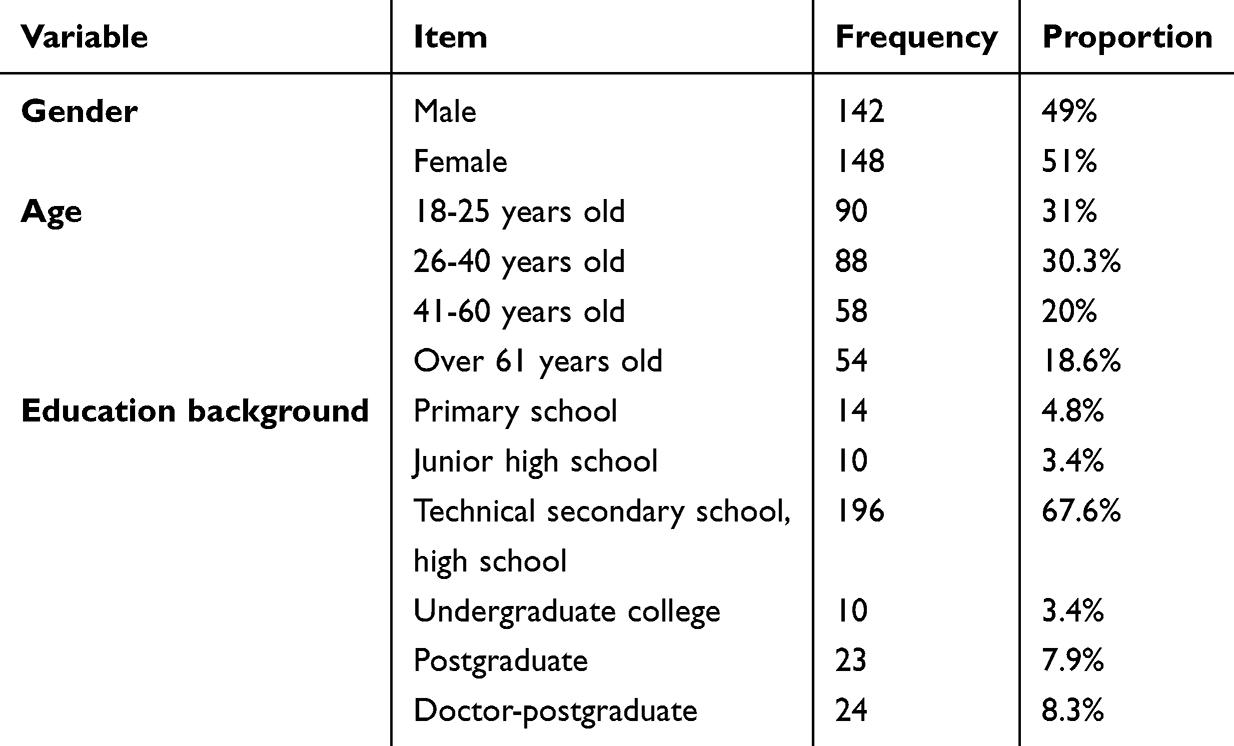 |
Table 1 Demographic Information of the Subjects |
Scenario Design
To test the aforementioned four hypotheses, we conducted a single-factor (information transfer: professional information Vs. emotional information) variance experiment, aimed at verifying the impact of medical robot information transfer on oncology patients’ information adherence and its underlying mechanisms. All participants were divided into two groups: the professional information group (144 participants) and the emotional information group (146 participants). In the professional information group, the subjects scanned the professional information replies of the medical robot. However, in the emotional information group, subjects browsed the emotional information responses.
Experimental Procedure
Referring to the study by Morse, Bottorff, Anderson, O’Brien and Solberg,32 which explored the relationship between nurses’ professional and emotional responses to patient reactions, we first instructed all participants to imagine themselves as oncology patients suffering daily from the disease, having endured significant physical and psychological damage, and currently undergoing treatment at a hospital. In the professional information group, they saw an intelligent medical robot approach from the corner of the ward, reminding them:
Dear patient, greetings. I am your intelligent healthcare assistant, dedicated to providing precise services for your health management. According to your treatment plan for today, you are required to take the following medication within the next few hours: Medication name: Amoxicillin capsules, Dosage: 1000 milligrams each time, Time to take: Please take it within 30 minutes after meals to reduce gastric discomfort, Precautions: Ensure you have eaten before taking to avoid stomach upset. If you have a history of allergy to penicillin drugs, please contact your doctor immediately. Rest assured, my design ensures the accuracy and reliability of the information
However, in the emotional information group, at this moment, the intelligent medical robot approaches from the corner of the ward and reminds you:
In this special moment, I am your intelligent healthcare companion, here by your side, providing you with the warmest health management services. Today, according to your carefully designed treatment plan, the medication you are about to take is: Medication name: Amoxicillin capsules, Dosage: 1000 milligrams each time, Time to take: It is recommended that you take it within 30 minutes after enjoying a delicious meal, in the most comfortable way, to alleviate any discomfort in your stomach. Before you prepare to take your medication, I would like to remind you that if you have ever had an allergic reaction to penicillin drugs, please inform us immediately, as your safety is our utmost concern. I understand that the process of treatment may sometimes make you feel uncomfortable or anxious. But please believe that every persistence and effort is an important step on the road to recovery. I will be here, with my professional knowledge and meticulous care, to ensure that your treatment process is as comfortable and reassuring as possible.
For specific supplementary materials, please refer to Supplementary Material S1. Subsequently, participants were required to answer measurement questions regarding information processing fluency, perceived psychological stress, and information adherence. Finally, we collected demographic information related to the participants.
Research Instruments
To validate the focal hypotheses of this study, in addition to collecting demographic information such as gender and age of the research participants, we measured the participants’ information processing fluency, perceived psychological stress, and information adherence using a 7-point Likert scale (1=Strongly Disagree, 7=Strongly Agree). Specifically, the measurement questions for information processing fluency were adapted from Yan33 research, for example: “Do you agree that seeing the information conveyed by the robot gives you a sense of correctness?” The measurement questions for perceived psychological stress were adapted from Cohen, Kamarck and Mermelstein34 research scale, for example: “Do you agree that when unexpected events occur, you feel agitated?” The measurement questions for information adherence were adapted from Laugesen, Hassanein and Yuan35 research scale, for example: “Do you agree that you would fully follow the medical robot’s advice?”
In light of the findings by Martin, Williams, Haskard and DiMatteo,36 patient emotions are a significant factor influencing patients’ information adherence. This is primarily because when individuals are in a negative emotional state, their cognitive resources may be occupied by emotional processing, thereby affecting their comprehension and memory of medical information. Therefore, we controlled for patient emotions by asking participants: “Do you agree that your current emotions are positively valenced (happy, joyful, relaxed, pleasant)?” (1=Strongly Disagree, 7=Strongly Agree).37 Finally, we collected demographic information related to the participants. The research scale and measurement items are detailed in Table 2.
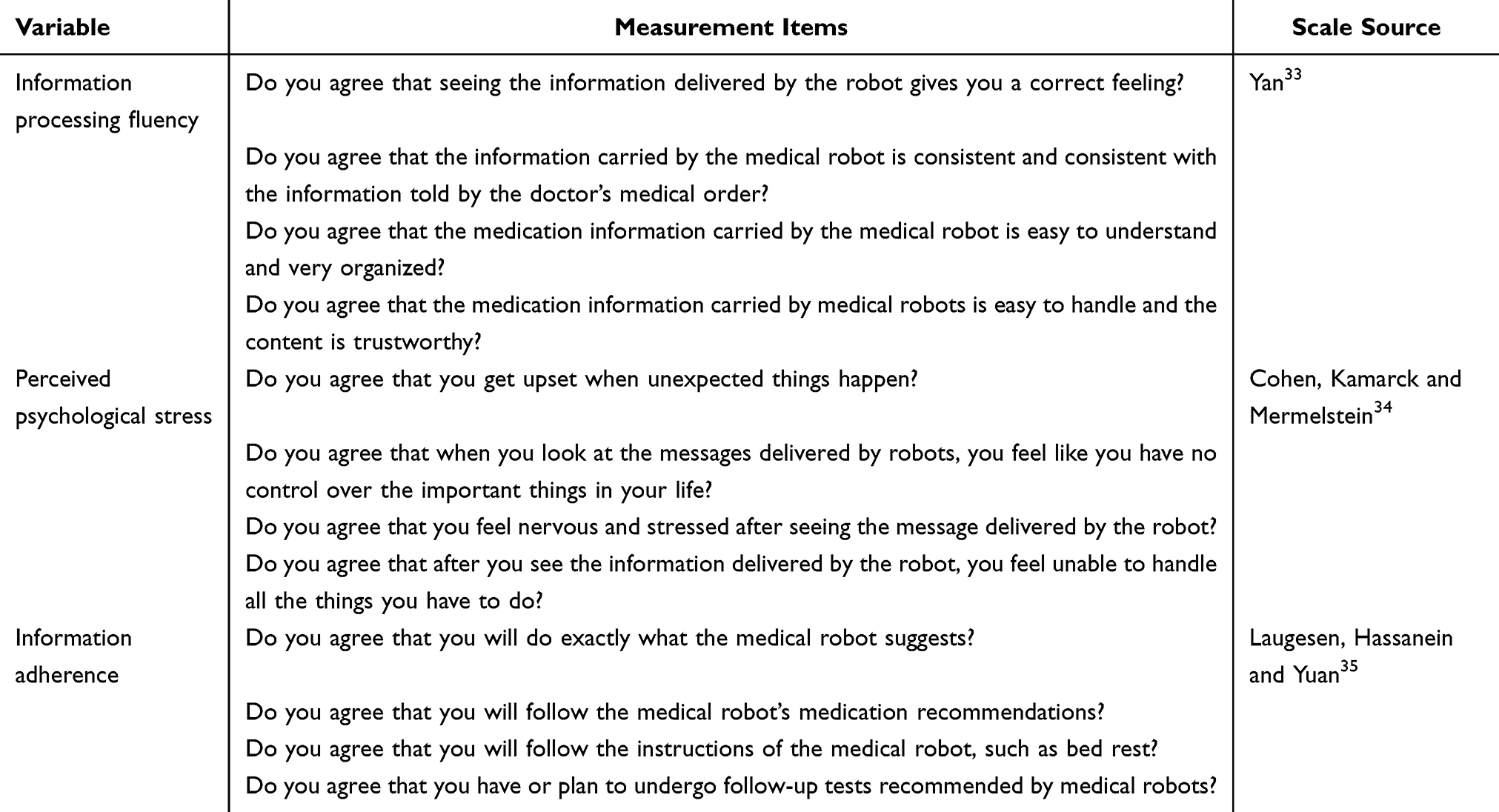 |
Table 2 Specific Measurement Items for Each Variable |
Statistical Analysis
All statistical analyses were performed using SPSS version (27.0). A p-value less than 0.05 was considered statistically significant.
First, descriptive statistics (frequencies, percentages, means, and standard deviations) were calculated to summarize the demographic characteristics of the participants and the main study variables.
Second, to test the main hypothesis H1, which proposed an impact of medical robot information transfer type on information adherence, a one-way Analysis of Variance (ANOVA) was conducted to examine the effect of information transfer type (professional vs. emotional) on oncology patients’ information adherence scores.
Third, to test the mediating roles of information processing fluency (H2) and perceived psychological stress (H3), as well as the serial mediating effect (H4), we utilized the PROCESS macro (Model 6 for serial mediation) for SPSS developed by Hayes.38 Bootstrapping analysis with 5000 resamples was employed to generate 95% bias-corrected confidence intervals (CIs) for the direct and indirect effects. If the confidence interval for an indirect effect did not include zero, the mediating effect was considered statistically significant. The analysis controlled for patient emotions, as specified in Control Variable Analysis.
Results
Normal Test
This study used skewness and kurtosis to assess the normality of the study, as shown in Table 3. According to the normality test standard proposed by Kline:39 the absolute value of skewness coefficient is less than 3, and the absolute value of kurtosis coefficient is less than 8, then the sample data is considered to meet the requirements of approximate normal distribution. We found that the absolute values of the kurtosis and skewness measures for each variable in this study followed a normal distribution.
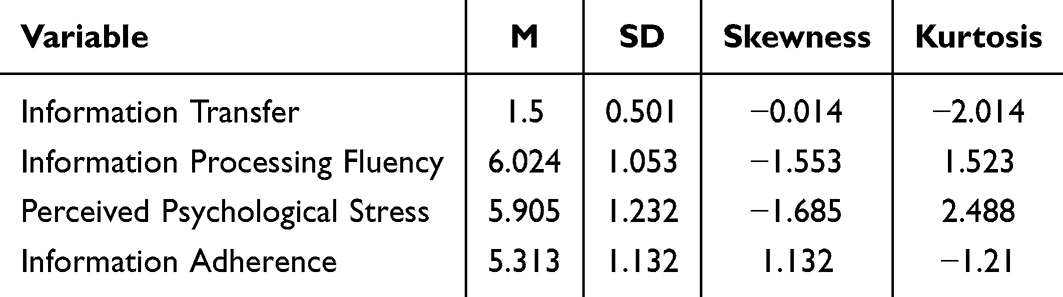 |
Table 3 Skewness and Kurtosis of Each Variable |
Manipulation Check
Referring to the study by Ladouceur, Gosselin and Dugas,40 we employed an independent samples T-test to verify that the manipulation method used in this study is scientifically valid. We used the information transfer method of the medical robot (professional information Vs. emotional information) as the grouping variable and the information adherence of oncology patients as the variable for testing. The results indicated that compared to professional information (M=4.483, SD=0.528), oncology patients had a stronger preference for emotional information (M=6.131, SD=0.96), t=18.08, P<0.001. Therefore, our manipulation is effective and feasible.
Main Effect Test
We utilized the information transfer by medical robots as the independent variable and the information adherence of oncology patients as the dependent variable, conducting a one-way analysis of variance. The experimental results indicated that the information adherence of oncology patients under the emotional information transfer by medical robots (M = 6.131, SD = 0.96) was significantly higher than that under the professional information transfer (M = 4.483, SD = 0.528), F (1, 288) = 326.877, P < 0.001. It can be inferred that the emotional information transfer by medical robots has a significant effect on the information adherence of oncology patients, thus confirming Hypothesis H1.
Control Variable Analysis
In light of Martin, Williams, Haskard and DiMatteo36 research findings, patient emotions are an important factor influencing patients’ information adherence. Therefore, we controlled for patient emotions as a covariate. Based on the analysis of covariance, between the two groups of medical robot information transfer, emotion had no significant impact on the information adherence of oncology patients (F(1288)=4.853, P=0.028). Consequently, patient emotions did not influence the experimental outcomes, and by excluding the control variable, Hypothesis H1 was confirmed once again.
Mediation Effect Analysis of Information Processing Fluency
We utilized information processing fluency as the mediating variable, the information transfer by medical robots as the independent variable, and the information adherence of oncology patients as the dependent variable. Employing Process Model 4, we analyzed the mediating relationship of information processing fluency between the information transfer by medical robots and the information adherence of oncology patients (Bootstrap sample: 5000; Igartua and Hayes.41 The experimental results indicated that the information transfer by medical robots significantly affected the information adherence of oncology patients (β=1.543, P<0.001); information processing fluency significantly affected the information adherence of oncology patients (β=0.3684, P<0.001); and the information transfer by medical robots significantly affected information processing fluency (β=0.2859, P=0.02). Overall, the mediating effect of information processing fluency between the information transfer by medical robots and the information adherence of oncology patients was significant (β=0.1053, SE=0.04, 95% CI=[0.019,0.181]). Therefore, information processing fluency fully mediates the relationship between the information transfer by medical robots and the information adherence of oncology patients, thus confirming Hypothesis H2.
Mediation Effect Analysis of Perceived Psychological Stress
We utilized perceived psychological stress as the mediating variable, the information transfer by medical robots as the independent variable, and the information adherence of oncology patients as the dependent variable. Employing Process Model 4, we analyzed the mediating role of perceived psychological stress (Bootstrap sample: 5000; Igartua and Hayes.41 The experimental results indicated that the coefficient for medical robot information transfer—perceived psychological stress is 0.446**; the coefficient for medical robot information transfer—information adherence of oncology patients is 1.515***; and the coefficient for perceived psychological stress—information adherence of oncology patients is 0.302***. Overall, the mediating effect of perceived psychological stress between the information transfer by medical robots and the information adherence of oncology patients was significant (β=0.1346, SE=0.036, 95% CI =[0.0589,0.2023]). Therefore, perceived psychological stress fully mediates the relationship between the information transfer by medical robots and the information adherence of oncology patients, thus confirming Hypothesis H3.
Chain Mediation Effect of Information Processing Fluency and Perceived Psychological Stress
Subsequently, we conducted a test for the serial mediating effects of information processing fluency and perceived psychological stress. We utilized information processing fluency and perceived psychological stress as mediating variables, the information transfer by medical robots as the independent variable, and the information adherence of oncology patients as the dependent variable. Employing Process Model 6, we analyzed the serial mediating effects of information processing fluency and perceived psychological stress on the relationship between the information transfer by medical robots and the information adherence of oncology patients (Bootstrap sample: 5000; Igartua and Hayes.41 The experimental results indicated that the information transfer by medical robots significantly affected the information adherence of oncology patients (β=1.5, P<0.001); the information transfer by medical robots significantly affected information processing fluency (β=0.2859, P=0.0206); the information transfer by medical robots significantly affected perceived psychological stress (β=0.2488, P=0.0328); information processing fluency significantly affected perceived psychological stress (β=0.6904, P<0.001); information processing fluency significantly affected the information adherence of oncology patients (β=0.2475, P<0.001); and perceived psychological stress significantly affected the information adherence of oncology patients (β=0.1751, P<0.001). Overall, the mediating effect of information processing fluency between the information transfer by medical robots and the information adherence of oncology patients was significant (β=0.0707, SE=0.0304, 95% CI=[0.0103,0.1294]); the mediating effect of perceived psychological stress was significant (β=0.0436, SE=0.0191, 95% CI=[0.002,0.0789]); and the serial mediating effect of information processing fluency and perceived psychological stress was significant (β=0.0305, SE=0.0193, 95% CI=[0.004,0.0914]). Therefore, the serial mediating effects of information processing fluency and perceived psychological stress on the relationship between the information transfer by medical robots and the information adherence of oncology patients were significant, thus confirming Hypothesis H4.
Discussion
This study investigated the impact of medical robot information transfer on information adherence among participants in a simulated oncology patient scenario. The findings provide valuable insights into the mechanisms underlying this relationship, highlighting the roles of information type, information processing fluency, and perceived psychological stress.
Summary of Key Findings
Recruiting 290 participants for a scenario-based experiment, this study found that:
H1: The type of information transferred by a medical robot significantly influenced participants’ information adherence in a simulated oncology context, with emotionally-laden information yielding higher adherence compared to purely professional information. H2: Information processing fluency mediated the relationship between medical robot information transfer and participants’ information adherence. H3: Perceived psychological stress also mediated the relationship between medical robot information transfer and participants’ information adherence. H4: Information processing fluency and perceived psychological stress serially mediated the pathway from medical robot information transfer to participants’ information adherence.
These analyses controlled for participants’ baseline emotional state, lending robustness to the findings within the experimental context. It is crucial to reiterate that participants were not actual oncology patients but were instructed to imagine themselves in such a role.
Theoretical Implications
The findings of this study offer several theoretical contributions. Firstly, consistent with H1, the superior effect of emotional information transfer over professional information on adherence in this simulated setting extends prior research on patient-provider communication to the domain of human-robot interaction. It suggests that even with non-human agents, messages conveying empathy and support may be more persuasive for individuals concerned about serious health issues, potentially by fulfilling socio-emotional needs alongside informational ones. This aligns with theories emphasizing the importance of relational aspects in health communication, even when one party is a robot.
Secondly, the mediating role of information processing fluency (H2) supports cognitive load theory and fluency heuristic perspectives. Our results suggest that when medical robots deliver information in a manner perceived as easy to process (as potentially facilitated by certain information types or delivery styles), individuals in this simulated vulnerable state are more likely to adhere. This underscores that the way information is presented by a robot is as critical as the content itself for enhancing cognitive engagement and subsequent behavioral intentions.
Thirdly, the mediating role of perceived psychological stress (H3) aligns with stress and coping theories. The finding that robot-delivered information (particularly emotional information) can influence adherence by potentially reducing perceived stress in a simulated illness scenario highlights a psychological pathway. It suggests that robots might not only inform but also indirectly influence behavior by modulating affective states, a novel insight in the context of medical robot interactions with individuals facing health-related anxieties.
Finally, the serial mediation (H4) of information processing fluency and perceived psychological stress offers a more nuanced understanding of the process. This finding suggests a potential sequence where easily processed robot-delivered information first reduces cognitive strain, which in turn alleviates perceived psychological stress, ultimately leading to higher adherence intentions. This integrated model contributes to a more comprehensive theoretical framework for understanding how different facets of robot communication (clarity and emotional tone) interact to influence recipient responses in health contexts.
Practical Implications
While acknowledging the study’s scenario-based nature, the findings offer tentative practical implications for the design and deployment of medical robots, particularly for interacting with individuals concerned about or at risk for conditions like cancer:
Prioritize Empathetic Communication: The stronger effect of emotional information suggests that medical robots designed to convey information (eg, medication reminders, pre-procedural instructions) should incorporate elements of empathy, reassurance, and emotional support in their communication style. This might be particularly beneficial for tasks requiring high adherence.
Optimize for Processing Fluency: Robot developers should focus on designing interfaces and information delivery methods that maximize comprehensibility and ease of processing. This could involve using clear language, visual aids, or interactive Q&A features to reduce cognitive burden for users who may already be experiencing stress.
Consider Psychological Stress Reduction: The role of perceived stress suggests that robots could be designed with features aimed at alleviating user anxiety (eg, calming vocal tones, positive framing of information, offering resources for stress management). This could indirectly enhance their willingness to follow medical advice delivered by the robot.
Personalized Information Delivery: The findings hint at the potential for personalizing robot communication. Robots could potentially adapt their information delivery style (eg, more emotional support for highly anxious individuals, clearer professional information for those focused on details) based on user characteristics or real-time affective state, thereby maximizing engagement and adherence.
Training and Integration: Healthcare institutions considering the use of such robots should train staff on how to integrate them effectively into patient care pathways, recognizing their potential in both information delivery and emotional support, particularly for individuals experiencing health-related concerns.
Limitations and Future Research Directions
While this study has the aforementioned findings, it still has certain limitations and deficiencies. Firstly, we employed a scenario experimental approach, which has the advantage of controlling experimental conditions to better explore the causal relationships between variables. However, the external validity of scenario experiments is relatively low, and the results under laboratory conditions may not fully reflect the complexity of actual clinical situations. In real-world settings, patients may be influenced by a multitude of uncontrollable factors, such as family support, physician style, hospital environment, etc. Therefore, future research should combine field experiments or longitudinal studies to enhance the external validity of the results, bringing them closer to clinical practices in the real world. Secondly, this study explored the role of medical robots in information transfer, yet the definition and operationalization of information transfer may have certain limitations. In different cultural contexts, the ways of expressing and receiving information may vary, and this study is primarily based on a specific information transfer mode. Information transfer relies not only on the robot’s own design but also on individual patient differences, such as emotional sensitivity and past medical experiences. Therefore, future research needs to further refine the definition of emotional information transfer and validate the applicability of this concept in different cultural and social contexts to improve the study’s generalizability and reproducibility.
Conclusion
This scenario-based study demonstrates medical robot information transfer significantly influences information adherence intentions, with emotionally-oriented communication proving more effective. This effect is serially mediated by information processing fluency and then perceived psychological stress. While clinical validation with actual patient populations is essential, these preliminary findings provide guidance for designing medical robots that are informative, cognitively accessible, and emotionally supportive, potentially enhancing patient engagement with health recommendations.
Data Sharing Statement
All experimental data used to support the findings of this study are available from the corresponding author upon request.
Ethics Approval and Consent to Participate
I confirm that all methods were performed in accordance with the relevant guidelines. All procedures were performed in accordance with the ethical standards laid down in the 1964 Declaration of Helsinki and its later amendments. I confirm that after we ask patients if they want to participate in the study, patients need to sign informed consent. All participants provided written Informed Consent for the study. This study was reviewed and approved by the Ethics Committee of North Sichuan Medical College under approval number 2024062.
Funding
This research was not funded by any organization or individual.
Disclosure
The authors declare that they have no conflicts of interest to report regarding the present study.
References
1. Dupont PE, Nelson BJ, Goldfarb M, et al. A decade retrospective of medical robotics research from 2010 to 2020. Sci Rob. 2021;6(60):eabi8017. doi:10.1126/scirobotics.abi8017
2. Chen I-HA, Ghazi A, Sridhar A, et al. Evolving robotic surgery training and improving patient safety, with the integration of novel technologies. World J Urol. 2021;39:2883–12. doi:10.1007/s00345-020-03467-7
3. Soto F, Wang J, Ahmed R, Demirci U. Medical micro/nanorobots in precision medicine. Adv Sci. 2020;7(21):2002203. doi:10.1002/advs.202002203
4. Aceto G, Persico V, Pescapé A. The role of information and communication technologies in healthcare: taxonomies, perspectives, and challenges. J Network Comput Appl. 2018;107:125–154. doi:10.1016/j.jnca.2018.02.008
5. Sung H, Ferlay J, Siegel RL, et al. Global cancer statistics 2020: GLOBOCAN estimates of incidence and mortality worldwide for 36 cancers in 185 countries. Ca A Cancer J Clin. 2021;71(3):209–249. doi:10.3322/caac.21660
6. Chuah SH-W, Yu J. The future of service: The power of emotion in human-robot interaction. J Retailing Consum Serv. 2021;61:102551. doi:10.1016/j.jretconser.2021.102551
7. Beran TN, Ramirez-Serrano A, Vanderkooi OG, Kuhn S. Humanoid robotics in health care: an exploration of children’s and parents’ emotional reactions. J Health Psychol. 2015;20(7):984–989. doi:10.1177/1359105313504794
8. Okita SY. Self–other’s perspective taking: the use of therapeutic robot companions as social agents for reducing pain and anxiety in pediatric patients. Cyberpsychol Behav Soc Network. 2013;16(6):436–441. doi:10.1089/cyber.2012.0513
9. Huang R, Li H, Suomi R, Li C, Peltoniemi T. Intelligent physical robots in health care: systematic literature review. J Med Internet Res. 2023;25:e39786. doi:10.2196/39786
10. Cresswell K, Cunningham-Burley S, Sheikh A. Health care robotics: qualitative exploration of key challenges and future directions. J Med Internet Res. 2018;20(7):e10410. doi:10.2196/10410
11. Denecke K, Baudoin CR. A review of artificial intelligence and robotics in transformed health ecosystems. Front Med Lausanne. 2022;9:795957. doi:10.3389/fmed.2022.795957
12. Johanson DL, Ahn HS, Broadbent E. Improving interactions with healthcare robots: a review of communication behaviours in social and healthcare contexts. Int J Soc Robot. 2021;13(8):1835–1850. doi:10.1007/s12369-020-00719-9
13. Woolf SH, Chan EC, Harris R, et al. Promoting informed choice: transforming health care to dispense knowledge for decision making. Ann Intern Med. 2005;143(4):293–300. doi:10.7326/0003-4819-143-4-200508160-00010
14. Chin H, Song H, Baek G, et al. The potential of chatbots for emotional support and promoting mental well-being in different cultures: mixed methods study. J Med Internet Res. 2023;25:e51712. doi:10.2196/51712
15. Lyu X-C, Jiang H-J, Lee L-H, Yang C-I, Sun X-Y. Oncology nurses’ experiences of providing emotional support for cancer patients: a qualitative study. Article. BMC Nurs. 2024;23(1):58. doi:10.1186/s12912-024-01718-1
16. Cardol CK, Boslooper-Meulenbelt K, van Middendorp H, Meuleman Y, Evers AWM, van Dijk S. Psychosocial barriers and facilitators for adherence to a healthy lifestyle among patients with chronic kidney disease: a focus group study. BMC Nephrol. 2022;23(1):205. doi:10.1186/s12882-022-02837-0
17. Li H, Wu X, Shen J, Lou S. Perspective and experience of patients with aplastic anemia on medication adherence. Patient Prefer Adherence. 2023;17:2215–2225. doi:10.2147/ppa.S390409
18. Schwarz T, Horváth I, Fenz L, Schmutterer I, Rosian-Schikuta I, Mårdh O. Interventions to increase linkage to care and adherence to treatment for hepatitis C among people who inject drugs: a systematic review and practical considerations from an expert panel consultation. Int J Drug Policy. 2022;102:103588. doi:10.1016/j.drugpo.2022.103588
19. Tang L, Jang S. Information value and destination image: investigating the moderating role of processing fluency. J Hospital Market Manag. 2014;23(7):790–814. doi:10.1080/19368623.2014.883585
20. Kushniruk AW. Analysis of complex decision-making processes in health care: cognitive approaches to health informatics. J Biomed Inform. 2001;34(5):365–376. doi:10.1006/jbin.2001.1021
21. Reyna VF, Nelson WL, Han PK, Dieckmann NF. How numeracy influences risk comprehension and medical decision making. Psychol Bull. 2009;135(6):943–973. doi:10.1037/a0017327
22. Liu Y, Wu X, Sang Y, et al. Evolution of surgical robot systems enhanced by artificial intelligence: a review. Adv Intell Sys. 2024;6(5):2300268. doi:10.1002/aisy.202300268
23. Koscelny SN. Exploring Healthcare Chatbot Information Presentation: Applying Hierarchical Bayesian Regression and Inductive Thematic Analysis in a Mixed Methods Study. Clemson University; 2024.
24. Marziliano A, Tuman M, Moyer A. The relationship between post-traumatic stress and post-traumatic growth in cancer patients and survivors: a systematic review and meta-analysis. Psycho-Oncology. 2020;29(4):604–616. doi:10.1002/pon.5314
25. Flood A, Keegan RJ. Cognitive resilience to psychological stress in military personnel. Front Psychol. 2022;13:809003. doi:10.3389/fpsyg.2022.809003
26. Laban G, Ben-Zion Z, Cross ES. Social robots for supporting post-traumatic stress disorder diagnosis and treatment. Front Psych. 2022;12:752874. doi:10.1016/j.ijnsa.2022.100072
27. Lazarus RS. Theory-based stress measurement. Psychol Inq. 1990;1(1):3–13. doi:10.1207/s15327965pli0101_1
28. Delehaye F, Dejardin O, Pellier I, et al. IMPACT de la déprivation sociale sur les difficultés psychosociales au décours d’un cancer pédiatrique: une étude prospective. Psycho-Oncologie. 2024;18:117–126. doi:10.32604/po.2024.043073
29. Kozlowski SW, Chao GT, Grand JA, Braun MT, Kuljanin G. Capturing the multilevel dynamics of emergence: Computational modeling, simulation, and virtual experimentation. Organ Psychol Rev. 2016;6(1):3–33. doi:10.1177/2041386614547955
30. Liang B, Yang D, Tan F, Sun D, Li J. How psychological ownership over nutritional products affects purchase intentions of high-pressure working groups. Front Nutr. 2024;11:1401035. doi:10.3389/fnut.2024.1401035
31. Kang H. Sample size determination and power analysis using the G* Power software. J Educ Eval Health Prof. 2021;18:17. doi:10.3352/jeehp.2021.18.17
32. Morse JM, Bottorff J, Anderson G, O’Brien B, Solberg S. Beyond empathy: expanding expressions of caring. J Adv Nurs. 1992;17(7):809–821. doi:10.1111/j.1365-2648.1992.tb02002.x
33. Yan D. Numbers are gendered: the role of numerical precision. J Consum Res. 2016;43(2):303–316. doi:10.1093/jcr/ucw020
34. Cohen S, Kamarck T, Mermelstein R. A global measure of perceived stress. J Health Social Behav. 1983;24:385–396. doi:10.2307/2136404
35. Laugesen J, Hassanein K, Yuan Y. The impact of internet health information on patient compliance: a research model and an empirical study. J Med Internet Res. 2015;17(6):e143. doi:10.2196/jmir.4333
36. Martin LR, Williams SL, Haskard KB, DiMatteo MR. The challenge of patient adherence. Therapeut Clin Risk Manag. 2005;1(3):189–199. doi:10.2147/tcrm.s12160382
37. Tan F, Kuang T, Yang D, Jia Z, Li R, Wang L. The higher the cuteness the more it inspires garbage sorting intention? J Cleaner Prod. 2023;426:139047. doi:10.1016/j.jclepro.2023.139047
38. Hayes AF. Partial, conditional, and moderated moderated mediation: quantification, inference, and interpretation. Commun Monogr. 2018;85(1):4–40. doi:10.1080/03637751.2017.1352100
39. Kline RB. Software review: software programs for structural equation modeling: amos, EQS, and LISREL. J Psychoeducat Assess. 1998;16(4):343–364. doi:10.1177/073428299801600407
40. Ladouceur R, Gosselin P, Dugas MJ. Experimental manipulation of intolerance of uncertainty: a study of a theoretical model of worry. Behav Res Ther. 2000;38(9):933–941. doi:10.1016/S0005-7967(99)00133-3
41. Igartua -J-J, Hayes AF. Mediation, moderation, and conditional process analysis: concepts, computations, and some common confusions. Span J Psychol. 2021;24:e49. doi:10.1017/SJP.2021.46
 © 2026 The Author(s). This work is published and licensed by Dove Medical Press Limited. The
full terms of this license are available at https://www.dovepress.com/terms
and incorporate the Creative Commons Attribution
- Non Commercial (unported, 4.0) License.
By accessing the work you hereby accept the Terms. Non-commercial uses of the work are permitted
without any further permission from Dove Medical Press Limited, provided the work is properly
attributed. For permission for commercial use of this work, please see paragraphs 4.2 and 5 of our Terms.
© 2026 The Author(s). This work is published and licensed by Dove Medical Press Limited. The
full terms of this license are available at https://www.dovepress.com/terms
and incorporate the Creative Commons Attribution
- Non Commercial (unported, 4.0) License.
By accessing the work you hereby accept the Terms. Non-commercial uses of the work are permitted
without any further permission from Dove Medical Press Limited, provided the work is properly
attributed. For permission for commercial use of this work, please see paragraphs 4.2 and 5 of our Terms.