
Back to Journals » International Journal of Women's Health » Volume 18
Temporal Trends and Model-Based Projections of Female-Specific Cancer Burden Among East Asian Women Aged 55 Years and Older: A GBD 2023 Analysis
Authors Hu H, Zhang S, Wang Y, Yang F 
Received 24 March 2026
Accepted for publication 16 May 2026
Published 19 May 2026 Volume 2026:18 611618
DOI https://doi.org/10.2147/IJWH.S611618
Checked for plagiarism Yes
Review by Single anonymous peer review
Peer reviewer comments 2
Editor who approved publication: Dr Marta Barba
Haoyang Hu,1,2,* Siyuan Zhang,2,3,* Yingzhe Wang,3,* Fei Yang1,2
1Department of Neurology, The First Medical Center, Chinese PLA General Hospital, Beijing, People’s Republic of China; 2Medical School of Chinese PLA, Beijing, 100853, People’s Republic of China; 3Department of Medical Oncology, The Fifth Medical Center of Chinese PLA General Hospital, Beijing, People’s Republic of China
*These authors contributed equally to this work
Correspondence: Fei Yang, Email [email protected]
Background: Population aging may substantially influence the burden of female-specific cancers in East Asia. This study assessed temporal trends and model-based projections of breast, cervical, ovarian, and uterine cancer burden among women aged 55 years and older in China, Japan, and South Korea using Global Burden of Disease Study 2023 estimates.
Methods: We analyzed age-standardized incidence, mortality, and disability-adjusted life-year rates from 1990 to 2023. Joinpoint regression was used to evaluate historical temporal trends, and autoregressive integrated moving average models were applied to generate model-based projections through 2040. Attributable risk factor patterns were described using the GBD comparative risk assessment framework.
Results: Breast cancer accounted for the largest burden among the four cancer types across the three countries in 2023. Cervical cancer generally showed declining trends, although the magnitude and timing of these changes varied by country. Ovarian and uterine cancer burdens were relatively higher in Japan and South Korea than in China. Model-based projections suggested that the burden of breast, ovarian, and uterine cancers may remain substantial through 2040, particularly in Japan and South Korea. In the GBD risk attribution framework, high body mass index and metabolic risks showed increasing contributions to selected hormone-related cancers, whereas unsafe sex remained the major attributable risk factor for cervical cancer.
Conclusion: Female-specific cancer burden among women aged 55 years and older in East Asia showed marked heterogeneity across countries and cancer types. These findings should be interpreted as descriptive estimates and model-based projections rather than causal evidence or deterministic predictions. Strengthening age-appropriate screening, HPV-related prevention, metabolic risk management, and continued surveillance may help inform future cancer control strategies in aging East Asian populations.
Keywords: female-specific malignancies, East Asia, older women, epidemiological trends
Introduction
Female-specific malignancies primarily encompass breast cancer and gynecological cancers. These include ovarian cancer, cervical cancer, and uterine carcinoma. Collectively, these malignancies constitute a critical public health challenge that threatens women’s health globally.1–5 The carcinogenesis of these tumors is influenced by complex interactions. Key factors include physiological hormonal fluctuations, genetic susceptibility, and environmental exposures.6–9
Breast cancer currently ranks first in both incidence and mortality among women worldwide.10,11 Concurrently, the burden of gynecological malignancies remains substantial. Ovarian cancer is characterized by high lethality. The incidence of uterine carcinoma has risen significantly over the past three decades due to metabolic changes. Furthermore, cervical cancer maintains high incidence rates among specific elderly populations despite vaccine interventions.12–14
Global population aging is driving a profound transition in the epidemiological profile of female cancers. Previous studies have predominantly focused on reproductive health in women of childbearing age. Consequently, there is a paucity of comprehensive analyses concerning postmenopausal and older women.15 These demographic faces unique health challenges. Factors such as cumulative environmental exposures and comorbidities become increasingly prevalent with age. These conditions significantly elevate cancer risks and complicate treatment regimens.16–18 Therefore, an updated assessment of disease burden in this population is urgent.
Most existing reports lack quantitative projections for the coming decades. This deficiency hinders the development of long-term cancer control strategies for aging societies. China, Japan, and South Korea represent major East Asian countries with shared regional characteristics but different stages of demographic aging, socioeconomic development, cancer screening implementation, HPV vaccination history, and metabolic risk profiles. These differences provide an opportunity to compare cancer burden patterns across distinct epidemiological contexts. However, the present study uses aggregated GBD estimates and therefore aims to describe temporal trends and contextual differences rather than to identify causal drivers.
In this study, socioeconomic transition refers to broad population-level changes that may influence cancer burden, including population aging, changes in the Socio-demographic Index (SDI), reproductive patterns, metabolic risk profiles, screening implementation, and HPV vaccination policies. These factors were considered as contextual elements for interpreting cross-country differences rather than as formally tested causal determinants. Because this study was based on aggregated GBD estimates, it was designed to describe temporal patterns and generate model-based projections, rather than to establish causal relationships between socioeconomic factors and cancer outcomes.
This study utilizes the latest data from the Global Burden of Disease Study 2023 (GBD 2023). We systematically assessed the disease burden of four female-specific malignancies among women aged 55 years and older in these three nations. Our methodology integrates Joinpoint regression to identify historical trends. We also employed Autoregressive Integrated Moving Average (ARIMA) models to project future burdens through 2040. This analysis aims to elucidate the spatiotemporal evolution of cancer burden in East Asia. Ultimately, these findings will provide a scientific basis for regional public health policy formulation.
Methods
Study Design and Data Source
This study was conducted as a descriptive epidemiological analysis using estimates from the Global Burden of Disease Study 2023 (GBD 2023), coordinated by the Institute for Health Metrics and Evaluation.19,20 Annual estimates of incidence, mortality, disability-adjusted life years (DALYs), and corresponding age-standardized rates were extracted for China, Japan, and South Korea from 1990 to 2023.
The GBD 2023 data used in this study should be interpreted as model-based estimates rather than direct registry counts. The GBD framework integrates multiple data sources, including cancer registries, vital registration systems, hospital records, and published studies, and applies statistical modeling to adjust for incomplete reporting, inconsistent coding, and systematic biases. Therefore, differences in data availability, diagnostic capacity, cancer registration coverage, and reporting quality across China, Japan, and South Korea may influence the estimates.
Case Definitions and Study Population
We analyzed four female-specific malignancies: breast cancer, cervical cancer, ovarian cancer, and uterine cancer. Case definitions were based on the International Classification of Diseases, 10th Revision (ICD-10). The corresponding ICD-10 codes were C50 for breast cancer, C53 for cervical cancer, C56 for ovarian cancer, and C54 for uterine cancer.
The study population consisted of women aged 55 years and older. This age cutoff was selected to capture women in late midlife and older adulthood, during which menopause-related hormonal changes, cumulative exposures, and age-related comorbidities may increasingly influence the burden of female-specific cancers. Because this cutoff differs from conventional definitions of older age, such as 60 or 65 years, the term “women aged 55 years and older” was used throughout the manuscript rather than treating all participants as elderly in a strict demographic sense.
GBD Estimation Framework and Outcome Measures
Mortality estimates in GBD were generated using the Cause of Death Ensemble model (CODEm), which combines information from multiple data sources and selects models based on predictive validity. Non-fatal outcome estimates were generated using DisMod-MR 2.1, a Bayesian meta-regression framework designed to ensure internal consistency among epidemiological parameters. The main outcome measures in this study were incidence, mortality, DALYs, and their corresponding age-standardized rates.
All rates were age-standardized using the GBD global standard population. Where available, GBD estimates were presented with 95% uncertainty intervals to reflect uncertainty arising from data sources, model assumptions, and estimation procedures.
Socio-Demographic Index and Risk Factor Attribution
The Socio-demographic Index (SDI) was used as a descriptive indicator of socioeconomic development.21 It was not used to infer causality, but rather to contextualize differences in cancer burden across countries and over time.
Attributable burden estimates for selected modifiable risk factors were obtained from the GBD comparative risk assessment framework. We included only risk–outcome pairs available in GBD 2023 for the selected cancers. The attributable fractions represent the proportion of deaths or DALYs estimated by GBD to be associated with specific risk factors under its counterfactual exposure framework. These estimates were interpreted descriptively and were not used to infer individual-level causal effects in the present study.
Joinpoint Regression Analysis
Temporal trends in age-standardized incidence, mortality, and DALY rates from 1990 to 2023 were assessed using Joinpoint Regression Software, version 5.1.1. Joinpoint regression uses piecewise log-linear models to identify statistically significant changes in temporal trends. The annual percentage change (APC) was calculated for each time segment, and the average annual percentage change (AAPC) was calculated to summarize the overall trend across the study period. Statistical significance was assessed using two-sided tests, and a P value less than 0.05 was considered statistically significant.
ARIMA-Based Projection Analysis
Future age-standardized rates from 2024 to 2040 were projected using autoregressive integrated moving average (ARIMA) models based on annual estimates from 1990 to 2023. Before model fitting, stationarity was assessed, and differencing was applied when necessary. Candidate ARIMA models were compared using information criteria, including the Akaike information criterion and Bayesian information criterion. Model adequacy was evaluated using residual diagnostics, including assessment of residual autocorrelation. Forecast uncertainty was expressed using 95% prediction intervals where applicable.22,23
Because ARIMA models extrapolate historical temporal patterns, the projected estimates should be interpreted as model-based projections rather than deterministic predictions. These models assume that historical trends and temporal dependencies will continue into the future and do not account for future changes in screening, HPV vaccination, treatment availability, risk factor exposure, coding practices, health policy, or unexpected public health events.
Statistical Analysis
All statistical analyses and visualizations were performed using R software, version 4.3.3. Descriptive analyses were conducted by country, cancer type, year, and outcome measure. Figures were generated to compare temporal trends, cross-country differences, attributable risk factor patterns, and model-based projections. All hypothesis tests were two-sided, and statistical significance was defined as P < 0.05.
Results
Current Epidemiological Status of Disease Burden in 2023
The distribution of disease burden in 2023 is presented in Figure 1 and Supplementary Tables 1–4. Overall, breast cancer accounted for the highest burden among the four female-specific malignancies across China, Japan, and South Korea, ranking first in prevalence, incidence, mortality, and DALYs in most comparisons. In contrast, ovarian cancer generally showed the lowest estimates across the assessed burden indicators.
 |
Figure 1 Spatial distribution of age-standardized disease burden for four female-specific malignancies among women aged 55 years and older in East Asia (2023). The choropleth maps illustrate the comparative burden across China, Japan, and South Korea. The panels are stratified by cancer type: (A) Breast cancer, (B) Cervical cancer, (C) Ovarian cancer, and (D) Uterine carcinoma. |
Marked cross-country differences were observed in age-standardized rates. For breast cancer, Japan showed the highest age-standardized burden among the three countries, whereas China showed the lowest age-standardized rates. However, China had a substantial absolute breast cancer burden, as reflected by the number of cases, deaths, and DALYs.
For cervical cancer, China showed the highest burden estimates among the three countries, whereas Japan showed the lowest corresponding rates. For ovarian cancer and uterine cancer, Japan generally had the highest age-standardized burden. South Korea showed the lowest ovarian cancer burden. For uterine cancer, South Korea had the lowest age-standardized incidence rate, while China had the lowest age-standardized mortality rate. Corresponding uncertainty intervals are provided in Supplementary Tables 1–4.
Joinpoint Regression Analysis of Burden Trajectories
Temporal trends in age-standardized disease burden from 1990 to 2023 showed considerable heterogeneity across cancer types and countries (Figure 2 and Supplementary Tables 4–7). For breast cancer, increasing trends were observed in all three countries, although the magnitude and pattern of increase differed. South Korea showed the largest increase in age-standardized incidence rate, with an AAPC of 3.52%, whereas Japan showed a sustained increase in age-standardized mortality rate, with an AAPC of 2.72%. In China, breast cancer trends fluctuated over the study period. Although the overall mortality trend declined, increases in both incidence and mortality estimates were observed during 2020–2023.
 |
Figure 2 Temporal trends and Joinpoint regression analysis of age-standardized prevalence rates for four female-specific malignancies among women aged 55 years and older in East Asia from 1990 to 2023. Rows represent countries: (A) China; (B) Japan; and (C) South Korea. Columns represent cancer types: breast cancer, cervical cancer, ovarian cancer, and uterine cancer. Black points indicate observed annual prevalence rates per 100,000 population, and colored lines indicate fitted trends estimated by Joinpoint regression. The segmented regression results are shown beside each panel, including the overall AAPC and APC for each Joinpoint segment. * indicates that the corresponding APC or AAPC is statistically significantly different from zero (P < 0.05). Abbreviations: APC, annual percentage change; AAPC, average annual percentage change. |
Cervical cancer generally showed declining long-term trends compared with the other three malignancies. South Korea showed the largest reductions in both age-standardized incidence and mortality rates. In China, cervical cancer burden showed an overall declining trend, although upward changes were observed in some recent Joinpoint segments, including periods after 2013 and 2020. In Japan, incidence initially declined but became relatively stable in later years, while mortality increased during the most recent segment, with an APC of 3.43%.
For uterine cancer, temporal patterns differed across the three countries. China showed declining trends in both age-standardized incidence and mortality rates over the study period. In contrast, Japan and South Korea showed increasing trends in selected burden indicators. In Japan, the age-standardized incidence rate of uterine cancer increased consistently, with an AAPC of 2.15%. For ovarian cancer, long-term increasing trends were observed in Japan and South Korea. In all three countries, increases in ovarian and uterine cancer burden estimates were observed after 2020. APCs and AAPCs with corresponding 95% confidence intervals are provided in Supplementary Tables 4–7.
Temporal Evolution and Age-Specific Patterns of Disease Burden
Temporal patterns in absolute numbers and age-standardized rates differed across countries and cancer types (Supplementary Figure 1). For breast cancer, increasing trends were observed in all three countries. China had the largest absolute burden during most of the study period, whereas its age-standardized mortality rate remained relatively stable Japan showed the highest age-standardized breast cancer burden, with increasing incidence and mortality rates over time. South Korea showed a marked increase in age-standardized incidence, particularly after 2000.
Cervical cancer showed different temporal patterns across the three countries. In South Korea, both age-standardized incidence and mortality rates declined substantially over the study period. In China, age-standardized rates generally decreased, while the absolute burden remained relatively high. In Japan, cervical cancer incidence declined during the early study period and then remained relatively stable in later years, whereas mortality showed an increasing pattern in the most recent period.
For ovarian and uterine cancers, country-specific differences were observed in both absolute burden and age-standardized rates. Japan and South Korea generally showed higher ovarian cancer burden than China. For uterine cancer, Japan changed from having relatively low incidence in 1990 to the highest age-standardized incidence among the three countries in 2023, whereas China showed a long-term declining pattern. Age-specific analyses showed that cancer burden in China tended to be higher in the younger-old age groups, whereas Japan and South Korea showed relatively higher burden in the oldest age groups (Supplementary Figure 2).
Association Between Socio-Demographic Index and Disease Burden
The relationship between Socio-demographic Index (SDI) and cancer burden showed distinct patterns across cancer types and countries (Supplementary Figure 3). For breast cancer, the age-standardized burden remained relatively stable at lower SDI levels but increased more prominently at higher SDI levels, particularly when SDI exceeded approximately 0.7. Japan and South Korea showed higher breast cancer burden at high SDI levels, while China showed an upward trend across the observed SDI range.
Ovarian cancer showed a generally positive pattern with increasing SDI. In China and South Korea, ovarian cancer mortality increased with rising SDI, whereas Japan showed a more moderate increase over the study period. For cervical cancer, an inverse pattern with SDI was observed in China and South Korea, with higher burden estimates at lower SDI levels and lower burden estimates at higher SDI levels. Japan maintained relatively low cervical cancer mortality across the observed SDI range.
For uterine cancer, age-standardized incidence and mortality generally increased with rising SDI in China and South Korea, whereas Japan remained at a relatively high burden level during the later study period. These SDI-related patterns should be interpreted as descriptive ecological associations and should not be considered evidence of causal relationships between socioeconomic development and cancer burden.
Burden Attributable to Modifiable Risk Factors
The GBD comparative risk attribution analysis showed distinct patterns of modifiable risk factors across cancer types and countries (Figure 3). For breast cancer, a diet high in red meat remained one of the leading attributable risk factors in 2023. Metabolic risk factors also contributed to the estimated burden, with high fasting plasma glucose accounting for 7.33%–8.60% of the attributable burden across the three countries. The attributable fraction related to high body mass index (BMI) increased in China and South Korea during the study period.
 |
Figure 3 Comparative attribution of modifiable risk factors to the disease burden of four female-specific malignancies among women aged 55 years and older in East Asia (1990 vs. 2023). The bar charts illustrate the percentage of DALYs and mortality attributable to specific risk factors in China (red), Japan (dark blue), and South Korea (light blue). The panels are stratified by cancer type: (A) Breast cancer, (B) Cervical cancer, (C) Ovarian cancer, and (D) Uterine carcinoma. |
For cervical cancer, unsafe sex accounted for the largest attributable fraction of DALYs and mortality in the GBD framework. The attributable fraction associated with smoking decreased over time, although smoking continued to contribute to the estimated cervical cancer burden in 2023. These estimates should be interpreted within the GBD comparative risk assessment framework and do not represent individual-level causal effects.
For ovarian and uterine cancers, high BMI and selected occupational exposures contributed to the estimated attributable burden. For ovarian cancer, the contribution of high BMI increased in China and reached 5.32% in 2023. In Japan, occupational carcinogens accounted for 3.19% of ovarian cancer DALYs. For uterine cancer, high BMI represented the largest attributable risk factor among those assessed, contributing to more than 20% of mortality in all three countries by 2023. Corresponding estimates and uncertainty intervals are provided in Figure 3.
Projected Disease Burden and Future Trends Through 2040
ARIMA-based projections suggested that cross-country differences in cancer burden may persist through 2040 (Figure 4). For breast cancer, Japan showed projected increases in both age-standardized incidence and mortality rates. In China and South Korea, age-standardized incidence rates were projected to increase, whereas mortality rates were projected to decline in China and remain relatively stable in South Korea. These projected patterns should be interpreted as model-based extrapolations of historical trends rather than deterministic predictions.
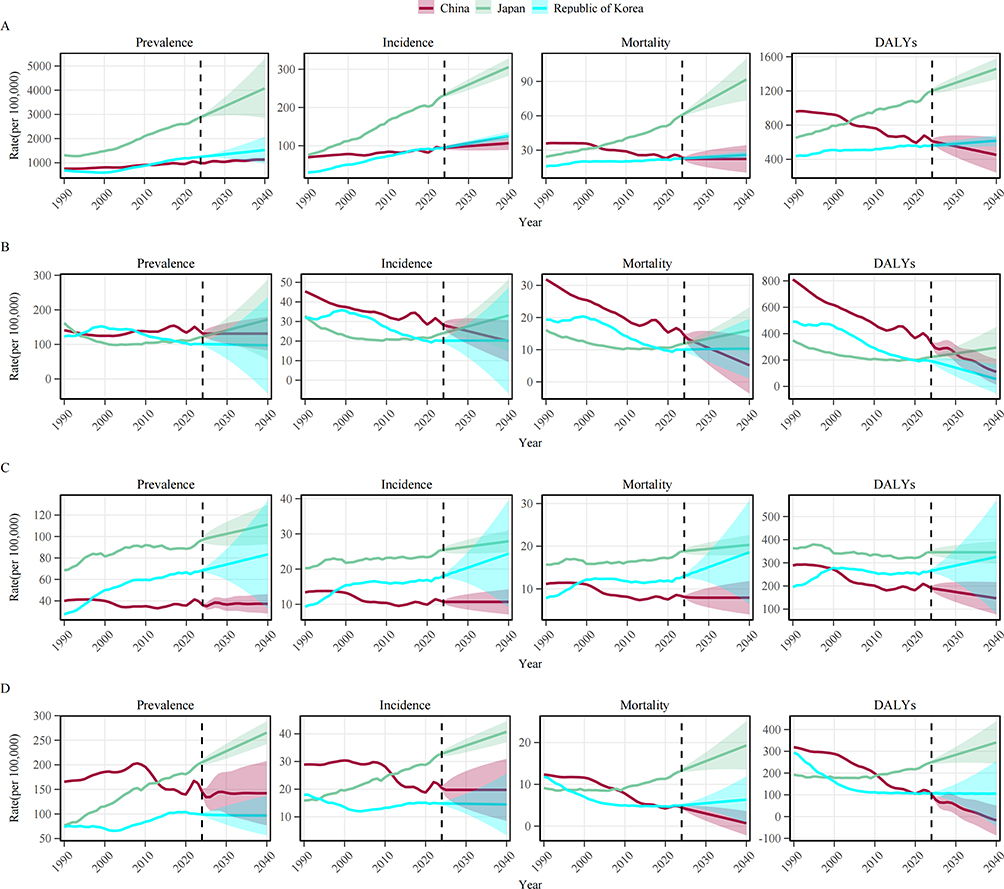 |
Figure 4 Observed and projected temporal trends of age-standardized disease burden for four female-specific malignancies among women aged 55 years and older in East Asia (1990–2040). The figure displays the historical data (1990–2023) and future projections (2024–2040) based on ARIMA models. The panels are stratified by cancer type: (A) Breast cancer, (B) Cervical cancer, (C) Ovarian cancer, and (D) Uterine carcinoma. |
For cervical cancer, projected trends varied across the three countries. China and South Korea showed projected declines in most burden indicators through 2040. In contrast, Japan showed relatively stable or slightly increasing projected mortality rates in the later projection period. The projected mortality rate in Japan was estimated to approach or exceed that in South Korea by the mid-2030s. However, this finding should be interpreted cautiously because ARIMA models do not account for future changes in screening, HPV vaccination coverage, treatment access, or reporting practices.
For ovarian and uterine cancers, Japan and South Korea generally showed higher projected age-standardized rates than China. Uterine cancer incidence and mortality rates in Japan were projected to increase, whereas China showed projected declines in corresponding burden indicators. For ovarian cancer, Japan and South Korea were projected to maintain relatively higher burden levels through 2040 compared with China. All projected estimates should be interpreted together with their prediction intervals, where available, given the uncertainty inherent in both GBD estimates and ARIMA-based projections.
Discussion
Using GBD 2023 estimates, this study described temporal trends and model-based projections of breast, cervical, ovarian, and uterine cancer burden among women aged 55 years and older in China, Japan, and South Korea. The findings showed substantial heterogeneity across countries and cancer types. Breast cancer accounted for the largest burden, cervical cancer generally declined with country-specific differences, and ovarian and uterine cancer burdens were relatively higher in Japan and South Korea than in China. These findings should be interpreted as descriptive epidemiological patterns and model-based projections rather than evidence of causal relationships. Potential biological, behavioral, and policy-related explanations are discussed below as contextual interpretations.
Breast cancer remained the leading contributor to disease burden among the four female-specific malignancies in China, Japan, and South Korea. The increasing incidence trends observed in this study are broadly consistent with patterns reported in Western high-income countries and other rapidly developed settings.24,25 Several population-level factors may help contextualize these trends, including changes in reproductive patterns, population aging, screening practices, and metabolic risk profiles. In the GBD comparative risk attribution framework, metabolic factors, including high body mass index and high fasting plasma glucose, accounted for an increasing proportion of breast cancer burden in selected countries.26–28 These findings are biologically plausible, as excess adiposity has been linked to altered estrogen metabolism, insulin resistance, and chronic inflammation. Nevertheless, because the present study was based on aggregated GBD estimates, it could not formally quantify the independent contribution of these factors, and the observed risk attribution patterns should not be interpreted as direct evidence of individual-level causality. Japan showed concurrent increases in breast cancer incidence and mortality during the study period, which may be related to its older population structure, comorbidity burden, differences in diagnostic intensity, and treatment patterns among older women. Previous studies have suggested that undertreatment and comorbidities may adversely affect cancer outcomes in older patients.29,30 However, these factors were not directly evaluated in the present analysis and should therefore be regarded as contextual explanations rather than confirmed causal mechanisms.
Cervical cancer generally showed declining long-term trends, although the magnitude and timing of decline differed across countries. South Korea showed sustained decreases in both incidence and mortality, which may be partly related to long-standing national screening efforts and HPV-related prevention strategies.31 In Japan, cervical cancer incidence declined during the early study period but became relatively stable in later years, while mortality showed an increasing pattern in the most recent period. Japan’s historical interruption of proactive HPV vaccine recommendation may provide an important policy context for interpreting these trends.32,33 In China, cervical cancer burden generally declined but remained substantial, suggesting the continued need to strengthen organized screening and HPV-related prevention. Overall, these findings support the importance of age-appropriate cervical cancer screening, improved HPV vaccination coverage in eligible cohorts, and continued surveillance. Nevertheless, policy-related explanations should be interpreted cautiously because screening coverage, vaccination uptake, healthcare access, and birth-cohort effects were not directly modeled in this study.
Ovarian cancer remained an important contributor to female-specific cancer burden in East Asia, particularly in Japan and South Korea, where age-standardized burdens were generally higher than those in China. The relatively high burden observed in these two countries may be related to differences in population aging, reproductive patterns, diagnostic intensity, and treatment contexts; however, these factors were not directly evaluated in the present study. Although advances in ovarian cancer treatment may have improved outcomes for selected patients, their population-level impact could not be assessed using aggregated GBD estimates. The persistently high mortality burden is consistent with the known clinical challenges of ovarian cancer, including late-stage diagnosis, lack of effective population-based screening, and high case fatality.34–36 In the GBD comparative risk attribution framework, high BMI and selected occupational carcinogens contributed to the estimated ovarian cancer burden in some countries, including Japan. Nevertheless, these attribution estimates should be interpreted cautiously and should not be considered evidence of direct individual-level causality. Future control strategies may benefit from improved risk stratification, earlier diagnostic approaches, equitable access to evidence-based treatment, and continued monitoring of population-level trends.
For uterine cancer, Japan changed from having a relatively low incidence rate in 1990 to showing the highest age-standardized incidence rate among the three countries by 2023. This pattern may be partly related to differences in population aging, reproductive history, diagnostic intensity, and metabolic risk profiles.37,38 In the GBD comparative risk attribution framework, high BMI represented the largest attributable risk factor for uterine cancer among those assessed and contributed to more than 20% of mortality in all three countries by 2023. This finding is biologically plausible, as excess adiposity has been linked to increased estrogen exposure, insulin resistance, and chronic inflammation.39,40 However, the present study could not determine whether changes in BMI directly caused the observed national trends. China showed a long-term declining pattern in uterine cancer burden, which may reflect cohort effects, differences in diagnostic practices, or other unmeasured factors. Because these explanations were not directly tested, they should be interpreted as hypotheses rather than confirmed mechanisms.
An apparently counterintuitive finding was that Japan showed relatively high burdens of breast, ovarian, and uterine cancers despite having a smaller increase in BMI than China and South Korea. This pattern suggests that BMI alone cannot fully explain cross-country differences in female-specific cancer burden. Several factors may help contextualize this observation, including Japan’s older population structure, reproductive and cohort effects, diagnostic intensity, screening practices, treatment patterns, and comorbidity burden among older women. Moreover, BMI is an imperfect proxy for metabolic risk and does not fully capture central adiposity, body fat distribution, sarcopenic obesity, insulin resistance, or cumulative lifetime exposure to metabolic abnormalities. This interpretation is consistent with the broader epidemiological understanding that female-specific cancer burden in midlife and older women is shaped by multiple demographic, reproductive, metabolic, and healthcare-related factors rather than by BMI alone. Therefore, BMI-related findings in this study should be interpreted within the GBD comparative risk attribution framework and should not be considered direct evidence that BMI changes alone determined national cancer trends.
Taken together, the findings suggest that East Asia may face a continuing burden from both cervical cancer and hormone- or metabolism-related female cancers among women aged 55 years and older. ARIMA-based projections suggested that some of these patterns may persist through 2040 if historical trends continue; however, these projections should not be interpreted as deterministic predictions. Future cancer control strategies may benefit from strengthening organized cervical cancer screening, improving HPV vaccination coverage in eligible cohorts, integrating metabolic health promotion into community-based prevention programs, and optimizing age-appropriate screening and treatment pathways for older women. Regional collaboration and continued surveillance may also help monitor changing cancer burden and inform more tailored public health responses. Some short-term increases observed after 2020 should also be interpreted cautiously. During this period, cancer estimates may have been influenced by healthcare disruptions, delayed diagnosis, changes in screening participation, and reporting practices. Therefore, post-2020 increases should not be interpreted as definitive evidence of sustained epidemiological shifts without confirmation from updated registry data.
This study has several limitations. First, the analysis relied on GBD 2023 estimates, which are model-based rather than direct registry counts. Although the GBD framework uses standardized methods to harmonize data sources and correct for systematic biases, the estimates remain subject to uncertainty related to data availability, cancer registration coverage, diagnostic capacity, mortality reporting, and coding practices across countries. Therefore, cross-country differences should be interpreted cautiously, particularly where source data quality or completeness may vary. Second, this study used aggregated national-level data and could not assess within-country heterogeneity, such as differences by region, socioeconomic status, urban–rural residence, screening participation, treatment access, or individual-level comorbidities. Because individual-level data were unavailable, the observed associations with SDI and attributable risk factors should be interpreted as descriptive ecological patterns rather than causal relationships. Third, we did not incorporate competing risk analyses. This limitation is particularly relevant for women aged 55 years and older, among whom cardiovascular disease and other age-related conditions may influence cancer mortality patterns and survival estimates. Future studies using individual-level cohort or registry data may help clarify the role of competing risks in older women. Finally, the ARIMA-based projections were derived from historical temporal trends and therefore should not be interpreted as deterministic predictions. These models do not account for future changes in screening programs, HPV vaccination coverage, treatment advances, risk factor distributions, health policy, diagnostic practices, coding systems, or unexpected public health events. Accordingly, projected estimates should be interpreted together with their prediction intervals and used primarily for cautious public health planning and hypothesis generation.
This GBD 2023-based analysis described heterogeneous temporal trends and model-based projections of breast, cervical, ovarian, and uterine cancer burden among women aged 55 years and older in China, Japan, and South Korea. Breast cancer remained the largest contributor to disease burden, cervical cancer generally declined with country-specific differences, and ovarian and uterine cancer burdens were relatively higher in Japan and South Korea. ARIMA-based projections suggested that some patterns may persist through 2040 if historical trends continue, but these estimates should not be interpreted as deterministic predictions. Continued surveillance, age-appropriate screening, HPV-related prevention in eligible cohorts, metabolic risk management, and optimized care pathways may help inform cancer control strategies in aging East Asian populations.
Data Sharing Statement
The datasets used and/or analyzed during the current study are publicly available in the Global Health Data Exchange (GHDx) repository, hosted by the Institute for Health Metrics and Evaluation: http://ghdx.healthdata.org/gbd-results-tool.
Ethics Approval and Consent to Participate
This study used publicly available, de-identified, summary-level data from the Global Burden of Disease Study 2023 database and did not involve direct contact with human participants or access to identifiable personal information. The study was reviewed by the Ethics Committee of the Chinese PLA General Hospital and was determined to be exempt from ethical review. The requirement for informed consent was also waived because only publicly available, aggregated, and de-identified data were used. This exemption is consistent with Article 32, Items (1) and (2), of the Measures for Ethical Review of Life Science and Medical Research Involving Human Subjects, issued in China on February 18, 2023.
Acknowledgments
We sincerely thank all colleagues who participated in the data analysis.
Author Contributions
All authors made a significant contribution to the work reported, whether that is in the conception, study design, execution, acquisition of data, analysis and interpretation, or in all these areas; took part in drafting, revising or critically reviewing the article; gave final approval of the version to be published; have agreed on the journal to which the article has been submitted; and agree to be accountable for all aspects of the work.
Funding
This research received no specific grant from any funding agency in the public, commercial, or not-for-profit sectors.
Disclosure
The authors report no conflicts of interest in this work.
References
1. Bray F, Laversanne M, Sung H, et al. Global cancer statistics 2022: GLOBOCAN estimates of incidence and mortality worldwide for 36 cancers in 185 countries. CA Cancer J Clin. 2024;74(3):229–12. doi:10.3322/caac.21834
2. Ginsburg O, Bray F, Coleman MP, et al. The global burden of women’s cancers: a grand challenge in global health. Lancet. 2017;389(10071):847–860. doi:10.1016/S0140-6736(16)31392-7
3. Li Y, Song W, Gao P, et al. Global, regional, and national burden of breast, cervical, uterine, and ovarian cancer and their risk factors among women from 1990 to 2021, and projections to 2050: findings from the Global Burden of Disease Study 2021. BMC Cancer. 2025;25(1):330. doi:10.1186/s12885-025-13741-9
4. Ginsburg O, Yip C-H, Brooks A, et al. Breast cancer early detection: a phased approach to implementation. Cancer. 2020;126(suppl S10):2379–2393. doi:10.1002/cncr.32887
5. Ginsburg O, Vanderpuye V, Beddoe AM. Women, power, and cancer: a lancet commission. Lancet. 2023;402(10419):2113–2166. doi:10.1016/S0140-6736(23)01701-4
6. Kocarnik JM, Compton K, Dean FE; GBD. Cancer Collaboration. Cancer incidence, mortality, years of life lost, years lived with disability, and disability-adjusted life years for 29 cancer groups from 2010 to 2019: a systematic analysis for the Global Burden of Disease Study 2019. JAMA Oncol. 2022;8(3):420–444. doi:10.1001/jamaoncol.2021.6987
7. Key TJ, Appleby PN, Reeves GK, et al; Endogenous Hormones and Breast Cancer Collaborative Group. Sex hormones and risk of breast cancer in premenopausal women: a collaborative re-analysis of individual participant data from seven prospective studies. Lancet Oncol. 2013;14(10):1009–1019.
8. Chlebowski RT, Anderson GL, Aragaki AK, et al. Association of menopausal hormone therapy with breast cancer incidence and mortality during long-term follow-up of the women’s health initiative randomized clinical trials. JAMA. 2020;324(4):369–380. doi:10.1001/jama.2020.9482
9. Li T, Zhang H, Lian M, et al. Global status and attributable risk factors of breast, cervical, ovarian, and uterine cancers from 1990 to 2021. J Hematol Oncol. 2025;18(1):5. doi:10.1186/s13045-025-01660-y
10. Arnold M, Morgan E, Rumgay H, et al. Current and future burden of breast cancer: global statistics for 2020 and 2040. Breast. 2022;66:15–23. doi:10.1016/j.breast.2022.08.010
11. Wilkinson L, Gathani T. Understanding breast cancer as a global health concern. Br J Radiol. 2022;95(1130):20211033. doi:10.1259/bjr.20211033
12. Menon U, Gentry-Maharaj A, Burnell M, et al. Ovarian cancer population screening and mortality after long-term follow-up in the UK collaborative trial of ovarian cancer screening (UKCTOCS): a randomised controlled trial. Lancet. 2021;397(10290):2182–2193. doi:10.1016/S0140-6736(21)00731-5
13. Liang J, Huai B, Yang Z, et al. Temporal trends and future projections of six major cancers among women of childbearing age in northeast Asia: analysis of data from the Global Burden of Disease Study 2021. Front Oncol. 2025;15:1716310. doi:10.3389/fonc.2025.1716310
14. Li W, Xu Y, Zeng X, et al. Etiological relationship between lipid metabolism and endometrial carcinoma. Lipids Health Dis. 2023;22(1):116. doi:10.1186/s12944-023-01868-2
15. Soerjomataram I, Bray F. Planning for tomorrow: global cancer incidence and the role of prevention 2020–2070. Nat Rev Clin Oncol. 2021;18(10):663–672. doi:10.1038/s41571-021-00514-z
16. Collaborative Group on Hormonal Factors in Breast Cancer. Type and timing of menopausal hormone therapy and breast cancer risk: individual participant meta-analysis of the worldwide epidemiological evidence. Lancet. 2019;394(10204):1159–1168. doi:10.1016/S0140-6736(19)31709-X
17. Han H, Guo W, Shi W, et al. Hypertension and breast cancer risk: a systematic review and meta-analysis. Sci Rep. 2017;7(1):44877. doi:10.1038/srep44877
18. Bouchardy C, Rapiti E, Fioretta G, et al. Undertreatment strongly decreases prognosis of breast cancer in elderly women. J Clin Oncol. 2003;21(19):3580–3587. doi:10.1200/JCO.2003.02.046
19. GBD. Intimate partner violence and sexual violence against children collaborators. Disease burden attributable to intimate partner violence against females and sexual violence against children in 204 countries and territories, 1990-2023: a systematic analysis for the Global Burden of Disease Study 2023. Lancet. 2026;407(10523):31–52.
20. GBD. The burden of dietary risk factors in the Nordic and Baltic countries: a systematic analysis for the Global Burden of Disease Study 2023. Lancet Regional Health Euro. 2026;61:101543. doi:10.1016/j.lanepe.2025.101543
21. Troeger CE, Arndt MB, Aalruz H; GBD. Quantifying the fatal and non-fatal burden of disease associated with child growth failure, 2000–2023: a systematic analysis from the Global Burden of Disease Study 2023. Lancet Child Adolesc Health. 2026;10(1):22–38. doi:10.1016/S2352-4642(25)00303-7
22. Deng Q, Wang S, Lyu J. Comparative effectiveness analysis of univariate time-series forecasting models for disease mortality rates in the Global Burden of Disease database: a case study of global hypertensive heart disease among women of childbearing age. Front Public Health. 2025;13:1681569. doi:10.3389/fpubh.2025.1681569
23. Guo T, Zhu W, Hui Y, et al. The burden of pancreatic cancer in five East Asian countries from 1990 to 2021 and its prediction up to 2036: a systemic analysis of the Global Burden of Diseases Study 2021. Cancer Med. 2025;14(23):e70656. doi:10.1002/cam4.70656
24. Lin C-H, Yap YS, Lee K-H, et al; Asian Breast Cancer Cooperative Group. Contrasting epidemiology and clinicopathology of female breast cancer in Asians vs the US population. J Natl Cancer Inst. 2019;111(12):1298–1306. doi:10.1093/jnci/djz090
25. Mubarik S, Cao J, Wang F, et al. Lifestyle and socioeconomic transition and health consequences of breast cancer in the East Asia region, from 1990 to 2019. Front Nutr. 2022;9:817836. doi:10.3389/fnut.2022.817836
26. Ko A, Chang Y-C, Bahar F, et al. Risk for cancer with glucagon-like peptide-1 receptor agonists and dual agonists: a systematic review and meta-analysis. Ann Intern Med. 2026;179(2):216–229. doi:10.7326/ANNALS-25-02237
27. Boberska M, Wietrzykowska D, Kulis E, et al. Behaviour change techniques used in effective interventions, promoting physical activity, healthy nutrition, and healthy body mass among women with breast cancer and breast cancer survivors: a meta-review. Health Psychol Rev. 2025; 1–29. doi:10.1080/17437199.2025.2592667
28. Li F, Gao Z. Obesity, chronic breast inflammation and carcinogenesis: molecular pathways and clinical implications. Int J Oncol. 2026;68(1):12. doi:10.3892/ijo.2025.5825
29. Yasui A, Kinoshita S, Endo M, et al. Disaster response and older adult cancer care in super-aged societies: insights from the 2024 Noto Peninsula Earthquake in Oku-Noto, Japan. Front Public Health. 2024;12:1427987. doi:10.3389/fpubh.2024.1427987
30. Matsumoto K, Hatakeyama Y, Seto K, et al. Cost of illness in a super-aged society—comparison of breast, lung, and prostate cancer in Japan. BMC Geriatr. 2022;22(1):964. doi:10.1186/s12877-022-03683-3
31. Bae S, Park JH, Oh S, et al. Public health impact and cost-effectiveness of implementing gender-neutral immunization with the nonavalent human papillomavirus vaccine in South Korea. Hum Vaccin Immunother. 2025;21(1):2582299. doi:10.1080/21645515.2025.2582299
32. Xiao C, Deng J, Ren F, Zhang C. Cervical cancer burden among females under 40 years in China, Japan, and South Korea, 1990–2021: a systematic analysis for the global burden of disease study 2021. Front Public Health. 2025;13:1695004. doi:10.3389/fpubh.2025.1695004
33. Diakite I, Tobe K, You X, Chen Y-T, Palmer C, Matsuki T. The public health impact of extending the catch-up nonavalent human papillomavirus vaccination program to 2028 in Japan: a model-based study. BMC Public Health. 2025;26(1):1113. doi:10.1186/s12889-025-25684-8
34. Wang Y, Xia Q, Wang X, Lu Y, Wang S, Jiao Y. Enhancing PARP inhibitor efficacy in ovarian cancer: targeting the PI3K/AKT/mTOR pathway. J Ovarian Res. 2025;19(1):57. doi:10.1186/s13048-025-01868-z
35. Passarelli A, Cecere SC, Ventriglia J, et al. The immunotherapy era in ovarian clear cell carcinoma: current evidence and future perspective. Front Immunol. 2025;16:1661048. doi:10.3389/fimmu.2025.1661048
36. Shi Y, Xiong W, Xia B. Neoadjuvant therapy in ovarian cancer: emerging paradigms and therapeutic frontiers. Crit Rev Oncol Hematol. 2026;219:105065. doi:10.1016/j.critrevonc.2025.105065
37. Chen G, Zhou S, Shi Q, et al. Global, regional, and national estimates of burden and risk factors of female cancers in child-bearing age: a systematic analysis for Global Burden of Disease Study and Bayesian projection to 2030. Transl Oncol. 2025;60:102473. doi:10.1016/j.tranon.2025.102473
38. Han Y, Chen H, Song D, Li R, Zhang T, Yang X. Evolving landscape of female cancers along with attributable risk factors in China from 1990 to 2021, and projections to 2040. Front Public Health. 2025;13:1629081. doi:10.3389/fpubh.2025.1629081
39. Patterson B, Sinha N, Broaddus E, et al. Associations between obesity and outcomes in pembrolizumab-treated endometrial cancer. Gynecol Oncol. 2026;204:228–234. doi:10.1016/j.ygyno.2025.12.001
40. Matylevich OP, Shelkovich SY, Balshakova AG, Yaumenenka AA, Pakiz M. Epidemiological trends in uterine corpus malignancies in Belarus: a 30-year analysis (1993-2022). Int J Gynaecol Obstet. 2026;173(3):1413–1420. doi:10.1002/ijgo.70743
 © 2026 The Author(s). This work is published and licensed by Dove Medical Press Limited. The
full terms of this license are available at https://www.dovepress.com/terms
and incorporate the Creative Commons Attribution
- Non Commercial (unported, 4.0) License.
By accessing the work you hereby accept the Terms. Non-commercial uses of the work are permitted
without any further permission from Dove Medical Press Limited, provided the work is properly
attributed. For permission for commercial use of this work, please see paragraphs 4.2 and 5 of our Terms.
© 2026 The Author(s). This work is published and licensed by Dove Medical Press Limited. The
full terms of this license are available at https://www.dovepress.com/terms
and incorporate the Creative Commons Attribution
- Non Commercial (unported, 4.0) License.
By accessing the work you hereby accept the Terms. Non-commercial uses of the work are permitted
without any further permission from Dove Medical Press Limited, provided the work is properly
attributed. For permission for commercial use of this work, please see paragraphs 4.2 and 5 of our Terms.