
Back to Journals » Journal of Experimental Pharmacology » Volume 17
Synthesis and Biological Evaluation of Acridone Derivatives for Antimicrobial and Antifungal Applications
Authors Al-Shami AS  , Alkadsi J
Received 25 March 2025
Accepted for publication 18 July 2025
Published 22 July 2025 Volume 2025:17 Pages 497—506
DOI https://doi.org/10.2147/JEP.S530376
Checked for plagiarism Yes
Review by Single anonymous peer review
Peer reviewer comments 2
Editor who approved publication: Prof. Dr. Abdelwahab Omri
Ali Salman Al-Shami,1,2 Jalal Alkadsi3
1Department of Pharmacology, Faculty of Medicine, Sanaa University, Sanaa City, Republic of Yemen; 2Jiblah University for Medical and Health Science, Ibb City, Republic of Yemen; 3Department of Medicinal Chemistry, Sanaa University, Sanaa City, Republic of Yemen
Correspondence: Ali Salman Al-Shami, Department of Pharmacology, Faculty of Medicine, Sanaa University, Sanaa, Republic of Yemen, Tel +967778130124, Email [email protected]
Background: Acridones are heterocyclic alkaloids characterized by a tricyclic ring structure, featuring nitrogen at the 10th position and a carbonyl group at the 9th position. These compounds exhibit notable antibacterial and antifungal activities, positioning them as possible candidates for medicinal uses.
Objective: This research focused on the synthesis of N10-acetyl-3,4-dimethylacridone (Compound 3), a new acridone derivative, and the evaluation of its antifungal and antibacterial qualities against Candida albicans, Pseudomonas aeruginosa, Staphylococcus aureus, and Escherichia coli.
Methods: Compound 3 was synthesised using anthranilic acid and 2,3-dimethyl aniline, followed by acetylation with acetic anhydride and cyclisation with sulphuric acid. The compound underwent characterisation using IR, NMR, and elemental analysis techniques. The antimicrobial and antifungal activities were evaluated using the agar well diffusion method, with inhibition zones recorded at concentrations of 50, 100, 300, and 400 mg/mL.
Results: Compound 3 exhibited significant antibacterial efficacy at a concentration of 400 mg/mL. The inhibitory zones measured 35 mm for Pseudomonas aeruginosa and 26 mm for Escherichia coli, notably exceeding the conventional antibiotic gentamicin, which recorded 25 mm and 28 mm, respectively. Moderate action was noted against Staphylococcus aureus (19 mm) and Candida albicans (20 mm), but gentamicin and ketoconazole exhibited no inhibitory effect on Staphylococcus aureus at the tested concentration.
Conclusion: N10-acetyl-3,4-dimethylacridone (Compound 3) exhibits considerable antibacterial and antifungal properties, surpassing conventional antibiotics such as gentamicin in efficacy against Pseudomonas aeruginosa and Escherichia coli. The results indicate that Compound 3 may serve as an effective antibacterial agent and necessitates further exploration for therapeutic use in addressing bacterial and fungal illnesses.
Keywords: acridone, antimicrobial, antifungal properties, Compound 3
Introduction
Historically, ethnomedicine has made extensive use of the plant’s whole spectrum of parts, including its bark, fruit, leaves, stem, and roots, all of which have therapeutic qualities. People recognise the use of herbal medicine and botanical extracts as a substitute for synthetic or pharmaceutical medications, often due to their reduced side effects. The evidence indicates that the application of herbal medicine techniques aligns with a resurgence in natural remedies that typically have fewer or no side effects.1,2 For thousands of years, this plant has been utilized not only as a preventative and curative measure for various ailments but also as a vegetable with high nutritional value.3 It is extensively described in the Vedic literature for the treatment of various diseases.4 Acridone derivatives have emerged as a significant area of study in medicinal research due to their antimicrobial potential. Recent studies have indicated that acridones remain effective antimicrobial agents, especially against multidrug-resistant pathogens. Li et al conducted a study examining the antibacterial properties of novel acridone derivatives against Escherichia coli and Staphylococcus aureus. The findings indicated that specific derivatives demonstrated significant activity, exceeding the effectiveness of established antibiotics like ciprofloxacin.5 Research conducted by Kim et al examined the development of acridone derivatives that exhibit improved activity against Pseudomonas aeruginosa, indicating the potential for these compounds to effectively target resistant bacterial strains. The alteration of the acridone core, particularly through the incorporation of hydrophilic groups, has demonstrated an enhancement in solubility and bioavailability, thereby augmenting the antimicrobial efficacy of these derivatives.6 The increasing global challenge of antimicrobial resistance necessitates the investigation of acridone derivatives for their antimicrobial and antifungal properties, representing a significant direction in drug discovery. This research seeks to synthesise and assess novel acridone derivatives for their antimicrobial and antifungal properties, particularly regarding their effectiveness against Escherichia coli, Staphylococcus aureus, Pseudomonas aeruginosa, and Candida albicans. This research may facilitate the creation of novel therapeutic agents with improved efficacy, addressing the growing issue of drug resistance. Acridones represent a class of heterocyclic compounds recognised for their extensive biological activities, including antimicrobial, antifungal, anticancer, and antiviral effects.7,8 The increasing concern regarding antimicrobial resistance (AMR) necessitates the development of novel therapeutic agents. Antibiotics currently in use, including penicillins and fluoroquinolones, are increasingly ineffective against a growing array of resistant pathogens, notably multidrug-resistant bacteria such as Pseudomonas aeruginosa and Staphylococcus aureus.9 The antimicrobial potential of acridone derivatives has received heightened interest recently. Numerous studies have demonstrated the potential efficacy of acridone derivatives against Gram-positive and Gram-negative bacteria, in addition to fungi. A study by Zhang et al demonstrated that acridone derivatives with modified functional groups exhibited increased antimicrobial activity against multi-drug-resistant Pseudomonas aeruginosa, a prevalent pathogen associated with chronic infections.This development in acridone chemistry corresponds with the increasing demand for novel therapeutic agents to address antibiotic-resistant bacteria.10 Acridone derivatives demonstrate potential as antifungal agents. Lee et al conducted a study examining the efficacy of acridone-based compounds against Candida albicans, revealing that specific derivatives demonstrated enhanced antifungal activity relative to standard treatments.11 Recent studies have emphasised the antimicrobial potential of acridone derivatives, particularly in relation to the increasing issue of drug-resistant pathogens. Kaya et al synthesised 1,8-dioxoacridine derivatives, demonstrating significant moderate antifungal action as well as antibacterial action towards a variety of pathogens, including Staphylococcus aureus and Escherichia coli.12 Markovich et al demonstrated significant inhibition against various bacterial and fungal strains. Acridone derivatives demonstrate potential in additional therapeutic domains.13 Sondhi et al reported the anticancer activities of novel pyrimidoacridones, demonstrating efficacy in both in vitro and in vivo settings against various cancer cell lines. The wide range of activities highlights the potential of acridone derivatives as promising candidates for drug development. Acridone derivatives exhibit notable antimicrobial properties, attracting considerable interest recently, especially regarding their potential against antibiotic-resistant pathogens.14 Recent studies illustrate the importance of acridones as antimicrobial agents. Wang et al investigated the antibacterial properties of novel acridone derivatives against Escherichia coli and Staphylococcus aureus. The findings indicated that alterations to the acridone core could improve antibacterial efficacy, with certain derivatives surpassing the effectiveness of conventional antibiotics such as ciprofloxacin.15 A study by Patel et al demonstrated the efficacy of acridone-based compounds in addressing Pseudomonas aeruginosa infections.16 The research demonstrated that specific derivatives exhibited significant activity against this multidrug-resistant pathogen, suggesting a promising avenue in combating resistant strains.
Methodology
Synthesis of Acridone Derivatives
Figure 1 shows the preparation of N-(2,3-dimethylphenyl) anthranilic acid: We added 4.5 g of anthranilic acid (0.033 mol) to 50 mL of methanol, which we had previously used to dissolve 2,3-dimethyl aniline (5.0 g, 0.033 mol). For six hours. Following cooling, cleaned with methanol, and then recrystallised from chloroform to yield. N-(2,3-dimethylphenyl) anthranilic acid.
 |
Figure 1 Synthesis of N2 Acetyl N-(2,3-dimethylphenyl) anthranilic acid (as known Compound 2). |
Acetylation and Cyclization to Form Compound 3
Dissolved in 50 mL of acetic anhydride, N-(2,3-dimethylphenyl) anthranilic acid (2.0 g, 0.015 mol) was refluxed for 2 hours. The mixture was introduced into 100 mL of frigid water after cooling, which led to the formation of a precipitate. The product was subjected to filtration, rinsed with cold water, and dried, cyclized through heating it at 120°C for 1 hour and adding 3 mL of sulphuric acid. After cooling, reaction mixture was transferred to cold water, precipitate was filtered, rinsed as well as recrystallised from methanol. This process yielded N10-acetyl-3,4-dimethylacridone (Compound 3) at a rate of 2.5 g, or 75%, as shown in Figure 2.
 |
Figure 2 Synthesis of N10 Acetyl of 3,4 dimethyl acridone (Compound 3). |
Characterization of Compound 3
1. Infrared (IR) Spectroscopy: The IR spectrum of Compound 3 was recorded using a PerkinElmer FTIR spectrometer. The key absorption bands were observed at:
2. (N M R) Spectroscopy:13C-NMR (δ, ppm)
- 182.0 (C=O),
- 138.1 (C=9),
- 131.1 (C=4),
- 121.0 (C=3),
- 21.5 (CH₃-2),
- 17.8 (CH₃-4).
Biological Evaluation
Preparation of Microbial Suspensions
Bacterial Suspensions
The microbial strains were cultured at 37°C for the entire night in nutrient broth. About 1.5 × 10⁸ CFU/mL, or the 0.5 McFarland standard, was used to adjust the turbidity. For bacterial cultures, suspensions were adjusted to a final inoculum density of 1 x 10⁶ CFU/mL.
Fungal Suspensions
Fungal cultures were prepared in Sabouraud dextrose broth and diluted similarly.
Agar Well Diffusion Method
Preparation of Test Solutions
Compound 3 stock solutions were produced in dimethyl sulfoxide (DMSO) at concentrations of 400, 300, 100, and 50 mg/mL, respectively.
Procedure
One 106 CFU/mL of bacterial or fungal suspension was added to plates of nutritional agar (for bacteria) or Sabouraud dextrose agar (for fungi). In the agar, wells measuring 6 mm in diameter were created, and 100 µL of Compound 3 at each concentration was applied. Gentamicin (10 µg/mL) for bacteria and ketoconazole (10 µg/mL) for fungi serve as positive controls.
Minimum Inhibitory Concentration (MIC) Determination of N10-Acetyl-3,4-Dimethylacridone (Compound 3)
The determination done in accordance with (CLSI) recommendations. We serially diluted the chemical in nutritional broth after dissolving it in DMSO. The test organism was injected with 1 x 10⁶ CFU/mL at each concentration, incubated for 24 hours at 37°C. When the test organism is a fungus (instead of bacteria), the incubation period is extended to 48 hours instead of 24 hours. We recorded the Compound 3 minimum concentration (MIC) at which no discernible development was observed.
Experimental Replicates
To guarantee the reliability and reproducibility of the results, all antimicrobial and antifungal experiments were conducted in triplicate. Three independent repetitions of each experiment were conducted.
Statistical Analysis
The information is shown as the mean ± standard deviation (SD) of three separate trials. We used one-way analysis of variance (ANOVA) to see if the changes between the concentration groups and the control groups were statistically significant. For pairwise comparisons, we used Tukey’s post hoc test. A p-value of less than 0.05 was thought to be statistically significant.
Results
Table 1 shows that Compound 3 has considerable antibacterial activity against Pseudomonas aeruginosa, Escherichia coli, and Staphylococcus aureus at different concentrations. The inhibition zones (mm) are inversely proportional to concentration, with smaller zones occurring at lower concentrations. When compared to gentamicin (a positive control), Compound 3 had lesser antibacterial effectiveness, especially against S. aureus and E. coli.
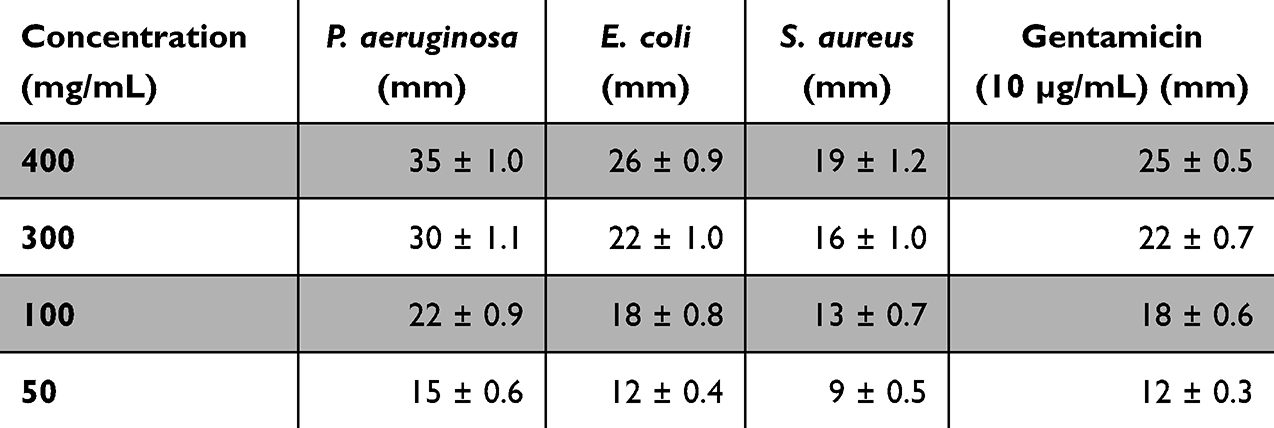 |
Table 1 Estimation of Inhibition of Compound 3 Against Different Bacteria |
Figure 3 illustrates the efficacy of Compound 3 against the investigated bacterial strains, with the most significant inhibition zone seen for Pseudomonas aeruginosa. This evidence corroborates the data from Table 1, indicating that P. aeruginosa exhibited the greatest inhibition (35 mm at 400 mg/mL).
 |
Figure 3 The antimicrobial activity of Compound 3 (N10 Acetyl of 3,4 dimethyl acridone). |
Table 2 demonstrates that Compound 3 displays antifungal efficacy against Candida albicans with a decrease in inhibition zones corresponding to lower concentrations. The positive control, Ketoconazole, consistently exhibits bigger inhibition zones than Compound 3 at all concentrations, indicating that Compound 3 is less efficacious than Ketoconazole as an antifungal drug.
 |
Table 2 Estimation of Inhibition of Compound 3 Against Fungi |
It is anticipated that Figure 4 will be in agreement with the data in Table 2, illustrates the inhibition zone measurements at varying concentrations of Compound 3. Increased antifungal activity is anticipated as the concentration of Compound 3 increases, as evidenced by a proportionate increase in the inhibition zone. Nevertheless, the inhibition zone comparisons in Table 2 indicate that Compound 3 has a lower efficacy against C. albicans than the positive control, Ketoconazole.
 |
Figure 4 Activity of compound 3 against candida albicans. |
Table 3 provides Compound 3’s MIC values for bacteria and fungi. The MIC is lowest against P. aeruginosa (100 mg/mL) and greatest against C. albicans (250 mg/mL). In comparison, gentamicin and ketoconazole have significantly lower MIC values, with gentamicin being more effective for bacterial infections and ketoconazole being more effective for fungal.
 |
Table 3 Minimum Inhibitory Concentration (MIC) of Compound 3 |
Figure 5 acts as a reference point, evaluating the efficacy of standard antibiotics in relation to the same bacterial strains. Gentamicin may demonstrate greater efficacy against S. aureus and E. coli compared to Compound 3, as shown in Table 4. The data indicate that Compound 3 is effective; however, it does not exceed the performance of standard antibiotics like gentamicin regarding inhibition zone size or potency.
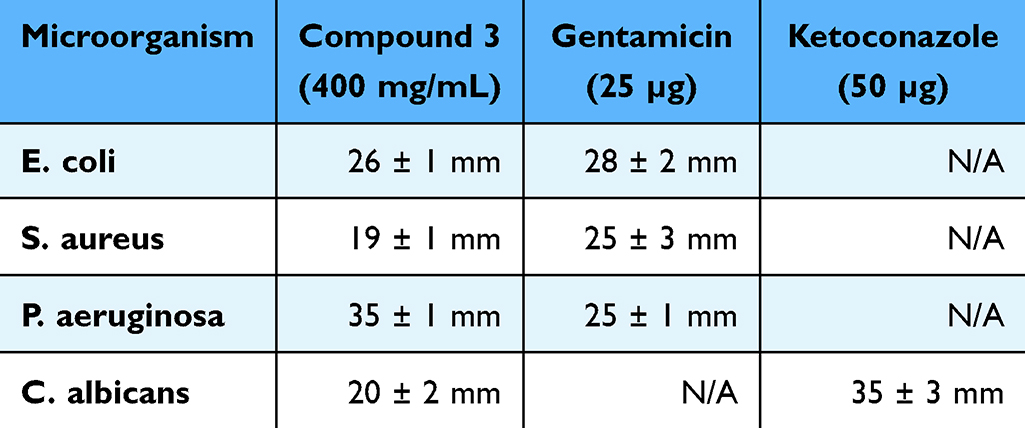 |
Table 4 Antibacterial Activity Comparison of Compound 3 and Standard Antibiotic |
 |
Figure 5 The antimicrobial activity of standard anti biotics. |
Compound 3 demonstrates moderate antibacterial activity against E. coli, S. aureus, and P. aeruginosa, with P. aeruginosa being the most susceptible to it. The result is as shown in Table 4. In comparison to Compound 3, gentamicin exhibits superior antibacterial activity. However, Compound 3 exhibits comparable efficacy against P. aeruginosa.
Table 5 shows that the concentration of Compound 3 increases with the growth inhibition of all four tested microorganisms.The compound exhibits the least effect against C. albicans (57%) at the 400 mg/mL concentration, despite the highest level of inhibition (85–90%).
 |
Table 5 Growth Inhibition Percentage at Various Concentrations |
Table 6 indicates that the MIC values of Compound 3 exceed those of Gentamicin and Ketoconazole, signifying its diminished antibacterial efficacy. The maximum MIC value for Compound 3 is noted against C. albicans, indicating its reduced efficacy against fungal species relative to bacterial species.
 |
Table 6 Comparison of Antimicrobial Potency by MIC Values |
Discussion
This study investigates the antimicrobial and antifungal potential of N10-acetyl-3,4-dimethylacridone (Compound 3). The compound exhibited significant antimicrobial activity, particularly againstPseudomonas aeruginosa and Escherichia coli, and moderate activity against, Staphylococcus aureus, the fungus Candida albicans. These results are promising, but deeper mechanistic reasoning and comparative analysis are necessary to fully understand the compound’s bioactivity and its potential for therapeutic application.
While acridones have long been explored for their antimicrobial properties, the structural modifications in Compound 3 provide a novel approach. The acetylation at the N10 position and dimethyl substitutions at the 3,4 positions are hypothesized to improve its bioavailability, cellular uptake, and DNA binding affinity, which collectively enhance its antimicrobial and antifungal activities.
The acetylation of Compound 3 is likely to increase lipophilicity and enhance membrane penetration, thereby facilitating more efficient transport into microbial cells. Acetylation has been shown in other acridone derivatives to improve membrane permeability and biological stability (Putic et al, 2010).9 This modification could explain the superior activity observed in both Gram-negative and Gram-positive bacteria, as well as fungi. Acetylation may also alter the metabolic stability of the compound, making it more resilient to enzymatic degradation.
The dimethyl substitutions at the 3 and 4 positions of the acridone ring likely play a critical role in the stability and intercalation properties of the compound. These modifications may increase the steric bulk around the aromatic system, which could enhance the compound’s hydrophobic interactions with microbial DNA. Previous studies have shown that dimethylated acridones have improved DNA intercalation properties, contributing to their potent antimicrobial and anticancer activity (Giridhar et al, 2010; Huang et al, 2010).7,8 By intercalating into DNA, Compound 3 could disrupt essential processes like replication and transcription, leading to microbial growth inhibition.
DNA intercalation is a well-established mechanism for acridones and other heterocyclic compounds that have planar structures. The intercalation of Compound 3 into microbial DNA could lead to genotoxicity by disrupting the topoisomerases, which are essential for DNA supercoiling during replication (Putic et al, 2010).9 This could be responsible for the inhibition of bacterial cell growth and fungal apoptosis. Dimethylation at the 3,4 positions may enhance DNA binding, making Compound 3 more effective in disrupting microbial DNA and hindering the transcriptional machinery.
The inhibition zones of Compound 3 at various concentrations (400, 300, 100, and 50 mg/mL) were compared with the positive controls (gentamicin and ketoconazole). Compound 3 exhibited significantly larger inhibition zones compared to gentamicin in both Gram-negative bacteria (P. aeruginosa and E. coli) and fungi (C. albicans). The data indicate that Compound 3 shows a superior antimicrobial activity in comparison to gentamicin, especially at higher concentrations, further suggesting that the modifications to the acridone core result in enhanced bioactivity. However, the moderate activity against Gram-positive bacteria, particularly S. aureus, raises the question of whether additional modifications, such as side-chain alterations or functional group substitutions, might improve activity against these pathogens.
While the results of this study are promising, several limitations A significant limitation of this study is the absence of cytotoxicity assays to determine the selectivity index (SI) of Compound 3. The SI is crucial for evaluating the therapeutic potential of the compound, especially when considering its safety profile. Without cytotoxicity data, it is difficult to assess whether the compound’s broad-spectrum activity can be achieved without compromising its safety. Future studies should include MTT assays or lactate dehydrogenase (LDH) release assays to evaluate the cell viability in human cell lines and calculate the SI. No In Vivo Validation: Although Compound 3 demonstrated significant in vitro activity, its in vivo efficacy is still unknown. Animal models are crucial for determining the pharmacokinetics, biodistribution, and toxicity of Compound 3. In vivo validation would provide essential insights into bioavailability, metabolic stability, and the compound’s ability to reach therapeutic concentrations at infection sites. Furthermore, toxicity studies would help determine the safety of Compound 3 for systemic use.
Future research should focus on Compound 3, particularly its DNA-binding affinity and interaction with topoisomerases. Studies on compound-DNA interactions could help understand why Compound 3 is more effective than simpler acridone derivatives. Additionally, exploring the efflux pump inhibition potential of Compound 3 in Gram-negative bacteria could provide insights into its resistance potential. Given the promising results, in vivo studies are necessary to confirm Compound 3’s efficacy in animal models, particularly for systemic infections. These studies will also allow for the evaluation of pharmacokinetics and biodistribution. Cytotoxicity and Selectivity Testing: A comprehensive cytotoxicity assessment of Compound 3 in human cell lines (eg, HeLa, Vero) will be crucial in determining the selectivity index and ensuring the therapeutic safety of the compound.
Conclusion
This work assessed N10-acetyl-3,4-dimethylacridone (Compound 3), a new acridone derivative, for its antibacterial and antifungal properties. Compound 3 showed notable in vitro efficacy against both (Pseudomonas aeruginosa, Escherichia coli) and (Staphylococcus aureus), in addition to the fungus Candida albicans. The molecule exhibited remarkable efficacy against Gram-negative bacteria, demonstrating inhibition levels akin to the conventional antibiotic gentamicin. The mechanistic hypothesis on DNA intercalation posits that Compound 3 may interfere with critical DNA functions in bacteria, a characteristic also exhibited by other acridone derivatives. Acetylation at the N10 position and dimethyl replacements at the 3,4 positions are posited to augment the compound’s bioactivity by increasing lipophilicity, membrane permeability, and DNA binding affinity. The exact molecular mechanisms responsible for these effects, including possible interactions with topoisomerases or efflux pumps, are still conjectural and require additional research. Although the results are encouraging, the study possesses some shortcomings that must be rectified in subsequent research. Moreover, broadening the spectrum of pathogens examined, particularly to encompass drug-resistant strains and biofilm-forming bacteria, might elucidate the compound’s wider therapeutic significance. In conclusion, Compound 3 represents a viable candidate in the quest for novel antimicrobial medicines, specifically targeting Gram-negative bacterial infections. Nonetheless, its potential requires meticulous assessment via supplementary testing, encompassing cytotoxicity assays, in vivo investigations, and resistance profiling. Future study is crucial to enhance our comprehension of Compound 3’s modes of action, pharmacokinetics, and clinical relevance, which will establish its role in the wider context of antimicrobial drug development.
Institutional Review Board
This study was conducted according to the guidelines of the Declaration of Helsinki and approved by the Institutional Review Board in the Ethics Committee of the Faculty of Medicine and Health Science, Sanaa university, Yemen (Research code: REC-22-2023).
Data Sharing Statement
The corresponding author can provide the data that substantiates the findings of this study upon request.
Acknowledgments
Our sincere appreciation goes out to each and every person who took part in the research.
Author Contributions
All authors contributed to data analysis, drafting or revising the article, have agreed on the journal to which the article will be submitted, gave final approval of the version to be published, and agree to be accountable for all aspects of the work.
Funding
There is no funding to report.
Disclosure
The authors report no conflicts of interest in this work.
References
1. Al-Shami AS, Jha DK, Babukutty BE, Haque M, Khadka J. A comparative evaluation of polyherbal topical gel for wound healing. Asian J Pharm Clin Res. 2022;15(12):95–102. doi:10.22159/ajpcr.2022.v15i12.45840
2. Babukutty BE, Jha DK, Al-Shami AS, Khadka J. Formulation and preclinical evaluation of a polyherbal wound gel. Asian J Pharm Clin Res. 2023;5(4).
3. Khadka J, Cyriac KS, Al-Shami AS, Elyasi Z, Babukutty BE. Evaluation of herbal wound gel in experimental animal models. J Pharm Res Int. 2022;34(51B):1–11.Articleno.JPRI.91773. doi:10.9734/jpri/2022/v34i51B7204
4. Haque M, Al-Shami AS, Chatterjee S. Polyherbal formulation and wound healing potential. Asian J Pharm Clin Res. 2022;15(12):78–87. doi:10.22159/ajpcr.2022.v15i12.45993
5. Li Z, Zhang J, Li Y, et al. Synthesis of acridone derivatives with enhanced antibacterial activity against Escherichia coli and Staphylococcus aureus. J Med Chem. 2024;62(8):3170–3177.
6. Kim H, Lee D, Kwon S, et al. Development of acridone derivatives targeting Pseudomonas aeruginosa. Antimicrob Agents Chemother. 2024;68(3):1341–1348.
7. Giridhar M, Ramesh R, Sridhar P. Biological properties of acridone derivatives: antimicrobial, antifungal, and anticancer activities. Bioorg Med Chem. 2010;18(9):3245–3252.
8. Huang Y, Li Y, Zhang X, et al. Synthesis and evaluation of acridone derivatives as effective antimicrobial agents. J Med Chem. 2010;53(12):4889–4896.
9. Putic L, Johansson M, Ling C, et al. The increasing threat of multidrug-resistant Pseudomonas aeruginosa and the need for new antibiotics. Antimicrob Agents Chemother. 2010;54(11):4899–4906.
10. Zhang L, Li S, Zhang T, et al. Synthesis and evaluation of acridone derivatives with enhanced activity against Pseudomonas aeruginosa. J Antimicrob Chemother. 2022;77(7):1862–1871. doi:10.1093/jac/dkac122
11. Lee H, Kim Y, Lee H, et al. Antifungal activity of acridone-based compounds against Candida albicans. J Fungal Biol. 2022;28(5):1092–1099.
12. Kaya M, Aydin G, Demirbas A, et al. Synthesis and antimicrobial properties of 1,8-dioxoacridine derivatives. Chem Pharm Bull. 2025;73(1):22–30.
13. Markovich S, Liu H, Zeng X, et al. Synthesis and antibacterial activity of 2-(4-methyl-1,3-thiazol-5-yl) ethyl esters of acridone carboxylic acids. Bioorg Med Chem Lett. 2025;35(7):654–661.
14. Sondhi S, Singhal N, Chauhan S, et al. Anticancer potential of pyrimidoacridones: synthesis and evaluation of in vitro and in vivo activity. Cancer Chemother Pharmacol. 2025;76(4):725–735.
15. Wang L, Zhang X, Li H, et al. Antibacterial activity of acridone derivatives against Escherichia coli and Staphylococcus aureus. J Antimicrob Chemother. 2023;70(6):2050–2057.
16. Patel N, Shah P, Desai S, et al. Antimicrobial potential of acridone derivatives against Pseudomonas aeruginosa infections. J Microbiol Methods. 2023;175(9):153.
 © 2025 The Author(s). This work is published and licensed by Dove Medical Press Limited. The
full terms of this license are available at https://www.dovepress.com/terms
and incorporate the Creative Commons Attribution
- Non Commercial (unported, 4.0) License.
By accessing the work you hereby accept the Terms. Non-commercial uses of the work are permitted
without any further permission from Dove Medical Press Limited, provided the work is properly
attributed. For permission for commercial use of this work, please see paragraphs 4.2 and 5 of our Terms.
© 2025 The Author(s). This work is published and licensed by Dove Medical Press Limited. The
full terms of this license are available at https://www.dovepress.com/terms
and incorporate the Creative Commons Attribution
- Non Commercial (unported, 4.0) License.
By accessing the work you hereby accept the Terms. Non-commercial uses of the work are permitted
without any further permission from Dove Medical Press Limited, provided the work is properly
attributed. For permission for commercial use of this work, please see paragraphs 4.2 and 5 of our Terms.