
Back to Journals » Clinical Ophthalmology » Volume 20
Sustainability in Ophthalmology: A Comparative Study of Knowledge, Attitudes, and Practices Among Surgeons and Nurses
Authors AlHilali S  , AlBassam M , AlOmairini MI
Received 30 December 2025
Accepted for publication 26 February 2026
Published 17 March 2026 Volume 2026:20 592840
DOI https://doi.org/10.2147/OPTH.S592840
Checked for plagiarism Yes
Review by Single anonymous peer review
Peer reviewer comments 2
Editor who approved publication: Dr Scott Fraser
Sara AlHilali,1 Mohammed AlBassam,2 Mona Ibrahim AlOmairini3
1Anterior Segment Division, King Khaled Eye Specialist Hospital and Research Center, Riyadh, Saudi Arabia; 2Ophthalmology Department, Makkah Health Cluster, Makkah, Saudi Arabia; 3College of Medicine, King Saud University Medical City, Riyadh, Saudi Arabia
Correspondence: Sara AlHilali, Anterior Segment Division, King Khaled Eye Specialist Hospital and Research Center, P. O. Box 7191, Riyadh, 11462, Saudi Arabia, Tel +966544017155, Email [email protected]
Objective: To assess and compare the knowledge, attitudes, and practices (KAP) toward sustainability among ophthalmic surgeons and nurses, and to explore factors influencing the implementation of sustainable practices in eye-care delivery.
Design: Cross-sectional observational study.
Setting: Public and private hospitals and eye-care facilities across Saudi Arabia.
Participants: Licensed ophthalmic surgeons and nurses working in public and private hospital settings across Saudi Arabia.
Methods: An online questionnaire assessed sustainability-related KAP using binary and Likert-scale items. Scores were normalized to percentages and categorized as low, moderate, or high. Group differences were analyzed using independent t-tests and one-way ANOVA. Perceived barriers and institutional factors were explored descriptively and using Chi-square tests.
Main Outcome Measures: Knowledge, attitude, and practice scores related to sustainable behavior in ophthalmic care delivery.
Results: A total of 83 respondents were included in this study. Ophthalmic surgeons demonstrated significantly higher attitude scores toward sustainability compared with nurses (66.1% ± 7.5 vs 54.1% ± 9, p < 0.001), while nurses achieved higher knowledge scores (67.1% ± 16.8 vs 42.7% ± 17.1, p < 0.001). Practice scores were comparable between groups (p = 0.1). Attitude (p < 0.001) and practice (p < 0.001) scores varied significantly by hospital type, highlighting differences in institutional engagement with sustainable ophthalmic practices.
Conclusion: Sustainability-related knowledge, attitudes, and practices vary across professional roles and healthcare settings in ophthalmology. Addressing these gaps through targeted education, multidisciplinary collaboration, and institutional support may enhance the integration of sustainable practices into routine ophthalmic care and contribute to more efficient and environmentally responsible service delivery.
Plain Language Summary: This study directly compares sustainability-related knowledge, attitudes, and practices between ophthalmic surgeons and nurses in Saudi Arabia. While nurses demonstrated higher knowledge levels, surgeons showed more positive attitudes, highlighting a professional gap between awareness and implementation. Institutional factors, particularly hospital type, significantly influenced sustainability attitudes and practices. These findings provide role-specific and system-level insights that can inform targeted educational strategies and policy development to strengthen sustainable ophthalmic care in the region.
Keywords: ophthalmology, sustainable development, health workforce, risk management, environmental health policy, healthcare systems
Introduction
Sustainability in healthcare has become an increasingly important priority, as the sector contributes substantially to global carbon emissions and environmental waste.1 Within healthcare, ophthalmology presents distinct sustainability challenges due to its reliance on single-use instruments, disposable supplies, and the high volume of procedures performed, particularly cataract surgery.2 Cataracts remain the leading cause of blindness worldwide, making cataract extraction one of the most frequently performed surgical procedures. Studies have shown that cataract surgery generates a considerable carbon footprint and significant waste, largely related to sterile packaging, single-use devices, and resource-intensive perioperative processes.2–4 Thiel et al3 highlighted the environmental burden associated with ophthalmic surgery and called for the adoption of more sustainable practices.Despite increasing awareness of healthcare-related emissions, limited research has explored how ophthalmic healthcare professionals perceive sustainability within eye care. In Saudi Arabia, where the healthcare sector continues to expand, sustainability in clinical practice remains relatively underexplored. This study aims to address this gap by examining the knowledge, attitudes, and practices (KAP) of ophthalmic surgeons and nurses regarding sustainability in their professional settings.
Surgeons and nurses occupy distinct roles within the surgical and clinical environment. Surgeons influence intraoperative decisions, including instrument and supply utilization, whereas nurses are closely involved in waste management, sterilization processes, and day-to-day operational practices. Understanding whether differences exist between these professional groups may provide insight into barriers and opportunities for integrating sustainable practices into ophthalmic care.
This study aimed to assess sustainability-related knowledge, attitudes, and practices (KAP) among licensed ophthalmic surgeons and nurses practicing in Saudi Arabia, compare KAP scores across professional roles and hospital types, and explore perceived barriers and institutional factors influencing the implementation of sustainable practices in ophthalmic care.
Methods
This was a cross-sectional, observational study conducted using a self-administered, structured online questionnaire to assess the knowledge, attitudes, and practices (KAP) of licensed ophthalmic surgeons and nurses practicing in healthcare facilities across Saudi Arabia regarding sustainability in ophthalmic care.
This study adhered to the tenets of the Declaration of Helsinki. The Institutional Review Board of King Khaled Eye Specialist Hospital and Research Center approved the study protocol (approval number: RP-24141). Informed consent was obtained electronically from all participants prior to survey initiation. Patients or the public were not involved in the design, conduct, reporting, or dissemination plans of this research.
The questionnaire was adapted from a previously published KAP instrument assessing sustainability practices in healthcare settings, with modifications to ensure relevance to ophthalmic practice.5–8 The adapted items were reviewed for clarity and contextual appropriateness prior to distribution. The questionnaire consisted of three core domains, knowledge, attitude, and practice, comprising three to five questions per domain, tailored to each profession. The questionnaire included binary (yes/no) questions and Likert-scale items with varying response ranges (1–3, 1–4, or 1–5), reflecting the format of the adapted instrument and the conceptual differences between domains. Shorter scales were used for items assessing perceived importance or agreement, whereas broader scales allowed greater discrimination for attitudinal constructs. Responses were scored using their raw numeric values, with binary items coded as 1 (yes) or 0 (no). To account for differences in scale length and ensure comparability across domains, each participant’s total domain score was normalized to a percentage of the maximum possible score. Final scores were categorized into three levels: low (0–49%), moderate (50–74%), and high (75–100%).
Participants were recruited through electronic invitations distributed via hospital mailing lists and professional ophthalmology networks across Saudi Arabia. No personally identifiable information was collected, and responses were recorded anonymously through a secure online survey platform. This study employed a convenience sampling approach, as participation was voluntary and based on survey accessibility. No formal sample size or power calculation was performed prior to data collection, given the exploratory nature of the study. Incomplete questionnaires were excluded, and analyses were performed using available data for minor missing responses.
Data analysis was performed using IBM SPSS Statistics for Windows, Version 29.0 (Armonk, NY: IBM Corp). Descriptive statistics were used to summarize demographic characteristics and KAP distributions. Independent samples t-tests were used to compare mean KAP scores between surgeons and nurses, and Welch’s t-test was applied when variances were unequal. Categorical comparisons (eg., proportion of participants in each KAP level) were analyzed using Chi-square tests.
Demographic variables included age (grouped as 25–34, 35–44, 45–54, and 55+), years of experience (1–5, 6–10, 11–15, and >15), and hospital type (general hospital, specialized eye hospital, or private hospital). One-way analysis of variance test (ANOVA) was used to examine the association between KAP scores and these demographic factors, including age group, years of experience, and hospital type.
Barriers to sustainability were assessed using a multiple-response question, where participants could select one or more options. Each selected barrier was coded as 1 (selected) or 0 (not selected), and frequencies were calculated separately for surgeons and nurses. Chi-square or Fisher’s exact tests were used to assess group differences.
Participants’ perceptions of the importance of sustainability were measured using independent Likert-scale items. Due to differences in scale formats and respondent roles, these questions were analyzed descriptively and reported using means, standard deviations (SD), and response distributions without statistical comparisons between groups.
Initial analyses were conducted on the full sample to identify overall trends. Where relevant differences emerged, subgroup analyses were conducted separately for surgeons and nurses to explore profession-specific insights.
Results
A total of 83 ophthalmic healthcare professionals participated in the study. The majority were between 25–34 years old (50.6%), followed by those aged 35–44 years old (31.3%) then 45–54 years old (16.9%), and just one participant (1.2%) was aged 55 or older. Females comprised 71.1% of the sample, while males accounted for 28.9%. The professional roles were relatively balanced, with 51.8% being surgeons and 48.2% nurses. Regarding clinical experience, 44.6% of participants had 1–5 years of experience, followed by 25.3% with 6–10 years, 16.9% with 11–15 years, and 13.3% with over 15 years. The majority were employed at public-specialized hospitals (66.3%), with fewer working in public-general (22.9%) or private hospitals (10.8%). Most participants performed between 1–10 surgeries per week (65.1%).
Surgeons and nurses generally recognized the importance of sustainability in ophthalmic care. Among surgeons, the perceived importance of sustainability within ophthalmology relative to other medical specialties was high (mean = 2.3 ± 0.6 on a 3-point scale). Additionally, there was moderate agreement among surgeons that hospital administrations should prioritize sustainability initiatives (mean = 3.9 ± 0.8 on a 5-point scale).
Nurses strongly endorsed their role in promoting sustainable practices (mean = 3.6 ± 0.5 on a 4-point scale), though the importance assigned to prioritizing sustainability within ophthalmic nursing specifically was comparatively lower (mean = 1.9 ± 0.7 on a 3-point scale; 67.5%). Formal training in sustainability was limited among respondents. Only 4.7% of surgeons and 25% of nurses reported having received any such training.
In this study, clear differences emerged between nurses and surgeons across the three KAP domains. Nurses scored notably higher in knowledge (67.1 ± 16.8 vs. 42.7 ± 17.1; p < 0.001). On the other hand, surgeons demonstrated a more positive attitude, with significantly higher scores than nurses (66.1 ± 7.5 vs. 54.1 ± 9; p < 0.001). When it came to practice, however, the two groups showed no meaningful difference (50.2 ± 24.3 for nurses vs. 57.8 ± 16.6 for surgeons; p = 0.1) [Table 1]. The magnitude of the differences in knowledge and attitude scores was large (Cohen’s d ≈ 1.4 for both comparisons), indicating substantial role-based variation beyond statistical significance.
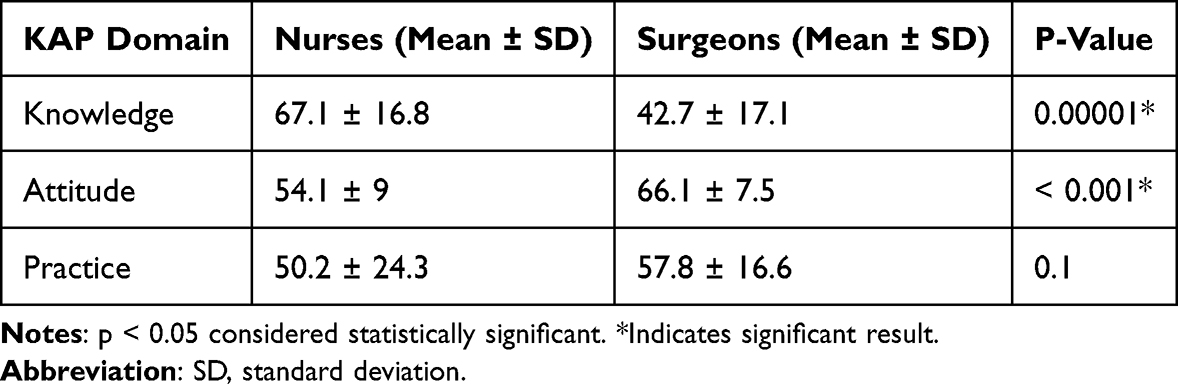 |
Table 1 Comparison of Mean KAP Scores Between Nurses and Surgeons |
The distribution of KAP score categories among nurses and surgeons are illustrated in Figure 1. Nurses demonstrated substantially higher knowledge scores than surgeons (68% vs. 16%). Attitude scores were predominantly neutral for both groups (93% of nurses, 86% of surgeons). Notably, nurses exhibited lower practice performance compared to surgeons (55% vs. 35%).
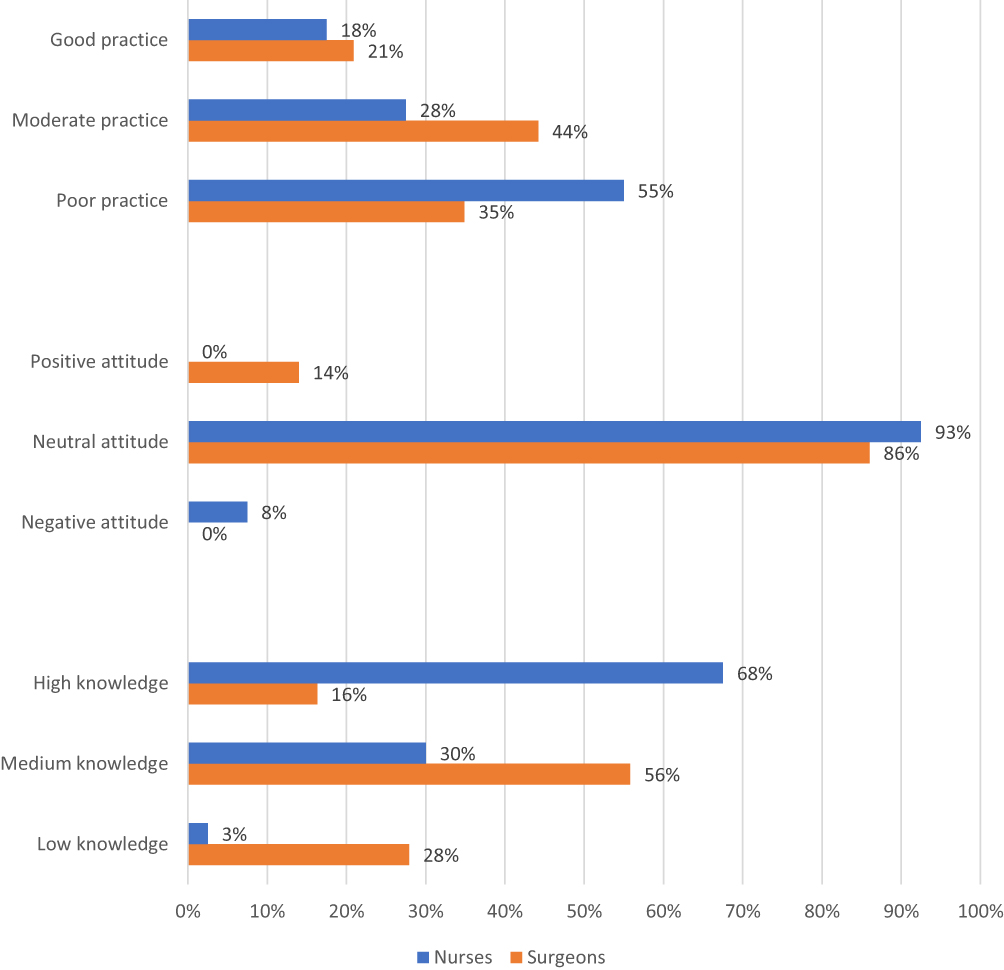 |
Figure 1 KAP Score Categories by Profession. Distribution of Knowledge, Attitude, and Practice (KAP) score categories among ophthalmic surgeons and nurses. Each bar represents the proportion of respondents in each KAP domain, grouped by professional role. Percentages were calculated within each group. |
The most commonly adopted sustainable practice was the use of reusable instruments (81.4% of surgeons, 72.5% of nurses; p = 0.3). Other practices, including minimizing energy consumption, reducing water usage, and waste segregation, were reported less frequently. Importantly, none of the assessed sustainable practices demonstrated a statistically significant difference between surgeons and nurses (all p > 0.05) [Table 2].
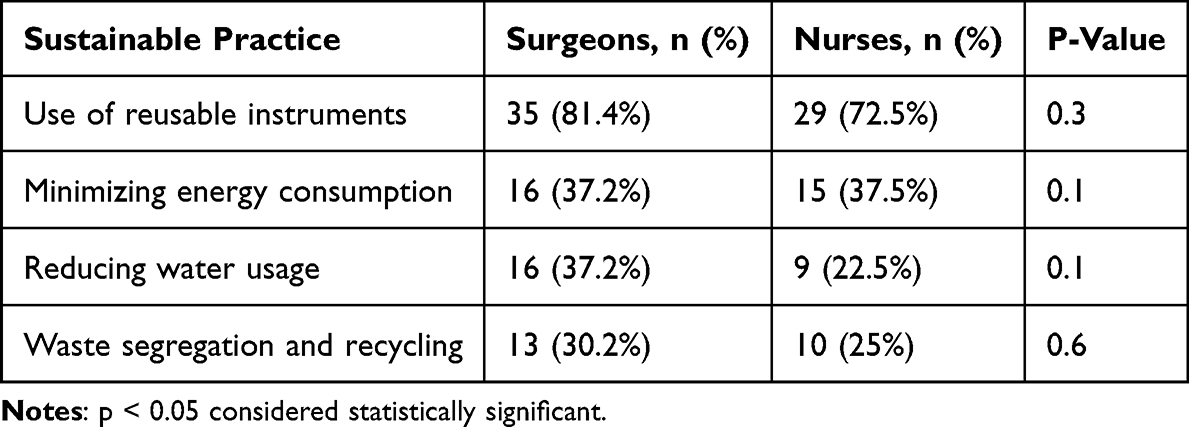 |
Table 2 Sustainable Practices Followed by Job Title |
Knowledge, attitude, and practice scores toward sustainability were compared across hospital types using one-way ANOVA. For attitude scores, respondents from general hospitals demonstrated the most favorable responses, with a mean score of 67%, and an interquartile range (IQR) of 64% to 71%. In specialized eye hospitals, the mean and median scores were 59% and 57%, respectively, with an IQR of 50% to 64%. Private hospitals had the lowest scores, with a mean of 52%, a median of 50%, and an IQR of 46% to 57%. [Figure 2] One-way ANOVA revealed a statistically significant difference in attitude scores between hospital types (F(2,80) = 9.7, p < 0.001) [Table 3].
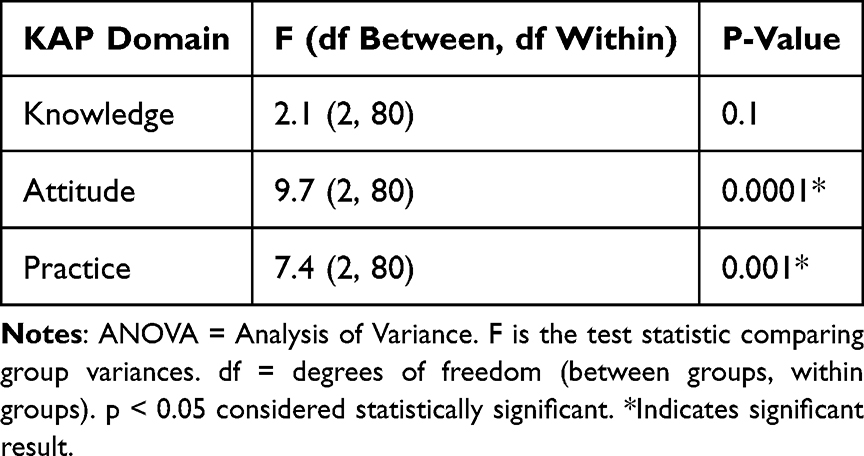 |
Table 3 ANOVA Summary Table for KAP Domains by Hospital Type |
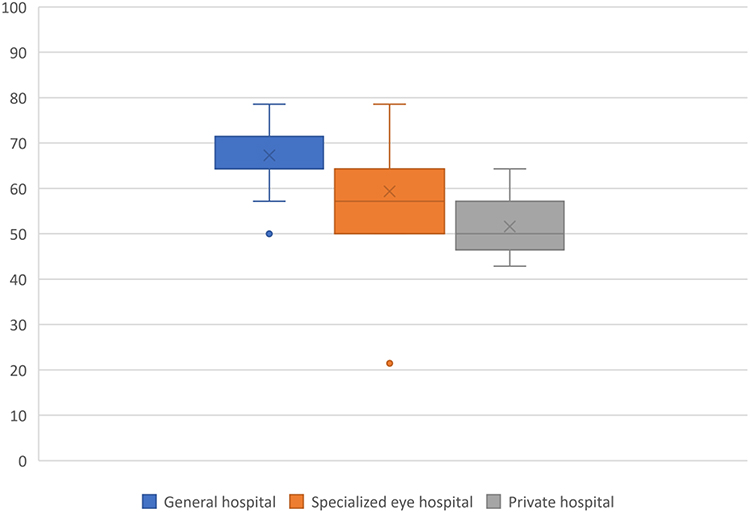 |
Figure 2 Attitude Scores by Hospital Type. Box-and-whisker plot showing the distribution of attitude scores toward sustainability across hospital types. Median scores were highest in general hospitals, followed by specialized eye hospitals and private hospitals. The box represents the interquartile range (IQR), the line inside the box indicates the median, and the “X” denotes the mean. Whiskers show the data range, and dots represent outliers. One-way ANOVA showed a statistically significant difference between hospital types (p = 0.0001). |
Regarding practice scores, participants from specialized eye hospitals again performed best, with a mean of 58%, a median of 54%, and an IQR of 46% to 77%. General hospital staff showed moderate scores (mean = 53%, median = 46%, IQR = 38% to 69%), while private hospitals had the lowest practice scores (mean = 32%, median = 23%, IQR = 23% to 38%). [Figure 3] The difference in practice scores across hospital types was statistically significant (F(2,80) = 7.4, p = 0.001) [Table 3].
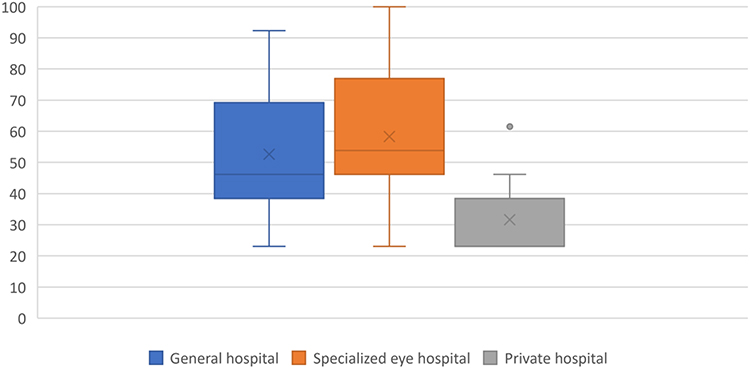 |
Figure 3 Practice Scores by Hospital Types. Box-and-whisker plot showing the distribution of sustainability practice scores across hospital types. Median and mean scores were highest in specialized eye hospitals and lowest in private hospitals. The box represents the IQR, the line inside the box indicates the median, and the “X” denotes the mean. Whiskers extend to 1.5×IQR, and dots represent outliers. One-way ANOVA revealed a statistically significant difference in practice scores between hospital types (p = 0.001). |
However, the difference in knowledge scores based on hospital type was not statistically significant (F(2,80) = 2.1, p = 0.1) [Table 3]. Additionally, one-way ANOVA was conducted to assess the effect of age and years of experience on KAP scores. No statistically significant differences were found across any of the domains for these variables.
Overall, the most frequently reported barriers to sustainability were lack of awareness and difficulty changing established practices. Lack of awareness was cited by 77% of surgeons and 53% of nurses (p = 0.02). A statistically significant difference was also observed for “difficulty changing practices,” reported by 58% of nurses compared to 33% of surgeons (p = 0.02). Other commonly reported obstacles included lack of institutional support (42% of surgeons vs. 43% of nurses), cost of sustainable alternatives (30% vs. 35%, respectively), and time constraints, which were more frequently noted by nurses (48%) than surgeons (30%). [Table 4 and Figure 4].
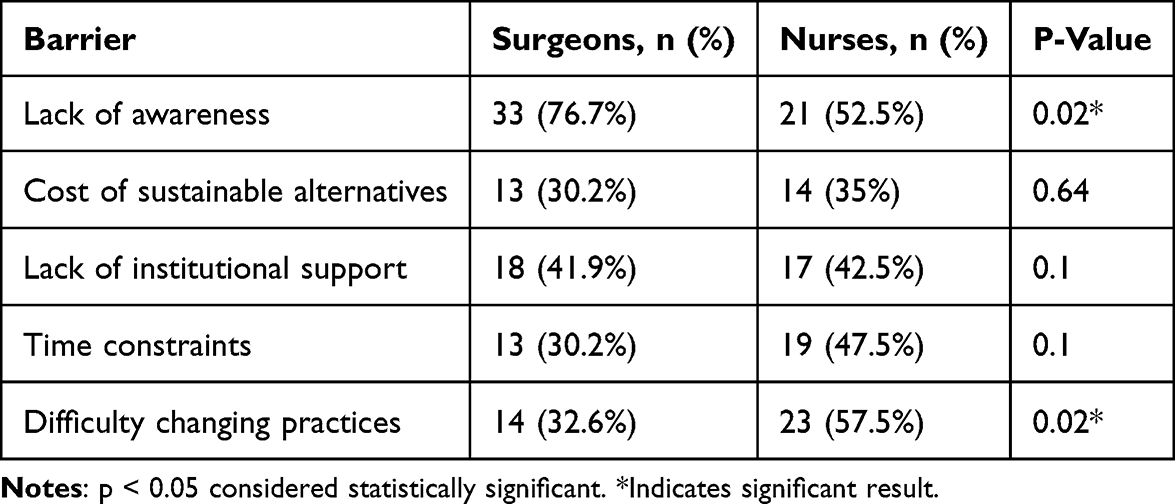 |
Table 4 Barriers to Sustainability by Job Title |
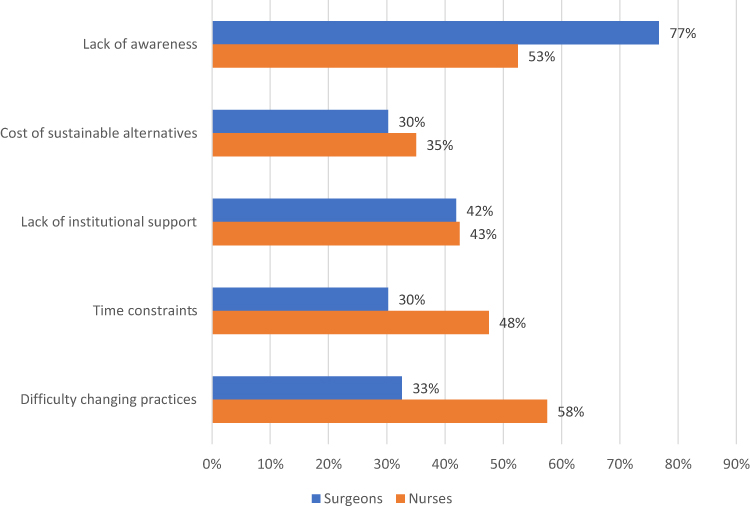 |
Figure 4 Reported Barriers to Sustainability by Job title. Reported barriers to sustainability among ophthalmic surgeons and nurses, presented as percentages. Multiple barriers could be selected by respondents. |
Discussion
This study revealed distinct role-based differences in sustainability-related knowledge, attitudes, and practices among ophthalmic healthcare professionals in Saudi Arabia. Nurses demonstrated significantly higher knowledge scores, whereas surgeons exhibited more positive attitudes toward sustainability. Practice scores did not differ significantly between the two groups. Additionally, attitude and practice scores varied by hospital type, suggesting that institutional context influences the implementation of sustainable behaviors. Overall, participants demonstrated substantial awareness of sustainability in the operating room (OR), consistent with prior reports indicating strong concern among ophthalmic professionals regarding OR waste reduction.5
Our findings showed that nurses achieved higher knowledge scores, but lower practice performance compared to surgeons, despite reporting greater exposure to formal training (25% vs. 4.7%). This pattern is consistent with international data: for example, 74% of nurses in Qatar6 and 61.6% in Bangladesh9 reported attending waste management workshops, whereas physicians typically receive little or no formal training in this area.7 Nurses’ stronger knowledge base may reflect their daily involvement in waste segregation, sterilization processes, and disposal practices.
Several factors may contribute to this knowledge–practice gap. Previous studies have identified institutional and leadership-related barriers to implementation.6,10 Nurses may also perceive sustainability responsibilities as additional workload and feel they have limited influence in institutional decision-making. For instance, even when nurses are well-trained in waste segregation protocols, their efforts may be constrained by inconsistent availability of color-coded bins or the absence of clear hospital-level policies.9 Broader healthcare research similarly highlights insufficient collaboration between training institutions and clinical environments as a contributing factor, with nearly 59% of Pakistani nurses citing this issue.11
This gap may reflect misalignment between sustainability education and real-world clinical practice.12,13 Bridging this divide requires more resilient, practice-relevant curricula that embed sustainability principles into undergraduate education and continuing professional development. Furthermore, stronger collaboration between researchers, policymakers, and clinicians is essential. Knowledge brokering has been proposed as an effective strategy to translate research findings into practical, accessible guidelines; thereby addressing barriers such as limited time and resource.14,15
Hospital type was another important determinant in this study. Attitude and practice scores were higher in general and specialized eye hospitals compared to private hospitals, although knowledge scores did not differ significantly. These findings are consistent with research from Pakistan, where public hospitals demonstrated superior medical waste segregation practices compared to private hospitals (50% vs. 16%).16 Governance-related factors, including leadership commitment, staff empowerment, and institutional policies, are crucial to sustainability adoption, as emphasized in a recent systematic review of governmental hospitals.17 The observed inter-institutional variations suggest that sustainability is not yet consistently embedded within organizational governance structures. Such inconsistency may pose a potential system-level risk, including operational inefficiency, regulatory non-compliance, and potential reputational impact. Integrating sustainability into hospital quality-assurance and accreditation frameworks could reduce these risks while enhancing institutional accountability.18
Cost remains a widely cited barrier to sustainability, noted by roughly one-third of our respondents. While initial expenses can be high, several studies show that integrating green practices can yield significant long-term savings. For example, one institution saved $60,000–$158,000 annually by reducing red bag waste.17 This may also explain why some private hospitals with greater upfront resources (eg., Tehran University–affiliated facilities) performed better in certain sustainability dimensions.19
Looking forward, physicians and nurses can contribute differently to driving change. Surgeons, as decision-makers, are well-positioned to influence supply utilization, pharmaceuticals choices, and surgical workflows, while nurses play a critical role in waste reduction and day-to-day implementation of sustainable practices. Integrating structured sustainability modules into ophthalmology residency programs and nursing curricula would provide foundational knowledge and promote early professional engagement. Additionally, incorporating sustainability indicators into hospital quality metrics and accreditation frameworks could institutionalize accountability and encourage leadership-driven implementation. Embedding sustainability into CME programs, hospital induction processes, grand rounds, and professional meetings may further support cultural change within ophthalmology.20 From a policy perspective, formal institutional guidelines and leadership-driven monitoring systems are essential to embed sustainability into routine practice.
This study has several limitations. It relied on self-reported questionnaires, which may be subject to response and social desirability bias. Its cross-sectional design limits causal inference, and the relatively small sample size, particularly within hospital subgroups, may not fully capture the diversity of ophthalmic professionals. Additionally, the voluntary nature of participation may have introduced selection bias, as individuals with a greater interest in sustainability may have been more likely to respond to the survey. Finally, as the study was conducted within the Saudi Arabian healthcare system, the findings may not be fully generalizable to other geographic or healthcare settings with different organizational structures and policies.
Future research should evaluate interventional and cost-focused strategies. Studies assessing the effect of training programs on KAP outcomes, combined with cost–benefit analyses of green strategies in ophthalmology, would clarify how to achieve long-term, cost-effective change. Qualitative research, such as interviews or focus groups, could also provide valuable insights into the motivations and barriers that shape sustainable practice in ophthalmology. Positioning sustainability within existing risk-management and policy frameworks will help ensure that environmentally responsible practices become integral to healthcare quality, safety, and long-term system resilience.
Disclosure
The authors report no conflicts of interest in this work.
References
1. Rodríguez-Jiménez L, Romero-Martín M, Spruell T, Steley Z, Gómez-Salgado J. The carbon footprint of healthcare settings: a systematic review. J Adv Nurs. 2023;79(8):2830–9. doi:10.1111/jan.15671
2. Morris DS, Wright T, Somner JEA, Connor A. The carbon footprint of cataract surgery. Eye. 2013;27(4):495–501. doi:10.1038/eye.2013.9
3. Thiel CL, Schehlein E, Ravilla T, et al. Cataract surgery and environmental sustainability: waste and lifecycle assessment of phacoemulsification at a private healthcare facility. J Cataract Refract Surg. 2017;43(11):1391–1398. doi:10.1016/J.JCRS.2017.08.017
4. Venkatesh R, Van Landingham SW, Khodifad AM, et al. Carbon footprint and cost-effectiveness of cataract surgery. Curr Opin Ophthalmol. 2016;27(1):82–88. doi:10.1097/ICU.0000000000000228
5. Chang DF, Thiel CL. Survey of cataract surgeons’ and nurses’ attitudes toward operating room waste. J Cataract Refract Surg. 2020;46(7):933–940. doi:10.1097/j.jcrs.0000000000000267
6. Musa F, Mohamed A, Selim N. Assessment of Nurses’ Practice and Potential Barriers Regarding the Medical Waste Management at Hamad Medical Corporation in Qatar: a Cross-Sectional Study. Cureus. 2020;12(5). doi:10.7759/CUREUS.8281
7. JW Maina. Knowledge, Attitude and Practice of Staff on Segregation of Hospital Waste: a Case Study of a Tertiary Private Hospital in Kenya. Eur Sci J. 2018;14(9):401. doi:10.19044/esj.2018.v14n9p401
8. Akore Yeboah E, Adegboye ARA, Kneafsey R. Nurses’ perceptions, attitudes, and perspectives in relation to climate change and sustainable healthcare practices: a systematic review. J Climate Change Health. 2024;16:100290. doi:10.1016/J.JOCLIM.2023.100290
9. Uddin MN, Islam MR, Yesmin K. Knowledge on Hospital Waste Management among Senior Staff Nurses Working in a Selected Medical College Hospital of Bangladesh. J Waste Manage. 2014;2014(1):573069. doi:10.1155/2014/573069
10. Álvarez-Nieto C, Parra-Anguita L, Álvarez-García C, et al. Sustainability education in nursing degree for climate-smart healthcare: a quasi-experimental study. Int J Sustainablility in Higher Educ. 2024;25(9):278–292. doi:10.1108/IJSHE-01-2024-0061
11. Danish M, Jaffer M, Kashf A, et al. Assessment Of Nurses’ Knowledge Regarding The Theory-Practice Gap In Hospitals Of Bahawalpur. Front Med Health Res. 2025;3(2):283–290 doi:10.5281/zenodo.15209043
12. Freemantle N, Nazareth I, Eccles M, et al. A randomised controlled trial of the effect of educational outreach by community pharmacists on prescribing in UK general practice. Br J Gen Pract. 2002;52(477):290.
13. Ajani K, Moez S. Gap between knowledge and practice in nursing. Procedia Soc Behav Sci. 2011;15:3927–3931. doi:10.1016/J.SBSPRO.2011.04.396
14. Haines A, Kuruvilla S, Borchert M. Bridging the implementation gap between knowledge and action for health. Bull World Health Organ. 2004;82(10):724.
15. Canadian Health Services Research Foundation. The Theory and Practice of Knowledge Brokering in Canada’s Health System. A Report Based on a CHSRF National Consultation and a Literature Review; 2003. Available from: www.chrsf.ca.
16. Badar S. Health Care Waste Management Practices in Public and Private Sector Hospitals. J Rawalpindi Med College. 2014;18(1):1.
17. Gorgun E, Dehipawala S, O’Hara M, et al. Environmental Sustainability Initiatives in the Operating Room: a Scoping Review. Ann Surg Open. 2024;5(3):e451. doi:10.1097/AS9.0000000000000451
18. van Schie V. Governance related factors influencing the implementation of sustainability in hospitals: a systematic literature review. Health Policy. 2024;146:105115. doi:10.1016/J.HEALTHPOL.2024.105115
19. Azar FE, Farzianpour F, Foroushani AR, et al. Evaluation of Green Hospital Dimensions in Teaching and Private Hospitals Covered by Tehran University of Medical Sciences. J Serv Sci Manage. 2015;8(2):259–266. doi:10.4236/JSSM.2015.82029
20. Sherry B, Lee S, Ramos Cadena MDLA, et al. How Ophthalmologists Can Decarbonize Eye Care: a Review of Existing Sustainability Strategies and Steps Ophthalmologists Can Take. Ophthalmology. 2023;130(7):702–714. doi:10.1016/j.ophtha.2023.02.028
 © 2026 The Author(s). This work is published and licensed by Dove Medical Press Limited. The
full terms of this license are available at https://www.dovepress.com/terms
and incorporate the Creative Commons Attribution
- Non Commercial (unported, 4.0) License.
By accessing the work you hereby accept the Terms. Non-commercial uses of the work are permitted
without any further permission from Dove Medical Press Limited, provided the work is properly
attributed. For permission for commercial use of this work, please see paragraphs 4.2 and 5 of our Terms.
© 2026 The Author(s). This work is published and licensed by Dove Medical Press Limited. The
full terms of this license are available at https://www.dovepress.com/terms
and incorporate the Creative Commons Attribution
- Non Commercial (unported, 4.0) License.
By accessing the work you hereby accept the Terms. Non-commercial uses of the work are permitted
without any further permission from Dove Medical Press Limited, provided the work is properly
attributed. For permission for commercial use of this work, please see paragraphs 4.2 and 5 of our Terms.