
Back to Journals » International Journal of Women's Health » Volume 18
Sex Differences in the Effects of Perioperative Rehabilitation on Postoperative Pulmonary Complications After Cardiac Valve Surgery: A Prespecified Subgroup Analysis of the PORT Randomized Trial
Authors Tan S, Liu Z, Cai X, Bai B, Jiang Z, Zhang S, Chen X, Xu J, Zhang G, Guo L, Ge Q, Ma H 
Received 23 October 2025
Accepted for publication 9 July 2026
Published 23 July 2026 Volume 2026:18 576395
DOI https://doi.org/10.2147/IJWH.S576395
Checked for plagiarism Yes
Review by Single anonymous peer review
Peer reviewer comments 2
Editor who approved publication: Dr Everett Magann
Shuyuan Tan,1,2,* Zhi Liu,1,2,* Xiangyu Cai,1,2,* Bingqing Bai,1 Zhongxing Jiang,1 Shengqing Zhang,1,2 Xianyuan Chen,1,2 Jindong Xu,3,4 Guolin Zhang,1,2 Lan Guo,1,2 Qinggang Ge,5 Huan Ma1,2
1Department of Cardiology, Guangdong Provincial People’s Hospital (Guangdong Academy of Medical Sciences), Southern Medical University, Guangzhou, Guangdong, People’s Republic of China; 2Department of Cardiac Rehabilitation, Guangdong Cardiovascular Institute, Guangdong Provincial People’s Hospital, Guangdong Academy of Medical Sciences, Guangzhou, Guangdong, People’s Republic of China; 3Department of Anesthesiology, Guangdong Provincial People’s Hospital (Guangdong Academy of Medical Sciences), Southern Medical University, Guangzhou, Guangdong, People’s Republic of China; 4School of Medicine, South China University of Technology, Guangzhou, Guangdong, People’s Republic of China; 5Department of Intensive Care Medicine, Peking University Third Hospital, Beijing, 100191, People’s Republic of China
*These authors contributed equally to this work
Correspondence: Huan Ma, Department of Cardiology, Guangdong Provincial People’s Hospital (Guangdong Academy of Medical Sciences), Southern Medical University, Guangzhou, Guangdong, People’s Republic of China, Email [email protected] Qinggang Ge, Department of Intensive Care Medicine, Peking University Third Hospital, Beijing, 100191, People’s Republic of China, Email [email protected]
Purpose: To evaluate whether biological sex modifies the association between perioperative rehabilitation and short-term postoperative pulmonary outcomes in patients undergoing cardiac valve surgery.
Patients and Methods: This prespecified subgroup analysis was based on the PORT randomized controlled trial, a single-center prospective study including 818 adults undergoing elective valve surgery. Patients were randomized to usual care or additional perioperative rehabilitation. Usual care followed standard institutional protocols without structured therapist-led rehabilitation. The intervention group received a supervised program including patient education, inspiratory muscle training, active cycle of breathing techniques, and early mobilization from admission to discharge. The primary endpoint was a composite of in-hospital mortality, postoperative pulmonary complications (PPCs), and prolonged hospitalization (> 7 days). Key secondary endpoints were radiologically confirmed pneumonia and pneumothorax within 7 days and before discharge. Sex-stratified multivariable Cox models were used to estimate adjusted hazard ratios (HRs), adjusting for age, body mass index, left ventricular ejection fraction category, Global Initiative for Chronic Obstructive Lung Disease category, hypertension, and smoking history.
Results: Perioperative rehabilitation was not associated with a significant reduction in the primary composite outcome in either sex. Among female patients, it was associated with lower risks of PPCs (adjusted HR 0.55, 95% CI 0.36– 0.83; P = 0.005) and pneumonia (adjusted HR 0.48, 95% CI 0.33– 0.70; P < 0.001), with a lower risk of pneumothorax also observed (adjusted HR 0.40, 95% CI 0.17– 0.99; P = 0.047). No significant associations were observed in male patients. A significant sex-by-treatment interaction was identified for pneumonia (P for interaction = 0.041).
Conclusion: Perioperative rehabilitation was associated with improved short-term pulmonary outcomes in female patients, particularly for pneumonia, whereas no significant benefit was observed in males. These findings suggest a potential sex-specific response, which requires confirmation in future multicenter studies.
Keywords: perioperative rehabilitation, pulmonary complications, sex differences, valve surgery
Introduction
Cardiovascular diseases exhibit important sex-related differences that extend to outcomes after valvular heart surgery.1 Female patients have been reported to experience higher perioperative mortality following mitral valve procedures and may face increased pulmonary risks during aortic valve replacement.2,3 These disparities may reflect a combination of anatomical, physiological, and clinical factors. Compared with males, females generally have smaller thoracic dimensions, lower respiratory muscle reserve, and reduced pulmonary reserve, which may increase vulnerability to postoperative atelectasis, impaired secretion clearance, and respiratory complications. Sex-related differences in inflammatory and autonomic responses may also influence perioperative pulmonary recovery. In addition, delayed diagnosis and more advanced valvular disease at presentation may further contribute to perioperative risk. However, sex differences in cardiac surgery outcomes are multifactorial and may vary across procedures and clinical contexts rather than representing a uniform disadvantage across all female patients.4,5
Postoperative pulmonary complications (PPCs) are among the most common adverse events after cardiac surgery, occurring in up to 55% of patients and comprising a heterogeneous group of conditions.6 These include pleural effusion, atelectasis, acute respiratory failure, pneumonia, and pneumothorax, with substantial variability in clinical severity. Among these, pneumonia and pneumothorax are of particular clinical relevance. Postoperative pneumonia is strongly associated with adverse outcomes, prolonged hospitalization, and increased healthcare utilization.7 Whereas pneumothorax, although less frequent, may require invasive intervention such as tube thoracostomy and can be life-threatening in severe cases.8 This heterogeneity highlights the importance of evaluating clinically meaningful individual components of PPCs.
Perioperative rehabilitation, including inspiratory muscle training, active cycle of breathing techniques, and early mobilization, may reduce PPCs through complementary physiological mechanisms. Inspiratory muscle training can enhance respiratory muscle strength and promote lung expansion; active cycle of breathing techniques facilitate airway clearance and reduce secretion retention; and early mobilization improves ventilation–perfusion matching, reduces pulmonary stasis, and preserves functional capacity.9–11 The Perioperative Rehabilitation Trial (PORT) demonstrated that a structured perioperative rehabilitation bundle reduced the incidence of PPCs in patients undergoing elective cardiac valve surgery.12 Although the composite primary endpoint was not significantly different between groups, the observed reduction in PPCs suggests potential clinical benefit and underscores the importance of examining individual outcomes.
However, whether biological sex modifies the association between perioperative rehabilitation and postoperative pulmonary outcomes remains unclear. The present study is a prespecified subgroup analysis of the PORT randomized trial and aims to evaluate whether the effects of perioperative rehabilitation on short-term postoperative pulmonary outcomes differ by sex. The primary endpoint was a composite of in-hospital mortality, postoperative pulmonary complications (PPCs), and prolonged hospitalization, while pneumonia and pneumothorax were examined as key secondary pulmonary endpoints given their clinical relevance. This analysis seeks to provide further insight into potential sex-specific differences in postoperative pulmonary recovery and to inform more individualized perioperative rehabilitation strategies.
Materials and Methods
Study Design
This study was a prespecified sex-based subgroup analysis of the PORT randomized controlled trial, a single-center, prospective, open-label, parallel-arm study. The study protocol was approved by the Medical Research Ethics Committee of Guangdong Provincial People’s Hospital (Approval No. 2018-297H-12). Written informed consent was obtained from all participants prior to enrollment. The study was conducted in accordance with the Declaration of Helsinki and reported in accordance with the Consolidated Standards of Reporting Trials (CONSORT) guidelines.
We included 818 adults scheduled for elective valvular surgery between January 2019 and June 2022, of whom 412 (50.4%) were female. Participants were randomized in a 1:1 ratio to receive either usual perioperative care or the PORT intervention.
Usual care consisted of standard institutional perioperative management, including routine education and unguided respiratory exercises (deep breathing, coughing, and incentive spirometry), which patients were encouraged to perform independently.
The PORT intervention comprised a structured perioperative rehabilitation program delivered under physiotherapist supervision, including four core components: education, inspiratory muscle training (IMT), active cycle of breathing techniques (ACBT), and early mobilization (EM). The intervention was implemented from hospital admission until discharge.
Inspiratory muscle training was performed twice daily for approximately 20 minutes per session, initiated at 30% of maximal inspiratory pressure and progressively increased in 5% increments to maintain a rating of perceived exertion (RPE) of 11–13. Active cycle of breathing techniques were performed three times daily (approximately 10 minutes per session). Early mobilisation was initiated on postoperative day 1 and conducted twice daily using a stepwise progression protocol. Exercise intensity was individually titrated based on patient tolerance and clinical status, with lower targets applied in the intensive care setting and moderate intensity on the general ward.
Prior to each session, physiotherapists performed a standardized safety assessment. Rehabilitation was initiated only when predefined safety criteria were met, including stable vital signs, adequate consciousness (eg, S5Q ≥ 2), absence of new clinically significant arrhythmias or electrocardiographic changes, and no evidence of clinical deterioration. Rehabilitation was withheld in the presence of predefined contraindications, including heart rate <40 or >130 beats/min, systolic blood pressure <80 or >200 mmHg, diastolic blood pressure <50 or >110 mmHg, oxygen saturation ≤90%, respiratory rate >30 breaths/min, Richmond Agitation-Sedation Scale scores of −4, −5, +3, or +4, body temperature ≥38.5°C or ≤36°C, or hemodynamic instability requiring high-dose vasoactive support. All sessions were delivered by trained physiotherapists following standardized institutional protocols.
Surgical Procedures
Valve surgery was performed using standardized institutional techniques through either median sternotomy or thoracoscopic/minimally invasive approaches, according to valve pathology, anatomical suitability, and surgeon discretion. Median sternotomy was the conventional approach, whereas selected patients underwent thoracoscopic surgery when clinically appropriate.
For sternotomy cases, central aortic and bicaval venous cannulation was generally used. In thoracoscopic cases, peripheral cannulation was used when required. Pleural opening was avoided whenever feasible but could occur depending on surgical exposure and operative requirements.
No patients underwent thymectomy. Throughout all procedures, careful attention was paid to preservation of the phrenic nerves. Chest drainage and postoperative ventilatory management followed standardized institutional protocols.
Pulmonary Function Assessment
Pulmonary function was assessed using maximal inspiratory pressure (MIP), measured preoperatively and postoperatively using a respiratory pressure meter according to standardized procedures. MIP reflects inspiratory muscle strength and is widely used to evaluate respiratory muscle function in perioperative settings.
Outcomes
The primary endpoint was a composite of in-hospital mortality, postoperative pulmonary complications (PPCs), and prolonged hospitalization (defined as postoperative length of stay >7 days).
Key secondary pulmonary endpoints included radiologically confirmed pneumonia (defined as consolidation with compatible clinical features) and pneumothorax (presence of pleural air without vascular cause). These outcomes were assessed within the first 7 postoperative days and before hospital discharge.
Postoperative outcomes were continuously monitored throughout hospitalization rather than assessed at predefined discrete time points. Clinical data and hospitalization records were reviewed daily by two independent investigators blinded to group allocation. Imaging studies (eg, chest radiography or computed tomography) were performed based on clinical indication rather than systematically. All suspected PPC events were adjudicated by a multidisciplinary team blinded to treatment allocation using established diagnostic criteria.
Additional outcomes included surgical intensive care unit (SICU) length of stay and 3-month all-cause mortality.
Statistical Analysis
Sex-stratified analyses were performed according to the prespecified study protocol. Continuous variables were presented as mean ± standard deviation or median with interquartile range, depending on distribution. Categorical variables were expressed as frequencies and percentages.
Between-group comparisons were conducted using the chi-square test or Fisher’s exact test for categorical variables and independent-samples t-tests for continuous variables.
Multivariable Cox proportional hazards models were used to estimate hazard ratios (HRs) and 95% confidence intervals (CIs), adjusting for clinically relevant covariates, including age, body mass index (BMI), left ventricular ejection fraction (LVEF) category, Global Initiative for Chronic Obstructive Lung Disease (GOLD) category, hypertension, and smoking history. An interaction term between sex and treatment allocation was included to evaluate potential sex-specific effects.
The proportional hazards assumption was assessed using Schoenfeld residuals, and no violations were observed (all P > 0.05). Diagnostic plots are provided in the Supplementary Materials (Figures S1 and S2).
A two-sided P value <0.05 was considered statistically significant. No formal adjustment for multiple comparisons was performed; therefore, subgroup findings should be interpreted with caution.
All statistical analyses were conducted using R software (version 4.1.2; R Foundation for Statistical Computing, Vienna, Austria).
Results
Baseline Characteristics
Among the 818 participants enrolled in the PORT trial, 412 (50.4%) were female (Figure 1). Baseline demographic and clinical characteristics stratified by sex are summarized in Table 1.
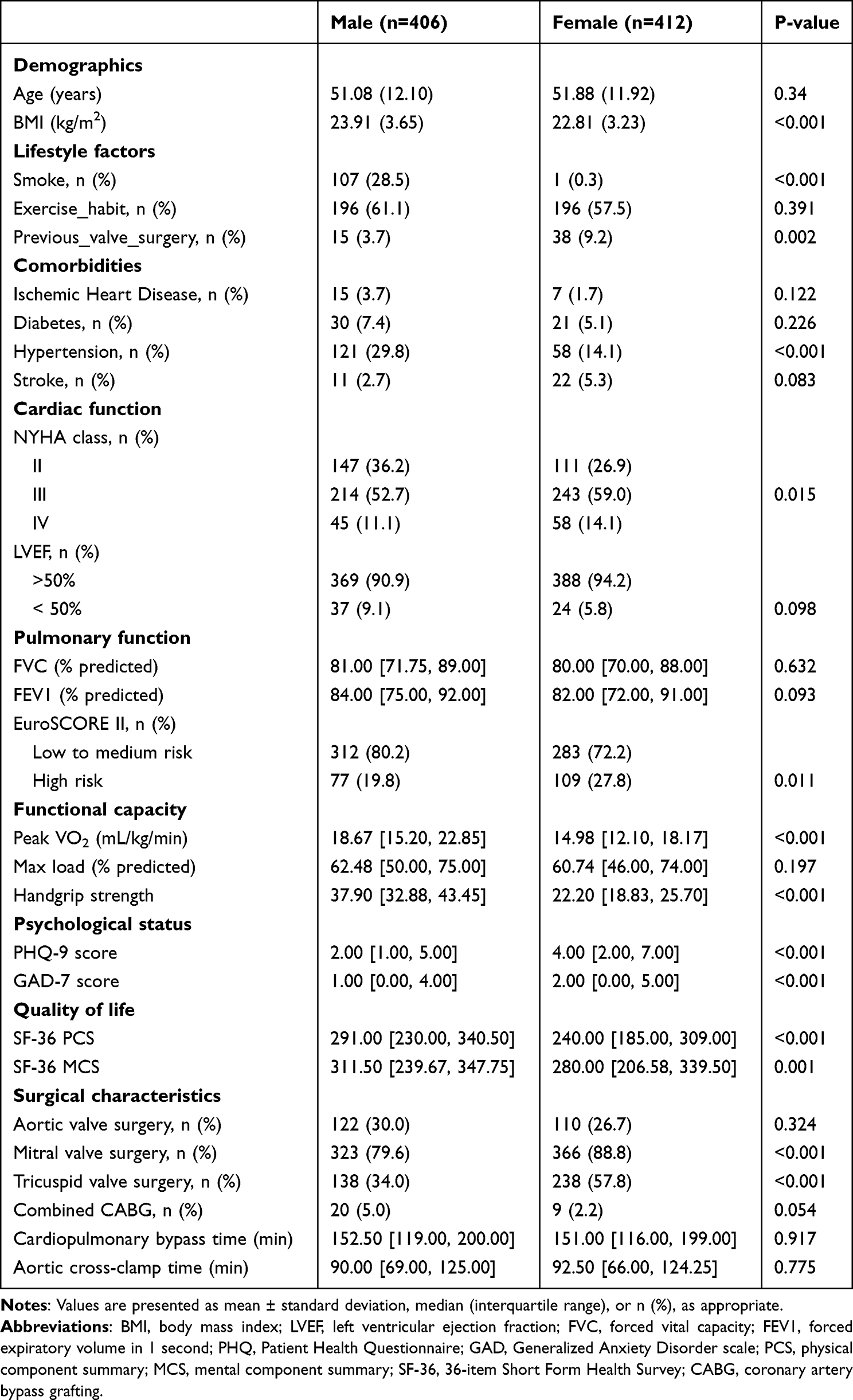 |
Table 1 Baseline Characteristics of Patients Stratified by Sex |
 |
Figure 1 Study flow diagram of participant enrollment, randomization, and analysis in the PORT trial. |
Compared with males, female participants had significantly lower body mass index (BMI) (P < 0.001), lower prevalence of hypertension (P < 0.001), and were substantially less likely to be current smokers (0.3% vs 28.5%, P < 0.001). Females also demonstrated lower peak oxygen uptake, reduced handgrip strength, and higher levels of depressive and anxiety symptoms (PHQ-9 and GAD-7; all P < 0.001). In addition, females had lower physical and mental component scores on the SF-36, indicating poorer baseline functional status and quality of life.
Regarding surgical characteristics, females were more likely to undergo mitral and tricuspid valve procedures, whereas males had a slightly higher prevalence of combined CABG procedures (Table 1).
Primary Outcomes
Within the female subgroup, participants receiving the PORT intervention had significantly lower rates of postoperative pulmonary complications (PPCs) within 7 days compared with usual care (38.2% vs 51.3%, P = 0.005). The incidence of pneumonia (19.8% vs 36.7%, P < 0.001) was significantly reduced, and a lower incidence of pneumothorax (3.8% vs 8.0%, P = 0.047) was also observed (Table 2).
 |
Table 2 Primary and Secondary Outcomes Within 7 Days Stratified by Sex |
In contrast, no statistically significant differences in PPCs or individual pulmonary complications were observed between treatment groups among male patients.
A statistically significant interaction between sex and treatment allocation was observed for pneumonia (P for interaction = 0.044), indicating a differential treatment effect by sex.
These findings were consistent when outcomes were assessed prior to discharge, with persistent reductions in PPCs, pneumonia, and pneumothorax among females but not males (Table S1).
Kaplan–Meier Analysis
Kaplan–Meier curves demonstrated that, in female patients, the cumulative incidence of pneumothorax (Figure 2), any PPCs (Figure 3), and pneumonia (Figure 4) increased at a significantly slower rate in the PORT group compared with the usual care group (all P < 0.01), whereas no significant difference was observed for pleural effusion (P = 0.58) (Figure 5). In contrast, among male patients, no significant between-group differences were observed for any of these outcomes (Figures 6–9).
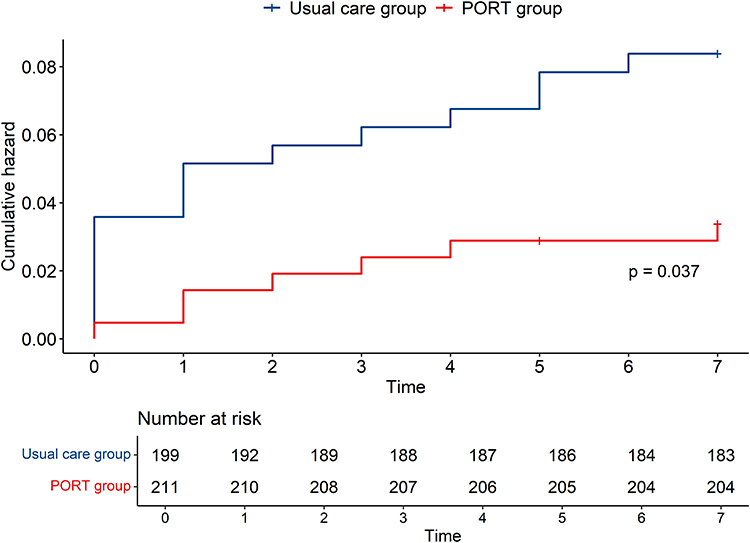 |
Figure 2 Kaplan–Meier curves for pneumothorax within 7 days after surgery among female patients. Comparison between the PORT group and the usual care group. |
 |
Figure 3 Kaplan–Meier curves for postoperative pulmonary complications (PPCs) within 7 days after surgery among female patients. Comparison between the PORT group and the usual care group. |
 |
Figure 4 Kaplan–Meier curves for pneumonia within 7 days after surgery among female patients. Comparison between the PORT group and the usual care group. |
 |
Figure 5 Kaplan–Meier curves for pleural effusion within 7 days after surgery among female patients. Comparison between the PORT group and the usual care group. |
 |
Figure 6 Kaplan–Meier curves for pneumothorax within 7 days after surgery among male patients. Comparison between the PORT group and the usual care group. |
 |
Figure 7 Kaplan–Meier curves for postoperative pulmonary complications (PPCs) within 7 days after surgery among male patients. Comparison between the PORT group and the usual care group. |
 |
Figure 8 Kaplan–Meier curves for pneumonia within 7 days after surgery among male patients. Comparison between the PORT group and the usual care group. |
 |
Figure 9 Kaplan–Meier curves for pleural effusion within 7 days after surgery among male patients. Comparison between the PORT group and the usual care group. |
Multivariate Cox Regression
In sex-stratified multivariable Cox proportional hazards models adjusted for age, BMI, LVEF category, GOLD category, hypertension, and smoking history, perioperative rehabilitation was independently associated with a reduced risk of PPCs in female patients (adjusted HR 0.55, 95% CI 0.36–0.83, P = 0.005), but not in males (adjusted HR 0.93, 95% CI 0.62–1.39, P = 0.715) (Table 2).
Significant benefits were observed in female patients, particularly for pneumonia (adjusted HR 0.48, 95% CI 0.33–0.70, P < 0.001). A lower risk of pneumothorax was also observed after adjustment (adjusted HR 0.40, 95% CI 0.17–0.99, P = 0.047). No statistically significant associations were identified in males.
Interaction testing confirmed a significant sex-by-treatment interaction for pneumonia, supporting the presence of sex-specific differences in response to perioperative rehabilitation. The proportional hazards assumption was satisfied for all models, with no significant violations detected (all P > 0.05).
Discussion
This study provides evidence of sex-specific differences in the effectiveness of perioperative rehabilitation in patients undergoing valve surgery. We found that female patients derived substantial pulmonary benefit from structured perioperative rehabilitation, including a significant reduction in pneumonia risk and a lower risk of pneumothorax, whereas no statistically significant benefit was observed in male patients. The presence of a significant sex-by-treatment interaction for pneumonia further supports the hypothesis that biological sex may modify the response to perioperative rehabilitation.
Sex-related differences in cardiovascular and respiratory physiology may partly explain these findings. Compared with male patients, female patients generally have lower cardiopulmonary reserve, smaller airway caliber, and distinct autonomic and inflammatory profiles.13–15 In our cohort, females also demonstrated lower baseline functional capacity and respiratory reserve, which may increase susceptibility to postoperative pulmonary complications while also providing greater potential for improvement with perioperative rehabilitation. In contrast, males may have had higher baseline reserve, resulting in a reduced measurable incremental benefit, consistent with a possible ceiling effect. Together, these findings suggest that baseline physiological reserve may influence responsiveness to perioperative rehabilitation.
These findings are particularly relevant in the context of persistent underutilization of perioperative rehabilitation among female patients. Despite evidence suggesting that females may achieve meaningful improvements in functional capacity and quality of life through rehabilitation, participation rates remain lower than those of males.16–18 Structural and behavioral factors—including referral patterns, caregiving responsibilities, and access barriers—may contribute to these disparities and limit the delivery of potentially beneficial interventions.19–21
From a clinical perspective, these results highlight the importance of considering biological sex as a potential modifier of response to perioperative rehabilitation. However, caution is warranted before translating these findings into routine sex-specific rehabilitation pathways. External validation in larger multicenter cohorts and mechanistic studies is required to confirm reproducibility and clarify underlying causal mechanisms.
Importantly, because this was a secondary subgroup analysis not specifically powered for sex-stratified comparisons, the absence of statistically significant benefit in male patients should not be interpreted as conclusive evidence of no effect. Clinically meaningful benefits in males cannot be excluded and require further investigation.
The present analysis was based on biological sex; however, gender-related determinants—including health-seeking behavior, social support, adherence, and access to care—may also influence postoperative outcomes. Future research should explicitly evaluate both biological and sociocultural contributors to response to perioperative rehabilitation.
Overall, this study extends existing evidence on perioperative rehabilitation by identifying biological sex as a potential modifier of treatment response in postoperative pulmonary complications, thereby supporting a more individualized and mechanistically informed approach to perioperative care.
Limitations
This study has several limitations. First, as a single-center study, the generalizability of the findings may be limited. Second, although key clinical variables were adjusted for, residual confounding cannot be excluded. In particular, baseline differences in smoking history between female and male participants, as well as unmeasured perioperative and intraoperative factors (eg surgical heterogeneity, analgesic strategies, and ventilatory management), may have influenced postoperative pulmonary outcomes. Third, this was a prespecified subgroup analysis that was not specifically powered for sex-stratified comparisons, which may reduce statistical precision, particularly in male patients. Fourth, the rehabilitation intervention involved increased contact with physiotherapists, introducing the potential for performance bias. Finally, no formal adjustment for multiple comparisons was performed, and the durability of the observed short-term benefits remains uncertain.
Conclusion
Perioperative rehabilitation was associated with improved short-term postoperative pulmonary outcomes in female patients after valve surgery, particularly for pneumonia, whereas no statistically significant benefit was observed in males. These findings suggest that biological sex may modify the short-term response to perioperative rehabilitation; however, the absence of observed benefit in males should be interpreted with caution, as subgroup analyses may have been underpowered.
Further multicenter studies with longer-term follow-up and mechanistic investigation are warranted to confirm these findings before translation into clinical practice.
Ethical Consideration
The study protocol was approved by the Medical Research Ethics Committee of Guangdong Provincial People’s Hospital (Approval No. 2018-297H-12). Written informed consent was obtained from all participants prior to enrollment. The study was conducted in accordance with the Declaration of Helsinki and reported in accordance with the Consolidated Standards of Reporting Trials (CONSORT) guidelines.
Author Contributions
All authors made a significant contribution to the work reported, whether that is in the conception, study design, execution, acquisition of data, analysis and interpretation, or in all these areas; took part in drafting, revising or critically reviewing the article; gave final approval of the version to be published; have agreed on the journal to which the article has been submitted; and agree to be accountable for all aspects of the work.
Funding
This study is supported by Su Ke’an Pharmaceutical Research and Development Project (202460), Guangzhou Municipal Science and Technology Program key projects (2023B03J1249), and Special Project for Clinical Collaboration between Traditional Chinese Medicine and Western Medicine of the National Administration of Traditional Chinese Medicine (No. ZDYN-2024-B-010; 2024129).
Disclosure
The authors report no conflicts of interest in this work.
References
1. Song HK, Grab JD, O’Brien SM, et al. Gender differences in mortality after mitral valve operation: evidence for higher mortality in perimenopausal women. Ann Thorac Surg. 2008;85(6):2040–13. doi:10.1016/j.athoracsur.2008.02.082
2. Regitz-Zagrosek V, Oertelt-Prigione S, Prescott E, et al. Gender in cardiovascular diseases: impact on clinical manifestations, management, and outcomes. Eur Heart J. 2016;37(1):24–34. doi:10.1093/eurheartj/ehv598
3. Vassileva CM, McNeely C, Mishkel G, et al. Gender differences in long-term survival of Medicare beneficiaries undergoing mitral valve operations. Ann Thorac Surg. 2013;96(4):1367–1373. doi:10.1016/j.athoracsur.2013.04.055
4. Steeds RP, Messika-Zeitoun D, Thambyrajah J, et al. IMPULSE: the impact of gender on the presentation and management of aortic stenosis across Europe. Open Heart. 2021;8(1):e001443. doi:10.1136/openhrt-2020-001443
5. Iribarren AC, AlBadri A, Wei J, et al. Sex differences in aortic stenosis: identification of knowledge gaps for sex-specific personalized medicine. Am Heart J Plus. 2022;21:100197. doi:10.1016/j.ahjo.2022.100197
6. Fischer MO, Brotons F, Briant AR, et al. Postoperative pulmonary complications after cardiac surgery: the VENICE international cohort study. J Cardiothorac Vasc Anesth. 2022;36(7):2344–2351. doi:10.1053/j.jvca.2021.12.024
7. He S, Wu F, Wu X, et al. Ventilator-associated events after cardiac surgery: evidence from 1,709 patients. J Thorac Dis. 2018;10(2):776–782. doi:10.21037/jtd.2018.01.49
8. Douglas JM, Spaniol S. Prevention of postoperative pneumothorax in patients undergoing cardiac surgery. Am J Surg. 2002;183(5):551–553. doi:10.1016/S0002-9610(02)00839-5
9. Katsura M, Kuriyama A, Takeshima T, et al. Preoperative inspiratory muscle training for postoperative pulmonary complications in adults undergoing cardiac and major abdominal surgery. Cochrane Database Syst Rev. 2015;2015(10):CD010356. doi:10.1002/14651858.CD010356.pub2
10. Borges MGB, Borges DL, Ribeiro MO, et al. Early mobilization prescription in patients undergoing cardiac surgery: systematic review. Braz J Cardiovasc Surg. 2022;37(2):227–238. doi:10.21470/1678-9741-2021-0140
11. Nazir A. Effectiveness of active cycle of breathing technique in improving physiological and functional outcomes following coronary artery bypass graft surgery: a narrative review. J Multidiscip Healthc. 2025;18:5431–5439. doi:10.2147/JMDH.S546054
12. Liu Y, Liu F, Xu M, et al. Peri-operative rehabilitation in patients undergoing elective cardiac valve surgery: a randomised controlled trial. Anaesthesia. 2026;81(3):362–372. doi:10.1111/anae.70025
13. Bouakkar J, Pereira TJ, Johnston H, et al. Sex differences in the physiological responses to cardiac rehabilitation: a systematic review. BMC Sports Sci Med Rehabil. 2024;16:74. doi:10.1186/s13102-024-00867-9
14. Rossy LA, Thayer JF. Fitness and gender-related differences in heart period variability. Psychosom Med. 1998;60(6):773–781. doi:10.1097/00006842-199811000-00022
15. Salton CJ, Chuang ML, O’Donnell CJ, et al. Gender differences and normal left ventricular anatomy in an adult population free of hypertension: a cardiovascular magnetic resonance study of the Framingham Heart Study offspring cohort. J Am Coll Cardiol. 2002;39(6):1055–1060. doi:10.1016/S0735-1097(02)01712-6
16. Galati A, Piccoli M, Tourkmani N, et al. Cardiac rehabilitation in women: state of the art and strategies to overcome the current barriers. J Cardiovasc Med. 2018;19(12):689–697. doi:10.2459/JCM.0000000000000730
17. Mamataz T, Ghisi GLM, Pakosh M, et al. Outcomes and cost of women-focused cardiac rehabilitation: a systematic review and meta-analysis. Maturitas. 2022;160:32–60. doi:10.1016/j.maturitas.2022.01.008
18. Zhang S, Ding R, Chen S, et al. Availability and trend of dissemination of cardiac rehabilitation in China: report from the multicenter national registration platform between 2012 and 2021. Front Cardiovasc Med. 2023;10:1210068. doi:10.3389/fcvm.2023.1210068
19. Lisci FM, Mazza M, Brisi C, et al. Takotsubo syndrome: the enigma of women’s depressed heart—a state-of-the-art review. Heart Mind. 2025;9:224–236. doi:10.4103/hm.HM-D-24-00081
20. Sanchis-Gomar F, Lippi G. The forgotten connection: mental health and cardiovascular disease. Heart Mind. 2025;9:3–4. doi:10.4103/hm.HM-D-24-00096
21. Smith JR, Thomas RJ, Bonikowske AR, et al. Sex differences in cardiac rehabilitation outcomes. Circ Res. 2022;130(4):552–565. doi:10.1161/CIRCRESAHA.121.319894
 © 2026 The Author(s). This work is published and licensed by Dove Medical Press Limited. The
full terms of this license are available at https://www.dovepress.com/terms
and incorporate the Creative Commons Attribution
- Non Commercial (unported, 4.0) License.
By accessing the work you hereby accept the Terms. Non-commercial uses of the work are permitted
without any further permission from Dove Medical Press Limited, provided the work is properly
attributed. For permission for commercial use of this work, please see paragraphs 4.2 and 5 of our Terms.
© 2026 The Author(s). This work is published and licensed by Dove Medical Press Limited. The
full terms of this license are available at https://www.dovepress.com/terms
and incorporate the Creative Commons Attribution
- Non Commercial (unported, 4.0) License.
By accessing the work you hereby accept the Terms. Non-commercial uses of the work are permitted
without any further permission from Dove Medical Press Limited, provided the work is properly
attributed. For permission for commercial use of this work, please see paragraphs 4.2 and 5 of our Terms.