
Back to Journals » Clinical, Cosmetic and Investigational Dermatology » Volume 19
Sequential Monopolar-Bipolar Pulsed Radiofrequency for Non-Invasive Periorbital Rejuvenation: A Case Series

Received 27 November 2025
Accepted for publication 2 February 2026
Published 10 February 2026 Volume 2026:19 584912
DOI https://doi.org/10.2147/CCID.S584912
Checked for plagiarism Yes
Review by Single anonymous peer review
Peer reviewer comments 2
Editor who approved publication: Prof. Dr. Rungsima Wanitphakdeedecha
Shangli Lin,1 Narendra Kumar2
1Aesthetic Dermatology, Shangli Aesthetic Dermatology Clinic, New Taipei City, Taiwan; 2Global Medical Affairs, Jeisys Med Inc., Seoul, South Korea
Correspondence: Shangli Lin, Aesthetic Dermatology, Shangli Aesthetic Dermatology Clinic, New Taipei City, Taiwan, Email [email protected]
Purpose: Periorbital aging manifests early due to thin dermis and reduced collagen. While surgery remains standard for advanced cases, patient demand for non-invasive rejuvenation has grown. Sequential monopolar-bipolar pulsed radiofrequency (RF) represents an emerging non-ablative technology capable of delivering controlled, uniform dermal heating for skin tightening and rejuvenation. Our aim is to assess the clinical outcomes of a sequential monopolar-bipolar pulsed RF system for non-surgical eyelid tightening and wrinkle reduction.
Patients and Methods: Three Asian patients (aged 48– 77 years) with varying degrees of periorbital laxity and rhytides underwent treatment using the DENSITY NOIR High Eye Tip (Jeisys Medical Inc, Seoul, South Korea) operating at 6.78 MHz. Each case received a single session with 200 shots to the upper eyelid and 100 shots to the lower eyelid, for a total of 300 shots per side, at energy level 5. Approximately 100 shots were delivered to the lateral canthal area to enhance tightening and lifting. Clinical outcomes were assessed through photographic documentation and subjective evaluation at follow-ups up to five months.
Results: All patients showed moderate to marked improvement by month 5, consistent with collagen remodeling timelines. Maximal improvement occurred between the fourth and fifth months, consistent with the expected timeline for collagen remodeling. Patients expressed high satisfaction with the gradual, natural rejuvenation achieved. No adverse effects were reported.
Conclusion: Sequential monopolar-bipolar pulsed RF (DENSITY NOIR) demonstrated clinically meaningful outcomes for periorbital skin tightening and wrinkle reduction after a single session. This technology may be a non-invasive option for patients seeking subtle, natural rejuvenation with minimal discomfort and downtime.
Keywords: periorbital treatment, periorbital skin rejuvenation, radiofrequency treatment, non-invasive rejuvenation, DENSITY NOIR RF system, aesthetic outcomes, DENSITY
Introduction
Global demand for non-invasive aesthetic procedures has surged in recent years, rebounding strongly after pandemic disruptions. In 2021, total cosmetic procedure volume increased by ~19% from the prior year, following a brief decline in 2020.1 Clinics worldwide reported a robust post-lockdown resurgence in aesthetic treatments, riding the “Zoom effect” of heightened facial self-scrutiny during video calls.2 Facial rejuvenation procedures increased by approximately 148% between 2020 and 2024,3 highlighting a marked shift toward minimally invasive aesthetic treatments. North America leads in demand (~40% of the global market), with the US alone accounting for ~22% of all cosmetic procedures; Brazil (~9%) and Japan (~7%)4 are the next-largest markets, though post-2020 growth is evident across all regions. Most patients are women (~85%), but male participation is rising, and middle-aged adults (35–50 years)4 make up the largest segment for non-invasive facial treatments. Periorbital aging manifests as fine wrinkles, skin laxity, pigmentation changes, and drooping of the eyelid skin, often contributing to a fatigued or aged appearance. The thin dermis and reduced collagen density in this area make it particularly prone to early photoaging and dermatochalasis.5 Traditional surgical blepharoplasty, or lower-eyelid lifting, is the gold standard for correcting significant dermatochalasis, eyelid fat pseudo-herniation, and deep laxity.6 However, patient demand for minimally invasive treatments with low downtime and favorable risk–benefit profiles has risen sharply.
A systematic literature review has shown that radiofrequency (RF) treatments for facial rejuvenation can improve skin texture and firmness, with high levels of patient satisfaction. Across published studies, RF procedures have been well tolerated, with mild discomfort and minimal pain, and have only transient adverse effects, supporting their favorable safety profile in aesthetic practice.7 Sequential monopolar-bipolar RF combines deep volumetric heating with superficial refinement through controlled dual-mode energy delivery.8,9
Recent clinical studies have demonstrated that this synergistic dual-mode approach enhances tissue tightening and collagen remodeling with greater comfort and safety compared to single-mode systems. A case series reported significant improvement in skin laxity and facial contour definition using a dual-mode technique, achieving uniform dermal heating and measurable collagen contraction, with no adverse events.10 Similarly, findings of a preclinical study provided histological evidence of collagen formation and elastin fiber reorganization following treatment with a dual-mode RF platform, confirming that the alternating energy delivery effectively stimulates both deep structural tightening and surface smoothness.11 Despite multiple energy-based options, few technologies have been validated near ocular structures due to thermal-safety concerns.
Given its proven efficacy and ability to deliver controlled, uniform dermal heating, this case study evaluated its rejuvenating potential specifically in the delicate periorbital region. Given its precise thermal control and integrated cooling, we assessed this dual-mode approach in Asian patients, a population at increased risk of pigmentary disorders. This descriptive case series aimed to evaluate the clinical outcomes and safety of sequential monopolar-bipolar pulsed radiofrequency using an Eye Tip for non-invasive eyelid tightening.
Case Presentation
This single-center case series evaluated the clinical outcomes and safety of a sequential monopolar-bipolar pulsed RF system for non-invasive periorbital skin tightening and wrinkle reduction. Three Asian patients (two females and one male, aged 48–77 years) with mild-to-moderate periorbital laxity are included in the case study. Given the exploratory nature of this case series, outcomes were assessed descriptively using standardized clinical photography and subjective evaluation of visible changes in skin laxity, wrinkle appearance, and overall periorbital rejuvenation over time. Standardized clinical photographs were obtained at baseline and each follow-up using identical settings, lighting conditions, patient positioning, facial expression, and angle. All images were captured in the same clinical setting to minimize photographic variability. This study follows reporting principles for clinical case series.
All patients were treated using DENSITY NOIR HIGH Eye Tip (Jeisys Medical Inc., Seoul, South Korea), operating at a frequency of 6.78 MHz. Each treatment session involved delivering 200 shots to the upper eyelid and 100 shots to the lower eyelid, for a total of 300 shots per side, at energy level 5. Approximately 100 shots were delivered to the lateral canthal area for enhanced tightening and lifting. No topical anesthetic or analgesic was used. Level 3 cooling was applied simultaneously to protect the epidermis during RF delivery. Baseline and post-treatment images were captured under consistent lighting and positioning at each visit (1 month and 5 months). All patients provided written informed consent for treatment and for the use of de-identified clinical photographs.
Case 1
A 65-year-old female with moderate upper and lower eyelid laxity and fine periorbital wrinkles underwent the treatment. At the one-month follow-up, the patient noted mild tightening and smoother skin texture. By five months, marked improvement in eyelid laxity and wrinkle reduction was evident, especially over the upper eyelid and nasal bridge. Clinical photographs confirmed reduced horizontal lines and enhanced dermal tone, with maximal improvement achieved between 1- and 5-months post-treatment (Figure 1). No adverse effects such as erythema, blistering, or post-inflammatory hyperpigmentation occurred, and the patient expressed high satisfaction with the subtle yet natural rejuvenation effect.
 |
Figure 1 A 65-year-old female before and 5 months after sequential monopolar-bipolar RF, showing upper-lid tightening and fine-wrinkle reduction. |
Case 2
A 48-year-old male with mild to moderate lower eyelid wrinkles and periorbital laxity received the treatment. Noticeable improvement was evident at one month, with visible tightening and smoother skin texture. Continued enhancement at 1- and −5-months showed a marked reduction in periorbital wrinkles and tightening of the lateral eyelid folds (Figure 2). The patient achieved a rejuvenated and less fatigued appearance while preserving natural facial contours. The procedure was well tolerated, with no adverse effects or pigmentary changes observed during follow-up.
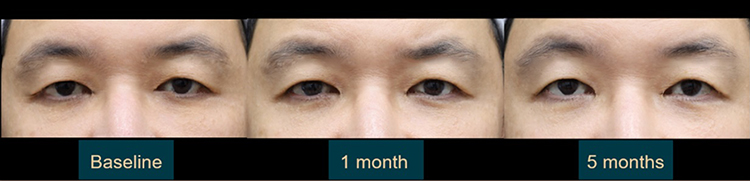 |
Figure 2 A 48-year-old male, before and after, 5 months after sequential monopolar-bipolar RF, showing upper-lid tightening and fine-wrinkle reduction. |
Case 3
A 77-year-old female with pronounced eyelid laxity and fine rhytides, most evident in the lower eyelid region, opted for non-invasive RF therapy due to her advanced age and preference to avoid surgery. At five months, the patient showed noticeable eyelid tightening, reduction in fine wrinkles, and smoother skin texture across the periorbital area, with the most prominent improvement in the infraorbital region and along the nasal bridge (Figure 3). The extent of tightening aligned with the expected timeline for collagen remodeling. The procedure was well tolerated, with no complications such as burns, erythema, or pigmentary alterations. The patient expressed satisfaction with the gradual, natural enhancement in eyelid firmness and wrinkle reduction.
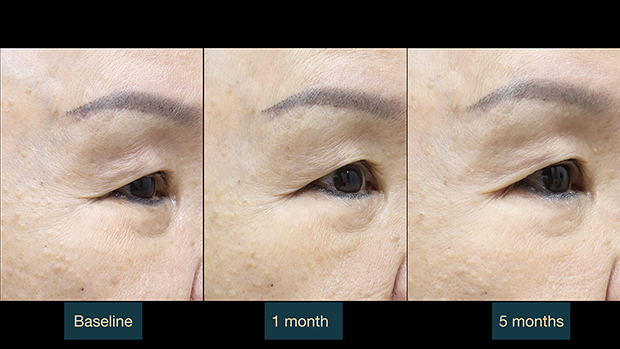 |
Figure 3 A 77-year-old female before and 5 months after sequential monopolar-bipolar RF, showing upper-lid tightening and fine wrinkle reduction. |
Discussion
The periorbital area is challenging to treat non-surgically because of thin skin, limited subcutaneous support, and proximity to ocular structures. These factors not only make it prone to early manifestations of aging, such as dermatochalasis, fine wrinkles, and loss of elasticity, but also limit the safe use of more aggressive rejuvenation techniques.5,6 All three patients demonstrated progressive improvement in eyelid laxity, fine wrinkles, and overall skin texture within a few months following a single treatment session, with no adverse events or downtime. These results highlight the potential of dual-mode RF systems as a non-surgical alternative for eyelid tightening, particularly in patients seeking subtle, natural rejuvenation without the risks associated with invasive procedures.8 While both monopolar and bipolar RF have established efficacy in skin tightening, the sequential combination of the two modes represents an evolution in energy-based rejuvenation. The monopolar mode enables deeper tissue penetration, promoting volumetric tightening, while the bipolar mode targets more superficial layers, improving surface texture and fine lines. The integrated use of these two mechanisms allows for a more uniform and efficient thermal effect across different skin depths, minimizing treatment discomfort and risk of epidermal injury.12
A cohort study of 70 Korean patients demonstrated a significant reduction in the periorbital wrinkles at 1-month follow-up with tolerable pain without using any local anesthesia during the procedure.13 More recently, Yang et al (2024) conducted a multicenter trial using monopolar RF and found significant improvement in periorbital and facial wrinkles after a single session,14 while Kim et al (2022) demonstrated that fractional microneedle RF effectively improved periorbital wrinkles, enhanced pigmentation, and dermal hydration in Asian patients.15 Compared to these modalities, sequential monopolar-bipolar pulsed RF, as used in the present study, offers a distinct advantage by combining deeper structural tightening with surface refinement within a single session.
This approach bridges the gap between topical rejuvenation and surgical blepharoplasty for patients seeking natural improvement without downtime. Recent clinical and histologic studies reinforce these findings. Oku et al (2025) demonstrated that sequential monopolar–bipolar RF achieved uniform dermal heating and measurable collagen contraction without adverse effects, leading to significant improvement in facial skin laxity and contour.10 Kumar et al (2025) further confirmed histologic evidence of collagen and elastin fiber reorganization following dual-mode RF treatment, validating its regenerative potential in both deep and superficial dermal layers.11 These observations are consistent with the gradual tightening and textural enhancement observed in our patients, most notably between the first and fifth months post-procedure, which coincides with the expected timeline for collagen remodeling and dermal matrix reorganization.
However, as with any non-surgical modality, the sequential monopolar-bipolar pulsed RF approach has inherent limitations. It is best suited for mild-to moderate dermatochalasis; patients with severe eyelid laxity or excess skin typically require blepharoplasty or ablative laser resurfacing for significant improvement.16 In comparison, ablative CO2 laser resurfacing can produce more dramatic results in advanced cases, but at the cost of prolonged recovery and increased complication risk.16 In contrast, the RF technique and similar non-ablative modalities offer more modest improvements with minimal downtime and a favorable safety profile.
The use of integrated cooling at level 3 contributed to epidermal protection, enabling the safe delivery of therapeutic thermal energy in this sensitive anatomical area.
Importantly, no adverse events, such as erythema, edema, blistering, or pigmentary alteration, were noted in any of the patients. This reinforces the safety profile of the sequential dual-mode system, which incorporates active cooling to protect the epidermis while enabling sufficient energy delivery to deeper dermal structures. The absence of complications is particularly significant given the periorbital region’s sensitivity and the proximity to ocular tissues, where precision and safety are paramount.
Despite the favorable clinical outcomes, certain limitations must be acknowledged.
A control group was not included, as the study was designed as a preliminary case series intended to generate clinical insights rather than comparative efficacy data. The lack of objective measurement tools, such as skin elasticity metrics or high-resolution imaging, limits the generalizability of findings. Additionally, long-term follow-up beyond 5 months would be valuable for assessing the durability of results. Future research with larger, controlled cohorts and standardized outcome measures is needed to confirm the efficacy and optimize treatment parameters, such as energy levels, shot count, and cooling intensity, for periorbital applications.
Conclusion
In this descriptive case series, sequential monopolar-bipolar pulsed radiofrequency (DENSITY NOIR) was associated with visible improvement in periorbital skin laxity and fine wrinkles following a single treatment session, with no downtime or adverse effects. While these findings suggest potential clinical utility as a non-invasive option for periorbital rejuvenation, they should be interpreted cautiously given the exploratory nature of the study, the small sample size, the absence of a control group, and the reliance on qualitative assessment. Larger, controlled studies incorporating objective outcome measures are warranted to confirm efficacy, optimize treatment parameters, and assess the durability of results.
Data Sharing Statement
The original contributions presented in the study are included in the article. Further inquiries can be directed to the corresponding author, Dr. Shangli Lin.
Ethics Approval and Consent to Participate
Written informed consent for publication of this case series, including photography and medical data, was obtained and signed by each patient. Institutional ethical approval was not required to publish this case report.
Acknowledgments
The authors would like to acknowledge Krystelis Ltd. for their medical writing support and the anonymous reviewers whose feedback helped improve the manuscript.
Funding
The authors received no financial support for this report.
Disclosure
Dr Narendra Kumar is a consultant to Jeisys Med Inc., Seoul, South Korea. Dr Shangli Lin reports no conflicts of interest in this work.
References
1. Global Survey 2021. Full Report and Press Releases. Available from: https://www.isaps.org/discover/about-isaps/global-statistics/global-survey-2021-full-report-and-press-releases/.
2. Ramirez SP, Scherz G, Smith H. Perceived stress and interest in non-invasive aesthetic procedures during the COVID-19 pandemic. Clin Cosmet Invest Dermatol. 2022;15:1247–6. doi:10.2147/CCID.S367001
3. ISAPS. International Survey on Aesthetic and Cosmetic Procedures. 2024:1–84. Available from: https://www.isaps.org/media/oogpzodr/isaps-global-survey_2024.pdf.
4. ISAPS. PR Global Survey Results. https://www.isaps.org/media/d1kfcxzp/pr-global-survey-results-general-final.pdf.
5. Tao BK, Butt FR, Dhivagaran T, et al. Periocular aging across populations and esthetic considerations: a narrative review. J Clin Med. 2025;14(2):535. doi:10.3390/jcm14020535
6. Naik M. Blepharoplasty and periorbital surgical rejuvenation. Ind J Dermatol Venereol Leprol. 2013;79(1):41. doi:10.4103/0378-6323.104668
7. Kumar N, Hye Suh D, Lee SJ, Ryu HJ. Radiofrequency-based treatments for facial rejuvenation: a systematic review of efficacy, safety, and patient-centered outcomes. Aesthetic Surg J Open Forum. 2025;7:ojaf159. doi:10.1093/asjof/ojaf159
8. Stochaj AS, Jezierska DH, Kubisz L. Comparing the efficacy of monopolar and bipolar radiofrequency treatment on facial skin in women. J Clin Aesthetic Dermatol. 2022;15(12):22–27.
9. Lin S, Kumar N. Clinical evaluation of a novel dual-mode radiofrequency device for facial laxity: a case series. Clin Cosmet Invest Dermatol. 2025;18:3013–3020. doi:10.2147/CCID.S563513
10. Oku K. The safety and efficacy of the Mono‐Bi CrossLIFT technique utilizing capacitive‐coupled sequential monopolar and bipolar pulsed radiofrequency for simultaneous facial skin tightening and contouring: a clinical case series. J Cosmet Dermatol. 2025;24(10):e70504. doi:10.1111/jocd.70504
11. Kumar N, Baek SY. Epidermal and dermal regeneration through sequential monopolar and bipolar radiofrequency: evidence from an aging mouse model. Aesthetic Surg J Open Forum. 2025;7:ojaf111. doi:10.1093/asjof/ojaf111
12. Oh S, Rho NK, Byun KA, et al. Combined treatment of monopolar and bipolar radiofrequency increases skin elasticity by decreasing the accumulation of advanced glycated end products in aged animal skin. Int J Mol Sci. 2022;23(6):2993. doi:10.3390/ijms23062993
13. Han SH, Yoon YM, Lee YW, Choe YB, Ahn KJ. Usefulness of monopolar thermal radiofrequency treatment for periorbital wrinkles. Ann Dermatol. 2018;30(3):296–303. doi:10.5021/ad.2018.30.3.296
14. Yang HJ, Choi SY, Jung JM, et al. A multicenter pilot study of the effectiveness and safety of a monopolar radiofrequency device for improving periorbital and facial fine wrinkles. J Dermatol Treat. 2025;36(1):2469633. doi:10.1080/09546634.2025.2469633
15. Kim KE, Park JH, Seul TW, Kim IH, Ryu HJ. Periorbital skin rejuvenation of asian skin using microneedle fractional radiofrequency. Ann Dermatol. 2023;35(5):360–366. doi:10.5021/ad.22.217
16. Themes UFO. Nonsurgical Light and Energy–Based Devices. Plastic Surgery Key. 2022. Available from: https://plasticsurgerykey.com/nonsurgical-light-and-energy-based-devices/.
 © 2026 The Author(s). This work is published and licensed by Dove Medical Press Limited. The
full terms of this license are available at https://www.dovepress.com/terms
and incorporate the Creative Commons Attribution
- Non Commercial (unported, 4.0) License.
By accessing the work you hereby accept the Terms. Non-commercial uses of the work are permitted
without any further permission from Dove Medical Press Limited, provided the work is properly
attributed. For permission for commercial use of this work, please see paragraphs 4.2 and 5 of our Terms.
© 2026 The Author(s). This work is published and licensed by Dove Medical Press Limited. The
full terms of this license are available at https://www.dovepress.com/terms
and incorporate the Creative Commons Attribution
- Non Commercial (unported, 4.0) License.
By accessing the work you hereby accept the Terms. Non-commercial uses of the work are permitted
without any further permission from Dove Medical Press Limited, provided the work is properly
attributed. For permission for commercial use of this work, please see paragraphs 4.2 and 5 of our Terms.
Recommended articles
Clinical Evaluation of a Novel Dual-Mode Radiofrequency Device for Facial Laxity: A Case Series
Lin S, Kumar N
Clinical, Cosmetic and Investigational Dermatology 2025, 18:3013-3020
Published Date: 13 November 2025