
Back to Journals » Clinical, Cosmetic and Investigational Dermatology » Volume 19
Secondary Syphilis Presenting with Complex Ulcers in the Oral Mucosa and Pubic Area: A Case Report
Received 9 November 2025
Accepted for publication 23 February 2026
Published 10 March 2026 Volume 2026:19 579753
DOI https://doi.org/10.2147/CCID.S579753
Checked for plagiarism Yes
Review by Single anonymous peer review
Peer reviewer comments 3
Editor who approved publication: Dr Michela Starace
Shanshan Li, Jingjing Li, Minzhi Wu
Department of Dermatology, The Fifth People’s Hospital of Suzhou, The Affiliated Hospital of Infectious Diseases of Soochow University, Suzhou, People’s Republic of China
Correspondence: Minzhi Wu, Email [email protected]
Abstract: Syphilis is an infectious disease caused by Treponema pallidum, which represented as a global public health challenge. We reported a case of atypical secondary syphilis presenting with ulcers confined to the oral commissures and pubic region. Notably, the patient was initially misdiagnosed as skin infection. Given the patient’s persistent ulcers on the oral commissure and mons pubis for over a month, characterized by the absence of significant pruritus or pain and unresponsive to oral antibiotics and topical medications, we recommend proceeding with the serological testing for syphilis. This patient was diagnosed with secondary syphilis, which highlighting the complexity of diagnosis and underscores the importance of early detection of syphilis.
Keywords: secondary syphilis, ulcers, oral mucosa, pubic area
Introduction
Syphilis is an infectious disease caused by Treponema pallidum, which represented as a global public health challenge.1 Secondary syphilis, occurring 6–12 weeks after primary infection, is characterized by systemic dissemination of Treponema pallidum and diverse mucocutaneous manifestations.2 While a generalized, non-pruritic papulosquamous rash is most common, mucosal involvement is frequent, often presenting as painless erosions (mucous patches) on the oral, genital, or anal mucosa. Typical chancres are usually solitary and genital. The presentation of concurrent, complex ulcers in both the pubic region and oral commissure is highly atypical and can readily mimic other conditions, leading to diagnostic delay.3 We reported a case of atypical secondary syphilis presenting with ulcers confined to the oral commissures and pubic region. This case highlights the complexity of diagnosis and underscores the importance of early detection of syphilis.
Clinical Data
A 28-year-old male patient presented to our department on November 26, 2024, with a persistent rash on the mons pubis for over one month. One month ago, the patient suddenly developed a rupture at the labia region without any obvious cause. The lesion gradually enlarged without any itching or pain. He visited the local hospital and was diagnosed with “skin infection”. He was prescribed cefprozil for oral anti-infection with topical application of fusidic acid and compound Eucommia lotion, which did not show any improvement. The ulcer was still expanding. The patient also has an ulcer at the left corner of the mouth, with a medical history of over a month. It had not received any treatment, but the condition has not improved. The patient denied any history of drug allergies and had no similar medical history in the past. He reported a single, stable sexual partner and denied other sexual contacts in the preceding year. Dermatological Examination at our clinic revealed an infiltrative erythematous plaque on the mons pubis with a central 2 cm ulcerated erosion, accompanied by the presence of mucous patches in the left labial commissure region, with a yellowish pseudomembrane (Figure 1).
 |
Figure 1 (A) An infiltrative erythematous plaque on the mons pubis with a central 2 cm ulcerated erosion; (B) the presence of mucous patches in the left labial commissure region, with a yellowish pseudomembrane. |
Given the patient’s persistent ulcers on the oral commissure and mons pubis for over a month, characterized by the absence of significant pruritus or pain and unresponsive to oral antibiotics and topical medications, we recommend proceeding with the tests for sexually transmitted diseases. The serological test for HIV was negative. However, serological tests showed positive non-treponemal (TRUST titer 1:8) and TPPA assay, confirming the diagnosis of secondary syphilis. In addition we suggested that the patient inform his partner to undergo the serological testing for syphilis.
The patient was treated with 2.4 million U of benzathine penicillin once a week for 3 consecutive weeks by intramuscular injection. Half a month after treatment, the patient was followed up by phone and reported that the ulcers in the oral mucosa and pubic area had basically healed, but there was still dark erythema in the pubic mound (Figure 2). He stated that his partner was also diagnosed with syphilis after the examination. After 3 months of treatment, the TRUST titer in the blood of the patient decreased to 1:1, and the patient is currently undergoing regular follow-up.
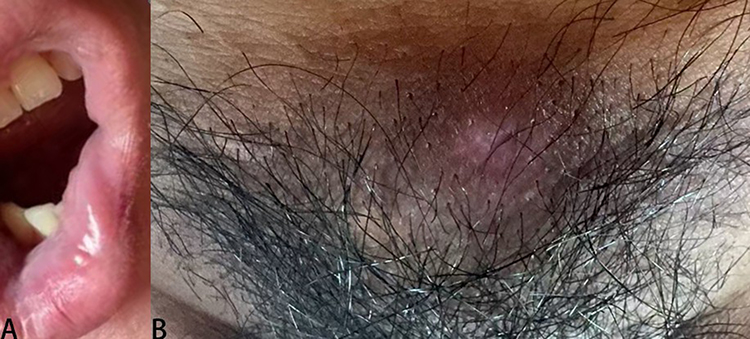 |
Figure 2 (A) The ulcer the mons pubis had basically healed, leaving dark erythema and pigmentation. (B) The mucous patches in the left labial commissure region had completely healed. |
Discussion
In recent years, the incidence of syphilis has been increasing. Annually, it was reported approximately 6 million new cases among adolescents and young adults worldwide.4 In 2022, it was estimated that there were 8 million adults aged 15 to 49 worldwide who were infected with syphilis.5 Due to the highly variable and non-specific clinical manifestations of syphilis, it is referred to as “the great imitator”,6 and it is extremely prone to misdiagnosis and missed diagnosis in clinical practice.
A review on the mucosal manifestations of syphilis in the head and neck revealed that the most common manifestation of secondary syphilis is the typical chancre - ulcer lesion. Chancre-ulcers and mucosal plaques accounted for 80.1% of presentations of secondary,7 further supporting our diagnosis. In this case, the location of the chancres in the patient was relatively special and uncommon, which was misdiagnosed as a skin infection. It actually worsened after applying topical medication. Similarly, the oral manifestations of syphilis are the challenging diagnoses in clinical practice. Our case aligns with findings that oral lesions are common in early syphilis; however, while Zhou et al report the tongue as the most frequent site (37.5%), our case involving the commissure represents a far less common location as noted in their data.8,9 These findings suggested that secondary syphilis could present with isolated, complex ulcers in uncommon locations such as the oral mucosa and pubic area. If painless, non-healing ulcers continue to worsen with topical antibacterial therapy, the serological testing for syphilis should be prompted. Additionally, it is worth noting that partner notification and management are integral to the treatment of any sexually transmitted infection.
Limitations
This case report has several inherent limitations. First, as a single case report, it describes a unique presentation that may not be generalizable to all patients with secondary syphilis. Second, the diagnosis was based on clinical presentation and serology; we did not perform dark-field microscopy or PCR on the ulcer exudate to directly visualize or detect Treponema pallidum, which could have provided definitive etiological confirmation. Third, the patient’s self-reported sexual history could not be independently verified. Finally, while the clinical outcome was positive, our follow-up period was limited to three months. Long-term serological follow-up to document seroconversion or cure would be ideal but was not available at the time of reporting.
Conclusion
This case underscores that syphilis remains a formidable mimic. Clinicians should maintain a high index of suspicion for secondary syphilis in patients presenting with persistent, painless ulcers at any site, including atypical locations like the pubic mound and oral commissure, even in the absence of classic risk factors. Prompt serological testing (both non-treponemal and treponemal) is imperative to avoid misdiagnosis, ensure effective treatment with penicillin, and stop transmission. The case is a perfect teaching example of syphilis as the “great imitator”, reinforcing the importance of a high diagnostic suspicion to prevent missed cases and complications.
Ethics and Consent Statement
The written informed consent was obtained from the patient for the publication of the case details and images. No further institutional approval was required.
Acknowledgments
We thank the patient for allowing us to use his pictures and clinical data.
Funding
This work was supported by the Science and Technology Project of Suzhou Health Management Research (SYWD2025367); Suzhou Key Medical Discipline (SZXK202520).
Disclosure
The authors have no conflicts of interest to declare for this work.
References
1. Meng Y, Yang L, Fu Y, et al. Detection of Treponema pallidum tpp47 DNA in clinical samples of syphilis patients. Eur J Med Res. 2025;30:873. doi:10.1186/s40001-025-03148-4
2. Novotny K, Ong CV, Dicaro MV, Singh A. Atypical presentation of syphilis with a superimposed methicillin-resistant Staphylococcus aureus infection. Cureus. 2025;17(6):e86133. doi:10.7759/cureus.86133
3. Srisungsuk S, Piyawannarat N, Siripongboonsitti T. Oropharyngeal condyloma lata in secondary syphilis: case report and literature review. Am J Case Rep. 2025;26:e947118. doi:10.12659/AJCR.947118
4. Barreto MEZ, Soares CD, de Andrade MMP, et al. Immunohistochemistry and RT-PCR as ancillary tools in the diagnosis of acquired oral syphilis. Oral Dis. 2025;31(3):890–4. doi:10.1111/odi.15107
5. Zhang X, Yao J, Jiang H, et al. Diagnostic importance of Treponema pallidum Tp0971 in the serological assessment of treatment efficacy for syphilis. Ann Clin Microbiol Antimicrob. 2025;24(1):58. doi:10.1186/s12941-025-00825-4
6. Chevalier FJ, Bacon O, Johnson KA, Cohen SE. Syphilis: a review. JAMA. 2025;334(21):1927–1940. doi:10.1001/jama.2025.17362
7. Khan M, Sharma A, Hathorn T, et al. The mucosal manifestations of syphilis in the head and neck. Ear Nose Throat J. 2023:1455613231165159.
8. Zhou X, Wu MZ, Jiang TT, et al. Oral manifestations of early syphilis in adults: a systematic review of case reports and series. Sex Transm Dis. 2021;48:e209–e214. doi:10.1097/OLQ.0000000000001538
9. de Andrade BAB, de Arruda JAA, Gilligan G, et al. Acquired oral syphilis: a multicenter study of 339 patients from South America. Oral Dis. 2021;28:1561–1572. doi:10.1111/odi.13963
 © 2026 The Author(s). This work is published and licensed by Dove Medical Press Limited. The
full terms of this license are available at https://www.dovepress.com/terms
and incorporate the Creative Commons Attribution
- Non Commercial (unported, 4.0) License.
By accessing the work you hereby accept the Terms. Non-commercial uses of the work are permitted
without any further permission from Dove Medical Press Limited, provided the work is properly
attributed. For permission for commercial use of this work, please see paragraphs 4.2 and 5 of our Terms.
© 2026 The Author(s). This work is published and licensed by Dove Medical Press Limited. The
full terms of this license are available at https://www.dovepress.com/terms
and incorporate the Creative Commons Attribution
- Non Commercial (unported, 4.0) License.
By accessing the work you hereby accept the Terms. Non-commercial uses of the work are permitted
without any further permission from Dove Medical Press Limited, provided the work is properly
attributed. For permission for commercial use of this work, please see paragraphs 4.2 and 5 of our Terms.