
Back to Journals » International Journal of Women's Health » Volume 17
Relationship Between Fear of Childbirth and Prenatal Depression: A Moderated Mediation Model
Authors Han J, Xie H, Ni S, Zhang A 
Received 6 August 2025
Accepted for publication 13 November 2025
Published 21 November 2025 Volume 2025:17 Pages 4681—4689
DOI https://doi.org/10.2147/IJWH.S552706
Checked for plagiarism Yes
Review by Single anonymous peer review
Peer reviewer comments 2
Editor who approved publication: Dr Vinay Kumar
Jingjing Han,1– 3 Hongyan Xie,4 Shiqian Ni,4 Aixia Zhang1
1Nursing Department, Women’s Hospital of Nanjing Medical University, Nanjing Women and Children’s Healthcare Hospital, Nanjing, Jiangsu, People’s Republic of China; 2Funing People’s Hospital, Yancheng, Jiangsu, People’s Republic of China; 3School of Nursing, Soochow University, Suzhou, Jiangsu, People’s Republic of China; 4School of Nursing, Nanjing Medical University, Nanjing, Jiangsu, People’s Republic of China
Correspondence: Aixia Zhang, Women’s Hospital of Nanjing Medical University, Nanjing Women and Children’s Healthcare Hospital, #123 Tianfei AlleyQinhuai District, Nanjing, 210004, People’s Republic of China, Tel +13401920998, Email [email protected]
Background: Fear of childbirth is a common psychological problem among women during the perinatal period. It not only affects the physical and mental health of the mother, but also has an impact on the health of the fetus. Studies have shown that fear of childbirth has a significant positive predictive effect on prenatal depression. However, there are few studies exploring the underlying mechanism between fear of childbirth and depression.
Methods: Childbirth Attitude Questionnaire, Social Support Rating Scale, Rumination Scale and Edinburgh Postpartum Depression Scale were used to measure 2765 Chinese pregnant women.
Results: Fear of childbirth had a positive predictive effect on prenatal depression (β = 0.11, t = 15.63, P < 0.001); rumination played a partial mediating role in the influence of fear of childbirth on prenatal depression, with an indirect effect value of 0.05; social support not only moderated the impact pathway of childbirth fear on rumination (β = − 0.01, t = − 2.26, P < 0.01), but also moderated the impact pathway of rumination on prenatal depression (β = − 0.01, t = − 2.12, P < 0.01).
Conclusion: Rumination mediated the relationship between fear of childbirth and prenatal depression, and social support had a moderating effect on the first and second half of the mediation model.
Keywords: prenatal depression, fear of childbirth, social support, rumination, moderated mediation model
Introduction
The period from pregnancy to childbirth is unforgettable for every woman. They have both expectations for individual role transformation and hesitation and helplessness towards the upcoming childbirth, the interweaving of various emotions is more likely to lead to negative emotions. Fear of childbirth is a common psychological issue among women during the perinatal period, characterized by anxiety and fear of unknown adverse events that may arise during or after childbirth.1 The global incidence rate was approximately 14%.2 The fear of childbirth is influenced by various factors, including personal, physiological, social and cultural factors. Fear of childbirth not only affects the mother’s physical and mental well-being, but also affects the health of the fetus. Pregnant women with fear of childbirth are more likely to experience preeclampsia, placental abruption, premature birth, increased cesarean section rates and decreased willingness to conceive again.3–5 American psychologist Ellis proposed the Emotional ABC Theory, which holds that stressor (A) is only the indirect cause of individual negative emotion (C), while the direct cause is individual’s unreasonable cognition and belief (B) about the event itself.6 Pregnant women may ruminate about the adverse consequences of childbirth during the stressful event of imminent delivery, leading to prenatal depression. Prenatal depression is a common psychological problem during pregnancy, with a prevalence rate of 28.5%.7 Prenatal depression not only endangers the physical and mental health and family relationships of pregnant women, but also affects the growth and development of fetuses and children. Pregnant women with severe prenatal depression may even engage in suicide or postpartum infanticide behavior.8 Studies have also shown that fear of childbirth had a significant positive predictive effect on prenatal depression,9 but few studies have explored the internal mechanism between fear of childbirth and depression. Therefore, this study was based on the Emotional ABC Theory to elucidate the specific pathways of action between fear of childbirth and prenatal depression.
Rumination is a method of coping with negative emotions that focuses on oneself, mainly manifested as self-reflection, repetition and passive attention to negative emotions.10 Rumination is divided into invasive rumination and purposeful rumination.11 Intrusive rumination is a negative emotion produced by an individual in the face of negative stressful events; purposeful rumination is the conscious and positive thinking about negative stressful events and their solutions, this form of rumination often needs to be guided and trained to enable the individual to grow positively after a traumatic experience. Studies have shown that rumination can positively predict prenatal depression.12 Therefore, this study hypothesized that rumination played a mediating role between fear of childbirth and prenatal depression.
The processes may be mediated by social support. Social support refers to the positive emotional support, information sharing, material assistance, and value transmission that come from interpersonal relationships. Studies have shown that social support is closely related to fear of childbirth.13 Women with a high level of social support are better able to prepare for childbirth before it occurs, to deal with potential problems during the delivery process, and thus reduce their level of fear of childbirth.14 When entering the pregnancy stage, the social role of the mother will change, and some social relationships will also change accordingly. At this point, the life care and spiritual encouragement provided by family members become increasingly important, and their role becomes more prominent. Adequate social support can have a protective effect on the mental health and social function of pregnant women, and is an effective positive factor in preventing prenatal depression.15 Another study indicated that social support can reduce an individual’s level of rumination.16 Therefore, we speculate that social support may play a moderating role on the pathway of fear of childbirth → rumination → prenatal depression.
In summary, based on the emotional ABC theory, this study explored the relationship and underlying mechanisms between fear of childbirth and prenatal depression, and assumed that rumination and social support play mediating and moderated roles in the relationship between fear of childbirth and prenatal depression, respectively.
Materials and Methods
Participants
From June 2023 to November 2023, pregnant women in obstetric clinic were selected by convenience sampling method.
Inclusion Criteria
(1) Aged ≥ 18 years Old; (2) Able to Complete Questionnaire Survey Independently; (3) Informed Consent.
Exclusion Criteria
(1) previous history of serious mental disorders; (2) serious obstetric complications and other organic diseases.17 2765 participants were ultimately included in this study.
Measures
Childbirth Attitudes Questionnaires (CAQ)
Using the Chinese scholar Wei Juan’s localized CAQ scale.18 The scale involves 4 dimensions and 16 items, and is scored using Likert 4-point to indicate the degree of change from “none” to “high”. The higher the score, the more severe the fear of childbirth. The scale has good reliability and validity, with a retest reliability of 0.80 and content validity of 0.92.
Social Support Rating Scale (SSRS)
This scale was developed by Chinese scholar Xiao Shuiyuan,19 and includes three dimensions: subjective support, objective support and support utilization. It consists of 10 items and has a total score of 0–66 points. The higher the total score, the higher the level of social support. The Cronbach’s α coefficient of this scale is 0.89–0.94, and the retest reliability is 0.92.
Ruminative Responses Scale (RRS)
Using version revised by Han Xiu and Yang Hongfei in China,20 there are a total of 22 projects with 3 dimensions: symptom rumination, compulsive thinking and deep reflection. The higher the score, the more severe the tendency towards rumination, with a Cronbach’s α coefficient of 0.94, indicating good reliability and validity.
Edinburgh Postpartum Depression Scale (EPDS)
EPDS is the most commonly used PND screening tool, developed by Cox et al, and later localized by Lee et al.21 It has been widely used both domestically and internationally. The scale consists of 10 items, including mood, pleasure, self-blame, anxiety, fear, insomnia, coping ability, sadness, crying and self-injury. Using the Likert 4-point scoring system, the total score is 0–30 points, with higher scores indicating more severe depression.
Data Analysis
Data entry and preliminary analysis were performed by SPSS 27.0, and the mediating and moderating effects were tested using SPSS macro program PROCESS.22 Using Model 4 to investigate the mediating effect of rumination on the relationship between fear of childbirth and prenatal depression. If the mediating effect exists, further use Model 59 to examine the moderating effect of social support in the mediating model. The model validation uses 5000 bootstrap corrections, and if the 95% confidence interval (CI) does not include 0, it indicates a significant effect.
Results
Common Method Deviation Test
Harman single factor test was used to extract a total of 9 factors with feature roots greater than 1, and the variance explained by the first factor was 30.49%, less than the critical standard of 40%, indicating that there was no serious common method bias in this study.
Descriptive Statistics
The general data analysis revealed significant differences in fear of childbirth, social support, and rumination among pregnant women of different age groups (P < 0.05), but no significant differences in prenatal depression (P = 0.259). Detailed results are shown in Table 1. The linear regression results indicate that pregnant women with middle school education have 2.773 lower prenatal depression scores compared to those with primary school education. Pregnant women with high school education exhibit 3.596 lower prenatal depression scores than those with primary school education. University graduates show 4.077 lower prenatal depression scores compared to primary school graduates, while postgraduate graduates have 27.625 higher prenatal depression scores than primary school graduates. Detailed in Table 2.
 |
Table 1 Effects of General Demographic Data on Pregnant Women’s Fear of Childbirth, Social Support, Rumination, and Prenatal Depression |
 |
Table 2 Linear Regression Analysis of Covariates |
Correlation Analysis Among Variables
As shown in Table 3, fear of childbirth was negatively correlated with social support and positively correlated with rumination and prenatal depression. Social support was negatively correlated with rumination and prenatal depression. Rumination was positively correlated with prenatal depression.
 |
Table 3 Mean, Standard Deviation and Correlation Analysis of Each Variable |
Mediation Effect Test
Standardize continuous variables using fear of childbirth as the independent variable, rumination as the mediating variable, prenatal depression as the dependent variable, education level, average monthly household income, and marital quality as control variables. The results showed that fear of childbirth had a significant positive prediction effect on rumination (β = 0.39, t = 22.66, P < 0.001), fear of childbirth had a significant positive prediction effect on prenatal depression (β = 0.31, t = 18.32, P < 0.001), and rumination had a significant positive prediction effect on prenatal depression (β = 0.30, t =17.76, P < 0.001), as shown in Table 4. The Bootstrap test results showed that the direct effect value of fear of childbirth → prenatal depression was 0.12, the indirect effect value of fear of childbirth → rumination → prenatal depression was 0.05, and the total effect value was 0.17. The 95% CI for indirect effects did not include 0, indicating that rumination played a partial mediating role in the impact of fear of childbirth on prenatal depression.
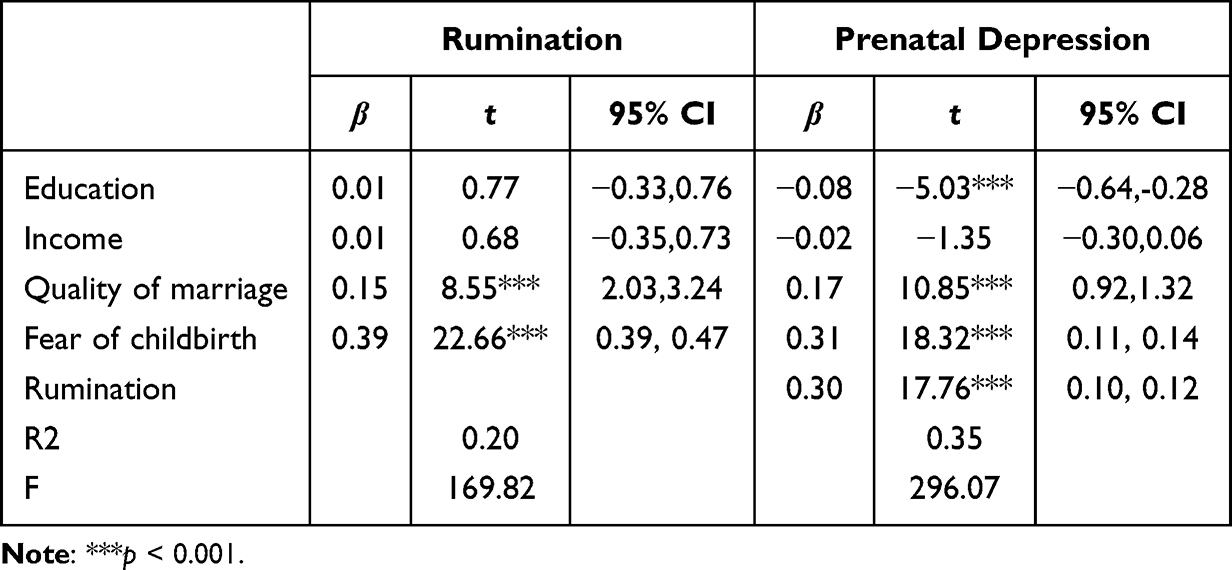 |
Table 4 Mediation Effect Test |
Moderating Effect Test
In the original mediation model, social support was included as a moderating variable in the equation, and the results are shown in Table 5. Social support had a significant negative predictive effect on rumination (β = −0.09, t = −3.5, P < 0.001), while fear of childbirth had a significant positive predictive effect on prenatal depression (β = −0.09, t = −3.56, P < 0.001). The interaction term between fear of childbirth and social support was significant in predicting rumination (β = −0.01, t = −2.26, P < 0.01), but not in predicting prenatal depression (β = 0.01, t = 1.92, P = 0.05). The interaction term between rumination and social support was significant in predicting prenatal depression (β = −0.01, t = −2.12, P < 0.01). As shown in Figure 1.
 |
Table 5 Moderated Mediation Effect Test |
 |
Figure 1 A moderated mediation model. Note: * *p < 0.01, ***p < 0.001. |
According to the mean and standard deviation of social support, social support was divided into three levels: low, medium and high. Further simple slope analysis showed that when social support was at low, medium and high levels, the effect values of fear of childbirth on rumination were 0.44 (P < 0.001), 0.40 (P < 0.001) and 0.36 (P < 0.001), respectively, indicating that with the increase of social support level, the positive effect of fear of childbirth on rumination was weakened. Similarly, when the level of social support was low, medium and high, the effect values of rumination on prenatal depression were 0.12 (P < 0.001), 0.11 (P < 0.001) and 0.09 (P < 0.001), respectively, indicating that the positive effect of rumination on prenatal depression decreased with the increase of social support level.
Discussion
In this study, a moderated mediation was constructed based on the emotional ABC theory to explore the relationship between fear of childbirth and prenatal depression. The results showed that there was a significant positive correlation between fear of childbirth and prenatal depression, which was consistent with the previous study.9 The negative impact of fear of childbirth is far greater than physical pain, so medical personnel must pay attention to the early psychological and emotional screening of pregnant women and develop individualized psychological intervention measures. Providing prenatal health education to pregnant women can reduce their fear of childbirth, increase their confidence in childbirth, and improve delivery experience.23 Medical staff should increase the investment and publicity of prenatal education, and carry out prenatal training in various forms, such as pregnant women’s schools, educational brochure, hospital official account, WeChat messaging service, to give pregnant women professional delivery knowledge and skills training, so as to help pregnant women better prepare for the delivery process.
Rumination played a partial mediating role between fear of childbirth and prenatal depression. Pregnant women lack knowledge related to childbirth and are unable to make reasonable use of external support systems to adopt positive and effective coping methods, which makes them repeatedly focus on their negative emotions and bad life events, making them more prone to psychological disorders.24 Fear of childbirth, as a negative psychological emotion, may induce rumination in individuals, thereby increasing their level of depression. In order to stop the vicious cycle between rumination and depression, there are many intervention methods for rumination, such as mindfulness-based cognitive therapy,25 expressive writing,26 rumination cognitive behavioral therapy,27 all of which reduce the degree of rumination by changing the way of thinking, thus reducing the level of depression.
The results of this study also indicated that social support had a moderating effect on the front and back halves of the mediation model. Social support Information comes from medical staff and care from family, as a protective factor, can use external resources to cope with the impact of individuals’ own rumination and reduce the negative impact of rumination on individuals. The stage from pregnancy to childbirth is a turning point for all women’s identity changes. From daughters to mothers, they not only have the joy of becoming mothers soon, but also may develop some misconceptions. The support and help from husbands, friends, and medical staff are the key factors for them to pass through this stage safely. Therefore, it is recommended that medical staff patiently listen to the subjective feelings of pregnant women, guide their families to understand and accompany pregnant women, and welcome the arrival of small lives with a positive attitude together. High social support can alleviate the negative impact of rumination on depression. However, the moderated effect of social support on fear of childbirth and prenatal depression is not significant, which seems to contradict reality. We speculate that the possible reason is that the delivery event is an objective fact, and external support cannot completely eliminate inner fear, leading to negative emotions. In the future, high-quality, multicenter, and longitudinal studies are needed to confirm this result.
Limitations
There are several limitations to this study. Firstly, adopt convenient sampling method, and all collected data was self-reported and may have biases. Secondly, it is a cross-sectional study that does not allow causal reasoning. Thirdly, the research subjects in this study were Chinese women, which may not be globally representative.
Conclusion
This study has enriched the relevant research on fear of childbirth and prenatal depression, and found that rumination played a mediating role between fear of childbirth and prenatal depression, and social support played a moderation effect in the pathway of fear of childbirth → rumination → prenatal depression.
Data Sharing Statement
The datasets used and/or analysed during the current study are available from the corresponding author on reasonable request.
Ethical Approval
The studies involving human participants were reviewed and approved by the Ethics Committee of the Women’s Hospital of Nanjing Medical University, Nanjing Women and Children’s Healthcare Hospital, Jiangsu, China (No.2022KY-137-01). The study was conducted in accordance with the Helsinki Declaration and Chinese regulations, ensuring ethical standards were maintained throughout the research process. The patients/participants provided their written informed consent to participate in this study.
Acknowledgments
We acknowledge the support of the Special Fund of Jiangsu Province Science and Technology. This study mainly explored the relationship and mechanism among fear of childbirth, rumination, social support, and prenatal depression. It is a cross-sectional study. The published article is a protocol of an intervention study on perinatal depression. The research time, theme, background, methods, results, and discussions of these two articles are different.
Funding
This work was supported by the Special Fund of Jiangsu Province Science and Technology (the Key Research and Development for Social Development) [grant number BE2022676]. The funder had no involvement in the design of the study, collection, analysis, and interpretation of data, and the writing of the manuscript.
Disclosure
The authors report no conflicts of interest in this work.
References
1. Nilsson C, Hessman E, Sjöblom H, et al. Definitions, measurements and prevalence of fear of childbirth: a systematic review. BMC Pregnancy Childbirth. 2018;18(1):28. doi:10.1186/s12884-018-1659-7
2. O’Connell MA, Leahy-Warren P, Khashan AS, Kenny LC, O’Neill SM. Worldwide prevalence of tocophobia in pregnant women: systematic review and meta-analysis. Acta Obstet Gynecol Scand. 2017;96(8):907–920. doi:10.1111/aogs.13138
3. Effati Daryani F, Mohammadi A, Mirghafourvand M. Childbirth self-efficacy and fear of childbirth and their predictors in adolescent and adult pregnant women referring to health centres of Urmia-Iran: a cross-sectional study. BMJ Open. 2023;13(10):e077043. doi:10.1136/bmjopen-2023-077043
4. Xu J, Li L, Ma XQ, et al. Fertility intentions, parenting attitudes, and fear of childbirth among college students in china: a cross-sectional study. J Pediatr Adolesc Gynecol. 2023;36(1):65–71. doi:10.1016/j.jpag.2022.07.015
5. Sydsjö G, Angerbjörn L, Palmquist S, Bladh M, Sydsjö A, Josefsson A. Secondary fear of childbirth prolongs the time to subsequent delivery. Acta Obstet Gynecol Scand. 2013;92(2):210–214. doi:10.1111/aogs.12034
6. He R, He X, Su Y, et al. Effect of ABC theory model on negative emotion of young patients with breast cancer during treatment. J Multidiscip Healthc. 2023;16:1883–1888. doi:10.2147/JMDH.S405564
7. Al-Abri K, Edge D, Armitage CJ. Prevalence and correlates of perinatal depression. Soc Psychiatry Psychiatr Epidemiol. 2023;58(11):1581–1590. doi:10.1007/s00127-022-02386-9
8. Dadi AF, Miller ER, Bisetegn TA, Mwanri L. Global burden of antenatal depression and its association with adverse birth outcomes: an umbrella review. BMC Public Health. 2020;20(1):173. doi:10.1186/s12889-020-8293-9
9. Dencker A, Nilsson C, Begley C, et al. Causes and outcomes in studies of fear of childbirth: a systematic review. Women Birth. 2019;32(2):99–111. doi:10.1016/j.wombi.2018.07.004
10. Cann A, Calhoun LG, Tedeschi RG, Triplett KN, Vishnevsky T, Lindstrom CM. Assessing posttraumatic cognitive processes: the event related rumination inventory. Anxiety Stress Coping. 2011;24(2):137–156. doi:10.1080/10615806.2010.529901
11. Hildingsson I, Rubertsson C. Depressive symptoms during pregnancy and after birth in women living in Sweden who received treatments for fear of birth. Arch Womens Ment Health. 2022;25(2):473–484. doi:10.1007/s00737-022-01213-z
12. Wang R, Cong S, Sha L, et al. Association between social networking site use intensity and depression among chinese pregnant women: cross-sectional study. J Med Internet Res. 2023:
13. Zhou X, Liu H, Li X, Zhang S. Fear of childbirth and associated risk factors in healthy pregnant women in northwest of china: a cross-sectional study. Psychol. Res. Behav. Manag. 2021;14:731–741. doi:10.2147/PRBM.S309889
14. Hassanzadeh R, Abbas-Alizadeh F, Meedya S, Mohammad-Alizadeh-Charandabi S, Mirghafourvand M. Fear of childbirth, anxiety and depression in three groups of primiparous pregnant women not attending, irregularly attending and regularly attending childbirth preparation classes. BMC Womens Health. 2020;20(1):180. doi:10.1186/s12905-020-01048-9
15. Epstein C, Rice MJ, French JA, Kupzyk KA, Houfek JF. Social support buffers the effects of prenatal depressed mood: a mixed-methods study. J Am Psychiatr Nurses Assoc. 2024;30(1):95–107. doi:10.1177/10783903211073793
16. Nolen-Hoeksema S, Wisco BE, Lyubomirsky S. Rethinking Rumination. Perspect Psychol Sci. 2008;3(5):400–424. doi:10.1111/j.1745-6924.2008.00088.x
17. Han J, Xie H, Cong S, et al. Effectiveness of smartphone-based music intervention on perinatal depression: protocol for a randomized controlled trial. BMC Psychol. 2024;12(1):633. doi:10.1186/s40359-024-02141-6
18. Wei J, Liu JY, Zhang LF, et al. Sinicization and reliability and validity detection of fear of childbirth scale. J Nurs. 2016;31(02):81–83.
19. Xiao SY. Theoretical basis and research application of the social support rating scale. J Clin Psychiatry. 1994;(02):98–100.
20. Han X, Yang HF. Trial of the nolen-hoeksema ruminant thinking scale in China. Chin J Clin Psychol. 2009;17(05):549–551.
21. Lee DT, Yip SK, Chiu HF, et al. Detecting postnatal depression in Chinese women. Validation of the Chinese version of the edinburgh postnatal depression scale. Br J Psychiatry. 1998;172:433–437. doi:10.1192/bjp.172.5.433
22. Hayes AF. Introduction to Mediation, Moderation, and Conditional Process Analysis: A Regression-Based Approach. New York: Guilford Press; 2013.
23. Serçekuş P, Başkale H. Effects of antenatal education on fear of childbirth, maternal self-efficacy and parental attachment. Midwifery. 2016;34:166–172. doi:10.1016/j.midw.2015.11.016
24. Berg M, Feldmann M, Kirchner L, Kube T. Oversampled and undersolved: depressive rumination from an active inference perspective. Neurosci Biobehav Rev. 2022;142:104873. doi:10.1016/j.neubiorev.2022.104873
25. Shapiro SL, Oman D, Thoresen CE, Plante TG, Flinders T. Cultivating mindfulness: effects on well-being. J Clin Psychol. 2008;64(7):840–862. doi:10.1002/jclp.20491
26. Sloan DM, Marx BP, Epstein EM. Further examination of the exposure model underlying the efficacy of written emotional disclosure. J Consult Clin Psychol. 2005;73(3):549–554. doi:10.1037/0022-006X.73.3.549
27. Watkins E. Psychological treatment of depressive rumination. Curr Opin Psychol. 2015;4:32–36. doi:10.1016/j.copsyc.2015.01.020
 © 2025 The Author(s). This work is published and licensed by Dove Medical Press Limited. The
full terms of this license are available at https://www.dovepress.com/terms
and incorporate the Creative Commons Attribution
- Non Commercial (unported, 4.0) License.
By accessing the work you hereby accept the Terms. Non-commercial uses of the work are permitted
without any further permission from Dove Medical Press Limited, provided the work is properly
attributed. For permission for commercial use of this work, please see paragraphs 4.2 and 5 of our Terms.
© 2025 The Author(s). This work is published and licensed by Dove Medical Press Limited. The
full terms of this license are available at https://www.dovepress.com/terms
and incorporate the Creative Commons Attribution
- Non Commercial (unported, 4.0) License.
By accessing the work you hereby accept the Terms. Non-commercial uses of the work are permitted
without any further permission from Dove Medical Press Limited, provided the work is properly
attributed. For permission for commercial use of this work, please see paragraphs 4.2 and 5 of our Terms.