
Back to Journals » Clinical, Cosmetic and Investigational Dermatology » Volume 19
Refractory Periungual Warts Treated with Filiform Fire Needle Combined with Warming-Yang and Collateral-Dredging Chinese Medicine Soak: A Two-Case Report
Authors Lyu S, Chong Z  , Yu T, Ruan C
Received 21 October 2025
Accepted for publication 25 February 2026
Published 27 May 2026 Volume 2026:19 575898
DOI https://doi.org/10.2147/CCID.S575898
Checked for plagiarism Yes
Review by Single anonymous peer review
Peer reviewer comments 2
Editor who approved publication: Dr Jeffrey Weinberg
Shanguang Lyu,1 Zhenzhen Chong,1,2 Tao Yu,3 Chen Ruan1
1Department of Acupuncture and Moxibustion, Tongde Hospital of Zhejiang Province, Hangzhou, Zhejiang, People’s Republic of China; 2Department of Acupuncture and Moxibustion, Zhejiang Chinese Medical University, Hangzhou, Zhejiang, People’s Republic of China; 3Department of Dermatology, Hangzhou Hospital of Traditional Chinese Medicine, Hangzhou, Zhejiang, People’s Republic of China
Correspondence: Zhenzhen Chong, Department of Acupuncture and Moxibustion, Tongde Hospital of Zhejiang Province, No. 234 Gucui Road, Xihu District, Hangzhou, Zhejiang, People’s Republic of China, Tel +86-18857108212, Email [email protected]
Rationale: Periungual warts, caused by Human Papillomavirus (HPV) infection, are a therapeutic challenge due to their proximity to the nail matrix and poor drug penetration. Conventional treatments, such as cryotherapy and laser, carry a high risk of nail damage and recurrence, highlighting the need for safer and more effective alternatives.
Patients Concerns: Two patients with refractory periungual warts were included, who had failed multiple previous traditional treatments. One was a 38-year-old male with a 2-year history of periungual warts on the right great toe, and the other was a 60-year-old female with a 1-year history of periungual warts on the right middle finger. Both patients showed no improvement after repeated cryotherapy, topical antiviral drugs, or oral medication.
Diagnoses: The diagnosis of refractory periungual warts was confirmed clinically based on the characteristic verrucous lesions adjacent to and partially embedded under the nail plate, coupled with a history of treatment failure.
Interventions: Based on the “Wen Tong Qu Shi Du” (warming dredging to dispel dampness and toxin) theory, a combined therapy was adopted: filiform fire needle (0.30 mm × 40 mm, heated to incandescence with an alcohol lamp) puncturing the core of the wart every 2 weeks, combined with daily soaking in warming-yang and collateral-dredging TCM decoction (10 g Ramulus Cinnamomi, 6 g Rhizoma Zingiberis, 15 g Poria Cocos, 20 g Coix Seed, 12 g Radix Angelicae Sinensis, 9 g Flos Carthami, 15 g Radix Isatidis, 15 g Folium Isatidis; decocted to 200 mL, soaked at 40– 45°C for 20 minutes each time).
Outcomes: The 38-year-old male patient achieved complete wart shedding after 3 treatments (6 weeks), and the 60-year-old female patient achieved complete wart shedding after 4 treatments (8 weeks). No adverse reactions such as nail matrix damage or local infection occurred in either patient during treatment. During the 6-month follow-up, there was no recurrence, and the nail bed was smooth with normal nail plate growth.
Lessons: The combination of filiform fire needle and warming-yang and collateral-dredging TCM soak shows significant efficacy in treating refractory periungual warts. The filiform fire needle directly destroys wart tissue and activates the local immune microenvironment based on the “resolving fire stagnation” principle, while the TCM soak improves the “dampness-stasis-toxin accumulation” pathological state through “warming yang to resolve dampness + dredging collaterals to dissipate stagnation”, achieving both symptom and root cause treatment. This therapy avoids the risk of nail matrix damage from traditional physical treatments and overcomes the limitations of poor drug penetration in antiviral therapy, providing a safe and effective TCM external treatment option for clinical practice.
Keywords: refractory periungual warts, filiform fire needle, warming yang and dredging collaterals, TCM soak, Case report
Introduction
Periungual warts, a special subtype of palmoplantar warts, are mainly caused by Human Papillomavirus (HPV) infection, which invades human cutaneous squamous epithelial cells through direct or indirect contact.1 Due to their growth at or under the nail edge, periungual warts are affected by nail plate coverage, resulting in difficult drug penetration. Their treatment efficiency is 30–50% lower than that of ordinary palmoplantar warts.2 Current traditional treatment methods for periungual warts include cryotherapy, photodynamic therapy, and antiviral drug therapy, but all have obvious limitations: physical treatments such as cryotherapy and laser can damage the nail matrix, leading to permanent nail deformities; long-term oral antiviral drugs may cause systemic side effects;3 in addition, these treatments generally have a long course and cause high patient discomfort.
Against this background, based on the TCM theory of “Wen Tong Qu Shi Du” (warming dredging to dispel dampness and toxin), this study adopted filiform fire needle combined with warming-yang and collateral-dredging TCM soak to treat 2 cases of refractory periungual warts. The purpose is to verify the efficacy and safety of this combined therapy and provide a new TCM external treatment strategy for clinically addressing the challenges of refractory periungual warts.
Case Report
Two patients with refractory periungual warts who had failed multiple traditional treatments were selected. The treatment plan was uniformly implemented: filiform fire needle puncture every 2 weeks, combined with daily warming-yang and collateral-dredging TCM soak. Clinical photographs and symptom records were collected every 2 weeks to monitor the changes in wart size, texture, and nail bed condition. The results showed that both patients achieved complete wart shedding within 6–8 weeks, with no adverse reactions.
Case 1: A 38-Year-Old Male with Periungual Warts on the Right Great Toe
A 38-year-old male with no past medical history (no diabetes, autoimmune diseases) and no family history of skin diseases complained of verrucous hyperplasia on the right great toe for 2 years. Two years ago, a verrucous neoplasm suddenly appeared near the nail of his right toe, which was diagnosed as periungual warts in another hospital. He had undergone more than 10 sessions of liquid nitrogen cryotherapy in other hospitals and our department and had used topical fluorouracil ointment, imiquimod ointment, and oral thymidine, but the verrucous lesions showed no significant improvement.
Physical examination in our outpatient department: A hard wart with a size of approximately 1.5 cm × 1.2 cm was found near the nail of the right toe, with clear boundaries and no redness or swelling; part of the wart was embedded in the nail bed, and the local nail plate was damaged (eg Figure 1A).
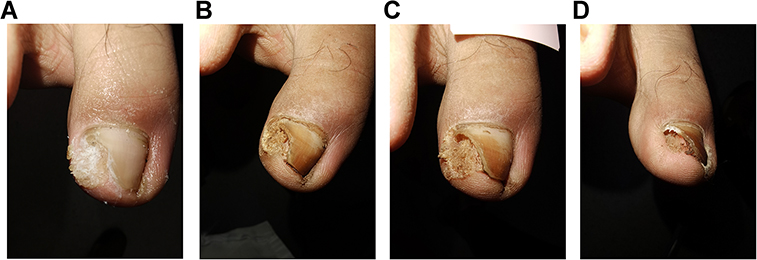 |
Figure 1 (A) Before treatment (baseline): A hard wart with a size of about 1.5 cm × 1.2 cm is visible near the nail of the right great toe, with clear boundaries and no redness or swelling; part of the wart is embedded in the nail bed, and the local nail plate is damaged and deformed. (B) 2 weeks after the first treatment (1st follow-up): The texture of the wart becomes soft, the boundary is reduced by about 30%, the maximum diameter is 1.05 cm, and there is no obvious aggravation of the nail plate damage. (C) 4 weeks after treatment (2nd follow-up): The scope of the wart is further narrowed, the surface is dry without exudation or redness, and the maximum diameter is 0.6 cm. (D) 6 weeks after treatment (3rd follow-up): The wart falls off completely, the nail bed surface is smooth, the nail plate grows normally, and there is no nail deformity or pigmentation. |
Diagnosis: Periungual warts.
Treatment process: 2 weeks after the first treatment (1st follow-up), the wart softened and its scope was reduced by 30% (eg Figure 1B); 4 weeks after treatment (2nd follow-up), the wart scope further narrowed and the surface became dry (eg Figure 1C); 6 weeks after treatment (3rd follow-up, ie 4th outpatient visit), the wart completely fell off, and the nail bed was smooth (eg Figure 1D).
Case 2: A 60-Year-Old Female with Periungual Warts on the Right Middle Finger
A 60-year-old female with a 5-year history of hypertension (blood pressure well-controlled at 130/80 mmHg) and no family history of skin diseases complained of verrucous hyperplasia on the right middle finger for more than 1 year More than 1 year ago, a verrucous neoplasm the size of a mung bean appeared near the nail of her right middle finger. Later, she underwent multiple sessions of liquid nitrogen cryotherapy, TCM soak (unclear formula), topical imiquimod ointment, and oral compound glycyrrhizic acid in another hospital, but the wart did not fall off and gradually enlarged.
Physical examination in our outpatient department: A hard wart with a size of approximately 1.2 cm × 1.0 cm was found near the nail of the right middle finger, with clear boundaries and no redness or swelling; part of the wart was embedded in the free edge of the nail and involved the nail bed (eg Figure 2A).
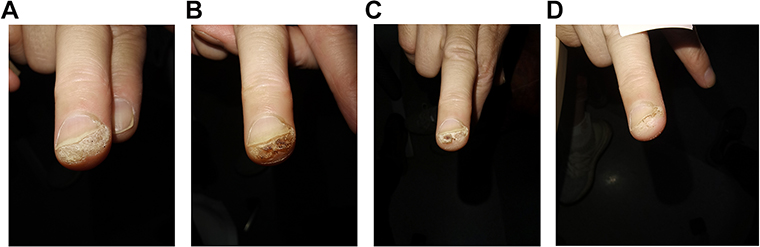 |
Figure 2 (A) Before treatment (baseline): A hard wart with a size of about 1.2 cm × 1.0 cm is visible near the nail of the right middle finger, with clear boundaries and no redness or swelling; part of the wart is embedded in the free edge of the nail and involves the nail bed. (B) 2 weeks after the first treatment (1st follow-up): The surface of the wart is dry and shrunk, with no obvious enlargement or signs of infection, and the maximum diameter is 0.9 cm. (C) 4 weeks after treatment (2nd follow-up): The wart becomes significantly thinner and drier, the scope is reduced by about 50%, the maximum diameter is 0.6 cm, and the affected area of the nail bed does not further deteriorate. (D) 8 weeks after treatment (4th follow-up): The wart disappears completely, the skin at the nail edge of the fingertip returns to normal texture and color, the nail bed is flat, and the nail plate grows normally without signs of nail matrix damage. |
Diagnosis: Periungual warts.
Treatment process: After receiving the combined therapy, the wart gradually regressed: 2 weeks after the first treatment (1st follow-up), the wart became dry and withered (eg Figure 2B); 4 weeks after treatment (2nd follow-up), the wart became dry and thin, and its scope was significantly reduced by 50% (eg Figure 2C); 8 weeks after treatment (4th follow-up), the wart basically disappeared, and the skin at the nail edge of the finger tip returned to normal (eg Figure 2D).
Discussion
Pathological Essence and Limitations of Traditional Treatment of Refractory Periungual Warts
From the perspective of TCM theory, the core pathological essence of periungual warts is the “dampness-stasis-toxin accumulation” state of local skin and mucous membranes caused by HPV infection, which is more prominent in refractory cases. Periungual warts belong to the category of “wart sores” in TCM As recorded in Surgical Zhengzong (Orthodox Surgery), “wart sores are caused by wind-heat invading the skin and qi-blood stagnation”. Combined with modern clinical observations, patients with refractory periungual warts mostly have the pathogenesis of “deficiency in root and excess in branch”: “deficiency in root” is centered on yang-qi deficiency, and “excess in branch” is manifested as internal accumulation of dampness, blood stasis obstruction, and toxin accumulation. Such patients often have insufficient congenital endowment, acquired malnutrition, or repeated physical treatment-induced yang-qi damage, resulting in weakened body defense function and unconsolidated skin interstices, making it easy for HPV to invade; yang-qi deficiency further leads to abnormal water-damp transportation, and internal retention of dampness provides a “breeding ground” for virus reproduction; qi-blood circulation is blocked, leading to stasis, and dampness, stasis, and toxin interact and accumulate in the periungual skin, forming intractable warts. With the prolongation of the course of disease, the pathogenesis becomes more complex, and the treatment difficulty increases significantly.
From the perspective of modern medicine, after HPV infects cutaneous squamous epithelial cells, it achieves virus replication and latency by regulating the host cell cycle and inhibiting apoptosis4 The special anatomical structure of the periungual area (nail plate coverage, relatively poor blood supply to the nail bed) further increases the treatment difficulty. Traditional treatment schemes have two core limitations: first, physical therapies such as liquid nitrogen cryotherapy and laser can directly destroy the surface tissue of warts through low temperature or high temperature, but the periungual area is adjacent to the nail matrix, and it is difficult to accurately control the energy of physical therapy, which easily damages the nail matrix and causes permanent nail deformities (such as nail defect, longitudinal nail ridge), with a complication rate of 15–20%;5 second, physical therapy only acts on the superficial layer of warts, and cannot clear HPV latent in deep tissues. Moreover, local tissue inflammation and microcirculation disorders are prone to occur after treatment, which instead creates conditions for virus residue and recurrence.6 In addition, topical antiviral drugs such as fluorouracil and imiquimod can inhibit virus DNA synthesis or regulate local immunity,7 but the periungual area has a thick cuticle, resulting in limited drug penetration; long-term use is also prone to local skin irritation (such as redness, erosion), leading to poor patient compliance, especially in refractory cases with a course of more than 1 year.
Mechanism of Filiform Fire Needle Combined with Warming-Yang and Collateral-Dredging TCM Soak
Based on the “Wen Tong Qu Shi Du” TCM theory, the combined therapy of filiform fire needle and warming-yang and collateral-dredging TCM soak targets the “dampness-stasis-toxin accumulation” core pathogenesis of refractory periungual warts and the limitations of traditional treatment, achieving the therapeutic goal of “treating both symptom and root cause”.
Therapeutic Mechanism of Filiform Fire Needle
Filiform fire needle therapy combines the mechanical stimulation of “needle” and the thermal effect of “fire”, and its mechanism can be explained from both TCM and modern medicine perspectives: From the TCM perspective: Guided by the therapeutic principle of “resolving fire stagnation”, the high-temperature thermal effect of filiform fire needle can directly penetrate the wart tissue, break local blood stasis obstruction, dredge meridians and qi-blood, and at the same time, assist yang-qi with its “warming and dredging” property, dispel internal accumulated dampness, and promote the excretion of accumulated toxin along with necrotic tissue, which conforms to the TCM treatment concept of “free flow ensures no pain, and nourishment ensures no dryness”. From the modern medicine perspective: First, the high temperature of filiform fire needle (about 800–1000°C) can instantly destroy HPV-infected cells in the wart tissue, denature viral DNA and inactivate it, and induce coagulative necrosis of local tissue, laying a foundation for subsequent tissue repair and wart shedding. Second, thermal stimulation can activate the local immune microenvironment. Studies have confirmed that after fire needle treatment, the infiltration numbers of CD4+ T cells, CD8+ T cells, and natural killer (NK) cells in local skin tissue increase significantly,8,9 and the secretion levels of cytokines such as interferon-γ (IFN-γ) and tumor necrosis factor-α (TNF-α) increase.10 These immune cells and cytokines can synergistically enhance the specific clearance ability of HPV, reducing the risk of virus latency and recurrence. Third, filiform fire needle can improve the microcirculation of the periungual area: the thermal effect dilates local capillaries, increases blood flow and tissue oxygen supply, alleviates the microcirculation disorder commonly seen after traditional cryotherapy, provides a good blood supply environment for nail bed tissue repair, and reduces the risk of nail matrix damage. The fact that no nail deformity occurred in the 2 patients in this study confirms the advantage of this therapy in protecting the nail matrix.
Therapeutic Mechanism of Warming-Yang and Collateral-Dredging TCM Soak
As an important part of the combined therapy, warming-yang and collateral-dredging TCM soak exerts a synergistic effect with filiform fire needle, improving the pathological environment of HPV reproduction “from the root”. The TCM prescription used in this study follows the principles of “warming yang to resolve dampness, dredging collaterals to dissipate stagnation, and clearing heat to detoxify” (the specific drugs include Ramulus Cinnamomi, Rhizoma Zingiberis, Poria Cocos, Coix Seed, Radix Angelicae Sinensis, Flos Carthami, Radix Isatidis, Folium Isatidis, etc), and its mechanism is reflected in three aspects: “Warming yang to resolve dampness” to eliminate the “habitat” of viruses: Warming-yang drugs such as Ramulus Cinnamomi and Rhizoma Zingiberis can warm and tonify spleen-kidney yang, enhance the body’s ability to transport water-damp, fundamentally reduce internal accumulation of dampness; dampness-resolving drugs such as Poria Cocos and Coix Seed can directly remove excess local dampness, destroying the humid microenvironment necessary for HPV survival. “Dredging collaterals to dissipate stagnation” to unblock qi-blood “stasis”: Blood-activating and collateral-dredging drugs such as Radix Angelicae Sinensis and Flos Carthami can promote qi-blood circulation in the periungual area, break the “dampness-stasis-toxin” vicious cycle, and at the same time enhance the local tissue response to filiform fire needle treatment, accelerating the shedding of necrotic warts and the repair of normal tissue. “Clearing heat to detoxify” to eliminate “toxin accumulation”: Heat-clearing and detoxifying drugs such as Radix Isatidis and Folium Isatidis can inhibit HPV replication and reduce local inflammatory reactions to play a “toxin-clearing” role. Modern pharmacology studies have confirmed that active ingredients in these drugs (such as indirubin, isatis root polysaccharide) have certain antiviral and immunomodulatory activities,11 which can form a superimposed effect with the immune activation effect of filiform fire needle.
In addition, the TCM soak achieves drug penetration through the “skin-nail bed” pathway, allowing drug components to directly reach the root of the wart and periungual tissue, avoiding the systemic metabolic loss of oral drugs, and at the same time reducing the direct stimulation of physical therapy on the nail matrix, further improving the safety and tolerance of treatment.
Limitations of the Study
This study has obvious limitations: first, the sample size is small (only 2 cases), which cannot fully reflect the efficacy of the therapy in different populations (such as patients of different ages, with different underlying diseases); second, there is a lack of a control group (such as a group treated with filiform fire needle alone, a group treated with TCM soak alone, or a group treated with traditional cryotherapy), so it is impossible to compare the advantages of the combined therapy in terms of efficacy and safety; third, the follow-up time is only 6 months, and long-term recurrence data (such as 1-year or 2-year follow-up) are lacking; fourth, the optimal treatment course of the combined therapy, the specific compatibility of the TCM prescription, and the specific target of action on HPV have not been clarified.
In the future, multi-center, large-sample randomized controlled trials are needed to further verify the efficacy and safety of this therapy; at the same time, in vitro cell experiments and animal models can be used to explore the specific molecular mechanism of the combined therapy in inhibiting HPV replication and regulating local immunity, so as to provide a more solid theoretical basis for its clinical promotion.
However, from the observation results of the existing 2 cases, the combined therapy of filiform fire needle and warming-yang and collateral-dredging TCM soak not only achieves rapid wart shedding (both patients were cured after 4 treatments) but also avoids recurrence and nail matrix damage, fully reflecting the characteristics and advantages of TCM “holistic concept” and “external treatment with internal effects”. Compared with traditional treatment which only focuses on local intervention of “warts”, this scheme solves the current wart problem through the synergistic effect of “warming dredging” and “dispelling dampness and toxin”, and also improves the body’s pathological state, providing a new idea and method for the TCM treatment of HPV-related skin diseases.
Conclusion
Despite its limitations, the case observation shows that the combined therapy of filiform fire needle and warming-yang and collateral-dredging TCM soak based on the “Wen Tong Qu Shi Du” theory is a safe and effective method for treating refractory periungual warts. It can not only promote the complete shedding of warts within a short course of treatment but also avoid adverse reactions such as nail matrix damage and reduce the recurrence risk, which has important clinical application value. However, due to the limitations of small sample size and lack of control group, the conclusions of this study need to be further verified by more in-depth clinical research.
Abbreviations
HPV, Human Papillomavirus; TCM, Traditional Chinese Medicine.
Data Sharing Statement
All data generated during this study are included in this published article.
Acknowledgments
We would like to thank the patients who participated in this study. All patients have provided informed consent for the publication of these cases and any accompanying images.
Funding
This study was supported by the Zhejiang Provincial Science and Technology Program for Traditional Chinese Medicine (No. 2019ZB026, No. 2023ZL321), and the Zhejiang Provincial TCM Inheritance and Innovation Talent Support Program (No. 2023ZR070). The funders had no influence on study design, data collection and analysis, decision to publish, or preparation of the manuscript.
Disclosure
The authors declare that they have no known competing financial interests or personal relationships that could have appeared to influence the work reported in this paper.
References
1. Alrashidi RA, Shaheen E, Abualola A, Alhumaidan A, Alkhudair N. The efficacy of cryotherapy compared to other modalities in the management of palmoplantar warts: a systematic review and network meta-analysis. Dermatol Rep. 2025;17(2):10121.
2. e Silva CBD, Paias CR, Cavalli CBSP, Miyashiro D, Cordero T. Diphencyprone as a therapeutic alternative for exuberant periungual warts. An Bras Dermatol. 2018;93(2):305–6. doi:10.1590/abd1806-4841.20187200
3. Yang Y, Lan Z, Zhang Y, et al. Local hyperthermia at 44°C for clearing cervical high-risk human papillomavirus infections: a randomized controlled clinical trial. Clin Infect Dis. 2021;73(9):1642–1649. doi:10.1093/cid/ciab369
4. Lin Y, Zhu Y, Jing L, Li X. Regulation of viral replication by host restriction factors. Front Immunol. 2025;16:1484119. doi:10.3389/fimmu.2025.1484119
5. Xie K, Cheng M, He B, et al. Photodynamic therapy combined with liquid nitrogen cryotherapy and curettage for recalcitrant periungual and subungual warts: a clinical experience and literature review. Indian J Dermatol. 2024;69(1):57–62. doi:10.4103/ijd.ijd_524_22
6. Wang M, Li T, Ma F, et al. Periungual and subungual warts successfully treated with a combination of electric shaving, curettage, and photodynamic therapy. Photodermatol Photoimmunol Photomed. 2020;37(1):82–84. doi:10.1111/phpp.12599
7. Micali G, Dall’Oglio F, Nasca MR. An open label evaluation of the efficacy of imiquimod 5% cream in the treatment of recalcitrant subungual and periungual cutaneous warts. J Dermatolog Treat. 2003;14(4):233–236. doi:10.1080/09546630310016763
8. Tang N, Wen WL, Huang CJ, Li Y, Liu Y. Efficacy of fire needle combined with halometasone cream in the treatment of patients with stable vitiligo and its effect on CD4+, CD8+, CD4+/CD8+ levels. J Diagn Ther Dermato-Venereol. 2022;29(5):446–450.
9. Guo C, Gu X, Zhang J, Li X. Efficacy of fire needle combined with 308 nm excimer laser therapy for vitiligo: a systematic review and meta-analysis of randomized controlled trials. J Cosmet Dermatol. 2024;23(8):2592–2602. doi:10.1111/jocd.16308
10. Sang ZH. Clinical observation on the treatment of multiple plantar warts with fire needle combined with TCM foot bath. J Clin Rational Drug Use. 2018;11(32):136–137.
11. Zhang QL. Clinical effect of external chitosan antibacterial film combined with oral isatis root granules in the treatment of patients with papillomavirus infection. Chin Med Pharm. 2016;6(1):94–96, 145.
 © 2026 The Author(s). This work is published and licensed by Dove Medical Press Limited. The
full terms of this license are available at https://www.dovepress.com/terms
and incorporate the Creative Commons Attribution
- Non Commercial (unported, 4.0) License.
By accessing the work you hereby accept the Terms. Non-commercial uses of the work are permitted
without any further permission from Dove Medical Press Limited, provided the work is properly
attributed. For permission for commercial use of this work, please see paragraphs 4.2 and 5 of our Terms.
© 2026 The Author(s). This work is published and licensed by Dove Medical Press Limited. The
full terms of this license are available at https://www.dovepress.com/terms
and incorporate the Creative Commons Attribution
- Non Commercial (unported, 4.0) License.
By accessing the work you hereby accept the Terms. Non-commercial uses of the work are permitted
without any further permission from Dove Medical Press Limited, provided the work is properly
attributed. For permission for commercial use of this work, please see paragraphs 4.2 and 5 of our Terms.