
Back to Journals » International Journal of Nanomedicine » Volume 21
Recent Advances in Nanozymes Toward Diabetic Foot Ulcers
Authors Zhou S, Deng J, Feng T  , Dong P
Received 28 October 2025
Accepted for publication 22 January 2026
Published 17 February 2026 Volume 2026:21 576610
DOI https://doi.org/10.2147/IJN.S576610
Checked for plagiarism Yes
Review by Single anonymous peer review
Peer reviewer comments 2
Editor who approved publication: Dr Yan Shen
Shiyang Zhou,1,* Jiayin Deng,1,* Tianji Feng,2 Peifang Dong1
1Nursing Department of Eye Center, The Second Affiliated Hospital, Zhejiang University School of Medicine, Hangzhou, 310009, People’s Republic of China; 2MOE Key Laboratory of Macromolecule Synthesis and Functionalization of the Ministry of Education, Department of Polymer Science and Engineering, Zhejiang University, Hangzhou, 310058, People’s Republic of China
*These authors contributed equally to this work
Correspondence: Tianji Feng, MOE Key Laboratory of Macromolecule Synthesis and Functionalization of Ministry of Education, Department of Polymer Science and Engineering, Zhejiang University, Hangzhou, 310058, People’s Republic of China, Email [email protected] Peifang Dong, Nursing Department of Eye Center, The Second Affiliated Hospital, Zhejiang University School of Medicine, Hangzhou, 310009, People’s Republic of China, Email [email protected]
Abstract: Diabetic foot ulcers (DFUs) are one of the most serious and intractable complications of diabetes, caused by oxidative stress due to hyperglycemia, chronic inflammation, and repeated infections. Conventional treatments such as insulin therapy do not improve the pathological wound microenvironment, resulting in slow healing and a high rate of recurrence. Nanozymes, with superior catalytic stability, tuneable enzyme-like activities, and multifunctional synergy, have emerged as a promising therapeutic strategy. Nanozymes that imitate natural enzymes such as glucose oxidase, peroxidase, catalase, and superoxide dismutase can actively remodel the DFUs microenvironment via glucose depletion, dynamic regulation of reactive oxygen species, disruption of biofilm, suppression of inflammation, and oxygen generation. These integrated functions can help wounds heal faster, and they can promote angiogenesis and tissue regeneration. This review discusses recent advances in catalytic mechanisms and therapeutic applications of nanozymes for DFUs management, with special attention paid to the microenvironment-responsive systems, hydrogel-based composites, and synergistic photothermal or drug delivery platforms. Lastly, the current issues of biosafety, catalytic efficiency, and target accuracy are mentioned, followed by future directions for clinical application.
Keywords: nanozymes, diabetic foot ulcers, wound microenvironment, enzyme-like activity, multifunctional therapy
Introduction
Diabetic foot ulcers (DFUs) are one of the most severe and common complications in diabetic patients, being chronic, non-healing wounds caused by long-term high blood sugar levels and an abnormal local environment.1–4 DFUs are related not just to vascular and nervous system damage brought on by constant hyperglycemia, but they are also commonly accompanied by a malfunctioning immune system and drug-resistant bacterial infections that slow down the healing process.5 The pathological pathway involves different parts, including more inflammation, protease activity not balanced, a lack of oxygen, and poor blood circulation in small parts of the body.6,7 They make a tricky little world that prevents today’s normal methods of making things better, such as using medicine to battle germs, cleaning up old stuff from an injury, and putting special bandages on a sore spot, from working as well as they should.8 Because of this, after the first healing, patients who have DFUs are more likely to get them again. About 40% of them will form a new ulcer within a year, leading to medical and financial issues for both the person and society.9
Nanozymes are a kind of synthetic nanomaterials that imitate the functions of natural enzymes, which have great potential in treating diabetic wounds.10–12 Compared with natural enzymes, nanozymes have better catalytic stability, lower cost and adjustable activity.13,14 Different metals such as Fe, Cu, Mn, Ag, and Ce with adjustable valence states are added into them, so they can simulate the activity of enzymes such as peroxidase (POD), oxidase (OXD), superoxide dismutase (SOD), and catalase (CAT), thus promoting dynamic reactive oxygen species (ROS) regulation, making them ideal materials for remolding the microenvironment.15–18 Size, shape, and surface characteristics of their catalytic performance can be improved by altering them.19,20 One nanozyme entity could contain multiple enzyme-like functions, such as gold nanoparticles (Au NPs) showing glucose oxidase (GOx)-like activity that converts glucose into hydrogen peroxide (H2O2) and also displays POD-like activity to catalyzes H2O2 into bactericidal hydroxyl radicals (•OH).21,22 Additionally, nanozymes having photothermal properties offer chances for combined therapeutic improvement.23,24 This multifunctionality enables the concurrent targeting of different pathological factors in diabetic wounds, resulting in synergistic antioxidant, anti-inflammatory, antibacterial, and pro-regenerative actions.25,26
During the repair process of DFUs, nanozymes allow for active control via three main processes.27,28 First, they reduce the local glucose level at the wound site. Controlling glucose levels is a critical initial step in treatment because long-term hyperglycemia can induce bacterial infections, inflammation, and oxidative stress, making DFUs worse.29,30 Some nanozymes demonstrated excellent GOx-like activity, allowing the reduction of glucose to gluconic acid and H2O2, reducing sugar levels.31,32 Then the produced H2O2 can be used as a substrate to produce •OH, thus enhancing antibacterial efficacy.33,34 Secondly, nanozymes can also inhibit bacterial infection. H2O2 is present in abundance within the DFUs microenvironment; therefore, nanozymes with POD-like activity could catalyze the conversion of H2O2 into •OH, eliminating pathogenic bacteria and controlling infection.35,36 Thirdly, they can relieve oxidative stress and exert anti-inflammatory effects. The DFU microenvironment contains elevated •O2− and H2O2, so there are more ROS that cause an imbalance in the redox state, causing more oxidative damage and preventing the immune system from being modulated, cells from moving, and tissues from repairing.37 Nanozymes with SOD- and CAT-like activity can remove excess ROS efficiently, relieve oxidative stress, and produce oxygen to improve ischemia hypoxia and accelerate wound healing.38,39 These methods indicate a substantial change in the control of DFUs, transitioning from passive to active, multi-target management thanks to nanozyme technology.
In this review, we critically assess the most recent advancements in nanozyme-based approaches for treating diabetic wounds, highlighting scientific progress and continuing translational challenges. First, we look at the complicated illness environment of a diabetic wound and find out what main chemical and physical factors make it hard for the wound to heal properly. And then we investigate the various enzyme-mimicking activities that lead to antibacterial, anti-inflammatory, antioxidant, and pro-regenerative effects, and also discuss the limitations of catalytic stability and biological compatibility under chronic wound conditions. Then we give a summary of recent uses of nanozymes in controlling infections, managing immune reactions, encouraging new blood vessel growth, and changing the outside tissue framework, together with checking how well they work and if they are safe in animals before they can be used on people. We provide a current assessment of the current problems, such as insufficient standardization, limited long-term biosafety data, and no clinical comparability, and offer potential paths forward for reasonable material creation and translational research. The purpose of this review is to provide a critical perspective and a practical methodology to direct the creation of nanozyme-based materials for clinically viable, precise therapy of diabetic foot ulcers (Figure 1).
 |
Figure 1 Scheme illustration of the diabetic wound microenvironment and the therapeutic strategy of nanozymes for diabetic foot ulcers. |
Diabetic Wound Microenvironment
Following injury, the skin starts a repair process that can be divided into four separate phases: hemostasis, inflammation, proliferation, and remodeling. These phases occur one after another, yet they also overlap due to factors such as ongoing messages between cells (Figure 2).40 But for diabetic wounds, especially chronic non-healing ulcers, this neat healing process gets all mixed up because there’s this complicated, dysregulated pathological microenvironment where the body tries to heal.41,42 Therefore, a thorough understanding of the microenvironment’s specific characteristics is required for the development of sophisticated functional materials such as nanozymes that promote healing.28 This section details key characteristics of the diabetic wound microenvironment, such as hyperglycemia, sustained inflammation, and elevated protease activity, in order to establish a foundation for understanding the etiology of diabetic wounds and the factors that impede healing (Table 1).
 |
Figure 2 Schematic representation of the four phases of diabetic wound healing: hemostasis, inflammation, proliferation, and remodeling.40 |
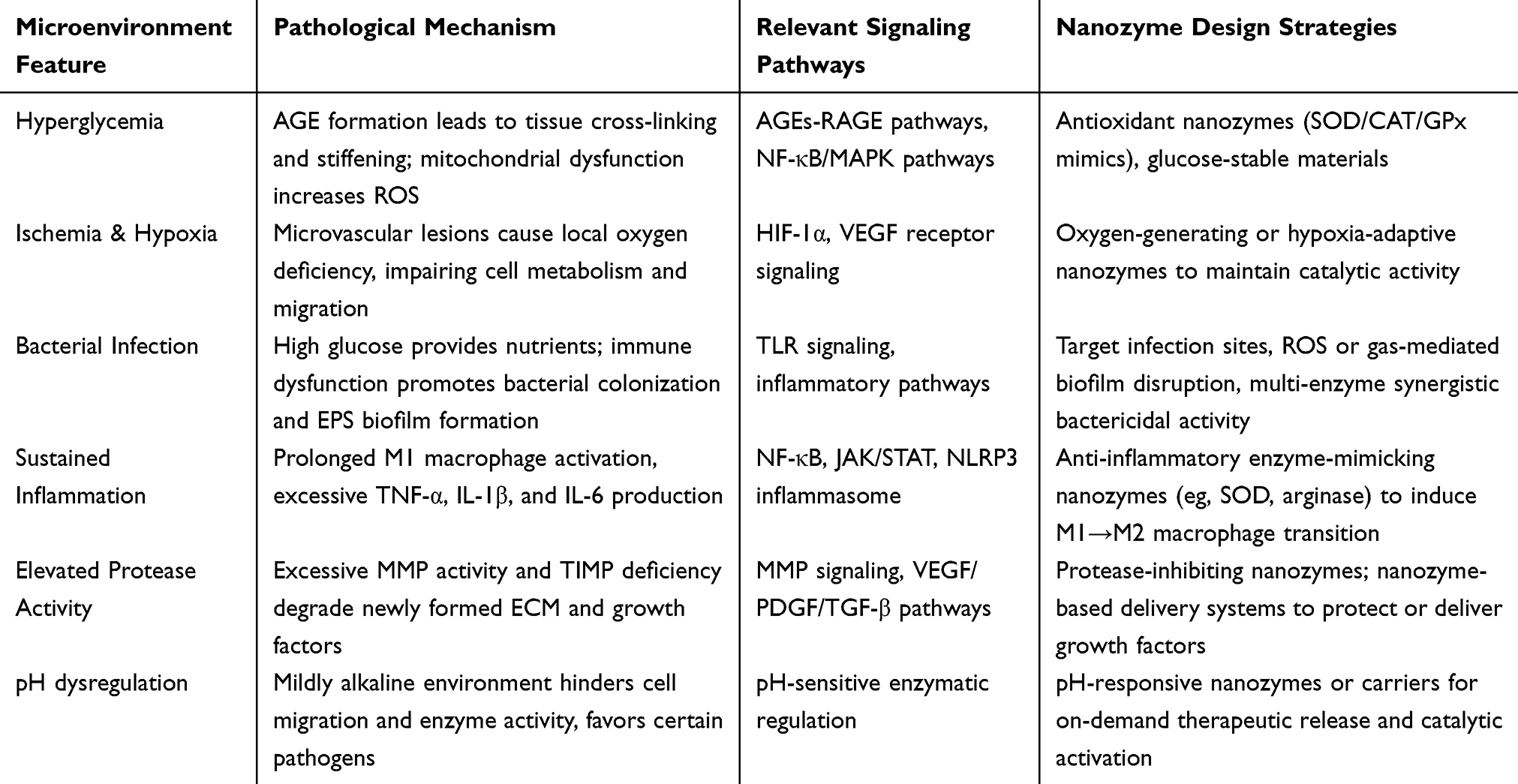 |
Table 1 Microenvironment Features of DFUs and Nanozyme-Based Therapeutic Strategies |
Hyperglycemia
Chronic hyperglycemia is a critical pathogenic feature of diabetic wounds, arising from compromised insulin secretion or function.43 Increased glucose levels in the local wound might trigger non-enzymatic glycation, resulting in the abnormal accumulation of advanced glycation end products (AGEs) inside the extracellular matrix (ECM) and on cell surfaces.44,45 The formation of AGEs directly causes tissue cross-linking and stiffening, resulting in a loss of elasticity, substantial impairment of mechanical properties, and disruption of the typical structure and function of the ECM. Additionally, it severely obstructs the migration, proliferation, and formation of new tissues by repair cells. Hyperglycemic conditions that lead to mitochondrial dysfunction greatly increase the production of ROS in the localized wound.46 Persistent oxidative stress does direct damage to cell membranes, proteins, and DNA, as well as activate pro-inflammatory signals and apoptosis, forming a vicious cycle.47 Thus, the design of functional materials such as nanozymes aimed at diabetic wound healing should pay attention to maintaining the stability and catalytic activity under high glucose and oxidative stress conditions. At the same time, they need to be able to scavenge excess ROS effectively and exhibit good biocompatibility, so that the material will not become inactive or induce adverse reactions in high-glucose microenvironments.
Ischemia and Hypoxia
Hyperglycemia is strongly associated with severe ischemia and hypoxia in diabetic wounds.48 Diabetes-associated microvascular complications, such as thickened basement membranes and dysfunctional endothelium, along with potential peripheral artery disease, create considerable local blood flow issues within the wound.10 Inadequate blood perfusion immediately results in a marked decline in the supply of oxygen and vital nutrients, while concurrently diminishing the efficiency of metabolic waste clearance, such as lactic acid and carbon dioxide.49 Insufficient oxygen, poor nutrition, and too much waste product in the area where the cells need to work hard to make new collagen and grow new blood vessels. This bad environment makes it hard for the body’s helper cells to do their job well.50 And this kind of hypoxic environment brings challenge and a chance for material design. Localized hypoxia could limit the catalytic efficiency of nanozymes that rely on oxygen as a catalytic substrate, but it would also drive the creation of nanozymes that can improve local oxygenation or adapt to hypoxic conditions to work properly. Consequently, engineering materials that can maintain functional activity under hypoxic environments or actively mitigate tissue hypoxia are necessary.
Susceptibility to Bacterial Infection
Bacterial infections are a major problem and challenging to manage in diabetic wounds.51 The hyperglycemic milieu provides lots of nutrients for microbial proliferation, while ischemia-hypoxia, neuropathy, and hyperglycemia-induced leukocyte dysfunction collectively foster a highly susceptible microenvironment conducive to bacterial colonization.52 After being infected, bacteria will build complex biofilms on necrotic tissue or damaged ECM quickly.53 The extracellular polymeric substances (EPS) produced by biofilms form a dense physical barrier that greatly impedes the penetration of antibiotics and immune cell infiltration and provides strong resistance against antimicrobial drugs and host defenses.54 It directly promotes tissue damage and keeps inflammation.55 Consequently, the design of antibacterial nanozymes focus on disrupting biofilm as follows: (1) active targeting capability to infection sites; (2) efficient biofilm-penetrating/disrupting methods (eg, catalytic generation of ROS, gas production, enzymatic EPS breakdown); and (3) intense bactericidal action with a low risk of inducing resistance (eg, multi-enzyme synergistic strategies).
Sustained Inflammatory Response
Excessive and prolonged inflammation is an important obstacle hindering the progression of diabetic wounds to the proliferative phase.56 Inflammation is just a temporary process during routine healing, but diabetic wounds show increased and chronic inflammation because of the combined effects of hyperglycemia, ischemia, bacterial infection, and AGEs.57 Immune cells, especially macrophages, have abnormal function due to prolonged polarization toward a pro-inflammatory (M1) phenotype, resulting in more cytokine production (eg, TNF-α, IL-1β, IL-6). This uncontrolled inflammatory milieu not only directly damages healthy tissue and hinders cellular repair, but it also enhances ROS and protease production, generating a self-reinforcing vicious cycle.58 And importantly, the chronic inflammatory signal reduces the polarization of anti-inflammatory (M2) macrophages, which delays the resolution of inflammation and tissue healing.38,59 Thus, nanozyme-based interventions need to be accompanied by immunomodulation methods, such as developing nanozymes that mimic anti-inflammatory enzymes like SOD or arginase to induce macrophage reprogramming from M1 to pro-repair M2 phenotype, thereby breaking the inflammatory impasse.60
Elevated Protease Activity
Protease dyshomeostasis is an important cause of the destruction of the extracellular matrix and poor healing of diabetic wounds.61 Under chronic infection and inflammation, the levels and activity of matrix metalloproteinases, such as MMP-2 and MMP-9, are significantly elevated, whereas the natural inhibitors of these enzymes, such as tissue inhibitors of metalloproteinase (TIMP), show a dysfunction.62 This leads to excessive breaking down of newly synthesized extracellular matrix components (eg, collagen, fibronectin) and important growth factors (eg, VEGF, PDGF, TGF-β), which stop new tissue from forming and growing properly and break the signals that help heal.63 As a result, wounds remain arrested in a detrimental inflammatory phase, unable to advance to proliferation or remodeling. To address this, we need two types of nanozymes: (1) protease-inhibiting nanozymes, which can block the action of proteases; and (2) nanozyme-based delivery systems that protect endogenous growth factors or deliver exogenous factors, resist proteolytic degradation, maintain ECM homeostasis, and function of bioactive molecules.
pH Dysregulation
pH dysregulation is a characteristic pathophysiological feature of chronic diabetic wounds compared to acute wounds.64 Acute wounds show temporary acidity that helps with antimicrobial activity and growth factor efficacy, then it becomes neutral to promote healing.65 In contrast, diabetic wounds often exhibit a neutral to weakly alkaline microenvironment (pH 7.0–8.5) because they cannot regulate their glucose levels, there is not enough oxygen in the tissues, infections keep happening, and metabolism is messed up.66 This kind of environment makes it hard for keratinocytes to move around, grow, and cover the skin again. It stops enzymes and growth factors inside your body from working correctly, and it may allow some harmful bacteria to grow more effectively.67 This has two implications for nanozyme design: First, materials need to retain significant catalytic activity within the mild alkaline range to ensure efficacy. Secondly, the unusual pH gradient presents opportunities for designing stimuli-responsive nanozymes, such as pH-sensitive carriers for the spatiotemporal release of therapeutics or nanozymes at the wound site, and pH-triggered assembly, disassembly, or activation of certain enzyme-like activities for on-demand therapy.68
The diabetic wound microenvironment is a complex pathological environment that includes hyperglycemia, ischemia and hypoxia, increased susceptibility to infection and biofilm formation, chronic inflammation, protease imbalance, and pH dysregulation. All these related factors together make it hard for wounds to heal naturally. Examining this microenvironment through the lens of materials science reveals how poor repairs occur and provides valuable insights for developing more effective smart treatments, such as multifunctional nanozymes. By adding microenvironment-sensitive characteristics and working together with other curative functions, these new platforms have great potential to solve the problems with current treatments.
Mechanisms of Nanozymes
Nanozymes have multiple functions, can adjust their catalytic efficiency, and exhibit physicochemical stability, making them potential therapeutic agents for modifying the pathological microenvironment of diabetic wounds and promoting tissue repair.69,70 Different kinds of enzyme-like activities are shown, including POD, OXD, CAT, SOD, and GOx, facilitating the regulation of local glucose levels, inhibition of bacterial infections, and mitigation of oxidative stress at the wound site (Table 2).71 Despite extensive advancements, most existing studies assess these catalytic properties under idealized in vitro conditions and ignore the complicated biochemical environment of chronic wounds, including variable pH, numerous reductants, and competing biomolecules, all of which may significantly impact catalytic behavior.59 An understanding of the performance and adaptation of nanozymes in realistic biological environments is essential. This section provides a detailed examination of the mechanisms by which nanozymes exert their therapeutic roles in DFUs.
 |
Table 2 Typical Types of Enzymes and Their Mechanisms and Functions for Wound Healing |
POD-Like Activity
POD is a category of oxidoreductases prevalent in plants, animals, and microbes. They facilitate redox processes and are intimately linked to the development of flora and fauna. Nanozymes demonstrating POD-like activity can effectively catalyze the production of reactive oxygen species using hydrogen peroxide as a substrate under mild conditions, including neutral or mildly acidic environments.101 This potential allows for significant antibacterial effects in diabetic infected wounds by generating bacterial membrane lipid peroxidation and protein denaturation via excessive ROS generation.102,103
The POD activity of nanozymes principally derives from their capacity to emulate the catalytic center function of genuine peroxidases, such as horseradish peroxidase (HRP).104 The fundamental processes generally encompass Fenton-like reactions or electron transfer-mediated catalytic pathways. (a) Variable-valence metal ions (eg, Fe3+/Fe2+, Cu2+/Cu+) present on the surfaces of nanozymes (eg, Fe3O4, CeO2, MnO2, Cu-based nanomaterials) can catalyze the decomposition of H2O2, leading to the generation of ROS such as •OH; (b) The unique electronic structure of the nanomaterial surface facilitates the single-electron reductive cleavage of H2O2 molecules, also resulting in the production of ROS.105 Fe3O4 serves as a prototypical nanozyme with POD-like activity. Although numerous studies attribute its mechanism to surface Fe2+-induced Fenton-like reactions, the role of internal atomic alterations in its catalytic process has been largely overlooked.106,107 Dong et al proposed that surface Fe2+ catalyzes the production of •OH from H2O2 by Fenton-like reactions while being oxidized to Fe3+. Simultaneously, internal Fe2+ concurrently transfers electrons to the surface via Fe2+-O-Fe3+ chains, thereby decreasing Fe3+ to maintain the catalytic cycle (Figure 3a).78 Prolonged catalysis results in the gradual oxidation of Fe3O4 into γ-Fe2O3 (maghemite), which results in a reduction in POD activity. This study demonstrates the participation of interior atoms (Fe2+ and Fe3+) in surface catalysis through electron transfer and ion migration, challenging the traditional perspective that only surface atoms govern catalytic activity.
 |
Figure 3 (a) Schematic diagram of the catalytic mechanism of the POD-like activity of Fe3O4 nanoparticles.78 (b) Schematic illustration of the plasmonic-enhanced glucose-activated cascade catalysis of GNR@CeO2@GNPs by both mimicking the GOx and POD activities.33 |
Nanozymes usually have higher POD-like activity under mildly acidic conditions.108 However, the pH is above 7.0 in many physiological situation.77 In diabetic infected wounds, the pH is typically weakly alkaline, greatly reducing the effectiveness of POD-like nanozymes in the healing process.109,110 To solve this problem, He et al developed a multifunctional nanozyme called Bio-HJzyme (CN/Cu2-xS@GOx) by adding GOx.111 This platform has two primary functions: controlling pH and improving POD catalysis. GOx helps glucose get oxidized in the wound microenvironment, making gluconic acid and H2O2. This mechanism reliably supplies H2O2 as a substrate for POD catalysis while concurrently lowering the local pH. Nanozyme may enhance the conversion of H2O2 into strong bactericidal ·OH, markedly improving antibacterial efficacy in diabetic wounds. This concept presents a fresh approach to improving the use of POD-like nanozymes in the treatment of diabetic wounds.
OXD-Like Activity
Nanozymes OXD-like activity may use O2 directly, without the involvement of H2O2, and this is activated by the metal surface site or oxygen vacancy, resulting in the generation of ROS, including superoxide radical (•O2−), and •OH, which kill bacterial infections in diabetic wounds and impair bacterial growth.79,112 Chen et al created a microenvironment-responsive nanomaterial, GC@Pd. In the mildly acidic milieu characteristic of infected wounds, GC@Pd utilizes its OXD-like activity, along with a photothermal effect, to efficiently eliminate bacterial biofilms.81 In contrast, in the alkaline environment of chronic wounds at advanced stages, it demonstrates CAT-like activity, effectively neutralizing ROS and reducing inflammation. This approach employs targeted mimicking activities of enzymes tailored to the wound environment, thereby promoting the healing of diabetic wounds.
Mitigating the issue of compromised healing in diabetic wounds fundamentally depends on the management of glucose levels.113 Hyperglycemia initiates a series of detrimental responses. Insulin injection is the principal approach for glucose reduction; however, notable adverse effects, including hypoglycemia and gastrointestinal upset, are considerable concerns.114 Therefore, there is an urgent necessity to investigate safer therapy for glucose reduction. In this respect, GOx-like activity of the specific nanozymes that employ glucose as a substrate presents a possible approach.32 Au NPs exhibiting significant GOx-like activity have been extensively utilized.115,116 Their fundamental process entails the adsorption and activation of the aldehyde group of glucose molecules at the active sites on the Au NPs surface, hence promoting glucose dehydrogenation and the liberation of electrons (2e−) and protons (2H⁺).117 Functioning as an electron transfer mediator, AuNPs provide electrons to adsorbed dissolved O2, facilitating its reduction to H2O2, while simultaneously oxidizing glucose to gluconic acid.118 The ongoing depletion of glucose deprives bacteria at the wound site of essential nutrients. Concurrently, the produced H2O2 can be further transformed into highly cytotoxic •OH, synergistically eliminating microorganisms.75 Wang et al created a bimetallic nanozyme that emulates the cocklebur plant.33 Surface-deposited gold nanoparticles (GNPs) bind and activate glucose molecules, resulting in local glucose depletion and the generation of H2O2 and a moderately acidic pH, which optimally activates the POD-like activity of CeO2 for synergistic antibacterial effects. Furthermore, gold nanorods (GNRs) act as plasmonic nanoantennas; upon irradiation with 808 nm laser light, they absorb photons, produce hot electrons, and transfer them to the CeO2 layer, thereby markedly amplifying enzyme-mimicking activities (Figure 3b).
Additionally, nanoparticles or compounds that contain other noble metals (such as Pt, Pd, Ru, Rh, and Ir) are also limited in the GOx-like activity.84,119 Wu et al reported an instance with a single-atom copper-anchored graphitic carbon nitride (Cu-g-C3N4) nanozyme.83 This nanozyme can catalyze the oxidation of glucose, and the presence of light increases electron transfer and enhances O2 adsorption, but it generates ROS. There is, however, little research on non-Au NP metallic nanozymes with GOx-like activity that shows glucose-depleting effect upon the treatment of DFUs. This is a significant area of focus in future studies, as it is a notable shortcoming.
CAT-Like Activity
CAT is an important antioxidant enzyme in biological organisms.120,121 It facilitates the breakdown of H2O2 into water and oxygen, keeping the balance of oxidation and reduction, protecting cells from being damaged by oxidative stress.6 Chronic hyperglycemia in DFUs leads to increased ROS, which hinders the wound healing process.122,123 Additionally, the activity and expression of endogenous antioxidant enzymes such as catalase are also significantly decreased in diabetic patients.124 Thus, exogenous CAT-like nanozymes can eliminate excess ROS, reduce inflammation, and promote the growth and movement of fibroblasts and keratinocytes.125,126
After the bacteria are removed through the POD-like action of nanozymes, when the healing process reaches the cell proliferation stage, CAT-like activity is needed.127 CAT-mimicking nanozymes can catalyze the decomposition of H2O2 into O2 to relieve hypoxia and provide energy for tissue repair.72,128 Zhao et al created a nanozyme hydrogel using manganese-cobalt oxide (MnCoO@PDA) nanoparticles, with redox-active Mn and Co sites mimicking those of catalase.90 This biomimetic hydrogel uses the H2O2 in the wound to produce oxygen and reduce local oxidative damage. This method efficiently facilitates cell migration and growth. At the same time, it regulates the immunological milieu, causing macrophages to polarize towards the pro-healing M2 phenotype. Synergistic effects accelerate collagen deposition and angiogenesis, promoting wound healing.
CAT has an increase in enzymatic activity under neutral or somewhat alkaline conditions, whereas POD and OXD enzymes have their highest activity levels in mildly acidic environments.129 The difference in optimal pH ranges prevents the synergistic effect from being achieved when different enzymes are used together.130,131 In order to overcome this problem, You et al placed a heterojunction FM (FeMn-based) structure at the tips of gelatin methacryloyl (GelMA) microneedles (Figure 4).89 This architecture enables spatially localized enzymatic activity for bidirectional ROS regulation. Extracellularly, in a neutral to weakly alkaline environment, the nanozyme predominantly demonstrates CAT-like and SOD-like activity, which efficiently scavenges reactive oxygen species and facilitates tissue repair. Intracellularly, upon encountering the acidic environment within bacteria, the nanozyme exhibits significant POD-like activity. And then it releases the Fe, causing the bacteria to undergo ferroptosis. Moreover, MXene is incorporated into the nanozyme, which promotes electron transport during exposure to near-infrared (NIR) light, thereby augmenting both the CAT-like and POD-like activities. This intelligent nanozyme gives off different enzyme reactions depending on where you are, because of how acidic or basic things are nearby. This singular material structure facilitates accurate bidirectional regulation of ROS. This combined approach brings together antioxidant, antibacterial, and regenerative functions for good diabetic wound treatment.
 |
Figure 4 The preparation method and application of an FM heterojunction-laden double-layer biomolecular microneedle. (a) FM heterojunction was incorporated into the tips of GelMA microneedles for the treatment of diabetic wounds; (b) The microneedle could accelerate wound healing by simultaneously up-regulating intercellular ROS and down-regulating extracellular ROS. The potential mechanisms are highlighted.89 |
SOD-Like Activity
SOD signifies a vital endogenous antioxidant enzyme in living organisms. It facilitates the dismutation of the highly hazardous •O2− into the less hazardous H2O2 and molecular oxygen (O2).93,132 Endogenous SOD is a metalloenzyme that is extensively found within cellular organelles. Nonetheless, its utilization is constrained by inadequate stability and elevated expenses. This constraint is addressed by the growing acknowledgment that several nanomaterials demonstrate significant SOD-like activity, along with enhanced stability and tunability, resulting in their extensive utilization as substitutes for natural SOD.92 Nanozymes with SOD-like activity typically contain transition metals with variable valence, which act as catalytic sites that reversibly accept and donate electrons to promote the dismutation of •O2−.133,134 During the healing of diabetic foot ulcers, chronic and severe oxidative stress frequently manifests at the wound site. SOD and its analogs function as a crucial initial barrier against oxidative stress, preserving intracellular redox equilibrium.94 Zhu et al manufactured carbon dots (CDs) utilizing carbon fiber as the carbon source.135 These CDs have remarkable SOD-like activity, efficiently neutralizing excess ROS and safeguarding cells from oxidative harm. Moreover, the CDs inhibit ROS production, reduce pro-inflammatory cytokine levels in the wound microenvironment, promote macrophage polarization towards the pro-healing M2 phenotype, and enhance angiogenesis, thereby accelerating wound healing (Figure 5).
 |
Figure 5 Schematic illustration of the synthesis and application of C-dots for diabetic wound healing, which illustrates the synthetic route of C-dots and the acceleration of diabetic wound healing through the treatment with C-dots.135 |
A lot of nanozymes that show SOD-like activity intrinsically display CAT-like activity, or they can collaborate with other CAT-like nanozymes or chemicals.93 The CAT-like activity then catalyzes the breakdown of H2O2 into safe H2O and O2. This activity gets rid of the harmful products that come from the •O2− reaction cascade, so there’s no buildup of H2O2 turning into even worse •OH, which markedly reduces oxidative tissue damage.25 Gao et al developed a multifunctional nanozyme system: MnO2-Au-mSiO2@aFGF (mSAM@aFGF).38 This system works via a cascade reaction: first, it uses its SOD-like activity to catalyze the dismutation of •O2− into H2O2. Then, it uses its CAT-like activity to break down H2O2 into H2O and O2. This dual-enzyme mimic process effectively removes excess ROS at the wound site. At the same time, it mitigates local hypoxia and greatly reduces the level of oxidative stress and the expression of pro-inflammatory cytokines (eg, IL-1β, IL-6). This approach improves cell proliferation, angiogenesis, and macrophage polarization towards the reparative M2 phenotype by releasing encapsulated acidic fibroblast growth factor (aFGF) in a controlled manner. This coordinated response expedites the shift of diabetic wounds from the inflammatory phase to the proliferative phase. Additionally, it integrates extra features of the material platform (antibacterial, anti-inflammatory, and pro-angiogenic actions) to achieve multifunctional integration for therapeutic purposes. Integrated nanozyme platforms have been widely used in developing treatments for DFUs.
In summary, the therapeutic efficacy of nanozymes in diabetic wounds primarily depends on their ability to mimic and regulate the catalytic functions of natural enzymes, and they can also interact with other functional components. Primary enzyme-like activities, including POD-like, OXD-like, CAT-like, and SOD-like activities, are crucial for the accurate control of ROS levels at the wound site. Nanozymes go through these pathways to both scavenge excessive H2O2 and •O2−, which helps alleviate oxidative damage, and under specific conditions, such as mildly acidic pH, they can catalyze the formation of bactericidal •OH radicals. Nevertheless, despite promising outcomes, current mechanistic studies primarily rely on simplified in vitro assays that fail to capture the dynamic and heterogeneous nature of chronic diabetic wounds. In these wounds, the pH changes, and there are numerous different molecules; some of these molecules can alter how things react in a way that’s difficult to predict. Therefore, we require a more comprehensive, detailed, and localized understanding of how nanozymes impact ROS. We should also be mindful when designing enzymes and responding to their environment, so that the insights gained from understanding these processes can lead to safe and effective treatments for individuals with diabetic wounds.
Application of Nanozymes in DFUs
Hypoglycaemics
The primary challenge in diabetes mellitus is getting accurate and lasting control over blood sugar levels. Conventional insulin injection therapy has difficulty in replicating the physiological insulin production pattern and carries the risk of hypoglycemia.136 In this situation, nanozymes having GOx activity present an appealing method for local glucose adjustment in diabetic wounds.137 By incorporating natural GOx or using the intrinsic GOx-like activity of nanozymes, devices can efficiently modulate blood glucose levels while simultaneously enabling real-time monitoring of blood glucose and pH levels.138,139 Gu et al developed a multi-purpose self-powered patch (MSPP).140 The patch combines a nanozyme-based glucose biofuel cell (GBFC) fabricated through laser induction, showing a linear relationship between open-circuit voltage and glucose concentration, as well as a pH sensor to correct blood glucose readings in real-time. Its GOx-like and POD-like activities produce antimicrobial ROS and a steady electric current via cascade reactions, therefore facilitating wound healing.
Developing a cascade catalytic system is an efficient approach for regulating glucose levels. The fundamental mechanism involves integrated GOx catalyzing the oxidation of β-D-glucose to produce gluconic acid and H2O2.84 However, such systems are often limited by the instability of natural enzymes and the oxygen dependency of the GOx-catalyzed reaction, which can restrict efficacy in hypoxic wound regions. Lin et al addressed this issue using mesoporous silica nanocarriers co-loading GOx and CAT (Figure 6a and b).141 These carriers move towards areas with abundant sugar. GOx converts glucose into acid, making the area less basic, and CAT breaks down H2O2 to produce oxygen. This process results in a lowering of blood sugar, the release of oxygen, and a change in acidity at the same time.
 |
Figure 6 (a) Schematic for the preparation of JNDMSNs. (b) Schematic illustration of JNDMSNs for efficient treatment of diabetic wounds through hyperglycemia targeting and multifunctional wound microenvironment remodeling.141 (c) The working mechanism of microenvironment-feedback (pH and glucose) regulatory hydrogel.142 (d) PFOB@PLGA@Pt/GelMA/ODex nanohybrid double network hydrogel for diabetic wound healing by eradicating bacteria and remodeling the microenvironment based on excellent multienzyme-like activity and tissue adhesion.84 |
Intelligent hydrogel carriers represent a significant avenue, encapsulating enzymes like GOx and CAT within a pH-sensitive matrix, utilizing catalytic by-products (eg, acid) to initiate network enlargement, degradation, or the cleavage of chemical bonds.36 Cheng et al took advantage of the alkaline environment in diabetic wounds by adding GOx that converts glucose into gluconic acid, allowing for dynamic changes in gel breakdown and GOx release. Feedback maintains homeostasis of glucose and pH and promotes tissue repair (Figure 6c).142
Nanozymes that have an inherent GOx-like activity go around the constraints of actual enzymes by directly causing the oxidation of glucose into gluconic acid and H2O2.143,144 The produced H2O2 can directly activate sensitive components in the carrier or be degraded by CAT-like nanozymes into O2, thus starting medicine discharge or carrier reaction via physical or chemical ways.83 AuCu@CuO2, which was created by Tan et al, shows a cooperative effect due to many enzyme-like actions: In a high-glucose setting, it has a GOx-like function that helps turn glucose into gluconic acid, reducing nearby glucose amounts and making H2O2; POD-like activity uses the self-made H2O2 to create ROS for strong killing of bacteria; at the same time, Glutathione peroxidase (GPx)-like and CAT-like activities cooperate to keep redox balance and release oxygen to fight against hypoxia, promoting angiogenesis and collagen formation, thus accelerating wound healing.16
In summary, nanozyme-GOx cascade systems enable precise glucose regulation, coupled with multimodal therapeutic benefits arising from their catalytic by-products, including the alleviation of local hypoxia, reduction of oxidative stress, and anti-inflammatory properties.145 Zhou et al designed an injectable, self-healing, tissue-adhesive, and microenvironment-responsive nanohybrid hydrogel (PFOB@PLGA@Pt), which utilizes the GOx-like activity of platinum nanozymes to metabolize glucose and simultaneously modulate the wound’s redox state, while exerting potent antibacterial effects (Figure 6d).84 Despite these promising results, most studies remain confined to short-term animal models and lack quantitative analyses of glucose and ROS fluctuations during the healing process. Future research should therefore focus on establishing standardized in vivo evaluation protocols, improving catalytic efficiency under hypoxia, and integrating closed-loop sensing-therapy systems to achieve safe, adaptive glucose control in diabetic wound care.
Anti-Infection
Building on their glucose-regulating capabilities, nanozymes also offer significant potential in addressing the persistent challenge of infections in diabetic wounds. Diabetic wounds are prone to bacterial infection and difficult to heal because of their hyperglycemic environment, microcirculatory dysfunction, and weakened immune system.146 Traditional antibiotic treatment often faces two major problems: bacteria developing resistance and forming biofilms, both of which significantly impact the effectiveness of long-term treatment for chronic infections.147 In this context, nanozymes, a type of nanomaterial that has catalytic properties like those of natural enzymes, show great potential in treating diabetic wounds due to their notable benefits, such as high efficiency, strong stability, excellent designability, and low risk of causing drug resistance.127,148
The common pathogenic bacteria in diabetic wounds comprise Staphylococcus aureus and Pseudomonas aeruginosa, with a significant proportion of these strains being drug-resistant strains.149 Nanozymes mainly achieve effective sterilization through the generation of a large amount of ROS. Among them, POD-like nanozymes can utilize elevated H2O2 levels present in the wound microenvironment to produce highly reactive •OH, which oxidize and degrade bacterial membranes, proteins, and nucleic acids.20 For example, Song et al showed that Au-Cu@MSA nanoclusters catalyze the conversion of H2O2 into •OH via POD-like activity in acidic environments; when encapsulated in hydrogel, they effectively eradicate methicillin-resistant Staphylococcus aureus (MRSA) and promote the healing of diabetic wounds.150
Nanozymes that show OXD-like activity do not need H2O2 and can use environmental oxygen (O2) directly to produce •O2− and other ROS, so they have reached extensive antibacterial efficacy.151 Ding et al reported a bimetallic cerium-zinc peroxide (CeZnOx) that responded to bacterial microenvironmental stimuli, functioning as a self-activated cascade reagent with acid-triggered multi-enzymatic activities. In a mildly acidic bacterial milieu, it generates elevated levels of ROS via enhanced POD-like and OXD-like activities (Figure 7a). In contrast, its CAT-like activity contributes to anti-inflammatory effects, achieving a high antibacterial efficiency of 99.99% within 60 minutes.35 A more advanced approach would be to develop cascade catalytic systems with complementary nanozyme activities integrated into them for stepwise and controlled ROS generation. Au NPs exhibiting GOx-like activity were mixed with Cu-TCPP(Fe) nanosheets, showing POD-like activity (Figure 7b). The GOx-like activity metabolized glucose concentrated at the wound to yield H2O2 and gluconic acid; subsequently, the POD-like activity utilized the produced H2O2 to generate a substantial quantity of •OH. This cascade reaction can efficiently and accurately produce ROS that can eliminate drug-resistant bacteria at low doses and also regulate the pH of the wound microenvironment by producing acid.34 Furthermore, many nanozymes with distinct shapes, such as nanoneedles and nanosheets, have sharp edges that can penetrate the bacterial cell membrane directly, resulting in the release of cellular contents and the death of bacteria (Figure 7c).76,152
 |
Figure 7 (a) Schematic diagram of the CeZnOx with acid-activated multienzymatic activities for antibacterial application.35 (b) Schematic diagram of the cascade reaction.34 (c) Schematic diagram of the antimicrobial mechanism for the FeOMo6@WOx-Based Spiky Artificial Nanobiocatalyst.152 (d) Design of the coordination polymer nanoparticle (CPNP) AIEzyme for anti-biofilm applications.153 |
Biofilm formation plays a critical part in the persistence and healing challenges of diabetic wounds, as its dense EPS matrix offers a formidable physical barrier and confers medication resistance to the underlying bacteria.151 The mechanisms employed by nanozymes to surmount the biofilm barrier primarily involve the degradation of the EPS matrix and the facilitation of penetration for sterilization. The potent oxidizing ROS, such as •OH, generated by nanozymes can indiscriminately oxidize and break down diverse biological macromolecules, including proteins, extracellular DNA (eDNA), and polysaccharides in EPS, thereby compromising the overall structural integrity of the biofilm.24 Wu et al documented a multifunctional graphene-based nanozyme, GO-NTA-Ce, exhibiting DNase-like characteristics and superior photothermal effects; its numerous catalytic sites demonstrate significant hydrolytic activity on eDNA within EPS, effectively impeding biofilm formation by compromising EPS integrity.154 Han et al creatively engineered an aggregation-induced emission (AIE) nanomaterial with enzymatic catalytic capabilities (“AIEzyme”), achieving the dual functions of biofilm disinfection and process monitoring (Figure 7d). AIEzyme shows great affinity for substrates, low activation energy, and stable structures, leading to lasting and effective DNAzyme-like activities. It breaks down eDNA inside the biofilm matrix well and is quite able to pass through, thereby inhibiting biofilm formation and disrupting mature biofilms over an extended duration.153
In summary, nanozymes offer a multifaceted antibacterial strategy by combining ROS-mediated chemical sterilization, morphology-induced physical disruption, and EPS degradation to eradicate both planktonic and biofilm-associated bacteria. However, the balance between antimicrobial potency and host tissue safety, as well as the translation of these effects into complex chronic wound environments, remains a central challenge. Future research should emphasize controllable ROS release, evaluation in chronic infection models, and integration with immune-modulatory or regenerative components to achieve safe and sustained infection management in diabetic wounds.
Anti-Inflammatory
Following bacterial eradication, unresolved inflammation becomes the dominant barrier to diabetic wound healing.155 Chronic hyperglycemia-associated oxidative stress, AGEs accumulation, and persistent pathogen-derived stimuli drive sustained immune activation, particularly of macrophages.156 This activation is characterized by an excessive production of pro-inflammatory factors (eg, TNF-α, IL-1β), a relative lack of anti-inflammatory factors (eg, IL-10), and impaired M1-to-M2 macrophage polarization, collectively disrupting fibroblast activity, collagen deposition, and angiogenesis.157,158 Conventional anti-inflammatory medications frequently exhibit constraints, including systemic adverse effects, inadequate targeting, and possible disruption of normal immune function and tissue regeneration.159 By contrast, nanozymes enable localized and tunable regulation of the inflammatory microenvironment through their catalytic and multifunctional properties, offering a promising strategy for inflammation control in diabetic wounds. However, precise immunomodulatory mechanisms still require further clarification.
Nanozymes alleviate chronic inflammation in diabetic wounds primarily by attenuating oxidative stress and reprogramming inflammatory signaling, with modulation of macrophage as a central outcome. Nanozymes possessing SOD-, CAT-, and GPx-like activities effectively eliminate ROS at the wound site and directly inhibit the activation of ROS-mediated inflammatory signaling.160 For instance, He et al incorporated mMnO2@PDA nanozymes exhibiting SOD-CAT cascade catalytic activity into hydrogels (Figure 8a).39 This dressing demonstrates enhanced oxygenation and ROS scavenging abilities, which can significantly decrease the M1/M2 macrophage ratio and promote angiogenesis in DFUs. Moreover, nanozymes can directly obstruct essential pro-inflammatory pathways. NF-κB is the principal transcription factor that governs the transcription of numerous pro-inflammatory factors (including TNF-α, IL-1β, IL-6) and is excessively activated in diabetic wounds.161 Wu et al created a stimulus-responsive hydrogel infused with the multifunctional nanozyme MCPtA, which decomposes H2O2 via CAT-like activity while concurrently inhibiting AGE-RAGE-RAS/JNK/NF-κB signaling and restoring PI3K/Akt activity, collectively shifting macrophages toward an anti-inflammatory M2 phenotype and reducing inflammatory burden.162
 |
Figure 8 (a) Schematic diagram illustrating QTFT/A/P hydrogel–promoted diabetic wound healing through mild photothermal antimicrobial activity, enzyme-like cascade reactions, oxygenation, AS release, pro-angiogenic effects, and macrophage remodeling.39 (b) Schematic illustration of PMT-C@PhM hydrogel promoting accelerated diabetic wound healing through infection control, oxygen supply, and inflammatory microenvironment improvement.94 |
Reprogramming macrophage polarization is another crucial route to resolve chronic inflammation and restore tissue homeostasis.157,163 Manganese ions (Mn2⁺) released from biodegradable manganese-based nanozymes, such as Mn3O4, can activate the cGAS-STING pathway or function as cofactors for arginase, thereby facilitating M2 polarization. Experimental studies have demonstrated that hydrogels infused with honeycomb manganese dioxide nanozymes (hMnO2), exhibiting SOD-like and CAT-like activities (Figure 8b), can markedly enhance the proportion of M2 macrophages (CD206⁺) in diabetic wounds, diminish the number of M1 macrophages (iNOS⁺), and are associated with a reduction in pro-inflammatory factors alongside an elevation in repair factors (VEGF, TGF-β).94 Although these findings reveal encouraging immunomodulatory potential, the temporal dynamics of macrophage phenotype transition and its correlation with wound-stage-dependent cues remain poorly defined. Future studies should thus focus on real-time immune monitoring and adaptive catalytic control to achieve safe, stage-specific resolution of inflammation.
Synergy Therapy
Photothermal Therapy (PTT)
PTT offers a non-invasive and efficient antibacterial approach with precise spatial control, making it particularly suitable for managing localized infection in diabetic wounds with minimal systemic effects.164 Using the excellent photothermal conversion characteristics of materials such as gold nanorods, copper sulfide (CuS), MXene, and polydopamine (PDA) under NIR irradiation, localized mild hyperthermia (42–48°C) can be generated, which directly damages the bacterial cell membrane integrity and causes protein denaturation, thus achieving physical sterilization.100,165 However, the thermal damage to nearby tissue and limited depth of light penetration remain major concerns, underscoring the need to combine PTT with catalytic mechanisms to enhance efficacy at lower irradiation intensities.
PTT, combined with nanomaterials exhibiting enzyme-mimicking properties, produces considerable synergy, which exceeds what single therapy can achieve.164 It is especially efficacious when utilized alongside nanozymes exhibiting POD-like activity (such as Fe3O4, CeO2, MoS2). A rise in local temperature can markedly enhance the rate of the catalytic reaction.166 For instance, the GOx-CeO2@BP/Apt nanocomposite system (Figure 9) developed by Chen et al exhibits a photothermal effect under NIR irradiation that not only directly eradicates bacteria but, more importantly, markedly enhances the peroxidase-like activity of CeO2, thereby increasing the efficiency of H2O2 decomposition in the wound microenvironment to produce highly toxic •OH by nearly fourfold.164 This PTT-enhanced nanozyme catalysis combines the instantaneous sterilization of physical hyperthermia with the profound eradication of chemical ROS, proving especially efficacious against drug-resistant strains and resilient biofilms. Nonetheless, the potential cytotoxicity associated with excessive ROS generation and the challenge of precisely controlling thermal–catalytic balance remain critical issues for translational applications.76
 |
Figure 9 Schematic depiction of the preparation and application of GOx–CeO2@BP/Apt in diabetic infected wound. BP NSs: black phosphorus nanosheets, CeO2: cerium oxide nanozyme, GOx–CeO2@BP/Apt NSs: GOx/CeO2 and DNA-aptamer-loaded BP NSs, NIR: near-infrared.164 |
PTT can be used for more than just increasing bactericidal catalysis, it can also be used to regulate oxidative stress and inflammatory reactions via nanozyme-assisted regulation.167 The AA-CDs formulated by Sun et al utilizing citric acid and ascorbic acid as precursors not only augmented the antibacterial efficacy of NIR irradiation but also enhanced its antioxidant capability to eliminate ROS, thereby more effectively safeguarding wound tissue cells from oxidative stress damage.168 PTT–nanozyme systems suppress excessive inflammation by removing pathogens and reducing pathogen-related inflammatory stimuli at their origin. Nanozymes scavenge ROS or neutralize pro-inflammatory factors such as TNF-α with PTT, inhibiting overactivated inflammatory cells, promoting macrophage polarization towards the pro-healing M2 phenotype, and alleviating chronic inflammation in diabetic wounds. Zhou et al incorporated AuCeO2 dumbbells and GOx into ROS-sensitive hydrogels (ACG gels) to develop multifunctional dressings that effectively eliminate bacterial infections, mitigate inflammation and oxidative stress, and modulate local blood glucose under NIR mediation, thereby significantly enhancing angiogenesis and tissue regeneration.169
In summary, the synergistic combination of nanozymes and photothermal therapy represents a highly promising, multi-target strategy for diabetic wound management, integrating antibacterial action, oxidative stress regulation, inflammation suppression, and tissue repair promotion. Nonetheless, precise spatiotemporal control of heat and ROS generation, quantitative assessment of immune responses, and validation of long-term biosafety are essential to advance this interdisciplinary approach from experimental innovation toward clinical translation. Progress in innovative, feedback-driven materials and standardized assessment systems will be crucial for realizing the full potential of PTT-nanozyme synergy in future diabetic wound therapies.
Drug Delivery
Diabetic wounds continue to be an important medical problem, with chronic inflammation, poor blood vessel growth, and a high chance of getting sick from germs. The results of regular topical treatments are frequently not satisfactory because the medicine breaks down quickly, does not penetrate the skin deeply, and it’s challenging to maintain sufficient concentration at the wound site.170,171
In this situation, nanozyme-based systems have become increasingly popular because they can deliver drugs and exhibit enzyme-like functions.80 Nanozymes interact with the wound microenvironment to simultaneously control ROS, adjust inflammatory reactions, and display antibacterial properties; they also act as effective carriers for antibiotics, anti-inflammatory substances, and bioactive molecules.52,172,173 Notably, nanozyme-catalyzed ROS generation provides a synergistic antibacterial mechanism by directly eliminating pathogenic microorganisms and disrupting biofilm structures, thereby enhancing drug penetration and therapeutic efficacy.174,175 The copper-gallic acid-vancomycin (CuGA-Van) nanoneedles, engineered by Wang et al, specifically target and adhere to the cell wall of MRSA.80 Their OXD-like activity promotes the generation of ROS, while the concomitant release of vancomycin and copper ions further enhances bacterial lethality (Figure 10a). Cu2+ disrupts the bacterial tricarboxylic acid cycle and respiratory chain, simultaneously compromising the cell wall and membrane structure with ROS and vancomycin, thus successfully mitigating drug resistance and facilitating wound healing. Moreover, the CuGA-Van nanoneedles exhibit a long-lasting and stimulus-responsive drug release behavior, with a total release of vancomycin reaching up to 78.98% after 48 hours, indicating that the drug is readily available under pathological conditions. Such carriers can be meticulously engineered as intelligent drug release systems that react to specific stimuli in the diabetic wound microenvironment, including slightly acidic pH, elevated H2O2 concentration, particular protease activity, or near-infrared light irradiation. This responsive release mechanism ensures that therapeutic agents (eg, Van) can be locally concentrated in the core of the infection, hence optimizing drug concentration at the lesion site and minimizing systemic exposure risk.
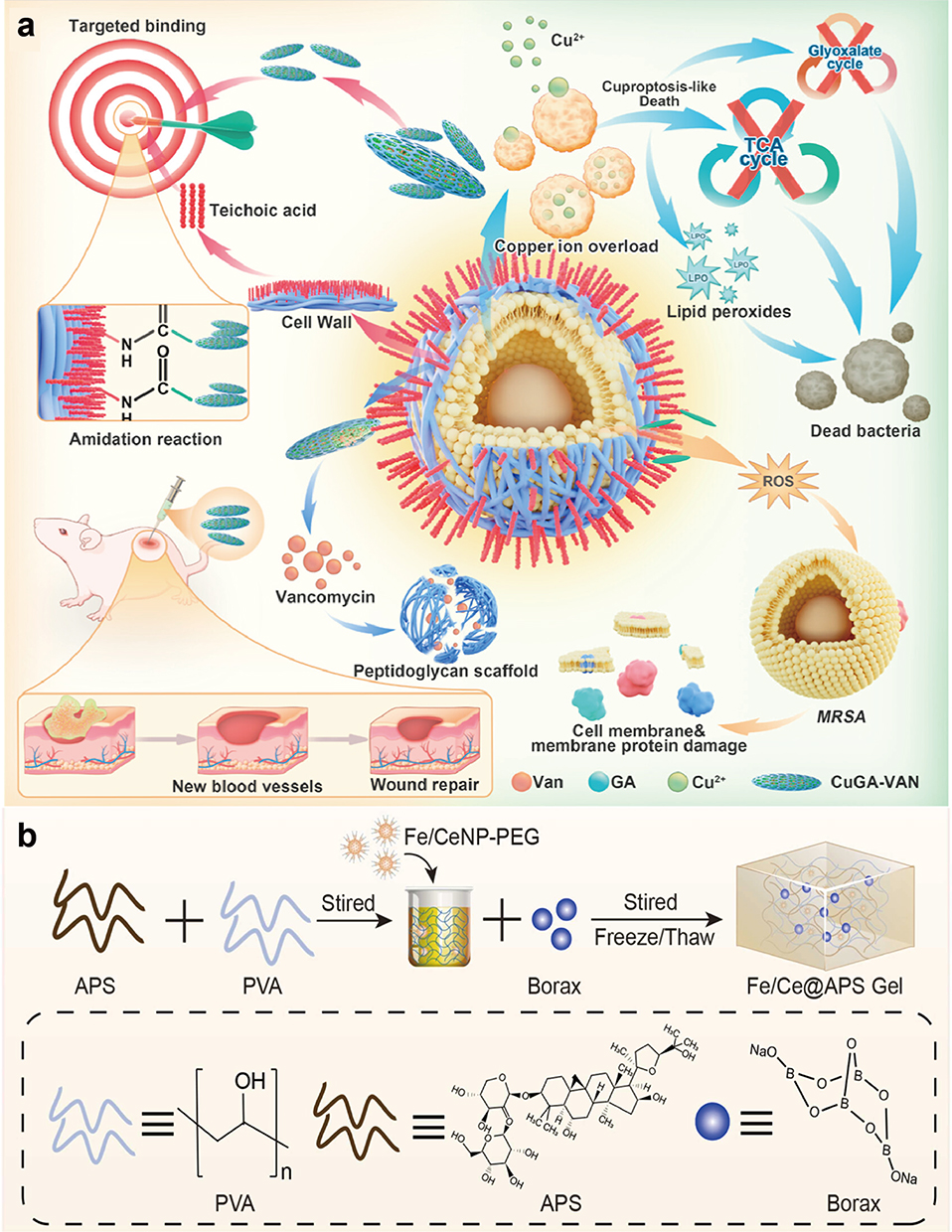 |
Figure 10 (a) CuGA-VAN targets Gram-positive bacteria through the formation of amide bonds, catalyzing the production of ROS and the slow release of Cu2+ and VAN, thereby disrupting the bacterial cell wall and cell membrane.80 (b) Schematic of the synthesis route of Fe/Ce@APS Gel.176 |
Nanozyme delivery systems can be used to modulate inflammation in diabetic wounds by combining antibacterial function with specific anti-inflammatory control. Zhang et al developed a biodegradable multifunctional hydrogel dressing (Fe/Ce@APS Gel) that utilizes Fe/Ce NP-PEG and astragalus polysaccharide (APS) to mitigate ROS and regulate oxygen levels (Figure 10b).176 Fe/CeNP-PEG nanoparticles included inside the APS Gel have better retention in wound tissue than unencapsulated Fe/CeNP-PEG. Additionally, it utilizes APS to enhance cell proliferation and angiogenesis, while mitigating inflammation and expediting granulation tissue formation by inhibiting the NLRP3/NF-κB signaling pathway, thereby synergistically facilitating diabetic wound healing.
In summary, nanozyme-based drug delivery systems integrate the inherent catalytic activity of nanozymes with stimulus-responsive drug release, forming a multifunctional therapeutic platform for diabetic wound management. They can coordinate the control of infection and inflammation through localized and on-demand therapeutic action. Although there have been some promising developments, further research is needed to clarify long-term biocompatibility, understand the quantitative interactions between catalytic and drug, and assess therapeutic efficacy in clinically relevant chronic wound models. In general, ongoing development of microenvironment-responsive materials is anticipated to improve the translational prospects of nanozyme-based approaches for diabetic wound care.
Combination with Hydrogel
The therapeutic efficacy of free nanozymes is often limited by rapid clearance by wound exudate, nonspecific diffusion, insufficient local retention, and susceptibility to interference from the complex wound milieu.97,177 Hydrogels serve as an optimal medium for wound healing owing to their three-dimensional network architecture, elevated water content, biocompatibility, and permeability, which collectively enable ECM mimicry, moisture retention, exudate absorption, and support for cell migration and proliferation.178 Beyond serving as passive scaffolds, hydrogels provide a versatile platform for integrating nanozymes, improving local retention, reducing systemic exposure, and protecting catalytic activity from biomolecular interference. Furthermore, the intrinsic mechanical strength, tissue adhesiveness, and moisture-retention properties of hydrogels synergize with nanozyme catalysis by stabilizing the wound bed, maintaining a hydrated and oxygen-permissive environment, and prolonging therapeutic residence time, thereby enhancing overall therapeutic efficacy.179,180 Additionally, intelligent, stimuli-responsive hydrogels can achieve spatiotemporally controlled release of nanozymes in response to local cues, such as pH, ROS, or glucose concentration, thereby improving the accuracy of therapy.74,181 Nevertheless, hydrogel composition, crosslinking density, and interactions with co-delivered agents may influence nanozyme activity and responsiveness, underscoring the need for rational material design and systematic evaluation under dynamic wound conditions.
Preclinical studies demonstrate the potential of nanozyme-hydrogel systems. Li et al developed a sprayable hydrogel (OxyGel) integrating cerium-based nanozymes (TCZ) to scavenge ROS and generate oxygen via dual SOD- and CAT-like activities, promoting M2 macrophage polarization and angiogenesis in a rat full-thickness skin defect model.182 Yang et al created a glucose-responsive hydrogel loaded with gold-molybdenum disulfide nanozymes that switches between ROS generation and oxygen production depending on glucose levels, thereby improving wound healing in infected wounds (Figure 11).183 Zhang et al reported a thermosensitive hydrogel containing a Cu/Mg bimetallic nanozyme, which reduces ROS, promotes angiogenesis, and achieves a wound closure rate of 90.6% over 14 days.184 While these preclinical results are encouraging, the scalability, reproducibility, and potential immunogenicity of such sophisticated nanozyme-hydrogel systems remain largely untested in higher-order models, limiting immediate clinical translation.
 |
Figure 11 Schematic diagram of the glucose-activated programmed hydrogel for infected diabetic wound healing. (a) Construction of the AMP, CP, and AN. (b) Tissue regeneration promoting effects of CPAN-AMP on infected diabetic wounds.183 |
In summary, nanozyme-hydrogel systems offer a versatile and multifunctional approach to diabetic wound therapy, effectively addressing many of the limitations associated with free nanozymes. However, critical challenges persist, including long-term biosafety, regulatory hurdles, batch-to-batch variability, and cost-effectiveness. Future research must rigorously evaluate pharmacokinetics, immunological responses, and translational feasibility to ensure that these sophisticated platforms can move beyond proof-of-concept studies toward safe and effective clinical application.
Conclusions and Perspectives
Diabetic wounds are defined as those that have long-term high blood sugar (hyperglycemia), ongoing swelling (inflammation), too much harmful chemical activity (oxidative stress), an increased chance of getting sick (infection), and not enough oxygen and blood flow (hypoxic-ischemic pathology). They continue to be a big problem for doctors to solve. This review outlines the most recent advancements in nanozyme-based therapeutic approaches and points out how they could tackle several disease-related issues at once. Nanozymes can mimic the catalytic functions of natural enzymes such as POD, CAT, SOD, and OXD, which allows them to regulate oxidative stress, inflammation, bacterial load, and tissue regeneration together, thus promoting faster wound healing in diabetic models. Though there are some positive results, it is still difficult to translate them into clinical applications; we need a roadmap-driven research plan for further development.
Near-term priorities should be on safety, stability, and catalytic reliability with real-world wounds. Biocompatibility and long-term safety are necessary, especially for metal-based nanozymes, because if they stay inside your body for too long, they could cause metal ions to come out, build up in your body (bioaccumulate), or make your immune system sick (immunotoxicity). The current studies mainly focus on short-term efficacy, and we need to do more standardized long-term biosafety evaluations, such as biodistribution, metabolism, and chronic toxicity in different species. Just as important is the stability of the nanozyme within these complicated wound environments that have lots of proteins around them, are quite acidic, lack oxygen, and keep changing all the time. These conditions can affect the structure and ability to start chemical reactions, leading to less effective treatment. Surface passivation, biopolymer-nanozyme hybridization, and biomimetic coatings could improve the physicochemical stability and also improve biocompatibility.
Mid-term priorities should focus on function improvement and therapy accuracy. GOx-mimicking nanozymes show great potential in managing diabetic wounds because they can deplete glucose locally and produce H2O2 on their own. But at present, the existing systems are mainly composed of gold-based nanozymes, which have low catalytic efficiency and range. More research needs to be done on other metals and metal oxides nanozymes, along with figuring out how glucose gets oxidized. And at the same time, it’s important to improve the targeting accuracy, because there is still not enough drug accumulation in the lesion area, and off-target effects that affect the treatment effect. Ligand-mediated targeting and external guidance strategies could increase the site-specific effectiveness and lower the dosage needed.
Long-term priorities need to include system integration and translational feasibility. Theragnostic nanozyme platforms, which combine therapy and real-time tracking as well as feedback-regulated intervention, might make it possible to have a closed-loop approach towards managing chronic diabetic wounds. But besides tech innovations, there are still many practical obstacles to be crossed. Regulatory uncertainties about nanozyme categorization, quality assurance, and long-term safety assessments complicate approval procedures. Also, the cost of noble-metal-based materials being high, the synthesis methods being complicated, and the difficulty in attaining large-scale, repeatable production processes create worries about whether or not they can be economically feasible and used clinically. Ensuring that each batch is consistent under good manufacturing practices is especially important for getting regulatory approval. Biopolymers mixed with nanozymes could provide a way to make things better, cost less, and work better with rules.
To conclude, nanozymes provide a flexible and strong platform for the treatment of diabetic wounds, but their clinical application needs a staged research plan, going from making sure it’s safe and stable, then making it work better, then being able to make lots of them, and getting permission from doctors and regulators. To address all these interrelated problems together is important if we want to turn nanozyme-based systems from something that works only in an experiment into something that can help people get better.
Data Sharing Statement
No primary research results, software, or code have been included, and no new data were generated or analysed as part of this review.
Author Contributions
All authors made a significant contribution to the work reported, whether that is in the conception, study design, execution, acquisition of data, analysis and interpretation, or in all these areas; took part in drafting, revising or critically reviewing the article; gave final approval of the version to be published; have agreed on the journal to which the article has been submitted; and agree to be accountable for all aspects of the work.
Disclosure
The author(s) report no conflicts of interest in this work.
References
1. Viner R, White B, Christie D. Type 2 diabetes in adolescents: a severe phenotype posing major clinical challenges and public health burden. Lancet. 2017;389:2252–28. doi:10.1016/S0140-6736(17)31371-5
2. Armstrong DG, Boulton AJM, Bus SA. Diabetic foot ulcers and their recurrence. New Engl J Med. 2017;376:2367–2375. doi:10.1056/NEJMra1615439
3. Jia W, Chan JCN, Wong TY, Fisher EB. Diabetes in China: epidemiology, pathophysiology and multi-omics. Nat Metab. 2025;7:16–34. doi:10.1038/s42255-024-01190-w
4. Manigrasso J, Chillón I, Genna V, et al. Author Correction: visualizing group II intron dynamics between the first and second steps of splicing. Nat Commun. 2022;13:1. doi:10.1038/s41467-021-27699-2
5. Lu Q, Tang X, Tao B, et al. Multifunctional hyaluronic acid microneedle patch enhances diabetic wound healing in diabetic infections. Int J Biol Macromol. 2025;296:139685. doi:10.1016/j.ijbiomac.2025.139685
6. Zhou L, Lan K, Huang X, et al. A novel photosynthetic biohybrid system for microenvironment regulation of diabetes retinopathy through continuous oxygen supply and nanozyme cascade reaction. Adv Funct Mater. 2023;33:2302493. doi:10.1002/adfm.202302493
7. Deng H, Li B, Shen Q, et al. Mechanisms of diabetic foot ulceration: a review. J Diabetes. 2023;15:299–312. doi:10.1111/1753-0407.13372
8. Wu H, Yang P, Li A, Jin X, Zhang Z, Lv H. Chlorella sp.-ameliorated undesirable microenvironment promotes diabetic wound healing. Acta Pharm Sin B. 2023;13:410–424. doi:10.1016/j.apsb.2022.06.012
9. Guo Q, Ying G, Jing O, et al. Influencing factors for the recurrence of diabetic foot ulcers: a meta-analysis. Int Wound J. 2023;20:1762–1775. doi:10.1111/iwj.14017
10. Li W, Bei Y, Pan X, et al. Selenide-linked polydopamine-reinforced hybrid hydrogels with on-demand degradation and light-triggered nanozyme release for diabetic wound healing. Biomater Res. 2023;27:49. doi:10.1186/s40824-023-00367-w
11. Deng S, Ou K, Zhang C, et al. A one-two punch strategy for diabetic wound management based on an antibiotic-hybrid biomineralized iron sulfide nanoparticle. Acta Biomater. 2024;181:333–346. doi:10.1016/j.actbio.2024.04.027
12. Zhang L, Cai S, Zhai Y, et al. Ultrafine Ru clusters with GOx enable glucose-activated cascaded reaction for bacterial-infected diabetic wound healing. Chem Eng J. 2024;488:150991. doi:10.1016/j.cej.2024.150991
13. P n N, Mehla S, Begum A, et al. Smart nanozymes for cancer therapy: the next frontier in oncology. Adv Healthc Mater. 2023;12:2300768. doi:10.1002/adhm.202300768
14. Malla P, Wang Y-M, Su C-H. New horizons for the therapeutic application of nanozymes in cancer treatment. J Nanobiotechnol. 2025;23:130. doi:10.1186/s12951-025-03185-5
15. Xiao J, An X, Tang F, et al. Photosynthesis-inspired NIR-triggered Fe3O4@MoS2 core–shell nanozyme for promoting MRSA-infected diabetic wound healing. Adv Healthc Mater. 2025;14:2404525. doi:10.1002/adhm.202404525
16. Tan X, Lin N, Yang S, et al. AuCu@CuO2 aerogels with H₂O₂/O₂ self-supplying and quadruple enzyme-like activity for MRSA-infected diabetic wound management. Adv Sci. 2025;12:2502391. doi:10.1002/advs.202502391
17. Xu M, Zhou Y, Xu Y, Shao A, Han H, Ye J. Supramolecular engineering of nanoceria for management and amelioration of age-related macular degeneration via the two-level blocking of oxidative stress and inflammation. Adv Sci. 2025;12:2408436. doi:10.1002/advs.202408436
18. Tang M, Zhang Z, Sun T, Li B, Wu Z. Manganese-based nanozymes: preparation, catalytic mechanisms, and biomedical applications. Adv Healthc Mater. 2022;11:2201733. doi:10.1002/adhm.202201733
19. Lei F, Huang Q, Zhang C, Lin Y, Zhang Y, Wang F. Pathogenesis guided application of nanozymes in the treatment of inflammatory bowel disease. Mater Today Bio. 2025;33:102008. doi:10.1016/j.mtbio.2025.102008
20. Liu L, Zhang Y, Ju T, Chen X, Li X, Wu L-A. Nanozymes: a promising solution for dental antibacterial applications. RSC Adv. 2024;14:36945–36959. doi:10.1039/D4RA07303G
21. Jiao L, Xu W, Yan H, et al. A dopamine-induced Au hydrogel nanozyme for enhanced biomimetic catalysis. ChemComm. 2019;55:9865–9868. doi:10.1039/C9CC04436A
22. Guo C, Liu D, Xu W, He L, Liu S. Accelerating the peroxidase- and glucose oxidase-like activity of Au nanoparticles by seeded growth strategy and their applications for colorimetric detection of dopamine and glucose. Colloids Surf A Physicochem Eng Asp. 2023;658:130555. doi:10.1016/j.colsurfa.2022.130555
23. Song J, Chen H, Lv Y, et al. CuO2-assisting-Zn single atom hybrid nanozymes for biofilm-infected wound healing. Chem Eng J. 2023;474:145706. doi:10.1016/j.cej.2023.145706
24. Hu J, Huang Y, Hao H, et al. Bioinspired programmed antibiofilm strategies for accelerated wound healing via spatiotemporally controlled enzyme nanoreactors. J Control Release. 2025;381:113582. doi:10.1016/j.jconrel.2025.113582
25. Gui S, Tang W, Huang Z, et al. Ultrasmall coordination polymer nanodots Fe-Quer nanozymes for preventing and delaying the development and progression of diabetic retinopathy. Adv Funct Mater. 2023;33:2300261. doi:10.1002/adfm.202300261
26. Qin X, Tian R, Wang B, et al. Metal-phenolic nanocapsules with photothermal antibacterial and ROS scavenging ability for diabetic wound healing. Adv Healthc Mater. 2024;13:2303604. doi:10.1002/adhm.202303604
27. Jiang J, Li X, Li H, et al. Recent progress in nanozymes for the treatment of diabetic wounds. J Mater Chem B. 2023;11:6746–6761. doi:10.1039/D3TB00803G
28. Xiao X, Zhao F, DuBois DB, et al. Nanozymes for the therapeutic treatment of diabetic foot ulcers. ACS Biomater Sci Eng. 2024;10:4195–4226. doi:10.1021/acsbiomaterials.4c00470
29. Zhang H-Y, Zhang Q-Y, Liu Q, et al. Exosome-loading miR-205: a two-pronged approach to ocular neovascularization therapy. J Nanobiotechnol. 2025;23:36. doi:10.1186/s12951-024-03079-y
30. Shi M, Du Z, Qi Y, et al. Wound microenvironment-responsive glucose consumption and hydrogen peroxide generation synergistic with azithromycin for diabetic wounds healing. Theranostics. 2022;12:2658–2673. doi:10.7150/thno.64244
31. Yin Y, Guo W, Chen Q, et al. A single H2S-releasing nanozyme for comprehensive diabetic wound healing through multistep intervention. ACS Appl Mater Inter. 2025;17:18134–18149. doi:10.1021/acsami.5c00889
32. Qu C, Luo T, Han R, et al. NIR-driven GOx-like nanozyme-modified injectable thermoresponsive hydrogel for antibacterial therapy and bone regeneration in periodontitis. Chem Eng J. 2025;506:160108. doi:10.1016/j.cej.2025.160108
33. Wang X, Qin X, Liu Y, et al. Plasmonic supramolecular nanozyme-based bio-cockleburs for synergistic therapy of infected diabetic wounds. Adv Mater. 2024;36:2411194. doi:10.1002/adma.202411194
34. Sun Y, Zhu Y, Si J, et al. Glucose-activated nanozyme hydrogels for microenvironment modulation via cascade reaction in diabetic wound. Chinese Chem Lett. 2025;36:110012. doi:10.1016/j.cclet.2024.110012
35. Ding Y, Li X, Li C, Niu Z, Wen G, Zhang H. Zinc cerium peroxide antibacterial agent with acid-activated cascade multienzymatic activities. ACS Appl Nano Mater. 2025;8:2886–2896. doi:10.1021/acsanm.4c06549
36. Zhang Y, Nie C, Wang Z, et al. A spatial confinement biological heterogeneous cascade nanozyme composite hydrogel combined with nitric oxide gas therapy for enhanced treatment of psoriasis and diabetic wound. Chem Eng J. 2025;507:160629. doi:10.1016/j.cej.2025.160629
37. Monaghan MG, Borah R, Thomsen C, Browne S. Thou shall not heal: overcoming the non-healing behaviour of diabetic foot ulcers by engineering the inflammatory microenvironment. Adv Drug Deliv Rev. 2023;203:115120. doi:10.1016/j.addr.2023.115120
38. Gao S, He X, Liu H, et al. Multifunctional bioactive nanozyme systems for enhanced diabetic wound healing. Adv Healthc Mater. 2025;14:2401580. doi:10.1002/adhm.202401580
39. He C, Gong H, Wang Y, et al. An artificial cascade-nanozyme-loaded hydrogel with robust revascularization and macrophage remodulation for diabetic foot ulcers therapy. Chem Eng J. 2025;516:164166. doi:10.1016/j.cej.2025.164166
40. Wang S, Sun X, Li Y, et al. Engineering immunomodulatory hydrogels for diabetic wound microenvironment reprogramming. Nano Today. 2025;65:102870. doi:10.1016/j.nantod.2025.102870
41. Hao P-C, Burnouf T, Chiang C-W, et al. Enhanced diabetic wound healing using platelet-derived extracellular vesicles and reduced graphene oxide in polymer-coordinated hydrogels. J Nanobiotechnol. 2023;21:318. doi:10.1186/s12951-023-02068-x
42. Xue Y, Zhang Y, Zhong Y, et al. LNP-RNA-engineered adipose stem cells for accelerated diabetic wound healing. Nat Commun. 2024;15:739. doi:10.1038/s41467-024-45094-5
43. Mandakhbayar N, Ji Y, El-Fiqi A, et al. Double hits with bioactive nanozyme based on cobalt-doped nanoglass for acute and diabetic wound therapies through anti-inflammatory and pro-angiogenic functions. Bioact Mater. 2024;31:298–311. doi:10.1016/j.bioactmat.2023.08.014
44. Kang Q, Yang C. Oxidative stress and diabetic retinopathy: molecular mechanisms, pathogenetic role and therapeutic implications. Redox Biol. 2020;37:101799. doi:10.1016/j.redox.2020.101799
45. Wang N, Wang L, Zhang C, Tan H-Y, Zhang Y, Feng Y. Berberine suppresses advanced glycation end products-associated diabetic retinopathy in hyperglycemic mice. Clin Transl Med. 2021;11:e569. doi:10.1002/ctm2.569
46. Liu Y, Wu Z, Li Y, et al. Metabolic reprogramming and interventions in angiogenesis. J Adv Res. 2025;70:323–338. doi:10.1016/j.jare.2024.05.001
47. Wu T, Bai X, Zhang Y, et al. Natural medicines-derived carbon dots as novel oral antioxidant administration strategy for ulcerative colitis therapy. J Nanobiotechnol. 2024;22:511. doi:10.1186/s12951-024-02702-2
48. Ghosal K, Chakraborty D, Roychowdhury V, Ghosh S, Dutta S. Recent advancement of functional hydrogels toward diabetic wound management. ACS Omega. 2022;7:43364–43380. doi:10.1021/acsomega.2c05538
49. Si Y, Dong S, Li M, et al. Curcumin-encapsulated exosomes in bisphosphonate-modified hydrogel microspheres promote bone repair through macrophage polarization and DNA damage mitigation. Mater Today Bio. 2025;32:101874. doi:10.1016/j.mtbio.2025.101874
50. Yin B, Dodda JM, Wong SHD, et al. Smart injectable hydrogels for periodontal regeneration: recent advancements in biomaterials and biofabrication strategies. Mater Today Bio. 2025;32:101855. doi:10.1016/j.mtbio.2025.101855
51. Kong J, Ma S, Chu R, et al. Photothermal and photocatalytic glycol chitosan and polydopamine-grafted oxygen vacancy bismuth oxyiodide (BiO1-xI) nanoparticles for the diagnosis and targeted therapy of diabetic wounds. Adv Mater. 2024;36:2307695. doi:10.1002/adma.202307695
52. Qin D, Hu W, Guo Y, Cheng R, Hao F, Zhao B. Baicalein based nano-delivery system restores mitochondrial homeostasis through PPAR signaling pathway to promote wound healing in diabetes. J Nanobiotechnol. 2025;23:360. doi:10.1186/s12951-025-03427-6
53. Liu F, Chen Y, Huang Y, et al. Synergistic wall digestion and cuproptosis against fungal infections using lywallzyme-induced self-assembly of metal-phenolic nanoflowers. Nat Commun. 2024;15:9004. doi:10.1038/s41467-024-53410-2
54. Chen Y, Gao Y, Huang Y, Jin Q, Ji J. Inhibiting quorum sensing by active targeted pH-sensitive nanoparticles for enhanced antibiotic therapy of biofilm-associated bacterial infections. ACS Nano. 2023;17:10019–10032. doi:10.1021/acsnano.2c12151
55. Xu Y, Luo Y, Weng Z, et al. Microenvironment-responsive metal-phenolic nanozyme release platform with antibacterial, ROS scavenging, and osteogenesis for periodontitis. ACS Nano. 2023;17:18732–18746. doi:10.1021/acsnano.3c01940
56. Shen Y, Li S, Hou X, et al. Ultrasound-triggered nanocomposite “Lever” hydrogels with a full repair system accelerates diabetic foot ulcer repair. Adv Sci. 2025;12:2500720. doi:10.1002/advs.202500720
57. Lewis JE, Omenge DK, Patterson AR, et al. The impact of semaglutide on wound healing in diabetes related foot ulcer patients: a TriNetX database study. Diab Vasc Dis Res. 2025;22:14791641251322909. doi:10.1177/14791641251322909
58. Wang L, Mai Y, Zhang J, et al. Polyvalent bacteriophages conjugated with ROS-scavenging nanozymes enhance antibiotic-resistant biofilm disruption and anti-inflammatory therapy. Chem Eng J. 2025;505:159666. doi:10.1016/j.cej.2025.159666
59. Zhao X, Xue C, Liu Y, Wang T, Shuai Q. Glu and GSH double-unlocked immunomodulatory tri-cascade nanoreactor for biofilm-infected diabetic wounds healing. Chem Eng J. 2024;485:150002. doi:10.1016/j.cej.2024.150002
60. Yang X, Tan M, Guo J, et al. PdZn/CoSA-NC nanozymes with highly efficient SOD/CAT activities for treatment of osteoarthritis via regulating immune microenvironment. Adv Funct Mater. 2024;34:2401963. doi:10.1002/adfm.202401963
61. Jin C, Zhao R, Hu W, et al. Topical hADSCs-HA Gel promotes skin regeneration and angiogenesis in pressure ulcers by paracrine activating PPARβ/δ pathway. Drug Des Devel Ther. 2024;18:4799–4824. doi:10.2147/DDDT.S474628
62. Rakita A, Nikolić N, Mildner M, Matiasek J, Elbe-Bürger A. Re-epithelialization and immune cell behaviour in an ex vivo human skin model. Sci Rep. 2020;10:1. doi:10.1038/s41598-019-56847-4
63. Yadav JP. Based on clinical research matrixmetalloprotease (MMP) inhibitors to promote diabetic wound healing. Horm Metab Res. 2023;55:752–757. doi:10.1055/a-2171-5879
64. Wang Y, Yuan X, Yao B, Zhu S, Zhu P, Huang S. Tailoring bioinks of extrusion-based bioprinting for cutaneous wound healing. Bioact Mater. 2022;17:178–194. doi:10.1016/j.bioactmat.2022.01.024
65. Zhong W, Hu R, Zhou S, et al. Spatiotemporally responsive hydrogel dressing with self-adaptive antibacterial activity and cell compatibility for wound sealing and healing. Adv Healthc Mater. 2023;12:2203241. doi:10.1002/adhm.202203241
66. Shi C, Liu P, Liu Y, Gai Z, Yang F, Yang Y. Accelerating chronic wound healing by breaking the pH limitations of biomolecule-loaded Nanozymes and remodeling the microenvironment in Cascade reactions. J Colloid Interface Sci. 2025;700:138370. doi:10.1016/j.jcis.2025.138370
67. Shirzaei Sani E, Xu C, Wang C, et al. A stretchable wireless wearable bioelectronic system for multiplexed monitoring and combination treatment of infected chronic wounds. Sci Adv. 2023;9:eadf7388. doi:10.1126/sciadv.adf7388
68. Mirani B, Hadisi Z, Pagan E, et al. Smart dual-sensor wound dressing for monitoring cutaneous wounds. Adv Healthc Mater. 2023;12:2203233. doi:10.1002/adhm.202203233
69. Li M, Jafari H, Okoro OV, Nie L, Shavandi A. Nanozymes as catalysts for accelerated healing of diabetic wounds. Cell Biomater. 2025;1:100049. doi:10.1016/j.celbio.2025.100049
70. Cui W, Wang Y, Luo C, et al. Nanoceria for ocular diseases: recent advances and future prospects. Mat Today Nano. 2022;18:100218. doi:10.1016/j.mtnano.2022.100218
71. Zhang D, Chen Q, Ren Q, et al. Transition metal-based nanozymes: classification, catalytic mechanisms and emerging biomedical applications. Coord Chem Rev. 2024;508:215771. doi:10.1016/j.ccr.2024.215771
72. Li Y, Fu R, Duan Z, Zhu C, Fan D. Construction of multifunctional hydrogel based on the tannic acid-metal coating decorated MoS2 dual nanozyme for bacteria-infected wound healing. Bioact Mater. 2022;9:461–474. doi:10.1016/j.bioactmat.2021.07.023
73. Liu Y, Xu B, Lu M, et al. Ultrasmall Fe-doped carbon dots nanozymes for photoenhanced antibacterial therapy and wound healing. Bioact Mater. 2022;12:246–256. doi:10.1016/j.bioactmat.2021.10.023
74. Jiang S, Xie D, Hu Z, et al. Enhanced diabetic wound healing with injectable hydrogel containing self-assembling nanozymes. J Control Release. 2024;372:265–280. doi:10.1016/j.jconrel.2024.06.040
75. Guo Y, Wang J, Wu X, et al. Gold nanoparticle-loaded multifunctional Ti3C2Tx MXene nanosheets fabricated by in situ reduction to effectively enhance their catalase-like activity for tumor therapy. Nano Today. 2025;65:102848. doi:10.1016/j.nantod.2025.102848
76. Liu W, Ye J, Wang Y, et al. Multimodal antibacterial E-skin patch driven by oxidative stress for real-time wound-status monitoring and integrated treatment of chronic wounds. Adv Funct Mater. 2025;35:2424698. doi:10.1002/adfm.202424698
77. Chen L, Xing S, Lei Y, et al. A glucose-powered activatable nanozyme breaking pH and H₂O₂ limitations for treating diabetic infections. Angew Chem Int Ed. 2021;60:23534–23539. doi:10.1002/anie.202107712
78. Dong H, Du W, Dong J, et al. Depletable peroxidase-like activity of Fe3O4 nanozymes accompanied with separate migration of electrons and iron ions. Nat Commun. 2022;13:5365. doi:10.1038/s41467-022-33098-y
79. Fang Y, Ning J, Tang Z, et al. Stable tensile-strained palladium hydride nanozymes with specifically enhanced peroxidase-like activity for intelligent glucose detection. Nano Res. 2025;18:94907984. doi:10.26599/NR.2025.94907984
80. Hu Z, Shan J, Jin X, et al. Nanoarchitectonics of in situ antibiotic-releasing acicular nanozymes for targeting and inducing cuproptosis-like death to eliminate drug-resistant bacteria. ACS Nano. 2024;18:24327–24349. doi:10.1021/acsnano.4c06565
81. Chen L, Peng M, He W, et al. Microenvironment-adaptive nanodecoy synergizes bacterial eradication, inflammation alleviation, and immunomodulation in promoting biofilm-associated diabetic chronic wound healing cascade. Aggregate. 2024;5:e640. doi:10.1002/agt2.640
82. Hui Y, Mao J, Rui M, et al. Hydrogel microsphere-encapsulated bimetallic nanozyme for promoting diabetic bone regeneration via glucose consumption and ROS scavenging. Adv Healthc Mater. 2024;13:2402596. doi:10.1002/adhm.202402596
83. Wu F, Wang Y, Li Y, et al. Single-atom Cu anchored on carbon nitride as a bifunctional glucose oxidase and peroxidase nanozyme for antibacterial therapy. ACS Nano. 2025;19:10816–10828. doi:10.1021/acsnano.4c12348
84. Zhou Z, Mei X, Hu K, Ma M, Zhang Y. Nanohybrid double network hydrogels based on a platinum nanozyme composite for antimicrobial and diabetic wound healing. ACS Appl Mater Inter. 2023;15:17612–17626. doi:10.1021/acsami.3c00459
85. Wu J, Meng T, Zhang X, et al. Glucose-responsive Zn(II)-porphyrin COF adhesive hydrogels with dual-active sites and GOX-like activity for accelerated wound healing. Adv Healthc Mater. 2025;14:2404076. doi:10.1002/adhm.202404076
86. Huang Y, Liao W, Wang W, Zhang T, Zhang Y, Lu L. Facile synthesis of nanoparticles-stacked Co3O4 nanoflakes with catalase-like activity for accelerating wound healing. Regen Biomater. 2024;11:rbae006. doi:10.1093/rb/rbae006
87. Chen Y, Yuan B, Yang Z, et al. Catalase-like nanozyme-hybrid hydrogels utilizing endogenous ROS as an oxygen source to synergically regulate oxidative stress and hypoxia for enhanced diabetic wound healing. Biomacromolecules. 2025;26:1672–1685. doi:10.1021/acs.biomac.4c01481
88. Yu Z, Li M, Yang L, et al. Enhancing diabetic wound healing: a two-pronged approach with ROS scavenging and ROS-independent antibacterial properties. Nano Today. 2024;57:102358. doi:10.1016/j.nantod.2024.102358
89. You W, Cai Z, Xiao F, et al. Biomolecular microneedle initiates Fe₃O₄/MXene heterojunction-mediated nanozyme-like reactions and bacterial ferroptosis to repair diabetic wounds. Adv Sci. 2025;12:2417314. doi:10.1002/advs.202417314
90. Zhao Y, Wang D, Qian T, et al. Biomimetic nanozyme-decorated hydrogels with H2O2-activated oxygenation for modulating immune microenvironment in diabetic wound. ACS Nano. 2023;17:16854–16869. doi:10.1021/acsnano.3c03761
91. Zhou Y, Liu C, Yu Y, et al. An organelle-specific nanozyme for diabetes care in genetically or diet-induced models. Adv Mater. 2020;32:2003708. doi:10.1002/adma.202003708
92. He J, Zhang W, Cui Y, Cheng L, Chen X-L, Wang X. Multifunctional Cu2Se/F127 hydrogel with SOD-like enzyme activity for efficient wound healing. Adv Healthc Mater. 2024;13:2303599. doi:10.1002/adhm.202303599
93. Chao D, Dong Q, Yu Z, et al. Specific nanodrug for diabetic chronic wounds based on antioxidase-mimicking MOF-818 nanozymes. J Am Chem Soc. 2022;144:23438–23447. doi:10.1021/jacs.2c09663
94. Wang Y, Chen C, He C, et al. Quaternized chitosan-based biomimetic nanozyme hydrogels with ROS scavenging, oxygen generating, and antibacterial capabilities for diabetic wound repair. Carbohydr Polym. 2025;348:122865. doi:10.1016/j.carbpol.2024.122865
95. Guo C, Wang Y, Liu H, et al. A refractory wound healing hydrogel with integrated functions of photothermal anti-infection, superoxide dismutase mimicking activity, and intelligent infection management. Mater Des. 2022;224:111280. doi:10.1016/j.matdes.2022.111280
96. Li Y, Fu R, Duan Z, Zhu C, Fan D. Injectable hydrogel based on defect-rich multi-nanozymes for diabetic wound healing via an oxygen self-supplying cascade reaction. Small. 2022;18:2200165. doi:10.1002/smll.202200165
97. Shang L, Yu Y, Jiang Y, et al. Ultrasound-augmented multienzyme-like nanozyme hydrogel spray for promoting diabetic wound healing. ACS Nano. 2023;17:15962–15977. doi:10.1021/acsnano.3c04134
98. Shen Z, Du L, Fang X, et al. Nanozyme cryogel accelerates diabetic wound healing by targeting biofilms and inflammations of the wound bed. ACS Nano. 2025;19:35081–35101. doi:10.1021/acsnano.5c12513
99. Meng W, Chen X, Chen Y, et al. Self-cascade of ROS/glucose-scavenging immunomodulatory hydrogels for programmed therapeutics of infected diabetic ulcers via Nrf2/NF-κB pathway. Small. 2025;21:2411189. doi:10.1002/smll.202411189
100. Huang W, Xu P, Fu X, et al. Functional molecule-mediated assembled copper nanozymes for diabetic wound healing. J Nanobiotechnol. 2023;21:294. doi:10.1186/s12951-023-02048-1
101. Dong J, Liu G, Petrov YV, et al. Discovery of FeP/carbon dots nanozymes for enhanced peroxidase-like catalytic and antibacterial activity. Adv Healthc Mater. 2024;13:2402568. doi:10.1002/adhm.202402568
102. Pan T, Chen H, Gao X, Wu Z, Ye Y, Shen Y. Engineering efficient artificial nanozyme based on chitosan grafted Fe-doped-carbon dots for bacteria biofilm eradication. J Hazard Mater. 2022;435:128996. doi:10.1016/j.jhazmat.2022.128996
103. Shen Y, Nie C, Pan T, et al. A multifunctional cascade nanoreactor based on Fe-driven carbon nanozymes for synergistic photothermal/chemodynamic antibacterial therapy. Acta Biomater. 2023;168:580–592. doi:10.1016/j.actbio.2023.07.006
104. Yang J, Dai H, Sun Y, et al. 2D material–based peroxidase-mimicking nanozymes: catalytic mechanisms and bioapplications. Anal Bioanal Chem. 2022;414:2971–2989. doi:10.1007/s00216-022-03985-w
105. Wang H, Wan K, Shi X. Recent advances in nanozyme research. Adv Mater. 2019;31:1805368. doi:10.1002/adma.201805368
106. Shen X, Wang Z, Gao X, Zhao Y. Density functional theory-based method to predict the activities of nanomaterials as peroxidase mimics. ACS Catal. 2020;10:12657–12665. doi:10.1021/acscatal.0c03426
107. Guo S, Guo L. Unraveling the multi-enzyme-like activities of iron oxide nanozyme via a first-principles microkinetic study. J Phys Chem C. 2019;123:30318–30334. doi:10.1021/acs.jpcc.9b07802
108. Wang Y, Li H, Guo L, Jiang Q, Liu F. A cobalt-doped iron oxide nanozyme as a highly active peroxidase for renal tumor catalytic therapy. RSC Adv. 2019;9:18815–18822. doi:10.1039/C8RA05487H
109. Fan Z, Liang C, Zhang J, et al. Multimodal synergistic strategies for diabetic wound healing using glucose oxidase nanocomposites: therapeutic mechanisms and nanomaterial design. Int J Nanomed. 2025;20:5727–5762. doi:10.2147/ijn.S515057
110. Luo W, Liu J, Jiang Y, et al. Multifunctional nanogel dressings with dual acid and H2O2 responsive release for synergetic therapy of diabetic bacterial wounds. Mater Today Bio. 2025;33:102094. doi:10.1016/j.mtbio.2025.102094
111. He M, Wang Z, Yang H, et al. Multi-functional Bio-HJzyme: revolutionizing diabetic skin regeneration with its glucose-unlocked sterilization and programmed anti-Inflammatory effects. Adv Sci. 2023;10:2300986. doi:10.1002/advs.202300986
112. Lv W, Jiang G, Lin X, et al. An unusual application of multifunctional nanozyme derived from COF: augmenting chemoimmunotherapy while attenuating cardiotoxicity. Adv Funct Mater. 2025;35:2412862. doi:10.1002/adfm.202412862
113. Dai F, Zhang J, Chen F, et al. A multi-responsive hydrogel combined with mild heat stimulation promotes diabetic wound healing by regulating inflammatory and enhancing angiogenesis. Adv Sci. 2024;11:2408783. doi:10.1002/advs.202408783
114. Grossman A, Johannsson G, Quinkler M, Zelissen P. THERAPY OF ENDOCRINE DISEASE: perspectives on the management of adrenal insufficiency: clinical insights from across Europe. Eur J Endocrinol. 2013;169:R165–R175. doi:10.1530/EJE-13-0450
115. Shan J, Zhang X, Cheng Y, et al. Glucose metabolism-inspired catalytic patches for NIR-II phototherapy of diabetic wound infection. Acta Biomater. 2023;157:200–209. doi:10.1016/j.actbio.2022.12.001
116. Lang NJ, Liu B, Liu J. Characterization of glucose oxidation by gold nanoparticles using nanoceria. J Colloid Interface Sci. 2014;428:78–83. doi:10.1016/j.jcis.2014.04.025
117. Chen J, Ma Q, Li M, et al. Glucose-oxidase like catalytic mechanism of noble metal nanozymes. Nat Commun. 2021;12:3375. doi:10.1038/s41467-021-23737-1
118. Shuai C, Xiao J, Wang K, Pan G, Peng S, Zhong Q. NIR-enhanced nanoreactors within Cu2O@Au–Pt scaffold for antibacterial therapy of diabetic wounds. Mater Today Chem. 2025;47:102802. doi:10.1016/j.mtchem.2025.102802
119. Cong C, Li C, Cao G, et al. Dual-activity nanozyme to initiate tandem catalysis for doubly enhancing ATP-depletion anti-tumor therapy. Biomater Adv. 2022;143:213181. doi:10.1016/j.bioadv.2022.213181
120. Dong X, Wang L, Wang D, Yu M, Yang XJ, Cai H. Proteomic study on nintedanib in gastric cancer cells. PeerJ. 2024;12:e16771. doi:10.7717/peerj.16771
121. Cao YY, Chen YY, Wang MS, et al. A catalase inhibitor: targeting the NADPH-binding site for castration-resistant prostate cancer therapy. Redox Biol. 2023;63:102751. doi:10.1016/j.redox.2023.102751
122. Singh RK, Yoon DS, Mandakhbayar N, et al. Diabetic bone regeneration with nanoceria-tailored scaffolds by recapitulating cellular microenvironment: activating integrin/TGF-β co-signaling of MSCs while relieving oxidative stress. Biomaterials. 2022;288:121732. doi:10.1016/j.biomaterials.2022.121732
123. Acosta FM, Stojkova K, Zhang J, et al. Engineering functional vascularized beige adipose tissue from microvascular fragments of models of healthy and type II diabetes conditions. J Tissue Eng. 2022;13:1–17. doi:10.1177/20417314221109337
124. Jia S, Wu S, Yi M, et al. New strategies for the treatment of diabetic foot ulcers using nanoenzymes: frontline advances in anti-infection, immune regulation, and microenvironment improvement. Int J Nanomed. 2025;20:8783–8810. doi:10.2147/ijn.S531396
125. Chen Y, Yang X, Li K, et al. Phenolic ligand–metal charge transfer induced copper nanozyme with reactive oxygen species-scavenging ability for chronic wound healing. ACS Nano. 2024;18:7024–7036. doi:10.1021/acsnano.3c10376
126. Jiang T, Chen W, Lu C, et al. A multifunctional nanozyme integrating antioxidant, antimicrobial and pro-vascularity for skin wound management. Int J Nanomed. 2024;19:3217–3232. doi:10.2147/IJN.S452216
127. Feng S, Peng X, Deng Y, et al. Biomimetic nanozyme-decorated smart hydrogel for promoting chronic refractory wound healing. ACS Appl Mater Inter. 2024;16:59862–59879. doi:10.1021/acsami.4c13220
128. Sim Y, Seong J, Lee S, et al. Metal-organic framework-supportedcatalase delivery for enhanced photodynamic therapy via hypoxia mitigation. ACS Appl Mater Interfaces. 2023;15:50953–50961. doi:10.1021/acsami.3c13395
129. Wang X, Liu T, Chen M, et al. An erythrocyte-templated iron single-atom nanozyme for wound healing. Adv Sci. 2024;11:2307844. doi:10.1002/advs.202307844
130. Han X, Li B, Wang W, et al. Cerium vanadate nanozyme with pH-dependent dual enzymatic activity forglioblastoma targeted therapy and postradiotherapy damage protection. ACS Nano. 2024;18:19836–19853. doi:10.1021/acsnano.4c06616
131. Xu S, Yuan Y, Pan Y, et al. A highly efficient and biocompatible cupper-based single-atom nanocatalyst with unsaturated coordination structure for efficient diabetic wound healing. Small. 2025;21:2502896. doi:10.1002/smll.202502896
132. Wang X, Zhang H, Sapio R, et al. SOD1 regulates ribosome biogenesis in KRAS mutant non-small cell lung cancer. Nat Commun. 2021;12:2259. doi:10.1038/s41467-021-22480-x
133. Zhang L, Zhang Y, Wang Z, et al. Constructing metal–organic framework nanodots as bio-inspired artificial superoxide dismutase for alleviating endotoxemia. Mater Horiz. 2019;6:1682–1687. doi:10.1039/C9MH00339H
134. Zhong J, Yang X, Gao S, et al. Geometric and electronic structure-matched superoxide dismutase-like and catalase-like sequential single-atom nanozymes for osteoarthritis recession. Adv Funct Mater. 2023;33:2209399. doi:10.1002/adfm.202209399
135. Yan Z, Zhang Y, Chen Q, et al. Carbon dot superoxide dismutase nanozyme enhances reactive oxygen species scavenging in diabetic skin wound repair. J Adv Res. 2026;79:691–706. doi:10.1016/j.jare.2025.03.049
136. Soccio RE, Chen ER, Lazar MA. Thiazolidinediones and the promise of insulin sensitization in type 2 diabetes. Cell Metab. 2014;20:573–591. doi:10.1016/j.cmet.2014.08.005
137. Du X, Jia B, Wang W, et al. pH-switchable nanozyme cascade catalysis: a strategy for spatial–temporal modulation of pathological wound microenvironment to rescue stalled healing in diabetic ulcer. J Nanobiotechnol. 2022;20:12. doi:10.1186/s12951-021-01215-6
138. Deng M, Zhang M, Huang R, et al. Diabetes immunity-modulated multifunctional hydrogel with cascade enzyme catalytic activity for bacterial wound treatment. Biomaterials. 2022;289:121790. doi:10.1016/j.biomaterials.2022.121790
139. Tian Q, Li S, Tang Z, et al. Nanozyme-enabled biomedical diagnosis: advances, trends, andchallenges. Adv Healthc Mater. 2025;14:2401630. doi:10.1002/adhm.202401630
140. Gu C, Zhang L, Hou T, Wang Q, Li F, Gai P. Laser-induced nanozyme biofuel cell-based self-powered patch for accelerating diabetic wound healing with real-time monitoring. Adv Funct Mater. 2025;35:2423106. doi:10.1002/adfm.202423106
141. Lin J, Lian C, Xu L, et al. Hyperglycemia targeting nanomotors foraccelerated healing of diabetic wounds by efficient microenvironment remodeling. Adv Funct Mater. 2025;35:2417146. doi:10.1002/adfm.202417146
142. Cheng Y, Wang Y, Wang Y, et al. Microenvironment-feedback regulated hydrogels as living wound healing materials. Nat Commun. 2025;16:6050. doi:10.1038/s41467-025-60858-3
143. Zhang B, Lv Y, Yu C, et al. Au–Pt nanozyme-based multifunctional hydrogel dressing for diabetic wound healing. Biomater Adv. 2022;137:212869. doi:10.1016/j.bioadv.2022.212869
144. Haas M, Cherfa S, Nguyen L, et al. PIM2 inhibition promotes MCL1 dependency in plasma cells involving integrated stress response-driven NOXA expression. Nat Commun. 2025;16:256. doi:10.1038/s41467-024-55572-5
145. Li Q, Dong M, Han Q, et al. Enhancing diabetic wound healing with a pH-responsive nanozyme hydrogel featuring multi-enzyme-like activities and oxygen self-supply. J Control Release. 2024;365:905–918. doi:10.1016/j.jconrel.2023.12.015
146. Dou Y, Zhang Y, Zhang S, Ma S, Zhang H. Multi-functional conductive hydrogels based on heparin–polydopamine complex reduced graphene oxide for epidermal sensing and chronic wound healing. J Nanobiotechnol. 2023;21:343. doi:10.1186/s12951-023-02113-9
147. Smith WPJ, Wucher BR, Nadell CD, Foster KR. Bacterial defences: mechanisms, evolution and antimicrobial resistance. Nat Rev Microbiol. 2023;21:519–534. doi:10.1038/s41579-023-00877-3
148. Li F, Du Y, Zheng Y, et al. Microenvironment-responsive MOF nanozymes armored cryogels promoted wound healing via rapid hemostasis, infection elimination and angiogenesis. J Control Release. 2025;384:113838. doi:10.1016/j.jconrel.2025.113838
149. Wang Y, Zhang M, Yan Z, Ji S, Xiao S, Gao J. Metal nanoparticle hybrid hydrogels: the state-of-the-art of combining hard and soft materials to promote wound healing. Theranostics. 2024;14:1534–1560. doi:10.7150/thno.91829
150. Zhang W, Chen Y, Xie K, et al. Multifunctional hydrogel embedded with Au−Cu nanoclusters for catalytic cascade therapy of infected diabetic wounds. Chinese Chem Lett. 2025;111481. doi:10.1016/j.cclet.2025.111481
151. Dong W, Xu L, Chen M, et al. Co-, N-doped carbon dot nanozymes based on an untriggered ROS generation approach for anti-biofilm activities and in vivo anti-bacterial treatment. J Mater Chem B. 2024;12:1052–1063. doi:10.1039/D3TB01794J
152. Wu X, Xing Z, Huang H, et al. Bacteriophage-like nanobiocatalysts with spiky topography and dualatom sites for treating drug-resistantbacteria. ACS Nano. 2024;18:26168–26183. doi:10.1021/acsnano.4c07406
153. Han L, Zhang Y, Huang B, Bian X, Tang BZ. Aggregation-induced emission artificial enzyme (AIEzyme) with DNase-like activity: imaging and matrix cleavage for combating bacterial biofilm. Aggregate. 2023;4:e360. doi:10.1002/agt2.360
154. Hu H, Kang X, Shan Z, et al. A DNase-mimetic artificial enzyme for the eradication of drug-resistant bacterial biofilm infections. Nanoscale. 2022;14:2676–2685. doi:10.1039/D1NR07629A
155. Wang X, Dong J, Kang J, et al. Self-adaptive release of stem cell-derived exosomes from a multifunctional hydrogel for accelerating MRSA-infected diabetic wound repair. J Am Chem Soc. 2025;147:16362–16378. doi:10.1021/jacs.5c02184
156. Lu Z, Fan W, Ye Y, et al. Drug in drug: quorumsensing inhibitor in star-shaped antibacterial polypeptides for inhibiting and eradicating corneal bacterial biofilms. ACS Nano. 2025;19:2268–2285. doi:10.1021/acsnano.4c12195
157. Zhang S, Zhao X, Zhang W, Wei X, Chen X-L, Wang X. Zn-DHM nanozymes regulate metabolic and immune homeostasis for early diabetic wound therapy. Bioact Mater. 2025;49:63–84. doi:10.1016/j.bioactmat.2025.02.041
158. Cui W, Chen S, Hu T, et al. Nanoceria-mediated cyclosporin a delivery for dry eye disease management through modulating immune–epithelial crosstalk. ACS Nano. 2024;18:11084–11102. doi:10.1021/acsnano.3c11514
159. Rahman AT, Shin J, Whang C-H, et al. Bilirubin nanomedicine rescues intestinal barrier destruction and restores mucosal immunity in colitis. ACS Nano. 2023;17:10996–11013. doi:10.1021/acsnano.3c03252
160. Wu Z, Hou Q, Qin L, et al. GPx-mimetic selenium-enriched yeast nanozymes ameliorate diabetic bone disease via dual-targeting of ROS scavenging and angiogenesis-osteogenesis coupling. Mater Today Bio. 2025;32:101836. doi:10.1016/j.mtbio.2025.101836
161. Wan X, Zhang Y, Zhang K, Mou Y, Jin X, Huang X. The alterations of ocular surface metabolism and the related immunity inflammation in dry eye. Adv Ophthalmol Pract Res. 2025;5:1–12. doi:10.1016/j.aopr.2024.08.003
162. Liu S, Lu M, Zhang M, Sun X, Luo B, Wu Y. Multifaceted catalytic glucose depletion and reactive oxygen species-scavenging nanoenzyme composite hydrogel for facilitating diabetic bone regeneration. ACS Nano. 2025;19:2677–2694. doi:10.1021/acsnano.4c14596
163. Xuan Q, Cai J, Gao Y, et al. Amyloid-templated ceria nanozyme reinforced microneedle for diabetic wound treatments. Adv Mater. 2025;37:2417774. doi:10.1002/adma.202417774
164. Wen C, Zhang Y, Lai L, et al. Photothermally enhanced cascaded nanozyme-functionalized black phosphorus nanosheets for targeted treatment of infected diabetic wounds. Adv Healthc Mater. 2025;14:2302955. doi:10.1002/adhm.202302955
165. Fan W, Han H, Lu Z, et al. ε-poly-L-lysine-modified polydopamine nanoparticles for targeted photothermal therapy of drug-resistant bacterial keratitis. Bioeng Transl Med. 2023;8:e10380. doi:10.1002/btm2.10380
166. Zhu W, Mei J, Zhang X, et al. Photothermal nanozyme-based microneedle patch against refractory bacterial biofilm infection via iron-actuated janus ion therapy. Adv Mater. 2022;34:2207961. doi:10.1002/adma.202207961
167. Liang S, Deng X, Chang Y, et al. Intelligent hollow Pt-CuS janus architecture for synergistic catalysis-enhanced sonodynamic and photothermal cancer therapy. Nano Lett. 2019;19:4134–4145. doi:10.1021/acs.nanolett.9b01595
168. Wang H, Sun S, Zhao Y, et al. Carbon dots with integrated photothermal antibacterial and heat-enhanced antioxidant properties for diabetic wound healing. Small. 2024;20:2403160. doi:10.1002/smll.202403160
169. Zhou B, Duan Y, Li W, et al. A tailored hydrogel with local glycemia management, antioxidant activity, and photothermal antibacterial properties for diabetic wound healing. Adv Sci. 2025;12:2414161. doi:10.1002/advs.202414161
170. Meissner S, Rees S, Nguyen L, et al. Encapsulation of the growth factor neurotrophin-3 in heparinised poloxamer hydrogel stabilises bioactivity and provides sustained release. Biomater Adv. 2024;159:213837. doi:10.1016/j.bioadv.2024.213837
171. Han H, Li S, Xu M, et al. Polymer- and lipid-based nanocarriers for ocular drug delivery: current status and future perspectives. Adv Drug Deliv Rev. 2023;196:114770. doi:10.1016/j.addr.2023.114770
172. Tang R, Ren Y, Zhang Y, et al. Glucose-driven transformable complex eliminates biofilm and alleviates inflamm-aging for diabetic periodontitis therapy. Mater Today Bio. 2023;20:100678. doi:10.1016/j.mtbio.2023.100678
173. Lv H, Wang S, He M, et al. Electrospun SF/PHBV nanofibers loaded with berberine as a bioactive wound dressing: accelerating diabetic wound healing and alleviating hypertrophic scar. Mater Des. 2025;251:113574. doi:10.1016/j.matdes.2024.113574
174. Xie X, Wei J, Zhang B, et al. A self-assembled bilayer polypeptide-engineered hydrogel for spatiotemporal modulation of bactericidal and anti-inflammation process in osteomyelitis treatment. J Nanobiotechnol. 2022;20:416. doi:10.1186/s12951-022-01614-3
175. Wang K, Yuan M-S, Dai P, et al. ZnFe layered double hydroxide nanosheets loaded with Cu single-atom nanozymes with multi-enzyme-like catalytic activities as an effective treatment for bacterial keratitis. Adv Sci. 2025;12:2411999. doi:10.1002/advs.202411999
176. Zhang X, Wen S, Liu Q, et al. Multi-functional nanozyme-integrated astragalus polysaccharide hydrogel for targeted phased therapy in diabetic wound healing. Nano Today. 2025;62:102739. doi:10.1016/j.nantod.2025.102739
177. Wang J, Zhang H, Hu S, Ma L. A MMP9-responsive nanozyme hydrogel to promote diabetic wound healing by reconstructing the balance of pro-inflammation and anti-inflammation. J Mater Chem B. 2025;13:8083–8093. doi:10.1039/D4TB02857K
178. Zhong Y, Wei E-T, Wu L, et al. Novel biomaterials for wound healing and tissue regeneration. ACS Omega. 2024;9:32268–32286. doi:10.1021/acsomega.4c02775
179. Mantry S, Das PK, Sankaraiah J, et al. Advancements on heparin-based hydrogel/scaffolds in biomedical and tissue engineering applications: delivery carrier and pre-clinical implications. Int J Pharm. 2025;679:125733. doi:10.1016/j.ijpharm.2025.125733
180. Huang J, Jiang T, Qie J, et al. Biologically inspired bioactive hydrogels for scarless corneal repair. Sci Adv. 2024;10:eadt1643. doi:10.1126/sciadv.adt1643
181. Qie J, Wang Y, Huang J, et al. A customized janus hydrogel with both anti-fibrosis and anti-infection properties for suture-free and care-free corneal injury repair. Adv Funct Mater. 2026;36:e13261. doi:10.1002/adfm.202513261
182. Li H, Wei S, Ling Q, et al. Nanozyme-reinforced hydrogel spray as a reactive oxygen species-driven oxygenator to accelerate diabetic wound healing. Adv Mater. 2025;37:2504829. doi:10.1002/adma.202504829
183. Yang Y, Fang Q, Wang J, et al. Glucose-activated programmed hydrogel with self-switchable enzyme-like activity for infected diabetic wound self-adaptive treatment. Adv Mater. 2025;37:2419158. doi:10.1002/adma.202419158
184. Zhang C, Zhang X, Li F, et al. Thermosensitive hydrogel integrated with bimetallic nano-enzymes for modulating the microenvironment in diabetic wound beds. Adv Sci. 2025;12:2411575. doi:10.1002/advs.202411575
 © 2026 The Author(s). This work is published and licensed by Dove Medical Press Limited. The
full terms of this license are available at https://www.dovepress.com/terms
and incorporate the Creative Commons Attribution
- Non Commercial (unported, 4.0) License.
By accessing the work you hereby accept the Terms. Non-commercial uses of the work are permitted
without any further permission from Dove Medical Press Limited, provided the work is properly
attributed. For permission for commercial use of this work, please see paragraphs 4.2 and 5 of our Terms.
© 2026 The Author(s). This work is published and licensed by Dove Medical Press Limited. The
full terms of this license are available at https://www.dovepress.com/terms
and incorporate the Creative Commons Attribution
- Non Commercial (unported, 4.0) License.
By accessing the work you hereby accept the Terms. Non-commercial uses of the work are permitted
without any further permission from Dove Medical Press Limited, provided the work is properly
attributed. For permission for commercial use of this work, please see paragraphs 4.2 and 5 of our Terms.