
Back to Journals » Clinical Ophthalmology » Volume 20
Real-World IOL Performance with Bilateral Plano Outcomes After Cataract Surgery: A Prospective, Comparative Study
Authors Coleman III WT, Martin CR, Cooley AW, Davidson CJ  , DeNaro BB, Zaunbrecher N, Link T, Shakarchi FF, Shelby CL, LoBue SA
Received 21 April 2026
Accepted for publication 8 July 2026
Published 25 July 2026 Volume 2026:20 606813
DOI https://doi.org/10.2147/OPTH.S606813
Checked for plagiarism Yes
Review by Single anonymous peer review
Peer reviewer comments 2
Editor who approved publication: Dr Bharat Gurnani
Wyche T Coleman III,1,* Curtis R Martin,1,* Ayorinde W Cooley,1 Cameron J Davidson,2 Brittany B DeNaro,1 Nicolas Zaunbrecher,1 Tim Link,1 Fatma F Shakarchi,1 Christopher L Shelby,1 Stephen A LoBue1
1Department of Ophthalmology, Willis-Knighton Eye Institute, Shreveport, LA, USA; 2Department of Foundational Medical Studies, Oakland University William Beaumont School of Medicine, Rochester, MI, USA
*These authors contributed equally to this work
Correspondence: Stephen A LoBue, Department of Ophthalmology and Director of Research, Willis-Knighton Medical Center, Shreveport, LA, USA, Tel +1 318 212 5901, Email [email protected]
Objective: To compare visual performance and patient satisfaction of various intraocular lenses (IOLs) in individuals who underwent bilateral cataract extraction with plano outcomes.
Methods: Patients underwent staged, bilateral cataract surgery with implantation of AcrySof PanOptix Trifocal, AcrySof SA60 Monofocal, or TECNIS Eyhance monofocal IOLs. All surgeries were performed by a single surgeon using femtosecond laser-assisted cataract surgery. Patients were followed postoperatively at day one, one month, and three months. A validated patient-reported outcome questionnaire, Refractive Cataract Surgery Survey (RCSS), was performed at one month. Exclusion criteria included postoperative spherical equivalent > 0.5 diopters and/or cylinder > 0.75 diopters in either eye. Outcomes were analyzed per patient; thus, both eyes were excluded if the above criteria was not met.
Results: The study included 242 eyes of 121 patients, consisting of 62 (51.2%) females and 59 (48.8%) males with a mean age of 66.8 ± 8.2 years (range 31– 83 years). A total of 66 eyes (27.2%) received the SA60 IOL, 124 eyes (51.3%) received the PanOptix Trifocal IOL, and 52 eyes (21.5%) received the Eyhance IOL. Toric IOL selection occurred in 65% for SA60, 50% for Eyhance, and 49% for PanOptix. The SA60 showed better uncorrected distance visual acuity compared to other lenses (p < 0.05). The PanOptix showed significantly better binocular uncorrected near visual acuity compared to other lenses (p < 0.001). RCSS lens satisfaction scores were highest with the PanOptix despite having the highest level of dysphotopsia.
Conclusion: Overall lens satisfaction was highest with the PanOptix IOL despite having the highest prevalence and severity of dysphotopsias. Some patients may prioritize functional spectacle independence at all distances, explaining high satisfaction rates despite optical trade-offs such as diffractive dysphotopsias.
Keywords: refractive error, intraocular lens, dysphotopsia, patient satisfaction
Introduction
Cataract surgery has evolved from a sight-restoring procedure to a refractive surgery that aims to reduce spectacle dependence and enhance quality of life. Advances in presbyopia-correcting intraocular lenses (IOLs) give patients multiple options, including monofocal, extended depth of focus (EDOF), and multifocal IOLs, each with distinct visual performance characteristics and -patient satisfaction profiles.1
Real-world comparative data remains limited for IOLs, particularly when controlling for refractive accuracy (eg, plano outcomes). Residual refractive error can impact visual outcomes and patient satisfaction, confounding comparisons between different EDOF, Multifocal, or monofocal IOLs.2–4 Previous studies have documented similar levels of patient satisfaction regarding distance and intermediate vision involving EDOF (eg Vivity), monofocal plus (Eyhance), and trifocal (eg PanOptix) IOLs.4 However, significant correlations were found between visual acuity and satisfaction ratings for all the above IOLs.4 To provide clarity for surgeons on IOL selection, understanding lens performance with optimal refractive outcomes is necessary among a variety of IOLs.
Assessment of patient satisfaction following refractive cataract surgery is also essential. While objective visual acuity measurements provide important clinical data, patient-reported outcomes offer crucial insights into patient satisfaction and real-world IOL performance. The Refractive Cataract Surgery Survey (RCSS), a validated 10-question survey, is effective in assessing patient satisfaction and IOL performance after refractive cataract surgery.4 Compared to traditional surveys, such as the Quality of Vision (QoV) questionnaire, the RCSS is a brief, targeted survey for refractive cataract surgery, analyzing key metrics of IOL performance and patient satisfaction.4
Thus to characterize true IOL performance, we created a prospective comparative study, analyzing objective and subjective visual performance with some of the most common types of IOLs utilized in the USA with plano refractive outcomes. We hypothesize that IOL performance and patient satisfaction may differ significantly among IOL types with plano outcomes.
Materials and Methods
A prospective study was conducted from July 2020 to July 2022 at Willis Knighton Eye Institute, Shreveport, Louisiana. Ethical approval was waived by the WCG IRB’s IRB Affairs Department under 45 CFR § 46.104(d)(4), as data on the identity of the human subjects could not be readily ascertained directly or through identifiers linked to the subjects. The study was conducted in accordance with the Declaration of Helsinki. Informed consent was obtained from all patients for their surgical procedures and participation in outcome assessments. All patients included were adults 18 years of age or older who underwent staged cataract surgery with posterior chamber IOL implantation without complications. Exclusion criteria included visually significant retinal pathology, glaucoma, corneal disease, or scarring. Additionally, patients with postoperative spherical equivalent greater than 0.5 (+ or -) diopters from plano and/or cylinder greater than 0.75 diopters in either eye caused both eyes to be excluded to ensure plano outcomes and eliminate refractive error as a confounding variable. Laser vision correction (eg photorefractive keratectomy (PRK) or Laser-Assisted In-situ Keratomileusis (LASIK)) to achieve a plano result after cataract surgery was also excluded from the study.
A single surgeon performed all cataract surgeries. A paracentesis and main incision were created manually while phacoemulsification was completed using the Centurion system with topical and intravenous anesthesia. A 5.0 mm capsulorhexis and lens fragmentation was accomplished using Lensx Femtosecond platform (Alcon, Fort Worth, Texas, USA). The Optiwave Refractive Analysis (ORA) System (Alcon, Fort Worth, Texas, USA) was used after cataract removal for IOL selection and toric IOL alignment when applicable.
Patients underwent staged, bilateral cataract surgery with implantation of one of three IOLs:
(1) AcrySof SA60 Aspheric Monofocal IOL (Alcon, Fort Worth, Texas, USA), a clear, single-piece, UV-blocking hydrophobic acrylic IOL. The overall diameter is 13.0 mm with an optic diameter of 6.0 mm, incorporating a posterior aspheric surface with a negative spherical aberration of −0.2 µm.
(2) AcrySof IQ PanOptix Trifocal IOL (Alcon, Fort Worth, Texas, USA), a clear, ultraviolet blue light-filtering foldable multifocal IOL with a 6.0 mm optic and a 4.5 mm central diffractive zone, distributing light to create +2.17 D intermediate and +3.25 D near addition powers.
(3) TECNIS Eyhance IOL (Johnson & Johnson Vision, Irvine, California, USA), a UV-blocking one-piece, hydrophobic acrylic enhanced monofocal IOL. The overall diameter is 13.0 mm with a 6.0 mm optic diameter.
Visual acuity was obtained using the Snellen chart with total letters read recorded and converted to logMAR for analysis. Distance measurements for binocular uncorrected distance visual acuity were tested under standardized conditions at 6 meters under 100% contrast photopic conditions. Binocular uncorrected near visual acuity was tested between 33–40 cm at the patient’s comfortable reading distance using a Rosenbaum near chart, with Jaeger values converted to Snellen equivalents for consistency.
Patient satisfaction was evaluated using the RCSS administered verbally at the one-month postoperative visit by an experienced technician using a standardized technique for each individual eye.4 Technicians were not blinded to the IOL type implanted in the patients. The survey consists of 10 questions: seven questions rated on a 1–10 scale assessing quality of distance, intermediate, and near vision without glasses; degree of spectacle independence; expectation fulfillment; and overall satisfaction with lens choice and physician care. Three additional yes/no questions assess willingness to choose the same lens again, presence of dysphotopsias, and whether visual disturbances limit daily activities.
Patients were examined postoperatively on day one, one month, and three months, with final refraction obtained between months one and three. Manifest refractions were performed using maximum plus refraction technique in plus cylinder notation. Monocular uncorrected distance and near visual acuity were performed on all patients as long as both eyes met a plano outcome. Patient satisfaction surveys were performed for each eye individually. Binocular data of visual acuity (eg distance and near) were also performed if both eyes met the inclusion criteria.
Sample size was calculated using a priori power analysis. Using G*power 3.1, a power calculation was conducted a priori. A medium effect size was used (f = 0.25) as well as standard values for alpha (0.05) and power (0.8) and 3 for the number of groups to reflect research design. This power analysis resulted in a total sample size of 156 (group size = 52) to obtain sufficient power. All groups met or exceeded a sample size of 52.
Statistical comparisons were performed and calculated using SPSS version 30 (IBM, Armonk, New York, USA, with an experienced statistician. Data are presented as mean ± standard deviation or standard error of the mean when applicable. Continuous variables were converted to logMAR. Numerical values for RCSS scores were analyzed with one-way analysis of variance (ANOVA) and Bonferroni post-hoc comparisons to assess differences between groups. Homogeneity of variance was evaluated using Levene’s test. Chi-square tests were used for categorical variables with Phi coefficients reported to indicate effect size. Statistical significance was set at p < 0.05.
Results
The study included 242 eyes of 121 patients, consisting of 62 (51.2%) females and 59 (48.8%) males with a mean age of 66.8 ± 8.2 years (range 31–83 years). IOL distribution was as follows: 66 eyes (27.2%) received the AcrySof SA60 IOL, 124 eyes (51.3%) received the AcrySof IQ PanOptix Trifocal IOL, and 52 eyes (21.5%) received the TECNIS Eyhance IOL. Postoperative refractive results for each group are summarized in Table 1. There was no statistical difference in age or Toric IOL selection between groups.
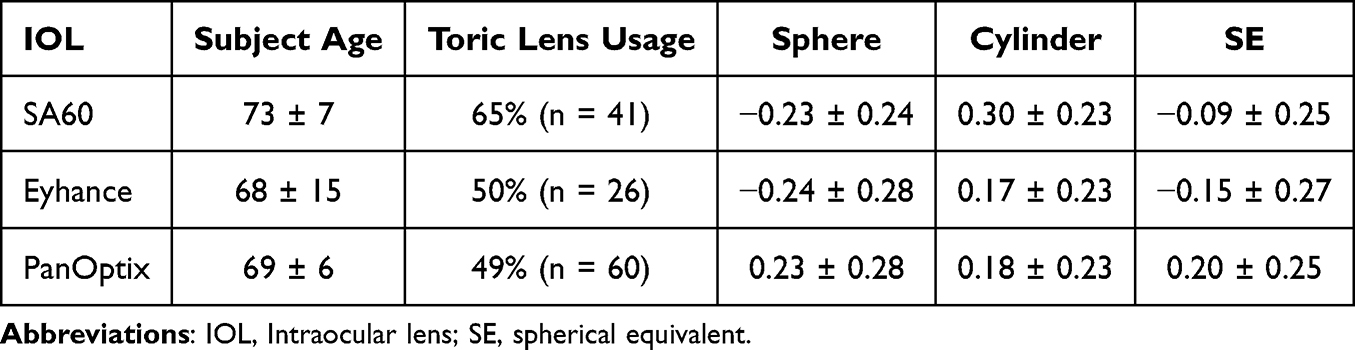 |
Table 1 Postoperative Refractive Results Detailing Average Patient Age, Percentage of Eyes Implanted with Toric Lenses, and Average Residual Sphere, Cylinder, and Spherical Equivalent with Standard Deviation in Each IOL Group |
Refractive Accuracy
In the SA60 IOL group, 97% of patients (n= 32) achieved 20/25 or better binocular uncorrected distance visual acuity (BUDVA) one month postoperatively, while 100% of Eyhance patients (n=26) and 100% of PanOptix patients (n=62) achieved 20/25 or better BUDVA (Figures 1–3).
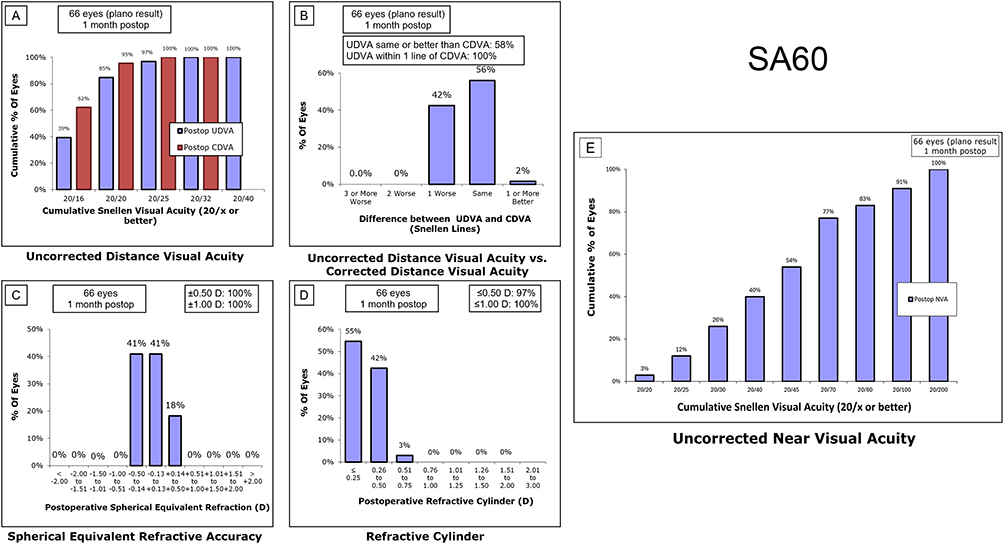 |
Figure 1 Postoperative refractive results of AcrySof SA60 IOL for (A) Binocular uncorrected distance visual acuity, (B) uncorrected distance visual acuity versus corrected distance acuity, (C) spherical equivalent, (D) refractive cylinder and (E) binocular uncorrected near visual acuity. |
 |
Figure 2 Postoperative refractive results of Eyhance IOL for (A) Binocular uncorrected distance visual acuity, (B) uncorrected distance visual acuity versus corrected distance acuity, (C) spherical equivalent, (D) refractive cylinder and (E) binocular uncorrected near visual acuity. |
 |
Figure 3 Postoperative refractive results of AcrySof PanOptix IOL for (A) Binocular uncorrected distance visual acuity, (B) uncorrected distance visual acuity versus corrected distance acuity, (C) spherical equivalent, (D) refractive cylinder and (E) binocular uncorrected near visual acuity. |
In the SA60 group, 58% of UDVA was the same or better than corrected distance visual acuity (CDVA) with 100% of eyes within 0.5 SE and less than 1 Diopter of residual cylinder (Figure 1). In the Eyhance group, 100% of UDVA was the same or better than CDVA with 100% of eyes within 0.5 SE and less than 1 Diopter of residual cylinder (Figure 2). In the PanOptix group, 99% of UDVA was the same or better than CDVA with 100% of eyes within 0.5 SE and less than 1 Diopter of residual cylinder (Figure 3).
For binocular uncorrected near visual acuity (BNVA) one-month postoperatively, 12% of SA60 patients (n=4) achieved 20/25 or better, while 26% of Eyhance patients (n=7) and 94% of PanOptix patients (n=59) achieved 20/25 BNVA or better (Figures 1–3).
Visual Acuity Outcomes
The AcrySof SA60 IOL demonstrated the best mean BUDVA (−0.047 logMAR, 20/18 Snellen equivalent, SD = 0.066), followed by Eyhance (−0.022 ± 0.064 logMAR, 20/19 equivalent) and PanOptix (−0.027 ± 0.060 logMAR, 20/19) (Figure 4A). ANOVA revealed significant differences in BUDVA between groups F(2, 241) =4.722, p<0.010. Post-hoc Bonferroni analysis showed statistically significant superiority of BUDVA in the SA60 group compared to the PanOptix and Eyhance groups (p = 0.024, CI [−0.0473, −0.0024] and p = 0.023, CI [−0.0582, −0.0032], respectively).
 |
Figure 4 Mean with standard deviation of log binocular uncorrected (A) distance and (B) near visual acuity by IOL group measured one month postoperatively. * = P <0.05, *** = P <0.001. |
ANOVA of BNVA demonstrated highly significant differences between groups F(2, 241)= 173.834, p<0.001. The PanOptix Trifocal IOL showed significantly superior BNVA (−0.02 ± 0.050, logMAR, 20/19 equivalent) compared to the other IOLs in post-hoc Bonferroni analysis (all p < 0.001, CI [Eyhance −0.364, −0.2276 and SA60 −0.5073, −0.3871]) (Figure 4B). The Eyhance and SA60 had BNVAs of 0.25 ± 0.223 logMAR (20/36 equivalent) and 0.39 ± 0.252 logMAR (20/49 equivalent), respectively. Eyhance performed significantly better than SA60 in BNVA (p < 0.001, CI [0.2276, 0.3604]).
Patient Satisfaction Outcomes
The RCSS questionnaire revealed significant differences in patient satisfaction across IOL platforms. SA60 achieved the highest scores for distance vision quality (Q1: 9.71 ± 0.62). ANOVA showed significant differences between groups for distance vision quality (Q1) F(2, 241) = 6.773, p<0.001, η2 = 0.053 (Figure 5A). Post-hoc analysis revealed that PanOptix and SA60 scored significantly higher than the Eyhance (p < 0.042, CI [0.012, 0.9483] and p < 0.001, CI [0.2724, 1.31], respectively). Significant differences were found between groups for intermediate vision quality (Q2) F(2, 241) = 12.234, p<0.001, η2 =0.092 (Figure 5A). PanOptix scored significantly higher than both Eyhance and SA60 (both p < 0.001, CI [Eyhance 0.3897, 1.7319 and SA60 0.4592, 1.685]), while other comparisons were not significant. ANOVA indicated significant differences were observed for near vision quality (Q3) F(2, 241) = 68.483, p<0.001, η2 =0.360 (Figure 5A). PanOptix scored significantly higher than all other IOLs in near vision quality (Q3: 8.83 ± 1.62; all p < 0.001, CI [Eyehance 2.4409, 4.3903 and SA60 2.9281, 4.6921]).
 |
Figure 5 Mean Refractive Cataract Surgery Survey scores for (A) patient-reported quality of distance (Question 1), intermediate (Question 2), and near (Question 3) vision one month postoperatively for each IOL. (B) mean scores for spectacle Independence (Question 4), (C) lenses meeting expectations (Question 5), (D) satisfaction with lenses (Question 6), and (E) desire to choose the same lens again (Question 8) one month postoperatively for each IOL. * = P <0.05, *** = P <0.001. |
Significant differences were found for spectacle independence (Q4) F(2, 241) =80.939, p<0.001, η2 = 0.400) (Figure 5B). PanOptix achieved significantly greater spectacle independence compared to the other IOLs (Q4: 9.60 ± 1.26; all p < 0.001, CI [Eyehance 1.8454, 3.105 and SA60 2.0591, 3.199]).
ANOVA revealed significant differences for expectation fulfillment (Q5) F(2, 241) = 35.695, p<0.001, η2 = 0.108 (Figure 5C). SA60 achieved the highest expectation fulfillment score (Q5: 9.73 ± 0.65). In post-hoc analysis, PanOptix and SA60 scored significantly higher than Eyhance (both, p < 0.001, CI [PanOptix −1.7764, −0.5363 and SA60 −2.1706, −0.7965]). No significant differences were observed for lens choice satisfaction (Q6) (F(3,241) = 3.007, p < 0.51; Figure 5D).
Lens Selection Preferences and Visual Disturbances
When asked if they would choose the same lens again, 118 (95%) PanOptix patients, 62 (94%) SA60 patients, and 40 (77%) Eyhance patients responded positively. ANOVA indicated significant differences in responses between groups (Q8) F(2,241) = 6.762, p < 0.001. Panopix patients were significantly more likely to select the same lens again when compared to Eyhance patients (p < 0.001, CI [0.0625, 0.3023]) (Figure 5E).
Chi-square analysis of nighttime glare and halos revealed significant differences between IOL groups (Q9) (χ2 = 52.543, p < 0.001, Phi = 0.451), representing a medium to large effect size (Figure 6A). Dysphotopsia was most dramatic for PanOptix lenses with 68% answering “Yes”, while Eyhance and SA60 lenses showed the opposite pattern with the 73% and 79% answering “No”, respectively. However, when asked about limiting visual disturbances (Question 10), fewer patients reported that glare and halos limited their activities, with limited activity reported in 6.5% of PanOptix patients and 0% of SA60 and Eyhance patients. A subset of PanOptix patients (n=6) underwent neodymium-doped yttrium aluminum garnet (nd:YAG) capsulotomy, which was associated with an improvement in satisfaction with lens choice (Figure 6B and C).
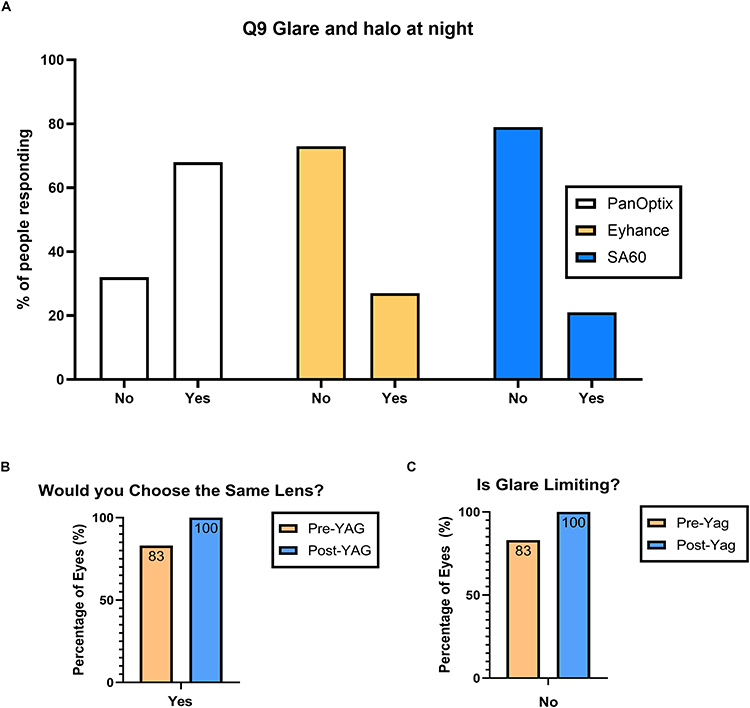 |
Figure 6 (A) Frequency of patients responding either “Yes” or “No” when asked if they experience glare or halos at night (Question 9) one month postoperatively for each IOL. (B) Refractive Cataract Surgery Survey responses to showing (B) an increase in patient satisfaction post-Nd:YAG capsulotomy and (C) a decrease in activity-limiting glare post-Nd:YAG capsulotomy. |
Discussion
This study provides a unique comparative analysis of various IOL platforms by eliminating refractive error as a confounding variable and utilizing the validated RCSS for standardized patient satisfaction assessment. By restricting inclusion to patients with bilateral plano outcomes (spherical equivalent ≤ 0.5 D, cylinder ≤ 0.75 D), we achieve a more accurate assessment of true IOL performance. Many multifocal and monofocal lens comparison studies do not account for the influence of residual refractive error on performance in their methodology or use a validated questionnaire that accounts for dysphotopsias to assess patient satisfaction.5,6 We advocate for the methodology used in this study to be used as a standard approach for measuring IOL performance, as residual refractive error can alter lens performance, generating inaccurate conclusions about lens capabilities.2,3
In all groups, 100% of eyes achieved a postoperative BUDVA 20/32 or better (Figures 1A, 2A and 3A). Near vision outcomes were best in the PanOptix group with a cumulative 94% of patients achieving a BNVA of 20/25 or better while 29% of Eyhance eyes and 12% of SA60 eyes achieved 20/25 or better BNVA (Figures 1E,2E and 3E). Interestingly, a small percentage of SA60 and Eyhance eyes achieved 20/20 BNVA. These results are consistent with recent publications on the efficacy of these lenses.7–11
Objective measurements indicated that SA60 achieved better average BUDVA compared to Eyhance and PanOptix. However, PanOptix demonstrated superior BNVA compared to all other lenses. Reports in the literature have supported that trifocal lenses provide superior near vision when compared to monofocal or enhanced-depth of focus (EDOF) IOLs.10,12,13 Eyhance also had significantly better BNVA compared to the SA60. Nevertheless, our findings show greater variability in standard deviation of BUDVA and BNVA in the Eyhance group, suggesting expected VA outcomes are not as repeatable using Eyhance compared to PanOptix in practice (Figure 4).
We aimed to elucidate the relationship between objective vision measurements and patient satisfaction among IOL platforms using a validated refractive cataract surgery survey. When surveying for postoperative vision without glasses at distance, SA60 scored significantly higher than Eyhance (Q1, Figure 5A). Previous studies comparing Eyhance, an enhanced monofocal IOL, to traditional monofocals have indicated that patient perception of distance vision is similar between the two types.14,15 Our findings may suggest a difference specific to these two IOLs.
Interestingly, no statistically significant difference in patient reported subjective intermediate vision was found between the Eyhance and SA60 groups, despite Eyhance’s EDOF capability.16 PanOptix scored significantly higher than Eyhance and SA60 for intermediate vision and near vision, correlating with improved BNVA (Q2, Figure 5A).
Near vision reports were consistent with IOL designs (Q3, Figure 5A). PanOptix scored significantly higher than all other lenses in spectacle independence, which is consistent with objective near vision measurements (Q4, Figure 5B). Quality of near vision remains a major determinant in achieving complete spectacle independence and overall patient satisfaction.17
PanOptix and SA60 scored significantly higher than Eyhance for quality of vision meeting patient expectations (Q5, Figure 5C). This result may correlate with patient-reported vision quality without glasses (Figure 5A) where SA60 scored better than the Eyhance in distance vision and the PanOptix scored better than the Eyhance for intermediate and near vision. It is possible that patients with the SA60 felt their needs were met as they only expected distance correction and that PanOptix patients received satisfactory vision correction at all distances. On the other hand, Eyhance patients may have been dissatisfied with the result of the proposed strong intermediate and distance vision.
While PanOptix achieved the highest average lens satisfaction score in RCSS Q6, no statistically significant difference in mean scores were found between groups (p=0.051) (Figure 5D). Future studies with larger sample sizes in treatment groups will likely be necessary to elucidate any significant differences in scoring. However, when patients were asked if they would select the same lens again, PanOptix scores were significantly higher compared to Eyhance scores (Q8, Figure 5E). This result may correlate with the significant differences in glasses independence (Q4) and met expectations (Q5) observed between the lenses.
Dysphotopsias are possible consequences after IOL implantation and are more common in multifocal compared to monofocal IOLs.18 When patients were asked about being bothered by glare and haloes at night, statistically significant differences were found between groups, with the distribution of responses representing a medium to large effect size (Q9, Figure 6 The most dramatic response was noted in PanOptix patients with 68% answering “Yes” Less dramatic and in the other direction was SA60 and Eyhance patients, with 79% and 73% answering “No,” respectively. Previous reports similarly indicated high rates of dysphotopsias in trifocal IOLs compared with monofocal IOLs.19–21 Overall satisfaction with lens choice for PanOptix patients was high and when asked if dysphotopsias limited night activities, 83% of PanOptix patients responded “No” which decreased to 0% after following Nd:YAG capsulotomy (n=6) (Figure 6B and C). All patients for other IOLs responded “No” to occurrence of limiting dysphotopsias. We have noted a significant improvement in the presence and severity of diffractive dysphotopsias after Nd:YAG capsulotomy with trifocal IOLs in a larger study.22 In a prospective study involving cataract surgery with PanOptix IOLs in 38 eyes from 21 patients, early Nd:YAG capsulotomies around at 55 ± 26 days were associated with reduced presence and severity of dysphotopsias and improved contrast sensitivity and uncorrected visual acuity.22 PanOptix patients in this study had Nd:YAG capsulotomies at an average of 105 ± 55 days postoperatively which was associated with improvement in patient satisfaction with low refractive errors.
In this cohort of eyes with only plano outcomes, we excluded patients with ocular comorbidities or adverse postoperative events. The large effect sizes observed for patient satisfaction domains emphasize the importance of IOL selection and patient perception in modern cataract surgery. Our results indicate that patients prioritize functional spectacle independence, explaining high satisfaction rates despite trade-offs such as diffractive dysphotopsias. The RCSS provided comprehensive insights into visual performance and patient satisfaction in this study. Our results are consistent with our previous study on lens performance using the RCSS, where the quality of near vision and degree of glasses independence were significant predictors of IOL selection and overall patient satisfaction. Findings in this current study suggest perceived quality of intermediate vision may also have predictive value.
This study demonstrates cases where patients achieved excellent visual acuity yet expressed dissatisfaction with specific aspects of their vision quality, emphasizing the critical role of patient-reported outcomes in comprehensive IOL assessment. Our findings propose that when refractive error is eliminated, the choice between modern IOL platforms must effectively incorporate patient lifestyle priorities rather than only visual acuity differences to adequately gauge lens performance. The PanOptix IOL demonstrated high objective and subjective results in this study. Our data supports improved all-distance vision provided by the PanOptix was associated with higher patient satisfaction ratings even in patients with dysphotopsias. We found that the Eyhance provides a slight benefit in objective near vision compared to the SA60 monofocal but no appreciable benefit in terms of patient satisfaction, possibly due to inconsistent levels of near visual acuity. Our findings underscore the need to responsibly and effectively advise patients on their options for cataract surgery. Patients seeking vision restoration come from a range of backgrounds and will have different thresholds for acceptable results. These differing requirements denote a responsibility for ophthalmologists to be as informed as possible on IOL platform capabilities with the goal of advising patients on all their options in a reasonable and ethical manner. Overall, these results may be applicable to surgeons in IOL selection to increase the likelihood of meeting each patient’s goals for vision correction.
Study limitations include single-surgeon experience, potential selection bias in IOL choice, limited long-term follow-up, and no objective testing for intermediate visual acuity. The relatively small and variable group sizes as well as the nature of corrective surgeries leading to non-normally distributed data (eg, negative skew), may have limited statistical power. This study utilized data from 2020–2022, and IOL technology continues to evolve rapidly.23,24 Newer IOLs may offer improved performance, namely the Clareon PanOptix Pro IOL (Alcon, Fort Worth Texas, USA), proposed to represent the next generation of PanOptix trifocal technology. We are collecting data on the PanOptix Pro in eyes with plano outcomes to help determine whether technological advances translate to meaningful improvements in real-world patient outcomes.
Conclusion
This study eliminates refractive error to provide a more accurate assessment of IOL performance and patient satisfaction using the RCSS. Patient satisfaction assessment is critical, as objective visual measurements alone do not predict patient happiness. Near vision quality and spectacle independence were the strongest predictors of overall patient satisfaction, emphasizing the importance of presbyopia correction in modern cataract surgery.
Abbreviations
RCSS, Refractive Cataract Surgery Survey; IOLs, intraocular lenses; EDOF, extended depth of focus; PRK, photorefractive keratectomy; LASIK, Laser-Assisted In-situ Keratomileusis; ORA, The Optiwave Refractive Analysis; ANOVA, analysis of variance; BUDVA, binocular uncorrected distance visual acuity; CDVA, corrected distance visual acuity; BNVA, binocular uncorrected near visual acuity; nd:YAG, neodymium-doped yttrium aluminum garnet.
Acknowledgments
The clinical staff at Willis Knighton Eye Institute provided assistance with patient care and data collection. This abstract was presented as a poster discussion at the American Society of Cataract and Refractive Surgeons (ASCRS) annual meeting in San Diego in April 2023: https://annualmeeting.ascrs.org/.
Disclosure
Wyche Coleman III reports personal fees from a major IOL manufacturer outside the submitted work. Wyche Coleman III reports Consulting fees from Zeiss, Alcon, outside the submitted work. The authors report no other conflicts of interest in this work.
References
1. Bourne RR, Stevens GA, White RA, et al. Causes of vision loss worldwide, 1990-2010: a systematic analysis. Lancet Glob Health. 2013;1:e339–12. doi:10.1016/S2214-109X(13)70113-X
2. Hayashi K, Sato T, Igarashi C, Yoshida M. Effect of spherical equivalent error on visual acuity at various distances in eyes with a trifocal intraocular lens. J Refract Surg. 2019;35:274–279. doi:10.3928/1081597X-20190404-01
3. Rosen E, Alio JL, Dick HB, Dell S, Slade S. Efficacy and safety of multifocal intraocular lenses following cataract and refractive lens exchange: metaanalysis of peer-reviewed publications. J Cataract Refract Surg. 2016;42:310–328. doi:10.1016/j.jcrs.2016.01.014
4. Coleman Iii WT, Martin CR, Davidson CJ, DeNaro BB, Shelby CL, LoBue SA. The refractive cataract surgery survey (RCSS): a validated questionnaire for quick clinical use. Clin Ophthalmol. 2025;19:1191–1202. doi:10.2147/OPTH.S515694
5. Liu D, Li H, Zheng S, Sun J, Bai H, Wu X. Comparison of visual performance between mix-and-match and bilateral implantation of rotationally asymmetric multifocal intraocular lenses. Clin Ophthalmol. 2024;18:3289–3295. doi:10.2147/OPTH.S487162
6. Morya AK, Nishant P, Singh A, Sinha S, Shah RC. A retrospective comparative performance analysis of multifocal eyecryl Actv IOL and the world’s first progressive polyfocal autofocus pro IOL. Clin Ophthalmol. 2025;19:1387–1399. doi:10.2147/OPTH.S521607
7. Gigon E, Bouthour W, Panos GD, Pajic B, Massa H. Real world outcomes of the new Tecnis Eyhance IOL. Eur J Ophthalmol. 2023;33:1390–1397. doi:10.1177/11206721221146675
8. Habibollahi A, Hashemi H, Mehravaran S. Contralateral comparison of visual outcome of AcrySof IQ and SA60AT intraocular lenses. Can J Ophthalmol. 2010;45:259–263. doi:10.3129/i09-263
9. Howes F, Rementeria-Capelo LA, Poyales F, et al. Visual performance and patient satisfaction of bilaterally implanted extended depth of focus intraocular lens: outcomes of a multicenter registry. J Refract Surg. 2025;41:e131–e143. doi:10.3928/1081597X-20241230-01
10. Sahin V, Unal M, Ayaz Y. Outcomes after bilateral implantation of AcrySof IQ PanOptix trifocal intraocular lens: a prospective interventional study. Med Hypothesis Discov Innov Ophthalmol. 2023;12:36–45. doi:10.51329/mehdiophthal1468
11. Yang YP, Tan Y, Liao Q. Analysis of visual quality improvement after implantation of PanOptix trifocal intraocular lens in cataract patients with different axial lengths. Am J Transl Res. 2024;16:2995–3004. doi:10.62347/FRJZ4885
12. Farvardin M, Johari M, Attarzade A, Rahat F, Farvardin R, Farvardin Z. Comparison between bilateral implantation of a trifocal intraocular lens (Alcon Acrysof IQ(R) PanOptix) and extended depth of focus lens (Tecnis(R) Symfony(R) ZXR00 lens). Int Ophthalmol. 2021;41:567–573. doi:10.1007/s10792-020-01608-w
13. Monaco G, Gari M, Di Censo F, Poscia A, Ruggi G, Scialdone A. Visual performance after bilateral implantation of 2 new presbyopia-correcting intraocular lenses: trifocal versus extended range of vision. J Cataract Refract Surg. 2017;43:737–747. doi:10.1016/j.jcrs.2017.03.037
14. Auffarth GU, Gerl M, Tsai L, et al. Clinical evaluation of a new monofocal IOL with enhanced intermediate function in patients with cataract. J Cataract Refract Surg. 2021;47:184–191. doi:10.1097/j.jcrs.0000000000000399
15. Huh J, Eom Y, Yang SK, Choi Y, Kim HM, Song JS. A comparison of clinical outcomes and optical performance between monofocal and new monofocal with enhanced intermediate function intraocular lenses: a case-control study. BMC Ophthalmol. 2021;21:365. doi:10.1186/s12886-021-02124-w
16. Hovanesian JA, Jones M, Allen Q. The vivity extended range of vision IOL vs the PanOptix trifocal, ReStor 2.5 active focus and ReStor 3.0 multifocal lenses: a comparison of patient satisfaction, visual disturbances, and spectacle independence. Clin Ophthalmol. 2022;16:145–152. doi:10.2147/OPTH.S347382
17. Joshi RS. Visual satisfaction and spectacle independence with monofocal intraocular lens with enhanced intermediate vision and trifocal intraocular lenses in the prepresbyopic age group patients with cataracts. Oman J Ophthalmol. 2023;16:482–488. doi:10.4103/ojo.ojo_167_22
18. Pusnik A, Petrovski G, Lumi X. Dysphotopsias or unwanted visual phenomena after cataract surgery. Life. 2022;13:53. doi:10.3390/life13010053
19. Bayhan HA, Tasci YY, Aslan Bayhan S, Takmaz T, Can I. Comparison of two presbyopia-correcting trifocal intraocular lenses: a prospective study. Turk J Ophthalmol. 2024;54:63–68. doi:10.4274/tjo.galenos.2024.27657
20. Espaillat A, Coelho C, Medrano Batista MJ, Perez O. Predictors of photic phenomena with a trifocal IOL. Clin Ophthalmol. 2021;15:495–503. doi:10.2147/OPTH.S282469
21. Hovanesian JA, Jones M, Allen Q. The PanOptix trifocal IOL vs the ReSTOR 2.5 active focus and ReSTOR 3.0-add multifocal lenses: a study of patient satisfaction, visual disturbances, and uncorrected visual performance. Clin Ophthalmol. 2021;15:983–990. doi:10.2147/OPTH.S285628
22. LoBue SA, Martin CR, Benson KK, Trosclair KB, Shelby CL, Coleman Iii WT. The role of early Nd:YAG laser capsulotomy in improving visual performance in mild to moderately symptomatic trifocal patients. Clin Ophthalmol. 2023;17:3991–4000. doi:10.2147/OPTH.S448784
23. Dick HB, Gerste RD. Future intraocular lens technologies. Ophthalmology. 2021;128:e206–e213. doi:10.1016/j.ophtha.2020.12.025
24. Luo C, Wang H, Chen X, Xu J, Yin H, Yao K. Recent advances of intraocular lens materials and surface modification in cataract surgery. Front Bioeng Biotechnol. 2022;10:913383. doi:10.3389/fbioe.2022.913383
 © 2026 The Author(s). This work is published and licensed by Dove Medical Press Limited. The
full terms of this license are available at https://www.dovepress.com/terms
and incorporate the Creative Commons Attribution
- Non Commercial (unported, 4.0) License.
By accessing the work you hereby accept the Terms. Non-commercial uses of the work are permitted
without any further permission from Dove Medical Press Limited, provided the work is properly
attributed. For permission for commercial use of this work, please see paragraphs 4.2 and 5 of our Terms.
© 2026 The Author(s). This work is published and licensed by Dove Medical Press Limited. The
full terms of this license are available at https://www.dovepress.com/terms
and incorporate the Creative Commons Attribution
- Non Commercial (unported, 4.0) License.
By accessing the work you hereby accept the Terms. Non-commercial uses of the work are permitted
without any further permission from Dove Medical Press Limited, provided the work is properly
attributed. For permission for commercial use of this work, please see paragraphs 4.2 and 5 of our Terms.