
Back to Journals » Local and Regional Anesthesia » Volume 18
Prolonged Neural Block After Lower-Limb Nerve Blocks in a Patient with Inherited Antithrombin III Deficiency: Implications for Regional Anesthesia
Authors Aizawa T, Sugiura N, Sugita S 
Received 2 September 2025
Accepted for publication 22 December 2025
Published 27 December 2025 Volume 2025:18 Pages 151—156
DOI https://doi.org/10.2147/LRA.S563087
Checked for plagiarism Yes
Review by Single anonymous peer review
Peer reviewer comments 3
Editor who approved publication: Prof. Dr. Stefan Wirz
Takeaki Aizawa, Nami Sugiura, Shinji Sugita
Department of Anesthesiology, Nippon Medical School Musashi-Kosugi Hospital, Kawasaki-shi, Kanagawa, Japan
Correspondence: Shinji Sugita, Department of Anesthesiology, Nippon Medical School Musashi-Kosugi Hospital, 1-383 Kosugi-cho, Nakahara-ku, Kawasaki-shi, Kanagawa, 211-8533, Japan, Tel +81-44-733-5181, Fax +81-44-711-8713, Email [email protected]
Purpose: Peripheral nerve block safety and pharmacology for patients with inherited antithrombin III (ATIII) deficiency remains unclear because of the rarity of the disease. Here, we report a case of unexpectedly prolonged motor and sensory inhibition following single-shot femoral and sciatic nerve blocks in a patient with inherited ATIII deficiency. We hypothesized that venous stasis, microcirculatory impairment, elevated peripheral venous pressure, and increased local tissue pressure might have contributed to prolonged nerve dysfunction and peripheral nerve injury.
Case Report: The patient was a 58-year-old man (170 cm, 69 kg) with inherited ATIII deficiency. He was scheduled for 1-hour surgical debridement of recurrent venous stasis ulcers with microcirculatory impairment on his lower left leg. Nerve blocks resulted in motor and sensory deficits in the lower leg that lasted 2 and 8 days, respectively. The prolonged duration of this nerve block might have been related to his inherited ATIII deficiency. This condition can contribute to thrombosis of vessels such as the inferior vena cava, potentially leading to venous microcirculatory impairment in the lower limbs and complex coagulopathy.
Conclusion: While peripheral nerve blocks are widely used for their efficacy and safety, the risk-benefit profile of regional anesthesia may be atypical in patients with coagulation disorders. This case highlights the need for cautious nerve block administration in patients with inherited ATIII deficiency.
Keywords: antithrombin III deficiency, peripheral nerve block, prolonged single-shot femoral and sciatic nerve blocks, case report
Introduction
Peripheral nerve blocks (PNBs) are widely used for perioperative analgesia because of their efficacy and safety.1–3 However, in patients with coagulation disorders, the risk-benefit profile of regional anesthesia may require additional considerations. Antithrombin III (ATIII) deficiency is an inherited or acquired thrombophilia characterized by reduced activity or concentration of antithrombin, which inhibits blood coagulation by inactivating thrombin and other active coagulation factors.4 Patients with ATIII deficiency, particularly the inherited type, are in a prothrombotic state over a lengthy course of disease. This prolonged duration can cause microvascular thrombosis and impaired capillary perfusion, especially in the venous circulation. Previous reports have described perioperative management strategies for patients with inherited ATIII deficiency, including anticoagulants and neuraxial anesthesia.5–7 However, the safety and pharmacology of PNBs for these patients have been less clear because of the rarity of the disease.
Here, we present a case of transient but prolonged motor and sensory inhibition following a single-shot lower-limb nerve block in a patient with ATIII deficiency. These outcomes raise concerns regarding the importance of altered anesthetic responses in the setting of venous microcirculatory impairment.
Case Presentation
The requirement for ethical approval was waived by the ethics committee of Nippon Medical School due to the nature of the case report, and an opt-out form (guarantee of information disclosure and opportunity to refuse) was provided on the website of our institution. This report was performed in accordance with the government ethical guidelines and regulations based on the Declaration of Helsinki. Written informed consent was obtained from the patient for the publication of this case report and any accompanying data.
A 58-year-old man (170 cm, 69 kg) with inherited ATIII deficiency was scheduled for 1-hour surgical debridement of recurrent venous ulcers on his lower left leg (Figure 1). His medical history included asthma and lumbar spinal canal stenosis. He had also had a bowel resection 27 years earlier due to superior mesenteric artery thrombosis. Although specific details of the anesthesia administered at that time were unavailable, the patient recalled experiencing transient lower extremity motor weakness that lasted for two days after epidural anesthesia was discontinued.Magnetic resonance imaging and computed tomography obtained during previous examinations revealed a narrowing of the inferior vena cava, which suggested an occlusive thrombus (Figure 2). In addition, abundant collateral vessels were noted around the bilateral femoral veins, which was characteristic of a history of deep vein thrombosis. Long-term medications included aspirin (100 mg), warfarin (3.5 mg), triazolam, fexofenadine, rebamipide, cefaclor, celecoxib, and senna extract. Aspirin and warfarin were discontinued 7 and 5 days before surgery, respectively. To normalize coagulation status, the patient received ATIII concentrate and unfractionated heparin. The heparin infusion was also discontinued about 6 hours before block placement.8
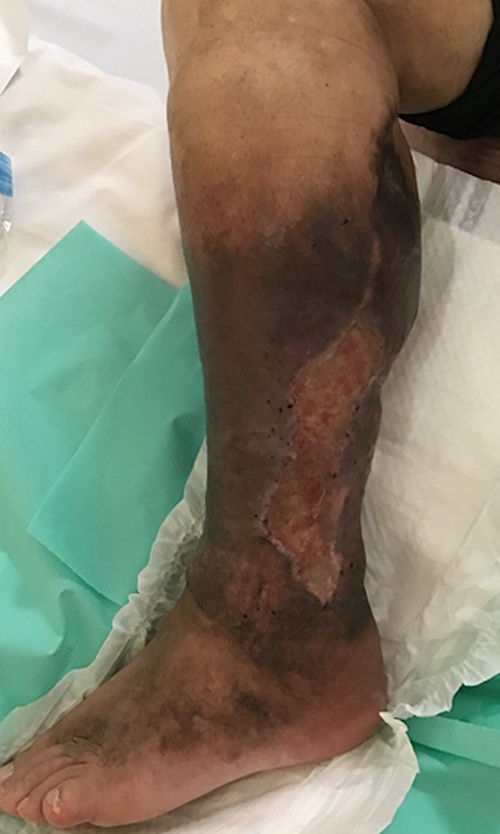 |
Figure 1 Left leg ulcer caused by inherited antithrombin III deficiency. |
 |
Figure 2 Magnetic resonance imaging and computed tomography from previous hospitalization. (A) Magnetic resonance imaging of pelvic veins; red arrow, narrowed inferior vena cava; Arrows, dilated veins and collateral channels extending toward pelvic organs (B). Computed tomography of left lower extremity veins. Arrows, varicose veins and collateral channels that had developed in the cutaneous veins. |
Several bedside procedures, including ulcer dressing and minor debridement, were performed using inadequate analgesia, which had caused the patient considerable distress. Therefore, we elected to use general anesthesia combined with PNBs using long-acting local anesthetics to ensure both intra- and postoperative pain control. General anesthesia was induced with 150 μg of fentanyl and 100 mg of propofol. After insertion of the supraglottic airway device (i-gel®, Intersurgical, UK), ultrasound-guided PNBs with peripheral nerve stimulators were performed using a 20-gauge peripheral nerve block needle (Stimuplex® Ultra 360®, B. Braun, Germany).9,10 Twenty mL of 0.25% levobupivacaine was administered for both the femoral and sciatic nerve blocks. No bleeding or aspiration of blood was observed during the procedure and no unusual resistance was observed during drug infusion. General anesthesia was maintained with 1–2 vol% sevoflurane. The surgery was completed ahead of schedule, and the general anesthesia lasted for 58 min.
The patient reported no postoperative pain. Active dorsiflexion of the ankle was preserved; however, knee flexion (lifting the leg in the supine position) was not possible. Motor impairment persisted until postoperative day 1. Sensory loss extended from the anterior thigh to the medial lower leg with mild hypoesthesia on the dorsum of the foot, but no other neurological findings were noteworthy. Bedside ultrasonography revealed no evidence of hematoma or compressive pathology. By postoperative day 2, the patient began experiencing improved motor function and was able to lift the leg. By day 8, all sensory deficits had completely resolved.
Discussion
This report presents a rare case of unexpectedly prolonged motor and sensory blocks after a single-shot femoral and sciatic nerve block in a patient with inherited ATIII deficiency. One randomized trial reported that the sensory effects of single-shot lower-limb PNBs with 0.5% bupivacaine or levobupivacaine, a higher concentration than used in our case, usually resolved within approximately 16–18 hours.11 In contrast, the motor and sensory deficits of our patient persisted for 2 and 8 days, respectively. The clinical course showed no evidence of hematoma or direct nerve trauma. Perioperative antithrombotic management, including the discontinuation intervals for aspirin and warfarin and the timing of unfractionated heparin cessation, was strategically arranged to allow sufficient washout of these agents. Therefore, any residual pharmacologic effect is unlikely to have influenced the performance or duration of the peripheral nerve block. This case demonstrates that altered microcirculation in patients with inherited ATIII deficiency may influence the pharmacokinetics and neural effects of local anesthetics.
Neurological complications associated with PNBs involve a combination of perioperative processes along with patient-specific, anesthetic, and surgical factors.12,13 The primary mechanisms of nerve injury associated with PNBs are mechanical trauma, ischemia, local anesthetic toxicity, and inflammation. In addition, inherited ATIII deficiency is associated with a prothrombotic state that impairs capillary perfusion. Reduced blood flow to the tissues causes systemic uptake and delayed clearance of local anesthetic agents.4,14 A study of human microdialysis reported that reduced local perfusion slowed the elimination rate constant and clearance of lidocaine from the injection site, thereby prolonging the duration of the sensory block.15 Consequently, even standard single-shot nerve blocks may exert prolonged effects in patients with impaired microcirculation.16 The patient in our case also had lumbar spinal canal stenosis; however, this condition is not known to alter the pharmacodynamics or duration of PNBs. Its contribution to the prolonged block in this case is therefore considered limited.17
The patient in this case reported that an unexpected delay in neurological recovery had occurred after epidural anesthesia in a previous surgery; however, his recollection of the details of this episode was limited and a causal relationship could not be verified. However, the similarity of that incident to the present case warrants careful consideration regarding whether this patient would have an atypical response to a local anesthetic under certain physiological conditions.
Previous studies have shown that the use of local anesthetics (either through epidural anesthesia or PNBs) was safe in lower-limb varicose vein surgeries.18,19 However, these reports did not address the possibility of altered block characteristics in patients with chronic venous insufficiency. Impaired venous microcirculation may reduce systemic uptake of local anesthetics and prolong nerve exposure, thereby increasing the risk of local anesthetic-induced neurotoxicity. Under such conditions, even standard doses of local anesthetics may exert enhanced or prolonged neural effects, and potentially even contribute to nerve injury.20 In the present case, imaging findings from the previous hospitalization indicated possible obstruction of the inferior vena cava in addition to deep vein thrombosis and the development of collateral pathways. These results suggested the presence of venous stasis, microcirculatory impairment, elevated peripheral venous pressure, and increased local tissue pressure. Moreover, the lower-limb ulcer that prompted the surgery was likely the result of microcirculatory dysfunction associated with chronic venous insufficiency.
To our knowledge, no previous reports have described prolonged motor deficits after peripheral nerve block in patients with congenital antithrombin deficiency or chronic venous insufficiency. Existing reports of PNBs in patients with coagulation disorders or thrombophilic conditions focus primarily on bleeding risk and procedural safety rather than block duration.21 In addition, chronic venous insufficiency has been associated with peripheral neuropathy.22
A limitation of our study was the lack of injection pressure monitoring, which might have helped reduce the risk of nerve injury by identifying high-pressure intraneural injections.23 Although dual guidance with ultrasound and nerve stimulation enhances nerve localization, it might not be sufficient to prevent nerve injury.24 In addition, the clinical utility of injection pressure monitoring remains controversial due to limited supporting evidence. However, in patients particularly susceptible to neural complications following PNBs, further investigation into the association between injection pressure and adverse outcomes may be warranted. Additional research is needed to determine the actual incidence and underlying mechanisms of these complications. Furthermore, in patients who may have impaired microcirculation, PNBs should be performed using carefully adjusted local anesthetic concentrations and doses to help prevent unnecessarily prolonged block duration.
This case report highlights the potential risks of prolonged neural effects and nerve injuries in patients with inherited ATIII deficiency. These outcomes may be influenced by impaired microcirculation and delayed clearance of local anesthetics, both of which can prolong perineural drug exposure and enhance neurotoxicity. Recognizing such patterns may be essential for optimizing anesthetic strategies in this population, particularly as the use of PNBs continues to grow in clinical practice.
Declaration of Generative AI in Scientific Writing
During the preparation of this work the authors used ChatGPT-4 for translation from Japanese to English.
Data Sharing Statement
The datasets used during the current study are available from the corresponding author upon reasonable request.
Ethics Approval and Informed Consent
The requirement for ethical approval was waived by the ethics committee of Nippon Medical School due to the nature of the case report, and an opt-out form (guarantee of information disclosure and opportunity to refuse) was provided on the website of our institution. This report was performed in accordance with the government ethical guidelines and regulations based on the Declaration of Helsinki.
Consent for Publication
Written informed consent was obtained from the patient for the publication of this case report and any accompanying data.
Acknowledgments
A portion of this case, which focused on wound care, was previously published in the International Journal of Surgical Wound Care.25 The present manuscript focuses exclusively on the anesthetic management of the case, which was not described in the previous publication. The Editor-in-Chief approved the submission of this manuscript to the aforementioned journal.
We would also like to thank Editage (www.editage.jp) for English language editing.
Author Contributions
All authors made a significant contribution to the work reported, whether that is in the conception, study design, execution, acquisition of data, analysis and interpretation, or in all these areas; took part in drafting, revising or critically reviewing the article; gave final approval of the version to be published; have agreed on the journal to which the article has been submitted; and agree to be accountable for all aspects of the work.
Funding
This study did not receive any specific grants from funding agencies in the public, commercial, or non-profit sectors.
Disclosure
The authors declare that they have no competing interests in this work.
References
1. Torrano V, Anastasi S, Balzani E, et al. Enhancing safety in regional anesthesia: guidelines from the Italian Society of Anesthesia, Analgesia, Resuscitation and Intensive Care (SIAARTI). J Anesth Analg Crit Care. 2025;5(1):26. doi:10.1186/s44158-025-00245-y
2. Chin KJ, Chan V. Ultrasound-guided peripheral nerve blockade. Curr Opin Anaesthesiol. 2008;21(5):624–631. doi:10.1097/ACO.0b013e32830815d1
3. Dabbagh A, Madadi F, Ebrahimi M, et al. Experimental implementation of the peripheral nerve block clinical registry: an observational study. Front Med. 2025;12:1486300. doi:10.3389/fmed.2025.1486300
4. Patnaik MM, Moll S. Inherited antithrombin deficiency: a review. Haemophilia. 2008;14(6):1229–1239. doi:10.1111/j.1365-2516.2008.01830.x
5. Ishizaki K, Sasaki M, Fujita T. Perioperative management of a patient with congenital antithrombin III deficiency. J Anesth. 1993;7(1):105–107. doi:10.1007/s0054030070105
6. Piper BJ, Farrell PT. Hereditary antithrombin III deficiency and neuraxial anaesthesia. Anaesth Intensive Care. 2015;43(6):782–785. doi:10.1177/0310057x1504300618
7. Nishimura Y, Takagi Y. Strategy for cardiovascular surgery in patients with antithrombin III deficiency. Ann Thorac Cardiovasc Surg. 2018;24(4):187–192. doi:10.5761/atcs.oa.18-00030
8. Kopp SL, Vandermeulen E, McBane RD, et al. Regional anesthesia in the patient receiving antithrombotic or thrombolytic therapy: American Society of Regional Anesthesia and Pain Medicine Evidence-Based Guidelines (fifth edition). Reg Anesth Pain Med. 2025. doi:10.1136/rapm-2024-1057669
9. Tu NH, Hai VM, Diep NT, Luong VD. Ultrasound-guided femoral - sciatic nerve block for lower limb long bone fractures. Mater Sociomed. 2024;36(3):217–221. doi:10.5455/msm.2024.36.217-221
10. Wang ZX, Zhang DL, Liu XW, Li Y, Zhang XX, Li RH. Efficacy of ultrasound and nerve stimulation guidance in peripheral nerve block: a systematic review and meta‐analysis. IUBMB Life. 2017;69(9):720–734. doi:10.1002/iub.1654
11. Urbanek B, Duma A, Kimberger O, et al. Onset time, quality of blockade, and duration of three-in-one blocks with levobupivacaine and bupivacaine. Anesth Analg. 2003;97(3):888–892. doi:10.1213/01.ane.0000072705.86142.5d
12. Radkowski P, Fadrowska-Szleper M, Podhorodecka K, Mieszkowski M. Neurological complications of regional anesthesia: an updated review with clinical guidelines. Med Sci Monit. 2023;29:e940399. doi:10.12659/MSM.940399
13. Bais K, Guirguis F, Guirguis M. Nerve injury following regional nerve block: a literature review of its etiologies, risk factors, and prevention. Curr Pain Headache Rep. 2024;28(9):863–868. doi:10.1007/s11916-024-01268-w
14. Gschwandtner ME, Ehringer H. Microcirculation in chronic venous insufficiency. Vasc Med. 2001;6(3):169–179. doi:10.1177/1358836x0100600308
15. Bernards CM, Kopacz DJ. Effect of epinephrine on lidocaine clearance in vivo: a microdialysis study in humans. Anesthesiology. 1999;91(4):962–968. doi:10.1097/00000542-199910000-00015
16. Hogan Q. Pathophysiology of peripheral nerve injury during regional anesthesia. Reg Anesth Pain Med. 2008;33(5):435–441. doi:10.1016/j.rapm.2008.03.002
17. Katz JN, Zimmerman ZE, Mass H, Makhni MC. Diagnosis and management of lumbar spinal stenosis. JAMA. 2022;327(17):1688–1689. doi:10.1001/jama.2022.5921
18. Mutlu M, Turkmen S. The effect of different anaesthesia techniques on postoperative pain and hospital discharge in varicose vein surgery. Cardiovasc J Afr. 2022;33(2):84–87. doi:10.5830/CVJA-2021-061
19. Li Y-H, Wang T, Qian C, Chen G-P, Lou W-S, Gu J-P. Application of femoral nerve block in treating great saphenous vein insufficiency by endovenous radiofrequency ablation combined with punctate stripping. Clin Appl Thromb Hemost. 2023;29:10760296231220054. doi:10.1177/10760296231220054
20. Verlinde M, Hollmann M, Stevens M, Hermanns H, Werdehausen R, Lirk P. Local anesthetic-induced neurotoxicity. Int J Mol Sci. 2016;17(3):339. doi:10.3390/ijms17030339
21. Wardhan R, Michel R, Vasilopoulos T, Yen E. Are the placement, maintenance, and removal of femoral and sciatic catheters associated with bleeding complications in vascular patients on antithrombotics? A single-center, retrospective cohort study. Reg Anesth Acute Pain Med. 2022;134(1):188–193. doi:10.1213/ANE.0000000000005743
22. Yim E, Vivas A, Maderal A, Kirsner RS. Neuropathy and ankle mobility abnormalities in patients with chronic venous disease. JAMA Dermatol. 2014;150(4):385–389. doi:10.1001/jamadermatol.2013.6723
23. Paśnicki M, Król A, Kosson D, Kołacz M. The safety of peripheral nerve blocks: the role of triple monitoring in regional anaesthesia, a comprehensive review. Healthcare. 2024;12(7):769. doi:10.3390/healthcare12070769
24. Sauter AR, Steinfeldt T. Editorial: safety monitoring for peripheral nerve blocks - Is there a state-of-the-art standard to avoid nerve injuries? J Clin Anesth. 2024;94:111400. doi:10.1016/j.jclinane.2024.111400
25. Shoji M, Kuwahara H, Ogawa R, Akaishi S. A case of stasis skin ulcer due to congenital antithrombin III deficiency. Int J Surg Wound Care. 2023;4(4):150–154. doi:10.36748/ijswc.4.4_150
 © 2025 The Author(s). This work is published and licensed by Dove Medical Press Limited. The
full terms of this license are available at https://www.dovepress.com/terms
and incorporate the Creative Commons Attribution
- Non Commercial (unported, 4.0) License.
By accessing the work you hereby accept the Terms. Non-commercial uses of the work are permitted
without any further permission from Dove Medical Press Limited, provided the work is properly
attributed. For permission for commercial use of this work, please see paragraphs 4.2 and 5 of our Terms.
© 2025 The Author(s). This work is published and licensed by Dove Medical Press Limited. The
full terms of this license are available at https://www.dovepress.com/terms
and incorporate the Creative Commons Attribution
- Non Commercial (unported, 4.0) License.
By accessing the work you hereby accept the Terms. Non-commercial uses of the work are permitted
without any further permission from Dove Medical Press Limited, provided the work is properly
attributed. For permission for commercial use of this work, please see paragraphs 4.2 and 5 of our Terms.