
Back to Journals » Drug, Healthcare and Patient Safety » Volume 16
Predictors of Using Pharmacists as a Medication Safety Information Resource Among Women of Reproductive Age
Authors Awuonda MK, Alem G, Olbert B, Reddy M, Daftary M, Wingate L, Ettienne E
Received 14 June 2023
Accepted for publication 12 September 2023
Published 7 December 2024 Volume 2024:16 Pages 125—132
DOI https://doi.org/10.2147/DHPS.S412786
Checked for plagiarism Yes
Review by Single anonymous peer review
Peer reviewer comments 2
Editor who approved publication: Dr Rajender Aparasu
Mary K Awuonda,1 Ghada Alem,2 Brittany Olbert,3 Medha Reddy,4 Monika Daftary,1 La’Marcus Wingate,1 Earl Ettienne1
1Clinical & Administrative Pharmacy Sciences, Howard University College of Pharmacy, Washington, DC, USA; 2Prince Sattam bin Abdulaziz University, Al-Kharj, Saudi Arabia; 3GBMC Healthcare, Towson, MD, USA; 4New York Medical College, Valhalla, NY, USA
Correspondence: Mary K Awuonda, Howard University College of Pharmacy, 2300 4th Street, NW, Washington, DC, 20059, USA, Email [email protected]
Background: Medication use during pregnancy is prevalent with notable increases in the use of over-the-counter medications. In this era of information proliferation, it is important to understand where women of reproductive age obtain information on medication safety.
Objective: The main objective of this study was to determine the predictive factors associated with the utilization of pharmacists as a medication information safety resource among reproductive age women.
Methods: A cross-sectional evaluation of baseline characteristics, collected during an online knowledge intervention study, was conducted among women aged 18– 44 who were living in the United States in 2018 to 2019. Descriptive statistics for all study variables were estimated. Logistic regression analyses were done to assess the predictors of the utilization of pharmacists as a medication safety resource.
Results: A total of 210 women of reproductive age were included in the study. The average age was 32.4 ± 6.5 years and the majority were White (69.5%), married (61.4%), and had at least a high school education level (86%). Fifty four percent of participants reported using pharmacists as a medication safety information resource. Findings from the multivariable analyses showed that women who reported difficulty understanding written medical information (p = 0.018) and those who were Black or African American (p = 0.008) had less odds of utilizing pharmacists as a medication information source.
Conclusion: Despite pharmacists being one of the most accessible health care professionals on medication information, only 54.3% of women surveyed utilized them as medication information sources. It was also found that women who had difficulty understanding written information and those who were Black or African American were less likely to utilize pharmacists as a medication safety information resource. Findings show opportunities for pharmacists to increase perceived value as medication safety experts among women of childbearing age. Additional studies need to be conducted given the study’s limited generalizability.
Keywords: medication safety, women, reproductive age
Background
Approximately half of all non-pregnant women between the ages of 15 to 44 and one-fourth of pregnant women use prescription medications in the United States.1 In total, roughly 45% of all women of reproductive age in the United States (US) have taken at least one prescription medication within the past month.2 More recent findings by Haas et al showed that 97.1% of women took at least one medication during pregnancy, including vitamins. In the same study, it was estimated that 30.5% took at least five medications, excluding vitamins, supplements and vaccines.3 The use of over-the-counter medications is also increasing in the US, further contributing to the number of medications women are taking.4 With this increase in prescription and over-the-counter medication use, it is important to examine the utilization of provider-related as well as non-provider related sources of medication information safety among women of reproductive age.
There are few studies that examine medication information sources being utilized among women of reproductive age. One study including a predominantly Latina population found that 62.1% of pregnant women addressed questions of medication safety during pregnancy to their care provider; however, they also admitted to using the internet and informational pamphlets.5 Increased reliance on the internet as a medication information source was also reported by Bert et al. In their multicenter Italian cross-sectional study, the investigators found that 95% of women were e-health seekers.6 A more recent systematic review by Lu et al also validated the need for medication information more broadly. In their study in 2022, it was reported that the most frequent consumer information needs were about labor and delivery (9/20 studies), medication in pregnancy (6/20 studies), newborn care (5/20 studies), and laboratory tests (6/20 studies).7
Health care professionals are one of the most knowledgeable and accurate medication safety information sources. They are trained to determine the reliability of online health information resources, and the education to provide up-to-date and accurate health information to patients. Pharmacists perhaps play the most vital role in drug information as they are not only one of the most trained and reliable drug information resources but also one of the most accessible.8 It is estimated that nearly 90% of Americans live within 5 miles of a community pharmacy and pharmacies are becoming the first and most convenient healthcare destination.4 With pharmacists being so accessible, they have the ability to provide accurate health information and counseling to patients. Evidence on factors determining the use of health care practitioners as medication information resources are scarce. Our study sought to fill this knowledge gap by examining predictive factors of utilizing pharmacists as a medication information resource.
Objectives
The main objective of this study was to determine the predictive factors associated with the utilization of pharmacists as a medication information safety resource among reproductive age women.
Methods
Study Design and Population
A cross-sectional analysis of baseline data collected during an educational web-based video intervention among women was conducted in 2019. This study included a sample of 210 adult women of reproductive age between the ages of 18 and 44. Women were recruited via the internet through a survey vendor Qualtrics who maintains panels of participants for online surveys. The vendor received the pre-specified inclusion criteria for the study, which was women who were pregnant at the time of the study, or had a child within the past year, or those who were non-pregnant. Women who had difficulty understanding the English language at the time of the study were excluded. Study participants were provided an incentive of $7.00 for their participation.
Study Variables
Data collection of study variables was done by Qualtrics Inc. (www.qualtrics.com), an independent vendor that provides online survey services. The outcome evaluated in this study was using pharmacists as medication safety information sources based upon a select all that apply survey item that asked Which of the following sources have you used to obtain information on medication safety? Other study variables collected included socio-demographic characteristics, difficulty understanding written information, needs help reading medical information and whether the health care professionals give complete medication information.
Statistical Analysis
Descriptive statistics of all study variables were estimated including means for continuous and percentages for categorical variables. Simple and multiple logistic regression analysis was used to evaluate predictors of using pharmacists as a medication information source. Adjusted and unadjusted odds ratios and their 95% confidence intervals were reported. All analyses were conducted at an alpha of 0.05.
Ethics Statement
This study was approved by the Howard University Institutional Review Board as a minimal risk study. The IRB number IRB-17-PHARM-14 and HU IRB Federal Wide Assurance number FWA00000891 were issued on Dec 15 2017. Informed consent was obtained from the study participants as the first web page of the Qualtrics online survey. The study complies with the Declaration of Helsinki. The participants needed to complete this prior to the start of the study. Only participants who provided consent were included in the study.
Results
Participant Characteristics
There was a total of 210 women who participated in the study. Participants between 18 and 44, with an average age of 32.4 ± 6.5 years were recruited for the study. The majority were white (69.5%), married (61.4%) females. Of the participants, 62 (29.5%) were currently pregnant and 61 (29.0%) had a child less than 1 year of age. About half were from rural areas (52.9%) with the remainder living in urban areas. Of the participants, 60% reported having high school level education and 26.2% had bachelor’s degrees. Household income is evenly spread with about 25% in each category and most reported having health care (91%). Please refer to Table 1 for specific criteria. Figure 1 summarizes the utilization of various sources for medication safety information. As shown, participants of reproductive age reported obtaining information on medication safety from their family physician (58.6%), pharmacist (54.3%), gynecologist (41.4%), through the internet (47.1%), via family/friend (33.3%), via medication information leaflets (26.2%), via media (11.4%) and 1.4% admitted to using other sources.
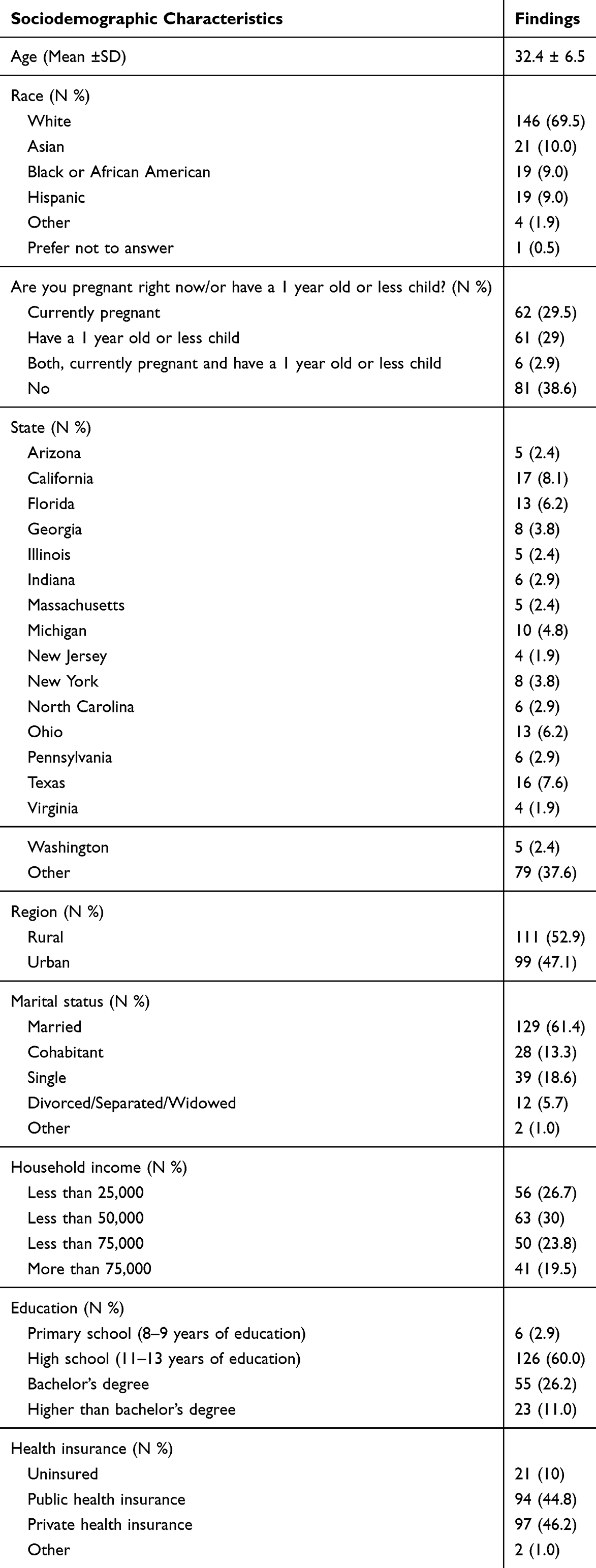 |
Table 1 Sociodemographic Characteristics of Study Participants |
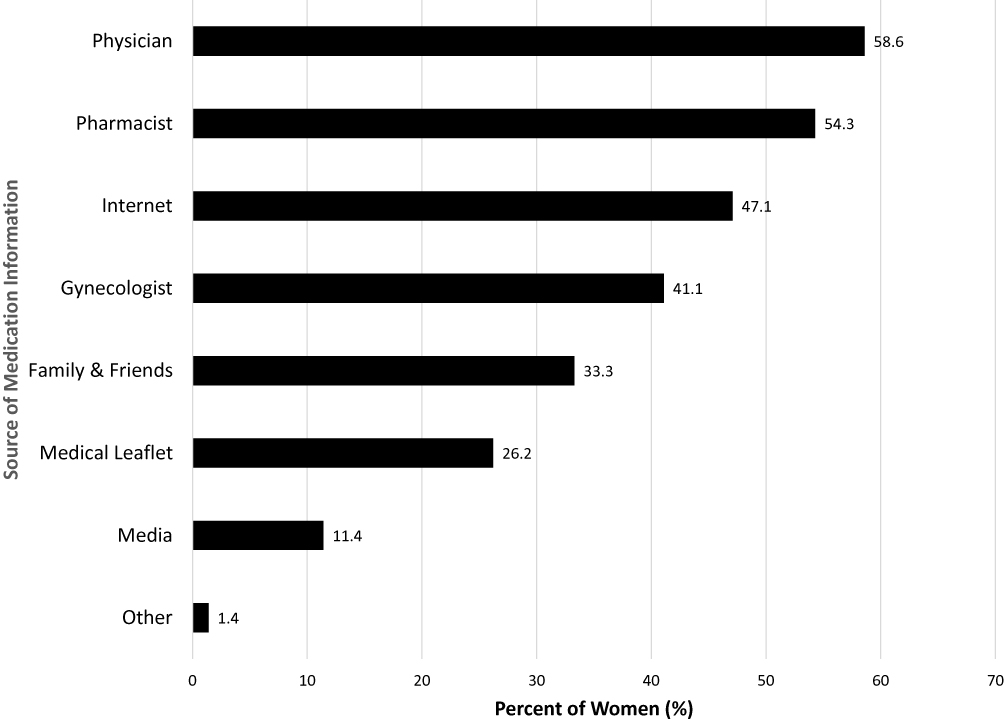 |
Figure 1 Utilization of medication information sources. |
Predictors of Utilization of Pharmacists as a Medication Safety Information Resource
The multivariable analysis findings are shown in Table 2. Multivariable logistic regression findings indicated that women who have difficulty understanding written medical information had fewer odds of utilizing pharmacists as information resources as compared to those who do not have difficulty understanding written information, adjusting for all other factors (OR = 0.301(95% CI 0.11–0.82); p = 0.018). The analyses also showed that Race was a predictive of the utilization of pharmacists as a medication information resource. Black/African American women of reproductive age had 0.199 times the odds of utilizing pharmacists as a medication information source compared to Whites (OR = 0.20(95% CI (0.06–0.66); p = 0.008)).
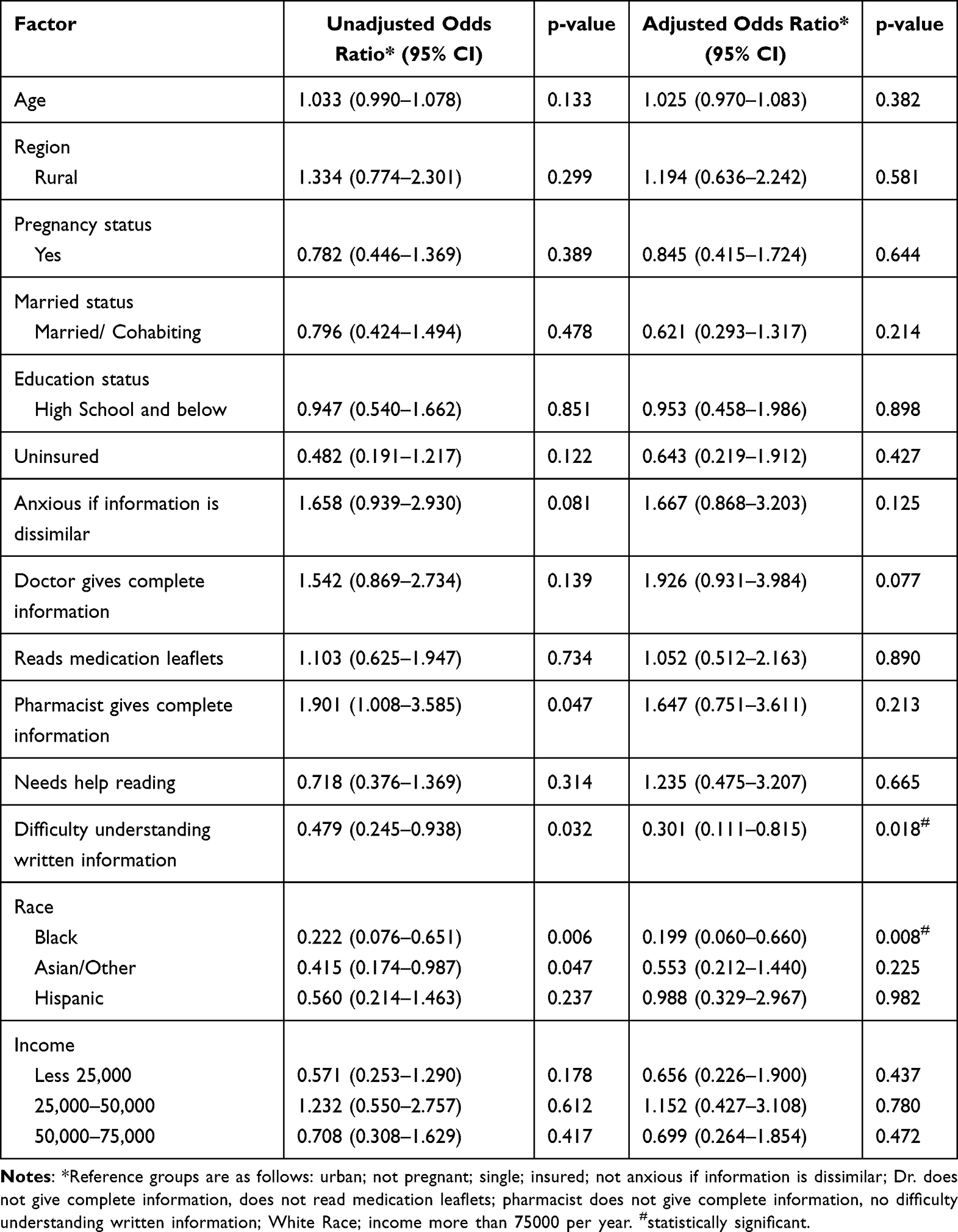 |
Table 2 Factors Predictive of Using Pharmacists as a Medication Safety Information Sources |
Provider-specific characteristics were not found to be predictive in the multivariable model. Participants who reported that pharmacists gave complete medication information had increased odds of using them as a medication information safety source (p = 0.047) in the unadjusted model. These findings were not significant once other factors were adjusted. Similarly, there was no significant impact found between perceptions that doctors provided complete information and utilization of pharmacists as a medication information source (p = 0.077).
Discussion
Our study sought to evaluate the predictive factors of utilizing pharmacists as a medication safety information source. Our findings identified suboptimal utilization of pharmacists as a medication information resource, despite pharmacists being one of the most accessible health care professionals.4,8 More specifically, our study found that only slightly more than half of the women (54.3%) of the reproductive age women surveyed utilized pharmacists as a medication safety information resource. While this study made no distinction on the type of pharmacists the participants were responding to, it is reasonable to conclude that more could be done by pharmacists to improve their “perceived utility” as a medication safety information resource by women of reproductive age. As an example, pharmacists could standardize asking women of reproductive age on their needs for any medication safety information in case they suspect pregnancy in outpatient clinical settings. Also, in community pharmacy settings, standard questions at medication pick-up or vaccination could also be helpful in encouraging women of reproductive age to express medication information gaps they may have. Despite the suboptimal utilization of pharmacists observed, it is noteworthy to also highlight that their utilization was on par with physicians (58.6%) and greater than obstetricians and gynecologists (41.1%). While this benchmarks pharmacists positively against other health professions, direct and better promotion of the value of pharmacists as medication safety information resources is needed among women of childbearing age.
Our findings also noted a significant reliance on the internet as another source of medication safety information (47%). While this study did not further explore dual utilizers of both pharmacists and the internet, a reasonable conclusion from the internet utilization findings themselves is that pharmacists can also play a significant role in supporting online medication safety. This finding is of particular significance when examined from the perspective of the recent public health emergency where reliance on the internet for health information was increased due to social isolation. Evidence of this was substantiated in a recent Norwegian study of 303 pharmacy customers over the pandemic. Their study cited side effects as the most common reason for use of the internet by the pharmacy customers.9 While comparable US studies – from the perspective of pharmacy customers or from a sample of women of reproductive age – were not found in the literature, the existing studies on the stress, social isolation, and health information access needs, while pregnant during the pandemic shows promising prospects for intervention by pharmacists.10,11 Further explained, these studies highlight opportunities for pharmacists to engage as experts on side effects for both pregnant and non-pregnant women of reproductive age women before they venture online uninformed. Systematic reviews conducted over the pandemic demonstrated high actual utilization of pharmacists during the pandemic, which could continue to be emphasized post-pandemic.12,13 According to all the 11 US and non-US studies reviewed by Viscari et al, pharmacists provided drug information to both health care providers and to patients across hospital, ambulatory, and community settings.12 Similar findings were observed in the systematic review of 94 studies – majority of which were European and US studies. Across these studies, pharmacovigilance, and education were noted as key activities performed by pharmacists. While none of the studies provided details on whether pharmacists interventions directly mitigated unsafe online medication information seeking, it still can be reasonably deduced that the high availability of pharmacists at various settings during this time mitigated or at least attenuated this risk.
Another key finding shown in our study is that participants who had difficulty understanding written medical information were even less likely to utilize pharmacists as a medication safety information source. According to the US Department of Health and Human Services, only about 12% of adults in America have proficient health literacy and over one-third has difficulty with common health tasks.13,14 These findings highlight the need for more pharmacists’ continuing education on motivational interviewing strategies to be able to empower reproductive age women who may have low health literacy or are afraid to ask questions. Also, thematically related to this finding is the observation that Black or African American women of reproductive had less odds of using pharmacists as a medication information source when compared to white women. It is our hypothesis that challenges associated with approachability, mistrust, as well as lack of knowledge on the expertise of pharmacists beyond dispensing roles could possibly be reasons for this finding. Caution is warranted, however, in our conclusions, since our study had a small sample of Black/African American women to draw inference from. Further studies are recommended to identify if there are barriers Black reproductive age women face in using pharmacists as a medication safety information source.
Having a specific pregnancy status, education status, income and education was not shown to significantly increase or decrease the likelihood of utilizing pharmacists as a medication information resource. These findings could potentially reflect the universality of access of pharmacists across levels of these groups since equal likelihood was observed. Pharmacists, as previously mentioned, are the most accessible professionals,4,8 and this is what could be reflected in these findings. However, caution is warranted in interpretation of these findings because of the small sample size we studied. More studies are suggested to confirm these effects.
Like all studies, our study has some noteworthy limitations. First, the study was conducted online, had few non-White participants, and used a purposive sampling approach. As such, there is selection bias and limited external validity of our findings. Second, there is also the potential for social-desirability effects as women may have provided more positive response on their utilization of medication information sources. Third, the study was an ad-hoc analysis of baseline data collected for a separate intervention study. On this basis, the study was not powered to specifically address the study outcome of pharmacist utilization as a medication information resource. Fourth, our study may also have the potential for bias due confounding. There are other social determinants of health and other factors, which could have impacted the utilization of pharmacists as medication safety information resources. Lastly, the study was conducted before the COVID-19 pandemic and so perceptions of pharmacists may have changed significantly. Future studies are recommended to confirm our study’s findings.
Conclusion
In conclusion, our study is suggestive of a perceived value of pharmacists as a medication safety information resource among women of reproductive age. The study also highlighted opportunities for increased pharmacist outreach to identify medication safety information gaps, particularly for Black/African American women and those who have difficulty understanding written medication information. To our knowledge, this is among the first studies to directly examine this issue, and so it adds to the overall body of literature on the perceptions of the role of pharmacists.
While the study provided key insights, it also has some important limitations, which limits the generalizability of our findings. Future studies are recommended to continue to examine the evolving role of pharmacists as medication safety information resources in this post-pandemic period.
Funding
This project was funded in part by the HRSA Center of Excellence Grant Number D34HP16042. This project was supported in part by the National Institute on Minority Health and Health Disparities of the National Institutes of Health under award Number G12MD007597.
Disclosure
The authors report no conflicts of interest in this work.
References
1. Mitchell AA, Gilboa SM, Werler MM, et al. Medication use during pregnancy, with particular focus on prescription drugs: 1976-2008. Am J Obstet Gynecol. 2011;205(1):51.e1–8. doi:10.1016/j.ajog.2011.02.029
2. National Center for Health Statistics. Health, United States, 2018. Hyattsville, MD: National Center for Health Statistics; 2019.
3. Haas DM, Marsh DJ, Dang DT, et al. Prescription and other medication use in pregnancy. Obstet Gynecol. 2018;131(5):789–798. doi:10.1097/AOG0000000000002579
4. Qato DM, Zenk S, Wilder J, Harrington R, Gaskin D, Alexander GC. The availability of pharmacies in the United States: 2007–2015. PLoS One. 2017;12(8):e0183172. doi:10.1371/journal.pone.0183172
5. Bakhireva LN, Young BN, Dalen J, Phelan ST, Rayburn WF. Patient utilization of information sources about safety of medications during pregnancy. J Reprod Med. 2011;56(7–8):339–343.
6. Bert F, Gualano MR, Brusaferro S, et al. Pregnancy e-health: a multicenter Italian cross-sectional study on Internet use and decision-making among pregnant women. J Epidemiol Community Health. 2013;67(12):1013–1018. doi:10.1136/jech-2013-202584
7. Lu Y, Barrett LA, Lin RZ, Amith M, Tao C, He Z. Understanding information needs and barriers to accessing health information across all stages of pregnancy: systematic review. JMIR Pediat Parent. 2022;5(1):e32235. doi:10.2196/32235
8. Tsuyuki RT, Beahm NP, Okada H, Al Hamarneh YN. Pharmacists as accessible primary health care providers: review of the evidence. Can Pharm J. 2018;151(1):4–5. doi:10.1177/1715163517745517
9. Bergmo TS, Sandsdalen V, Manskow US, Småbrekke L, Waaseth M. Internet use for obtaining medicine information: cross-sectional survey. JMIR Form Res. 2023;7:e40466. doi:10.2196/40466
10. Birkelund KS, Rasmussen SS, Shwank SE, Johnson J, Acharya G. Impact of the COVID-19 pandemic on women’s perinatal mental health and its association with personality traits: an observational study. Acta Obstet Gynecol Scand. 2023;102(3):270–281. doi:10.1111/aogs.14525
11. Craighead CG, Collart C, Frankel R, et al. Impact of telehealth on the delivery of prenatal care during the COVID-19 pandemic: mixed methods study of the barriers and opportunities to improve health care communication in discussions about pregnancy and prenatal genetic testing. JMIR Form Res. 2022;6(12):e38821. doi:10.2196/38821
12. Visacri MB, Figueiredo IV, Lima TM. Role of pharmacist during the COVID-19 pandemic: a scoping review. Res Social Adm Pharm. 2021;17(1):1799–1806. doi:10.1016/j.sapharm.2020.07.003
13. Amariles P, Monsalve M, Rivera-Cadavid M, Ceballos M, Ledezma-Morales M, Salazar-Ospina A. Processes implemented and activities carried out by the pharmacists during the COVID‑19 pandemic: a scoping review. Farm Hosp. 2022;46(6):350–358.
14. US Department of Health and Human Services. America’s Health Literacy: why We Need Accessible Health Information. Available from: https://health.gov/communication/literacy/issuebrief/.
 © 2024 The Author(s). This work is published and licensed by Dove Medical Press Limited. The
full terms of this license are available at https://www.dovepress.com/terms
and incorporate the Creative Commons Attribution
- Non Commercial (unported, 3.0) License.
By accessing the work you hereby accept the Terms. Non-commercial uses of the work are permitted
without any further permission from Dove Medical Press Limited, provided the work is properly
attributed. For permission for commercial use of this work, please see paragraphs 4.2 and 5 of our Terms.
© 2024 The Author(s). This work is published and licensed by Dove Medical Press Limited. The
full terms of this license are available at https://www.dovepress.com/terms
and incorporate the Creative Commons Attribution
- Non Commercial (unported, 3.0) License.
By accessing the work you hereby accept the Terms. Non-commercial uses of the work are permitted
without any further permission from Dove Medical Press Limited, provided the work is properly
attributed. For permission for commercial use of this work, please see paragraphs 4.2 and 5 of our Terms.