
Back to Journals » Clinical Interventions in Aging » Volume 21
Predictive Value of Incorporating Principal Diagnosis into CGA for Short-Term Functional Recovery in an ACE Unit: A Retrospective Study
Authors Chen L, Pu D  , Wang G, Zhao M, Shi W, Yang N, Ma X, Zhang Y, Li C, Li M
Received 10 March 2026
Accepted for publication 27 May 2026
Published 3 June 2026 Volume 2026:21 608016
DOI https://doi.org/10.2147/CIA.S608016
Checked for plagiarism Yes
Review by Single anonymous peer review
Peer reviewer comments 4
Editor who approved publication: Dr Zhi-Ying Wu
Li Chen,1,* Dongyan Pu,2,* Guiqing Wang,1 Meiying Zhao,1 Wenqian Shi,1 Nannan Yang,1 Xiwen Ma,1 Yaqin Zhang,1 Chunhong Li,1 Mingzi Li3
1Department of Geriatrics, Zhengzhou Central Hospital Affiliated to Zhengzhou University, Zhengzhou, Henan, 450001, People’s Republic of China; 2School of Nursing, Southwest Medical University, Luzhou, Sichuan, 646000, People’s Republic of China; 3School of Nursing, Peking University, Beijing, 100191, People’s Republic of China
*These authors contributed equally to this work
Correspondence: Chunhong Li, Zhengzhou Central Hospital, 16 Tongbai North Road, Zhongyuan District, Zhengzhou, Henan, 450000, People’s Republic of China, Email [email protected] Mingzi Li, School of Nursing, Peking University, 38 Xueyuan Road, Haidian District, Beijing, 100191, People’s Republic of China, Tel +86 10 82805230, Email [email protected]
Purpose: In Acute Care for Elders (ACE) units, Comprehensive Geriatric Assessment (CGA) relies heavily on cumulative comorbidity metrics like Charlson Comorbidity Index (CCI). However, it fails to reflect the dynamic nature of acute illness, limiting its ability to predict short-term functional recovery. Therefore, we aimed to evaluate whether the principal diagnosis, representing acute physiological stress, offers superior predictive value compared to the CCI for functional outcomes in hospitalized older adults.
Patients and Methods: This retrospective cohort study included 213 patients (≥ 65 years) admitted to the Acute Care for Elders (ACE) unit between January 2023 and December 2024. The primary outcome was short-term functional recovery, measured as the change in the Barthel Index (BI) from admission to discharge (ΔBI). Hierarchical multiple linear regression was used to create three models: a base model (demographic/clinical covariates), a CCI model, and a principal diagnosis model. Model performance was compared using Adjusted R2, Area Under the Curve (AUC) from ROC analysis, Net Reclassification Improvement (NRI), and information criteria (AIC/BIC).
Results: The principal diagnosis model demonstrated significantly higher explanatory power (Adjusted R2 = 0.85) compared to the CCI model (Adjusted R2 = 0.78) and the base model (Adjusted R2 = 0.75). The inclusion of principal diagnosis resulted in a significant continuous Net Reclassification Improvement (NRI=0.37, 95% CI 0.11– 0.65, p = 0.006). After adjustment for covariates, specific diagnoses such as Endocrine and Respiratory diseases were strong predictors of recovery, whereas CCI was not statistically significant.
Conclusion: The principal diagnosis outperforms cumulative comorbidity as a predictor of short-term functional recovery in the ACE unit. Integrating principal diagnosis into the CGA serves as a valuable and practical complement to refine early functional prognostication.
Keywords: functional recovery, aging, hospitalized elderly, clinical decision-making
Introduction
Older adults hospitalized due to acute health problems have a higher risk of adverse outcomes, including frailty, cognitive Impairment, malnutrition, and depression.1–3 Together these additional stressors can lead to an irreversible functional decline, which can result in loss of independence following an acute illness. Indeed, the prevalence of decline in functional in acute care settings varies from 30 to 60%.4 Hospitalization itself may lead to limited functional recovery or even a new functional decline.5 Additionally, when hospitalized older adults are discharged with a decline in their activities of daily living (ADL), the long-term prognosis for functional recovery is often unfavorable.6
Acute Care for Elders (ACE) program was proposed to facilitate the rapid recovery of elderly patients and improve functional outcomes.5 Its core components integrate: patient-centered care, a specially designed environment, review of medical care, and planning for discharge to help patients maintain or achieve independence in basic activities of daily living.7 In ACE units, a dedicated Multidisciplinary Team (MDT) applies the principles of Comprehensive Geriatric Assessment (CGA) to manage multimorbidity, a central characteristic of this patient population.8,9 CGA is a multidisciplinary diagnostic process that evaluates functional status, cognition, emotional status, nutritional status, comorbidities, polypharmacy.10 The value of CGA is great in older adults as it identifies the functional impairments and geriatric syndromes. Currently, the primary application of CGA is to inform the clinical decision-making process regarding patients appropriate for admission to an ACE unit or a general ward.11
However, current risk stratification strategies within the CGA rely heavily on comorbidity burden, most notably the use of Charlson Comorbidity Index (CCI). Although these tools effectively predict long-term mortality, they fail to reflect the dynamic nature of the acute illness itself.12 Similarly, while pre-morbid factors like baseline function, cognitive impairment, and frailty13,14 might predict short-term recovery, they also remain static and unmodifiable. Since functional recovery is closely linked to the disease’s inherent physiological course,15,16 relying solely on static metrics makes it difficult for clinicians to accurately assess the potential for functional recovery during short-term hospitalization in the ACE unit, which may further lead to biased treatment decisions, and misallocation or inefficient utilization of medical resources.
One study, after a detailed review of current CGA practices, pointed out that an ideal assessment system must account for the specific clinical course of each disease.17 In order to achieve an efficient and intuitive assessment in a time-constrained clinical environment, we propose integrating “principal diagnosis” as a component in CGA process. The principal diagnosis identifies the primary pathophysiological process and immediate clinical priority precipitating the admission.6 Resolving this acute process facilitates early clinical stabilization, which is strongly associated with the patient’s short-term functional recovery. In this context, the principal diagnosis may be served as a practical indicator for the severity of in-hospital acute stress and the expected course of recovery. Meanwhile, diagnosis grouping is clinically meaningful for MDT to reduce cognitive burden and ultimately improves the efficiency of multidisciplinary decision-making.18
Therefore, this study aims to verify whether admission diagnosis, reflecting acute severity, outperforms the CCI-assessed chronic burden in predicting short-term functional recovery. By validating the unique value of principal diagnosis in predicting short-term functional recovery, we hope to provide clinicians with more comprehensive and simple feasible assessment evidence, thereby optimizing the allocation strategy of scarce older adults’ medical resources.
Methods
Study Design and Setting
This study examined patients admitted to the Department of Acute Geriatrics and General Geriatrics at Zhengzhou Affiliated Central Hospital of Zhengzhou University from January 2023 to December 2024. The ACE unit implements core principles including routine Comprehensive Geriatric Assessment (CGA), individualized care plans delivered by a multidisciplinary team, early rehabilitation focus, patient-centered environmental modifications, and proactive discharge planning. We included patients 65 years of age or older who had been admitted within 2 weeks of symptom onset for an acute or acute exacerbation of a chronic illness. Patients who were totally dependent on personal care, had severe mobility impairment, severe dementia, and were admitted to the hospital with end-stage disease such as multiple organ failure and severe cardiopulmonary and renal insufficiency were excluded.
Data Collection
Data were retrospectively extracted from electronic medical records and hospital administrative databases by two trained geriatric resource nurses using a standardized data collection form. Baseline data collected at admission included: age, gender, principal diagnosis, Charlson Comorbidity Index (CCI), FRAIL Scale (FRAIL), Morse Fall Scale (MFS), Mini-Cognitive Assessment Instrument (Mini-Cog), Nutritional Risk Screening 2002 (NRS-2002), five-item Geriatric Depression Scale (GDS-5), previous hospitalization times, baseline albumin, baseline hemoglobin and baseline Activities of Daily Living (ADL). Outcome data included: ADL, LOS, total hospitalization costs, albumin and hemoglobin at discharge, in-hospital deaths, and 15-day all-cause readmission.
Classification of Principal Diagnosis
The principal diagnosis recorded at hospital admission was used for classification. Based on the underlying pathophysiology and affected organ system, we used the International Classification of Diseases (ICD-11),19 diagnoses were grouped into seven mutually exclusive major categories: Cardiovascular diseases (eg, heart failure, coronary artery disease), Digestive diseases (eg, gastrointestinal bleeding, cholecystitis), Endocrine diseases (eg, diabetes mellitus and complications), Fever/Infection (primarily non-respiratory systemic infections), Neurological diseases (eg, stroke, Parkinson’s disease), Respiratory diseases (eg, COPD, pneumonia), and Renal diseases (eg, acute kidney injury, exacerbation of chronic kidney disease). To ensure mutual exclusivity, infections localized to a specific organ system were classified under that respective category, such as pneumonia within Respiratory diseases and cholangitis within Digestive diseases. Consequently, the “Infection” category was strictly reserved for systemic conditions like sepsis or infections lacking a specific focal origin, including fever of unknown origin. Detailed information can be found in Supplementary Table S1.
The classification results were discussed with experienced clinicians from multiple specialties and validated by academic clinicians not involved in the study.
CCI
The Charlson Comorbidity Index (CCI) was used to assess the baseline comorbidity burden for each patient.20 This validated index assigns a specific weight (1, 2, 3, or 6) to 17 predefined comorbid conditions, based on their established association with one-year mortality. The total CCI score was calculated by summing the weights of all present comorbidities for a given patient. A higher total score indicates a greater burden of comorbid disease and corresponds to a higher predicted risk of mortality. The age-adjusted CCI was also calculated, where one point was added to the score for each decade of age from 50 years onward.
ADL
Functional recovery was assessed by improvement in activities of daily living (ADL) from admission to discharge. The ADL of patients in the ACE unit group before and after intervention were evaluated by the Barthel Index rating scale.21,22 Basic self-care of daily living includes the following ten items: eating, bathing, grooming, dressing, bowel control, bladder control, toilet use, transfers, and movements on the floor and stairs. The score of 100 was complete independence, 61–99, mild dependence; 41 to 60 points, moderate dependence; 40 points or less, severe dependence; 0 points, total dependence.
Statistical Analysis
All statistical analyses were conducted using R statistical software (Version 4.2.0). A two-sided p-value of < 0.05 was considered statistically significant for all tests. The analytical strategy was designed to compare the predictive value of the principal diagnosis against the established Charlson Comorbidity Index (CCI) for short-term functional recovery within the ACE unit. The dataset contained no missing values for the outcome and candidate predictors, a complete case analysis approach was adopted.
Primary Outcome Definition
The primary outcome was short-term functional recovery, quantified as the change in the Barthel Index from admission to discharge (ΔBI). For the purpose of assessing model discrimination, this continuous outcome was dichotomized to identify patients who achieved a “clinically significant functional recovery”, defined as a ΔMBI of ≥ 10 points. This threshold was selected based on established minimal clinically important difference (MCID) literature for the Barthel Index.23–25
Baseline and Outcome Comparisons
For continuous variables (eg, age, length of stay, costs, Barthel Index scores), independent samples Student’s t-tests were used. For categorical variables (eg, gender, readmission rates, principal diagnosis distribution), Pearson’s chi-squared test or Fisher’s exact test was employed as appropriate.
Fitting the Hierarchical Multivariate Models
The central analysis involved the construction of three nested multiple linear regression models to predict the primary continuous outcome (ΔBI) within the ACE unit. The goal was to isolate the added predictive value of the CCI and the principal diagnosis. The forced entry method were used to ensure all pre-specified covariates were retained in the models. Based on the widely accepted epidemiological rule of thumb requiring at least 10 to 15 observations per predictor variable to prevent overfitting.26 The sample size of this study adequately supported the inclusion of 16 predictor variables in the final full model.
Model 1 (Base Model)
Included established demographic and comprehensive geriatric assessment (CGA) covariates: age, gender, prior hospitalizations, baseline ADL, nutritional status (NRS-2002 score), cognitive status (Min-Cog), frailty status (FRAIL scale), and depression (GDS-5).
Model 2 (CCI Model)
The age-adjusted CCI score (continuous) was added to the covariates from the Base Model.
Model 3 (Diagnosis Model)
The principal diagnosis (a seven-level categorical variable, with “Renal diseases” as the reference category) was added to the covariates from the Base Model.
Multicollinearity
The final models were checked for multicollinearity among predictor variables using the Variance Inflation Factor (VIF). A VIF value > 5 was considered indicative of significant multicollinearity.
Subgroup Analysis
To address the potential ceiling effect of the Barthel Index, a sensitivity analysis was performed on subgroups of patients with baseline Barthel Index ≤ 95, 90, 85, 70, 75, ensuring that the predictive value of diagnosis holds true in patients with the capacity for recovery.
Determining Added Predictive Value
To determine whether the principal diagnosis offered superior predictive value compared to the CCI, the performance of Model 2 and Model 3 was formally compared against the Base Model and each other using a comprehensive set of metrics:
Overall Model Fit and Explained Variance
The performance of each model was evaluated using the Adjusted R-squared (R2) to quantify the proportion of variance in ΔBI explained by the predictors, while penalizing for model complexity. The Root Mean Square Error (RMSE) was calculated as a measure of the average prediction error. A formal comparison of nested models was conducted using the Likelihood Ratio Chi-Squared (χ2) test, which assesses whether the addition of new predictors (CCI or Diagnosis) results in a statistically significant improvement in model fit over the Base Model.
Discrimination
The ability of each model to discriminate between patients who did and did not achieve clinically significant functional recovery (ΔBI ≥ 10) was assessed using Receiver Operating Characteristic (ROC) curve analysis. The Area Under the Curve (AUC) was calculated for each model. To test for a statistically significant difference in discriminative ability, the AUCs of Model 2 and Model 3 were formally compared using the DeLong’s test.
Reclassification
The continuous Net Reclassification Improvement (NRI) was calculated to evaluate the extent to which the Diagnosis Model improved risk prediction accuracy compared to the CCI Model. NRI quantifies the net proportion of patients correctly reclassified to higher or lower recovery probabilities, serving as a sensitive metric for model performance. Since we utilized the continuous (category-free) NRI, no arbitrary risk probability thresholds were applied. The calculation assessed the directional change in predicted probabilities for each individual. Specifically, whether the model assigned higher probabilities to events (patients with ΔBI≥10) and lower probabilities to non-events compared to the reference model.
Model Selection Criteria
To further compare the non-nested models while accounting for goodness-of-fit and model complexity, the Akaike’s Information Criterion (AIC) and Bayesian Information Criterion (BIC) were calculated. Lower values for these criteria indicate a more optimal model, balancing explanatory power with parsimony.
Internal Validation
The final models were internally validated using bootstrapping with 1000 resamples to calculate optimism-corrected performance metrics (including adjusted R2 and AUC), ensuring the robustness of the discrimination estimates.
Presentation and Validation of the Final Model
The clinical utility of the final, superior model (Model 3) was visually presented.
Ethical Considerations
This study was approved by the Ethics Committee of Zhengzhou Central Hospital Affiliated Zhengzhou University (Ethics number: 2018020781). The study was conducted in accordance with the Declaration of Helsinki. Due to the retrospective nature of the study, the requirement for written informed consent was waived by the Ethics Committee of Zhengzhou Central Hospital. To protect the privacy of the participants, all data were anonymized and maintained with strict confidentiality prior to analysis. No personal identifying information was accessed by the research team.
Results
Baseline Characteristics
A total of 221 patients admitted to the ACE unit met eligibility criteria. After excluding eight patients with severe dependency, mobility disorders, dementia, or end-stage disease, 213 ACE patients remained. Based on their baseline functional status, participants were stratified into four groups using the Barthel Index (BI): Severe (BI 0–40, n=26, 12.2%), Moderate (BI 41–60, n=24, 11.3%), Mild (BI 61–99, n=154, 72.3%), and Independent (BI 100, n=9, 4.2%). The mean age of the cohort was 77.35 ± 7.92 years, and 123 (57.7%) were female. The two most common causes of admission were cardiovascular diseases and respiratory diseases (each n=44, 20.7%), followed by neurological disorders (13.6%). The average length of stay was 8.15 ± 2.60 days. The population presented with a substantial comorbidity burden (mean CCI, 4.70 ± 1.83).
A comparison of the baseline clinical and demographic characteristics across the functional subgroups is shown in Table 1. Age and gender distribution were not significantly associated with baseline functional status (p = 0.179 and p = 0.436, respectively). However, regarding emotional status, the frailest patients exhibited significantly higher depression scores; the mean GDS-5 score was highest in the Severe group (2.19 ± 2.12) and lowest in the Independent group (0.11 ± 0.33, p < 0.001). Other clinical parameters, including length of stay, costs, nutritional status (NRS-2002), and cognitive status (Mini-Cog), did not differ significantly among the groups.
 |
Table 1 Baseline Characteristics |
In terms of clinical outcomes, readmission rates within 15 days varied significantly (p = 0.012), reaching 7.7% in the Severe group while no readmissions occurred in the Mild or Independent groups. Notably, the extent of functional recovery (ΔBarthel Index) differed significantly across groups (p < 0.001); patients in the Moderate group achieved the highest mean gain (14.58 ± 11.60), whereas the Independent group experienced a slight mean functional decline (−0.56 ± 1.67).
Comparative Performance of Predictive Models
To formally test the hypothesis that principal diagnosis is a superior predictor to cumulative comorbidity, the performance of three hierarchical models was compared (Table 2). Model 1 (Base Model) had an adjusted R2 of 0.75. The addition of CCI in Model 2 yielded only a marginal improvement (Adjusted R2 = 0.78). However, the inclusion of the principal diagnosis in Model 3 resulted in a substantial increase in explanatory power, with an Adjusted R2 of 0.85.
 |
Table 2 Comparison of the Three Models |
As shown in Table 2, the superiority of the Diagnosis Model (Model 3) over the CCI Model (Model 2) was consistent across all evaluation metrics. Model 3 demonstrated a significantly lower Root Mean Square Error (RMSE: 8.04 vs. 8.18, p = 0.046) and a significantly higher Likelihood Ratio χ2 value (64.58 vs. 54.33, p < 0.001), indicating a better model fit. This was further supported by lower Akaike’s Information Criterion (AIC: 1404.5 vs. 1525.9) and Bayesian Information Criterion (BIC: 1440.7 vs. 1569.6). Furthermore, the Net Reclassification Improvement (NRI) for Model 3 compared to Model 2 was 0.37 (95% CI: 0.11–0.65), indicating that the Diagnosis Model correctly reclassified a significant proportion of patients (p = 0.006).
The risk stratification capability of Model 3 was further demonstrated. As illustrated in the violin plot (Figure 1), Model 3 effectively stratified the ACE cohort into two distinct prognostic groups: “Functional Maintenance” and “Clinically Significant Recovery”. The actual functional recovery observed in the group predicted to have significant recovery was substantially and statistically higher than that of the maintenance group (t-test: p < 0.001).
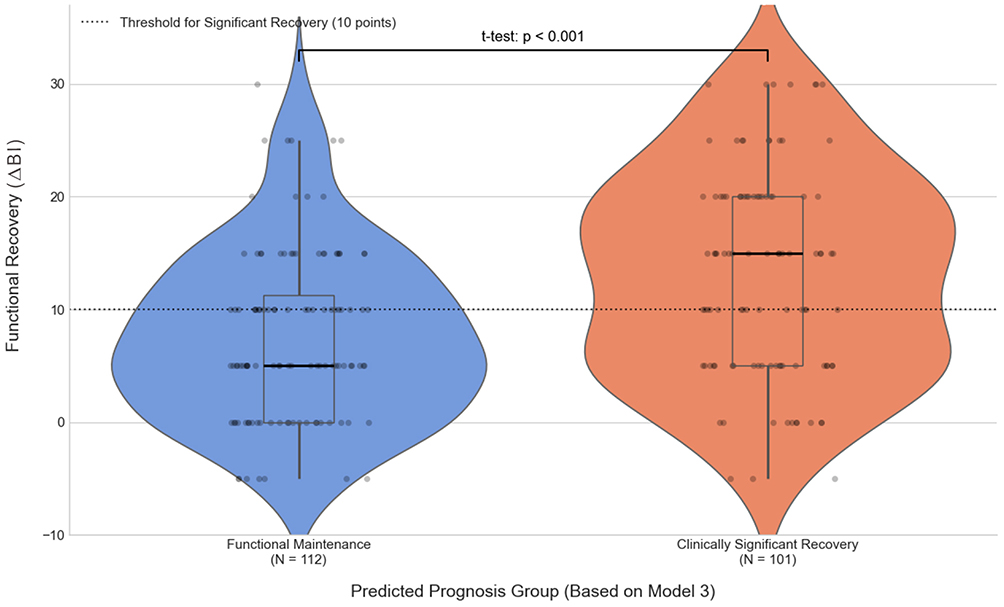 |
Figure 1 Model-Based Risk Stratification of Functional Recovery. The violin plots illustrate the probability density of the data at different values. The embedded boxplots represent the median and interquartile range (IQR), while the whiskers extend to the minimum and maximum values (excluding outliers). Individual data points are shown as jittered dots to reflect the underlying distribution. The horizontal dashed line indicates the operational threshold for clinically significant recovery (ΔBI = 10). Statistical significance between groups was determined using an independent samples Student’s t-test. Bold value (p < 0.001) indicates a statistically significant difference. Abbreviation: ΔBI, change in Barthel Index. |
Finally, Receiver Operating Characteristic (ROC) curve analysis for predicting clinically significant functional recovery (ΔBI ≥ 10 points) further confirmed these findings (Figure 2). As shown in the ROC Curves figure, the Area Under the Curve (AUC) for Model 3 (Diagnosis: AUC = 0.928) was significantly higher than that for Model 2 (CCI: AUC = 0.888), with a DeLong’s test p-value of 0.031.
 |
Figure 2 ROC Curves for Predicting Clinically Significant Functional Recovery. Under the receiver operating characteristic curve, the model incorporating the principal diagnosis demonstrated an enhanced capability to discriminate the potential for short-term functional recovery compared to both the base model and the comorbidity-based model. Statistical comparisons of AUC values were performed using DeLong’s test, and bold font in the statistical comparison box indicates a P-value that is statistically significant at the P ≤ 0.05 level. Abbreviations: AUC, area under curve; CI, confidence intervals. |
Sensitivity analyses using varying functional recovery thresholds (ΔBI ≥ 5–12) confirmed the Diagnosis Model’s robustness (Supplementary Table S2). The lack of statistical significance in AUC differences at higher thresholds is likely attributable to the diminished statistical power resulting from fewer events and the metric’s inherent insensitivity to calibration improvements. Despite this, the Integrated Discrimination Improvement (IDI) remained highly significant across all cutoffs (p ≤ 0.002), thereby confirming the model’s better classification utility.
Furthermore, to rule out ceiling effects, we analyzed subgroups with restricted baseline ADL scores (≤95 to≤75). The lower bound was set at 75 to maintain a sufficient sample size (≥100) for stable multivariate regression (Supplementary Table S3). Across all subgroups, the Diagnosis Model consistently demonstrated superior fit (higher Adjusted R2, lower AIC/BIC) and significant Net Reclassification Improvement (NRI, all p < 0.01), indicating that the predictive value of the principal diagnosis remains significant regardless of the patient’s baseline functional reserve.
Predictors of Short-Term Functional Recovery in the ACE Unit
The primary analysis focused exclusively on the 213 patients within the ACE unit to identify predictors of short-term functional recovery, defined as the change in Barthel Index from admission to discharge (ΔBI). The multiple linear regression analysis, incorporating all potential predictors, identified several factors significantly associated with functional recovery (Table 3). Baseline ADL was a strong negative predictor (B=−0.180, p < 0.001), indicating that patients with higher initial function had less room for improvement.
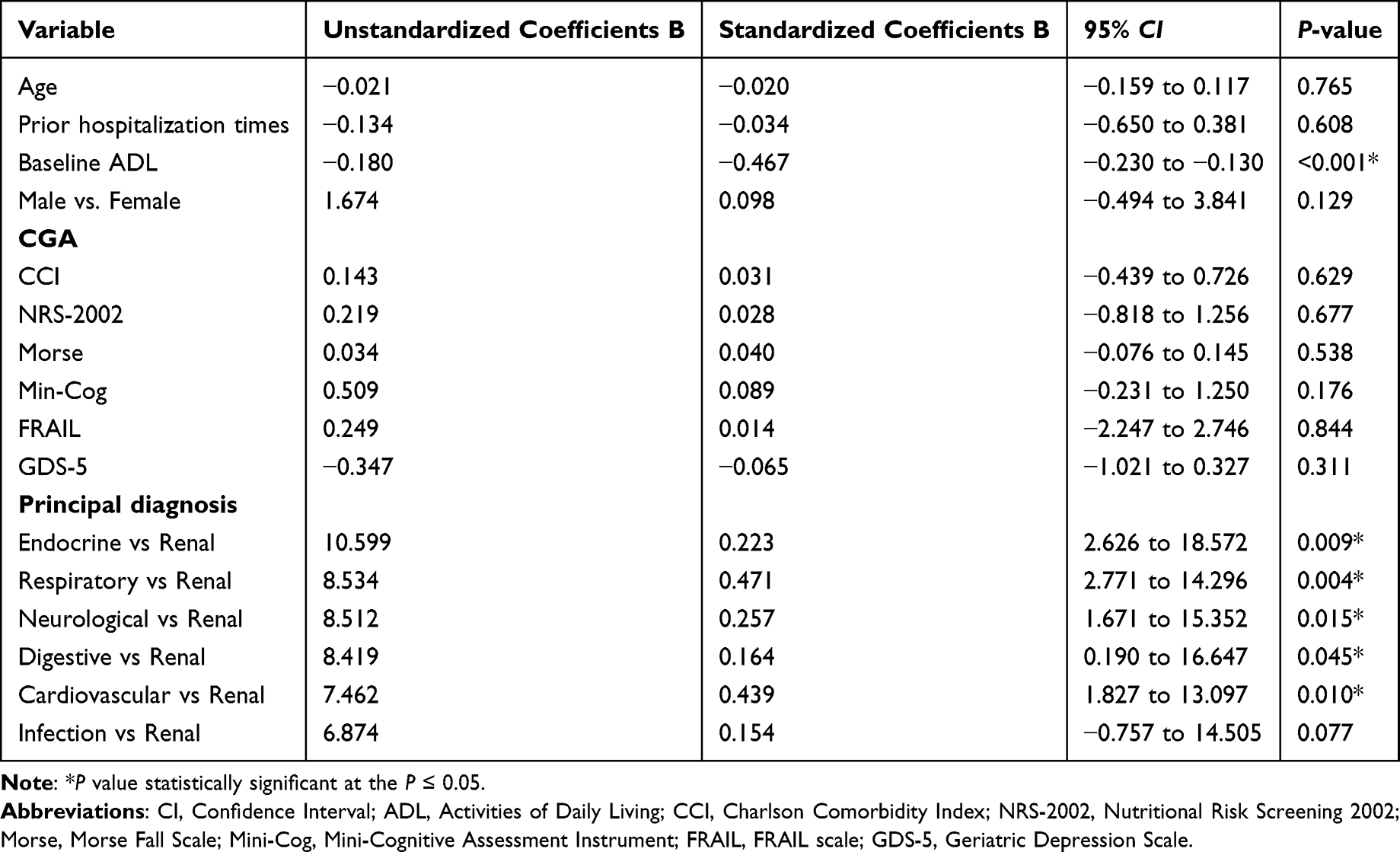 |
Table 3 Model 3: Multiple Linear Regression Analysis Performed with All Variables |
Most notably, the primary diagnosis emerged as a powerful predictor. Compared to patients with Renal diseases (the reference category), those admitted with Endocrine (B =10.599, p = 0.009), Respiratory (B=8.534, p = 0.004), Neurological (B=8.512, p = 0.015), Digestive (B=8.419, p = 0.045), and Cardiovascular (B=7.462, p = 0.010) conditions achieved significantly higher functional gains. Conversely, after adjusting for diagnosis and functional status, the Charlson Comorbidity Index (CCI) and other CGA assessment indicators were not significant predictors of short-term functional recovery (B=0.143, p = 0.629).
Discussion
This study’s principal finding is that in an ACE unit, the principal diagnosis for acute admission serves as a robust, independent predictor of short-term functional recovery, outperforming the cumulative chronic disease burden as measured by the Charlson Comorbidity Index (CCI). This suggests that while a patient’s history of multimorbidity is important, the specific pathophysiological impact of the acute illness itself is a more dominant factor in determining the short-term rehabilitation within an ACE unit.
A central contribution of our research is the elucidation of the complex interplay between acute illness and chronic comorbidity in determining short-term outcomes. Although not a significant predictor of functional recovery in the regression models, the CCI remains clinically vital in the ACE unit. By evaluating comorbidities, the MDT can estimate the risk of in-hospital complications, such as infections, falls, and delirium, then predict post-discharge long-term care requirements. However, while CCI reflects a patient’s chronic, cumulative health deficit, the “principal diagnosis” represents the nature and intensity of the current acute physiological stress.27 This finding highlights that while the ACE unit is beneficial overall, the magnitude of functional recovery is not uniform across all conditions treated within this specialized environment. Furthermore, the immediate physiological impact of the acute event, characterized by inflammatory responses, metabolic derangements, and hemodynamic instability, alongside the specific rehabilitation pathways required, may outweigh the influence of chronic comorbidities on short-term functional recovery. These findings suggest that when performing CGA, clinicians should account for the time-constrained nature of acute hospitalization by re-evaluating the relative impact of acute versus chronic factors on prognosis. This might provide a more accurate prediction of short-term ADL recovery potential, thus helping inform more targeted admission criteria. It could also potentially broaden the clinical utility of CGA, rather than the mere identification of geriatric syndromes.
Based on clinical evidence, ACE units effectively reduce the decline of functional at discharge and increase the likelihood of discharge to home;28 however, evidence regarding the long-term sustainability of these functional and survival benefits remains conflicting. Deschodt et al conducted a systematic review and meta-analysis of inpatient geriatric consultation teams and evaluated clinical outcomes including functional status and mortality.29 They found that while the geriatric intervention significantly reduced mortality at 6 and 8 months post-discharge, it did not demonstrate a statistically significant effect on functional status or readmission rates in the long term. Similarly, in a comprehensive meta-analysis of acute geriatric units, Baztán et al reported that while the intervention group showed significantly less functional decline at discharge, the survival curves of the intervention and control groups tended to converge over time, with no significant difference in case fatality observed at 3-month follow-up.30,31 This suggests that the effects of ACE interventions are time-sensitive, mainly occurring during hospitalization and the immediate transition period. Short-term functional gains may not translate linearly or directly into long-term survival advantages. External factors, such as post-discharge community support and socioeconomic status, may play a more decisive role in long-term outcomes. Consequently, CGA tools designed to predict long-term outcomes may not accurately predict patients’ functional recovery during short hospital stays.
The distinct recovery trajectories observed across diagnostic groups underscore the critical influence of acute pathophysiology on short-term outcomes. Patients with endocrine diseases had the most significant ADL recovery effect during hospitalization, followed by respiratory diseases, neurological diseases, digestive diseases and cardiovascular diseases. The recovery potential of fever/infection, and renal diseases is relatively low. Patients with endocrine, respiratory, and cardiovascular exacerbations achieved substantial recovery, a finding likely attributable to the rapid reversibility of acute physiological derangements, including hyperglycemia, fluid overload, and hypoxemia.32–34 Endocrine diseases stems from the underlying metabolic blockades, primarily disrupting cellular energy metabolism and signaling.35 Targeted therapies such as hormone replacement or strict glycemic control, can quickly restore cellular ATP production, providing an immediate physiological basis for rapid recovery.36–38 Similarly, respiratory emergencies are initially driven by acute hypoxia and airway spasms. Once these ventilation barriers are medically stabilized, patients exhibit high functional plasticity and are highly responsive to early bedside rehabilitation.39 Multidimensional interventions, including respiratory muscle training and aerobic exercises, can rapidly alleviate airway inflammation, mitigate oxidative stress, and improve ventilation efficiency.40,41 Similarly, patients with neurological conditions achieved significant gains, likely attributable to the ACE unit’s goal-oriented rehabilitation fostering neuroplasticity.42 Conversely, severe infections or renal failure trigger intense systemic inflammatory cascades. This profound inflammation drives continuous muscle protein depletion, induces a deep catabolic state, and suppresses anabolic signaling.43,44 Unlike localized impairments, this systemic insult leads to global deconditioning. Reversing this condition requires a protracted anabolic recovery period that often spans several months, extending far beyond the time of acute hospitalization.45
Integrating the principal diagnosis into the CGA framework offers distinct advantages that may contribute to the precision of risk stratification and the quality of clinical decision-making in ACE units. During the initial assessment, the recognition of the specific diagnosis prompts the interdisciplinary team to adopt disease-specific risk stratification. For example, in patients with a neurological admission, in addition to treating acute illness, further interventions for high recovery potential, such as early and intensive rehabilitation, should be performed. Patients diagnosed with renal failure or systemic infection requires a focus on metabolic stabilization and nutritional rebuilding. Furthermore, in an ACE unit, medical resources can be better allocated based on the diagnosis. Physical therapists can focus on patients with rapid recovery potential, while dietitians and nurses can provide more nutritional and supportive care for patients with complex conditions. Lastly, in clinical settings with limited time and resources, principal diagnosis is readily available upon admission. Unlike complex frailty scales that require extra testing, the principal diagnosis is readily available upon admission. It could enable rapid risk assessment and immediate triage. If these findings are further validated, it may eventually support more tailored resource allocation.
The strengths of this study included its comprehensive analytical strategy, which helped in verifying the stability of the predictive models under various clinical scenarios. By using a hierarchical modeling approach and multiple robust statistical metrics, we provide a comprehensive and statistically sound basis for our conclusions. Moreover, the subgroup analyses based on restricted baseline functional status were conducted to mitigate the potential ceiling effect of the Barthel Index, which in turn facilitated the confirmation of the principal diagnosis’s predictive value even among patients with high initial function. In addition, we evaluated the model against different functional recovery thresholds (ΔBI ≥ 5, 8, 10, 12) and utilized the NRI metric, thereby making the demonstration of the diagnosis model’s risk classification accuracy and robustness possible. Furthermore, focusing on data from a period of stable ACE unit operation likely provides a realistic assessment of its ongoing clinical impact.
Nevertheless, several limitations must be acknowledged. First, the exclusion of fully dependent patients, while appropriate as they often require palliative rather than rehabilitative care, may limit the generalizability of our findings. Second, the single-center design and the investigator-defined diagnostic grouping, while ensuring consistency of care, limited the external validity and generalizability across different healthcare settings. Replicating these findings in multi-center studies is therefore a critical next step. These limitations highlight the need for further research to confirm the diagnosis-specific recovery patterns observed here across diverse populations and healthcare settings. Third, while the main analysis was adequately powered, the reduced event rates in our sensitivity analyses inevitably diminished statistical power. Lastly, as an observational retrospective study, residual confounding from unmeasured variables cannot be completely ruled out. Additionally, Focusing mainly on the change in Barthel Index at discharge might have limited the assessment of the long-term sustainability of the observed functional benefits. It is essential to conduct future prospective e follow-up studies using objective measures, such as SPPB or grip strength, to verify the long-term benefits of incorporating the principal diagnosis into the CGA. Nonetheless, our findings suggest that the principal diagnosis offers superior predictive value for short-term recovery compared to the CCI. Integrating this acute indicator into the CGA provides a promising approach to refine risk stratification and potentially inform the allocation of clinical resources.
Conclusion
In conclusion, among the different predictive factors evaluated, the principal acute diagnosis, rather than cumulative comorbidity burden, was associated with a more accurate prediction of short-term functional recovery during hospitalization. These findings suggest that incorporating the specific acute illness into the CGA might refine and complement traditional risk stratification, serving as an important clinical predictor for short-term functional improvement. However, given the single-center retrospective design and the partly investigator-defined diagnostic grouping, rigorous external validation in multi-center cohorts is required in future studies.
Data Sharing Statement
The data that support the findings of this study are available from the corresponding author upon reasonable request. No further data will be shared beyond what is included in the manuscript.
Acknowledgments
This paper has been uploaded to ResearchSquare as a preprint: https://www.researchsquare.com/article/rs-7476124/v1.
Author Contributions
All authors made a significant contribution to the work reported, whether that is in the conception, study design, execution, acquisition of data, analysis and interpretation, or in all these areas; took part in drafting, revising or critically reviewing the article; gave final approval of the version to be published; have agreed on the journal to which the article has been submitted; and agree to be accountable for all aspects of the work.
Funding
This work was supported by the Key Research Program of Henan Province for Medical Science and Technology (Grant No. 2018020781).
Disclosure
The authors report no conflicts of interest in this work.
References
1. Lang PO, Meyer N, Heitz D, et al. Loss of independence in Katz’s ADL ability in connection with an acute hospitalization: early clinical markers in French older people. Eur J Epidemiol. 2007;22(9):621–13. doi:10.1007/s10654-007-9150-1
2. Brown CJ. After three decades of study, hospital-associated disability remains a common problem. J Am Geriatr Soc. 2020;68(3):465–466. doi:10.1111/jgs.16349
3. Siegmund LA, Siedlecki SL. Avoiding functional decline and minimizing the effects of frailty in hospitalized older adults. Clin Nurse Spec. 2025;39(3):140–146. doi:10.1097/nur.0000000000000896
4. Palmer RM. Acute hospital care of the elderly: minimizing the risk of functional decline. Cleve Clin J Med. 1995;62(2):117–128. doi:10.3949/ccjm.62.2.117
5. Palmer RM, Landefeld CS, Kresevic D, Kowal J. A medical unit for the acute care of the elderly. J Am Geriatr Soc. 1994;42(5):545–552. doi:10.1111/j.1532-5415.1994.tb04978.x
6. Boyd CM, Landefeld CS, Counsell SR, et al. Recovery of activities of daily living in older adults after hospitalization for acute medical illness. J Am Geriatr Soc. 2008;56(12):2171–2179. doi:10.1111/j.1532-5415.2008.02023.x
7. Rogers SE, Flood KL, Kuang QY, et al. The current landscape of acute care for elders units in the United States. J Am Geriatr Soc. 2022;70(10):3012–3020. doi:10.1111/jgs.17892
8. Cleveland J. Acute Care for Elders units: a model from the past or for the future? J Am Geriatr Soc. 2022;70(10):2758–2760. doi:10.1111/jgs.17994
9. Nicholson K, Liu W, Fitzpatrick D, et al. Prevalence of multimorbidity and polypharmacy among adults and older adults: a systematic review. Lancet Healthy Longev. 2024;5(4):e287–e296. doi:10.1016/s2666-7568(24)00007-2
10. Rubenstein LZ, Stuck AE, Siu AL, Wieland D. Impacts of geriatric evaluation and management programs on defined outcomes: overview of the evidence. J Am Geriatr Soc. 1991;39(9 Pt 2):8S–16S. discussion 17S-18S. doi:10.1111/j.1532-5415.1991.tb05927.x
11. Abdalla A, Adhaduk M, Haddad RA, Alnimer Y, Ríos-Bedoya CF, Bachuwa G. Does acute care for the elderly (ACE) unit decrease the incidence of falls? Geriatr Nurs. 2018;39(3):292–295. doi:10.1016/j.gerinurse.2017.10.011
12. Sundararajan V, Henderson T, Perry C, Muggivan A, Quan H, Ghali WA. New ICD-10 version of the Charlson comorbidity index predicted in-hospital mortality. J Clin Epidemiol. 2004;57(12):1288–1294. doi:10.1016/j.jclinepi.2004.03.012
13. Gutiérrez Rodríguez J, Domínguez Rojas V, Solano Jaurrieta JJ. Deterioro funcional secundario a la hospitalización por enfermedad aguda en el anciano. Análisis de la incidencia y los factores de riesgo asociados [Functional deterioration secondary to hospitalization for an acute disease in the elderly. An analysis of its incidence and the associated risk factors]. Rev Clin Esp. 1999;199(7):418–423.
14. Chang HC, Lu YY, Kao SL. Association of frailty and functional recovery in an acute care for elders unit: a prospective observational study. BMC Geriatr. 2022;22(1):608. doi:10.1186/s12877-022-03290-2
15. Ponzetto M, Maero B, Maina P, et al. Risk factors for early and late mortality in hospitalized older patients: the continuing importance of functional status. J Gerontol a Biol Sci Med Sci. 2003;58(11):1049–1054. doi:10.1093/gerona/58.11.m1049
16. Rosen A, Wu J, Chang BH, et al. Risk adjustment for measuring health outcomes: an application in VA long-term care. Am J Med Qual. 2001;16(4):118–127. doi:10.1177/106286060101600403
17. Lee H, Lee E, Jang IY. Frailty and comprehensive geriatric assessment. J Korean Med Sci. 2020;35(3):e16. doi:10.3346/jkms.2020.35.e16
18. Meier N, Pedersen KZ, Andresen LC, Andersen O. Patients with non-specific complaints in emergency departments: a growing patient safety concern in an aging population with multimorbidity. Healthcare. 2024;12(20). doi:10.3390/healthcare12202014
19. The L. ICD-11. Lancet. 2019;393(10188):2275. doi:10.1016/s0140-6736(19)31205-x
20. Charlson ME, Carrozzino D, Guidi J, Patierno C. Charlson comorbidity index: a critical review of clinimetric properties. Psychother Psychosom. 2022;91(1):8–35. doi:10.1159/000521288
21. Mahoney FI, Barthel DW. Functional evaluation: the barthel index. Md State Med J. 1965;14:61–65.
22. Sainsbury A, Seebass G, Bansal A, Young JB. Reliability of the barthel index when used with older people. Age Ageing. 2005;34(3):228–232. doi:10.1093/ageing/afi063
23. Hsieh YW, Wang CH, Wu SC, Chen PC, Sheu CF, Hsieh CL. Establishing the minimal clinically important difference of the barthel index in stroke patients. Neurorehabil Neural Repair. 2007;21(3):233–238. doi:10.1177/1545968306294729
24. Vitacca M, Malovini A, Balbi B, et al. Minimal clinically important difference in barthel index dyspnea in patients with COPD. Int J Chron Obstruct Pulmon Dis. 2020;15:2591–2599. doi:10.2147/copd.S266243
25. Šimundić AM. Measures of diagnostic accuracy: basic definitions. Ejifcc. 2009;19(4):203–211.
26. Smith LR. Observational studies and predictive models. Anesth Analg. 1990;70(3):235–239. doi:10.1213/00000539-199003000-00001
27. Bhayana S, Schytz PA, Bisgaard Olesen ET, Soh K, Das V. Single-cell advances in investigating and understanding chronic kidney disease and diabetic kidney disease. Am J Pathol. 2025;195(1):55–68. doi:10.1016/j.ajpath.2024.07.007
28. Fox MT, Persaud M, Maimets I, et al. Effectiveness of acute geriatric unit care using acute care for elders components: a systematic review and meta-analysis. J Am Geriatr Soc. 2012;60(12):2237–2245. doi:10.1111/jgs.12028
29. Deschodt M, Flamaing J, Haentjens P, Boonen S, Milisen K. Impact of geriatric consultation teams on clinical outcome in acute hospitals: a systematic review and meta-analysis. BMC Med. 2013;11(1):48. doi:10.1186/1741-7015-11-48
30. Baztán JJ, Suárez-García FM, López-Arrieta J, Rodríguez-Mañas L, Rodríguez-Artalejo F. Effectiveness of acute geriatric units on functional decline, living at home, and case fatality among older patients admitted to hospital for acute medical disorders: meta-analysis. BMJ. 2009;338(jan22 2):b50. doi:10.1136/bmj.b50
31. Palmer RM. The acute care for elders unit model of care. Geriatrics. 2018;3(3). doi:10.3390/geriatrics3030059
32. Chen L, Chen XW, Huang X, Song BL, Wang Y, Wang Y. Regulation of glucose and lipid metabolism in health and disease. Sci China Life Sci. 2019;62(11):1420–1458. doi:10.1007/s11427-019-1563-3
33. Li T, Xu H, Chen L, et al. The association between skeletal muscle mass and all-cause mortality in acute exacerbation of chronic obstructive pulmonary disease. Front Nutr. 2025;12:1568527. doi:10.3389/fnut.2025.1568527
34. Fromentin S, Forslund SK, Chechi K, et al. Microbiome and metabolome features of the cardiometabolic disease spectrum. Nat Med. 2022;28(2):303–314. doi:10.1038/s41591-022-01688-4
35. Stark R, Roden M. Mitochondrial function and endocrine diseases. Eur J Clin Invest. 2007;37(4):236–248. doi:10.1111/j.1365-2362.2007.01773.x
36. O’Mahony F, Razandi M, Pedram A, Harvey BJ, Levin ER. Estrogen modulates metabolic pathway adaptation to available glucose in breast cancer cells. Mol Endocrinol. 2012;26(12):2058–2070. doi:10.1210/me.2012-1191
37. Tan C, Voss U, Svensson S, Erlinge D, Olde B. High glucose and free fatty acids induce beta cell apoptosis via autocrine effects of ADP acting on the P2Y(13) receptor. Purinergic Sig. 2013;9(1):67–79. doi:10.1007/s11302-012-9331-6
38. Vanhorebeek I, De Vos R, Mesotten D, Wouters PJ, De Wolf-Peeters C, Van den Berghe G. Protection of hepatocyte mitochondrial ultrastructure and function by strict blood glucose control with insulin in critically ill patients. Lancet. 2005;365(9453):53–59. doi:10.1016/s0140-6736(04)17665-4
39. Puhan MA, Scharplatz M, Troosters T, Steurer J. Respiratory rehabilitation after acute exacerbation of COPD may reduce risk for readmission and mortality -- a systematic review. Respir Res. 2005;6(1):54. doi:10.1186/1465-9921-6-54
40. McDonald VM, Clark VL, Cordova-Rivera L, Wark PAB, Baines KJ, Gibson PG. Targeting treatable traits in severe asthma: a randomised controlled trial. Eur Respir J. 2020;55(3):1901509. doi:10.1183/13993003.01509-2019
41. Gokcek O, Yurdalan U, Tugay BU, El C, Dogan S. Evaluation of the possible effect of inspiratory muscle training on inflammation markers and oxidative stress in childhood asthma. Eur J Pediatr. 2023;182(8):3713–3722. doi:10.1007/s00431-023-05047-4
42. Ferriero G, Negrini F, Salgovic L, Ronconi G. Stroke and neuroplasticity: harnessing the brain’s adaptive potential for recovery. Eur J Phys Rehabil Med. 2024;60(4):549–551. doi:10.23736/s1973-9087.24.08679-9
43. Norheim KL, Bautmans I, Kjaer M. Handgrip strength shows no improvements in geriatric patients with persistent inflammation during hospitalization. Exp Gerontol. 2017;99:115–119. doi:10.1016/j.exger.2017.10.006
44. Wu CC, Tian YC, Lu CL, et al. AST-120 improved uremic pruritus by lowering indoxyl sulfate and inflammatory cytokines in hemodialysis patients. Aging. 2024;16(5):4236–4249. doi:10.18632/aging.205580
45. Triana Cuervo PA, Ocampo-Chaparro JM, Reyes-Ortiz CA, Casanova ME. Tasa de filtración glomerular estimada y mortalidad posterior al alta en una unidad geriátrica de agudos [Estimated glomerular filtration rate and post-hospital mortality after discharge from an acute care for the elderly unit]. Rev Esp Geriatr Gerontol. 2019;54(5):265–271. doi:10.1016/j.regg.2019.04.006
 © 2026 The Author(s). This work is published and licensed by Dove Medical Press Limited. The
full terms of this license are available at https://www.dovepress.com/terms
and incorporate the Creative Commons Attribution
- Non Commercial (unported, 4.0) License.
By accessing the work you hereby accept the Terms. Non-commercial uses of the work are permitted
without any further permission from Dove Medical Press Limited, provided the work is properly
attributed. For permission for commercial use of this work, please see paragraphs 4.2 and 5 of our Terms.
© 2026 The Author(s). This work is published and licensed by Dove Medical Press Limited. The
full terms of this license are available at https://www.dovepress.com/terms
and incorporate the Creative Commons Attribution
- Non Commercial (unported, 4.0) License.
By accessing the work you hereby accept the Terms. Non-commercial uses of the work are permitted
without any further permission from Dove Medical Press Limited, provided the work is properly
attributed. For permission for commercial use of this work, please see paragraphs 4.2 and 5 of our Terms.