
Back to Journals » Clinical Optometry » Volume 18
Predictive Gaze Shifts and Gaze Tracking with Coincidence-Anticipation Timing Responses
Authors Page D, Fogt JS  , Fogt N
Received 18 October 2025
Accepted for publication 25 January 2026
Published 7 February 2026 Volume 2026:18 575238
DOI https://doi.org/10.2147/OPTO.S575238
Checked for plagiarism Yes
Review by Single anonymous peer review
Peer reviewer comments 2
Editor who approved publication: Prof. Dr. Chris Lievens
Dallin Page,1,2 Jennifer Swingle Fogt,1 Nick Fogt1
1College of Optometry, the Ohio State University, Columbus, OH, USA; 2Department of Optometry, Malmstrom Air Force Base, Great Falls, MT, USA
Correspondence: Nick Fogt, College of Optometry, the Ohio State University, 338 West Tenth Avenue, Columbus, Ohio, 43210, USA, Email [email protected]
Introduction: Coincidence-anticipation timing (CAT) requires an individual to execute a task at the same time that an approaching object arrives. Previous studies on intercepting a moving object suggest that if the interception location is known, observers quickly shift their gaze to this location. The purpose of this experiment was to qualitatively determine whether a clinical CAT device with a known interception location induces early predictive gaze shifts.
Materials and Methods: CAT responses were measured using a Bassin Anticipation Timer consisting of a linear track of lights (3.58m). The lights illuminated sequentially to simulate movement along the track. A wearable video eye tracker was used to record the participants’ gaze location. Participants pushed a button to coincide with illumination of the final light on the track. CAT responses were assessed in 2 conditions. In the nonrandom condition, participants responded to blocks of 21 consecutive presentations at stimulus velocities of 5mph (8.04km/h), 10mph (16.09km/h), and 20mph (32.18km/h) (63 trials). In the random condition, participants responded to randomized stimulus velocities of 5 to 20mph (64 trials).
Results: CAT responses were collected from 20 participants. The relationship between CAT errors and stimulus velocity was best fit with a linear function for the nonrandom condition and with a quadratic function for the random condition. Gaze tracking data were examined for 14 participants. Predictive gaze shifts occurred in 23.6% of the trials in the nonrandom condition and 12.4% of trials in the random condition. In trials with no predictive movements, tracking generally occurred for most of the trajectory. Substantial head movements in the direction of the approaching stimulus occurred regularly for most participants.
Conclusion: Predictive gaze movements were uncommon in this coincidence-anticipation timing task. Continuous tracking was the most common gaze strategy. Future studies can explore whether training with CAT devices leads to improved sports performance.
Keywords: vision, sports, coincidence anticipation timing, eye movements, head movements
Introduction
Sports vision practitioners test and train visuomotor skills using a number of clinical devices.1 Those skills that are assessed and trained are thought to be relevant to performance in actual competition. Coincidence anticipation timing is the ability of an individual to execute a task such as a button press or a tennis racket swing at the same time that an approaching object arrives.2 Coincidence anticipation timing is said to be an important skill in many sports and studies have demonstrated that the efficiency of coincidence anticipation timing is better in athletes compared to nonathletes.3–5 Little is known about the eye (and head) movements that observers employ when coincidence-anticipation timing measures are made in clinical settings.6–9 It is important to understand the nature of these movements, as it is assumed that the clinical devices employed for training sports-related skills such as coincidence-anticipation timing induce behaviors that are similar to those required in sports.3,10
There is a growing body of evidence that in coincidence-anticipation timing tasks on the field of play, such as batting or catching approaching objects, individuals tend to track these objects initially with their gaze using some combination of eye and head movements.11–14 After this initial tracking period, observers often make a predictive gaze shift (a predictive saccade perhaps combined with a head movement) to a point near the predicted interception location. However, the predictable interception location included with some coincidence-anticipation timing devices may result in gaze behaviors such as highly truncated periods of gaze tracking and very early predictive gaze shifts to the interception location. Therefore, the gaze movements that occur in using these devices may not reflect the full range of eye and head movement gaze tracking behaviors used in actual competitions.15
In a recent study, observers were required to tap a projected target once this target reached an interception zone.15 The target was moved in a frontal plane on a screen. The participants were free to move their eyes and head. In some trials, the interception zone was known immediately (that is, prior to the time the target was shown). In the other trials, the interception zone was unknown until later in the target’s trajectory. When the interception zone was known immediately, observers shifted their gaze to this area very early in the target’s trajectory. When the interception zone was not immediately known, then observers tracked the target with their gaze. In a second experiment, a more predictable target trajectory was used compared to that of the first experiment.15 This resulted in earlier gaze shifts to the expected interception zone even in cases where the interception zone was not shown immediately. One might have hypothesized that because the predictable target was easier to pursue, this might have delayed predictive gaze shifts. Since this did not happen, the authors concluded that the ease with which an object can be tracked is less important than knowledge of the location of the interception zone in determining whether and when a predictive gaze shift occurs in interceptive tasks.15
The authors are aware of four published studies examining uninstructed eye movements during coincidence-anticipation timing measurements.6–9 In all of these studies the object was moved in a frontal plane rather than approaching in depth (sagittal approach). In two of these studies, the head was fixed and participants were required to push a button to coincide with the arrival of the target.6,7 In the other two studies, both of which were from the same laboratory, participants threw a dart to intercept a moving object (head free to move).8,9 The results of these four studies suggest that different eye movements ranging from primarily smooth pursuit to one or more saccades are possible depending on the characteristics of the stimulus. In one of the dart-throwing investigations, the researchers hypothesized that if the predictability of the target speed and the predictability of the target motion were reduced, the likelihood of a predictive gaze shift would decline.8 This hypothesis was only partially supported by the results. For one-dimensional (horizontal) target motion, the investigators hypothesis did not hold true as gaze tracking was similar regardless of the predictability of the target velocities. However, when the target followed a two-dimensional trajectory that included unpredictable vertical target motion, participants were less likely to gaze at the interception point. Instead, gaze was located on or ahead of the target for longer periods of time compared to when the target followed a one-dimensional (horizontal) trajectory. This latter result suggests that less predictable two-dimensional target motions reduce the likelihood of predictive gaze shifts or result in later predictive gaze shifts. Finally, in the other dart-throwing study, individuals either threw the dart at the target whenever they deemed it appropriate or threw the dart to intercept the target when the target reached a known interception location.9 Observers were more likely to gaze at the interception point at higher target speeds and in the condition where the interception point was known. Taken together, these studies suggest that, in intercepting approaching objects, predictive gaze shifts to the interception location are more likely to occur or occur earlier when the interception location is known, when the motion of the target is more predictable, and when the speed of the object is greater.
A commonly used device to measure coincidence anticipation timing is the Bassin Anticipation Timer.16–18 This device consists of a row of light emitting diodes on a track. The LEDs are illuminated sequentially in order to simulate an approaching object. The observer’s task is to push a button or execute a motor response (eg a bat swing) to coincide with the illumination of a particular light on the track. The linear Bassin Anticipation Timer track has both a predictable trajectory and a known “interception” point. Therefore, based on the studies described above, one might expect that in using the Bassin Anticipation Timer, predictive gaze shifts (saccadic eye movements combined with head movements) in the direction of the target LED would be very common and would begin relatively early in the object’s approach.9,15 This might reduce the efficacy of the Bassin Anticipation timer and similar devices as testing and training tools in sports vision, because the periods of gaze pursuit used in actual competitions may not be employed when using these devices. It is important therefore to determine whether an observer immediately shifts their gaze to the known interception point or simply fixates on the interception point when using the Bassin Anticipation Timer and similar coincidence-anticipation measurement and training devices.
The primary purpose of this study was to assess coincidence-anticipation timing responses and determine the frequency of different gaze tracking behaviors with the Bassin Anticipation Timer when observers were not instructed on how to move the head and eyes. Comparison of gaze behavior with this instrument to known behaviors during on field sports activities could be made to assess the validity of the widely used Bassin Anticipation Timer and similar devices for the measurement (and perhaps) training of coincidence anticipation timing. Because the “interception point” of the Bassin Anticipation Timer is always the same, it was expected that observers would make a predictive saccade or a combined predictive saccade and predictive head movement to the end of the track nearest them relatively early in the target’s approach. The secondary purpose of the study was to determine whether the likelihood of predictive movements was influenced by randomizing the target speed. The questions addressed in this study are of particular relevance for sports vision practitioners and others interested in visuomotor control.
Methods
This study was approved by The Ohio State University Biomedical Institutional Review Board in compliance with the Declaration of Helsinki. Participants were recruited through an Email sent to faculty, staff, and students of The Ohio State University College of Optometry, and through the “Study Search” website administered by the Ohio State Clinical and Translational Science Institute (CTSI). Prior to data collection, all participants provided written informed consent. Participants were required to have visual acuity of 20/20 in each eye, 60 arc seconds of stereoacuity or better, and no strabismus (as assessed with a unilateral cover test) in primary, left or right gaze. Participants were not required to have sports experience.
Eye Tracking
After the eligibility testing, an infrared video eye tracker consisting of cameras mounted on a spectacle frame (ETL-500B, ISCAN Inc., Woburn, MA) was placed on the participant. The eye tracker was equipped with a 60Hz forward-facing scene camera in order to obtain gaze tracking measures (left eye only) and a qualitative indication of the head movement relative to the scene viewed by the participant. The eye tracker was calibrated using a five-point calibration. There were cases where the eye tracker could not be properly calibrated for the participant. For those individuals, the calibration was done while one of the experimenters wore the device, and then this calibration was used for the participant. Those cases where the eye tracker was calibrated on an examiner prior to data collection could have resulted in quantitative errors in measuring gaze location. However, this procedure would not have influenced the qualitative assessments of eye and head movement patterns used as outcome measures in this experiment. A DVD recording from the scene camera of the eye tracker was made for each participant during the coincidence-anticipation timing measurements. This recording showed both the scene viewed by the participant and a cross-hair representing the location of the gaze in the scene.
Coincidence-Anticipation Timing Measurements (Bassin Anticipation Timer)
Coincidence anticipation timing was measured using a Bassin Anticipation Timer (Lafayette Instruments, Lafayette, IN) consisting of a linear track of LED lights. The track was 3.58 meters in length. The lights (10mm) are red except for the yellow cue light at the end of the track opposite the participant. The lights, which are about 4.5cm apart, illuminate sequentially to simulate movement along the track. The Bassin Anticipation Timer was located on a table 1.21 meters from the floor. The participants stood at a designated location at the end and to the side of the track. The participant’s orientation was much like a baseball batter, situated at the side of the track so that the approaching lights would simulate a non-head-on sagittal approach similar to that of a pitched baseball. Participants stood on the right side of the Bassin Anticipation Timer if they identified as left-handed, and the left side of the track if they identified as right-handed.
The experiment was controlled by a computer program (PsymSoft, Lafayette Instruments, Lafayette, Indiana). To reduce anticipation, the yellow cue light at the end of the track opposite the participant remained lit for a random amount of time from 0.50 to 2 seconds prior to the lights approaching the participant.
Experimental Conditions
The participants were tested in two randomized conditions. Participants were not instructed on whether to maintain their gaze on the illuminated lights or whether to move the head or eyes in either condition. Further, in both conditions, participants were instructed to push a button to coincide with illumination of the final light (nearest the participant) on the Bassin track.
Initially, 18 practice trials were completed. In these trials, participants made six coincidence-anticipation timing responses at each of three stimulus speeds (5mph (8.04km/), 10mph (16.09km/h), 20mph (32.18km/h)). After the practice trials, the test trials were performed. The test trials consisted of randomized speed presentations (random condition), and matched-speed presentations (nonrandom condition). In the random condition, participants pushed the button in response to randomized stimulus speeds of 5 to 20mph (8.04km/h to 32.18km/h). All whole number values (ie 5mph, 6mph, 7mph, etc). of stimulus speed in this range were used. Each stimulus speed was usually shown 4 times for a total of 64 presentations, although for three participants there were 65 presentations due to a glitch in the software. In the nonrandom condition, participants pushed the button in response to blocks of 21 consecutive presentations at the 5mph speed, 10mph speed, and 20mph speed. This resulted in 63 total presentations, although for 4 participants there were 64 presentations once again because of a software glitch. The order of the blocks of each speed for the nonrandom condition was randomized for each participant. For one subject, the random condition was repeated because those data from the eye tracker were not properly recorded.
Data were collected with an 11-bit analog-to-digital converter (USB-1208FS, Measurement Computing, Norton, MA). The pushbutton responses were recorded in synchrony (2000Hz) with outputs from a photodiode placed over the cue (start) light and a second photodiode placed over the “target” light at the end of the track adjacent to the participant. Once the final target was illuminated, the Bassin Anticipation Timer was reset by the examiner using a second push button. Participants therefore did not receive feedback about their performance as all of the lights on the Bassin Anticipation Timer track were illuminated on every trial.
Data Analyses
A custom computer program written by one of the investigators was used to analyze these analog data to obtain the signed or constant coincidence-anticipation timing errors. Positive errors corresponded to late responses (that is the pushbutton was depressed after the “target” light was illuminated), and negative timing errors corresponded to early responses. The program calculated the time between illumination of the cue light and the final light on the Bassin Anticipation Timer track, as well as the (signed) difference in timing between the illumination of the cue light and the push-button response. Minitab Version 14 (Minitab, Inc., State College, PA) statistical software was used to calculate means and standard deviation for the signed errors. Software (WinX DVD, Digiarty, Software Inc). was used to convert the DVD recordings of the scene and the gaze cross-hair in the scene to MP4 video files (30Hz). The MP4 video files were then viewed frame by frame by one of the investigators (DP) in digitizing software (Tracker, Brown et al, Open Source Physics) to categorize the eye movements and head movements made during a trial. Some of the trials in which predictive saccades were identified by this investigator were also viewed by a second investigator (NF) to confirm that predictive saccades occurred. There were very few trials (<10) where the two examiners disagreed.
Results
Data were collected from 20 participants (13 female, 7 male) between the ages of 18 and 40 (mean age 27.4 ± 5.1, range 22–40).
Coincidence-Anticipation Timing Responses
Figure 1 shows the overall signed mean coincidence-anticipation timing errors (mean of participant means) for the nonrandom and random conditions at each stimulus velocity for all 20 subjects. Those data points relating coincidence-anticipation timing errors and stimulus velocity could be well fit with a linear function (r2 = 98.4%) in the nonrandom condition, while these data points were better fit with a quadratic function (r2 = 94.9%) rather than a linear function in the random condition. All of the mean responses for both conditions were early.
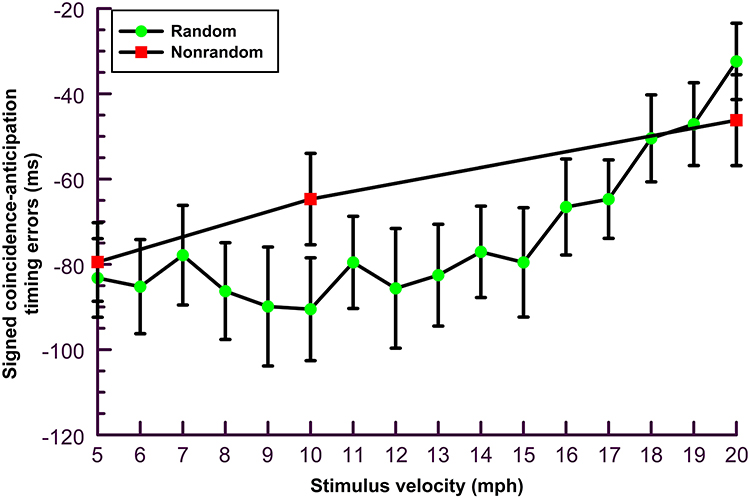 |
Figure 1 Means (and standard errors) of the signed coincidence-anticipation timing errors (milliseconds) for the random and nonrandom conditions for 20 subjects. |
Eye and Head Movements
In viewing the videos from the gaze tracker, head movements could be detected as movements of the entire visual scene, while eye movements in the orbit could be discerned as movements of the eye tracking cross-hair relative to the scene.
Both eye and head movements were placed in one of five categories for each trial. These categories are shown in Table 1 below.
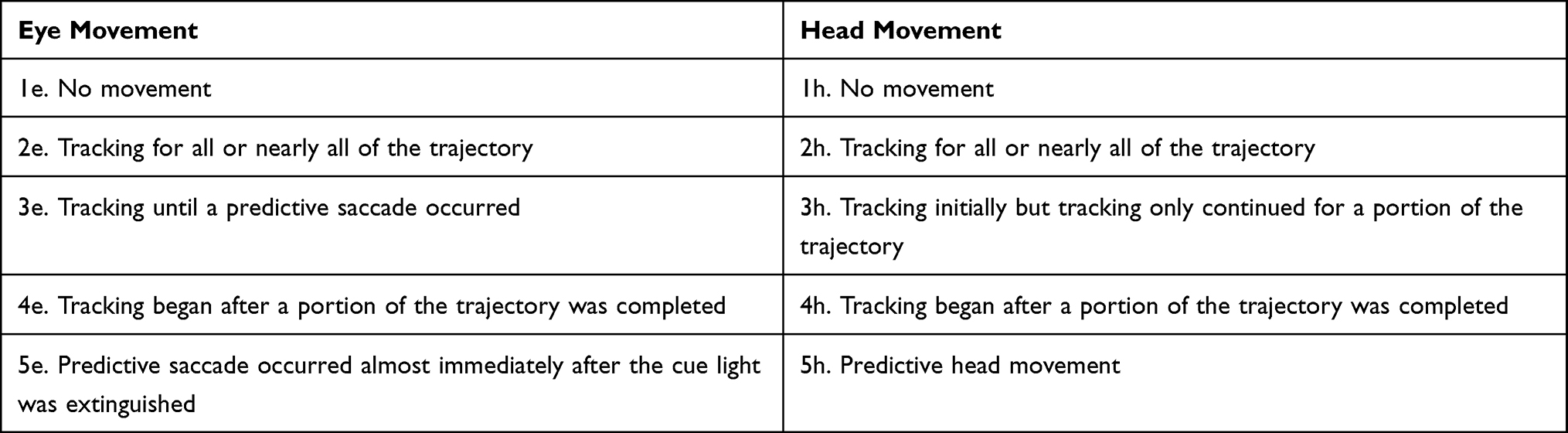 |
Table 1 Categories for Eye Movements and Head Movements |
There was one participant for whom no eye tracker data were obtained, and three other participants for whom the calibration was not adequate to assess the location of the eyes. Specifically, for these three latter participants the location of the eye at the beginning of the trials was grossly different from the location of the cue light (two participants), or the crosshair representing the gaze location could not be seen at the beginning of the trials (one participant). A fifth participant was not included in the analyses described below because the cross-hair was not visible late in the stimulus trajectory. Finally, a sixth participant was not included in the eye and head tracking analyses because this participant did not track the approaching lights with eye or head movements. Instead, this participant placed their gaze part-way between the proximal and distal ends of the Bassin Anticipation Timer track and then mostly maintained their gaze at this location throughout the trials.
For those 14 participants (8 female, 6 male) for whom gaze tracking was analyzed, trial numbers 1–10, 26–35, and 54–63 were included in the analysis for the nonrandom condition and trial numbers 1–10, 27–36, and 55–64 were included in the analysis for the random condition to cover the early, middle, and late eye and head tracking responses respectively. There was one subject for whom eye tracker data were not properly recorded for the first 9 trials in the random condition. For this subject, trials numbers 10–19, 27–36, and 55–64 were used in the analyses. There were some trials from two participants in which the eye tracking was not adequate for analysis; 9 in the nonrandom condition (7 from one participant and 2 from a second participant) and 18 in the random condition (12 from one participant and 6 from the second participant).
Eye and head movement behaviors were assessed for a total of 411 trials in the nonrandom condition and 402 trials in the random condition. In general, either gaze tracking of the stimulus, or a predictive gaze shift, or both gaze tracking and a predictive gaze shift occurred. In only 12 trials (6 in the nonrandom condition and 6 in the random condition) was there no tracking and no predictive gaze shift. The number of predictive saccadic eye movements, or combined predictive eye movements and predictive head eye movements, was determined for the nonrandom and random conditions (Table 1: Category 3e or 5e for eye movements and/or Category 5h for the head movements). Predictive gaze shifts were said to have occurred if there was a rapid gaze shift in the direction of the approaching lights. Generally, these shifts placed the gaze location at or near the end of the Bassin Anticipation Timer track. For a particular trial, only one predictive movement was counted even in cases where more than one predictive movement may have occurred. At lower stimulus velocities, predictive gaze shifts placed gaze ahead of the approaching lights such that the stimulus “arrived” after gaze had “landed”, but at higher stimulus velocities these gaze shifts may have resulted in the gaze landing at the same location and at the same time that the stimulus “arrived” at this location.
The number of predictive gaze shifts for the nonrandom and random conditions is summarized in Figure 2.
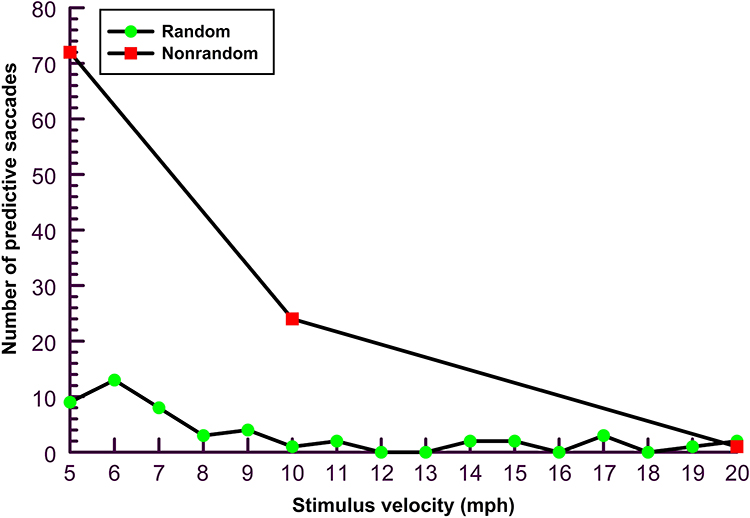 |
Figure 2 The number of predictive saccades at each stimulus velocity for the random and nonrandom conditions for 14 subjects. |
In the nonrandom condition, predictive gaze shifts occurred in 97 trials (23.6%). Seventy-two (74.2%) of these predictive gaze shifts occurred for the 5mph stimulus, 24 (24.7%) occurred for the 10mph stimulus, and 1 (1.03%) occurred for the 20mph stimulus. There were 7 instances (1.70%) where a predictive saccade occurred very early in the stimulus trajectory (category 5e). In the random condition, predictive gaze shifts occurred in 50 trials (12.4%). Of these latter trials, 38 (76.0%) occurred for stimulus speeds of 10mph or less. In this latter condition, there were 3 instances (0.75%) where a predictive saccade occurred very early in the stimulus trajectory (category 5e). In both conditions, in trials with no predictive movements, gaze tracking or attempted gaze tracking generally occurred for most of the trajectory.
The median value for the percentage of trials with predictive saccades (at any stimulus velocity) for the random condition was 5.42 and for the nonrandom condition was 28.34. A statistical comparison of these values just missed significance at the α = 0.05 level (p = 0.05, Wilcoxon signed-rank test).
The number of trials in which the head moved in the direction of the approaching lights throughout much of the trajectory (Table 1: Category 2h for head movements) was also assessed. This was done because there are a number of studies in which head movements in the direction of an approaching object have been found in interceptive tasks.13,19,20 Eye movements (including predictive eye movements) sometimes accompanied these head movements. Predictive head movements (Category 5h for head movements (Table 1) or partial head movements (Categories 3h and 4h for head movements (Table 1)) were not included in this analysis. The mean percentage of those head movements that were placed in Category 2h (mean of subject means) in the nonrandom condition was 60.8% ± 30.7%, and for the random condition this mean value was 66.3% ± 30.8% of trials. The median percentage values for the nonrandom and random conditions were not significantly different (p = 0.61, Wilcoxon signed-rank test).
Finally, the number of cases in which the head was relatively stable and the eyes were moved in the direction of the approaching lights throughout much of the trial was determined. (Table 1: Category 2e for eye movements with Category 1h for head movements). No predictive eye movements were made in this category. Eighty-one of the nonrandom trials (19.7%) met this latter criterion. Of these 81 trials, 57 of them were found for just three participants. For the random condition, 55 trials (13.4%) met this criterion. Of these 55 trials, 40 of them occurred for just two participants, and these two participants were two of the three participants that had numerous eye tracking trials (with a stable head) in the nonrandom condition.
Coincidence-Anticipation Timing Errors and Gaze Pattern
In a final analysis, constant (signed) coincidence-anticipation timing errors were calculated for three categories of eye and head tracking responses to determine whether an advantage in coincidence anticipation timing was conferred by a particular gaze pattern.21 The gaze tracking patterns analyzed included cases where head movements occurred throughout the trial and eye movements were mostly limited (primarily head movement trials), cases where eye movements occurred throughout the trial and head movements were limited (primarily eye movement trials), and cases where a predictive gaze shift occurred. Trials where a partial head or eye movement occurred were not included. The mean signed errors at each stimulus velocity for each of these categories of eye and head tracking responses was determined for those data from every trial. The results are shown in Figures 3 (nonrandom) and 4 (random). There were stimulus velocities (mentioned in the figure captions) for which a particular gaze tracking pattern did not occur or only occurred once.
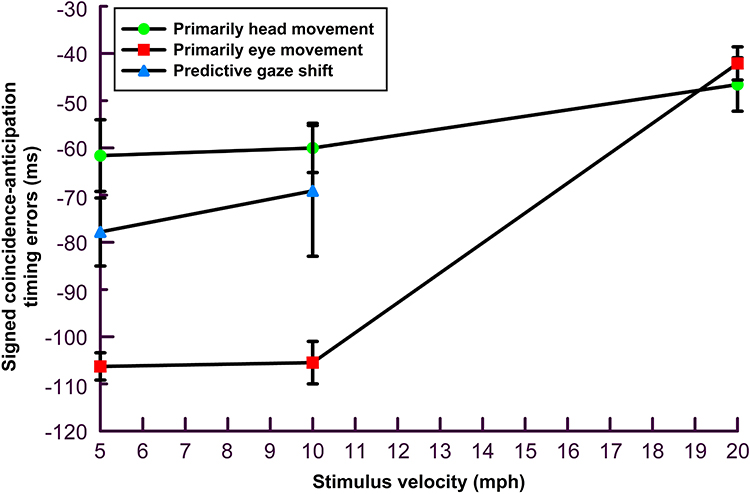 |
Figure 3 Means (and standard errors) of signed coincidence-anticipation timing errors in the nonrandom condition for different gaze tracking patterns. Fourteen subjects were included. Only one value was recorded for the predictive gaze shift pattern at 20mph so this value was not included on the graph. |
A formal statistical comparison of the response errors for the different gaze tracking patterns represented in Figures 3 and 4 was not performed as the number of responses for the various stimulus velocity/gaze tracking patterns was variable and, in some cases, very small. For the nonrandom condition, the number of responses for the different gaze tracking patterns ranged from 20 to 72 at 5mph, from 21 to 79 at 10mph, and from 1 to 76 at 20mph. In comparing the number of responses at 5, 10, and 20mph in the random condition, these values ranged from 3 to 10 at 5mph, from 1 to 16 at 10mph, and from 2 to 18 at 20mph.
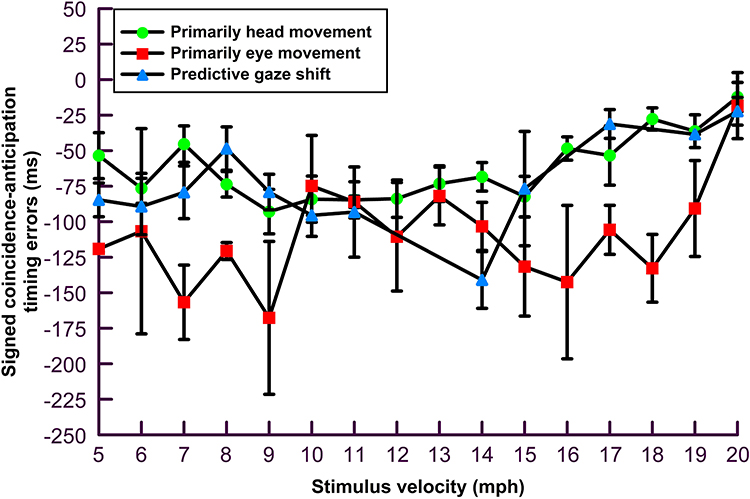 |
Figure 4 Means (and standard errors) of signed coincidence-anticipation timing errors in the random condition for different gaze tracking patterns. Fourteen subjects were included. For the predictive gaze shift pattern no values were recorded at 12mph, 13mph, 16mph, and 18mph and one value was recorded at 10mph and 19mph. |
Discussion
This study examined coincidence-anticipation timing responses and gaze tracking strategies under a specific group of experimental parameters. These included the inclusion of healthy subjects, use of a linear (rather than curvilinear) Bassin Anticipation Timer track, use of a simple push-button coincidence-anticipation timing response rather than a complex motor response, inclusion of a small number of subjects who utilized primarily an eye tracking strategy, and use of qualitative classification of the gaze tracking strategies. Some of these experimental conditions including the linear track and the push-button response are described in the 2006 American Optometric Association Sports Vision Screening Protocols included in Erickson’s book entitled “Sports Vision: Vision Care for the Enhancement of Sports Performance”, and are therefore likely to be commonly employed by practitioners.22 As described below, the results under these experimental conditions suggest that predictive gaze shifts are relatively uncommon and that continuous tracking is a common gaze strategy.
Coincidence-Anticipation Timing Responses
As shown in Figure 1, the relationship between the stimulus velocities and the signed coincidence-anticipation timing errors varied for the nonrandom and random conditions. The signed error versus stimulus velocity plot was linear for the nonrandom condition and nonlinear (quadratic) for the random condition. One explanation for these differences may be that in the random condition, participants were “primed” to respond earlier at the lower speeds because of the possibility that the stimulus speed could be high. In the nonrandom condition, the stimulus speed was known before each trial. This could explain why, in the random condition, participants responded earlier to the slower stimuli until the stimulus velocity was high enough that the time required for the push-button response approached the duration of the stimulus approach.
Eye and Head Movement Responses
Predictive eye or combined predictive eye and head movements were relatively uncommon in both the nonrandom and random conditions, although they occurred in a greater percentage of trials in the nonrandom condition (23.6%) compared to the random condition (12.4%) (Figure 2). These data suggest that at least in the case of the Bassin Anticipation timer, predictive movements are relatively uncommon even though the location of the interception point is known prior to each trial. These results are consistent with the results from a study of predictive motion (PM).21 In a predictive motion task, observers are shown a portion of an object’s trajectory and are then required to predict when that object will arrive at a particular location. It has been shown that in PM tasks, performance is better if the object is tracked along the entire trajectory compared to when fixation remains at the object’s arrival location. The results of PM studies might therefore predict that in coincidence-anticipation timing experiments using devices such as the Bassin Anticipation Timer, observers are more likely to at least attempt to track the approaching object continuously rather than making a predictive gaze shift to the (known) interception point. The continuous tracking strategy was found in the majority of trials in this study.
Predictive gaze shifts were more common at the lower stimulus velocities compared to the higher stimulus velocities and they were more common in the nonrandom condition. These results suggest that the easier it is to track the stimulus, the more likely it is that a predictive gaze shift will occur for the Bassin Anticipation Timer.
Cases where tracking occurred primarily with the head for most of the stimulus approach were also examined. In both the nonrandom and random conditions, these head movements occurred at a relatively high percentage in both the nonrandom (60.8%) and random (66.3%). The results of the present study are not sufficient to determine whether these head movements were beneficial for coincidence-anticipation timing responses.18–20
Of those participants who used less common eye and head movement strategies, eye movements were used almost exclusively, and one participant did not tend to move the head or the eyes.
Eye and Head Movement Responses and Coincidence-Anticipation Timing Errors
It was of interest to determine whether a particular pattern of eye and head movement responses resulted in better mean coincidence-anticipation timing responses. As shown in Figures 3 and 4, those individuals who moved the eyes rather than the head tended to respond earlier (at least at some stimulus velocities) compared to individuals who moved their heads throughout the trial or compared to individuals who made predictive gaze shifts. This result must be interpreted with caution, because there were very few individuals who primarily moved the eyes, and because there were stimulus velocities where there were very few or no trials where larger eye movements were accompanied by minimal head movements or where predictive gaze shifts occurred.
Summary
In the majority of trials in this study, participants maintained their gaze near the stimulus throughout much of its approach in both nonrandom and random conditions. While predictive gaze shifts did occur, they were relatively uncommon compared to cases where gaze tracking occurred throughout the stimulus trajectory. In addition, when predictive gaze shifts did occur, they rarely occurred very early in the stimulus trajectory. These results suggest that coincidence-anticipation timing devices such as the Bassin Anticipation Timer that have both a predictable trajectory and a predictable “interception” point do not typically induce predictive saccades with no periods of gaze tracking. While future studies are necessary to assess the potential impact of coincidence-anticipation training on performance in competitions, this study suggests that training with the Bassin Anticipation Timer will engage most individuals in gaze tracking behaviors similar to those known to occur in the field of play.13,19
Strengths and Limitations
The strength of this study is that it is the first to assess the likelihood of predictive saccades with a commercially available coincidence-anticipation timing device. The primary limitation in this study is that the eye and head movement responses were examined in a qualitative way. Quantifying these responses may allow for a more detailed comparison between subtle differences in head and eye movements and the accuracy of coincidence-anticipation timing responses. In addition, the participants’ task in this study was to push a button. While it is not unusual for coincidence-anticipation timing responses to be measured using push-button responses, different eye and head movement patterns may have occurred if a more complex visuomotor interceptive action such as reaching for, tapping on, or swinging a bat or racquet at the approaching lights was required.23–25 Finally, in future studies, a larger sample size may help to ensure that an adequate number of individuals who primarily move the eyes and not the head are examined to determine how this movement pattern affects the accuracy of coincidence-anticipation timing responses relative to other patterns of gaze movement.
Conclusions
Predictive gaze shifts were relatively uncommon when participants made coincidence-anticipation timing responses with the Bassin Anticipation Timer. Most participants moved their heads substantially in the direction of the approaching lights while the eyes were generally moved (in the orbits) to a lesser extent than the head. A small number of participants (3 in the nonrandom condition and 2 in the random condition) primarily moved the eyes in the direction of the approaching lights. Predictive gaze shifts were more common in the nonrandom condition, and more common at lower stimulus velocities. At least in the case of the Bassin Anticipation Timer, the results suggest that predictive gaze shifts are more likely to occur when the predictability of the stimulus velocity is higher and when the stimulus velocity is lower. Overall, participants tended to gaze at or near the approaching lights rather than at the interception point. These latter behaviors are qualitatively similar to those seen in studies in which gaze tracking responses have been assessed in sports-specific tasks.11–14,19,20
Data Sharing Statement
The data that support the findings of this study are available from the corresponding author, Nick Fogt, upon reasonable request.
Ethics Approval and Informed Consent
This study was reviewed and approved by the Ohio State University Biomedical Sciences Institutional Review Board (Protocol #2020H0115). All participants provided written informed consent in compliance with the Declaration of Helsinki.
Acknowledgments
The abstract of this paper, entitled “Predictive gaze shifts with coincidence-anticipation timing”, was presented at the 2025 Association for Research in Vision and Ophthalmology (ARVO) Conference as a poster with interim findings. This abstract of the paper was published in https://iovs.arvojournals.org/ (Investigative Ophthalmology and Visual Science June 2025, Vol. 66, 5345).
Funding
This study was supported by the Ohio State University College of Optometry. The study was also supported, in part, by The Ohio State University Clinical and Translational Science Institute (CTSI) and the National Center for Advancing Translational Sciences of the National Institutes of Health under Grant Number UM1TR004548. The content is solely the responsibility of the authors and does not necessarily represent the official views of the National Institutes of Health. In preparing this paper, Nick Fogt was supported in part by an appointment to the Department of Defense (DOD) Research Participation Program administered by the Oak Ridge Institute for Science and Education (ORISE) through an interagency agreement between the US Department of Energy (DOE) and the DOD. ORISE is managed by ORAU under DOE contract number DE-SC0014664. All opinions expressed in this paper are the author’s and do not necessarily reflect the policies and views of Department of the Navy, Department of Defense, or the US Government, or ORAU/ORISE.
Disclosure
The authors report no competing interests in this work.
References
1. Fogt N, Appelbaum LG, Dalton K, Erickson G, Gray R. Guest editorial: visual function and sports performance. Optom Vis Sci. 2021;98(7):669–12. doi:10.1097/OPX.0000000000001717
2. Fleury M, Bard C, Gagnon M, Teasdale N. Coincidence-anticipation timing: the perceptual-motor interface. In: Proteau L, Elliott D, editors. Advances in Psychology: Vision and Motor Control. Vol. 85. Amsterdam: North-Holland Elsevier Science Publishers B.V.; 1992:315–334.
3. Dunham P. Coincidence-anticipation performance of adolescent baseball players and nonplayers. Percept Mot Skills. 1989;68(3_suppl):1151–1156. doi:10.2466/pms.1989.68.3c.1151
4. Hodges NJ, Wyder-Hodge PA, Hetherington S, Baker J, Besler Z, Spering M. Topical review: perceptual-cognitive skills, methods, and skill-based comparisons in interceptive sports. Optom Vis Sci. 2021;98(7):681–695. doi:10.1097/OPX.0000000000001727
5. Tochikura I, Sato D, Imoto D, et al. Baseball players’ eye movements and higher coincident-timing task performance. Percept Mot Skills. 2020;127(3):571–586. doi:10.1177/0031512520905435
6. Haywood KM. Eye movements during coincidence-anticipation performance. Motor Behav. 1977;9(4):313–318. doi:10.1080/00222895.1977.10735123
7. Haywood KM. Eye movement pattern and accuracy during perceptual-motor performance in young and old adults. Experim Aging Res. 1982;8(3):153–157. doi:10.1080/03610738208260273
8. Lim J, Carlton LG. Effects of target motion characteristics on interceptive aiming performance and gaze control. Int J Sport Psychol. 2014;45(5):409–428. doi:10.7352/IJSP.2014.45.409
9. Lim J. Effects of spatial and temporal constraints on interceptive aiming task performance and gaze control. Percept Mot Skills. 2015;121(2):509–527. doi:10.2466/24.30.PMS.121c16x4
10. Appelbaum LG, Lochhead L, Feng J, Erickson G, Liu S, Laby DM. Limited evidence is not no Evidence: a rebuttal to Fransen, 2024. Sports Med. 2025;55(1):241–242. doi:10.1007/s40279-024-02141-x
11. Hayhoe MM, McKinney T, Chajka K, Pelz JB. Predictive eye movements in natural vision. Exp Brain Res. 2012;217(1):125–136. doi:10.1007/s00221-011-2979-2
12. Mann DL, Nakamoto H, Logt N, Sikkink L, Brenner E. Predictive eye movements when hitting a bouncing ball. J Vis. 2019;19(14):28. doi:10.1167/19.14.28
13. Toole AJ, Fogt N. Review: head and eye movements and gaze tracking in baseball batting. Optom Vis Sci. 2021;98(7):750–758. doi:10.1097/OPX.0000000000001721
14. Ono S, Yoshimura Y, Shinkai R, Kizuka T. Properties of gaze strategies based on eye–head coordination in a ball-catching task. Vision. 2024;8(2):20. doi:10.3390/vision8020020
15. de la Malla C, Rushton SK, Clark K, Smeets JBJ, Brenner E. The predictability of a target’s motion influences gaze, head, and hand movements when trying to intercept it. J Neurophysiol. 2019;121(6):2416–2427. doi:10.1152/jn.00917.2017
16. Crocetta TB, Guarnieri R, Antunes TPC, et al. Instruments for studying coincidence-anticipation timing task: an updated systematic review. J Phys Educ Sport Manag. 2018;5(1):37–52. doi:10.15640/jpesm.v5n1a5
17. Crocetta TB, Guarnieri R, Massetti T, et al. Concurrent validity and reliability of alternative computer game for the coincidence-anticipation timing task. Meas Phys Educ Exerc Sci. 2019;23(2):169–185. doi:10.1080/1091367X.2018.1560297
18. Ross E, Kinney M, Fogt N. Coincidence anticipation timing responses with head tracking and eye tracking. Aerosp Med Hum Perform. 2022;93(2):79–88. doi:10.3357/AMHP.5904.2022
19. Mann DL, Spratford W, Abernethy B, Zeil J. The head tracks and gaze predicts: how the world’s best batters hit a ball. PLoS One. 2013;8(3):e58289. doi:10.1371/journal.pone.0058289
20. Shinkai R, Ando S, Nonaka Y, Yoshimura Y, Kizuka T, Ono S. Importance of head movements in gaze tracking during table tennis forehand stroke. Hum Mov Sci. 2023;90:103124. doi:10.1016/j.humov.2023.103124
21. Bennett SJ, Baures R, Hecht H, Benguigui N. Eye movements influence estimation of time-to-contact in prediction motion. Exp Brain Res. 2010;206(4):399–407. doi:10.1007/s00221-010-2416-y
22. Erickson GB. Sports Vision: Vision Care for the Enhancement of Sports Performance.
23. Ranganathan R, Carlton LG. Perception-action coupling and anticipatory performance in baseball batting. Motor Behav. 2007;39(5):369–380. doi:10.3200/JMBR.39.5.369-380
24. Mann DL, Abernethy B, Farrow D. Visual information underpinning skilled anticipation: the effect of blur on a coupled and uncoupled in situ anticipatory response. Atten Percept Psychophys. 2010;72(5):1317–1326. doi:10.3758/APP.72.5.1317
25. Mann DL, Abernethy B, Farrow D. Action specificity increases anticipatory performance and the expert advantage in natural interceptive tasks. Acta Psychol. 2010;135(1):17–23. doi:10.1016/j.actpsy.2010.04.006
 © 2026 The Author(s). This work is published and licensed by Dove Medical Press Limited. The
full terms of this license are available at https://www.dovepress.com/terms
and incorporate the Creative Commons Attribution
- Non Commercial (unported, 4.0) License.
By accessing the work you hereby accept the Terms. Non-commercial uses of the work are permitted
without any further permission from Dove Medical Press Limited, provided the work is properly
attributed. For permission for commercial use of this work, please see paragraphs 4.2 and 5 of our Terms.
© 2026 The Author(s). This work is published and licensed by Dove Medical Press Limited. The
full terms of this license are available at https://www.dovepress.com/terms
and incorporate the Creative Commons Attribution
- Non Commercial (unported, 4.0) License.
By accessing the work you hereby accept the Terms. Non-commercial uses of the work are permitted
without any further permission from Dove Medical Press Limited, provided the work is properly
attributed. For permission for commercial use of this work, please see paragraphs 4.2 and 5 of our Terms.