
Back to Journals » International Journal of Nanomedicine » Volume 21
Preclinical Advances in Functionalized Nanozymes for Periodontitis: From Antibacterial Action to Tissue Regeneration
Authors Chen X  , Huang L, Lin W , Liu M, Jiang Y , Xiao Y
Received 1 April 2026
Accepted for publication 9 June 2026
Published 26 June 2026 Volume 2026:21 613092
DOI https://doi.org/10.2147/IJN.S613092
Checked for plagiarism Yes
Review by Single anonymous peer review
Peer reviewer comments 2
Editor who approved publication: Professor Eng San Thian
Xiaobo Chen,1,* Liping Huang,1,* Wei Lin,2 Ming Liu,1 Yang Jiang,1 Yin Xiao3
1Xiamen Key Laboratory of Stomatological Disease Diagnosis and Treatment, Stomatological Hospital of Xiamen Medical College, Xiamen, Fujian Province, People’s Republic of China; 2Department of Stomatology and Engineering Research Center of Stomatological Biomaterials, Xiamen Medical College, Xiamen, Fujian Province, People’s Republic of China; 3School of Medicine and Dentistry, Griffith University, Gold Coast Campus, Gold Coast, QLD, 4222, Australia
*These authors contributed equally to this work
Correspondence: Yin Xiao, School of Medicine and Dentistry, Griffith University, Gold Coast Campus, Gold Coast, QLD, 4222, Australia, Tel +61 (0)7 5678 0153, Email [email protected]
Background: Periodontitis is a chronic infectious disease caused by bacteria, which leads to destruction of periodontal tissues, tooth loss, and systemic complications. Conventional treatments often fail to counteract the suppression of periodontal tissue regeneration caused by the persistent inflammatory microenvironment.
Scope: This review focuses on the application of functionalized nanozymes in the treatment of periodontitis, covering the classification of nanozymes, their mechanisms of action, and recent advances in nanozyme-based therapeutic strategies.
Key Findings: Functionalized nanozymes, with their multiple bioactivities including antibacterial, antioxidant, and osteogenic stimulation, represent a promising complement to existing therapeutic approaches. Their sophisticated designs enhance biofilm eradication, modulate immune responses, and facilitate tissue regeneration, thereby overcoming key limitations of existing periodontal treatments.
Conclusion: Functionalized nanozymes, particularly motor-based composite nanozymes, show great promise for periodontitis treatment due to their self-propulsion and multifunctional design (antibacterial, antioxidant, osteogenic). However, long-term biosafety, especially metal-ion accumulation, remains the key bottleneck for clinical translation. With continued optimization and standardized safety evaluation, these nanozyme platforms may open a new precision therapy avenue for drug-resistant refractory periodontitis.
Keywords: periodontal therapy, nanozymes, antibacterial, reactive oxygen species, immune modulation, regeneration
Introduction
Periodontitis is a chronic inflammatory disease caused by bacterial infection. Fundamentally, the pathology involves a dysregulated host immune response to pathogens like Porphyromonas gingivalis. This excessive inflammation releases a flood of reactive oxygen species (ROS), matrix metalloproteinases (MMPs), and pro-inflammatory cytokines, ultimately leading to the degradation of periodontal ligament collagen, resorption of alveolar bone, tooth loss, and compromised systemic health.1,2 According to the GBD 2021 data, periodontitis affected approximately 62% of dentate adults (severe periodontitis: 23.6%), with over 1 billion people worldwide suffering from severe periodontitis (1.067 billion; 95% UI: 0.897–1.235), representing an age-standardized prevalence of 12.50% (95% UI: 10.53–14.49).3,4 Although mechanical debridement combined with antibiotic therapy is the current standard of care, its efficacy is often compromised by the complex periodontal tissue architecture, resilient biofilms, and the escalating challenge of antibiotic resistance.5–7 Critically, conventional therapies often fail to reverse inflammation-induced tissue damage or promote functional regeneration. Importantly, the control of inflammation and the regulation of the immune microenvironment are crucial for the subsequent bone healing process.8,9 Therefore, developing novel precision therapies that can simultaneously eradicate pathogens and restore periodontal tissue homeostasis has become a critical priority. Nanomaterials, characterized by their distinctive properties such as a high surface-area-to-volume ratio, customizable chemistry, and responsiveness to stimuli, effectively address these challenges.10 Among various nanomaterials, nanozymes are advanced nanomaterials with multiple natural enzyme-mimicking catalytic activities, which offer a potentially promising new approach to tackling this problem.11,12 Their distinct advantage lies in a dual-action mechanism that addresses both pathogenic elimination and tissue restoration. On one hand, by mimicking peroxidase (POD) or oxidase activities, nanozymes can catalyze the generation of ROS to efficiently eradicate pathogens within deep biofilms.13 On the other hand, their superoxide dismutase (SOD)- and catalase (CAT)-like activities enable them to precisely scavenge excessive pathological ROS in the tissue, thereby breaking the vicious cycle of oxidative stress, mitigating inflammation, and creating a favorable immune microenvironment for tissue self-repair.14 Based on current preclinical evidence from in vitro experiments and rodent models, this dual functionality shows notable potential to address the long-standing issue of simultaneously achieving bactericidal effect and anti-inflammatory regeneration in periodontitis treatment.
Rapid advancements in materials science have rendered nanozymes increasingly powerful and controllable in their functionality. For instance, integrating self-propulsive capabilities into nanozymes to form nanomotors enables effective biofilm penetration and enhances antibacterial activity.15,16 Despite this progress, existing reviews—including those by Hosseini Hooshiar et al5 and Liu et al17—have primarily focused on the general antibacterial effects of nanozymes across various oral infectious diseases. A comprehensive review systematically covering the application of functionalized nanozymes specifically for periodontitis remains lacking. In particular, no previous review has systematically summarized advanced functionalized designs such as self-propelled nanomotors and gas-generating systems, nor has any integrated the triple bioactivities of antibacterial, antioxidant, and osteogenic properties into a holistic framework for periodontitis. In light of this, the present review aims to summarize recent advances in functionalized nanozymes as therapeutic agents for periodontal disease, evaluate their potential for clinical translation, dissect current challenges, and outline future research directions.
A structured literature search was conducted for this narrative review to identify and synthesize studies on functionalized nanozymes for periodontitis treatment. PubMed, Web of Science, Scopus, and Google Scholar were searched to ensure broad coverage and minimize omission of relevant reports. The search included all literature published up to 31 May 2026, with iteratively refined terms such as “nanozymes”, “periodontitis”, “artificial enzymes”, “antibacterial”, “immune modulation”, “bone regeneration”, “nanomotors”, and “periodontal therapy”. In line with the nature of a narrative review, studies were selected based on their relevance and contribution to the thematic synthesis rather than on formal quantitative inclusion criteria; only peer-reviewed articles published in English were considered.
Potential Mechanisms in Periodontal Treatment and Classification of Nanozymes
Nanozymes are synthetic nanomaterials that emulate the catalytic functions of natural enzymes. Functionally, they do not act as static catalysts but rather switch between opposing redox roles in a microenvironment-dependent manner: under inflammatory conditions characterized by acidity and elevated H2O2, they function as pro-oxidant antimicrobial agents, whereas in contexts of excessive oxidative stress or during the resolution phase, they act as antioxidant anti-inflammatory mediators to restore immune homeostasis in periodontal treatment.18
- Antimicrobial (Pro-oxidant) Mechanism: In the weakly acidic (pH ≈ 5.5–6.5) and H2O2-rich milieu of active periodontal inflammation, nanozymes typically mimic peroxidase (POD)-like activity. They catalyze Fenton- or Fenton-like reactions to convert endogenous H2O2 into highly cytotoxic hydroxyl radicals (˙OH).19,20 This burst of ROS directly disrupts microbial membrane integrity, oxidizes proteins and DNA, and ultimately eradicates pathogens. Concurrently, metal ions such as Cu2⁺ and Zn2⁺ released from the nanozyme scaffold exert synergistic antibacterial effects.21
- Anti-inflammatory (Antioxidant) Mechanism: As inflammation progresses or in microenvironments with neutral pH and accumulated superoxide (˙O2−), nanozymes shift toward antioxidant behavior. They mimic a cascade of endogenous antioxidant enzymes: superoxide dismutase (SOD)-like activity converts ˙O2− into H2O2 and O2; catalase (CAT)-like activity further decomposes H2O2 into harmless H2O and O2; and glutathione peroxidase (GPx)-like activity reduces cytotoxic lipid peroxides.22 This coordinated scavenging re-establishes redox balance, dampens chronic inflammation, and supports tissue repair.
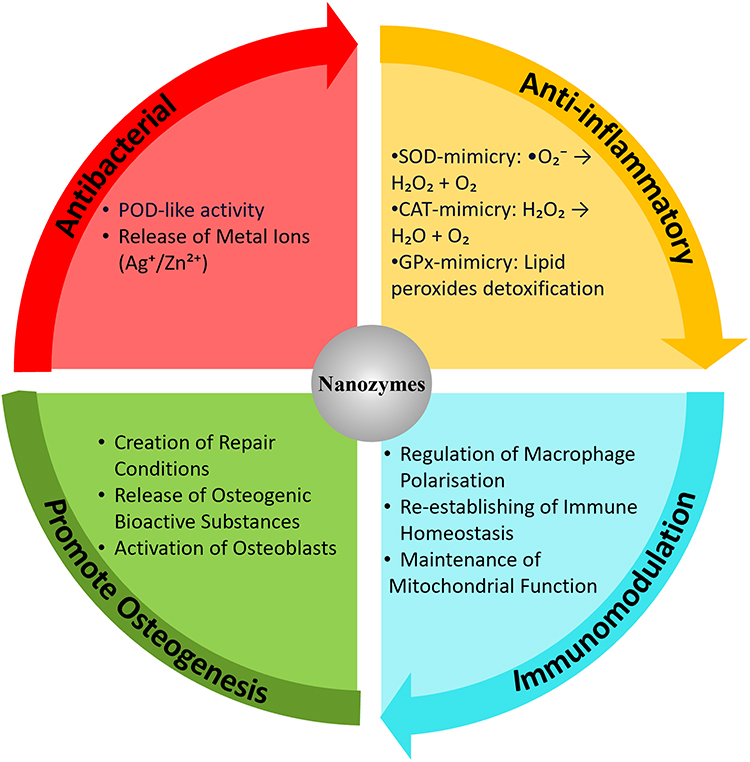 |
Figure 1 Schematic illustration of the cascade therapeutic mechanism of functionalized nanozymes in periodontitis treatment. |
In summary, as illustrated in Figure 1, nanozymes orchestrate a sequential and synergistic therapeutic cascade against periodontitis through four interconnected stages: (1) Antibacterial action: Nanozymes first target and eliminate periodontal pathogens by catalyzing the generation of cytotoxic reactive oxygen species (ROS), such as hydroxyl radicals via peroxidase-like activity and/or releasing antimicrobial metal ions (eg., Ag⁺, Zn2⁺), thereby disrupting biofilm integrity and halting ongoing microbial stimulation. (2) ROS scavenging: Once pathogen burden is reduced, nanozymes can switch to an antioxidant mode, mimicking the enzymatic cascade of superoxide dismutase (SOD), catalase (CAT), and glutathione peroxidase (GPx) to neutralize excess ROS, restore redox homeostasis, and alleviate oxidative stress in the inflamed tissue. (3) Immune modulation: By mitigating oxidative damage and preserving mitochondrial function, nanozymes promote the polarization of macrophages from the pro-inflammatory M1 phenotype toward the anti-inflammatory, pro-repair M2 phenotype, thus reprogramming the local immune microenvironment toward resolution and homeostasis. (4) Tissue regeneration: Finally, the sustained release of osteogenic ions, particularly Cu2⁺, along with other bioactive cues directly stimulates osteoblast differentiation and activity, fostering alveolar bone formation and enabling functional regeneration of the periodontal complex.
Based on their constituent materials, nanozymes are divided into four main categories: metal-based nanozymes (MNPs), carbon-based nanozymes (CNMs), metal-organic framework-based nanozymes (MNOFs), and composite nanozymes. Each category offers a distinct set of advantages and challenges (Table 1).
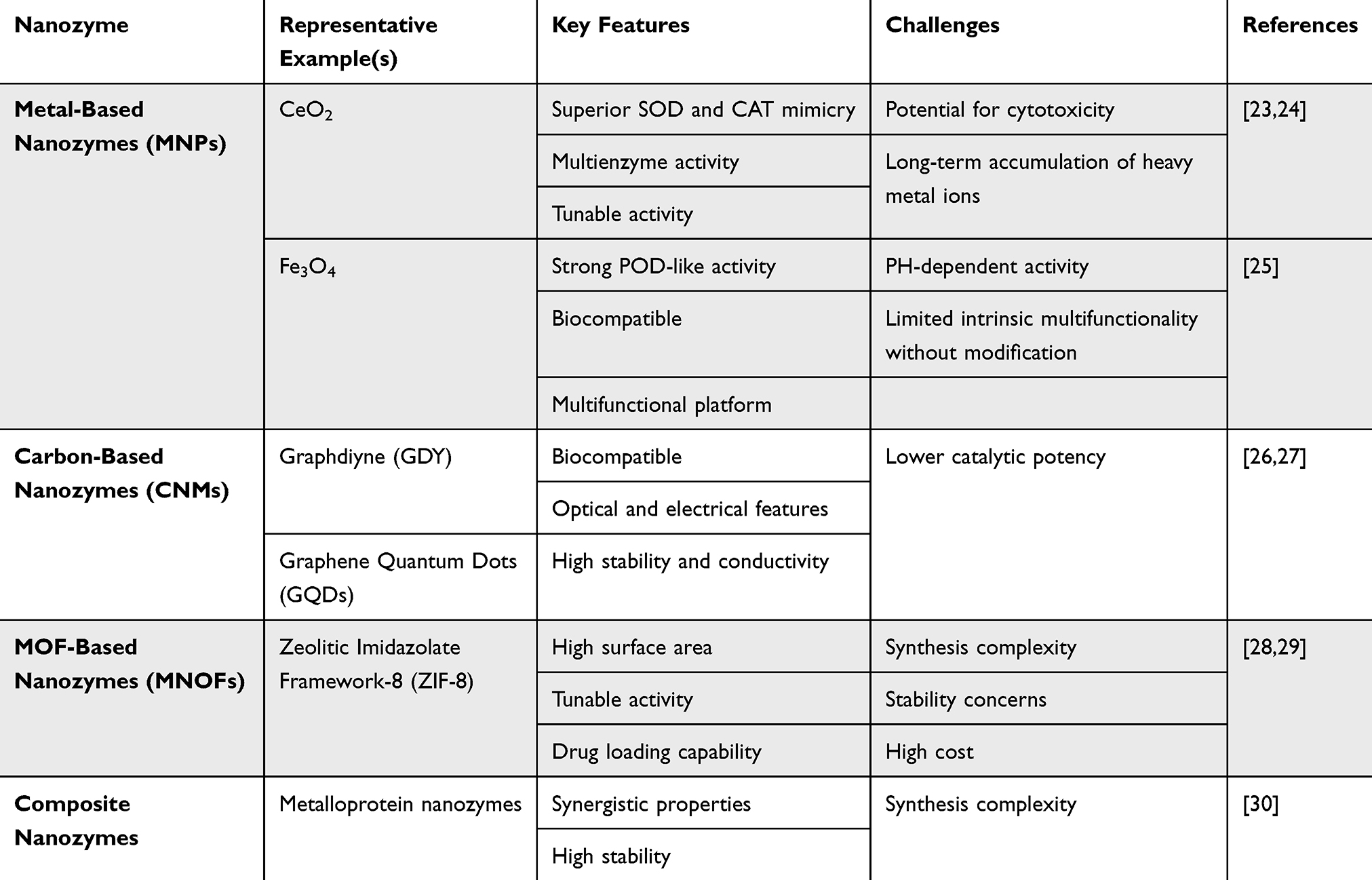 |
Table 1 Classification of Nanozymes Based on Material Composition |
Metal-Based Nanozymes (MNPs)
Metal-based nanozymes (MNPs), primarily composed of transition metals and their oxides, represent the most established and extensively investigated class of nanozymes. Their catalytic activity originates from the intrinsic redox properties of the constituent metals and the unique electronic and crystalline structures of their nanoparticle surfaces.22 Key advantages of MNPs include their high stability, tunable catalytic activity, low production costs, and amenability to large-scale fabrication. These features are largely attributed to their stable crystal lattices and the adjustable valence states of the metal ions, which facilitate efficient electron transport during redox reactions.
A prominent example is cerium dioxide (CeO2), which effectively scavenges ROS such as ˙O2− and H2O2 through a dynamic Ce3⁺/Ce4⁺ redox cycle.23 CeO2 nanozymes exhibit both superoxide dismutase and catalase-like activities, enabling the scavenging of diverse reactive oxygen species (ROS). A representative illustration of their tunable catalytic activity can be observed in the construction of core–shell structures such as CeO2@ZIF-8. Through such architectures, researchers can precisely modulate the surface Ce3⁺/Ce4⁺ ratio, thereby significantly enhancing the ROS elimination capacity.24 Despite their therapeutic potential, a significant barrier to clinical translation remains concerns about cytotoxicity and long-term bioaccumulation, leading to heavy metal deposition.
Similarly, other metal oxides like Fe3O4 mainly simulate POD, which catalyzes the production of ·OH from H2O2 in an acidic environment to kill bacteria. The biocompatibility of Fe3O4 nanoparticles is relatively good. The drawback is that the activities of POD-like mimetic enzymes are highly dependent on local H2O2 concentration and pH. In the deep part of the periodontal pocket, the concentration of H2O2 may be insufficient, resulting in its “deactivation”.25
Carbon-Based Nanozymes (CNMs)
Carbon-based nanozymes (CNMs) are a class of nanomaterials composed predominantly of carbon elements. This category includes diverse structures such as carbon nanotubes, graphene oxide (GO), fullerenes, graphdiyne (GDY), graphene quantum dots (GQDs), and carbon quantum dots (CQDs). CNMs are distinguished by several key properties: a large specific surface area, excellent biocompatibility, and superior electron transport capabilities.
The catalytic activity and selectivity of these materials can be precisely engineered by tailoring their surface chemistry and structural features. Furthermore, many CNMs exhibit remarkable optical and electrical properties, making them ideal for the development of multifunctional theragnostic platforms. For example, Graphdiyne (GDY), with its unique sp–sp2 hybridized carbon network, exhibits high photothermal conversion efficiency in the near-infrared region. It has adjustable catalytic activity. Its highly conjugated structure and electronic properties are conducive to catalytic reactions, and it can also serve as an excellent carrier to enhance the performance of the composite nanozyme. Its electron-rich surface can be loaded with metals like iron (Fe) to create peroxidase-like active sites, which catalyze the conversion of H2O2 into cytotoxic ˙OH radicals.26
Graphene Quantum Dots (GQDs) effectively quench various radicals through efficient electron transfer. Their antioxidant capacity is directly related to the density of surface functional groups, such as carboxyls. GQDs also exhibit strong, tunable fluorescence, making them highly suitable for integrated imaging and therapeutic applications.27
Given that carbon is a naturally abundant element, CNMs represent a more cost-effective and environmentally sustainable alternative to metal-based nanozymes for nanozyme synthesis.31 It has good biocompatibility, but its catalytic activity and the diversity of enzyme-mimicking types are usually inferior to those of MNPs.
Metal-Organic Frameworks-Based Nanozymes (MNOFs)
Metal–organic frameworks (MOFs) serve as the foundation for MNOFs, a class of synthetic nanozymes. Their catalytically active metal nodes directly participate in electron transfer and can be functionalized by selecting various metals, ligands, or incorporating functional groups like amino and carboxyl moieties.32
MNOFs offer significant advantages, including abundant functional sites, tunable pore architectures, and a high surface area. These features allow for the accommodation and exposure of additional active sites, thereby improving substrate selectivity and catalytic efficiency. The structural diversity of MOFs provides a versatile platform for designing nanozymes with a wide range of enzyme-mimetic activities. Furthermore, MOFs support controlled release and efficient drug loading, enabling the development of multifunctional therapeutic platforms.
For instance, the introduction of copper ions into Zeolitic Imidazolate Framework-8 (ZIF-8) creates a bimetallic nanozyme with significantly enhanced peroxidase-like activity. This nanozyme mimics POD activity to generate ROS, which, in synergy with the released Cu2⁺ and Zn2⁺ ions, produces potent antibacterial effects.28 Similarly, introducing cobalt ions into the ZIF-8 framework to construct a zinc-cobalt bimetallic organic framework (Zn/Co-MOF) not only reduces metal ion leakage but also enhances multi-enzyme-like antioxidant activity, effectively scavenging reactive oxygen species and promoting osteogenic differentiation via activation of the Wnt pathway.29
Another paradigm for enhancing MOF-based nanozyme activity lies in engineering both the physical structure and surface chemistry. The creation of a hierarchical pore system—where macropores enable rapid molecular diffusion and meso-/micropores host abundant active sites—directly addresses mass-transfer limitations and increases catalytic efficiency. Parallel to this, -NH2 functionalization of the MOF surface (eg., yielding HMUiO-66-NH2) enhances its interfacial properties, improving biocompatibility and circulatory stability. Functionally, this advanced nanozyme not only scavenges ROS to mitigate oxidative stress but also contributes to bone repair by reprogramming the immune microenvironment, for instance, through polarizing macrophages toward a pro-regenerative phenotype, thereby creating a favorable milieu for tissue regeneration.33
Some MOF-based nanozymes have poor chemical stability in water, acids, bases or physiological environments, which may lead to structural collapse and loss of activity. The intrinsic catalytic activity of many MOF-based nanozymes is still lower than that of natural enzymes or noble MNPs, and complex structural design is required to enhance it. The complex structure makes large-scale preparation difficult: it is costly, has poor repeatability, and it is difficult to ensure consistency between batches.
Composite Nanozymes
Composite nanozymes are defined as nanozymes composed of two or more distinct nanomaterials or functional components. By integrating the advantageous properties of different materials, these nanozymes exhibit enhanced stability, biocompatibility, and adaptability within complex biological environments.
A notable example is polyphenol-metal nanozymes, which offer unique benefits. The strong metal-chelating capacity of polyphenols effectively anchors and stabilizes metal ions, overcoming common issues of aggregation and deactivation. Additionally, polyphenols provide excellent biocompatibility, antioxidant, and antibacterial properties, which synergize with the intrinsic enzyme-mimetic catalysis of the metal ions.
For instance, researchers have synthesized copper-based nanozymes (CuNCs) by coordinating copper ions with salvianolic acid B (SalB), a polyphenol compound with established antioxidant and pro-angiogenic activities.34 The unique copper–phenolic hydroxyl coordination structure in SalB-CuNCs facilitates the valence transition of copper, enhancing its cascade-like enzyme-mimetic catalytic activity and conferring potent oxidative stress alleviation. Concurrently, SalB’s inherent bioactivity imparts significant pro-angiogenic effects to the composite nanozyme.
To further optimize nanozyme biocompatibility, some researchers have combined metal catalytic centers with protein scaffolds, which markedly reduces cytotoxicity while retaining antioxidant activity. Over the past decade, a variety of metalloprotein nanozymes have been synthesized using diverse metals and proteins, such as MoS2@Au-HSA, Au/Ru-FTn, Cu-BSA, Hemin@BSA-ZIF8, and Mn-BSA. In the design by Ou et al, a polyphenol-coordinated bimetallic nanozyme was constructed using bismuth (Bi), copper (Cu), and tannic acid (TA). The introduction of Bi played a critical role in modulating the electronic structure of the nanozyme, thereby significantly enhancing its reactive oxygen species (ROS) scavenging capacity. Furthermore, the complex was integrated with bovine serum albumin (BSA), which improved the structural stability and biocompatibility of the resulting artificial metalloprotease. Both in vitro and in vivo experiments demonstrated that the final product, CuBi-TA@BSA, exhibits remarkable biocompatibility along with excellent pro-angiogenic, anti-inflammatory, and antioxidant properties. However, the scalable production of such nanozymes remains a significant challenge.30
Advances in Functionalized Nanozymes for Periodontal Therapy
The complex clinical course of periodontitis necessitates a multi-faceted therapeutic approach. Conventional single-functional nanozymes often fail to achieve the simultaneous objectives of pathogen eradication, oxidative stress modulation, and tissue regeneration. To overcome these limitations, researchers have developed advanced multi-component systems that synergize to create integrated antibacterial, antioxidant, and osteogenic platforms. This has led to the development of several classes of functionalized nanozymes, enabling significant improvements in the spatiotemporal precision and controllability of treatment (Table 2).
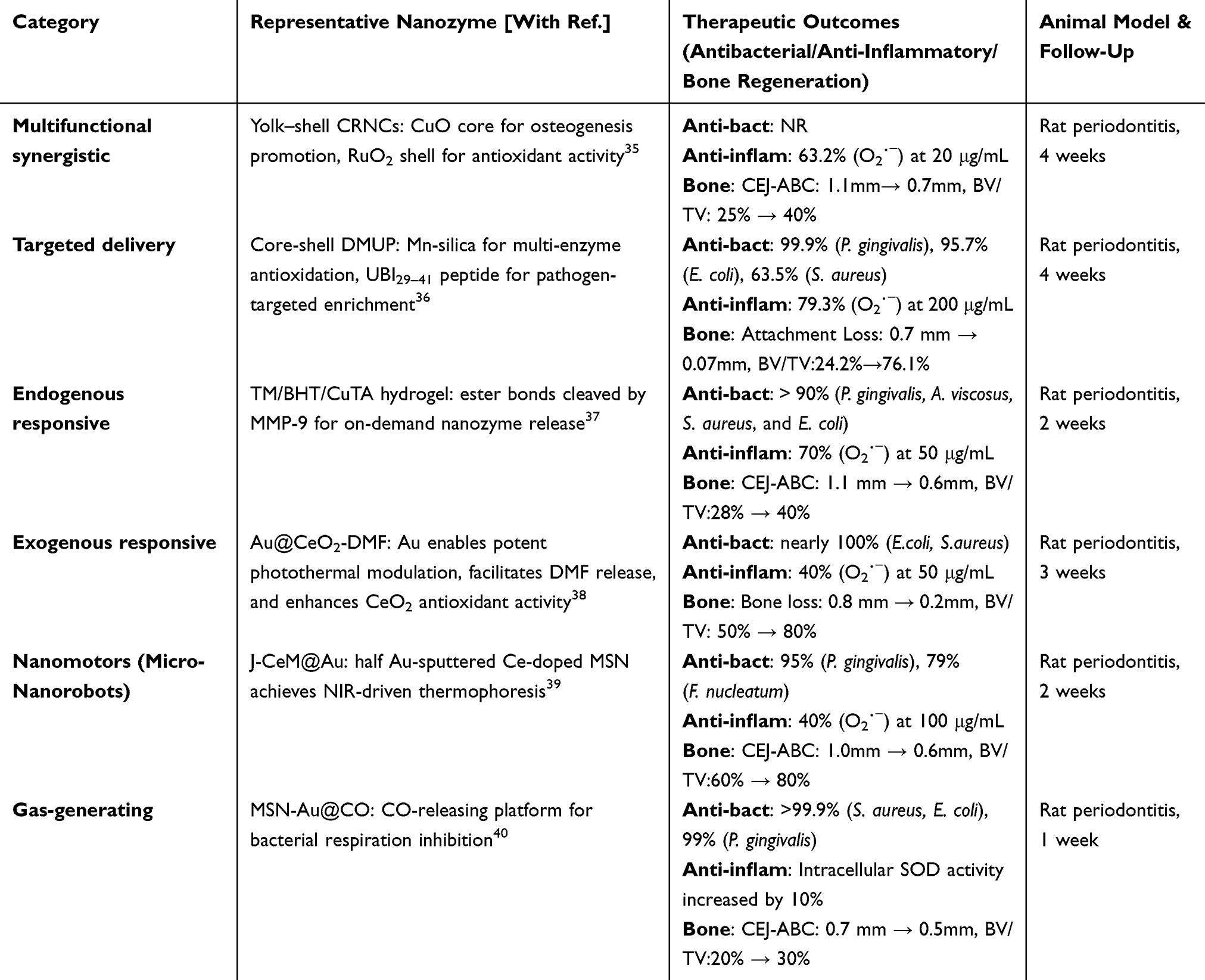 |
Table 2 Advances in Functionalized Nanozymes for Periodontal Therapy |
Multifunctional Synergistic Therapeutic Nanozymes
Through modular design, these nanozymes integrate two or more therapeutic modules onto a single platform to concurrently address the multiple pathological processes of periodontitis.41,42 For example, copper-based nanozymes (CuNZs) exert antibacterial effects by releasing Cu2⁺ ions, further compromising the integrity of bacterial cell walls and membranes. In addition, CuNZs can catalyze Fenton-like reactions, converting H2O2 into ·OH, which induce irreversible lipid peroxidation and consequent damage to bacterial membranes. Beyond their antibacterial properties, CuNZs contribute to immunomodulation by maintaining a balanced M1/M2 macrophage ratio and downregulating the expression of pro-inflammatory cytokines (IL-1β, IL-6, and TNF-α), thereby mitigating inflammation and facilitating tissue regeneration.43–45 Meng et al46 constructed a copper-doped Prussian blue nanozyme (CuPB) by incorporating Cu2⁺ ions into the Prussian blue framework. This engineered nanozyme not only effectively scavenges multiple ROS and suppresses inflammatory responses, but also promotes osteogenic differentiation of bone marrow mesenchymal stem cells (BMSCs) through activation of the PI3K-Akt signaling pathway. In a rat model of diabetes-associated periodontitis, local administration of CuPB nanozyme downregulated the expression of pro-inflammatory cytokines such as TNF-α and significantly reduced alveolar bone loss.
Li et al35 constructed yolk-shell structured copper-ruthenium nanocapsules (CRNCs) using CuO as the core by modifying its surface with a RuO2 layer. This core-shell configuration allows the RuO2 shell to physically protect the CuO core, thereby enhancing the nanozyme’s overall stability and biocompatibility. Within the acidic, ROS-rich microenvironment, the encapsulated CuO core serves as a responsive reservoir for Cu2⁺ release, thereby stimulating osteogenesis and angiogenesis. Simultaneously, the RuO2 shell functions as an antioxidant nanozyme, reducing inflammation, modulating macrophage polarization, and scavenging ROS. Thus, CRNC nanozymes effectively integrate antioxidant activity, angiogenesis enhancement, and osteogenesis stimulation to address inflammation, vascular dysfunction, and bone tissue damage in periodontitis concurrently. Despite these encouraging results, the ion leakage toxicity of conventional metal-based nanozymes still limits their clinical translation. Studies have shown that doping with multiple metal elements can effectively reduce ion leakage. For example, Zhang et al47 fabricated a manganese ferrite nanozyme hydrogel (MFZ@PG) by introducing manganese ions into an iron-based nanozyme system. The incorporation of manganese effectively enhanced structural stability and reduced metal ion release, significantly improving biosafety; cell viability remained at 99.5% even at 200 mg/L, with a hemolysis rate below 5%. Meanwhile, manganese doping enhanced multienzyme-like activity, enabling 82.5% scavenging of superoxide anions and efficient elimination of H2O2. Moreover, MFZ@PG promoted osteogenic differentiation via the ZBP1/β-catenin signaling pathway, increasing ALP activity to 92.7% and matrix mineralization to 89.7% compared with the oxidative stress group. In a rat periodontitis model, local administration of MFZ@PG significantly reduced alveolar bone resorption, decreasing the CEJ-ABC distance from 894.4 μm to 487.5 μm and increasing bone volume fraction (BV/TV) from 38.5% to 66.8%.
Targeted Delivery of Nanozymes
Targeted design is a critical strategy for enhancing local therapeutic efficacy and minimizing systemic toxicity by ensuring specific accumulation at the disease site. Current research focuses on two primary targeting approaches.
Immune Cell Targeting
This strategy functionalizes nanozymes to specifically recognize macrophage membrane receptors, enabling ligand-receptor-mediated internalization.48 This allows for precise modulation of macrophage polarization (M1/M2) to remodel the immune microenvironment. Han et al49 designed cerium dioxide nanoparticles functionalized with a targeting A2 DNA aptamer. This aptamer confers selective targeting toward macrophages, promoting efficient cellular internalization of the nanoparticles and enhancing their anti-inflammatory and immunomodulatory functions. Cai et al50 utilized bacterial outer membrane vesicles (OMVs), which can recognize the highly expressed CD64 and CD14 receptors on the surface of M1 macrophages, to modify gold nanocages (AuNCs), preparing hybrid nanoparticles (AuNC-OM) that can selectively target M1 macrophages. AuNC-OM can selectively target M1 macrophages without affecting the phagocytosis of M2 macrophages. Animal studies have demonstrated that this material can protect against lipopolysaccharide (LPS)-induced bone resorption in a mouse model.
Pathogen-Specific Recognition
This approach incorporates pathogen-associated molecular pattern (PAMP) recognition elements to achieve enhanced retention within the biofilm microenvironment. For instance, the bacteria-targeting peptide Ubiquitin 29–41 (UBI29-41) has been conjugated to manganese-based nanozymes, facilitating precise localization to bacterial membranes.36 Another strategy leverages outer membrane vesicles (OMVs) derived from Fusobacterium nucleatum, a keystone bridging organism in periodontal biofilms, to functionalize ternary chalcogenide AgBiS2 nanoparticles.51 These OMVs retain native bacterial adhesins on their surface, including RadD, AidA, and CmpA (which bind to early colonizers like Streptococcus gordonii) as well as RadD, Fap2, and FomA (which recognize late colonizers such as Porphyromonas gingivalis). By mimicking the natural co-aggregation behavior of F. nucleatum, the OMV-coated nanoparticles selectively anchor to diverse periodontal pathogens through these specific ligand–receptor interactions, thereby achieving precise targeting within polymicrobial biofilms. Simultaneously, the OMV cloak provides biomimetic camouflage, enabling the nanoparticles to evade immune surveillance and passively migrate alongside dispersing bacteria. This dynamic mobility allows the therapeutic agents to track pathogen spread to newly colonized niches, effectively intercepting biofilm expansion at its source. Both in vitro and in vivo studies have validated the exceptional biofilm-eradicating and periodontitis-treating efficacy of this biomimetic platform.
Despite the promise of targeted nanozyme systems, several key challenges remain. Non-specific protein adsorption in saliva and gingival crevicular fluid forms a protein corona that masks targeting ligands, reducing binding specificity and efficiency.52 Moreover, most targeting strategies, though effective in cell models, suffer from rapid immune clearance in vivo, leading to lower targeting efficiency and retention than observed in vitro. To address these limitations, biomimetic membrane-coating strategies have been developed. For instance, Li et al53 constructed a periodontal ligament stem cell membrane-camouflaged MnO2 nanozyme (MnO2@hPM). The membrane coating, enriched with PDLSC-affinity biomolecules and hypoxia-educated functional proteins, enables active targeting of inflamed PDLSCs, neutralization of pro-inflammatory cytokines, scavenging of excessive ROS, and restoration of osteogenic potential in inflammation-impaired PDLSCs. In an experimental periodontitis model, MnO2@hPM effectively accumulated at the disease site, significantly alleviated inflammation, and reduced alveolar bone loss.
Endogenous Stimulus-Responsive Nanozymes
To address the challenges of dynamic regulation and limited precision, smart responsive nanozymes have been developed. These systems precisely sense and respond to specific signals (eg., pH, ATP, enzymes) within the periodontal microenvironment, enabling targeted delivery and on-demand release.54
Enzyme-Responsive
The TM/BHT/CuTA hydrogel incorporates ester bonds that are susceptible to hydrolysis by enzymes such as MMP-9, which are overexpressed in inflammatory environments. This design enables the on-demand release of CuTA nanozymes, which exhibit SOD and catalase activities to mitigate oxidative stress and provide antibacterial, anti-inflammatory, and osteogenic properties.37
ATP-Responsive
The Mg/Zn-MOF system is designed to be activated by extracellular adenosine triphosphate (ATP), triggering the selective release of magnesium and zinc ions. This process inhibits the expression and activation of Gasdermin D, preventing the release of pro-inflammatory factors and halting the inflammatory cascade.55
pH-Responsive
Sulfur quantum dots (SQDs) exhibit a pH-dependent dual-mode catalytic capability. Within the acidic inflammatory milieu, they trigger a SOD- POD cascade to generate bactericidal ROS. Conversely, under neutral conditions, their activity dynamically switches to a SOD- CAT cascade, which decomposes H2O2 into water and oxygen to produce anti-inflammatory effects.56 Similarly, Du et al57 developed a high-entropy alloy (HEA) nanozyme (PtPdRuRhIr) with pH-switchable enzyme-mimetic activities. Under acidic conditions, H⁺ in the solution preferentially binds to the ·O intermediate to generate ·OH, thereby exhibiting potent peroxidase-like activity for bacterial killing. Under neutral conditions, the ·O intermediate reacts with another H2O2 molecule, rearranges, and releases O2 and H2O, effectively scavenging reactive oxygen species (ROS). In a rat periodontitis model, local administration of this HEA nanozyme significantly reduced the cementoenamel junction–alveolar bone crest (CEJ-ABC) distance from approximately 1.3 mm to 0.5 mm and increased the bone volume fraction (BV/TV) from 40% to 80%. Moreover, its small size (approximately 68 nm) enables rapid renal clearance; ICP-MS analysis showed only trace accumulation of HEA metal elements in the kidneys and liver on day 1, with nearly complete clearance by day 3.
Although endogenous stimulus-responsive nanozymes have shown promising potential in vitro, their clinical translation may still face some notable challenges. Among these, the discrepancy in response thresholds between in vitro and in vivo conditions could be a particularly prominent issue. In vitro studies typically employ well-controlled signal concentrations (eg., specific pH, ATP levels, or enzyme activities), whereas the actual levels of these signals in the periodontal microenvironment are often lower and more variable. This may lead to suboptimal nanozyme sensitivity and, consequently, compromise therapeutic efficacy to some extent. To address this potential limitation, exploiting kinetic differences among catalytic materials to construct temporally sequenced therapeutic systems could be a feasible strategy. For instance, natural molecules with slower catalytic kinetics, such as polydopamine (PDA), could be used as reactive oxygen species (ROS) scavengers. During the early infection phase, the antibacterial module requires rapid generation of high ROS levels to eliminate pathogens; the slow catalytic rate of PDA may allow it to avoid interfering with this process. Once the infection is controlled and inflammation enters the resolution phase, PDA may gradually and persistently scavenge residual ROS, thereby alleviating oxidative stress and creating a more favorable microenvironment for tissue regeneration.58
Exogenous Stimulus-Responsive Nanozymes
Recent advances in multifunctional nanozyme systems leverage the synergy between photothermally triggered responses and chemodynamic activities, demonstrating great potential for antibacterial therapy. The core strategy involves the rational design of materials that enable spatiotemporally controlled antibacterial action through light, allowing therapeutic effects to be confined to irradiated areas in an on-demand manner.59–62 This synergy not only enhances efficacy but also minimizes off-target effects. The GDY-Fe@HA-DA hydrogel system integrates graphdiyne-iron (GDY-Fe) nanosheets into a hyaluronic acid-dopamine (HA-DA) matrix. This composite exhibits high photothermal conversion efficiency, rapidly reaching 40–50 °C under low-power NIR irradiation (0.5 W cm−2). Concurrently, under inflammatory acidic conditions (pH 5.5–6.5), the Fenton activity of the GDY-Fe nanosheets is markedly enhanced, promoting the generation of hydroxyl radicals (·OH) and oxygen (O2). The ·OH effectively disrupts bacterial membranes (eg., in Porphyromonas gingivalis), while the O2 release alleviates local hypoxia to suppress anaerobic bacteria. The HA-DA matrix forms a uniform, porous network through catechol-mediated cross-linking, providing excellent tissue adhesion, mechanical tunability, and a stable carrier for the GDY-Fe nanosheets. This design enables spatiotemporally synergistic antibacterial action through combined chemodynamic (CDT) and photothermal (PTT) therapies.26
Another representative system, AuAg@PC-Fe nanoparticles, utilizes a metal–phenolic network (MPN) coating strategy. The core consists of gold–silver alloy (AuAg) nanoparticles enveloped by a dense MPN layer formed through Fe3⁺–catechol coordination. Under 808 nm near-infrared light (2.5 W cm−2), the localized surface plasmon resonance effect of the AuAg alloy yields a pronounced photothermal effect, effectively eradicating pathogens via localized heating. The MPN coating further imparts enzyme-like antioxidant properties, scavenging excessive ROS and neutralizing ABTS⁺ radicals, thereby mitigating oxidative stress and suppressing pro-inflammatory factor release. This dual photothermal–antioxidant functionality not only enhances the broad-spectrum antibacterial efficacy of the nanoparticles (achieving inhibition rates exceeding 90% against Escherichia coli and Staphylococcus aureus), but also modulates macrophage polarization from the M1 to M2 phenotype, supporting transition to a reparative inflammatory microenvironment.63
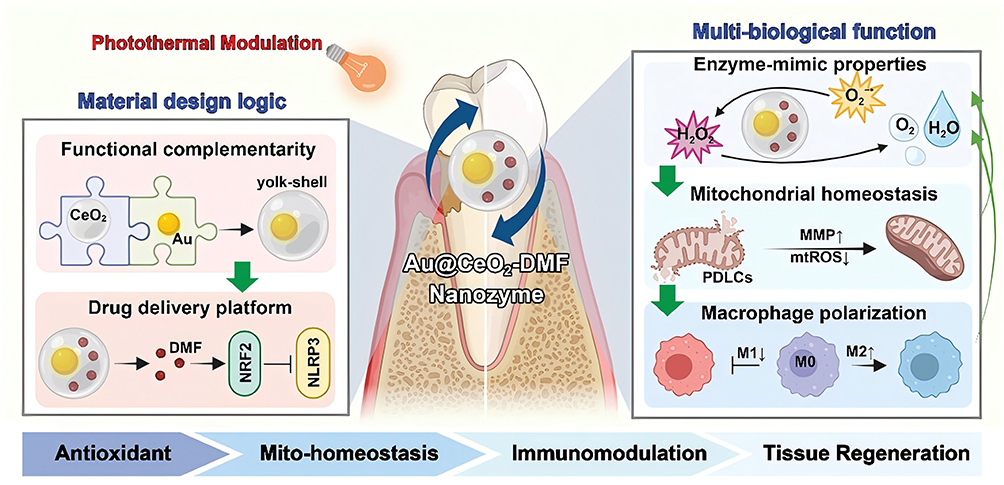 |
Figure 2 NIR-controlled material design of Au@CeO2–DMF enabling triple-therapy for periodontitis via antioxidant activation, mitochondrial restoration, and immunomodulation. ↑ means significantly increased expression, ↓ means significantly decreased expression. Reproduced with permission from ref.38 Copyright 2025, Wiley. |
Li et al38 synthesized a multifunctional yolk–shell nanozyme, Au@CeO2-dimethyl fumarate (DMF). As shown in Figure 2, the complementary functions of gold and cerium dioxide confer potent photothermal modulation, with rapid heating under near-infrared irradiation, which promotes DMF release and augments the antioxidant activity of CeO2. Au@CeO2-DMF is capable of restoring mitochondrial function and rebalancing immune responses, thereby achieving sustained anti-inflammatory effects. In vivo studies have demonstrated that Au@CeO2-DMF treatment suppresses inflammatory responses and promotes alveolar bone regeneration in models of periodontitis.
Photo-responsive nanozymes hold great promise for periodontitis therapy, but excessive generation of reactive oxygen species (ROS) may exacerbate local oxidative stress and pose risks to host cells. An ideal strategy is to endow nanozymes with a “switchable” function: generating ROS for potent bactericidal action under light irradiation, while scavenging ROS to alleviate inflammation and promote tissue repair in the absence of light. For example, Li X. et al64 designed a near-infrared (NIR) light-responsive copper-cerium bimetallic oxide nanozyme (CuCeO2). Under NIR irradiation, the nanozyme activates its peroxidase-like activity to produce ROS, which, together with the photothermal effect, achieves potent antibacterial activity against Porphyromonas gingivalis, with an inhibition rate of 98.69 ± 0.23% and a minimum inhibitory concentration (MIC) of 25 μg/mL. In the absence of NIR light, CuCeO2 exhibits intrinsic enzyme-like activities that effectively scavenge ROS, alleviate cellular oxidative stress, and promote osteogenic differentiation. In vivo animal experiments demonstrate that CuCeO2 significantly inhibits alveolar bone loss and shows excellent blood compatibility (hemolysis <5%). This dual-mode strategy, “ROS generation for sterilization under light, ROS scavenging for anti-inflammation without light”, may represent a promising avenue for the clinical translation of photo-responsive nanozymes. Nevertheless, to advance toward clinical application, future efforts might focus on elucidating the precise mechanism underlying the switch between light-induced ROS production and dark-state ROS clearance. A deeper understanding of this mechanism could ultimately facilitate on-demand and accurate dual-mode switching.
Nanomotors for Enhanced Biofilm Penetration (Micro-Nanorobots)
The dense extracellular polymeric substance (EPS) matrix in biofilms presents a major barrier to penetration. To address this, nanozyme-based nanomotors are engineered with self-propulsion capabilities, which enhance their mobility and improve penetration through the biofilm.65
Chemical-Driven Nanomotors
Their propulsion leverages endogenous pathological fuels from the disease microenvironment, exemplified by elevated H2O2 in inflammatory sites. Researchers have developed a yolk-shell structured microrobot with a single-end opening, in which copper single atoms are anchored on carbon nitride (denoted as Y-CuSA/CN). This design enables self-propulsion by decomposing locally elevated hydrogen peroxide at inflammatory sites to generate oxygen bubbles. The microrobot achieves a velocity of 17.2 μm/s and a diffusion rate of 7.2 μm2/s, significantly enhancing its biofilm penetration capability. During movement, it catalytically produces ROS, exerting potent antibacterial effects. Both in vitro and in vivo tests validated its efficacy in biofilm eradication.66 In a separate study, sputter-fabricated Janus Ag–MnO2 nanomotors, which propel via oxygen bubbles from catalytic H2O2 decomposition, demonstrated high bactericidal efficacy (>97%) against periodontal pathogens and effective treatment of periodontitis in mice.67 Another research strategy combined targeting function with nanomotor activity by fabricating folic acid-modified, photosensitizer-loaded CeO2 nanoparticles with dual specificity for bacteria and M1 macrophages. This system not only eliminates bacteria via PTT but also scavenges ROS and produces O2 to enhance diffusion and ameliorate hypoxia. The clearance of ROS further induces a phenotypic switch in macrophages from M1 to M2, resulting in inflammation resolution and tissue regeneration.68
Light-Driven Nanomotors
These systems convert optical energy into autonomous motion through mechanisms such as self-thermophoresis and photothermally induced bubble propulsion. Self-thermophoresis occurs when asymmetric light absorption creates a temperature gradient, generating a thermophoretic flow from hotter to cooler regions that drives directional movement. Alternatively, intense photothermal effects can trigger the formation and ejection of gas bubbles—for instance, through localized thermal decomposition of surrounding media or onboard fuel—providing thrust via bubble recoil. Both mechanisms enable precise, fuel-free propulsion under remote optical control. For instance, the Janus-structured J-CeM@Au nanomotor utilizes asymmetrically modified gold nanoparticles to generate a pronounced thermophoretic effect under NIR irradiation (Figure 3). This propels the nanomotor at speeds up to 45 µm/s, and the resulting mechanical forces disrupt the biofilm EPS, increasing nanozyme penetration depth from 20 µm to 50 µm. The NIR laser provides the energy for propulsion and activates the nanomotor’s antibacterial properties, allowing it to penetrate biofilms and kill bacteria. Additionally, the nanomotor’s ability to scavenge ROS can modulate the immune response and create a regenerative environment, promoting the healing of periodontal tissue.39
 |
Figure 3 The synthesis process and therapeutic mechanism of J-CeM@Au. (A) Illustration for the preparation process of J-CeM@Au. (B and C) Illumination of the multifunctional J-CeM@Au for accelerating periodontitis healing by biofilm eradicating and ROS scavenging. (D) Mechanisms for the immunomodulation of J-CeM@Au. ↓ means reduced ROS levels. Adapted from ref,39 published under the CC BY-NC-ND 4.0 license. |
In another approach, sodium nitroprusside was incorporated into Prussian blue nanoparticles to construct an integrated system in which NIR-irradiated Prussian blue induces photothermal heating, accelerating nitric oxide release from sodium nitroprusside and enhancing biofilm penetration via gaseous propulsion. Combined with its inherent photothermal antibacterial activity, the system achieves potent antibacterial effects. Additionally, the ROS-scavenging capacity of Prussian blue contributes to immunomodulation and supports periodontal tissue regeneration.69
Despite the promising biofilm-penetrating ability of nanomotors in vitro, their clinical translation faces practical challenges. The limited availability of endogenous fuels (eg., H2O2) in the periodontitis microenvironment often fails to sustain self-propulsion, while light-driven systems alone are constrained by inadequate tissue penetration, making it difficult to activate nanomotors in deep periodontal pockets or furcation areas. To address these limitations, current research has been shifting toward synergistic strategies, such as constructing hybrid light–chemical propulsion systems that enable rapid activation in superficial tissues under near-infrared light while relying on local chemical fuels to sustain motion in deeper regions. Another complementary approach involves designing fuel self-supply systems, for instance, by loading glucose oxidase (GOx) onto nanomotors to convert locally abundant glucose into H2O2 in situ, thereby providing a continuous energy source.70 These efforts are expected to enhance the adaptability and therapeutic efficacy of nanomotors within the complex in vivo environment.
Gas-Generating Nanozymes
The hypoxic microenvironment of periodontal pockets (pO2 < 5 mmHg) fosters the growth of anaerobic bacteria such as Porphyromonas gingivalis, posing a significant challenge in periodontitis management. Gas-generating nanozymes have emerged as an innovative strategy to reshape this microenvironment and enhance antibacterial efficacy by in situ gas production. Early efforts focused on augmenting local oxygen levels; for example, platinum nanoparticle-modified PCN-222 (Pt@PCN-222) leverages catalase-like activity to convert endogenous hydrogen peroxide into water and oxygen, thereby relieving hypoxia and promoting both photodynamic and peroxidase-like antibacterial activity. This dual mechanism not only suppresses anaerobic bacterial proliferation but also alleviates oxidative stress and supports tissue repair.71
To address the limitations of deep infection treatment, Wang et al72 developed an integrated system (CeCycn-Cu5.4O) comprising spontaneous oxygen-producing cyanobacteria as carriers for the photosensitizer Ce6, and ultrasmall catalase-mimicking Cu5.4O nanoparticles (Cu5.4O USNPs). The cyanobacteria continuously generate oxygen through photosynthesis, thereby overcoming the hypoxia limitation of traditional photodynamic therapy (PDT). This enhanced oxygen supply, combined with the catalase-like activity of Cu5.4O USNPs, enables effective anaerobic biofilm eradication upon laser irradiation and promotes rapid tissue repair, presenting a promising strategy for disinfecting deep periodontal pockets.
Beyond oxygen, other therapeutic gases such as carbon monoxide (CO), nitric oxide (NO), molecular hydrogen (H2), and hydrogen sulphide (H2S) have demonstrated potential in periodontal therapy.73 Researchers have engineered nanozyme platforms capable of controlled, localized gas release, often integrating photodynamic or photothermal modalities for spatiotemporal precision. Such multimodal designs offer synergistic antibacterial, anti-inflammatory, and tissue-reparative benefits, which are particularly advantageous for drug-resistant periodontitis.
A notable example is the carbon monoxide-enhanced multienzyme hybrid platform (MSN-Au@CO), comprising gold nanoparticles conjugated to mesoporous silica and loaded with a carbonyl manganese CO donor.40 The gold nanoparticles exhibit glucose oxidase-like activity, generating hydrogen peroxide and gluconic acid, followed by peroxidase-like conversion of H2O2 into hydroxyl radicals for effective bacterial killing. Simultaneously, H2O2 triggers CO release, which inhibits bacterial respiration and further enhances therapeutic efficacy, as demonstrated in diabetic periodontitis models (Figure 4).
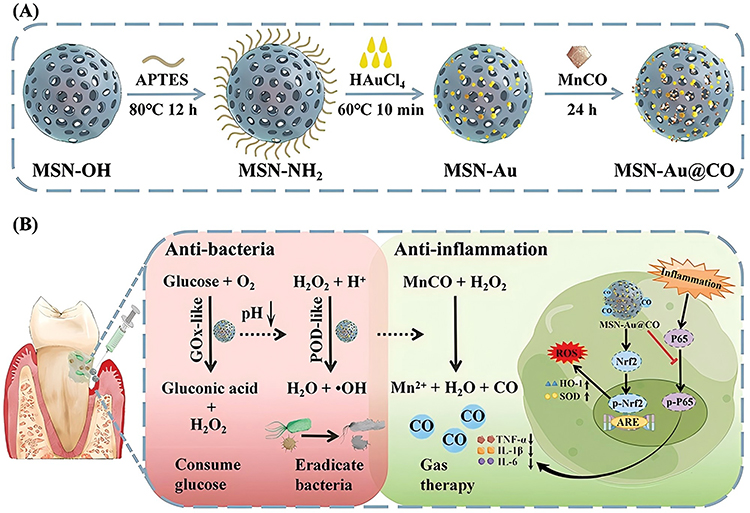 |
Figure 4 (A) Schematic illustration of the construction of MSN-Au@CO. (B) The mechanisms of the cascade reaction present antibacterial and antiinflammation effects in the treatment of diabetic periodontitis. In the nanozyme cascade reaction, MSN-Au@CO consumes glucose to generate ˙OH, which eradicates periodontal bacteria. In addition, the resultant CO enhances MSN-Au to reduce inflammation by inhibiting P65 nuclear translocation and increasing the antioxidant ability by promoting Nrf2 nuclear translocation. ↑ means significantly increased expression, ↓ means significantly decreased expression. Reproduced with permission from ref.40 Copyright 2024, Wiley. |
Hydrogen sulphide-based systems have also shown promise. Li et al74 synthesized a mesoporous silica-copper composite (DM/Cu2⁺-CuS), which responds to glutathione in the biofilm microenvironment for selective H2S release. This design ensures controlled peroxidase-like and bactericidal activity while the generated H2S modulates inflammation and, together with copper ions, promote angiogenesis. However, excessive gas release poses risks of toxicity and adverse effects such as cellular damage. To mitigate this, controlled-release strategies, such as pH-responsive MOFs loaded with CO-releasing molecules, are being developed to ensure effective antibacterial action without exceeding safe gas concentrations.75
Clinical Relevance and Future Perspectives
To accurately assess the translational potential of functionalized nanozymes for periodontitis treatment, they should be compared not only with conventional mechanical debridement and antibiotics but also with other non-traditional strategies that have a longer history of clinical translation. Antimicrobial peptides (eg., LL-37) exhibit rapid bactericidal activity and immunomodulatory effects but suffer from high production costs, susceptibility to protease degradation, short half-life, inhibition by physiological salt concentrations and saliva, as well as cytotoxicity.76,77 Photodynamic therapy alone relies on an external light source with limited tissue penetration, requires repeated treatments, shows inconsistent efficacy against key pathogens, and cannot directly modulate inflammation or promote bone regeneration.78,79 Probiotics/postbiotics (eg., Lactobacillus reuteri) may modestly improve bleeding on probing and clinical attachment levels, but their effects are highly strain-specific, diminish after discontinuation, and lack ROS-scavenging or osteogenic capacity.80,81 Other established nanomaterial strategies, such as chlorhexidine-loaded mesoporous silica, enable sustained local release and enhanced biofilm penetration but lack intrinsic multi-enzyme activity.82 By contrast, functionalized nanozymes—particularly nanomotors and cascade catalytic systems—integrate deep biofilm penetration, ROS scavenging, immune microenvironment remodeling, and pro-osteogenic activity into a single platform, offering unique advantages in the full-course regulation of periodontitis. Nevertheless, their clinical translation faces major challenges, including insufficient long-term biosafety, potential cumulative toxicity of metal ions, unclear metabolic clearance pathways, and the absence of standardized toxicological evaluation frameworks.17,83 For example, accumulation of metal ions such as Cu2⁺ can trigger local toxic responses, including NLRP3 inflammasome activation and apoptosis of gingival epithelial cells.84 Although the use of degradable carriers, biomimetic coatings, and natural biomaterials (eg., chitosan, hyaluronic acid) may mitigate toxicity risks to some extent, a systematic framework to assess the dose-dependent effects of nanozymes on immunomodulation is still lacking, and their metabolic clearance via hepatic and renal pathways remains to be elucidated.
Moreover, despite the encouraging preclinical findings, several methodological limitations must be acknowledged when interpreting these results. First, most studies employ small sample sizes, increasing the risk of type I and type II errors. Second, follow-up durations are almost uniformly short (≤4 weeks), insufficient to assess long-term biosafety, material degradation kinetics, or the stability of alveolar bone regeneration. Third, the majority of studies use only phosphate-buffered saline or untreated controls, lacking head-to-head comparisons with established clinical therapies (eg., mechanical debridement, chlorhexidine mouthwash, or locally delivered minocycline gel). Consequently, the relative therapeutic advantages of nanozyme platforms remain unclear. Fourth, the complexity of multi-component nanozyme synthesis raises concerns about inter-laboratory batch-to-batch reproducibility and scalability, yet few studies report inter-batch consistency data. These limitations do not negate the potential value of nanozymes but highlight the urgent need for more rigorous, standardized, and translationally oriented preclinical evaluation systems.
Based on the preclinical evidence, we propose a preliminary clinical translation framework that considers the unique anatomical and pathological features of periodontitis. First-in-human trials could prioritize patients with refractory chronic periodontitis who respond poorly to conventional mechanical debridement and antibiotics. Local administration into the periodontal pocket is preferred over systemic delivery to maximize local catalytic activity while minimizing off-target toxicity. A single-administration, dose-escalation Phase 0/I trial using an injectable biodegradable hydrogel formulation may be considered. The dose should be carefully titrated according to the limited volume of the periodontal pocket to ensure sustained catalytic activity, prevent excessive metal ion release, and avoid systemic exposure. This localized, low-dose, biodegradable delivery strategy appears to offer a potentially safe and feasible pathway for the clinical translation of functionalized nanozymes.
Smarter, More Precise Nanozyme Systems
- Multi-mode responsive systems: Integrate nanozyme units with NIR light, ultrasound or magnetic field triggers to realize spatiotemporal catalytic switch; guided by pathological pH, ROS and bacterial concentration in periodontal pocket, the catalytic antibacterial/antioxidant function is selectively turned on only at lesion sites, avoiding off-target injury to normal gingival tissue.85
- Closed-loop platforms: Developing “smart” theranostic systems that sense disease biomarkers (eg., MMP-8, IL-1β) in real time, responsively activate catalytic functions, and adjust therapy based on feedback will create truly dynamic and personalized treatments.
Rational Design and Green Synthesis
- Artificial intelligence and machine learning: Artificial intelligence has become a powerful driving force in the advancement of nanobiomedicine.86,87 Computational methods such as machine learning that simulate the relationship between nanozyme structure and activity can accelerate the design process, enabling rapid, high-throughput screening of novel and efficient nanozymes.88,89
- Green manufacturing: Replace toxic organic solvents with water-phase natural ligand (tannic acid, chitosan) synthesis routes; adopt room-temperature mild preparation to lower production cost and facilitate subsequent clinical batch production.
Advanced Delivery Systems and Biocompatibility
- Formulations compatible with dental devices: Creating nanozyme formulations compatible with dental devices (eg., injectable hydrogels, light-responsive patches) ensures local enrichment at the lesion site.
- Long-term biosafety assessment: Establishing standardized systems for evaluating the long-term biosafety of nanozymes, including their effects on the immune system, metabolic clearance pathways, and potential systemic toxicity.
Ultimately, only through deep cross-disciplinary integration of materials science, catalytic engineering, clinical dentistry, and bioinformatics can functionalized nanozymes be truly upgraded from “broad-spectrum antibacterial and anti-inflammatory” agents to “precision periodontal microenvironment remodeling platforms.” By leveraging local targeted delivery, smart responsive release, deep biofilm penetration, and standardized safety evaluation, nanozymes hold the potential to achieve synergistic coupling of infection control, inflammation resolution, and bone regeneration, thereby providing a next-generation precision regenerative strategy for refractory periodontitis.
Conclusion
Among the various nanozyme architectures for periodontitis treatment, motor-based composite nanozymes may represent one of the more translation-ready candidates. Leveraging self-propulsive capability, these nanozymes have demonstrated promising biofilm-penetrating ability in preclinical models, effectively overcoming the anatomical complexity of periodontal pockets and resolving the dilemma that conventional therapeutic agents cannot efficiently reach deep lesion sites. Beyond deep penetration, their integrated multifunctional design enables concurrent antibacterial action, ROS scavenging, modulation of macrophage M2 polarization, and promotion of alveolar bone regeneration, suggesting a potential advantage for comprehensive periodontal intervention. Nevertheless, long-term biosafety, especially the chronic bioaccumulation of metal ions, remains the single most pressing bottleneck hindering clinical translation. Addressing this critical challenge requires sustained and robust interdisciplinary collaboration across materials science, stomatology, and translational medicine to optimize structural design, degradability, and in vivo metabolic clearance. From a clinical perspective, patients with drug-resistant refractory periodontitis represent the most appropriate cohort for future pilot clinical trials. Based on the continuous optimization of materials and the gradual establishment of standardized safety evaluation frameworks, such nanozyme platforms may offer new perspectives for precision therapy in this patient population.
Abbreviations
ATP, Adenosine triphosphate; AuNPs, Gold nanoparticles; Bi, Bismuth; BMSCs, Bone marrow mesenchymal stem cell(s); BSA, Bovine serum albumin; CAT, Catalase; CDT, Chemical dynamic therapy; CeO2, Cerium dioxide; CeO2 NPs, Cerium oxide nanoparticles; circRNA, circular RNA; CNM(s), Carbon-based nanozyme(s); CO, Carbon monoxide; CQD(s), Carbon quantum dot(s); CRNCs, Copper–ruthenium nano-capsule(s); CuNZs, Copper-based nanozyme(s); DMF, Dimethyl fumarate; ETA, Electron transfer activity; EPS, Extracellular polymeric substance; FA, Folic acid; Fe3O4, Triiron tetraoxide; GPx, Glutathione peroxidase; GDY, Graphdiyne; GO, Graphene oxide; GQD(s), Graphene quantum dot(s); H2O2, Hydrogen peroxide; H2S, Hydrogen sulphide; HMUiO-66, Hierarchical mesoporous MOF; IL-1β, Interleukin-1 beta; IL-6, Interleukin-6; TNF-α, Tumor necrosis factor-alpha; MMP-9, Matrix metalloproteinase; MNOF(s), Metal–organic framework-based nanozyme(s); MNP(s), Metal-based nanozyme(s); MOF(s), Metal-organic framework(s); MPN, Metal–phenolic network; NIR, Near-infrared; NO, Nitric oxide; OMVs, Outer membrane vesicle(s); PAMP, Pathogen-associated molecular pattern; PCFs, 2TT-mC6B@CeO2@FA nanoparticles; PDT – Photodynamic therapy; pH, potential of hydrogen; POD, Peroxidase; PTA, Photothermal agent(s); PTT, Photothermal therapy; QD(s), Quantum dot(s); ROS, Reactive oxygen species; SalB, Salvianolic acid B; SEM, Scanning electron microscopy; SOD, Superoxide dismutase; SQD(s), Sulfur quantum dot(s); TA, Tannic acid; TMA, Tyramine–methacrylamide; UBI29–41, Ubiquitin 29–41; UiO-66(Ce), Cerium-based metal–organic framework; ˙O2−, Superoxide anions; ˙OH, Hydroxyl radicals.
Funding
This work was supported by the Joint Funds for the Innovation of Science and Technology, Fujian Province (Grant No. 2024Y9680).
Disclosure
The authors report no conflicts of interest in this work.
References
1. Benzian H, watt R, Makino Y, Stauf N, Varenne B. WHO calls to end the global crisis of oral health. Lancet. 2022;400(10367):1909–19. doi:10.1016/s0140-6736(22)02322-4
2. Valverde A, George A, Nares S, Naqvi AR. Emerging therapeutic strategies targeting bone signaling pathways in periodontitis. J Periodontal Res. 2025;60(2):101–120. doi:10.1111/jre.13326
3. Nascimento GG, Alves-Costa S, Romandini M. Burden of severe periodontitis and edentulism in 2021, with projections up to 2050: the Global Burden of Disease 2021 study. J Periodontal Res. 2024;59(5):823–867. doi:10.1111/jre.13337
4. Trindade D, Carvalho R, Machado V, Chambrone L, Mendes JJ, Botelho J. Prevalence of periodontitis in dentate people between 2011 and 2020: a systematic review and meta-analysis of epidemiological studies. J Clin Periodontol. 2023;50(5):604–626. doi:10.1111/jcpe.13769
5. Hosseini Hooshiar M, Badkoobeh A, Kolahdouz S, et al. The potential use of nanozymes as an antibacterial agents in oral infection, periodontitis, and peri-implantitis. J Nanobiotechnol. 2024;22(1):207. doi:10.1186/s12951-024-02472-x
6. Cobb CM, Sottosanti JS. A re-evaluation of scaling and root planing. J Periodontol. 2021;92(10):1370–1378. doi:10.1002/JPER.20-0839
7. Bamford NC, MacPhee CE, Stanley-Wall NR. Microbial Primer: an introduction to biofilms - what they are, why they form and their impact on built and natural environments. Microbiology. 2023;169(8). doi:10.1099/mic.0.001338
8. Dang Y, Zhang Y, Luo GC, et al. The decisive early phase of biomaterial-induced bone regeneration. Appl. Mater. Today. 2024:38. doi:10.1016/j.apmt.2024.102236.
9. Li LL, Xu JY, Ye C, et al. Biomaterials-based strategy for dental-oral tissue regeneration: current clinical application, laboratory development, and future direction. Biomaterials. 2026:326. doi:10.1016/j.biomaterials.2025.123714.
10. Xu S, Liang P, Zhong L, Fu X, Li Y, Wang Y. Nanomaterials in Oral Regeneration: current Advances and Future Directions. Regenerative Medicine Dentistry. 2025;2(4):16. doi:10.53941/rmd.2025.100016
11. Huang Y, Ren J, Qu X. Nanozymes: classification, Catalytic Mechanisms, Activity Regulation, and Applications. Chem Rev. 2019;119(6):4357–4412. doi:10.1021/acs.chemrev.8b00672
12. Gao WD, Mu YQ, Xiao L, Xiao YD. Applications, and Future Perspectives of Nanozymes in Orthopedics and Dentistry. Eur Cells Mater. 2025;52:80–97. doi:10.22203/eCM.v052a06
13. Yang Y, Li Z, Fan X, et al. Nanozymes: potential Therapies for Reactive Oxygen Species Overproduction and Inflammation in Ischemic Stroke and Traumatic Brain Injury. ACS Nano. 2024;18(26):16450–16467. doi:10.1021/acsnano.4c03425
14. Feng Z, Guo Y, Zhang Y, et al. Nanozymes: a bibliometrics review. J Nanobiotechnol. 2024;22(1):704. doi:10.1186/s12951-024-02907-5
15. He T, Yang Y, Chen XB. Propulsion mechanisms of micro/nanorobots: a review. Nanoscale. 2024;16(27):12696–12734. doi:10.1039/d4nr01776e
16. Liang S, Xing J, Zhang Z, Wang D, Xing D, Geng Z. H(2)O(2)-Driven Aggregation Induced Emission-Based Nanomotors for the Monitoring and Treatment of Infected Surgical Wound. Small. 2025;21(17):e2500207. doi:10.1002/smll.202500207
17. Liu L, Zhang Y, Ju T, Chen X, Li X, Wu L-A. Nanozymes: a promising solution for dental antibacterial applications. RSC Adv. 2024;14(50):36945–36959. doi:10.1039/d4ra07303g
18. Zhang W, Yang Z, Zhang Y, et al. Multi-Enzyme Mimetic Molybdenum Nitride Nanozymes Reshape Subgingival Microenvironment for Synergistic Periodontitis Therapy via ROS Regulation and Microbiome Remodeling. Adv Sci. 2026;2016:e17770. doi:10.1002/advs.202517770
19. Li H, Cai X, Yi T, et al. Tumor microenvironment responsive Mn3O4 nanoplatform for in vivo real-time monitoring of drug resistance and photothermal/chemodynamic synergistic therapy of gastric cancer. J Nanobiotechnol. 2022;20(1):240. doi:10.1186/s12951-022-01441-6
20. Qin L, Yang S, Zhao C, et al. Prospects and challenges for the application of tissue engineering technologies in the treatment of bone infections. Bone Res. 2024;12(1):28. doi:10.1038/s41413-024-00332-w
21. Liu Q, Zhang A, Wang R, Zhang Q, Cui D. A Review on Metal- and Metal Oxide-Based Nanozymes: properties, Mechanisms, and Applications. Nano-Micro Lett. 2021;13(1):154. doi:10.1007/s40820-021-00674-8
22. Luo X, Zhang Y, Zeng Y, et al. Nanotherapies Based on ROS Regulation in Oral Diseases. Adv Sci. 2025;12(9):e2409087. doi:10.1002/advs.202409087
23. Ma Y, Tian Z, Zhai W, Qu Y. Insights on catalytic mechanism of CeO2 as multiple nanozymes. Nano Res. 2022;15(12):10328–10342. doi:10.1007/s12274-022-4666-y
24. Liu Y, Meng X, Zhao Z, Li K, Lin Y. Assembly of Hydrophobic ZIF-8 on CeO(2) Nanorods as High-Efficiency Catalyst for Electrocatalytic Nitrogen Reduction Reaction. Nanomaterials (Basel). 2022;12(17). doi:10.3390/nano12172964
25. Xu Y, Zhou Z, Deng N, et al. Molecular insights of nanozymes from design to catalytic mechanism. Sci China Chem. 2023;66(5):1318–1335. doi:10.1007/s11426-022-1529-y
26. Wu X, Wang L, Lu Y, et al. A Microenvironment-Responsive Graphdiyne-Iron Nanozyme Hydrogel with Antibacterial and Anti-Inflammatory Effect for Periodontitis Treatment. Adv Healthc Mater. 2024:e2403683. doi:10.1002/adhm.202403683.
27. Chung S, Revia RA, Zhang M. Graphene Quantum Dots and Their Applications in Bioimaging, Biosensing, and Therapy. Adv Mater. 2021;33(22):e1904362. doi:10.1002/adma.201904362
28. Huang F, Lu X, Kuai L, et al. Dual-Site Biomimetic Cu/Zn-MOF for Atopic Dermatitis Catalytic Therapy via Suppressing FcγR-Mediated Phagocytosis. J Am Chem Soc. 2024;146(5):3186–3199. doi:10.1021/jacs.3c11059
29. Tang H, Yu Y, Zhan X, et al. Zinc-Cobalt Bimetallic Organic Frameworks with Antioxidative and Osteogenic Activities for Periodontitis Treatment. Small. 2025;21(25):e2412065. doi:10.1002/smll.202412065
30. Ou MH, Zhang K, Liao GN, et al. Polyphenol-Regulated Bimetallic Artificial Metalloproteinases with Broad-Spectrum RONS Scavenging Activities for Diabetic Wound Repair. Adv Funct Mater. 2025. doi:10.1002/adfm.202501438
31. Lin Z, Zhou H, Lu J, Yin X. Carbon-based nanozymes in cancer therapy: current trends and future prospects. Biomaterials. 2025;324:123465. doi:10.1016/j.biomaterials.2025.123465
32. Ali A, Ovais M, Zhou H, Rui Y, Chen C. Tailoring metal-organic frameworks-based nanozymes for bacterial theranostics. Biomaterials. 2021;275:120951. doi:10.1016/j.biomaterials.2021.120951
33. Lam W, Yao Y, Tang C, Wang Y, Yuan Q, Peng L. Bifunctional mesoporous HMUiO-66-NH2 nanoparticles for bone remodeling and ROS scavenging in periodontitis therapy. Biomaterials. 2025;314:122872. doi:10.1016/j.biomaterials.2024.122872
34. Wen MY, Wang TY, Li N, et al. Polyphenol-Copper Derived Self-Cascade Nanozyme Hydrogel in Boosting Oxygenation and Robust Revascularization for Tissue Regeneration. Adv Funct Mater. 2024;34(40). doi:10.1002/adfm.202403634
35. Li Y, Muhammad F, Chen X, et al. Smart multifunctional Cu2O@RuO2 nanozyme for angiogenesis and osteogenesis in periodontitis. Nano Today. 2025;61:102624. doi:10.1016/j.nantod.2024.102624
36. Lin S, Cui T, Jiang Y, et al. Microenvironment-responsive NIR-IIb multifunctional nanozyme platform for bacterial imaging and specialized anti-anaerobic bacteria periodontal therapy. J Nanobiotechnol. 2025;23(1):189. doi:10.1186/s12951-025-03270-9
37. Xu Y, Luo Y, Weng Z, et al. Microenvironment-Responsive Metal-Phenolic Nanozyme Release Platform with Antibacterial, ROS Scavenging, and Osteogenesis for Periodontitis. ACS Nano. 2023;17(19):18732–18746. doi:10.1021/acsnano.3c01940
38. Li TC, Shu MM, Zhu C, et al. Triple-Combination Therapy with a Multifunctional Yolk-Shell Nanozyme Au@CeO2 Loaded with Dimethyl Fumarate for Periodontitis. Adv Sci. 2025;12(7):17. doi:10.1002/advs.202413891
39. Bai X, Peng W, Tang Y, et al. An NIR-propelled janus nanomotor with enhanced ROS-scavenging, immunomodulating and biofilm-eradicating capacity for periodontitis treatment. Bioact Mater. 2024;41:271–292. doi:10.1016/j.bioactmat.2024.07.014
40. Wang Y, Chu T, Jin T, et al. Cascade Reactions Catalyzed by Gold Hybrid Nanoparticles Generate CO Gas Against Periodontitis in Diabetes. Adv Sci. 2024;11(24):e2308587. doi:10.1002/advs.202308587
41. Xu Y, Huang N, Pan L, Du J, Cao L, Jiang X. Complexed Micelles System Based on Ceria Oxide Nanozyme for Bone Remodeling and ROS Scavenging in Periodontitis. Adv Healthc Mater. 2025;15(4):e02690. doi:10.1002/adhm.202502690
42. Mei HX, Liu H, Sha CL, et al. Multifunctional Metal-Phenolic Composites Promote Efficient Periodontitis Treatment via Antibacterial and Osteogenic Properties. ACS Appl Mater Interfaces. 2024;16(11):13573–13584. doi:10.1021/acsami.3c19621
43. Ge H, Wang M, Wei X, Chen X-L, Wang X. Copper-Based Nanozymes: potential Therapies for Infectious Wounds. Small. 2025;21(8):e2407195. doi:10.1002/smll.202407195
44. Lin J, Fang J, Zhou J, et al. NIR-II triggered Cu(I) phosphide for chemodynamic and photothermal periodontitis treatment: efficient reduction of bacterial co-aggregation. Acta Biomater. 2024;187:396–408. doi:10.1016/j.actbio.2024.08.013
45. Hu Y, Ma X, Wan H, et al. A Biomimetic Layered Silk Fibroin Microsphere Modulating Redox Homeostasis and Enhancing Osteogenic Differentiation for Synergistic Periodontal Regeneration. Small. 2025;22(10):e10869. doi:10.1002/smll.202510869
46. Meng Z, Zeng Z, Zhang Z, et al. Osteogenic Nanozymes for Diabetic Bone Regeneration via Synergistic Antioxidant and Osteoinductive Functions. Adv Mater. 2026;38(23):e72833. doi:10.1002/adma.72833
47. Zhang L, Wang W, Tan H, et al. Ligand-Modulated Manganese Ferrite Nanozyme Hydrogel with Balanced Antioxidant Activity and Biocompatibility for Periodontitis Treatment. Adv Healthc Mater. 2026;15(15):e05568. doi:10.1002/adhm.202505568
48. Cai D, Li Z, Gao W, et al. Proinflammatory Macrophage-Targeted Nanoparticles Rejuvenate Aged Macrophages and Their Phagocytic Capacity. ACS Nano. 2025;19(46):40002–40022. doi:10.1021/acsnano.5c14201
49. Han Y, Yang L, Zhang J, et al. Circular RNA-chimeric CeO2 nanoplatform maintains protective autophagy in macrophages for periodontitis. Chem Eng J. 2025;503:158338. doi:10.1016/j.cej.2024.158338
50. Cai DL, Li ZL, Gao WD, et al. Bacteria-Derived Extracellular Vesicle as A “Trojan Horse” for Selective M1 Macrophage-Targeting in A Multi-Cellular Entanglement Environment. Adv Funct Mater. 2025;35(32). doi:10.1002/adfm.202501459
51. Qi M, Ding Q, Shi Y, et al. NIR-activated nanodisguisers for targeted bactericidal action and enhanced electron transfer in periodontitis treatment. Biomaterials. 2025;324:123487. doi:10.1016/j.biomaterials.2025.123487
52. Cong Y, Qiao R, Wang X, et al. Protein Corona-Mediated Inhibition of Nanozyme Activity: impact of Protein Shape. J Am Chem Soc. 2024;146(15):10478–10488. doi:10.1021/jacs.3c14046
53. Li L, Wu RX, Wang J, et al. A multirisk-rescued biomimetic nanozyme against periodontitis via inflammation targeting and microenvironment reprogramming. Chem Eng J. 2025;506:19. doi:10.1016/j.cej.2025.160119
54. Ren H, Liu P, Sun Z, et al. Combined strategy of dual-module cerium nanosystem composite extracellular vesicles regulate ROS in the tissue microenvironment to promote periodontitis recovery. Mater Today Bio. 2025;36:102625. doi:10.1016/j.mtbio.2025.102625
55. Yang Q, Sun X, Ding Q, et al. An ATP-responsive metal-organic framework against periodontitis via synergistic ion-interference-mediated pyroptosis. Natl Sci Rev. 2024;11(8):nwae225. doi:10.1093/nsr/nwae225
56. Liu J, Wei J, Xiao S, et al. Multienzyme-Activity Sulfur Quantum Dot Nanozyme-Mediated Cascade Reactions in Whole-Stage Symptomatic Therapy of Infected Bone Defects. ACS Nano. 2025;19(7):6858–6875. doi:10.1021/acsnano.4c12343
57. Du HL, Gao SH, Wang YQ, et al. High-Entropy Alloy-Based Artificial Enzymes With Modulated D-Band Center and pH-Controllable ROS Biocatalysis for Stage-Specific Treatment of Inflammatory and Infectious Oral Diseases. Adv Mater. 2026;38(10):18. doi:10.1002/adma.202519865
58. Song JZ, Li F, Zou XY, et al. A ˙OH self-suppling and dual regulation hybrid nanozyme combined with photothermal therapy to eliminate biofilms and eradicate infections. Chem Eng J. 2024;481:15. doi:10.1016/j.cej.2024.148613
59. Wu Q, Deng T, Cheng J, et al. Constructing Interfacial Charge Transfer Channels and Electric Field in Violet Phosphorus-Based van der Waals Heterojunction for Phototherapy of Periodontitis. Acs Nano. 2024;18(18):11988–12009. doi:10.1021/acsnano.4c02433
60. Qin Z, You J, Wu Q, et al. A Self-Adaptive Periodontal Ecosystem Engineered With Molybdenum-Based Nanozyme-Embedded Composite Hydrogel for Microenvironment-Responsive Precision Therapy. Adv Mater. 2026;38(14):e22859. doi:10.1002/adma.202522859
61. Li M, Ding Q, Hu S, et al. A triple-responsive nanozyme platform of AgAu-CeO2 heterojunction integrated with probiotics for precision antibacterial therapy in periodontitis. Biomaterials. 2025;327:123731. doi:10.1016/j.biomaterials.2025.123731
62. Yuan Y, Zeng L, Yuan L, et al. Injectable Double-Cross-Linked Hydrogel Enhanced by Mg/Mn-Based Nanozymes for Photothermal Therapy and Immunomodulation in Periodontal Bone Resorption. ACS Appl Mater Interfaces. 2026;18(17):24224–24244. doi:10.1021/acsami.6c03273
63. Wang H, Wang D, Huangfu H, et al. Branched AuAg nanoparticles coated by metal–phenolic networks for treating bacteria-induced periodontitis via photothermal antibacterial and immunotherapy. Mater Des. 2022;224:111401. doi:10.1016/j.matdes.2022.111401
64. Li X, Liang H, Huang Y, et al. Near-infrared light-responsive copper-cerium bimetallic oxide nanozyme with antibacterial and antioxidant abilities for periodontitis therapy. Colloids Surf B Biointerfaces. 2025;252:114685. doi:10.1016/j.colsurfb.2025.114685
65. Tao J, Sun Y, Wang G, Sun J, Dong S, Ding J. Advanced biomaterials for targeting mature biofilms in periodontitis therapy. Bioact Mater. 2025;48:474–492. doi:10.1016/j.bioactmat.2025.02.026
66. Guo ZP, Li YH, Wei W, et al. One-End-Opened Yolk-Shell Copper Single-Atom Microrobots for Enhanced Penetration and Eradication of Bacterial Biofilms. Adv Funct Mater. 2025. doi:10.1002/adfm.202503970
67. Huang M, Ke C, Yang L, Hu N, Wu Y, He Q. Self-Propelled MnO(2)-Based Colloidal Motors for Active Treatment of Periodontal Inflammation. Chem Asian J. 2025;20(11):e202500157. doi:10.1002/asia.202500157
68. Wang WT, Gao YM, Lin Y, et al. Inflammatory Microenvironment-Responsive Nanomotors with NIR Photothermal Effect for Deep Inflammation Elimination and Infection Inhibition. Adv Funct Mater. 2025;35(10). doi:10.1002/adfm.202416684
69. Li Z, Fan X, Liu Y, et al. Engineering Mild-Photothermal Responsive and NO Donor Prussian Blue Nanozymes Using Mild Synthesis for Inflammation Regulation and Bacterial Eradication in Periodontal Disease. Adv Mater. 2025;37(6):e2409840. doi:10.1002/adma.202409840
70. Gong J, Wang SH, Liu J, et al. In situ oxygen-generating bio-heterojunctions for enhanced anti-bacterial treatment of anaerobe-induced periodontitis. Chem Eng J. 2024;498:13. doi:10.1016/j.cej.2024.155083
71. Dong F, Liu Y, Dong H, et al. A nano-oxygen generator for enhanced light-controlled elimination of anaerobic bacteria in periodontal infections. Nano Today. 2024;56:102280. doi:10.1016/j.nantod.2024.102280
72. Wang B, Zhou L, Guo Y, et al. Cyanobacteria-based self-oxygenated photodynamic therapy for anaerobic infection treatment and tissue repair. Bioact Mater. 2022;12:314–326. doi:10.1016/j.bioactmat.2021.10.032
73. Mu YQ, Du ZB, Gao WD, et al. Osteoimmunometabolic modulation via hydrogen-self-supplying magnesium-reinforced collagen membrane for enhanced guided bone regeneration. Biomaterials. 2026:329. doi:10.1016/j.biomaterials.2025.123928.
74. Li L, Xie Y, Wang J, Sun Q, Gao M, Li C. Biofilm microenvironment-activated multimodal therapy nanoplatform for effective anti-bacterial treatment and wound healing. Acta Biomater. 2024;183:221–234. doi:10.1016/j.actbio.2024.06.002
75. Yang C, Ming H, Li B, et al. A pH and glutathione-responsive carbon monoxide-driven nano-herb delivery system for enhanced immunotherapy in colorectal cancer. J Control Release. 2024;376:659–677. doi:10.1016/j.jconrel.2024.10.043
76. He YQ, Zhou YX, Liu N, et al. Cathelicidin LL-37 in periodontitis: current research advances and future prospects- A review. Int Immunopharmacol. 2025;150:12. doi:10.1016/j.intimp.2025.114277
77. Czarnowski M, Wnorowska U, Luckiewicz M, et al. Natural Antimicrobial Peptides and Their Synthetic Analogues for Effective Oral Microflora Control and Oral Infection Treatment-The Role of Ceragenins in the Development of New Therapeutic Methods. Pharmaceuticals. 2024;17(12):26. doi:10.3390/ph17121725
78. Wiench R, Fiegler-Rudol J, Latusek K, et al. Indocyanine Green as a Photosensitizer in Periodontitis Treatment: a Systematic Review of Randomized Controlled Trials. Life. 2025;15(7):20. doi:10.3390/life15071015
79. Oliveira HHC, Chicrala-Toyoshima GM, Damante CA, Ferreira RBP, Light R. Clear Results: an Integrative Review of the Adjunctive Periodontal Treatment with Methylene Blue in Antimicrobial Photodynamic Therapy. Dent J. 2025;13(7):19. doi:10.3390/dj13070289
80. Ghamari M, Sabzi S, Rajabi E, et al. Probiotics, Prebiotics, Synbiotics, Postbiotics, and Bioactive Agents in Modulating Harmful Oral Biofilms. Probiotics Antimicrob Proteins. 2026;18(2):2838–2869. doi:10.1007/s12602-025-10636-w
81. Wim T, Mehraveh S, Katalina L, et al. Not a miracle, not a myth: the role of probiotics in periodontal health. Periodontol 2000. 2026. doi:10.1111/prd.70039
82. Fang L, Zhang Y, Cheng L, et al. Silica nanoparticles containing nano-silver and chlorhexidine to suppress Porphyromonas gingivalis biofilm and modulate multispecies biofilms toward healthy tendency. J Oral Microbiol. 2024;16(1):2361403. doi:10.1080/20002297.2024.2361403
83. Zhang Q, Wang Z, Shen S, et al. Integrating enzyme-nanoparticles bring new prospects for the diagnosis and treatment of immune dysregulation in periodontitis. Front Cell Infect Microbiol. 2024;14:1494651. doi:10.3389/fcimb.2024.1494651
84. Lai Y, Gao FF, Ge RT, Liu R, Ma S, Liu X. Metal ions overloading and cell death. Cell Biol Toxicol. 2024;40(1):72. doi:10.1007/s10565-024-09910-4
85. Xin YJ, Guo ZY, Ma AJ, et al. A robust ROS generation nanoplatform combating periodontitis via sonodynamic/chemodynamic combination therapy. Chem Eng J. 2023;451:17. doi:10.1016/j.cej.2022.138782
86. A Tiwari, Widodo, DI Krisnawati, et al. AI-driven nanomedicine for cancer theranostics. Mol Cancer. 2026;25(1). doi:10.1186/s12943-025-02563-9
87. Tiwari A, Krisnawati DI, Tzou K-Y, Kuo T-R. Machine learning for extracellular vesicles enables diagnostic and therapeutic nanobiotechnology. J Nanobiotechnol. 2026;24(1):153. doi:10.1186/s12951-025-03952-4
88. Chen Z, Yu Y, Gao Y, Zhu Z. Rational Design Strategies for Nanozymes. ACS Nano. 2023;17(14):13062–13080. doi:10.1021/acsnano.3c04378
89. Jiang S, Su G, Wu J, et al. Co3O4/CoFe2O4 Hollow Nanocube Multifunctional Nanozyme with Oxygen Vacancies for Deep-Learning-Assisted Smartphone Biosensing and Organic Pollutant Degradation. ACS Appl Mater Interfaces. 2023;15(9):11787–11801. doi:10.1021/acsami.2c22136
 © 2026 The Author(s). This work is published and licensed by Dove Medical Press Limited. The
full terms of this license are available at https://www.dovepress.com/terms
and incorporate the Creative Commons Attribution
- Non Commercial (unported, 4.0) License.
By accessing the work you hereby accept the Terms. Non-commercial uses of the work are permitted
without any further permission from Dove Medical Press Limited, provided the work is properly
attributed. For permission for commercial use of this work, please see paragraphs 4.2 and 5 of our Terms.
© 2026 The Author(s). This work is published and licensed by Dove Medical Press Limited. The
full terms of this license are available at https://www.dovepress.com/terms
and incorporate the Creative Commons Attribution
- Non Commercial (unported, 4.0) License.
By accessing the work you hereby accept the Terms. Non-commercial uses of the work are permitted
without any further permission from Dove Medical Press Limited, provided the work is properly
attributed. For permission for commercial use of this work, please see paragraphs 4.2 and 5 of our Terms.