
Back to Journals » Patient Preference and Adherence » Volume 20
Patient Journey Maps to Improve Treatment Adherence in Chronic Comorbidities: A Narrative Review
Authors Liu J  , Wang B , Wang X, Lu Y , Zhou Z, Xue Y, Li M
Received 3 May 2026
Accepted for publication 2 July 2026
Published 24 July 2026 Volume 2026:20 621407
DOI https://doi.org/10.2147/PPA.S621407
Checked for plagiarism Yes
Review by Single anonymous peer review
Peer reviewer comments 2
Editor who approved publication: Dr Emma Veale
Jingran Liu, Bo Wang, Xiyu Wang, Yi Lu, Zhongning Zhou, Yanmin Xue, Mingxia Li
School of Nursing, Shandong University of Traditional Chinese Medicine, Jinan, Shandong, People’s Republic of China
*These authors contributed equally to this work
Correspondence: Mingxia Li, School of Nursing, Shandong University of Traditional Chinese Medicine, Jinan, Shandong, 250000, People’s Republic of China, Email [email protected]
Purpose: To summarize the research progress on the application of patient journey maps in improving treatment compliance among patients with chronic comorbidities, and to analyze their mechanisms for optimizing comorbidity management pathways, strengthening care continuity, enhancing patient experience at key care touchpoints, and optimizing treatment experiences for special populations.
Patients and Methods: A search was conducted on PubMed, CINAHL, and Web of Science databases. We conducted relevant research on using the paper’s reference list. We searched for keywords such as patient journey map, chronic comorbidities, and treatment compliance separately and in combination.
Results: A total of 8 studies were included. The review found that patient journey maps can effectively identify compliance barriers in four key areas: (1) missing comorbidity management pathways; (2) disruption of continuity of care during the transition period across institutions; (3) intervention at key care touchpoints; (4) the stigmatization and inadequate pain management faced by special populations lead to voluntary discharge.
Conclusion: The patient journey map, as a visualization tool, systematically reveals the key nodes of treatment-compliance disorders among patients with chronic comorbidities, providing a clear path for nursing staff to develop interventions.
Keywords: patient journey mapping, multimorbidity, patient compliance
Introduction
Chronic comorbidities, which are generally described as a patient having two or more chronic diseases at the same time, have grown to be a significant worldwide health concern.1,2 Approximately one-third of adults suffer from chronic comorbidities as the world’s population ages.1 Comorbidity includes complicated treatment conflicts, medication interactions, and significant self-management responsibilities in addition to the superposition of pathogenic and physiological causes. Patients with chronic comorbidities deal with problems like reduced quality of life and increased death rates.1,3 In terms of the use of medical resources, patients with comorbidities have longer hospital stays, are more likely to be readmitted, and utilize emergency care more frequently, all of which lead to a considerable increase in medical expenses.4
Treatment compliance is the key to improving the prognosis of chronic comorbidities. The World Health Organization reports that the average long-term treatment compliance rate for chronic disease patients in developed countries is only 50%, while in developing countries, this proportion is even lower.5 Reduced treatment outcomes, worsening health conditions, and higher medical costs may result from non-compliance with therapy.6,7 Compliance issues are more common in comorbid patients. They frequently have to adhere to several treatment regimens and travel between unconnected specialty clinics, which is a difficult process that frequently surpasses the patient’s mental and physical capacities. A specialized single-disease model has long served as the foundation for how the medical system operates. However, this disjointed service paradigm frequently results in an undue load on the management of patients with comorbidities. Conventional compliance therapies frequently ignore patients’ multifaceted needs and subjective experiences, focusing instead on a specific illness. To the best of our knowledge, the literature currently available on the diagnosis and treatment of compliance issues in patients with chronic comorbidities is very lacking. The majority of studies on compliance interventions focus on a particular illness, paying little attention to the connections between illnesses and treatment-plan conflicts.
The idea of patient-centered care is progressively taking shape in this setting. As a tool for visualizing the full patient experience, the patient journey map intuitively shows the patient’s hidden experiences and emotional swings. This helps healthcare providers identify pain points and key touchpoints, improves the overall quality of chronic disease management, helps patients better understand and participate in treatment, and increases treatment compliance.8 Patient journey maps have proven useful in managing a single illness. However, they have not been systematically addressed in the complex field of chronic comorbidities, particularly regarding treatment compliance hurdles.
The purpose of this paper is to examine the available data, clarify how patient journey maps might be a useful tool for determining the root causes of lower treatment compliance among patients with chronic comorbidities, and investigate how nursing staff can provide treatment.
Materials and Methods
This study is a narrative review that summarizes key findings, care breakpoints, and intervention implications. It aims to integrate methodically mapped patient journeys to enhance patient compliance among those with chronic comorbidities.
Search Strategy
We searched the following databases for articles until April 2026: Web of Science, CINAHL (EBSCO), and PubMed. The following search terms and their synonyms are used: patient journey/process map/patient journey mapping/patient journey map/journey mapping, multimorbidity/multiple chronic conditions/comorbidity/chronic disease, adherence/compliance/treatment adherence and compliance. Simultaneously search the official websites of journals and trace the references of the study to enhance the acquisition of pertinent material. This search was conducted to enhance transparency in literature coverage and does not represent a systematic review-level comprehensive search.
Eligibility Criteria, Study Selection, and Data Extraction
The study was selected based on the inclusion and exclusion criteria described in Table 1, and only English-language articles were included. Two researchers independently assessed the search results. The titles and abstracts of the search results are first screened. Articles found to be potentially eligible are reviewed in full, and the included literature is ultimately identified. The first author, publication year, research subjects, research methodology, use of patient path maps, and impact on compliance are the primary components of the retrieved information. Any complaints about the literature screening and content extraction process will be discussed and resolved by both parties.
 |
Table 1 Inclusion and Exclusion Criteria for Narrative Reviews |
Results
This study included 8 articles for in-depth analysis. There are two mixed-methods studies and six qualitative investigations. One to fifty people make up the sample size. Table 2 presents the synthesis of the analysis results.
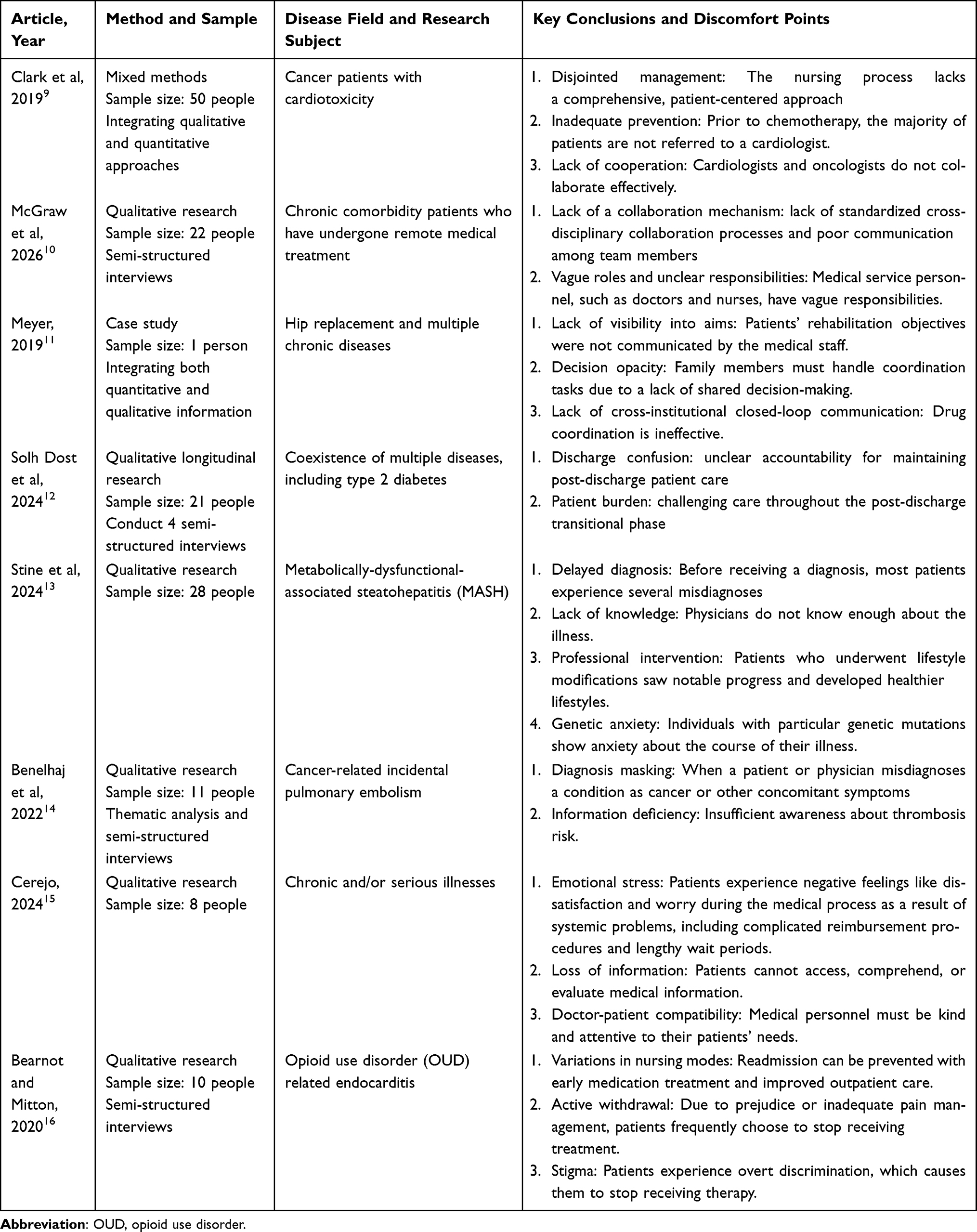 |
Table 2 Characteristics of Articles Included in the Review |
Optimizing the Comorbidity Management Process
The patient journey map identifies compliance hurdles in comorbid management and uses visualization to show the actual experiences of comorbid patients in the healthcare system. Clark et al9 used a mixed-method process mapping to conduct case reviews and in-depth interviews on 50 patients with cardiotoxic cancer, constructing a complete journey map of cancer patients from the onset of cardiotoxicity to cardiac rehabilitation. According to research, there is a lack of cooperation between the oncology and cardiology departments, which leads to delayed cardiac monitoring and low rehabilitation participation rates, and the great majority of patients who experience cardiac toxicity following anti-cancer treatment are not informed about cardiac risks prior to treatment. Patients are willing to take charge of their health, but a lack of knowledge makes it challenging to translate that willingness into practical action, thereby reducing treatment compliance. According to the patient journey map, a system design flaw rather than subjective negativity is the cause of the decline in compliance among patients with cardiotoxic malignancy. Treatment compliance among patients with comorbidities may be enhanced by standardizing referral procedures and optimizing the tumor-cardiovascular joint management pathway. Simple process reengineering alone is insufficient to address the issue in telemedicine; the medical team’s service model must also be changed. McGraw et al10 found that establishing efficient cross- disciplinary collaboration processes is key to the success of primary healthcare. Confusion and poor communication result from patients’ uncertainty about nurses’ roles in managing chronic diseases. Our goal is to increase cross-disciplinary teamwork and patient-centered care by giving nurses additional responsibilities in remote healthcare and allocating work according to professional skills. A study also confirmed that enhancing cross-disciplinary collaboration can help provide more comprehensive and continuous care for patients with chronic comorbidities.17 Collectively, the above studies indicate that the primary systemic driver of reduced treatment compliance in patients with chronic comorbidities is the lack of information flow and ambiguous responsibilities across specialty departments. Patients are frequently treated as a set of disease-specific presentations rather than as complete individuals, leading to the systematic neglect of the real challenges they face when navigating different specialties. Hence, the core value of the patient journey map resides in its capacity to translate institutional-level collaborative deficits into intervenable process nodes, moving beyond a sole emphasis on modifying individual patient behaviors.
Strengthen the Continuity of Care
Ensuring continuity of nursing services across different medical settings has long been regarded as an essential component of patient-centered care and patient safety.18 One of the main issues facing the global healthcare system is improving continuity and coordination of care for patients with chronic comorbidities.19 Patients with chronic comorbidities frequently have to move between many departments and service facilities, which can lead to fragmented experiences. High-quality care continuity is crucial to their treatment compliance, and the patient journey map can link these scattered nodes to guarantee smooth information and treatment plan transfer between various providers. Meyer11 found multiple continuity of care breaks among patients during cross-institutional transfers by drawing patient journey maps. Not being told upon discharge that antibiotics must be taken consistently, leading to the patient’s voluntary cessation of medication and subsequent serious infection; Functional rehabilitation stalled after being moved to an assisted living facility because the physical therapy plan was left out of the care plan. These fissures result from the care system’s inability to provide a consistent, cohesive, supportive environment, not from patients’ subjective lack of participation. Solh Dost et al12 found in their research on patients with multiple diseases, including type 2 diabetes, that the early stage after discharge is the most vulnerable period for compliance. Inadequate community follow-up and abrupt changes in self-medication management are common issues that patients deal with. Researchers discovered through creating a patient map that patients who have previously had poor medication adherence are more likely to relapse into noncompliant behavior after being discharged.20 To offer patients seamless care, medical professionals should incorporate multidisciplinary resources (such as community nurses and pharmacist follow-up) into the discharge plan and completely take individual behavior trajectories into account. Based on the above findings, medical teams should pay special attention to the early stages after discharge, transforming the passive handover into an active, personalized transitional support process.
Enhancing Patient Experience at Key Care Touchpoints
To effectively construct interventions, the patient journey map methodically describes and analyzes patients’ behavioral drivers and pain points at every step of the diagnosis, treatment, and rehabilitation process. Stine et al13 conducted a study on patients with metabolic dysfunction-related steatohepatitis and identified key touchpoints and pain points through patient journey maps. They discovered that patients sent to nutritionists were more likely to adhere to long-term dietary modifications, suggesting that positive experiences with expert support at this touchpoint can lead to meaningful improvements in compliance. Benelhaj et al14 conducted a qualitative study on patients with occasional pulmonary embolism in cancer, demonstrating the complex medical journey of patients with chronic comorbidities. Patients have serious physiological and psychological difficulties in sticking to anticoagulant medication as a result of the lack of knowledge and uncertainty, including injection load, symptom confusion, delayed diagnosis, etc. According to research, patients’ poor adherence to anticoagulant therapy is caused by their ignorance about the severity of thrombosis.21 By identifying these particular pain spots (such as diagnosis notification techniques, home injection instructions, and risk routine education), a patient journey map can be created, allowing for the development of targeted intervention strategies to enhance treatment compliance in comorbid patients. Through patient education videos and other methods, nursing staff can increase patients’ understanding of dangers. Cerejo15 conducted qualitative interviews with patients with chronic comorbidities and created a patient journey map that depicts the collective journey of patients with chronic and/or severe illnesses, highlighting the stress, pain points, and wide-ranging emotions experienced by patients. Medical facilities can implement psychological support or streamline administrative procedures to lessen patient hardship and increase compliance by using journey maps to identify “emotional high-pressure touchpoints” (such as difficult reimbursement processes and prolonged wait times).
In contrast to a single disease patient journey map, bad experiences at a particular disease touchpoint (such as the uncertainty surrounding anticoagulant therapy instructions in Benelhaj) are not isolated; rather, the major touchpoints for chronic comorbidities interact with one another. There will be more discomfort at other touchpoints, including worry about adverse effects from chemotherapy. Resolving conflicts between touchpoints is just as important as optimizing individual touchpoints when dealing with chronic comorbidities.
Optimizing the Treatment Experience for Special Populations
The construction of patient journey maps is also applicable to improving treatment compliance for special populations. This type of population often has complex pathogenesis and is difficult to diagnose and treat, requiring special attention. Bearnot et al16 focused on patients with opioid use disorder-related endocarditis and created a patient journey map through semi-structured interviews to present their unique nursing events accurately. According to research, in this particular comorbidity, non-compliance is frequently a means of self-defense. Instead of refusing care, patients frequently decide to “voluntarily discharge” or cease treatment in order to prevent iatrogenic harm brought on by the stigmatization and moral condemnation of medical professionals. Patients are more likely to stick with treatment and have much better compliance in facilities that offer early addiction intervention, interdisciplinary collaboration, and nonjudgmental communication. Healthcare practitioners can proactively identify compliance-vulnerability windows and rethink nurse-patient engagement paradigms by using the patient journey map to translate fragmented medical behaviors into actionable intervention maps.
Discussion
Main Findings
This review attempts to demonstrate the application value of patient journey maps in the field of chronic comorbidities based on a thorough review of the literature. The patient’s relationship structure and psychological development process are clearly shown in the patient journey map, which supports the entire course of treatment. Patients’ pain locations do not exist in a vacuum; rather, they continuously worsen as the illness worsens.22 We can pinpoint the direct causes of low patient compliance and provide targeted solutions by determining the needs and emotional experiences of our patients.
Treatment compliance disorders in comorbid patients are rooted in a larger care system characterized by interactive effects among the supply of medical services, institutional design, and interpersonal relationships, rather than existing in isolation at the individual behavioral level, according to research. The key potential advantage of patient journey maps is the ability to concretize macro- and meso-level obstacles into observable, measurable path nodes, providing precise targets for future intervention design.
Implications for Nursing Practice
The patient journey map provides a systematic basis for changing care routes in nursing practice. As the medical professionals who interact with patients the most frequently, nurses naturally take on the primary coordination role of creating and implementing patient journey maps during the clinical translation phase of this tool.
In contrast to single illness nursing, patients with chronic comorbidities frequently deal with complicated medical conditions, drug regulations, and possible conflicts. A journey map should be used by nurses who manage chronic comorbidities to proactively identify risk touchpoints, such as medication changes following discharge or transitions between specialists; integrate multidisciplinary resources, such as physicians, pharmacists, nutritionists, and social workers; provide targeted interventions at critical touchpoints; prevent prescription conflicts; and lower patient compliance because patients must independently review conflicting medical advice. In addition, nurses must pay close attention to the general aspects of nursing, such as everyday living, exercise, and nutrition, and have a thorough understanding of the patient’s overall condition.15 As the condition progresses, explain treatment options to patients, clear up any misunderstandings, and show them respect and encouragement.
The difficulties with dropout and compliance are most noticeable in the early stages of patient dropout, particularly in the first three months. Environmental factors, healthcare professional involvement, nurse support, and patient education are important areas that impact compliance, according to current research findings.23,24 In order to enhance patients’ adherence to treatment programs, nursing staff should support patients and foster positive nurse-patient relationships. Understand patients’ needs and compliance challenges through follow-up, interviews, nurse needs assessments, and other methods, and offer focused patient education.
Limitations and Directions
There are certain restrictions on this review. There are few large-scale randomized controlled trials to assess the precise effect of patient journey map interventions on long-term clinical outcomes such as readmission rates and mortality, and most included studies are small-scale exploratory or single-site projects. This review may have overlooked some pertinent material because it searched only three databases and included only English-language works; it did not search dissertations, conference papers, or other types of literature. The study’s medical conditions, comorbidity combinations, and disease types vary widely, which could lead to scenario-specific research findings. There could be publication bias because this field of study is still in its infancy. Therefore, rather than drawing firm conclusions, this analysis aims to offer guidance for future research. Furthermore, future technical research will continue to focus on dynamically integrating patient route maps into electronic health record (EHR) systems to enable real-time monitoring and early warning.
Conclusion
The patient journey map, as a patient-centered visualization tool, can provide a panoramic view of patients’ real experiences within complex medical systems and identify fundamental issues that lead to reduced compliance. At the clinical practice level, the journey map provides nursing staff with a structured framework for identifying high-risk adherence nodes and proactively implementing team-based interventions. Embedding journey maps into routine assessment and transitional care coordination transforms fragmented information into a coherent care trajectory. At the healthcare system level, the journey map serves not only as a clinical tool but also as a diagnostic instrument for institutional bottlenecks. Healthcare organizations can leverage aggregated journey maps to promote multidisciplinary joint clinics, standardize medication reconciliation, and establish closed-loop cross-institutional information sharing. These findings provide preliminary directional references for care pathway transformation in nursing practice. However, given the limited number of included studies, small sample sizes, and predominantly qualitative designs, the conclusions of this review remain preliminary and exploratory and require confirmation by larger-scale, methodologically rigorous studies. Future research should translate patient journey maps into clinical interventions and integrate them with digital health, ultimately providing precise, continuous, and compassionate care for patients with chronic comorbidities.
Funding
Jingran Liu and Bo Wang report funding from the Youth Research and Innovation Team of Shandong University of Traditional Chinese Medicine.
Disclosure
The authors report no conflicts of interest in this work.
References
1. Chowdhury SR, Chandra Das D, Sunna TC, Beyene J, Hossain A. Global and regional prevalence of multimorbidity in the adult population in community settings: a systematic review and meta-analysis. eClinicalMedicine. 2023;57:101860. doi:10.1016/j.eclinm.2023.101860
2. Moffat K, Mercer SW. Challenges of managing people with multimorbidity in today’s healthcare systems. BMC Fam Pract. 2015;16:129. doi:10.1186/s12875-015-0344-4
3. Corcoran N, Wilson N, Mackinnon S, et al. Quantifying cost and health-related quality of life outcomes in different multimorbidity trajectories: a systematic review protocol. BMJ Open. 2025;15(8):e102096. doi:10.1136/bmjopen-2025-102096
4. McPhail SM. Multimorbidity in chronic disease: impact on health care resources and costs. Risk Manag Healthc Policy. 2016;9:143–8. doi:10.2147/RMHP.S97248
5. World Health Organization.Adherence to long-term therapies: evidence for action. 2003. Available from: https://iris.who.int/items/bf8058c0-03b2-4b47-838f-5534849927fb.
6. Anghel LA, Farcaş AM, Oprean RN. Medication adherence and persistence in patients with autoimmune rheumatic diseases: a narrative review. Patient Preference Adherence. 2018;12:1151–1166. doi:10.2147/PPA.S165101
7. Paranjpe R, Chen H, Johnson ML, Birtcher K, Serna O, Abughosh S. Adherence to concomitant diabetes, hypertension, and hyperlipidemia treatments among older patients - ScienceDirect. J Am Pharm Assoc. 2022;62(4):1351–1358. doi:10.1016/j.japh.2022.03.011
8. Xu J, Li R, Yao S, Sun Q, Guo H. Patient journey map in chronic disease management: theory, practice and future. J Clin Nurs Res. 2025;9(5):397–402. doi:10.26689/jcnr.v9i5.10740
9. Clark RA, Marin TS, McCarthy AL, et al. Cardiotoxicity after cancer treatment: a process map of the patient treatment journey. Cardiooncology. 2019;5:14. doi:10.1186/s40959-019-0046-5
10. McGraw M, Couturier Y, Gaboury I, Poirier MD, Poitras ME. The process of interprofessional collaboration in primary healthcare in a telehealth context: perspectives of patients living with chronic disease. J Interprof Educ Pract. 2026;43:100813. doi:10.1016/j.xjep.2026.100813
11. Meyer MA. Mapping the patient journey across the continuum: lessons learned from one patient’s experience. J Patient Exp. 2019;6(2):103–107. doi:10.1177/2374373518783763
12. Solh Dost L, Gastaldi G, M DSM, Schneider MP. Navigating outpatient care of patients with type 2 diabetes after hospital discharge - a qualitative longitudinal study. BMC Health Serv Res. 2024;24(1):476. doi:10.1186/s12913-024-10959-4
13. Stine JG, Medic N, Pettersson B, Venerus M, Blau JE. The health care experience of adults with metabolic dysfunction–associated steatohepatitis and influence of PNPLA3: a qualitative study. Hepatol Commun. 2024;8(6):e0451. doi:10.1097/HC9.0000000000000451
14. Benelhaj NE, Hutchinson A, Maraveyas A, Johnson MJ. Cancer patients’ experiences of the diagnosis and treatment of incidental pulmonary embolism (a qualitative study). PLoS One. 2022;17(10):e0276754. doi:10.1371/journal.pone.0276754
15. Cerejo C. The untold emotional toll of navigating the health system: the journey of patients in/from India, living with serious and/or chronic conditions. Current Med Res Opin. 2024;40(9):1605–1613. doi:10.1080/03007995.2024.2383732
16. Bearnot B, Mitton JA. “You’re always jumping through hoops”: journey mapping the care experiences of individuals with opioid use disorder-associated endocarditis. J Addict Med. 2020;14(6):494–501. doi:10.1097/ADM.0000000000000648
17. Pariser P, Pham TN, Brown JB, Stewart M, Charles J. Connecting people with multimorbidity to interprofessional teams using telemedicine. Annals Fam Med. 2019;17(Suppl 1):S57–S62. doi:10.1370/afm.2379
18. Davies EL, Bulto LN, Walsh A, et al. Reporting and conducting patient journey mapping research in healthcare: a scoping review. J Adv Nurs. 2023;79(1):83–100. doi:10.1111/jan.15479
19. Barnett K, Mercer SW, Norbury M, watt G, Wyke S, Guthrie B. Epidemiology of multimorbidity and implications for health care, research, and medical education: a cross-sectional study. Lancet. 2012;380(9836):37–43. doi:10.1016/S0140-6736(12)60240-2
20. Solh Dost L, Gastaldi G, Schneider M. Patient medication management, understanding and adherence during the transition from hospital to outpatient care - a qualitative longitudinal study in polymorbid patients with type 2 diabetes. BMC Health Serv Res. 2024;24(1):620. doi:10.1186/s12913-024-10784-9
21. Mahé I, Chidiac J, Pinson M, et al. Patients experience of living with cancer associated thrombosis in France (Le PELICAN). Thrombosis Res. 2020;194:66–71. doi:10.1016/j.thromres.2020.06.024
22. Huang M, Huang S, Ma H. A patient journey map based on the experience of temporomandibular disorders patients: a qualitative systematic review and meta-synthesis. Front Public Health. 2026;14:1769781. doi:10.3389/fpubh.2026.1769781
23. Rashidi A, Kaistha P, Whitehead L, Robinson S. Factors that influence adherence to treatment plans amongst people living with cardiovascular disease: a review of published qualitative research studies. Int J Nurs Stud. 2020;110:103727. doi:10.1016/j.ijnurstu.2020.103727
24. Berardinelli D, Conti A, Hasnaoui A, et al. Nurse-led interventions for improving medication adherence in chronic diseases: a systematic review. Healthcare. 2024;12(23):2337. doi:10.3390/healthcare12232337
 © 2026 The Author(s). This work is published and licensed by Dove Medical Press Limited. The
full terms of this license are available at https://www.dovepress.com/terms
and incorporate the Creative Commons Attribution
- Non Commercial (unported, 4.0) License.
By accessing the work you hereby accept the Terms. Non-commercial uses of the work are permitted
without any further permission from Dove Medical Press Limited, provided the work is properly
attributed. For permission for commercial use of this work, please see paragraphs 4.2 and 5 of our Terms.
© 2026 The Author(s). This work is published and licensed by Dove Medical Press Limited. The
full terms of this license are available at https://www.dovepress.com/terms
and incorporate the Creative Commons Attribution
- Non Commercial (unported, 4.0) License.
By accessing the work you hereby accept the Terms. Non-commercial uses of the work are permitted
without any further permission from Dove Medical Press Limited, provided the work is properly
attributed. For permission for commercial use of this work, please see paragraphs 4.2 and 5 of our Terms.