
Back to Journals » Clinical Pharmacology: Advances and Applications » Volume 18
Optimizing Enoxaparin Dosing in Asian Patients: The Critical Role of Age and Renal Function in Achieving Target Anti-Xa Levels
Authors Peng W  , Yang S, Dai Y, Zhao Z , Yang B
Received 26 November 2025
Accepted for publication 30 January 2026
Published 6 February 2026 Volume 2026:18 576067
DOI https://doi.org/10.2147/CPAA.S576067
Checked for plagiarism Yes
Review by Single anonymous peer review
Peer reviewer comments 2
Editor who approved publication: Professor Arthur E. Frankel
Wenxing Peng,1 Shuran Yang,1,2 Ying Dai,3 Zinan Zhao,4,5 Bo Yang6
1Department of Pharmacy, Beijing Anzhen Hospital, Capital Medical University, Beijing, People’s Republic of China; 2School of Pharmaceutical Sciences, Capital Medical University, Beijing, People’s Republic of China; 3Department of Pharmacy, First Affiliated Hospital of Wenzhou Medical University, Wenzhou, Zhejiang, People’s Republic of China; 4Department of Pharmacy, Beijing Hospital; National Center of Gerontology; Institute of Geriatric Medicine, Chinese Academy of Medical Sciences Beijing, People’s Republic of China; 5Beijing Key Laboratory of Assessment of Clinical Drugs Risk and Individual Application (Beijing Hospital), Beijing, People’s Republic of China; 6Department of Cardiac Surgery, Beijing Anzhen Hospital, Capital Medical University, Beijing, People’s Republic of China
Correspondence: Bo Yang, Department of Cardiac Surgery, Beijing Anzhen Hospital, Capital Medical University, No. 2 Anzhen Road, Chaoyang District, Beijing, 100029, People’s Republic of China, Email [email protected]
Objective: To investigate the roles of age and renal function in optimizing enoxaparin dosage for achieving target anti-Xa levels in Asian patients.
Methods: A total of 135 patients subjected to enoxaparin therapy were retrospectively enrolled. Baseline demographic characteristics, clinical indicators, and laboratory test results were collected. The distribution patterns of weight-adjusted doses and anti-Xa levels were analyzed. Dose-response curves were employed to evaluate the probability of achieving therapeutic anti-Xa levels in different age groups (< 80 years vs ≥ 80 years) and estimated glomerular filtration rate (eGFR) categories (eGFR < 60 mL/min vs ≥ 60 mL/min).
Results: The dose distribution revealed discrepancies between actual weight-adjusted doses and manufacturer-recommended doses in some patients. Age significantly influenced the attainment of target anti-Xa levels, whereas renal function exhibited no significant impact. Dose-response curves demonstrated that patients aged ≥ 80 years required lower doses to achieve 90– 95% target anti-Xa levels compared to those < 80 years. No significant difference was observed in target attainment between patients with eGFR < 60 mL/min and those with eGFR ≥ 60 mL/min.
Conclusion: Within the range of eGFR ≥ 30 mL/min/1.73 m2, advanced age, rather than mild-to-moderate renal impairment, emerged as the critical factor for achieving target anti-Xa levels with enoxaparin in Asian patients. Patients aged ≥ 80 years required lower doses compared to younger patients. These findings still need prospective validation.
Keywords: enoxaparin, Asian patients, anti-Xa levels, age, renal function
Introduction
Venous thromboembolism (VTE), comprising pulmonary embolism and deep vein thrombosis, represents one of the leading causes of cardiovascular-related morbidity and mortality worldwide.1 Anticoagulant therapy plays an important role in the prevention and treatment of thrombotic disorders. Low-molecular-weight heparin (LMWH), particularly enoxaparin, has been widely used as a first-line anticoagulant in clinical practice due to predictable pharmacokinetic profile, no requirement for routine monitoring, and lower risk of heparin-induced thrombocytopenia. The anticoagulant effect of LMWH is primarily mediated through the inhibition of coagulation factor Xa (FXa) activity, and monitoring plasma anti-Xa levels serves as a critical tool for assessing anticoagulation intensity and guiding individualized dose adjustment. Studies have demonstrated that maintaining therapeutic anti-Xa levels is essential for ensuring both therapeutic efficacy and safety.2,3
However, achieving and maintaining target anti-Xa levels presents challenges due to the influence of multiple patient-specific factors. Among these, age and renal function are key factors affecting enoxaparin clearance and exposure.4,5 With advancing age, alterations in body composition (eg, decreased muscle mass, increased fat proportion), changes in hepatic and renal function, and modifications in drug volume of distribution may significantly impact the pharmacokinetics of LMWH.
Notably, LMWH is primarily eliminated via renal metabolism. Consequently, renal insufficiency is widely recognized as a critical factor contributing to LMWH accumulation and increased bleeding risk.6 This has prompted multiple clinical guidelines to recommend dose adjustment or alternative anticoagulant selection in patients with renal impairment.7–10
Recently, increasing studies suggest that racial differences may influence the pharmacokinetic and pharmacodynamic characteristics of LMWHs.11 Compared with Caucasian populations, Asian patients exhibit significant differences in body weight, body fat distribution, and metabolic enzyme activity, which may contribute to fluctuations in anti-Xa levels. Some studies indicate that Asian patients may require lower LMWH doses than the standard recommended regimen to achieve comparable anticoagulant efficacy.12,13 However, studies regarding Asian populations, particularly those exploring how age and renal function jointly affect the dose-response relationship of enoxaparin, remain insufficient.
This study aims to analyze clinical data from Asian patients treated with enoxaparin, investigating the impact of age and renal function on weight-adjusted dosing and the attainment rate of target anti-Xa levels. By identifying the optimal dose range for achieving target anti-Xa levels in different age and renal function subgroups, this study seeks to provide a clinical basis for personalized enoxaparin dosing optimization in Asian patients, thereby enhancing the efficacy and safety of anticoagulant therapy.
Methods
Study Design and Population
This retrospective observational study was conducted at Beijing Anzhen Hospital, Capital Medical University. A consecutive series of adult patients who received therapeutic enoxaparin and underwent anti-Xa level monitoring between August 2023 and March 2025 were screened for eligibility. Enoxaparin therapy was indicated for the treatment or prophylaxis of venous thromboembolism (VTE) or high-risk thrombotic clinical conditions. Inclusion criteria were: (1) age ≥18 years; (2) receipt of subcutaneous enoxaparin for at least three consecutive doses administered every 12 hours; (3) at least one steady-state peak anti-Xa level measured 4–6 hours post-dose; (4) availability of complete demographic, clinical, and laboratory data. Exclusion criteria included: (1) estimated glomerular filtration rate (eGFR) <30 mL/min/1.73 m2; (2) severe hepatic dysfunction (Child-Pugh Class C); (3) active bleeding or coagulopathy; (4) concurrent use of other anticoagulants; (5) known hypersensitivity to enoxaparin or other LMWH; (6) pregnancy; (7) incomplete dosing or monitoring records. The study protocol was approved by the Ethics Committee of Beijing Anzhen Hospital (No.2025297x).
Data Collection
Baseline characteristics were extracted from medical records, including age, sex, weight, smoking/alcohol status, comorbidities, and primary anticoagulation indication. Laboratory parameters included platelet count, liver enzymes (ALT, AST), bilirubin, blood urea nitrogen (BUN), and coagulation markers (APTT, PT). Renal function was assessed using the Chronic Kidney Disease Epidemiology Collaboration (CKD-EPI) formula to calculate eGFR. Patients were stratified by age (<80 vs ≥80 years) and renal function (eGFR <60 vs ≥60 mL/min/1.73 m2).
Enoxaparin Administration and Anti-Xa Monitoring
Enoxaparin was administered subcutaneously every 12 hours for therapeutic purposes. Steady-state peak anti-Xa levels were measured 4–6 hours after the third or later dose using a chromogenic assay (STA®-Liquid Anti-Xa, Diagnostica Stago). The therapeutic target range was defined as 0.4–1.0 IU/mL for twice-daily therapeutic dosing. Actual daily weight-adjusted dose (mg/kg/day) was calculated for each patient.
Statistical Analysis
Statistical analyses were performed using R software (version 4.2.2). Continuous variables were presented as median with interquartile range (IQR), and categorical variables as frequencies (percentages). The distribution of weight-adjusted doses and anti-Xa levels was visualized using density plots and boxplots. Dose-response curves were constructed to evaluate the probability of achieving target anti-Xa levels across different weight-adjusted enoxaparin doses. Logistic regression models were fitted with achievement of target anti-Xa level as the binary outcome and weight-adjusted dose (mg/kg/day) as the predictor. The fitted models were used to estimate the probability of target attainment across a range of doses, and dose-response curves were plotted using predicted probabilities derived from the models. Effective doses (ED90 and ED95), defined as the doses required to achieve 90% and 95% probability of target anti-Xa level attainment, respectively, were computed by solving the logistic regression equation for the specified probabilities. Stratified analyses were then conducted by age (<80 vs ≥80 years) and eGFR (<60 vs ≥60 mL/min/1.73 m2) subgroups to compare the probability of achieving target anti-Xa levels.
Results
Baseline Characteristics of Patients
A total of 135 Asian patients with enoxaparin were ultimately enrolled in this study. The median age of the patients was 65.0 years (interquartile range [IQR]: 53.0, 71.5), with 47.1% being male. Common comorbidities included hypertension (48.5%), hyperlipidemia (28.7%), and diabetes mellitus (22.1%). The primary indication for anticoagulation was pulmonary embolism (85.2%). Laboratory tests revealed a median eGFR of 73.8 mL/min (IQR: 56.4, 99.5), with 29.4% of patients having an eGFR between 30–60 mL/min and 70.6% exhibiting an eGFR ≥60 mL/min. Detailed baseline demographic and clinical characteristics are presented in Table 1.
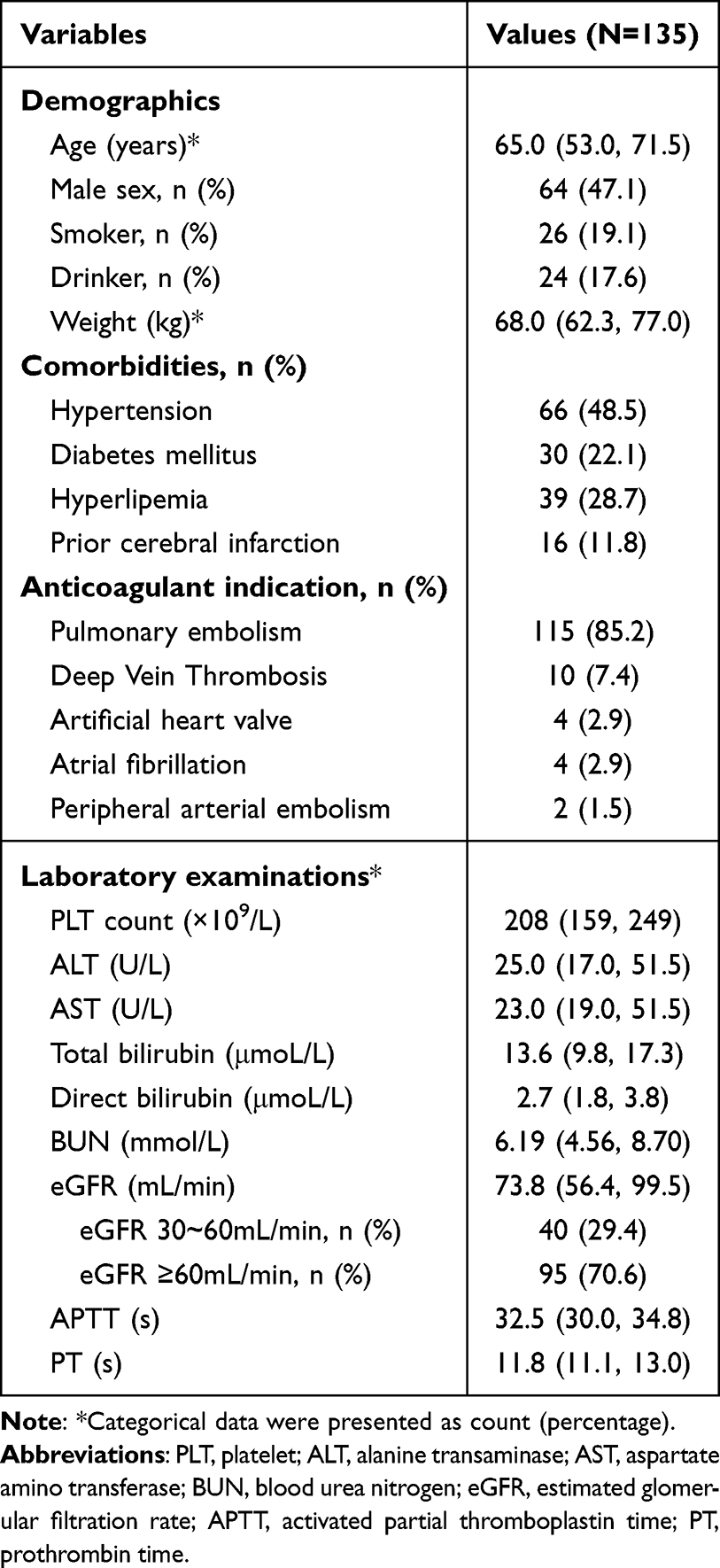 |
Table 1 Baseline Demographic and Clinical Characteristics of the Included Patients |
Distribution of Enoxaparin Doses and Anti-Xa Levels
The actual weight-adjusted doses of enoxaparin (mg/kg/day) administered to patients and steady-state peak anti-Xa levels were analyzed (Figure 1). The distribution of weight-adjusted doses (Figure 1A) revealed discrepancies between the actual doses administered and the fixed weight-adjusted doses recommended in the drug prescribing information. The distribution of anti-Xa levels (Figure 1B) revealed that some patients exhibited values outside the therapeutic target range, indicating potential underdosing or overdosing.
 |
Figure 1 Distribution of weight-adjusted dosage (A) and steady-state peak anti-Xa levels (B) of enoxaparin. The outer curves (density plots) represent the density estimate of the data distribution, with wider sections indicating higher data density (more observations). The inner box plot includes a median line marking the median value of the dataset, a box spanning from the first quartile to the third quartile, and whiskers extending from the box representing 95% confidence interval. (A) The red horizontal line represents the drug manufacturer’s recommended weight-based dose, while blue dots represent individual enoxaparin weight-based dose values. (B) The area between red horizontal lines represents the target anti-Xa level range, with red dots representing individual anti-Xa level values. |
Impact of Age on the Probability of Achieving Target Anti-Xa Levels with Enoxaparin
Dose-response curve showed a significant age-dependent effect on the probability of achieving target anti-Xa levels (Figure 2A). The model stratified by age (<80 vs ≥80 years) demonstrated that, at identical weight-adjusted doses, patients aged ≥80 years (blue line) exhibited a significantly higher probability of achieving target anti-Xa levels compared to those aged <80 years. To attain 90% and 95% target probability thresholds (Figure 2B), the required weight-adjusted doses for patients aged ≥80 years (approximately 0.66 mg/kg/day and 0.72 mg/kg/day, respectively) were markedly lower than those for patients aged <80 years (approximately 0.87 mg/kg/day and 0.98 mg/kg/day).
 |
Figure 2 Weight-based dose and probability to achieve therapeutic anti-Xa levels group by age. (A) Overview. The weight-based dose is the independent variable, achieving the anti-Xa target is the dependent variable, and the vertical axis shows the estimated probability. Patients were grouped by age (<80 years, red; ≥80 years, blue) for modeling, with data dots visualized at the bottom layer. (B) Zoomed-in region marked in light blue in (A) is shown, with 90% and 95% probabilities represented by yellow dotted lines, and the corresponding weight-based doses are displayed on the vertical blue and red dotted lines. |
Impact of Renal Function on the Probability of Achieving Target Anti-Xa Levels with Enoxaparin
In contrast to the influence of age, the dose-response curve analysis stratified by renal function (eGFR <60 mL/min vs ≥60 mL/min) (Figure 3A) revealed no significant difference in the probability of achieving target anti-Xa levels between the two groups at the same weight-adjusted doses. Although the eGFR <60 mL/min group (blue line) exhibited a higher trend toward achieving the target probability at lower dose ranges compared to the eGFR ≥60 mL/min group (red line), this difference did not reach statistical significance. Furthermore, no significant differences were observed between the two groups in the doses required to achieve 90% and 95% target probabilities (Figure 3B).
 |
Figure 3 Weight-based dose and probability to achieve therapeutic anti-Xa levels group by eGFR. (A) Overview. The weight-based dose is the independent variable, achieving the anti-Xa target is the dependent variable, and the vertical axis shows the estimated probability. Patients were grouped by eGFR (≥60 mL/min, red; <60 mL/min, blue) for modeling, with data dots visualized at the bottom layer. (B) Zoomed-in region marked in light blue in (A) is shown, with 90% and 95% probabilities represented by yellow dotted lines, and the corresponding weight-based doses are displayed on the vertical blue and red dotted lines. Abbreviation: eGFR, estimated glomerular filtration rate. |
Discussion
This study investigated the role of age and renal function in optimizing enoxaparin dosing in Asian patients, providing insights for individualized anticoagulation therapy. The results demonstrated that age was a significant factor influencing the probability of achieving target anti-Xa levels, whereas renal insufficiency, defined as eGFR <60 mL/min, showed no significant association with anti-Xa levels in this study. These findings offer important guidance for the clinical application of enoxaparin in Asian populations.
Some studies suggest that age does not affect anti-Xa levels following enoxaparin administration, particularly noting similar responses between healthy elderly and younger patients.14 However, this study conducted in a Chinese population demonstrated that patients aged ≥80 years had a significantly higher probability of achieving target anti-Xa levels than younger patients (p < 0.05) when receiving the same weight-adjusted enoxaparin dosage. This phenomenon may be closely associated with age-related physiological changes, including decreased muscle mass, increased fat proportion, reduced hepatic blood flow, and altered drug distribution volume. These factors collectively contribute to a significant reduction in enoxaparin clearance.
Notably, our findings align with guidelines emphasizing individualized treatment for elderly patients, revealing that patients aged ≥80 years require 24–26% lower weight-adjusted doses. However, most guidelines lack specific recommendations for Asian elderly population. Furthermore, current guidelines and studies emphasize renal insufficiency as a key risk factor for LMWH accumulation,15,16 the results of this study demonstrated no statistically significant difference in the probability of achieving target anti-Xa levels between the eGFR <60 mL/min group and the eGFR ≥60 mL/min group. This finding requires cautious interpretation, as it is potentially confounded by two critical study design factors: First, patients with severe renal impairment (eGFR <30 mL/min) were excluded from the analysis, and the majority of enrolled patients with renal dysfunction had only moderate impairment (eGFR 30–60 mL/min, accounting for 29.4%), with a median eGFR of 73.8 mL/min, indicating relatively preserved overall renal function in the study population. Second, the median body weight of Asian patients was significantly lower than that of Western populations, resulting in an approximately 20–30% reduction in absolute LMWH dosage, which may mitigate the accumulation effect caused by mild-to-moderate renal function decline. Based on these findings, for Asian patients with eGFR ≥30 mL/min—particularly those with lower body weight—dose reduction solely based on eGFR <60 mL/min may be overly conservative.17 However, our findings regarding the lack of association between renal function (eGFR ≥30 mL/min) and anti-Xa levels cannot be generalized to patients with severe renal insufficiency, and dose adjustment recommendations for this high-risk subgroup still require evidence from dedicated studies.
The clinical significance of this study is primarily reflected in the following aspects: Advanced age should be prioritized as a key consideration for enoxaparin dose reduction in Asian patients, with lower initial doses (0.66–0.72 mg/kg/day for patients ≥80 years) recommended for this population accompanied by monitoring of anti-Xa levels. For patients with mild to moderate renal impairment (eGFR 30–60 mL/min), dose reduction decisions should be made cautiously based on comprehensive evaluation of factors including age and body weight, rather than relying solely on eGFR thresholds. Importantly, these dose suggestions are hypothesis-generating and require prospective validation before being integrated into standard clinical practice. This study supports the implementation of anti-Xa monitoring in special populations, particularly in complex cases involving elderly patients or those with concurrent renal dysfunction.18 The findings demonstrate that actual clinical doses administered to the study population were generally lower than recommended doses, suggesting that Asian populations may achieve target anti-Xa levels with reduced dosage requirements. However, a critical limitation is the lack of data on bleeding and recurrent thrombosis events. This prevented us from correlating anti-Xa level attainment with clinical outcomes, thereby constraining the translation of our pharmacodynamic findings into definitive clinical recommendations. The anti-Xa-guided dosing approach adopted in this study is inferred from target level attainment. Future studies are therefore necessary to validate these dosing strategies using clinical endpoints.
This study has several limitations. First, the retrospective nature of the study may introduce selection bias, as patients were only included if they underwent anti-Xa monitoring, which may overrepresent high-risk or complex cases. Second, patients with an eGFR <30 mL/min were excluded, and anti-Xa levels were not thoroughly investigated in this population. Third, only peak anti-Xa concentrations were monitored, with peak levels remaining unassessed. Finally, no direct correlation was established with clinical bleeding/thrombotic events. Future studies should validate the dosing recommendations proposed herein through prospective, randomized controlled designs and further explore their association with clinical outcomes to provide more evidence-based medical evidence.
Conclusion
In conclusion, advanced age appears to be a key determinant of enoxaparin exposure and target anti-Xa level attainment in Asian patients with eGFR ≥30 mL/min/1.73 m2. Patients ≥80 years required lower doses (0.66–0.72 mg/kg/day for 90–95% target attainment) versus those <80 years (0.87–0.98 mg/kg/day). Renal function (eGFR <60 vs ≥60 mL/min/1.73 m2) had no significant impact. These findings are limited to eGFR ≥30 mL/min/1.73 m2 and require prospective validation.
Ethical Statement
The authors are accountable for all aspects of the work in ensuring that questions related to the accuracy or integrity of any part of the work are appropriately investigated and resolved. The study was conducted in accordance with the WMA Declaration of Helsinki (adopted by the 18th WMA General Assembly, Helsinki, Finland, June 1964; revised in 2013; available at: https://www.wma.net/policies-post/wma-declaration-of-helsinki). This study protocol was approved by the Ethics Committee of Beijing Anzhen Hospital, Capital Medical University (No.2025297x). All included patients gave their informed consent prior to recruitment.
Author Contributions
All authors made a significant contribution to the work reported, whether that is in the conception, study design, execution, acquisition of data, analysis and interpretation, or in all these areas; took part in drafting, revising or critically reviewing the article; gave final approval of the version to be published; have agreed on the journal to which the article has been submitted; and agree to be accountable for all aspects of the work.
Funding
Natural Science Foundation of Beijing Municipal (No. 7242048). High-Level Research Specialized Discipline Construction Project of Beijing Anzhen Hospital (No. 2024AZC3004). Hospital Pharmacy High-Quality Development Research Project of National Institute of Hospital Administration, National Health Commission (No. NIHAYSZX2547). Chronic Disease Management Research Project of National Health Commission Capacity Building and Continuing Education Center (No. GWJJMB202510041074).
Disclosure
All authors declare no conflict of interest.
References
1. Sukumar S, Cabero M, Tiu S. et al. Anti-factor Xa activity assays of direct-acting oral anticoagulants during clinical care: an observational study. Res Pract Thromb Haemost. 2021;5(4):e12528. doi:10.1002/rth2.12528
2. Verhoeff K, Raffael K, Connell M, et al. Relationship between anti-Xa level achieved with prophylactic low-molecular weight heparin and venous thromboembolism in trauma patients: a systematic review and meta-analysis. J Trauma Acute Care Surg. 2022;93(2):e61–8. doi:10.1097/TA.0000000000003580
3. May CC, Cua S, Smetana KS, et al. Supraprophylactic Anti-Factor Xa levels are associated with major bleeding in neurosurgery patients receiving prophylactic enoxaparin. World Neurosurg. 2022;157:e357–e363. doi:10.1016/j.wneu.2021.10.087
4. Mottier D, Girard P, Couturaud F, et al. Enoxaparin versus placebo to prevent symptomatic venous thromboembolism in hospitalized older adult medical patients. NEJM Evid. 2023;2(8):EVIDoa2200332. doi:10.1056/EVIDoa2200332
5. van den Broek MPH, Verschueren MV, Knibbe CAJ. Critical appraisal of evidence for anti-Xa monitoring and dosing of low-molecular-weight heparin in renal insufficiency. Expert Rev Clin Pharmacol. 2022;15(10):1155–1163. doi:10.1080/17512433.2022.2132228
6. Wang D, Fan G, Lei J, et al. LMWHs dosage and outcomes in acute pulmonary embolism with renal insufficiency, an analysis from a large real-world study. Thromb J. 2022;20(1):26. doi:10.1186/s12959-022-00385-z
7. Monagle P, Chan AKC, Goldenberg NA, et al. Antithrombotic therapy in neonates and children: antithrombotic Therapy and Prevention of Thrombosis, 9th ed: American College of Chest Physicians Evidence-Based Clinical Practice Guidelines. Chest. 2012;141(2 Suppl):e737S–e801S. doi:10.1378/chest.11-2308
8. Kearon C, Akl EA, Comerota AJ, et al. Antithrombotic therapy for VTE disease: antithrombotic Therapy and Prevention of Thrombosis, 9th ed: American College of Chest Physicians Evidence-Based Clinical Practice Guidelines. Chest. 2012;141(2 Suppl):e419S–e496S. doi:10.1378/chest.11-2301
9. Tran A, Fernando SM, Gates RS, et al. Efficacy and Safety of Anti-Xa-Guided Versus Fixed Dosing of Low Molecular Weight Heparin for Prevention of Venous Thromboembolism in Trauma Patients: a Systematic Review and Meta-Analysis. Ann Surg. 2023;277(5):734–741. doi:10.1097/SLA.0000000000005754
10. Lip GYH, Banerjee A, Boriani G, et al. Antithrombotic therapy for atrial fibrillation: CHEST guideline and expert panel report. Chest. 2018;154(5):1121–1201. doi:10.1016/j.chest.2018.07.040
11. Gibson CM, Yuet WC. Racial and ethnic differences in response to anticoagulation: a review of the literature. J Pharm Pract. 2021;34(5):685–693. doi:10.1177/0897190019894142
12. Rojas L, Aizman A, Ernst D, et al. Anti-Xa activity after enoxaparin prophylaxis in hospitalized patients weighing less than fifty-five kilograms. Thromb Res. 2013;132(6):761–764. doi:10.1016/j.thromres.2013.10.005
13. Yam L, Bahjri K, Geslani V, et al. Enoxaparin thromboprophylaxis dosing and anti-factor Xa levels in low-weight patients. Pharmacotherapy. 2019;39(7):749–755. doi:10.1002/phar.2295
14. Damiani A, De Menezes Caceres V, Roberts G, et al. A clinical practice-based comparison of conventional and individualized dosing strategies for therapeutic enoxaparin. Pharmacol Res Perspect. 2025;13(1):e70039. doi:10.1002/prp2.70039
15. Bahabri A, Chan AKC, Belostosky V, et al. Management of anticoagulation therapy in patients with thromboembolism in the context of renal dysfunction: challenging cases and practical algorithms. J Pediatr Hematol Oncol. 2021;43(7):e1040–e1044. doi:10.1097/MPH.0000000000002045
16. Sahraei Z, Eshraghi A, Barati S. Evaluating anti-factor Xa levels in patients with augmented renal clearance receiving enoxaparin prophylaxis: an exploratory pilot study. J Res Pharm Pract. 2025;14(1):35–38. doi:10.4103/jrpp.jrpp_11_25
17. Sikes L, Charles K, Antigua A, et al. Anti-Factor Xa level monitoring for enoxaparin prophylaxis and treatment in high-risk patient groups. HCA Healthc J Med. 2023;4(2):105–109. doi:10.36518/2689-0216.1464
18. Hamilton DO, Main-Ian A, Tebbutt J, et al. Standard- versus intermediate-dose enoxaparin for anti-factor Xa guided thromboprophylaxis in critically ill patients with COVID-19. Thromb J. 2021;19(1):87. doi:10.1186/s12959-021-00337-z
 © 2026 The Author(s). This work is published and licensed by Dove Medical Press Limited. The
full terms of this license are available at https://www.dovepress.com/terms
and incorporate the Creative Commons Attribution
- Non Commercial (unported, 4.0) License.
By accessing the work you hereby accept the Terms. Non-commercial uses of the work are permitted
without any further permission from Dove Medical Press Limited, provided the work is properly
attributed. For permission for commercial use of this work, please see paragraphs 4.2 and 5 of our Terms.
© 2026 The Author(s). This work is published and licensed by Dove Medical Press Limited. The
full terms of this license are available at https://www.dovepress.com/terms
and incorporate the Creative Commons Attribution
- Non Commercial (unported, 4.0) License.
By accessing the work you hereby accept the Terms. Non-commercial uses of the work are permitted
without any further permission from Dove Medical Press Limited, provided the work is properly
attributed. For permission for commercial use of this work, please see paragraphs 4.2 and 5 of our Terms.