
Back to Journals » Clinical Ophthalmology » Volume 19

Ontario Primary Care Practitioners and Access to Ophthalmologists Through Electronic Consultation
Authors Britton JJL, Tsang A  , Keely E, Liddy C
Received 9 July 2025
Accepted for publication 18 November 2025
Published 4 December 2025 Volume 2025:19 Pages 4423—4431
DOI https://doi.org/10.2147/OPTH.S549183
Checked for plagiarism Yes
Review by Single anonymous peer review
Peer reviewer comments 2
Editor who approved publication: Dr Scott Fraser
Julia Janine Lee Britton,1 Adrian Tsang,2 Erin Keely,1,3 Clare Liddy3– 5
1Department of Medicine, University of Ottawa, Ottawa, Ontario, Canada; 2University of Ottawa Eye Institute, The Ottawa Hospital, Ottawa, Ontario, Canada; 3Ontario eConsult Centre of Excellence, The Ottawa Hospital, Ottawa, Ontario, Canada; 4Department of Family Medicine, University of Ottawa, Ottawa, Ontario, Canada; 5C. T. Lamont Primary Healthcare Research Centre, Bruyere Health Research Institute, Ottawa, Ontario, Canada
Correspondence: Clare Liddy, Department of Family Medicine, University of Ottawa, 600 Peter Morand Crescent, Room 201, Ottawa, Ontario, K1G 5Z3, Canada, Email [email protected]
Purpose: In Canada, accessing specialty services remains a significant challenge, leading to growing wait times for specialist care. To address this concern, the Champlain Building Access to Specialists through eConsultation (BASE) service was introduced. The Champlain BASE eConsult service is a secure web-based program that enables access to medical specialists by PCPs. The primary objective is to investigate the types of questions primary care providers (PCP) are asking ophthalmologists through the BASE service.
Patients and Methods: Descriptive and retrospective analysis of 116 eConsults sent from PCPs to the ophthalmology specialty between January and December 2022, within the Champlain region, covering ~ 1.3 million people in Eastern Ontario. Using two validated taxonomies, the “content” and “type” of questions asked were coded. A closeout survey was used to determine PCP’s subsequent course of action, referral outcomes, and perceived helpfulness of eConsult responses.
Results: 116 eConsults (37 pediatric; 79 adult) were reviewed with an average patient age of 36.8 years. The most common types of questions asked related to general management (61%) and referral appropriateness (43%). The most common content questions related to other non-specified content – adults (28%), lid lesions (24%) and other non-specified content – pediatrics (12%). The ophthalmologist’s median response time was 0.67 days (16.1 hours) after eConsult creation, with 84% of responses being received within seven days. PCPs received a new or additional course of action in 47% of cases. Unnecessary in-person referrals were avoided in 44% of cases. Over 88% of cases were rated at least 4/5 in value, and in 94% of eConsults, the ophthalmologists’ recommendations were accepted.
Conclusion: The use of the eConsult service improves access to ophthalmologists by providing quicker, helpful, and generally accepted specialist advice while decreasing the requirement for patients to attend in-person consultations.
Plain Language Summary: In Canada, long wait times to see specialists like eye doctors are a significant concern for patients. Our study looked at how family doctors and nurse practitioners used an eConsult service to ask eye doctors questions about how to manage their patients’ eye issues. We examined how many in-person referrals were prevented, how helpful the service was to the family doctors and nurse practitioners, and how quickly they received responses. We found that the online service helped patients get faster advice from eye doctors and reduced the need for in-person visits. The family doctors and nurse practitioners felt that the service was useful for their own learning and improved their ability to manage eye issues for future patients.
Keywords: family medicine, specialist, healthcare access, eConsult
Introduction
In Canada, access to specialty services continues to be a significant challenge. As a result, wait times to see a specialist in the outpatient setting continue to grow. An ophthalmologist is a specialist within the field of medicine who treats diseases of the eye. Because there is limited ophthalmology instruction in medical school and family medicine training, many family medicine residents have low confidence in managing ocular conditions. In 2019, there were 3.27 ophthalmologists per 100,000 people in Ontario.1 Furthermore, in 2020, the total number of ophthalmology assessments (in-person and virtual visits) was 2.02 million.2 As a result, the median wait time from referral by primary care provider (PCP) until the patient seeing an ophthalmologist was 16.3 weeks, in 2022.3 This is in comparison to 4.5 weeks, 30 years prior.3 The Champlain Building Access to Specialists through eConsultation (Champlain eConsult BASETM) service was created to address this wait time concern.4 As defined by Vimalananda et al (2015),5 electronic consultation (eConsult) is “asynchronous, consultative, provider-to-provider communications within a shared electronic health record (EHR) or web-based platform.”
The Champlain eConsult BASETM service has been shown by numerous studies analyzing eConsults sent by PCPs to a specific specialty service to not only reduce the need for patients to attend in-person specialist visits but also to provide timely, expert advice from specialists to support clinical decision making.6–15 Furthermore, a study by Liddy et al (2019) that evaluated eConsults and learning between PCPs and specialists found that the Champlain eConsult BASETM service provided educational value for PCPs and improved inter-provider collegiality.16 Ultimately, a decrease in unnecessary referrals to specialists will allow for reduced wait times, late diagnoses, and poor patient health outcomes. To the best of our knowledge there are no other studies that have specifically investigated the impact of eConsults sent by PCPs to ophthalmologists.
The objectives of this study were to 1) investigate the types of questions PCPs are asking ophthalmologists through the eConsult system; 2) determine the number of referrals that PCPs initiated following the initial eConsult response; 3) determine the number of eConsults with ophthalmologists’ recommendations that were accepted by the PCP; 4) determine the difference between the time an eConsult is submitted by a PCP and the first response is received from the ophthalmologist; 5) determine the difference between the time an eConsult was assigned to an ophthalmologist and the first response was received; 6) determine how helpful the PCPs felt that the eConsult response was.
Materials and Methods
Study Design
This study is a descriptive, retrospective analysis of the eConsults sent from PCPs to the ophthalmology specialty through the Champlain eConsult BASETM service within Eastern Ontario, between January to December 2022. All cases sent during this time period were included in the analysis. PCPs are free to submit a consultation at their discretion when they believe an eConsult would be beneficial.
The Champlain eConsult BASETM service was created by Dr. Clare Liddy and Dr. Erin Keely.4 The protocol for the Champlain eConsult BASETM service, a secure web-based program that enables access to medical specialists by PCPs, has been published by Keely et al (2013)4 and is as follows: 1) a PCP submits a patient-specific clinical question to an ophthalmologist by creating a clinical case in the internet service; 2) in addition to the health history, the PCP then has the option to include additional patient information (ie images, laboratory results, previous reports) as an attachment; 3) the eConsult is then assigned to an ophthalmologist; 4) the ophthalmologist receives a notification with a link to the eConsult by email; 5) the ophthalmologist can respond with specific management recommendations, requests for additional information, or recommendation of a formal referral. Once the consultation is completed, the PCP completes a mandatory five-question closeout survey. Pro-rated to self-reported time spent consulting, the ophthalmologist is remunerated at $200 per hour by the Ontario Ministry of Health.17
Study Setting, Population and Size
The Champlain eConsult BASETM service population is within the Champlain region, covering about 1.3 million people in Eastern Ontario.8 About fifty percent of the Champlain population lives within the city of Ottawa, and about fifty percent live in communities extending up to two hours away by car.6
Data Collection
Data was collected and stored securely in a Microsoft SharePoint site, accessed through HealthCare Works.4 Data collected by the eConsult service at the time of eConsult includes PCP type (family physician or nurse practitioner), patient age, patient gender, specialty referred to, self-reported response time by specialist, questions asked by PCPs, and responses by specialist.4 Additional data collected via the closeout survey includes the outcomes of the eConsult and PCP satisfaction with responses.4 A Likert scale was used to answer questions #3 and #4. No identifying patient data were included for analysis.
Data Analysis
Data were analyzed retrospectively by two reviewers (J.B. and A.T.) using two validated taxonomies: the International Classification of Primary Care-3 (ICP-3) and the Taxonomy of Generic Clinical Questions (TGCQ).10,18,19 The ICP-3 was used to inform the “content” of the questions, and the TGCQ was used to inform the “type” of questions asked.10 Furthermore, the eConsult system records the timing for eConsult response to be received by the PCP. The scales were modified to comprise the relevant clinical topics and question types.10 During the validation phase, the first 30 eConsults were coded by the primary care resident (J.B.) and ophthalmologist (A.T.) and merged to assess the level of agreement between the two coders. Coding discrepancies were resolved between the two coders and then J.B. proceeded to code the remaining eConsults.
The mandatory close-out survey was used to determine eConsult outcomes and perceived helpfulness. A descriptive analysis was conducted to describe the responses to the closeout survey.
Results
Of the 116 submitted eConsults, there were 70 (60.3%) female and 46 (39.7%) male patients, with an average age of 36.8 years. The median time for the PCP to receive a response after eConsult creation was 0.67 days (mean 4.75; SD 9.26; range 49.23). The median time difference between the eConsult assignment to an ophthalmologist and the first response received by the PCP was 0.43 days (mean 2.63; SD 5.12; range 29.90). The median amount of time required for an ophthalmologist to write their response was 15 minutes (mean 17.53; SD 9.14; range 80.00). 84% (97/116) of ophthalmologist responses were received within 7 days of the eConsult being created. Four cases took longer than 30 days for a response to be received from an ophthalmologist after the case had been assigned.
The most frequent question type asked was classed as “management - general management” (61%). The second most common question asked was classified as “management - should I refer” (43%) (Figure 1). Often, more than one type of question was asked per eConsult. A common theme for general management questions was a request for guidance on management after providing a description of the clinical presentation, which often was also accompanied by request for diagnosis clarification. For example, there was a patient who had presented with a one-day history of non-painful red eye and their PCP wrote “please advise on possible diagnosis and management.” Alternative phrases included, “would be grateful for your expert thoughts,” and “what would be the next steps for management.” Another theme was request for recommendations as to what further investigations or work-up would be necessary. As well, there were numerous questions related to chronic lid lesions and clarification on their management. For example, a patient with recurring chalazion had attempted a few weeks of polysporin and warm compresses. The PCP questioned what the next steps would be due to the persistent nature.
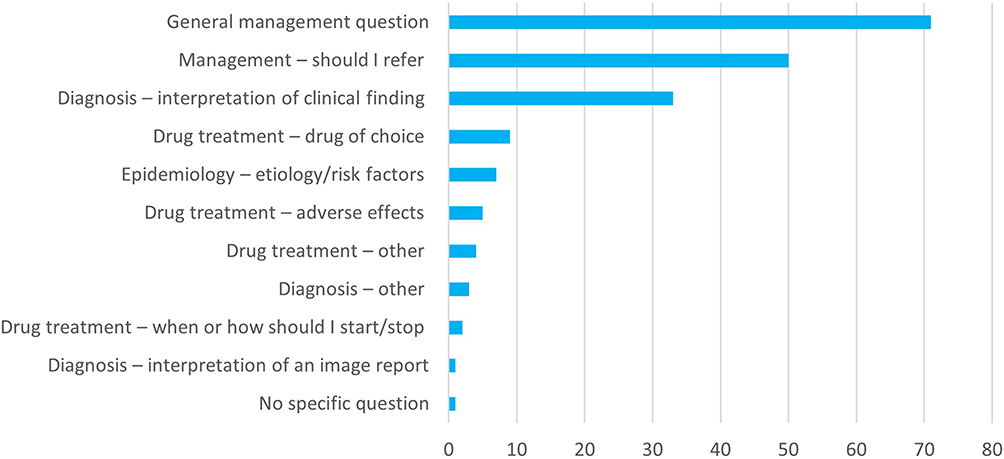 |
Figure 1 Type of question asked by PCPs of ophthalmologists via the eConsult system. Numbers on the X-axis represent numbers of cases for each category. |
The most frequent content questions were those related to other non-specified content for adults (28%), the second most common questions related to lid lesions (24%), and the third were pediatric other non-specified content (12%) (Figure 2). Figure 3 illustrates the subcategory of content questions for “other non-specified content for adults.” For “pediatric other non-specified content” there were a further 14 individual clinical subcategories, including: nasolacrimal duct obstruction, family history of albinism, convergency insufficiency, conjunctival lesion, bloody tears, foreign body, blepharitis, lid excoriation, scleral melanocytosis, pupil abnormality, dry eye, ocular HSV, iris nevus, and possible Horner’s syndrome (Figure 4).
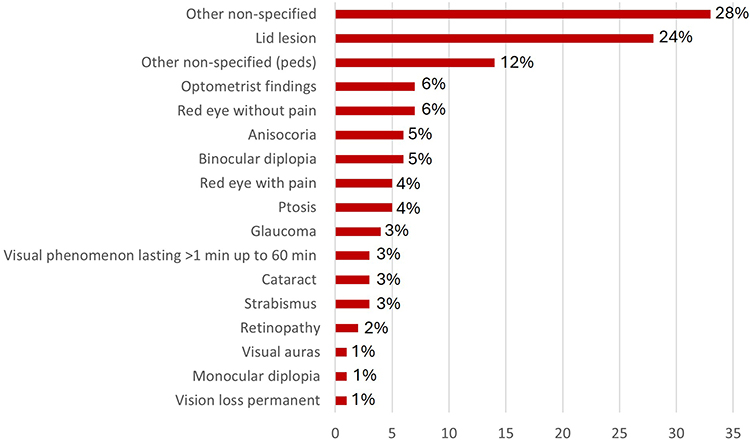 |
Figure 2 Content of question asked PCPs of ophthalmologists via the eConsult system. Numbers on the X-axis represent numbers of cases for each category. |
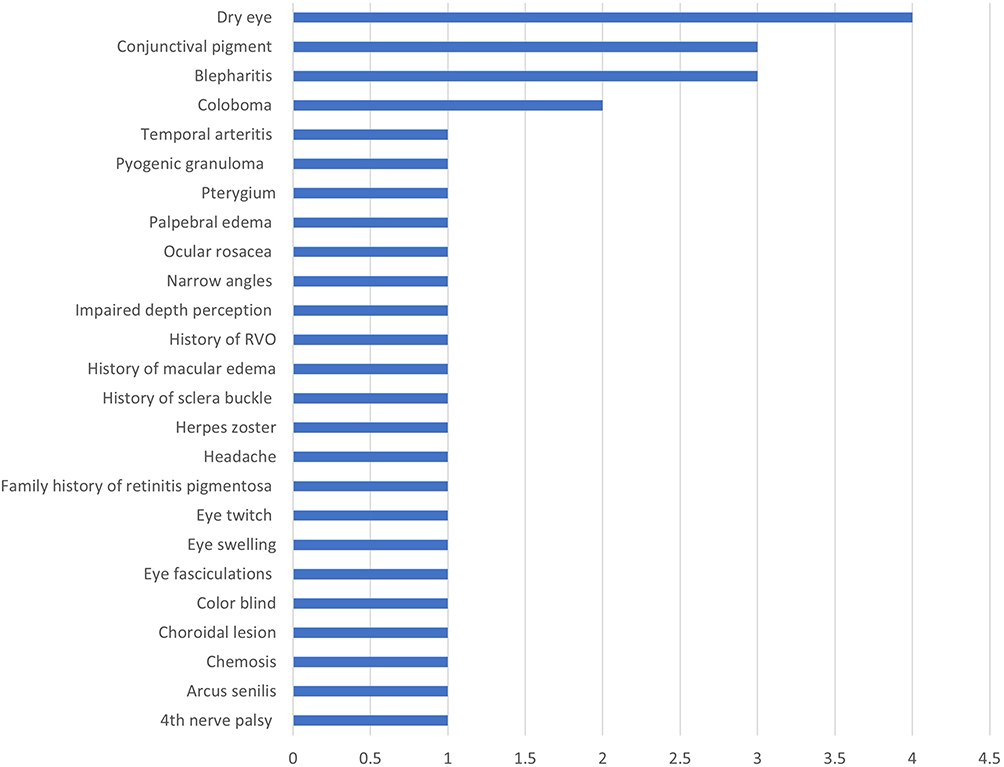 |
Figure 3 Content of questions subcategory for questions coded as “other non-specified – adult”. Numbers on the X-axis represent numbers of cases for each category. |
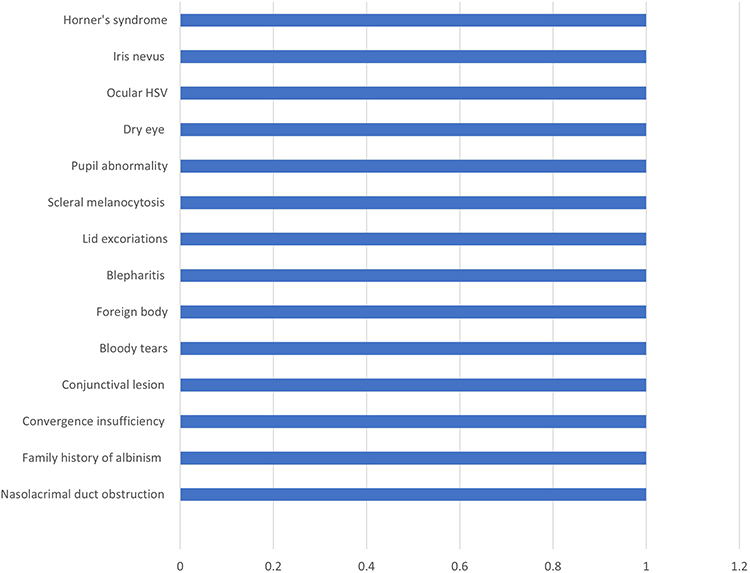 |
Figure 4 Content of questions subcategory for questions coded as “other non-specified – pediatric”. Numbers on the X-axis represent numbers of cases for each category. |
Post-eConsult Survey
With regards to outcomes based on the information received from the eConsult (Figure 5), nearly all PCPs received useful advice. Of the remainder, one PCP commented “I did not find the response helpful” but they did not elaborate further.
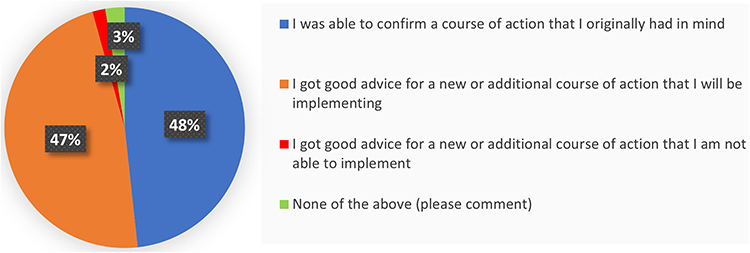 |
Figure 5 Outcomes of eConsult system on course of action implemented by PCP. |
There was a total of 41 in-person referrals initiated by PCPs following the initial eConsult response (Figure 6). Of those, 95% of referrals were originally contemplated and found to still be needed. Of all eConsults, 2% of referrals were not originally contemplated, but the eConsult resulted in a referral being initiated.
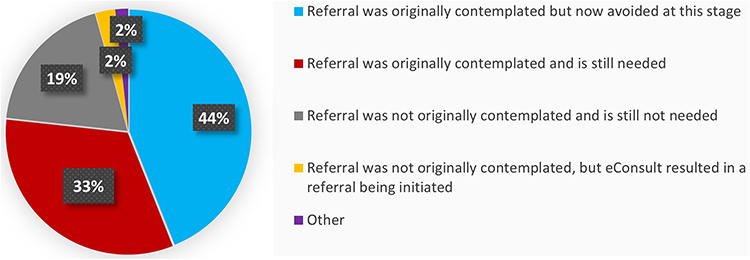 |
Figure 6 Results of eConsult system on the decision of the PCP to refer to ophthalmologist. |
PCPs ranked the overall helpfulness of the eConsult service using a Likert scale ranging from 1 (minimal) to 5 (valuable). 88% of PCPs ranked the eConsult service a 4 (25%) or a 5 (75%) for its helpfulness. In 94% of eConsults, the ophthalmologists’ recommendations were accepted by the PCP. This included those who reported accepting the recommendations or agreed to make a referral as per the ophthalmologist’s recommendations.
Discussion
Main Findings
As demonstrated by previous studies,6–15 our study illustrates the positive impact that the eConsult system can have on both quicker access to specialist advice and PCPs’ ensuing decision making with regards to in-person referrals. Although wait time for an in-person consult with an ophthalmologist in Ontario was 16.3 weeks in 2022, the median time for response to an eConsult was significantly quicker at 16.7 hours post-creation. In cases where in-person referral was not required, this service allowed for PCP lead management to be initiated sooner. In some cases where referral was warranted, the ophthalmologist would request a referral be sent to them, therefore streamlining the process.
This study further shows that eConsults are generally perceived as valuable by PCPs, since nearly all recommendations made by ophthalmologists were accepted. The eConsult system prevented unnecessary referral in 44% of cases. Therefore, patients were able to avoid waiting for and traveling to an in-person appointment. As well, ophthalmologist’s clinic time was not consumed by unnecessary referrals.
PCPs play an important role in managing patients with common ocular conditions, including dry eye syndrome, blepharitis, styes, chalazion, conjunctivitis, congenital nasolacrimal duct obstruction, superficial foreign bodies, corneal abrasion, and subconjunctival hemorrhage.20 The most common questions asked by PCPs pertained to general management of a broad range of common ocular conditions and query as to weather a referral would be warranted. One study completed a systematic review that demonstrated that the amount of ophthalmology teaching in medical schools has been declining globally for the last two decades.21 On average, only 26.4% of students felt confident in their ophthalmology knowledge.21 Similarly, another study found that although the number of hours of ophthalmology training received by family medicine residents during medical school met the International Council of Ophthalmology Task Force recommendations, 80% of family medicine residents reported to be uncomfortable in handling treatable ocular conditions.22 Additionally, they found that except for dry eyes and conjunctivitis, residents felt “moderately comfortable” or less with managing all other conditions in their study.22 A possible explanation for our findings of heterogenicity among the content of questions asked (both for adults and pediatrics), as well as the focus on general management and referral appropriateness, could be in relation to the PCP’s perceived skill level and confidence in managing these ocular conditions.
In 2% of cases, patients were referred to an ophthalmologist because of the eConsult recommendation despite a referral not initially being planned. For two of the six cases of binocular diplopia (Figure 2), the ophthalmologists advised urgent referral. One ophthalmologist’s response stated, “any new, sudden persistent diplopia should be evaluated in the emergency room for quick access to imaging and neurology consultation.” These cases illustrate the importance of PCP confidence regarding referral decision-making in ensuring urgent cases reach specialist care in a timely manner. As also shown by Hadden et al (2022), the eConsult service helps to detect referrals that would have otherwise been missed. Similarly, two recent studies found that eConsult is an effective and cost-efficient way to provide timely care for eye issues.23,24
Implications
Generally, not only do eConsults save time for those who are involved, waitlists can become shorter for patients who do require specialist consultation by reducing the number of unnecessary referrals. Furthermore, nearly half of all PCPs reported that they received good advice for a new or additional course of action that they would then implement, which they had not considered previously. Therefore, eConsults can be used in general practice to provide valuable education for PCPs, while also providing documentation of the consult which they can revisit. This is supported by Liddy et al (2019), who found that virtual connection through the eConsult service led to opportunities for teaching and learning, without providers requiring an in-person meeting.16
Limitations
The study has a small sample size which limits its generalizability to the population in other jurisdictions. As well, due to the possibility of eConsult response time to be greater than 30 days, it is possible that some cases requiring urgent intervention may be delayed past a required timeframe for appropriate management. In addition, we modified the validated ICP-3 and TGCQ taxonomies to make them more relevant for an ophthalmology study, but this may make it more difficult to compare our findings directly with results from studies using unmodified versions of these taxonomies. Finally, based on the amount of information provided by the PCP and the way in which they form their question, there is room for interpretation variations by the specialist, possibly leading to different outcomes.
Future Work/Recommendations
In Eastern Ontario, the Champlain eConsult BASETM service has been utilized by PCPs due to the benefits of timely access to specialist services, continued education and improved referral efficiency. Therefore, as previously suggested, we recommend expanding the eConsult service to other jurisdictions throughout Canada.7
Secondly, the benefits of the eConsult service could be further refined with education. Further training, whether during medical school, residency, or through implementation of a training intervention created by ophthalmologists, should be investigated to determine its effectiveness of increasing comfort in managing and referring common ocular conditions and preventing delays in necessary referrals.
Conclusions
In Canada, growing wait times to see a specialist continues to be a significant concern for timely treatment and patient health outcomes. Through the establishment of a collaborative platform between PCPs and ophthalmologists, the Champlain eConsult BASETM service helps to prevent unnecessary referrals to ophthalmologists, provide guidance for care in a timely manner compared to in-person referrals, and has significant educational value as perceived by PCPs. Additionally, the eConsult system can help to detect referrals that could be missed. Finally, efforts to improve PCP confidence in managing a broad range of ocular conditions and referral decision-making would likely provide further efficiency for the eConsult system.
Abbreviations
BASE, Building Access to Specialist Care via eConsult; ICP-3, International Classification of Primary Care-3; PCP, Primary care provider; TGCQ, Taxonomy of Generic Clinical Questions.
Data Sharing Statement
Data are available upon reasonable request from the corresponding author, Clare Liddy [email protected]).
Ethics Approval and Informed Consent
The objectives, methodology, and data collection involved in this study were reviewed and granted ethical clearance by the Ottawa Health Science Network Research Ethics Board (OHSN-REB; protocol number 2009848-01H). All methods were carried out in accordance with relevant guidelines and regulations. All patient data were maintained with confidentiality, in compliance with the Declaration of Helsinki. The OHSN-REB waived informed consent for the study due to its retrospective, cross-sectional nature, so individualized patient consent was not obtained.
Author Contributions
All authors made a significant contribution to the work reported, whether that is in the conception, study design, execution, acquisition of data, analysis and interpretation, or in all these areas; took part in drafting, revising or critically reviewing the article; gave final approval of the version to be published; have agreed on the journal to which the article has been submitted; and agree to be accountable for all aspects of the work.
Funding
Support with analysis was provided in-kind from the Ontario eConsult Centre of Excellence which is funded by the Ontario Health. The opinions, results, and conclusions reported in this paper are those of the authors and are independent of the funding sources. No endorsement by Ontario Health is intended or should be inferred.
Disclosure
Dr. Liddy and Dr. Keely are the co-founders of the eConsultBASE™ service but have no commercial interest in the service. Dr. Keely is the Executive Director of the Ontario eConsult Centre of Excellence and receives salary support from Ontario Health. Dr. Keely completes occasional eConsults as a specialist through the service for which she is reimbursed. Dr. Liddy is the Evaluation Lead for the Ontario eConsult Centre and receives salary support from Ontario Health. She is also the Digital Clinical Lead at Ontario Health for which she receives salary support. They have no other conflicts of interest to declare.
References
1. Sayal AP, Ahmed Y, Popovic MM, et al. Supply and demographic characteristics of Ontario’s ophthalmologists from 2010 to 2019: a population-based analysis. CMAJ Open. 2022;10(4):E1067–E1078. doi:10.9778/cmajo.20210319
2. Jin Y-P, Canizares M, El-Defrawy S, Bogale W, Buys Y. Use of virtual care in ophthalmology in Ontario, Canada in 2020 during the COVID-19 pandemic. Can J Ophthalmol. 2024;59(1):e7–e15. doi:10.1016/j.jcjo.2022.10.015
3. Moir M, Barua B. Waiting your turn: wait times for health care in Canada. 2022.
4. Keely E, Liddy C, Afkham A. Utilization, benefits, and impact of an e-Consultation service across diverse specialties and primary care providers. Telemed J E Health. 2013;19(10):733–738. doi:10.1089/tmj.2013.0007
5. Vimalananda VG, Gupte G, Seraj SM, et al. Electronic consultations (e-consults) to improve access to specialty care: a systematic review and narrative synthesis. J Telemedicine Telecare. 2015;21(6):323–330. doi:10.1177/1357633X15582108
6. Keely E, Canning S, Saloojee N, Afkham A, Liddy C. Improving access to gastroenterologist using eConsultation: a way to potentially shorten wait times. J Canadian Assoc Gastroenterol. 2018;1(3):124–128. doi:10.1093/jcag/gwy017
7. Archibald D, Stratton J, Liddy C, Grant R, Green D, Keely E. Evaluation of an electronic consultation service in psychiatry for primary care providers. BMC Psychiatry. 2018;18(1). doi:10.1186/s12888-018-1701-3
8. Hadden WJ, Guglani S, Sakanovic A, Liddy C, Keely E, Meulenkamp B. Access to orthopedic specialist service in Ontario via eConsult. Canadian J Surg. 2022;65(5):E643–E649. doi:10.1503/cjs.005820
9. Lai A, Keely E, McCutcheon T, Liddy C, Afkham A, Frost D. A retrospective analysis of the use of electronic consultation in general internal medicine. Internal Med J. 2022;53(9):1642–1647. doi:10.1111/imj.15940
10. Fung C, Shah S, Helmer-Smith M, Levi C, Keely E, Liddy C. Clinical questions asked by long-term care providers through eConsult: a retrospective study. Gerontol Geriatr Med. 2021;7:233372142110320. doi:10.1177/23337214211032055
11. Tran C, Liddy C, Liu DM, Afkham A, Keely E. eConsults to endocrinologists improve access and change primary care provider behavior. Endocr Pract. 2016b;22(10):1145–1150. doi:10.4158/e161321
12. Kohlert S, Murphy P, Tse D, Liddy C, Afkham A, Keely E. Improving access to otolaryngology–head and neck surgery expert advice through eConsultations. Laryngoscope. 2018;128(2):350–355. doi:10.1002/lary.26677
13. Witherspoon L, Liddy C, Afkham A, Keely E, Mahoney J. Improving access to urologists through an electronic consultation service. Canadian Urologic Assoc J. 2017;11(8):270–274. doi:10.5489/cuaj.4314
14. Rostom K, Smith CD, Liddy C, Afkham A, Keely E. Improving access to rheumatologists: use and benefits of an electronic consultation service. J Rheumatol. 2018;45(1):137–140. doi:10.3899/jrheum.161529
15. Keely E, Li J, Magner P, Afkham A, Liddy C. Nephrology eConsults for primary care providers: original investigation. Canadian J Kidney Health Dis. 2018;5(5):2054358117753619. doi:10.1177/2054358117753619
16. Liddy C, Abu-Hijleh T, Joschko J, Archibald D, Keely E. eConsults and learning between primary care providers and specialists. Family Medicine. 2019;51(7):567–573. doi:10.22454/fammed.2019.407574
17. Liddy C, Drosinis P, Armstrong CD, McKellips F, Afkham A, Keely E. What are the cost savings associated with providing access to specialist care through the Champlain BASE eConsult service? A costing evaluation. BMJ Open. 2016;6(6):e010920. doi:10.1136/bmjopen-2015-010920
18. Ely JW, Osheroff JA, Gorman PN, et al. A taxonomy of generic clinical questions: classification study. BMJ. 2000;321(7258):429–432. doi:10.1136/bmj.321.7258.429
19. WONCA, World Organization of Family Doctors (Director). 2022. ICPC-3 International Classification of Primary Care: User Manual and Classification. Van Boven K, Napel HT. editors.
20. Shields SR. Managing eye disease in primary care. Part 2. How to recognize and treat common eye problems. Postgraduate Med. 2000;108(5):83–96. doi:10.3810/pgm.2000.10.1780
21. Spencer SKR, Ireland PA, Braden J, et al. A systematic review of ophthalmology education in medical schools: the global decline. Ophthalmology. 2024;132(7):855–863. doi:10.1016/j.ophtha.2024.01.005
22. Chan TY, Rai AS, Lee E, Glicksman JT, Hutnik CM. Needs assessment of ophthalmology education for primary care physicians in training: comparison with the International council of ophthalmology recommendations. Clinical Ophthalmology. 2011;5:311–319. doi:10.2147/OPTH.S17567
23. Sherif NA, Lorch AC, Armstrong GW. Physician-to-physician econsultations to ophthalmologists at an academic medical center. Transl Vis Sci Technol. 2024;13(10):13. doi:10.1167/tvst.13.10.13
24. Milovanova E, Park T, Stockl F. Effect of implementation of an electronic consult referral platform (eConsult) to triage retina referrals in Manitoba. Can J Ophthalmol. 2025;60(4):e610–e614. PMID: 39904485. doi:10.1016/j.jcjo.2025.01.014
 © 2025 The Author(s). This work is published and licensed by Dove Medical Press Limited. The
full terms of this license are available at https://www.dovepress.com/terms
and incorporate the Creative Commons Attribution
- Non Commercial (unported, 4.0) License.
By accessing the work you hereby accept the Terms. Non-commercial uses of the work are permitted
without any further permission from Dove Medical Press Limited, provided the work is properly
attributed. For permission for commercial use of this work, please see paragraphs 4.2 and 5 of our Terms.
© 2025 The Author(s). This work is published and licensed by Dove Medical Press Limited. The
full terms of this license are available at https://www.dovepress.com/terms
and incorporate the Creative Commons Attribution
- Non Commercial (unported, 4.0) License.
By accessing the work you hereby accept the Terms. Non-commercial uses of the work are permitted
without any further permission from Dove Medical Press Limited, provided the work is properly
attributed. For permission for commercial use of this work, please see paragraphs 4.2 and 5 of our Terms.