
Back to Journals » Therapeutics and Clinical Risk Management » Volume 22
Minimally Invasive Evacuation for Spontaneous Supratentorial Intracerebral Hemorrhage After Contemporary Randomized Trials: Patient Selection, Timing, and Platform Choice
Authors Shao X, Tan C, Yu M, Yang F
Received 23 April 2026
Accepted for publication 4 July 2026
Published 22 July 2026 Volume 2026:22 619414
DOI https://doi.org/10.2147/TCRM.S619414
Checked for plagiarism Yes
Review by Single anonymous peer review
Peer reviewer comments 2
Editor who approved publication: Dr Sandeep Ajoy Saha
Xin Shao,1 Chen Tan,2 Meiqi Yu,3 Fan Yang1
1Department of Neurosurgery, the First Hospital of China Medical University, Shenyang, Liaoning, People’s Republic of China; 2Department of Endocrinology and Metabolism, the First Hospital of China Medical University, Shenyang, Liaoning, People’s Republic of China; 3Department of Cardiac Surgery, the First Hospital of China Medical University, Shenyang, Liaoning, People’s Republic of China
Correspondence: Fan Yang, Department of Neurosurgery, the First Hospital of China Medical University, No. 155 Nanjing North Street, Heping District, Shenyang, Liaoning Province, 110001, People’s Republic of China, Email [email protected]
Abstract: Spontaneous intracerebral hemorrhage (ICH) accounts for only 10– 15% of all strokes but contributes disproportionately to stroke-related death and long-term disability. For decades, surgical evacuation of supratentorial ICH failed to show consistent functional benefit in randomized trials. The Early Minimally Invasive Removal of Intracerebral Hemorrhage (ENRICH) trial altered this trajectory by providing the first positive randomized evidence that an early, protocolized minimally invasive parafascicular approach can improve utility-weighted 180-day outcome in a predominantly lobar population. Interpretation was complicated by the 2025 MIND trial, which tested Artemis-based minimally invasive evacuation in a cohort dominated by deep hemorrhage and, after early termination, did not show benefit on its primary endpoint. In parallel, the SWITCH trial suggested at most a limited role for decompressive craniectomy without clot evacuation in severe deep ICH, with any possible reduction in death or extreme disability tempered by substantial residual disability among survivors. These trials indicate that the current issue is no longer the general rationale for surgery, but the specific patients, treatment window, and technical conditions under which evacuation is most likely to confer net benefit. This review traces the evidence from the International Surgical Trial in Intracerebral Haemorrhage (STICH) program and the Minimally Invasive Surgery Plus Alteplase for Intracerebral Hemorrhage Evacuation (MISTIE) program to ENRICH and MIND, compares the major minimally invasive strategies, and examines hemorrhage location, hematoma volume, and treatment timing as the principal determinants of patient selection. On the basis of current randomized evidence, the clearest evidence-supported indication is early (< 24 h) minimally invasive evacuation for patients resembling the ENRICH population: lobar supratentorial ICH, hematoma volume 30– 80 mL, and treatment performed by a trained team using a standardized parafascicular workflow. Conversely, routine minimally invasive evacuation for most deep supratentorial hemorrhages, ultra-early (< 8 h) intervention outside clinical trials, intervention beyond the ENRICH-supported early window, and the use of alternative platforms without comparable randomized support should be regarded as investigational or extrapolative rather than established standard care.
Keywords: intracerebral hemorrhage, minimally invasive surgery, ENRICH trial, MIND trial, trans-sulcal parafascicular surgery, endoscopic hematoma evacuation, patient selection, surgical timing
Introduction
Epidemiological Burden and the Persistent Treatment Gap
In 2021, spontaneous intracerebral hemorrhage (ICH) accounted for about 28.8% of incident strokes worldwide. Although less common than ischemic stroke, it contributed nearly half of stroke-related disability-adjusted life years, reflecting its disproportionate burden of death and long-term disability.1 Contemporary population-based evidence indicates a 1-month case-fatality of 35.5%, while pooled estimates suggest that only about 31.2% of patients achieve a good functional outcome by 3–12 months, without a clear temporal improvement over time.2
Pharmacological options for ICH are limited. The INTERACT2 trial showed that early intensive systolic blood-pressure lowering to below 140 mmHg was safe and did not significantly reduce the primary endpoint of death or major disability at 90 days, although ordinal analysis suggested a modest shift toward better functional outcome.3 ATACH-2 subsequently showed that more aggressive systolic blood-pressure reduction to a target of 110–139 mmHg, as compared with 140–179 mmHg, did not improve death or disability and was associated with more renal adverse events.4 Hemostatic strategies have also been disappointing: in TICH-2, tranexamic acid did not improve 90-day functional outcome despite a modest reduction in early hematoma expansion.5 In the absence of a clearly effective clot-directed medical therapy, interest in surgical evacuation has persisted as a means of reducing both clot mass effect and secondary injury related to blood breakdown products.
Pathophysiological Rationale for Surgical Evacuation
The injury mechanisms of ICH are conventionally divided into primary and secondary phases. The primary insult is mechanical: the expanding hematoma disrupts and compresses adjacent brain tissue, generates mass effect and intracranial hypertension, and can reduce perihematomal perfusion.6 Within hours, a secondary injury cascade is set in motion by thrombin signaling and complement activation; subsequent erythrolysis and hemoglobin breakdown further amplify heme- and iron-mediated oxidative stress, neuroinflammation, blood–brain barrier injury, and perihematomal edema.7–9 Translational studies have shown that iron-related injury begins early after ictus and evolves over the ensuing days as erythrolysis and hemoglobin breakdown progress.9 In experimental models, early clot aspiration reduced neuronal loss in rodent ICH and, in porcine thrombolysis-aspiration paradigms, lessened perihematomal edema and tissue pressure.10,11 The surgical rationale is therefore twofold: relief of mass effect and reduction of ongoing clot-derived secondary injury. Clinical translation, however, has depended on removing sufficient hematoma while minimizing iatrogenic tissue injury, a tension that has shaped the evolution from open craniotomy to contemporary minimally invasive evacuation strategies.12
The Timing Paradox: Why Earlier is Not Necessarily Safer
A critical tension pervades the design of every ICH surgery trial. Hematoma expansion (HE) occurs in roughly one fifth of patients overall, with risk concentrated in the first few hours after symptom onset, and is a major determinant of early neurological deterioration and poor outcome.13 Among imaging markers, the CTA spot sign is the most established predictor of subsequent hematoma expansion;14 noncontrast CT markers such as the blend, black hole, island, and swirl signs also convey risk, but their performance is more variable across signs and imaging time windows.15 Earlier evacuation may in principle limit mass effect and downstream secondary injury, but ultra-early evacuation before bleeding has stabilized can increase intraoperative bleeding and complicate hemostasis.16 This tension is reflected in the trial windows used across contemporary studies: the Early Minimally Invasive Removal of Intracerebral Hemorrhage (ENRICH) trial mandated treatment within 24 hours,17 the MIND trial allowed intervention within 72 hours,18 and the Dutch Intracerebral Haemorrhage Surgery Trial (DIST) is explicitly testing an ultra-early window within 8 hours.19 Similar ultra-early strategies are being explored in ongoing programs such as EVACUATE and DIST.19,20 Understanding this tradeoff is essential to interpreting the divergent results of successive surgical trials and to defining the optimal therapeutic window.
This review is organized around three clinical questions: patient selection, treatment timing, and platform choice. Major randomized trials are used as the main framework for linking sources of heterogeneity to the divergent outcomes observed across surgical studies. The major randomized trials informing patient selection, procedural timing, and platform choice are summarized in Table 1.
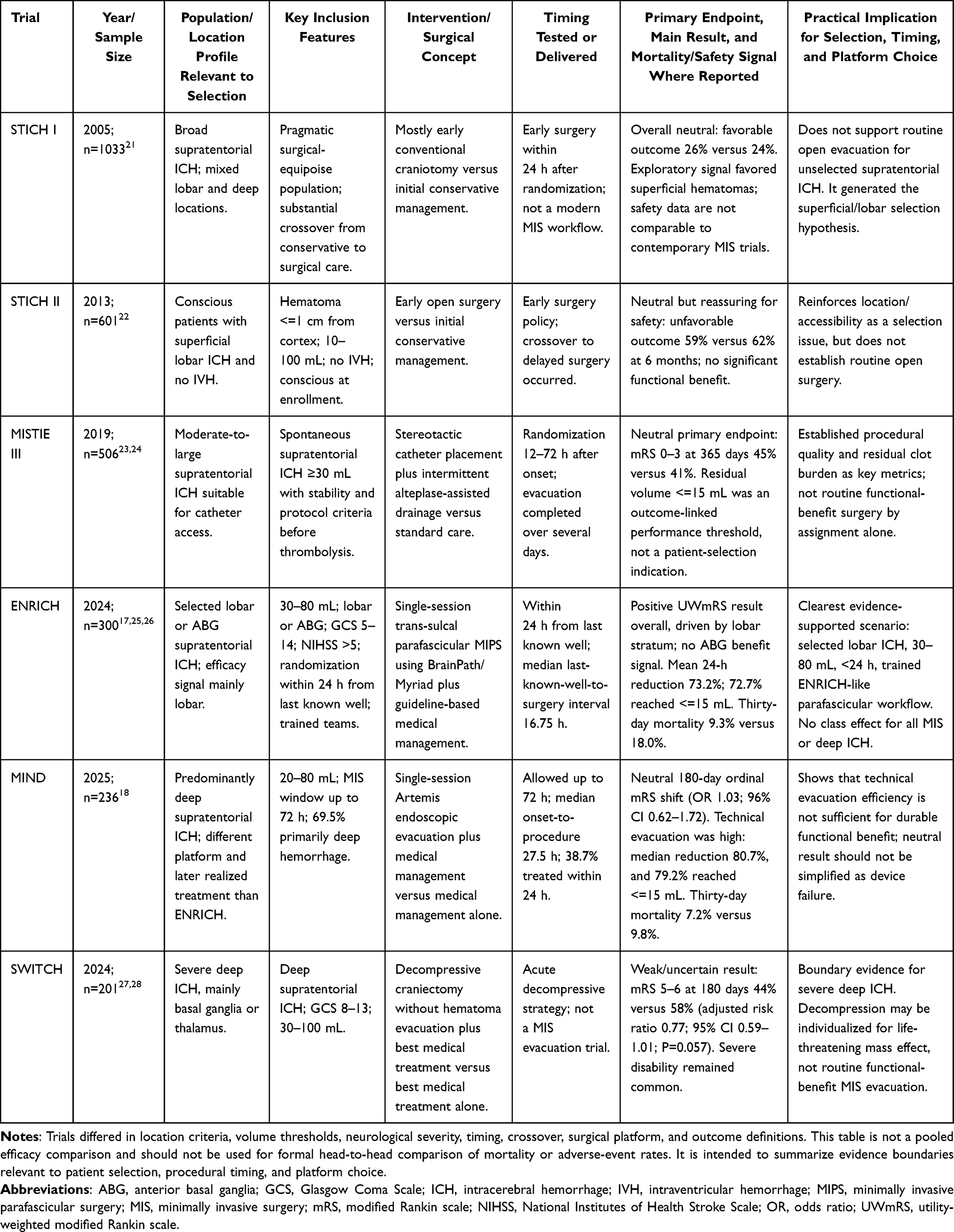 |
Table 1 Major Randomized Trials of Surgery or Minimally Invasive Evacuation for Spontaneous Supratentorial Intracerebral Hemorrhage |
Historical Evidence Chain: From Craniotomy to Early Minimally Invasive Attempts
The McKissock and Auer Era
The first randomized controlled trial (RCT) comparing surgical evacuation with conservative management for spontaneous ICH was conducted by McKissock et al in 1961, enrolling 180 patients.29 The trial found no overall advantage for surgery and contributed to long-standing skepticism toward routine open evacuation for supratentorial ICH. Nearly three decades later, Auer et al reported the first randomized trial of endoscopic surgery for ICH.30 Among 100 patients, endoscopic evacuation was associated with lower mortality than medical treatment in the subcortical hemorrhage subgroup (30% versus 70%), whereas a clear benefit was not demonstrated in putaminal or thalamic hemorrhages.30 These findings introduced the possibility that treatment effect may differ by hemorrhage location.
International Surgical Trial in Intracerebral Haemorrhage (STICH) I
STICH remains the largest RCT of early surgery for supratentorial ICH to date; most procedures in the surgical arm were conventional craniotomies. A total of 1033 patients with supratentorial ICH were randomized to early surgery (within 24 hours of randomization) or initial conservative management, with the primary outcome assessed at six months using a prognosis-based dichotomization of the Glasgow Outcome Scale.21 No overall difference was detected: 26% of the early-surgery group versus 24% of the initial-conservative-treatment group achieved a favorable outcome.21 Subgroup analyses, however, suggested a possible benefit of surgery for hematomas located within 1 cm of the cortical surface, a finding that would subsequently motivate the STICH II trial. Interpretation was complicated by the fact that the trial predated contemporary minimally invasive platforms and by substantial crossover from the conservative to the surgical arm (26%), which reduced separation between groups in the intention-to-treat analysis.31
STICH II
STICH II refined the entry criteria by enrolling conscious patients with superficial lobar hemorrhages (≤1 cm from the cortical surface) of 10–100 mL without intraventricular hemorrhage (IVH), yielding a more homogeneous population of 601 patients across 78 centers.22 At six months, 59% of the early surgery group had an unfavorable outcome compared with 62% of the conservative group—an absolute difference of 3.7 percentage points that did not reach statistical significance (odds ratio 0.86; 95% CI, 0.62–1.20; P = 0.367).22 Crossover from initial conservative treatment to delayed surgery occurred in 21% of cases, further complicating interpretation.22 Despite its neutral primary result, STICH II kept open the possibility of benefit in selected superficial lobar ICH and showed that an early-surgery policy did not increase death or disability at 6 months.
Lessons from STICH I and II Combined
A later combined analysis of the STICH trials evaluated 1541 patients with available outcome data using both subgroup meta-analysis and nonparametric regression, and found the most favorable surgical signal in patients with intermediate baseline severity (approximately GCS 10–13), with surgery appearing increasingly unfavorable in smaller hematomas and more favorable as hematoma volume increased.32 This analysis suggested that the neutral top-line results of the STICH program likely reflected treatment-effect heterogeneity across baseline severity and hematoma size and should not be interpreted as evidence of uniformly absent surgical benefit.32
The Minimally Invasive Surgery Plus Alteplase for Intracerebral Hemorrhage Evacuation (MISTIE) Program: Catheter-Based Thrombolysis and the Emergence of the 15-mL Threshold
MISTIE II
MISTIE program pioneered an alternative to open craniotomy: image-guided stereotactic catheter placement followed by intermittent instillation of alteplase to lyse the clot and permit passive drainage. MISTIE II, an open-label Phase 2 dose-finding trial, enrolled 96 patients with supratentorial ICH of 20 mL or greater and demonstrated the procedural feasibility of stereotactic catheter evacuation plus alteplase. Although overall safety appeared acceptable, the excess of asymptomatic bleeding signaled that technical execution and treatment intensity would require tighter control in later-phase testing. These findings informed the design of the Phase 3 MISTIE III trial.33
MISTIE III
MISTIE III tested this strategy in a phase 3, open-label, blinded-endpoint efficacy trial. Across 78 hospitals in the USA, Canada, Europe, Australia, and Asia, 506 patients with supratentorial ICH of 30 mL or greater were randomized to image-guided catheter evacuation plus alteplase (1.0 mg every 8 hours for up to nine doses) or standard medical care. The primary modified intention-to-treat analysis was neutral: 45% of patients assigned to MISTIE and 41% assigned to standard care achieved mRS 0–3 at 365 days (adjusted risk difference 4%; 95% CI, −4 to 12; P = 0.33).23 However, the secondary performance analyses were more instructive than the top-line result. Functional benefit tracked more closely with the adequacy of clot removal than with surgical assignment alone: an end-of-treatment residual volume of ≤15 mL, or roughly ≥70% evacuation, identified the performance range associated with a higher probability of good functional outcome, whereas mortality benefit was associated with residual volume ≤30 mL or >53% reduction. These analyses also exposed a clear learning-curve effect, with no surgeon who had performed >4 trial procedures and no site with >7 procedures leaving a patient with an end-of-treatment hematoma volume >30 mL.24
Methodological Legacy of MISTIE
Although MISTIE III did not establish trial-level superiority, it changed how surgical success in minimally invasive ICH evacuation was subsequently framed. Its principal methodological legacy was the shift from treatment assignment to treatment quality: residual clot volume displaced procedural intent as the operative metric most closely linked to outcome. In this respect, the MISTIE program showed that minimally invasive ICH surgery must be judged by procedural performance, with timing, evacuation completeness, and technical consistency explicitly specified if efficacy is to be tested fairly.34
The ENRICH Trial: First Positive Randomized Evidence
Design and Methodological Innovations
The ENRICH trial was a prospective, multicenter, adaptive, randomized trial with end-point adjudication conducted at 37 centers in the United States between 2017 and 2023. Eligible patients had spontaneous supratentorial ICH of 30–80 mL in either a lobar or anterior basal ganglia (ABG) location, a Glasgow Coma Scale score of 5–14, and a National Institutes of Health Stroke Scale score greater than 5, and were assigned within 24 hours after they were last known to be well to minimally invasive parafascicular surgery (MIPS) plus guideline-based medical management or to guideline-based medical management alone. The primary efficacy end point was the mean utility-weighted modified Rankin scale (UWmRS) score at 180 days, with superiority predefined as a posterior probability of at least 0.975.24
The trial used response-adaptive enrollment by hemorrhage location. At the second interim analysis, after 175 patients had been enrolled, the prespecified futility threshold was met for the ABG stratum and subsequent enrollment was restricted to lobar hemorrhage. Surgeons completed prerequisite training, and the operative workflow used a small craniotomy with sulcal exposure, image-guided BrainPath port placement, evacuation with suction and the Myriad device, and surgeon-directed hemostasis.26
Primary and Secondary Outcomes
Among 300 randomized patients, 208 had lobar and 92 had ABG hemorrhages. The primary analysis showed a mean UWmRS of 0.458 in the surgical group versus 0.374 in the medical group, corresponding to a between-group difference of 0.084 (95% Bayesian credible interval [BCI], 0.005–0.163) and a posterior probability of superiority of 0.981. Subgroup estimates favored lobar hemorrhage (difference 0.127; 95% BCI, 0.035–0.219), whereas no benefit signal was detected in the ABG subgroup (difference −0.013; 95% BCI, −0.147 to 0.116). Among operated patients, mean hematoma volume reduction at 24 hours was 73.2%, and 72.7% achieved a postprocedural volume of 15 mL or less; in ENRICH, this variable was prespecified as an exploratory end point and was not used as the primary efficacy target. Thirty-day mortality was 9.3% in the surgical group and 18.0% in the medical group; decompressive hemicraniectomy occurred in 3.3% and 20.0%, respectively.17
Methodological Limitations and Critical Appraisal
Several aspects of ENRICH warrant cautious interpretation. Although the sponsor did not participate in data collection, data analysis, or manuscript submission, external replication remains important because the trial evaluated a single proprietary operative ecosystem. Methodologically, the headline superiority result arose from a pooled Bayesian primary analysis across hemorrhage locations, despite clear divergence between the lobar and ABG estimates. ENRICH therefore supports a standardized early parafascicular evacuation strategy in a tightly selected population, predominantly patients with lobar ICH. It does not establish a class effect for minimally invasive evacuation across devices or deep-hemorrhage phenotypes.17
Health Economic Evaluation
A cost-effectiveness analysis using ENRICH data found that, from the hospital perspective, MIPS cost $2782 less per patient than medical management, with lower acute-care utilization. From the healthcare perspective in lobar ICH, MIPS cost $8850 less and gained 0.068 quality-adjusted life-years per patient, and probabilistic sensitivity analysis found MIPS to be dominant in more than 93% of model iterations. These data suggest economic dominance within the ENRICH-defined lobar population under the modeled assumptions, but they should not be extrapolated to other devices, centers, or case-mix distributions.35
Post-Trial Practice Patterns
An early post-ENRICH survey reported that 62 of 123 respondents (50%) said the trial had changed their clinical practice. Among those respondents, 58 (94%) reported increasing the use of surgical evacuation in highly selected patients, but only 11 (18%) used the same technique and devices as ENRICH and 37 (60%) used alternative minimally invasive approaches. Notably, 15 respondents (24%) continued to recommend minimally invasive evacuation for basal ganglia ICH, and 93 (76%) stated that further trials were still needed to confirm benefit even in lobar ICH. These findings indicate that ENRICH has influenced treatment attitudes more than technique selection. They primarily document post-trial practice recalibration rather than comparative platform efficacy.36
Evidence Divergence After ENRICH: The MIND Trial and the SWITCH Boundary
MIND Trial
The MIND (Artemis in the Removal of Intracerebral Hemorrhage) trial was a multicenter, open-label RCT that randomized 236 patients with supratentorial ICH of 20–80 mL in a 2:1 ratio to minimally invasive surgery using the Artemis Neuro Evacuation Device (Penumbra, Inc.) plus medical management (n = 154) or to medical management alone (n = 82). The surgical window extended to 72 hours after onset, and 69.5% of enrolled patients had primarily deep hemorrhages, in contrast to ENRICH’s lobar-enriched efficacy signal. Importantly, the neutral result in MIND cannot be attributed to inadequate evacuation performance: in the per-protocol cohort, the median hematoma reduction was 80.7%, 79.2% of treated patients achieved a residual volume of 15 mL or less, and yet the primary endpoint of 180-day ordinal mRS shift was not met (odds ratio 1.03; 96% CI, 0.62–1.72; P = 0.45). Thirty-day mortality was numerically lower in the surgical group (7.2% versus 9.8%) but not significantly so. Exploratory outcomes favored minimally invasive surgery at earlier time points, including improved 30-day disability and fewer serious adverse events through 180 days, but these signals remained insufficient to establish a durable functional advantage at the trial’s primary time point.18
Interpretation of MIND is further constrained by early stopping. After the ENRICH results were reported, continued randomization in the primarily lobar cohort became difficult to justify, and an independent feasibility analysis suggested a low probability that continued enrollment restricted to deep ICH would demonstrate a between-group difference; MIND was therefore stopped at 236 participants. The consequence was not merely a smaller trial sample, but a less precise efficacy estimate with wider confidence bounds.18
Multiple factors may explain the divergent outcomes of MIND and ENRICH. First, the hemorrhage location profile differed markedly: MIND enrolled predominantly deep ICH (69.5%), a population for which ENRICH showed no benefit (ABG subgroup UWmRS difference −0.013). Second, the comparison is not only between nominal eligibility windows but also between actual treatment timing: in the per-protocol MIND cohort, the median onset-to-procedure time was 27.5 hours and only 38.7% underwent MIS within 24 hours.18 This made direct comparison with ENRICH’s earlier-treatment strategy more difficult and may also have reduced the likelihood of demonstrating benefit.17 Third, the operative strategies were not identical: MIND tested Artemis-based endoscopic evacuation, whereas ENRICH evaluated a standardized trans-sulcal parafascicular BrainPath/Myriad workflow.17,18 Fourth, early stopping widened statistical uncertainty and left the efficacy estimate too imprecise to treat the result as definitively negative.
Interpreting the Neutral MIND Result Relative to ENRICH
The neutral 180-day result of MIND should not be interpreted as evidence that minimally invasive clot evacuation was technically ineffective. On the contrary, the trial achieved substantial hematoma reduction, with a median reduction of 80.7% and residual hematoma volume of 15 mL or less in 79.2% of treated patients. The key lesson is therefore not that evacuation failed, but that efficient evacuation alone was insufficient to produce a durable functional benefit in the population and treatment context studied.18
The most plausible explanation for the ENRICH–MIND divergence is the interaction of hemorrhage location, realized treatment timing, and early trial termination, with location likely carrying the greatest weight. ENRICH showed its efficacy signal primarily in lobar hemorrhage and did not show a benefit signal in the anterior basal ganglia stratum. MIND, by contrast, enrolled a predominantly deep-hemorrhage population, with 69.5% of participants having primarily deep bleeds. This case mix placed much of the trial outside the subgroup in which the strongest randomized evidence for benefit currently exists.17,18
Timing is the second major explanatory factor. The distinction between ENRICH and MIND is not simply a nominal 24-hour versus 72-hour eligibility window, but the time at which treatment was actually delivered. In the per-protocol MIND cohort, the median onset-to-procedure time was 27.5 hours, and only 38.7% of surgically treated patients underwent MIS within 24 hours. This delay may have reduced the biological opportunity for early clot removal to alter secondary injury, while also making direct comparison with the ENRICH workflow inappropriate.6,9,17,18
Early termination further limits interpretation. Asghar’s critical appraisal of MIND emphasized that early stopping reduced statistical power and shifted the effective case mix toward deep hemorrhage; the Letter also highlighted delayed treatment delivery and sponsor involvement as reasons for cautious interpretation.18,37 These concerns are relevant to a narrative synthesis, but they should not be overstated. The available data support cautious interpretation and independent confirmation; they do not permit this review to perform or claim de novo sensitivity modeling.
Platform-specific factors remain possible but should not be made the primary explanation for the neutral result. MIND tested Artemis-based endoscopic evacuation, whereas ENRICH tested a standardized trans-sulcal parafascicular BrainPath/Myriad workflow. However, because MIND achieved strong clot reduction, its neutral result is not best explained by inadequate evacuation performance. Rather, MIND weakens any assumption of a class-wide benefit for MIS-ICH and suggests that benefit depends on matching a suitable patient phenotype, treatment window, and reproducible operative workflow. Current evidence therefore supports an ENRICH-like parafascicular strategy for selected lobar ICH more strongly than it supports routine extrapolation to deep ICH, delayed treatment, or alternative platforms.17,18,25,26
SWITCH Trial: The Surgical Boundary in Deep ICH
The Swiss Trial of Decompressive Craniectomy versus Best Medical Treatment of Spontaneous Supratentorial Intracerebral Haemorrhage (SWITCH) trial addressed a fundamentally different surgical question from ENRICH and MIND. Rather than evacuating the hematoma, SWITCH evaluated decompressive craniectomy without clot removal plus best medical treatment versus medical treatment alone in patients with severe deep supratentorial ICH (basal ganglia or thalamus; GCS 8–13; hematoma volume 30–100 mL).27 The trial was conducted across 42 European stroke centers and randomized 201 patients before being halted due to funding constraints.
In the intention-to-treat population, 44% of the decompressive craniectomy group and 58% of the medical group had an mRS of 5–6 (death or severe disability) at 180 days (adjusted risk ratio 0.77; 95% CI, 0.59–1.01; P = 0.057). This primary result did not reach conventional statistical significance and was interpreted by the investigators as weak evidence of benefit; it should be read against the persistently high burden of severe disability at 180 days.27 A subsequent post hoc location analysis did not show convincing evidence that the treatment effect of decompressive craniectomy differed across prespecified deep-ICH anatomical categories; if anything, the available data remain too imprecise to support anatomy-specific treatment recommendations.28
Comparative Synthesis
The aggregate evidence from ENRICH, MIND, and SWITCH argues against a unitary surgical effect across supratentorial ICH and instead points to effect modification by hemorrhage location, operative strategy, and treatment timing.17,18,27 ENRICH provides randomized support for early, standardized parafascicular evacuation in carefully selected lobar supratentorial ICH.17 By contrast, MIND indicates that technically effective evacuation in a cohort dominated by deep hemorrhage was not sufficient to secure a durable 180-day functional advantage, while SWITCH leaves decompressive craniectomy for severe deep ICH within the range of possible benefit rather than established benefit. For deep supratentorial ICH, randomized evidence is limited, internally inconsistent, and insufficient for straightforward practice transfer; extending ENRICH-derived treatment logic beyond its lobar, early-treatment context is still an extrapolation unsupported by direct randomized evidence.38
Minimally Invasive Technical Platforms: A Comparative Analysis
The expansion of minimally invasive strategies for intracerebral hemorrhage evacuation has produced a technically heterogeneous field in which operative access, speed and completeness of clot removal, hemostatic control, and evidence maturity vary substantially across platforms. This section focuses on the principal approaches and compares them through three clinically consequential dimensions: evacuation efficiency, intraoperative hemostatic capability, and suitability for deep-seated hemorrhages.
Trans-Sulcal Parafascicular Surgery
As implemented in ENRICH, minimally invasive parafascicular surgery uses a small craniotomy and neuronavigation-guided placement of a transparent sheath through a sulcal corridor aligned with adjacent white-matter tracts. Hematoma evacuation is then performed under direct visualization with an aspiration device, allowing clot removal and hemostatic inspection within a single operative session.17,26 In ENRICH, 24-hour hematoma reduction averaged 73.2%, and 72.7% of treated patients achieved a residual volume of 15 mL or less.17 The procedure was undertaken in a formal operating-room setting under general anesthesia, with prerequisite operator training before trial participation. However, its randomized efficacy signal is so far confined to the lobar-predominant ENRICH population; benefit in deep hemorrhage has not been established in randomized data.
Catheter-Based Thrombolysis
The MISTIE strategy represents a different therapeutic logic: stereotactic catheter placement into the clot cavity followed by multiday alteplase-assisted drainage with serial imaging surveillance. Its main strength is procedural minimalism, but this comes at the cost of slower and less complete hematoma removal than is typically achieved with single-session visualization-based platforms. In MISTIE III, only 58% of surgically treated patients reached the residual-volume target of 15 mL or less, and the mean time from randomization to completion of treatment was 3.6 days.23 The phase 3 trial did not meet its primary functional endpoint, but secondary analyses showed that outcome was more closely related to end-of-treatment clot burden and procedural performance than to treatment assignment alone.23 Catheter-based thrombolysis therefore remains the clearest example of a performance-dependent MIS platform in which technical execution materially influences the probability of clinical benefit.
Endoscopic Evacuation
Endoscopic evacuation uses a burr hole or mini-craniotomy to provide direct intralesional visualization and aspiration through a minimally disruptive trajectory. Earlier multicenter randomized evidence from Intraoperative Stereotactic Computed Tomography-Guided Endoscopic Surgery (ICES) established that image-guided endoscopic evacuation could remove the majority of hematoma rapidly and with acceptable procedural safety, but that study was not designed to provide definitive proof of long-term functional superiority.39 Subsequent device-specific development further strengthened the platform’s technical rationale, including multicenter experience with aspiration systems later carried into randomized testing. The strongest contemporary evidence now comes from MIND: despite a median hematoma-volume reduction of 80.7% and residual volumes of 15 mL or less in 79.2% of treated patients, the trial did not demonstrate a significant 180-day functional advantage over medical management.18 The key evidentiary gap for endoscopic evacuation is therefore no longer basic feasibility, but whether technically effective clot removal can produce durable and generalizable functional benefit across broader supratentorial ICH populations. That question is being directly pursued in ongoing endoscopy-based randomized programs such as DIST and EMINENT-ICH.19,40
Stereotactic Aspiration
Needle-based stereotactic aspiration, often combined with local fibrinolytic adjuncts in earlier studies, has thinner contemporary evidence base than parafascicular surgery, endoscopic evacuation, or catheter-based thrombolysis. Randomized evidence from SICHPA suggested that the approach was feasible and acceptably safe, but that hematoma reduction remained modest.41 In contemporary practice, stereotactic aspiration serves primarily as a lower-complexity decompressive option and a historical precursor of later catheter-based approaches. It does not have evidence base sufficient to support claims of functional superiority.
Integrative Comparison and the Absence of Head-to-Head Evidence
No completed randomized trial has directly compared one minimally invasive evacuation platform against another. Instead, ENRICH, MISTIE III, and MIND each tested a distinct operative strategy against medical management, leaving current platform choice dependent on indirect cross-trial interpretation, local expertise, and device availability.17,18,23 On the available randomized evidence, single-session visualization-based approaches, including parafascicular and endoscopic evacuation, appear capable of achieving faster decompression than catheter-based thrombolysis, while also offering a more immediate route to hemostatic assessment than blind catheter drainage. Yet comparative efficacy has not been established, especially for deep hemorrhage: ENRICH was neutral in the anterior basal ganglia stratum, and MIND was also neutral despite strong technical evacuation performance in a cohort dominated by deep bleeds.17,18 Future trials may therefore need to move away from fixed device mandates and adopt platform-agnostic performance standards, such as residual-volume and evacuation-efficiency targets, if investigators are to determine whether surgical benefit is device-specific or generalizable across operative concepts. A practice-oriented comparison of the major minimally invasive platforms and their evidence boundaries is provided in Table 2.
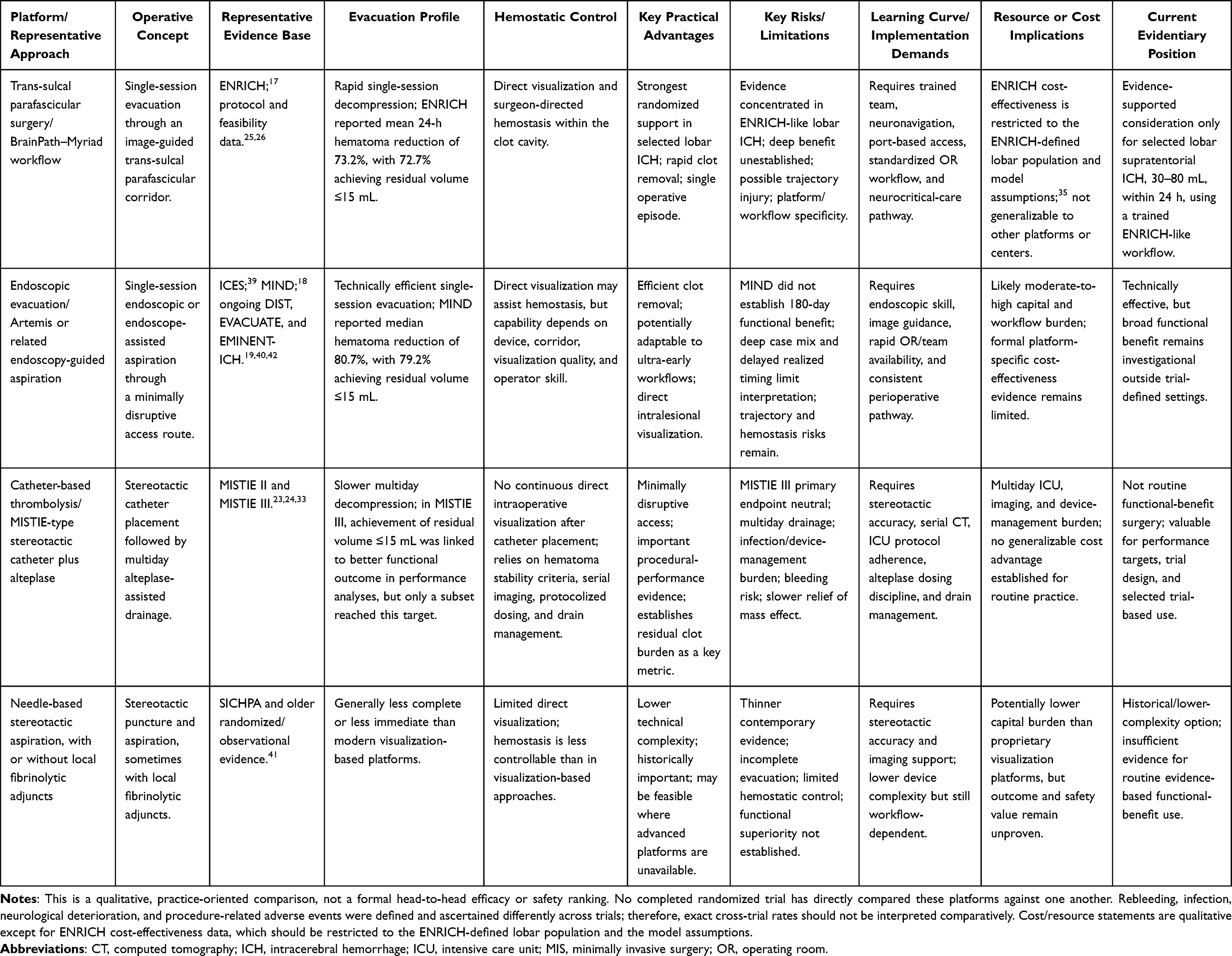 |
Table 2 Comparative Practical Features and Evidence Boundaries of Minimally Invasive Evacuation Platforms |
Comparative Risk and Implementation Considerations
Platform choice should be framed as a risk-management decision under incomplete comparative evidence, not as a settled hierarchy of devices. No completed randomized trial has directly compared parafascicular surgery, endoscopic evacuation, catheter-based thrombolysis, and stereotactic aspiration against one another. Existing trials instead tested different platforms against medical management in different populations, time windows, and procedural environments. Apparent cross-platform differences in rebleeding, infection, evacuation efficiency, or functional outcome should therefore be interpreted as hypothesis-generating rather than as head-to-head comparative effects.17,18,23,39,41
From a practical standpoint, visualization-based single-session platforms offer faster decompression and a more immediate opportunity for hemostatic inspection, but they require an operative team capable of image-guided trajectory planning, direct intralesional visualization, intraoperative hemostasis, and postprocedural critical-care management. Their benefit also depends on whether the local team can reproduce the workflow under which evidence was generated. This is particularly important for the ENRICH-like parafascicular approach, for which randomized support is currently strongest in selected lobar ICH treated early by trained teams.17,25,26
Endoscopic evacuation has strong technical appeal because it combines direct visualization with efficient single-session clot removal, and MIND confirmed high evacuation efficiency. However, MIND did not demonstrate 180-day functional superiority in a predominantly deep-hemorrhage population. The platform should therefore be regarded as technically effective but not yet supported as a broadly generalizable evidence-based indication across supratentorial ICH phenotypes. Ongoing endoscopy-based trials will be important for determining whether earlier treatment, different selection criteria, or refined workflow can convert technical success into durable functional benefit.18,19,39,40,42
Catheter-based thrombolysis has a different risk profile. It is less dependent on complex intraoperative visualization, but decompression is slower, treatment is multiday, and success depends on accurate catheter placement, serial imaging, protocolized alteplase dosing, drain management, infection prevention, and consistent achievement of residual-volume targets. MISTIE III did not meet its primary functional endpoint, but it established residual clot burden and procedural performance as key determinants of outcome. This approach may therefore be best understood as performance-dependent rather than simply device-dependent.23,24
Resource and cost considerations should also be evidence-bounded. The ENRICH cost-effectiveness analysis supports economic dominance only within the ENRICH-defined lobar population and modeled assumptions. These findings should not be generalized to other platforms, centers, or case mixes without direct evidence. For non-academic or lower-volume centers, the decisive question is not only whether a device is available, but whether the institution can deliver the full perioperative pathway, including rapid triage, hematoma stability assessment, anticoagulation reversal, trained surgical coverage, postprocedural imaging, neurocritical care, and complication management.35,43,44
Patient Selection: Location, Volume, and Timing
Hemorrhage Location
Hemorrhage location has emerged as the most reproducible modifier of surgical effect across the major randomized comparisons to date. In STICH I, the post hoc observation favoring superficial lobar hematomas prompted the design of STICH II for this subgroup. In ENRICH, benefit was confined to the lobar stratum (UWmRS difference 0.127), whereas no benefit signal was seen in the ABG stratum (difference −0.013).17 In MIND, a trial dominated by deep hemorrhages, the overall result was neutral.18 In SWITCH, decompressive craniectomy for severe deep ICH yielded at most weak evidence of benefit, and subsequent location-specific analysis did not establish a convincing differential effect across deep anatomical subtypes.27,28
Anatomical accessibility provides a plausible, though not exclusive, explanation for this interaction. Lobar hemorrhages may be approachable through a relatively direct sulcal corridor, whereas deep hemorrhages more often require transgression of white-matter tracts and deep gray-matter structures, increasing the risk that the access route itself erodes the net benefit of clot removal.45 Deep supratentorial ICH is also more commonly linked to hypertensive arteriolopathy, whereas lobar ICH in older patients is more often associated with cerebral amyloid angiopathy; these etiologic differences may shape recovery patterns, but they do not by themselves establish differential responsiveness to surgery.43
Major randomized MIS-ICH trials have been confined to supratentorial hemorrhage; cerebellar and brainstem ICH therefore remain outside the randomized evidentiary base for contemporary minimally invasive evacuation. The subsequent SWITCH location analysis should be regarded as hypothesis-generating: it moves beyond a simple lobar-versus-deep dichotomy, but did not provide convincing evidence that decompressive craniectomy has a differential effect across deep anatomical subtypes.28
Hematoma Volume
Trial-specific volume criteria have varied considerably: STICH I had no lower limit, MISTIE III required 30 mL or more, ENRICH required 30–80 mL, MIND required 20–80 mL, and DIST requires as little as 10 mL. Secondary analyses from MISTIE III shifted attention toward surgical performance: an end-of-treatment residual volume of 15 mL or less emerged as a post hoc performance threshold associated with a higher probability of favorable functional outcome, but this threshold has not been prospectively validated as a patient-selection cutoff.24 In ENRICH, 72.7% of operated patients reached this benchmark.17
These data support a performance-target model in which residual hematoma burden is a more informative procedural metric than treatment assignment alone. However, MIND also indicates that technical attainment of a low residual volume is not, by itself, sufficient to secure durable functional benefit in a cohort dominated by deep hemorrhage.18 The lower and upper volume boundaries of net surgical benefit therefore have not been defined: current randomized evidence is strongest in the moderate-to-large range studied by MISTIE III, ENRICH, and MIND, while the effects at the extremes of hematoma size are still uncertain.45 The ICH Score and its derivatives, which incorporate volume alongside GCS, age, IVH, and infratentorial location, remain useful for prognostication, but their role in guiding surgical patient selection has yet to be prospectively validated.
Timing
The ENRICH trial required that surgery be initiated within 24 hours after the patient was last known to be well; the median time from last known well to surgery was 16.75 hours.17 MISTIE III allowed randomization 12–72 hours after onset, and the median time from stroke onset to randomization was 47 hours, with treatment completion occurring substantially later because evacuation was catheter-based and thrombolysis-assisted.23 MIND permitted minimally invasive surgery within 72 hours.18 Ongoing ultra-early trials, including DIST and EVACUATE, are testing an 8-hour window.19
Across-trial contrasts keep timing near the center of the discussion, but timing cannot be disentangled from location mix, operative platform, or realized treatment interval. ENRICH tested an earlier parafascicular strategy in a lobar-enriched population and met its primary end point, whereas MIND evaluated a different device in a cohort dominated by deep hemorrhage and did not; these differences permit hypothesis generation, but not attribution of the divergent results to timing alone.17,18 Preclinical and translational data support the concept of a limited biological window for clot removal, as iron-mediated toxicity and perihematomal edema evolve over the ensuing hours to days after ictus, providing a mechanistic rationale for earlier—but hemostatically controlled—intervention.6
Ultra-early surgery within 8 hours, as pursued in DIST and EVACUATE, should currently be regarded as a hypothesis-testing strategy; an effective treatment window has not yet been established. The DIST pilot study supported the safety and technical feasibility of endoscopy-guided evacuation within 8 hours, but it was not designed to establish efficacy.20 Because hematoma-expansion risk is front-loaded in the first hours after onset, ultra-early intervention may offer maximal biological leverage while simultaneously intensifying the challenge of intraoperative hemostasis;13 whether that trade-off is favorable remains for ongoing randomized trials to determine.
Consciousness Level and Baseline Severity
Baseline neurological severity has been incorporated into eligibility or randomization frameworks across major surgical trials. ENRICH incorporated GCS into block randomization, whereas pooled reanalysis of the STICH program suggested that any surgical signal is most apparent in patients with intermediate severity, approximately GCS 10–13; overall, the available data favor a middle-severity window rather than benefit being uniformly distributed across the full GCS spectrum.25,32 The role of the National Institutes of Health Stroke Scale (NIHSS) as an alternative or complement to GCS in surgical selection has received relatively little study; the NIHSS threshold of ≥2 in DIST reflects operational eligibility, not a validated cutoff for predicting surgical benefit.19
Anticoagulant-associated ICH remains a clinically important but trial-underrepresented subgroup because completed randomized MIS studies largely excluded patients with uncorrected coagulopathy. Contemporary reversal pathways have made urgent intervention more feasible than in earlier trial eras, but this should not be overgeneralized: the DIST protocol permits inclusion after INR correction for vitamin K antagonists and after idarucizumab reversal for dabigatran, while still excluding untreated coagulopathy and factor Xa inhibitor use.19,44
Perioperative Variables Influencing MIS-ICH Outcomes
Blood Pressure Management
Whether perioperative blood pressure targets should differ for patients undergoing MIS remains an open question. INTERACT2 suggested a favorable ordinal functional shift with early systolic blood pressure lowering toward <140 mmHg, whereas ATACH-2 found no clinical benefit of a more intensive 110–139 mmHg target over 140–179 mmHg and reported more renal adverse events.3,4 A preplanned pooled individual-participant analysis of INTERACT2 and ATACH-II further suggested that lower and more stable achieved systolic blood pressure over the first 24 hours was associated with better functional outcome in patients with predominantly mild-to-moderate ICH who did not require immediate neurosurgery; these data therefore do not define MIS-specific perioperative targets.46 In the surgical context, careful preoperative and immediate postoperative blood pressure control is biologically and technically reasonable, but prospective data defining MIS-specific perioperative targets are lacking and current practice is largely extrapolated from nonsurgical ICH trials.46
Intraventricular Hemorrhage
IVH burden complicates both operative decision-making and cross-trial interpretation. In CLEAR III, intraventricular alteplase administered through a routine external ventricular drain did not substantially improve functional outcome; although mortality was lower, many additional survivors remained severely disabled, which limits direct extrapolation to concomitant parenchymal hematoma evacuation.47 Trial-level handling of IVH has also differed: STICH II focused on superficial lobar ICH without intraventricular haemorrhage, ENRICH excluded hemorrhages with substantial thalamic or intraventricular extension, and the published DIST protocol does not list IVH as an exclusion criterion.17,19,22 How IVH burden modifies the effect of parenchymal clot evacuation is poorly defined, and future MIS trials should consider IVH burden or ventricular obstruction status as prespecified stratification variables.
Perihematomal Edema as an Imaging Biomarker and Intermediate Outcome
Although MIND did not show a 180-day functional benefit,18 perihematomal edema remains a mechanistically informative imaging biomarker in MIS-ICH, but it is not a validated surrogate end point. Perihematomal edema (PHE) is a recognized marker of secondary brain injury after ICH.48 Recent data linked to the DIST platform further showed that ultra-early MIS within 8 hours was associated with reduced early absolute PHE growth, with the magnitude of this effect modified by achieved hematoma reduction.49 A 2026 individual-participant-data meta-analysis further found that PHE growth within 24 and 72 hours was independently associated with death or dependence after ICH.50 These findings support prospective incorporation of quantitative PHE measures into early-phase surgical trials, while clinical efficacy should continue to be judged by functional outcomes rather than edema metrics alone.
Ongoing Trials and Future Directions
EVACUATE
EVACUATE is an ongoing Australian randomized program evaluating ultra-early minimally invasive evacuation with the Aurora platform in patients with supratentorial ICH, with surgery targeted within 8 hours of onset. Supporting the technical rationale, a phase 2a Australian multicentre study of Aurora-based evacuation initiated within 12 hours reported a median 24-hour hematoma reduction of 71%, with no major surgical safety signal.42 Because EVACUATE differs from ENRICH in platform, inclusion schema, and operative workflow, it tests an ultra-early endoscopic strategy and should not be viewed as a direct replication of ENRICH.
DIST
DIST is a multicentre, prospective, randomized trial with open-label treatment and blinded end-point assessment conducted across 11 neurosurgical centres in the Netherlands.19 It plans to enroll 600 patients with spontaneous supratentorial ICH (hematoma volume ≥10 mL, NIHSS ≥2), randomized 1:1 to minimally invasive endoscopy-guided surgery within 8 hours of symptom onset plus standard medical management, or to standard management alone. The primary endpoint is mRS at 180 days. Recruitment started in November 2022; as of October 2025, 235 participants had been enrolled, and completion of recruitment is expected in 2027.19
DIST is currently the largest ongoing randomized endoscopy-guided trial in spontaneous supratentorial ICH. Relative to ENRICH, DIST adopts a shorter treatment window, a broader location spectrum, a lower volume threshold, and a different operative platform.17 These design differences mean that DIST will primarily test whether an early endoscopic concept can extend beyond the lobar-predominant parafascicular context of ENRICH and should not be interpreted as a direct device-to-device comparison.17
EMINENT-ICH and Additional Evidence
EMINENT-ICH is an ongoing Swiss endoscopy-based randomized trial; mature outcome data are not yet available, and the study is not discussed further here. To broaden the evidentiary landscape beyond Europe, it is more informative to cite completed randomized evidence from Asia: in the multicenter Chinese MISICH trial, both endoscopic surgery and frameless navigated aspiration improved 6-month functional outcome compared with craniotomy, with the apparent advantage concentrated in deep hemorrhages.51
Adjunctive Neuroprotection: Lessons from Intracerebral Hemorrhage Deferoxamine (I-DEF)
I-DEF trial was a multicentre, randomized, placebo-controlled, double-blind phase 2 trial evaluating deferoxamine mesylate as an iron-chelating strategy targeting secondary injury after ICH. Although the primary futility analysis did not support phase 3 advancement on the basis of 90-day mRS 0–2, subsequent post hoc analyses suggested faster early neurological improvement, an altered recovery trajectory over follow-up, and possible effect heterogeneity according to baseline hematoma volume. These signals are exploratory and should not be conflated with trial-level efficacy.52 Their relevance to MIS-ICH is primarily mechanistic. They keep open the possibility that clot evacuation and secondary-injury modulation may eventually be combined, but no randomized data currently support a combined strategy.53–55
Unresolved Questions
The ongoing trial landscape maps onto several unresolved clinical and methodological questions: whether ENRICH identified a platform-specific benefit or a more generalizable surgical concept; whether deep ICH can be made surgically responsive through tighter anatomical, timing, or workflow selection; whether ultra-early intervention improves net benefit or increases hemostatic risk; how long-term recovery should be measured; and whether imaging or blood biomarkers can enrich patient selection. EVACUATE, DIST, and EMINENT-ICH primarily address the first three questions by testing earlier endoscopy-based evacuation strategies across broader selection criteria and different operative workflows, whereas long-term recovery and precision-selection questions remain less directly answered by current trial designs.
Device Specificity versus Concept Generalizability
A central unresolved issue is whether ENRICH identified a platform-specific advantage of the BrainPath/Myriad ecosystem or instead clarified the clinical conditions under which high-quality minimally invasive clot evacuation can improve outcome. Post-ENRICH practice data underscore the practical importance of this distinction, because many clinicians who reported increasing surgical use did so with approaches other than the ENRICH platform.36 A logical next step would be trial designs that prespecify performance targets while allowing more than one credentialed minimally invasive platform; the challenge is that such designs complicate operator credentialing, procedural standardization, and attribution of benefit to platform versus execution.
The Deep ICH Dilemma
Deep supratentorial hemorrhage is the principal unresolved territory of MIS and cannot yet be considered an evidence-based indication. Randomized evidence has not shown a reproducible functional benefit in this compartment: ENRICH showed no signal in anterior basal ganglia hemorrhage, MIND was neutral in a cohort dominated by deep ICH, and SWITCH suggested at most weak evidence for decompressive craniectomy in severe deep hemorrhage.17,18,27 The key unanswered question is whether net benefit can be recovered in more narrowly selected subgroups defined by anatomy, timing, or procedural strategy. Importantly, the subsequent SWITCH location analysis did not demonstrate convincing effect modification across deep anatomical categories; accordingly, anatomical substratification has yet to be validated as a basis for patient selection.28
Ultra-Early versus Early Surgery
The 8-hour strategy being tested in DIST, and explored in other ultra-early programs, directly probes whether benefit can be extended to the earliest segment of the 24-hour window within which ENRICH showed efficacy.17,19 If ultra-early evacuation proves beneficial, the field would move toward a truly time-critical ICH pathway; if it proves neutral or harmful, that would argue that earlier is not necessarily better and that hemostatic stabilization may be necessary before intervention. The answer also carries system-level implications, because any successful ultra-early strategy would require neurosurgical capability to be integrated into the hyperacute stroke response pathway from the outset, rather than activated later during hospitalization.
Long-Term Outcomes and Rehabilitation
Most MIS-ICH trials report primary outcomes at 180 or 365 days, yet accumulating ICH literature indicates that recovery often extends beyond the conventional 90-day horizon and, in a substantial minority of patients, continues through 12 months or longer.56,57 Recovery appears to vary with baseline severity, hemorrhage location, and postacute complications, yet the interaction between surgical evacuation, rehabilitation intensity, and patient-reported quality of life has rarely been incorporated into MIS trial architecture.58 Future studies should therefore incorporate longer follow-up and multidimensional recovery measures instead of relying on a single mid-term disability assessment.
Precision Medicine Integration
Advanced imaging phenotyping—including automated volumetry, hematoma-expansion modeling, and multimodal radiomic or deep-learning approaches—may eventually support more biologically and anatomically informed stratification, but its role in operative triage is still investigational.59,60 Blood-based biomarkers, particularly markers of neuroaxonal and astroglial injury, may add incremental information on injury severity and outcome risk; however, prospective evidence integrating such signals with imaging to guide real-time MIS decisions is still lacking.61,62 At present, these tools are better framed as research-stage enrichers for future trial stratification than as clinically deployable selectors.
Evidence-Based Clinical Decision Framework (with Acknowledged Limitations)
Current randomized evidence supports a stepwise, evidence-bounded framework rather than a universal recommendation for minimally invasive evacuation. The framework proposed here is not a guideline and should not replace individualized neurosurgical judgment. Its purpose is to translate the available randomized evidence into a practical structure for identifying patients who fall within, near, or outside the best-supported evidence boundary. This stepwise, evidence-bounded decision framework is summarized in Figure 1 and is derived from the randomized evidence summarized above, particularly MISTIE III, ENRICH, MIND, and SWITCH.17,18,23,27
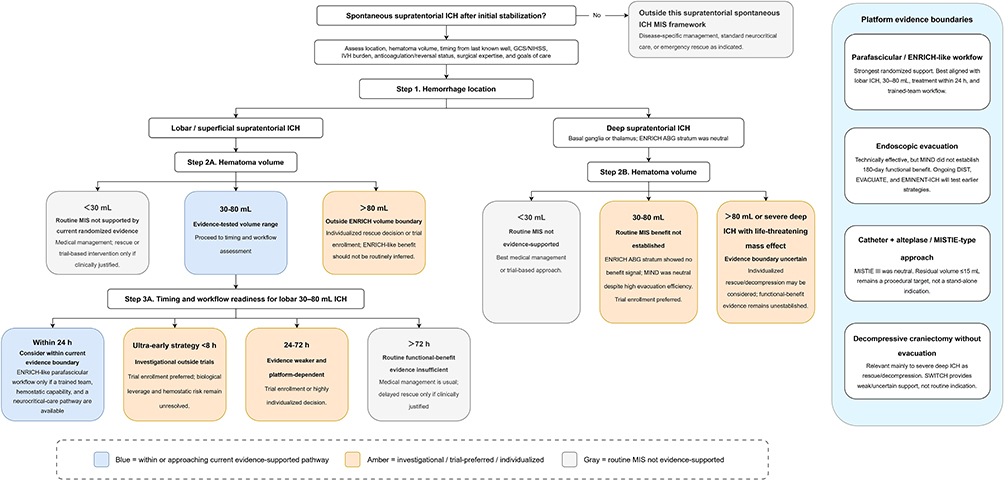 |
Figure 1 Evidence-based clinical decision framework for minimally invasive evacuation after initial stabilization of spontaneous supratentorial intracerebral hemorrhage. The framework summarizes current randomized evidence boundaries and is not intended as a formal guideline. Decisions should incorporate hematoma stability, neurological severity, IVH burden, anticoagulant or reversal status, premorbid function, goals of care, local surgical expertise, and trial availability. Abbreviations: ABG, anterior basal ganglia; ICH, intracerebral hemorrhage; IVH, intraventricular hemorrhage; MIS, minimally invasive surgery. |
The first decision point is whether the patient has spontaneous supratentorial ICH after initial stabilization and exclusion of secondary causes requiring a different pathway. Patients with aneurysm, arteriovenous malformation, tumor-associated hemorrhage, hemorrhagic transformation, infratentorial hemorrhage, or uncontrolled coagulopathy fall outside the framework and require disease-specific management. Before any MIS decision, clinicians should assess location, hematoma volume, time from last known well, neurological severity, intraventricular extension, hematoma expansion risk, anticoagulant or antiplatelet exposure, surgical goals, premorbid function, and local operative expertise.
For lobar or superficial supratentorial ICH, the strongest current evidence-supported profile is hematoma volume of 30–80 mL, presentation within 24 hours, and availability of a trained team capable of delivering an ENRICH-like parafascicular workflow. In this setting, MIS may be considered within the current randomized evidence boundary. This statement should not be generalized to all lobar hemorrhages: small hematomas, very large hematomas, unstable bleeding, severe irreversible injury, poor premorbid status, and inability to reproduce the trial-like workflow all move the decision toward individualized management rather than routine evidence-supported evacuation.17,25,26
For lobar ICH outside the ENRICH-defined window, the evidence boundary weakens. Ultra-early intervention within 8 hours remains investigational because the potential biological advantage of earlier clot removal must be balanced against hematoma expansion and intraoperative hemostasis risk. Intervention between 24 and 72 hours may be biologically plausible and sometimes clinically reasonable, but randomized support is weaker and platform- and context-dependent. Intervention beyond 72 hours should generally be regarded as delayed rescue or individualized management rather than evidence-based functional-benefit surgery.13,17–20
For deep supratentorial ICH, routine extension of MIS is not currently supported as established standard care. ENRICH did not show a benefit signal in the anterior basal ganglia stratum, MIND was neutral despite high evacuation efficiency in a predominantly deep-hemorrhage cohort, and SWITCH provides at most weak support for decompressive craniectomy without clot evacuation in severe deep hemorrhage.17,18,27,28 Deep ICH with life-threatening mass effect, refractory intracranial hypertension, or impending herniation may still justify individualized rescue surgery or decompression, but this should be distinguished from evidence-established functional-benefit MIS.
Hematoma volume should be treated as both a selection variable and a procedural-performance variable. Volumes below 30 mL generally fall outside the best-supported randomized evidence for routine MIS and should usually be managed medically unless deterioration, mass effect, or trial enrollment provides a specific rationale. Volumes of 30–80 mL represent the principal evidence-tested range for contemporary MIS trials, but location and timing remain decisive. Volumes above 80 mL fall outside the ENRICH boundary and require individualized rescue-oriented decision-making or trial-based management when feasible.
Platform selection should follow the evidence boundary rather than device availability alone. If an ENRICH-like lobar patient can be treated within 24 hours by a trained parafascicular team, this is the clearest evidence-supported scenario. If the available approach is endoscopic, catheter-based, stereotactic, or performed outside a trial-like workflow, the decision becomes more extrapolative. In these cases, trial enrollment should be prioritized whenever possible, and the expected benefit should be discussed against platform-specific risks, including trajectory injury, rebleeding or hemostatic failure, infection or device-management burden, learning curve, and resource intensity.
Conclusion
After contemporary randomized trials, minimally invasive evacuation should be viewed as an evidence-bounded intervention rather than a universal strategy for spontaneous supratentorial ICH. Current randomized evidence most clearly supports early (<24 h) minimally invasive evacuation for ENRICH-like patients with lobar supratentorial ICH, hematoma volume of 30–80 mL, and access to a trained team using a standardized trans-sulcal parafascicular workflow. Routine extrapolation to most deep supratentorial hemorrhages, ultra-early (<8 h) intervention outside clinical trials, delayed intervention beyond the ENRICH-supported early window, very small or very large hematomas, or non-ENRICH platforms without comparable randomized support remains investigational or unsupported. Clinical decisions should therefore be anchored to hemorrhage location, hematoma volume, treatment timing, and local workflow reproducibility, with trial enrollment prioritized whenever patients fall outside the established evidence boundary.
Declaration of Generative AI Use
Authors declare no AI use during the preparation of this work.
Abbreviations
ICH, intracerebral hemorrhage; HE, hematoma expansion; RCT, randomized controlled trial; STICH, surgical trial in intracerebral haemorrhage; IVH, intraventricular hemorrhage; MISTIE, minimally invasive surgery plus alteplase for intracerebral hemorrhage evacuation; ENRICH, early minimally invasive removal of intracerebral hemorrhage; ABG, anterior basal ganglia; MIPS, minimally invasive parafascicular surgery; UWmRS, utility-weighted modified Rankin scale; BCI, Bayesian credible interval; SWITCH, Swiss Trial of Decompressive Craniectomy versus Best Medical Treatment of Spontaneous Supratentorial Intracerebral Haemorrhage; ICES, Intraoperative Stereotactic Computed Tomography-Guided Endoscopic Surgery; NIHSS, National Institutes of Health Stroke Scale; PHE, perihematomal edema; DIST, Dutch Intracerebral Haemorrhage Surgery Trial; i-DEF, intracerebral hemorrhage deferoxamine.
Ethics Statement
Ethical approval is not applicable for review study.
Author Contributions
All authors made a significant contribution to the work reported, whether that is in the conception, study design, execution, acquisition of data, analysis and interpretation, or in all these areas; took part in drafting, revising or critically reviewing the article; gave final approval of the version to be published; have agreed on the journal to which the article has been submitted; and agree to be accountable for all aspects of the work.
Disclosure
The authors declare no competing interests in this work.
References
1. Parry-Jones AR, Krishnamurthi R, Ziai WC, et al. World stroke organization (WSO): Global intracerebral hemorrhage factsheet 2025. Int J Stroke. 2025;20(2):145–19. doi:10.1177/17474930241307876
2. Wolsink A, Cliteur MP, van Asch CJ, et al. Incidence, case fatality, and functional outcome of intracerebral haemorrhage, according to age, sex, and country income level: a systematic review and meta-analysis. Lancet Reg Health Eur. 2025;49:101180. doi:10.1016/j.lanepe.2024.101180
3. Anderson CS, Heeley E, Huang Y, et al. Rapid blood-pressure lowering in patients with acute intracerebral hemorrhage. N Engl J Med. 2013;368(25):2355–2365. doi:10.1056/NEJMoa1214609
4. Qureshi AI, Palesch YY, Barsan WG, et al. Intensive blood-pressure lowering in patients with acute cerebral hemorrhage. N Engl J Med. 2016;375(11):1033–1043. doi:10.1056/NEJMoa1603460
5. Sprigg N, Flaherty K, Appleton JP, et al. Tranexamic acid for hyperacute primary IntraCerebral Haemorrhage (TICH-2): an international randomised, placebo-controlled, phase 3 superiority trial. Lancet. 2018;391(10135):2107–2115. doi:10.1016/s0140-6736(18)31033-x
6. Magid-Bernstein J, Girard R, Polster S, et al. Cerebral hemorrhage: pathophysiology, treatment, and future directions. Circ Res. 2022;130(8):1204–1229. doi:10.1161/circresaha.121.319949
7. Ziai WC. Hematology and inflammatory signaling of intracerebral hemorrhage. Stroke. 2013;44(6 Suppl 1):S74–8. doi:10.1161/strokeaha.111.000662
8. Keep RF, Hua Y, Xi G. Intracerebral haemorrhage: mechanisms of injury and therapeutic targets. Lancet Neurol. 2012;11(8):720–731. doi:10.1016/s1474-4422(12)70104-7
9. Chen Y, Chen S, Chang J, Wei J, Feng M, Wang R. Perihematomal edema after intracerebral hemorrhage: an update on pathogenesis, risk factors, and therapeutic advances. Front Immunol. 2021;12:740632. doi:10.3389/fimmu.2021.740632
10. Altumbabic M, Peeling J, Del Bigio MR. Intracerebral hemorrhage in the rat: effects of hematoma aspiration. Stroke. 1998;29(9):1917. doi:10.1161/01.str.29.9.1917
11. Wagner KR, Xi G, Hua Y, et al. Ultra-early clot aspiration after lysis with tissue plasminogen activator in a porcine model of intracerebral hemorrhage: edema reduction and blood-brain barrier protection. J Neurosurg. 1999;90(3):491–498. doi:10.3171/jns.1999.90.3.0491
12. Vitt JR, Sun CH, Le Roux PD, Hemphill JC. Minimally invasive surgery for intracerebral hemorrhage. Curr Opin Crit Care. 2020;26(2):129–136. doi:10.1097/mcc.0000000000000695
13. Morotti A, Boulouis G, Dowlatshahi D, et al. Intracerebral haemorrhage expansion: definitions, predictors, and prevention. Lancet Neurol. 2023;22(2):159–171. doi:10.1016/s1474-4422(22)00338-6
14. Brouwers HB, Chang Y, Falcone GJ, et al. Predicting hematoma expansion after primary intracerebral hemorrhage. JAMA Neurol. 2014;71(2):158–164. doi:10.1001/jamaneurol.2013.5433
15. Song L, Qiu X, Zhang C, et al. Combining non-contrast CT signs with onset-to-imaging time to predict the evolution of intracerebral hemorrhage. Kor J Radiol. 2024;25(2):166–178. doi:10.3348/kjr.2023.0591
16. Ali M, Smith C, Vasan V, et al. Management of intracavitary bleeding during ultra-early minimally invasive intracerebral hemorrhage evacuation. J Neurosurg. 2025;142(4):1003–1013. doi:10.3171/2024.6.Jns232985
17. Pradilla G, Ratcliff JJ, Hall AJ, et al. Trial of early minimally invasive removal of intracerebral hemorrhage. N Engl J Med. 2024;390(14):1277–1289. doi:10.1056/NEJMoa2308440
18. Arthur AS, Jahromi BS, Saphier PS, et al. Minimally invasive surgery vs medical management alone for intracerebral hemorrhage: the MIND randomized clinical trial. JAMA Neurol. 2025;82(11):1113–1121. doi:10.1001/jamaneurol.2025.3151
19. Wilting FNH, Wolsink A, Colmer NHC, et al. The Dutch Intracerebral Haemorrhage Surgery Trial: study protocol for a randomised clinical trial of minimally invasive endoscopy-guided surgery in patients with spontaneous, supratentorial intracerebral haemorrhage. Eur Stroke J. 2026;11(1). doi:10.1093/esj/aakaf008
20. Sondag L, Schreuder F, Pegge SAH, et al. Safety and technical efficacy of early minimally invasive endoscopy-guided surgery for intracerebral haemorrhage: the Dutch Intracerebral haemorrhage Surgery Trial pilot study. Acta Neurochir. 2023;165(6):1585–1596. doi:10.1007/s00701-023-05599-2
21. Mendelow AD, Gregson BA, Fernandes HM, et al. Early surgery versus initial conservative treatment in patients with spontaneous supratentorial intracerebral haematomas in the International Surgical Trial in Intracerebral Haemorrhage (STICH): a randomised trial. Lancet. 2005;365(9457):387–397. doi:10.1016/s0140-6736(05)17826-x
22. Mendelow AD, Gregson BA, Rowan EN, Murray GD, Gholkar A, Mitchell PM. Early surgery versus initial conservative treatment in patients with spontaneous supratentorial lobar intracerebral haematomas (STICH II): a randomised trial. Lancet. 2013;382(9890):397–408. doi:10.1016/s0140-6736(13)60986-1
23. Hanley DF, Thompson RE, Rosenblum M, et al. Efficacy and safety of minimally invasive surgery with thrombolysis in intracerebral haemorrhage evacuation (MISTIE III): a randomised, controlled, open-label, blinded endpoint phase 3 trial. Lancet. 2019;393(10175):1021–1032. doi:10.1016/s0140-6736(19)30195-3
24. Awad IA, Polster SP, Carrión-Penagos J, et al. Surgical performance determines functional outcome benefit in the minimally invasive surgery plus recombinant tissue plasminogen activator for intracerebral hemorrhage evacuation (MISTIE) procedure. Neurosurgery. 2019;84(6):1157–1168. doi:10.1093/neuros/nyz077
25. Ratcliff JJ, Hall AJ, Porto E, et al. Early minimally invasive removal of intracerebral hemorrhage (ENRICH): Study protocol for a multi-centered two-arm randomized adaptive trial. Front Neurol. 2023;14:1126958. doi:10.3389/fneur.2023.1126958
26. Labib MA, Shah M, Kassam AB, et al. The safety and feasibility of image-guided brainpath-mediated transsulcul hematoma evacuation: a multicenter study. Neurosurgery. 2017;80(4):515–524. doi:10.1227/neu.0000000000001316
27. Beck J, Fung C, Strbian D, et al. Decompressive craniectomy plus best medical treatment versus best medical treatment alone for spontaneous severe deep supratentorial intracerebral haemorrhage: a randomised controlled clinical trial. Lancet. 2024;403(10442):2395–2404. doi:10.1016/s0140-6736(24)00702-5
28. Polymeris AA, Lang MF, Hakim A, et al. Effect of decompressive craniectomy according to location of deep intracerebral hemorrhage: a SWITCH trial analysis. Stroke. 2026;57(1):12–19. doi:10.1161/strokeaha.125.052460
29. McKissock W, Richardson A, Taylor J. Primary intracerebral hæmorrhage: a controlled trial of surgical and conservative treatment in 180 unselected cases. Lancet. 1961;278(7196):221–226. doi:10.1016/S0140-6736(61)90353-1
30. Auer LM, Deinsberger W, Niederkorn K, et al. Endoscopic surgery versus medical treatment for spontaneous intracerebral hematoma: a randomized study. J Neurosurg. 1989;70(4):530–535. doi:10.3171/jns.1989.70.4.0530
31. Prasad KS, Gregson BA, Bhattathiri PS, Mitchell P, Mendelow AD. The significance of crossovers after randomization in the STICH trial. Acta Neurochir Suppl. 2006;96:61–64. doi:10.1007/3-211-30714-1_15
32. Gregson BA, Mitchell P, Mendelow AD. Surgical decision making in brain hemorrhage. Stroke. 2019;50(5):1108–1115. doi:10.1161/strokeaha.118.022694
33. Hanley DF, Thompson RE, Muschelli J, et al. Safety and efficacy of minimally invasive surgery plus alteplase in intracerebral haemorrhage evacuation (MISTIE): a randomised, controlled, open-label, phase 2 trial. Lancet Neurol. 2016;15(12):1228–1237. doi:10.1016/s1474-4422(16)30234-4
34. Morris NA, Simard JM, Chaturvedi S. Surgical management for primary intracerebral hemorrhage. Neurology. 2024;103(4):e209714. doi:10.1212/wnl.0000000000209714
35. Hanmer J, Arnold J, Hall A, et al. Cost-effectiveness analysis of early minimally invasive removal of intracerebral hemorrhage. Stroke. 2025;56(7):1799–1806. doi:10.1161/strokeaha.124.048493
36. Incontri D, Kellner CP, Polymeris A, et al. Minimally invasive evacuation for intracerebral hemorrhage: current practice and perspectives after ENRICH. J Neurointerv Surg. 2025. doi:10.1136/jnis-2025-023804
37. Asghar P. A critical appraisal of the MIND trial on minimally invasive surgery for intracerebral hemorrhage. Surg Neurol Int. 2026;17:49. doi:10.25259/sni_1351_2025
38. de Oliveira Manoel AL, Msheik A, Schuind S, Al Rumaihi GIK, Taccone F. Surgery for intracerebral hemorrhage: new evidence and changing perspectives. Crit Care. 2025;30(1):7. doi:10.1186/s13054-025-05763-3
39. Vespa P, Hanley D, Betz J, et al. ICES (Intraoperative Stereotactic Computed Tomography-Guided Endoscopic Surgery) for brain hemorrhage: a multicenter randomized controlled trial. Stroke. 2016;47(11):2749–2755. doi:10.1161/strokeaha.116.013837
40. Hallenberger TJ, Fischer U, Bonati LH, et al. Early minimally invasive image-guided endoscopic evacuation of intracerebral hemorrhage (EMINENT-ICH): a randomized controlled trial. Trials. 2024;25(1):692. doi:10.1186/s13063-024-08534-7
41. Teernstra OP, Evers SM, Lodder J, Leffers P, Franke CL, Blaauw G. Stereotactic treatment of intracerebral hematoma by means of a plasminogen activator: a multicenter randomized controlled trial (SICHPA). Stroke. 2003;34(4):968–974. doi:10.1161/01.Str.0000063367.52044.40
42. Kleinig TJ, Abou-Hamden A, Laidlaw J, et al. Early minimally invasive intracerebral hemorrhage evacuation: a phase 2a feasibility, safety, and promise of surgical efficacy study. J Neurointerv Surg. 2024;16(6):555–558. doi:10.1136/jnis-2023-020446
43. Cordonnier C, Demchuk A, Ziai W, Anderson CS. Intracerebral haemorrhage: current approaches to acute management. Lancet. 2018;392(10154):1257–1268. doi:10.1016/s0140-6736(18)31878-6
44. Kuramatsu JB, Gerner ST, Schellinger PD, et al. Anticoagulant reversal, blood pressure levels, and anticoagulant resumption in patients with anticoagulation-related intracerebral hemorrhage. JAMA. 2015;313(8):824–836. doi:10.1001/jama.2015.0846
45. Schreuder F, Gaberel T, Cordonnier C. Surgical management of intracerebral hemorrhage: new light on the horizon? Stroke. 2025;56(2):575–578. doi:10.1161/strokeaha.124.047467
46. Moullaali TJ, Wang X, Martin RH, et al. Blood pressure control and clinical outcomes in acute intracerebral haemorrhage: a preplanned pooled analysis of individual participant data. Lancet Neurol. 2019;18(9):857–864. doi:10.1016/s1474-4422(19)30196-6
47. Hanley DF, Lane K, McBee N, et al. Thrombolytic removal of intraventricular haemorrhage in treatment of severe stroke: results of the randomised, multicentre, multiregion, placebo-controlled CLEAR III trial. Lancet. 2017;389(10069):603–611. doi:10.1016/s0140-6736(16)32410-2
48. Ironside N, Chen CJ, Ding D, Mayer SA, Connolly ES Jr. Perihematomal edema after spontaneous intracerebral hemorrhage. Stroke. 2019;50(6):1626–1633. doi:10.1161/strokeaha.119.024965
49. Cliteur MP, Sondag L, Pegge SAH, et al. The effect of minimally invasive intracerebral haematoma evacuation on early perihaematomal oedema formation. Eur Stroke J. 2026;11(1). doi:10.1093/esj/aakaf025
50. Samarasekera N, Tuck S, Wang X, et al. Perihematomal edema and functional outcome after intracerebral hemorrhage: a meta-analysis of individual participant data. Stroke. 2026. doi:10.1161/strokeaha.125.053991
51. Xu X, Zhang H, Zhang J, et al. Minimally invasive surgeries for spontaneous hypertensive intracerebral hemorrhage (MISICH): a multicenter randomized controlled trial. BMC Med. 2024;22(1):244. doi:10.1186/s12916-024-03468-y
52. Selim M, Foster LD, Moy CS, et al. Deferoxamine mesylate in patients with intracerebral haemorrhage (i-DEF): a multicentre, randomised, placebo-controlled, double-blind phase 2 trial. Lancet Neurol. 2019;18(5):428–438. doi:10.1016/s1474-4422(19)30069-9
53. Foster L, Robinson L, Yeatts SD, et al. Effect of deferoxamine on trajectory of recovery after intracerebral hemorrhage: a post hoc analysis of the i-DEF trial. Stroke. 2022;53(7):2204–2210. doi:10.1161/strokeaha.121.037298
54. Wei C, Wang J, Foster LD, et al. Effect of deferoxamine on outcome according to baseline hematoma volume: a post hoc analysis of the i-DEF trial. Stroke. 2022;53(4):1149–1156. doi:10.1161/strokeaha.121.035421
55. Polymeris AA, Lioutas VA, Foster LD, et al. Early neurological improvement with deferoxamine after intracerebral hemorrhage: a post hoc analysis of the i-DEF trial. Int J Stroke. 2025;20(10):1235–1245. doi:10.1177/17474930251348088
56. Shah VA, Thompson RE, Yenokyan G, et al. One-year outcome trajectories and factors associated with functional recovery among survivors of intracerebral and intraventricular hemorrhage with initial severe disability. JAMA Neurol. 2022;79(9):856–868. doi:10.1001/jamaneurol.2022.1991
57. Mai LM, Joundi RA, Katsanos AH, Selim M, Shoamanesh A. Pathophysiology of intracerebral hemorrhage: recovery trajectories. Stroke. 2025;56(3):783–793. doi:10.1161/strokeaha.124.046130
58. Sakamoto Y, Bosookhuu O, Ouyang M, et al. Associated factors of long-term functional outcome and recovery pattern after intracerebral hemorrhage: a prospective population-based study in Ulaanbaatar, Mongolia. Stroke. 2025;56(2):437–446. doi:10.1161/strokeaha.123.046253
59. Pszczolkowski S, Manzano-Patrón JP, Law ZK, et al. Quantitative CT radiomics-based models for prediction of haematoma expansion and poor functional outcome in primary intracerebral haemorrhage. Eur Radiol. 2021;31(10):7945–7959. doi:10.1007/s00330-021-07826-9
60. Tran AT, Zeevi T, Haider SP, et al. Uncertainty-aware deep-learning model for prediction of supratentorial hematoma expansion from admission non-contrast head computed tomography scan. NPJ Digit Med. 2024;7(1):26. doi:10.1038/s41746-024-01007-w
61. Zheng P, Wang X, Chen J, Wang X, Shi SX, Shi K. Plasma neurofilament light chain predicts mortality and long-term neurological outcomes in patients with intracerebral hemorrhage. Aging Dis. 2023;14(2):560–571. doi:10.14336/ad.2022.21020
62. Barba L, D’Anna L, Abu-Rumeileh S, et al. Implementing blood biomarkers in stroke research and clinical practice. Stroke. 2025;56(8):2380–2384. doi:10.1161/strokeaha.125.051498
 © 2026 The Author(s). This work is published and licensed by Dove Medical Press Limited. The
full terms of this license are available at https://www.dovepress.com/terms
and incorporate the Creative Commons Attribution
- Non Commercial (unported, 4.0) License.
By accessing the work you hereby accept the Terms. Non-commercial uses of the work are permitted
without any further permission from Dove Medical Press Limited, provided the work is properly
attributed. For permission for commercial use of this work, please see paragraphs 4.2 and 5 of our Terms.
© 2026 The Author(s). This work is published and licensed by Dove Medical Press Limited. The
full terms of this license are available at https://www.dovepress.com/terms
and incorporate the Creative Commons Attribution
- Non Commercial (unported, 4.0) License.
By accessing the work you hereby accept the Terms. Non-commercial uses of the work are permitted
without any further permission from Dove Medical Press Limited, provided the work is properly
attributed. For permission for commercial use of this work, please see paragraphs 4.2 and 5 of our Terms.