
Back to Journals » Medical Devices: Evidence and Research » Volume 18
Mid-Term Management of Operating Room Equipment: Improving Surgical Quality
Authors Dai Y, Xu Y, Zhang Y  , Wang K
Received 27 June 2025
Accepted for publication 9 August 2025
Published 14 August 2025 Volume 2025:18 Pages 415—425
DOI https://doi.org/10.2147/MDER.S550091
Checked for plagiarism Yes
Review by Single anonymous peer review
Peer reviewer comments 2
Editor who approved publication: Dr Scott Fraser
Yanting Dai,1,* Yunfei Xu,1,* You Zhang,2 Ke Wang3
1Operating Room, Shanghai Key Laboratory of Maternal Fetal Medicine, Shanghai Institute of Maternal-Fetal Medicine and Gynecologic Oncology, Shanghai First Maternity and Infant Hospital, School of Medicine, Tongji University, Shanghai, 200092, People’s Republic of China; 2Information Center, Shanghai Key Laboratory of Maternal Fetal Medicine, Shanghai Institute of Maternal-Fetal Medicine and Gynecologic Oncology, Shanghai First Maternity and Infant Hospital, School of Medicine, Tongji University, Shanghai, 200092, People’s Republic of China; 3Neonatology Department, Shanghai Key Laboratory of Maternal Fetal Medicine, Shanghai Institute of Maternal-Fetal Medicine and Gynecologic Oncology, Shanghai First Maternity and Infant Hospital, School of Medicine, Tongji University, Shanghai, 200092, People’s Republic of China
*These authors contributed equally to this work
Correspondence: You Zhang; Ke Wang, Email [email protected]; [email protected]
Abstract: This study focuses on the mid-term management theory of equipment lifecycle and systematically examines the impact of operating room instrument management on operational efficiency optimization. The review mainly covers four key aspects: operator training, information technology application, cost control, and quality assurance. The results indicate that mid-term management plays a crucial role in the full lifecycle management of operating room equipment and plays a key role in improving the quality of operating room operations. This management model is undergoing a profound transformation from experience driven to evidence-based practice, and from single control to system integration. Future research should focus on developing standardized evaluation metrics, scalable digital management platforms, and cross institutional data sharing models for optimizing the lifecycle of medical devices.
Keywords: operating room, instrument and equipment, mid-life cycle management theory, operational quality
As a key department with multidisciplinary collaboration and high resource investment within the hospital, the management of instruments and equipment in the operating room is directly related to surgical process efficiency, patient safety, and medical cost control. In 2021, the General Office of the State Council of China issued the “Opinions on Promoting the High-Quality Development of Public Hospitals”,1 which aims to promote the transformation of public hospitals from scale expansion to quality and efficiency improvement, from extensive management to refined management, and strengthen technological and management innovation. At present, the management of operating room equipment mainly faces three severe challenges: firstly, equipment operation is becoming increasingly complex. Taking the Da Vinci surgical robot as an example, its operation instructions exceed 200, which puts higher demands on the technical level of nursing staff; Secondly, the frequency and load of equipment usage continue to increase; Finally, quality control standards are relatively outdated, traditional management models overly rely on empirical judgment, and lack scientific quantitative evaluation mechanisms.
The life cycle theory of medical equipment is currently widely used in the medical industry as a core equipment management model.2–4 Its connotation is to manage all aspects of medical equipment comprehensively and reasonably, and according to the application for installation and acceptance, operation, use, and maintenance of instruments and equipment, it can be divided into pre -, mid -, and post management. Among them, the mid-term operation and maintenance stage, as the core link of the equipment lifecycle, has a significant impact on perioperative safety, optimized allocation of medical resources, and collaborative efficiency of medical teams in terms of management level,5 and is closely related to the nursing work in the operating room. In addition, the theory of comprehensive equipment management emphasizes full staff management, so the management of operating room instruments and equipment should not be limited to the hospital equipment department but should also play the management role of nursing staff.
In this context, the mid-term management of equipment is gradually shifting from passive maintenance to active prevention, and four core systems have been established: operation training, information management, cost optimization, and quality assurance. This review aims to systematically summarize the mid-term management strategies of surgical equipment in the operating room and analyze their practical implications in improving surgical quality, with a focus on training, cost-efficiency, risk management, and digital transformation.
Methodology
This review was conducted by searching peer-reviewed literature published from 2015 to 2024 using databases including PubMed, Web of Science, China National Knowledge Infrastructure, and Google Scholar. Keywords included “operating room equipment”, “mid-term management”, “surgical quality”, and “medical device lifecycle”. Priority was given to original studies and systematic reviews related to surgical equipment training, cost control, quality assurance, and information technology. Only English and Chinese articles were included.204 articles were preliminarily identified through keywords, and 131 duplicate articles were removed. After reading the literature titles and abstracts, 58 articles were excluded. After further reading the entire text, 43 articles were ultimately included.
Innovation in Standardized Training System
Training in the operation of surgical instruments is an important link in enhancing the professional capabilities of medical teams and ensuring the safety of surgeries. However, traditional training models seem inadequate in addressing complex clinical situations and sudden emergencies, urgently requiring a systematic reform. This reform is not only about improving operational skills, but also involves the cultivation of psychological qualities and the optimization of multidisciplinary collaborative abilities, thereby providing comprehensive capability support for operating room nursing staff.
Breakthroughs in the Limitations of Traditional Training Models
Traditional operating room instrument training models often focus on the demonstration of operational procedures, neglecting the training of response capabilities under clinical emergencies. Research by Santos et al5 indicates that in medical instrument safety incidents, the proportion caused by human error is much higher than that of instrument malfunctions. Through retrospective analysis and accident case tracking, it was found that incidents caused by improper operations or excessive psychological stress accounted for up to 60% among nursing staff and anesthesiologists using instruments, revealing a “skill-situation” disconnection in traditional training. On the other hand, this also highlights the importance of psychological resilience training in instrument management. Notably, in the operating room of Nanchang First Hospital in Jiangxi Province, Wan Qian et al6 implemented a step-by-step training program and studied its application effects in the collaboration of thoracoscopic lung resection surgery in cardiothoracic surgery. The results showed that step-by-step teaching not only enhances the self-learning ability, operational accuracy, and instrument cleaning and maintenance skills of specialized nurses but also reduces the time for instrument assembly, positively impacting the operational efficiency of the operating room. However, its single-discipline orientation reveals inadequacies when facing multidisciplinary combined surgeries. In light of this, it is recommended to formulate standardized instrument operation training plans and introduce real simulation scenarios into the training to strengthen operational skills and improve psychological quality, effectively reducing the occurrence of human errors.
Technical Integration of Information Technology Training Tools
With the deepening development of medical informatization, the widespread application of QR code technology is gradually transforming the working model of operating room nursing staff. The study by Lifang Ma et al7 pointed out that after using QR code electronic manuals for equipment management and training in the operating room, nursing staff had more positive evaluations on the use and operation of the equipment, and the time to find the equipment was significantly shortened, demonstrating the advantages compared to traditional training methods and confirming the practicality of QR code electronic manuals in optimizing equipment management and enhancing the effects of nursing training. Similarly, Shao Junfa8 converted the training videos of electrosurgical instruments into QR codes and made them waterproof, pasting them on the free area of the instrument operation interface, and combined WeChat group for learning and reporting. The results showed that the self-elimination rate of electrosurgical instrument failures in the experimental group was significantly higher than that in the control group (χ2=12.126, P<0.01), effectively improving the operation level and fault handling ability of operating room nursing staff on electrosurgical instruments. The research by Chen Jun et al9 further demonstrated the application of QR code recognition technology in precise equipment management, by storing equipment information in QR codes for management, and comparing the qualification rate and punctuality of equipment maintenance before and after application. The results showed: the qualification rate of operating room equipment maintenance increased from 67.35% before application to 94.90% (χ2=24.288, P<0.001), and the punctuality rate increased from 76.53% to 93.88% (χ2=11.696, P<0.001). However, relying solely on static QR code encoding technology makes it difficult to carry the dynamically updated clinical knowledge base, and the lack of adaptability of unidirectional information output mode to human-computer interaction further hinders the training effect.
Furthermore, virtual reality (VR) and augmented reality (AR) technologies are increasingly being applied to the training of complex devices, guiding instrument assembly through a three-dimensional visualization interface, significantly improving surgical efficiency. Currently, VR and AR technologies have achieved results in the standardized training of neurosurgery residents,10 but caution is needed regarding the new risks that technology dependence might bring, such as the degradation of traditional operational skills. Additionally, the absence of tactile feedback systems may also lead to distortion in force perception, potentially causing unnecessary tissue damage during surgery. In the future, a mixed reality solution of “mechanical sensors + visual compensation” can be adopted: integrating micro-piezoelectric elements into force feedback gloves to capture operational force in real-time; simultaneously superimposing tissue deformation threshold prompts through the AR interface.
Construction of the Information Management System
Information management is an essential support for improving the operational quality of modern operating rooms, with its core being the establishment of a scientific and intelligent management system to achieve precise, standardized, and efficient instrument management. Currently, the informatization of operating room management has gradually become the development trend of mid-term instrument management.
Decision-making System for Intelligent Maintenance
With the rapid development of information technology, the management of operating room instruments is gradually transitioning from a traditional experience-driven model to a data-driven model. The core of this transformation lies in constructing an intelligent decision support system that covers the entire lifecycle of the instruments, thereby achieving real-time monitoring of the usage status of the instruments and comprehensive traceability of management information. Research by Sergeeva et al11 indicates that through the means of information management, the traceability of instrument management can be significantly improved. This transformation is not only reflected in the improvement of management efficiency but also in the level of intelligent decision support. By building an intelligent decision support system that covers the entire lifecycle of the instruments, operating room managers can make scientific decisions based on real-time data, thereby effectively enhancing management efficacy. However, there are still some issues in existing research, such as the phenomenon of data islands between different systems, and the lack of standardization in the practical application of information management. Future research should focus more on how to build a more efficient and scalable information management system through technology integration and process optimization.
Total productive maintenance management (TnPM), as an advanced management system derived from the concept of total productive maintenance, is focused on reducing equipment failure rates, cutting operational costs and improving operational efficiency by controlling the entire lifecycle of the equipment. The TnPM system emphasizes the cooperation between equipment operators and managers, using scientific maintenance planning, standardized operating procedures, and real-time monitoring technology to maximize the utilization of the equipment.12 Practice in laparoscopic equipment management by Wang Meng et al13 has shown that the TnPM system can significantly improve equipment operation accuracy and reduce failure rates. The successful application of this system lies not only in its scientific maintenance planning and standardized operating procedures but also in the cooperative mechanism between equipment operators and managers. However, it is still necessary to solve the standardization issue of equipment data collection and the sustainability issue of personnel training in order to fully exploit the potential of the TnPM system in practical applications.
The Full Process Traceability System of UDI Technology
Unique Device Identification (UDI) is an identification assigned to a device throughout its life cycle, possessing both uniqueness and traceability.14 The UDI system architecture proposed by Natalia A. Wilson et al15 tracks the entire life cycle of the device from procurement to operation and disposal by assigning a unique code to each device. This system can not only track the care information of patients during the use of the device, evaluate the condition of the device, provide data support for the iterative upgrade of the device, but also provide patients with detailed information on the devices used, effectively ensuring patient safety. Chen Beibei et al16 relying on the national UDI system construction, created a medical consumables intelligent management solution based on UDI through software function design and management process optimization. This solution has realized the entire process management of medical consumables from production to use through the utilization of UDI and has built an intelligent management model of “one code connectivity, full-process scanning, precise tracing”. Research results show that this management model has significantly improved the level of refined management of medical consumables, providing reference and learning for the application of UDI in medical institutions. Although the implementation of the UDI system helps bridge the management gap and enhances the health system’s support in ensuring the safety and effectiveness of patients’ use of devices. However, the comprehensive promotion of the UDI system still faces some challenges, such as the uniformity of coding standards, the cost of system implementation, and issues related to data privacy protection. Future research should pay more attention to how to solve these problems in practical applications, so as to promote the further popularization of the UDI system.
Inventory-Taking System of RFID Technology
Radio frequency identification (RFID) technology uses radio signals to achieve target identification and non-contact data reading and writing,17 which has significant advantages in improving the accuracy of surgical instrument management. Lazzaro’s team18 developed an intelligent inventory system that embeds micro-RFID tags in surgical sponges and combines them with an automated system to achieve real-time and accurate counting of sponge numbers during surgery, ensuring 100% accuracy in tracking surgical residues. Zhang Fukang’s team19 used ultra-high frequency RFID technology to completely transform and shield the layout of the original warehouse in the operating room, and built an intelligent management system for operating room consumables based on RFID. This system covers four major functional modules: product warehousing, usage recording, inventory monitoring, and querying, and achieves the entire process management and traceability of high-value consumables. The research results show that after the application of the system, the incidence of adverse events in consumable management dropped to 2.9%, significantly lower than the 8.8% before the application (χ2=31.601,P<0.001), effectively promoting the refinement, standardization, and intelligent management process of high-value consumables in hospitals. The application of RFID technology also has some limitations, such as high tag costs and signal interference. Future research should focus more on how to further improve the application effect of RFID technology in operating room management through technological improvements and cost control.
Intelligent Scheduling System of AI Technology
The application of AI technology is innovating the risk management mode of medical devices. Runarsson20 developed a surgery scheduling model based on neural network and probability constraints, which aims to solve the complex uncertainty factors involved in the surgery arrangement, such as operation duration, operation interval, surgeons’ schedule, operating room occupation, ward capacity and expected number of patients, etc. The study optimized the surgery scheduling through a mixed integer programming method to achieve the optimal configuration of the daily plan of the operating room. Zhou Jing et al21 also proposed a similar surgery scheduling optimization model. This study starts with the practical problem of “uneven resource utilization” faced by hospital operating rooms, and explores the method of building an intelligent surgical scheduling platform. The multi-stage surgical scheduling model constructed by this intelligent surgical scheduling platform supports medical teams to conduct two rounds of “grabbing orders”, which can fully utilize the spare resources in the operating room, improve the utilization rate of golden time, and reduce the average number of overtime operating rooms per day.
The Development Trend of the Information Management System
In summary, the synergy between information data and manual management is a key strategy for improving the operational efficiency of operating rooms. Through the application of informatization measures, the precision and traceability of operating room equipment management can be significantly enhanced, thereby providing strong support for the improvement of operating room operational quality. However, the comprehensive promotion of informatization management still faces some challenges, such as technology standardization, cost control, and data privacy protection. Future research should focus more on how to build a more efficient and scalable informatization management system through technology integration and process optimization. In addition, manual management still has an irreplaceable role in operating room operations. For example, the collaboration between equipment operators and managers, as well as standardized operating procedures and maintenance planning, are important guarantees for ensuring the efficient operation of equipment. Therefore, future operating room management should pay more attention to the organic combination of informatization means and manual management, and achieve a comprehensive improvement in the quality of operating room operations through the synergy between technology and management.
The Transformation of Economic Management Model and Value Creation
With the rapid development of medical technology and the increasing complexity of operating room equipment management, traditional economic management models have gradually revealed their limitations. The economic management of operating room instruments should not be limited to the control of procurement costs, but should focus on the systematic assessment and optimization of the entire lifecycle of the instruments.
Limitations and Breakthrough Directions of Traditional Management Model
The traditional economic management of surgical room instruments often focuses on the control of procurement costs,22 overlooking potential losses in the use, maintenance, and disposal of the instruments. Zhou Mingshan23 emphasizes that the traditional instrument management model lacks a clear economic and target responsibility system, making it difficult to effectively control the entire lifecycle cost of the instruments. The total lifecycle cost of the instruments not only includes purchase expenses but should also cover operation and maintenance, upkeep, depreciation, and residual value recovery. Therefore, establishing an economic management model centered on the entire lifecycle cost is imperative. Liu Huiying24 adopts the SPD model for refined management and operation of medical consumables. SPD mode refers to Supply Processing&Distribution, where Supply represents supply, Processing represents processing (or organization), and Distribution represents distribution. It is a supply chain optimization service that uses logistics information technology as a tool to centralize and integrate the supply, inventory, processing, and distribution of hospital materials (drugs, medical consumables), in order to improve the efficiency of medical material management and reduce costs. In this mode, the medical consumables supply chain is composed of an external supply chain and an internal supply chain that intersect. In the selection and procurement, acceptance and warehousing, storage and distribution, use and settlement of medical consumables, a refined management chain is established through logistics, information flow, and fund flow to connect medical consumables suppliers, instrument departments, clinical receiving departments, and patients. The SPD mode implements management of the entire process of medical consumables from purchase to final use consumption, truly achieving the goal of managing both materials and accounts, effectively eliminating the occurrence of adverse phenomena in extensive management, strengthening the sense of responsibility of departments and links, establishing a good management concept, and laying a solid management foundation for the sustainable and healthy development of the hospital.
The Application and Value Enhancement of RTLS
With the in-depth development of information technology, real-time positioning system (RTLS) is becoming an important tool for economical management of operating room devices. The research of Jason C. Troutner’s team25 shows that the RTLS system can significantly improve the tracking efficiency and distribution timeliness of surgical instruments, thereby reducing the risk of infections and economic waste caused by improper instrument management. In the practice of Massachusetts General Hospital, the application of the RTLS system increased the quality compliance rate of instruments from 88.9% to 94.5%, and saved $17,350 in instrument management costs annually, not only effectively improving the efficiency of instrument management, but also optimizing the cost-effectiveness of the endoscopic sterilization process. The value of RTLS is not only reflected in cost savings, but more importantly, in its optimization of work efficiency. The research of YEOH C’s team26 shows that the deployment of RTLS system in operating rooms can monitor patient flow in real time, reduce the time nurses spend looking for instruments, and thus enhance their work efficiency. In addition, the combination of RTLS with mobile terminals also provides anesthesiologists with more efficient communication and data collection tools, further optimizing perioperative processes.27 However, the widespread application of RTLS still faces challenges such as high technical costs and complex system integration. In the future, further exploration of its applicability in hospitals of different sizes is needed.
Innovation and Application of Data-Driven Decision System
Data-driven decision support systems are becoming a new impetus for economic management of operating room instruments. The study by Altalabi et al28 shows that by applying stochastic dynamic programming to optimize the replacement strategy of medical instruments and based on predictions of the instrument’s entire lifecycle status, usage demands, and maintenance costs, the hospital’s economic cost can be significantly reduced, and operational efficiency enhanced. This model makes scientific decisions on the timing of replacement by predicting the instrument’s entire lifecycle status, usage demands, and maintenance costs, avoiding resource waste caused by the arbitrariness of replacement timing in traditional models. Crosby L29 and others also applied stochastic dynamic programming to optimize the replacement strategy of medical instruments, shortening the instrument processing time and operating room preparation time, reducing the medical costs for both patients and hospitals. Domestic scholar Hu Haiyang and others30 further explored the application of dynamic programming theory in preventive maintenance and procurement update management of medical instruments. They pointed out that the dynamic programming model can achieve the goals of minimizing instrument operation consumption, maximizing operational efficiency, and scientifically managing. However, existing research is mostly focused on the construction of theoretical models, and practical applications still need to solve issues such as the completeness of data acquisition and dynamic adjustment of model parameters. In the future, artificial intelligence technology can be combined to develop more intelligent decision support systems to enhance the precision and efficiency of economic management.
Sharing and Value Creation of Medical Device Resources Under the Framework of Medical Consortium
Under the framework of the “Medical Consortium”, medical equipment sharing has become an important model for improving resource allocation efficiency. At present, equipment sharing within the medical consortium is mainly realized through the technology sharing network dominated by core institutions, and the member units improve the utilization efficiency of large-scale equipment through information sharing and collaboration.31 Zhang Le et al32 took Hospital A as an example to explore how to build a sustainable equipment sharing resource center with the help of Internet of Things technology, and summarized the standardized process of building such a resource center in hospitals. They emphasized that breaking down departmental barriers and realizing the “de-departmentalization” of equipment ownership are the keys to the success of the sharing model. However, there are still some problems in the existing sharing model, such as the imperfection of the resource sharing mechanism, and the imbalance of benefit distribution among member units. In the future, it is necessary to further explore how to achieve dynamic optimization of resource sharing through data visualization and intelligent management platforms. In addition, it is also necessary to establish a more flexible benefit distribution mechanism to mobilize the enthusiasm of member units to participate in sharing, so as to truly maximize the benefits of resources.
Improvement and Promotion of Quality Control System
The quality management of operating room instruments is undergoing a transition from passive response to active prevention. In this process, the role of nursing staff in risk early warning and continuous quality optimization is becoming increasingly prominent. How to effectively implement quality control to ensure the safe and stable operation of instruments and achieve ideal surgical results is an important test of the capabilities of nursing staff and their management.
Risk Management: From Passive Response to Active Prevention
The theory of risk management originated from the field of enterprise management in the early 20th century, with its core principle being the systematic identification, assessment, and control of risks to minimize their impact on organizational objectives. In the management of surgical instruments in operating rooms, the application of risk management strategies is of significant importance. By early identifying and intervening in potential risks during the use of instruments, the rate of instrument failure can be effectively reduced, ensuring the smooth progress of surgeries.33
In recent years, scholars at home and abroad have conducted extensive research on risk management of operating room instruments. The team of Huang Fengyu34 applied effective risk management strategies such as risk assessment, identification, and control in the study of Da Vinci robot management, prospectively identified high-risk links, and formulated corresponding measures to reduce the incidence of risks, achieving standardized management of instruments and ensuring that the operating room can obtain safe and effective Da Vinci robot surgical instruments in a timely manner to ensure the smooth progress of surgery. Li Jianmin et al35 started from the perspective of risk management, divided hospital medical equipment management into groups according to clinical diagnosis and treatment needs, and established an information feedback mechanism to record instrument user information in detail, achieve tracking and traceability. This measure can quickly respond to and solve problems when they arise, effectively reduce the occurrence of instrument failures and adverse events in patients, improve the quality of instrument management, and ensure patient safety. The study of Yang Yidong36 further explored the value of risk management in hospital medical device management. The results showed that after the implementation of risk management, the improvement of instrument management quality in the experimental group was significantly higher than that in the control group, and the incidence of instrument risk events was significantly lower than that in the control group (P<0.05). The study pointed out that risk management effectively controls risks and reduces their impact on instrument management by analyzing the possible risk factors in instrument management and formulating corresponding management systems, norms, and processes.
Despite the significant effectiveness of risk management in operating room instrument management, there are still many challenges faced in its implementation. For example, how to achieve comprehensive risk assessment under limited resources, and how to timely update risk control measures in complex and ever-changing clinical environments, both require further research and exploration.
Internal Control: From Individual Management to System Optimization
Internal control, as a systematic management method, its core lies in establishing a scientific control mechanism, which can achieve comprehensive and all-encompassing control over the entire process of instrument management in operating rooms.
In the 1990s, the American Anti-Fraudulent Financial Reporting Committee (COSO) issued the “Internal Control—Integrated Framework” report, which authoritatively defined internal control and proposed five major elements, including control environment, risk assessment, control activities, information communication, and monitoring. At the beginning of the 21st century, COSO released the “Enterprise Risk Management—Integrated Framework” marking the evolution of the internal control concept, emphasizing the importance of enterprise-wide risk identification and management, and the synergy between risk management and the internal control framework.37,38 The internal control elements of operating room quality control align with the five major elements of the COSO framework. Yu Shuang et al39 optimized the internal control process of operating room instruments based on the COSO internal control framework, significantly improving the standardization and precision of operating room instrument management, effectively reducing the risk of instrument use, and enhancing surgical efficiency and patient satisfaction. However, there are still some issues in its implementation process, such as overly complex control processes and poor information communication. Future research can further explore how to simplify control processes while maintaining control effects and improving management efficiency.
Continuous Improvement: From Local Optimization to Overall Enhancement
Continuous Quality Improvement is a management approach centered on data-driven methods and the involvement of all members. Its application in operating room instrument management not only achieves optimization of local management but also promotes a comprehensive enhancement of the entire management system. Continuous Quality Improvement emphasizes the concept of full participation and end-to-end quality management. By innovatively applying quality improvement methods, it significantly optimizes management efficiency. Commonly used management tools include Quality Control Circles and the PDCA cycle.
Mi Shuli40 and her team implemented Quality Control Circle activities in their hospital, focusing on the theme of “sterilization qualification rate and intact rate of operating room instruments.” They implemented a system where specific individuals were responsible for detailed division of labor management of operating room instruments, improving the management system and strengthening supervision, and regularly carrying out learning, reporting, and summarizing. This measure not only optimized management effectiveness, ensuring the sterilization qualification rate and intact rate of surgical instruments, but also improved the satisfaction of doctors using them. Ji Xiaoman41 combined the PDCA cycle with the “Five-S Method” and applied it to the management of operating room instruments, conducting regular assessments and implementing continuous improvements. Practice has shown that this method helps standardize the management of operating room instruments, ensuring the instrument intact rate and terminal disinfection rate, and extending the lifespan of the instruments. The study by Xia Shuyan42 also shows that the implementation of the Quality Control Circle significantly reduced the failure rate of operating room instruments, enhancing team cohesion and management enthusiasm.
Evaluation System: From Single Index to Multi-Dimensional Assessment
The quality evaluation system of medical devices is shifting from a single safety index to multi-dimensional efficacy assessments. The team of Weng YiYi43 strengthened the use management and quality control of medical devices in tertiary general hospitals. They used expert consultation, literature analysis, questionnaire survey, and gray multi-level evaluation methods comprehensively, established a medical device quality management evaluation index system, and allocated index weights, eventually forming a three-level hierarchical structure model that covers the entire life cycle management practice of medical devices. The research results show that in the evaluation of medical device quality control management in 2018 in six tertiary medical institutions, the procurement quality score is relatively high, while the use quality score is low. This indicates that the evaluation index system can be effectively applied to the quality control management assessment of medical devices in tertiary general hospitals. Wu WeiMin and his colleagues44 constructed a similar medical device use quality evaluation index system in Guangxi Province. Through literature research and special group discussions, they initially formulated an evaluation index system for Guangxi medical institutions, then used the Delphi method for screening, and the expert scoring method to determine the weights of each level of indicators, ultimately establishing an evaluation system containing 12 first-level indicators, 32 second-level indicators, and 44 third-level indicators. This study also constructed a set of scientific, reasonable, and easy-to-operate medical device use quality evaluation systems. Although the existing evaluation system has played an important role in the quality management of medical devices, there are still some problems in its application process. For example, whether the design of evaluation indicators comprehensively covers all aspects of medical device management, whether the evaluation methods are scientific and reasonable, etc., all need further research and exploration.
Development Trends of Quality Control System
Based on the above research, the improvement and enhancement of the quality control system for operating room instruments in the future can start from the following aspects. Firstly, strengthen the systematic nature of risk management: Based on existing research, further improve risk assessment and control processes, construct a multi-level, multi-dimensional risk management system to ensure that risks can be timely identified and effectively controlled. Secondly, optimize internal control processes: Based on the COSO framework, combined with the actual situation of operating room instrument management, further optimize internal control processes to enhance the standardization and precision of management. Additionally, construct a scientific evaluation system: On the basis of the existing evaluation index system, further improve evaluation indices and methods, build a multi-dimensional, dynamic evaluation system to provide a scientific basis for the quality management of operating room instruments.
Summary
Currently, the mid-term management of operating room instruments and equipment plays a crucial role in improving the quality of operating room operations. This management model is undergoing a profound transformation from experience driven to evidence-based practice, and from single control to system integration. The management of medical equipment in the operating room has certain practical significance (see Table 1).
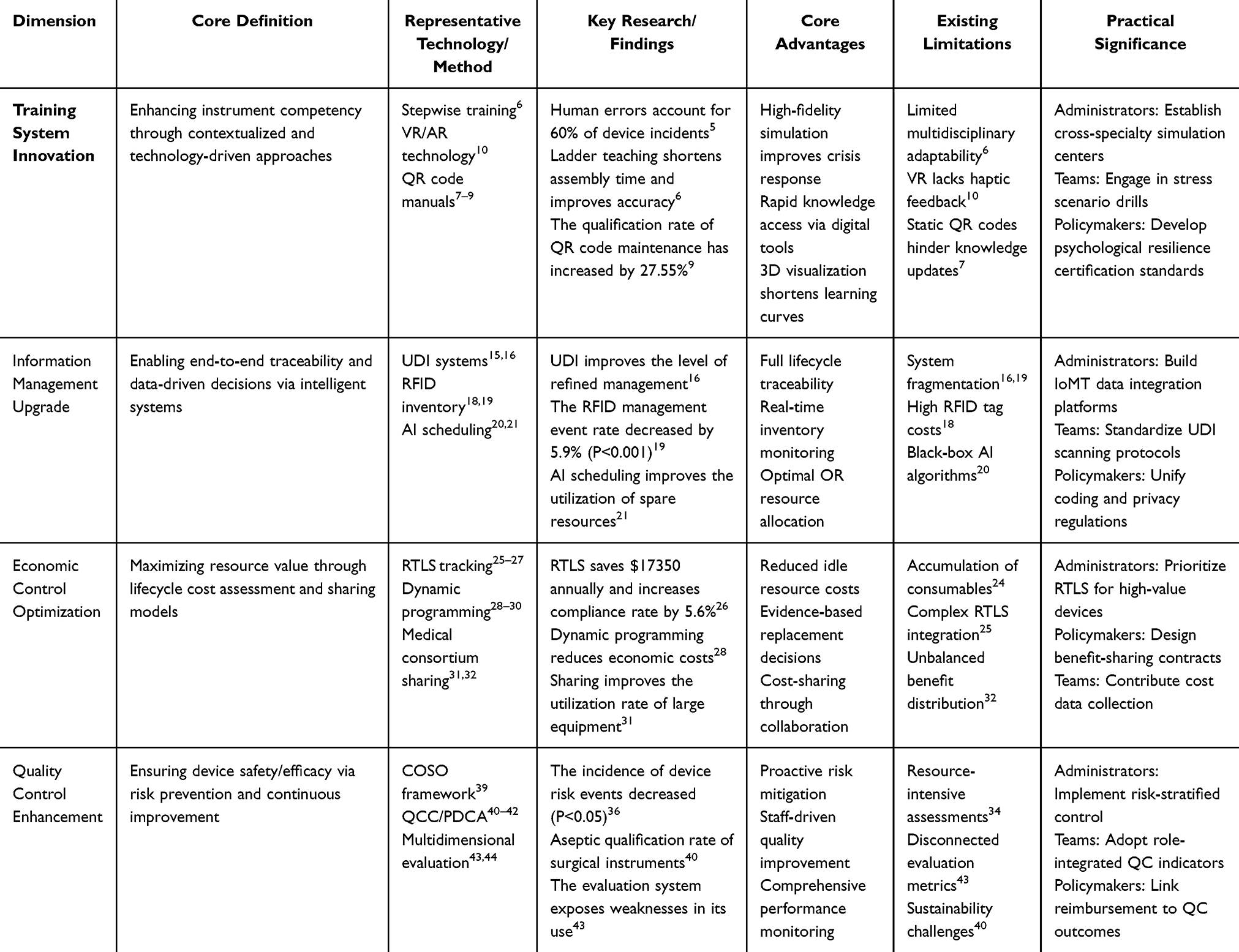 |
Table 1 Systematic Analysis Framework for Mid-Term Management of Operating Room Medical Equipment |
However, there are still gaps in the long-term mechanisms of technical application, economic efficiency, and quality control in the mid-term management of medical equipment in operating rooms, which hinders the improvement of operating room operation quality. In terms of technical application, VR/AR training lacks interdisciplinary integration, cross system data fragmentation hinders full process traceability, and the application of information tools presents an isolated state; In terms of economic efficiency evaluation, there is an excessive reliance on theoretical deduction of the full life cycle cost, and there is a real-time interruption in the collection of clinical data. The verification of the benefits of technological investment is limited to individual cases; In terms of the long-term mechanism of quality control, there is an imbalance between the consumption of clinical risk management resources and clinical feasibility, evaluation indicators are detached from job time, and continuous quality improvement relies on administrative drive. These issues further constrain the improvement of operating room operation quality.
Outlook
Nursing staff, as the front-line subject of equipment use, are not only practitioners of management innovation, but also drivers of technological innovation. Future research should focus on developing standardized evaluation metrics, scalable digital management platforms, and cross institutional data sharing models for optimizing the lifecycle of medical devices. By establishing a standardized training system, intelligent management platform, lean cost control mode, and dynamic quality control mechanism, we aim to improve the operational quality of the operating room; It is also necessary to further adhere to patient safety as the center and nursing profession as the leading role, establish a balance between technological innovation and humanistic care, and ultimately achieve the synergistic improvement of equipment management quality and nursing professional value.
Disclosure
The authors report no conflicts of interest in this work.
References
1. The General Office of the State Council Opinions of the General Office of the State Council on Promoting the High-Quality Development of Public Hospitals: state Council Document No. 18 [EB/OL]. 2021. Available from: https://www.gov.cn/zhengce/content/2021-06/04/content_5615473.htm.
2. Chen YH, Kung LC, Yu JY, et al. lmpact of management models on revenue sharing for signaling medical equipment reliability. J Oper Res Soc. 2022;45(38):79–81.
3. Marselli M. United Wire expanding operations, adds new equipment to make medical products[y]. Wire Journal Intemational. 2023;14(12):56–58.
4. Maktabi M, Neumuth T. Situation-dependent medical device risk estimation: design and evaluation of an equipment management center for vendor-independent integrated operating rooms. J Patient Saf. 2021;17(7):622–630. doi:10.1097/PTS.0000000000000455
5. Wei L, Tie H. Exploration and Optimization Strategies for the Whole Life Cycle Management of Medical Equipment. China Equipment Engineering. 2025;11:100–102.
6. Qian W, Luhua L. The application effect of step-by-step teaching in cardiac and thoracic surgery subspecialty surgical cooperation. Chinese Contemporary Medicine. 2024;31(17):135–140.
7. Ma L, Mu Y, Wei L, Wang X. Practical Application of QR Code Electronic Manuals in Equipment Management and Training. Front Public Health. 2021;9:726063. doi:10.3389/fpubh.2021.726063
8. Junfa S, Bin X, Luhua L, et al. The application of QR code technology in the training and management of electrosurgical equipment in operating rooms. Contemporary Nurse. 2021;28(06):97–99.
9. Jun C, Yan L, Quanping W, et al. Application of QR Code Recognition Technology in the Management of Instruments and Equipment in the Operating Room. General Nursing. 2021;19(06):807–809.
10. Yihui M, Wei W, Xiaopeng H, et al. Application of Virtual Reality and Augmented Reality Technologies in Standardized Training for Neurosurgery Residents. Chinese Journal of Continuing Medical Education. 2024;16(24):190–193.
11. Sergeeva A, Aij K, van den Hooff B, et al. Mobile Devices in the Operating Room: intended and Unintended Consequences for Nurses’. Work Health Inform J. 2016;22(4):1101–1110. doi:10.1177/1460458215598637
12. Tao C, Weifeng C. Optimization and Improvement of Equipment Maintenance Management Model by TnPM. China Equipment Engineering. 2023;9:266–268.
13. Meng W, Yonghua Z, Li L, et al. The application of TnPM management model in operating room equipment management. Qilu Nursing Journal. 2022;28(10):42–44.
14. Jian Z. Research on the Application of Unified Device Identifier (UDI) Coding Management in Laparoscopic Surgical Instruments. Chinese Medical Device Journal. 2018;42(04):299–302.
15. Wilson NA, Tcheng JE, Graham J, Drozda Jr JP. Advancing Patient Safety Surrounding Medical Devices: a Health System Roadmap to Implement Unique Device Identification at the Point of Care. Med Dev. 2021;14:411–421.
16. Beibei C, Shuhan Z, Xingyu J, et al. Practice of Intelligent Management for the Whole Process of High-value Medical Consumables Based on UDI. Chinese Medical Devices. 2024;39(09):
17. Liping Z, Liang C. Application Practice of Smart Ward Based on IoT Information Platform. Chinese Medical Equipment. 2023;38(9):93–98.
18. Lazzaro A, Corona A, Iezzi L, et al. Radiofrequency-based identification medical device: an evaluable solution for surgical sponge retrieval. Surg Innov. 2017;24(3):268–275. doi:10.1177/1553350617690608
19. Fukang Z, Yuntian D, Xiuli L. Design and Application of Operating Room Consumables Management System Based on Radio Frequency Identification Technology. China Medical Equipment. 2024;39(04):
20. Runarsson TP. Approximating probabilistic constraints for surgery scheduling using neural networks[C].
21. Jing Z, Hua L, Jin X. Design and Implementation of an Intelligent Surgical Scheduling Platform. China Digital Medicine. 2024;19(01):49–54.
22. Guohong Y, Hao W, Yuncheng L, et al. The Construction of Medical Equipment Bidding and Procurement Management System Based on Internet+ Technology. People’s Military Doctor. 2015;58(10):1239–1240.
23. Mingshan Z. The Application of Economic Management Methods in Medical Equipment Management. Chinese Medical Equipment. 2008;2008(3):76–77.
24. Huiying L. Analysis of the Application of SPD Mode in Fine Management of Medical Consumables. China Equipment Engineering. 2023;2:43–45.
25. Troutner JC, Harrell MV, Seelen MT, Daily BJ, Levine WC. Using Real-Time Locating Systems to Optimize Endoscope Use at a Large Academic Medical Center. J Med Syst. 2020;44(4):71. doi:10.1007/s10916-020-1540-x
26. Yeoh C, Mascarenhas J, Tan KS, et al. Automated notifications improve time to anesthesia induction: integrating health information technology systems to enhance perioperative efficiency. Anaesthsia and Anaesthetics. 2018;4(3):12.
27. Koval J, Miller E, Miller E, et al. The impact of a real-time locating system within the perioperative environment on physicians and patients’ families. Healthcare Quarterly. 2020;23(SP):25–32. doi:10.12927/hcq.2020.26175
28. Altalabi WM, Rushdi MA, Tawfik BM. Optimisation of medical equipment replacement using stochastic dynamic programming. J Med Eng Technol. 2020;44(7):411–422. doi:10.1080/03091902.2020.1799096
29. Crosby L, Lortie E, Rotenberg B, Sowerby L. Surgical Instrument Optimization to Reduce Instrument Processing and Operating Room Setup Time. Otolaryngol Head Neck Surg. 2020;162(2):215–219. doi:10.1177/0194599819885635
30. Haiyang H, Yang L, Lin Y, et al. Application of Dynamic Programming Algorithm in Medical Equipment Operation Cost Management. Modern Hospital. 2022;22(09):1406–1408.
31. Yili T. “A Review of the Current Status of Medical Equipment Sharing Management under the ‘Medical Consortium’ Model. Chinese Medical Equipment. 2021;36(09):156–158.
32. Zhang L, Cheng W, Wenhua B. The Construction and Application of Medical Equipment Sharing Resource Centers in Hospitals. China’s Chief Accountants. 2024;4):41–44.
33. Huijun X. Application of Risk Management Measures in Medical Devices. Engineering Technology Development. 2022;3(8):62–64.
34. Fengyu H, Lixia H, Lixiang W, et al. The application of risk management in the reprocessing of surgical instruments for the fourth generation Da Vinci robot. Lingnan Emergency Medicine Journal. 2024;29(02):200–202.
35. Jianmin L, Zhimin C, Lizhen Z, et al. The application of risk management in hospital medical device management and its impact on management quality. Chinese Medical Device Information. 2023;29(18):179–182.
36. Yidong Y. The Application Value of Risk Management in Hospital Medical Device Management. China Medical Device Information. 2024;30(19):172–174.
37. Jing L. Research on Internal Control Management of Public Hospitals’ Procurement Activities under the COSO Framework. Chinese Agricultural Accounting. 2024;34(13):36–38.
38. Xue R, Jing W. Research on Internal Control Audit of Public Hospitals Based on the New COSO Framework. Chinese Chief Accountants. 2022;10:141–143.
39. Shuang Y. Exploration of Optimizing Internal Control of Operation Room Equipment under the COSO Framework. Hospital Management Forum. 2024;41(09):87–90.
40. Treeli M. Analysis of the implementation effect of Quality Control Circle activities in the management of surgical instruments and equipment. China Medical Device Information. 2019;25(05):170–171.
41. Xiaoman J, Naimei T, Lei G. The application of the “Five Constants Method” combined with PDCA management model in the management of surgical instruments and equipment in operating rooms. General Nursing. 2017;15(36):4553–4555.
42. Luo Y, Yang Q, Li B, et al. Establishment of a quality control circle to reduce biofilm formation in flexible endoscopes by improvement of qualified cleaning rate. J Int Med Res. 2020;48(9):300060520952983. doi:10.1177/0300060520952983
43. Yiyi W, Miaochun Q, Weiming W, et al. Construction and Application of Medical Device Quality Control Management Evaluation System. Journal of PLA Hospital Management. 2020;27(06):531–534.
44. Wei-Min W, Wei B, Jia-Ling P, et al. Research on the Construction of Quality Evaluation Index System for Medical Devices in Guangxi Medical Institutions. Modern Hospital. 2019;19(04):
 © 2025 The Author(s). This work is published and licensed by Dove Medical Press Limited. The
full terms of this license are available at https://www.dovepress.com/terms
and incorporate the Creative Commons Attribution
- Non Commercial (unported, 4.0) License.
By accessing the work you hereby accept the Terms. Non-commercial uses of the work are permitted
without any further permission from Dove Medical Press Limited, provided the work is properly
attributed. For permission for commercial use of this work, please see paragraphs 4.2 and 5 of our Terms.
© 2025 The Author(s). This work is published and licensed by Dove Medical Press Limited. The
full terms of this license are available at https://www.dovepress.com/terms
and incorporate the Creative Commons Attribution
- Non Commercial (unported, 4.0) License.
By accessing the work you hereby accept the Terms. Non-commercial uses of the work are permitted
without any further permission from Dove Medical Press Limited, provided the work is properly
attributed. For permission for commercial use of this work, please see paragraphs 4.2 and 5 of our Terms.