
Back to Journals » International Medical Case Reports Journal » Volume 18
Management of Pediatric Chronic Hepatitis C with Crushed or Split Glecaprevir/Pibrentasvir: A Case Series From East Jeddah Hospital, Saudi Arabia
Authors Alamri AM, Almehman WA, Albuhairy AM, Alkatheeri AA, Alzahrani YA 
Received 28 March 2025
Accepted for publication 21 August 2025
Published 1 September 2025 Volume 2025:18 Pages 1135—1140
DOI https://doi.org/10.2147/IMCRJ.S529396
Checked for plagiarism Yes
Review by Single anonymous peer review
Peer reviewer comments 2
Editor who approved publication: Dr Xudong Zhu
Aisha M Alamri,1 Wijdan A Almehman,1 Ali M Albuhairy,2 Ayed A Alkatheeri,3 Yahya A Alzahrani3
1Department of Pediatrics, East Jeddah Hospital, Ministry of Health, Jeddah, 23816, Saudi Arabia; 2Department of Medical Microbiology, East Jeddah Hospital, Ministry of Health, Jeddah, 23816, Saudi Arabia; 3Drug Information Center, Department of Pharmacy, East Jeddah Hospital, Ministry of Health, Jeddah, 23816, Saudi Arabia
Correspondence: Yahya A Alzahrani, Drug Information Center, Department of pharmacy, East Jeddah hospital, 23816 King Abdullah Road, Sulaymaniyah, Jeddah, 22253, Saudi Arabia, Tel +966557700178, Email [email protected]
Purpose: Glecaprevir/Pibrentasvir (GLE/PIB) is approved for chronic hepatitis C treatment in both adults and pediatric patients, no data regarding crushing this drug in pediatric populations. This case series evaluate the efficacy and safety of crushed or split GLE/PIB tablets in two pediatric patients at East Jeddah Hospital, Saudi Arabia.
Patients and Methods: Two treatment-naïve pediatric patients with normal liver function received weight-based GLE/PIB for eight weeks. The first patient ingested crushed tablets with juice, while the second consumed divided tablets. Viral load, liver function, and coagulation profiles were monitored. Both patients achieved rapid viral suppression, with hepatitis C RNA undetectable or near the lower limit of quantification by day 14. Liver function tests improved, and no adverse effects were observed.
Conclusion: This is the first case series of successful pediatric HCV treatment using crushed or Hepatitis C virus and hepatocellular carcinoma: carcinogenesis in the era of direct-acting antivirals split GLE/PIB. This approach may expand treatment options in resource-limited settings where pediatric formulations are unavailable.
Keywords: glecaprevir/pibrentasvir, crushed tablets, split tablets, direct-acting antivi-rals daas, Saudi Arabia, case series
Introduction
Hepatitis C virus (HCV) is a single-stranded RNA virus belonging to the Flaviviridae family, primarily infecting hepatocytes and causing both acute and chronic liver disease. It remains a major global health concern due to its high prevalence and its association with serious complications such as cirrhosis and hepatocellular carcinoma.1,2
The global prevalence of HCV infection is estimated at 1.0% (95% CI 0.8–1.1%), corresponding to 71.1 million (62.5–79.4) viremic infections.3 In Saudi Arabia, HCV prevalence in the general adult population is estimated at 0.7–1.0%.4,5 The global pediatric HCV burden is estimated at 3.26 million (95% UI 2.07–3.90) children aged 0–18 years.6,7 Limited data exists on pediatric HCV prevalence in Saudi Arabia. One study found a prevalence of 0.012% among children <14 years old, while another reported a prevalence of 0.22% among children aged 1–12 years.8,9
Treatment options for HCV have significantly improved with the introduction of direct-acting antivirals (DAAs). These medications target specific steps in the HCV replication cycle and offer high cure rates with fewer side effects compared to interferon-based regimens. Common DAA regimens include sofosbuvir/velpatasvir, glecaprevir/pibrentasvir (GLE/PIB), sofosbuvir/ledipasvir, and elbasvir/grazoprevir, achieving sustained virologic response (SVR) rates >95% across all HCV genotypes.10,11
GLE/PIB is a fixed-dose combination approved as a pangenotypic regimen for treating chronic HCV infection in both adults and pediatric patients. It consists of glecaprevir, an NS3/4A protease inhibitor, and pibrentasvir, an NS5A inhibitor. GLE/PIB is highly effective across all genotypes (GT1-6), even in patients with compensated cirrhosis and chronic kidney disease.12,13 While a pediatric formulation of GLE/PIB pellets is available in some countries, in Saudi Arabia the only approved formulation is the adult tablet containing 100 mg glecaprevir and 40 mg pibrentasvir. This tablet is produced as an immediate-release bilayer tablet using hot melt extrusion technology with a non-functional film coating.
For pediatric patients or others who have difficulty swallowing whole tablets, alternative methods of administration may be necessary. Crushing GLE/PIB tablets has been limited explored in adult patients, with no data available on its use in pediatric populations.
Three reports have provided insights into the use of crushed or cut GLE/PIB tablets. A Phase 1 study by Oberoi et al in healthy adults found that cutting tablets in half had minimal impact on drug exposures, while grinding or crushing resulted in lower glecaprevir and higher pibrentasvir exposures. Two case reports in adult patients demonstrated successful treatment using crushed GLE/PIB tablets, one in heart transplant recipients and another in a patient receiving medication via a percutaneous endoscopic gastrostomy tube.14–16
Despite the findings in adults, a significant gap remains in the literature regarding the use of manipulated GLE/PIB tablets in pediatric patients. This knowledge deficit is particularly relevant in regions where approved pediatric formulations are unavailable. To address this critical issue, a case Series of two pediatric HCV-infected patients in Saudi Arabia treated with crushed or split GLE/PIB tablets is proposed. The study aims to evaluate the safety, tolerability, and efficacy of this alternative administration method in pediatric patients while acknowledging the limitations and potential risks associated with tablet manipulation. This case series is expected to contribute valuable insights to the ongoing discussion on optimizing HCV treatment strategies for children in resource-limited settings, potentially expanding treatment access for pediatric HCV patients in regions where approved formulations are not yet accessible.
Material and Methods
Patient Histories and Initial Evaluations
Both patients had no significant prior personal medical history and were not taking any medications other than the prescribed GLE/PIB regimen.
Both patients acquired HCV through vertical (fetomaternal) transmission. The first patient, a 4-year-9-month-old girl, was exposed to HCV in utero, as her mother was diagnosed with the virus during the 2nd trimester of pregnancy. Following medical recommendations, her mother was advised to have her daughter screened after the age of two. At three years of age, a routine check-up revealed elevated liver enzymes (ALT and AST), leading to further investigation. She was subsequently referred to our hospital “ East Jeddah Hospital” for comprehensive assessment and follow-up. She was first seen at our hospital on June 6, 2024, where she was asymptomatic, had no complaints, and her clinical examination was unremarkable.
The second patient, a 10-year-11-month-old boy, was diagnosed with HCV two years prior to his visit to East Jeddah Hospital. His mother was diagnosed with HCV while pregnant with his younger sibling, prompting the Saudi Center for Infectious Diseases in Jeddah to contact the family for screening. All family members tested negative except for the second patient. Initially, his family was informed that treatment would not be available until he reached 12 years of age, but he was later referred to our hospital for follow-up and evaluation. He was first seen on June 9, 2024, and like the first patient, he was asymptomatic, had no complaints, and his clinical examination was unremarkable.
Laboratory examinations for the first patient revealed HCV genotype 1a, with a reactive HCV antibody test (23.39 IU/mL). Additional testing ruled out other viral hepatitis co-infections as HBsAg was nonreactive (0.29 IU/mL) and HBsAb was high (141.27 mIU/mL), indicating a previous hepatitis B vaccination response. Her baseline AST was 45 U/L, GGT 13.9 U/L, ALP 250 U/L, total bilirubin 0.36 mg/dL, albumin 3.8 g/dL, PT 13.7 sec, and INR 1.03, with no signs of coagulopathy. A fibroscan at King Abdulaziz University Hospital (KAUH) revealed no evidence of liver fibrosis or decompensation. Her complete blood count (CBC) showed normal characteristics, including WBC 6.42 (10³/μL), ANC 0.95 (10³/μL), lymphocyte count 4.82 (10³/μL), and haemoglobin 13.3 g/dL. Similarly, the second patient’s laboratory tests confirmed HCV genotype 4, as evidenced by a reactive HCV antibody test (20.14 IU/mL). Additional testing revealed that HBsAg was nonreactive (0.29 IU/mL) and HBsAb was 32.19 mIU/mL, which ruled out the presence of other viral infections. His Fibroscan results at King Fahad Hospital were normal, confirming that there was no fibrosis or liver decompensation. His baseline AST was 55 U/L, PT 13.1 sec, and INR 0.98. His CBC was within the normal range, with WBC count of 8.29 (10³/μL), ANC count of 2.98 (10³/μL), a lymphocyte count of 3.76 (10³/μL), and a haemoglobin level of 14.3 g/dL.
Treatment and Administration
Due to their treatment-naïve condition and normal liver imaging, both patients received GLE/PIB therapy on October 9, 2024. The first patient was recommended a daily dosage of 150 mg/60 mg depending on weight, whilst the second patient was administered 250 mg/100 mg daily. The medication was crushed into a fine powder using the Bingcute Pill Crusher (a 3-in-1 multifunctional pill cutter, splitter, and grinder), purchased from Amazon. The crushed medication was then mixed with oral sweet before administration to ensure accurate and complete dosing. The mixture was administered within 15 minutes of preparation to prevent degradation, followed by a water rinse to ensure the full dose was delivered. To improve palatability, the patients’ parents were advised to ensure that the mixture was consumed within five minutes to prevent the tablets from developing a bitter taste if left longer. On the other hand, an Apex Ultra Pill Cutter, which was also bought from Amazon, was used to divide the second patient’s pills in half prior to administration. The treatment was administered daily for eight weeks, in accordance with guidelines for treatment-naïve, non-cirrhotic pediatric patients. Adherence was closely monitored to maintain treatment effectiveness and prevent dosing errors.
Treatment Response and Outcomes
Over the eight-week treatment period, both patients were evaluated through serial HCV RNA quantification, liver function tests, and coagulation profile assessments at October 9 (Day 0), October 16 (Day 7), October 23 (Day 14), November 6 (Day 28), November 20 (Day 42), and December 4 (Day 56).
The first patient had a baseline HCV RNA level of 405,783 IU/mL on Day 0 (October 9). By Day 7 (October 16), her viral load had diminished to <12 IU/mL, and by Day 14 (October 23), HCV RNA became undetectable and remained so for the remainder of the treatment period (Figure 1). Liver function tests demonstrated a gradual enhancement, with ALT declining from 73.3 U/L at baseline to 11 U/L by Day 56, and AST reducing from 58 U/L to 26 U/L. Her coagulation indicators were steady during the treatment, with PT fluctuating between 13.4 and 12.9 seconds and INR between 1.02 and 0.97. She finished the entire treatment regimen without problems, adverse effects, or the necessity for dose modifications (Table 1).
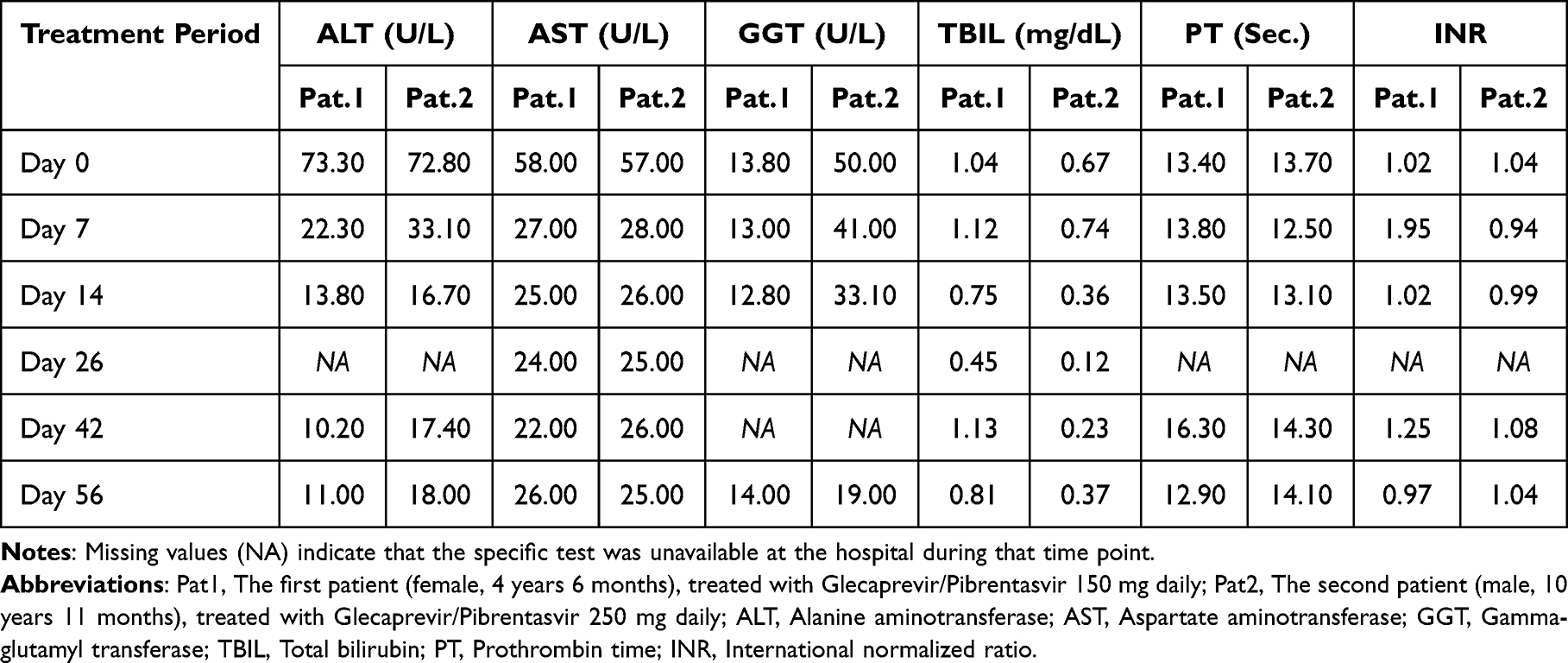 |
Table 1 Liver Function Test and Coagulation Profile Over 8 Weeks of Treatment |
 |
Figure 1 HCV viral load reduction over 8 weeks of treatment in two pediatric patients receiving Glecaprevir/Pibrentasvir (GLE/PIB). The first patient (black line) received 150 mg OD, and the second patient (red line) received 250 mg OD. Viral load was measured as log₁₀ (IU/mL) at different time points. |
For the second patient, his baseline HCV RNA level was 1,603,317 IU/mL on Day 0 (October 9). By Day 7 (October 16), his viral load had decreased to 76 IU/mL, and by Day 14 (October 23), it dropped further to <15 IU/mL. By Day 28 (November 6), HCV RNA became undetectable, with a transient increase to <15 IU/mL by Day 42 (November 20), before becoming undetectable again at Day 56 (Figure 1). Liver enzyme levels demonstrated steady improvement, with ALT decreasing from 72.8 U/L at baseline to 18 U/L by Day 56 and AST decreasing from 57 U/L to 25 U/L. His coagulation profile remained stable, with PT ranging from 13.7 to 14.1 seconds and INR from 1.04 to 1.04. Like the first patient, he completed the full treatment course without complications, adverse effects, or the need for dose modifications (Table 1).
Discussion
This case series provide the first documented evidence of successful treatment of pediatric HCV patients using crushed or split GLE/PIB tablets. Both patients achieved dramatic viral suppression and SVR without significant adverse effects, suggesting that this approach may be a viable option when pediatric formulations are unavailable.
The rapid reduction in HCV RNA levels noted in both individuals corresponds with the pharmacokinetic characteristics of GLE/PIB in adults. Prior research indicates that GLE/PIB generally attains its peak antiviral efficacy within the initial two weeks of therapy.17 Our results demonstrate a similar pattern in pediatric patients, with HCV RNA becoming undetectable or near the lower limit of quantification by day 14 in both cases.
The efficacy of crushed or split GLE/PIB tablets in our pediatric patients is consistent with limited data from adult populations. Waldman et al reported successful treatment of adult heart transplant recipients using crushed GLE/PIB, achieving 100% SVR,15 while Tanaka et al described a case of an adult patient treated effectively with crushed GLE/PIB administered via a percutaneous endoscopic gastrostomy tube.16 Similarly, Lalanne et al reported a case of therapeutic drug monitoring-guided treatment using crushed sofosbuvir/velpatasvir in an adult patient, which resulted in favorable pharmacokinetics and successful viral clearance despite tablet manipulation. Although this case involved a different DAA regimen and patient population, it reinforces the broader feasibility of modified DAA administration when standard formulations are unsuitable Collectively, these reports along with our current findings support the viability of alternative administration strategies in populations where pediatric formulations are not accessible and contribute to a growing body of evidence for off-label but clinically effective practices in HCV management.18
However, it is crucial to note that tablet manipulation may impact drug bioavailability. Oberoi et al found that crushing or grinding GLE/PIB tablets in adults resulted in lower glecaprevir exposures (27–36% decrease in AUCinf) and higher pibrentasvir exposures (33–83% increase in AUCinf) compared to intact tablets.14 While our patients achieved viral suppression, the altered pharmacokinetics of crushed or split tablets may have implications for optimal dosing and treatment duration in pediatric populations.
The safety profile observed in our patients is encouraging, with no significant adverse events reported. This is consistent with the generally favorable safety profile of GLE/PIB in both adult and pediatric populations.19 However, long-term follow-up will be necessary to assess for any delayed effects of altered drug exposures due to tablet manipulation.
Our strategy for tablet manipulation and administration sought to mitigate any concerns regarding medication stability and palatability. Crushing the pills prior to administration and facilitating prompt drinking of the medication combination likely preserved therapeutic efficacy. This procedure adheres to standard practices for delivering crushed drugs, as extended exposure to air or liquids may compromise drug stability.
While our results are promising, several limitations must be acknowledged. This case series cannot definitively establish the safety and efficacy of crushed or split GLE/PIB in pediatric patients. Larger studies with pharmacokinetic assessments are needed to optimize dosing and confirm treatment outcomes. Additionally, we did not assess the pharmacokinetics or bioavailability of crushed or split GLE/PIB tablets in these pediatric patients, which limits our ability to draw conclusions about the precise impact of tablet manipulation on drug absorption and effectiveness.
Conclusion
This case series provides preliminary evidence supporting the off-label use of crushed or split GLE/PIB tablets for the treatment of pediatric chronic hepatitis C in situations where age-appropriate formulations are not accessible. The administration of crushed tablets dispersed in a palatable liquid vehicle or tablets divided using a standardized pill cutter demonstrated favorable virologic outcomes and was well tolerated in both cases.
These findings suggest that, with appropriate dose calculation, preparation under controlled conditions, and close clinical monitoring, manipulated GLE/PIB tablets may represent a viable interim strategy in pediatric patients who are unable to swallow intact tablets. Further prospective studies are warranted to assess the pharmacokinetic profile, long-term safety, and clinical efficacy of such administration methods, and to establish standardized protocols for their use in pediatric HCV management.
Consent Statements
Institutional approval was not required for publication of this case series. Written informed consent was obtained from the parents of both pediatric patients for the publication of this case series, including any accompanying images.
Disclosure
The authors report no conflicts of interest in this work.
References
1. Fiehn F, Beisel C, Binder M. Hepatitis C virus and hepatocellular carcinoma: carcinogenesis in the era of direct-acting antivirals. Curr Opin Virol. 2024;67:101423. doi:10.1016/j.coviro.2024.101423
2. Fitzmaurice C, Akinyemiju T, Abera S, et al. The burden of primary liver cancer and underlying etiologies from 1990 to 2015 at the global, regional, and national level results from the global burden of disease study 2015. JAMA Oncol. 2017;3(12):1683–1691. doi:10.1001/jamaoncol.2017.3055
3. Blach S, Zeuzem S, Manns M, et al. Global prevalence and genotype distribution of hepatitis C virus infection in 2015: a modelling study. Lancet Gastroenterol Hepatol. 2017;2(3):161–176. doi:10.1016/S2468-1253(16)30181-9
4. Al-Faleh FZ. Changing pattern of hepatitis viral infection in Saudi Arabia in the last two decades. Ann Saudi Med. 2003;23(6):367–371. doi:10.5144/0256-4947.2003.367
5. Almajid A, Albarbari H, Bazroon A, et al. Epidemiological Perspectives: a Four-Year Insight Into Hepatitis C Surveillance in the Kingdom of Saudi Arabia. Cureus. 2024. doi:10.7759/cureus.52646
6. Goble S, Mattos AZ, Mendizabal M, Debes JD. Hepatitis C and hepatocellular carcinoma in Latin America: elimination as a path to cancer prevention. Ann Hepatol. 2023;28(6):101149. doi:10.1016/j.aohep.2023.101149
7. Sánchez-ávila JF, González E, Vázquez V, Suárez S, Uribe M. Geographical distribution of HCV genotypes in Mexico. Ann Hepatol. 2007;6(3):156–160. doi:10.1016/s1665-2681(19)31921-0
8. El-Shabrawi MH, Alanani NMK. Burden of pediatric hepatitis C. World J Gastroenterol. 2013;19(44):7880–7888. doi:10.3748/wjg.v19.i44.7880
9. Abdo AA, Sanai FM, Al-Faleh FZ. Epidemiology of viral hepatitis in Saudi Arabia: are we off the hook. Saudi Journal of Gastroenterology. 2012;18(6):349–357. doi:10.4103/1319-3767.103425
10. Tran K, Brett K, Walter M. Direct-Acting Antivirals for Pediatric Chronic Hepatitis C Virus Infection. Canadian Journal of Health Technologies. 2023;3(9). doi:10.51731/cjht.2023.740
11. Peribañez-Gonzalez M, Cheinquer H, Rodrigues L, et al. Efficacy and safety of glecaprevir/pibrentasvir in treatment-naïve adults with chronic hepatitis C virus genotypes 1–6 in Brazil. Ann Hepatol. 2021;20:100257. doi:10.1016/j.aohep.2020.09.002
12. Cottrell EB, Chou R, Wasson N, Rahman B, Guise JM. Reducing risk for mother-to-infant transmission of hepatitis C virus: a systematic review for the U.S. preventive services task force. Ann Intern Med. 2013;158(2):109–113. doi:10.7326/0003-4819-158-2-201301150-00575
13. Casiraghi MA, De Paschale M, Romanò L, et al. Long-term Outcome (35 Years) of Hepatitis C after Acquisition of Infection Through Mini Transfusions of Blood Given at Birth. Hepatology. 2004;39(1):90–96. doi:10.1002/hep.20030
14. Oberoi RK, Zhao W, Sidhu DS, Viani RM, Trinh R, Liu W. A Phase 1 Study to Evaluate the Effect of Crushing, Cutting Into Half, or Grinding of Glecaprevir/Pibrentasvir Tablets on Exposures in Healthy Subjects. J Pharm Sci. 2018;107(6):1724–1730. doi:10.1016/j.xphs.2018.02.015
15. Waldman G, Bethea E, Gustafson J, et al. Use of Crushed Glecaprevir/Pibrentasvir in Hepatitis C Positive Donor Heart Transplant Recipients. The Journal of Heart and Lung Transplantation. 2020;39(4):S95–S96. doi:10.1016/j.healun.2020.01.941
16. Tanaka Y, Tateishi R, Koike K. Successful treatment of chronic hepatitis C virus infection with crushed glecaprevir/pibrentasvir administered via a percutaneous endoscopic gastrostomy tube: case report and review of the literature. Clin J Gastroenterol. 2019;12(6):588–591. doi:10.1007/s12328-019-00997-5
17. Kwo PY, Poordad F, Asatryan A, et al. Glecaprevir and pibrentasvir yield high response rates in patients with HCV genotype 1–6 without cirrhosis. J Hepatol. 2017;67(2):263–271. doi:10.1016/J.JHEP.2017.03.039
18. Lalanne S, Jézéquel C, Tron C, et al. Therapeutic Drug Monitoring-Guided Crushed Sofosbuvir-Velpatasvir Treatment: a Case Study. Ther Drug Monit. 2020;42(2):163–164. doi:10.1097/FTD.0000000000000718
19. Jonas MM, Rhee S, Kelly DA, et al. Pharmacokinetics, Safety, and Efficacy of Glecaprevir/Pibrentasvir in Children With Chronic HCV: part 2 of the DORA Study. Hepatology. 2021;74(1):19. doi:10.1002/HEP.31841
 © 2025 The Author(s). This work is published and licensed by Dove Medical Press Limited. The
full terms of this license are available at https://www.dovepress.com/terms
and incorporate the Creative Commons Attribution
- Non Commercial (unported, 4.0) License.
By accessing the work you hereby accept the Terms. Non-commercial uses of the work are permitted
without any further permission from Dove Medical Press Limited, provided the work is properly
attributed. For permission for commercial use of this work, please see paragraphs 4.2 and 5 of our Terms.
© 2025 The Author(s). This work is published and licensed by Dove Medical Press Limited. The
full terms of this license are available at https://www.dovepress.com/terms
and incorporate the Creative Commons Attribution
- Non Commercial (unported, 4.0) License.
By accessing the work you hereby accept the Terms. Non-commercial uses of the work are permitted
without any further permission from Dove Medical Press Limited, provided the work is properly
attributed. For permission for commercial use of this work, please see paragraphs 4.2 and 5 of our Terms.