
Back to Journals » Psychology Research and Behavior Management » Volume 18
Longitudinal Associations Between Childhood Emotional Abuse and Social Anxiety in Emerging Adults: The Role of Interpersonal Sensitivity and Insecurity

Received 14 March 2025
Accepted for publication 4 August 2025
Published 27 August 2025 Volume 2025:18 Pages 1787—1797
DOI https://doi.org/10.2147/PRBM.S528300
Checked for plagiarism Yes
Review by Single anonymous peer review
Peer reviewer comments 2
Editor who approved publication: Dr Igor Elman
Ya Zhu,1,* Wangjia Zhang,2,* Xuliang Shi2
1Center for Mental Health Education and Counseling, Guangdong University of Science and Technology, Dongguan, Guangdong, 523083, People’s Republic of China; 2College of Education, Hebei University, Baoding, Hebei, 071002, People’s Republic of China
*These authors contributed equally to this work
Correspondence: Xuliang Shi, College of Education, Hebei University, Baoding, 071002, People’s Republic of China, Email [email protected]
Objective: Childhood emotional abuse serves as one of the most widely recognized risk factors contributing to social anxiety. However, little is known about the role of interpersonal factors in this relationship. The present study aims to examine the longitudinal mediating effects of interpersonal sensitivity and interpersonal insecurity on the relationship between childhood emotional abuse and social anxiety.
Methods: The data for this study were derived from a large-scale health-related cohort study of college students in Southeast China. A total of 3861 students completed the three waves of surveys and were used for subsequent data analysis. All participants filled out questionnaires related to childhood emotional abuse (Wave 1), interpersonal sensitivity and interpersonal insecurity (Wave 2), as well as social anxiety (Wave 3). Mediation analyses with bootstrapping were conducted to explore the mediating role of interpersonal sensitivity and interpersonal insecurity in the relationship between childhood emotional abuse and social anxiety.
Results: The results showed that the prevalence of social anxiety was 25.9% among college students. Findings from mediation analysis showed that interpersonal sensitivity and interpersonal insecurity play parallel mediating roles in the relationship between childhood emotional abuse and social anxiety.
Conclusion: Psychological interventions aimed at reducing interpersonal sensitivity and interpersonal insecurity may be conducive to alleviating the social anxiety of college students who have suffered from childhood emotional abuse.
Keywords: childhood emotional abuse, interpersonal sensitivity, interpersonal insecurity, social anxiety, longitudinal study
Introduction
Social anxiety disorder (SAD) is a common psychological condition characterized by an intense and persistent fear of social situations or performance activities where one might be negatively evaluated or scrutinized by others.1 The disorder often begins in late childhood or early adolescence and can persist into adulthood if left untreated. In a systematic review and meta-analysis, researchers found that the global prevalence of SAD was estimated to be 4.7% in children, 8.3% in adolescents, and 17% in youth.2 Studies have shown that social anxiety is particularly prominent in undergraduate students.3 Individuals with SAD are at a higher risk of developing depression,4 substance abuse,5 and other mental health conditions6 due to the chronic stress and isolation associated with the disorder.
Childhood Emotional Abuse and Social Anxiety
Childhood emotional abuse is a form of maltreatment that involves intentional or unintentional behaviors by caregivers or close relatives that make a child feel worthless, unloved, or unimportant.7 Compared with other types of abuse, emotional abuse is more likely to pose a risk of mental health problems, such as social anxiety.8,9 Existing theoretical and empirical studies have shown that childhood emotional abuse has a positive effect on social anxiety. First, from a family perspective, the attachment theory emphasizes that negative experiences in parent-child relationships may be risk factors for maladjustment later in life.10 Childhood emotional abuse will have a negative impact on an individual’s secure attachment, and the behavioral habits formed thereby will extend to the pattern of getting along with others in the future. Second, from a cognitive perspective, according to the schema theory11 and the cognitive specificity hypothesis,12 human cognitive processes are guided by underlying cognitive schemata, and each mood disorder has specific cognitive content associated with that disorder.13,14 Third, from an etiological perspective, etiological models of social anxiety suggest that social anxiety develops as a result of the interaction of biological predisposition, negative experiences, and misperceptions of threat cues.15 A small number of longitudinal studies have found that childhood emotional abuse is an important predictor of subsequent social anxiety.16,17 Although an increasing amount of evidence has demonstrated a clear relationship between childhood emotional abuse and social anxiety, the underlying mechanisms of this relationship remain to be explored. Uncovering these mechanisms holds significant clinical importance for understanding the occurrence of social anxiety, and it can also inform future prevention and intervention strategies for individuals who have experienced childhood emotional abuse.
Interpersonal Sensitivity and Interpersonal Insecurity as Potential Mediators
Childhood emotional abuse, as a distal factor, may increase social anxiety by influencing proximal factors (eg, interpersonal sensitivity and interpersonal insecurity). Interpersonal sensitivity refers to the excessive attention and sensitivity of individuals to negative social evaluation. Individuals with high interpersonal sensitivity are usually more sensitive to others’ opinions of them and are often manifested as feelings of inadequacy, obedience, avoidance or inhibition of expression in social interaction.18,19 According to the vulnerable-stress model, an individual’s self-schema is in a latent state before being exposed to relevant stressors.20 Once the schema is activated, cognitively vulnerable individuals will have more psychological problems.21 Specifically, negative experiences suffered in childhood, especially emotional abuse, can increase an individual’s cognitive vulnerability, which can be manifested in interpersonal sensitivity in the social domain. Individuals with higher interpersonal sensitivity will capture more negative social factors in the same stressful context, resulting in more negative emotions, such as social anxiety.13,22,23 Therefore, it is reasonable to conclude that interpersonal sensitivity, as a cognitive mechanism related to the stress response system, may be a potential mediator through which childhood trauma is associated with social anxiety. Some cross-sectional studies have provided preliminary support for this issue. For example, in a sample of 415 volunteers from the general adult population, researchers found that interpersonal sensitivity played a mediating role in the relationship between child abuse and depressive symptoms.
Another interpersonal factor related to social anxiety is interpersonal insecurity, which refers to an individual’s fear of interpersonal rejection or harm, or the establishment of an insecure connection with others.24 If a person feels supported and cared for in social relationships, it will enhance his interpersonal security; otherwise, it will increase his interpersonal insecurity.25 Interpersonal insecurity can lead to interpersonal dysfunctions, and social anxiety is one of its manifestations. According to the basic psychological need theory,26 humans have the need to form intimate relationships and develop relationships. When this need is not met, individuals are prone to negative emotions and maladaptive behaviors. Empirical research has also shown that interpersonal insecurity was salient risk factor for psychopathology.27,28 Additionally, studies have shown that interpersonal insecurity is mainly caused by not being loved, not being protected and not being trusted in the process of interpersonal communication.29,30 Therefore, individuals who have experienced childhood trauma may have high interpersonal insecurity due to their fear of rejection and abandonment and the difficulty in establishing trust with others. In a clinical sample seeking treatment for eating disorders, researchers have found that attachment insecurity mediates the relationship between childhood maltreatment and eating disorders.29 Consequently, based on previous empirical and theoretical evidence, it is essential to explore whether interpersonal insecurity could serve as a mediator in the relationship between childhood emotional abuse and subsequent social anxiety.
The Current Study
Many previous studies have explored the pathways from childhood trauma to social anxiety, but no studies have incorporated comprehensive models of interpersonal factors to examine the longitudinal effects of childhood emotional abuse on social anxiety. Therefore, this study adopted a longitudinal design to examine the mediating effects of interpersonal sensitivity and interpersonal insecurity in the relationship between childhood emotional abuse and social anxiety. The current study put forward two hypotheses:
Hypothesis 1: Interpersonal sensitivity would mediate the relationship between childhood emotional abuse and subsequent social anxiety. Hypothesis 2: Interpersonal insecurity would mediate the relationship between childhood emotional abuse and subsequent social anxiety.
Materials and Methods
Participants and Procedures
The data for this study were derived from a large-scale health-related cohort study of college students in Southeast China. The first survey, conducted in March 2019 (T1), included 4352 freshmen from three universities in Guangdong province. Based on prior pre-surveys, students required a minimum of 15 minutes to complete the questionnaire. As a result, questionnaires finished in under 15 minutes were regarded as potentially invalid and were excluded from the dataset. After removing these questionnaires, 4191 freshmen (45.6% female, Mage = 19.14, SD = 1.02) were followed for subsequent follow-up investigations (T2, September 2019). The retention rates for T2 and T3 (September 2020) were 93.17% and 92.86%, respectively. The main reason for student attrition was their absence from class on the day of the assessment. Finally, a total of 3861 participants were retained for subsequent data analysis.
Prior to the survey, electronic informed consent was acquired from the participants. In order to guarantee the consistency of instructions, pre-data collection training was offered to class advisors and graduate students. After a short introduction regarding the requirements and precautions, all students were told to complete an online mental health survey via mobile phones in a regular classroom environment. As an incentive for their participation, students were awarded course credits for mental health courses when they finished the survey. The research protocol for this study was scrutinized and approved by the Research Ethics Committee of the corresponding author’s institution and by the local education authorities and relevant university principals.
Questionnaire Measures
Childhood Emotional Abuse
Childhood emotional abuse at T1 was evaluated using the emotional abuse subscale of the Childhood Trauma Questionnaire-Short Form (CTQ-SF). The CTQ-SF is divided into five subscales: emotional neglect, physical neglect, emotional abuse, sexual abuse, and physical abuse. The emotional abuse subscale includes 5 items (eg, “People in my family said hurtful or insulting things to me”). All items were evaluated on a 5-point scale ranging from 1 (never) to 5 (very often). Scores from 5 items were summed to get a total score ranging from 5 to 25, with higher scores indicating a higher extent of exposure to emotional abuse. The CTQ-SF has shown satisfactory psychometric properties in Chinese sample.31 In the present study, the Cronbach’s alpha was 0.79.
Interpersonal Sensitivity
Interpersonal sensitivity at T2 was measured by interpersonal sensitivity subscale of Brief Symptom Inventory (BSI).32,33 This subscale focuses on feelings of personal inadequacy and inferiority, characterized by self-deprecation, a sense of uneasiness, and marked discomfort during interpersonal interactions.32 It includes 4 items (eg, “feeling very self-conscious with others”), and each item is scored on a response scale of 0 (not at all) to 4 (extremely). Higher scores indicated higher levels of interpersonal sensitivity. BSI have demonstrated excellent internal consistency in the general population.34 The results of confirmatory factor analysis showed that there is a good model structure for this variable (see Table S1 of Supplemental Materials). In the present study, the Cronbach’s alpha was 0.87.
Interpersonal Insecurity
Interpersonal insecurity at T2 was assessed using interpersonal security subscale of Security Questionnaire.35 This questionnaire comprises two dimensions: interpersonal security and certainty in control. The interpersonal security subscale consists of 8 items designed to measure the sense of security experienced in interpersonal interactions. Participants rated all items on a 5-point scale ranging from 1 (very true or often true) to 5 (not true or hardly ever true). For this study, all items were recoded so that a higher score indicated higher interpersonal insecurity. These items have been widely used in previous studies.36,37 The results of confirmatory factor analysis showed that there is a good model structure for this variable (see Table S1 of Supplemental Materials). In the present study, the Cronbach’s alpha was 0.89.
Social Anxiety
Social anxiety at T1 and T3 was measured with the social anxiety subscale of Screen for Adult Anxiety Related Disorders (SCAARED).38 This subscale consists of 7 items (eg, “It is hard for me to talk with people I don’t know well”). Participants rated their agreement with the statement on a 3-point scale, ranging from 0 (not true or hardly ever true) to 2 (very true or often true). Items were summated for a total score, with higher scores indicating higher social anxiety. The SCAARED demonstrates strong reliability and validity among Chinese adults.39,40 The results of longitudinal measurement invariance test showed that this variable has metric measurement invariance (see Table S2 of Supplemental Materials). In the present study, the Cronbach’s alphas were 0.88 at T1 and 0.90 at T3, respectively.
Covariates
Gender, age, family income, current smoking, current drinking and social anxiety at T1 were controlled as covariates in all models, as these variables have been found to be related with social anxiety.41,42 Among them, current alcohol drinking was measured by AUDIT-C.43
Data Analysis
First, chi-square tests for categorical data and t-tests for continuous data were used to identify statistically significant differences in the characteristics of students with social anxiety compared to those without. Pearson correlation analysis was performed on main variables. Secondly, a path analysis was conducted to examine proposed longitudinal mediation model. In this model, childhood emotional abuse at T1 was the predicting variable, interpersonal sensitivity and interpersonal insecurity at T2 were the mediators, and social anxiety at T3 was the outcome variable. The variables that were found to be significant in Table 1 were included in the model. Thirdly, the mediation effects of interpersonal sensitivity and insecurity were evaluated using a bootstrap procedure consisting of 5000 iterations, which estimates both direct and indirect effects simultaneously.44 A mediation pathway is considered significant if the confidence intervals do not include zero. All analyses in this study were performed using SPSS 25.0 and Mplus 8.3.
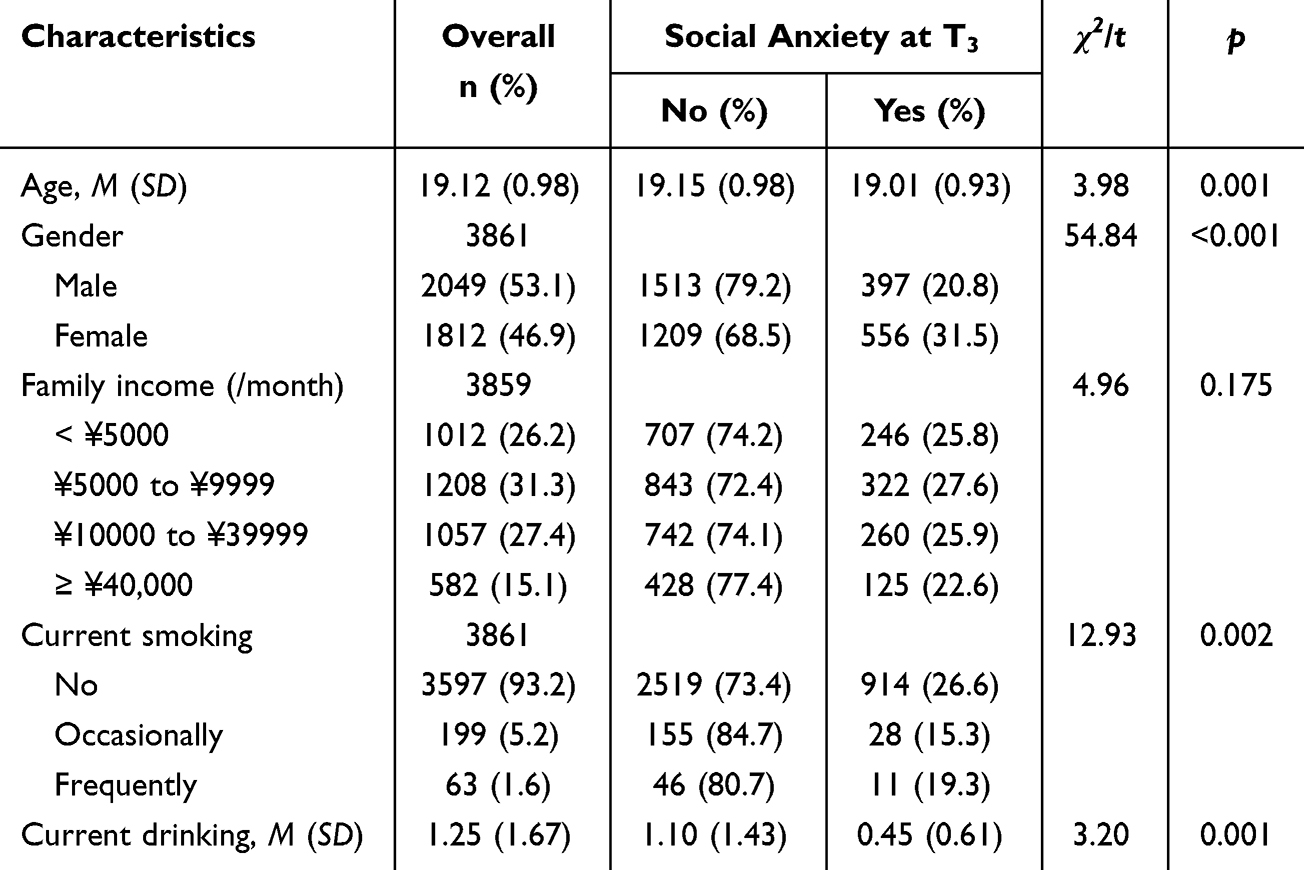 |
Table 1 Characteristics of Social Anxiety |
Results
Missing Data
Little’s MCAR test indicated significance for the key constructs across time points (χ2 (1207) = 183.36, p = 0.88), suggesting that missing data was missing completely at random (MCAR). To further determine the pattern of missing data, a series of t-test and chi-square tests were used to compare the mean differences between the completed and missing data. It was found that males (χ2 (1) = 62.53, p < 0.001) and students with higher social anxiety at T3 (t (3718) = −2.06, p = 0.039) were more likely to drop out.
Descriptive Analyses
At T1, the sample’s mean age was 19.12 years old (SD = 0.98), with 46.9% being male. The overall prevalence of social anxiety among these students was 25.9%, with females reporting a higher proportion compared to males (31.5% vs 20.8%; χ2 = 54.84, df = 1, p < 0.001). Table 1 presented characteristics of social anxiety. The results indicated that gender, age, current smoking, and current drinking were related to social anxiety at T3. Table 2 provided the means, standard deviations, and the correlation coefficients between main variables. Notably, all correlation coefficients were positive and significant. The results of multicollinearity test showed that there is no multicollinearity problem between interpersonal sensitivity and interpersonal insecurity (see Table S3 of Supplemental Materials).
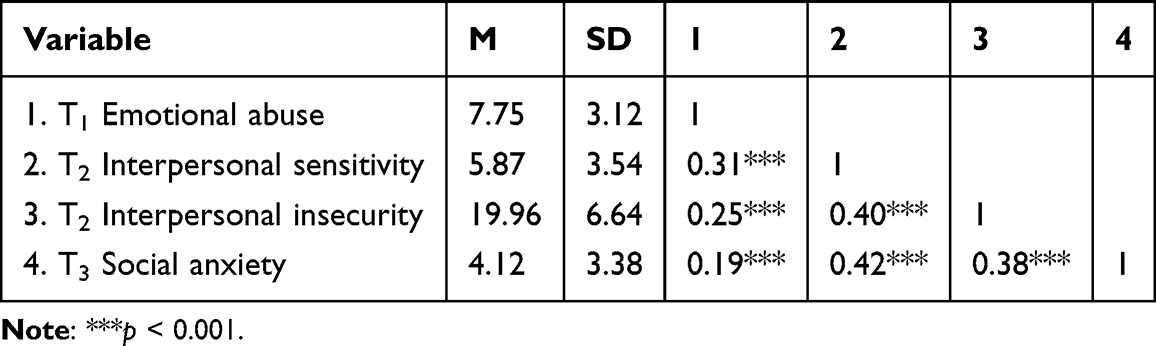 |
Table 2 Descriptive Statistics and Correlations for Key Variables |
Testing for the Proposed Model
After controlling for gender, age, current smoking, current drinking and social anxiety at T1, a path analysis was conducted to test the longitudinal mediation roles of interpersonal sensitivity and interpersonal insecurity between childhood emotional abuse and social anxiety. The proposed model (see Figure 1) demonstrated a good fit with the data, χ2 = 5161.332, df = 560, p < 0.001, CFI = 0.908, TLI = 0.899, SRMR = 0.055, and RMSEA = 0.046. The results indicated that childhood emotional abuse positively predicted interpersonal sensitivity (b = 0.253, p < 0.001) and interpersonal insecurity (b = 0.200, p < 0.001). Additionally, both interpersonal sensitivity and interpersonal insecurity were positive predictors of social anxiety (b = 0.307, p < 0.001; b = 0.063, p < 0.010, respectively). The bootstrap analyses (see Table 3) revealed two significant indirect effects between childhood emotional abuse and social anxiety with the mediating effect of interpersonal sensitivity (indirect effect = 0.078, 95% CI = 0.061 to 0.094), interpersonal insecurity (indirect effect = 0.013, 95% CI = 0.004 to 0.021). These results supported Hypothesis 1 and Hypothesis 2. Moreover, the direct effect from childhood emotional abuse to social anxiety is nonsignificant (direct effect =−0.034; 95% CI =−0.072 to 0.004).
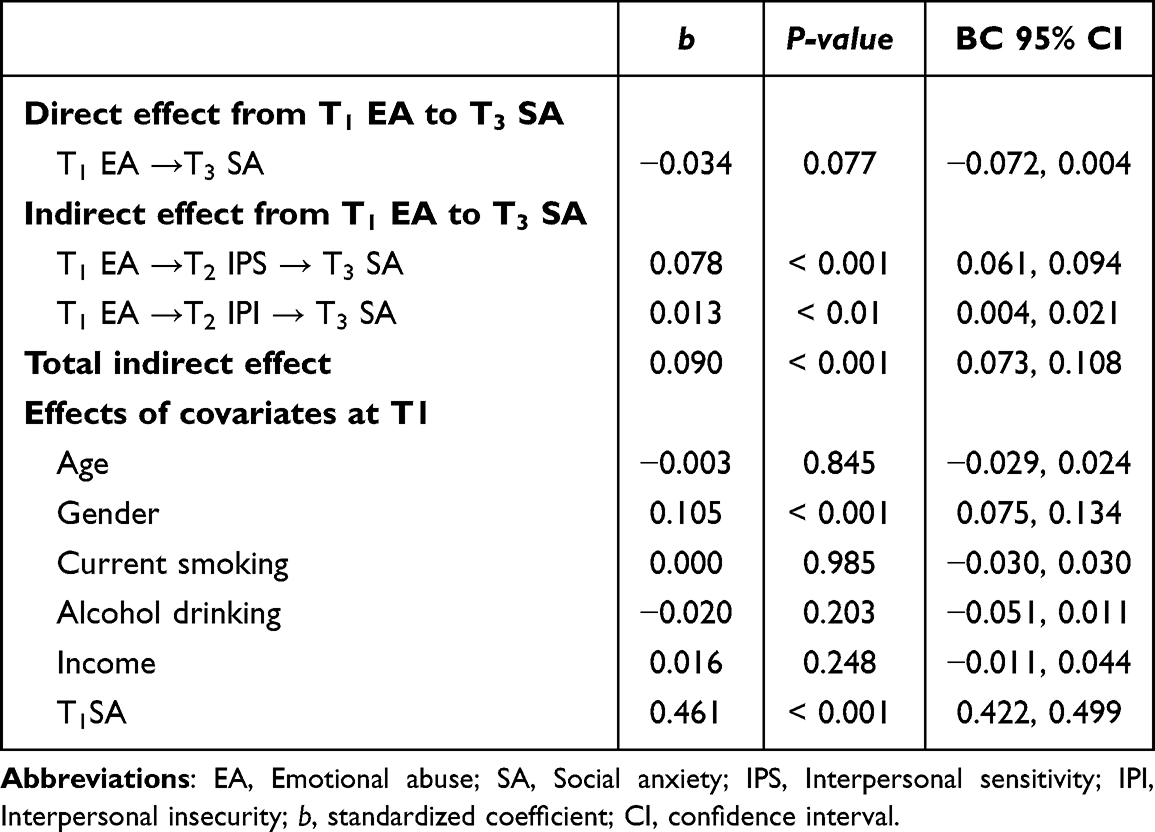 |
Table 3 Standardized Path and Covariates Coefficients from the Mediation Analyses |
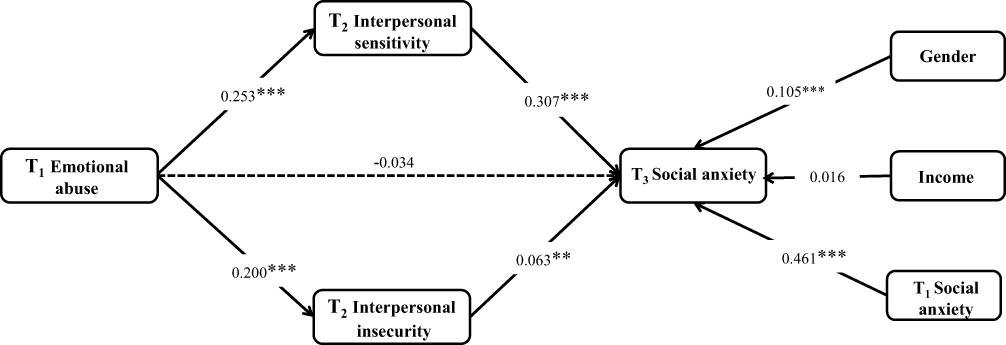 |
Figure 1 The mediating effect of interpersonal sensitivity and interpersonal insecurity in the relationship between childhood emotional abuse and social anxiety. Notes: Controlled for gender, age, current smoking, current drinking and social anxiety at T1. Unstandardized coefficients are reported; ***p < 0.001. |
Discussion
Even though previous research has indicated that childhood emotional abuse constitutes a well-established risk factor for social anxiety, the underlying mechanisms are still not well understood. Therefore, using a sample of 3861 college students, the current study explored the mechanisms underlying the relationship between childhood emotional abuse and social anxiety. Our major findings include: (1) social anxiety was prevalent in Chinese college students; (2) childhood emotional abuse, interpersonal sensitivity, and interpersonal insecurity were closely related to social anxiety; (3) interpersonal sensitivity and interpersonal insecurity served as mediators on the effect of childhood emotional abuse on social anxiety. These findings facilitate our better comprehension of the mechanisms underlying social anxiety and prompt us to propose targeted interventions for mitigating its severity, especially in cases where individuals have experienced childhood trauma.
The Prevalence of Social Anxiety
This study found that the prevalence of social anxiety was 25.9%. Firstly, the transition to university life often involves significant environmental and social changes, which can exacerbate feelings of insecurity and self-doubt. Secondly, the pervasive use of social media among this group has been linked to increased social comparison and reduced face-to-face interaction skills, potentially worsening social anxiety symptoms.45,46 Furthermore, developmental factors specific to emerging adulthood, such as identity formation and the establishment of new social networks, may render college students particularly vulnerable to social anxiety disorders. Our results also found that female college students have a higher prevalence of social anxiety than males, which may be due to differences in neurobiological responses to stress and greater sensitivity to social evaluation.47 Additionally, societal expectations and gender roles may play a significant role, as women are often socialized to prioritize interpersonal harmony and fear negative evaluation more intensely than men.48 Psychological factors like rumination also play a role in this disparity. Studies suggest that females are more inclined to engage in self-criticism when facing interpersonal issues.49 Finally, cultural factors might also be one of the critical reasons for the relatively high incidence of social anxiety among Chinese college students. In collectivist culture, students are strongly encouraged to regulate their desires and behaviors to promote class harmony and enhance group unity. Therefore, interpersonal factors have a stronger influence on social anxiety in collectivist culture.
Mediating Role of Interpersonal Sensitivity
The results of this study indicate that interpersonal sensitivity plays a significant longitudinal mediating role in the effect of childhood emotional abuse on social anxiety, consistent with our hypothesis. Specifically, college students who experienced severe childhood emotional abuse had higher interpersonal sensitivity, which is consistent with previous studies.23,50,51 According to the theory of biological sensitivity to context52 and vulnerability-stress model,20 early life experiences have a long-term impact on an individual’s physical and mental health. Individuals who experience emotional abuse during childhood often develop maladaptive cognitive schemas that predispose them to perceive social interactions as threatening. These negative schemas can make people overly vigilant to social cues and increase the tendency to interpret ambiguous behaviors as hostile or dismissive, thus exacerbating interpersonal sensitivity.53,54 In addition, studies have shown that individuals with high interpersonal sensitivity tend to overinterpret neutral or ambiguous social interactions as negative or threatening, thereby increasing social anxiety.55 This heightened sensitivity often leads to increased rumination and anticipatory anxiety in social situations, further reinforcing avoidance behaviors and social withdrawal.
Mediating Role of Interpersonal Insecurity
Aligned with Hypothesis 2, this study demonstrated that interpersonal insecurity constituted another significant mediating factor between childhood emotional abuse and social anxiety. Attachment theory suggests that parent-child interactions throughout childhood play an essential role in enabling children to form secure attachment.10 Childhood emotional abuse leads to the disruption of the formation of interpersonal security, given that abusive caregivers lack the capacity to provide the consistent emotional support when children encounter interpersonal problems.56 This disruption commonly gives way to the internalization of negative relational schemas, which impair their ability to form secure and supportive relationships in adulthood.30 This study further revealed that interpersonal insecurity was positively correlated with social anxiety. This finding supplemented previous cross-sectional studies, suggesting that interpersonal insecurity serves as a robust risk factor for social anxiety. For example, in a sample of 414 adult psychiatric inpatients, researchers found that attachment insecurity mediated the relation of interpersonal trauma to anxiety.57 Individuals with high levels of interpersonal security believe that they are deserving of the concern, care, and affection of others. They perceive significant others as being accessible, reliable, trustworthy, and well-intentioned, and tend to have relationships characterized by intimacy and trust.58,59 Moreover, they can effectively resolve interpersonal conflicts, all of which contribute to alleviating social anxiety.
Strengths and Limitations
The present study exhibits several notable strengths. Specifically, it features a large sample size, employs a three-wave longitudinal design, and takes into account a number of demographic covariates. However, when interpreting these results, certain limitations must also be borne in mind. First, we have only investigated the impact of childhood emotional abuse on social anxiety. Future studies should explore the effect of different types of childhood abuse on social anxiety. Secondly, all the data in this study are from non-anonymous self-reports, which may lead to reporting bias. Future research should be conducted in an anonymous form as much as possible, and data can be collected from multiple sources, including parents, teachers and peers, to reduce this potential bias. Third, interpersonal sensitivity was measured by four items of the Brief Symptom Inventory (BSI). Future research could benefit from using more comprehensive and validated instruments, such as the Interpersonal Sensitivity Measure (IPSM).18 Fourth, the third data collection was carried out in the context of the COVID-19 pandemic. Although the pandemic was relatively well-controlled in the research setting, it may still affect the research results (eg, the intensification of anxiety caused by pandemic stress factors). Fifth, a critical methodological limitation is that interpersonal sensitivity and interpersonal insecurity were not assessed at baseline, thereby precluding any causal inferences regarding their temporal relationships with other variables. Future research could employ cross-lagged panel analysis to replicate these findings. Finally, other factors, such as cultural context (eg, stigma around mental health in China), might amplify social anxiety in college students. Future research should consider the influence of cultural factors on social anxiety.
In addition, no direct impact of childhood emotional abuse on social anxiety was observed. This also indicates that childhood emotional abuse, as a remote factor affecting an individual’s mental health, needs to influence social anxiety by affecting personal traits such as interpersonal sensitivity and interpersonal insecurity. Previous studies have also demonstrated that self-esteem and loneliness mediated the relationship between childhood emotional abuse and social anxiety in Chinese adolescents.60
Clinical Implication
The present study has significant clinical implications for the intervention and prevention of social anxiety. On the one hand, for individuals who have experienced childhood trauma, the intervention and treatment of interpersonal sensitivity could potentially play a crucial role in reducing the likelihood of social anxiety. Previous studies have demonstrated that individuals exhibit a significant reduction in negative beliefs about themselves and others following interpersonal sensitivity cognitive behavioral therapy (CBT).61 In addition, group psychological counseling has also been widely used in interpersonal intervention among college students, and group sand-play therapy is one of the effective methods. According to the group dynamics theory, the atmosphere of acceptance, inclusion and support created by a group has a positive impact on an individual’s interpersonal communication.62 Existing studies have shown that individuals in group sand-play therapy can improve their empathy ability and interpersonal expression ability, and reduce the interpersonal sensitivity of college students.63 On the other hand, this study indicated that interpersonal insecurity was a significant risk factor for social anxiety. In a sample of college students with insecure attachment patterns, researchers found that relationship skills-focused group interventions improved interpersonal relationships and enhanced positive relationship expectations.64 Therefore, it is necessary to equip college students with some interpersonal skills to enhance their interpersonal security and thereby reduce social anxiety.
Conclusion
The parallel mediating effects of interpersonal sensitivity and interpersonal insecurity between childhood emotional abuse and social anxiety have not been fully examined. This study employed a parallel mediation model to investigate the longitudinal mediating effects of interpersonal sensitivity and interpersonal insecurity on the relationship between childhood emotional abuse and social anxiety, with three waves of longitudinal data utilized. This is helpful for understanding the causal relationship of variables over time. The results showed that interpersonal sensitivity and interpersonal insecurity play parallel mediating roles in the relationship between childhood emotional abuse and social anxiety. Therefore, psychological interventions aimed at reducing interpersonal sensitivity and interpersonal insecurity may be conducive to alleviating the social anxiety of college students who have suffered from childhood emotional abuse. Cultural contextual factors should be systematically incorporated into future research on social anxiety to enhance the cultural validity and generalizability of findings.
Data Sharing Statement
The data are not publicly available due to privacy and research ethical restrictions.
Statement of Ethics
This study complies with the Declaration of Helsinki. The present study protocol was reviewed and approved by the Research Ethics Committee of Hebei University.
Informed Consent Statement
All participants provided written informed consent prior to their study enrolment.
Acknowledgments
We thank all the project participants in this study.
Funding
This work was supported by the Research Topics on Ideological and Political Education in Guangdong Province in 2024 (Grant No. 2024GXSZ104).
Disclosure
The authors declare no conflicts of interest in this work.
References
1. Morrison AS, Heimberg RG. Social anxiety and social anxiety disorder. Annu Rev Clin Psycho. 2013;9:249–274. doi:10.1146/annurev-clinpsy-050212-185631
2. Salari N, Heidarian P, Hassanabadi M, et al. Global prevalence of social anxiety disorder in children, adolescents and youth: a systematic review and meta-analysis. J Prev. 2024;45:795–813. doi:10.1007/S10935-024-00789-9
3. Cheng SH, Sun Z-J, Lee IH, et al. Factors related to self-reported social anxiety symptoms among incoming university students. Early Interv Psychia. 2017;11:314–321. doi:10.1111/eip.12247
4. Stein MB, Fuetsch M, Müller N, et al. Social anxiety disorder and the risk of depression: a prospective community study of adolescents and young adults. Arch Gen Psychiat. 2001;58:251–256. doi:10.1001/archpsyc.58.3.251
5. Lemyre A, Gauthier-Légaré A, Bélanger RE. Shyness, social anxiety, social anxiety disorder, and substance use among normative adolescent populations: a systematic review. Am J Drug Alcohol Abuse. 2019;45:230–247. doi:10.1080/00952990.2018.1536882
6. Heerey EA, Kring AM. Interpersonal consequences of social anxiety. J Abnorm Psychol. 2007;116:125–134. doi:10.1037/0021-843X.116.1.125
7. Fung HW, Chung HM, Ross CA. Demographic and mental health correlates of childhood emotional abuse and neglect in a Hong Kong sample. Child Abuse Neglect. 2020;99:104288. doi:10.1016/j.chiabu.2019.104288
8. Liu J, Deng J, Zhang H, Tang X. The relationship between child maltreatment and social anxiety: a meta-analysis. J Affect Disord. 2023;329:157–167. doi:10.1016/J.JAD.2023.02.081
9. Bruce LC, Heimberg RG, Blanco C, Schneier FR, Liebowitz MR. Childhood maltreatment and social anxiety disorder: implications for symptom severity and response to pharmacotherapy. Depress Anxiety. 2012;29:132–139. doi:10.1002/da.20909
10. Rosenstein DS, Horowitz HA. Adolescent attachment and psychopathology. J Consult Clin Psych. 1996;64:244–253. doi:10.1037/0022-006X.64.2.244
11. Hawke LD, Provencher MD. Schema theory and schema therapy in mood and anxiety disorders: a review. J Cogn Psychother. 2011;25:257–276. doi:10.1891/0889-8391.25.4.257
12. Beck R, Perkins TS. Cognitive content-specificity for anxiety and depression: a meta-analysis. Cognitive Ther Res. 2001;25:651–663. doi:10.1023/A:1012911104891
13. Calvete E. Emotional abuse as a predictor of early maladaptive schemas in adolescents: contributions to the development of depressive and social anxiety symptoms. Child Abuse Neglect. 2014;38:735–746. doi:10.1016/j.chiabu.2013.10.014
14. Wright MOD, Crawford E, Del Castillo D. Childhood emotional maltreatment and later psychological distress among college students: the mediating role of maladaptive schemas. Child Abuse Neglect. 2009;33:59–68. doi:10.1016/j.chiabu.2008.12.007
15. Rapee RM, Spence SH. The etiology of social phobia: empirical evidence and an initial model. Clin Psychol Rev. 2004;24:737–767. doi:10.1016/j.cpr.2004.06.004
16. Liu J, Shi Y, Xie S, et al. Meta-analysis of prospective longitudinal cohort studies on the impact of childhood traumas on anxiety disorders. J Affect Disord. 2025;374:443–459. doi:10.1016/J.JAD.2025.01.067
17. Banducci AN, Lejuez CW, Dougherty LR, MacPherson L. A prospective examination of the relations between emotional abuse and anxiety: moderation by distress tolerance. Prev Sci. 2017;18:20–30. doi:10.1007/s11121-016-0691-y
18. Boyce P, Parker G. Development of a scale to measure interpersonal sensitivity. Aust NZ J Psychiat. 1989;23:341–351. doi:10.3109/00048678909068294
19. Marin TJ, Miller GE. The interpersonally sensitive disposition and health: an integrative review. Psychol Bull. 2013;139:941–984. doi:10.1037/a0030800
20. Zvolensky MJ, Leen-Feldner EW. Anxiety and stress vulnerability and substance problems: theory, empirical evidence, and directions for future research. Clin Psychol Rev. 2005;25:707–712. doi:10.1016/j.cpr.2005.05.007
21. Calvete E, Orue I, Hankin BL. A longitudinal test of the vulnerability-stress model with early maladaptive schemas for depressive and social anxiety symptoms in adolescents. J Psychopathol Behav Assess. 2015;37:85–99. doi:10.1007/s10862-014-9438-x
22. Massing-Schaffer M, Liu RT, Kraines MA, Choi JY, Alloy LB. Elucidating the relation between childhood emotional abuse and depressive symptoms in adulthood: the mediating role of maladaptive interpersonal processes. Pers Indiv Differ. 2015;74:106–111. doi:10.1016/j.paid.2014.09.045
23. Otsuka A, Takaesu Y, Sato M, et al. Interpersonal sensitivity mediates the effects of child abuse and affective temperaments on depressive symptoms in the general adult population. Neuropsych Dis Treat. 2017;13:2559–2568. doi:10.2147/NDT.S144788
24. Lemay EPJ, Dudley KL. Implications of reflected appraisals of interpersonal insecurity for suspicion and power. Pers Soc Psychol B. 2009;35:1672–1686. doi:10.1177/0146167209348380
25. Mikulincer M, Shaver PR, Gillath O, Nitzberg RA. Attachment, caregiving, and altruism: boosting attachment security increases compassion and helping. J Pers Soc Psychol. 2005;89:817–839. doi:10.1037/0022-3514.89.5.817
26. Vansteenkiste M, Ryan RM, Soenens B. Basic psychological need theory: advancements, critical themes, and future directions. Motiv Emotion. 2020;44:1–31. doi:10.1007/s11031-019-09818-1
27. Davies PT, Winter MA, Cicchetti D. The implications of emotional security theory for understanding and treating childhood psychopathology. Dev Psychopathol. 2006;18:707–735. doi:10.1017/s0954579406060354
28. Kobak R, Bosmans G. Attachment and psychopathology: a dynamic model of the insecure cycle. Curr Opin Psychol. 2019;25:76–80. doi:10.1016/j.copsyc.2018.02.018
29. Tasca GA, Ritchie K, Zachariades F, et al. Attachment insecurity mediates the relationship between childhood trauma and eating disorder psychopathology in a clinical sample: a structural equation model. Child Abuse Neglect. 2013;37:926–933. doi:10.1016/j.chiabu.2013.03.004
30. Raby KL, Labella MH, Martin J, Carlson EA, Roisman GI. Childhood abuse and neglect and insecure attachment states of mind in adulthood: prospective, longitudinal evidence from a high-risk sample. Dev Psychopathol. 2017;29:347–363. doi:10.1017/S0954579417000037
31. Huang M-C, Schwandt ML, Ramchandani VA, George DT, Heilig M. Impact of multiple types of childhood trauma exposure on risk of psychiatric comorbidity among alcoholic inpatients. Alcohol Clin Exp Res. 2012;36:598–606. doi:10.1111/j.1530-0277.2011.01695.x
32. Derogatis LR, Melisaratos N. The Brief Symptom Inventory: an introductory report. Psychol Med. 1983;13:595–605. doi:10.1017/s0033291700048017
33. Gupta MA, Gupta AK. Cutaneous body image dissatisfaction and suicidal ideation: mediation by interpersonal sensitivity. J Psychosom Res. 2013;75:55–59. doi:10.1016/j.jpsychores.2013.01.015
34. Wong DFK, He X, Leung G, Lau Y, Chang Y. Mental health of migrant workers in China: prevalence and correlates. Soc Psych Psych Epid. 2008;43:483–489. doi:10.1007/s00127-008-0341-1
35. Cong Z, An L. Developing of security questionnaire and its reliability and validity. Chin Ment Health J. 2004;18:97–99. doi:10.3321/j.issn:1000-6729.2004.02.010
36. Xin S, Sheng L, Liang X, Liu Y, Chen K. Psychological security in Chinese college students during 2006–2019: the influence of social change on the declining trend. J Affect Disord. 2022;318:70–79. doi:10.1016/J.JAD.2022.08.056
37. Geng J, Lei L, Han L, Gao F. Shyness and depressive symptoms: a multiple mediation model involving core self-evaluations and sense of security. J Affect Disord. 2021;286:19–26. doi:10.1016/J.JAD.2021.01.035
38. Angulo M, Rooks BT, Gill M, et al. Psychometrics of the screen for adult anxiety related disorders (SCAARED)- A new scale for the assessment of DSM-5 anxiety disorders. Psychiat Res. 2017;253:84–90. doi:10.1016/j.psychres.2017.02.034
39. Wang S, Shi X, Zhu Y, Wang Z. Factor structure of the Chinese version of the Screen for Adult Anxiety Related Disorders (SCARRED). Asian J Psychiatr. 2022;73:103159. doi:10.1016/J.AJP.2022.103159
40. Chen X, Chen J, Shi X, et al. Trajectories of maternal symptoms of posttraumatic stress disorder predict long-term mental health of children following the Wenchuan earthquake in China: a 10-year follow-up study. J Affect Disord. 2020;266:201–206. doi:10.1016/j.jad.2020.01.084
41. Ranta K, Kaltiala-Heino R, Koivisto A-M, et al. Age and gender differences in social anxiety symptoms during adolescence: the Social Phobia Inventory (SPIN) as a measure. Psychiat Res. 2007;153:261–270. doi:10.1016/j.psychres.2006.12.006
42. Burke RS, Stephens RS. Social anxiety and drinking in college students: a social cognitive theory analysis. Clin Psychol Rev. 1999;19:513–530. doi:10.1016/s0272-7358(98)00058-0
43. Bush K, Kivlahan DR, McDonell MB, Fihn SD, Bradley KA. The AUDIT alcohol consumption questions (AUDIT-C): an effective brief screening test for problem drinking. Arch Intern Med. 1998;158:1789–1795. doi:10.1001/archinte.158.16.1789
44. Preacher KJ, Hayes AF. Asymptotic and resampling strategies for assessing and comparing indirect effects in multiple mediator models. Behav Res Methods. 2008;40:879–891. doi:10.3758/BRM.40.3.879
45. Vannucci A, Flannery KM, Ohannessian CM. Social media use and anxiety in emerging adults. J Affect Disord. 2017;207:163–166. doi:10.1016/j.jad.2016.08.040
46. Wu W, Huang L, Yang F. Social anxiety and problematic social media use: a systematic review and meta-analysis. Addict Behav. 2024;153:107995. doi:10.1016/J.ADDBEH.2024.107995
47. Asher M, Asnaani A, Aderka IM. Gender differences in social anxiety disorder: a review. Clin Psychol Rev. 2017;56:1–12. doi:10.1016/j.cpr.2017.05.004
48. McLean CP, Anderson ER. Brave men and timid women? A review of the gender differences in fear and anxiety. Clin Psychol Rev. 2009;29:496–505. doi:10.1016/j.cpr.2009.05.003
49. Johnson DP, Whisman MA. Gender differences in rumination: a meta-analysis. Pers Indiv Differ. 2013;55:367–374. doi:10.1016/j.paid.2013.03.019
50. Nakazawa H, Masuya J, Tanabe H, et al. Interpersonal sensitivity mediates the effects of childhood maltreatment on the evaluation of life events and anxiety states in adult community volunteers. Neuropsych Dis Treat. 2021;17:2757–2766. doi:10.2147/NDT.S310010
51. Krammer S, Grosse Holtforth M, Burri A, et al. Interpersonal sensitivity as a mediator between cumulative childhood traumatic events and adult sexual disturbance. J Sex Marital Ther. 2018;44(2):213–220. doi:10.1080/0092623X.2017.1354343
52. Ellis BJ, Boyce WT. Biological sensitivity to context. Curr Dir Psychol Sci. 2008;17:183–187. doi:10.1111/j.1467-8721.2008.00571.x
53. Pinto-Gouveia J, Castilho P, Galhardo A, Cunha M. Early maladaptive schemas and social phobia. Cognitive Ther Res. 2006;30:571–584. doi:10.1007/s10608-006-9027-8
54. Calvete E, Orue I, Hankin BL. Early maladaptive schemas and social anxiety in adolescents: the mediating role of anxious automatic thoughts. J Affect Disord. 2013;27:278–288. doi:10.1016/j.janxdis.2013.02.011
55. Gilboa-Schechtman E, Foa E, Vaknin Y, Marom S, Hermesh H. Interpersonal sensitivity and response bias in social phobia and depression: labeling emotional expressions. Cognitive Ther Res. 2008;32:605–618. doi:10.1007/s10608-008-9208-8
56. Cantón-Cortés D, Cantón J, Cortés MR. Emotional security in the family system and psychological distress in female survivors of child sexual abuse. Child Abuse Neglect. 2016;51:54–63. doi:10.1016/j.chiabu.2015.11.005
57. Wiltgen A, Arbona C, Frankel L, Frueh BC. Interpersonal trauma, attachment insecurity and anxiety in an inpatient psychiatric population. J Anxiety Disord. 2015;35:82–87. doi:10.1016/j.janxdis.2015.07.010
58. Iliceto P, Fino E, Schiavella M, Candilera G. Individual differences in interpersonal security predict suicidal ideation and problem gambling. Pers Indiv Differ. 2020;162:110031. doi:10.1016/j.paid.2020.110031
59. Fairbairn CE, Briley DA, Kang D, et al. A meta-analysis of longitudinal associations between substance use and interpersonal attachment security. Psychol Bull. 2018;144:532–555. doi:10.1037/bul0000141
60. Chen C, Qin J. Emotional abuse and adolescents’ social anxiety: the roles of self-esteem and loneliness. J Fam Violence. 2020;35:497–507. doi:10.1007/s10896-019-00099-3
61. Hiçdurmaz D, Öz F. Interpersonal sensitivity, coping ways and automatic thoughts of nursing students before and after a cognitive-behavioral group counseling program. Nurs Educ Today. 2016;36:152–158. doi:10.1016/j.nedt.2015.09.006
62. Yu S, Zhan L. Effect of restricted group sandplay on interpersonal sensitivity in college students. Front Psychol. 2021;12:1–7. doi:10.3389/FPSYG.2021.771209
63. Roesler C. Sandplay therapy: an overview of theory, applications and evidence base. Art Psychother. 2019;64:84–94. doi:10.1016/j.aip.2019.04.001
64. Kilmann PR, Urbaniak GC, Parnell MM. Effects of attachment-focused versus relationship skills-focused group interventions for college students with insecure attachment patterns. Attach Hum Dev. 2006;8:47–62. doi:10.1080/14616730600585219
 © 2025 The Author(s). This work is published and licensed by Dove Medical Press Limited. The
full terms of this license are available at https://www.dovepress.com/terms
and incorporate the Creative Commons Attribution
- Non Commercial (unported, 4.0) License.
By accessing the work you hereby accept the Terms. Non-commercial uses of the work are permitted
without any further permission from Dove Medical Press Limited, provided the work is properly
attributed. For permission for commercial use of this work, please see paragraphs 4.2 and 5 of our Terms.
© 2025 The Author(s). This work is published and licensed by Dove Medical Press Limited. The
full terms of this license are available at https://www.dovepress.com/terms
and incorporate the Creative Commons Attribution
- Non Commercial (unported, 4.0) License.
By accessing the work you hereby accept the Terms. Non-commercial uses of the work are permitted
without any further permission from Dove Medical Press Limited, provided the work is properly
attributed. For permission for commercial use of this work, please see paragraphs 4.2 and 5 of our Terms.