
Back to Journals » Clinical Ophthalmology » Volume 19
Jacques Daviel (1696–1762) and the Competition to Extract Cataracts: A Reappraisal
Authors Leffler CT, Hogewind BF, Schwartz SG  , Grzybowski A , Albert DM
Received 6 May 2025
Accepted for publication 8 August 2025
Published 20 August 2025 Volume 2025:19 Pages 2835—2846
DOI https://doi.org/10.2147/OPTH.S538655
Checked for plagiarism Yes
Review by Single anonymous peer review
Peer reviewer comments 2
Editor who approved publication: Dr Scott Fraser
Christopher Theodore Leffler,1,2 B Frits Hogewind,3 Stephen G Schwartz,4 Andrzej Grzybowski,5,6 Daniel M Albert7
1Department of Ophthalmology, Virginia Commonwealth University, Richmond, VA, 23298, USA; 2Department of Ophthalmology, Richmond VA Medical Center, Richmond, VA, USA; 3Department of Ophthalmology, Medical Center Haaglanden, The Hague, the Netherlands; 4Department of Ophthalmology, Bascom Palmer Eye Institute, University of Miami Miller School of Medicine, Naples, FL, USA; 5Institute for Research in Ophthalmology, Foundation for Ophthalmology Development, Poznan, Poland; 6Department of Ophthalmology, University of Warmia and Mazury, Olsztyn, Poland; 7Department of Ophthalmology, Oregon Health & Science University, Portland, OR, USA
Correspondence: Christopher Theodore Leffler, Department of Ophthalmology, Virginia Commonwealth University, 401 N. 11th St, Richmond, VA, 23298, USA, Tel +1-804-828-9315, Fax +1-804-828-1010, Email [email protected]
Purpose: To analyze the timing and interactions among Jacques Daviel (1696– 1762) and other Paris-based surgeons who pursued cataract extraction in the mid-18th century.
Methods: Historical books, newspapers, and manuscripts were reviewed.
Results: The claim of English oculist John Taylor that his visit to Daviel’s hometown of Marseille in 1734 inspired Daviel to become an ophthalmologist is supported by contemporaneous evidence. In 1745, while in Marseille, Jacques Daviel switched from a single-instrument couching technique to a two-instrument technique. By September of 1748, while in Paris, Daviel had extracted remnants of a cataract from the posterior chamber following a failed couching. On July 1, 1750, a surgeon and monk named Jean Baseilhac (1703– 1781), known as Frère Côme, was said to have performed cataract extraction through an incision in the center of the cornea. On July 3, 1750, in Paris, surgeon Natale Pallucci (1719– 1797), made a corneal incision and extracted from the posterior chamber cataract fragments which remained after couching. For four months, beginning on July 7, 1750, in Leuven, Daviel experimented with planned cataract extraction in animals. On Sep. 18, 1750, in Cologne, Daviel performed a planned, primary cataract extraction on a cleric named Gilles Noupres.
Conclusion: Jacques Daviel became an ophthalmologist in 1734 and secondarily extracted lens fragments by 1748. Three Paris-based eye surgeons, including Daviel, pursued the development of cataract extraction beginning in the first week of July 1750. The first contemporaneously documented planned cataract extraction through an incision was performed by Daviel in Cologne on Sep. 18, 1750.
Summary: Three Paris-based surgeons, including Jacques Daviel, began to pursue cataract extraction in the first week of July 1750.
Keywords: cataract extraction, ophthalmology history, historical, cataract couching
Introduction
Cataract surgery has been performed since antiquity. The prevailing surgical technique from antiquity through much of the eighteenth century was couching, which involved dislocating the opacified lens into the vitreous with a rod or needle. Occasional medieval Arabic surgeons, and perhaps even ancient Greco-Roman predecessors, had performed aspiration of soft cataracts by suction.1 However, this technique does not work for the majority of age-related cataracts, which are too hard to be aspirated through a tube.
Jacques Daviel of France revolutionized ophthalmology in the mid-18th century by performing planned cataract extraction. Daviel delivered the entire lens after making an incision. Daviel’s surgical advance is regarded as a major milestone in medical history, but the timing of Daviel’s start as an ophthalmologist, and the date of his first extraction, have been uncertain. Previous authors have written that Daviel’s first cataract extraction took place in 1745,2–4 1747,5,6 1748,7–9 1749,10 or 1750.11 Our own investigation demonstrates that Daviel and two other Paris-based eye surgeons simultaneously began to perform or experiment with cataract extraction in the first week of July 1750.
Methods
We reviewed historical newspapers, manuscripts, and books regarding the ophthalmic surgeries of Jacques Daviel and his contemporaries. This research was facilitated by several newly available sources. First, an undated manuscript in Jacques Daviel’s handwriting, discovered in 2004, appears to record his cataract extractions in humans and animals.12 In addition, in 2023, we identified newspaper articles from 1750 reporting on Daviel’s ophthalmic cases.1,13 We sought to give the greatest weight to contemporaneous accounts. Although our group wrote in a letter that Daviel’s first contemporaneously documented cataract extraction was performed in 1750,13 we have not previously had the opportunity to set out the supporting evidence in detail in the peer-reviewed literature. Moreover, by closely studying the identities of the patients operated by Daviel and by other Paris-based surgeons, we were able to learn more about the progression of Daviel’s career, and how it related to his surgeon contemporaries. This study was approved by the Office of Research Subjects Protection of Virginia Commonwealth University.
Daviel Becomes a Surgeon (1720)
Daviel first studied surgery under his uncle at Rouen,14 and then in Paris at the Hôtel-Dieu under Louis Philippe Bouquot.14,15 Daviel had been training in Paris when he was called to treat the plague in Marseille, arriving in Digne in June 1721.16 He was already referred to as a “chirurgien” during this period.16
The few mentions of Daviel in provincial archives are consistent with a career as a general surgeon and anatomist. On Oct. 21, 1728, the rectors of the Hôtel-Dieu of Marseille relocated the anatomy amphitheater away from the ward for sick men at the expense of the Sieur Daviel, the anatomical demonstrator.16 On Apr. 12, 1730, a royal ordinance from Versailles in response to a petition from Daviel established procedures for full professional recognition of the surgeons who had begun their surgical careers treating the plague.16
Jacques Daviel Becomes an Ophthalmologist (1734)
English oculist John Taylor (c. 1703–1772) claimed that his visit to Marseille in 1734 inspired Daviel to take up ophthalmology. Taylor wrote:
Mr. Daviel was a surgeon in Marseille and…had no intention of treating eye diseases when I passed through this city in [August] 1734. The desire to contribute to his fortune…led me to share my knowledge with him and to initiate him into the mysteries of an art of which he then had no understanding.17
Daviel’s first advertisement in the Courrier d’Avignon on March 4, 1735, indicated that he had been performing eye surgeries since the departure of the English oculist “l’Occuliste Anglois” in August [1734]. The first operation (“la première opération”) performed by Daviel was on Sep. 24, [1734] on a man suffering from pterygia for five years which were so severe that he had to be guided.18 Daviel’s second operation was on Amiel of Provence, age 52, who had undergone cataract couching, apparently by Taylor, on Aug. 17 [1734]. However, the cataract had risen again, and pressed on the iris, causing headaches, inflammation, and poor vision. Daviel operated again on October 9 [1734], alleviating pain, restoring vision, and permitting the iris to move.18 On Nov. 1 [1734], Daviel performed a cataract couching (“abattit la cataracte”) on a 60-year-old man who had been bilaterally blind for five years.18
Daviel vowed to treat the poor
…for all diseases within his expertise, especially those of the eyes, to which he would henceforth dedicate himself particularly. [les maladies qui seront de sa compétence, et surtout pour celles des yeux auxquelles il s’attachera désormais particulièrement]18
Years later, Daviel and others claimed he had an interest in ophthalmology before 1734. Daviel wrote that he specialized in ophthalmology in about 1730,15 or perhaps 1724.19 Surgeon Sauveur François Morand (1697–1773) wrote that Daviel had been interested in eye diseases exclusively since 1728.14
The eulogy for Daviel by the surgeon D’Apples of Lausanne stated that about 1730, Daviel had performed a cataract operation by dépression on a Swiss concierge for Madame D’Orléans (Françoise Marie de Bourbon, 1677–1749) in her château de Bagnolet near Paris.20 However, we know, because all the identifying details match, that the case described by D’Apples was that of M. Christina, who Daviel described as his 5th Paris case, operated between Nov. 7, 1746, and June 7, 1747.15 Therefore, D’Apples’ recollection was off by 17 years.
After Taylor’s 1734 visit to Marseille, Daviel practiced in a similar fashion. From 1735 to 1744, Daviel frequently travelled to find patients, and wrote about his operations in the Courier D’Avignon.18
From November 1736 to Feb. 1737, Daviel practiced in Madrid and Lisbon.18 In July 1739, he travelled on the galley La Fortune to Livorno (Italy), to escort the Duchess of Modena, Charlotte Aglaé d’Orléans (1700–1761).18 In 1741, he visited Milan, Turin, Bologna, and Genoa.18
Two-Instrument Couching: Daviel’s Gateway to Paris (1745–1749)
Daviel longed for the professional recognition that could come only in a major medical center such as Paris. In 1742, Daviel presented a case before the Académie Royale des Sciences in that city.19,21
But it was Daviel’s adoption of a different cataract couching technique which would ultimately facilitate his relocation to Paris. On April 8, 1745, while living in Marseille, Daviel performed a difficult couching with the standard sharp needle on Frère Félix, a hermit from Aiguille in Provence, near Aix.15,22 Therefore, Daviel conceived of a blunt needle, with no point or cutting edge, to complete the couching. Unfortunately, the second attempt was followed by suppuration of the eye.15
If Daviel’s new couching needle was blunt, its use would likely have been preceded by a sharp instrument to incise the sclera. Indeed, in 1752, Daviel clarified that after the hermit’s case, he decided to first open the sclera with a lancet, and then couch the cataract with a spatula.22 Daviel recalled in 1748 that the difficult couching in the hermit in 1745 motivated him to use his new technique to couch [j’abattis] seven patients between April and Oct. 1745.15 The seventh patient travelled from Paris to Marseille, arriving in Sep. 1745. Daviel explained both methods of couching, and the patient decided on the new operation, which was performed on Oct. 18, 1745.15
Couching with first a sharp and then a blunt instrument was not unheard of in ophthalmology. Since antiquity, eye surgeons had dealt with the problem that the couching needle needed to be sharp enough to penetrate the sclera, but that a needle which was too sharp could damage the iris. Therefore, ancients such as Celsus emphasized that the needle should be of intermediate sharpness. Beginning with the medieval period, Arabic authors, and perhaps unnamed Indian surgeons as well, used a two-instrument technique, as Daviel adopted in 1745, in which a sharp lancet was used to incise the sclera, and then a blunter probe was used to couch the cataract.23 Taylor had published his own version of the two-instrument couching technique in 1736.24
Daviel moved from Marseille to Paris, arriving on Nov. 7, 1746.15 He received certificates from surgeons Morand and Bouquot for cases of cataract couching using the new technique, which he performed in their presence at the Hôtel Royal des Invalides on June 7, 1747.14,15
Secondary Extraction in Garion (by 1748)
Daviel had positioned himself in the city which had long been the center of advocacy of cataract extraction. Three well-known instances in which failed couching attempts had displaced the cataract into the anterior chamber, and the cataract was subsequently extracted, were performed in Paris in 1707, 1708, and 1716.1,6 The writings of Charles de Saint-Yves and John Thomas Woolhouse, both of whom practiced in Paris, indicated that such extractions were routine for them.1
In 1739, Lorenz Heister of Germany wrote that he had heard from England that John Taylor of England bragged that he had extracted cataracts which were posterior to the iris.1,25 The 1751 thesis of Thurant from Paris stated that Taylor had actually done so several times in 1737.22,26 Indeed, Taylor practiced in Paris in 1737.27 On the other hand, surgeon Thomas Hope spent 6 months training with Taylor in 1743, and only heard him speak about cataract extraction in the setting of couching attempts which had subluxed the lens into the anterior chamber.3
However, early in his career, Daviel did not extract cataracts which had subluxed into the anterior chamber. In the Courrier d’Avignon of May 20, 1735, Daviel described a surgery in a 40-year-old woman from Orgon, who was hit in the eye by a tree branch, causing the crystalline lens to become separated into 3 pieces which remained in the anterior chamber.18 Daviel used a needle to move the pieces posteriorly into the normal anatomic location for cataract operations, before finishing the couching in the standard manner.18
Even after his arrival in Paris, the local mindset in favor of cataract extraction may not have influenced Daviel immediately. The 24th of 28 cataract surgery patients Daviel detailed in his Sep. 1748 letter was a woman whose cataract had almost entirely moved into the anterior chamber.15 Nonetheless, Daviel did not describe removing it by extraction.
However, Daviel did have significant experience making corneal incisions. By 1748, Daviel wrote that on 60 occasions, he had made incisions in the cornea to remove blood or pus which had accumulated.15
Ultimately, Daviel did find an instance in which cataract extraction was appropriate. At some point before his letter of Sep. 30, 1748, Daviel attempted a couching in a wig-maker (“perruquier”) named M. Garion.15 “Louis-Alexis Garion, maître perruquier rue Dauphine” had a 37-year-old son (born in 1711),28 and therefore was probably elderly at the time of this cataract surgery. After the failed attempt at couching in M. Garion, Daviel incised the lower part of the cornea, held the incision open with forceps (“pincettes”), and introduced a needle (“aiguille”) into the posterior chamber to draw the crystalline lens from the eye. This was accompanied by loss of vitreous.15 Later, Daviel clarified that the lens had broken into fragments, which were extracted.22 This was not a planned procedure, however. In his letter of Sep. 30, 1748, Daviel wrote “The observations which I made at this successful operation [on M. Garion] have aroused in me great ideas concerning the extraction of cataract”.15,29
Despite his excitement, Daviel’s log of cataract extractions shows no cases between October 1745 and June 1749.12 Other than this secondary extraction in the wig-maker Garion, all of the cataract surgeries performed by Daviel and detailed in his letters of September 1748 and July 1749 were described as cases of couching (eg “…j’ai abbattu une cataracte…”).15
On Feb. 12, 1749, Daviel advertised in the ‘s Gravenhaegse courant that he resided in Paris and would teach students his novel technique for reclination of cataracts using a new instrument.30 The word describing the surgery, ligten, was the archaic Dutch spelling for lichten, which represented reclination of the cataract, that is couching in such a manner that the anterior surface of the lens faces superiorly as the lens lays in the vitreous.1
Daviel Plans a Trip to St. Petersburg (March 1750)
On Mar. 24, 1750, Daviel announced in the Gazette d’Amsterdam his plans to travel to the Low Countries, to England, to Germany, Vienna, Poland, and St. Petersburg. On May 9, 1750, the magistrate of Cambrai wrote a letter lauding Daviel for succeeding in the vast majority of his operations for cataract, inflammation, and other eye conditions.31 Nothing in the magistrate’s letter or the response from the town secretary suggests that Daviel’s cataract operations used a newer technique.
Frère Côme’s Extractions (July 1, 1750)
In the first week of July of 1750, there was a flurry of developments related to cataract extraction among three Paris-based surgeons: Jean Baseilhac, Natale Pallucci, and Jacques Daviel.
Jean Baseilhac (1703–1781), often called Frère Côme, was a monk, and a surgeon, best known for lithotomy. He never publicized his cataract surgeries, but according to his eulogy, he invented his own instruments for cataract extraction, and performed the procedure for the first time on July 1, 1750, on the mother-in-law of the intaglio engraver (“Graveur en taille-douce”) Fessard.32,33 The eulogy makes no statement about whether the patient’s vision was improved. The son-in-law of the patient was evidently the engraver Étienne Fessard (1714–1777) of Paris.34 This surgery was witnessed by the master surgeon Merlin of Lyon and by Frère Côme’s nephew, surgeon Pascal Baseilhac.32,33
On July 8, 1750, Frère Côme performed a cataract couching in one eye, and a cataract extraction in the other eye, of a 50-year-old winegrower (vigneron) named Ebrad from Carrières. This patient was able to return home unassisted on the 19th postoperative day, with vision better in the eye which had undergone cataract extraction, as compared with the couched eye. After the surgery, the patient reportedly never needed glasses to practice his profession.32,33
According to his associates, Frère Côme conceived of the idea of cataract extraction on his own, and had no communication with Daviel, who, the monk’s associates maintained, would not announce his own technique in the Gazette de Cologne for several months.32,33 Frère Côme’s associates did not claim that he was the first to extract cataracts, but wanted to establish that he arrived at this milestone independent of Daviel.32,33
Frère Côme shared patients with Daviel. At some point before Sep. 1748, Daviel had couched the cataract (“j’ai abbatu une cataracte”) of a 62-year-old wood merchant named M. Siflet, from Fauxbourg S. Antoine.15 On Oct. 23, 1751, Daviel wrote a letter comparing the results of Frère Côme’s cataract extraction in the contralateral eye of Sifflet:
This monk [Frère Côme] split the transparent cornea precisely in the middle of the eye, from one angle to the other, and consequently passed through the pupil. The operation was a complete failure, and the patient was left with a lifeless, atrophied eye, completely blind. And to the misfortune of this monk, he performed this operation on a timber merchant [un marchand de bois] from the Faubourg Saint-Antoine named Mr. Sifflet, whom I had operated on for one eye—the right one—the only one through which he can see. Brother Côme fared no better in two other operations that he performed in the same manner and according to his method, which is among the most harmful. Mr. de Vermale called my method the operation “Davielique”, and I named Brother Côme’s method the comic operation [l’opération comique].35
A medical student named Georg Sigwart, working under David Mauchart of Tubingen, wrote a thesis on cataract extraction published Dec. 22, 1752, and had travelled to interview Frère Côme. When Sigwart stated that friends had told him that the monk was extracting cataracts, Frère Côme repeatedly responded: “I have never spoken of such a thing to anyone, and therefore no one could have told you that.” Sigwart then found a woman who had cataract extraction performed in the right eye by Frère Côme, and in the left eye by Daviel. The scar in the eye operated by Daviel was barely visible, but the eye operated by the monk was blind, with a thick, irregular and unsightly scar. The incision was a straight horizontal cut, right through the middle of the cornea.36
Frère Côme saved the crystalline lenses which he extracted and accumulated more than 500 of these specimens.32,33
Natale Pallucci’s Secondary Extraction (July 3, 1750)
Natale Pallucci (1719–1797) of Italy was the next to take a step towards cataract extraction, on July 3, 1750. Pallucci had arrived in Paris in July 1747.37 He had trained in his birthplace of Florence in 1744,37 and then at Montpellier, until his move to Paris.1 Pallucci indicated that of all surgical disorders, those which affect the eyes had always excited his attention.37 In Italy, he had tested cataract needles which had a conical shape. Within several weeks of arriving in Paris in July 1747, the military surgeon Morand had demonstrated for Pallucci at the Hôtel Royal des Invalides a flat and sharp cataract needle which worked well.37
Pallucci published an account of six former soldiers operated for cataract at the Hôtel Royal des Invalides in the spring of 1750, with the cases assisted by Morand, often with Bouquot witnessing as well.38 On May 11, 1750, Pallucci performed a cataract couching on an elderly soldier named Charles Pagliano in Paris.39 However, an opacity which Pallucci believed to be the lens capsule returned to the visual axis, and was located behind the pupil (“place derriere la prunelle.etoit la Capsule du Crystallin”).38 On July 3, 1750, Pallucci made a corneal incision and then used forceps (“pincettes”) to extract the detached capsule and fragments of the cataract (“plusiers fragmens”) from the posterior chamber (Figure 1).38 Pallucci’s incision was inferior to the visual axis, but not as peripheral as that of Daviel (Figure 2).40
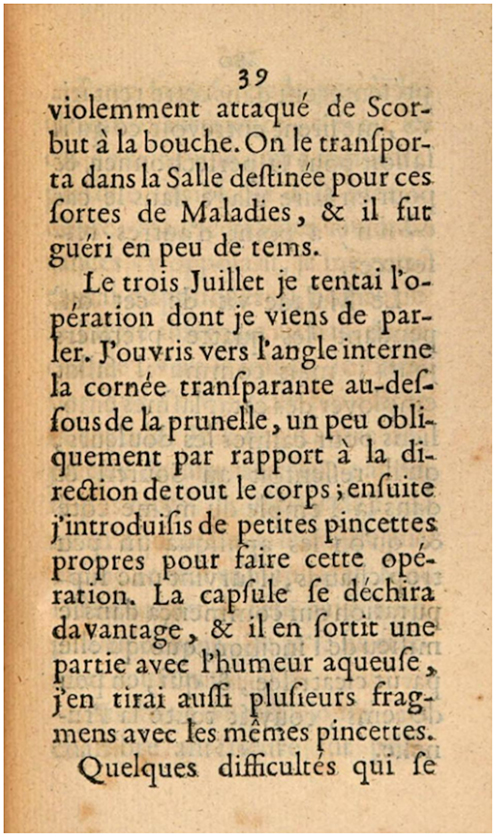 |
Figure 1 Pallucci on July 3, 1750 used forceps (“pincettes”) to extract the detached capsule and fragments of the cataract from the posterior chamber after making a corneal incision. Reprinted from Pallucci NG. Histoire de l’opération de la cataracte, faite à six soldats invalides par M. Pallucci, avec des remarques pour servir de suite à la description de son nouvel instrument. Paris: Houry; 1750:10–56. Creative Commons.38 |
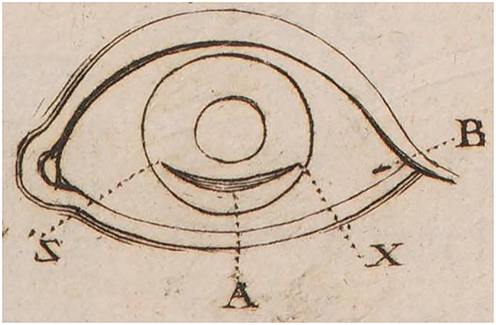 |
Figure 2 Pallucci in September 1751 depicted the corneal incision he used for cataract extraction (Pallucci “Methode d’abbattre” 1752, p. 161, Plate II, Figure 5). Reprinted from Pallucci NG. Methode d’abbattre la cataracte: Dédiée à Madame la Princesse De Conty. Paris: Houry; 1752:157–201. Creative Commons.40 |
Daviel’s Animal (July 7, 1750) and Human (Sep. 1750) Extractions
Just after these operations by Frère Côme and Pallucci at the start of July 1750, we see a number of changes in Daviel’s surgical practice. The first is that Daviel began experimenting with cataract extraction in animals. In his entire unpublished log of human and animal cataract extractions, from April 1745 to the start of 1752, Daviel only performed animal work for four months: from July to November 1750. Daviel’s first animal experiment was on a sheep on July 7, 1750: “A Louvin Deux expériences faites sur des yeux de Mouton le 7 Juillet” (Figure 3).12 This experiment was conducted in between Daviel’s stops in Douai and Liège. And so, Daviel, who was 200 miles from Paris, conducted his first animal experiments on cataract extraction 6 days after Côme’s operation and 4 days after that of Pallucci.
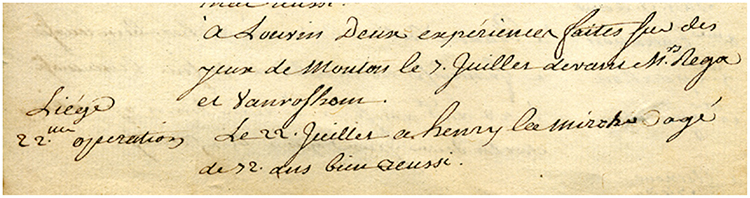 |
Figure 3 Daviel recorded that he performed his first experiment related to cataract extraction on sheep in Louvain on July 7, 1750. |
Daviel continued to perform animal experiments on cataract extraction on a dog in Liège on Aug. 12, 1750, on a sheep in Cologne in Sep. 1750 in the presence of the faculty, on a sheep on Nov. 3, 1750 in Mannheim, and then on the horse of the Elector on Nov. 12, 1750 in front of a prince.12 These animal experiments support the idea that the period from July to November 1750 was one of innovation for Daviel.
Another change in Daviel’s practice in the latter half of 1750 is that he was willing to go on record stating the cities in which he performed the cataract extractions. He named the cities in his 1752 presentation to the Academy of Surgery: Liège, Cologne, and Mannheim.22,41 In 1752, any of Daviel’s peers could have gone to the doctors in these cities to confirm to verify what happened two years earlier.
But there is an even stronger reason to believe that Daviel really performed planned cataract extraction from the posterior chamber in the fall of 1750: it was documented contemporaneously in the newspapers and by other witnesses. These newspaper accounts were identified in 2023.1,13
While he visited Liège, the newspapers noted that the fame and honor received by Taylor, and other itinerant oculists then in Germany, had motivated Daviel to travel to the region (Figure 4).42 Daviel later wrote that in Liège he performed 6 cataract extractions in four patients, between July 22 and Aug. 17, 1750.12,22,41 That is possible, but the newspaper accounts of the Liège visit simply describe Daviel as an ophthalmologist who operates on the poor free of charge, and remains in town until patients have recovered.1
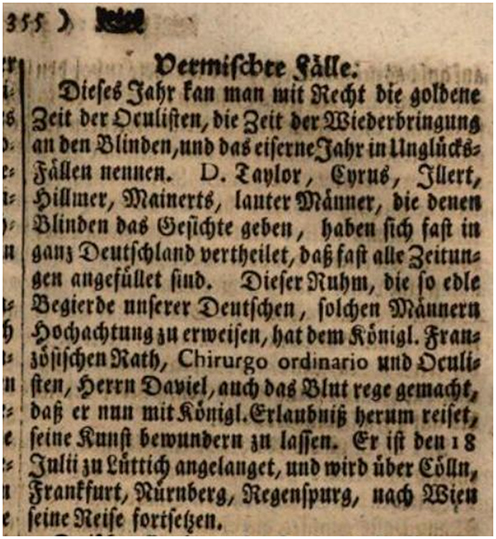 |
Figure 4 The Regensburg newspaper Staats-Relation der neuesten europäischen Nachrichten und Begebenheiten of July 26, 1750 noted that the oculist Daviel practiced in Liège, and would travel next to Cologne. The article stated that the fame and honor accorded oculists who practiced in Germany, such as Taylor, had motivated Daviel to practice in the region.42 |
On Sep. 16, 1750, the Regensburg newspaper noted that Daviel was in Cologne, and would arrive in Vienna soon.1 As noted above, Frère Côme’s associates recalled that Daviel announced his new technique in the Gazette de Cologne. On Sep. 18, 1750,1,12,13 Daviel extracted the cataract in Gilles Noupres, a cleric whose cataract was “soft like jelly”.22,41 Daviel handed the extracted cataract to the doctors who witnessed the procedure.1,13 The patient was able to say the Mass 15 days after the surgery.22,41 It is perhaps significant that Noupres’ cataract was soft, because such cataracts were difficult to couch. They could simply break into pieces when impacted by the couching needle. In fact, Daviel had written about the difficulty of couching soft cataracts in 1749.19
From Cologne, Daviel moved on to Mannheim, arriving in October 1750. The newspaper reported: “There [in Mannheim], he has already pulled various cataracts completely out of the eye according to his new method”. (Er hat daselbst schon verschiedene Staare nach seiner neuen Art völlig aus den Augen gezogen).1,43 Daviel’s unpublished log lists cataract extractions in four patients in Mannheim, performed on Oct. 19, Nov. 5, and (in two patients) on Nov. 21, 1750.12
We know more specifics about Daviel’s trip to Mannheim based on his surgical colleague Vermale. Daviel arrived in Mannheim and examined “Mr. le Baron de Sikingen”, who was over 70 years old.44 Sikingen had had couching performed in one eye, initially in May 1746, by an unknown surgeon. A repeat operation was performed in the same eye by Hilmer on Dec. 28, 1746 because the lens had returned to the visual axis.44, p. 9 For the next 3 years, Sikingen could read the Gazettes with the help of “lunettes”.44 Beginning in April 1750, Sikingen had an “ophtalmie” (inflammation) in the eye which Vermale attributed to the lens dislocating into the anterior chamber (“la chambre antérieure”).44 Upon his arrival in Mannheim, Daviel examined the eye, and successfully performed “l’extraction” on Sikingen the next day, on October 19, 1750.44
Daviel subsequently performed planned, primary cataract extraction in 3 patients in Mannheim, between Nov. 5 and Nov. 21, 1750, as described by Vermale.12,44 While on this trip to Mannheim, at the age of 54 years, Jacques Daviel decided to operate on cataracts solely by the method of extraction.22,41
Vermale called Daviel’s method “new” and indicated that Daviel had only recently been performing the surgery: (“…la nouvelle méthode que ce fameux Oculiste a imaginé & mis depuis peu en pratique avec beaucoup de succès”).44 Vermale specified that Daviel had only performed the procedure 23 times: “…dans vingt-trois extractions qu’il a déja fait, aucun mauvais succès ne la point encore mortifié”.44 If the final Mannheim patient was the 23rd patient, then Daviel’s first cataract extraction would be listed 22 patients earlier in Daviel’s unpublished log, ie in the summer of 1749.12 Daviel’s unpublished log also records that he performed cataract extractions beginning in July 1749, after a years-long hiatus.12 However, there is doubt about whether Daviel really performed cataract extraction between July 1749 and June 1750. He never publicly claimed to have done so in the cities in which he practiced during this period: Paris, Auxerres, Roye, Péronne, Cambrai, and Douai.12
Pallucci Challenges Daviel (1751)
Pallucci believed there were parallels between his case and Daviel’s subsequent decision to perform cataract extraction. Pallucci wrote in a work approved by M. Morand on Sep. 4, 1751 that he had been working on extraction “for a long time”, even before Daviel’s trip to Mannheim, as evidenced by Pallucci’s publication of Pagliano’s case from July 3, 1750.40
Daviel Claims Priority for Extraction (1752)
One might imagine that after Daviel’s decision in Mannheim in the fall of 1750 to exclusively adopt cataract extraction, he might immediately travel to Paris to perform cases before his colleagues, to present at a medical meeting, or to publish an article. But he spent 1751 honing his craft in cities distant from Paris. After Mannheim, Daviel next performed cataract extractions in 11 patients from March to May 1751 in Strasbourg.12 For two cases, he was assisted by his son.45 One of the Strasbourg patients was a 50-year-old man who was successfully operated for congenital cataracts.12 In 1751, Daviel also performed cataract extractions in 11 patients in Metz in July and August 1751, and in 24 patients (43 eyes) in Reims between Sep. 15 to Oct. 5.12,35
After Reims, Daviel subjected his technique to scrutiny in Parisian medical circles. Daviel joined the court at Fontainebleau, where King Louis XV hunted in the autumn, and performed cataract extractions in 3 patients on Nov. 2 and 3, 1751.12,35 The last of these was in a 7-year-old with congenital cataracts. This was Daviel’s first recorded pediatric cataract extraction, but was not successful.12
In January 1752, Daviel operated in Paris on a 64-year-old water carrier in front of prominent physicians such as Antoine Jussieu, and surgeons such as Morand.12 One of Jussieu’s students, M. Thurant, subsequently presented on Mar. 14, 1752 his thesis on Daviel’s method.26 Thurant reviewed the cataract extractions Daviel had performed in Reims in the presence of competent doctors, who judged that of 43 cataracts operated, 24 were “perfectly cured”, 9 saw “weakly”, and 10 remained “blind”.26
Heading into 1752, available sources made it appear that Daviel first performed planned primary cataract extractions in the fall of 1750. But Daviel had a surprise: in 1752, he claimed that he had been performing cataract extractions on and off over the last 7 years, since 1745, and kept it a secret! However, he was not specific about what year, what city, what specific date, the name of the patient, or the names of any witnesses.
Daviel presented his own work to the Académie de Chirurgie on April 13, 1752, and a brief summary was published in August 1752.46
Thomas Hope of England witnessed Daviel perform two cataract extractions in 1752, before September 25. Hope wrote that Daviel “was the first, who, in 1745, began to put it [extraction] in practice”.3 Presumably, Daviel provided that date to Hope.
When Daviel presented his work to the Académie de Chirurgie a second time, on Nov. 16, 1752, he indicated that he had performed 206 cataract extractions, of which 182 were successful.22,41 Daviel goes to great lengths to insist he began performing extractions before Pallucci’s arrival in Paris. Daviel also illustrated his cataract technique, performed with an inferior limbal incision (Figure 5).
 |
Figure 5 Daviel’s cataract method, as he illustrated in his article Sur une Nouvelle Methode de Guérir la Cataracte par l’Extraction du Crystalllin published in 1753 in Mémoires de l’Académie Royale de Chirurgie. (A) The cataract before the operation. (B) Making the inferior limbal incision with the keratome. (C) Extending the incision with a blunt needle. (D) and (E) Extending the incision with curved scissors. The spatuma (F) is used to elevate the cornea (G) so that a needle (H) punctures the capsule of the crystalline lens. (I) Extraction of the cataract is completed with the finger pressing on the eye. |
In 1755, Daviel’s son wrote that his father had performed cataract extraction twice in 1745.47 But in 1752, Daviel had claimed even greater experience with extraction in 1745. The elder Daviel claimed that after the 1745 case of the hermit, he performed planned cataract extraction from the posterior chamber in five unnamed, undated, and unwitnessed patients with success, but then an unstated number of less fortunate outcomes caused him to instead perform cataract couching with two instruments.22,41 However, previous historians have written that Daviel’s first cataract extraction took place well after 1745.5–11 In other words, historians have been skeptical of Daviel’s claims about performing extraction in 1745, and we demonstrate in the Appendix that the skepticism is justified.
Conclusions
The claim of English oculist John Taylor that his 1734 visit to Marseille, the hometown of Jacques Daviel, inspired Daviel to become an ophthalmologist is supported by contemporaneous evidence. In 1745, while in Marseille, Jacques Daviel switched from a single-instrument couching technique to a two-instrument technique. By September of 1748, while residing in Paris, Daviel had extracted remnants of a cataract from the posterior chamber following a failed couching. In July of 1750, three Paris-based surgeons, including Daviel, pursued cataract extraction. On July 1, 1750, a surgeon and monk named Jean Baseilhac (1703–1781), known as Frère Côme, was later said to have performed cataract extraction through an incision in the center of the cornea. On July 3, 1750, surgeon Natale Pallucci, who was practicing in Paris, secondarily operated on a patient after cataract couching, by making a corneal incision and using forceps to extract residual cataract fragments from the posterior chamber. For four months, beginning on July 7, 1750, in Leuven, Daviel began experimenting with planned cataract extraction in animals. On September 18, 1750, in Cologne, Daviel performed the first contemporaneously documented, planned, primary cataract extraction on a cleric named Gilles Noupres. In November 1750, while in Mannheim, Daviel performed planned extractions of cataracts from the posterior chamber in three patients and resolved to perform cataract extractions exclusively.
Although Daviel’s method worked for some dedicated oculists, many eye surgeons over the next century continued to perform cataract couching. In the British Isles, only about half of cataract surgeons had adopted cataract extraction by 1800, and this figure was just one third of surgeons in the United States.48,49 It was not feasible to suture the incision in Daviel’s day. Cataract extraction became a more broadly accessible technique after preoperative pupillary dilation began to be used in the early 1800s, general anesthesia became commonly used in the West in the 1840s, aseptic techniques were understood beginning in the 1860s, and topical anesthesia with cocaine was introduced in 1884.23,50
Disclosure
Dr Stephen Schwartz previously owned stock from GE Healthcare. The authors report no other conflicts of interest in this work.
References
1. Leffler CT, Hogewind BF, Schwartz SG, Samara WA. Cataract extraction from antiquity through Daviel in 1750. In: Leffler CT, editor. A New History of Cataract Surgery. Part 1. From Antiquity Through 1750. Amsterdam: Wayenborgh; 2024:377–439.
2. Astbury N. A hand to hold: communication during cataract surgery. Eye. 2004;18(2):115–116. doi:10.1038/sj.eye.6700569
3. Hope T. Extracts of two letters of Thomas Hope, MD to John Clephane, MD, FRS concerning Monsieur Dav’el’s method of couching a cataract. Philosophical Transactions of the Royal Society of London. 1752;47:530–533.
4. Grangier R. Marseille et Jacques Daviel. Histoire des Sciences Medicales. 2011;XLV(1):57–62.
5. Keeler R, Singh AD, Dua HS. Guillaume Pellier de Quengsy: a bold eye surgeon. British Journal of Ophthalmology. 2014;98(5):576–578. doi:10.1136/bjophthalmol-2014-305269
6. Grzybowski A, Claoué C, Schwartz SG. Extracapsular cataract extraction in Europe prior to Jacques Daviel. Acta Ophthalmologica. 2023;101(3):349–352. doi:10.1111/aos.15282
7. Bokhorst LP, Zegers RH. Couching then and now. Nederlands Tijdschrift Voor Geneeskunde. 2011;155:A3283.
8. Lozano-Alcázar J. Cataract surgery to 1748. Cirugía y Cirujanos. 2001;69(3):141–143.
9. Canto AP, Culbertson WW. Femtosecond lasers: ushering in a new era in cataract surgery. Expert Review of Ophthalmology. 2012;7(3):203–206. doi:10.1586/eop.12.31
10. Mery STH. Jean. The American Encyclopedia and Dictionary of Ophthalmology. Wood CA, editor. Vol. 10. Chicago: Cleveland Press; 7658:1917.
11. Blodi FC. Cataract Surgery. In: Albert DM, Edwards DD, editors. The History of Ophthalmology. Cambridge, MA: Blackwell; 1996:165–175.
12. André L, Daviel J. “Liste des Malades a qui J’ai Fait l’extraction de la Cataracte de la Chambre Postérieure de l’oeil par la nouvelle methode que j’ay inventé a Marseille depuis 1745.” Manuscrit inédit de Jacques Daviel. Par le Médecin Général Inspecteur Louis André. Communication à la Société Francophon’ d’Histoire d’ l’Ophtalmologie. Le 8 mai 2004 à Paris France. Provence historique: Revue Trimestrielle. 2005. Available from: https://www.snof.org/encyclopedie/un-manuscrit-in%C3%A9dit-de-daviel.
13. Leffler CT, Hogewind BF, Schwartz SG, Grzybowski A. Jacques Daviel performed the first documented planned primary cataract extraction on Sep. 18, 1750. Eye. 2024;38:1392–1393. doi:10.1038/s41433-023-02874-5
14. Morand SF, Éloge de M, Daviel. Opuscules de chirurgie, par M. Morand. Premiere Partie. Paris: Despréz; 1768:82–90.
15. Daviel J, Lettre de M. Daviel, Conseiller, Chirurgien ordinaire du Roi en Survivance & par quartier, à M. de Joyeuse, Docteur en Medecine de l’Université de Montpellier, Aggregé au Collége des Medecins de Marseille, & Médecin des Hôpitaux des Galéres. Mercure de France. Paris. 1748, p.198–221.
16. Chavernac. Daviel en Provence. Revue Sextienne Historique, Littéraire, Scientifique et Archéologique, Publiée à Aix. Vol. 12 (no. 7-9). Aix: Makaire. 1893: pp.145–190.
17. Taylor J. Lettre A Messieurs De L’Académie Royale de Chirurgie de Paris, touchant une nouvelle Découverte sur l’Art de rétablir la Vue, quand on l’a perdue par la Maladie connue sous le nom de Cataracte…les dangereuse consequences de l’Opération de la Cataracte par extraction. Paris: Taylor; 1766:1–8.
18. Pansier P. La pratique ophtalmologique de Daviel (1735–1744) par le Dr. P. Pansier (d’Avignon). Annales d’Oculistique. 1905;134(5):338–363.
19. Daviel J, Réponse de M. Daviel, Conseiller-Chirurgien ordinaire, & Oculiste du Roi, à la Lettre Critique de M. Roussilles. Mercure de France. 1749;7:206–227.
20. D’Apples. Éloge, ou Abrégé historique de la vie de Monsieur Daviel, par Monsieur d’Apples. Acta Helvetica, Physico-Mathematico-Botanico-Medica. 1762;174–179.
21. Koch HR. Jacques Daviels Kampf um Anerkennung. Mitteilungen der Julius-Hirschberg-Gesellschaft zur Geschichte der Augenheilkunde. Band 12. 2010. Wurzburg. Kongshausen. 2014: 117–175.
22. Daviel JA, Pearce WG. On a new method to cure cataract by extraction of the lens by Jacques Daviel, translated by W. G. Pearce. Brit. J. Ophthalmol. 1967;51(7):449–458. doi:10.1136/bjo.51.7.449
23. Leffler CT, Klebanov A, Samara WA, Grzybowski A. The history of cataract surgery: from couching to phacoemulsification. Annals of Translational Medicine. 2020;8(22):1551. doi:10.21037/atm-2019-rcs-04
24. Taylor J. A New Treatise on the Diseases of the Chrystalline Humour of a Human Eye: Or, of the Cataract and Glaucoma. London: Roberts; 1736:33–42.
25. Heister L. Institutiones Chirurgicae: in Quibus Quicquid ad Rem Chirurgicam Pertinet, Optima et Novissima Ratione Pertractatur. Vol. 1. Apud Franciscum Pitteri. 1740;554.
26. de Jussieu A, Thurand [Thurant]. Question Medico-Chirurgicale, soutenue dans les Ecoles de la Faculte de Medecine de Paris, le 14 Mars 1752, par M. Thurand…La Methode de guerir la Cataracte par l’extraction du crystallin. In:von Haller A editor Collection de Theses Medico-Chirurgicales: Sur Les Points Les Plus Importants de la Chirurgie Théorique & Pratique. Paris, Vincet;1760. 75–88
27. Pusey B. An Old-Time Quack Eye Doctor: the Chevalier John Taylor. Journal of the American Medical Association. 1903;41(19):1142–1144. doi:10.1001/jama.1903.92490380018001e
28. Fehrenbach J. Une famille de la petite bourgeoisie parisienne de Louis XIV à Louis XVIII. Les Gaugé et leurs alliances à travers les archives (1680-1820. Paris: Editions L’Harmattan; 2007:52.
29. Daviel STH. Jacques. In: Wood CA, editor. The American Encyclopedia and Dictionary of Ophthalmology. Chicago: Cleveland Press; 1914:3751–3777.
30. Daviel J. De Heer Daviel, Wonende op de Malaquay-Kade te Pary’. Vol. 12. ‘s Gravenhaegse courant; 1749:2.
31. Coulon H. La Communauté des Chirurgiens-Barbiers de Cambrai (1366-1795). J.-B. Baillière et Fils. 1908: 176.
32. Cambon M. Éloge historique de Jean Baseilhac, dit Frère Côme, religieux feuillant & chirurgien lithotomiste: Avec des détails sur les instruments qu’il a inventés, perfectionnés ou appropriés pour la taille dans le haut & le bas appareil & autres opérations chirurgicales, pour servir à l’histoire de la chirurgie. Paris: Chez la Veuve Ballard & fils; 1781:18–19.
33. Baseilhac P. De la taille latérale par le périnée, et celle de l’hypogastre, ou haut appareil: Rapportée à leurs vrais auteurs, avec les regles theoriques qu’ils ont fixees pour leur parfaite execution, et la description constructive des instrumens qu’ils ont inventes ou perfectionnes pour y proceder avec succes. Paris: Gabon et Comp; 1804:86–89.
34. Fuhring P. Les deux girandoles d’or de Louis XV par Thomas Germain, chefs-d’oeuvre du Rococo. Revue de l’Art. 1992;95(1):52–60.
35. Delacroix H. Jacques Daviel Á Reims. Paris, Masson; 1890:12–59.
36. Sigwart GF, Mauchart D. Novum problema chirurgicum: de extractione cataractae ultra perficienda. Erhardianis: Tubingen. 1752;28–30.
37. Pallucci NG. Nouvelles remarques sur la lithotomie suivies de plusieurs observations sur la separation du penis et su’ l’amputation des mammelles; avec figures.Paris: cavelier. 1750: X–231.
38. Pallucci NG. Histoire de l’opération de la cataracte, faite à six soldats invalides par M. Pallucci, avec des remarques pour servir de suite à la description de son nouvel instrument. Paris: Houry; 1750:10–56.
39. Pallucci NG. Lettre a monsieur le marquis de *** sur les operations de la cataracte, faites par M. Pallucci, chirurgien, pensionnaire de sa majeste imp. Paris: Houry; 1751:31.
40. Pallucci NG. Methode d’abbattre la cataracte: Dédiée à Madame la Princesse De Conty. Paris: Houry; 1752:157–201.
41. Daviel J. Sur une Nouvelle Methode de Guérir la Cataracte par l’Extraction du Crystalllin. Mémoires de l’Académie Royale de Chirurgie, T. II, Paris; 1753:337–354.
42. Oculisten D, Taylor C. Staats-Relation Der neuesten Europäischen Nachrichten und Begebenheiten, Worinnen das merckwürdigste in Politischen- und Kriegs-Sachen … vorgetragen, nebst Beylagen und Monathlichen Zugaben (etc.), Volume 6. Regensburg:1750:355. Illert, Hilmer, Mainerts, Herrn Daviel
43. No author listed. Kurtz-gefasster historischer Nachrichten zum Behuf der neuern europäischen Begebenheiten. Stück auf das Jahr 1750. Regenspurg: Seiffart; 1750:916.
44. Vermale [De Vermalle] R. Lettre de Monsieur Raimon de Vermale, Conseiller d’Etat, & premier Chirurgien de son A. S. Monseigneur l’Electeur Palatin…A Mr. de Chicoyneau. Conseiller d’Etat ordinaire, & premier Medecin du Roi, sur l’extraction de la cataracte hors de la chambre postérieure de l’oeil: nouvelle opération imagine & perfectionnée par le célébre Mr. Daviel, Conseiller Chirurgien ordinaire & Oculiste du Roi, & de S. A. S. Monseigneur l’Electeur Palatin. 1751.
45. Héran J. Histoire de la médecine à Strasbourg. 2e éd. Strasbourg. La Nuée Bleue. 1997;134.
46. No author listed. Mercure de France. Séance Publique. De l’Academie Royal de Chirurgie, tenue le Jeudi 13 Avril 1752. Mercure de France. 1752; 198: 45–67.
47. Daviel (fils). Réflexions critiques adressées à M** médecin à Lyon, sur une lettre annoncée sous le nom du sieur Béranger, Oculiste, par M. Daviel le fils, Maître ès Arts en l’Université de Paris. Mercure de France. Paris. Chaubert. 1755. pp. 182–206.
48. Leffler CT, Schwartz SG, Peterson E, Couser NL, Salman AR. The First Cataract Surgeons in the British Isles. Am J Ophthalmol. 2021;230:75–122. doi:10.1016/j.ajo.2021.03.009
49. Leffler CT, Schwartz SG, Wainsztein RD, Pflugrath A, Peterson E. Ophthalmology in North America: early stories (1491-1801). Ophthalmol Eye Dis. 2017;9:1179172117721902. doi:10.1177/1179172117721902
50. Grzybowski A. Cocaine and the eye: a historical overview. Ophthalmologica. 2008;222:296–301. doi:10.1159/000140625
 © 2025 The Author(s). This work is published and licensed by Dove Medical Press Limited. The
full terms of this license are available at https://www.dovepress.com/terms
and incorporate the Creative Commons Attribution
- Non Commercial (unported, 4.0) License.
By accessing the work you hereby accept the Terms. Non-commercial uses of the work are permitted
without any further permission from Dove Medical Press Limited, provided the work is properly
attributed. For permission for commercial use of this work, please see paragraphs 4.2 and 5 of our Terms.
© 2025 The Author(s). This work is published and licensed by Dove Medical Press Limited. The
full terms of this license are available at https://www.dovepress.com/terms
and incorporate the Creative Commons Attribution
- Non Commercial (unported, 4.0) License.
By accessing the work you hereby accept the Terms. Non-commercial uses of the work are permitted
without any further permission from Dove Medical Press Limited, provided the work is properly
attributed. For permission for commercial use of this work, please see paragraphs 4.2 and 5 of our Terms.