
Back to Journals » Journal of Healthcare Leadership » Volume 17

Information Technology in Nursing Practice: A Scoping Review of Assessment Tools for Evaluating Nurses’ Competencies
Authors Cachata D, Costa M  , Magalhães T , Lucas P , Gaspar F
Received 3 December 2024
Accepted for publication 4 March 2025
Published 25 May 2025 Volume 2025:17 Pages 211—223
DOI https://doi.org/10.2147/JHL.S509955
Checked for plagiarism Yes
Review by Single anonymous peer review
Peer reviewer comments 7
Editor who approved publication: Dr Pavani Rangachari
Dulce Cachata,1,2 Mónica Costa,1,3 Teresa Magalhães,4 Pedro Lucas,1 Filomena Gaspar1
1Nursing Research, Innovation and Development Center in Lisbon (CIDNUR), Nursing School of Lisbon, Lisbon, Portugal; 2Innovation Health Center, Hospital de Cascais, Cascais, Portugal; 3Escola Superior de Saúde do Instituto Politécnico de Setúbal, Setúbal, Portugal; 4NOVA National School of Public Health, Public Health Research Centre, Comprehensive Health Research Center, CHRC, NOVA University of Lisbon, Lisbon, Portugal
Correspondence: Pedro Lucas, Email [email protected]
Introduction: The ongoing evolution of Health Information Technology has provided professionals with major challenges in maintaining the safety and quality of care provided to patients, especially when it comes to hyper-technological environments in hospital. This has driven the need to develop specific competencies and maintain a balance between ethical aspects, social and legal challenges related to privacy and data security, as well as the challenge of ensuring person-centered care practice. Then it will be important to understand what competences nurses are developing, based on what models and what instruments exist to assess them.
Purpose: Identify and map information technologies and measurement instruments used to assess nurses’ competencies in technological environments in hospital.
Methods: A scoping review was carried out using the methodology presented by The Joanna Briggs Institute.
Results: Of the 101 articles extracted, 4 articles were selected where 5 instruments were identified that evaluate: (1) Informatics Competency in Nursing Leaders; (2) Technological Competence as Nursing Care – Perception and Practice dimension; (3) Self-Assessment of Nursing Informatics Skills; (4) Clinical Decision Making in Nursing, and (5) Self-Assessment Questionnaire that Assesses Nurses’ Informatics Skills, for nursing informatics.
Conclusion: The development and enhancement of technological skills in nursing care provide an innovative and crucial perspective for managing and organizing healthcare delivery. This perspective is of great importance, reinforced by the reality in which nurses find themselves, with highly technological nursing practice environments that are increasingly developed. Knowledge and use of IT equipment, areas of basic IT knowledge, information literacy, wireless device skills, the role of clinical IT, and applied IT skills are some of the skills identified by this study. The use of various support tools as instruments for clinical decision-making in nursing is also fundamental to the quality of nursing care.
Keywords: clinical competency, competency assessment, information technology, instruments, nursing care, hospital
Introduction
The health care delivery system supports key tenets of person-centered care, encompassing dimensions of safety, effectiveness, efficiency, and easy accessibility. This is attributed to a combination of rapid technological advancements, rising expectations and demands for sustainability, along with staff shortages, turnover, migration, and potential geopolitical instability.1–3 The World Health Organization views nurses as the backbone of healthcare systems across all societies; consequently, a lack of competence among nurses can significantly impact patient outcomes.4 Nurses’ competence in relation to safety and quality of care has been extensively discussed.5–9 Indeed, Aiken et al5 studies have demonstrated that the educational level of nurses is critical; specifically, higher competence among nurses in hospital wards leads to a lower incidence of mortality, morbidity, and adverse events.10
As the central theme of nursing is “caring” and if the integration of technology as a mean of collecting data and improving patient safety is reaching maturity, this moment is of particular importance in care practices. If nursing technology aims to improve the quality results of patient care, caring for the patient is certainly part of this equation, if not the central theme.11 Consequently, the implementation of Nursing Information Systems12 generated in nurses the need to acquire new skills in providing care.13.Many countries have enhanced competency requirements with minimum standards of knowledge, skills, and attitudes for healthcare practice.2 Technical competencies are the capabilities and skills of healthcare workers to practice and perform effectively and safely without leader supervision while applying appropriate skills, knowledge, and judgment.14
The most recent literature refers us to the use of different technological tools, for example, early warning systems aim to detect patients’ deteriorating condition, improving the quality of nursing care and reducing the number of emergencies.15 Barcode Medication Administration technology improves quality and safety by reducing the risk of human error and simultaneously guarantees product traceability. However, either depends on nurses’ knowledge to mediate between the embedded logics of their design and the unpredictable needs of patients,16 to reap these benefits, digital transformation in the health sector will require not only technical advancements but also adaptation of attitudes, skills, and culture within the health workforce.17 This includes the specific knowledge and skills required for successful job performance in specialty fields. Behavioral competencies refer to the ability to engage and collaborate with others in specific practice contexts.18 Leadership competencies include behaviors and skills that contribute to organizational performance.2 Healthcare organizations will be more prepared to integrate information technology into care processes if teams have the appropriate knowledge and skills.
Aim of the Review
The objectives of this study were twofold, namely identify and map the information technologies and measurement instruments used to assess nurses’ competencies.
Material and Methods
This scoping review was conducted by guidelines of Joanna Briggs Institute (JBI) updated methodology for scoping review19 and was reported according to the Preferred Reporting Items for Systematic Reviews and Meta-Analyses extension for Scoping Reviews checklist (PRISMA-ScR checklist).20 A protocol for this scoping review has been registered and published on the Open Science Framework (https://osf.io/ey8qr/)
The research was conducted in three distinct phases, utilizing the Medline, CINAHL, Cochrane databases through the EBSCO platform, as well as ScienceDirect, Wiley Online Library, SciELO, and PubMed. Data extraction and analysis were performed using the JBI Template for Source of Evidence Details, Characteristics, and Results Extraction Instrument, which was adapted to address the specific questions of this review: What information technologies do nurses use, and what measuring instruments are used to assess their competencies in technological environments in hospitals?
Criteria for Eligibility
The inclusion criteria were based on the mnemonic PCC – Population, Concept and Context, which refers to the type of study, language, and the date of publication of the documents added.19
Population: Nurse/Nurse Manager
Nurse competence is connected to professional performance, showcasing the effective use of skills and knowledge that facilitate clinical judgment and decision-making in research, teaching, training, management, and consultancy, ultimately contributing to the enhancement and progression of nursing care delivery.21
Concept: Information Technology
Health technology refers to the application of skills and knowledge organized into devices, procedures, and systems designed to address health issues and enhance quality of life.3 Nursing information technologies are mainly utilized to facilitate the nursing process,22 based on technical and semantic interoperability standards.23
Context
Technological environments in hospitals.
Study Selection
Therefore, this study involves nurses and nurse managers in hospital settings who incorporate information technology into their caregiving practices.
Inclusion Criteria
All types of studies containing instruments that assess how nurses use information technologies in their care practice and what competencies they develop.
Types of Evidence Sources
All types of peer-reviewed studies published since January 2012 to December 2023, with abstracts in Portuguese, English and Spanish (Castilian) were considered eligible. From the perspective of the methodology of a scoping review,24 included studies were both qualitative and quantitative, whether prospective or retrospective, encompassing randomized clinical trials, cross-sectional studies, experimental studies, literature reviews with or without meta-analysis, qualitative context analyses, expert opinions, reflections, and descriptive studies. Editorials and posters were excluded.
Strategy for Search
In December 2023, we conducted a three-step search strategy as recommended by JBI.25,26
- A preliminary search of two databases
- Analysis of keywords, titles, and abstracts
- Manual search of pertinent materials
First, indexing terms were determined in the CINAHL and MEDLINE databases to select the most relevant words and phrases for creating the Boolean search query. The second phase involved a systematic search of electronic databases using predefined terms. The databases accessed were Medline, CINAHL, Cochrane Central Register of Controlled Trials via the EBSCO platform, ScienceDirect, Wiley Online Library, SciELO, and PubMed. The search strategy involved different combinations of descriptors, utilizing the Boolean operators ‘AND’ and ‘OR’, along with the truncation symbol ‘*’, to capture multiple suffixes, having been established as a limiting filter, publication date of January 2012 to December 2023. To obtain documents not included in the previously mentioned databases, a search was also conducted in the gray literature, aiming to incorporate information and studies that fulfilled the predefined inclusion criteria but were absent from scientific publications - Table 1. In the third stage, the reference lists of selected articles were reviewed, examining studies deemed relevant and supplementary to enhance the research’s sensitivity and encompass the broadest possible range of existing literature.
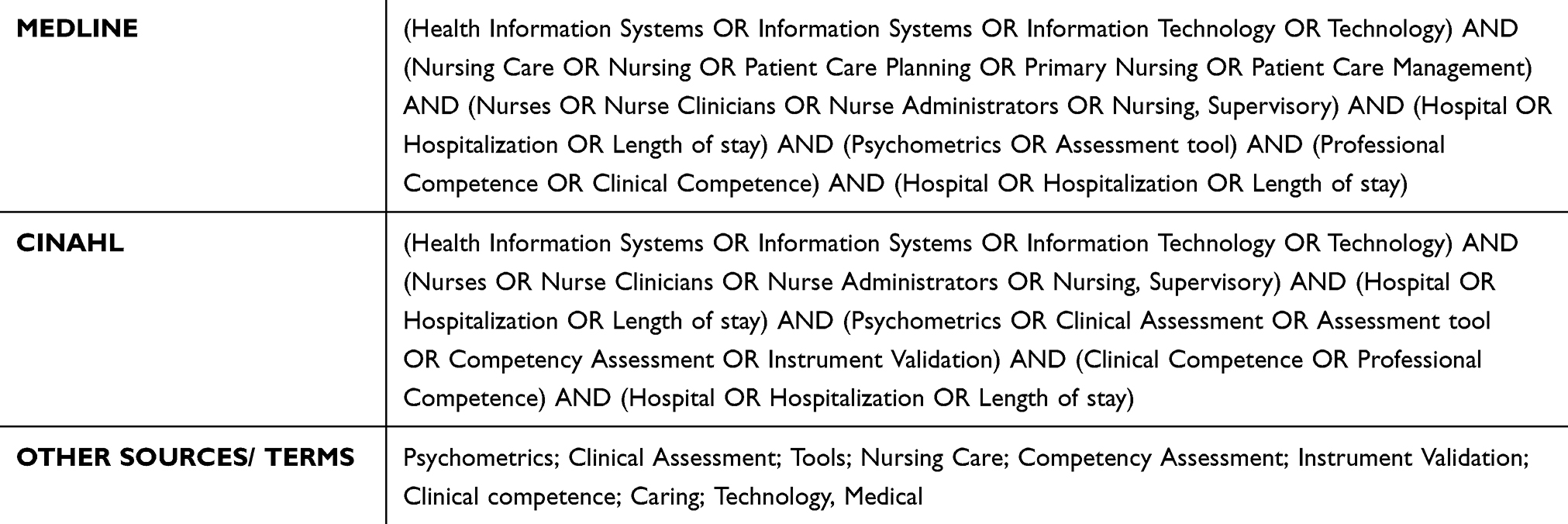 |
Table 1 Data Sources and Research |
Data Extraction
Study selection, data extraction and coding were carried out by two independent reviewers, a third reviewer was available to resolve possible discrepancies. To manage the research results, the Covidence® software was used, facilitating the process of selecting studies. Duplicate studies were automatically eliminated. Initially, the titles and abstracts of the selected studies were analyzed based on the inclusion criteria. Following this initial selection, the articles were reviewed in their entirety. Some studies were identified where both reviewers did not agree, so that each one justified their choice, and a consensus was reached, without the need for the intervention of the third reviewer. Finally, after the reading of the eligible studies in full by both reviewers, relevant data were extracted and analyzed using the JBI Template Source of Evidence Details, Feature and Results Extraction Instrument, adapted to the question of this review, validated, and accepted by both reviewers. The results of the search and selection of studies are presented in full schematized using the PRISMA-ScR – Figure 1.
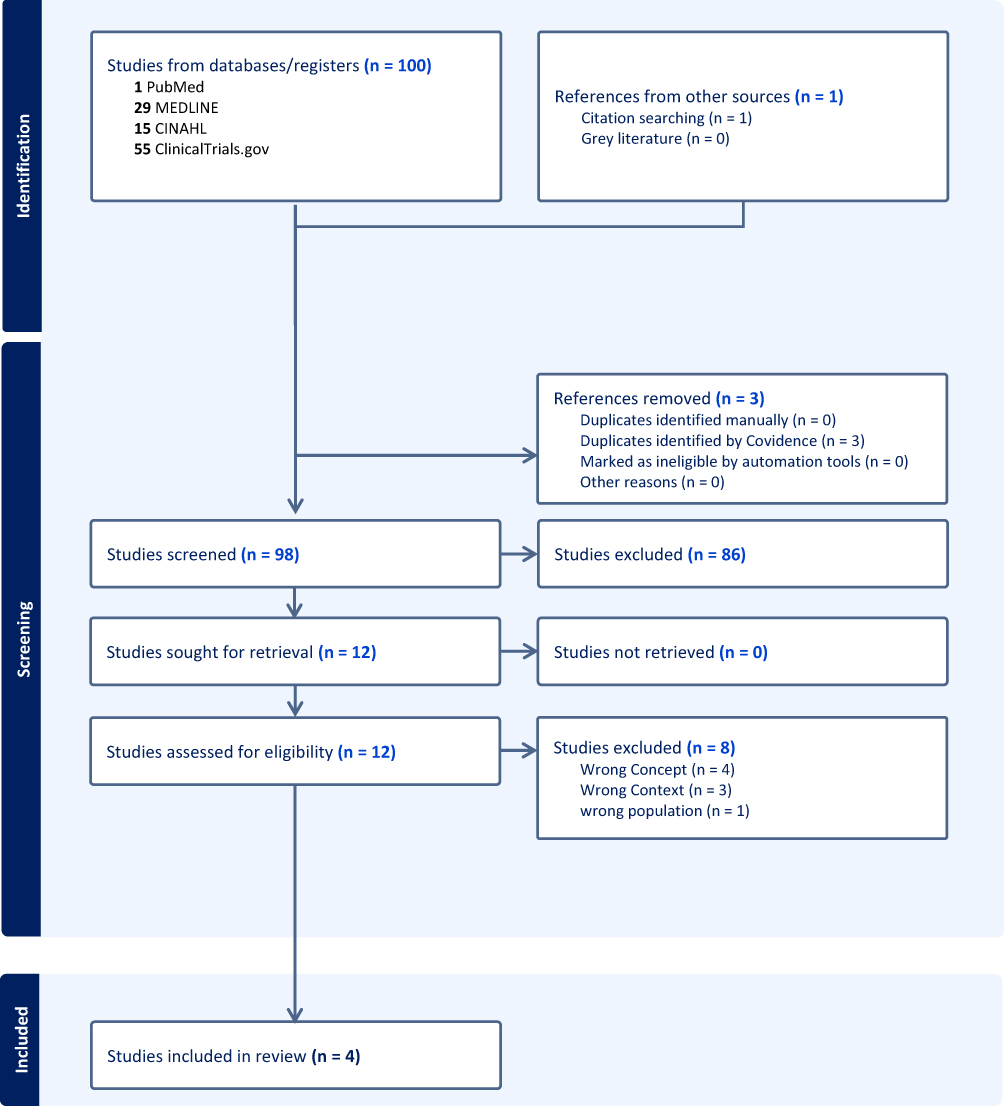 |
Figure 1 Flowchart of the study selection. |
A total of 101 results were identified across all sources. There were three (n = 3) duplicates identified, leaving 98 (n = 98) titles and abstracts for review. There were 86 (n = 86) articles excluded through this process due to the irrelevance of the papers to the aims of the review. Screening yielded 12 studies with potential for eligibility. Exclusion of several articles deemed to be out of scope resulted in 4 studies being included in this review.
To respond to the objective of this review, the analysis of the articles went through 3 stages, identifying the dimensions analyzed in each of the stages, represented in Tables 2–4.
The first step was to understand the design and objective of the studies under analysis, identify the information technology used by nurses in the care environment and skills developed, and the identification of instruments that allow evaluating these skills. The second stage was dedicated to checking the instruments, understanding what the instruments assess, the type of measurement scales used and identifying the methodology used when analyzing the psychometric quality of these instruments. The analysis and report of a psychological measure’s internal consistency is a well-established requirement in the scientific community carried out for each instrument. Among the several available methods to estimate internal consistency, Cronbach’s α ranks high in most researchers’ preferences.27 Thus, in the third stage, it was considered important to explore the methodology and results of the psychometric analysis regarding demographic data, construction validity and reliability, to safely understand the applicability of the instruments.
 |
Table 2 Details of Included Studies |
 |
Table 3 Characterization of Instruments |
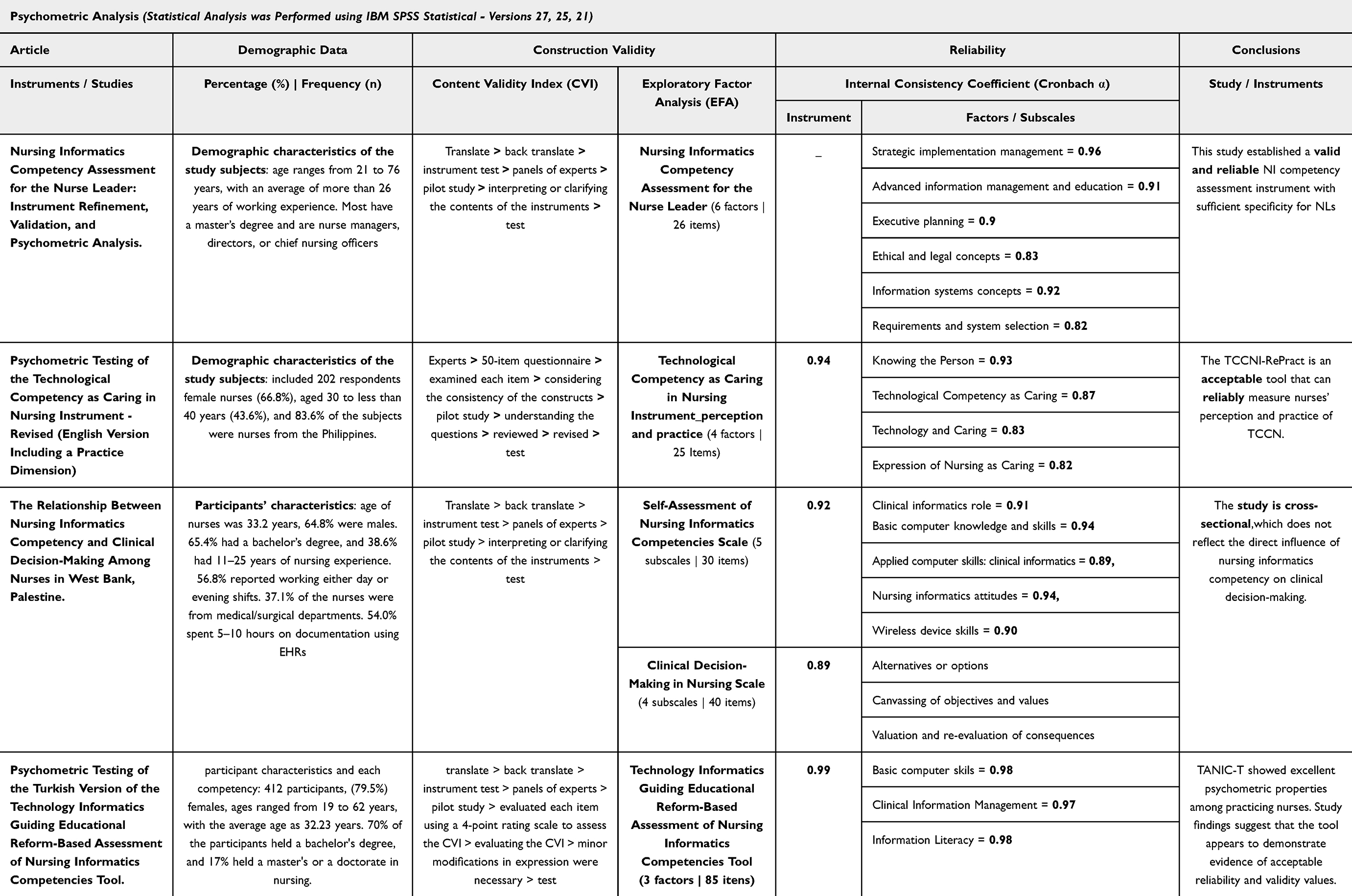 |
Table 4 Psychometric Analysis of the Instruments |
Results
Studies spanned over our predefined timeframe from the earliest in 201728 to the most recent paper, published in 2022.29 The studies were carried out in various geographic locations: United States (n = 2); Philippines and Saudi Arabia (n = 1); West Bank and Palestine (n = 1); Türkiye (n = 1).
This research highlights methodological studies with cross-sectional quantitative approaches, through exploratory factor analyzes (n = 3).28–31 Methodological studies aim to develop, validate, and evaluate solid and reliable measurement instruments.32 One of the studies presents a cross-sectional, descriptive-correlational design with a quantitative and qualitative approach28 - Table 2. Of the 4 studies included in this review, 4 of the 5 instruments under analysis conclude that the identified instruments have acceptable reliability and validity values. Aiming at a greater understanding of the identified instruments, Table 3 shows their characterization, specifically, what the instruments evaluate, items and the measurement scale, and route to evaluate the psychometric qualities of the instrument’s measurement scales.
It was also considered that it was important to understand how the instruments had been tested and validated, regarding translation, validation, and consistency to understand whether the instruments were suitable and accurate for the intended application. Table 4 presents the methodology of the studies, results of the psychometric analysis of the instruments and conclusions of the studies.
Discussion
Monitoring the development of nursing technologies is a consequence of the growing dependence on technologies that critically influence human life and impact the experience of care recipients. Thus, it is important to develop a look at technological competence as nursing care, guided by a model of practice formalized as technological competence and care in nursing theory.33
After analysis, the four articles included in this review highlight the importance of instruments for assessing nurses’ skills, given the growing integration of information technology in health organizations, with great representation in the contexts of care practice at different levels. One of the instruments is a specific instrument for nurse leaders, focusing on specific areas such as, concepts and management, strategic planning, executive leadership, financial management and ethical/legal concepts - The Nursing Informatics Competency Assessment for the Nurse Leader (NICA – LN),28 will enable nurse leaders to acknowledge the competencies required in their role, help create solutions to address potential gaps and improve patient care delivery.
Two of the instruments focusing on IT skills related to the knowledge and use of the equipment itself, namely, areas of basic computer knowledge, information literacy - Technology Informatics Guiding Educational Reform–Based Assessment of Nursing Informatics Competencies Tool - TANIC-T,31 and wireless device skills, clinical informatics role, and applied informatics skills: clinical informatics, by using the Self-Assessment of Nursing Informatics Competencies Scale (SANICS).29 In this study Batran,29 sought to relate technological skills, with clinical decision-making, also presenting an instrument on Clinical Decision-Making in Nursing - Clinical Decision-Making in Nursing Scale (CDMNS),34 which essentially focuses on the assessment of clinical decision-making, describing the nurse’s perception of clinical decision-making based on self-expression, therefore, none of these instruments correspond to what was intended.
The instrument, TCCNI_RePract,30 evaluate the use of technology as a nursing care tool: comprehending patients’ needs, enhancing their self-esteem, encouraging improved health, and fostering stronger relationships with others. The understanding of technological competence as nursing care is anchored in Rozzano Locsin’s theory – Technological Competency as Caring in Nursing, which essentially focuses on knowing the person, through technological competence and understanding this competence as an instrument of care.35,36 This instrument allows not only to evaluate how nurses perceive technological competence as nursing care but also how they use these skills in their daily practice, particularly in highly technological practice environments. According to the authors, The TCCNI-RePract is a tool that reliably assesses nurses’ perceptions and practices in relation to the TCCN.30 This scale effectively and consistently measures nurses’ perceptions and practices across four dimensions: 1) Knowing People, 2) Technological Competence as Caring, 3) Technology and Caring, and 4) Nursing Expression as Caring. Therefore, it is deemed suitable for guiding the training of hospital nursing teams30 Nursing informatics skills are essential for safe and effective clinical practice. Throughout the studies, it was noticed that knowledge and skills regarding information systems are a focus of attention for health organizations that invest in technology and have a major impact on the quality of care provided. Ongoing education and training are considered vital for enhancing the quality of care provided by nurses.37 Although it is recognized that to increase nursing informatics competencies it is critical to assess nursing informatics competence levels and given that informatic technologies skills are necessary and should be an ongoing requirement, one of the recommendations is to use tools with nursing students to identify their computer knowledge, skill gaps and to better prepare them for practice in contemporary care environments. However, skills and knowledge are crucial for nurses in fostering relationships with their patients, as these relationships rely on trust in each nurse’s technical abilities. As nurses gain proficiency with technology, they significantly enhance their efficiency in utilizing it.35 Nurses and healthcare professionals in general must be specifically recognized and involved in the escalation of digital development in healthcare, preparing themselves for the required skills development, increasing their involvement in digital competence in healthcare development methods, such as guidance, mentoring or coaching, and contributing to the design of models that support high-quality care practice. Additionally, as already mentioned by other authors, managers must take a stronger role in supporting different areas of digital health competence.38 The International Council of Nurses also encourages national nurses’ associations, in collaboration with their governments, to contribute to the development of digital health competency frameworks to inform nursing education and ensure their integration into continuing nursing education at national and international level.17
Conclusion
With the growing use of technology and the consequent dependency experienced by care recipients, it is important to provide the acquisition and development of technological competences as nursing care, guided by a model of practice such as technological competence and caring in nursing theory. This importance is reinforced by the reality in which nurses find themselves with highly technological and increasingly developed nursing practice environments. These include knowledge and use of their own IT equipment, areas of basic IT knowledge, information literacy, wireless device skills, the role of clinical IT, and applied IT skills. These applied informatics skills should consider clinical informatics, using various support tools such as the Nursing Clinical Decision-Making tool, which essentially focuses on the evaluation of clinical decision-making, describing the nurse’s perception of clinical decision-making based on self-expression.
Evaluating the use of technology as a nursing care tool is crucial for understanding patients’ needs, enhancing their self-esteem, promoting better health, and fostering stronger relationships with others. But computer skills in nursing are also essential for safe and effective clinical practice.
Information systems knowledge and skills are a focus of attention for healthcare organizations that invest in technology and significantly influence the quality of care delivered. Continuing education and training are recognized as essential to improving the care provided by nurses. Although nurses are aware of the importance of using technology as a support to profoundly understand patients and promote their recovery, building a better relationship with patients, they sometimes fail to do so for various reasons.
Therefore, more studies are needed to better understand the obstacles and challenges that hinder nurses from delivering effective nursing care in technological environments, as well as how the organization and management of nursing care should be viewed so that care is supported by technology, but without losing the essence of care. Caring for the person as a unique and individual being, with their own values, experiencing a health experience that is also unique in a moment, aware that the current moment is not the next one. Hospitals and organizations that promote a human caring environment should support nurses’ ongoing professional development, such as acquiring new competencies based on the latest evidence that support the practice of nursing care, for better health outcomes and a better patient experience. We noted the scarcity of studies in the review area. This emphasizes the great relevance and importance of this review for scientific evidence.
Data Sharing Statement
The findings of this study are supported by data that can be requested from the corresponding author under reasonable circumstances.
Ethical Approval
This review does not engage with human subjects, materials, tissues, or data, so ethics committee approval was not necessary.
Author Contributions
All authors made a significant contribution to the work reported, whether that is in the conception, study design, execution, acquisition of data, analysis and interpretation, or in all these areas; took part in drafting, revising or critically reviewing the article; gave final approval of the version to be published; have agreed on the journal to which the article has been submitted; and agree to be accountable for all aspects of the work.
Funding
Financial support was provided by the Nursing Research, Innovation and Development Centre of Lisbon (CIDNUR), at Escola Superior de Enfermagem de Lisboa, Lisbon, Portugal.
Disclosure
The authors declare that they have no conflicts of interest.
References
1. Hoffmann J, Reimer A, Mause L, Müller A, Dresbach T, Scholten N. Driving new technologies in hospitals: association of organizational and personal factors with the readiness of neonatal intensive care unit staff toward webcam implementation. BMC Health Serv Res. 2022;22(1). doi:10.1186/s12913-022-08072-5
2. Yaqoob Mohammed Al Jabri F, Kvist T, Azimirad M, Turunen H. A systematic review of healthcare professionals’ core competency instruments. Nurs Health Sci. 2021;23(1):87–102. doi:10.1111/nhs.12804
3. World Health Organization. Health technology assessment; 2022. Available from: https://who-sandbox.squiz.cloud/en/health-topics/Health-systems/health-technologies-and-medicines/policy-areas/health-technology-assessment.
4. World Health Organization. Working together for health; 2006. Available from: https://books.google.pt/books?hl=pt-PT&lr=&id=taYsDwAAQBAJ&oi=fnd&pg=PR13&dq=world+health+organization+2006+considers+nurses+constitute+the+backbone+of+healthcare+systems&ots=9gh12tyeE8&sig=5JQl2jx8q_W_yNCrGXIpMfrAx70&redir_esc=y#v=onepage&q&f=false.
5. Aiken LH, Clarke SP, Sloane DM, et al. Nurses’ reports on hospital care in five countries. Health Aff. 2001;20(3):43–53. doi:10.1377/hlthaff.20.3.43
6. Aiken LH, Clarke SP, Cheung RB, Sloane DM, Silber JH. Educational levels of hospital nurses and surgical patient mortality. JAMA. 2003;290(12):1617–1623. doi:10.1001/jama.290.12.1617
7. Aiken LH. Hospital nurse staffing and patient mortality, nurse burnout, and job dissatisfaction. JAMA. 2002;288(16):1987. doi:10.1001/jama.288.16.1987
8. Kane RL, Shamliyan T, Mueller C, Duval S, Wilt TJ. Nurse staffing and quality of patient care. Evid Rep Technol Assess. 2007;(151):1–115. PMID: 17764206; PMCID: PMC4781632.
9. Kendall-Gallagher D, Blegen MA. Competence and certification of registered nurses and safety of patients in intensive care units. Am J Respir Crit Care Med. 2009;18(2):106–113. doi:10.4037/ajcc2009487
10. Nilsson J, Johansson E, Egmar AC, et al. Development and validation of a new tool measuring nurses self-reported professional competence-The nurse professional competence (NPC) Scale. Nurse Educ Today. 2014;34(4):574–580. doi:10.1016/j.nedt.2013.07.016
11. Hill CL. Invited editorial: caring and technology. Online J Nurs Inform. 2013. http://ojni.org/issues/?p=2856.
12. e Silva AADP. Sistemas de informação em enfermagem: Uma teoria explicativa da mudança. Coimbra: Formasau; 2006.
13. Cunha A, Ferreira J, Rodrigues M. Atitude dos enfermeiros face ao sistema informatizado de informação em enfermagem. Revista de Enfermagem Referência. 2010;III Série(1):7–16. doi:10.12707/RII0935
14. International Council of Nurses. Core competencies in disaster nursing: version 2.0. 2019. https://www.icn.ch/sites/default/files/inline-files/ICN_Disaster-Comp-Report_WEB_final.pdf.
15. Goellner Y, Tipton E, Verzino T, Weigand L. Improving care quality through nurse-to-nurse consults and early warning system technology. Nurs Manage. 2022;53(1):28–33. doi:10.1097/01.NUMA.0000795580.57332.fa
16. Boonen M, Rankin J, Vosman F, Niemeijer A. Nurses’ knowledge and deliberations crucial to barcoded medication administration technology in a Dutch hospital: discovering nurses’ agency inside ruling. Health. 2020;24(3):279–298. doi:10.1177/1363459318800155
17. International Council of Nurses. Digital health transformation and nursing practice; 2023. Available from: https://www.icn.ch/sites/default/files/2023-08/ICN%20Position%20Statement%20Digital%20Health%20FINAL%2030.06_EN.pdf.
18. Bahreini M, Shahamat S, Hayatdavoudi P, Mirzaei M. Comparison of the clinical competence of nurses working in two university hospitals in Iran. Nurs Health Sci. 2011;13(3):282–288. doi:10.1111/j.1442-2018.2011.00611.x
19. Peters MDJ, Marnie C, Tricco AC, et al. Updated methodological guidance for the conduct of scoping reviews. JBI Evid Synth. 2020;10):2119–26. doi:10.11124/JBIES-20-00167
20. Tricco AC, Lillie E, Zarin W, et al. PRISMA extension for scoping reviews (PRISMA-ScR): checklist and explanation. Ann Intern Med. 2018;169(7):467–473. doi:10.7326/M18-0850
21. Ordem dos Enfermeiros. Estatuto da Ordem dos Enfermeiros e REPE. 2015. Available from: https://www.ordemenfermeiros.pt/arquivo/publicacoes/Documents/nEstatuto_REPE_29102015_VF_site.pdf.
22. Chaves LDP, Ferreira JBB, Camelo SHH, Balderrama P, Tanaka O. Reflexões acerca de Sistemas de Informação em Saúde, Pesquisa Avaliativa e Enfermagem. Enfermería Global. 2014;13(34):293–302.
23. Serviços Partilhados do Ministério da Saúde. SPMS lidera evolução tecnológica dos sistemas de informação da saúde. 2019. Available from: https://www.spms.min-saude.pt/2019/07/spms-lidera-evolucao-tecnologica-dos-sistemas-de-informacao-da-saude.
24. Arksey H, O’Malley L. Scoping studies: towards a methodological framework. Int J Soc Res Methodol. 2005;8(1):19–32. doi:10.1080/1364557032000119616
25. Delaney L. Guides: Scoping Reviews. 2023. Available from: https://guides.library.stonybrook.edu/c.php?g=1249473&p=9145187.
26. Page MJ, McKenzie JE, Bossuyt PM, et al. The PRISMA 2020 statement: an updated guideline for reporting systematic reviews. BMJ. 2021;29(71). doi:10.1136/bmj.n71
27. Maroco J, Garcia-Marques T. Qual a fiabilidade do alfa de Cronbach? Questões antigas e soluções modernas? Laboratório de psicologia. 2006;4. http://hdl.handle.net/10400.12/133.
28. Yen PY, Phillips A, Kennedy MK, Collins S. Nursing informatics competency assessment for the nurse leader instrument refinement, validation, and psychometric analysis. J Nurs Adm. 2017;47(5):271–277. doi:10.1097/NNA.0000000000000478
29. Batran A, Al-Humran SM, Malak MZ, Ayed A. The relationship between nursing informatics competency and clinical decision-making among nurses in West Bank, Palestine. Comput Inform Nurs. 2022;40(8):547–553. doi:10.1097/CIN.0000000000000890
30. Yokotani T, Tanioka T, Betriana F, et al. Psychometric testing of the technological competency as caring in nursing instrument – revised (English version including a practice dimension). Nurs Media J Nurs. 2021;11(3):346–358. doi:10.14710/nmjn.v11i3.41409
31. Kaynar NS, Secginli S, West K. Psychometric testing of the Turkish version of the technology informatics guiding educational reform-based assessment of nursing informatics competencies tool. Comput Inform Nurs. 2020;38(11):572–578. doi:10.1097/CIN.0000000000000671
32. Polit D, Beck C. Nursing Research: Generating and Assessing Evidence for Nursing Practice.
33. Locsin RC, Purnell M, Lynn CE. Rapture and suffering with technology in nursing. 2007. Available from: https://iafhc.wildapricot.org/resources/Online%20Presentations/2021/Rapture%20and%20Sufferning%20_Locsin.pdf.
34. Jenkins HM. A research tool for measuring perceptions of clinical decision making. J Prof Nurs. 1985;1(4):221–229. doi:10.1016/s8755-7223(85)80159-9
35. Locsin R. Technological Competency as Caring in Nursing: A Model for Practice. Torraza Piemonte (TO): Amazon Italia S.r.I.; 2016.
36. Locsin R. Technological Competency as Caring in Nursing: A Model for Practice. Indianapolis: SIGMA Theta Tau International Honor Society of Nursing; 2005.
37. Vogel J, Hollenbach J, Haering A, Augurzky B, Geissler A. The association of hospital profitability and digital maturity – an explorative study using data from the German DigitalRadar project. Health Policy. 2024;142. doi:10.1016/j.healthpol.2024.105012
38. Jarva E, Oikarinen A, Andersson J, Pramila-Savukoski S, Hammarén M, Mikkonen K. Healthcare professionals’ digital health competence profiles and associated factors: a cross-sectional study. J Adv Nurs. 2024;80(8):3236–3252. doi:10.1111/jan.16096
 © 2025 The Author(s). This work is published and licensed by Dove Medical Press Limited. The
full terms of this license are available at https://www.dovepress.com/terms
and incorporate the Creative Commons Attribution
- Non Commercial (unported, 4.0) License.
By accessing the work you hereby accept the Terms. Non-commercial uses of the work are permitted
without any further permission from Dove Medical Press Limited, provided the work is properly
attributed. For permission for commercial use of this work, please see paragraphs 4.2 and 5 of our Terms.
© 2025 The Author(s). This work is published and licensed by Dove Medical Press Limited. The
full terms of this license are available at https://www.dovepress.com/terms
and incorporate the Creative Commons Attribution
- Non Commercial (unported, 4.0) License.
By accessing the work you hereby accept the Terms. Non-commercial uses of the work are permitted
without any further permission from Dove Medical Press Limited, provided the work is properly
attributed. For permission for commercial use of this work, please see paragraphs 4.2 and 5 of our Terms.