
Back to Journals » International Journal of Women's Health » Volume 18
Impact of Thin and Thick Intrapartum Meconium-Stained Amniotic Fluid on Cesarean Delivery and Neonatal Outcomes in Low-Risk Pregnancies
Authors Kaewthong W, Srisukho S  , Kamlungkuea T, Parapob N, Tongsong T
Received 4 November 2025
Accepted for publication 22 January 2026
Published 27 January 2026 Volume 2026:18 579100
DOI https://doi.org/10.2147/IJWH.S579100
Checked for plagiarism Yes
Review by Single anonymous peer review
Peer reviewer comments 2
Editor who approved publication: Dr Everett Magann
Wanrada Kaewthong,1,* Sasivimol Srisukho,1,* Threebhorn Kamlungkuea,1,2 Natnipa Parapob,1,2 Theera Tongsong1,2
1Department of Obstetrics and Gynecology; Faculty of Medicine, Chiang Mai University, Chiang Mai, Thailand; 2Fetal Center, Faculty of Medicine, Chiang Mai University, Chiang Mai, Thailand
*These authors contributed equally to this work
Correspondence: Sasivimol Srisukho, Department of Obstetrics and Gynecology, Faculty of Medicine, Chiang Mai University, Chiang Mai, 50200, Thailand, Email [email protected] Theera Tongsong, Department of Obstetrics and Gynecology, Faculty of Medicine, Chiang Mai University, Chiang Mai, 50200, Thailand, Email [email protected]
Objective: To evaluate whether thin and thick meconium-stained amniotic fluid are risk factors for increased rates of cesarean delivery, both for fetal and non-fetal distress indications, as well as for operative vaginal delivery.
Methods: A retrospective cohort study was conducted on low-risk singleton pregnancies. They were divided into three groups for comparisons of outcomes: the control group (clear amniotic fluid), the thin meconium group, and the thick meconium group.
Results: A total of 12,171 women met the inclusion criteria, comprising 10,341 with clear amniotic fluid and 1,730 (15.0%) with meconium-stained amniotic fluid, of which 1,159 (9.5%) had thin meconium and 671 (5.5%) had thick meconium. Most labor outcomes in the thin meconium group were comparable to those in the control group. However, in the thick meconium group, the overall rate of cesarean delivery, including those indicated for both fetal distress and non-fetal distress, as well as the rate of operative vaginal delivery, were significantly increased after adjustment for potential confounders, with adjusted odds ratios of 1.93, 2.25, 1.72, and 1.95, respectively. Additionally, the rate of low Apgar scores was significantly higher in the thick meconium group.
Conclusion: Thick meconium-stained amniotic fluid was identified as a risk factor for an increased rate of cesarean delivery, both for fetal distress and non-fetal distress indications. The latter may be related to a lower threshold for decision-making, as physicians may fear potential fetal compromise, leading to unnecessary cesarean deliveries. Stricter criteria for cesarean section indications in cases of thick meconium should therefore be emphasized.
Keywords: amniotic fluid, cesarean section, delivery outcome, meconium
Introduction
Meconium-stained amniotic fluid has been associated with an increased risk of fetal distress or non-reassuring fetal heart rate patterns, as well as lower Apgar scores,1–4 consistent with the understanding that fetal hypoxia precipitates meconium passage. In the presence of fetal hypoxia, the release of arginine vasopressin stimulates colonic smooth muscle to contract and relax the anal sphincter, leading to the passage of meconium.5 Nevertheless, although meconium-stained amniotic fluid can partly reflect fetal hypoxia or non-reassuring fetal well-being, meconium passage in utero can also occur in normal fetuses.6,7 Accordingly, meconium-stained amniotic fluid is not always indicative of fetal distress; rather, it reflects an increased risk of adverse outcomes. In line with clinical practice guidelines, its presence warrants closer surveillance with electronic fetal monitoring to detect fetal distress or non-reassuring fetal heart rate patterns, which may necessitate cesarean section or urgent delivery. However, meconium-stained amniotic fluid alone is not considered a standalone indication for cesarean section.
Meconium-stained amniotic fluid occurs in 5–20% of parturients8 and is consistently reported to be associated with an increased risk of cesarean section and operative vaginal delivery.9,10 This increase is presumably attributable to the higher incidence of fetal distress among women complicated by meconium-stained amniotic fluid, as mentioned earlier. However, it remains unclear whether the rates of cesarean section and operative vaginal delivery due to non–fetal distress indications are also elevated. Furthermore, most previous studies have evaluated the overall impact of meconium-stained amniotic fluid without stratifying cases by severity. However, in clinical practice, thin meconium staining often appears not to be associated with adverse outcomes, a question that remains insufficiently investigated. The severity of staining may therefore have differential effects on perinatal outcomes. Accordingly, this study examined the effects of thin (defined as light or yellow-green, translucent amniotic fluid without particulate matter) and thick meconium-stained amniotic fluid (dark green, opaque, or highly viscous fluid containing particulate material or clumps) separately, focusing on low-risk pregnancies to minimize confounding from other risk factors. The primary objective of this study was to determine whether thin and thick meconium-stained amniotic fluid are independent risk factors for increased rates of cesarean section, both for fetal distress and non-fetal distress indications, as well as for operative vaginal delivery.
Patients and Methods
A retrospective cohort study was carried out, using data from the obstetric electronic database and complete medical records of the Department of Obstetrics and Gynecology, Chiang Mai University, Thailand. The database contains prospectively collected data of pregnant women who delivered at Maharaj Nakorn Chiang Mai Hospital, a tertiary care medical school and referral center, with entries recorded on the day of discharge. This study was ethically approved by the Institutional Review Board, Faculty of Medicine, Chiang Mai University (Research Ethics Committee Panel 5; Research ID: OBG-2568-0061; Date of Approval: 6 February 2025). The database was then accessed to retrieve all consecutive records of women who gave birth at our hospital between 2014 and 2024. During the study period, labor management followed a uniform institutional protocol. For example, the diagnosis of labor arrest or failed induction was based on the American College of Obstetricians and Gynecologists (ACOG) guidelines,11 and non-reassuring fetal heart rate patterns were classified according to the National Institute of Child Health and Human Development (NICHD) criteria.12 The inclusion criteria were as follows: (1) singleton pregnancies; (2) low-risk pregnancies; (3) vertex presentation; (4) clearly documented condition of amniotic fluid during labor (clear, thin, or thick meconium-stained); and (5) planned vaginal delivery, either spontaneous or induced. The exclusion criteria were as follows: (1) multifetal pregnancies; (2) pregnancies at high risk of obstetric or medical complications (eg, heart disease, connective tissue diseases, chronic hypertension, pregestational diabetes mellitus or preeclampsia); (3) fetal structural or chromosomal abnormalities; (4) elective cesarean section (mostly for previous cesarean delivery); (5) antepartum non-reassuring fetal status; (6) non-vertex fetal presentation; and (7) obstetric emergencies such as umbilical cord prolapse or placental abruption.
Demographic and obstetric data (eg, maternal age, parity, chronic medical conditions) and pregnancy outcomes (eg, gestational age at birth, obstetric complications, mode of delivery, and neonatal outcomes) were validated, extracted from the medical records, and digitally recorded. The primary outcomes were the rates of cesarean section (overall and by specific indications) and operative vaginal delivery. The secondary outcomes were low Apgar scores at 1 and 5 minutes, defined as a score of <7 at 1 and 5 minutes, respectively. The parturients were classified into three groups: (1) clear amniotic fluid, (2) thin meconium-stained amniotic fluid, and (3) thick meconium-stained amniotic fluid. Severity was subjectively assessed intrapartum by the attending obstetrician based on color, viscosity, and particulate content. Thin meconium-stained amniotic fluid was defined as light or yellow-green, translucent fluid without particulate matter. Thick meconium-stained amniotic fluid was defined as dark green, opaque, or highly viscous fluid containing particulate material or clumps. Cases with intermediate features were classified by the predominant characteristic; for analysis, any moderate or particulate meconium was grouped as thick meconium-stained amniotic fluid.
Statistical Analysis
Statistical analyses were performed using the Statistical Package for the Social Sciences (SPSS), version 26.0 (IBM Corp., 2019; IBM SPSS Statistics for Windows, Version 26.0, Armonk, NY, USA). Descriptive statistics are presented as mean ± standard deviation (SD) or as median with interquartile range, depending on variable distribution, and as percentages for categorical variables. Baseline data between the study groups (meconium-stained amniotic fluid) and the control group (clear amniotic fluid) were compared using Student’s t-test for continuous variables and the chi-square test for categorical variables. For outcome comparisons, relative risks with 95% confidence intervals were analyzed. Univariable and multivariable analyses were conducted to adjust for potential confounding factors associated with adverse outcomes, using logistic regression analysis. A p-value < 0.05 was considered statistically significant. Based on a large previous study by Hiersch et al,9 which reported an odds ratio of 1.48 (95% CI, 1.31–1.69) for cesarean section among women with meconium-stained amniotic fluid, the required sample size for this study was calculated to be at least 428 cases with thick meconium staining and 4,280 controls (assuming a prevalence of 10%) to achieve 90% statistical power at a 95% confidence interval.
Results
During the study period, there were a total of 15,254 deliveries. After excluding elective cesarean sections, multiple pregnancies, cases of placenta previa, breech presentations, and fetal anomalies, 12,171 cases remained available for analysis. Among these, the prevalence of meconium-stained amniotic fluid was 15.0% (1,730 cases), comprising thin meconium in 9.5% (1,159 cases) and thick meconium in 5.5% (671 cases), as shown in Figure 1. Most baseline characteristics of women in the meconium-stained amniotic fluid group were comparable to those in the control group, as presented in Table 1. However, the proportion of nulliparous women in the thick meconium group was significantly higher than in the control group.
 |
Table 1 Demographic Data of the Patients with Meconium Stained Amniotic Fluid Compared with Those with Clear Amniotic Fluid |
 |
Figure 1 Flowchart of patient recruitment. |
Most obstetric outcomes were comparable between the control group (clear amniotic fluid) and the thin meconium-stained amniotic fluid group, except that gestational age and placental weight were slightly, but significantly, lower in the thin meconium group, as presented in Table 2.
 |
Table 2 Comparisons of the Main Adverse Outcomes Between the Group of Clear Amniotic Fluid and Thin Meconium Stained Amniotic Fluid |
Most adverse labor outcomes were significantly more frequent in the thick meconium group compared with the control group, as presented in Table 3. The overall cesarean section rate (CSR) was significantly higher in the thick meconium group (relative risk, 1.54; 95% CI, 1.35–1.76). Notably, not only CSRs due to fetal distress but also those due to cephalopelvic disproportion, failure of induction, and other indications were significantly higher in the thick meconium group. Gestational age, fetal weight, placental weight, and estimated blood loss showed only minimal differences between the groups, although the differences reached statistical significance. Additionally, the rate of operative vaginal delivery was nearly two-fold higher in the thick meconium group (relative risk, 1.94; 95% CI, 1.51–2.48).
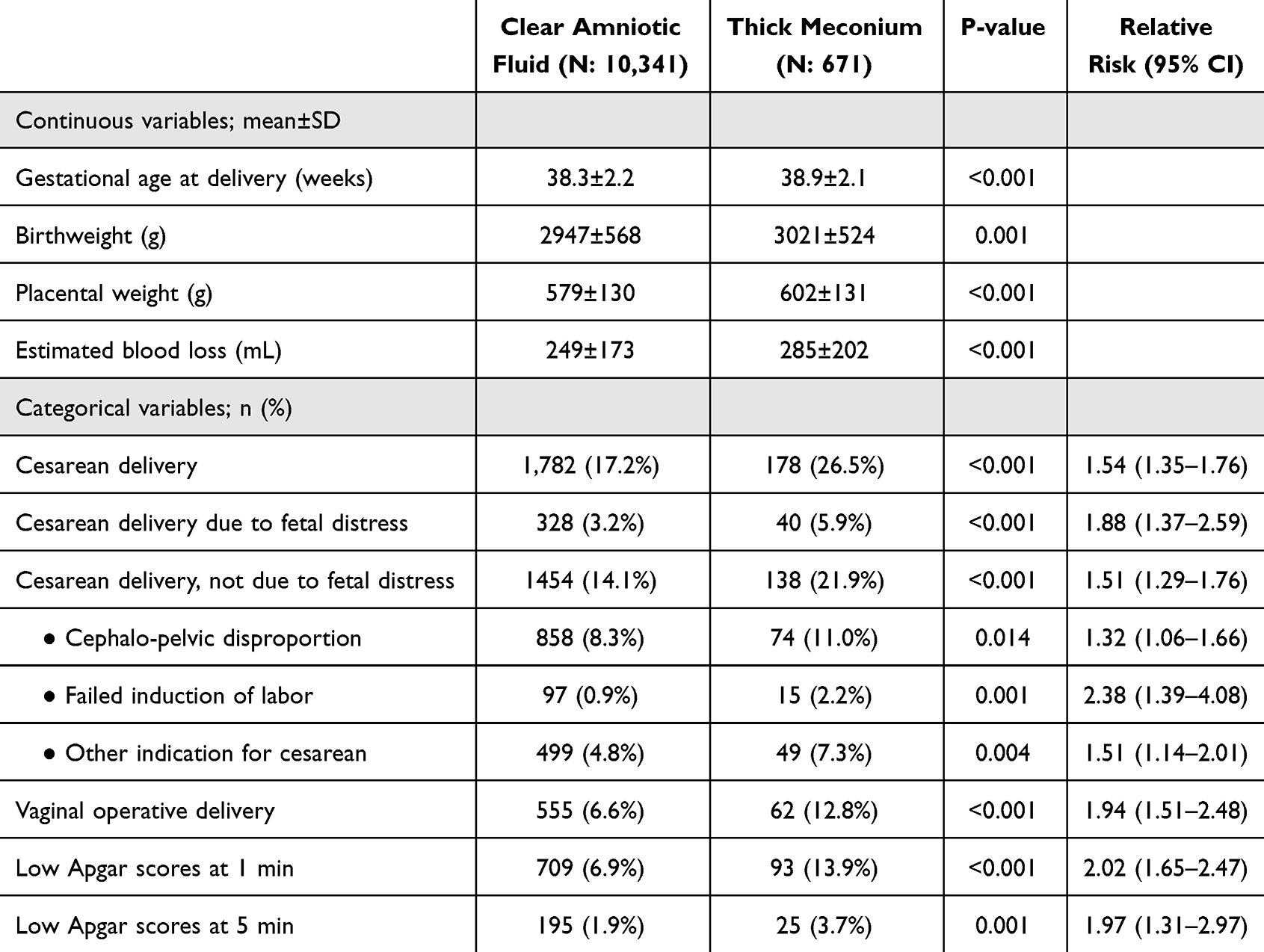 |
Table 3 Comparisons of the Main Adverse Outcomes Between the Group of Clear Amniotic Fluid and Thick Meconium Stained Amniotic Fluid |
After adjustment for potential confounding factors, thick meconium-stained amniotic fluid remained a risk factor for an increased total CSR, with a nearly two-fold higher rate than that observed in the control group (adjusted odds ratio, 1.93; 95% CI, 1.59–2.33), as presented in Table 4. The adjusted odds ratios of CSR for various indications were also significantly higher in the thick meconium group, except for CSR due to cephalopelvic disproportion, which showed a tendency to be higher but did not reach statistical significance. Additionally, thick meconium-stained amniotic fluid was a significant independent risk factor for operative vaginal delivery and low Apgar scores in newborns.
 |
Table 4 Odds Ratio of Thick Meconium Stained Amniotic Fluid as a Risk Factors for Adverse Delivery Outcomes Based on Univariable and Multivariable Analysis, Compared to the Group of Clear Amniotic Fluid |
Discussion
The main insights gained from this study are as follows: 1) Thick meconium-stained amniotic fluid in labor is a risk factor for an increased rate of cesarean section and operative vaginal delivery. 2) Thick meconium-stained amniotic fluid is significantly associated with low Apgar scores in newborns, even after adjustment for confounding factors. 3) Thin meconium does not have a significant impact on most delivery outcomes; although the rate of low Apgar scores at 1 minute was slightly but significantly increased. Unlike most previous studies, which reported only the overall rate of cesarean section,8,9,13–15 this study also examined subgroups of cesarean section according to their indications. This approach allowed us to assess the impact of meconium-stained amniotic fluid on decision-making for cesarean section within each subgroup, thereby providing insights that may guide clinicians in appropriate management. Importantly, we analyzed thin and thick meconium-stained amniotic fluid separately and found that these two groups differed substantially in their impact on labor outcomes, whereas most previous studies did not stratify by the severity of meconium staining.9,13,15,16
In terms of the increased rates of cesarean section and operative vaginal delivery, our findings are consistent with those reported by Hiersch et al,9 who demonstrated in a multivariate analysis of a large retrospective cohort study that meconium-stained amniotic fluid was associated with operative vaginal delivery (adjusted odds ratio, 1.82; 95% CI, 1.63–2.09; p < 0.001) and cesarean section (odds ratio, 1.48; 95% CI, 1.31–1.69; p < 0.001). However, their analysis included all cases with meconium-stained amniotic fluid without differentiating between thin and thick meconium, as was done in our study, and they did not stratify by the indications for cesarean section. Consequently, direct comparison of their results with ours should be interpreted with caution.
In both our practice and standard guidelines, meconium-stained amniotic fluid is an indication for electronic fetal monitoring but not for cesarean section. Thus, theoretically, the CSR for indications other than fetal distress or non-reassuring fetal status would not be expected to increase. However, our findings demonstrate that the rate of cesarean section for all indications other than fetal distress was also significantly higher, with an adjusted odds ratio of 1.73 (95% CI, 1.41–2.14). In other words, pregnancies with thick meconium-stained amniotic fluid were associated with an increased risk of cesarean section due to both fetal distress and non-fetal distress indications. The rise in cases without fetal distress was largely attributable to a significant increase in cesarean sections performed for failed induction and other indications. Although cesarean section due to cephalopelvic disproportion did not reach statistical significance in the multivariable analysis, it showed a tendency toward increase and was significantly higher in the univariable analysis. The reasons for the increased rate of cesarean section in the absence of fetal distress remain unclear and cannot be fully explained by scientific evidence. One possible explanation is that physicians managing pregnancies complicated by thick meconium-stained amniotic fluid may have a lower threshold for deciding on cesarean delivery out of concern for potential fetal distress, thereby increasing the likelihood of subjective over-diagnosis of failed induction or cephalopelvic disproportion. Therefore, this study suggests that thick meconium-stained amniotic fluid may be a risk factor for an increased rate of unnecessary cesarean section, unrelated to fetal distress. Accordingly, greater awareness is needed in decision-making regarding cesarean delivery in the absence of fetal distress, with closer attention paid to ensuring that the procedure is performed only for appropriate indications. Such awareness is expected to contribute to a reduction in unnecessary cesarean sections.
Similarly, the rate of operative vaginal delivery was significantly higher in cases of thick meconium-stained amniotic fluid. As with the increase in cesarean section, physicians may have been more inclined to perform the procedure out of concern for fetal distress or by interpreting meconium-stained amniotic fluid as evidence of distress despite the absence of true compromise. Unnecessary operative vaginal deliveries might have been avoided if greater attention had been paid to accurately diagnosing fetal distress or non-reassuring fetal status in the second stage of labor.
Clinical Implication
Our findings suggest that stricter criteria for diagnosing fetal distress, cephalo-pelvic disproportion, failed induction, or other indications should be more rigorously applied in the management of pregnancies complicated by thick meconium-stained amniotic fluid to avoid unnecessary cesarean section and operative vaginal delivery.
Research Implication
Prospective cohort studies comparing delivery outcomes between pregnancies complicated by thick meconium-stained amniotic fluid and those without should be conducted in settings where indications for cesarean section are rigorously audited.
Strengths and Weaknesses
The main limitation of this study is its retrospective design, as the recorded data may not have been entirely reliable or complete. For example, some variables, such as oxytocin use, were not fully documented in sufficient detail and were therefore not included in the analysis. Importantly, the classification of thin and thick meconium-stained amniotic fluid was based on the subjective judgment of the attending physicians, without assessment of inter-observer variability. This may have introduced bias, and reproducibility in other settings may be limited. The strengths of this study include the large sample size, which provided sufficient power to draw conclusions with high confidence. Furthermore, the findings reflect real-world clinical practice in a service setting rather than results derived from controlled research environments. Therefore, the results can be applied to guide and improve clinical management of pregnancies complicated by meconium-stained amniotic fluid.
Conclusion
This study demonstrated that thin meconium-stained amniotic fluid did not affect most delivery outcomes, whereas thick meconium-stained amniotic fluid significantly increased the risk of low Apgar scores as well as higher rates of cesarean section and operative vaginal delivery. Importantly, thick meconium-stained amniotic fluid was identified as a risk factor for cesarean section performed for non-fetal distress indications, reflecting a low threshold for deciding on cesarean delivery, likely driven by concerns about potential fetal compromise. Our findings suggest that stricter criteria for diagnosing fetal distress, failed induction, and other indications should be more rigorously applied in the management of pregnancies complicated by thick meconium-stained amniotic fluid, in order to reduce unnecessary cesarean sections and operative vaginal deliveries. For example, diagnoses such as cephalopelvic disproportion or failed induction should adhere to the ACOG guidelines,11 and the diagnosis of non-reassuring fetal heart rate patterns should follow the NICHD criteria.12
Institutional Review Board Statement
The study was conducted according to the guidelines of the Declaration of Helsinki and approved by Research Ethics Committee 5, Faculty of Medicine, Chiang Mai University (Research Ethics Committee Panel 5; Research ID: OBG-2568-0061; Date of Approval: 6 February 2025).
Data Sharing Statement
The datasets analyzed during the current study are available from the corresponding author (TT) upon reasonable request.
Informed Consent Statement
Informed consent was waived by the Research Ethics Committee because this study involved a retrospective review of anonymized medical records, and all patient information was kept strictly confidential.
Acknowledgments
We would like to express our gratitude to MFM team who helped us in patient recruitment and collecting data.
Author Contributions
All authors made a significant contribution to the work reported, whether that is in the conception, study design, execution, acquisition of data, analysis and interpretation, or in all these areas; took part in drafting, revising or critically reviewing the article; gave final approval of the version to be published; have agreed on the journal to which the article has been submitted; and agree to be accountable for all aspects of the work.
Funding
This work was supported by The Chiang Mai University Research Fund CMU-2568. The funder had no role in the design of the study and collection, analysis, and interpretation of data and in writing the manuscript.
Disclosure
The authors declare no conflicts of interest in this work.
References
1. Nathan L, Leveno KJ, Carmody TJ, Kelly MA, Sherman ML. Meconium: a 1990s perspective on an old obstetric hazard. Obstet Gynecol. 1994;83(3):329–9.
2. Starks GC. Correlation of meconium-stained amniotic fluid, early intrapartum fetal pH, and Apgar scores as predictors of perinatal outcome. Obstet Gynecol. 1980;56(5):604–609.
3. Ziadeh SM, Sunna E. Obstetric and perinatal outcome of pregnancies with term labour and meconium-stained amniotic fluid. Arch Gynecol Obstet. 2000;264(2):84–87. doi:10.1007/s004040000088
4. Rodriguez Fernandez V, Lopez Ramon YCCN, Marin Ortiz E, Couceiro Naveira E. Intrapartum and perinatal results associated with different degrees of staining of meconium stained amniotic fluid. Eur J Obstet Gynecol Reprod Biol. 2018;228:65–70. doi:10.1016/j.ejogrb.2018.03.035
5. Cunningham FG, Leveno KJ, Dashe JS, Hoffman BL, Spong CY, Casey BM. Williams Obstetrics.
6. López Ramón YCC, Ocampo Martínez R. In-utero defecation. Ultrasound Obstet Gynecol. 2002;19(5):531. doi:10.1046/j.1469-0705.2002.00699.x
7. Ramón Y, Cajal CL, Martínez RO. Defecation in utero: a physiologic fetal function. Am J Obstet Gynecol. 2003;188(1):153–156. doi:10.1067/mob.2003.107
8. Gallo DM, Romero R, Bosco M, et al. Meconium-stained amniotic fluid. Am J Obstet Gynecol. 2023;228(5S):S1158–S78. doi:10.1016/j.ajog.2022.11.1283
9. Hiersch L, Krispin E, Aviram A, Wiznitzer A, Yogev Y, Ashwal E. Effect of meconium-stained amniotic fluid on perinatal complications in low-risk pregnancies at term. Am J Perinatol. 2016;33(4):378–384. doi:10.1055/s-0035-1565989
10. Parveen PA, Begum SA, Mahmud T, et al. Effect of meconium staining amniotic fluid on fetal outcome. Mymensingh Med J. 2024;33(2):526–532.
11. Caughey AB, Cahill AG, Guise JM, Rouse DJ. Safe prevention of the primary cesarean delivery. Am J Obstet Gynecol. 2014;210(3):179–193. doi:10.1016/j.ajog.2014.01.026
12. Macones GA, Hankins GD, Spong CY, Hauth J, Moore T. The 2008 National Institute of Child Health and human development workshop report on electronic fetal monitoring: update on definitions, interpretation, and research guidelines. Obstet Gynecol. 2008;112(3):661–666. doi:10.1097/AOG.0b013e3181841395
13. Schreiber H, Cohen G, Zahavi M, et al. Adverse obstetric outcomes in cases of meconium-stained amniotic fluid complicated with intrapartum fever. Arch Gynecol Obstet. 2024;310(4):1951–1957. doi:10.1007/s00404-024-07673-1
14. Shakya P, Yadav MK, Poudel S. Meconium-stained amniotic fluid among term deliveries in a tertiary care centre: a descriptive cross-sectional study. JNMA J Nepal Med Assoc. 2022;60(252):672–675. doi:10.31729/jnma.7604
15. Parween S, Prasad D, Poonam P, Ahmar R, Sinha A, Ranjana R. Impact of meconium-stained amniotic fluid on neonatal outcome in a tertiary hospital. Cureus. 2022;14(4):e24464. doi:10.7759/cureus.24464
16. Jha UC, Dangal G. Fetal outcome in cesarean versus normal deliveries in pregnancy with meconium-stained liquor: a cross-sectional study. J Nepal Health Res Counc. 2021;19(1):107–110. doi:10.33314/jnhrc.v19i1.2856
 © 2026 The Author(s). This work is published and licensed by Dove Medical Press Limited. The
full terms of this license are available at https://www.dovepress.com/terms
and incorporate the Creative Commons Attribution
- Non Commercial (unported, 4.0) License.
By accessing the work you hereby accept the Terms. Non-commercial uses of the work are permitted
without any further permission from Dove Medical Press Limited, provided the work is properly
attributed. For permission for commercial use of this work, please see paragraphs 4.2 and 5 of our Terms.
© 2026 The Author(s). This work is published and licensed by Dove Medical Press Limited. The
full terms of this license are available at https://www.dovepress.com/terms
and incorporate the Creative Commons Attribution
- Non Commercial (unported, 4.0) License.
By accessing the work you hereby accept the Terms. Non-commercial uses of the work are permitted
without any further permission from Dove Medical Press Limited, provided the work is properly
attributed. For permission for commercial use of this work, please see paragraphs 4.2 and 5 of our Terms.
Recommended articles
Prolonged Second Stage of Labor in Thai Women: A Retrospective Cohort Study
Panichayatham P, Pongsatha S, Kamlungkuea T, Luewan S, Tongsong T
International Journal of Women's Health 2026, 18:561682
Published Date: 6 January 2026