
Back to Journals » Vascular Health and Risk Management » Volume 21
Identification of Proactive Health Behavior Clusters in Atrial Fibrillation-Related Ischemic Stroke Patients: A Multi-Center Latent Class Analysis
Authors Guo L  , Guo Y, Montayre J, Ning W, Namassevayam G, Zhang M, Xie Y, Zhou X , Zhao P, Wang J, Di R
Received 10 June 2025
Accepted for publication 26 August 2025
Published 4 September 2025 Volume 2025:21 Pages 749—758
DOI https://doi.org/10.2147/VHRM.S534357
Checked for plagiarism Yes
Review by Single anonymous peer review
Peer reviewer comments 2
Editor who approved publication: Dr Akash Batta
Lina Guo,1,* Yuying Guo,1,* Jed Montayre,2 Wenjing Ning,2 Genoosha Namassevayam,3 Mengyu Zhang,1 Yuying Xie,4 Xinxin Zhou,4 Peng Zhao,4 Juanjuan Wang,1 Ruiqing Di5
1Department of Neurology, National Advanced Stroke Center, the First Affiliated Hospital of Zhengzhou University, Zhengzhou, People’s Republic of China; 2School of Nursing, the Hong Kong Polytechnic University, Hong Kong, SAR, People’s Republic of China; 3Department of Supplementary Health Sciences, Faculty of Health-Care Sciences, Eastern University, Batticaloa, Sri Lanka; 4School of Nursing and Health, Zhengzhou University, Zhengzhou, People’s Republic of China; 5Department of Nursing, the first Affiliated Hospital of Zhengzhou University, Zhengzhou, People’s Republic of China
*These authors contributed equally to this work
Correspondence: Ruiqing Di, Department of Nursing, the first Affiliated Hospital of Zhengzhou University, Zhengzhou, People’s Republic of China, Email [email protected]
Objective: This study aims to identify latent classes of proactive health behavior and to explore the predictive factors associated with various clusters of proactive health behavior among patients with atrial fibrillation-related ischemic stroke.
Methods: A multi-center cross-sectional study was conducted, recruiting a total of 1,250 participants through cluster random sampling from January 2023 to May 2024. Latent class analysis was performed to identify classes of proactive health behavior within the sample of atrial fibrillation-related ischemic stroke patients. Additionally, multinomial regression analyses were utilized to investigate the predictive factors associated with the different latent classes identified. This study adhered to the STROBE checklist.
Results: Out of the 1,250 participants, 1,196 (91.6%) completed the survey, including 809 males and 387 females, with 71% of them reporting moderate or lower levels of proactive health behavior. The findings revealed three latent classes: (1) low proactive health behavior with health responsibility deficiency (n=426, 35.6%); (2) moderate proactive health behavior with stress and coping disorder (n=464, 38.7%); and (3) high proactive health behavior with light physical activity (n=306, 25.5%). Factors correlated with the latent classes of proactive health behavior were identified. Protective factors included a high level of stroke knowledge, strong awareness of health beliefs, and better environmental and social support (all p < 0.05). Conversely, risk factors for the latent classes of proactive health behavior included low education, being unmarried, lack of thrombolysis, and low household income (all p < 0.05).
Conclusion: This study successfully identified three different latent classes of proactive health behaviors and their related predictors in Chinese atrial fibrillation-related ischemic stroke patients. These findings provide theoretical guidance and practical insights for the development of targeted intervention programs aimed at improving proactive health behaviors in patients with atrial fibrillation-related ischemic stroke patients.
Keywords: atrial fibrillation, ischemic stroke, proactive health behavior, multi-center study, latent class analysis
Introduction
Stroke poses a significant threat to public health worldwide due to its high incidence, recurrence, disability rates, mortality and overall burden.1 The Global Burden of Disease 2019 Stroke Collaborators2 reported 12.2 million new strokes, 101 million prevalent strokes, and 143 million disability-adjusted life years (DALYs) attributed to stroke globally in 2019. Alarmingly, approximately 2 out of every 5 individuals in China will experience a stroke in their lifetime.3 Stroke is categorized into hemorrhagic and ischemic types, with about 87% classified as ischemic stroke.4 Approximately 75% of ischemic stroke survivors face various degrees of disability, which may include limb movement disorders, sensory disorders, aphasia, loss of balance, cognitive impairments, mood disorders, and dysphagia.5
Previous cohort studies have shown that about 20% to 30% of ischemic stroke patients are diagnosed with atrial fibrillation before, during, or after the initial attack.6,7 Atrial fibrillation is the most common cardiac arrhythmia and a significant risk factor for stroke.8,9 Currently, more than 10 million people in China are estimated to have atrial fibrillation.10 Furthermore, it is projected that atrial fibrillation will affect 17.9 million individuals in Europe by 2060 and between 6 and 12 million people in the United States by 2050.10,11 Atrial fibrillation has been termed a “pandemic” of the 21st century.12 Compared to individuals without atrial fibrillation population, those with this condition are nearly 5 times more likely to experience stroke events.13 Additionally, strokes caused by atrial fibrillation exhibit higher incidence, disability and mortality rates.4,14
The World Health Organization15 reported that approximately 60% of factors affecting health and quality of life are dependent on health behavior. Excitingly, improvements in proactive health behavior have been identified as one of the most cost-effective and applicable non-drug intervention to reduce the prevalence of cardiovascular and cerebrovascular diseases worldwide.16,17 Proactive health behavior refers to individuals taking personal responsibility for their health and actively engaging in health management.18 This original concept, first proposed by Chinese scholars, emphasizes that individuals are primarily responsible for their health and should actively participate in health management.16 However, research on proactive health behavior remains limited, and little is known about the clusters of such behaviors. Identifying these clusters is essential for targeted interventions.
The COM-B model (Capability, Opportunity, Motivation and Behavior) has been established as a core framework for understanding health behavior change.19 Developed by Michie and colleagues,20,21 this theoretical model suggests that health behavior change can only be achieved when an individual possesses the necessary capability, opportunity, and motivation. The dynamic interaction between these elements significantly influences individual health behavior.22 Exploring predictive variables associated with the latent classes of proactive health behavior from the COM-B perspective is crucial for developing of a precision intervention program. This approach will provide a comprehensive understanding of the factors influencing proactive health behavior and facilitate the creation of more effective intervention strategies.
Therefore, this study aims to verify the following hypotheses: (1) distinct latent classes of proactive health behavior exist among atrial fibrillation-related ischemic stroke patients; and (2) The latent classes are influenced by multiple variables. The primary objective of this study is to identify latent classes of proactive health behavior and explore their predictors. The findings of this research can provide a theoretical foundation for designing proactive health behavior training program tailored to different clusters, as well as inform active health management strategies aimed at improving the quality of life for individuals who have experienced ischemic strokes.
Methods
Participants and Procedure
Patients meeting the following criteria were included in this study: (1) diagnosed with ischemic stroke by a neurologist; (2) Age≥18 years; (3) no communication barriers; and (4) diagnosed by a neurologist with no cognitive impairment. Patients were excluded if they: (1) participated in other studies; or (2) had severe organ dysfunction that rendered them unsuitable for the survey.
Multivariable study guidelines recommend a sample size at least 20 times of the total number of variables.23 Given that this study includes 43 independent variables and accounting 20% of invalid questionnaires, the calculated sample size should be at least 1075 participants. Consequently, a total of 1250 participants were recruited from five tertiary grade A hospitals in Henan Province, China. Ultimately, 1196 atrial fibrillation-related ischemic stroke patients completed the survey, yielding an effective response of 95.7%.
It is important to emphasize that this study strictly adhered to the STROBE (Strengthening the Reporting of Observational Studies in Epidemiology) statement checklist. This checklist is designed to enhance the transparency and reporting quality of observational studies, ensuring the integrity and reliability of research findings.
Ethical Considerations
This study was approved by the Ethics Committee of the First Affiliated Hospital of Zhengzhou University (Approval Number:2022-KY-1168-001). Each participant ensured their voluntarily participates after fully understanding the research content, potential risks, benefits, and data confidentiality. Written informed consent was obtained prior to the study. The implementation of this study is in line with the principles of the Helsinki Declaration.
Data Collection
From January 2023 to May 2024, a cluster random sampling was conducted across five tertiary A hospitals in Henan Province. The 18 cities of Henan Province were divided into five regions: eastern, southern, western, northern, and central. Tertiary A hospital in each region were then numbered, and one hospital from each regions was selected using an online random number generator (https://www.random-online.com/) for this survey. A total of 250 atrial fibrillation-related ischemic stroke patients were surveyed at each hospital, resulting in 1250 cases collected.
This study was conducted through face-to-face surveys. The head of the research team established a WeChat group to facilitate communication with the investigators from the neurology departments of the selected hospitals. Investigators received training through Tencent Meetings and face-to-face lectures. Before the survey commenced, each investigator fully explained the purpose and significance of the survey and conducted one-on-one surveys after obtaining informed consent from the participants. In cases of illiteracy or visual impairment, the investigator read each question aloud to the participant verbatim and filled in the answers selected by the participants. Questionnaires were collected and verified on-site to ensure the integrity and authenticity of the data.
Measurements
The sociodemographic survey was developed by the research team and included various factors such as age, gender, education level, monthly income, body mass index (BMI), employment status, place of residence, living conditions, type of medical insurance, marital status, number of children, smoking history, and alcohol consumption history. Additionally, disease-related information was obtained from electronic medical records, including family history of stroke, duration of first stroke, number of stroke attacks, TOAST classification, thrombolysis status, and the Charlson’s comorbidity index (CCI). The National Institutes of Health Stroke Scale (NIHSS) was also utilized to assess the neurological function of stroke patients.
The COM-B model was specifically operationalized using the following instruments: the Stroke Prevention Knowledge Questionnaire (Capability), the World Health Organization’s Quality of Life Questionnaire-Brief Version (Environment subscale, Opportunity), the Social Support Rating Scale (Opportunity), The Champion Health Belief Model Scale (Motivation) and the Health Promoting Lifestyle Profile II (Behavior).
Stroke Prevention Knowledge Questionnaire (SPKQ): This scale was developed by Wan et al24 and consist of eight dimensions: risk factors of stroke, symptoms of stroke, management of stroke, daily life, exercise, diet, medication adherence and blood pressure monitoring. The questionnaire includes a total of 36 items, with each item scored as 1 point for “know”, and 0 point “don’t know”, resulting in a total score ranging from 0 to 36 points. A higher score indicates greater recognition of stroke knowledge by the patient. The content validity index was 0.89, and the Cronbach’s alpha was 0.904, indicating good reliability and validity.25
Social Support Rating Scale (SSRS): Developed by Chinese scholars, this scale was designed to assess the level of social support.26 It consists of 10 items and evaluates three factors: objective support, subjective support, and the utilization of social support. Scores are categorized into three levels: low (12–22), medium (23–44), and high (45–66) levels of social support.26 The Cronbach’s alpha for this scale was 0.756, indicating acceptable reliability.
WHO’s Quality of Life Questionnaire-Brief Version-Environment subscale (WHOQOL-BREF- Environment subscale): This 8-item scale measure patient’s experiences and perceptions of their living environment over the past month.27 A 5-point Likert scoring method is used, with total scores ranging from 8 to 40 points. A higher score indicates greater satisfaction with the surrounding environment. This scale has demonstrated good reliability and validity in multiple studies, with a Cronbach’s alpha of 0.868.
Short Form Health Belief Model Scale (SF-HBMS): was developed by Wan Lihong et al.28 It consisted of six dimensions: disease susceptibility, disease severity, self-efficacy, health motivation, perceived health behavior disorders, and perceived health behavior benefits, with a total of 20 items. This scale adopted the Likert 5-point scoring method, with 1 point for “strongly disagree” and 5 points for “strongly agree”. The perceived health behavior disorder dimension was scored in reverse, with a total score ranging from 20 to 100 points. The higher score indicated the higher the patient’s level of health belief.19 The Cronbach’s a of SF-HBMS was 0.850, indicating good reliability and validity.
Health Promoting Lifestyle Profile II (HPLP II): Originally developed by Walker in 198728 and subsequently refined by Chinese researcher Zhang et al29 this scale comprises six dimensions: nutrition, exercise, health responsibility, stress coping, interpersonal relationships, and self-actualization, totaling 52 items. It utilized a 4-point Likert rating method, with options scored as follows: “never” (1 point), “occasionally” (2 points), “frequently” (3 points), and “always” (4 points). The total score ranges from 52 to 208 points, with higher scores indicating a greater level of health behavior. This scale has demonstrated good reliability and validity, with a Cronbach’s alpha of 0.959.
Statistical Analysis
All data was entered using the Excel 2021 software. Mplus 8.3 was employed to identify 1 to 5 latent classes from 52 items related to health promotion behavior in stroke patients. The evaluation indicators for model fitting included Log Likelihood (LL), Akaike Information Criterion (AIC), Bayesian Information Criterion (BIC), and Adjusted BIC (aBIC). Smaller values for these indicators indicate better model fit. The entropy range was from 0 to 1, with values closer to 1 reflecting more accurate classification. To compare models, the Lo-Mendel-Rubin likelihood ratio (LMR) and Bootstrap likelihood ratio test (BLRT) were utilized; a p-value of less than 0.05 indicated that k classes were superior to k-1 classes (Guo et al, 2024). Descriptive analysis and multiple logistic regression were conducted using SPSS 27.0 software. Continuous data conforming to a normal distribution were represented by mean and standard deviation, with categorical data were expressed as frequency and percentage (%). Multiple logistic regression analysis was used to explore the predictive factors of different latent classes of health promotion behavior in stroke patients. A p-value of less than 0.05 was considered statistically significant.
Results
Descriptive Characteristics
The age of the 1196 atrial fibrillation-related ischemic stroke patients in this study ranged from 23 to 91 years, with a mean age of 61.87 years (SD=11.84). The mean body mass index (BMI) was 24.37 (SD=5.06). The mean scores for the Stroke Prevention Knowledge Questionnaire (SPKQ), Social Support Rating Scale (SSRS), WHO Quality of Life Questionnaire-Brief Version (WHOQOL-BREF) Environment subscale, and Short Form Health Belief Model Scale (SF-HBMS) were 22.89 (SD=7.83), 39.71 (SD=6.88), 28.11 (SD=4.74), and 75.15 (SD=10.67), respectively. Notably, the mean score for the Health Promoting Lifestyle Profile II (HPLP II) was 129.03 (SD=26.00), indicating that approximately 70% of the patients exhibited a moderate or lower level of proactive health behavior. Additional characteristics of the participants are presented in Table 1.
 |
Table 1 Characteristics of the Sample (N = 1,196) |
Latent Class Analysis of Proactive Health Behavior
This study began with one latent class and progressively increased the number of classes in the model, ultimately fitting a total of five latent classes. The results indicated that as the number of latent classes increased, the values of the Akaike Information Criterion (AIC), Bayesian Information Criterion (BIC), and Adjusted BIC (aBIC) consistently decreased. However, the range of change in each fitting index diminished after the three-class model, suggesting that the degree of optimization gained from adding more classes was minimal. When retaining three classes, the Entropy value was optimal (Entropy = 0.967), and both the LMR and BLRT achieved statistical significance (P < 0.05). Based on these various indicators, three classes were ultimately determined, as shown in Table 2.
 |
Table 2 Fit Indices of LCPA for Proactive Health Behaviours Clusters |
According to the characteristics of the latent classes and clinical experience, three latent classes were named as follows: Latent Class 1, which exhibited a low overall score in proactive health behavior-especially in health responsibility-was labeled the Low Proactive Health Behavior with Health Responsibility Deficiency (n = 426, 35.6%). Latent Class 2 demonstrated a moderate level of proactive health behavior, although it scored lowest in stress management and interpersonal communication; thus, it was designated the Moderate Proactive Health Behavior with Stress and Coping Disorder (n = 464, 38.7%). Lastly, Latent Class 3 showed the highest score in proactive health behavior but had a lower score in physical activity, earning the name High Proactive Health Behavior with Light Physical Activity (n = 306, 25.5%). Refer to Figure 1 for a visual representation.
 |
Figure 1 Conditional probability of three different latent classes of proactive health behavior. |
The Predictive Factors of the Three Latent Classes of Proactive Health Behavior
The three latent classes of proactive health behavior were treated as dependent variables in this analysis. The independent variables included age, gender, marital status, education, monthly income, place of residence, residential status, type of health insurance, number of children, smoking history, alcohol consumption history, family history of stroke, employment status, time since the first stroke, thrombolysis status, TOAST classification, frequency of stroke attacks, Modified Rankin Scale (mRS) scores, National Institutes of Health Stroke Scale (NIHSS) scores, Charlson Comorbidity Index (CCI), and the scores from four scales: Stroke Prevention Knowledge Questionnaire (SPKQ), Social Support Rating Scale (SSRS), WHO Quality of Life Questionnaire-Brief Version-Environment subscale (WHOQOL-BREF), and the Short Form Health Belief Model Scale (SF-HBMS), all framed within the COM-B theory. Multivariate logistic regression analysis was conducted, revealing that education level, marital status, thrombolysis treatment, SPKQ, SSRS, WHOQOL-BREF-Environment subscale, and SF-HBMS scores were significant predictors of the latent classes of proactive health behavior. Detailed results can be found in Table 3.
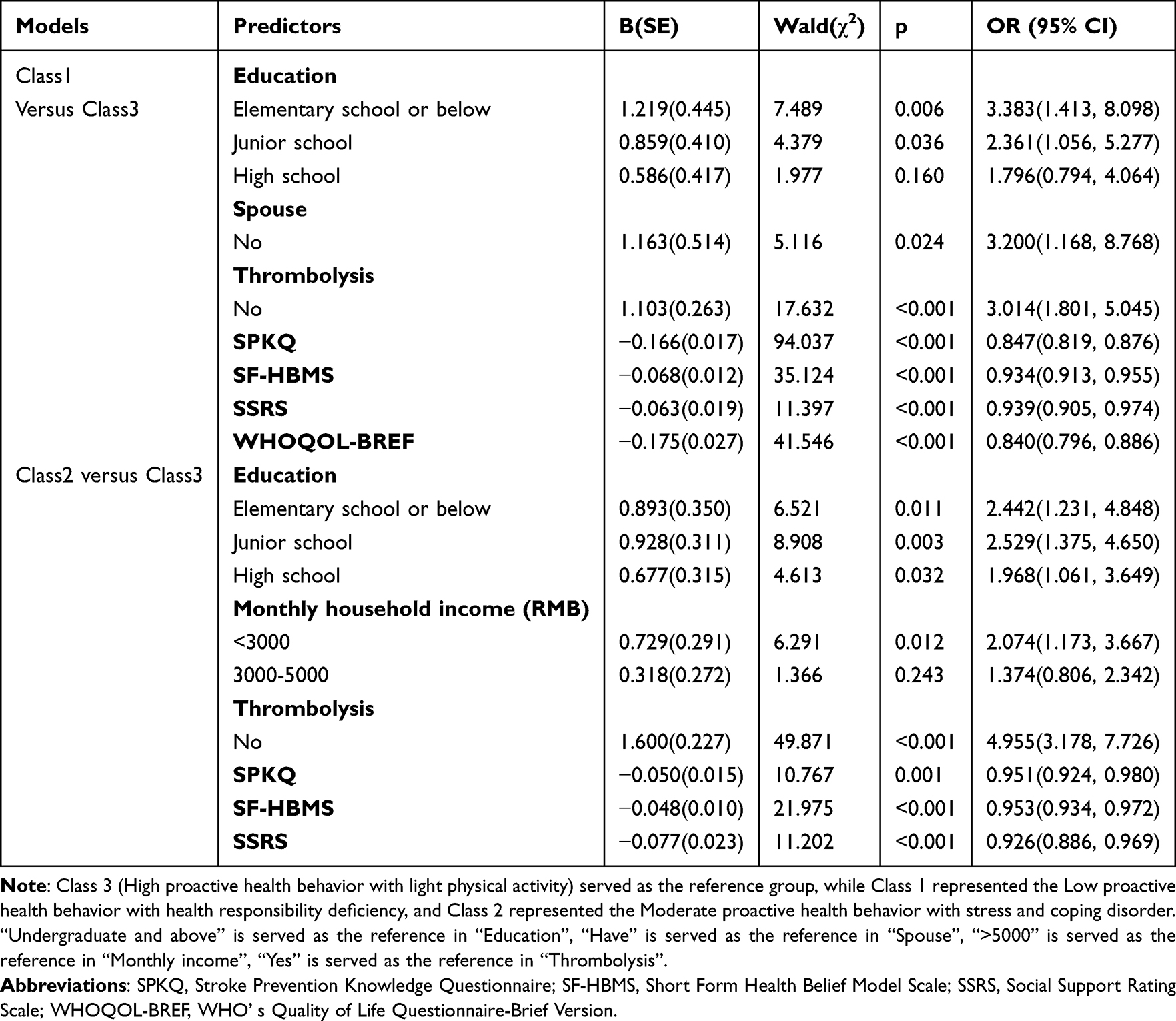 |
Table 3 Prediction of Three Latent Classes of Proactive Health Behavior |
Discussion
To the best of our knowledge, this is the first study based on a multi-center sample of atrial fibrillation-related ischemic stroke patients using latent classes to determine different proactive health behavior clusters and their predictive factors. Latent class analysis was proved to a promising statistical method with an individual-centered perspective, and it can intuitively show the heterogeneity existing in the group and analyze the independent characteristics of each latent class. The predictive factor analysis of this study was based on the COM-B model, which believed that the formation of individual behavior required the joint driving effect of three factors: capability, opportunity and motivation. Capability and opportunity can not only directly promote the generation of behavior, but also indirectly affect health behavior through motivation. The three interact to maximize the formation of individual health behavior. The results of this study provide insights to health managers identify different latent classes of proactive health behaviors in atrial fibrillation-related stroke patients at an early stage. This finding can provide more targeted and tailored interventions for proactive health behavior of this population. Overall, this study provided valuable help and guidance for future research, nursing clinical practice and management in the field of stroke care.
This study is the first to employ a multi-center sample of atrial fibrillation-related ischemic stroke patients to identify different clusters of proactive health behavior and their predictive factors using latent class analysis. This method has demonstrated promise as a statistical approach that adopts an individual-centered perspective, effectively illustrating the heterogeneity within the group and analyzing the distinct characteristics of each latent class. The predictive factor analysis conducted in this study is grounded in the COM-B model, which posits that the development of individual behavior requires the combined influence of three factors: capability, opportunity, and motivation. Capability and opportunity not only directly foster the emergence of behavior but also indirectly influence health behavior through motivation. These three factors interact to enhance the formation of individual health behavior. The findings of this study can assist nursing managers in identifying various latent classes of proactive health behaviors among atrial fibrillation-related stroke patients at an early stage. This insight enables the provision of more targeted and tailored interventions for proactive health behaviors within this population. Overall, this study offers valuable insights and guidance for future nursing research, clinical practice, and management in the field of stroke care.
Key findings from the study identifies three distinct classes of proactive health behavior among stroke patients: Class 1, characterized by low proactive health behavior and health responsibility deficiency; Class 2, marked by moderate proactive health behavior with stress and coping disorders; and Class 3, featuring high proactive health behavior with light physical activity. Notably, Class 1 and Class 2 make up a significant proportion (74.3%), aligning with the findings of Lina Guo.25 The overall level of proactive health behavior among stroke patients is relatively low. Class1, representing 35.6%, shows the lowest score in the dimension of health responsibility. Health behavior is often positively correlated with health responsibility.30 Future research should focus on diverse health education strategies, enhancing patients’ sense of health responsibility, and promoting proactive health behavior changes. Class 2, which constitutes 38.7%, aligns with findings from previous study.25 Individuals, families, and society must extend psychological support and care, helping to strengthen stress management and regulate interpersonal relationships. Class 3, comprising 25.5%, demonstrates high levels of proactive health behavior but lacks sufficient physical activity. Research indicates a positive correlation between physical activity and disease management.31 Therefore, healthcare providers should offer personalized guidance based on each patient’s condition, considering factors such as exercise type, intensity, frequency, and duration. Additionally, patients’ needs should be dynamically monitored to improve their physical activity levels. In conclusion, the proactive health behaviors of stroke patients need significant improvement. Medical professionals should evaluate these distinct characteristics to better manage and enhance proactive health behaviors.
Class 1, characterized by the poorest proactive health behavior and the lowest health responsibility scores, may be affected by the recurrent and prolonged nature of stroke, which can diminish health responsibility and self-efficacy. Patients in this group often have limited education, knowledge, and skills, further reducing their health responsibility and self-efficacy. However, family and social support can play a critical role in improving these patients’ health responsibility and aiding in their recovery.32 Therefore, healthcare providers should prioritize education and awareness on health responsibility, leveraging the patients’ social support networks. Additionally, researchers could design intervention plans based on the COM-B model19 to address these needs more effectively. Class 2 exhibits moderate proactive health behavior, with patients possessing some health knowledge and beliefs, but scoring high in the stress-coping dimension. Economic status often influences their health behavior choices. Additionally, social support can enhance patients’ coping abilities, encouraging them to adopt healthier behaviors. According to stress and coping theory, individuals with greater adaptability to stress tend to have a stronger sense of control and are more likely to use problem-solving strategies. In contrast, those with lower adaptability often feel less in control and may resort to coping strategies that focus on emotional regulation.33 The former group tries to modify their relationship with the environment by actively seeking external resources and promoting healthy behavior through increased social support. In contrast, the latter group focuses on reducing stress perception and is more likely to engage in unhealthy behaviors such as overeating, smoking, and alcohol abuse to cope. Consequently, researchers often use stress management strategies like mindfulness, meditation, and cognitive-behavioral therapy to improve patients’ coping and adaptability. Class 3 has the highest proactive health behavior score, but there are notable deficiencies in physical activity. Factors such as limb dysfunction, weakness, and fear of falling can reduce activity levels among stroke patients. Evidence suggests that physical activity has positive physical and psychosocial effects.34 Regular physical activity has been shown to improve many stroke-related risk factors, including hypertension, obesity, excessive alcohol consumption, and smoking. Therefore, healthcare providers should encourage patients to adjust their lifestyle based on their specific circumstances, and consider interventions using wearable devices and smartphone applications to help increase their physical activity levels.35
Limitations
This study has several limitations that warrant discussion. First, although it is a multi-center study, the participants were recruited from five hospitals in five cities within Henan Province. This geographic limitation may restrict the generalizability of the findings to a national level. A more diverse and nationally representative sample would enhance the external validity of the results and provide more comprehensive insights for future research. Second, the study employed a cross-sectional survey design, which constrains the ability to establish causal relationships and assess longitudinal changes in proactive health behaviors. Future research should consider a longitudinal design to investigate the dynamic interplay between capability, opportunity, motivation, and proactive health behavior, thereby providing a more robust foundation for developing targeted interventions. Finally, there is currently no specific scale designed to measure the proactive health behavior of stroke patients. The scale utilized in this study was selected by researchers based on literature review and previous practical experience. Future research could benefit from the development of a dedicated scale for evaluating proactive health behaviors in stroke patients, grounded in the COM-B model, to assess these behaviors in a more scientific, holistic, and objective manner. Despite these limitations, this study offers valuable insights into the latent classes of proactive health behaviors in atrial fibrillation-related stroke patients. Addressing these limitations in future research can deepen our understanding of proactive health behaviors within this population and inform the development of targeted interventions.
Conclusion
Despite the aforementioned limitations, the results of this study successfully verified the research hypothesis and identified three distinct latent classes of proactive health behaviors among patients with atrial fibrillation-related ischemic stroke. These findings hold significant implications for healthcare professionals, as they enable the early identification of specific subgroups of patients who are more likely to exhibit poor proactive health behaviors. This insight provides a novel perspective for the development of targeted interventions aimed at enhancing proactive health behaviors within these subgroups. Additionally, this study contributes to the promotion of standardized and systematic management of proactive health behaviors in patients with atrial fibrillation-related ischemic stroke, offering valuable practical insights and experiences for healthcare professionals. In conclusion, despite the limitations, this study provides important findings that can inform further research and interventions aimed at improving proactive health behaviors in this patient population.
Funding
This study was funded by the National Natural Science Foundation of China (grant number 72204225), the China Postdoctoral Science Foundation (grant number 2023M733234), the Medical Science and Technology Project of Henan Province (grant number LHGJ20220429), and Chinese Nursing Association Foundation (grant number ZHKY202316).
Disclosure
The authors report no conflicts of interest in this work.
References
1. Zhao HL, Huang Y. Lifetime risk of stroke in the global burden of disease study. N Engl J Med. 2019;380(14):1377–1378. doi:10.1056/NEJMc1900607
2. Feigin VL, Stark BA, Johnson CO, GBD. Stroke collaborators. Global, regional, and national burden of stroke and its risk factors, 1990-2019: a systematic analysis for the global burden of disease study 2019. Lancet Neurol. 2021;20(10):795–820. doi:10.1016/S1474-4422(21)00252-0
3. M Q, L R, W L, et al. Temporal trend and attributable risk factors of stroke burden in China, 1990-2019: an analysis for the global burden of disease study 2019. Lancet Public Health. 2021;6(12). doi:10.1016/S2468-2667(21)00228-0
4. Mukherjee K, Kamal KM. Impact of atrial fibrillation on inpatient cost for ischemic stroke in the USA. Int J Stroke off J Int Stroke Soc. 2019;14(2):159–166. doi:10.1177/1747493018765491
5. Guo L, Zauszniewski JA, Zhang G, et al. Resourcefulness among initial ischemic stroke patients: a longitudinal study of 12 months. Patient Prefer Adher. 2024;18:565–577. doi:10.2147/PPA.S448647
6. Schnabel RB, Yin X, Gona P, et al. 50 year trends in atrial fibrillation prevalence, incidence, risk factors, and mortality in the Framingham heart study: a cohort study. Lancet. 2015;386(9989):154–162. doi:10.1016/S0140-6736(14)61774-8
7. Grond M, Jauss M, Hamann G, et al. Improved detection of silent atrial fibrillation using 72-hour Holter ECG in patients with ischemic stroke: a prospective multicenter cohort study. Stroke. 2013;44(12):3357–3364. doi:10.1161/STROKEAHA.113.001884
8. Lippi G, Sanchis-Gomar F, Cervellin G. Global epidemiology of atrial fibrillation: an increasing epidemic and public health challenge. Inter J Stroke. 2021;16(2):217–221. doi:10.1177/1747493019897870
9. Lloyd-Jones DM, Wang TJ, Leip EP, et al. Lifetime risk for development of atrial fibrillation: the Framingham heart study. Circulation. 2004;110(9):1042–1046. doi:10.1161/01.CIR.0000140263.20897.42
10. Shi S, Tang Y, Zhao Q, et al. Prevalence and risk of atrial fibrillation in China: a national cross-sectional epidemiological study. Lancet Reg Health - West Pac. 2022;23:100439. doi:10.1016/j.lanwpc.2022.100439
11. Patel NJ, Deshmukh A, Pant S, et al. Contemporary trends of hospitalization for atrial fibrillation in the United States, 2000 through 2010: implications for healthcare planning. Circulation. 2014;129(23):2371–2379. doi:10.1161/CIRCULATIONAHA.114.008201
12. Kornej J, Börschel CS, Benjamin EJ, Schnabel RB. Epidemiology of atrial fibrillation in the 21st century: novel methods and new insights. Circ Res. 2020;127(1):4–20. doi:10.1161/CIRCRESAHA.120.316340
13. Lip GYH, Murphy RR, Sahiar F, et al. Risk levels and adverse clinical outcomes among patients with nonvalvular atrial fibrillation receiving oral anticoagulants. JAMA Network Open. 2022;5(8):e2229333. doi:10.1001/jamanetworkopen.2022.29333
14. Lee E, Choi EK, Han KD, et al. Mortality and causes of death in patients with atrial fibrillation: a nationwide population-based study. Novo G, ed. PLoS One. 2018;13(12):e0209687. doi:10.1371/journal.pone.0209687
15. World Health Organization. The WHO cross-national study on health behavior in school-aged children from 28 countries: findings from the United States. J Sch Health. 2000;70(6):227–228. doi:10.1111/j.1746-1561.2000.tb07421.x
16. He J, Wang T. The community proactive health management model based on the grounded theory: the case of Beijing, China. Heliyon. 2023;9(4):e14992. doi:10.1016/j.heliyon.2023.e14992
17. Maron DJ, Mancini GBJ, Hartigan PM, et al. Healthy behavior, risk factor control, and survival in the courage trial. J Am Coll Cardiol. 2018;72(19):2297–2305. doi:10.1016/j.jacc.2018.08.2163
18. Zhang Y, Li J, Hu Y, et al. Proactive health behavior in middle-aged and older adult females with urinary incontinence: a grounded theory study. Neurourol Urodyn. 2024;43(8):2005–2016. doi:10.1002/nau.25526
19. Zhang M, Guo L, Namassevayam G, et al. Factors associated with health behaviours among stroke survivors: a mixed-methods study using COM-B model. J Clin Nurs. 2024;33(6):2138–2152. doi:10.1111/jocn.17103
20. Michie S, van Stralen MM and West R. The behaviour change wheel: a new method for characterising and designing behaviour change interventions. Implementation Sci. 2011;6(1). doi:10.1186/1748-5908-6-42
21. Keyworth C, Epton T, Goldthorpe J, Calam R, Armitage CJ. Acceptability, reliability, and validity of a brief measure of capabilities, opportunities, and motivations (“COM-B”). Br J Health Psychol. 2020;25(3):474–501. doi:10.1111/bjhp.12417
22. Butcher NJ, Monsour A, Mew EJ, et al. Guidelines for reporting outcomes in trial reports: the consort-outcomes 2022 extension. JAMA. 2022;328(22):2252–2264. doi:10.1001/jama.2022.21022
23. Wan LH, Zhao J, Zhang XP, et al. Stroke prevention knowledge and prestroke health behaviors among hypertensive stroke patients in mainland China. J Cardiovasc Nurs. 2014;29(2):E1–9. doi:10.1097/JCN.0b013e31827f0ab5
24. Guo L, Liu Y, Zhu Y, Wei M. Identification of health behaviour clusters among people at high risk of stroke: a latent class profile analysis. J Adv Nurs. 2020;76(11):3039–3047. doi:10.1111/jan.14523
25. Tang X, Li L, Yao K, et al. Association between social support and mutual-support needs among the rural adults in China: a cross-sectional study. Front Public Health. 2023;11:1171046. doi:10.3389/fpubh.2023.1171046
26. Skevington SM, Lotfy M, O’Connell KA. WHOQOL group. The world health organization’s WHOQOL-BREF quality of life assessment: psychometric properties and results of the international field trial. A report from the WHOQOL group. Qual Life Res Int J Qual Life Asp Treat Care Rehabil. 2004;13(2):299–310. doi:10.1023/B:QURE.0000018486.91360.00
27. Wan L-H, You L-M, Chen S-X, et al. The effectiveness of a comprehensive reminder system in the secondary prevention of hypertensive ischaemic stroke: randomized controlled trial protocol. J Adv Nurs. 2016;72(12):3195–3206. doi:10.1111/jan.13095
28. Walker SN, Sechrist KR, Pender NJ. The health-promoting lifestyle profile: development and psychometric characteristics. Nurs Res. 1987;36(2):76–81. doi:10.1097/00006199-198703000-00002
29. Zhang XP, Pan JH, Wan LH, et al. Factors influencing health behaviour, blood pressure control, and disability in hypertensive ischaemic stroke patients after a comprehensive reminder intervention. J Adv Nurs. 2020;76(6):1384–1393. doi:10.1111/jan.14340
30. Zadworna M. Healthy aging and the university of the third age – health behavior and subjective health outcomes in older adults. Arch Gerontol Geriatr. 2020;90:104126. doi:10.1016/j.archger.2020.104126
31. Edwards JJ, Deenmamode AHP, Griffiths M, et al. Exercise training and resting blood pressure: a large-scale pairwise and network meta-analysis of randomised controlled trials. Br J Sports Med. 2023;57(20):1317–1326. doi:10.1136/bjsports-2022-106503
32. Nelson MLA, MacEachern E, Prvu Bettger J, et al. Exploring the inclusion of person-centered care domains in stroke transitions of care interventions: a scientific statement from the American heart association. Stroke. 2024;55(6):e169–e181. doi:10.1161/STR.0000000000000462
33. Mengelkoch S, Gassen J, Lev-Ari S, et al. Multi-omics in stress and health research: study designs that will drive the field forward. Stress Amst Neth. 2024;27(1):2321610. doi:10.1080/10253890.2024.2321610
34. Basu T, Sehar U, Malhotra K, et al. Healthy brain aging and delayed dementia in Texas rural elderly. Ageing Res Rev. 2023;91:102047. doi:10.1016/j.arr.2023.102047
35. Akinosun AS, Polson R, Diaz-Skeete Y, et al. Digital technology interventions for risk factor modification in patients with cardiovascular disease: systematic review and meta-analysis. JMIR MHealth UHealth. 2021;9(3):e21061. doi:10.2196/21061
 © 2025 The Author(s). This work is published and licensed by Dove Medical Press Limited. The
full terms of this license are available at https://www.dovepress.com/terms
and incorporate the Creative Commons Attribution
- Non Commercial (unported, 4.0) License.
By accessing the work you hereby accept the Terms. Non-commercial uses of the work are permitted
without any further permission from Dove Medical Press Limited, provided the work is properly
attributed. For permission for commercial use of this work, please see paragraphs 4.2 and 5 of our Terms.
© 2025 The Author(s). This work is published and licensed by Dove Medical Press Limited. The
full terms of this license are available at https://www.dovepress.com/terms
and incorporate the Creative Commons Attribution
- Non Commercial (unported, 4.0) License.
By accessing the work you hereby accept the Terms. Non-commercial uses of the work are permitted
without any further permission from Dove Medical Press Limited, provided the work is properly
attributed. For permission for commercial use of this work, please see paragraphs 4.2 and 5 of our Terms.