
Back to Journals » Psychology Research and Behavior Management » Volume 19
How Online Cross-Cutting and Like-Minded Interactions Relate with Emerging Adults’ Prosocial Tendencies: Cognitive and Affective Empathy as Mediators
Authors Li W, Guo TY, Wu H, Hao Y
Received 11 February 2026
Accepted for publication 22 June 2026
Published 16 July 2026 Volume 2026:19 602902
DOI https://doi.org/10.2147/PRBM.S602902
Checked for plagiarism Yes
Review by Single anonymous peer review
Peer reviewer comments 3
Editor who approved publication: Dr Igor Elman
Wu Li, Tian You Guo, Haoyu Wu, Ye Hao
School of Media and Communication, Shanghai Jiao Tong University, Shanghai, People’s Republic of China
Correspondence: Ye Hao, School of Media and Communication, Shanghai Jiao Tong University, 800 Dongchuan Road, Minhang District, Shanghai, People’s Republic of China, Email [email protected]
Purpose: In the digital era, online social interactions (OSIs) have become increasingly prevalent, making it essential to explore their impacts on human behavior. The study intended to examine the associations between two types of OSIs, namely online cross-cutting and like-minded interactions, with individuals’ prosocial tendencies, as well as the underlying mechanisms of these associations by introducing cognitive and affective empathy as potential mediators and gender as a moderator.
Methods: An online questionnaire was administered through Wenjuanxing, a widely used Chinese survey platform, and a total of 1142 valid responses were collected from emerging adults (gender: 54.0% females, 46.0% males; age: 18– 25 years old, M = 21.15, SD = 1.89). We employed the structural model analysis to investigate the relationships among the variables in the conceptual model, as well as the bootstrap method to test for the mediating effects of cognitive and affective empathy. Also, multigroup analyses were conducted to explore gender differences in the relationships among the study variables.
Results: Our results indicated that online cross-cutting interactions were negatively related with prosocial tendencies, despite the positive mediating effect of cognitive empathy (B = 0.007, SE = 0.005, 95% CI = [0.001, 0.021], κ2 = 0.014). Conversely, online like-minded interactions were positively associated with prosocial tendencies through the mediating roles of both cognitive and affective empathy (B = 0.013, SE = 0.008, 95% CI = [0.001, 0.032], κ2 = 0.027; B = 0.126, SE = 0.035, 95% CI = [0.060, 0.194], κ2 = 0.357). Additionally, the results highlighted the moderating effects of gender. In particular, online cross-cutting interactions were positively associated with cognitive empathy among males, whereas this association was not significant among females.
Conclusion: Based on our findings, we identified cognitive and affective empathy as mediators for the relationships between online cross-cutting/like-minded interactions and prosocial tendencies, along with the moderating effects of gender. Our findings, from a theoretical perspective, provide a more comprehensive and nuanced understanding of whether and how OSIs relate to prosocial tendencies, while offering valuable insights, on a practical front, for designing online platforms aimed at fostering prosocial tendencies among emerging adults.
Keywords: online social interactions, cross-cutting interactions, like-minded interactions, empathy, prosocial tendencies, emerging adults
Introduction
Face-to-face social interactions have long been identified as a key component in the cognitive and emotional developments of individuals from an early age.1 However, in today’s digital era, these interactions have increasingly been replaced by online social interactions (OSIs), which are conducted through digital platforms, especially among young people.2 In fact, it has been stated by the Social Information Processing Theory and Hyperpersonal Model that online communication may lead to outcomes transcending those of face-to-face communication.3 Since the rise of the internet in the early 2000s, studies have shown that a significant number of young people use online networks to interact with acquaintances, with 82% reporting that they engage with others they rarely meet offline.4 Since then, OSIs have come to constitute an evergrowing portion of social interactions, with statistics revealing that over 80% of emerging adults engage in social media use on a daily basis.5 Moreover, it has been estimated that the activity of daily social media use, as of late, saw an increase of approximately 30% due to the rising presence of social media platforms in facilitating online interactions.5
With the increasing prevalence of OSIs among young users, scholars have devoted growing attention to exploring their impacts on those engaging in such activities. For instance, it has been found that OSIs are capable of bolstering the social-emotional competence of college students through the indirect pathway of bonding social capital.6 Moreover, past research has shown that explicit social interaction in online experience sharing is a necessary component for inducing social bonding and that OSIs play a vital role in shaping the establishment of community cohesion for urban inhabitants.7,8 Additionally, a growing body of research suggests that OSIs generally exert positive influence on participating individuals by enhancing their well-beings.9–11 However, to the best of the authors’ knowledge, the impact of OSIs on individuals’ prosociality remains largely unexamined despite the rapid shift from offline social interactions to OSIs.
Prosociality reflects a positive orientation towards others and a willingness to contribute to the welfare of the broader community.12 Its significance lies in the benefits it brings not only to the receivers but also to the individuals who exhibit such behavior. Developmental psychology has demonstrated that adults engaging in prosocial behavior are linked to experiencing various positive psychological and social benefits, such as stronger self-esteem13 and alleviated life stress.14 Abundant research has highlighted the crucial role of face-to-face social interactions in shaping individuals’ prosociality.15–17 However, the prosocial effect observed in such interactions cannot be directly generalized to OSIs due to fundamental differences in their natures. For instance, compared with face-to-face social interactions, OSIs reduce constraints related to time and space while simultaneously lacking the rich social cues present in their offline counterparts.18
Among limited existing literature regarding the prosocial effect of OSIs, Li et al19 conducted a pioneering investigation among Chinese adolescents to elucidate the associations between OSIs and prosociality. Grounded in the Social Information Processing Theory and Hyperpersonal Model, which suggest that online communication can approach or even exceed face-to-face interactions given sufficient interaction time,20 the authors explored and confirmed that adolescents’ interactions on social media could positively predict their prosocial tendencies. However, several limitations warrant consideration. First, OSIs were measured by the frequency of liking, commenting, and private messaging, without differentiating interaction partners. There is evidence suggesting that individuals differ in their behavioral responses based on their congruency in views with those they interact with.21 Second, the authors found that OSIs did not affect prosocial tendencies through empathy, as opposed to existing findings. This discrepancy was attributed to the overlooked multidimensional nature of empathy, which encompasses both intellectual understanding and emotional sharing.22 Third, although age and gender are potential moderators of the relationship between OSIs and prosocial tendencies,23 only age was examined, leaving potential gender differences unexplored.
To address these gaps, the current study built upon Li et al19 in three ways. First, it classified OSIs into two categories: online cross-cutting interactions and online like-minded interactions. This was done to validate that two different types of OSIs can predict prosocial tendencies from varying perspectives. Second, the study introduced cognitive empathy and affective empathy as mediating variables to explain how OSIs are related with prosocial tendencies, aiming to provide an in-depth understanding of the role that empathy plays in this process. Third, the study spotlighted the division between males and females when developing prosocial tendencies through differential OSIs and empathetic pathways, thereby affirming the moderating role of gender. In addition, the study chose emerging adults to represent its age group in hopes of becoming a spiritual successor to the previous study conducted by Li et al,19 which investigated adolescents.
Literature Review
Online Cross-Cutting/Like-Minded Interactions and Prosocial Tendencies
One of the limitations to Li et al19 is the overly broad conceptual definition of OSIs adopted in their research. To better understand OSIs’ relations to prosocial tendencies, the current study considers this concept in a more nuanced manner. In contrast to face-to-face interactions, OSIs illustrate a preference for digital platforms as network sites for relational interchanges, resulting in the frequent employment of social media platforms that can “generate opportunities to talk with others who think alike as well as with those who think differently”.24 Based on the nature of the figure that an individual is engaging with, we categorized OSIs into two types: online cross-cutting interactions and online like-minded interactions. The former refers to individuals’ online interactions with those who have differing views, beliefs or interests, while the latter refers to their online communication with those who share similar views, beliefs or interests.25
The terms “cross-cutting” and “like-minded” originate from the political spectrum, respectively, referring to political dissent and political concurrence.26 A vast amount of research has been conducted in exploring the cross-cutting and like-minded aspects of political discussion. For instance, one previous study found that exposure to cross-cutting content, both online and offline, led to stronger political participation.27 On the other hand, the effects of both online and offline like-minded discussions on political participation appear to be insignificant.28 Based on these findings, a common trend becomes apparent in that cross-cutting interactions allow for more active individuals due to the discourse between politically divergent parties. Meanwhile, like-minded interactions seem to result in more inactive individuals who are enclosed within a politically convergent environment that offers little ideological friction.
The dichotomy between cross-cutting and like-minded discussions, despite first emerging from the realm of political communication, can be applied to different forms of social interaction in more general topics. For instance, cross-cutting exposure has been generalized as a means for individuals to envision their emotional predicaments when placed in others’ situations.29 In fact, the dichotomy of OSIs, as represented by online cross-cutting and like-minded interactions, proves particularly useful in the social media context.30,31 Here, the growing divisions between online opinions of users and the impulse for them to find those with similar perspectives have fostered the need for differentiations to be made between various types of OSIs. On the one hand, social media platforms function as a nexus, drawing together individuals from an array of geographical regions and socio-cultural backgrounds.32 This inherently facilitates the potential for cross-cutting interactions, fostering an environment conducive to the exchange of disparate perspectives and ideas. On the other hand, most social media platforms extensively utilize algorithmic recommendation mechanisms designed to identify and suggest potential connections to users based on shared interests and viewpoints.33 These mechanisms include but are not limited to recommendation feeds and content moderation.33 As a result, like-minded interactions tend to be amplified, as users are often directed towards individuals who share similar beliefs, preferences, and values. In light of the above discussions, this study raises the first research question to investigate the associations of online cross-cutting and like-minded interactions with prosocial tendencies:
RQ1: Do online cross-cutting/like-minded interactions relate with prosocial tendencies?
Mediating Effects of Cognitive Empathy and Affective Empathy
Another objective of this study is to examine potential mediators that could explain the relationship between online cross-cutting/like-minded interactions and prosocial tendencies, if such a relationship exists. Empathy, defined as the ability to understand and share the feelings of others,34 was proposed as a major contender for the mediator position. According to Hoffman’s theory of empathy-based moral development and Batson’s empathy-altruism hypothesis, empathy serves as a significant catalyst for prosocial behaviors and moral development.35,36 However, Li et al19 found that empathy did not mediate the relationship between OSIs and prosocial tendencies. We speculated that the non-significance of empathy as a mediator might be due to its lack of division into more exquisite subconstructs or components. Therefore, it is relevant for the current study to explore the multidimensional nature of empathy, thereby illuminating its potential mediating presence for the relationships between OSIs and prosocial tendencies.
Indeed, empathy is not a unidimensional construct by nature and is often divided into cognitive empathy and affective empathy.37 Cognitive empathy, also known as “perspective taking”, refers to individuals’ ability to identify and understand the emotions and perspectives of others. This involves perceiving from another person’s perspective and thinking about how this individual might be feeling. In contrast, affective empathy, also known as “emotional empathy” or “empathic concern”, refers to the ability to share or emotionally respond to another person’s feelings. This goes beyond merely understanding others’ perspectives and emotions—it involves actually experiencing what they are feeling.38 In summary, cognitive empathy denotes the empathetic route of being able to comprehend others’ emotions, while affective empathy represents the empathetic route of being able to experience others’ emotions.39
The division of empathy into cognitive and affective empathy is important as it helps us understand the different ways in which people can relate to the experiences of others. This distinction becomes particularly significant when simultaneously exploring the effects of online cross-cutting and like-minded interactions on prosocial tendencies. According to the normative theory, a heterogeneous environment, where cross-cutting interactions occur due to a divergence of opinions, enables individuals to face opposing arguments, thereby more likely fostering cognitive empathy rather than affective empathy for others.40 However, when interacting with like-minded people on social media, both cognitive and affective empathy can be nurtured. Sharing common viewpoints or experiences with others can make it easier to understand their perspectives, which is the essence of cognitive empathy. Furthermore, shared viewpoints or experiences can also lead to shared emotional responses, allowing individuals to develop their affective empathy, or the ability to more readily feel what the other person is feeling.41 Based on the above discussions, the following research question regarding the mediation effects of cognitive and affective empathy is proposed:
RQ2: How do cognitive and affective empathy mediate the relationships between online cross-cutting/like-minded interactions and prosocial tendencies?
Moderating Role of Gender
The final objective of this study is to highlight the role of gender as a moderator influencing the various relationships that have been proposed. Research has found that prosociality and empathy differ across genders. An early meta-analysis conducted by Eagly and Crowley42 investigated gender differences in helping behavior, revealing that females are more likely than males to engage in such behavior. Another meta-analysis also examined gender differences in empathy and prosocial behavior across various age groups, finding that females tend to exhibit higher levels of empathy and engage in more prosocial behavior than males.43 In addition, the distinction between cognitive empathy and affective empathy can be represented by the gender differences between males and females. For instance, Chen et al44 found that females tend to demonstrate more affective empathy than males, while the display of cognitive empathy between the two genders is more balanced. The division between men and women in terms of empathetic routes is further emphasized by the findings of a female preference for affective empathy and a male leaning towards cognitive empathy.45
These gender-based differences in empathy can influence individuals’ engagement in prosocial behaviors as well as their responses to online cross-cutting and like-minded interactions. In a recent study by Wu et al,46 the moderating effect of gender on the relationship between adolescent empathy and cooperation propensity, a form of prosocial behavior, was explored. The study revealed that the positive association between adolescent empathy and cooperation propensity is more pronounced among males than among females. While there is a lack of direct empirical research on the moderating effect of gender in the relationship between online cross-cutting/like-minded interactions and empathy, insights can be drawn from gender socialization theories. According to these theories, gender socialization plays a crucial role in shaping individuals’ empathic development.47 Females are often socialized to be more nurturing and empathic, which may affect how they respond to others’ emotions in a scenario of cross-cutting versus like-minded online interactions. Males, on the other hand, may approach empathy and social interactions differently based on societal expectations and norms. Therefore, the following research question is proposed to integrate gender differences into our research:
RQ3: How do gender differences moderate the relationships between online cross-cutting/like-minded interactions and prosocial tendencies, as mediated by cognitive and affective empathy?
Method
Participant and Procedures
The study’s participants are comprised of emerging adults, aged between 18 to 25 years old.48 The rationale behind selecting this age group was twofold. First, our aim is to investigate the potential replication of Li et al19 within a new demographic segment that shares resemblances with the previous sample. Consequently, we deemed emerging adults as a suitable cohort demonstrating a seamless transition from the adolescent group in the prior study. Furthermore, akin to adolescents, emerging adults find themselves at a pivotal juncture characterized by substantial shifts in identities, responsibilities, and decision-making processes.48 In other words, the stage of emerging adulthood for individuals is characterized by instability, as a result of their explorations in newfound identities and responsibilities. As such, these individuals become vulnerable to influences, particularly in the media landscape where they spend a vast amount of time interacting with others. Given the cohort’s susceptibility to external influences in their media environments, the significance of OSIs in shaping their values and worldviews cannot be overlooked. Hence, understanding the developmental trajectory of their perceptions and behaviors assumes critical importance in fostering societal progress and unity.49
The study was authorized by the IRB at the institution of the authors. A pilot study in September 2024 was performed among 86 emerging adults to test the reliability and validity of the instruments. Each scale was found to be a unidimensional construct with a Cronbach’s alpha value above 0.70. Subsequently, the main online survey was conducted in October 2024 among emerging adults and lasted about four weeks. The survey was distributed via the online platform of Wenjuanxing, which specializes in recruiting survey subjects for research studies in China. The survey opened with an initial question of “Have you ever used Weibo in the past six months” to determine suitable subjects for the study. Following Li et al,19 the Chinese social media platform of Weibo was chosen as the principal site for investigation. Weibo stands out as one of the most widely used social media websites in China, particularly among young people. Its function as an open domain enables users to engage in online cross-cutting/like-minded interactions with any other members, including both associates and strangers.50
We used G*Power to calculate the required sample size. Employing linear regression as the statistical test, with a small effect size (f2 = 0.02), an α level of 0.05, a power of 0.95, and seven predictors (two independent variables, two mediating variables, and three control variables), the analysis indicated that 1099 participants would be needed. Considering the response rate and the potential invalid responses that do not meet the quality requirements, we aimed to collect approximately 1400 to 1500 questionnaires. To boost response rate, participants had a 20% chance to win a 10 RMB incentive upon survey completion.
Over a period of approximately four weeks, we distributed the online questionnaire via Wenjuanxing across a number of universities in different regions of China, and a total of 1382 participants responded to the survey. We removed cases with response times less than 120 seconds or where almost all the responses were identical, thereby certifying the quality of the data. In addition, the cases outside the 18–25 age range were also discarded. As a result, 1142 cases were retained for data analysis. Among the valid samples, there were more females (54.0%) than males (46.0%). The mean of age was 21.15 (SD = 1.89). Regarding the major, the majority studied social science and humanities (55.8%), with the remainder in science and engineering (44.2%). In addition, the participants, except for four respondents with IP addresses outside mainland China, are from 29 provinces in China. Among them, 532 (46.8%) are from the East part of China, 377 (33.1%) are from the Central region, and 229 (20.1%) are from the West part of China. This geographic distribution of our samples aligns with the results released by the Seventh Chinese National Population Census (https://www.stats.gov.cn/sj/zxfb/202302/t20230203_1901080.html).
Measures
Online Cross-Cutting and Like-Minded Interactions
Drawing on Heatherly et al24 and Lin & Kim,51 participants were asked to self-report on a 5-point Likert-type scale (never = 1, always = 5) their frequency of interactions with various individuals on Weibo. Specifically, three items, including “people with different opinions”, “people with different thinking pattern”, and “people with a different set of values”, were selected to measure online cross-cutting interactions (M = 2.199, SD = 1.174, α = 0.938). Another three items, including “people with similar opinions”, “people with similar thinking pattern”, and “people with a similar set of values”, were chosen to gauge online like-minded interactions (M = 2.813, SD = 1.251, α = 0.963).
Cognitive and Affective Empathy
Davis52 developed the Interpersonal Reactivity Index (IRI) to measure an individual’s empathy. Of the four IRI dimensions, perspective taking and empathic concern best embody one’s empathy,53 reflecting its cognitive and affective components, respectively.54 Therefore, these two subscales were used to measure cognitive and affective empathy in this study. Participants rated their agreement with statements on a 7-point Likert-type scale (ranging from 1 = strongly disagree to 7 = strongly agree). The sample items for perspective taking included “I try to look at everybody’s side of a disagreement before I make a decision” and “When I’m upset at someone, I usually try to put myself in his shoes for a while” (M = 4.482, SD = 1.370, α = 0.923). The sample items for empathic concern were “I would describe myself as a pretty soft-hearted person” and “I often have tender, concerned feelings for people less fortunate than me” (M = 5.114, SD = 1.080, α = 0.886).
Prosocial Tendencies
In reference to Carlo & Randall55 and Zhan et al,56 a total of 8 items were employed to measure prosocial tendencies. Respondents evaluated how much they related to each item on a 7-point Likert-type scale (ranging from 1 = “very unlike me” to 7 = “very much like me”). Examples of such included “I try to get close to and take care of those in need” and “I will help those in need in voluntary activities” (M = 5.197, SD = 1.051, α = 0.927).
Control Variables
Numerous prior studies suggest that both gender and age are associated with empathy and prosocial tendencies;57,58 therefore, these two demographic variables are treated as control variables in our study. Online exposure to prosocial content is also controlled for due to its potential impact on empathy and prosocial tendencies.19 We asked participants to rate on a 5-point Likert-type scale (never = 1, always = 5) their frequency of exposure to three kinds of prosocial content (e.g., friendly content, supportive content, and uplifting content) on Weibo (M = 3448, SD = 0.854, α = 0.888). The full items of the scales used in our study are provided in Appendix I.
Data Analysis
To assess the potential for common method bias (CMB), we utilized the unmeasured latent method factor technique in our research. Subsequently, structure equation modeling (SEM) was adopted to validate the conceptual model. Following the two-step procedure recommended by Anderson and Gerbing,59 we initially conducted a confirmatory factor analysis (CFA) to assess the reliability and validity of the measurement model. This was followed by structural model analysis to examine the relationships among all studied variables. In addition, we resorted to the bootstrap method to further identify the mediating effects of empathy on the links between online cross-cutting/like-minded interactions and prosocial tendencies. Finally, a multigroup analysis was performed to identify gender differences in the relationships specified by our conceptual model. All statistical analyses were completed using SPSS and AMOS.
Results
Common Method Bias
Survey-based studies that collect data from the same source may suffer from CMB.60 To assess the potential for CMB, we utilized the unmeasured latent method factor technique.61 Specifically, using AMOS, we performed a CFA where we specified a latent method factor in addition to the factors representing the key constructs in this study. The non-significant differences in goodness-of-fit indices between the models with and without the latent method factor imply that the inclusion of the latent method factor did not significantly improve the model fit (ΔTLI = 0.011, ΔCFI = 0.011, and ΔRMSEA = −0.009), indicating that CMB is not a major concern in our data.
Measurement Model
In the CFA, each construct was allowed to co-vary freely. To verify an acceptable measurement model, a series of fit indices were estimated. According to Hu & Bentler62 and Schreiber,63 some of the key fit indices in our study did not reach the threshold. The modification indices suggested a correlation between the residual errors of two items measuring cognitive empathy and the residual errors of another two items measuring affective empathy. Therefore, the residual errors of the first two aforementioned items were allowed to covary, and so were those of the second two items. Adding a double arrow linking these two pairs of residual errors reduced the chi-square (χ2) value by 48.035, and 40.714, respectively. After the modification, all the fit indices were acceptable (χ2/df = 3.999, GFI = 0.926, NFI = 0.958, CFI = 0.968, RMSEA = 0.051, 90% CI = [0.048, 0.055]).
Additionally, the measurement model was also examined to assess the reliability, convergent validity, and discriminant validity of the constructs.64 As illustrated in Table 1, the item loadings of each construct have exceeded 0.6, and the composite reliability is greater than 0.8, indicating good internal consistency and reliability of the items. Furthermore, the average variance extracted (AVE) for each construct is greater than 0.6, demonstrating adequate convergent validity of the scale. Additionally, Table 2 illustrates that the square roots of the AVE values (represented by the diagonal values) surpass the inter-construct correlations (off-diagonal values), thereby confirming the discriminant validity of the scale.
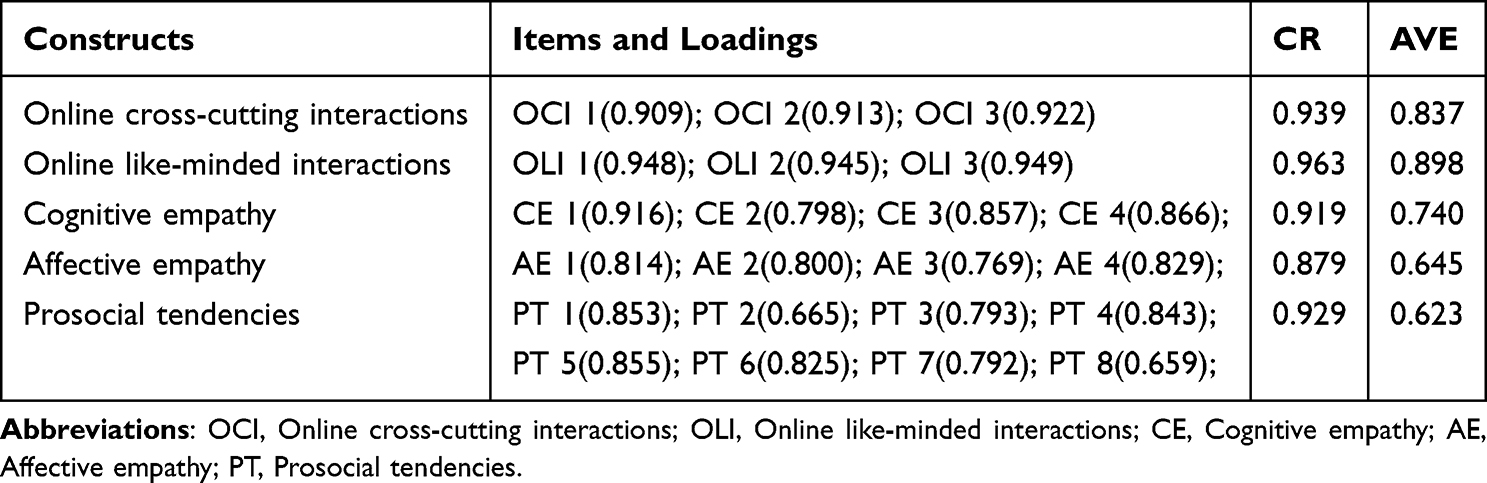 |
Table 1 Confirmatory Factor Analysis Results of Key Constructs |
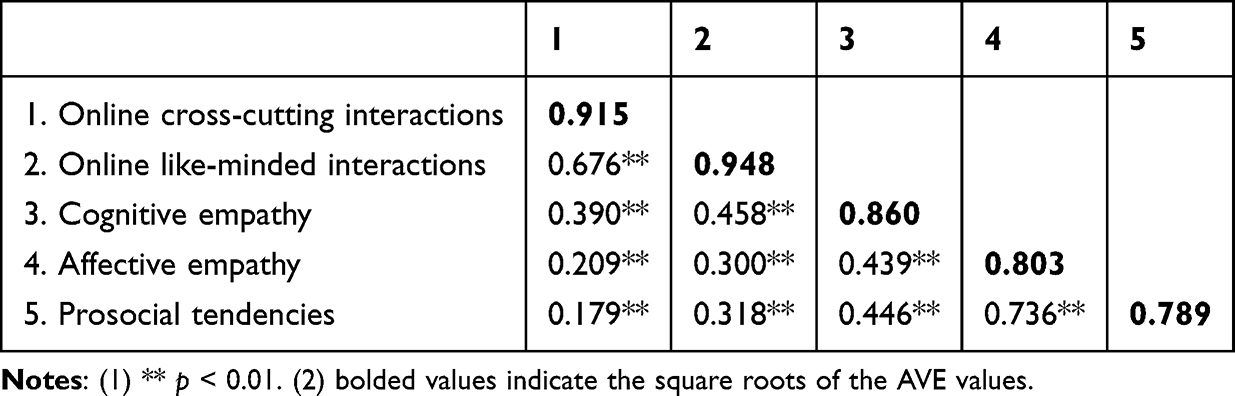 |
Table 2 Discriminant Validity for Measurement Model |
Structural Model
In SEM, we included online exposure to prosocial content, gender, and age as control variables to obtain more robust results. The model showed acceptable fit to the data (χ2/df = 3.827, GFI = 0.926, NFI = 0.955, CFI = 0.966, RMSEA = 0.050, 90% CI = [0.047, 0.053]). Online exposure to prosocial content was found to be positively related with cognitive empathy (β = 0.293, p < 0.001, f2 = 0.09), affective empathy (β = 0.283, p < 0.001, f2 = 0.07), and prosocial tendencies (β = 0.163, p < 0.001, f2 = 0.03). Neither gender nor age was significantly associated with the above three variables. Then, we examined each path coefficient when controlling for these covariates.
As depicted in Figure 1, online cross-cutting interactions were positively related with cognitive empathy (β = 0.121, p = 0.004, f2 = 0.01), not significantly related with affective empathy (β = −0.032, p = 0.504, f2 < 0.01), and negatively associated with prosocial tendencies (β = −0.111, p < 0.001, f2 = 0.01). In contrast, online like-minded interactions were positively related with cognitive empathy (β = 0.256, p < 0.001, f2 = 0.03) and affective empathy (β = 0.210, p < 0.001, f2 = 0.02), while not significantly associated with prosocial tendencies (β = 0.062, p = 0.060, f2 < 0.01). Both cognitive empathy and affective empathy showed positive associations with prosocial tendencies (β = 0.063, p = 0.026, f2 = 0.01; β = 0.731, p < 0.001, f2 = 1.22). These four constructs, along with control variables, accounted for 70% of the variance in prosocial tendencies (R2 = 0.70).
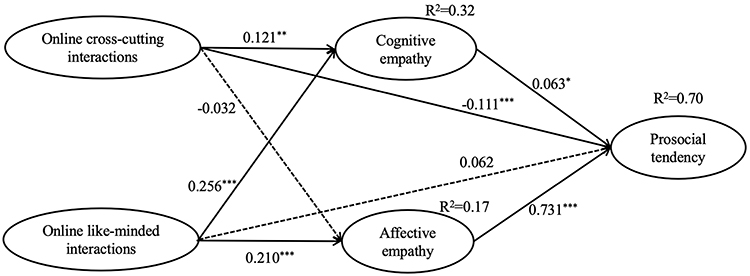 |
Figure 1 Conceptual model with standardized path coefficient. Notes: *p < 0.05; **p < 0.01; ***p < 0.001. |
Mediation Analysis
To probe the potential mediation effect of empathy between online cross-cutting/like-minded interactions and prosocial tendencies, we utilized the bootstrap confidence interval recommended by Preacher and Hayes,65 setting a 95% bias-corrected confidence interval based on 5000 bootstrap samples. A confidence interval for the indirect effect that does not straddle zero provides statistical support for mediation effects between the independent and dependent variables.
First, we checked the mediation effect of empathy in the relationship between online cross-cutting interactions and prosocial tendencies in SEM model. As displayed in Table 3, the results indicated that cognitive empathy mediated the relationship between online cross-cutting interactions and prosocial tendencies (B = 0.007, SE = 0.005, 95% CI = [0.001, 0.021], κ2 = 0.014). However, affective empathy did not show a mediating effect (B = −0.021, SE = 0.034, 95% CI = [−0.087, 0.045], κ2 = 0.060). Additionally, the direct effect was negatively significant (B = −0.101, SE = 0.034, 95% CI = [−0.167, −0.034]), and the total effect also demonstrated a significantly negative relationship (B = −0.115, SE = 0.043, 95% CI = [−0.198, −0.031]).
Next, we explored the mediation effect of empathy in the relationship between online like-minded interactions and prosocial tendencies in SEM model, as shown in Table 3. The results indicated that online like-minded interactions related to prosocial tendencies via the mediation effects of both cognitive empathy (B = 0.013, SE = 0.008, 95% CI = [0.001, 0.032], κ2 = 0.027) and affective empathy (estimate = 0.126, SE = 0.035, 95% CI = [0.060, 0.194], κ2 = 0.357). Furthermore, the indirect effect through affective empathy was significantly larger than that through cognitive empathy (B = −0.113, SE = 0.036, 95% CI = [−0.184, −0.044]). In addition, the direct effect was not significant (B = 0.051, SE = 0.034, 95% CI = [−0.017, 0.117]), while the total effect was significantly positive (B = 0.191, SE = 0.040, 95% CI = [0.111, 0.268]).
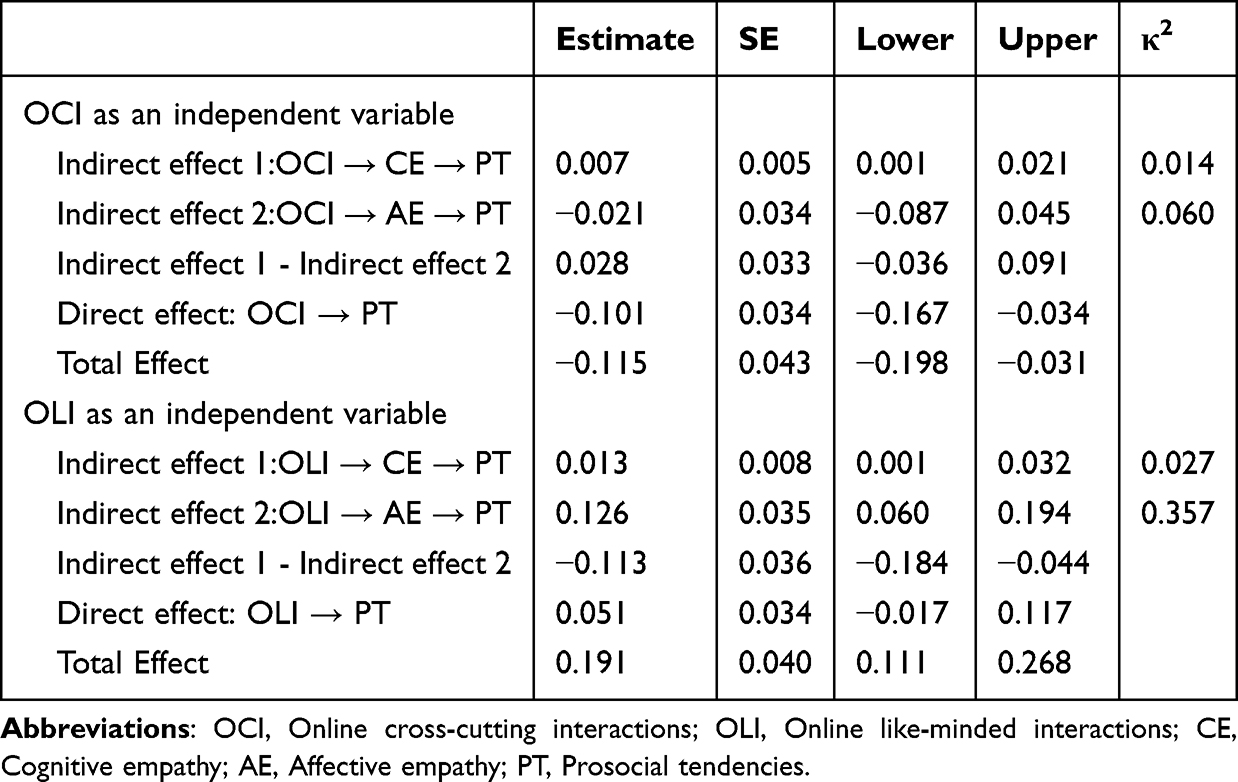 |
Table 3 Indices of Mediation Test with 95% Bootstrap Confidence Intervals |
Multigroup Analysis
Before proceeding with multigroup analyses, we conducted tests for measurement invariance in four steps: configural invariance, metric invariance (weak factorial), scalar invariance (strong factorial), and residual invariance (strict or invariant uniqueness).66 The results are presented in Table 4. Given that the χ2 statistic is often criticized for its sensitivity to sample size, we focused on the differences in ΔCFI and ΔRMSEA. Values equal to or smaller than 0.01 indicate the invariance of model.67 Based on the indices of ΔCFI and ΔRMSEA, we conclude that measurement invariance has been confirmed across gender groups at all levels.
 |
Table 4 Tests for Measurement Invariance Across Gender Groups |
Subsequently, we proceeded with a multigroup analysis to explore potential discrepancies in path coefficients across gender groups. Employing a threshold of absolute values of the critical ratios for differences between parameters surpassing 1.96,68 we were able to identify significant differences in the paths from online cross-cutting interactions to cognitive empathy (CR = −3.138), from online cross-cutting interactions to affective empathy (CR = −2.054), and from cognitive empathy to prosocial tendencies (CR = −2.106).
As shown in Table 5, for the female group, online cross-cutting interactions did not show a significant relationship with cognitive empathy (β = −0.012, p = 0.811, f2 < 0.01), while it was negatively related to affective empathy (β = −0.123, p = 0.027, f2 = 0.01). In contrast, for the male group, online cross-cutting interactions were positively associated with cognitive empathy (β = 0.245, p < 0.001, f2 = 0.03), whereas it did not show a significant relationship with affective empathy (β = 0.042, p = 0.584, f2 < 0.01). On the other hand, the relationship between cognitive empathy and prosocial tendencies was non-significant for females (β = 0.035, p = 0.319, f2 < 0.01) while being positively significant for males (β = 0.101, p = 0.034, f2 = 0.01).
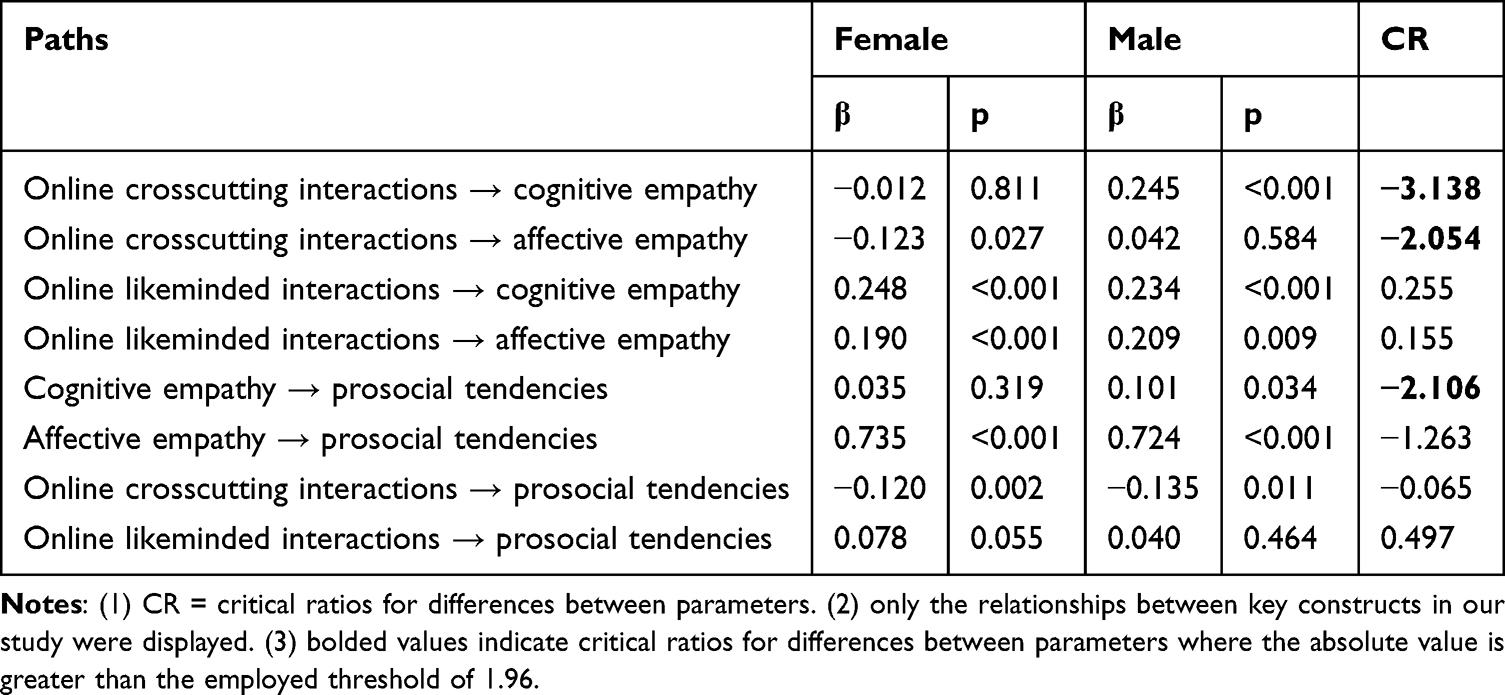 |
Table 5 Path Coefficient Comparison Across Gender Group |
Discussion
Building upon Li et al’s19 study, the current study subdivided OSIs into two categories: online cross-cutting and like-minded interactions. We examined the associations of these two types of OSIs with individuals’ prosocial tendencies, introducing cognitive and affective empathy as potential mediators and gender as a moderator. The main results were discussed in this part.
The Effects of Online Cross-Cutting Interactions
Some prior studies in political communications have demonstrated that increased online cross-cutting interactions led to higher levels of political participation.26,27 However, in response to RQ1, our research revealed that both the direct and total effects of online cross-cutting interactions on prosocial tendencies were significantly negative. This discrepancy could be explained by several factors. Drawing on the Social Information Processing Theory and Hyperpersonal Model, we propose that the lack of nonverbal cues (e.g., facial expressions, tone of voice) in online cross-cutting interactions makes individuals more prone to negative attribution and extreme perceptions of outgroup members. In the political communication context, such negative attribution may paradoxically stimulate political participation by fostering critical thinking, debate, and engagement with diverse perspectives given that political participation inherently accommodates conflict and opposition.69 In contrast, in the prosociality context, the same negative attribution and emotional exhaustion induced by online cross-cutting interactions are likely to decrease trust and generate a reluctance to engage in prosocial actions.70,71 Additionally, political discussions may involve group identities that drive political engagement despite disagreements. However, in the prosociality context, a focus on differences through cross-cutting interactions may undermine the sense of shared identity and community, thereby reducing the inclination to engage in prosocial actions. Hence, our study, alongside those conducted in political realms, indicates that the effects of online cross-cutting interactions vary depending on the context and specific outcome considered, highlighting the complexity of cross-cutting social interactions and their associations with subsequent behaviors.
Regarding the mediating effect of empathy inquired by RQ2, our results suggest that cognitive empathy positively mediated the relationship between online cross-cutting interactions and prosocial tendencies, but affective empathy did not. This is understandable since cognitive empathy highlights the process of recognizing and understanding others’ emotions, while affective empathy underscores the process of experiencing others’ emotions.38 Individuals engaged in cross-cutting interactions are capable of identifying and comprehending the views, beliefs, and interests of others, even if they do not agree with the perspectives that they are observing. In contrast, these individuals may not be capable of experiencing the emotions associated with these differing views, beliefs, and interests, as these perspectives contrast with their own.72 However, the relationships among online cross-cutting interactions, cognitive/affective empathy, and prosocial tendencies vary across gender groups, which will be discussed later.
The Effects of Online Like-Minded Interactions
Our study revealed that despite online like-minded interactions not being significantly associated with prosocial tendencies on a direct level, the total effect of online-like-minded interactions on prosocial tendencies was significantly positive, which makes a sharp contrast to that of online cross-cutting interactions. In light of RQ1, the contrasting relations of these two types of OSIs with prosocial tendencies in our study can be explained by the dynamics of these different types of interactions. As mentioned earlier, online cross-cutting interactions, where individuals engage with those holding differing views or beliefs, may lead to increased cognitive dissonance, conflict, and a focus on differences rather than similarities.39 This could potentially reduce empathy and trust, resulting in a negative relation with prosocial tendencies. Conversely, online like-minded interactions involve individuals who share similar values, beliefs, and goals.38 These interactions often create a supportive and harmonious environment where mutual understanding, cooperation, and reinforcement of prosocial behaviors are more likely to occur. The alignment of perspectives and shared goals in like-minded interactions can enhance empathy, trust, and a focus on commonalities, all of which contribute to the promotion of prosocial tendencies. However, like-minded interactions can induce the formation of echo chambers and filter bubbles, or confined environments where the same information and perspectives are circulated.73 As such, the homogenization of information received by an individual may lead to information fatigue, characterized as “a state of psychological weariness and declining interest toward information”.74 This explains the lack of direct effect from online like-minded interactions to prosocial tendencies in that the excessive accumulation of like-minded interactions prohibits the development of prosocial tendencies, as a result of the psychological exhaustion caused by information fatigue.
With regard to the indirect effect inquired by RQ2, both cognitive and affective empathy were found to mediate the relationship between online like-minded interactions and prosocial tendencies, which is consistent with some early studies conducted in the offline context.52,75 Since individuals who engage in like-minded interactions share similar views, beliefs, or interests, they not only intellectually understand each other’s emotions but are also more likely to emotionally resonate with each other. That is, both cognitive and affective empathy could be cultivated during the process of online like-minded interactions. Another noteworthy aspect is that the indirect effect of affective empathy surpassed that of cognitive empathy in linking online like-minded interactions and prosocial tendencies. As mentioned above, when individuals share similar views, beliefs, or interests, they are likely to connect with others’ emotions on both an intellectual and experiential level. However, the emotional resonance, or affective empathy, can lead to a deeper, more visceral understanding of others’ experiences. Therefore, this emotional connection might be more likely to foster individuals’ prosocial tendencies because they can more acutely feel what the other person is going through.
Gender Differences
The multigroup analyses conducted in this study yielded differences in the relationships between online cross-cutting interactions and empathy across gender groups, as probed by RQ3. A positive association between online cross-cutting interactions and cognitive empathy was observed among males, contrasting with the insignificant relationship identified for females. Meanwhile, an insignificant relationship between online cross-cutting interactions and affective empathy was found among males, while a negative relationship was evident within the female cohort. These observed disparities can be attributed to the different communication styles across gender groups. Numerous studies suggest that males and females may exhibit distinct communication styles.76 Males might prioritize problem-solving and analytical thinking, aligning with cognitive empathy, whereas females may emphasize emotional expression and connection, aligning with affective empathy.43 These communication differences could influence how individuals interpret and respond to online cross-cutting interactions. Additionally, gendered patterns of online behavior could also play a role.77 For instance, males might engage more in content that requires cognitive processing, such as debates, leading to a stronger association between online cross-cutting interactions and cognitive empathy. In contrast, females may gravitate towards content that elicits emotional responses, potentially resulting in the negative relationship between online cross-cutting interactions and affective empathy.
Another finding worth discussing across gender groups is that for the relationship between cognitive empathy and prosocial tendencies, the male group displayed a positive association while the female group demonstrated an insignificant relationship. This result could be understood by the ways in which males and females interpret and express cognitive empathy, which could impact their prosocial tendencies differently.47 Males may demonstrate prosocial behavior due to cognitively understanding others’ perspectives and needs, while females may engage in prosocial acts driven by emotional empathy or other factors not directly related to cognitive empathy.
Contributions and Limitations
Theoretically, the current study addressed research limitations of Li et al,19 providing a more comprehensive and nuanced understanding of whether and how OSIs associate with individuals’ prosocial tendencies among emerging adults. First, we classified OSIs into online cross-cutting and like-minded interactions. Our results indicate the negative associations of online cross-cutting interactions and the positive associations of online like-minded interactions with prosocial tendencies, thereby highlighting the importance of distinguishing between cross-cutting and like-minded when exploring their associations with OSIs in shaping individuals’ prosociality. Second, the study simultaneously introduces cognitive empathy and affective empathy as potential mediators, finding that online cross-cutting and like-minded interactions relate with prosocial tendencies through different empathetic routes. This result suggests that the different types of OSIs could elicit various empathetic responses, which further influence individuals’ inclination towards prosocial actions. Third, the study emphasized gender differences in exploring the associations of OSIs with prosocial tendencies via empathy, and the results provide an insightful look into the conditions under which these relationships may vary across different gender groups.
Apart from the theoretical contributions, the present study’s findings have practical implications for the design of online platforms to foster more prosocial tendencies among emerging adults. Given the positive association of online like-minded interactions with prosocial tendencies, platforms could be designed to facilitate more of these interactions, such as creating group chats where individuals with similar perspectives and interests can communicate with each other. However, excessive facilitation of online like-minded interactions may lead to the possibility of forming echo chambers or filter bubbles. This should be avoided, as the state of information fatigue that results from these circumstances can limit the establishment of prosocial tendencies. Moreover, considering the complex associations of online cross-cutting interactions with prosocial tendencies, more nuanced and strategic interventions are required. For instance, online platforms can establish and enforce community guidelines that encourage respectful and considerate online cross-cutting interactions, such as making clear that aggressive exchanges between individuals with differing beliefs and viewpoints can lead to those involved being potentially banned from the platforms. The use of moderation tools can help manage these interactions, potentially minimizing their direct negative impact on prosocial tendencies while maximizing their indirect positive impact on prosocial tendencies through the cultivation of cognitive empathy. For example, AI moderators can be incorporated into online platforms to help dissenting individuals with cognitively recognizing and understanding each other’s point of view, thereby allowing prosocial tendencies to be nurtured.
A number of limitations to the current study can be spotlighted to improve future research. For one, the reliance on cross-sectional data in our study makes it hard for causal inference to be established. In other words, it is difficult for us to claim that OSIs influence prosocial tendencies through cognitive or affective empathy in a causal-and-effect manner, as the relationships in our proposed model could be bidirectional. For instance, individuals with higher prosocial tendencies might also have greater empathy, which could in turn enhance their engagement in OSIs, especially online like-minded interactions. Therefore, employing additional research methods, such as longitudinal surveys or experiments, is essential in future studies to clarify the direction of influence among the constructs examined. Another limitation exists in that the sample for the current study is limited to Chinese participants. In other words, the results yielded from this study are only applicable to the Chinese population. Future research should consider expanding the sample to include participants from an international population, thereby giving worldwide applicability to the results of the study. Also, the collected data for this study are sourced from self-reported gauges for variables such as empathy and prosocial tendencies. Despite testing for CMB and ensuring its lack of potential threat, the study did not account for the possibility of social desirability bias that could arise from the participants’ self-reporting of positive traits, which should be considered by future research. Finally, it should be highlighted that although some regression paths reached statistical significance (p < 0.05), their effect sizes were extremely small (e.g., f2 = 0.01). Therefore, these results should be interpreted with caution, and the substantive importance of such paths should not be overemphasized.
Conclusion
Building upon the research by Li et al, the current study aimed to explore whether and how OSIs are associated with prosocial tendencies. To get a more comprehensive and nuanced understanding of this relationship, OSIs were further categorized into online cross-cutting and online like-minded interactions. Additionally, cognitive and affective empathy were introduced as potential mediators, while gender was examined as a moderator. Based on data collected from 1142 Chinese emerging adults, the results revealed that online cross-cutting interactions were negatively related to prosocial tendencies, despite the positive mediating effect of cognitive empathy. In contrast, online like-minded interactions were positively associated with prosocial tendencies through the mediating roles of both cognitive and affective empathy, with the indirect effect via affective empathy being significantly stronger than that via cognitive empathy. In addition, multigroup analyses revealed that the relationships among online cross-cutting interactions, empathy, and prosocial tendencies varied across gender groups. Particularly, online cross-cutting interactions were positively associated with cognitive empathy among males, whereas this association was not significant among females. These findings not only deepen theoretical understandings of the link between OSIs and prosocial tendencies but also provide practical insights for designing online platforms aimed at fostering prosocial tendencies in emerging adults.
Data Sharing Statement
The data is available from the corresponding author, Y. Hao, upon reasonable request.
Ethical Approval
The study was reviewed and approved by the Institutional Review Board at Shanghai Jiao Tong University (No. H20230320I).
Informed Consent
Informed consent was obtained from all study participants prior to participation. Respondents’ participation in this study was voluntary.
Acknowledgments
This study was approved by the Institutional Review Board of Shanghai Jiao Tong University (Approval No. H20230320I). We are grateful to the many professors and students who provided assistance during the data collection process, especially to Professor Shuyan Zhang from Northeast Normal University and Lanjuan Du, a former graduate student at Shanghai Jiao Tong University.
Author Contributions
All authors made a significant contribution to the work reported, whether that is in the conception, study design, execution, acquisition of data, analysis and interpretation, or in all these areas; took part in drafting, revising or critically reviewing the article; gave final approval of the version to be published; have agreed on the journal to which the article has been submitted; and agree to be accountable for all aspects of the work.
Funding
This study was supported by the Project of the 2025 Shanghai Philosophy and Social Science Planning Research Topic (Research on the Impact of AI Content Production Affordances on Youth Social Mentality, No. 2025BXW003).
Disclosure
The authors declare no competing interests in this work.
References
1. Zöggeler-Burkhardt L, Embacher EM, Smidt W. Social relationships, interactions and learning in early childhood – theoretical approaches, empirical findings and challenges. Early Child Develop Care. 2023;193(11–12):1199–15. doi:10.1080/03004430.2023.2260976
2. Casale S, Tella L, Fioravanti G. Preference for online social interactions among young people: direct and indirect effects of emotional intelligence. Pers Individ Dif. 2013;54(4):524–529. doi:10.1016/j.paid.2012.10.023
3. Sumner EM, Ramirez A. Social information processing theory and hyperpersonal perspective. In: Hoffner CA, Zoonen L, editors. The International Encyclopedia of Media Effects. Wiley-Blackwell; 2017:1–11. doi:10.1002/9781118783764.wbieme0090
4. Lenhart A, Madden M. Friendship, strangers and safety in online social networks. Pew Research Center; 2007. Available from: https://www.pewresearch.org/internet/2007/04/18/friendship-strangers-and-safety-in-online-social-networks/.
5. Hui E, Singh S, Lin PKF, Dillon D. Social media influence on emerging adults’ prosocial behavior: a systematic review. Basic Appl Social Psychol. 2024;46(4):239–265. doi:10.1080/01973533.2024.2342396
6. Xiong Y, Zhou Y. The impact of online social interaction on college students’ socio-emotional competence mediated by bonding social capital. Sci Rep. 2025;15:33287. doi:10.1038/s41598-025-18957-0
7. Li H, Li H, Zhou X, Kuang Y, Liu F. The impact of online social interaction on urban community cohesion and group differences: evidence from China. BMC Public Health. 2025;25:1484. doi:10.1186/s12889-025-22680-w
8. Wolf W, Dotson K. Online experience sharing without explicit social interaction does not foster social bonding. Cyberpsychology. 2025;19(1):Article3. doi:10.5817/CP2025-1-3
9. Churchman A, Hemmings BJ, Basu A. The impact of online interactions on students’ wellbeing during lockdown. Cogent Psychol. 2024;11(1). doi:10.1080/23311908.2024.2371025
10. Liang N, Grayson SJ, Kussman MA, Mildner JN, Tamir DI. In-person and virtual social interactions improve well-being during the COVID-19 pandemic. Comput Human Behav Rep. 2024;15:100455. doi:10.1016/j.chbr.2024.100455
11. Tibbetts M, Epstein-Shuman A, Leitao M, Kushlev K. A week during COVID-19: online social interactions are associated with greater connection and more stress. Comput Human Behav Rep. 2021;4:100133. doi:10.1016/j.chbr.2021.100133
12. Batson CD, Powell AA. Altruism and prosocial behavior. In: Millon T, Lerner M, editors. Handbook of Psychology, Vol. 5. Personality and Social Psychology. John Wiley & Sons, Inc; 2003:463–484. doi:10.1002/0471264385.wei0519
13. Fu X, Padilla-Walker LM, Brown MN. Longitudinal relations between adolescents’ self-esteem and prosocial behavior toward strangers, friends and family. J Adolescence. 2017;57(1):90–98. doi:10.1016/j.adolescence.2017.04.002
14. Raposa EB, Laws HB, Ansell EB. Prosocial behavior mitigates the negative effects of stress in everyday life. Clin Psychol Sci. 2015;4(4):691–698. doi:10.1177/2167702615611073
15. Dirga R, Mukhtar A, Alfarid R. Social interaction and prosocial behavior through the lens of social psychology. J Soc Humanity Perspect. 2024;2:114–126. doi:10.71435/639112
16. Eisenberg N, Miller PA. The relation of empathy to prosocial and related behaviors. Psychol Bull. 1987;101(1):91–119. doi:10.1037/0033-2909.101.1.91
17. Penner LA, Dovidio JF, Piliavin JA, Schroeder DA. Prosocial behavior: multilevel perspectives. Ann Rev Psychol. 2005;56(1):365–392. doi:10.1146/annurev.psych.56.091103.070141
18. Li W, Chen M. How online social interactions predict the sense of virtual community via social capital: testing a dual-process model with an interest-based SNS. Comput Human Behav. 2022;135:107347. doi:10.1016/j.chb.2022.107347
19. Li W, Chen M, Li X. More interactions, more prosociality? An investigation of the prosocial effect of online social interactions among adolescents. Cyberpsychol Behav Soc Network. 2022;25(7):432–438. doi:10.1089/cyber.2021.0343
20. Walther JB, Whitty MT. Language, psychology, and new new media: the hyperpersonal model of mediated communication at twenty-five years. J Language Soc Psychol. 2021;40(1):120–135. doi:10.1177/0261927X20967703
21. Buder J, Zimmermann A, Buttliere B, Rabl L, Vogel M, Huff M. Online interaction turns the congeniality bias into an uncongeniality bias. Psychol Sci. 2023;34(10):1055–1068. doi:10.1177/09567976231194590
22. Liu L, Li X, Sun Y, et al. The role of empathy and perceived stress in the association between dispositional awe and prosocial behavior in medical students: a moderated mediation model. Educ Psychol. 2024;44(3):358–376. doi:10.1080/01443410.2024.2354690
23. Lacko D, Machackova H, Smahel D. Does violence in video games impact aggression and empathy? A longitudinal study of Czech adolescents to differentiate within- and between-person effects. Comput Human Behav. 2024;159:108341. doi:10.1016/j.chb.2024.108341
24. Heatherly KA, Lu Y, Lee JK. Filtering out the other side? Cross-cutting and like-minded discussions on social networking sites. New Med Soc. 2017;19(8):1271–1289. doi:10.1177/1461444816634677
25. Boulianne S, Koc-Michalska K. The role of personality in political talk and like-minded discussion. Int J Press/Politics. 2022;27(1):285–310. doi:10.1177/1940161221994096
26. Schneider FM, Weinmann C. In need of the devil’s advocate? The impact of cross-cutting exposure on political discussion. Political Behav. 2021;45(1):373–394. doi:10.1007/s11109-021-09706-w
27. Min SJ, Wohn DY. All the news that you don’t like: cross-cutting exposure and political participation in the age of social media. Comput Human Behav. 2018;83:24–31. doi:10.1016/j.chb.2018.01.015
28. Matthes J, Marquart F, Von Sikorski C. Like-minded and cross-cutting talk, network characteristics, and political participation online and offline: a panel study. Communications. 2021;46(1):113–126. doi:10.1515/commun-2020-2080
29. Borah P, Edgerly S, Vraga EK, Shah DV. Hearing and talking to the other side: antecedents of cross-cutting exposure in adolescents. Mass Commun Soc. 2013;16(3):391–416. doi:10.1080/15205436.2012.693568
30. Chen H, Lin J. Cross-cutting and like-minded discussion on social media: the moderating role of issue importance in the (de)mobilizing effect of political discussion on political participation. J Broadcast Electronic Media. 2021;65(1):135–156. doi:10.1080/08838151.2021.1897822
31. Kim Y, Chen H. Social media and online political participation: the mediating role of exposure to cross-cutting and like-minded perspectives. Telematic Informatic. 2016;33(2):320–330. doi:10.1016/j.tele.2015.08.008
32. Ausat AMA. The role of social media in shaping public opinion and its influence on economic decisions. Technol Soc Perspect. 2023;1(1):35–44. doi:10.61100/tacit.v1i1.37
33. Narayanan A. Understanding Social Media Recommendation Algorithms. Academic Commons; 2023. doi:10.7916/khdk-m460
34. VandenBos GR. APA Dictionary of Psychology.
35. Batson CD, Lishner DA, Stocks EL. The empathy—Altruism hypothesis. In: Schroeder DA, Graziano WG, editors. The Oxford Handbook of Prosocial Behavior. Oxford University Press; 2014:259–281. doi:10.1093/oxfordhb/9780195399813.013.023
36. Hoffman ML. Empathy and Moral Development: Implications for Caring and Justice. Cambridge University Press; 2000. doi:10.1017/CBO9780511805851
37. Singer T. The neuronal basis and ontogeny of empathy and mind reading: review of literature and implications for future research. Neurosci Biobehav Rev. 2006;30(6):855–863. doi:10.1016/j.neubiorev.2006.06.011
38. Decety J, Jackson PL. The functional architecture of human empathy. Behav Cognitive Neurosci Rev. 2004;3(2):71–100. doi:10.1177/1534582304267187
39. Ang RP, Goh DH. Cyberbullying among adolescents: the role of affective and cognitive empathy, and gender. Child Psychiatry Human Dev. 2010;41(4):387–397. doi:10.1007/s10578-010-0176-3
40. An J, Kwak H, Posegga O, Jungherr A. Political discussions in homogeneous and cross-cutting communication spaces. In:
41. Dinishak J. Empathy, like-mindedness, and autism. In: Risjord M, editor. Normativity and Naturalism in the Philosophy of the Social Sciences. Routledge; 2016:113–134. doi:10.4324/9781315676722
42. Eagly AH, Crowley M. Gender and helping behavior: a meta-analytic review of the social psychological literature. Psychol Bull. 1986;100(3):283–308. doi:10.1037/0033-2909.100.3.283
43. Eisenberg N. The development of empathy-related responding. In: Mikulincer M, Shaver PR, Simpson JA, Dovidio JF, editors. APA Handbook of Personality and Social Psychology, Vol. 3. Interpersonal Relations. American Psychological Association; 2015:419–446. doi:10.1037/14344-000
44. Chen W, Lu J, Liu L, Lin W. Gender differences of empathy. Adv Psychol Sci. 2014;22(9):1423–1434. doi:10.3724/SP.J.1042.2014.01423
45. Rochat MJ. Sex and gender differences in the development of empathy. J Neurosci Res. 2023;101(5):718–729. doi:10.1002/jnr.25009
46. Wu Q, Bu W, Lin D, et al. Empathy and cooperation vary with gender in Chinese junior high school adolescents. PsyCh Journal. 2023;13(1):55–65. doi:10.1002/pchj.705
47. Rueckert L, Naybar N. Gender differences in empathy: the role of the right hemisphere. Brain Cognition. 2008;67(2):162–167. doi:10.1016/j.bandc.2008.01.002
48. Arnett JJ. Emerging adulthood: a theory of development from the late teens through the twenties. Am Psychologist. 2000;55(5):469–480. doi:10.1037/0003-066X.55.5.469
49. Wu Y, Hu J, Li W. The link between online gaming behaviour and unethical decision-making in emerging adults: the mediating roles of game cheating and moral disengagement. Behaviour Inf Technol. 2020;42(10):1534–1547. doi:10.1080/0144929X.2022.2087539
50. Wang B, Zhen F. The role of distance in online social networks: a case study of Sina micro-blog. Progress Geography. 2016;35(8):983–989. doi:10.18306/dlkxjz.2016.08.007
51. Lin H, Kim Y. Learning from disagreement on social media: the mediating role of like-minded and cross-cutting discussion and the moderating role of fact-checking. Comput Human Behav. 2023;139:107558. doi:10.1016/j.chb.2022.107558
52. Davis MH. Measuring individual differences in empathy: evidence for a multidimensional approach. J Personal Soc Psychol. 1983;44(1):113–126. doi:10.1037/0022-3514.44.1.113
53. Siu AMH, Shek DTL. Validation of the interpersonal reactivity index in a Chinese context. Res Soc Work Pract. 2005;15(2):118–126. doi:10.1177/1049731504270384
54. Zhang F, Dong Y, Wang K. Reliability and validity of the Chinese version of the Interpersonal Reactivity Index-C. Chin J Clin Psychol. 2010;18(2):155–157.
55. Carlo G, Randall BA. The development of a measure of prosocial behaviors for late adolescents. J Youth Adolescence. 2002;31(1):31–44. doi:10.1023/A:1014033032440
56. Zhan Q, Wang S, Li C, et al. Revision and validation of the prosocialness scale for adults (PSA) among Chinese college students. BMC Psychol. 2023;11(1):124. doi:10.1186/s40359-023-01124-3
57. Bailey PE, Brady B, Ebner NC, Ruffman T. Effects of age on emotion regulation, emotional empathy, and prosocial behavior. J Gerontol B. 2020;75(4):802–810. doi:10.1093/geronb/gby084
58. Kamas L, Preston A. Empathy, gender, and prosocial behavior. J Behav Exp Econ. 2021;92:101654. doi:10.1016/j.socec.2020.101654
59. Anderson JC, Gerbing DW. Structural equation modeling in practice: a review and recommended two-step approach. Psychol Bull. 1988;103(3):411–423. doi:10.1037/0033-2909.103.3.411
60. Conway JM, Lance CE. What reviewers should expect from authors regarding common method bias in organizational research. J Bus Psychol. 2010;25(3):325–334. doi:10.1007/s10869-010-9181-6
61. Williams LJ, Hartman N, Cavazotte F. Method variance and marker variables: a review and comprehensive cfa marker technique. Organ Res Methods. 2010;13(3):477–514. doi:10.1177/1094428110366036
62. Hu L, Bentler PM. Cutoff criteria for fit indexes in covariance structure analysis: conventional criteria versus new alternatives. Struct Equ Modeling. 1999;6(1):1–55. doi:10.1080/10705519909540118
63. Schreiber JB. Update to core reporting practices in structural equation modeling. Res Social Administrative Pharm. 2017;13(3):634–643. doi:10.1016/j.sapharm.2016.06.006
64. Fornell C, Larcker DF. Evaluating structural equation models with unobservable variables and measurement error. J Marketing Res. 1981;18(1):39–50. doi:10.2307/3151312
65. Preacher KJ, Hayes AF. SPSS and SAS procedures for estimating indirect effects in simple mediation models. BehavRes Methods Instrum Comput. 2004;36(4):717–731. doi:10.3758/bf03206553
66. Putnick DL, Bornstein MH. Measurement invariance conventions and reporting: the state of the art and future directions for psychological research. Develop Rev. 2016;41:71–90. doi:10.1016/j.dr.2016.06.004
67. Cheung GW, Rensvold RB. Evaluating goodness-of-fit indexes for testing measurement invariance. Struct Equ Modeling. 2002;9(2):233–255. doi:10.1207/S15328007SEM0902_5
68. Byrne BM. Testing for multigroup equivalence of a measuring instrument: a walk through the process. Psicothema. 2008;20(4):872–882.
69. Bossetta M, Dutceac Segesten A, Bonacci D. Reconceptualizing cross-cutting political expression on social media: a case study of Facebook comments during the 2016 Brexit referendum. Political Commun. 2023;40(6):719–741. doi:10.1080/10584609.2023.2222370
70. Thurner S, Hofer M, Korbel J. Why more social interactions lead to more polarization in societies. Proc Natl Acad Sci USA. 2025;122(44):e2517530122. doi:10.1073/pnas.2517530122
71. Zschau TT, Lee H, Miller J. When politics gets personal: students’ conversational strategies as everyday identity work. Behav Sci. 2025;15(6):835. doi:10.3390/bs15060835
72. Shamay-Tsoory SG. The neural bases for empathy. Neuroscientist. 2010;17(1):18–24. doi:10.1177/1073858410379268
73. Barni M, Fang Y, Liu Y, et al. Combating misinformation/disinformation in online social media: a multidisciplinary view. APSIPA Transact Signal Inform Process. 2022;11(2):1–28. doi:10.1561/116.00000127
74. Zhong F, Gu C. The impact of health information echo chambers on older adults avoidance behavior: the mediating role of information fatigue and the moderating role of trait mindfulness. Front Psychol. 2024;15:1412515. doi:10.3389/fpsyg.2024.1412515
75. Aron A, Aron EN, Smollan D. Inclusion of other in the self scale and the structure of interpersonal closeness. J Personal Soc Psychol. 1992;63(4):596–612. doi:10.1037/0022-3514.63.4.596
76. Wood JT, Dindia K. What’s the difference? A dialogue about differences and similarities between women and men. In: Canary DJ, Dindia K, editors. Sex Differences and Similarities in Communication. Lawrence Erlbaum Associates Publishers; 1998:19–40. doi:10.4324/9781315805870
77. Christov-Moore L, Simpson EA, Coudé G, Grigaityte K, Iacoboni M, Ferrari PF. Empathy: gender effects in brain and behavior. Neurosci Biobehav Rev. 2014;46:604–627. doi:10.1016/j.neubiorev.2014.09.001
 © 2026 The Author(s). This work is published and licensed by Dove Medical Press Limited. The
full terms of this license are available at https://www.dovepress.com/terms
and incorporate the Creative Commons Attribution
- Non Commercial (unported, 4.0) License.
By accessing the work you hereby accept the Terms. Non-commercial uses of the work are permitted
without any further permission from Dove Medical Press Limited, provided the work is properly
attributed. For permission for commercial use of this work, please see paragraphs 4.2 and 5 of our Terms.
© 2026 The Author(s). This work is published and licensed by Dove Medical Press Limited. The
full terms of this license are available at https://www.dovepress.com/terms
and incorporate the Creative Commons Attribution
- Non Commercial (unported, 4.0) License.
By accessing the work you hereby accept the Terms. Non-commercial uses of the work are permitted
without any further permission from Dove Medical Press Limited, provided the work is properly
attributed. For permission for commercial use of this work, please see paragraphs 4.2 and 5 of our Terms.