
Back to Journals » Open Access Journal of Contraception » Volume 17

Healthcare Professionals’ Self-Perceived Confidence in Contraceptive Implant Localisation and Removal Procedures in Catalonia: A Cross-Sectional Study
Authors Bel-Querol S  , Ramos-Dios G , Perelló-Capó J
Received 4 March 2026
Accepted for publication 20 June 2026
Published 14 July 2026 Volume 2026:17 606820
DOI https://doi.org/10.2147/OAJC.S606820
Checked for plagiarism Yes
Review by Single anonymous peer review
Peer reviewer comments 5
Editor who approved publication: Professor Igal Wolman
Sabina Bel-Querol,1 Gabriel Ramos-Dios,2 Josep Perelló-Capó3,4
1Sexual and Reproductive Health Care Services (ASSIR Terres de l’Ebre), Institut Català de la Salut, Tortosa, Spain; 2Department of Obstetrics and Gynecology, Hospital Sant Joan de Deu, Manresa, Spain; 3Department of Obstetrics and Gynecology, Hospital de la Santa Creu i Sant Pau, Barcelona, Spain; 4Department of Paediatrics, Obstetrics and Gynecology, Preventive Medicine and Public Health, Universitat Autònoma de Barcelona, Barcelona, Spain
Correspondence: Sabina Bel-Querol, Sexual and Reproductive Health Care Services (ASSIR Terres de l’Ebre), Institut Català de la Salut, Tortosa, Spain, Email [email protected]
Purpose: Removal of contraceptive implants can be technically challenging, particularly in complex cases such as deeply located or non-palpable implants. To evaluate healthcare professionals’ (HCPs’) self-perceived confidence in contraceptive implant procedures—including localization and removals of varying complexity—and to examine their opinions regarding access to specialized referral pathways for difficult cases.
Patients and Methods: A cross-sectional study was conducted among 135 HCPs involved in contraceptive implant management. Participants completed a structured questionnaire assessing self-perceived confidence (5 point Likert scales), frequency of complex case encounters and views on referral systems. Analyses included descriptive statistics, Mann–Whitney U-tests and Spearman correlations.
Results: The sample included 68.1% midwives (n=92) and 20.0% gynaecologists (n=27), with a mean age of 39.7± 10.8 years and 11.6± 9.3 years of experience. Self-perceived confidence was high for localization (48.1% “much”, 17.8% “very much”) but markedly lower for complex removals: 40.7% reported “very little” confidence for deeply located palpable implants and 70.4% for nonpalpable implants (89.7% “little/very little”). Gynaecologists reported significantly higher confidence than midwives (p ≤ 0.002). Awareness of referral pathways was low (31.9%), although support for creating specialized circuits was nearly universal (98.5%).
Conclusion: HCPs reported limited confidence in performing complex implant removals. These findings highlight perceived confidence gaps and support consideration of targeted training and clear referral pathways to support safe and equitable access to implant removal services.
Keywords: subdermal implants, clinical confidence, midwives, gynaecologists, referral and consultation
Introduction
Contraceptive implants are among the most effective long-acting reversible contraception (LARC) methods, with failure rates below 1% and high continuation compared with other reversible options.1 The etonogestrel-releasing subdermal implant offers up to three years of reliable, low maintenance contraception.2 However, the method’s success depends not only on correct insertion but also on HCPs’ ability to manage implant removals, particularly in complex cases.3 Despite increasing LARC use, the 2024 Spanish Contraception Survey reports that only about 1.7% of women use a subdermal implant, indicating persistently limited uptake.4
Although implant insertion and removal are usually straightforward, complications such as deep placement, non-palpable implants, or migration can pose major challenges for HCPs.3 These complex cases require specialized skills, suitable equipment, and sometimes advanced imaging for safe removal.3 Inadequate management may increase patient anxiety, prolong use beyond the intended duration, and reduce the likelihood of choosing the same LARC method again.5
Responsibilities for implant management vary across healthcare systems, with both gynaecologists and midwives playing key roles in contraceptive care delivery.6 Understanding the capacity and confidence of different professional groups, as well as awareness of referral pathways for complex cases, is important for optimising service delivery and outcomes.6,7 In response, many healthcare systems have implemented structured training programmes—both for initial skill development and continuing education—to ensure all providers meet minimum competency standards. Training approaches incorporate three core components: theoretical knowledge delivery, skills practice with high-fidelity models and supervised clinical training with direct feedback.8 Research on deliberate practice in medical education demonstrates that focused, repetitive practice with immediate feedback and rigorous skills assessment accelerates the development of clinical expertise.9 However, the present study focuses on healthcare professionals’ self-perceived confidence rather than observed technical competence.
Virtual and simulation-based curricula have shown high satisfaction and certification rates, with 96.5% of HP reporting high satisfaction and 94.7% achieving competency certification following structured training,8 but their impact on capacity for complex removals—especially among primary care providers and midwives—remains insufficiently characterised, underscoring the need to identify persistent gaps and refine training content.
Despite increasing global use of contraceptive implants, evidence on HCPs’ self-perceived ability to manage implant procedures of varying complexity remains limited, and data on specialized referral pathways for difficult cases in Spain are scarce.4 Comparable gaps have been reported across Europe, with substantial variability in provider training and a lack of structured networks for complex contraceptive care.10
The study focused on removal procedures, as these are generally more complex and associated with greater variability in clinical practice compared with insertion.
Therefore, we aimed to (1) evaluate HCPs’ self-perceived confidence for implant localisation and removals of different complexity; (2) quantify how often complex cases are encountered; (3) compare self-perceived confidence and practice patterns between professional groups; and (4) explore knowledge and opinions regarding specialised referral circuits for difficult removals.
Materials and Methods
Study Design and Setting
This cross-sectional observational study was conducted among healthcare professionals (HCPs) involved in contraceptive implant management in Catalonia. Data were collected between January and October 2023 through an online structured questionnaire administered via SurveyMonkey®.
Participants
The study population comprised gynaecologists, midwives, and primary care physicians involved in contraceptive implant insertion or removal. The only exclusion criterion was the absence of implant-related clinical activity.
Participants were recruited during a contraceptive implant training programme organised by the Catalan Department of Health and the Catalan Society of Contraception. The programme was open to healthcare professionals involved in implant care and aimed to update knowledge and skills across different levels of experience.
Participation in the study was voluntary. All attendees received an information sheet prior to accessing the questionnaire and provided electronic informed consent. Only consenting individuals were included in the study. Although completion of the questionnaire was required to obtain course certification, responses were fully anonymous, and no identifiable data were collected.
Training Program
The training programme followed a blended format consisting of a 10 hour online theoretical module and a 5 hour in-person practical session. The online content covered implant functioning, insertion techniques and common causes of difficult removals. The face-to-face session included supervised hands-on practice with high-fidelity simulators, demonstrations of localisation and removal techniques, and discussion of clinical cases, with emphasis on deeply placed, non-palpable and migrated implants.
Data Collection Instrument
Questionnaire Development
A structured questionnaire was specifically developed for this study using an iterative Design Thinking approach to ensure content validity and a user-centred design. The development process involved identifying relevant practice gaps, defining procedural domains related to self-perceived confidence, and refining items through internal peer review prior to pilot testing. All items were designed to assess perceived confidence in managing contraceptive implant procedures rather than objective technical competence. The questionnaire was not formally validated using psychometric methods.
Content and Structure
The final questionnaire included the following domains:
- Demographic and professional characteristics: age, years of experience, specialty, and professional status.
- Clinical practice volume: monthly frequency of implant insertions and removals.
- Self-perceived confidence: assessed using a 5 point Likert scale (1 = “very little” to 5 = “very much”) across four procedures:
- Implant localisation;
- Removal of palpable, normally inserted implants;
- Removal of deeply located but palpable implants;
- Removal of non-palpable implants.
- Exposure to complex cases: frequency of encountering deeply located, non-palpable or migrated implants.
- Referral systems: awareness of existing circuits and opinions on the need for specialised pathways (5 point Likert scale).
- Perceived impact: whether implant management influences user satisfaction (5 point Likert scale).
Pilot Testing and Data Collection
The questionnaire was piloted with 10 HCPs to assess clarity and face validity, resulting in minor wording adjustments. The final version was administered anonymously. Completion was required to obtain course certification, yielding a 100% response rate (n = 135). The full questionnaire and its English translation areavailable in Supplementary Figure 1.
Sample Size Considerations
A priori sample size calculation was not performed because all eligible course participants were required to complete the survey. A post hoc power analysis indicated adequate power (94.7%) for the main comparison between gynaecologists and midwives regarding perceived confidence in non-palpable implant removal (Mann–Whitney U-test, r = 0.36, p = 0.002). Post hoc power analysis was included for completeness but should be interpreted with caution, as it provides limited additional information beyond the reported p-values.
Study Variables and Outcomes
The study examined three domains:
Primary outcome: self-perceived confidence
- Likert scores (1–5) for the four implant-related procedures.
- Independent variables: professional category, years of experience in the profession, monthly procedure volume, exposure frequency.
- Control variables: age, professional status.
Secondary outcomes: referral system awareness and opinions
- Awareness of existing circuits (yes/no/do not know).
- Need for specialised circuits (Likert 1–5).
- Perceived impact on user satisfaction (Likert 1–5).
Only items directly related to self-perceived confidence in implant localisation and removal and core exposure variables (procedural volume, experience) were included in the main analyses. Additional exploratory items were analysed descriptively but are not presented in detail here to maintain focus on the primary study aims.
Statistical Analysis
Data were analysed using SPSS Statistics version 27.0 (IBM Corp., Armonk, NY, USA). Categorical variables were summarised using frequencies and percentages; continuous variables using means and standard deviations.
Group comparisons were conducted using Mann–Whitney U-tests. Spearman’s rank correlation coefficients assessed associations between continuous variables. A significance level of p < 0.05 was applied. Mean ranks were reported to illustrate group differences. Likert-scale data were summarised as percentages to facilitate interpretability.
Nonparametric tests were selected due to the ordinal nature of Likert-scale variables.
Additionally, confidence intervals were not reported for median differences in group comparisons (Mann–Whitney U-tests) due to the ordinal nature of outcome variables and potential violation of distributional assumptions required for nonparametric confidence interval estimation. Effect sizes (r) were calculated and reported instead to quantify the magnitude of group differences independently of sample size.
Results
A total of 135 healthcare professionals completed the survey, including 92 midwives (68.1%), 27 gynaecologists (20.0%), 8 midwifery residents (5.9%), 7 medical residents (5.2%), and 1 primary care physician (0.7%). The mean age was 39.7 years (SD = 10.8; 95% CI: 37.9–41.6), and mean professional experience was 11.6 years (SD = 9.3; 95% CI: 10.0–13.3). Gynaecologists reported a significantly higher monthly volume of implant insertions (8.17 vs 2.23) and removals (5.37 vs 0.79) compared with midwives (both p < 0.001).
Self-perceived confidence in implant procedures varied according to procedural complexity. Confidence in implant localisation was high, with 65.9% of participants reporting “much” or “very much” confidence. Confidence was lower for the removal of palpable, normally inserted implants, with 42.2% reporting “much” or “very much” confidence. In contrast, markedly lower confidence ratings were observed for more complex procedures: 67.4% of participants reported “little” or “very little” confidence for the removal of deeply located but palpable implants, and 89.7% reported “little” or “very little” confidence for non-palpable implant removal (Figure 1).
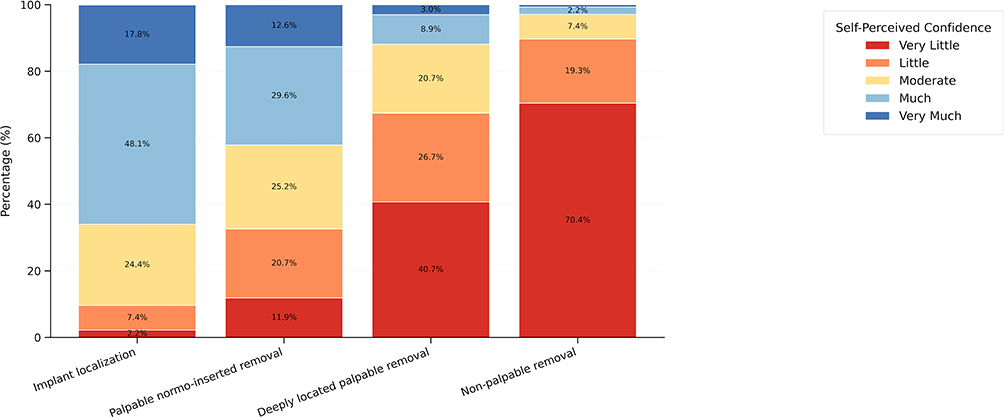 |
Figure 1 Distribution of self-perceived confidence by procedure type (n = 119). Percentages are calculated using the number of valid responses for each item as the denominator. |
When comparing professional groups, gynaecologists reported significantly higher self-perceived confidence than midwives across all four implant-related procedures (all p ≤ 0.002). The largest difference in mean ranks was observed for the removal of deeply located palpable implants (98.80 vs 57.22), followed by non-palpable implant removal, routine palpable removal, and implant localisation (Table 1). Effect sizes ranged from r = 0.28 (implant localisation) to r = 0.52 (deeply located palpable implant removal), indicating small-to-medium to large differences in self-perceived confidence between professional groups. Group comparisons in Table 1 and confidence distributions in Figure 1 include only midwives and gynecologists (n=119), excluding residents and the primary care physician to ensure comparability between professional categories
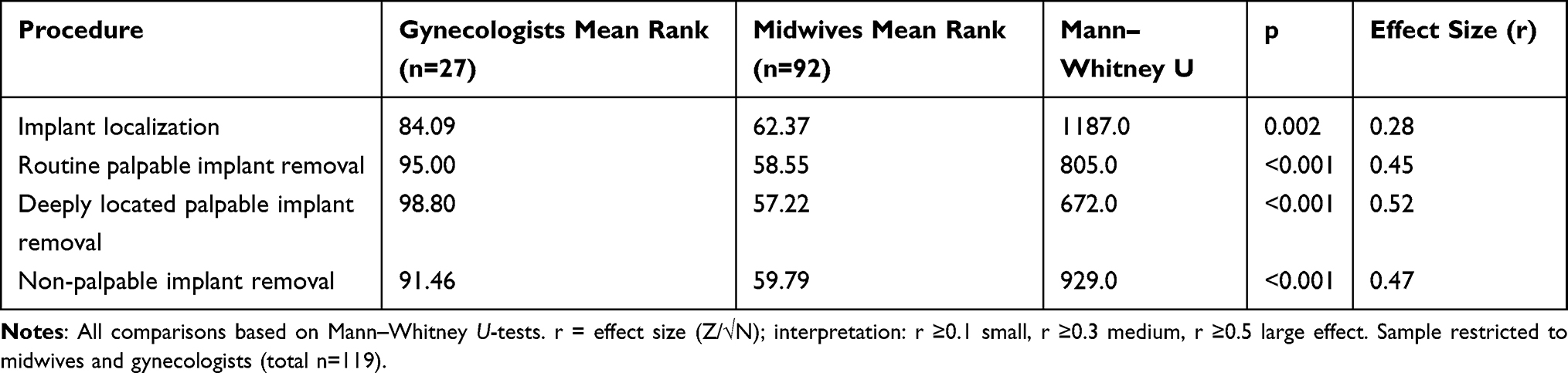 |
Table 1 Comparison of Self-Perceived Confidence Between Gynecologists and Midwives (n=119) |
Years of overall professional experience were not significantly associated with self-perceived confidence for any of the procedures evaluated (Spearman’s ρ ranging from −0.072 to 0.055; all p > 0.40).
The strongest associations were observed between self-perceived confidence in routine palpable implant removal and monthly procedural volume (ρ = 0.63, 95% CI [0.52, 0.73], p < 0.001), and between confidence in deeply located palpable implant removal and monthly procedural volume (ρ = 0.57, 95% CI [0.44, 0.68], p < 0.001). Similar associations, although generally weaker, were observed between monthly insertion volume and self-perceived confidence in complex procedures (Figure 2). Detailed correlation coefficients are presented in Supplementary Table 1.
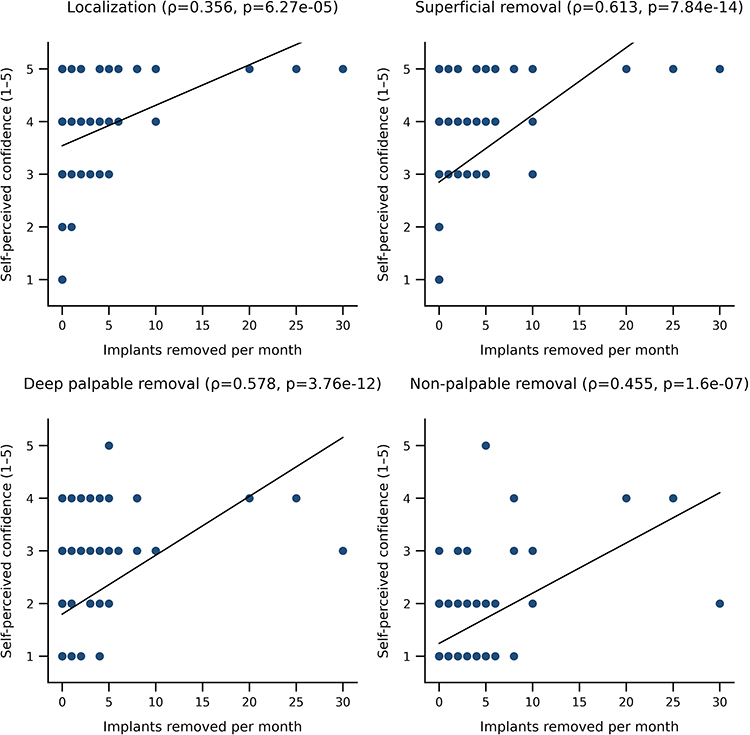 |
Figure 2 Correlation between monthly implant removal volume and self-perceived confidence for complex removals. |
Most participants reported infrequent exposure to complex implant cases. Specifically, 52.6% reported never having encountered deeply located palpable implants, and 26.7% reported encountering them only yearly. For non-palpable implants, 68.1% reported no prior exposure, and 25.2% reported encountering such cases only yearly. Migrated implants were rarely encountered, with 92.6% of participants reporting no prior experience (Table 2).
 |
Table 2 Frequency of Encountering Complex Implant Cases (N=135) |
Finally, only 31.9% of participants reported awareness of an existing specialised referral pathway for complex implant removals, while 68.2% indicated that no such pathway existed or that they were unsure. Support for the development of specialised referral circuits was high, with 98.5% reporting “much” or “very much” agreement. Most participants (95.5%) also reported that appropriate management of implant removals strongly influences user satisfaction.
All ratings reflect self-perceived confidence rather than objectively assessed technical competence.
Discussion
Findings and Interpretation
This study demonstrates substantial differences in healthcare professionals’ self-perceived confidence when managing complex contraceptive implant removals. Because the assessment relied on self-perception rather than observed technical performance—and self-assessment is known to correlate poorly with actual performance11–13—the reported findings, while clinically relevant, may not fully reflect true technical ability. Confidence was adequate for routine localisation and palpable removals but declined sharply for more complex scenarios: 67.4% of participants reported low confidence for the removal of deeply located palpable implants and 89.7% for non-palpable implants. These findings reflect a perceived confidence gap for complex procedures and are consistent with evidence linking deep placement to technically difficult removals and increased neurovascular risk.14–16 Low perceived confidence may influence clinicians’ referral behaviour or willingness to attempt complex removals.16,17 Higher confidence among gynaecologists likely reflects greater procedural exposure and their established role in managing complications,16 while the expanding role of midwives highlights the importance of appropriate support when managing infrequently encountered complex cases.18,19
The observed pattern of high confidence in basic procedures and lower confidence in complex ones may be explained by limitations inherent to self-assessment, which should be interpreted cautiously in the absence of objective competence measures. The positive correlations observed between monthly procedural volume and self-perceived confidence (ρ = 0.347–0.633) suggest that repeated exposure may contribute to greater procedural familiarity, whereas the absence of an association with years of professional experience indicates that seniority alone does not necessarily translate into higher confidence when managing specific procedures.20 Finally, the low level of awareness regarding referral circuits highlights limited familiarity with specialised pathways and suggests that variability in the organisation and communication of these pathways may exist.16,21 These findings are consistent with previous studies reporting increased technical difficulty and lower confidence in the management of complex implant removals, particularly in cases involving deeply located or non-palpable implants.
While physicians reported higher self-perceived confidence than midwives for more complex procedures, this finding should be interpreted with caution, as professional category is likely correlated with procedural volume and other contextual factors. Given the cross-sectional and univariable design of the study, it is not possible to determine whether professional category exerts an independent effect beyond procedural exposure.
Results in the Context of What is Known
Previous studies have reported complication rates of approximately 1.7–3.5% for implant removals, with deep insertion consistently identified as the leading cause of difficult or failed procedures.15,21,22 The markedly lower confidence reported for deeply located and non-palpable implant removals in the present study reflects this well-recognised clinical challenge. Evidence from referral centres indicates that non-palpable implants can often be removed successfully using ultrasound guidance and advanced techniques, with high success rates reported across several series.21,23–25 These findings support the value of concentrating expertise and specialised resources for complex removals and provide context for the lower confidence reported by frontline providers when managing such cases.
Implications for Practice and Future Research
This study primarily provides a detailed, quantitative description of self-perceived confidence gradients across different levels of contraceptive implant removal complexity and procedural volume, rather than proposing a new conceptual framework. The findings are consistent with expected patterns whereby higher procedural volume is associated with greater self-perceived confidence and should therefore be interpreted as hypothesis-generating.11–13,26
The low frequency with which deeply located or non-palpable implants are encountered in routine practice, together with the marked decline in self-reported confidence for these procedures, suggests that many clinicians may have limited opportunities to develop or maintain familiarity with complex removals. This pattern is consistent with the well-described relationship between procedural frequency and confidence or skill retention, particularly for infrequently performed techniques.27,28 From a practice perspective, low perceived confidence may influence clinicians’ sense of preparedness, referral behaviour, or decision-making when facing uncommon or technically demanding cases.
Several strategies described in the literature could be explored to support clinicians who report low confidence in complex implant removals. These include clearly defined referral pathways and access to specialised centres with experience in managing non-palpable or deeply located implants using imaging guidance and advanced removal techniques.21,23–25 Questions on referral pathways were designed to assess general awareness rather than detailed procedural knowledge of referral structures. In addition, simulation-based training and refresher activities have been proposed as potential approaches to help clinicians maintain confidence and familiarity with rarely performed procedures in a safe learning environment.8,29 Evidence from different healthcare settings also suggests that organised referral systems may facilitate timely access to implant removal services and improve continuity of care.30,31
Future research should prioritise objective assessments of procedural competence, for example through simulation-based evaluations or structured clinical assessments, to examine how self-perceived confidence aligns with observed performance.11–13 Further studies are also needed to explore how different models of referral organisation, training design, and system support influence clinicians’ confidence, patient experience, and access to timely contraceptive implant removal services.32,33
Strengths and Limitations
This study provides valuable insights into an underexplored area of contraceptive care and has several strengths. Although recruitment occurred within a training programme, the course formed part of a broader Department of Health initiative aimed at updating skills across diverse professional groups. Consequently, the sample reflects a wide range of clinicians involved in implant provision in Catalonia rather than a narrowly self-selected group. The study offers a comprehensive assessment of healthcare professionals’ self-perceived confidence across implant-related procedures of varying complexity and includes both gynaecologists and midwives, reflecting real-world multidisciplinary care. Its multidimensional design captures self-perceived confidence, clinical practice patterns, exposure to complex cases, and system-level factors.
However, several limitations should be considered. First, confidence was assessed using self-reported measures rather than objective clinical performance. Prior evidence suggests limited agreement between self-assessment and actual competence, meaning that the findings reflect perceived confidence rather than verified technical ability.
Second, the cross-sectional design precludes causal inference.
Third, participants were recruited within a structured training programme, which may introduce selection bias. This population may differ from the broader clinical workforce, as it may include healthcare professionals who are more motivated, more engaged in implant provision, or seeking additional training due to lower confidence. As a result, the findings may not be fully generalisable to all clinicians involved in contraceptive implant care. Furthermore, the educational setting in which the survey was administered may have influenced responses through contextual or social desirability effects.
Fourth, although questionnaire completion was required to obtain course certification, participation was voluntary and responses were anonymous. However, this design may still introduce potential response bias.
Fifth, the questionnaire was specifically developed for this study and underwent pilot testing but was not formally validated using psychometric methods (eg., internal consistency), which represents an additional limitation. Some exploratory questionnaire items are not presented in detail, as they were not directly aligned with the primary objectives or did not add interpretative value.
Sixth, the analyses were predominantly descriptive and univariable. As a result, it is not possible to fully disentangle the independent contribution of professional category from procedural volume or other potential confounding factors. In particular, professional category may partly act as a proxy for procedural exposure, and the relatively small number of physicians limits the stability of subgroup comparisons and the generalisability of differences observed between professional groups.
Seventh, post hoc power analysis was included for completeness but should be interpreted with caution, as it provides limited additional information beyond the reported p-values.
Finally, multivariable analyses were not performed, and effect sizes and confidence intervals were reported only for key comparisons and correlations, but not for all outcomes, which may limit the depth of statistical interpretation. No adjustments for multiple comparisons were applied, which may increase the risk of type I error, and the use of percentage-based summaries may not fully capture the ordinal nature of the data.
Conclusion
This study highlights substantial differences in healthcare professionals’ self-perceived confidence when managing complex contraceptive implant removals, particularly non-palpable implants, for which 89.7% of participants reported limited confidence. These findings, together with the higher confidence observed among gynaecologists, suggest the potential value of role-specific training and a structured, stepped-care approach. The mismatch between strong support for referral pathways (98.5%) and the low awareness of existing circuits (31.9%) indicates a gap in awareness and organisation. Strengthening referral networks, competency-based training, and simulation-based education may help improve patient safety, reduce delays, and enhance care delivery. Enhancing these system-level elements could contribute to addressing perceived confidence gaps and supporting safe, patient-centred care.
Overall, this study provides a clinically relevant contribution by quantifying gradients in self-perceived confidence within a specific national context. While the findings largely confirm expected associations between procedural volume and perceived confidence, they help to define areas for further research and support future hypothesis-driven studies.
Abbreviations
HCP, healthcare professional (s); LARC, long-acting reversible contraception.
Data Sharing Statement
The data supporting the findings of this study are available from the corresponding author upon reasonable request.
Ethics Approval and Informed Consent
This study was conducted in accordance with applicable Spanish regulations for biomedical research. According to Spanish Law 14/2007 on Biomedical Research and Royal Decree 1090/2015 regulating clinical research ethics committees, studies involving voluntary surveys of healthcare professionals without the use of personal health data or patient intervention are considered non-interventional and may be exempt from formal ethics committee approval.
This study did not involve patients, clinical interventions, or identifiable personal data. Participation was voluntary and anonymous, and all participants provided electronic informed consent prior to completing the questionnaire. The study was conducted in accordance with the principles of the Declaration of Helsinki.
Consent for Publication
This manuscript does not include any identifiable images, videos, or multimedia involving human participants; therefore, consent for publication was not applicable.
Acknowledgments
The authors thank the Catalan Society of Contraception and the Department of Health of Catalonia for their collaboration in organising the training course within which this study was conducted. They also acknowledge Ignasi Gich for his support with the statistical analysis.
The authors note the limited use of generative AI tools—specifically Microsoft Copilot (GPT-5 Chat model, 2026 release) and Perplexity Pro (January 2026 release)—restricted solely to language refinement and editorial clarity. All scientific content, data interpretation, statistical analyses, and final decisions were performed independently by the authors.
Author Contributions
All authors made a significant contribution to the work reported, whether that is in the conception, study design, execution, acquisition of data, analysis and interpretation, or in all these areas; took part in drafting, revising or critically reviewing the article; gave final approval of the version to be published; have agreed on the journal to which the article has been submitted; and agree to be accountable for all aspects of the work.
Funding
This research received no specific grant from any funding agency in the public, commercial, or not-for-profit sectors.
Disclosure
SBQ has received registration fees from Gedeon Richter and Organon, and honoraria for lectures from Organon, outside the submitted work. She also reports travel reimbursement from Cinfa for attending the Spanish Congress of Contraception 2026. GRD has received honoraria for lectures from Exeltis, Bayer Hispania, and Organon, outside the submitted work. JPC has received honoraria for consulting, participation in advisory boards or lectures from Bayer Hispania, Cinfa, Theramex, Exeltis, and Organon, outside the submitted work. He is also the President of the Catalan Society of Contraception. The authors report no other conflicts of interest in this work.
References
1. Moray KV, Chaurasia H, Sachin O, Joshi B. A systematic review on clinical effectiveness, side effect profile and meta analysis on continuation rate of etonogestrel contraceptive implant. Reprod Health. 2021;18(1):4. doi:10.1186/s12978-020-01054-y
2. Mansour D, Korver T, Marintcheva Petrova M, Fraser IS. The effects of Implanon on menstrual bleeding patterns. Eur J Contracept Reprod Health Care. 2008;13(Suppl 1):1328. doi:10.1080/13625180801959931
3. Faranna D, Bergamo N, de Toledo Piza Soares J, Juliato CRT, Bahamondes L. Deep implant removal: the impact of implant depth and positioning. Int J Gynaecol Obstet. 2025;173:854–11. doi:10.1002/ijgo.70675
4. Leon-Larios F, Alonso Llamazares MJ, Mausbach Reisen H, Parra Ribes I, Rey Novoa M, Lahoz-Pascual I. Impact of hands-on clinical training program for subdermal implant on contraceptive counseling and users’ choice in Spain: a 6 month follow up study. Contraception. 2024;132:110372. doi:10.1016/j.contraception.2024.110372
5. Hubacher D, Olawo A, Juma G, et al. When it comes to time of removal, nothing is straightforward: a qualitative study of barriers to removal of LARC in Western Kenya. Contraception. 2021;104(3):314–319. doi:10.1016/j.contraception.2021.03.017
6. Walker SH, Hooks C, Blake D. Views of postnatal women and midwives on midwives providing contraceptive advice: mixed methods study. BMC Pregnancy Childbirth. 2021;21(1):411. doi:10.1186/s12884-021-03895-2
7. Faculty of Sexual and Reproductive Healthcare. FSRH Clinical Guideline: Progestogen Only Implants. London: FSRH; 2021. (amended 2023).
8. Black A, Black D, Toor R, Gersh R, Bhangu P, Costescu D. Hands-on training in a digital world: a simulation-based virtual training program for placement and removal of the subdermal contraceptive implant. J Obstet Gynaecol Can. 2022;44(11):1167–1173. doi:10.1016/j.jogc.2022.08.016
9. Ericsson KA. Deliberate practice and expert performance in medicine. Acad Med. 2004;79(10 Suppl):S70–S81. doi:10.1097/00001888-200410001-00022
10. Khattak H, Tsiapakidou S, Mukhopadhyay S, et al. Variations in SRH services across Europe: questionnaire based study. Eur J Obstet Gynecol Reprod Biol. 2024;299:350–358. doi:10.1016/j.ejogrb.2024.05.026
11. Graves L, Lalla L, Young M. Evaluation of perceived and actual competency in a family medicine objective structured clinical examination. Canadian Family Physician Medecin de Famille Canadien. 2017;63(4):e238–e243.
12. Katowa-Mukwato P, Banda S. Self-perceived versus objectively measured competence in performing clinical practical procedures by final year medical students. Int J Med Educ. 2016;7:122–129. doi:10.5116/ijme.5709.2a7e
13. Davis DA, Mazmanian PE, Fordis M, Van Harrison R, Thorpe KE, Perrier L. Accuracy of physician self-assessment compared with observed measures of competence: a systematic review. JAMA. 2006;296(9):1094–1102. doi:10.1001/jama.296.9.1094
14. Singh M, Mansour D, Richardson D. Location and removal of non-palpable Implanon implants with the aid of ultrasound guidance. J Fam Plan Reproduc Health Care. 2006;32(3):153–156. doi:10.1783/147118906777888549
15. Chevreau J, Krief D, Abou Arab O, et al. Factors associated with difficult removal of etonogestrel implants. Eur J Obstet Gynecol Reprod Biol. 2018;224:8184. doi:10.1016/j.ejogrb.2018.03.019
16. Odom EB, Eisenberg DL, Fox IK, et al. Difficult implant removal: multidisciplinary approach. Obstet Gynecol. 2017;129(3):409413.
17. Guilbert É, Arguin H, Bélanger M. Migration of etonogestrel subcutaneous contraceptive implants: systematic review and recommendations for practice. Eur J Contracept Reprod Health Care. 2024;29(3):115–130. PMID: 38712717. doi:10.1080/13625187.2024.2342919
18. World Health Organization. WHO Recommendations: Optimizing Health Worker Roles to Improve Access to Key Maternal and Newborn Health Interventions Through Task Shifting. Geneva: World Health Organization; 2012. 2, Introduction.
19. Schaefer L. Task sharing implant insertion by community health workers: not just can it work, but how might it work practically and with impact in the real world. Global Health. 2015;3(3):327–329. doi:10.9745/GHSP-D-15-00230
20. Notarnicola I, Ivziku D, Tartaglini D, et al. Self-perceived clinical competence of nurses in different working experiences: a cross-sectional study. Healthcare. 2023;11(21):2808. doi:10.3390/healthcare11212808
21. Matulich MC, Chen MJ, Schimmoeller NR, et al. Referral center experience with nonpalpable contraceptive implant removals. Obstetrics Gynecol. 2019;134(4):801–806. doi:10.1097/AOG.0000000000003457
22. Buitrón-García-Figueroa R, Zancatl-Díaz ML, Basurto-Kuba EOP, Alvarez-Alfaro Ó. Location and removal of non-palpable subdermal single-rod contraceptive implant. Ubicación y extracción del implante anticonceptivo subdérmico no palpable. Cirugia y cirujanos. 2020;88(4):485–488. doi:10.24875/CIRU.20001370
23. Chen MJ, Creinin MD. Removal of a nonpalpable etonogestrel implant with preprocedure ultrasonography and modified vasectomy clamp. Obstetrics Gynecol. 2015;126(5):935–938. doi:10.1097/AOG.0000000000001082
24. Mastey N, Matulich MC, Uhm S, et al. US referral center experience removing nonpalpable and difficult contraceptive implants with in-office ultrasonography: a case series. Contraception. 2021;103(6):428–430. doi:10.1016/j.contraception.2021.01.018
25. Soler-Perromat JC, Isern-Kebschull J, Del Amo M, et al. Ultrasound-guided minimally invasive removal of deep contraceptive implants: outcomes and challenges. Quant Imaging Med Surg. 2024;14(11):7791–7802. doi:10.21037/qims-24-356
26. Eva KW, Regehr G. Self-assessment in the health professions: a reformulation and research agenda. Acad Med J Assoc Am Med Coll. 2005;80(10 Suppl):S46–S54. doi:10.1097/00001888-200510001-00015
27. Binstadt ES, Dahms RA, Carlson AJ, Hegarty CB, Nelson JG. When the learner is the expert: a simulation-based curriculum for emergency medicine faculty. Western J Emerg Med. 2019;21(1):141–144. doi:10.5811/westjem.2019.11.45513
28. Legoux C, Gerein R, Boutis K, Barrowman N, Plint A. Retention of critical procedural skills after simulation training: a systematic review. AEM Educ Train. 2020;5(3):e10536. doi:10.1002/aet2.10536
29. Chene G, Atallah A, Ohannessian A, et al. Clinical evaluation of a low-cost and high-fidelity animal model for palpable and nonpalpable implant removal. Contraception. 2025;158:111356. doi:10.1016/j.contraception.2025.111356
30. Callahan R, Lebetkin E, Brennan C, et al. What goes in must come out: a mixed-method study of access to contraceptive implant removal services in Ghana. Global Health. 2020;8(2):220–238. doi:10.9745/GHSP-D-20-00013
31. Howett R, Gertz AM, Kgaswanyane T, et al. Closing the gap: ensuring access to and quality of contraceptive implant removalservices is essential to rights-based contraceptive care. Afr J Reprod Health. 2019;23(4):19–26. PMID: 32227736; PMCID: PMC12570057. doi:10.29063/ajrh2019/v23i4.3
32. Kruger J, Dunning D. Unskilled and unaware of it: how difficulties in recognizing one’s own incompetence lead to inflated self-assessments. J Personality Social Psychol. 1999;77(6):1121–1134. doi:10.1037//0022-3514.77.6.1121
33. Rahmani M. Medical trainees and the Dunning-Kruger effect: when they don’t know what they don’t know. J Grad Med Educ. 2020;12(5):532–534. doi:10.4300/JGME-D-20-00134.1
 © 2026 The Author(s). This work is published and licensed by Dove Medical Press Limited. The
full terms of this license are available at https://www.dovepress.com/terms
and incorporate the Creative Commons Attribution
- Non Commercial (unported, 4.0) License.
By accessing the work you hereby accept the Terms. Non-commercial uses of the work are permitted
without any further permission from Dove Medical Press Limited, provided the work is properly
attributed. For permission for commercial use of this work, please see paragraphs 4.2 and 5 of our Terms.
© 2026 The Author(s). This work is published and licensed by Dove Medical Press Limited. The
full terms of this license are available at https://www.dovepress.com/terms
and incorporate the Creative Commons Attribution
- Non Commercial (unported, 4.0) License.
By accessing the work you hereby accept the Terms. Non-commercial uses of the work are permitted
without any further permission from Dove Medical Press Limited, provided the work is properly
attributed. For permission for commercial use of this work, please see paragraphs 4.2 and 5 of our Terms.