
Back to Journals » HIV/AIDS - Research and Palliative Care » Volume 17
Factors Impacting Viral Load Suppression in Children and Adolescents Living with HIV Enrolled in an Orphans and Vulnerable Children Program in Northeast Nigeria
Authors Inyang JF, Sontyo JJ  , Bello A, Usman KS, Idaboh TA, Magaji D, Katbi M
Received 30 November 2024
Accepted for publication 16 April 2025
Published 27 September 2025 Volume 2025:17 Pages 323—335
DOI https://doi.org/10.2147/HIV.S509460
Checked for plagiarism Yes
Review by Single anonymous peer review
Peer reviewer comments 2
Editor who approved publication: Prof. Dr. Olubunmi Akindele Ogunrin
Joseph Fabian Inyang,1 Jimin James Sontyo,1 Ayokunle Bello,1 Kabiru Suru Usman,2 Tosin Awele Idaboh,3 Doreen Magaji,3 Moses Katbi3
1Integrated Child Health and Social Service Award − 4, Project ProHealth International, Abuja, Nigeria; 2Integrated Child Health and Social Service Award − 4 Project, Catholic Relief Services, Abuja, Nigeria; 3Program Management, USAID, Abuja, Nigeria
Correspondence: Jimin James Sontyo, Email [email protected]
Introduction: There is limited research on factors impacting viral load suppression among children and adolescents living with HIV (CALHIV) in low-income countries. The objective of the study was to determine and analyze factors affecting HIV viral suppression levels among CALHIV enrolled in the Integrated Child Health and Social Services Activity (ICHSSA 4) Orphans and Vulnerable Children (OVC) project in Northeast Nigeria.
Methodology: The study adopted a descriptive cross-sectional research design for the study. The study involved collecting data among 847 CALHIV aged 0 to 17 years, enrolled in USAID-supported healthcare facilities across 9 Local Government Areas (LGAs) in Adamawa, Bauchi, and Taraba States. Prevalence of viral load suppression was described by child/adolescent, caregiver-related factors. Mixed-effects multivariable logistic regression models were fitted to explore the factors associated with viral load suppression.
Results: CALHIV enrolled on the ICHSSA-4 project > 2 years (92.7%) had better suppression levels compared to those 1 year and less (7.1%). About 94.5% of CALHIV who adhered to prescribed ARV medication were transitioned to pediatric ARV optimal regimen achieved viral suppression. Psychosocial factors such as the presence of treatment support person, enrolment in an age-appropriate support group, and positive HIV disclosure status also impacted viral load suppression positively. The sociodemographic, health/clinical, and psychosocial factors affecting viral load in CALHIV enrolled on the project were found to be statistically significant (p < 0.05).
Conclusion: The study found that factors such as CSO OVC services provided to households, adherence support, food sufficiency in the household, attendance at support groups, treatment literacy and other social services influence viral load suppression. Identifying these factors can help monitor and improve treatment outcomes among CALHIV enrolled in an OVC programs and surely accelerate progress towards achieving the UNAIDS 3rd 95 goal.
Keywords: OVC, HIV, viral load suppression, children and adolescents
Introduction
HIV/AIDS remains a major public health challenge globally and particularly in Sub-Saharan Africa, where vulnerable populations, including children and adolescents, have been disproportionately affected by the burden of the disease. Nigeria ranks 4th in global HIV burden with approximately an estimated 1.8 million persons said to be living with HIV as of 2019.1 The Northeast of Nigeria has a prevalence of 1.1% which is slightly below the national prevalence of 1.4%.2 Considered under the groups vulnerable to HIV infection, children under 15 account for about 9% of all new infections and 13% of all AIDS-related deaths globally.3
Achieving the epidemic control of HIV/AIDS by 2030 necessitates identifying 95% of all individuals, including children aged 0–19 years, who are infected with HIV. Furthermore, it entails ensuring that 95% of the identified individuals receive sustained, lifelong antiretroviral therapy (ART), and 95% of people receiving ART attain viral suppression.4 Ensuring treatment adherence is pivotal to achieving undetectable viral load which is critical for enhancing health outcomes such as reduction of HIV transmissions, and mitigating AIDS-related illnesses and death. While good progress has been made in achieving virologic suppression among adults, children and adolescents, 10 to 19 on ART have unacceptably low treatment adherence and viral suppression rates.5
Achieving optimal viral suppression rate among CALHIV remains a major challenge to achieving epidemic control of HIV.6 The orphans and vulnerable children (OVC) program is critical in addressing these unique needs and challenges faced by children and adolescents living with HIV (CALHIV). Though there is limited evidence that these programs enhance outcomes, these community-based programs such as OVC-related services provided through community-based organizations (CBOs), are designed to provide essential support, care, and resources to improve and maintain the adherence, retention, and viral suppression of CALHIV and ensure the overall resilience of vulnerable households. To achieve HIV epidemic control by 2030, HIV interventions and OVC community programs must focus on mitigating factors responsible for poor viral suppression rates among CALHIV.
Viral load suppression (VLS) is critical to treatment success and reducing morbidity and mortality in persons living with HIV3 including CALHIV. Despite the importance of VLS in reducing HIV new infection and achieving epidemic control, program data in Nigeria shows alarmingly suboptimal VLS rates among children and adolescents, especially when compared to adults.7 The Nigeria HIV/AIDS Indicator and Impact (NAIIS) recorded the national VLS rate among persons living with HIV 15–49 years as 42.3% with suppression rate in the Northeast slightly higher than the national rate at 49.7%.8 Globally, VLS was only 40% among children 0–15 in 20209 compared to 67% in adults.8 Global and regional estimates for VLS are not readily available for children and adolescents (0–17), but cohort data among children and adolescents on ART in 31 countries shows a suboptimal suppression rate of 64% at one year and 59% at three years after ART initiation.10 Viral suppression rates of 69.1% and 64.8% were also reported among 10–14 and 15–19 years old CALHIV, respectively, in a study involving 10 states in Nigeria.7
Certain factors such as humanitarian conflicts and displacement, stigma and discrimination, mental health and psychosocial support, level of health literacy and education of caregivers, community and family support may affect ART treatment outcomes among CALHIV in Northeast Nigeria. The OVC program has been essential in mitigating these factors through tailored and targeted health and social services which includes household economic interventions and provision of client-centered HIV care and support services for CALHIV and their households.11
OVC programs enroll and provide need-based services to children and their families. Children and adolescents living with HIV(CALHIV), HIV-exposed infants, children of persons living with HIV form the fulcrum category of children who receive comprehensive support through OVC programs. These include but are not limited to HIV testing, treatment adherence counselling, support for uptake of medication, nutrition support, mental health and psychosocial support, and linking them to other health, and social services.
Children and adolescents with HIV need to achieve viral load suppression if they are to lead long and healthy lives.12 To accelerate progress towards ending AIDS, there is an urgent need to better understand the challenges and influencing factors of VLS among CALHIV (aged 0–17 years) who are on antiretroviral therapy (ART) and enrolled in an OVC program. Research and data concerning the factors influencing viral suppression rates in children CALHIV receiving antiretroviral therapy (ART) within the framework of the OVC program in Nigeria are currently scarce. Consequently, this study seeks to address this knowledge gap and provide insights into other critical issues. The study, therefore, aims to:
- To examine the relationship between treatment adherence and viral load suppression among CALHIV enrolled in OVC program over one year period.
- To identify and analyze the barriers and challenges hindering optimal viral load suppression in CALHIV and propose strategies for addressing them.
- To determine the association between the duration of enrollment in an OVC program and viral load suppression outcomes for CALHIV.
Ethical Considerations
This study complies with the declaration of Helsinki. Approval for this study was granted by the State Health Research and Ethics Committee (HREC) of Adamawa (MAUTHYOLA/HREC/23/301), Bauchi (BSMOH/REC/100/2023) and Taraba (TRS/REC/2023/031) States where it was conducted. All data collectors were trained to collect data in compliance with ethical standards. A written informed consent and assent was obtained from all participants in line with the HREC approval. Research participants either read the consent form or it was read to them in the native language to obtain voluntary consent to participate in the study.
For every participant, voluntary informed consent was obtained while assent was also received from participants less than 18 years, after consent was sort from their parents. The study used written informed consent from each participant prior to data collection solicited by a trained study data collector. It also contained a synopsis of the study, including confidentiality considerations. Potential respondents were given an opportunity to ask any questions about the research before they are asked if they were willing to participate. Potential respondents who agreed to participate were interviewed.
Settings
The ICHSSA-4 project, funded by the United States Agency for International Development (USAID), aimed to improve the well-being of orphans and vulnerable children (OVC) and their households by mitigating the impact of HIV and other causes of vulnerability in Adamawa, Bauchi, Taraba, Sokoto, Kebbi, and Zamfara states. The ICHSSA-4 project, implemented by Pro-Health International (PHI) in consortium with the Catholic Relief Services (CRS), collaboratively, over the past 4 years, worked together with 15 CSOs, government agencies such as the Ministry of Women Affairs, Ministry of Health, State agency for the Control of HIV/AIDS (SACA) and health facilities across the 6 project states.
The ICHSSA 4 program adopted a child-focused and family-centered approach to address the needs of vulnerable children within their family and community context while also strengthening community systems for effective service delivery, referrals, and linkages for sustainability.
The ICHSSA 4 project commenced implementation in Adamawa and Bauchi in 2020 and later expanded to Taraba and the other states. The three states sampled for this study represent the states the project has implemented for 3 years.
Methods
Study Period, Design, and Population
The study adopted a quantitative cross-sectional design. The study utilized stratified random sampling to ensure children and adolescents living with HIV are accounted for in the study. The population included all CALHIV active on the project with a documented viral load result as at the time of the study (Figure 1).
 |
Figure 1 Map of the study states in the Northeast Nigeria. |
Inclusion and Exclusion Criteria
All treatment active CALHIV aged 0–17 years enrolled in the OVC project from October 2020-September 2023 were included. Those outside this period and those with treatment interruptions were excluded. This dataset covered all currently active children and adolescents who are beneficiaries of the project and specifically included those with documented viral load results. This was to ensure that those selected for the study have benefited from OVC services for at least 3 years.
Data Collection
Primary data collection was conducted between November 2023 and January 2024. Subsequently, the literature review was done and completed in April of 2024 while the review and completion of Manuscript happened in July 2024. In collecting data, upon arrival at an OVC household, enumerators identified the household head and explained the survey’s purpose. They ensured the presence of at least one CALHIV and sought permission to proceed. Enumerators compiled a list of all OVC and CALHIV in the household, recording their ages and genders. From this list, a CALHIV was randomly selected for an interview. After obtaining informed consent, enumerators interviewed the selected CALHIV’s primary caregiver. Information was gathered on the household’s basic socio-demographic details, including age, gender, schooling status, religion, education level, occupation, biological parent’s status, marital status, and the interventions received by the household. An electronic device (Kobo collect) used for data collection automatically generated unique clusters and household identifiers. Each selected CALHIV was also assigned a unique identifier. The dataset was designed to prevent respondents from being de-identified, ensuring confidentiality.
Study Variables
The basic socio-demographic information (eg, age, gender, schooling status, religion, level of education, occupation, status of the biological parent, and marital status etc) of OVC and their caregivers, and the number of interventions the household received were collected using cross-sectional survey while health-related information (such as treatment adherence, viral load test, viral load count, drug regimen, etc) and number of interventions the household received were extracted from the routine programmatic Excel database of the OVC program. The level of association between the independent variables (selected socio-demographic, health-related variables and number of intervention households received) and the outcome variable (latest viral load results) was examined. The outcome of interest defines whether viral load count is suppressed, and three groups of variables were considered potential predictors of viral load suppression. These groups included i) sociodemographic characteristics of beneficiaries, caregivers, ii) health-related information, and iii) number of intervention households received. The study also aimed to assess and understand if there is an association between adherence to ART medication and viral load suppression.
Sample Size Determination and Estimation
This study used a multicenter retrospective, de-identified routine programmatic monitoring data extracted from a PEPFAR USAID-funded ICHSSA 4 project data, implemented in three North East Nigerian states (Adamawa, Bauchi, and Taraba) from October 2020 to September 2023 to determine the sample size. Consideration was given to the inclusion criteria. Aggregated records of active cases of Orphan and Vulnerable children aged below 18 years were extracted for the purpose of sampling.
The Cochran formula is used to compute sample sizes when we have a known sample frame for a discrete outcome. The objective was to estimate an expected viral load suppression rate of 80% among active cases. We aimed for a precision level of ±5% and use a standard deviation of 1.96 at the 95% confidence level.
To obtain a minimum effective sample size (ESS), 225 active cases were needed in Adamawa, where there were 1626 active cases. In Bauchi, with 1453 active cases, the required sample size was 221, and in Taraba, with 1340 active cases, it was 219. To account of non-response, the sample size in each state was increased to 300 in the three states, yielding overall sample size of 900.
Definition of Variables
Adherence for children and adolescents in the CALHIV category was categorized as “good” if they have no history of missing pills, “fair” if they occasionally missed 1 or 2 pills, and “poor” if they frequently missed more than two pills.13
Viral load test outcomes for a CALHIV are categorized using a binary indicator: suppressed or unsuppressed. Following the guidelines set by the World Health Organization (WHO), a CALHIV is deemed virally suppressed if his/her viral load count was less than 1000 copies/mL of ribonucleic acid, RNA.14
Data Analysis
The proportion of viral load suppression was estimated and disaggregated by states. Descriptive statistics was used to summarize the data by presenting the distributions of independent variables by the outcome variable. The distributions were expressed as frequencies and percentages for categorical variables and mean and their standard deviations for continuous variables. Bivariate analyses were used to examine the crude association between each independent variable and the recent viral load outcome using Pearson chi-squared (χ2) tests. Mixed-effects multivariate logistic regression was used to identify predictors of viral load outcome by examining the adjusted association between the outcome variable and selected socio-demographic, health-related variables and number of intervention households received through mutual adjustment. Given the hierarchical nature of the data and to account for the clustering effect, a mixed-effects logistic regression approach was used in fitting the model, with random intercepts for cluster units. Measures of association was presented as odd ratios (OR) with their corresponding 95% confidence intervals (CI), with statistical significance considered at p-value <0.05. We used the Akaike information criterion (AIC) to assess the goodness-of-fit of the model. Data analysis was performed using Stata statistical software (Version 16).
Results
Data was obtained from 847 CALHIV aged 0 to 17 years who have been on ART at least a year and have their viral load results. The overall project prevalence of viral load suppression was 94.5%, with the highest rate in Taraba state at 97.3%. This was followed by Adamawa 93.5% and Bauchi 92.4% (Table 1) which were slightly below the PEPFAR threshold of 95%.
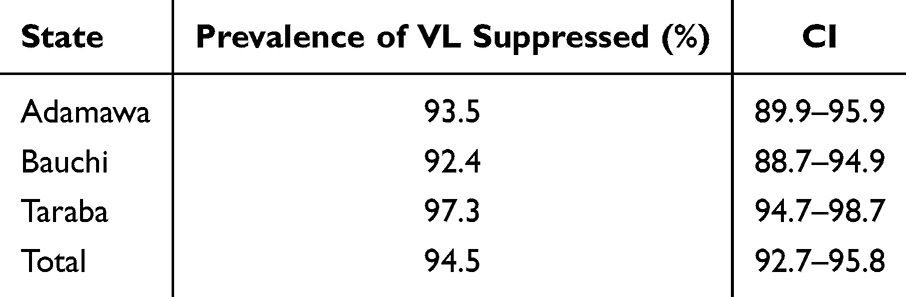 |
Table 1 Prevalence of Viral Load Suppression by State |
Tables 2 and 3 presents the prevalence of VL suppression by socio-demographic characteristics of caregiver and CALHIV. About 95.9% of female CALHIV had VL suppressed.
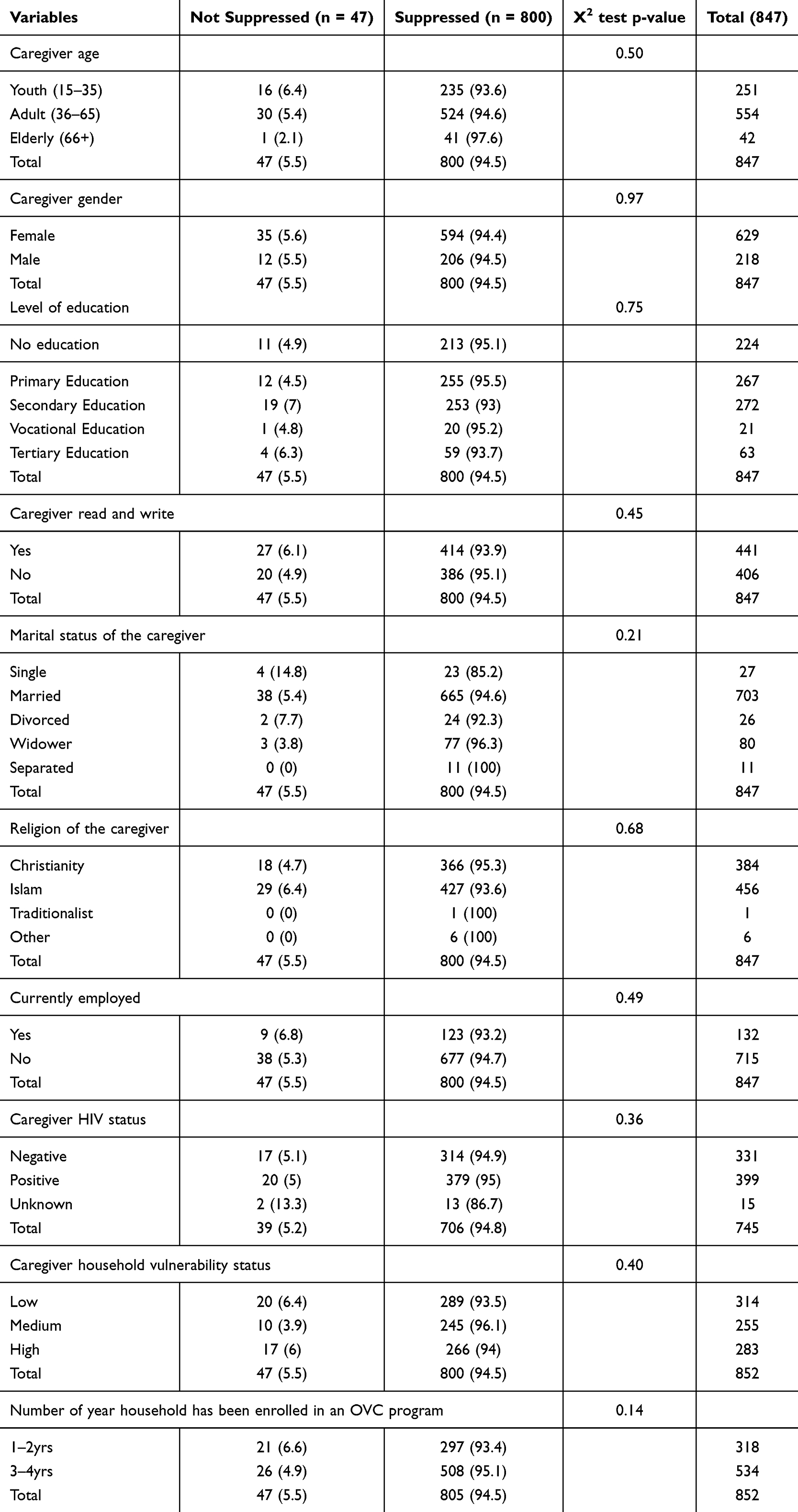 |
Table 2 Socio-Demographic Characteristics of Caregiver VL Suppression Status in the Three Implementation States |
 |
Table 3 Socio-Demographic Characteristics of CALHIV by VL Suppression Status in Three Implementing States |
Table 4 illustrates the viral load suppression rates among caregivers and CALHIV based on various factors. These factors include duration of enrollment in the OVC project, engagement in activities provided by the project through the Civil Society Organizations (CSOs), adherence to prescribed antiretroviral medication, presence of a treatment partner or supporter which includes the caregiver and/or community case worker and access to adequate food. Notably, most respondents who were on the project longer and receiving services on the OVC program had higher viral suppression rate (p value = 0.001 >2 years, 96%; >3 years; 95.7%; >4 years, 95.9%).
 |
Table 4 Other Factors of CALHIV by VL Suppression Status in Three Implementing States |
The study found that the approach adopted by the project of assigning case workers to support the CALHIV and caregivers yielded results. All assessed households acknowledged this support and showed a VL suppression rate of 97.4%. Moreover, adequate food played a role in viral suppression as CALHIV who had adequate food to eat achieved a VL suppression of 96.9%. These findings underscore the multifaceted nature of factors influencing VL suppression among CALHIV in an OVC program.
Table 5 presents the outcomes regarding odds ratios across various factors incorporated in the mixed-effects multivariable logistic regression model. CALHIV who spent 2 years and more on the program exhibited significantly higher odds of achieving viral load suppression (2 years: OR: 3.86, 95% CI: 1.45–10.29, p=0.007; 3 years: OR: 4.84, 95% CI: 1.95–11.98, p=0.001; 4 years: OR: 4.52, 95% CI: 1.48–13.80, p=0.008). Furthermore, children who had not experienced insufficient food to eat had higher odds compared to children who had experienced insufficient food to eat (OR: 3.17, 95% CI: 1.19–8.44, p=0.021). It should be noted that the OVC program provides facility-lite services, which explains why some adolescents and their caregivers do not visit home.
 |
Table 5 Results of Univariate Mixed-Effects Logistic Regression Models of Viral Load Suppression and Associated Factors Among Orphans and Vulnerable Children and Adolescents Living with HIV in Three Implementing States |
Discussion
The study focuses on assessing the factors influencing viral load suppression among CALHIV in Northeast Nigeria, specifically within the context of OVC programs. The overarching goal was to understand the dynamics that contribute to the successful management of HIV in this vulnerable population. The findings from the study showed a range of factors impacting viral load in CALHIV. It revealed that health/clinical, psychosocial, and programmatic factors affect viral load suppression rates in CALHIV. These findings align with outcomes from a similar study carried out in Kenya, which highlights the interplay of psychosocial and clinical factors affecting viral load outcomes in CALHIV.11 These findings also agree with the experience of the ICHSSA 4 project implementation across the states investigated in this study.
With an overall prevalence of 94.5% viral load suppression, the study provides regional breakdowns, revealing variations in Taraba (97.3%), Adamawa (93.5%), and Bauchi (92.4%). Gender disparities explored highlighted a notably higher viral load suppression rate of 95.9% among female CALHIV. The positive correlation between the duration of enrollment in the OVC program and viral load suppression is a significant finding. The duration of enrollment plays a crucial role, with a compelling 95.9% suppression rate among children enrolled for four years. Additionally, the higher the period on treatment, the higher the odds for viral suppression among CALHIV. The study sheds light on the impact of engagement with CSOs on viral load suppression. The OVC program provides value-added services that enhance adherence to treatment and, by extension, achieves viral load suppression at 95%. Furthermore, a noteworthy increase to 96.8% was observed among those engaged in CSO services for an extended duration, emphasizing the importance of sustained involvement. This aligns with a study in conducted in South Africa that showed the association between families accessing social interventions that provide economic support for their families and higher viral suppression rates.15 Additionally, another study in Kenya highlighted that through the provision of services by CSOs, such as opportunities for saving and lending, caregivers of CALHIV are likely to be more supportive in diverse ways that improve the well-being of CALHIV, including VL suppression.11
The role of medication adherence in achieving viral load suppression is underscored, as CALHIV, currently adhering to prescribed antiretroviral medication, showed a VLS rate of 95.0%. Studies have demonstrated that poor ARV adherence is associated with low viral suppression.16,17 The finding is similar to that from a study carried out in Zimbabwe that showed that poor adherence was a risk factor for virological failure.18 Similarly, it has been found that good adherence to ARV is positively associated with viral suppression among children and adolescents in Uganda.19 Moreover, good adherence to ARV is crucial for successful viral suppression, as poor adherence leads to an increase in HIV viremia, risk of treatment failure, and accumulating resistance mutations.20,21
The study underscores the significant impact of psychosocial support (PSS) on viral load suppression among CALHIV. Specifically, CALHIV with a treatment partner or supporter—comprising the primary caregiver, case manager, facility case worker, or case monitor—exhibited an impressive 97.4% suppression rate. Furthermore, CALHIV enrolled in a support group demonstrated a 94.5% suppression rate, while those assigned a case manager/community caseworker showed a 94.6% rate of suppression. A South African study showed that psychosocial interventions may improve the lives of OVC in general.22 This aligns with findings from a UNICEF study in Malawi, Uganda, and Zimbabwe that found that children living with HIV who receive treatment support from their families are more likely to achieve viral load suppression.23 It is, therefore, imperative that interventions are tailored to encourage caregivers as treatment supporters for CALHIV in their care. More so, it has been revealed in a Tanzanian study that adolescents who enrolled in peer support groups had better viral suppression outcomes,24 and belonging to a support group was associated with high viral load suppression rates.25,26 Peer support groups such as Operation Triple Zero (OTZ) have been identified as a successful strategy for improving the uptake of ART services by children and adolescents living with HIV, hence facilitating ART adherence and subsequent viral load suppression. These factors as highlighted above influenced results of clients across states of implementation of the project. Beyond medication, several factors such as PSS, financial support and peer influence impacted treatment outcomes.
Furthermore, the correlation between food security and viral load suppression is explored in this study, with high viral load suppression rates observed among children who had sufficient food (96.9%). The regression study equally reveals a high odd of achieving viral suppression with food security. Food insufficiency among caregivers may also play a major role in viral suppression among CALHIV.22,27 The mixed-effects multivariable logistic regression model provides a deeper understanding of the relationships between various factors and viral load suppression. Notably, the duration of OVC program enrollment is associated with significantly higher odds of viral load suppression.
Conclusion and Recommendations
This study comprehensively analyzes the factors influencing viral load suppression among CALHIV in an OVC project in Northeast Nigeria. The findings provide valuable insights into the local context of OVC programming and its effects on treatment outcomes for children and adolescents who are HIV positive. It also has broader implications for integrating HIV care interventions for CALHIV among pediatric sub-populations in low-resource settings globally. Understanding the complex interplay between engagement in OVC programs, involvement of CSOs, medication adherence, psychosocial support through caregiver involvement, and food security is crucial for designing effective, context-specific interventions to improve treatment outcomes among CALHIV. Additionally, the study underscores the role of OVC programs in advancing the UNAIDS 95–95–95 goals, particularly the third 95, which focuses on viral load suppression.
The study recommends a longitudinal study would significantly enhance our understanding of the factors influencing viral load suppression among CALHIV over an extended period. This would provide more robust and insightful findings that could inform targeted interventions and strategies. Additionally, targeted interventions based on the study’s findings should be developed and implemented to improve viral load suppression rates among CALHIV. These interventions should focus on enhancing psychosocial support and addressing food insecurity, as highlighted in the study’s findings.
Furthermore, capacity-building initiatives should be implemented to train healthcare providers and caregivers on the importance of medication adherence, HIV status disclosure, and other factors influencing viral load suppression. These initiatives should include initial and refresher training to ensure that healthcare providers and caregivers have the knowledge and skills to support CALHIV effectively. Additionally, policy changes geared towards sustainability should be advocated to support access to comprehensive HIV care and support services for CALHIV. This could include advocating for state Community Health Insurance schemes that cover comprehensive HIV care, support services, and policies that address food security and enhance psychosocial support for CALHIV.
Strengths and Limitations of the Study
The strengths of this study include its use of independent surveys conducted by external investigators not affiliated with the USAID PEPFAR-funded project, its large analytic sample, and its inclusion of three states in the Northeast. This study illustrates the proportion of viral load suppression disaggregated by states with the inclusion of household sociodemographic variables, which yield representative samples of OVC and their caregivers to provide data to address research questions on USAID PEPFAR-funded project and inform future improvements.
Limitations
Although the study has its benefits, as shown above, its limitations include reliance on self-reporting by caregivers, particularly for variables such as caregiver literacy, which may have been subject to social desirability bias. The reliance on self-reporting and caregiver recall for some variables may result in recall bias, affecting the data’s accuracy. Because the study is limited within the context of Northeast Nigeria, findings may not apply to the entire region with other imposing sociodemographic factors besides the sample size. Due to the study’s cross-sectional nature, causal relationships between variables could not be established.
Acknowledgment
The authors wish to acknowledge the entire Pro-Health International ICHSSA-4 team and Civil Society Organizations implementing the OVC project in Northeastern Nigeria, United States Agency for International Development (USAID) providing technical backstopping as well as funding for the program, relevant state government ministries and agencies and other stakeholders involved in the implementation of ICHSSA-4 project.
Author Contributions
All the authors made significant contributions to the work reported, conceptualization, study design, execution, data acquisition, analysis and interpretation. The author also took part in drafting, revising and critically reviewing the article; and gave approval of the version to be published.
Funding
This study is funded by USAID as part of the implementation of the ICHSSA 4 project under the cooperative agreement number 720620202CA00005.
Disclosure
The authors have no conflict of interest to report.
References
1. UNAIDS. (2020) Global AIDS Monitoring; Country progress report-Nigeria. Available from: https://www.unaids.org/sites/default/files/country/documents/NGA_2020_countryreport.pdf.
2. NAIIS. (2019) NAIIS Fact sheet. Available from: https://www.naiis.ng/resource/factsheet/NAIIS%20PA%20NATIONAL%20FACTSHEET%20FINAL.pdf.
3. UNICEF. (2019) Pediatric Care and Treatment.
4. Viral suppression and associated factors among children tested for HIV viral load at Amhara Public Health Institute, Dessie Branch, Ethiopia: a cross-sectional study. Avaiable from: https://www.ncbi.nlm.nih.gov/pmc/articles/PMC9890760/.
5. Okonji EF, van Wyk B, Mukumbang FC, et al. Determinants of viral suppression among adolescents on antiretroviral treatment in Ehlanzeni district, South Africa: a cross-sectional analysis. AIDS Res Ther. 2021;18(1):66. doi:10.1186/s12981-021-00391-7
6. Gordon TP, Talbert M, Mugisha MK, Herbert AE. Factors associated with HIV viral suppression among adolescents in Kabale district, South Western Uganda. PLoS one. 2022;17(8):e0270855.
7. Ekwueme C, Torbonde N, Anaba UC, Makplang M, Ekong E, Sam-Agudu NA. The third 90: viral suppression among HIV- POSITIVE CHILDREN AND ADOLESCEnts in 10 Nigerian states. 2018. Human Res Health. 2018;16. doi:10.1186/s12960-018-0313-9
8. UNAIDS. (2021) End inequalities. End AIDS. Global AIDS Strategy 2021-2026.
9. Joint United Nations Programme on HIV/AIDS. (2021) UNAIDS epidemiological estimates. Available from: https://aidsinfo.unaids.org/.
10. Han WM, Law MG, Egger M, et al. Global estimates of viral suppression in children and adolescents and adults on antiretroviral therapy adjusted for missing viral load measurements: a multiregional, retrospective cohort study in 31 countries. Lancet HIV. 2021;8(12):e766–e775. [pmid:34856180]. doi:10.1016/S2352-3018(21)00265-4
11. Onyango B, Mokaya R, Wasianga J, et al. Factors associated with viral load suppression among orphans and vulnerable children and adolescents living with HIV in Kenya. PLOS Glob Public Health. 2023;3(3):e0000794. PMID: 36963026; PMCID: PMC10035747. doi:10.1371/journal.pgph.0000794
12. UNICEF. (2021) Understanding and Improving Viral Load Suppression in Children with HIV In Eastern and Southern Africa Available from: https://www.unicef.org/esa/reports/understanding-and-improving-vls.
13. Landovitz R. What’s the best way to measure ART adherence, vol. 3. Massachusetts: journal Watch; p. 23.nal, retrospective cohort study in 31 countries. Lancet HIV. 2011;8(12):e766–e775. pmid:34856180.
14. WHO. (2011) Meeting Report on the Assessment of World Health Organization Hiv Drug Resistance Early Warning Indicators [Internet]. Available from: https://apps.who.int/iris/bitstream/handle/10665/75186/9789241503945_eng.pdf?sequence=1.
15. Sitienei EC, Pillay J. Psycho-educational and social interventions provided for orphans and vulnerable children at a community-based organisation in Soweto, South Africa. Afr J AIDS Res. 2019;18(1):1–8. doi:10.2989/16085906.2018.1548359
16. Bulage L, Ssewanyana I, Nankabirwa V, et al. Factors associated with virological non-suppression among hiv-positive patients on antiretroviral therapy in Uganda, August 2014–July 2015. BMC Infect Dis. 2017;17(1):326. doi:10.1186/s12879-017-2428-3
17. Bernheimer JM, Patten G, Makeleni T, et al. Paediatric HIV treatment failure: a silent epidemic. J Int AIDS Soc. 2015;18(1):20090. doi:10.7448/IAS.18.1.20090
18. Sithole Z, Mbizvo E, Chonzi P, et al. Virological failure among adolescents on ART, Harare City, 2017- a case-control study. BMC Infect Dis. 2018;18(1):469. PMC free article. doi:10.1186/s12879-018-3372-6
19. Natukunda J, Kirabira P, Ong KIC, Shibanuma A, Jimba M. Virologic failure in HIV-positive adolescents with perfect adherence in Uganda: a cross-sectional study. Trop Med Health. 2019;47(1):8. PMC free article. doi:10.1186/s41182-019-0135-z
20. Hailu GG, Hagos DG, Hagos AK, Wasihun AG, Dejene TA, Paraskevis D. Virological and immunological failure of HAART and associated risk factors among adults and adolescents in the Tigray region of Northern Ethiopia. PLoS One. 2018;13(5):e0196259. doi:10.1371/journal.pone.0196259
21. Muri L, Gamell A, Ntamatungiro AJ, et al. Development of HIV drug resistance and therapeutic failure in children and adolescents in rural Tanzania. AIDS. 2017;31(1):61–70. doi:10.1097/QAD.0000000000001273
22. Zanoni BC, Sibaya T, Cairns C, Lammert S, Haberer JE. Higher retention and viral suppression with adolescent-focused HIV clinic in South Africa. PLoS One 2017;12(12):e0190260. doi:10.1371/journal.pone.0190260
23. Nasuuna E, Kigozi J, Babirye L, et al. Low HIV viral suppression rates following the intensive adherence counseling (IAC) program for children and adolescents with viral failure in public health facilities in Uganda. BMC Public Health. 2018;18(1):1048. doi:10.1186/s12889-018-5964-x
24. Evans D, Menezes C, Mahomed K, et al. Treatment outcomes of HIV-infected adolescents attending public-sector HIV clinics across Gauteng and Mpumalanga, South Africa. AIDS Res Hum Retroviruses. 2013;29(6):892–900. doi:10.1089/AID.2012.0215
25. Ayer R, Kikuchi K, Ghimire M, et al. Clinic attendance for antiretroviral pills pick-up among HIV-positive people in Nepal: roles of perceived family support and associated factors. PLoS One 2016;11(7):e0159382. doi:10.1371/journal.pone.0159382
26. Ferrand R, Simms V, Dauya E, et al. The effect of community-based support for caregivers on the risk of virological failure in children and adolescents with HIV in Harare, Zimbabwe (ZENITH): an open-label, randomised controlled trial. Lancet Child Adolesc Health. 2017;1(3):175–183. doi:10.1016/S2352-4642(17)30051-2
27. Akpan U, Yucel R, Liu Z, et al. Strategies for improving viral suppression among children living with HIV considered to be failing first-line antiretroviral therapy in Akwa Ibom, Nigeria: a before - after study. Int J Pediatric Res. 2023;9(1). doi:10.23937/2469-5769/1510112.
 © 2025 The Author(s). This work is published and licensed by Dove Medical Press Limited. The
full terms of this license are available at https://www.dovepress.com/terms
and incorporate the Creative Commons Attribution
- Non Commercial (unported, 4.0) License.
By accessing the work you hereby accept the Terms. Non-commercial uses of the work are permitted
without any further permission from Dove Medical Press Limited, provided the work is properly
attributed. For permission for commercial use of this work, please see paragraphs 4.2 and 5 of our Terms.
© 2025 The Author(s). This work is published and licensed by Dove Medical Press Limited. The
full terms of this license are available at https://www.dovepress.com/terms
and incorporate the Creative Commons Attribution
- Non Commercial (unported, 4.0) License.
By accessing the work you hereby accept the Terms. Non-commercial uses of the work are permitted
without any further permission from Dove Medical Press Limited, provided the work is properly
attributed. For permission for commercial use of this work, please see paragraphs 4.2 and 5 of our Terms.