
Back to Journals » Clinical, Cosmetic and Investigational Dermatology » Volume 19
Evaluating the Top Interdisciplinary Authors in Dermatology and Immunology Through Decadal Trend H-Index Analysis of 1980-2024
Authors Lau M, Szeto MD, Patel D, Mo L  , Tan KJ, Del Duca E, Dellavalle RP, Guttman-Yassky E
Received 30 August 2025
Accepted for publication 25 February 2026
Published 11 March 2026 Volume 2026:19 564192
DOI https://doi.org/10.2147/CCID.S564192
Checked for plagiarism Yes
Review by Single anonymous peer review
Peer reviewer comments 2
Editor who approved publication: Dr Jeffrey Weinberg
Megan Lau,1 Mindy D Szeto,2 Dev Patel,1 Lillian Mo,1 Kathryn Jayne Tan,1 Ester Del Duca,1 Robert P Dellavalle,3 Emma Guttman-Yassky1
1Department of Dermatology, Icahn School of Medicine at Mount Sinai, New York, NY, USA; 2Feinberg School of Medicine, Northwestern University, Chicago, IL, USA; 3Department of Dermatology, University of Minnesota School of Medicine, Minneapolis, MN, USA
Correspondence: Emma Guttman-Yassky, Department of Dermatology, Icahn School of Medicine at Mount Sinai, 5 E 98th Street, New York, NY, 10029, USA, Tel +1 212-241-9728/3288, Fax +1 212-876-8961, Email [email protected]
Objective: Previous bibliometric analyses focus on primary specialty, potentially overlooking authors whose contributions span multiple disciplines. Given the increasing recognition of dysregulated immunological processes in dermatological conditions and the targeting of immune pathways in therapeutics, this study aims to evaluate the h-index of authors in both dermatology and immunology, capturing the multifaceted research landscape of dermatology and providing a comprehensive assessment of scholarly impact.
Methods: A search of the Web of Science (WOS) schema from 1980 to 2024 was conducted using the InCites dataset, limited to original articles, editorial materials, and meeting abstracts, and authors were ranked by InCites h-index.
Results: Over the past 5 years, the top 20 authors by InCites h-index in dermatology and immunology research were 65% males and 35% females, with USA (30%), Germany (20%), and France (15%) representing the highest proportions of authors. The trends across decades showed increased representation of female authors, presence of institutions outside the United States, and cross-disciplinary productivity in dermatology and immunology.
Conclusion: The cross-disciplinary associations in dermatology underscore the utility of the h-index in assessing scholarly impact across multiple fields. The observed growth in interdisciplinary productivity and global representation among leading authors reflects translational research exploring immune pathways and molecular profiles that have driven the advancement and translational revolution of immunology-based therapies in dermatology.
Keywords: h-index, scholarly influence, interdisciplinary citations, bibliometric analysis
Introduction
Proposed by Hirsch in 2005, the h-index measures a researcher’s impact based on the number of publications and citations.1 The metric varies across disciplines and may require standardization for direct comparisons across specialties.1 Despite this variability, the interdisciplinary nature of research allows the h-index to reflect broader scholarly influence beyond a researcher’s primary field. To date, this is the first study to evaluate the h-index of authors in dermatology and immunology.
Szeto et al examined the top dermatologic authors using the h-index from 1980 to 2020 and used Web of Science (WOS) category field WC = “dermatology” to filter publications.2 However, bibliometric analyses based on primary specialty or departmental affiliation may overlook authors whose contributions span across interdisciplinary fields. In this study, our comprehensive search approach integrates dermatology and immunology to reflect the multifaceted research landscape of dermatology.
Interdisciplinary citation metrics are important for evaluating scientific impact, especially in translational medicine, as they capture the dissemination of ideas across different disciplines. Translational advances that improve patient outcomes often emerge from multidisciplinary efforts, and prior studies have shown that research with higher levels of interdisciplinary citation demonstrates more sustained long-term impact.3 Prior studies mapping immune profiles in dermatologic conditions and immune-targeted therapies have improved patient outcomes, optimized response rates, and are used to guide treatment in both responders and non-responders, allowing a more personalized approach to dermatologic care.4,5 The h-index metric can capture interdisciplinary influence by reflecting sustained cross-disciplinary citation and integrating productivity with citation impact across diverse fields; however, it may have limitations in distinguishing between highly specialized or field-specific contributions within interdisciplinary research.6
Investigations of immunopathological mechanisms have led to targeted therapies that revolutionized dermatologic treatment, with immune pathways playing a central role in the pathogenesis of common skin conditions such as psoriasis (IL23/Th17-driven), atopic dermatitis (Th2-driven), lichen planus (Th1-driven), and lupus erythematosus (type-II-IFN-involvement).5,7 Transcriptomic, proteomic, and cytokine analysis of skin and blood have identified key biomarkers, shown the immune molecular profiles of skin conditions, driven the expansion of systemic therapeutics, and established the groundwork for personalized medicine in dermatology.8 Given the cumulative integration of immunology within dermatologic research and the broader shift toward immune-targeted therapies, this study is the first to assess the h-index of authors publishing in both disciplines to comprehensively characterize scholarly impact.9 This analysis provides a quantitative framework to identify fundamental contributors establishing the foundation of translational research in dermatology and benchmark institutional and investigator impact, thus offering insights to guide global collaborations and understand long-term scholarly impact that has shaped the field.
Methods
A search from 1980 to 2024 of the WOS schema was conducted on December 30, 2024, using the InCites dataset and WOS researcher profiles. The query criteria were set to research areas “dermatology” and “immunology” and limited to original articles, letters, editorial materials, and meeting abstracts. Research profiles focused exclusively on immunology or dermatology, with no publications in the respective field, were excluded from the analysis. Authors were ranked by InCites h-index, and gender, Google Scholar H-index, and Scopus H-index were presented based on Google searches of full names and the authors’ last-known institutional affiliation.
The dataset included bibliometric and demographic variables for leading contributors in immunology and dermatology, organized by decade. Data extracted from WOS included decade, country, affiliation, times cited, percentage of documents cited, number of immunology articles, number of dermatology articles, Category Normalized Citation Impact (CNCI), and number of documents cited. The data were used to evaluate trends in author gender representation, geographic distribution, research productivity, and citation impact across decades.
Results
Gender and Geographic Representation Among Leading Authors
From 1980 to 1989, all contributors of dermatology and immunology were male (100%) (Table 1). During 1990–1999, female authorship emerged at 5%, and continued to increase to 15% in 2000–2009, and reached 35% in 2020–2024 (Table 1 and Table 2). In 1980-1989, most contributors originated from the United States (85%), with smaller representation from Brazil (5%) and France (5%) (Table 1). Over the recent 5 years, the top-ranked authors by InCites h-index were more dispersed with representation in the USA (30%), followed by Germany (20%) and France (15%) (Table 2).
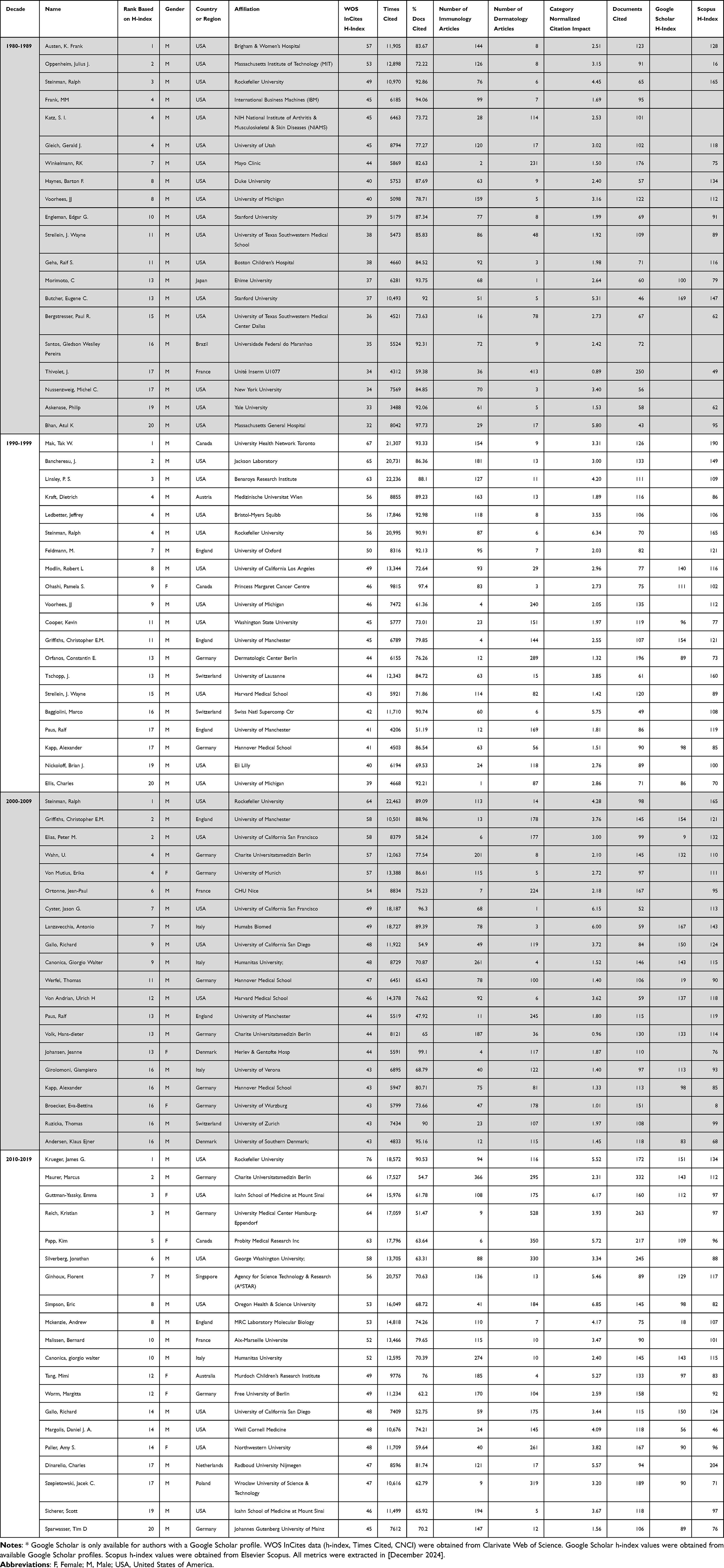 |
Table 1 Top 20 Dermatology and Immunology h-Index Authors by Decade, 1980–2020 |
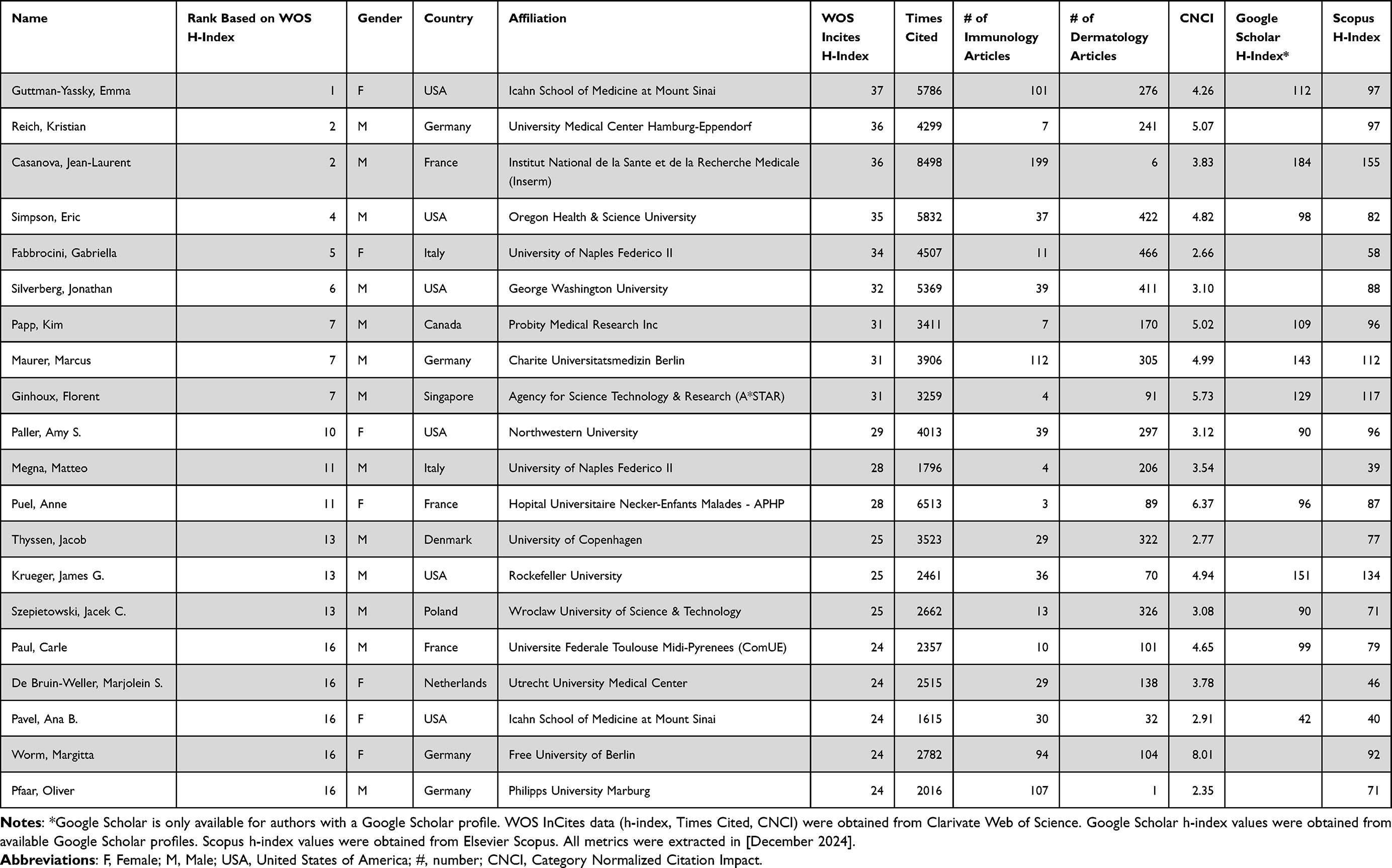 |
Table 2 Top 20 Dermatology and Immunology Authors by h-Index, 2020–2024 |
Growth in Scholarly Impact of Dermatology and Immunology Integration
Across four decades (1980s–2010s), authors in dermatology and immunology demonstrated a continual increase in bibliometric influence (Table 1 and Table 2). The mean WOS h-index increased from 40.6 in the 1980s to 54.2 in the 2010s, with the maximum individual h-index reaching 76 in the most recent decade (Table 1). The mean CNCI of authors in both disciplines increased from 2.75 ± 1.24 in 1980–1989 to 4.13 ± 1.44 in 2010–2019 (Table 1). Overall, 50% of the top-ranked authors in 2020–2024 have a CNCI above 4, demonstrating research impact 4 times above the global average in their interdisciplinary fields (Table 2).
Expansion of Cross-Disciplinary Productivity
From 1980 to 1989, top-ranked authors aggregately produced 1475 immunology and 995 dermatology publications (Table 1). In 2010–2019, output increased to 2296 immunology and 3060 dermatology publications (Table 1). As immunology directed the bibliometric footprint of top-ranked authors in earlier decades, the dataset reveals a progressive shift as dermatology publications grew at a faster rate than immunology output, narrowing the disciplinary gap. The scope of dermatology research expanded substantially over the study period per author. In 1980–1989, highly ranked authors produced an average of approximately 50 dermatology publications, increasing to over 150 in 2010–2019 with nearly a threefold rise (Table 1). Immunology-related publications also increased, from an average 74 in earlier decades to 115 in the 2010s, reflecting growing cross-disciplinary activity (Table 1).
Discussion
Our analysis indicates sustained growth in the bibliometric influence of dermatology and immunology authors over four decades through quantification of impact across interdisciplinary fields and identifies key drivers of translational research, benchmarks investigator impact, and informs funding decisions, academic advancement, and cross-disciplinary collaboration. Previous bibliometric studies have largely examined dermatology exclusively or over shorter time intervals. The trends of both disciplines are similar to Szeto et al; in which the ranking of top h-index authors in exclusively dermatology by decade demonstrated an increasing proportion of female authors across decades and an expanded presence of institutions outside the United States and the United Kingdom.2 However, the increasing presence of authors from other countries signals the growing globalization of research, driven by increased international collaboration between institutions.10
The findings from the analysis expand the literature on cross-disciplinary productivity. While immunology initially dominated the bibliometric footprint in the 1980s, dermatology output grew at a faster rate, reflecting both the expansion of dermatology as a research field and the increasing integration with immunology. These findings support the paradigm shift in translational dermatology in which advances in inflammatory skin disease research and understanding immunopathomechanisms have revolutionized the therapeutic repertoire.11
The trajectory of dermatology integration with immunology parallels therapeutic innovation. Many of the transformative therapeutics in dermatology, including biologics targeting TNF-α, IL-17, and IL-23, and small-molecule inhibitors, originated from fundamental immunological research and further application to skin disease.12 Immunology has supported major therapeutic advances in dermatology including dupilumab, an IL-4 receptor alpha antagonist, in which the mechanism comes from foundational immunologic research.12 Dupilumab now carries multiple indications for dermatologic skin disease including atopic dermatitis, chronic spontaneous urticaria, and bullous pemphigoid.13
When available, Google Scholar and Scopus h-indices were consistently higher than InCites h-index as the InCites h-index is calculated within a specified time frame, whereas Google Scholar and Scopus account for all published articles.2,14 Other metrics including g-index have stronger emphasis on highly cited papers, the i10-index includes publications with at least 10 citations, and Altmetric scores reflect real-time online attention with how many times the articles and authors are mentioned.15,16 The h-index incorporates productivity and citations and the cross-disciplinary associations in dermatology highlight the potential utility of the h-index in capturing an author’s broader scholarly impact that extends across multiple adjacent fields. However, the h-index has several limitations, including its bias toward career length, inability to account for author rank, variation depending on the citation database, and tendency to favor established disciplines, potentially underestimating researchers in emerging disciplines where citations accumulate more slowly.1 Future research can supplement h-index with complementary metrics by including author contribution, seniority, and h-index across different databases to ensure a more extensive evaluation of scientific contributions and influence.
Disclosure
Emma Guttman-Yassky is an employee of Mount Sinai and has received research grants from and/or is a consultant for Abbvie, Arcutis, Almirall, Amgen, AnaptysBio, Apogee Therapeutics, Apollo Therapeutics Limited, Artax Biopharma Inc., Aslan, Astria, Bristol Myers Squibb, Boerhinger-Ingelhiem, Calliditas, Cara Therapeutics, Celldex, Centrexion Therapeutics Corporation, Concert, Connect Biopharm, Coty, DBV Technologies, Eli Lilly, Enveda Biosciences, Escient Pharmaceuticals, Inc., Fairmount Funds Management LLC, FL2022-001, Inc., Galderma, Gate Bio, Google Ventures (GV), GSK Immunology, Incyte, Inmagene, Janssen Biotech, Jasper Therapeutics, Kymera Therapeutics, Kyowa Kirin, Leo Pharma, Matchpoint Therapeutics, Merck, Nektar Therapeutics, Novartis Pharmaceuticals, NUMAB Therapeutics AG, Nuvig, OrbiMed Advisors LLC, OTSUKA, Pfizer, Pharmaxis Ltd, Pioneering Medicine VII, Inc., Proteologix US Inc, Q32Bio, RAPT, RayThera, Inc, Regeneron Pharmaceuticals, RibonTherapeutics, Inc., Rocatinlimab, SAGIMET Bioscieces, Sanofi, SATO, Schrödinger, Inc., Sitryx, Sun Pharma Advanced Research Company (SPARC), Takeda, Teva Branded Pharmaceutical Products R&D, Inc, TRex, UCB, Ventyx Biosyences. The rest of the authors declare that they have no relevant conflicts of interest.
References
1. Hirsch JE. An index to quantify an individual’s scientific research output. Proc Natl Acad Sci U S A. 2005;102(46):16569–9. doi:10.1073/pnas.0507655102
2. Szeto MD, Presley CL, Maymone MBC, et al. Top authors in dermatology by h-index: a bibliometric analysis of 1980-2020. J Am Acad Dermatol. 2021;85(6):1573–1579. doi:10.1016/j.jaad.2020.10.087
3. Larivière V, Haustein S, Börner K. Long-distance interdisciplinarity leads to higher scientific impact. PLoS One. 2015;10(3):e0122565. doi:10.1371/journal.pone.0122565
4. Ungar B, Manson M, Kim M, et al. Tape-strip profiling identifies unique immune and lipid dysregulation in patients with seborrheic dermatitis. J Am Acad Dermatol. 2025;92(6):1277–1287. doi:10.1016/j.jaad.2025.01.082
5. Seremet T, Di Domizio J, Girardin A, et al. Immune modules to guide diagnosis and personalized treatment of inflammatory skin diseases. Nat Commun. 2024;15(1):10688. doi:10.1038/s41467-024-54559-6
6. Bornmann L, Daniel HD. The state of h index research. Is the h index the ideal way to measure research performance? EMBO Rep. 2009;10(1):2–6. doi:10.1038/embor.2008.233
7. Inkeles MS, Scumpia PO, Swindell WR, et al. Comparison of molecular signatures from multiple skin diseases identifies mechanisms of immunopathogenesis. J Invest Dermatol. 2015;135(1):151–159. doi:10.1038/jid.2014.352
8. Obi A, Rothenberg-Lausell C, Levit S, Del Duca E, Guttman-Yassky E. Proteomic alterations in patients with atopic dermatitis. Expert Rev Proteomics. 2024;21(5–6):247–257. doi:10.1080/14789450.2024.2350938
9. Terhaar H, Jiminez V, Grant E, Collins C, Khass M, Yusuf N. Immune repertoires in various dermatologic and autoimmune diseases. Genes. 2024;15(12). doi:10.3390/genes15121591
10. Gantenbein L, Arora P, Navarini A, Brandt O, Mueller SM. Global publication productivity in dermatology: a bibliometric description of the past and estimation of the future. J Eur Acad Dermatol Venereol. 2021;35(7):1424–1433. doi:10.1111/jdv.17196
11. Facheris P, Jeffery J, Del Duca E, Guttman-Yassky E. The translational revolution in atopic dermatitis: the paradigm shift from pathogenesis to treatment. Cell Mol Immunol. 2023;20(5):448–474. doi:10.1038/s41423-023-00992-4
12. Liu D, Patel D, Lau M, et al. A translational approach to improve therapeutics in atopic dermatitis and beyond. J Immunol. 2025;214(9):2165–2179. doi:10.1093/jimmun/vkaf049
13. Napolitano M, Di Guida A, Nocerino M, Fabbrocini G, Patruno C. The emerging role of dupilumab in dermatological indications. Expert Opin Biol Ther. 2021;21(11):1461–1471. doi:10.1080/14712598.2021.1907341
14. Mondal H, Deepak KK, Gupta M, Kumar R. The h-Index: understanding its predictors, significance, and criticism. J Family Med Prim Care. 2023;12(11):2531–2537. doi:10.4103/jfmpc.jfmpc_1613_23
15. Elmore SA. The altmetric attention score: what does it mean and why should I Care? Toxicol Pathol. 2018;46(3):252–255. doi:10.1177/0192623318758294
16. Alter N, Daiem M, Pontell ME, et al. Limitations of academic bibliometric indices: the need for more comprehensive metrics. Ann Plast Surg. 2025;95(6):603–606. doi:10.1097/sap.0000000000004484
 © 2026 The Author(s). This work is published and licensed by Dove Medical Press Limited. The
full terms of this license are available at https://www.dovepress.com/terms
and incorporate the Creative Commons Attribution
- Non Commercial (unported, 4.0) License.
By accessing the work you hereby accept the Terms. Non-commercial uses of the work are permitted
without any further permission from Dove Medical Press Limited, provided the work is properly
attributed. For permission for commercial use of this work, please see paragraphs 4.2 and 5 of our Terms.
© 2026 The Author(s). This work is published and licensed by Dove Medical Press Limited. The
full terms of this license are available at https://www.dovepress.com/terms
and incorporate the Creative Commons Attribution
- Non Commercial (unported, 4.0) License.
By accessing the work you hereby accept the Terms. Non-commercial uses of the work are permitted
without any further permission from Dove Medical Press Limited, provided the work is properly
attributed. For permission for commercial use of this work, please see paragraphs 4.2 and 5 of our Terms.