
Back to Journals » Research and Reports in Tropical Medicine » Volume 17
Entomo-Molecular and Epidemiological Survey of Arboviruses in Aedes (Stegomyia) aegypti Mosquito Populations and Dengue Seroprevalence Among Migrants in Reynosa, a City on the US-Mexico Border
Authors Fernández-Santos NA  , Adeniran AA, Dauda OG, Ramírez-Palacios LR, Wei L, Rodríguez-Pérez MA
Received 17 March 2026
Accepted for publication 10 July 2026
Published 22 July 2026 Volume 2026:17 608746
DOI https://doi.org/10.2147/RRTM.S608746
Checked for plagiarism Yes
Review by Single anonymous peer review
Peer reviewer comments 2
Editor who approved publication: Professor Preeti Shanbag
Nadia A Fernández-Santos,1,2,* Adebiyi Abdulhakeem Adeniran,3,* Oluwadamilare Ganiu Dauda,1 Luis Román Ramírez-Palacios,4 Lihua Wei,1 Mario A Rodríguez-Pérez1
1Instituto Politécnico Nacional, Centro de Biotecnología Genómica, Reynosa, Tamaulipas, México; 2Department of Entomology, Texas A&M University, College Station, TX, USA; 3Department of Infectious Diseases, Washington University School of Medicine, St Louis, MO, USA; 4Laboratorio Estatal de Salud Pública de Oaxaca, Secretaría de Salud, Oaxaca, México
*These authors contributed equally to this work
Correspondence: Nadia A Fernández-Santos; Mario A Rodríguez-Pérez, Email [email protected]; [email protected]
Background: Border regions such as the US–Mexico border may be particularly vulnerable to dengue emergence and re-emergence due to high human mobility, cross-border movement, and favorable conditions for Aedes mosquitoes.
Methods: We investigated dengue and other arboviruses in mosquito vectors, and dengue seroprevalence among migrants residing in camps in Reynosa, Mexico, between October 2019 and November 2022. Entomological surveillance was conducted in two phases using BG-Sentinel traps, CDC backpack aspirators, Autocidal Gravid Ovitraps, and resting boxes. Mosquito trapping was done twice a week with an interval of 3 days between each trapping. Mosquito samples were tested by RT-PCR for dengue, chikungunya, and Zika viruses, while migrant blood samples were screened for anti-dengue IgM antibodies using ELISA.
Results: In the first phase, 2263 mosquitoes were collected, including 456 females Aedes aegypti grouped into 42 pools; three pools were positive for DENV-2 while none were positive for DENV-1, DENV-3, DENV-4, chikungunya virus, or Zika virus. During the second phase, 1713 mosquitoes were collected, including 179 female A. aegypti grouped into 14 pools, with one pool positive for dengue virus and none positive for chikungunya or Zika viruses. Among the 95 migrant serum samples analyzed, four were positive for anti-DENV IgM, yielding a seroprevalence of 4.2% (95% CI: 1.2– 10.4%). Participants reported frequent mosquito exposure and general awareness of mosquitoes, although knowledge of mosquito-borne arboviruses and preventive practices remained limited. IgM-seropositive participants were less likely to report mosquito contact in their country of origin than seronegative individuals (0% vs. 67.8%; p = 0.013), which may suggest local exposure, though IgM serology cannot determine the timing or location of infection.
Conclusion: These findings highlight the need for strengthened vector control and arboviral surveillance in Reynosa, both to reduce local transmission and to mitigate the risk of cross-border spread.
Keywords: Aedes aegypti, Arboviruses, entomo-molecular analysis, migrants, US-Mexico border
Introduction
Dengue virus (DENV), chikungunya virus (CHIKV) and Zika virus (ZIKV) are arboviruses of major public health concern across tropical and subtropical regions, transmitted principally by Aedes (Stegomyia) species.1 Arboviruses transmitted by Aedes mosquitoes constitute a significant public health risk in regions inhabited by almost 4 billion people.2 Among these, dengue constitutes the greatest challenge as it places considerable strain on public health system due to its extensive geographic spread and the frequent occurrence of large outbreaks.1,2 Dengue is caused by infection with any of four antigenically distinct but closely related dengue virus types or serotypes (DENV-1 to DENV-4).3 Globally, an estimated 100–400 million infections occur annually.2 An estimated 75% of dengue virus infections do not lead to noticeable symptoms.2 In symptomatic individuals, illness usually begins 4–10 days following an infectious mosquito bite and can vary from a self-limiting febrile disease to severe, potentially fatal manifestations such as dengue shock syndrome.2 Approximately 5% of reported cases develop severe dengue, marked by vascular leakage, significant bleeding, and organ dysfunction, necessitating prompt clinical management and supportive treatment.4 In 2024, an estimated 14.1 million dengue cases were reported worldwide, exceeding the previous record of 7 million cases documented in 2023.5 This represents double the figure reported in the preceding year. An estimated 9508 dengue-related deaths were reported, corresponding to a global case-fatality rate of 0.07%.5 The Americas account for a substantial share of the global disease burden, with more than 13 million cases notified to the World Health Organization.2
In Mexico, dengue is hyperendemic, with sustained circulation of all four serotypes, a high disease burden, and a marked increase in impact over recent decades.6,7 Ongoing transmission has been documented in most Mexican states, with the widespread distribution of the primary vector, Aedes aegypti, which has been reported in 30 states.7 All four DENV serotypes have been reported in the US–Mexico border region, an area that remains infrequently surveyed.6 In addition, CHIKV has been detected in nearly all states in Mexico, with the highest incidence observed in the southern and central regions of the country.8 Autochthonous CHIKV infections have also been documented in Cameron County, Texas along the US–Mexico border, as well as among residents of border communities in Tamaulipas, Mexico.9 Climatic conditions marked by heavy rainfall and warm temperatures have been implicated in creating favorable environments for the proliferation of arbovirus-transmitting vectors.10 In addition to these environmental drivers, human mobility further complicates transmission dynamics. Large-scale migratory movements, particularly involving individuals originating from endemic countries, increase the likelihood of introducing novel dengue virus serotypes into non-endemic region, thereby amplifying transmission risk.11 These risks are further intensified by the vulnerable conditions experienced by many migrants. Overcrowded, temporary shelters and migrant camps often lack adequate sanitation and hygiene infrastructure, creating environments suitable for the establishment and proliferation of Ae. aegypti and thereby increasing the potential for dengue, CHIKV and other arbovirus transmission.12 Despite this, the infectivity status of the local vector population is poorly investigated. In this exploratory study, we investigated whether arbovirus transmission in Reynosa, a northern Mexico–US border city, may be influenced by the movement of individuals from southern regions seeking entry into the United States, given that human mobility and travel have been associated with the introduction of arboviruses into receptive or previously non-endemic areas.13 Specifically, we aimed to determine whether Ae. aegypti populations in migrant shelter are involved in arbovirus transmission and assess dengue seroprevalence among populations residing in migrant camps, thereby generating evidence relevant to arboviral risk at the US–Mexico border.
Materials and Methods
Ethical Consideration
The study protocol was approved by the Ethics Committee of the Escuela Nacional de Medicina y Homeopatía, Instituto Politécnico Nacional (IRB No. CBE/006/2020), and was conducted in accordance with the principles of the Declaration of Helsinki. Two distinct permissions were obtained. First, the shelter authorities and property owners granted permission for trap deployment on their premises for the duration of sample collection. Second, separate written informed consent was obtained from all eligible human participants prior to blood collection and questionnaire administration, following a clear explanation of the study objectives, the voluntary nature of participation, and the right to withdraw at any time. All samples were collected in accordance with the approved protocol and international ethical guidelines.
Study Area
The study was carried out in Reynosa, a city located along the US–Mexico border (Figure 1). Mosquito sampling was conducted at mission-supported migrant shelters that provide temporary accommodation for migrants from southern Mexico and for individuals deported from the United States. Samples were collected from shelters in Pedro Mendez, Nuevo Amanecer, Aquiles Serdán and in the Ramos neighborhoods, specifically Casa del Migrante “Nuestra Señora de Guadalupe” (26.09712, −98.28661) and the Senda de Vida shelter (26.10007, −98.28467) in Reynosa, Tamaulipas. These sites were purposively selected based on the high concentration of migrant populations in the area. The migrant house “Señora de Guadalupe” shelter hundreds of migrants, mostly from Haiti, with women and children being the primary residents. The Senda de Vida shelter houses approximately 1500 migrants in two locations, primarily from Central American countries.
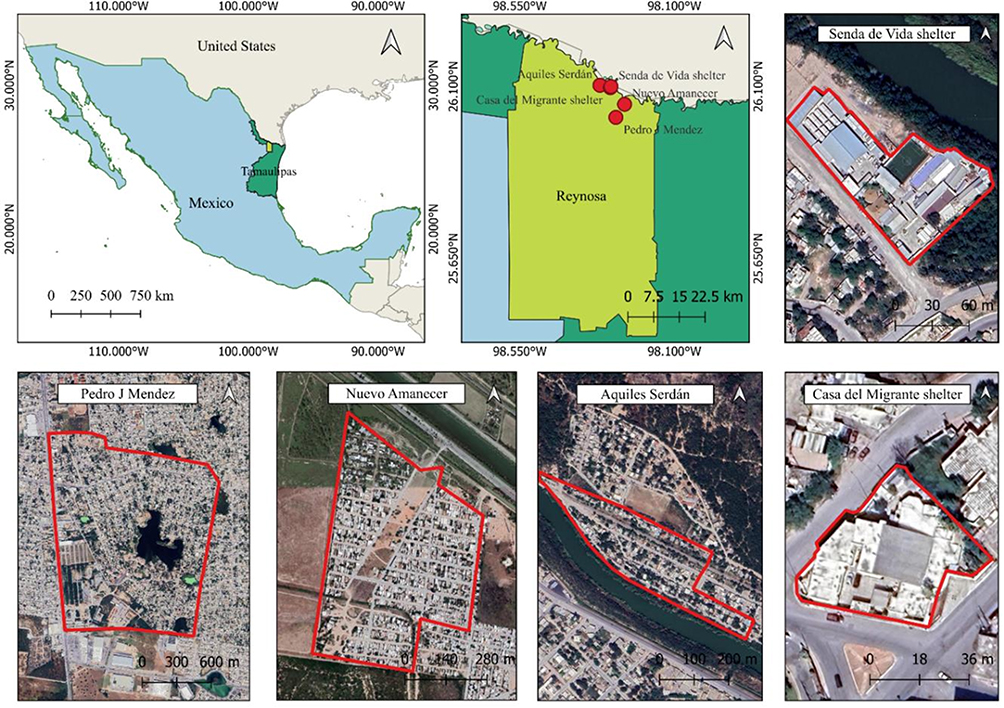 |
Figure 1 Map of study area. The main maps show the municipality of Reynosa, Tamaulipas, Mexico, on the Mexico-US border; the three study sampled neighborhoods and two study migrant camp shelters are marked and enlarged in the satellite image. The maps generated using the QGIS 3.40.3 (https://qgis.org/en/site/). Free geographic data of administrative areas of Mexico was downloaded from the National Institute of Statistics and Geography, México (INEGI https://www.inegi.org.mx/app/maps). Satellite images and street maps were obtained from Google Maps (https://www.google.com/maps). |
Study Participants
Participants were eligible if they were migrants aged 18 years or older residing in the sampled shelters and willing to provide written informed consent. Individuals under 18 years of age, those who declined consent, and those with an acute illness and could not safely undergo blood collection from the vein were excluded. A convenience sampling approach was used to recruit residents present at the shelters during sampling visits. Of the 107 individuals approached, 95 consented to participate and were subsequently enrolled in the study. The questionnaire was a structured, interviewer-administered instrument comprising sections on demographics, mosquito exposure, knowledge of mosquito-borne arboviruses and their vectors, and preventive practices. It was administered face-to-face immediately prior to blood collection.
Mosquito Collection and Processing
The first phase of mosquito sampling was conducted in the fall, between October and December 2019. Adult mosquitoes were collected using a combination of BG-Sentinel traps (Biogents AG, Germany), CDC backpack aspirators (John W. Hock Company, No. 1412.01, Gainesville, FL), Autocidal Gravid Ovitraps (AGO) traps (Springstar) baited with fermented grass infusion; and a custom-designed resting boxes for engorged and resting mosquitoes previously described.14 Trapping was performed twice weekly, with a three-day interval between collections. To minimize trap interaction and ensure independent density estimates, BG-Sentinel traps baited with BG-lures were spaced approximately 25 m apart. Traps were set and baited in the late afternoon before dusk and serviced the following day. BG-Sentinel traps were emptied by securing the collection bags, while resting boxes were vacuumed using aspirators. All specimens were transferred into mesh-bottom polystyrene cups. CDC-backpack aspirator was used for indoor mosquito aspiration at dusk. The second phase, initially planned for spring (April–June 2020), could not be undertaken because COVID-19 lockdown restrictions prohibited site visits. Second phase collection was able to be done in May and November 2022, using BG-Sentinel traps and CDC backpack aspirators, with the same collection frequency as the first phase. BG-Sentinel traps were deployed at selected sampling locations and spaced approximately 25 m apart to minimize trap interaction and ensure independent density estimates. As in the first phase, traps were set and baited in the late afternoon before dusk and serviced the following day; collection bags were secured to retrieve trapped mosquitoes. Indoor and resting mosquitoes were sampled using a CDC backpack aspirator. All specimens were transferred into mesh-bottom polystyrene cups and transported under cold-chain conditions to the Centro de Biotecnología Genómica (CBG), Instituto Politécnico Nacional (IPN), where they were stored at −20 °C pending taxonomic identification. Molecular analyses were subsequently conducted at the Laboratory of Virology and Molecular Biology, Oaxaca State Public Health Laboratory.
Taxonomic Classification of Mosquitoes
Specimens were subsequently sorted using a BioQuip Chill Plate, and morphological identification was performed under a Zeiss stereomicroscope (Model: 420) following standard taxonomic keys.15 Identified mosquitoes were pooled by species and collection site. Specimens from the first entomological surveillance phase were pooled at a mean of 11 mosquitoes per pool (range 1–27), whereas those from the second phase were pooled with up to 25 individuals per pool. Only female Ae. aegypti were retained for analysis and stored at −80 °C until processing; all other species were discarded.
Collection of Blood Samples
For the blood extraction method, the work area was disinfected with 70% ethanol. Blood samples were drawn from venous blood using a 21-gauge green needle (BD Vacutainer brand) with the Vacutainer system and collected in a yellow tube with separator gel (BD Vacutainer serum, 6.0 mL). The tubes were transported to the aforementioned laboratory at CBG-IPN in a cooler with ice packs, maintaining the cold chain, and then centrifuged for 15 minutes at 2000 rpm at 4°C. The serum was separated and transferred to a 1.5 mL Eppendorf tube. The tubes were stored in an ultra-low temperature freezer at −70°C until analysis.
RNA Purification and RT-qPCR Triplex
Mosquitoes were homogenized in Minimum Essential Medium Eagle Cell Culture Media (Sigma-Aldrich) and genomic RNA extracted using the QIAamp Viral RNA mini extraction kit (Qiagen, Germany) according to manufacturer instructions. Pools were tested using Viasure Zika, Dengue and Chikungunya RT-PCR kit (CerTest, Spain) according to manufacturer’s instructions. Briefly, 15 μL of rehydration buffer was added to each well containing a premix of enzymes, primers probes, buffer, dNTPs, and stabilizers from the manufacturer. This was followed by adding 5 μL of extracted RNA to each well and positive and negative control in the last wells. Positive and negative control provided by the manufacturer were reconstituted by adding 100 μL of the RNAse/DNAse free water to lyophilized sample and vortex thoroughly in a separate area of the laboratory. Cycling conditions started with the reverse transcription cycle at 45 °C for 15 min, followed by an RT-enzyme inactivation cycle at 95 °C for 2 min and 45 cycles of 10 seconds at 95 °C and 50 seconds at 60 °C. The thermocycling was performed on an Applied Biosystem 7500 Real Time PCR system at Laboratory of Virology and Molecular Biology of the Oaxaca State Public Health Laboratory.
Measurement of Anti-DENV IgM Antibodies
The preserved serum samples were tested for dengue-specific IgM antibodies using the Panbio Dengue IgM Capture ELISA (Abbott). The assay was performed according to the manufacturer’s instructions, with absorbance measured at 450/620 nm (S1). The cut-off value was calculated as the average optical density (OD) of the calibrator controls (cut-off = 0.329). Samples with OD values exceeding the cut-off were considered positive, and Panbio units were derived as (sample OD / cut-off) × 10. A result >11 Panbio units was interpreted as positive for recent dengue virus exposure.
Data Analysis
Mosquito infection rate was estimated using the Maximum Likelihood Estimation method with 95% confidence intervals using the PooledInfRate software (CDC, Fort Collins). Human dengue seroprevalence was calculated as a proportion with exact (Clopper–Pearson) binomial 95% confidence intervals. Data from the questionnaires were entered into a Microsoft Excel spreadsheet (MS 2021) and cleaned for inconsistencies and missing values. Descriptive statistics were calculated to summarize participant characteristics and responses to key questions related to mosquito exposure, arbovirus knowledge, and preventive behaviors. Categorical variables were reported as frequencies (n) and percentages (%). Associations between IgM dengue seropositivity and questionnaire variables were examined using Fisher’s exact test; given the small number of seropositive participants, all such associations were treated as exploratory. Statistical significance was set at p < 0.05. All analyses were performed using the IBM Statistical Package for the Social Sciences (SPSS) software, version 21 (IBM Corp., Armonk, NY, USA).
Results
Mosquito Species and Sex Distribution Across Trap Types During the First Phase of Entomo-Surveillance
A total of 2263 individual mosquitoes were caught with 788 Ae. aegypti (332 males and 456 females) collected. Other mosquito species collected were not identified to species level. The highest number of mosquitoes was collected from the BG-Sentinel trap, 1311 (57.9%), followed by resting box collection, 874 (38.6%), with the least collection 78 (3.5%) from the AGO trap (Table 1).
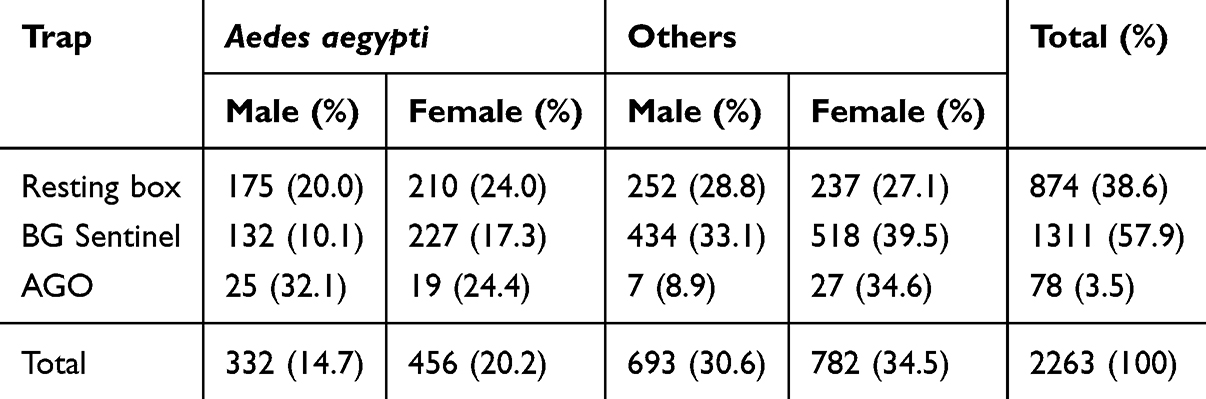 |
Table 1 Mosquitoes Collection from Each Trap Used During the First Entomo-Surveillance |
Mosquito Species and Sex Distribution Across Trap Types During the Second Phase of Entomo-Surveillance
During the second phase of entomological surveillance, a total of 1713 mosquitoes were caught. Of these, 315 (18.4%) were identified as Ae. aegypti and 1398 (81.6%) as Culex spp (Table 2).
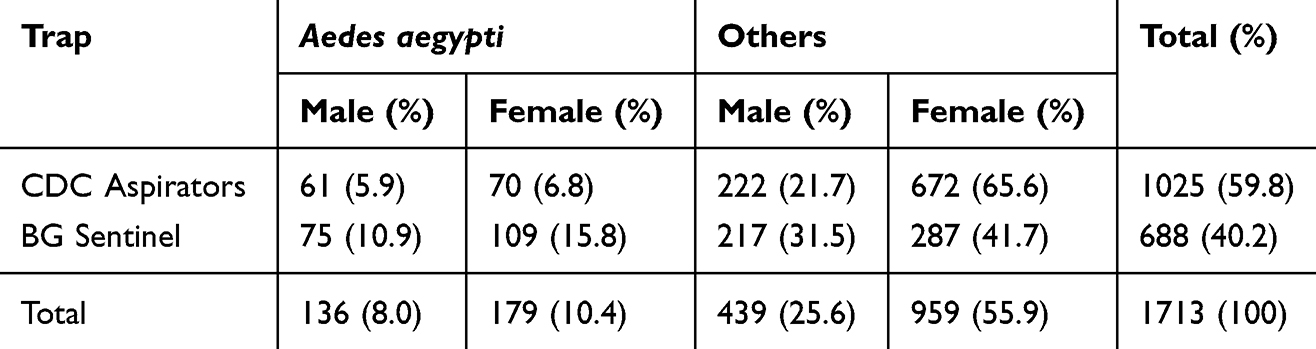 |
Table 2 Mosquitoes Collection from Each Trap Used During the Second Entomo-Surveillance |
Arbovirus Infection Rate in Mosquito Samples
In the first entomological phase, 456 female Aedes aegypti mosquitoes were grouped into 42 pools for analysis. Three pools tested positive for DENV-2, corresponding to a point prevalence of 0.7% and 95% confidence intervals (CI) of 0.1 and 1.6 per 100 mosquitoes examined. All pools were negative for DENV-1, DENV-3, DENV-4, CHIKV, and ZIKV, with a point prevalence of zero and a corresponding 95% upper limit (UL) CI of 0.42 per 100 mosquitoes.. In the second entomological phase, of the 315 Ae. aegypti mosquitoes collected, 179 females were combined into 14 pools, of which one pool tested positive for dengue virus, while all were negative for CHIKV and ZIKV (Table 3). The positive and negative controls consistently produced the expected reactive and non-reactive results, respectively, validating the assay.
 |
Table 3 Aedes aegypti Pool Composition and Arbovirus Detection |
Seroprevalence of Dengue Antibody Among Migrants
Serum samples from 95 participants were analyzed. Four were positive, giving a seropositivity of 4.2% (95% CI: 1.2–10.4%). Optical density values for the positive samples ranged from 0.366 to 1.320 and Panbio units from 11.12 to 40.12, confirming dengue IgM positivity.
Knowledge of Mosquito-Borne Arboviruses and Preventive Measures
Overall, respondents reported frequent exposure to mosquitoes, both in their countries of origin (65.3%) and within shelters (71.6%). While 60 (63.2%) could recognize mosquito larvae, awareness of mosquito-borne arbovirus transmission was low, with 63 (66.3%) lacking this knowledge. Only 30 (31.6%) of participants had heard of dengue, and awareness of chikungunya and Zika was particularly limited. Preventive practices were inconsistent: repellents 32 (33.7%) and physical control 24 (25.2%) were the most commonly reported measures, yet 25 (26.3%) reported taking no action at all (Table 4). The results also indicated that IgM-positive participants reported significantly lower mosquito contact at their country of origin compared to IgM-negative participants (0% vs 67.8%; Fisher’s exact test, p = 0.013).
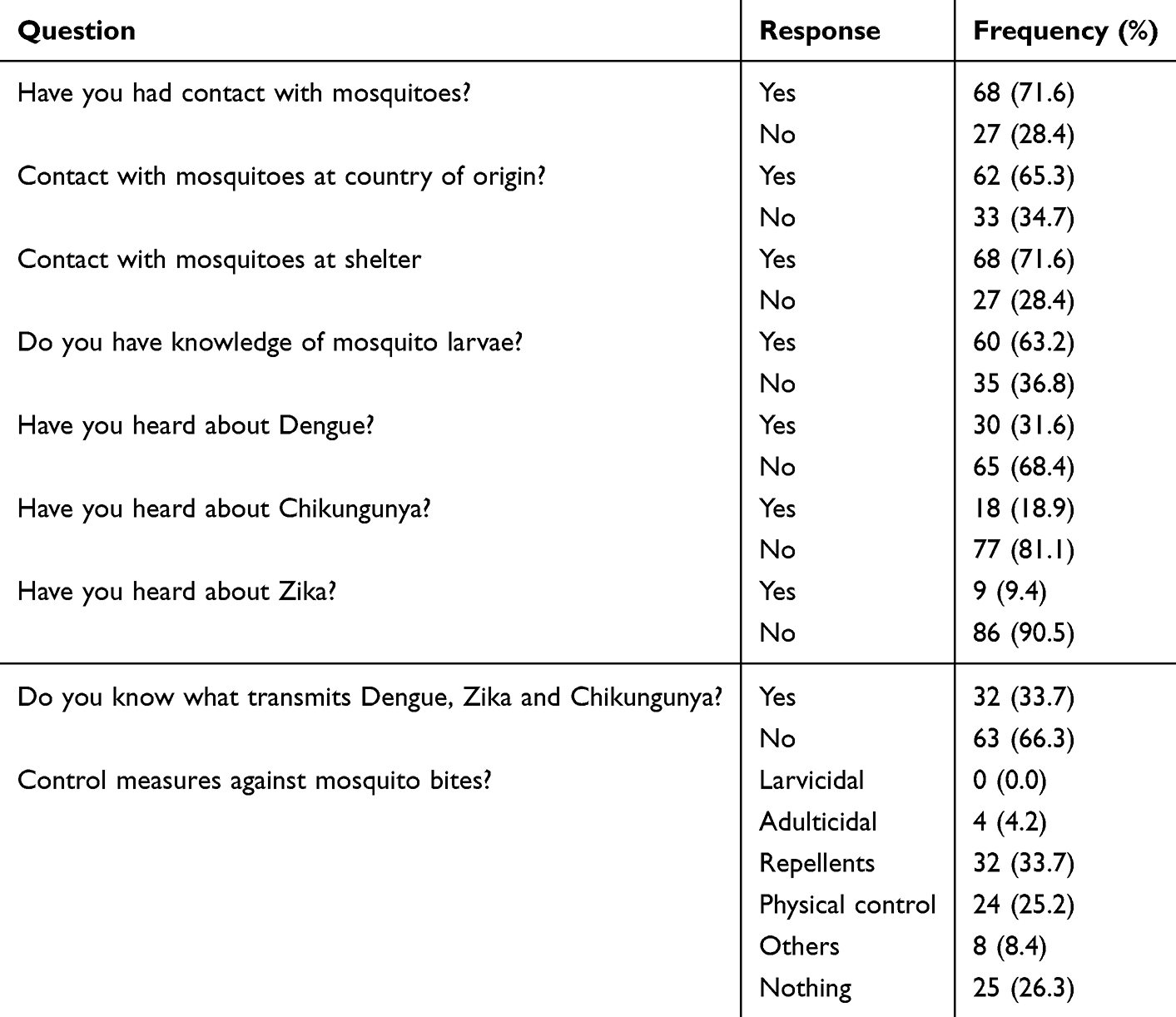 |
Table 4 Knowledge of Participants on Mosquito-Borne Arboviruses |
Discussion
Given the substantial burden and complex epidemiology of dengue in Mexico, together with limited evidence on local vector infectivity and human exposure in border settings, this study aimed to generate evidence on arbovirus transmission dynamics within migrant camps in Reynosa, a major Mexico–US border city, to inform epidemiological understanding and public health intervention. No mosquito pools tested positive for chikungunya virus (CHIKV), Zika virus (ZIKV), or DENV serotypes 1, 3, and 4, despite increasing incidence and severity of arboviral diseases reported in Mexico over the past decade.9,16 Nevertheless, DENV-2 was detected in three mosquito pools during the first entomological surveillance phase, while one pool tested positive for dengue virus during the second phase, although serotype confirmation was not achieved. Dengue remains endemic in Mexico, with recurrent outbreaks occurring during periods of increased vector abundance and favorable climatic conditions for viral transmission.17 The detection of DENV-positive mosquito pools in this study indicates active dengue circulation in the study area and aligns with previous reports documenting DENV-1 and DENV-2 transmission among mosquito and human populations in Reynosa.6 Previous evidence further suggests that DENV-2 was the predominant circulating serotype in the region between 2016 and 2023, followed by DENV-1.18 The repeated detection of DENV-2 in this study may reflect the contribution of serotype dynamics to cyclical dengue patterns. Cyclical epidemic patterns have been documented in Singapore to be associated with periodic shifts in the predominant circulating dengue serotype, with each epidemic wave often linked to a serotype shift and followed by a dormant year, reflecting the interplay between serotype-specific immunity and transmission dynamics.19
The detection of dengue virus in mosquito vectors suggests an ongoing risk of local transmission in Reynosa, with potential implications for broader transmission dynamics along the US–Mexico border, particularly in areas where competent vectors are established. High human mobility, cross-border movement, widespread vector presence, and inadequate mosquito control have all been implicated in dengue emergence and re-emergence in the United States and its territories.20 In addition, the precarious living conditions often experienced in temporary shelters and migrant camps, including overcrowding, poor sanitation, inadequate waste disposal, and limited access to potable water, may create favorable conditions for the proliferation of Aedes aegypti and increased human–vector contact.12,21
Human serological findings further complement the entomological evidence. This study identified a dengue IgM seroprevalence of 4.2% among individuals residing in migrant camps, suggesting recent DENV exposure within this population. These findings are consistent with earlier reports of active dengue transmission in Reynosa, where IgM-positive cases and viral circulation have previously been documented.1,6 From an epidemiological perspective, recent exposure is important because viraemic individuals, including those with mild or unrecognized infections, may contribute to onward transmission in settings with high vector density. Previous studies suggest that clinically inapparent infections may account for a substantial proportion of dengue transmission,22 particularly because asymptomatic or pre-symptomatic individuals maintain routine activities and remain exposed to mosquito bites.22,23 The unapparent symptoms among individuals who tested positive for anti-dengue IgM may be explained by prior exposure, as infection with a single serotype often confers long-term immunity to that particular serotype while conferring only short-lived protection against the other serotypes.24 Consequently, infected individuals may unknowingly contribute to viral dissemination when moving to new areas where competent vectors are abundant.
Although none of the IgM-seropositive participants reported prior mosquito exposure in their countries of origin, three reported mosquito contact within the shelters. While this pattern may suggest possible local acquisition of infection in Reynosa, IgM seropositivity reflects recent exposure only and cannot determine the timing or location of infection. Exposure during migration or infection acquired elsewhere in endemic regions therefore remain plausible explanations. Nonetheless, when interpreted alongside the detection of DENV-positive mosquito pools, these findings are consistent with ongoing local dengue transmission in Reynosa. The findings of the survey also showed high mosquito contact at both country of origin and migrant camps but limited knowledge on mosquito-borne arboviruses and inconsistent preventive behaviors amongst migrants. None of the four participants who tested positive for dengue IgM reported prior mosquito exposure in their countries of origin, while three reported current mosquito contact within the shelter. This pattern may suggest local acquisition of infection in Reynosa; however, IgM positivity reflects recent exposure only and cannot establish the timing or location of infection. Importation along the migration route and endemic local transmission independent of migration therefore remain plausible alternative explanations. Taken together with the vector data, this is consistent with active local transmission of dengue in Reynosa. Although most of the participants could recognize mosquito larvae, this basic knowledge did not translate into adequate understanding of arbovirus transmission, as over 66% of respondents were unaware of how dengue, chikungunya, and Zika are spread and about a quarter doing nothing to prevent mosquito bites. These observations are consistent with findings from previous studies.25,26 The implication of this disconnect is that recognizing the vector alone is insufficient to improve knowledge of arboviral transmission or to promote protective behaviors in the absence of targeted health education on mosquito-borne diseases. Consequently, inadequate control practices by migrants increase human–vector contact, thereby increasing the risk of arbovirus transmission.
This study has several limitations, particularly with respect to sample size, warranting cautious interpretation of the findings given the limited mosquito collections and human participants included. The gap in the collection periods was partially attributed to disruptions caused by COVID-19, which posed a challenge for longitudinal comparison of the collection period.
Conclusion
Despite these limitations, the findings highlight the increasing public health importance of dengue in Reynosa and the broader US–Mexico border region, underscoring the need for strengthened vector control and arboviral surveillance to reduce local transmission and mitigate the risk of cross-border spread. Although based on a small number of seropositive cases, the serological findings, together with evidence of infected mosquito vectors, emphasize the importance of integrated surveillance and targeted public health interventions in high-risk settings such as migrant shelters and border communities.
Acknowledgments
We acknowledge the heads of the migrant camps for granting permission to carry out the study. The authors also acknowledge the laboratory scientists and technicians at the Oaxaca Public Health Laboratory for their assistance with the molecular analysis.
Funding
This study was supported with funding from The Royal Society of Tropical Medicine and Hygiene to coauthor AAA through the Small Research Grant Award. This study was also supported with funding from IPN (SIP-PRORED, grant Nos. 20243970, 20254753 and 20260039) to coauthor NAFS and SIP small grants No. 20251306 to coauthor MARP. The funders had no role in the study design, data collection and analysis, and decision to publish or preparation of the manuscript.
Disclosure
Dr. Mario A. Rodriguez-Perez is a member of the editing board of Research and Reports in Tropical Medicine (RRTM) and the Chief Editor of RRTM. The other authors declare no conflicts of interest in this work.
References
1. Dzul-Manzanilla F, Correa-Morales F, Che-Mendoza A, et al. Identifying urban hotspots of dengue, chikungunya, and Zika transmission in Mexico to support risk stratification efforts: a spatial analysis. Lancet Planet Health. 2021;5(5):e277–9. doi:10.1016/S2542-5196(21)00030-9
2. World Health Organization. Dengue. 2025. Available from: https://www.who.int/news-room/fact-sheets/detail/dengue-and-severe-dengue.
3. Wong JM, Adams LE, Durbin AP, et al. Dengue: a growing problem with new interventions. Pediatrics. 2022;149(6):e2021055522. doi:10.1542/peds.2021-055522
4. Pando-Robles V, Alvarez-Obregón J, Castillo-Flores GD, et al. Epidemiological and economic burden of dengue in Mexico: data analysis from 2010 to 2020. Am J Trop Med Hyg. 2025;113(6):1363–1374. doi:10.4269/ajtmh.24-0777
5. Haider N, Hasan MN, Onyango J, et al. Global dengue epidemic worsens with record 14 million cases and 9000 deaths reported in 2024. Int J Infect Dis. 2025;158:107940. doi:10.1016/j.ijid.2025.107940
6. Rodriguez-Perez M, Russell T, Olguin-Rodriguez O, et al. Dengue serotypes circulating in Aedes aegypti and humans in a poor or peripheral neighborhood at Reynosa, Mexico. Southwest Entomol. 2021:45. doi:10.3958/059.045.0420
7. Undurraga EA, Betancourt-Cravioto M, Ramos-Castañeda J, et al. Economic and disease burden of dengue in Mexico. PLoS Negl Trop Dis. 2015;9(3):e0003547. doi:10.1371/journal.pntd.0003547
8. Garay-Morán C, Román-Pedroza JF, López-Martínez I, et al. Caracterización clínica y epidemiológica de fiebre chikungunya en México. Rev Panam Salud Publica. 2017:41e58. doi:10.26633/RPSP.2017.58
9. Laredo-Tiscareño SV, Machain-Williams C, Rodríguez-Pérez MA, et al. Arbovirus surveillance.
10. Carbone G, Boiardi G, Infantino C, et al. Vectors on the move: how climate change fuels the spread of arboviruses in Europe. Microorganisms. 2025;13(9):2034. doi:10.3390/microorganisms13092034
11. Rodriguez-Morales A, Montenegro-Idrogo J, Celis-Salinas J, et al. Unraveling the unparalleled 2024 epidemic of dengue in the Americas. Rev Chil Infectol. 2024;41:421–428. doi:10.4067/s0716-10182024000300133
12. Matías-Pérez D, Guerra-Martínez A, Hernández-Bautista E, et al. Impact of migratory flows and socio-environmental factors on dengue epidemiology in Oaxaca, Mexico. Front Sociol. 2025;10:1617789. doi:10.3389/fsoc.2025.1617789
13. Volk SM, Chen R, Tsetsarkin KA, et al. Genome-scale phylogenetic analyses of chikungunya virus reveal independent emergences of recent epidemics and various evolutionary rates. J Virol. 2010;84(13):6497–6504. doi:10.1128/JVI.01603-09
14. Estrada-Franco JG, Fernandez-Santos NA, Adeniran AA, et al. Vertebrate–Aedes aegypti and Culex quinquefasciatus arbovirus transmission networks: non-human feeding revealed by meta-barcoding and next-generation sequencing. PLoS Negl Trop Dis. 2020;14:e0008867. doi:10.1371/journal.pntd.0008867
15. Burkett-Cadena N. Mosquitoes of the Southeastern United States. 2013.
16. Galán-Huerta KA, Martínez-Landeros E, Delgado-Gallegos JL, et al. Molecular and clinical characterization of chikungunya virus infections in Southeast Mexico. Viruses. 2018;10(5):248. doi:10.3390/v10050248
17. Sánchez-González G, Condé R, Noguez Moreno R, López Vázquez PC. Prediction of dengue outbreaks in Mexico based on entomological, meteorological and demographic data. PLoS One. 2018;13(8):e0196047. doi:10.1371/journal.pone.0196047
18. Simmons O, Vicco A, Martínez-Vega RA, et al. Changes in dengue virus transmission in Mexico: 2016–2023. medRxiv. 2025. doi:10.64898/2025.12.12.25342126
19. Rajarethinam J, Ang LW, Ong J, et al. Dengue in Singapore from 2004 to 2016: cyclical epidemic patterns dominated by serotypes 1 and 2. Am J Trop Med Hyg. 2018;99(1):204–210. doi:10.4269/ajtmh.17-0819
20. Añez G, Rios M. Dengue in the United States of America: a worsening scenario? Biomed Res Int. 2013;2013:678645. doi:10.1155/2013/678645
21. Massaro E, Kondor D, Ratti C. Assessing the interplay between human mobility and mosquito-borne diseases in urban environments. Sci Rep. 2019;9(1):16911. doi:10.1038/s41598-019-53127-z
22. Ten Bosch QA, Clapham HE, Lambrechts L, et al. Contributions from the silent majority dominate dengue virus transmission. PLoS Pathog. 2018;14(5):e1006965. doi:10.1371/journal.ppat.1006965
23. Duong V, Lambrechts L, Paul RE, et al. Asymptomatic humans transmit dengue virus to mosquitoes. Proc Natl Acad Sci USA. 2015;112(47):14688–14693. doi:10.1073/pnas.1508114112
24. Yang ZS, Baua AD, Hemdan MS, et al. Dengue virus infection: a systematic review of pathogenesis, diagnosis and management. J Infect Public Health. 2025;18(12):102982. doi:10.1016/j.jiph.2025.102982
25. Alobuia WM, Missikpode C, Aung M, Jolly PE. Knowledge, attitude, and practices regarding vector-borne diseases in Western Jamaica. Ann Glob Health. 2015;81(5):654–663. doi:10.1016/j.aogh.2015.08.013
26. Bedoya-Rodríguez FJ, Guevara-Fletcher CE, Pelegrin JS. Knowledge, attitudes, and practices regarding mosquito-borne diseases in an urban sector of southwestern Colombia. Front Public Health. 2025;13. doi:10.3389/fpubh.2025.1682827
 © 2026 The Author(s). This work is published and licensed by Dove Medical Press Limited. The
full terms of this license are available at https://www.dovepress.com/terms
and incorporate the Creative Commons Attribution
- Non Commercial (unported, 4.0) License.
By accessing the work you hereby accept the Terms. Non-commercial uses of the work are permitted
without any further permission from Dove Medical Press Limited, provided the work is properly
attributed. For permission for commercial use of this work, please see paragraphs 4.2 and 5 of our Terms.
© 2026 The Author(s). This work is published and licensed by Dove Medical Press Limited. The
full terms of this license are available at https://www.dovepress.com/terms
and incorporate the Creative Commons Attribution
- Non Commercial (unported, 4.0) License.
By accessing the work you hereby accept the Terms. Non-commercial uses of the work are permitted
without any further permission from Dove Medical Press Limited, provided the work is properly
attributed. For permission for commercial use of this work, please see paragraphs 4.2 and 5 of our Terms.