
Back to Journals » International Journal of Nanomedicine » Volume 21
Engineered Exosomes: Advances in Therapeutic Applications for Otolaryngology–Head and Neck Diseases
Authors Zhu H, He J, Yang S, Qin G
Received 16 October 2025
Accepted for publication 5 February 2026
Published 17 February 2026 Volume 2026:21 574708
DOI https://doi.org/10.2147/IJN.S574708
Checked for plagiarism Yes
Review by Single anonymous peer review
Peer reviewer comments 3
Editor who approved publication: Professor Lijie Grace Zhang
Han Zhu,* Jing He,* Shishi Yang,* Gang Qin
Department of Otolaryngology Head and Neck Surgery, The Affiliated Hospital of Southwest Medical University, Luzhou, Sichuan, People’s Republic of China
*These authors contributed equally to this work
Correspondence: Gang Qin, Email [email protected]
Abstract: Given the intricate anatomy of otolaryngology–head and neck (OHNS) regions and the inherent limitations of conventional therapies, many OHNS diseases have suboptimal clinical outcomes. As natural intercellular mediators, exosomes have demonstrated unique application potential in OHNS treatment in recent years, thanks to their high biocompatibility, low immunogenicity, and intrinsic targeting capabilities. However, such issues as limited drug-loading capacity, suboptimal in vivo stability, and insufficient targeting precision still hinder their clinical translation. Notably, recent advances in engineering strategies such as genetic editing, surface modification, and optimized drug loading enhance natural exosomes’ functionality, boosting targeting accuracy, in vivo stability, and therapeutic efficacy. Considering conventional therapy limitations and engineered exosomes’ unique potential, this review synthesizes their progress, mechanisms, and translational challenges in OHNS, and addresses lingering technical and translation barriers via interdisciplinary collaboration to optimize their design, utility, and bench-to-bedside translation, as these exosomes are promising precision tools for refractory OHNS diseases advancing precision medicine in the field.
Keywords: engineered exosomes, otorhinolaryngological tumors, inflammatory diseases, tissue regeneration and repair, targeted delivery
Introduction
Background on OHNS Diseases
With growing public demand for a high quality of life, otorhinolaryngology-head and neck (OHNS) diseases have attracted increasing attention. OHNS diseases such as otitis media, age-related hearing loss, allergic rhinitis, chronic sinusitis, chronic pharyngitis, obesity-linked obstructive sleep apnea hypopnea syndrome, laryngeal carcinoma, nasopharyngeal carcinoma and thyroid carcinoma exhibit high prevalence or marked incidence growth.1,2 Clinically, these disorders pose multiple management challenges: high recurrence, frequent complications, refractory sensorineural hearing loss due to irreversible hair cell damage, and head and neck tumor heterogeneity with variable gene expression, metabolism, and treatment responses.3–6 As conventional drugs suffer from poor targeting and suboptimal efficacy, while surgical therapies are highly invasive and fail to repair irreversible damage, there is an urgent need for novel therapeutic platforms to address such unmet clinical needs.
Exosomes in Disease Management
Exosomes are nanoscale extracellular vesicles secreted by cells,7 characterized by unique structural properties and diverse biological functions. Structurally, they measure 30–150 nm in diameter, have a cup-shaped or spherical morphology, and are enclosed in a lipid bilayer carrying proteins, lipids, and nucleic acids.8 These features confer enhanced stability and multifunctional potential. Functionally, they act as intercellular messengers transferring bioactive molecules to modulate recipient cells9–11 carriers of nutrients and genetic material12 immune modulators regulating immune responses and tolerance and tissue repair agents supporting damaged tissue regeneration.13 Their structural uniqueness, functional versatility, and intrinsic trafficking capacity make exosomes promising platforms for diagnosis, therapy, and drug delivery. Exosome research has grown exponentially over five decades with global annual publications increasing from 1 in 1973 to 1809 by mid-2025 and 246 clinical trials registered since 1999 indicating rapid clinical translation progress (Figure 1).
 |
Figure 1 Annual Number of Publications on Exosomes and Engineered Exosomes (1973–2025). Data were retrieved from the Web of Science Core Collection database. Publications were retrieved using the following terms in the Keywords field: “exosome” OR “engineered exosomes”. |
However, natural exosomes suffer from inherent limitations including insufficient targeting precision from lack of tissue-specific recognition molecules, limited drug-loading capacity for therapeutics like chemotherapeutics or nucleic acids and suboptimal in vivo stability.14 These drawbacks make natural exosomes unfit for OHNS clinical demands prompting engineered modifications.15 (Figure 2).
 |
Figure 2 Engineered modification of natural exosomes and their core therapeutic mechanisms in disease treatment (Created with BioRender.com). This schematic first illustrates the transformation process of natural exosomes into engineered exosomes: Natural exosomes (left) contain membrane proteins and endogenous contents, but they have inherent limitations such as insufficient targeting precision, limited drug-loading capacity, and suboptimal in vivo stability. Through surface modifications and loading of cargos, functionally enhanced engineered exosomes (middle) can be obtained. It also demonstrates four core mechanisms by which engineered exosomes exert therapeutic effects in disease management, each represented by a distinct colored module: (1) Precise Targeted Delivery (Blue), (2) Immune Regulation (Green), (3) Tissue Repair and Regeneration (Orange), (4) Metabolism Regulation (Purple). Note: Upward arrows (↑) indicate upregulation, promotion, or increase, while downward arrows (↓) indicate downregulation, inhibition, or decrease. |
Engineered Exosomes: Mechanisms and Applications
Engineered exosomes are nanoscale vesicles functionally modified via biotechnological approaches, designed to achieve functional enhancement, meet specific clinical demands16 and overcome the inherent limitations of natural exosomes17 Consequently, they exhibit enhanced performance in applications such as disease treatment, diagnostic imaging, and biomolecule delivery. Notably, several therapeutic strategies utilizing engineered exosomes have advanced to clinical trial phases in fields including oncology and neurodegenerative disorders (Table 1).
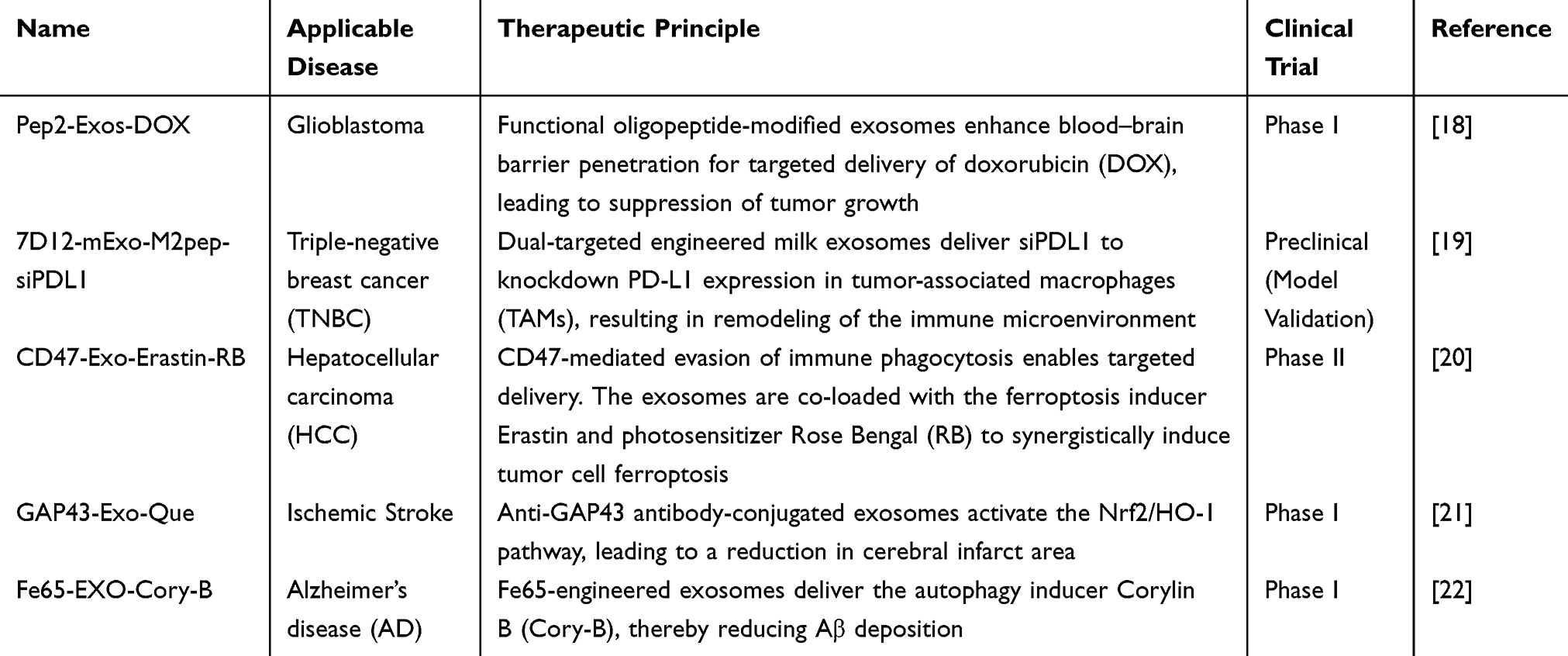 |
Table 1 Engineered Exosomes That Have Entered Clinical Trials |
Engineered exosomes exert therapeutic effects via four key mechanisms (Figure 2) with clear molecular bases. First, targeted delivery and smart drug loading: functional modifications such as TAxI peptide conjugation enhance blood brain barrier penetration23 while BDNF loading boosts delivery efficiency,24 improving targeting precision and treatment efficacy. Second, immune modulation and inflammatory intervention: they reprogram M1 to M2 macrophages25 carry siRIPK326 target CCR6+ sites to suppress Th17 cells and activate Tregs27 or deliver PD-L1 to inhibit Tfh cell polarization,28 alleviating inflammation in autoimmune and inflammatory diseases. Third, tissue repair and regeneration: AMSC derived exosomes released via pH responsive hydrogels29 stem cell exosomes combined with oxygen releasing nanoparticles30 galactose modified GPEG EXOs31 and TEPEP exosome based patches32 promote angiogenesis wound healing liver protection and tendon repair through molecular mediated pathways. Fourth, metabolic regulation: MSC EXO modulates miR-126 miR-21 and miR-145 to reshape glycolipid metabolism in PCOS.33 Despite early-stage research in otorhinolaryngology head and neck surgery their unique biological properties hold significant application potential.
This review summarizes recent advances in the application of engineered exosomes, modified through various biotechnological techniques, for the treatment of diseases in OHNS. It highlights the distinctive advantages of engineered exosomes over conventional therapies in addressing the unique clinical challenges of OHNS and discusses key challenges as well as corresponding potential strategies regarding targeting precision, quality control, and clinical translation. By integrating current research findings, we aim to provide a comprehensive overview of how engineered exosome technologies can effectively address unmet clinical needs in OHNS. Ultimately, this work seeks to contribute to improved patient outcomes and pave the way for future innovations in therapeutic strategies for OHNS diseases.
Review Methodology
Literature Search Strategy
We conducted a comprehensive systematic search of three core biomedical databases: Web of Science (Core Collection), PubMed, and Scopus, covering publications from January 1999 to October 2025 ((consistent with the time span of the included literature, where 98% of studies are published after 2015, and the latest studies include 2025 publications). The search strategy combined key terms and Boolean operators to ensure inclusivity of relevant studies, with the following keywords and combinations:
Primary keywords: “engineered exosomes”, “modified exosomes”, “exosome engineering”, “otolaryngology–head and neck diseases”, “OHNS”, “nasal diseases”, “ear diseases”, “head and neck tumors”, “laryngeal diseases”; Synonym expansions: “extracellular vesicle engineering”, “targeted exosomes”, “cargo-loaded exosomes”, “otolaryngological disorders”, “head and neck squamous cell carcinoma (HNSCC)”; Combined search strings (eg, “engineered exosomes” AND (“OHNS” OR “otolaryngology–head and neck diseases”) AND (“therapy” OR “treatment”)).
Inclusion and Exclusion Criteria
Inclusion criteria: (1) Original research articles (preclinical or clinical), review articles, and systematic reviews focusing on engineered exosomes (via genetic modification, surface modification, cargo loading, etc.) for OHNS disease treatment; (2) Studies published in English with full-text availability; (3) Research providing clear data on modification strategies, therapeutic outcomes, or mechanistic insights.
Exclusion criteria: (1) Studies on natural (unmodified) exosomes alone; (2) Non-OHNS disease-focused research; (3) Abstract-only publications, conference proceedings, case reports, and non-peer-reviewed manuscripts; (4) Studies with insufficient technical or outcome details.
Literature Selection and Data Extraction
The literature screening process adhered to the PRISMA 2020 guidelines: (1) Initial screening of titles and abstracts by two independent authors (Author A and Author B) to exclude irrelevant studies; (2) Full-text review of potentially eligible studies by the same two authors to confirm compliance with inclusion criteria; (3) Resolution of discrepancies through discussion with a third author (Author C) to ensure objectivity; (4) Data extraction of key information: study type, modification strategy, target OHNS disease, model system (in vitro/in vivo/clinical), therapeutic outcomes, and limitations.
Quality Assessment
For preclinical studies, we used the SYRCLE’s Risk of Bias Tool to evaluate methodological quality (eg, randomization, blinding, sample size justification); for clinical studies, the Newcastle-Ottawa Scale (NOS) was applied to assess selection bias, comparability, and outcome measurement. Only studies with moderate to high quality (SYRCLE score ≥ 6/10; NOS score ≥ 5/9) were included in the final synthesis to ensure the reliability of the summary.
Therapeutic Applications of Engineered Exosomes in Otorhinolaryngology-Head and Neck Diseases (Figure 3)
Research Progress on Engineered Exosomes in Ear Diseases (Figure 4)
Significant advancements have been made in recent years in the application of engineered exosomes for the treatment of ear diseases. By leveraging mechanisms such as precise cellular signaling regulation, targeted delivery of therapeutic molecules, and immunomodulation, engineered exosomes provide innovative strategies for managing disorders of the external, middle, and inner ear. The following section highlights recent research progress, with a focus on the diverse mechanisms through which engineered exosomes exert their effects in auditory pathologies.
 |
Figure 3 Therapeutic Applications of Engineered Exosomes in Otorhinolaryngology–Head and Neck Diseases. (Created with FigDraw, https://www.figdraw.com). Abbreviations: OE, Otitis Externa; OM, Otitis Media; SNHL, Sensorineural Hearing Loss; ME, Microtia; AIED, Autoimmune Inner Ear Disease; CRS, Chronic Rhinosinusitis; AR, Allergic Rhinitis; NT, Nasal Trauma; PH, Pharyngolaryngitis; TPT, Throat and Pharyngeal Tumors; NPC, Nasopharyngeal Carcinoma; OSCC, Oral Squamous Cell Carcinoma; LC, Laryngeal Carcinoma; TC, Thyroid Carcinoma; CLNM, Cervical Lymph Node Metastasis. |
 |
Figure 4 Blood-Labyrinth Barrier (BLB) Crossing and Inner Ear Therapy. (Created with BioRender.com). Schematic illustration of the mechanism by which engineered exosomes cross the blood-labyrinth barrier (BLB) to target the inner ear. Surface-modified with inner ear-targeting peptide 2 (IETP2), engineered exosomes bind to LRP1 receptors on BLB endothelial cells, penetrate the barrier via transcytosis, and then target inner ear hair cells. By inhibiting the NF-κB pathway to reduce reactive oxygen species (ROS) production, these exosomes exert hair cell protection, ultimately lowering the hearing threshold and enhancing hair cell survival. |
Targeted Delivery Function: Precise Localization to Pathological Tissues in the Ear
Engineered exosomes can achieve site-specific enrichment and localized therapeutic action in pathological ear tissues through surface modifications or intelligent carrier design. In outer ear disorders, studies demonstrate that surface-modified engineered exosomes specifically target auricular chondrocytes, stimulating the proliferation of microtia chondrocytes and facilitating cartilage regeneration.34,35 For middle ear diseases, these exosomes can be directed to the tympanic membrane, promoting its complete regeneration.36 Furthermore, modified exosomes exhibit specific affinity for inner ear hair cells, enhancing cytoprotection through the overexpression of protective proteins or mitigation of ototoxic drug damage, thereby preserving auditory function.37–43
The blood-labyrinth barrier (BLB) is a selectively permeable interface that separates systemic circulation from the inner ear fluids, maintaining the unique homeostatic environment of the labyrinth. It also presents a major obstacle for therapeutic interventions, as it restricts the entry of most drugs and molecules into the inner ear.18 To overcome this challenge, drawing from strategies developed for the blood–brain barrier (BBB), targeting approaches involving the low-density lipoprotein receptor-related protein 1 (LRP1) have been explored. This represents an exciting area of research that could significantly enhance our ability to deliver therapeutics directly to the inner ear. For instance, IgG antibodies encapsulated in Angiopep-2-modified polymers have been successfully delivered to the central nervous system in mice.44 These advancements highlight the potential of engineered exosomes not only for targeted delivery but also for improving the efficacy of treatments that otherwise would be limited by the BLB. This methodology has inspired BLB-directed drug development, including the synthesis of an LRP1-specific binding ligand—inner ear-targeting peptide 2 (IETP2)—which enables the targeted delivery of conjugated small-molecule compounds to the inner ear.45 Additionally, local delivery routes such as the round window membrane and stapes footplate are critical for exosome accumulation in perilymph: the round window membrane’s permeability to nanoscale vesicles and the stapes-mediated entry into vestibular perilymph both contribute to enhanced inner ear targeting efficiency.46 Incorporating these insights into future engineered exosome designs could revolutionize treatment protocols for various inner ear disorders. Future efforts may utilize BBB-targeted engineered exosomes for BLB penetration, enabling precise drug delivery to the inner ear, minimizing systemic exposure, and enhancing therapeutic precision. By leveraging such innovative strategies, we foresee a new era of targeted therapies that can more effectively address the complexities of ear diseases, ultimately leading to improved patient outcomes.
Immunomodulatory Function: Regulation of the Inflammatory Microenvironment in the Ear
Inflammation plays a critical role in the pathogenesis of hearing loss associated with various ear disorders. Engineered exosomes can attenuate inflammatory responses by targeting the delivery of anti-inflammatory molecules. For example, neural stem cell-derived exosomes overexpressing miR-21 have been shown to protect against hearing loss following ischemia-reperfusion injury (IRI) by suppressing inflammatory processes within the mouse cochlea. This intervention reduces the auditory brainstem response threshold, downregulates pro-inflammatory cytokines such as IL-1β and TNF-α, and upregulates the anti-inflammatory cytokine IL-10.19,47 These findings underscore the potential of engineered exosomes as novel therapeutic agents that can effectively modulate the inflammatory microenvironment in the ear, paving the way for more targeted interventions.
Meanwhile, exosomes derived from mesenchymal stem cells modulate autophagic activity in hair cells, providing protection to inner ear sensory cells and enhancing their survival.37 This suggests that harnessing the immunomodulatory capabilities of these exosomes could lead to significant advancements in treating not only hearing loss but also other inflammatory conditions of the ear.
In conclusion, the ability of engineered exosomes to regulate inflammatory responses offers a promising avenue for therapeutic intervention in ear disorders. As research progresses, it will be essential to explore the mechanisms underlying exosome-mediated immunomodulation further and to translate these findings into clinical settings. Future studies should focus on optimizing exosome production and characterization to enhance their therapeutic efficacy while minimizing potential side effects.
Tissue Healing and Regenerative Functions: Promotion of Ear Structure Reconstruction
Studies have demonstrated that surface-modified engineered exosomes can specifically enhance the proliferation of microtia chondrocytes, facilitating cartilage regeneration.34,35 Additionally, targeted exosome systems have been shown to promote complete regeneration of the tympanic membrane.36 These advancements highlight the potential of engineered exosomes as innovative therapeutic tools for reconstructive procedures in ear disorders, potentially transforming standard treatment protocols.
Hearing function depends on the proper activity of the auditory nerve, and engineered exosomes have exhibited regenerative effects on damaged auditory neural pathways. Research indicates that these exosomes enhance functional mechanisms, such as cellular adhesion and axonal guidance, while activating repair-related signaling pathways, including the PI3K–AKT and mTOR pathways. These effects collectively promote a pro-regenerative phenotype in neural cells and stimulate axonal growth.48 This underscores the critical role of engineered exosomes in not only repairing damaged tissues but also in actively promoting the functional restoration of auditory pathways, which is essential for recovering hearing abilities. Furthermore, engineered exosomes mediate beneficial alterations in gene expression within mouse cochlear tissues, supporting auditory nerve repair and improving conductive auditory function.49
Beyond neural repair, engineered exosomes have been reported to scavenge excess reactive oxygen species (ROS), enhance tissue vascularization and angiogenesis, and regulate local oxygen supply in ischemic environments, as evidenced in cardiac repair models.50–52 These properties suggest that engineered exosomes possess multifunctional capabilities that could be leveraged in ear regeneration strategies, addressing both tissue healing and vascular support. For instance, incorporation of vascular endothelial growth factor (VEGF) into engineered exosomes enables specific targeting of cochlear stria vascularis endothelial cells, stimulating their proliferation and regeneration, restoring endolymphatic ion homeostasis, and ultimately improving auditory outcomes.53 As we look to the future, it will be crucial to explore the synergistic effects of combining different regenerative factors within engineered exosomes, which may enhance their therapeutic efficacy in treating complex ear disorders.
Cytoprotective Function: Protection Against Auditory Cell Injury
Inner ear hair cells are susceptible to damage from various factors, including aging, noise exposure, and ototoxic drugs, often resulting in hearing impairment. Studies have confirmed that exogenous exosomes can activate autophagy and protect inner ear hair cells through endocytosis-dependent mechanisms.37 Engineered exosomes further mitigate ototoxic damage or enhance cellular protection by overexpressing specific protective proteins.38–40 This underscores the potential of engineered exosomes not only as passive protectors but as active modulators of cellular pathways critical for maintaining hair cell integrity. Additionally, genetic modification enables these exosomes to overexpress remodeling factors and miRNAs, augmenting their ability to safeguard hair cells.41,42 For example, engineered exosomes have been shown to reduce drug-induced apoptosis and oxidative stress in hair cells through the miR-182-5p/FOXO3 signaling pathway.43 These findings highlight the significance of targeted molecular interventions in enhancing the resilience of auditory cells against damaging stimuli. Notably, inner ear-derived exosomes can serve as biomarkers reflecting hair cell status, offering particular utility during ototoxic drug treatments.54
Through their capabilities in targeted delivery, immunomodulation, tissue repair, cytoprotection, and genetic regulation, engineered exosomes constitute a multifaceted intervention platform for auditory disorders. This versatility positions them as promising candidates for developing comprehensive treatment strategies that address both the prevention and management of hearing loss. Their functional scope encompasses the entire ear anatomy—from the external ear cartilage to the inner ear hair cells—providing tailored therapeutic strategies for challenging conditions such as microtia, otitis media, and sensorineural hearing loss. Future research should prioritize the development of intelligent delivery systems and interdisciplinary integration to refine functional integration and accelerate the clinical translation of these systems. As we move forward, it is essential to explore the integration of engineered exosomes with other emerging technologies, such as gene editing and nanotechnology, to develop more effective interventions.
Research Progress on Engineered Exosomes in Nasal Diseases (Figure 5)
As the primary interface between the respiratory tract and the external environment, the nose is frequently exposed to pathogens, allergens, and irritants, making it susceptible to conditions such as allergic rhinitis, chronic rhinosinusitis, and nasal polyps. Although conventional treatments—including corticosteroids, antibiotics, and surgery—can provide symptomatic relief, they are often limited by systemic side effects, inadequate local targeting, and high recurrence rates. These limitations underscore the urgent need for novel therapeutic approaches that can effectively modulate chronic immune dysregulation and achieve precise interventions at the molecular level.
 |
Figure 5 Integrated Mechanisms of Engineered Exosomes in Nasal Diseases. (Created with BioRender.com). Schematic illustration of the multifunctional roles of engineered exosomes in treating nasal disorders: (A) In allergic rhinitis (AR), exosomes regulate immune responses by promoting naïve T cell differentiation into Foxp3⁺ regulatory T cells (Tregs), inhibiting Th2 cell activation (reducing IL-4/IgE production), and blocking mast cell Ca2⁺ influx and degranulation; (B) In chronic rhinosinusitis (CRS), exosomes induce M1-to-M2 macrophage repolarization to resolve inflammation (reducing ROS and pro-inflammatory mediators) and support tissue repair; (C) Stem cell-derived exosomes enhance nasal epithelial cell proliferation (mucosal restoration) and endothelial cell angiogenesis (submucosal perfusion), collectively alleviating pathological changes in nasal tissues. |
In contrast, engineered exosomes offer a promising alternative through surface modifications for targeted delivery and the encapsulation of therapeutic molecules. By enhancing their delivery mechanisms, these tailored exosomes can selectively accumulate at nasal lesion sites, regulate the local immune microenvironment, and promote tissue repair, thus presenting a strategic approach for managing nasal diseases.
Regulation of Immune Response
Engineered exosomes play a pivotal role in modulating immune cell functions and attenuating excessive immune activation, offering therapeutic benefits in nasal inflammatory diseases. In allergic rhinitis, modified exosomes increase concentrations of IFN-γ and TGF-β while reducing IL-4 and IgE levels, resulting in a significant alleviation of allergic airway inflammation and improvement in symptoms such as nasal itching, sneezing, and rhinorrhea.55 This shift in the cytokine profile highlights the potential of engineered exosomes to reprogram the immune response, providing a more balanced and less inflammatory state. Additionally, lncRNA-engineered exosomes can induce the differentiation of naïve T cells into regulatory T cells (Tregs), upregulate Foxp3 expression, inhibit Th2 cell overactivation, and reduce IgE production and eosinophil infiltration.56,57 These exosomes can also be loaded with calcium channel blockers (eg, verapamil) or protease inhibitors to disrupt calcium signaling and inhibit tryptase release in mast cells, thereby preventing allergen-induced degranulation. For example, miR-124-loaded exosomes specifically target and downregulate TRPC6 channel expression in mast cells, resulting in reduced histamine release.58 This suggests that engineered exosomes may not only mitigate symptoms but also address the underlying dysregulation in immune processes associated with allergic reactions.
In the context of chronic rhinosinusitis, engineered exosomes deliver exogenous miRNAs that modulate endogenous miRNA profiles within nasal mucosal epithelial cells or local inflammatory cells, subsequently regulating inflammatory processes and airway remodeling.59 Furthermore, exosomes carrying signaling molecules, such as PGE2 analogs, facilitate the repolarization of pro-inflammatory M1 macrophages into the anti-inflammatory M2 phenotype, decrease the production of reactive oxygen species (ROS) and pro-inflammatory mediators, support tissue repair, and suppress mucus hypersecretion and pathological tissue remodeling.60 These findings emphasize the multifaceted roles of engineered exosomes in not only controlling inflammation but also promoting healing and restoring normal function in the nasal passages.
In nasal inflammatory diseases such as allergic rhinitis and chronic rhinosinusitis, the immunomodulatory potential of engineered exosomes is further supported by research on severe COVID-19: exosomes can alleviate excessive inflammatory responses by targeting pro-inflammatory cytokines (eg, TNF-α, IL-6) and promoting the release of the anti-inflammatory mediator IL-10.61
Promotion of Tissue Healing
Beyond their immunomodulatory functions, engineered exosomes play a significant role in tissue repair processes. In conditions involving nasal mucosal injury, such as chronic rhinosinusitis with nasal polyps, these exosomes enhance the proliferation and migration of nasal epithelial cells, accelerating the regeneration of damaged mucosa, restoring physiological nasal function, and improving patients’ quality of life. This regenerative capability points to the potential of engineered exosomes as a cornerstone in developing therapies that not only treat symptoms but also promote long-term healing and restoration of normal nasal physiology. For instance, stem cell-derived exosomes can be functionally modified to not only stimulate epithelial regeneration but also promote angiogenesis within the submucosal layer, thereby enhancing local perfusion and providing essential nutritional support for tissue recovery.20,62
In summary, engineered exosomes offer multiple therapeutic advantages for nasal diseases, including anti-inflammatory activity, immune regulation, tissue repair promotion, and targeted drug delivery. They represent a promising innovative strategy for managing refractory disorders such as allergic rhinitis and chronic rhinosinusitis. While technical and translational challenges remain, the innate biological properties and engineerability of exosomes position them as a compelling tool for future precision medicine applications in rhinology. As research progresses, it will be crucial to explore the integration of these systems into clinical practice, ensuring that they can provide effective, targeted treatments that improve patient outcomes.
Research Progress on Engineered Exosomes in Throat Diseases (Figure 6)
Research on engineered exosomes for treating throat diseases is still in its early stages, with relatively few studies conducted to date. Nevertheless, emerging evidence supports their potential, particularly in the realm of immunomodulation. For example, Meng63 developed a protein-modified exosome vaccine derived from dendritic cells (DCs). When delivered via intratracheal inoculation, these engineered exosomes bind to the neonatal Fc receptor (FcRn) on lung epithelial cells, stimulate high-titer IgA production, and activate tissue-resident memory T cells, thereby inducing a potent mucosal immune response. This approach shows considerable promise for preventing and treating viral infections in the throat.
 |
Figure 6 Mechanism of Engineered Exosome Therapy in Throat Inflammation: Mucosal Delivery & Immunomodulation. (Created with BioRender.com). Upon intratracheal administration, engineered exosomes (surface-functionalized with Fc ligands, a nanoplatform for mucosal targeting) engage neonatal Fc receptors (FcRn) on respiratory mucosal epithelial cells, triggering multi-dimensional immunoregulatory cascades: (1) Inducing B cell differentiation into plasma cells that secrete secretory IgA (sIgA) to reinforce mucosal immune defense; (2) Promoting M1-to-M2 macrophage polarization (switching from pro-inflammatory to anti-inflammatory phenotype); (3) Activating tissue-resident memory T (TRM) cells, suppressing pro-inflammatory Th17 cell function, and facilitating regulatory T cell (Treg) expansion; (4) Inhibiting NLRP3 inflammasome activation and reducing pro-inflammatory cytokine production (IL-1β, TNF-α). |
While the advancements in exosome engineering are promising, it is crucial to emphasize that further research is necessary to fully understand the mechanisms underlying these responses, as well as to establish standardized protocols for their clinical application. Mesenchymal stem cells (MSCs) and their exosomes (MSC-Exos) have demonstrated the ability to reduce inflammation and apoptosis in multiple disease models by modulating inflammatory mediators and promoting macrophage polarization toward an anti-inflammatory phenotype.50,64–68 Similarly, exosomes derived from M2 macrophages (M2 Exo), which inherently possess inflammatory homing capacity and anti-inflammatory activity, can be engineered to reprogram macrophage behavior and regulate immune cell functions. Such modifications facilitate the shift from M1 to M2 macrophage polarization, inhibit Th17 cell activity, and promote the activation of regulatory T cells (Tregs), collectively contributing to the resolution of inflammation.23,25,27 In addition, it is essential to consider that while MSC-Exos and M2 Exo exhibit anti-inflammatory properties that may hold therapeutic value for chronic inflammatory conditions of the throat, the variability in exosome composition and function across different sources could influence their effectiveness. Moreover, engineered exosomes enhance immunoregulation by inducing Treg differentiation, suppressing M1 polarization, stimulating M2 polarization, downregulating NLRP3 inflammasome activation, and reducing the secretion of pro-inflammatory cytokines.65,69–71 This multifaceted approach underscores the versatility of engineered exosomes in tailoring immune responses, but it also highlights the need for rigorous preclinical and clinical testing to optimize their therapeutic applications. Both MSC-Exos and M2 Exo exhibit anti-inflammatory properties that may hold therapeutic value for chronic inflammatory conditions of the throat. Through engineering approaches—such as loading with elevated levels of anti-inflammatory cytokines or microRNAs—their efficacy can be further augmented, potentially improving their capacity to alleviate inflammatory responses and support tissue repair in throat disorders. Overall, while the current evidence is encouraging, the integration of engineered exosomes into clinical practice will require comprehensive understanding and validation through ongoing research efforts.
Research Progress on Engineered Exosomes in the Treatment of Head and Neck Tumors (Figure 7)
Head and neck cancers (HNCs) rank as the seventh most common malignancy globally, with approximately 890,000 new cases and 450,000 deaths reported in 2018.72,73 The predominant histologic subtype is head and neck squamous cell carcinoma (HNSCC), representing over 90% of all cases.74 These tumors arise mainly from the mucosal epithelium of the oral cavity, pharynx, larynx, and paranasal sinuses.75 Current treatment modalities include surgery, radiotherapy, chemotherapy, molecularly targeted therapy, and combination regimens. Nevertheless, the overall therapeutic efficacy remains suboptimal, underscoring the urgent need for more precise and innovative treatment strategies.76,77 Given these challenges, we believe that engineered exosomes have the potential to revolutionize treatment paradigms in HNCs by enabling more effective and personalized approaches.
 |
Figure 7 Head & Neck Tumor Synergistic Therapy. (Created with BioRender.com). Engineered exosomes (surface-functionalized with targeting moieties, encapsulating doxorubicin (DOX) and PD-L1 small interfering RNA (siPDL1)) act as a nanoplatform to exert dual antitumor effects: (Path 1) Tumor cell-directed delivery: Exosomes specifically target cancer cells, releasing DOX to induce tumor cell apoptosis and siPDL1 to silence PD-L1 expression (counteracting PD-1/PD-L1-mediated immune evasion); (Path 2) Immunosuppressive tumor microenvironment (TME) reprogramming: Exosomes target M2-polarized tumor-associated macrophages (TAMs, immunosuppressive phenotype), promoting their repolarization toward the pro-inflammatory M1 phenotype. This repolarization drives CD8+ T cell activation (via interleukin-12 (IL-12) secretion), reinforcing antitumor immune surveillance. |
In recent years, engineered exosomes have emerged as a promising nanoscale delivery platform for oncology applications. Through surface modifications, cargo optimization, and immune activation strategies, they can efficiently deliver therapeutic agents—such as chemotherapeutic drugs, siRNA, or gene-editing systems including CRISPR/Cas9—to specifically target tumor cells.78 Furthermore, functionalization of exosomal surface molecules markedly enhances their binding affinity for tumor cells, thereby increasing treatment precision and efficacy.79 As a result, engineered exosomes hold significant promise for advancing targeted drug delivery, activating immune responses, and remodeling the tumor microenvironment in the treatment of head and neck cancers.
Targeted Delivery of Chemotherapeutic Agents
Engineered exosomes function as targeted delivery systems through the surface modification of membrane proteins, substantially improving their affinity for diverse tumor tissues and enhancing antitumor efficacy.80–85 For instance, exosomes derived from M1 macrophages and modified with sialic acid-binding immunoglobulin-like lectin 10 (Siglec-10) have been shown to repolarize peritoneal macrophages into a therapeutic phenotype, enabling effective treatment of ovarian cancer.84 Similarly, exosomes engineered with PI3Kγ modification enable the precise in situ reprogramming of tumor-associated macrophages (TAMs), thereby contributing to antitumor responses.86 When loaded with gene-editing cargo, these exosomes can achieve synergistic antitumor effects.87
Commonly investigated molecular payloads include small interfering RNA (siRNA), long non-coding RNA (lncRNA), microRNA (miRNA), and signal transducer and activator of transcription 6 (STAT6), all of which enhance the targeting efficiency and specificity of engineered exosomes for cancer therapy.80,87–92 We assert that the continuous evolution of these molecular payloads will further augment the therapeutic utility of engineered exosomes, opening avenues for combination therapies that could yield substantial benefits for patients. These approaches also show potential for prognostic evaluation and disease monitoring in oral cancer.93 In thyroid cancer, a targeted exosome-based delivery platform has been developed to direct chemotherapeutic agents to αvβ3-positive anaplastic thyroid cancer (ATC) cells, resulting in specific suppression of tumor growth.85
Immune Activation and Remodeling of the Tumor Microenvironment
The tumor microenvironment (TME) is a complex ecosystem formed by cancer cells and host-derived elements, including vascular networks, the extracellular matrix, immune cells, and other stromal components. Within this milieu, tumor-associated macrophages (TAMs) play a pivotal role in establishing an immunosuppressive TME (ITM), thereby facilitating immune evasion by tumors.94 The abnormal vasculature in the TME further exacerbates conditions such as hypoxia and acidosis, which reinforce the ITM and promote tumor progression.95 Addressing these conditions is crucial; thus, our perspective emphasizes the need for therapies that can effectively reprogram the TME to support anti-tumor immunity. Immune evasion is a key mechanism driving tumor development, metastasis, and treatment resistance. Immune activation therapies seek to counteract these processes by reversing immunosuppression, enhancing immune cell function, and eliciting robust anti-tumor immunity.96
Engineered exosomes mediate multi-faceted anti-tumor activities through several mechanisms: Firstly, They reprogram TAMs toward an M1-like phenotype, restoring macrophage-mediated innate immune responses and inhibiting tumor growth and metastasis.85,89,97–101 Secondly, They activate T lymphocytes, enabling direct killing of tumor cells.21,99–102 Thirdly, They induce ferroptosis in tumor cells, providing an additional mechanism for tumor suppression.81,97,98,102–104 Finally, They reverse the immunosuppressive TME, selectively target cancer cells, and promote the infiltration of immune cells.105–108 These approaches address the shortcomings of conventional monotherapies and represent promising strategies for treating resistant and metastatic tumors.
For example, researchers from The Third Affiliated Hospital of Sun Yat-sen University developed engineered dendritic cell-derived exosomes (EmDEX@GA), which exhibit lymph node homing, immune checkpoint blockade, and pathway activation capabilities. Upon intratumoral injection, EmDEX@GA migrates to tumor-draining lymph nodes via CCR7, blocks PD-L1/PD-1 interactions, activates the STING pathway, promotes dendritic cell maturation and antigen presentation, reverses T cell suppression, and triggers a systemic anti-tumor immune response that effectively inhibits both lymphatic and distant metastases.22 Previous studies have confirmed that exosomes can remodel the tumor immune microenvironment by regulating the functions of immune cells.109 Future research may focus on designing engineered exosomes to deliver immune-activating molecules—such as cytokines, immune checkpoint inhibitors, or antigenic peptides—directly to tumor sites, thereby stimulating anti-tumor immunity and enhancing immune-mediated tumor clearance. Alternatively, engineered exosomes could be used to suppress immunosuppressive cells within the TME, such as regulatory T cells (Tregs) and myeloid-derived suppressor cells (MDSCs), to alleviate immunosuppression and enable more effective anti-tumor responses.
Early Tumor Diagnosis, Disease Monitoring, and Prognostic Evaluation
Salivary exosomes have attracted significant attention as a promising tool for the diagnosis and early detection of oral cancers due to their high stability, offering a convenient and reliable biological sample source for clinical applications.110 In patients with head and neck tumors, body fluid-derived exosomes carry tumor-specific molecular markers. Engineering modifications have further broadened their functional scope, enabling comprehensive support throughout the entire diagnostic and therapeutic process for head and neck malignancies.111
At the diagnostic level, precise analysis of exosomal biomolecules—such as proteins and nucleic acids—can facilitate early tumor detection, improve diagnostic accuracy, and assist in determining tumor malignancy grade. These capabilities provide essential information for disease stratification and clinical evaluation. In disease monitoring and prognostic assessment, exosomal molecular cargo can be employed to predict treatment response, dynamically evaluate therapeutic efficacy, and estimate recurrence risk. This information enables clinicians to develop timely intervention strategies and personalize treatment plans.
Moreover, engineered exosomes can function as traceable agents for real-time monitoring of tumor progression and metastatic behavior. In our view, the integration of engineered exosomes into routine clinical practice could greatly enhance patient management, allowing for more tailored and effective therapeutic approaches. This provides clinicians with deeper insights into tumor dynamics, thereby supporting the formulation and adjustment of treatment strategies and facilitating more precise and efficient management of head and neck tumors.
In summary, engineered exosomes have generated substantial foundational research data for therapeutic applications in otorhinolaryngology-head and neck surgery (OHNS) diseases, with significant breakthroughs achieved in preclinical validation. Some targeted modification strategies have advanced into early-stage clinical trials, collectively forming a stepwise development continuum spanning “basic research–preclinical research–clinical research” (Figure 8). This stratified translational pathway not only highlights the promising research potential in this field but also reflects distinct core objectives at different stages: basic research focuses on optimizing functional mechanisms, the preclinical phase emphasizes model validation and safety assessment, while the clinical stage must address key challenges such as enhancing targeting efficiency and achieving standardized application. To more intuitively present the comprehensive distribution of their clinical translation potential, this review conducts a comprehensive evaluation of core diseases through three dimensions (clinical urgency, translation difficulty, and technical maturity) (Figure 9). Moving forward, based on this translational framework, the following sections will further explore the central challenges and potential solutions in the clinical translation of engineered exosomes.
 |
Figure 8 Hierarchical Classification of Exosome Engineering Implementation Potential: From High- to Low-Feasibility. (Created with BioRender.com). This figure classifies exosome engineering strategies (as nanotherapeutic modification approaches) by implementation feasibility, based on three key criteria: technical maturity, translation difficulty, and safety risk. It presents a clear priority order for translational research, distinguishing high-, medium-, and low-feasibility approaches. |
 |
Figure 9 Clinical Application Potential Evaluation of Engineered Exosomes in OHNS Diseases. (Created with BioRender.com). 3D scatter plot illustrating the translational landscape of engineered exosome-based nanotherapies across OHNS diseases, evaluated by three dimensions: Clinical Urgency (incidence and treatment gaps), Translation Difficulty (barriers to clinical translation), and Technical Maturity (research depth and mechanism clarity). Bubble size reflects the quantity of related research studies (larger bubbles indicate stronger foundational data). Head & Neck Tumors (HNSCC/TC) exhibit high clinical urgency and technical maturity; Ear Diseases (OM/Microtia) show moderate urgency and maturity; Nasal Diseases (AR/CRS) have lower urgency but high technical maturity. The dashed trend line indicates that higher technical maturity tends to correlate with lower translation difficulty. |
Research Challenges and Prospects
Despite the customizable biological properties and innovative therapeutic potential of engineered exosomes in treating otorhinolaryngology-head and neck surgery (OHNS) diseases including hearing loss, ear-nose-throat inflammation and head-neck tumors, their clinical translation is still hindered by multiple scientific and technical challenges. These obstacles cover OHNS-specific anatomical and pathophysiological barriers as well as universal translational bottlenecks in manufacturing and regulation. Resolving these issues is crucial to tapping the full clinical value of engineered exosomes and promoting their application in OHNS treatment.
OHNS-Specific Therapeutic Optimization
Unique anatomical and pathophysiological features of the OHNS region pose significant barriers to effective exosome-based drug delivery. Anatomically, narrow middle ear, compartmentalized paranasal sinuses and limited access to inner ear tissues restrict conventional local delivery. Biological barriers such as the blood–labyrinth barrier (BLB) and nasal mucosal barrier, whose complexity is similar to the blood–brain barrier (BBB), further impede exosome penetration. In addition, current exosome ligand systems often have low density and weak binding affinity, resulting in insufficient accumulation at target sites. This problem is worsened in inflammatory microenvironments with viscous secretions that reduce targeting efficiency and increase off-target effects.
For sinonasal disorders featured with rapid mucociliary clearance and excessive mucosal immune activation, surface modification of exosomes with chitosan or hyaluronic acid derivatives enhances mucoadhesion, prolonging their sinus cavity residence time from 2–4 hours to more than 12 hours while shielding immunogenic epitopes to reduce non-specific inflammation.112 Combining intranasal spray with thermosensitive hydrogel carriers achieves sustained release, solving rapid drug clearance in sinonasal tissues. For chronic rhinosinusitis with viscous secretions, exosomes engineered to express hyaluronidase can penetrate dense mucus barriers, improving cargo delivery to inflamed mucosal epithelial cells.
For inner ear diseases like sensorineural hearing loss, BLB and limited tissue access are major barriers. Accelerating clinical translation of LRP1-targeted exosomes modified with IETP2 peptides is critical, as they have been proven to traverse BLB precisely and safely.45 Optimizing intratympanic injection protocols such as controlled-release microcatheters enhances BLB penetration through transcytosis. Exosome-scaffold composites matching tympanic membrane anatomical structure, such as exosome-loaded gelatin methacryloyl hydrogels, realize localized sustained release and avoid systemic side effects. Combining exosomes with neurotrophic factors also promotes auditory nerve regeneration and maintains cochlear hair cell viability through PI3K–AKT pathway regulation.
For head-neck tumors, dense extracellular matrix (ECM) in tumor microenvironment (TME) and high cellular heterogeneity affect drug penetration and targeted delivery. Dual-targeted exosomes equipped with EGFR/CD44v6 ligands for tumor cell recognition and hyaluronidase-modified surfaces for TME penetration can degrade dense ECM, enhancing delivery of chemotherapeutics or siPDL1. Image-guided delivery systems like near-infrared fluorescently labeled exosomes enable real-time monitoring of exosome distribution in complex head-neck anatomy, improving safety and efficacy of clinical translation.
Key Translational Barriers and Solutions
Beyond OHNS-specific challenges, engineered exosomes face universal translational bottlenecks in manufacturing, regulation, quality control and immune compatibility, which need interdisciplinary collaboration in line with ISEV guidelines to solve.113.
In manufacturing and regulation, regulatory approval and GMP-compliant large-scale production are core obstacles. Establishing standardized GMP processes is essential, including automated cell culture systems to ensure consistent parent cell quality, standardized isolation and purification protocols including tangential flow filtration combined with size-exclusion chromatography to reduce batch-to-batch variability, and strict quality control (QC) criteria in line with FDA/EMA guidelines covering particle size, zeta potential, cargo loading efficiency and surface ligand density. Pre-regulatory consultations will clarify exosome classification into biological products or drug delivery systems to streamline approval, while adhering to ISEV position papers ensures alignment with global safety and manufacturing standards.
Batch-to-batch heterogeneity caused by differences in parent cell culture, isolation and modification impairs therapeutic reproducibility. AI-assisted QC systems monitor key production parameters in real time to dynamically adjust culture conditions and modification efficiency.114 For standardized potency assays, OHNS-specific 3D organoids including sinonasal mucosal, cochlear hair cell and HNSCC TME organoids replace traditional in vivo assays, realizing high-throughput standardized evaluation while complying with 3Rs principle (Replacement, Reduction, Refinement).115 3D cochlear organoids, for instance, simulate BLB microenvironment to assess exosome penetration and hair cell protection effects.
Biological barrier penetration and immune compatibility remain critical issues. Drawing on BBB penetration strategies, dual-ligand modification enhances BLB transcytosis. CRISPR-Cas9-mediated endogenous loading of anti-inflammatory cytokines reduces mucosal immune activation in sinonasal applications. “Stealth” exosomes engineered through PEGylation or CD47 modification can evade immune cell phagocytosis, improving in vivo stability and circulation time.
Forward-Looking Directions
Future research will integrate advanced technologies with OHNS-specific needs to advance precision medicine and address current limitations.
AI-driven exosome design will play a pivotal role in optimizing therapeutic efficacy. Machine learning algorithms can analyze multi-omics data and high-dimensional experimental parameters to predict and optimize exosome properties such as surface ligand density, cargo loading ratio, and carrier material composition. For instance, recent studies have demonstrated the application of machine learning in analyzing surface-enhanced Raman spectroscopy (SERS) profiles of exosomes to accurately distinguish cancer subtypes with over 90% accuracy, showcasing the potential of AI in exosome-based diagnostics and design optimization.116 Furthermore, AI models can be trained on large-scale molecular datasets to guide the rational design of engineered exosomes for precision targeting, as highlighted in reviews on AI-enabled extracellular vesicle drug delivery.117 These approaches enable adaptive optimization based on dynamic pathological microenvironments, such as inflammatory cytokine levels in chronic rhinosinusitis or ECM composition in head and neck squamous cell carcinoma, thereby enhancing targeting accuracy and therapeutic adaptability.
CRISPR-based cargo engineering will genetically modify parent cells like mesenchymal stem cells to endogenously produce exosomes loaded with therapeutic proteins or miRNAs, boosting cargo stability and delivery efficiency.
Multi-omics technologies including single-cell sequencing, proteomics and transcriptomics will establish multidimensional QC systems in accordance with MISEV 2018 guidelines to ensure consistency of exosome composition and function across batches. Combination therapies will tackle refractory cases: combining exosomes with immune checkpoint inhibitors to remodel immunosuppressive TME in head-neck tumors,95 and co-delivering neurotrophic factors and anti-oxidative agents via BLB-penetrating exosomes for inner ear diseases.44 Exploring alternative exosome sources and optimizing bioreactor culture conditions will further promote large-scale production.
Notably, this field is still in its infancy. Therapeutic potential is mainly supported by early preclinical evidence from cell lines and small animal models, with insufficient large-animal validation and limited high-quality clinical data in OHNS patients. There are no clinically approved OHNS-specific exosome platforms, and regulatory paths need further clarification. Nevertheless, through rigorous preclinical and clinical evaluation, technological refinement and interdisciplinary collaboration among material scientists, clinicians and regulators, engineered exosomes are expected to address unmet clinical needs in OHNS and become a transformative treatment modality, serving as a cornerstone of precision medicine in this field.
Conclusion
This review highlights recent advancements in engineered exosomes as a novel nanotherapeutic platform for treating otorhinolaryngology-head and neck surgery (OHNS) diseases, including auditory disorders, nasal inflammatory conditions, throat diseases, and head and neck tumors. These engineered exosomes effectively overcome the limitations of natural exosomes, such as poor targeting precision and low drug-loading capacity, through genetic editing and surface modifications. They demonstrate significant therapeutic potential by providing precise delivery to inner ear hair cells, modulating the immune microenvironment in nasal diseases, addressing viral infections and inflammation in throat diseases, and enhancing targeted drug delivery in head and neck tumors. However, clinical translation faces challenges, including anatomical complexities and the need for standardized production and safety protocols.
To accelerate the translation of engineered exosomes into OHNS clinical practice, future research should prioritize three core directions: first, the development of OHNS-specific delivery systems (eg, mucociliary navigation-enabled intranasal carriers, blood–labyrinth barrier-penetrating exosomes) tailored to the anatomical and physiological characteristics of target tissues; second, the integration of artificial intelligence (AI) algorithms to optimize exosome surface modification and cargo loading, enhancing adaptability to dynamic pathological microenvironments; and third, the establishment of standardized production and quality control frameworks in line with MISEV 2018 guidelines and GMP requirements, ensuring batch-to-batch consistency and reproducible therapeutic efficacy. In summary, engineered exosomes offer substantial translational value for OHNS disease treatment, and interdisciplinary collaboration will pave the way for their successful clinical implementation. With sustained efforts to address existing challenges, engineered exosomes are expected to evolve into a cornerstone of precision medicine in otorhinolaryngology-head and neck diseases, offering new hope for patients with refractory or complex conditions.
Funding
This work was supported by the Clinical Medicine Special Research Project of Southwest Medical University (Grant No. 2024LCYXZX34).
Disclosure
The authors declare no competing interests. The mechanism schematic in this study was constructed through an independent design and refinement process led by the authors. Initial visual frameworks were developed based on the authors’ detailed textual specifications and in-depth understanding of the scientific mechanisms. Subsequent scientific validation, iterative revisions (including correction of biological accuracy, optimization of logical coherence, and enhancement of visual clarity), and final rendering were completed by the authors using BioRender (https://biorender.com) and FigDraw (https://www.figdraw.com). All scientific interpretations, design decisions, and creative elements related to the schematic are the original and independent work of the authors.
References
1. Tudeen M, Williams MP, Orlando FA, Malaty J. Otology: hearing loss. FP Essent. 2024;542:7–21. PMID: 38950019.
2. Messineo L, Bakker JP, Cronin J, Yee J, White DP. Obstructive sleep apnea and obesity: a review of epidemiology, pathophysiology and the effect of weight-loss treatments. Sleep Med Rev. 2024;78:101996. doi:10.1016/j.smrv.2024.101996
3. Wise SK, Damask C, Roland LT, et al. International consensus statement on allergy and rhinology: allergic rhinitis – 2023. Int Forum Allergy Rhinol. 2023;13:293–859. doi:10.1002/alr.23090
4. Vlajkovic SM, Thorne PR. Molecular mechanisms of sensorineural hearing loss and development of inner ear therapeutics. Int J Mol Sci. 2021;22:5647. doi:10.3390/ijms22115647
5. Sagi V, Stankovic KM. Toward personalized diagnosis and therapy for hearing loss: insights from cochlear implants. Otol Neurotol. 2022;43:e903–e909. doi:10.1097/MAO.0000000000003624
6. Tan R, Wu J, Wang C, et al. The develop of persistent luminescence nanoparticles with excellent performances in cancer targeted bioimaging and killing: a review. J Nanobiotechnology. 2025;23:299. doi:10.1186/s12951-025-03350-w
7. Ni Z, Zhou S, Li S, et al. Exosomes: roles and therapeutic potential in osteoarthritis. Bone Res. 2020;8:25. doi:10.1038/s41413-020-0100-9
8. Record M, Silvente-Poirot S, Poirot M, Wakelam MJO. Extracellular vesicles: lipids as key components of their biogenesis and functions. J Lipid Res. 2018;59:1316–1324. doi:10.1194/jlr.E086173
9. Das S, Devinney MJ, Berger M, Brown C. Mind the messenger: role of extracellular vesicle signalling in postoperative neurocognitive dysfunction. Br J Anaesth. 2025;134:1610–1612. doi:10.1016/j.bja.2025.03.003
10. Hsu CY, Chandramoorthy HC, Mohammed JS, et al. Exosomes as key mediators in immune and cancer cell interactions: insights in melanoma progression and therapy. Arch Dermatol Res. 2025;317:729. doi:10.1007/s00403-025-04237-4
11. Yang D, Zhang W, Zhang H, et al. Progress, opportunity, and perspective on exosome isolation - efforts for efficient exosome-based theranostics. Theranostics. 2020;10:3684–3707. doi:10.7150/thno.41580
12. Zeng L, Shi W, Chen K, et al. Indocyanine green aggregation-induced hypotonic stress to remodel aloe exosome-like vesicles for enhanced tumor penetration and phototherapy. ACS Nano. 2025;19:15425–15443. doi:10.1021/acsnano.4c15440
13. Eerdekens H, Pirlet E, Willems S, Bronckaers A, Pincela Lins PM. Extracellular vesicles: innovative cell-free solutions for wound repair. Front Bioeng Biotechnol. 2025;13:1571461. doi:10.3389/fbioe.2025.1571461
14. Raposo G, Stoorvogel W. Extracellular vesicles: exosomes, microvesicles, and friends. J Cell Biol. 2013;200:373–383. doi:10.1083/jcb.201211138
15. Pooresmaeil F, Andi S, Hasannejad-Asl B, Takamoli S, Bolhassani A. Engineered exosomes: a promising vehicle in cancer therapy. Ther Deliv. 2023;14:775–794. doi:10.4155/tde-2023-0131
16. Ferreira D, Moreira JN, Rodrigues LR. New advances in exosome-based targeted drug delivery systems. Crit Rev Oncol Hematol. 2022;172:103628. doi:10.1016/j.critrevonc.2022.103628
17. Huang L, Wu E, Liao J, Wei Z, Wang J, Chen Z. Research advances of engineered exosomes as drug delivery carrier. ACS Omega. 2023;8:43374–43387. doi:10.1021/acsomega.3c04479
18. Nyberg S, Abbott NJ, Shi X, Steyger PS, Dabdoub A. Delivery of therapeutics to the inner ear: the challenge of the blood-labyrinth barrier. Sci Transl Med. 2019;11:eaao0935. doi:10.1126/scitranslmed.aao0935
19. Hao F, Shan C, Zhang Y, Zhang Y, Jia Z. Exosomes derived from microRNA-21 overexpressing neural progenitor cells prevent hearing loss from ischemia-reperfusion injury in mice via inhibiting the inflammatory process in the cochlea. ACS Chem Neurosci. 2022;13:2464–2472. doi:10.1021/acschemneuro.2c00234
20. Lee SJ, Koh A, Lee SH, Kim KW. Efficacy of epidermal growth factor in suppressing inflammation and proliferation in pterygial fibroblasts through interactions with microenvironmental M1 macrophages. Sci Rep. 2024;14:22601. doi:10.1038/s41598-024-74413-5
21. Wang D, Wan Z, Yang Q, et al. Sonodynamical reversion of immunosuppressive microenvironment in prostate cancer via engineered exosomes. Drug Deliv. 2022;29:702–713. doi:10.1080/10717544.2022.2044937
22. Wang Y, Guo X, Qin J, et al. Locoregional immune checkpoint blockade and remodeling of lymph nodes by engineered dendritic cell-derived exosomes for suppressing tumor progression and metastasis. Adv Sci. 2025:12e2500139. doi:10.1002/advs.202500139
23. Wang YK, Zhao YP, Ye MZ, et al. Chimeric CNS-targeting-peptide engineered exosomes for experimental autoimmune encephalomyelitis therapy. Int Immunopharmacol. 2023;124:110835. doi:10.1016/j.intimp.2023.110835
24. Zhai Y, Wang Q, Zhu Z, et al. High-efficiency brain-targeted intranasal delivery of BDNF mediated by engineered exosomes to promote remyelination. Biomater Sci. 2022;10:5707–5718. doi:10.1039/d2bm00518b
25. You DG, Lim GT, Kwon S, et al. Metabolically engineered stem cell-derived exosomes to regulate macrophage heterogeneity in rheumatoid arthritis. Sci Adv. 2021:7:eabe0083. doi:10.1126/sciadv.abe0083
26. Zhang L, Liu M, Sun Q, et al. Engineering M2 type macrophage-derived exosomes for autoimmune hepatitis immunotherapy via loading siRIPK3. Biomed Pharmacother. 2024;171:116161. doi:10.1016/j.biopha.2024.116161
27. Huang R, Jia B, Su D, et al. Plant exosomes fused with engineered mesenchymal stem cell-derived nanovesicles for synergistic therapy of autoimmune skin disorders. J Extracell Vesicles. 2023:12e12361. doi:10.1002/jev2.12361
28. Rui K, Tang X, Shen Z, et al. Exosome inspired photo-triggered gelation hydrogel composite on modulating immune pathogenesis for treating rheumatoid arthritis. J Nanobiotechnology. 2023;21:111. doi:10.1186/s12951-023-01865-8
29. Wang C, Wang M, Xu T, et al. Engineering bioactive self-healing antibacterial exosomes hydrogel for promoting chronic diabetic wound healing and complete skin regeneration. Theranostics. 2019;9:65–76. doi:10.7150/thno.29766
30. Zhong T, Gao N, Guan Y, Liu Z, Guan J. Co-delivery of bioengineered exosomes and oxygen for treating critical limb ischemia in diabetic mice. ACS Nano. 2023;17:25157–25174. doi:10.1021/acsnano.3c08088
31. Lu X, Hu H, Zhou Y, et al. One-step engineered mesenchymal stem cell-derived exosomes against hepatic ischemia-reperfusion injury. Int J Pharm. 2025;672:125292. doi:10.1016/j.ijpharm.2025.125292
32. Shi G, Wang Y, Wang Z, et al. A novel engineered purified exosome product patch for tendon healing: an explant in an ex vivo model. J Orthop Res. 2021;39:1825–1837. doi:10.1002/jor.24859
33. Hadidi M, Karimabadi K, Ghanbari E, Rezakhani L, Khazaei M. Stem cells and exosomes: as biological agents in the diagnosis and treatment of polycystic ovary syndrome (PCOS). Front Endocrinol. 2023;14:1269266. doi:10.3389/fendo.2023.1269266
34. Chen J, Huang T, Liu R, Wang C, Jiang H, Sun H. Congenital microtia patients: the genetically engineered exosomes released from porous gelatin methacryloyl hydrogel for downstream small RNA profiling, functional modulation of microtia chondrocytes and tissue-engineered ear cartilage regeneration. J Nanobiotechnology. 2022;20:164. doi:10.1186/s12951-022-01352-6
35. Chen J, Zhang E, Wan Y, Huang T, Wang Y, Jiang H. A quick and innovative pipeline for producing chondrocyte-homing peptide-modified extracellular vesicles by three-dimensional dynamic culture of hADSCs spheroids to modulate the fate of remaining ear chondrocytes in the M1 macrophage-infiltrated microenvironment. J Nanobiotechnology. 2024;22:300. doi:10.1186/s12951-024-02567-5
36. Chahsetareh H, Yazdian F, Pezeshki-Modaress M, et al. Alginate hydrogel-PCL/gelatin nanofibers composite scaffold containing mesenchymal stem cells-derived exosomes sustain release for regeneration of tympanic membrane perforation. Int J Biol Macromol. 2024;262:130141. doi:10.1016/j.ijbiomac.2024.130141
37. Liu H, Kuang H, Wang Y, et al. MSC-derived exosomes protect auditory hair cells from neomycin-induced damage via autophagy regulation. Biol Res. 2024;57:3. doi:10.1186/s40659-023-00475-w
38. Breglio AM, May LA, Barzik M, et al. Exosomes mediate sensory hair cell protection in the inner ear. J Clin Invest. 2020;130:2657–2672. doi:10.1172/jci128867
39. Li W, Yang T, Zhang Z, Peng A, Wang Q. Exosomes derived from TNF-α preconditioned bone marrow mesenchymal stem cells alleviate cisplatin-induced ototoxicity in mice. Int J Med Sci. 2025;22:1215–1222. doi:10.7150/ijms.104121
40. Yang T, Li W, Peng A, Liu J, Wang Q. Exosomes derived from bone marrow-mesenchymal stem cells attenuates cisplatin-induced ototoxicity in a mouse model. J Clin Med. 2022;11:4743. doi:10.3390/jcm11164743
41. Tan F, Li X, Wang Z, Li J, Shahzad K, Zheng J. Clinical applications of stem cell-derived exosomes. Signal Transduct Target Ther. 2024;9:17. doi:10.1038/s41392-023-01704-0
42. György B, Sage C, Indzhykulian AA, et al. Rescue of hearing by gene delivery to inner-ear hair cells using exosome-associated AAV. Mol Ther. 2017;25:379–391. doi:10.1016/j.ymthe.2016.12.010
43. Lai R, Cai C, Wu W, Hu P, Wang Q. Exosomes derived from mouse inner ear stem cells attenuate gentamicin-induced ototoxicity in vitro through the miR-182-5p/FOXO3 axis. J Tissue Eng Regen Med. 2020;14:1149–1156. doi:10.1002/term.3089
44. Bertrand Y, Currie JC, Demeule M, et al. Transport characteristics of a novel peptide platform for CNS therapeutics. J Cell Mol Med. 2010;14:2827–2839. doi:10.1111/j.1582-4934.2009.00930.x
45. Shi X, Wang Z, Ren W, et al. LDL receptor-related protein 1 (LRP1), a novel target for opening the blood-labyrinth barrier (BLB). Signal Transduct Target Ther. 2022;7:175. doi:10.1038/s41392-022-00995-z
46. Salt AN, Hirose K. Communication pathways to and from the inner ear and their contributions to drug delivery. Hear Res. 2018;362:25–37. doi:10.1016/j.heares.2017.12.010
47. Yang T, Cai C, Peng A, Liu J, Wang Q. Exosomes derived from cochlear spiral ganglion progenitor cells prevent cochlea damage from ischemia-reperfusion injury via inhibiting the inflammatory process. Cell Tissue Res. 2021;386:239–247. doi:10.1007/s00441-021-03468-x
48. Huang J, Li J, Li S, et al. Netrin-1-engineered endothelial cell exosomes induce the formation of pre-regenerative niche to accelerate peripheral nerve repair. Sci Adv. 2024:10:eadm8454. doi:10.1126/sciadv.adm8454
49. Tsai SC, Yang KD, Chang KH, et al. Umbilical cord mesenchymal stromal cell-derived exosomes rescue the loss of outer hair cells and repair cochlear damage in cisplatin-injected mice. Int J Mol Sci. 2021;22:6664. doi:10.3390/ijms22136664
50. Kang Y, Xu L, Dong J, et al. Programmed microalgae-gel promotes chronic wound healing in diabetes. Nat Commun. 2024;15:1042. doi:10.1038/s41467-024-45101-9
51. Liu S, Chen X, Bao L, et al. Treatment of infarcted heart tissue via the capture and local delivery of circulating exosomes through antibody-conjugated magnetic nanoparticles. Nat Biomed Eng. 2020;4:1063–1075. doi:10.1038/s41551-020-00637-1
52. Ren Y, Wang W, Yu C, et al. An injectable exosome-loaded hyaluronic acid-polylysine hydrogel for cardiac repair via modulating oxidative stress and the inflammatory microenvironment. Int J Biol Macromol. 2024;275:133622. doi:10.1016/j.ijbiomac.2024.133622
53. Wang X, Zhang J, Li G, et al. Vascular regeneration in adult mouse cochlea stimulated by VEGF-A(165) and driven by NG2-derived cells ex vivo. Hear Res. 2019;377:179–188. doi:10.1016/j.heares.2019.03.010
54. Wong EHC, Dong YY, Coray M, et al. Inner ear exosomes and their potential use as biomarkers. PLoS One. 2018:13e0198029. doi:10.1371/journal.pone.0198029
55. Sadeghi M, Dehnavi S, Khodadadi A, et al. Immunomodulatory features of MSC-derived exosomes decorated with DC-specific aptamer for improving sublingual immunotherapy in allergic mouse model. Stem Cell Res Ther. 2024;15:481. doi:10.1186/s13287-024-04099-z
56. Zhu X, Wang X, Wang Y, Zhao Y. Exosomal long non-coding RNA GAS5 suppresses Th1 differentiation and promotes Th2 differentiation via downregulating EZH2 and T-bet in allergic rhinitis. Mol Immunol. 2020;118:30–39. doi:10.1016/j.molimm.2019.11.009
57. Zhou J, Lu Y, Wu W, Feng Y. HMSC-derived exosome inhibited Th2 cell differentiation via regulating miR-146a-5p/SERPINB2 pathway. J Immunol Res. 2021;2021:6696525. doi:10.1155/2021/6696525
58. Luo X, Han M, Liu J, et al. Epithelial cell-derived micro RNA-146a generates interleukin-10-producing monocytes to inhibit nasal allergy. Sci Rep. 2015;5:15937. doi:10.1038/srep15937
59. Zhipu N, Zitao H, Jichao S, Cuida M. Research advances in roles of microRNAs in nasal polyp. Front Genet. 2022;13:1043888. doi:10.3389/fgene.2022.1043888
60. Shin CH, Byun J, Lee K, et al. Exosomal miRNA-19a and miRNA-614 induced by air pollutants promote proinflammatory M1 macrophage polarization via regulation of RORα expression in human respiratory mucosal microenvironment. J Immunol. 2020;205:3179–3190. doi:10.4049/jimmunol.2000456
61. Kadriyan H, Prasedya ES, Pieter NAL, Gaffar M, Punagi AQ, Bukhari A. The potential role of exosome on cytokine storm and treatment of severe COVID-19 infection. Bali Med J. 2020;9:630–636. doi:10.15562/bmj.v9i3.1966
62. Zha Y, Li Y, Lin T, Chen J, Zhang S, Wang J. Progenitor cell-derived exosomes endowed with VEGF plasmids enhance osteogenic induction and vascular remodeling in large segmental bone defects. Theranostics. 2021;11:397–409. doi:10.7150/thno.50741
63. Meng F, Xing H, Li J, et al. Fc-empowered exosomes with superior epithelial layer transmission and lung distribution ability for pulmonary vaccination. Bioact Mater. 2024;42:573–586. doi:10.1016/j.bioactmat.2024.08.015
64. Wang X, Chen Y, Zhao Z, et al. Engineered exosomes with ischemic myocardium-targeting peptide for targeted therapy in myocardial infarction. J Am Heart Assoc. 2018:7e008737. doi:10.1161/JAHA.118.008737
65. Yuan J, Yang H, Liu C, et al. Microneedle patch loaded with exosomes containing MicroRNA-29b prevents cardiac fibrosis after myocardial infarction. Adv Healthc Mater. 2023:12e2202959. doi:10.1002/adhm.202202959
66. Riazifar M, Mohammadi MR, Pone EJ, et al. Stem cell-derived exosomes as nanotherapeutics for autoimmune and neurodegenerative disorders. ACS Nano. 2019;13:6670–6688. doi:10.1021/acsnano.9b01004
67. Bao H, Tian Y, Wang H, et al. Exosome-loaded degradable polymeric microcapsules for the treatment of vitreoretinal diseases. Nat Biomed Eng. 2024;8:1436–1452. doi:10.1038/s41551-023-01112-3
68. Yang H, Wu P, Wang T, et al. Topical ophthalmic instillation of engineered hMSCs-derived exosomes: a novel non-invasive therapeutic strategy for ocular posterior-segment disorder. Biochem Biophys Res Commun. 2024;723:150212. doi:10.1016/j.bbrc.2024.150212
69. Lv Z, Zhao C, Wu X, et al. Facile engineered macrophages-derived exosomes-functionalized PLGA nanocarrier for targeted delivery of dual drug formulation against neuroinflammation by modulation of microglial polarization in a post-stroke depression rat model. Biomed Pharmacother. 2024;179:117263. doi:10.1016/j.biopha.2024.117263
70. Chiang MC, Yang YP, Nicol CJB, Chiang T, Yen C. Resveratrol-enhanced human neural stem cell-derived exosomes mitigate MPP+-induced neurotoxicity through activation of AMPK and Nrf2 pathways and inhibition of the NLRP3 inflammasome in SH-SY5Y cells. Life. 2025;15:294. doi:10.3390/life15020294
71. Wu G, Zhang J, Zhao Q, et al. Molecularly engineered macrophage-derived exosomes with inflammation tropism and intrinsic heme biosynthesis for atherosclerosis treatment. Angew Chem Int Ed Engl. 2020;59:4068–4074. doi:10.1002/anie.201913700
72. Bray F, Ferlay J, Soerjomataram I, Siegel RL, Torre LA, Jemal A. Global cancer statistics 2018: GLOBOCAN estimates of incidence and mortality worldwide for 36 cancers in 185 countries. CA Cancer J Clin. 2018;68:394–424. doi:10.3322/caac.21492
73. Warnakulasuriya S. Global epidemiology of oral and oropharyngeal cancer. Oral Oncol. 2009;45:309–316. doi:10.1016/j.oraloncology.2008.06.002
74. Wyss A, Hashibe M, Chuang SC, et al. Cigarette, cigar, and pipe smoking and the risk of head and neck cancers: pooled analysis in the international head and neck cancer epidemiology consortium. Am J Epidemiol. 2013;178:679–690. doi:10.1093/aje/kwt029
75. Johnson DE, Burtness B, Leemans CR, Lui VWY, Bauman JE, Grandis JR. Head and neck squamous cell carcinoma. Nat Rev Dis Primers. 2020;6:92. doi:10.1038/s41572-020-00224-3
76. Nishimura H, Nose M, Hiai H, Minato N, Honjo T. Development of lupus-like autoimmune diseases by disruption of the PD-1 gene encoding an ITIM motif-carrying immunoreceptor. Immunity. 1999;11:141–151. doi:10.1016/s1074-7613(00)80089-8
77. Aung TN, Qu Z, Kortschak RD, Adelson DL. Understanding the effectiveness of natural compound mixtures in cancer through their molecular mode of action. Int J Mol Sci. 2017;18:656. doi:10.3390/ijms18030656
78. Kok VC, Yu CC. Cancer-derived exosomes: their role in cancer biology and biomarker development. Int J Nanomed. 2020;15:8019–8036. doi:10.2147/IJN.S272378
79. Zhang M, Hu S, Liu L, et al. Engineered exosomes from different sources for cancer-targeted therapy. Signal Transduct Target Ther. 2023;8:124. doi:10.1038/s41392-023-01382-y
80. Huang X, Wu W, Jing D, et al. Engineered exosome as targeted lncRNA MEG3 delivery vehicles for osteosarcoma therapy. J Control Release. 2022;343:107–117. doi:10.1016/j.jconrel.2022.01.026
81. Du J, Wan Z, Wang C, et al. Designer exosomes for targeted and efficient ferroptosis induction in cancer via chemo-photodynamic therapy. Theranostics. 2021;11:8185–8196. doi:10.7150/thno.59121
82. Cheng L, Zhang P, Liu Y, et al. Multifunctional hybrid exosomes enhanced cancer chemo-immunotherapy by activating the STING pathway. Biomaterials. 2023;301:122259. doi:10.1016/j.biomaterials.2023.122259
83. Creeden JF, Sevier J, Zhang JT, et al. Smart exosomes enhance PDAC targeted therapy. J Control Release. 2024;368:413–429. doi:10.1016/j.jconrel.2024.02.037
84. Li Q, Song Q, Zhao Z, et al. Genetically engineered artificial exosome-constructed hydrogel for ovarian cancer therapy. ACS Nano. 2023;17:10376–10392. doi:10.1021/acsnano.3c00804
85. Wang C, Li N, Li Y, et al. Engineering a HEK-293T exosome-based delivery platform for efficient tumor-targeting chemotherapy/internal irradiation combination therapy. J Nanobiotechnology. 2022;20:247. doi:10.1186/s12951-022-01462-1
86. Zhang L, Lin Y, Li S, Guan X, Jiang X. In situ reprogramming of tumor-associated macrophages with internally and externally engineered exosomes. Angew Chem Int Ed Engl. 2023;62e202217089. doi:10.1002/anie.202217089
87. Huang C, Zhou Y, Feng X, Wang J, Li Y, Yao X. Delivery of engineered primary tumor-derived exosomes effectively suppressed the colorectal cancer chemoresistance and liver metastasis. ACS Nano. 2023;17:10313–10326. doi:10.1021/acsnano.3c00668
88. Gan Y, Hao Q, Han T, et al. Targeting BRIX1 via engineered exosomes induces nucleolar stress to suppress cancer progression. Adv Sci. 2024:11e2407370. doi:10.1002/advs.202407370
89. Chen Y, Gong L, Cao Y, et al. Reprogramming tumor-associated macrophages by a dually targeted milk exosome system as a potent monotherapy for cancer. J Control Release. 2024;366:395–409. doi:10.1016/j.jconrel.2023.12.058
90. Kamerkar S, Leng C, Burenkova O, et al. Exosome-mediated genetic reprogramming of tumor-associated macrophages by exoASO-STAT6 leads to potent monotherapy antitumor activity. Sci Adv. 2022:8:eabj7002. doi:10.1126/sciadv.abj7002
91. Liang G, Zhu Y, Ali DJ, et al. Engineered exosomes for targeted co-delivery of miR-21 inhibitor and chemotherapeutics to reverse drug resistance in colon cancer. J Nanobiotechnology. 2020;18:10. doi:10.1186/s12951-019-0563-2
92. McDonald MF, Hossain A, Momin EN, et al. Tumor-specific polycistronic miRNA delivered by engineered exosomes for the treatment of glioblastoma. Neuro Oncol. 2024;26:236–250. doi:10.1093/neuonc/noad199
93. Solomon MC, Chandrashekar C, Kulkarni S, Shetty N, Pandey A. Exosomes: mediators of cellular communication in potentially malignant oral lesions and head and neck cancers. F1000Res. 2023;12:58. doi:10.12688/f1000research.127368.2
94. Tiwari A, Trivedi R, Lin SY. Tumor microenvironment: barrier or opportunity towards effective cancer therapy. J Biomed Sci. 2022;29:83. doi:10.1186/s12929-022-00866-3
95. Wang L, Zhang L, Zhang Z, Wu P, Zhang Y, Chen X. Advances in targeting tumor microenvironment for immunotherapy. Front Immunol. 2024;15:1472772. doi:10.3389/fimmu.2024.1472772
96. Wang H, Sun P, Yuan X, et al. Autophagy in tumor immune escape and immunotherapy. Mol Cancer. 2025;24:85. doi:10.1186/s12943-025-02277-y
97. Yu Y, Li T, Ou M, et al. OX40L-expressing M1-like macrophage exosomes for cancer immunotherapy. J Control Release. 2024;365:469–479. doi:10.1016/j.jconrel.2023.11.051
98. Wang D, Qiu G, Zhu X, et al. Macrophage-inherited exosome excise tumor immunosuppression to expedite immune-activated ferroptosis. J Immunother Cancer. 2023:11e006516. doi:10.1136/jitc-2022-006516
99. Qin S, Liu Y, He G, et al. Spatiotemporal delivery of dual nanobodies by engineered probiotics to reverse tumor immunosuppression via targeting tumor-derived exosomes. ACS Nano. 2024;18:26858–26871. doi:10.1021/acsnano.4c08117
100. Cheng Q, Dai Z, Smbatyan G, Epstein AL, Lenz HJ, Zhang Y. Eliciting anti-cancer immunity by genetically engineered multifunctional exosomes. Mol Ther. 2022;30:3066–3077. doi:10.1016/j.ymthe.2022.06.013
101. Zhen X, Li Y, Yuan W, et al. Biointerface-engineered hybrid nanovesicles for targeted reprogramming of tumor microenvironment. Adv Mater. 2024;36:e2401495. doi:10.1002/adma.202401495
102. Hu S, Ma J, Su C, et al. Engineered exosome-like nanovesicles suppress tumor growth by reprogramming tumor microenvironment and promoting tumor ferroptosis. Acta Biomater. 2021;135:567–581. doi:10.1016/j.actbio.2021.09.003
103. Li B, Chen X, Qiu W, et al. Synchronous disintegration of ferroptosis defense axis via engineered exosome-conjugated magnetic nanoparticles for glioblastoma therapy. Adv Sci. 2022:9e2105451. doi:10.1002/advs.202105451
104. Wu M, Zhang Z, Li D, et al. Integrating oxygen-boosted sonodynamic therapy and ferroptosis via engineered exosomes for effective cancer treatment. Theranostics. 2025;15:68–85. doi:10.7150/thno.102977
105. Pan S, Zhang Y, Huang M, et al. Urinary exosomes-based engineered nanovectors for homologously targeted chemo-chemodynamic prostate cancer therapy via abrogating EGFR/AKT/NF-κB/IκB signaling. Biomaterials. 2021;275:120946. doi:10.1016/j.biomaterials.2021.120946
106. Bahreyni A, Mohamud Y, Ashraf Nouhegar S, Zhang J, Luo H. Synergistic viro-chemoimmunotherapy in breast cancer enabled by bioengineered immunostimulatory exosomes and dual-targeted coxsackievirus B3. ACS Nano. 2024;18:4241–4255. doi:10.1021/acsnano.3c09491
107. Ma X, Yao M, Gao Y, et al. Functional immune cell-derived exosomes engineered for the trilogy of radiotherapy sensitization. Adv Sci. 2022:9e2106031. doi:10.1002/advs.202106031
108. Xie Y, Bai O, Zhang H, Li W, Xiang J. Tumor necrosis factor gene-engineered J558 tumor cell-released exosomes stimulate tumor antigen P1A-specific CD8+ CTL responses and antitumor immunity. Cancer Biother Radiopharm. 2010;25:21–28. doi:10.1089/cbr.2009.0714
109. Pang X, Wang SS, Zhang M, et al. OSCC cell-secreted exosomal CMTM6 induced M2-like macrophages polarization via ERK1/2 signaling pathway. Cancer Immunol Immunother. 2021;70:1015–1029. doi:10.1007/s00262-020-02741-2
110. Zhou S, Zhu Y, Li Z, Zhu Y, He Z, Zhang C. Exosome-derived long non-coding RNA ADAMTS9-AS2 suppresses progression of oral submucous fibrosis via AKT signalling pathway. J Cell Mol Med. 2021;25:2262–2273. doi:10.1111/jcmm.16219
111. Theodoraki MN, Yerneni S, Gooding WE, et al. Circulating exosomes measure responses to therapy in head and neck cancer patients treated with cetuximab, ipilimumab, and IMRT. Oncoimmunology. 2019;8:1593805. doi:10.1080/2162402X.2019.1593805
112. Chen Z, Xiong M, Tian J, Song D, Duan S, Zhang L. Encapsulation and assessment of therapeutic cargo in engineered exosomes: a systematic review. J Nanobiotechnology. 2024;22:18. doi:10.1186/s12951-023-02259-6
113. Lener T, Gimona M, Aigner L, et al. Applying extracellular vesicles based therapeutics in clinical trials - an ISEV position paper. J Extracell Vesicles. 2015;4:30087. doi:10.3402/jev.v4.30087
114. Kooijmans SA, Aleza CG, Roffler SR, van Solinge WW, Vader P, Schiffelers RM. Display of GPI-anchored anti-EGFR nanobodies on extracellular vesicles promotes tumour cell targeting. J Extracell Vesicles. 2016;5:31053. doi:10.3402/jev.v5.31053
115. Zou Z, Li H, Xu G, Hu Y, Zhang W, Tian K. Current knowledge and future perspectives of exosomes as nanocarriers in diagnosis and treatment of diseases. Int J Nanomed. 2023;18:4751–4778. doi:10.2147/IJN.S417422
116. Diao X, Li X, Hou S, Li H, Qi G, Jin Y. Machine learning-based label-free SERS profiling of exosomes for accurate fuzzy diagnosis of cancer and dynamic monitoring of drug therapeutic processes. Anal Chem. 2023;95:7552–7559. doi:10.1021/acs.analchem.3c00026
117. Greenberg ZF, Graim KS, He M. Towards artificial intelligence-enabled extracellular vesicle precision drug delivery. Adv Drug Deliv Rev. 2023;199:114974. doi:10.1016/j.addr.2023.114974
 © 2026 The Author(s). This work is published and licensed by Dove Medical Press Limited. The
full terms of this license are available at https://www.dovepress.com/terms
and incorporate the Creative Commons Attribution
- Non Commercial (unported, 4.0) License.
By accessing the work you hereby accept the Terms. Non-commercial uses of the work are permitted
without any further permission from Dove Medical Press Limited, provided the work is properly
attributed. For permission for commercial use of this work, please see paragraphs 4.2 and 5 of our Terms.
© 2026 The Author(s). This work is published and licensed by Dove Medical Press Limited. The
full terms of this license are available at https://www.dovepress.com/terms
and incorporate the Creative Commons Attribution
- Non Commercial (unported, 4.0) License.
By accessing the work you hereby accept the Terms. Non-commercial uses of the work are permitted
without any further permission from Dove Medical Press Limited, provided the work is properly
attributed. For permission for commercial use of this work, please see paragraphs 4.2 and 5 of our Terms.