
Back to Journals » International Journal of Nanomedicine » Volume 20
Engineered Carbon Nanotube Scaffolds for Next-Generation Tissue Engineering: Synergizing Mechanical, Electrical, and Bioactive Properties – a Review
Authors Li Y, Zhou Y, Xue Y, Sun R, Tian Y, Zhan L, Liu R  , Fan B , Gao Q
Received 27 June 2025
Accepted for publication 23 October 2025
Published 25 November 2025 Volume 2025:20 Pages 14131—14147
DOI https://doi.org/10.2147/IJN.S550179
Checked for plagiarism Yes
Review by Single anonymous peer review
Peer reviewer comments 4
Editor who approved publication: Dr Yan Shen
Yunfei Li,1,2 Yigui Zhou,1,2 Yun Xue,1 Ruilong Sun,1,2 Yongzheng Tian,1,2 Longwen Zhan,1,2 Ruitang Liu,1,2 Bo Fan,1 Qiuming Gao1
1Orthopedic Centre, The 940 Hospital of Joint Logistics Support Force of Chinese People’s Liberation Army, Lanzhou, Gansu, 730050, People’s Republic of China; 2Gansu University of Traditional Chinese Medicine, Lanzhou, Gansu, 730050, People’s Republic of China
Correspondence: Bo Fan, The 940th Hospital of the Joint Logistic Support Force of the People’s Liberation Army, Spinal Surgery, Lanzhou, People’s Republic of China, Email [email protected] Qiuming Gao, Orthopedics Center, The 940th Hospital of the Joint Logistic Support Force of the People’s Liberation Army of China, Lanzhou, People’s Republic of China, Email [email protected]
Abstract: Carbon nanotubes (CNTs) and their composites exhibit considerable potential for application in tissue engineering, owing to their unique physical, chemical, and biological properties which render them ideal candidates for constructing biological scaffolds, facilitating tissue regeneration, and enhancing cellular functions. This review systematically examines the application of CNT-based scaffolds, with a focus on their synergistic mechanical, electrical, and bioactive properties. We discuss the fundamental characteristics of CNTs, including their mechanical strength, electrical conductivity, chemical modifiability, antimicrobial activity, and the central challenge of cytotoxicity. Strategies to mitigate cytotoxicity through functionalization and composite formation are elaborated. The review probes the enhanced biocompatibility, electrical properties, and mechanical performance of CNT composites, alongside their applications in bone, neural, and cardiac tissue engineering. A specific focus is placed on CNT scaffolds functionalized with growth factors, such as vascular endothelial growth factor (VEGF) and fibroblast growth factor (FGF), highlighting their role in promoting angiogenesis and osteogenesis. Finally, we summarize the current state of the field, address existing limitations—particularly regarding cytotoxicity and long-term safety—and suggest promising directions for future research, including the integration of photothermal therapy and the need for more comprehensive in vivo studies. This review aims to provide a balanced and critical perspective on the journey of CNT-based scaffolds from laboratory innovation to clinical reality.
Keywords: carbon nanotube CNTs, carbon nanotube composites, growth factors, tissue engineering, scaffold
Introduction
Tissue engineering represents a promising strategy for repairing tissue damage, with seed cells, cytokines, and scaffold materials constituting its three core elements. Scaffolds, serving as the structural foundation for tissue regeneration, have become a focal point of researchEarly investigations extensively utilized bioceramics, hydroxyapatite, and chitosan as scaffold materials. However, the inherent brittleness and poor mechanical properties of bioceramics limit their application in load-bearing contexts.1 Although the above materials have been used in tissue engineering studies in the past, their ability to repair tissues is limited by the difficulty of overcoming immunogenicity, their inability to fully mimic the in vivo microenvironment and their ability to exhibit mechanical or biochemical properties similar to those of primary organs/tissues.2 Through continuous studies by researchers, it has been found that CNTS (CNTS) all have excellent mechanical, electromagnetic, chemical modification, and biocompatibility properties, and CNTS exhibit strong protein adsorption, which is conducive to promoting tissue repair.3,4 Researchers have also found that CNTS can also be used as a drug carrier to promote tissue repair thereby controlling the precise and slow release of drugs to promote tissue repair.3,4 CNTS, as a novel scaffold material for tissue repair, has a broad application prospect in tissue engineering. Studies have shown that the interaction of CNTS with cells and biomolecules can promote cell growth, propagation, and differentiation, and some researchers have prepared CNTS as scaffolds to culture cells and found that it promotes cell adhesion, proliferation, and differentiation as well as reduces the risk of infection and improves the safety of implants.5 The researchers also revealed that CNTS composites with bioactive materials resulted in scaffolds that retained the properties of the bioactive materials and imparted electrical conductivity to the composites, as well as enhancing the mechanical properties of the composites. Recent tissue engineering studies have loaded CNTS materials with growth factors that promote tissue repair to investigate the ability of the two to work together to promote tissue repair.
Despite this promise, the application of CNTs in tissue engineering is not without challenges. Cytotoxicity remains a significant concern, potentially linked to factors like CNT concentration, diameter, length, and surface chemistry. Consequently, research into functionalization (eg, carboxylation, hydroxylation) and composite formation to mitigate toxicity and enhance performance is active. Furthermore, a comprehensive comparison with other emerging nanomaterials such as graphene, nanofibers, and nanocellulose is essential to contextualize the unique advantages and limitations of CNTs. Further, graphene has excellent optical, thermal, and mechanical characteristics. It has been found that up to 2.3% of white light is absorbed by each layer of graphene with a reflectance of less than 0.1%.6 The pure single graphene layer is highly transparent along with a high degree of flexibility. There is a linear relationship between the absorbance and the number of layers of graphene; consequently, as the number of layers increases in graphene, the absorbance increases rapidly.6 Nanocellulose has received increasing attention in science and industry in recent years as a nanoscale material for the reinforcement of polymer matrix composites due to its superior mechanical properties, renewability, and biodegradability.7 This review aims to provide a comprehensive and critical overview of engineered CNT scaffolds for tissue engineering. We will delineate the superior properties of CNTs and their composites, critically assess their applications in bone, neural, and cardiac tissue engineering, and examine the strategic loading of growth factors to augment their bioactivity. By synthesizing current knowledge and highlighting both achievements and persistent hurdles—such as cytotoxicity, degradation kinetics, and the imperative for more robust clinical translation studies—this review seeks to outline the path forward for CNT-based technologies in regenerative medicine.
Properties of Carbon Nanotubes (CNTs)
Carbon nanotubes are considered an ideal additive for composites because of their superlative physical, electronic and optical properties. Carbon Nanotubes (CNTs) are one kind of carbon allotrope which has a seamless hollow cylindrical shape.8 Like carbons in graphene, carbon atoms in CNTs are also bonded with three neighboring carbon atoms in a sp2 configuration forming the hexagonal units. A CNT is defined as a one-atomthick sheet of graphite rolled into a tube with a diameter of one nanometer, which is classified as a single-wall carbon nanotube (SWCNT); if there are additional or multiple.graphene tubes around the core of an SWCNT, this is known as a multiwalled carbonnanotube (MWCNT).9 Conceptually, CNTs are considered as rolled-up graphene sheets in certain directions. The rolling up of single-layer graphene and multi-layer graphene form single-wall CNTs (SWCNTs) and multi-wall CNTs (MWCNTs), respectively.10 This section reviews the key properties of CNTs, including their mechanical, electrical, chemical, antimicrobial, and cytotoxic characteristics, while also considering distinctions between single-walled (SWCNTs) and multi-walled carbon nanotubes (MWCNTs) where relevant. Owing to their superior electrical characteristics, nanometer dimensions and definable lengths, single-walled carbon nanotubes (SWCNTs) are considered as one of the most promising materials for various types of nanodevices.11 An unprecedented chemical-free, one-step method is presented to convert single-walled carbon nanotube (SWCNT) networks into multilayer graphene-rich films at an exceptionally low temperature (<120 °C). The resulting graphene-rich films exhibit a sevenfold increase in thermal conductivity (66.25 ± 7.16 W m−1 K−1) and a 2.6-fold enhancement in electrical conductivity (0.18 ± 0.06 MS m−1), significantly improving the thermal and electrical transport properties. This scalable and energy-efficient method uniquely enables interface engineering and continuous sp2 structure reconstruction, opening new avenues for high-performance electronics, thermal management, and energy storage applications.12 On the micro/nano scale, friction and wear can be greatly enhanced because of the extremely high surface-to-volume ratio, which are considered as the bottlenecks to restrict the development of Micro/Nano Electro-Mechanical Systems. Double-walled carbon nanotubes, especially for the centimeter-long ones, are proved to be with ultralow inter-wall interaction, which really attracts researchers’ attention because friction and wear can be maximally reduced ranging from nano- to macroscale. Furthermore, DWCNTs also have excellent mechanical and electronic properties. Thus, they can be considered as the candidates for fabricating M/NEMS such as nano-motors, nano-oscillator and ultrasensitive sensors.13 Through comparison, it is evident that DWCNTs, while inheriting the excellent electromechanical properties of SWCNTs, demonstrate irreplaceable advantages in micro/nano mechanical systems due to their unique double-walled structure and ultra-low friction characteristics. In contrast, SWCNTs are more focused on nanodevice and material conversion applications (Table 1).
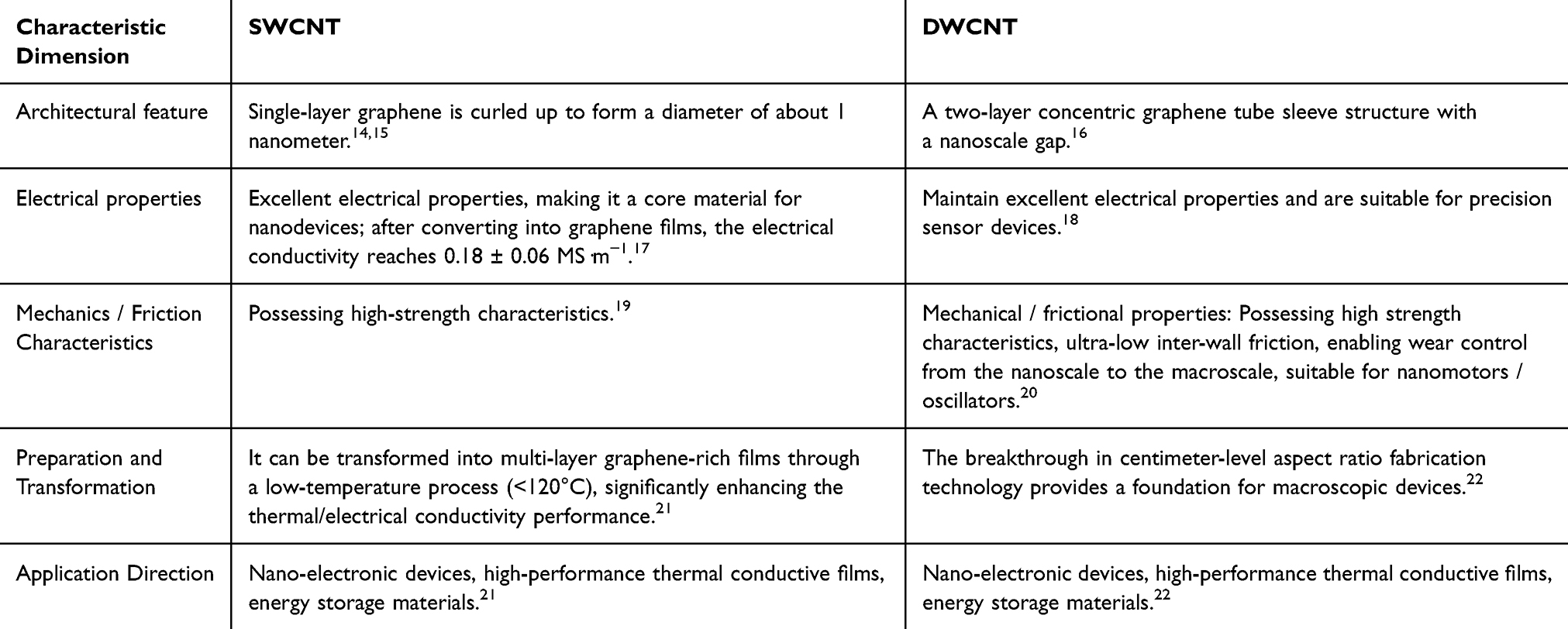 |
Table 1 Comparison Table of Properties Between Single-Walled and Double-Walled Carbon Nanotubes |
Mechanical Properties
Good mechanical strength is an important property of CNTS in the preparation of tissue engineering bioscaffolds. Compared to conventional metals or ceramics, CNTSs are not only flexible, but also have higher strength and lower density.2 CNTS has a density of 1.3–2.0 g/cm 3, tensile strength of 11–52 GPa, flexural strength of (14.2± 8) GPa and Young’s modulus of 32–1470 GPa.3,4 CNTS overcomes the poor mechanical properties of other bioactive materials in tissue engineering applications, and its excellent mechanical properties make it an important substrate or co-material in the field of tissue repair, and it can be used as a reinforcing material or substrate for materials such as chitosan, hydroxyapatite and bioceramics.2 Such a property provides a potential way to overcome the challenges that synthetic bone-like composites cannot have comparable mechanical properties to that of natural tissues and makes them an ultimate candidate as structural materials or reinforcements for polymer and ceramic matrices in the field of bone regeneration.23 Recently Yan et al found that CNTS has a great influence on the properties of CNTS/CCF/PEKK composites such as mechanical properties, biocompatibility, electrical conductivity and thermal conductivity; the flexural and shear strengths of the materials reached a maximum at 0.5 wt% CNTS content, which increased by 15.99% and 18.16%, respectively, as compared to that of the materials without added CNTS.24 In addition, they found that the addition of an appropriate amount of CNTS improves the material’s resistance to deformation, but an excessive amount of CNTS is counterproductive.24 Recent studies have shown that the addition of an appropriate amount of CNTS to the material can improve the mechanical properties, with the compressive strength and modulus of elasticity of the material reaching 0.46 GPa and 3.71 MPa, respectively, which is close to the mechanical properties of the human load-bearing bone tissues, and is beneficial to the regeneration of bone. Recently Wang et al found that carboxylated CNTS has good mechanical properties and can increase the mechanical properties of other materials, resulting in higher compressive strength without cytotoxicity, which is tantamount to expanding the application of CNTS in bone tissue engineering.25 The electrical properties of single-walled carbon nanotubes (SWCNTs) are excellent and they are mainly used in nano-devices. They can also be transformed into graphene films with enhanced performance through new technologies, which are applied in fields such as electronics and thermal management. Double-walled carbon nanotubes (DWCNTs) have extremely low friction and excellent electromechanical properties, and they have significant advantages in solving the friction and wear problems of micro-nano systems. They are mainly used in micro-nano electromechanical systems (such as nanomotors and sensors).
Electrical and Magnetic Properties
CNTS consists mainly of several to dozens of layers of carbon atoms arranged in a hexagonal arrangement in a coaxial circular tube. Its unique atomic basis and special structure make it electrically and magnetically conductive.26 The conductivity of CNTS was found to be determined by factors such as its arrangement, diameter, aspect ratio and chiral decision.3,4 Recent studies have shown that CNTS promotes the electrochemistry and electrical conductivity of relevant biomolecules and proteins, thereby accelerating the increase in osteoblast proliferation and bone formation during bone repair.23,27,28 Yan et al recently revealed the effect of CNTS on the mechanical properties, electrical conductivity, and thermal conductivity of CNTS/CCF/PEKK composites in a paper, which showed that the electrical conductivity of CNTS/CCF/PEKK composites is directly proportional to the content of CNTS, and that the higher the content of CNTS in the composites, the better the electrical conductivity and thermal conductivity of the materials.24 A recent study by Mamta et al found that CNTS can confer electrical conductivity to composites, and CNTS-based materials provide proper electrical conductivity and thus promote neuronal regeneration, which can induce neural axon germination, cell transformation, etc.29 Hailin et al found that CNTS has good electrical conductivity and can be added to the scaffolds as a reinforcing material to enhance the electrical conductivity of the scaffolds, which increased from 55.67±1.86% to 59.77±0.94%, which is expected to have the potential to be used as a bioactive scaffold for neural tissue engineering.30 In addition, the researchers found that CNTS is magnetically conductive. For example, the study of electromagnetic properties of CNTS/glass fibre/epoxy composites by Yan et al showed that CNTS has a tremendous effect on the electromagnetic properties of CNTS/glass fibre/epoxy composites, and that the electromagnetism of the composites improved with the increase of CNTS content.31 Carbon nanotubes, due to their excellent electrical and magnetic properties determined by their unique atomic structure and geometric features (such as arrangement, diameter and chirality), demonstrate great application potential in multiple cutting-edge fields. As reinforcing phases in composite materials, the addition of carbon nanotubes can significantly enhance the electrical and magnetic properties of the matrix, and the improvement of these properties is positively correlated with the content. Therefore, the electromagnetic properties of carbon nanotubes make them an important functional material for promoting the development of biomedical and advanced composite materials.
Chemical Properties and Functionalization
Studies have shown that CNTS is cytotoxic due to its unique structure, and in order to address its cytotoxicity, researchers have found that it can be modified by covalent and non-covalent modifications to reduce cytotoxicity and increase the chemical properties, such as hydroxylation, carboxylation, alcoholation and nitration. Chemically modified CNTSs have certain chemical properties and their controllable functional chemistry has an important influence on other properties of CNTSs.32 Roy et al recently found that carboxylated CNTS’s and hydroxylated CNTS’s could improve their tensile strength, which increased by 11.2% and 14.2%, respectively.33 Recently Sara et al investigated the effect of hydroxylation and carboxylation on the performance of CNTS and found that the uptake of zorubicin and etoposide by CNTS was improved after carboxylation and hydroxylation and they found that: hydroxylated CNTS and carboxylated CNTS were more suitable for the uptake of zorubicin and etoposide.34 A recent study has shown that carboxylated CNTS enhances the properties of composites and that carboxylated CNTS promotes sustainable delivery of biomolecules, which makes carboxylated CNTS offer a new promising therapeutic approach to promote tissue regeneration.35 Such functionalization not only reduces cytotoxicity but also enables the sustainable delivery of biomolecules, offering new therapeutic avenues for tissue regeneration. However, it is important to critically evaluate that functionalization does not always completely abrogate toxicity and can sometimes introduce new complexities in scaffold fabrication and reproducibility.
Antimicrobial Properties
The process of tissue damage is often accompanied by varying degrees of infection and is exacerbated by certain implanted materials, which have an impeding effect on the ability of the tissue to repair.36 Researchers explored and found that CNTS with antimicrobial properties can effectively control tissue infections. Recent studies revealed that the main mechanism of anti-microbial activity of multi-walled CNTS is physical damage to cells.37 CNTS can structurally disrupt microbial cell walls and cell membranes.37 Some researchers confirm that when CNT size decreases, their surface-to-volume ratio increases and ends in stronger interaction with the microorganism cell membrane. They explain that disruption of the cell membrane, metabolic procedure, and morphology, as well as the enhanced efflux of plasmid DNA, RNA, and cytoplasmic materials, are the main mechanisms of action of CNTs’ bacteriostatic properties.38 In addition, it was found that the antimicrobial properties of CNTS depend on their structure, surface modification, and the surrounding environment of specific microorganisms.39 Recent studies have shown that most of the possible antimicrobial mechanisms of CNTS are based on invasion of the microbial cell wall and induction of structural damage.40 Therefore, CNTS can be used as a tissue repair material to control or reduce infection. Horandghadim et al studied the combination of multi-walled CNTS with hydroxyapatite tantalum pentoxide and found that the multi-walled CNTS enhanced the antimicrobial properties of HA_Ta2O5 coatings, which side by side confirms that multi-walled CNTS has antimicrobial properties.37 Recently Moskvitina et al investigated the antimicrobial effects of multi-walled CNTS, two types of chlorofluorocarbons, OLCs and NDs against Escherichia coli and Staphylococcus spp.37 In their study, they found that NDs, two chlorofluorocarbons and carboxylated hydrophilic multi-walled CNTS had the highest antibacterial activity.37 Because of its antimicrobial properties, CNTS is mostly used as an auxiliary material in composites to improve or give antimicrobial properties to the composites, and a recent study has shown that CNTS has antimicrobial properties against Porphyromonas gingivalis, and the antimicrobial properties are related to the concentration of CNTS, and the antimicrobial activity is significantly elevated when the concentration of CNTS is greater than 0.5%, and it can kill up to 30% of the bacteria.41 While promising, the antimicrobial mechanism must be carefully balanced against potential harm to mammalian cells, and long-term efficacy in vivo requires further validation.
Cytotoxicity of CNTS
The current study found that CNTS are cytotoxic and that CNTs may accumulate in organs during excretion and may be harmful to organs.42 CNTs can elicit toxicity through membrane damage, DNA damage, oxidative stress, changes in mitochondrial activities, altered intracellular metabolic routes, and protein synthesis. The most common mechanisms of CNT cytotoxicity also encompass apoptosis and necrosis. The length and diameter of CNTs were found to have an effect on their toxicity.43 The cytotoxicity of CNTS has become the most important problem limiting its development and application. Therefore, the cytotoxicity of CNTS in tissue engineering needs to be further investigated. In order to solve the cytotoxicity problem of CNTS, researchers have conducted several exploratory studies. Vijayalakshmi et al investigated the cytotoxicity of CNTS and carboxyl-functionalized multiwall CNTS on LN18 cells in vitro and found that the cell viability of MWCNT-Cooh was higher than that of MWCNT at 20 and 40 g/mL after 24 and 48 h. Moreover, the results of viability and oxidative stress together indicated that, compared to MWCNT MWCNT-Cooh was less toxic at longer incubation times and higher concentrations.44 Studies have shown that CNTS is cytotoxic and carboxylation function modification of CNTS reduces the toxicity. Świętek et al exposed SAOS-2 human cell line to CNTS to study the cytotoxicity and found that the cytotoxic effect of CNTS on the SAOS-2 human cell line increased gradually with the increase in concentration.45 These findings underscore the importance of functionalization and careful dosage control to minimize adverse cellular responses while harnessing CNTs’ beneficial properties. However, conflicting results exist in the literature regarding the efficacy of specific functionalization strategies, highlighting the need for standardized toxicity assessment protocols. Furthermore, the potential for CNTs to induce inflammatory responses and their long-term fate in the body remain active areas of investigation.
Materials Composite with Carbon Nanotubes
The remarkable success of polymer nanocomposites with the incorporation of CNTs to impart superior performance, particularly in mechanical properties, has been widely reported. Among all the factors that contribute to the excellent properties of the nanocomposites, the individual morphological features of CNTs contribute significantly to determining the performance of the nanocomposites.46 CNTS has been used as a scaffold material due to its excellent mechanical properties, toughness and modulus of elasticity close to that of human tissues, but it still has some drawbacks,47 such as cytotoxicity. The researchers combined CNTS with other materials to form new composites, which could improve the properties of CNTS by compounding other materials, making it a potential tissue scaffold material. The use of CNTS for bone tissue engineering allows bone repair to be not limited to autologous and allogeneic bone.48 To leverage the advantages of CNTs while mitigating drawbacks like cytotoxicity and poor dispersibility, researchers have developed CNT-based composites with various polymers and ceramics. Recent studies have shown that CNTS can be combined with chitosan, hydroxyapatite, and polycaprolactone bioactive glass to optimise its properties and make it more conducive for application in bone tissue engineering.49 Recent experimental results by Shuai et al showed that the incorporation of self-assembled montmorillonite-CNTS composite nanoparticles into PLA bone scaffolds improved the mechanical properties of PLA bone scaffolds, and the CNTS composites exhibited good hydrophilicity as well as degradability, which had a favourable promotion effect on cell adhesion, proliferation and differentiation.50 In another recent study, chitosan (CS)-hydroxyapatite (HAp)-composite with multi-walled CNTS (MWCNT) was prepared as chitosan-hydroxyapatite-multi-walled carbon nanocrystalline nanocomposite patch, which showed that the nanocomposite film containing HAp nanoparticles (5% by weight) and MWCNT (0.5% by weight) has comparable mechanical properties to human bone and electrical conductivity and good biocompatibility with human bone cells.51 Moreover, researchers have also explored the intriguing possibility of utilizing the natural cytotoxic properties of CNTs to selectively target cancer cells, opening up promising avenues for cancer therapy.52 Liu et al showed that biomimetic torrefied aerogel scaffolds based on modified CNTS and hydroxyapatite-polyvinyl alcohol accelerated bone regeneration in the absence of intrinsic cytokines.51 It was shown that PVA/MWCNTs/HAP could enhance the adhesion, differentiation and expression of osteogenic marker genes of MC3T3_E1 cells, and could improve the mechanical properties of composites as well as surface hydrophilicity towards MC3T3_E1 cells by regulating the content of MWCNTs.51 Suh et al used electrospinning to obtain scaffolds with conductive properties by compounding CNTS with polycaprolactone and gelatin.53 It was shown that the addition of CNTS increased the conductivity of different scaffolds from 0.0 ± 0.00kS to 0.54 ± 0.10kS (Sandwich CNTSsCNT) and 5.22 ± 0.49kS (Dual Deposition CNTSDD CNT) compared to the scaffolds without CNTS, and the electrical conductivity of the composites varied depending on how the conductivity was measured, increasing to 0.25 ± 0.003 kS (sCNT) and 2.85 ± 1.12 (DD CNT) when measured perpendicular to the CNT arrays.53 In addition, they demonstrated that the addition of CNTS not only reduced the degradation rate of the scaffolds, but also increased the hydrophobicity as well as the mechanical properties of the scaffolds;53 and they demonstrated that the CNTS composites were highly cytocompatible by implanting cells on the composites, which could be used for cardiac and neural tissue engineering in the future.53 Sun and coworkers reported the functionalization and solubilization of SWNTs and multiple-walled carbon nanotubes (MWNTs) with polystyrene copolymers bearing hydroxyl or amine moieties for the subsequent fabrication of polystyrene–carbon nanocomposite films using a wet-casting method. The films thus obtained were found to have excellent optical quality, and were free of any significant nanotube aggregation effects.54 A recent study has shown that composites formed from CNTS and hydroxyapatite are cytotoxic and inhibit cell growth and motility. However, Nguyen et al found significant in vitro cytotoxicity of CNTS/hydroxyapatite against SUM_159 and MCF_7 breast cancer cell lines,55 and they demonstrated that the toxicity of CNTS composites on cancer cells was dose- and time-dependent, and that higher concentrations of CNTS composites inhibited the clonogenicity of cancer cells, and it was shown that CNTS composites can reduce the expression of cancer cell-related genes, thus further treating cancer. Researchers have made great achievements in CNTS composites. The researchers have further used CNTS composites for tissue engineering, especially in the treatment of bone defects, where the therapeutic results are not much different from those of autogenous and allogeneic bone. Recently, Yazhuo et al found that CNTS-carboxymethyl chitosan hydrogel has good biocompatibility and other properties, CNTS improves the mechanical properties of composites, electrochemical responsiveness, and CNTS can sustainably enhance the osteogenic differentiation of cells as well as the formation of new bone, which compensates for the insufficiency of the bone morphogenetic protein 2 in vivo, and facilitates the regenerative repair of tissues.48 Cao et al recently found that CNTS composites have good biocompatibility and comparable mechanical properties with human bone, MC3T3-E1 osteoblasts were planted in the CNTS composites, and the cell proliferation, adhesion, and differentiation ability were significantly enhanced, and the enhancement of the cell osteogenic differentiation as well as the enhancement of the vitality of the CNTS played a crucial role, and the CNTS has a significant enhancement effect on the osteogenesis of the human body.56 CNTS has a significant enhancement effect on human osteogenesis and is expected to be a new type of bioactive scaffold for bone tissue engineering.56 Unlike other scaffolds consisting of MWCNTs alone or TNTs alone, the MWCNT-TNT nanocomposite synergistically provides excellent biocompatibility, good electrical conductivity, low electrochemical interferences and a high signal-to-noise ratio.57
Properties of CNT Composites
CNTS composite scaffolds are a new class of composites that also have excellent mechanical properties, electrical conductivity, biocompatibility and good interfacial contact area.9 CNTS composites are widely used in tissue engineering due to their excellent properties, and this section focuses on reviewing the excellent properties of CNTS composites (Table 2).
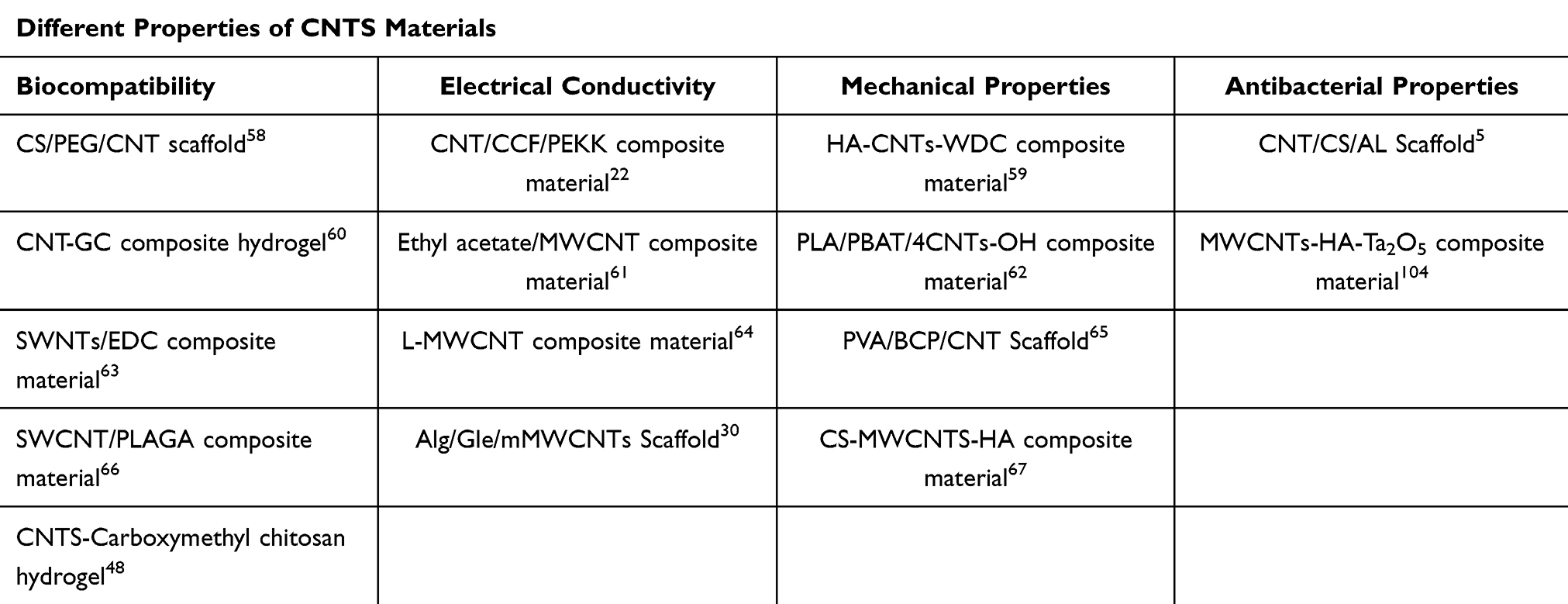 |
Table 2 Summarizes the Different Properties of CNTs Made from Different Materials, and the Composite Materials with Varying Properties Will Be Used in Different Fields |
Biocompatibility
Biocompatibility is an important criterion for whether a biomaterial can be implanted in the body. During tissue repair, tissue regeneration is affected by biocompatibility,68 and the higher the biocompatibility the better the tissue regeneration. Biocompatibility is a prerequisite for any implantable material. CNT composites often demonstrate improved biocompatibility compared to pristine CNTs, supporting cell attachment, proliferation, and tissue integration. The in vitro evaluations showed that the scaffolds were hemocompatible (with hemolysis induction lower than 5%) and cytocompatible (inducing significant proliferative effect (cell viability of 121 ± 4%, p < 0.05) for AlG/CNPs 10%).69 Sang et al found that a composite scaffold composed of chitosan, polyethylene glycol, and MWCNT was highly biocompatible;58 the composite scaffold was very similar to the extracellular matrix favourable for the growth and propagation of rat pheochromocytoma (PC12) cells, and enhanced the expression of cell-associated proteins, for example, growth-associated protein 43 (gap 43), nerve growth factor receptor (NGFR) and class III β-tubulin (tub β3) protein, among others. The incorporation of CNTS improves the properties of composites such as biocompatibility and mechanical properties, and the cell adhesion rate is related to the concentration of CNTS, the higher the concentration of CNTS the higher the cell adhesion rate. A recent study by Ravanbakhsh et al found that CNTS composite hydrogel has biocompatible, rheological and porous properties and CNTS can increase the porosity of the scaffolds and the high porosity of this scaffolds promotes cell adhesion, migration and recruitment from the surrounding natural tissues.60 Feng et al found that single-walled CNTS/EDC composites had high biocompatibility and bioactivity;63 the composite scaffolds were favourable for angiogenesis and induced the differentiation of MSCs into vascular endothelial cell-like cells (VEC-like cells); and vascular markers such as VEGF, VEGF-R2, CD31, and the RNA of vWF were markedly highly expressed. Favourable vascularisation of scaffold materials has a promoting effect on tissue regeneration. Vascular regeneration has been a difficult problem in tissue engineering, and the study by Feng et al provides a way to solve this problem. Zarei et al investigated the biocompatibility of PHB poly (3-hydroxybutyric acid)/CNTS composites; the results of the study showed that PHB/1% CNTS scaffolds favoured periodontal stem cell attachment and proliferation compared to pure PHB scaffolds.70 Recent studies on SWCNT/PLAGA composites by Gupta et al found their biocompatibility to be extremely similar to Food and Drug Administration-approved PLAGA, and the composites showed potential to favour tissue regeneration, promising to be a new type of bone repair material.66 Different researchers have confirmed the good biocompatibility of CNTS composites from both in vivo and in vitro experiments, and CNTS composites have a promising application in tissue engineering and other biomedical fields. It is critical to note, however, that biocompatibility is highly dependent on the specific composite formulation, CNT type, and processing methods, and results cannot be universally extrapolated.
Electrical Properties
In natural bones, bioelectric phenomena promote bone growth and fracture healing.71 Scaffold materials in bone tissue engineering have bioelectrical effects favouring the promotion of bone repair, a property required for bone tissue regeneration scaffolds. Studies have shown that CNTS has electrically conductive properties, therefore CNTS can impart conductive properties to CNTS composites, and CNTS composites can be used as electrically conductive scaffold materials for tissue engineering.72 The addition of nano-fillers and carbon nanotubes (CNTs) modulates the band gap, reduces strain, and enhances the elastic limit of polymers. The incorporation of CNTs strengthens the mechanical properties of the composite material; however, it increases electrical conductivity, which is adjusted by using metal oxides.73 Multi-walled carbon nanotubes can serve as a conducting filler in a conjugated luminescent polymer, poly(m-phenylenevinylene-co-2,5-dioctyloxy-p-phenylenevinylene), polyaniline. It has been demonstrated that the electronic structure of poly(m-phenylenevinylene-co-2,3-dioctoxy-p-phenylenevinylene and other types of conducting polymers is modified by the presence of carbon nanotubes, suggesting that there is strong coupling between the conjugated π-electron system and the multi-walled carbon nanotube.74 In order to prove the superior electrical conductivity of CNTS composites, several studies have been carried out by numerous scholars. Recently Yan et al studied CNT/CCF/PEKK composites and found that the electrical and thermal conductivity of the composites increased with the increase of CNTS content.25 Stanciu et al investigated the electrical properties of ethyl acetate/MWCNT composites;61 they found that the electrical conductivity of 1wt.% MWCNTs was about 10–10S/m. Whereas, the conductivity of the 5wt% composites was increased by 6 to 8 orders of magnitude to a saturated state of 10–2S/m.61 A recent study by Lee et al showed that the electrical properties of CNTS composites with different length ratios were quite different, and the results of the study showed that the electrical conductivity of L-MWCNT composites tended to be better than that of S-MWCNT composites.64 It was shown that the electrical conductivity of CNTS composites is related to the concentration as well as the length of CNTS, and the higher the concentration and the longer the length, the better the electrical conductivity of CNTS.
Therefore, the percolation threshold—the critical CNT concentration at which a continuous conductive network forms—is a key parameter in designing scaffolds with desired conductivity without compromising other properties like porosity or degradation.
Mechanical Properties
Scaffold materials for tissue engineering require good mechanical properties to achieve the mechanical properties of human structures.75 Polymer/CNT composites have better mechanical properties with higher electrical conductivity for biosensor applications.18 CNTS composites are a new type of scaffold material for tissue engineering with good mechanical properties to support human tissue repair. Researchers have conducted numerous studies to demonstrate the excellent mechanical properties of CNTS composites. Wang et al recently found that hydroxyapatite-CNTS-woody carbon composites (HA-CNTs-WDC) have good mechanical properties; the compressive strength of HA-CNTs-WDC composites reaches 10.54 MPa, which is similar to the mechanical properties of human bone, and has the potential to be a scaffold material for bone tissue engineering.59 In addition, Wang et al showed that multi-walled CNTS/polylactic acid/polybutylene terephthalate composites (PLA/PBAT/4CNTs-OH) possessed excellent mechanical properties, which was mainly attributed to the existence of strong interactions between CNTS and other substances leading to the CNTS composites exhibiting excellent mechanical properties.62 Some scholars have used Differential Scanning Calorimetry (DSC) to study the curing behavior of epoxy resin/AFCNT. The tensile strength and impact strength of epoxy nanocomposites reinforced with 2.0 wt.% AFCNT were increased by 43.2% and 370%, respectively. Moreover, the glass transition temperature (Tg) was also increased by 21 °C.76 It is acknowledged that the mechanical properties of the composites are significantly influenced by interfacial interactions between nanotubes and polymer matrices. The current challenge of the application of nanotubes in the composites is hence to determine the mechanical properties of the interfacial region, which is critical for improving and manufacturing the nanocomposites.77
Other Properties
Based on the thermal studies, both nHA particles and MWCNTS were known to enhance the thermal stability of the prepared composites.78 Furthermore, research has shown that CNT composites also possess antibacterial properties, excellent interfacial bonding performance, and thermal conductivity. These properties can also play an important role in tissue engineering.79 Some scholars have studied thermoplastic polyurethane (TPU) doped with multi-walled carbon nanotubes (MWCNT) at concentrations of 1, 3, 5, and 7 wt%. The effects of MWCNTs on the thermal, viscoelastic, and electrical properties of the TPU matrix were characterized by differential scanning calorimetry (DSC), dynamic mechanical analysis (DMA), and impedance spectroscopy. The results showed that thermal, electrical, and viscoelastic properties such as the glass transition temperature shifted to higher temperatures. The melting temperature decreased, while electrical conductivity and storage modulus increased by 61.5% and 58.3%, respectively. Wang et al studied HA-CNTs-WDS and found that this CNTS composite has good interfacial adhesion and is expected to be used as a scaffold material for bone tissue engineering.59 A recent study by Suo et al found that CNTS/chitosan/sodium alginate (CNT/CS/AL) had excellent in vitro antimicrobial properties, and this CNTS composite scaffold had a certain antimicrobial effect against Porphyromonas gingivalis, and the higher the concentration of CNTS the better its antimicrobial properties.5 Some scholars have found, regarding the mechanical behavior of MWCNT reinforced CS (MWCNT/CS), 5 and 10% concentrations of MWCNTs enhanced the mechanical behavior of CS, with that of 5% exhibiting a superior mechanical strength compared to 10% concentration and neat CS. Regarding biological properties, MWCNT/CS best supported proliferation of endothelial and myofibroblast cells, MWCNTs and MWCNT/CS caused no apoptosis and were not toxic of the examined cell types.80 Studies have shown that CNTS composites are widely used in bone tissue engineering, neural tissue engineering and cardiac tissue engineering due to the above mentioned excellent properties.
Shortcomings and Challenges of CNTs in Tissue Engineering
Despite the promising properties of CNT composites, several significant challenges hinder their widespread clinical application in tissue engineering. For example, the cytotoxicity of CNTS composites has hindered their widespread use in tissue engineering.81 De Godoy et al conducted a series of studies on CNTS composites using the mouse macrophage cell line J774A.1, which demonstrated that OCNT-TEPA (tetraethylaniline functional multiwall CNTS) has a dose-dependent cytotoxicity and may be cytotoxic to mouse macrophages (J774A.1).82 Jose et al prepared CNTS composite scaffolds from polycaprolactone (PCL) and MWCNTs, and cells were implanted in this scaffold material, and it was found that the scaffolds had low cytotoxicity to the cells, which affects the cell growth and propagation.56 In addition to the cytotoxicity of CNTS affecting its development, the degradation rate also affects the use of CNTS in tissue engineering. In order to determine whether the degradation rate of CNTS composites is affected by the incorporation of CNTS into their composites, the researchers carried out a series of investigations. In their study of PHBV/CNT nanocomposites, Silva et al found that although the biodegradation rate of PHBV was reduced by the addition of CNT, the biodegradability of PHBV was not affected.83 In addition, they found that the biodegraded CNT could potentially be recovered.83 The long-term fate and potential recovery of degraded CNTs in the body require further investigation. The persistence of non-degraded or partially degraded CNT fragments could lead to chronic inflammatory responses or other unforeseen complications. Other challenges include potential inflammatory responses, the need for standardized sterilization protocols for CNT-composites, and the scalability and reproducibility of manufacturing processes. Addressing these limitations—particularly achieving an optimal balance between functionality, safety, and controlled degradation—is essential for the future advancement of CNT-based tissue engineering.
CNTS Material Loaded with Growth Factors
CNTS and its composites have excellent properties as tissue engineering scaffold materials.84 The integration of growth factors(GFs) into CNT scaffolds represents a sophisticated strategy to create bioactive constructs that actively direct cellular processes for enhanced tissue regeneration. This section reviews the combination of CNTs with specific GFs.
CNTS Loaded with Vascular Endothelial Growth Factor (VEGF)
Blood provides important nutrients for the healing of damaged bone tissue.85 Vascular endothelial growth factor is a component and key factor in angiogenesis and plays a role in promoting angiogenesis.86 Whether carbon nanotube materials contain vascular growth factors with the ability to promote angiogenesis and tissue defect healing has been extensively investigated by numerous researchers. After a series of studies, the researchers found that carbon nanotube complexes containing vascular endothelial growth factor (VEGF) promoted angiogenesis and facilitated tissue regeneration. For example, a recent study by Song et al showed that VEGF-loaded CNTS materials can repair abdominal wall injuries, and they demonstrated in vitro and in vivo that VEGF-loaded MWNT composite scaffolds have good biocompatibility; VEGF-loaded multi-walled CNTS can bring vascular endothelial growth factor (VEGF) into the cells or tissues to promote tissue vascularisation and cell proliferation, and with a controlled release of VEGF The VEGF-loaded CNTS can promote tissue vascularisation at a faster rate to repair abdominal wall defects87 (Figure 1). In addition, another recent study investigated the use of MWNT/VEGF165 to repair abdominal wall defects. CNTS composite scaffolds loaded with VEGF165 were found to have excellent biocompatibility, allowing early vascularisation and more efficient collagen deposition.88 As mentioned above, carbon nanotubes and their complexes containing vascular endothelial growth factor do effectively promote early angiogenesis or tissue vascularisation and accelerate tissue repair.
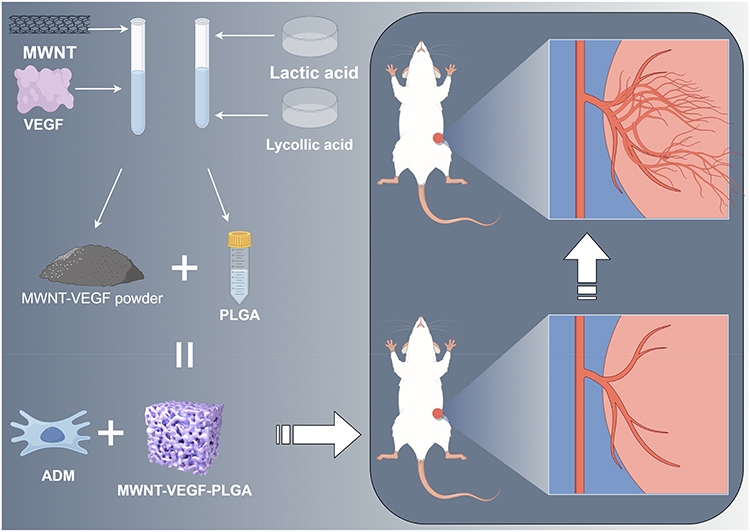 |
Figure 1 Mix 0.1g MWNT and 20ug VEGF with 5mL of deionized water, sonicate at room temperature for 2 hours, and prepare MWNT suspension. Pre freeze at −80 °C for 12 hours and vacuum dry at 60 °C for 12 hours to prepare MWNT-VEGF powder. MWNT-VEGF was modified by plasma to prepare MWNT-VEGF-PLGA ultra-thin film. The MWNT-VEGF-PLGA ultra-thin film and ADM form the MWNT-VEGF-PLGA-ADM composite scaffold, which can be used to repair abdominal wall defects (by figdraw).87 |
CNTS Loaded with Fibroblast Growth Factor (FGF)
Fibroblast growth factors are essential for the healing of tissue defects.89 Among other biomedical applications, after proper functionalization carbon nanotubes can be transformed into sophisticated biosensing and biocompatible drug-delivery systems, for specific targeting and elimination of tumor cells.90 The ability of carbon nanotube materials containing fibroblast growth factors to promote tissue defect healing has been extensively investigated by numerous researchers. Studies have shown that CNTS composites loaded with fibroblast growth factor (FGF) have the ability to promote endothelial cell proliferation as well as the ability to control osteoblast differentiation, among other things, thereby promoting bone repair. Numerous researchers have confirmed the superiority of fibroblast growth factor-loaded CNTS and its composites in the healing of bone defects. For example, a recent study by Hirata et al showed that implantation of FGF-CNT between the parietal bone and the periosteum in rats had a promoting effect on new bone formation.91 In their study, they found that at day 14 after composite implantation, a large amount of new bone generation was seen in most of the pores of the FGF-CNT-coated sponges, and the breakdown products of the CNTS could be integrated in the new bone to further promote bone healing91 (Figure 2). In addition, a recent study by Alshaya et al showed that the addition of rfhSP-D-CNT complex to the culture system of SKOV3 cells had an inhibitory effect on the growth of SKOV3 cells, whose apoptotic possible mechanism was the impaired mTOR complex, and the results of the study showed that rfhSP-D-CNT complex had an antitumour effect, which could indirectly prove the CNTS load-associated factors for the treatment of clinical diseases and future use in clinical therapy.92
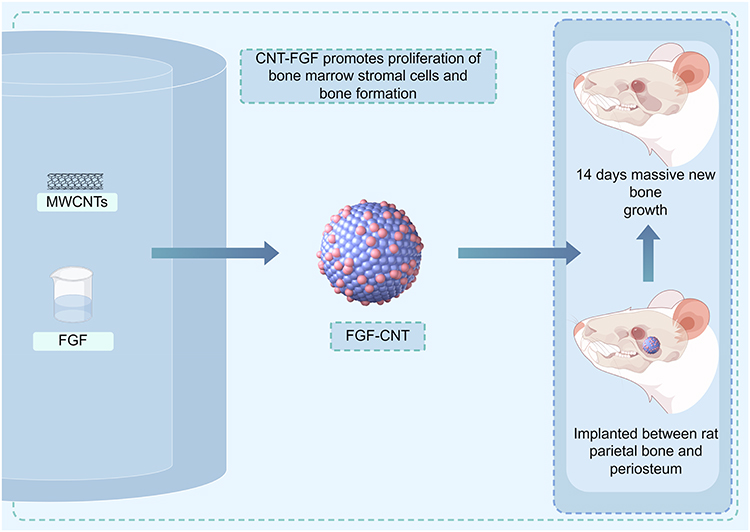 |
Figure 2 FGF functionalized MWCNTS, and then the FGF-MWCNT coated sponge was implanted between the parietal bone and periosteum of rats. After 14 days of implantation, a large amount of new bone was observed in most of the pores of the FGF-CNT coated sponge (by figdraw).91 |
Application of CNTS and Its Composites
Numerous studies have been conducted in a series of investigations in search of novel bioactive materials, eventually turning their attention to CNTS and their composites. Researchers have found that CNTS and its composites are widely used in tissue engineering due to their excellent properties, and the application of CNTS and its composites in tissue engineering provides new therapeutic avenues in the medical field.93 This section provides an overview of CNTS and its composites in bone tissue engineering, neural tissue engineering, and cardiac tissue engineering.
Application of CNTS Composites in Bone Tissue Engineering
In regards to their significant extent in bone regeneration, it has been determined that CNTs hold the capability to endure clinical applications through bone tissue engineering and orthopedic procedures.94 Factors such as trauma, tumour and infection have become important causes of bone defects, and with the progress and development of society the number of patients with bone defects has increased dramatically.95 Due to the progress of medical technology and social development,96 patients are now demanding more and more technical methods and results for bone defect treatment. Traditional autologous bone grafting, allogeneic bone grafting, and artificial substitutes have been widely used in the clinical treatment of bone defects;97 however, there are still some shortcomings in the treatment of bone defects by the above clinical methods. For example, the best method for treating bone defects is autologous bone grafting, but this surgical method causes pain in the donor area and autologous bone grafting is limited.98 CNT composites offer a promising alternative. Wang et al identified a HA-CNTs-WDC composite scaffold with excellent mechanical properties, biocompatibility, biomineralization capacity, and interfacial adhesion, marking it as a promising bone graft substitute. Abdollahi et al proposed a PHB-starch-1wt.%MWCNT composite as a novel bone scaffold due to its favorable mechanical properties, biocompatibility, biodegradability, and ability to promote bone-associated protein expression. Recently Lan et al found that PVA/BCP/CNT has excellent mechanical properties, biocompatibility, and biodegradability, and the special structure of this composite scaffold is conducive to the growth and propagation of osteoblasts, which make this composite scaffold expected to be a potential bioactive scaffold in the field of bone tissue engineering and regeneration.65 Gupta et al found that SWCNT/PLAGA composites have unlimited potential for bone tissue engineering because the structure of the composite scaffolds is similar to the trabeculae of cancellous bone which is favourable for osteoblast proliferation and osteogenic gene expression, and has excellent mechanical properties and biocompatibility, which make the composite materials have unlimited potential for musculoskeletal regeneration and bone tissue engineering.99 Xinfeng et al investigated a novel CNTS composite scaffold material with injectability, excellent mechanical properties and biocompatibility, and the development of this injectable CNTS scaffold opens up new avenues for bone tissue engineering scaffolds.
Fonseca-Garcia et al successfully prepared 3D biomimetic chitosan/multi-walled CNTS/nano hydroxyapatite (CTS/MWCNT/nHAp) scaffolds; this biomimetic scaffold has high biocompatibility and cellular activity, and the doped CNTS did not affect the composite scaffold’s biocompatibility, and it can promote human periosteal cells as a bioactive material for growth and propagation, which is expected to be a new bioactive material for bone tissue engineering.100 Chen et al successfully prepared and studied chitosan multiwall CNTS/hydroxyapatite composites and found that they have excellent mechanical properties and biocompatibility; the composites are promising as biomaterials for bone tissue engineering.67 The structures studied above indicate that CNTS and its composites have various excellent properties and that CNTS and its composites have a wide range of applications in bone tissue engineering. Notably, these CNT scaffolds have demonstrated remarkable positive effects across various cell culture systems, stimulating neuronal growth, promoting cardiomyocyte maturation, and facilitating osteocyte differentiation. These encouraging results have sparked significant interest within the regenerative medicine field, including neural, cardiac, muscle, and bone regenerations. However, addressing the concern of CNT cytotoxicity in these scaffolds remains critical. Consequently, substantial efforts are focused on exploring strategies to minimize cytotoxicity associated with CNT-based scaffolds.52
CNTS Composites for Neural and Cardiac Tissue Engineering Applications
Carbon nanotubes are attractive candidates for the development of scaffolds able to support neuronal growth and differentiation thanks to their ability to conduct electrical stimuli, to interface with cells and to mimic the neural environment.101 Sang et al investigated and prepared CS/PEG/CNT scaffolds and found that the scaffolds had good biocompatibility, electrical conductivity, and the doped CNTS conferred electrical conductivity to other biomaterials and the electrical conductivity of the composites was correlated with the concentration of CNTS. In addition, CNTS facilitates neuronal cell growth and high expression of related genes, so the composite can be applied to neural tissue engineering.58
In addition, CNTS can enhance the electrical conductivity and mechanical stability of cardiac tissues. By co-culturing CNTS with cardiac cells, cardiac tissue models with better electrophysiological properties and mechanical strength can be constructed, providing new ideas for the research and treatment of heart diseases. Alegret et al studied the preparation of different CNTS composites by combining CNT with CP and showed that the composite scaffolds have good biocompatibility and improve the spontaneous cellular pacing function, which helps cardiomyocytes to proliferate and differentiate into myocytes to promote cardiac function; CNT composite scaffolds provide a ray of light in the development of cardiac tissue-engineered scaffolds.102 The ability of CNT composites to improve intercellular coupling and conduction velocity in engineered cardiac patches is a significant step towards creating functional myocardium. Despite promising results, the application of CNTs in these sensitive tissues necessitates rigorous investigation into their long-term safety and interaction with electrically excitable cells. Concerns regarding potential pro-arrhythmic effects in cardiac applications or unintended neuromodulation in neural interfaces must be thoroughly addressed.
Summary and Outlook
CNTs and their composites have demonstrated immense potential in tissue engineering due to their synergistic mechanical, electrical, and bioactive properties. Their applications span bone, neural, and cardiac tissue engineering, where they promote cell growth, differentiation, and functional recovery by providing a supportive microenvironment. The integration of growth factors further enhances their regenerative capacity. In addition, recent studies have shown that CNTS has a photothermal effect, which can be combined with near-infrared light and other auxiliary therapies for the repair of tissue defects, and researchers have applied near-infrared light together with CNTS and its composites in bone tissue engineering to improve the osteogenic efficacy, antimicrobial properties, and the promotion of angiogenesis of the CNTS materials.103 In addition, studies have shown that near-infrared light-responsive CNTS and its composites in the treatment of bone tumours are effective.103 CNTS and its composites are expected to replace bone allografts in the future, and have unlimited potential for use in tissue engineering, providing a new approach to treating tissue defects.104
However, significant challenges persist. Cytotoxicity remains a primary concern, and current functionalization strategies, while beneficial, are not a panacea. The long-term interaction mechanisms between CNTs and biological systems, including degradation products, immune responses, and potential systemic effects, require deeper investigation to ensure safety and efficacy. The field must also address issues of scalable manufacturing, standardization, and regulatory approval.
Future research should prioritize:1. Developing more effective surface modification strategies to thorough mitigate cytotoxicity and improve biointegration.2. Conducting comprehensive long-term in vivo studies to evaluate biocompatibility, biodegradation, and functional outcomes using standardized models and reporting.3. Designing sophisticated multi-functional scaffolds that combine CNTs with multiple bioactive cues (eg, GFs, drugs) and other nanomaterials for enhanced performance.4. Establishing robust, scalable, and reproducible manufacturing protocols suitable for clinical translation.5. Fostering cross-disciplinary collaboration between materials science, biology, and clinical medicine to translate laboratory innovations into clinically viable products. In conclusion, while CNT-based scaffolds present a powerful platform for next-generation tissue engineering, realizing their full potential necessitates a balanced and critical approach that rigorously addresses both their remarkable capabilities and their inherent challenges through sustained and collaborative research efforts.
Author Contributions
All authors have made significant contributions to the reported work, whether in terms of concept, research design, execution, data acquisition, analysis and interpretation, or in all these areas; Participate in the drafting, revision or critical review of articles; The final approved version for publication; An agreement has been reached on the journal to which the article should be submitted. And agree to be responsible for all aspects of the work.
Funding
Natural Science Foundation of Gansu Province (25JRRA809)
Gansu University of Traditional Chinese Medicine (YBXM-202415).
Disclosure
The authors report no conflicts of interest in this work.
References
1. Li Q, Feng C, Cao Q, et al. Strategies of strengthening mechanical properties in the osteoinductive calcium phosphate bioceramics. Regen Biomater. 2023;10:rbad013. doi:10.1093/rb/rbad013
2. Wang W, Zhu Y, Liao S, Li J. Carbon nanotubes reinforced composites for biomedical applications. Biomed Res Int. 2014;2014:518609. doi:10.1155/2014/518609
3. Zhang X, Chen X, Hong H, et al. Decellularized extracellular matrix scaffolds: recent trends and emerging strategies in tissue engineering. Bioact Mater. 2022;10:15–31. doi:10.1016/j.bioactmat.2021.09.014
4. Venkatesan J, Pallela R, Kim S-K. Applications of carbon nanomaterials in bone tissue engineering. J Biomed Nanotechnol. 2014;10:3105–3123. doi:10.1166/jbn.2014.1969
5. Suo L, Wu H, Wang P, et al. The improvement of periodontal tissue regeneration using a 3D-printed carbon nanotube/chitosan/sodium alginate composite scaffold. J Biomed Mater Res B Appl Biomater. 2023;111:73–84. doi:10.1002/jbm.b.35133
6. Tiwari SK, Sahoo S, Wang N, Huczko A. Graphene research and their outputs: status and prospect. J Sci. 2020;5:10–29.
7. Gan PG, Sam ST, Abdullah MFB, Omar MF. Thermal properties of nanocellulose‐reinforced composites: a review. J Appl Polym Sci. 2020;137:48544. doi:10.1002/app.48544
8. Oh Y, Islam MF. Preformed nanoporous carbon nanotube scaffold-based multifunctional polymer composites. ACS Nano. 2015;9:4103–4110. doi:10.1021/acsnano.5b00170
9. Mohd Nurazzi N, Asyraf MRM, Khalina A, et al. Fabrication, functionalization, and application of carbon nanotube-reinforced polymer composite: an overview. Polymers. 2021;13:1047. doi:10.3390/polym13071047
10. Lee SH, Rho WY, Chang H, et al. Carbon nanomaterials for biomedical application. Adv Exp Med Biol. 2021;1309:257–276.
11. Liu W, Hierold C, Haluska M. Electrical contacts to individual SWCNTs: a review. Beilstein J Nanotechnol. 2014;5:2202–2215. doi:10.3762/bjnano.5.229
12. Li J, Seo J, Feng P, et al. One-step transformation of single-walled carbon nanotube networks into high-performance multilayer graphene-rich films via laser shockwave compaction. Adv Funct Mater. 2025;2025:e11015.
13. Liu M, Ye X, Bai Y, Zhang R, Wei F, Li X. Multi-scale analysis of the interaction in ultra-long carbon nanotubes and bundles. J Mech Phys Solids. 2020;142:104032. doi:10.1016/j.jmps.2020.104032
14. Kinloch IA, Suhr J, Lou J, Young RJ, Ajayan PM. Composites with carbon nanotubes and graphene: an outlook. Science. 2018;362:547–553. doi:10.1126/science.aat7439
15. Horandghadim N, Ghazanfar-Ahari Y, Khalil-Allafi J. Multiwalled-carbon nanotubes reinforced hydroxyapatite- tantalum pentoxide nanocomposite coating on Nitinol alloy: antibacterial activity and Electrochemical properties. Surf Interfaces. 2022;29:101773. doi:10.1016/j.surfin.2022.101773
16. Bellarosa L, Bakalis E, Melle-Franco M, Zerbetto F. Interactions in concentric carbon nanotubes: the radius vs the chirality angle contributions. Nano Lett. 2006;6:1950–1954. doi:10.1021/nl061066g
17. Yu F, Shi Y, Yao W, Han S, Ma J. A new breakthrough for graphene/carbon nanotubes as counter electrodes of dye-sensitized solar cells with up to a 10.69% power conversion efficiency. J Power Sources. 2019;412:366–373. doi:10.1016/j.jpowsour.2018.11.066
18. Ates M, Eker AA, Eker B. Carbon nanotube-based nanocomposites and their applications. J Adhes Sci Technol. 2017;31:1977–1997. doi:10.1080/01694243.2017.1295625
19. Esmaeili A, Sbarufatti C, Jiménez-Suárez A, Ureña A, Hamouda AMS. A comparative study of the incorporation effect of SWCNT-OH and DWCNT with varied microstructural defects on tensile and impact strengths of epoxy based nanocomposite. J Polym Res. 2020;27:152. doi:10.1007/s10965-020-02135-z
20. Huang J, Ng AL, Piao Y, et al. Covalently functionalized double-walled carbon nanotubes combine high sensitivity and selectivity in the electrical detection of small molecules. J Am Chem Soc. 2013;135:2306–2312. doi:10.1021/ja310844u
21. Liu Y, Du Y, Meng Q, Xu J, Shen SZ. Effects of preparation methods on the thermoelectric performance of SWCNT/Bi2Te3 bulk composites. Materials. 2020;13:2636. doi:10.3390/ma13112636
22. Wang Z, Wang X, Zheng T, et al. High flux nanofiltration membranes with Double-Walled Carbon Nanotube (DWCNT) as the interlayer. Membranes. 2022;12:1011. doi:10.3390/membranes12101011
23. Pei B, Wang W, Dunne N, Li X. Applications of carbon nanotubes in bone tissue regeneration and engineering: superiority, concerns, current advancements, and prospects. Nanomaterials. 2019;9:1501. doi:10.3390/nano9101501
24. Yan X, Qiao L, Tan H, et al. Effect of carbon nanotubes on the mechanical, crystallization, electrical and thermal conductivity properties of CNT/CCF/PEKK composites. Materials. 2022;15:4950. doi:10.3390/ma15144950
25. Wang J, Huang C, Wang Y, et al. Exploration of the single-walled carbon nanotubes’ influence for cartilage repair. Colloid Surf A. 2020;606:125520. doi:10.1016/j.colsurfa.2020.125520
26. Gul N, Genc Oztoprak B. Investigation of electrical and electromagnetic properties of quartz fiber reinforced polymer composite material by using modified paints with carbon nanoparticles (graphene/double-walled carbon nanotube). J Compos Mater. 2022;56:3013–3027. doi:10.1177/00219983221099332
27. Ferrer-Anglada N, Gomis V, El‐Hachemi Z, et al. Carbon nanotube based composites for electronic applications: CNT-conducting polymers, CNT-Cu. Phys Status Solidi A. 2006;203:1082–1087. doi:10.1002/pssa.200566188
28. Saha A, Jiang C, Marti AA. Carbon nanotube networks on different platforms. Carbon. 2014;79:1–18. doi:10.1016/j.carbon.2014.07.060
29. Mishra M, Maiti SK, Elangovan K, et al. Evaluation of stem cell laden collagen + polycaprolactone + multi-walled carbon nano-tubes nano-neural scaffold with and without insulin like growth factor-I for sciatic nerve regeneration post crush injury in wistar rats. Cell Physiol Biochem. 2023;57:452–477.
30. Ma H, Yu K, Wang H, et al. Fabrication and detection of a novel hybrid conductive scaffold based on alginate/gelatin/carboxylated carbon nanotubes (Alg/Gel/mMWCNTs) for neural tissue engineering. Tissue Cell. 2023;80:101995. doi:10.1016/j.tice.2022.101995
31. Yan Z, Lu Y, Yuexin D. Study on the electrical behavior of MWCNTs in GF/Epoxy composites. J Nanosci Nanotechnol. 2010;10:5339–5345. doi:10.1166/jnn.2010.1941
32. Shanta AS, Al Mamun KA, Islam SK, McFarlane N, Hensley DK. Carbon nanotubes, nanofibers and nanospikes for electrochemical sensing: a review. In: Jain F, Broadbridge C, Tang H, editors. Microelectronics and Optoelectronics. Vol. 60. Singapore: World Scientific Publ Co Pte Ltd; 2017:25–36.
33. Roy S, Petrova RS, Mitra S. Effect of carbon nanotube (CNT) functionalization in Epoxy-CNT composites. Nanotechnol Rev. 2018;7:475–485. doi:10.1515/ntrev-2018-0068
34. Eskandari S, Barzegar A, Mahnam K. Absorption of daunorubicin and etoposide drugs by hydroxylated and carboxylated carbon nanotube for drug delivery: theoretical and experimental studies. J Biomol Struct Dyn. 2022;40:10057–10064. doi:10.1080/07391102.2021.1938232
35. Behrouznejad B, Sadat SB, Masaeli E. The orchestration of sustained drug delivery by bacterial cellulose/gelatin nanocomposites reinforced with carboxylic carbon nanotubes. Carbohydr Polym. 2024;333:121917. doi:10.1016/j.carbpol.2024.121917
36. Sui J, Ding Y, Chen M, et al. BMP4 peptide and enoxacin-loaded mesoporous silica nanoparticles direct cell fate and boost bone regeneration during infection. Mater Des. 2023;231:112066. doi:10.1016/j.matdes.2023.112066
37. Moskvitina E, Kuznetsov V, Moseenkov S, Serkova A, Zavorin A. Antibacterial effect of carbon nanomaterials: nanotubes, carbon nanofibers, nanodiamonds, and onion-like carbon. Materials. 2023;16:957. doi:10.3390/ma16030957
38. Hadidi N, Mohebbi M. Anti-infective and toxicity properties of carbon based materials: graphene and functionalized carbon nanotubes. Microorganisms. 2022;10:2439. doi:10.3390/microorganisms10122439
39. Stegarescu A, Lung I, Ciorîță A, et al. The antibacterial properties of nanocomposites based on carbon nanotubes and metal oxides functionalized with azithromycin and ciprofloxacin. Nanomaterials. 2022;12:4115. doi:10.3390/nano12234115
40. Park J-E, Jang Y-S, Park I-S, et al. The effect of multi-walled carbon nanotubes/hydroxyapatite nanocomposites on biocompatibility. Adv Compos Mater. 2018;27:53–65. doi:10.1080/09243046.2017.1374705
41. Yu H, Yao J, Qin Z, Liu L, Yang X. Comparison of covalent and noncovalent interactions of carbon nanotubes on the crystallization behavior and thermal properties of poly(3‐hydroxybutyrate‐ co ‐3‐hydroxyvalerate). J Appl Polym Sci. 2013;130:4299–4307. doi:10.1002/app.39529
42. Vardharajula S, Ali SZ, Tiwari PM, et al. Functionalized carbon nanotubes: biomedical applications. Int J Nanomed. 2012;7:5361–5374. doi:10.2147/IJN.S35832
43. Swietek M, Brož A, Tarasiuk J, et al. Carbon nanotube/iron oxide hybrid particles and their PCL-based 3D composites for potential bone regeneration. Mater Sci Eng C. 2019;104:109913. doi:10.1016/j.msec.2019.109913
44. Vijayalakshmi V, Sadanandan B, Anjanapura RVV. In vitro comparative cytotoxic assessment of pristine and carboxylic functionalized multiwalled carbon nanotubes on LN18 cells. J Biochem Mol Toxicol. 2023;37. doi:10.1002/jbt.23283
45. Cao J, Lu Y, Chen H, Zhang L, Xiong C. Preparation, properties and in vitro cellular response of multi-walled carbon nanotubes/bioactive glass/poly(etheretherketone) biocomposite for bone tissue engineering. Int J Polym Mater Polym Biomat. 2019;68:433–441. doi:10.1080/00914037.2018.1455679
46. Nurazzi NM, Sabaruddin FA, Harussani MM, et al. Mechanical performance and applications of CNTs reinforced polymer composites-a review. Nanomaterials. 2021;11:2186. doi:10.3390/nano11092186
47. Bengalli RD, Zerbi G, Lucotti A, Catelani T, Mantecca P. Carbon nanotubes: structural defects as stressors inducing lung cell toxicity. Chem Biol Interact. 2023;382:110613. doi:10.1016/j.cbi.2023.110613
48. Huang Y, Zhang L, Ji Y, et al. A non-invasive smart scaffold for bone repair and monitoring. Bioact Mater. 2023;19:499–510. doi:10.1016/j.bioactmat.2022.04.034
49. Machado-Paula MM, F. Corat MA, de Vasconcellos LMR, et al. Rotary jet-spun polycaprolactone/hydroxyapatite and carbon nanotube scaffolds seeded with bone marrow mesenchymal stem cells increase bone neoformation (vol 5, pg 1013, 2022). ACS Appl Bio Mater. 2023;6:933. doi:10.1021/acsabm.3c00030
50. Shuai C, Peng B, Liu M, Peng S, Feng P. A self-assembled montmorillonite-carbon nanotube hybrid nanoreinforcement for poly-L-lactic acid bone scaffold. Mater Today Adv. 2021;11:100158. doi:10.1016/j.mtadv.2021.100158
51. Sanchez AG, Prokhorov E, Luna-Barcenas G, et al. Chitosan-hydroxyapatite-MWCNTs nanocomposite patch for bone tissue engineering applications. Mater Today Commun. 2021;28:102615. doi:10.1016/j.mtcomm.2021.102615
52. Shar A, Shar A, Joung D. Carbon nanotube nanocomposite scaffolds: advances in fabrication and applications for tissue regeneration and cancer therapy. Front Bioeng Biotechnol. 2023;11:1299166. doi:10.3389/fbioe.2023.1299166
53. Suh TC, Twiddy J, Mahmood N, et al. Electrospun carbon nanotube-based scaffolds exhibit high conductivity and cytocompatibility for tissue engineering applications. ACS Omega. 2022;7:20006–20019. doi:10.1021/acsomega.2c01807
54. Paiva MC, Zhou B, Fernando KAS, et al. Mechanical and morphological characterization of polymer–carbon nanocomposites from functionalized carbon nanotubes. Carbon. 2004;42:2849–2854. doi:10.1016/j.carbon.2004.06.031
55. Nguyen T, Maniyar A, Sarkar M, Sarkar TR, Neelgund GM. The cytotoxicity of carbon nanotubes and hydroxyapatite, and graphene and hydroxyapatite nanocomposites against breast cancer cells. Nanomaterials. 2023;13:556. doi:10.3390/nano13030556
56. Penaranda-Armbrecht J, Correa-Quiceno MJ, Caicedo-Angulo JC, Neuta-Arciniegas PA, Gutierrez-Montes JO. Fabrication of multi-walled carbon nanotube/polycaprolactone scaffolds for possible application in tissue engineering. J Polym Res. 2024;31:64. doi:10.1007/s10965-024-03875-y
57. Liu X, Yan R, Zhang J, Zhu J, Wong DKY. Evaluation of a carbon nanotube-titanate nanotube nanocomposite as an electrochemical biosensor scaffold. Biosens Bioelectron. 2015;66:208–215. doi:10.1016/j.bios.2014.11.028
58. Sang S, Cheng R, Cao Y, et al. Biocompatible chitosan/polyethylene glycol/multi-walled carbon nanotube composite scaffolds for neural tissue engineering. J Zhejiang Univ Sci B. 2022;23:58–73. doi:10.1631/jzus.B2100155
59. Wang Z, Zhang L, Zhang R, Wang M. Design and fabrication of hydroxyapatite-carbon nanotubes-wood derived carbon composites. Mater Lett. 2022;315:131974. doi:10.1016/j.matlet.2022.131974
60. Ravanbakhsh H, Bao G, Latifi N, Mongeau LG. Carbon nanotube composite hydrogels for vocal fold tissue engineering: biocompatibility, rheology, and porosity. Mater Sci Eng C. 2019;103:109861. doi:10.1016/j.msec.2019.109861
61. Stanciu N-V, Stan F, Sandu I-L, et al. Mechanical, electrical and rheological behavior of ethylene-vinyl acetate/multi-walled carbon nanotube composites. Polymers. 2019;11:1300. doi:10.3390/polym11081300
62. Wang P, Gao S, Chen X, et al. Effect of hydroxyl and carboxyl-functionalized carbon nanotubes on phase morphology, mechanical and dielectric properties of poly(lactide)/poly (butylene adipate-co-terephthalate) composites. Int J Biol Macromol. 2022;206:661–669. doi:10.1016/j.ijbiomac.2022.02.183
63. Luo F, Li R, Zheng H, et al. Differentiation of bone mesenchymal stem cells into vascular endothelial cell-like cells using functionalized single-walled carbon nanotubes. Front Bioeng Biotechnol. 2022;10:913080. doi:10.3389/fbioe.2022.913080
64. Lee D-K, Yoo J, Kim H, Kang B-H, Park S-H. Electrical and thermal properties of carbon nanotube polymer composites with various aspect ratios. Materials. 2022;15:1356. doi:10.3390/ma15041356
65. Lan W, Zhang X, Xu M, et al. Carbon nanotube reinforced polyvinyl alcohol/biphasic calcium phosphate scaffold for bone tissue engineering. RSC Adv. 2019;9:38998–39010. doi:10.1039/C9RA08569F
66. Gupta A, Liberati TA, Verhulst SJ, et al. Biocompatibility of single-walled carbon nanotube composites for bone regeneration. Bone Jt Res. 2015;4:70–77. doi:10.1302/2046-3758.45.2000382
67. Chen L, Hu J, Shen X, Tong H. Synthesis and characterization of chitosan-multiwalled carbon nanotubes/hydroxyapatite nanocomposites for bone tissue engineering. J Mater Sci. 2013;24:1843–1851.
68. Williams DF. The plasticity of biocompatibility. Biomaterials. 2023;296:122077. doi:10.1016/j.biomaterials.2023.122077
69. Zhou Z, Zhou A, Jalil AT, Saleh MM, Huang C. Carbon nanoparticles-based hydrogel nanocomposite induces bone repair in vivo. Bioprocess Biosyst Eng. 2023;46:577–588. doi:10.1007/s00449-022-02843-4
70. Zarei M, Karbasi S, Aslani FS, et al. In vitro and in vivo evaluation of poly (3-hydroxybutyrate)/carbon nanotubes electrospun scaffolds for periodontal ligament tissue engineering. J Dent. 2020;21:18–30.
71. Khare D, Basu B, Dubey AK. Electrical stimulation and piezoelectric biomaterials for bone tissue engineering applications. Biomaterials. 2020;258:120280. doi:10.1016/j.biomaterials.2020.120280
72. Meng D, Ioannou J, Boccaccini AR. BioglassA®-based scaffolds with carbon nanotube coating for bone tissue engineering. J Mater Sci. 2009;20:2139–2144.
73. Faiza N, Qammar M, Butt S, et al. A sequenced study of improved dielectric properties of carbon nanotubes and metal oxide-reinforced polymer composites. Materials. 2022;15:4592. doi:10.3390/ma15134592
74. Chen J, Liu B, Gao X, Xu D. A review of the interfacial characteristics of polymer nanocomposites containing carbon nanotubes. RSC Adv. 2018;8:28048–28085. doi:10.1039/c8ra04205e
75. Li Y, Zhou J, Hu S, et al. [Methods of improving the mechanical properties of hydrogels and their research progress in bone tissue engineering]. Zhongguo Xiu Fu Chong Jian Wai Ke Za Zhi. 2021;35:1615–1622. doi:10.7507/1002-1892.202107053 Danish
76. Sun Y, Zhang X, Zhao D. Reinforcement of aminopropyl-terminated siloxane-treated carbon nanotubes in epoxy thermosets: mechanical and thermal properties. Polymers. 2023;15:3184. doi:10.3390/polym15153184
77. Arash B, Wang Q, Varadan VK. Mechanical properties of carbon nanotube/polymer composites. Sci Rep. 2014;4. doi:10.1038/srep06479
78. Elmofty AR, Abdel Aziz ME, Tash M, El-Hadad S. Development and characterization of hydroxyapatite and multiwall carbon nanotubes reinforced polypropylene biocomposites. Sci Rep. 2025;15:18754. doi:10.1038/s41598-025-96082-8
79. Chilito JM, Lara-Ramos JA, Angel J, et al. Thermal, viscoelastic, and electrical properties of thermoplastic polyurethane films reinforced with multi-walled carbon nanotubes. Heliyon. 2024;10:e32794. doi:10.1016/j.heliyon.2024.e32794
80. Kroustalli A, Zisimopoulou AE, Koch S, et al. Carbon nanotubes reinforced chitosan films: mechanical properties and cell response of a novel biomaterial for cardiovascular tissue engineering. J Mater Sci Mater Med. 2013;24:2889–2896. doi:10.1007/s10856-013-5029-8
81. Kharlamova MV, Kramberger C. Cytotoxicity of carbon nanotubes, graphene, fullerenes, and dots. Nanomaterials. 2023;13:1458. doi:10.3390/nano13091458
82. de Godoy KF, Rodolpho JM, Fragelli BD, et al. Cytotoxic effects caused by functionalized carbon nanotube in murine macrophages. Cell Physiol Biochem. 2022;56:514–529.
83. da Silva AP, Do Amaral Montanheiro TL, Stieven Montagna L, et al. Effect of carbon nanotubes on the biodegradability of poly(3-hydroxybutyrate-co-3-hydroxyvalerate) nanocomposites. J Appl Polym Sci. 2019;136:48020. doi:10.1002/app.48020
84. Bao L, Cui X, Mortimer M, et al. The renaissance of one-dimensional carbon nanotubes in tissue engineering. Nano Today. 2023;49:101784. doi:10.1016/j.nantod.2023.101784
85. Feng G, Liu W, Yu Y, et al. Angiogenesis coupled with osteogenesis in a bone tissue engineering scaffold enhances bone repair in osteoporotic bone defects. Biomed Mater. 2023;18:045002. doi:10.1088/1748-605X/accf55
86. Zhang Y, Kontos CD, Annex BH, Popel AS. Endothelial regulation of microvascular growth and stability by ang-tie and VEGF signaling pathways: a mechanistic computational systems biology model. FASEB J. 2022;36.
87. Song Z, Yang Z, Yang J, et al. Repair of abdominal wall defects in vitro and in vivo using VEGF sustained-release Multi-Walled Carbon Nanotubes (MWNT) composite scaffolds. PLoS One. 2013;8:e64358. doi:10.1371/journal.pone.0064358
88. Liu Z, Feng X, Wang H, et al. Carbon nanotubes as VEGF carriers to improve the early vascularization of porcine small intestinal submucosa in abdominal wall defect repair. Int J Nanomed. 2014;9:1275–1286.
89. Furuhata M, Takayama T, Yamamoto T, et al. Real-time assessment of guided bone regeneration in critical size mandibular bone defects in rats using collagen membranes with adjunct fibroblast growth factor-2. J Dental Sci. 2021;16:1170–1181. doi:10.1016/j.jds.2021.03.008
90. Gomez-Gualdrón DA, Burgos JC, Yu J, Balbuena PB. Carbon nanotubes: engineering biomedical applications. Prog Mol Biol Transl Sci. 2011;104:175–245. doi:10.1016/B978-0-12-416020-0.00005-X
91. Hirata E, Ménard-Moyon C, Venturelli E, et al. Carbon nanotubes functionalized with fibroblast growth factor accelerate proliferation of bone marrow-derived stromal cells and bone formation. Nanotechnology. 2013;24:435101.
92. Alshaya DS, Jalal AS, Alburae NA, et al. Carbon nanotube-coated recombinant human surfactant protein D reduces cell viability in an ovarian cancer cell line, SKOV3, and modulates mTOR pathway and pro-inflammatory cytokine response. J King Saud Univ Sci. 2022;34:101851. doi:10.1016/j.jksus.2022.101851
93. Puthillam U, Ravoor J, Elsen Selvam R, et al. Physical, mechanical, and biological characterization of robocasted carbon nanotube reinforced microwave sintered calcium phosphate scaffolds for bone tissue engineering. J Mech Behav Biomed Mater. 2022;136:105523. doi:10.1016/j.jmbbm.2022.105523
94. Ilbasmis-Tamer S, Ciftci H, Turk M, Degim T, Tamer U. Multiwalled carbon nanotube-chitosan scaffold: cytotoxic, apoptoti c, and necrotic effects on chondrocyte cell lines. Current Pharm Biotechnol. 2017;18:327–335. doi:10.2174/1389201018666170127105555
95. Ghassemi T, Shahroodi A, Ebrahimzadeh MH, et al. Current concepts in scaffolding for bone tissue engineering. Arch Bone Jt Surg. 2018;6:90–99.
96. Mazzoni E, Iaquinta MR, Mosaico M, et al. Human mesenchymal stem cells and innovative scaffolds for bone tissue engineering applications. Tissue Eng Part B Rev. 2023;29:514–531. doi:10.1089/ten.teb.2022.0217
97. Rollo G, Luceri F, Bisaccia M, et al. Allograft versus autograft in forearm aseptic non-union treatment. J Biol Regul Homeost Agents. 2020;34:207–Society.
98. Ozer T, Guliyeva V, Aktas A, Baris E, Ocak M. Effects of a locally administered risedronate/autogenous bone graft combination on bone healing in a critical-size rabbit defect model. J Orthop Surg Res. 2023;18:88. doi:10.1186/s13018-023-03568-0
99. Gupta A, Main BJ, Taylor BL, et al. In vitro evaluation of three-dimensional single-walled carbon nanotube composites for bone tissue engineering. J Biomed Mater Res Part A. 2014;102:4118–4126. doi:10.1002/jbm.a.35088
100. Fonseca-Garcia A, Mota‐Morales JD, Quintero‐Ortega IA, et al. Effect of doping in carbon nanotubes on the viability of biomimetic chitosan-carbon nanotubes-hydroxyapatite scaffolds. J Biomed Mater Res Part A. 2014;102:3341–3351. doi:10.1002/jbm.a.34893
101. Scapin G, Salice P, Tescari S, et al. Enhanced neuronal cell differentiation combining biomimetic peptides and a carbon nanotube-polymer scaffold. Nanomedicine. 2015;11:621–632. doi:10.1016/j.nano.2014.11.001
102. Alegret N, Dominguez-Alfaro A, Mecerreyes D, et al. Neonatal rat ventricular myocytes interfacing conductive polymers and carbon nanotubes. Cell Biol Toxicol. 2023;39:1627–1639. doi:10.1007/s10565-022-09753-x
103. Kim H, Chung K, Lee S, Kim DH, Lee H. Near-infrared light-responsive nanomaterials for cancer theranostics. Wiley Interdiscip Rev Nanomed Nanobiotechnol. 2016;8:23–45. doi:10.1002/wnan.1347
104. Assali M, Kittana N, Alhaj-Qasem S, et al. Noncovalent functionalization of carbon nanotubes as a scaffold for tissue engineering. Sci Rep. 2022;12:12062. doi:10.1038/s41598-022-16247-7
 © 2025 The Author(s). This work is published and licensed by Dove Medical Press Limited. The
full terms of this license are available at https://www.dovepress.com/terms
and incorporate the Creative Commons Attribution
- Non Commercial (unported, 4.0) License.
By accessing the work you hereby accept the Terms. Non-commercial uses of the work are permitted
without any further permission from Dove Medical Press Limited, provided the work is properly
attributed. For permission for commercial use of this work, please see paragraphs 4.2 and 5 of our Terms.
© 2025 The Author(s). This work is published and licensed by Dove Medical Press Limited. The
full terms of this license are available at https://www.dovepress.com/terms
and incorporate the Creative Commons Attribution
- Non Commercial (unported, 4.0) License.
By accessing the work you hereby accept the Terms. Non-commercial uses of the work are permitted
without any further permission from Dove Medical Press Limited, provided the work is properly
attributed. For permission for commercial use of this work, please see paragraphs 4.2 and 5 of our Terms.