
Back to Journals » International Journal of Women's Health » Volume 17
Effects of Different Gonadotropin-Releasing Hormone Agonists on IVF/ICSI-ET Outcomes in Long Protocol: A Retrospective Study
Authors Xu M, Li H, Zhao Y, Li H, Zhao C, Zhang X, Ni R, Liang J, Xu J 
Received 15 January 2025
Accepted for publication 20 April 2025
Published 8 May 2025 Volume 2025:17 Pages 1313—1320
DOI https://doi.org/10.2147/IJWH.S517738
Checked for plagiarism Yes
Review by Single anonymous peer review
Peer reviewer comments 3
Editor who approved publication: Dr Vinay Kumar
Min Xu,* Honglin Li,* Yiyan Zhao, Huimei Li, Chao Zhao, Xi Zhang, Rong Ni, Jian Liang, Jinhuan Xu
Reproductive Center, Huai’an First People’s Hospital of Nanjing Medical University, Huaian, People’s Republic of China
*These authors contributed equally to this work
Correspondence: Jinhuan Xu, Reproductive Center, Huai’an First People’s Hospital of Nanjing Medical University, No. 1, Huanghe Road, Huaiyin District, Huai’an, Jiangsu, People’s Republic of China, Email [email protected]
Background: Triptorelin acetate, leuprorelin and goserelin acetate were three commonly used gonadotropin-releasing hormone agonist (GnRH-a) formulations in IVF/ICSI-ET. However, current knowledge about the real-world effects on clinical outcomes of different GnRH-a formulations is limited. In this study, we aimed to compare the clinical outcomes of IVF/ICSI-ET using different GnRH-a formulations in long protocol during follicle phase.
Methods: This is a retrospective study. A total of 154 infertile women undergoing IVF/ICSI-ET in long protocol during follicle phase from September 2019 to December 2023 were assigned to three groups according to different GnRH-a formulations (A: triptorelin acetate; B: leuprorelin; C: goserelin acetate). The baseline information, ovulation induction outcomes and pregnancy outcomes were compared among three groups. Student’s t-test, Pearson Chi-Square test or Fisher’s exact test was used for statistical analysis appropriately.
Results: Groups A, B and C included 94, 36 and 24 patients, respectively. Compared with groups A and B, group C had significantly smaller total amount of gonadotropin (A vs B vs C: 2224.20± 700.02 U vs 2266.67± 884.01 U vs 1685.94± 360.24 U) and shouter days of using gonadotropin (A vs B vs C: 11.61± 1.91 days vs 11.83± 2.48 days vs 9.50± 0.98 days) (P< 0.05). Among the three groups, group C had the best pregnancy outcomes with the highest implantation rate (A vs B vs C: 40.4% vs 32.7% vs 41.9%), clinical pregnancy rate (A vs B vs C: 41.7% vs 39.4% vs 57.9%), live birth rate (A vs B vs C: 32.5% vs 33.3% vs 52.6%) and the lowest miscarriage rate (A vs B vs C: 22.9% vs 15.4% vs 9.1%).
Conclusion: Goserelin acetate was found to have good pregnancy outcomes in IVF/ICSI-ET with small amount and shout using days of gonadotropin, but there is a lack of statistical significance when compared to the pregnancy outcomes of triptorelin acetate and leuprorelin. The findings need future confirmation in larger trials or meta-analyses.
Keywords: gonadotropin-releasing hormone agonists, IVF/ICSI-ET, triptorelin, leuprelin, goserelin
Introduction
Controlled ovarian hyperstimulation (COH) is an important procedure in the “in vitro” fertilization/intracytoplasmic sperm injection and embryo transfer (IVF/ICSI-ET) process, to regulate the function of the ovaries and prompt the ovaries develop multiple follicles synchronously in a single menstrual cycle, which aims to improve the egg harvest rate and the chance of conception.1,2 Gonadotropin-releasing hormone agonist (GnRH-a) is one of the commonly used COH drugs, which is a synthetic gonadotropin-releasing hormone (GnRH) analogue.3 GnRH pathway plays an important role in the hypothalamic-pituitary-gonadal axis of reproduction.1,4 GnRH-a suppresses gonadotropin (luteinizing hormone [LH] and follicle-stimulating hormone [FSH]) secretion by mimicking the action of GnRH, thus promoting follicle development and the secretion of sex hormones.3 Several randomized clinical trials (RCTs) have shown that gonadotropin plus GnRH-a improves pregnancy rates in IVF/ICSI-ET compared to no GnRH-a.5
Long follicle phase is currently the mainstream COH protocol, which is easy to operate, can improve endometrial receptivity, reduce abortion rate and has been widely used in clinical practice in China.6 The long follicle phase protocol generally down-regulates the endometrial receptivity using GnRH-a during the follicle phase to achieve better clinical outcomes of IVF/ICSI-ET.4 Commonly used GnRH-a formulations for COH include goserelin, leuprorelin and triptorelin. A prospective randomized study found that patients who received leuprorelin had remarkably higher embryo implantation rate and pregnancy rate than triptorelin in COH.7 However, current knowledge about the real-world effects on clinical outcomes of different GnRH-a formulations is limited.
RCTS are commonly considered the gold standard of drug evaluation. Nevertheless, strict inclusion criteria and quality control of procedures make it difficult to reproduce the results of RCTs in real world.8 Real-world study uses real-world data from routine clinical work focusing on the efficacy and safety of a medical product.9 Electronic health records, registries, bills and insurance data are common sources of real-world study.9 A real-world study focuses on the evaluation of drug effect in real clinical settings.8 We believe that real-world studies and RCTs are mutually complementary. Hence, we attempted to propose a real-world evaluation of different GnRH-a formulations as a complementary evidence for RCTs.
Currently, the differences in the efficacy of these GnRH-a formulations are still inconclusive. This study retrospectively analyzed the differences in clinical outcomes of different GnRH-a formulations in IVF/ICSI-ET and proposed a hypothesis that Goserelin acetate had better pregnancy outcomes than triptorelin acetate and leuprorelinin in IVF/ICSI-ET.
Methods
Patients and Study Design
This is a retrospective study. Infertile women undergoing IVF/ICSI-ET in long protocol during follicle phase from September 2019 to December 2023 at reproductive center of Huai’an First People’s Hospital of Nanjing Medical University.
The inclusion criteria were as follows: 1) IVF/ICSI-ET assisted pregnancy for primary/secondary infertility; 2) no previous IVF/ICSI-ET history; 3) treating with long protocol during follicle phase; and 4) follow-up until pregnancy outcome. The exclusion criteria were as follows: 1) diagnoses of abnormal uterine morphology, including uterine malformations (mediastinum, unicornis, double uterus), submucosal fibroids, endometrial polyps, or uterine adhesions; 2) other conditions that may lead to infertility, such as hyperprolactinemia, abnormal and uncontrolled thyroid function; 3) pregnancy contraindications or diseases that have definite effects on pregnancy; and 4) chromosomal abnormalities in one or both spouses.
In this hospital, the most commonly used GnRH-a formulations were triptorelin acetate (Diphereline, Beaufort Ipsen Pharmaceutical, France), leuprorelin (Beiyi, Shanghai Lizhu Pharmaceutical, China) and goserelin acetate (Zoladex, AstraZeneca Pharmaceutical, England). The eligible patients were assigned to three groups according to their GnRH-a formulations: group A (triptorelin acetate), group B (leuprorelin) and group C (goserelin acetate).
Ethics
The study was conducted in accordance with the Helsinki Declaration of 1964 and approved by the ethics committee of Huai’an First People’s Hospital of Nanjing Medical University (No. KY-2024-244-01). Study data were fully deidentified, and confidential information of patients was deleted, in accordance with the CIOMS/WHO International Ethical Guidelines for Health-related Research Involving Humans (2016), consequently, the study was deemed exempt from informed consent.
Protocols for IVF/ICSI-ET
From day 2 of menstruation, long-acting GnRH-a was administered through subcutaneous injection (3.75 mg triptorelin acetate; 3.75 mg leuprorelin; or 3.6 mg goserelin acetate). After 30 days, gonadotropin (Gonal-F; Merck Serono, Switzerland; Prilikon, Merck Pharmaceutical, China; Lishenbao, Livzon Pharmaceutical, China; Jinsaiheng, GeneScience Pharmaceutical, China; or human menopausal gonadotropin [HMG], Livzon Pharmaceutical, China) was administered 100–300 U/d to initiate ovulation according to the condition of follicles. When there were over two follicles of ≥ 18 mm in diameter, 5000 IU-10000 IU of HCG was administered. Oocytes were retrieved through transvaginal ultrasound-guidance after 36 hours. IVF or ICSI was administered based on sperm quality. A maximum of 2 embryos were transferred per cycle, and the remaining embryos were cryopreserved according to the routine vitrification of the center. Transvaginal ultrasound was performed 28 days after transplantation, clinical pregnancy was diagnosed when the gestational sac and fetal heart beat were observed.
Clinical Outcomes
The baseline information, ovulation induction outcomes and pregnancy outcomes were compared among the three groups. In the process of ovulation induction, start-up amount of gonadotropin, total amount of gonadotropin, days of using gonadotropin, endometrial thickness on hCG day, hormone levels (including FSH, estradiol [E2], progestin [P] and LH) and mature oocytes retrieved were observed. Fertility rate (the number of zygotes of two pronuclei [2PN] divided by the number of yield oocytes), 2PN fertilization rate (the number of 2PN cleavage embryos divided by the number of 2PN zygotes), good-quality embryo rate (the number of embryos available for transfer, cryopreservation and extended culture to day 3 divided by the number of 2PN zygotes), blastocyst formation rate (the number of blastocysts divided by the number of day 3 embryos for extended culture), number of transplanted embryos were calculated.10
The primary pregnancy outcome was clinical pregnancy rate (CPR), and secondary pregnancy outcomes include the embryo implantation rate, live birth rate, miscarriage rate and premature birth rate.
Statistical Analyses
Quantitative variables were expressed as means ± standard deviations (SD) and were analyzed using Student’s t-test. Qualitative variables were expressed as frequencies (percentages) and were analyzed using Pearson Chi-Square test or Fisher’s exact test as appropriate. P < 0.05 was considered statistically significant. The statistical analysis was performed with the Statistical Package for Social Sciences version 26.0 (SPSS, Chicago, IL, USA).
Results
Baseline Information
As shown in Figure 1, a total of 154 eligible patients were finally included in the study. Group A included 94 patients, group B included 36 patients and group C included 24 patients. In Table 1, there were no significant statistical differences in mean women’s age, spouse’s age, women’s body mass index (BMI), infertility years and infertility type (primary or secondary), assisted reproductive technology (IVF and/or ICSI). The total amount of gonadotropin (A vs B vs C: 2224.20±700.02 U vs 2266.67±884.01 U vs 1685.94±360.24 U) and days of using gonadotropin (A vs B vs C: 11.61±1.91 days vs 11.83±2.48 days vs 9.50±0.98 days) in groups A and B were significantly greater than in group C (P < 0.05). In terms of the hormone levels, the values of baseline E2 and LH on HCG day in group C were significantly different compared with other two groups (P < 0.05). All other characteristics were balanced among three groups.
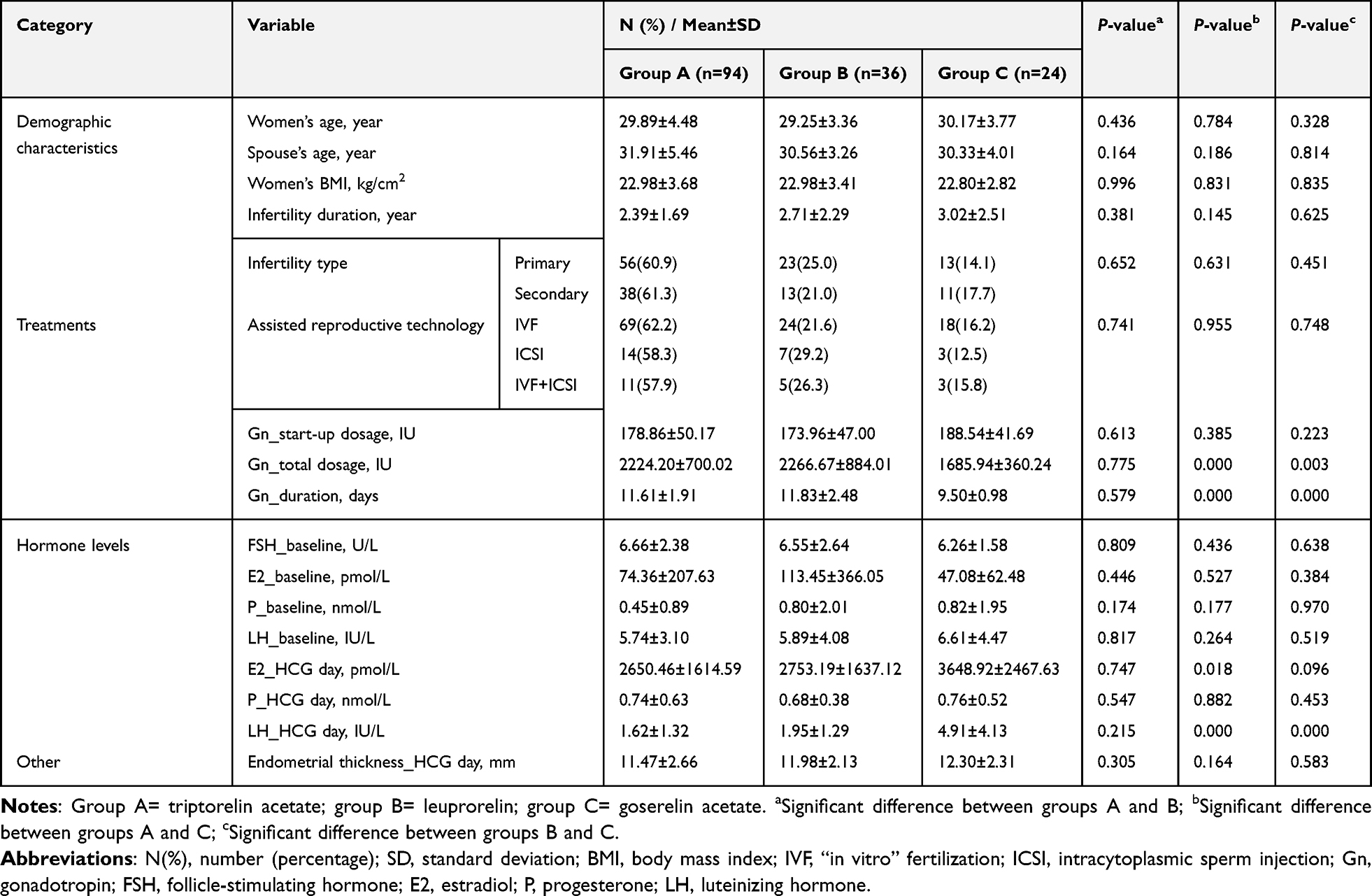 |
Table 1 Baseline Information |
 |
Figure 1 Workflow of patient enrollment. |
Ovulation Induction Outcomes
As displayed in Table 2, the ovulation induction outcomes differed among three groups with non-significant difference, such as group A had the highest 2PN fertilization rate, good-quality embryo rate, blastocyst formation rate; group B had the highest fertility rate; and group C retrieved the most oocytes (all P>0.05).
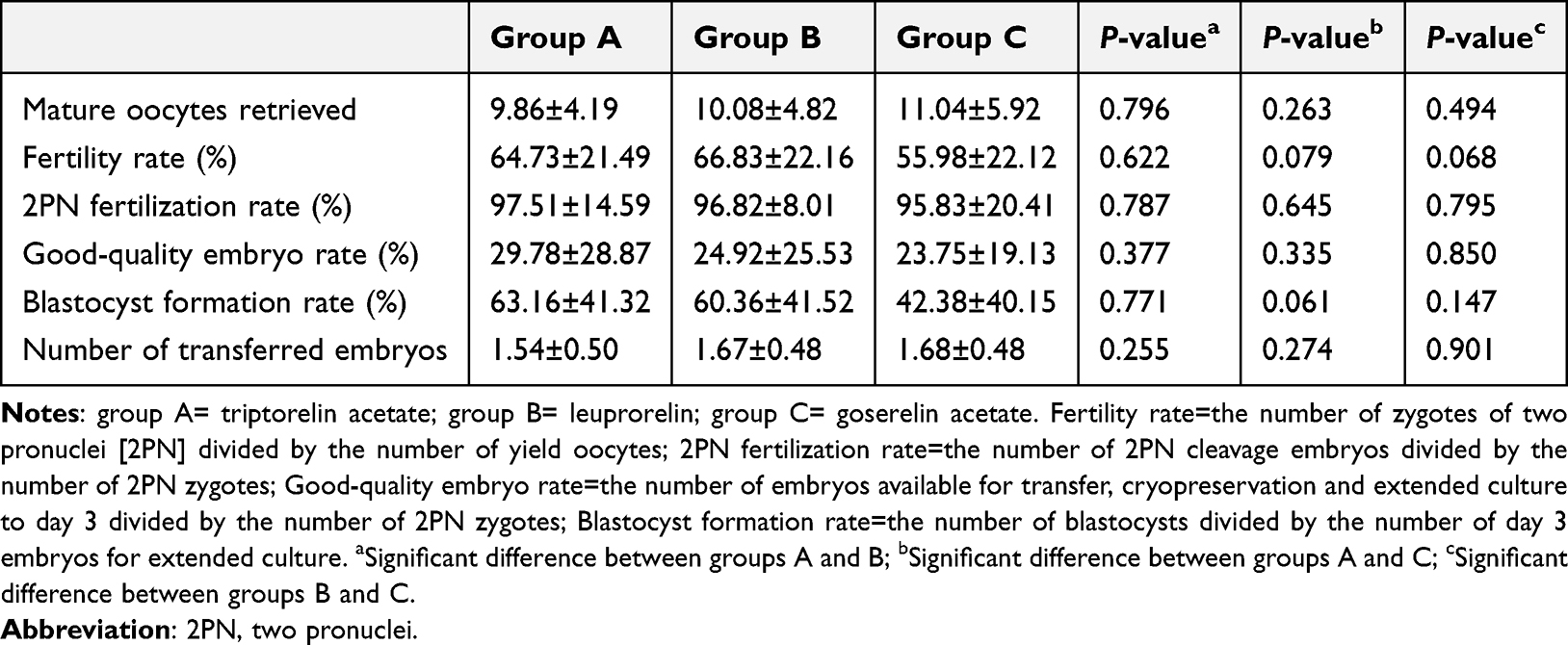 |
Table 2 Ovulation Induction Outcomes |
Pregnancy Outcomes
Patients in group A underwent a total of 84 cycles and 109 transfers, patients in group B underwent a total of 33 cycles and 49 transfers, and those in group C underwent a total of 19 cycles and 31 transfers. According to Table 3, compared with groups A and B, group C had the highest pregnancy outcomes with the highest implantation rate (A vs B vs C: 40.4% vs 32.7% vs 41.9%), clinical pregnancy rate (A vs B vs C: 41.7% vs 39.4% vs 57.9%), live birth rate (A vs B vs C: 32.5% vs 33.3% vs 52.6%) and the lowest miscarriage rate (A vs B vs C: 22.9% vs 15.4% vs 9.1%) with non-significant difference (all P>0.05).
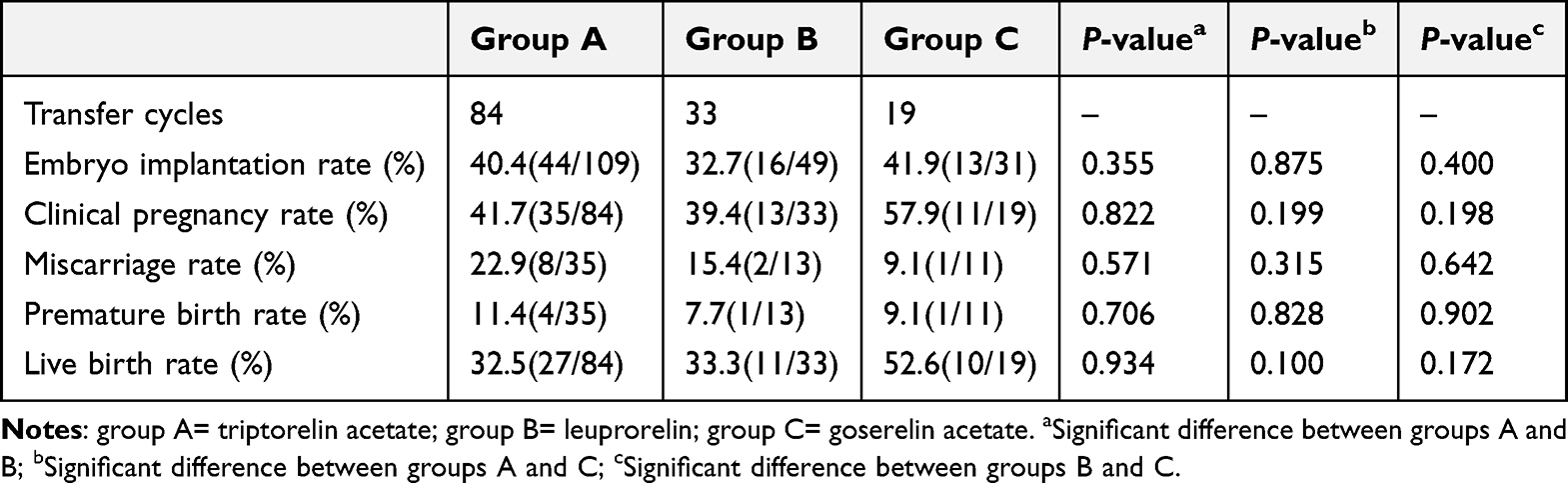 |
Table 3 Pregnancy Outcomes |
Discussion
With the increasing application of IVF/ICSI-ET, GnRH-a regimens have been widely used for a long time, and the positive effect on live birth rate of GnRH-a has been proven.11 Currently, triptolene and leuprorelin are commonly used in long follicular phase protocols, while goserelin is relatively rarely used in downregulation procedure.12 In this study, we retrospectively collected four-year data of different GnRH-a formulations, in order to provide real-world evidence of the effects on clinical outcomes of IVF/ICSI-ET using different GnRH-a formulations. After analyses, we found that goserelin acetate show good pregnancy outcomes of IVF/ICSI-ET, specifically the implantation rate, clinical pregnancy rate, live birth rate and miscarriage rate, but no significant statistical differences were observed compared to triptorelin acetate and leuprorelin. It is noteworthy that the total amount of gonadotropin and duration of using gonadotropin were remarkably lower and shorter in patients using goserelin acetate than those using triptorelin acetate and leuprorelin. Herein, we inferred that goserelin acetate has good pregnancy outcomes in IVF/ICSI-ET with small amount and shout use of gonadotropin, but there is a lack of statistical significance when compared to the pregnancy outcomes of triptorelin acetate and leuprorelin. These findings need future confirmation in larger trials or meta-analyses.
A good pregnancy outcome requires an acceptable endometrium and a high-quality embryo. The important role of GnRHa in the endometrial/embryonic dialogue during early implantation has been reported et al found that GnRH can enhance endometrial receptivity and embryonic development.13–16 GnRH and GnRH receptors are expressed in endometrium and embryo, and the expressions reach the highest levels during endometrial secretion and blastocyst expansion.17–20 This suggests that GnRH-a has direct effect and functional role in the endometrium and embryo. Fujii et al suggested that giving GnRH-a during the luteal phase and early pregnancy had a positive effect on implantation and pregnancy outcomes.21 Several meta-analyses demonstrated that in the fresh embryo transfer, the addition of GnRH-a during the luteal phase can considerably improve the rate of sustained pregnancy and live birth.22–24
The clinical outcomes in this study are partly consistent with previous studies. Parinaud et al found that leuprolide and triptorelin had similar pregnancy rates in IVF long-term suppression regimens.25 Orvieto et al found that compared with triptorelin, leuprolide depot can significantly improve the implantation rate and pregnancy rate, but no effect on the quality of embryo based on a study of 26 samples.7 In Cheung et al’s study, the efficacy and safety of triptorelin and leuprorelin in down-regulating pituitary-ovarian function were similar.26 Compared to leuprorelin, triptorelin had a longer duration of drug action, which benefits to be administered at longer intervals. In our study, goserelin acetate achieved good pregnancy outcomes of IVF/ICSI-ET with smaller amount and shouter use of gonadotropin than triptorelin acetate and leuprorelin, but the statistical significance needs to be verified in future research.
As far as we know, this is the first study of evaluating the clinical outcomes of triptolene, leuprorelin and goserelin in IVF/ICSI-ET based on real-world data. The effects of triptorelin and leuprorelin on IVF/ICSI-ET outcomes have been proven in a large amount of studies. In light of previous findings, goserelin is used to reduce estrogen levels in pre- or perimenopausal women, and protect ovarian function in cancer treatment.27,28 Nowadays, goserelin is also used in IVF/ICSI-ET with similar mechanism of action to that of triptorelin and leuprorelin. Tapanainen et al demonstrated that goserelin can effectively induce pituitary down-regulation in IVF/ICSI-ET with few side effects.29 Additionally, goserelin has longer half-life than triptolene and leuprorelin, which may help the sustained release of the drug to regulate the gonadotropin in the body. This may be one reason why goserelin regimen requires a small amount of gonadotropin to achieve good pregnancy outcomes. The mechanism of effects of goserelin on the clinical outcomes in IVF/ICSI-ET should be investigated more deeply in the future. Based on the results of this study, we may consider favoring the use of goserelin regimen in clinical practice for patients with gonadotropin intolerance or related side effects (such as abdominal pain and bloating).
Our study has several limitations. First, samples for the study began to be collected in September 2019, and the number of eligible samples after screening was limited. Further verification of our findings with larger sample size from multi-centers is needed. In addition, it is inevitable in real-world study that some variables are screened out due to high missing rates, may leading to a biased result. In future study based on real-world data, some statistical methods, such as multiple imputation and Markov Chain Monte Carlo, can be used to deal with missing data. Third, real-world study has noticeable demerits that it is non-experimental, causing inevitable interference of various confounding factors. This study did not control baseline differences in patient characteristics, due to the concern regarding potential reductions in sample size. In future study with sufficient sample size, confounding factors will be controlled by propensity scores matching, multiple regression and hierarchical analysis to reduce bias.30 We also plan to conduct a RCT to control for potential confounding factors in the future. According to the principle of randomization, subjects are assigned to each group with the same probability, hence the potential confounding variables will be evenly distributed across the group. Forth, GnRH-a formulations should be selected not only by reference to the IVF/ICSI-ET outcomes, but also by comparing their efficacy through binding kinetics to GnRH receptors, duration of action and side effects. This is a research aspect we should concern and add relevant data in the future. Furthermore, in future research, we intend to evaluate more GnRH-a formulations, such as ganirelix, and evaluate more neonatal outcomes, such as malformation rate and Apgar scores.
Conclusions
In this study, we compared the real-world effects of three commonly used GnRH-a formulations in IVF/ICSI-ET. Our findings indicate that goserelin acetate has good pregnancy outcomes in IVF/ICSI-ET with small amount and shout use of gonadotropin, but there is a lack of statistical significance when compared to the pregnancy outcomes of triptorelin acetate and leuprorelin. This study may provide a comprehensive evaluation methodology in future study with large-scale multicenter dataset, and help clinicians choose the proper COH regimen for patients with different situations, such as goserelin regimen for those with gonadotropin intolerance.
Abbreviations
COH, controlled ovarian hyperstimulation; IVF/ICSI-ET, “in vitro” fertilization/intracytoplasmic sperm injection and embryo transfer; GNRH-a, gonadotropin-releasing hormone agonist; GnRH, gonadotropin-releasing hormone; LH, luteinizing hormone; FSH, follicle-stimulating hormone; RCTs, randomized clinical trials; HMG, human menopausal gonadotropin; E2, estradiol; P, progestin; 2PN, two pronuclei; CPR, clinical pregnancy rate; SD, standard deviations; BMI, body mass index.
Data Sharing Statement
The data that support the findings of this study are available from the corresponding author upon reasonable request.
Ethics Approval and Consent to Participate
The study was conducted in accordance with the Helsinki Declaration of 1964, and approved by the ethics committee of Huai’an First People’s Hospital of Nanjing Medical University (No. KY-2024-244-01). Study data were fully deidentified, and confidential information of patients was deleted, in accordance with the CIOMS/WHO International Ethical Guidelines for Health-related Research Involving Humans (2016), consequently, the study was deemed exempt from informed consent.
Author Contributions
All authors made a significant contribution to the work reported, whether that is in the conception, study design, execution, acquisition of data, analysis and interpretation, or in all these areas; took part in drafting, revising or critically reviewing the article; gave final approval of the version to be published; have agreed on the journal to which the article has been submitted; and agree to be accountable for all aspects of the work.
Funding
This research did not receive any specific grant from funding agencies in the public, commercial, or not-for-profit sectors.
Disclosure
The authors declare that they have no competing interests in this work.
References
1. Blumenfeld Z. What is the best regimen for ovarian stimulation of poor responders in ART/IVF? Front Endocrinol. 2020;11:192. doi:10.3389/fendo.2020.00192
2. Vander Borght M, Wyns C. Fertility and infertility: definition and epidemiology. Clin Biochem. 2018;62:2–10. doi:10.1016/j.clinbiochem.2018.03.012
3. De Sanctis V, Soliman AT, Di Maio S, Soliman N, Elsedfy H. Long-term effects and significant Adverse Drug Reactions (ADRs) associated with the use of Gonadotropin-Releasing Hormone analogs (GnRHa) for central precocious puberty: a brief review of literature. Acta Biomed. 2019;90(3):345–359. doi:10.23750/abm.v90i3.8736
4. Geng Y, Xun Y, Hu S, Lai Q, Jin L. GnRH antagonist versus follicular-phase single-dose GnRH agonist protocol in patients of normal ovarian responses during controlled ovarian stimulation. Gynecological Endocrinol. 2018;35(4):309–313. doi:10.1080/09513590.2018.1528221
5. Depalo R, Jayakrishan K, Garruti G, et al. GnRH agonist versus GnRH antagonist in in vitro fertilization and embryo transfer (IVF/ET). Reprod Biol Endocrinol. 2012;10(1):26. doi:10.1186/1477-7827-10-26
6. Liang XQ, Mahmood A, Peng MR, Tan L, Yu G. Effect of two ovulation-promoting drugs on clinical outcomes of IVF /ICSI-ET in patients of different ages with early follicular phase prolonged protocol. Chin J Fam Plann Gynecol. 2023;15(9):70–75. doi:10.3969/j.iSSN.1674-4020.2023.09.14
7. Orvieto R, Kerner R, Krissi H, Ashkenazi J, Ben Rafael Z, Bar-Hava I. Comparison of leuprolide acetate and triptorelin in assisted reproductive technology cycles: a prospective, randomized study. Fertil Steril. 2002;78(6):1268–1271. doi:10.1016/s0015-0282(02)04262-0
8. Kim HS, Lee S, Kim JH. Real-world evidence versus randomized controlled trial: clinical research based on electronic medical records. J Korean Med Sci. 2018;33(34):e213. doi:10.3346/jkms.2018.33.e213
9. Dang A. Real-world evidence: a primer. Pharmaceut Med. 2023;37(1):25–36. doi:10.1007/s40290-022-00456-6
10. Mao R, Zhu L, Long R, et al. A new insight on evaluation of the fertility and pregnancy outcome in patients with primary Sjögren syndrome: a propensity score matched study in multi-IVF centers. Reprod Biol Endocrinol. 2024;22(1):57. doi:10.1186/s12958-024-01228-4
11. Zhang Y, Zhao W, Han Y, et al. The follicular-phase depot GnRH agonist protocol results in a higher live birth rate without discernible differences in luteal function and child health versus the daily mid-luteal GnRH agonist protocol: a single-centre, retrospective, propensity score matched cohort study. Reprod Biol Endocrinol. 2022;20(1). doi:10.1186/s12958-022-01014-0
12. Liu C, Tian T, Lou Y, et al. Live birth rate of gonadotropin-releasing hormone antagonist versus luteal phase gonadotropin-releasing hormone agonist protocol in IVF/ICSI: a systematic review and meta-analysis. Expert Rev Mol Med. 2023;26. doi:10.1017/erm.2023.25
13. Li L, Liu L, Kou Z, Huo M, An J, Zhang X. GnRH agonist treatment regulates IL-6 and IL-11 expression in endometrial stromal cells for patients with HRT regiment in frozen embryo transfer cycles. Reprod Biol. 2022;22(2):100608. doi:10.1016/j.repbio.2022.100608
14. Xu B, Geerts D, Hu S, et al. The depot GnRH agonist protocol improves the live birth rate per fresh embryo transfer cycle, but not the cumulative live birth rate in normal responders: a randomized controlled trial and molecular mechanism study. Hum Reprod. 2020;35(6):1306–1318. doi:10.1093/humrep/deaa086
15. Nam DH, Lee SH, Kim HS, et al. The role of gonadotropin-releasing hormone (GnRH) and its receptor in development of porcine preimplantation embryos derived from in vitro fertilization. Theriogenology. 2005;63(1):190–201. doi:10.1016/j.theriogenology.2004.04.004
16. Kawamura K, Fukuda J, Kumagai J, et al. Gonadotropin-releasing hormone I analog acts as an antiapoptotic factor in mouse blastocysts. Endocrinology. 2005;146(9):4105–4116. doi:10.1210/en.2004-1646
17. Raga F, Casañ EM, Kruessel JS, et al. Quantitative gonadotropin-releasing hormone gene expression and immunohistochemical localization in human endometrium throughout the menstrual cycle. Biol Reprod. 1998;59(3):661–669. doi:10.1095/biolreprod59.3.661
18. Casañ EM, Raga F, Kruessel JS, Wen Y, Nezhat C, Polan ML. Immunoreactive gonadotropin-releasing hormone expression in cycling human endometrium of fertile patients. Fertil Steril. 1998;70(1):102–106. doi:10.1016/S0015-0282(98)00125-3
19. Casañ EM, Raga F, Polan ML. GnRH mRNA and protein expression in human preimplantation embryos. Mol Hum Reprod. 1999;5(3):234–239. doi:10.1093/molehr/5.3.234
20. Raga F, Casañ EM, Kruessel J, Wen Y, Bonilla-Musoles F, Polan ML. The role of gonadotropin-releasing hormone in murine preimplantation embryonic development. Endocrinology. 1999;140(8):3705–3712. doi:10.1210/endo.140.8.6899
21. Fujii S, Sato S, Fukui A, Kimura H, Kasai G, Saito Y. Continuous administration of gonadotrophin-releasing hormone agonist during the luteal phase in IVF. Hum Reprod. 2001;16(8):1671–1675. doi:10.1093/humrep/16.8.1671
22. van der Linden M, Buckingham K, Farquhar C, Kremer JA, Metwally M. Luteal phase support for assisted reproduction cycles. Cochrane Database Syst Rev. 2015;2015(7):CD009154. doi:10.1002/14651858.CD009154.pub3
23. Oliveira JB, Baruf R, Petersen CG, Mauri AL, Cavagna M, Franco JG. Administration of single-dose GnRH agonist in the luteal phase in ICSI cycles: a meta-analysis. Reprod Biol Endocrinol. 2010;8:107. doi:10.1186/1477-7827-8-107
24. Kyrou D, Kolibianakis EM, Fatemi HM, Tarlatzi TB, Devroey P, Tarlatzis BC. Increased live birth rates with GnRH agonist addition for luteal support in ICSI/IVF cycles: a systematic review and meta-analysis. Hum Reprod Update. 2011;17(6):734–740. doi:10.1093/humupd/dmr029
25. Parinaud J, Oustry P, Perineau M, Rème J-M, Monroziès X, Pontonnier G. Randomized trial of three luteinizing hormone-releasing hormone analogues used for ovarian stimulation in an in vitro fertilization program. Fertil Sterility. 1992;57(6):1265–1268. doi:10.1016/s0015-0282(16)55085-7
26. Cheung TK, Lo KW, Lam CW, Lau W, Lam PK. A crossover study of triptorelin and leuprorelin acetate. Fertil Steril. 2000;74(2):299–305. doi:10.1016/s0015-0282(00)00598-7 Erratum in: Fertil Steril. 2000;74(5):1060. PMID: 10927048.
27. Moore HCF, Unger JM, Phillips K-A, et al. Goserelin for ovarian protection during breast-cancer adjuvant chemotherapy. N Engl J Med. 2015;372(10):923–932. doi:10.1056/NEJMoa1413204
28. Cheer SM, Plosker GL, Simpson D, Wagstaff AJ. Goserelin: a review of its use in the treatment of early breast cancer in premenopausal and perimenopausal women. Drugs. 2005;65(18):2639–2655. doi:10.2165/00003495-200565180-00011
29. Tapanainen J, Hovatta O, Juntunen K, et al. Subcutaneous goserelin versus intranasal buserelin for pituitary down-regulation in patients undergoing IVF: a randomized comparative study. Hum Reprod. 1993;8(12):2052–2055. doi:10.1093/oxfordjournals.humrep.a137980
30. Ma J, Yu Z, Chen T, et al. The effect of Shengmai injection in patients with coronary heart disease in real world and its personalized medicine research using machine learning techniques. Front Pharmacol. 2023;14:1208621. doi:10.3389/fphar.2023.1208621
 © 2025 The Author(s). This work is published and licensed by Dove Medical Press Limited. The
full terms of this license are available at https://www.dovepress.com/terms
and incorporate the Creative Commons Attribution
- Non Commercial (unported, 4.0) License.
By accessing the work you hereby accept the Terms. Non-commercial uses of the work are permitted
without any further permission from Dove Medical Press Limited, provided the work is properly
attributed. For permission for commercial use of this work, please see paragraphs 4.2 and 5 of our Terms.
© 2025 The Author(s). This work is published and licensed by Dove Medical Press Limited. The
full terms of this license are available at https://www.dovepress.com/terms
and incorporate the Creative Commons Attribution
- Non Commercial (unported, 4.0) License.
By accessing the work you hereby accept the Terms. Non-commercial uses of the work are permitted
without any further permission from Dove Medical Press Limited, provided the work is properly
attributed. For permission for commercial use of this work, please see paragraphs 4.2 and 5 of our Terms.