
Back to Journals » Drug Design, Development and Therapy » Volume 18

Effect of Low-Dose Esketamine on Postoperative Delirium in Elderly Patients Undergoing Total Hip or Knee Arthroplasty: A Randomized Controlled Trial
Authors Ma CB, Zhang CY, Gou CL, Liang ZH, Zhang JX, Xing F, Yuan JJ  , Wei X, Zhang YB, Wang ZY
Received 8 May 2024
Accepted for publication 25 October 2024
Published 26 November 2024 Volume 2024:18 Pages 5409—5421
DOI https://doi.org/10.2147/DDDT.S477342
Checked for plagiarism Yes
Review by Single anonymous peer review
Peer reviewer comments 3
Editor who approved publication: Prof. Dr. Tin Wui Wong
Chao-Bang Ma,1,* Cheng-Yang Zhang,1,* Cai-Li Gou,1 Zeng-Hui Liang,1 Jing-Xian Zhang,2 Fei Xing,1,3 Jing-Jing Yuan,1,3 Xin Wei,1,3 Ya-Bing Zhang,1 Zhong-Yu Wang1,3
1Department of Anesthesiology, Pain and Perioperative Medicine, the First Affiliated Hospital of Zhengzhou University, Zhengzhou, Henan Province, People’s Republic of China; 3Henan Province International Joint Laboratory of Pain, Cognition and Emotion, Zhengzhou, Henan Province, People’s Republic of China; 2The Surgical Department of the First Affiliated Hospital of Zhengzhou University, Zhengzhou, Henan Province, People’s Republic of China
*These authors contributed equally to this work
Correspondence: Zhong-Yu Wang, Department of Anesthesiology, Pain and Perioperative Medicine, the First Affiliated Hospital of Zhengzhou University, No. 1 Jianshe East Road, Erqi District, Zhengzhou City, Henan Province, People’s Republic of China, Tel +86-13937165514, Email [email protected]
Purpose: Postoperative delirium (POD) is a prevalent and severe complication in elderly patients undergoing major surgery, associated with increased morbidity and mortality. This randomized controlled trial aimed to investigate the effects of low-dose esketamine on the incidence of POD in elderly patients underwent total hip or knee arthroplasty.
Patients and Methods: Two hundred and sixty elderly participants were randomly assigned to either the esketamine group (Group E) (0.20mg/kg loading, 0.125mg/kg/h infusion, 0.5 mg/kg for postoperative analgesia) or the placebo group (Group P) (received normal saline). The primary outcome was the incidence of POD, with secondary outcomes including delirium subtypes, duration, intraoperative analgesic consumption, operative and anesthesia times, hemodynamic changes, postoperative pain scores, sleep quality, and common postoperative adverse events.
Results: There was no significant difference in the incidence of POD between Group E (8.5%) and Group P (10.8%). No significant differences were observed for the time of delirium onset, duration of delirium, and delirium subtype between the two groups. Patients in the esketamine group had more stable hemodynamic profile after induction and reduced the pain score of motion on the first two days postoperatively but increased the incidence of postoperative dizziness.
Conclusion: The repeated infusion of low-dose esketamine did not reduce the incidence of POD during the initial three postoperative days in elderly patients following total hip or knee arthroplasty.
Keywords: esketamine, delirium, aged, arthroplasty
Introduction
With the increasing severity of population aging, obesity, and metabolic issues, bone and joint diseases among the elderly have become increasingly prominent, making surgical intervention a necessary treatment option in many cases.1 Total hip arthroplasty (THA) and total knee arthroplasty (TKA) are established and efficacious treatments for end-stage degenerative diseases of the hip and knee.2 However, postoperative delirium (POD), one of the dominant complications usually occurs in elderly patients after major surgery, results in delayed recovery, extended hospital stays, and even related mortality.3 The etiology of delirium is multifactorial, and its pathophysiology remains elusive, making prevention and management particularly challenging. Pain, opioid analgesia, and the inflammatory response to surgery are all implicated as potential risk factors for POD.4
Esketamine, the S-enantiomer of ketamine, exhibits a significantly higher affinity for the glutamate N-methyl-D-aspartic acid receptor (NMDAR).5 Ketamine selectively inhibits calcium influx and reduces γ-aminobutyric acid (GABA) release by binding to NMDAR on inhibitory neurons. This action decreases GABAergic inhibition, leading to enhanced glutamate neurotransmission. Glutamate activates α-amino-3-hydroxy-5-methyl-4-isoxazole-propionic acid receptors (AMPARs) and triggers brain-derived neurotrophic factor (BDNF) release. BDNF, via tropomyosin receptor kinase B (TrkB) receptors, activates the mammalian target of rapamycin (mTOR) pathway, promoting synaptic protein synthesis and dendritic spine formation, strengthening cortical connectivity.6,7 It is also believed to exert a neuroprotective effect by suppressing the inflammatory response to surgery,8 so it may prevent POD in elderly patients. This hypothesis has inspired several trials to test the impact of subanesthetic doses of ketamine on the risk of POD.9–11 However, these studies have not reached a consensus on whether ketamine can reduce the incidence of delirium. But to be clear, ketamine did not increase the risk of POD.12 The majority of research has concentrated on administering a single bolus of ketamine or esketamine during the induction of anesthesia, whether a single dose of ketamine can induce similar BDNF/mTOR-mediated neuroplasticity changes to achieve the desired clinical effect of preventing POD requires further investigation and evidence suggests that the administration of multiple low-dose ketamine infusions may more effectively harness its therapeutic properties without a concomitant escalation in adverse effects.13,14
Given the mixed results from previous studies and the clinical need for POD management, we hypothesized that the repeated administration of low-dose esketamine at key time points—induction of anesthesia, intraoperative infusion, and postoperative analgesia—might reduce the incidence of POD in elderly patients undergoing total hip or knee arthroplasty.
Materials and Methods
Ethical Considerations
This prospective, double-blind, placebo-controlled randomized clinical trial was approved by the Institutional Scientific Research and Clinical Trials Ethics Committee of the First Affiliated Hospital of Zhengzhou University. This trial was registered at the Chinese Clinical Trial Registry (http://www.chictr.org.cn/) with the Registration number ChiCTR2300077666 on November 15, 2023. All procedures performed in the study involving human participants adhered to the ethical standards of the institutional and national research committee, and the trial was conducted in accordance with the ethical standards of the Declaration of Helsinki. Written informed consent was obtained from all patients.
Study Design and Participants
Eligible participants were patients aged 60 years or older with an American Society of Anesthesiologists (ASA) physical status of II (mild systemic disease) or III (severe systemic disease), scheduled for elective THA or TKA under general anesthesia. Exclusion criteria included preoperative delirium, allergy to esketamine, significant hypertension, neuropsychiatric disorders, history of neurological or psychiatric conditions, substance abuse within the past year, intellectual disability, or a Mini-Mental State Examination (MMSE) score <24, and inability to operate a patient-controlled IV analgesia pump.
Randomization and Blinding
Patients were randomized in a 1:1 ratio to receive either an esketamine infusion (Jiangsu Hengrui Pharmaceuticals Co., Ltd.) or an equivalent volume of saline. Randomization was stratified using a computer-generated randomization table, and allocation concealment was ensured with sequentially numbered, sealed envelopes. The envelopes were handed to a nurse not involved in the study, who prepared the study medication. The researchers assessing outcomes and collecting data were blinded to the treatment allocation, and the randomization codes were revealed only after the completion of the primary analysis.
Anesthesia Protocol
Anesthesia protocols were standardized, and no anticholinergic agents were used for premedication. Standard monitoring was applied upon admission to the operating theater, including oxygen saturation (SpO2), electrocardiography (ECG), invasive arterial blood pressure, and Bispectral Index (BIS) monitoring.
Based on the same other anesthetics in the two groups, esketamine was given at 0.20 mg/kg for induction and 0.125 mg/kg/h for maintenance in group E, while in group P, 0.9% saline was given in equal volume. Induction of anesthesia after pre-oxygenation with mask ventilation in both groups: 0.3 mg/kg etomidate, 40–50 ug/kg alfentanil, and 0.6 mg/kg rocuronium. Group E was given esketamine 0.20 mg/kg, and group P was given an equal volume of 0.9% sodium chloride injection. A laryngeal mask was inserted after the patient lost consciousness, and the end-tidal carbon dioxide partial pressure was maintained between 35 and 45 mmHg. Propofol 4–6 mg/kg/h and remifentanil 0.1–0.3 mg/kg/min were infused intravenously, and 2% desflurane was inhaled to maintain BIS values between 40 and 60. Group E was given a continuous infusion of esketamine 0.125 mg/kg/h from the incision to the end of surgery, and the patients in group P were given an equal volume of 0.9% saline. Blood pressure fluctuations were managed with vasoactive drugs to keep them within 20% of baseline values. Prophylactic administration of palonosetron 0.075 mg and flurbiprofen 100 mg was given 20 minutes before the end of surgery to prevent postoperative pain and nausea and vomiting. After surgery, the laryngeal mask was removed when adequate muscle strength was established, and all participants were transferred to the post-anesthesia care unit (PACU), then fascia iliaca or adductor canal block is performed under ultrasound guidance with 20 mL of 0.5% ropivacaine.
Postoperative analgesia was managed with patient-controlled IV analgesia using 2.0 mg/kg hydromorphone, 0.15 mg palonosetron, and saline up to 100 mL. In Group E, an additional 0.5 mg/kg of esketamine was administered, while an equal volume of saline was added to Group P. The continuous infusion rate of the patient-controlled pump was set at 2 mL/h for 48 hours, with a self-controlled analgesic dose of 1 mL and a lockout interval of 15 minutes.
Clinical Outcomes and Assessments
The primary outcome was the incidence of POD during the first three postoperative days, assessed using the 3-minute Diagnostic Confusion Assessment Method (3D-CAM) (which is a practical and sensitive tool for the detection of POD15). Delirium assessments were conducted when patients were sufficiently aroused (Richmond Agitation and Sedation Scale score (RASS) ≥ −3) and were performed twice daily for the first three postoperative days, with at least 6 hours between assessments. Due to the fluctuating nature of delirium, investigators also inquired about the patient’s symptoms from family members and caregivers. Patients with POD were further classified into three subtypes according to the consciousness levels evaluated by the RASS immediately before assessing delirium: Hyperactive delirium was defined when RASS was consistently positive (+1 to +4); hypoactive delirium was defined when RASS was consistently neutral or negative (–3 to 0); and mixed delirium was defined when both hypoactive and hyperactive delirium episodes were presented during the observation period. The time of onset and the duration of delirium were also recorded as days of POD per patient.
Secondary outcomes included hemodynamic parameters (mean arterial pressure, heart rate) and BIS values were recorded before general anesthesia induction (T0), immediately after induction drug injecting (T1), when the laryngeal mask was inserted (T2), one minute after the laryngeal mask was inserted (T3), three minutes after the laryngeal mask was inserted (T4), and at the time of skin incision (T5). Postoperative pain scores at rest and with movement within the first three postoperative days were assessed using the NRS (0 indicating no pain to 10 indicating intolerable pain). Sleep quality was evaluated using the NRS, with scores ranging from 0 (excellent or good sleep) to 10 (inability to sleep). Common postoperative adverse reactions, including dizziness, hallucinations, nausea, and vomiting (recorded as positive as long as it occurs once in three days after surgery) were recorded. Additionally, complications within the first 30 postoperative days, operative and anesthesia times, intraoperative remifentanil consumption, estimated infusion volume, blood loss, laryngeal mask removal time, and length of stay in the PACU were documented.
Sample Size Calculation
Sample size estimation was based on a meta-analysis review reporting a range of 4–50% for POD incidence in orthopedic surgery,16 and we assumed an incidence of POD of 30% in the placebo group. Although Hudetz and colleagues9 found that ketamine was associated with a reduction in delirium incidence from 31% to 3% (absolute reduction 28%, 95% CI 8–46), we considered a 15% absolute reduction to be more realistic while still remaining within the lower bound of the confidence interval for the effect size. Therefore, a baseline incidence of 30% and a 50% reduction with esketamine, a total of 260 patients (130 per group) were planned to achieve 80% power with a two-sided alpha set at 0.05, accounting for an estimated 5% loss to follow-up.
Statistical Analysis
The normality of variable distribution was assessed with the Kolmogorov–Smirnov test. Continuous data are presented as mean ± SD (x ± s) and were compared using the unpaired, two-tailed t-test for normally distributed data. Non-normally distributed data are reported as median (IQR) and analyzed using the Mann–Whitney U-test. Categorical variables were reported as number (%) and compared using chi-square or Fisher’s exact test, as appropriate. Repeated-measures analysis of variance was used to compare single indices at multiple time points between the two groups. A logistic regression model was employed to evaluate potential risk factors associated with POD. Post-hoc subgroup analyses were done for the primary outcome. P<0.05 was considered to indicate statistical significance for the treatment-by-covariate interaction in the subgroup analysis.
The P-value was considered statistically significant at <0.05. Statistical analyses were conducted with SPSS 25.0 software (SPSS, Inc, Chicago, IL, USA) and R studio 4.3.1 (R studio, Boston, MA, USA).
Results
From November 15, 2023, to March 15, 2024, a total of 284 patients were assessed for eligibility. Five patients were excluded due to the use of epidural anesthesia, and 19 patients declined to participate. Ultimately, 260 patients were enrolled and randomly assigned to either the esketamine group (n = 130) or the placebo group (n = 130) (Figure 1).
 |
Figure 1 Flowchart of the study design. |
Baseline Demographics and Perioperative Characteristics
The baseline characteristics were well balanced between the two groups (Table 1). The majority of participants were female (189 [72.7%]), with a mean age of 69 years. Most patients underwent total knee replacement surgery (191 [73.5%]). At the same time, the majority of intra- and postoperative characteristics were well balanced between the two groups. However, the mean remifentanil consumption was significantly lower in group E compared to the group P. Furthermore, the time to emergence from anesthesia and removal of the laryngeal mask was notably shorter in Group E than in Group (Table 2).
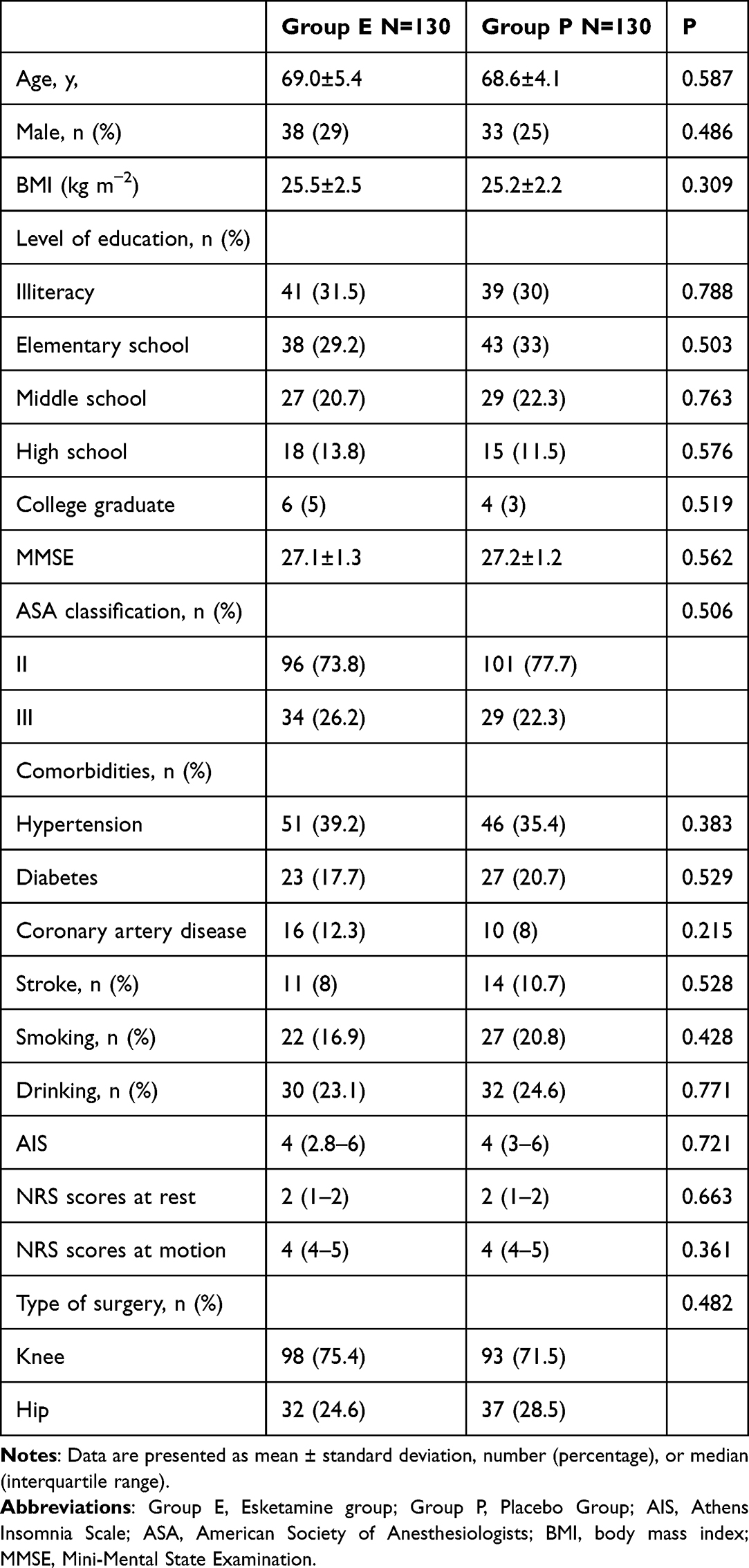 |
Table 1 Baseline Characteristics of Study Participants by Treatment Group |
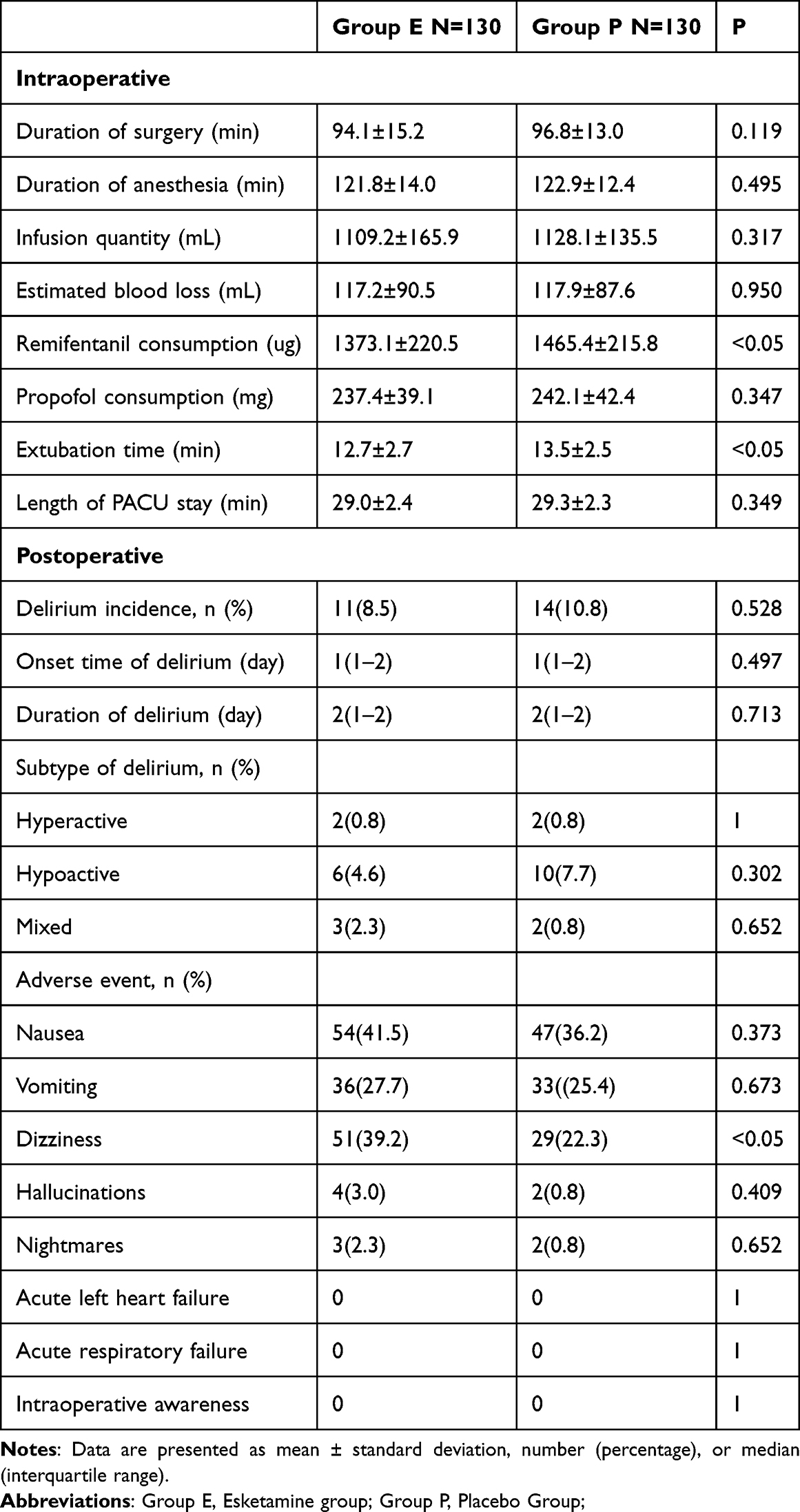 |
Table 2 Intraoperative and Postoperative Data by Treatment Group |
Primary Outcome
The overall incidence of POD among all participants was 9.6% (25 of 260 patients) during the first three postoperative days. There was no significant difference in the incidence of POD between the group E (11 [8.5%] of 130 patients) and the group P (14 [10.8%] of 130 patients). The onset time and duration of POD were similar between the two groups. There were also no significant differences in the incidence of hyperactive, hypoactive, or mixed delirium subtypes (Table 2).
Secondary Outcomes
The esketamine group exhibited higher MAP and BIS values at time points T1 to T4 compared to the control group. Although the heart rate was also higher in the esketamine group, it was not statistically significant. This suggests that the anesthesia induction protocol with esketamine is more conducive to hemodynamic stability (Figure 2). Although esketamine did not improve postoperative sleep quality, it did alleviate pain scores during the first two postoperative days (Figure 3).
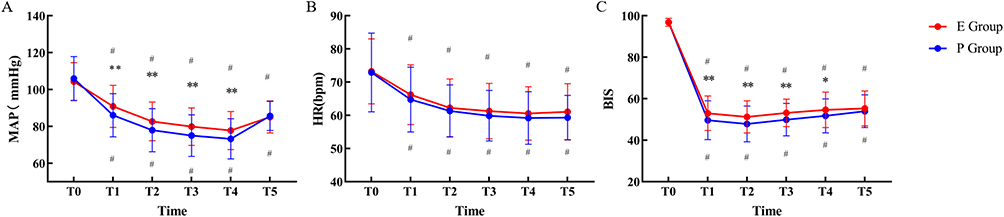 |
Figure 2 Comparison of hemodynamic parameters and BIS between the two groups. (A). MBP; (B). HR;(C). BIS. Abbreviations: MAP, mean arterial pressure; HR, heart rate; BIS, bispectral index. (T0) before general anesthesia induction, (T1) immediately after induction drug injecting, (T2) when the laryngeal mask was inserted, (T3) one minute after the laryngeal mask was inserted, (T4) three minutes after the laryngeal mask was inserted, (T5) at the time of skin incision. P Group, Placebo group; E Group, esketamine group. Notes: Compared with T0 in the same group, #P <0.05; compared with the group P at the same time point, *P <0.05, **P <0.01. |
 |
Figure 3 Comparison of NRS pain score at motion (A) and at rest (B), the NRS of subjective sleep quality (C). Abbreviations: D1, 1 day after surgery; D2, 2 days after surgery; D3, 3 days after surgery; P Group, Placebo group; E Group, esketamine group. Notes: *P<0.05, **P<0.01. |
A binary logistic regression analysis identified risk factors for POD, including age over 75 years, a history of cerebrovascular accident, and an MMSE score less than 27. Gender and surgical approach did not significantly influence the occurrence of POD. However, there were no significant interactions between treatment and subgroups on postoperative delirium (Figure 4).
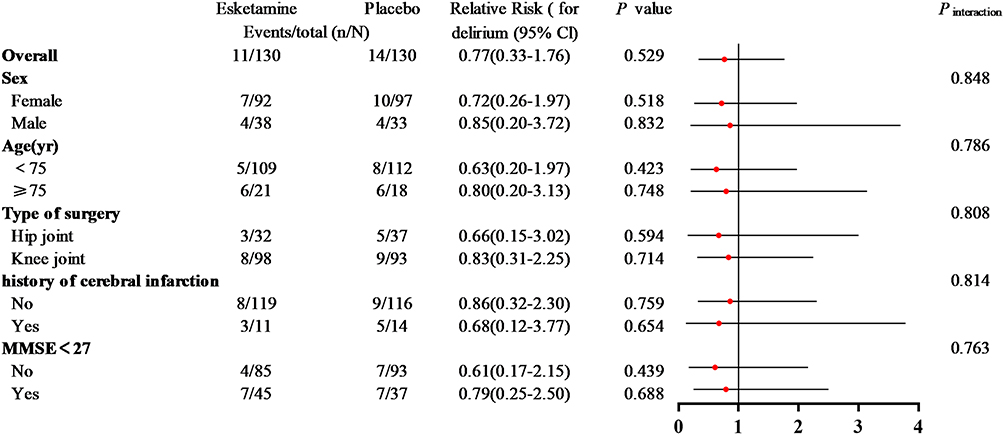 |
Figure 4 Forest plot of the subgroup analysis for the primary outcome. Post-hoc subgroup analyses were conducted by sex (female vs male), age (<75vs. ≥75), type of surgery (total Hip arthroplasty vs total knee arthroplasty), history of cerebral infarction (yes vs no) and preoperative Mini-Mental State Examination score (<27 vs ≥27). To determine the effect of the intervention in that particular subgroup, the effect of the intervention method (relative risk [95% CI (confidence interval)]) is presented separately in each subgroup. The interaction term is a test of whether the effect of the experimental intervention is statistically different in significance between subgroups. |
Adverse Events
Adverse events, including acute heart failure, acute respiratory failure, and intraoperative awareness, did not differ significantly between the groups. The overall proportion of patients who complained of postoperative nausea or vomiting over three postoperative days was high, but there was no significant difference in the incidence of this complication. The incidence of dizziness was higher in the group E (P<0.05), although this adverse event was transient and most patients experienced it only until midday on the first postoperative day. There were no statistically significant differences in the number of nightmares and hallucinations reported by the two groups (Table 2).
Discussion
In our trial, the use of low-dose esketamine at strategic intervals for elderly patients undergoing THA or TKA failed to diminish the risk of POD. Nonetheless, esketamine treatment effectively curtailed intraoperative opioid requirements, resulting in stabilized hemodynamics during anesthesia induction and significantly alleviated pain scores during early postoperative recovery.
With the aging of the population, the proportion of elderly patients undergoing surgery increases accordingly, and perioperative neurocognitive disorders are common central nervous system complications following surgical anesthesia.17 This broad umbrella term encompasses various clinical conditions, including POD, delayed neurocognitive recovery (dNCR), postoperative neurocognitive disorder (postoperative NCD), and both mild and major cognitive impairments.18 However, delirium is an early neurological complication, typically appearing within the first week of post-surgery, most commonly within 3 days.17 Delirium presents in forms ranging from hyperactive, marked by agitation and hallucinations, to hypoactive, characterized by lethargy and slow response, with mixed delirium also possible. The primary pathophysiological mechanisms driving these conditions remain incompletely understood. At present, the recognized causes mainly include inflammation theory, oxidative stress, decreased cholinesterase activity, intestinal microbiota disorders, and inhibition of EEG bursts.19–21 While delirium may be reversible and self-resolving, severe cases can prolong hospital stays and pose serious health risks.
Esketamine acts as an analgesic, sedative, and amnestic agent by blocking the transmission of NMDA receptors. As a new sedative and analgesic drug, its anesthetic titer is twice that of ketamine, and offers the advantage of fewer adverse effects and shorter recovery time.22 Neuroinflammatory response is considered to be a very important mechanism for POD occurrence.23 Fortunately, low doses of ketamine can reduce the levels of inflammatory factors and play a neuroprotective role in Parkinson’s disease mice,24 and recent studies have shown that esketamine can increase the volume of astrocytes in the hippocampus subregion and the release of brain-derived neurotrophic factor in depressed rats.25 Although low-dose of esketamine did not reduce the incidence of postoperative delirium, the study also did not find an increase in postoperative delirium incidence attributable to the esketamine interventions.
No dose effects have been described for ketamine, either in the prevention of acute and chronic pain management, depression, or postoperative delirium, leaving this question open. We chose this dose based on label instructions, RCT studies, and meta-analyses. The anesthesia induction dose of esketamine in the instructions is 0.5mg/kg, but overdose reactions may occur at this dose in elderly patients with joint replacement surgery, so we administered 0.2mg/kg for induction. Study showed that 0.25 mg/kg IV esketamine administered during anesthesia induction followed by continuous IV administration at 0.125 mg/kg/h (infusion stopped 20 min before the end of surgery) significantly reduced the incidence of DNR in patients with gastrointestinal tumors.26 Studies have demonstrated that continuous infusion of ketamine at a rate of 0.015mg/kg/h for 48 hours during major abdominal surgery can reduce postoperative opioid use and hyperalgesia without increasing POD and other side effects.27 Furthermore, a recent randomized trial focusing on cesarean section patients found that the continuous infusion of esketamine as an adjuvant to the postoperative analgesia pump at a rate of 0.01mg per hour significantly improved negative emotions such as depression and anxiety after surgery.28 Therefore, we incorporated 0.5mg/kg of esketamine into the postoperative analgesia pump, maintaining the infusion for a 48-hour period to maximize its potential benefits. Ultimately, we chose to administer esketamine 0.20mg/kg during anesthesia induction, with a continuous intraoperative pump rate of 0.125 mg/kg/h and 0.5 mg/kg to the postoperative analgesic pump. As to whether other doses administered during the perioperative period affect the incidence of delirium, we will gradually verify it in subsequent studies.
Our results concur with some previous studies that have not found a significant benefit of intraoperative ketamine on POD incidence.10,11,27 However, our findings diverge from others, particularly those involving cardiac surgery with cardiopulmonary bypass (CPB), where ketamine has shown a potential for reduced POD.9,29 The cardiopulmonary bypass procedure is a known POD risk factor,30 but existing studies have demonstrated that the use of ketamine during coronary artery bypass grafting surgery provides myocardial protection.31 During the establishment of CPB, contact with foreign surfaces such as tubing, blood pumps, and oxygenators, along with surgical trauma, triggers a robust systemic inflammatory response, leading to myocardial injury and ischemia-reperfusion injury.32 The intense inflammatory response triggered by blood contact with the tubing during extracorporeal circulation may have negative impacts on brain function. Esketamine’s anti-inflammatory effects alleviate the inflammation triggered by CPB, potentially reducing the risk of POD. However, the occurrence of postoperative delirium involves multiple complex factors, and relying solely on the anti-inflammatory effects of esketamine may not fully explain its preventive effects.
Numerous investigations have explored the potential of bispectral index (BIS) monitoring to guide anesthesia and reduce the risk of postoperative delirium POD.19,33,34 Despite some inconsistency in the findings, BIS monitoring is generally regarded as a valuable tool for titrating anesthetic agents to optimize the depth of anesthesia. In the elderly, where the balance of anesthetic dosage is critical, BIS monitoring is particularly recommended to minimize exposure to anesthetics. Ketamine, known to modulate brain electrical activity by increasing the power of both slow (θ) and fast (γ) waves, can elevate BIS values.35,36 This effect complicates the interpretation of BIS monitoring when ketamine or its S-enantiomer, esketamine, is used. However, evidence suggests that the influence of low-dose ketamine on BIS values is transient and does not persist beyond the immediate post-induction period, nor does it interfere with the intraoperative assessment of sedation depth.37 Our findings align with this understanding, as we observed no significant BIS differences between groups at incision. However, in our study, low-dose esketamine was infused at incision, and while BIS values were not systematically recorded, anecdotal reports indicated that BIS values in some participants reached high levels (up to 85), potentially compromising the blinding of the anesthesiologists. However, the absence of any intraoperative awareness among participants is a notable and reassuring finding. The instances of elevated BIS values warrant further investigation to ensure the reliability of BIS monitoring in the context of esketamine use. Elucidating these mechanisms is crucial for refining anesthetic techniques and bolstering patient safety protocols.
Postoperative pain, a prevalent issue following joint replacement surgery, can inflict both physical and psychological distress, potentially escalating the risk of delirium.38 Ketamine exerts its analgesic effects through antagonism of the NMDA receptor and inhibition of the hyperpolarisation-activated cyclic nucleotide-gated 1 (HCN1) channel.39 Evidence from a systematic review supports intraoperative ketamine infusion as an effective adjunct for postoperative pain management, potentially minimizing opioid-related side effects.40 However, conflicting results from a different study, which utilized a single ketamine dose during anesthesia induction,11 highlight the need for further investigation into the optimal dosing and administration strategies for esketamine. In our study, although the morphine equivalence for analgesia was not documented, the esketamine group exhibited reduced remifentanil consumption compared to the placebo group, suggesting esketamine’s potential interaction with the μ-opioid receptor.41 The impact of perioperative sleep disorders on cognitive function and delirium risk is well established.42 And while study have indicated that esketamine infusion may enhance postoperative sleep quality,43 our findings did not corroborate this effect. This discrepancy may stem from varying study designs, patient demographics, or dosing protocols. Further research is warranted to clarify the relationship between esketamine and sleep quality in diverse surgical contexts.
We found that older age, history of cerebral infarction, and preoperative cognitive changes (MMSE<27) were factors associated with the development of postoperative delirium, which was consistent with the results of previous studies.18,44 In addition, pre-existing cognitive dysfunction and poor baseline functional status are additional precipitating factors, underscoring the necessity for baseline neurocognitive assessments to identify at-risk patients. However, there were no significant interactions between treatment and subgroups on postoperative delirium, which may indicate that the mode of esketamine administration in this study had no potential benefit between subgroups.
Our study reported a 9.6% incidence of POD, notably lower than results from prior research.4 The most significant risk factor for PND is ageing. Neuronal ageing and loss increase the brain’s vulnerability to inflammation and oxidative stress.18 Our study included individuals aged 60 and above, a demographic that may contribute to the observed lower incidence of delirium, given their relatively younger age compared to other cohorts. Yet, while prioritizing the elderly high-risk group, it is vital to remember that POD can also manifest in healthy young adults. Poor baseline functional status is another significant risk factor,45 but the majority of our participants were classified as ASA Grade II. Furthermore, we implemented preventive measures such as rigorous blood pressure control, postoperative nerve blocks and enhanced patient education on self-management, all likely contributing to the reduced POD incidence.46–48 Indeed, the fluctuating nature of delirium and the limited follow-up period restricted to the first three postoperative days may increase the likelihood of false-negative results.
Regarding adverse events, the trial did not find that there was an increase in any systemic adverse events potentially associated with esketamine administration in the perioperative period. Similarly, the incidence of postoperative nausea or vomiting did not differ significantly between groups, although the overall incidence of nausea or vomiting was high. However, the incidence of dizziness was higher in the group E, although this adverse event was transient, which may be related to psychomimetic side effects of esketamine. Fortunately, the incidence of hallucinations and nightmares was very low, and there was no difference between the two groups. Thus, the safety profile of administering multiple low-dose of esketamine during the perioperative period is without dispute.
Previous study have shown that a minimal dose of esketamine (0.015 mg/kg/h continuous infusion for 48 h) in patients who underwent major abdominal surgery resulted in a lower Intensive Care Delirium Screening Checklist score than a low dose of esketamine (0.25 mg/kg loading dose, 0.125 mg/kg/h continuous infusion for 48 h) or a placebo.27 However, the assessment tools, outcome measures, administration method of esketamine, and small sample size of the study were insufficient to confirm the effects of esketamine on POD. There is currently a lack of randomized controlled studies evaluating esketamine for POD prevention, and our trial helps to fill a gap in this area. While our study did not demonstrate that multiple low-dose administrations of esketamine reduced the incidence of postoperative delirium, the stringent inclusion criteria and rigorous statistical approaches employed have yielded robust results. These findings offer valuable insights and a solid foundation for the design of future research in this domain.
This study has several limitations. First, this is a single-center study, and the trial population was elderly patients undergoing lower limb major arthroplasty, including THA or TKA. The therapeutic measures and clinical practice in different medical centers may influence the external validity and generalisability of the results. Second, the trial was only followed up to 3 days postoperatively. The bias development due to the short follow-up period could not be ruled out, and the absence of long-term cognitive function assessment precludes a comprehensive understanding of the potential effects of esketamine on cognitive recovery post-discharge. Third, we did not measure biomarkers related to delirium, such as IL-β, IL-6, TNF-α, and S100β. These biomarkers have been studied in the context of delirium and may provide valuable insights into the pathophysiology and diagnosis of the condition.49,50
Conclusion
The continuous infusion of low-dose esketamine does not appear to diminish the occurrence of POD in elderly patients undergoing total hip or knee arthroplasty. Further research is needed on whether esketamine holds promise as a potential intervention for POD in older patients.
Data Sharing Statement
All data generated or analyzed during this study were included in the published article. Further inquiries about the datasets can be directed to the corresponding author on reasonable request.
Acknowledgments
We would like to thank the Department of Anesthesiology, Pain and Perioperative Medicine, the First Affiliated Hospital of Zhengzhou University for their friendly assistance with the study. An unauthorized version of the Chinese MMSE was used by the study team without permission, however this has now been rectified with PAR. The MMSE is a copyrighted instrument and may not be used or reproduced in whole or in part, in any form or language, or by any means without written permission of PAR (www.parinc.com).
Funding
This work was supported by the National Natural Science Foundation of China (Grants No.: 82371235) and Joint Construction Project of Henan Province Medical Science & Technology Research Plan (SBGJ202002066).
Disclosure
The authors declare no conflicts of interest in this work.
References
1. Castell MV, van der Pas S, Otero A. Osteoarthritis and frailty in elderly individuals across six European countries: results from the European Project on OSteoArthritis (EPOSA). BMC Musculoskeletal Disord. 2015;16(1):1–8. doi:10.1186/s12891-015-0807-8
2. Tao M, Zhang S, Han Y. Efficacy of transcranial direct current stimulation on postoperative delirium in elderly patients undergoing lower limb major arthroplasty: a randomized controlled trial. Brain Stimulation. 2023;16(1):88–96. doi:10.1016/j.brs.2023.01.839
3. Goldberg TE, Chen C, Wang Y, et al. Association of delirium with long-term cognitive decline: a meta-analysis. JAMA Neurol. 2020;77(11):1373. doi:10.1001/jamaneurol.2020.2273
4. Inouye SK, Westendorp RG, Saczynski JS. Delirium in elderly people. Lancet. 2014;383(9920):911–922. doi:10.1016/S0140-6736(13)60688-1
5. Bahji A, Vazquez GH, Zarate CA. Comparative efficacy of racemic ketamine and esketamine for depression: a systematic review and meta-analysis. J Affective Disorders. 2021;278:542–555. doi:10.1016/j.jad.2020.09.071
6. Maeng S, Zarate CA, Du J, et al. Cellular mechanisms underlying the antidepressant effects of ketamine: role of α-amino-3-hydroxy-5-methylisoxazole-4-propionic acid receptors. Biol. Psychiatry. 2008;63(4):349–352. doi:10.1016/j.biopsych.2007.05.028
7. Zanos P, Gould TD. Mechanisms of ketamine action as an antidepressant. Mol Psychiatry. 2018;23(4):801–811. doi:10.1038/mp.2017.255
8. Hudetz JA, Iqbal Z, Gandhi SD, et al. Ketamine attenuates post‐operative cognitive dysfunction after cardiac surgery. Acta Anaesthesiol Scand. 2009;53(7):864–872. doi:10.1111/j.1399-6576.2009.01978.x
9. Hudetz JA, Patterson KM, Iqbal Z, et al. Ketamine attenuates delirium after cardiac surgery with cardiopulmonary bypass. J Cardiothorac Vasc Anesth. 2009;23(5):651–657. doi:10.1053/j.jvca.2008.12.021
10. Hollinger A, Rüst CA, Riegger H, et al. Ketamine vs. haloperidol for prevention of cognitive dysfunction and postoperative delirium: a Phase IV multicentre randomised placebo-controlled double-blind clinical trial. J Clin Anesth. 2021;68:110099. doi:10.1016/j.jclinane.2020.110099
11. Avidan MS, Maybrier HR, Abdallah AB, et al. Intraoperative ketamine for prevention of postoperative delirium or pain after major surgery in older adults: an international, multicentre, double-blind, randomised clinical trial. Lancet. 2017;390(10091):267–275. doi:10.1016/S0140-6736(17)31467-8
12. Reisinger M, Reininghaus EZ, Biasi JD, Fellendorf FT, Schoberer D. Delirium‐associated medication in people at risk: a systematic update review, meta‐analyses, and
13. Murrough JW, Perez AM, Pillemer S, et al. Rapid and longer-term antidepressant effects of repeated ketamine infusions in treatment-resistant major depression. Biol. Psychiatry. 2013;74(4):250–256. doi:10.1016/j.biopsych.2012.06.022
14. Phillips JL, Norris S, Talbot J, et al. Single, repeated, and maintenance ketamine infusions for treatment-resistant depression: a randomized controlled trial. AJP. 2019;176(5):401–409. doi:10.1176/appi.ajp.2018.18070834
15. Olbert M, Eckert S, Mörgeli R, Kruppa J, Spies CD. Validation of 3-minute diagnostic interview for CAM-defined Delirium to detect postoperative delirium in the recovery room: a prospective diagnostic study. EurJ Anaesthesiol. 2019;36(9):683–687. doi:10.1097/EJA.0000000000001048
16. Zhao J, Liang G, Hong K, et al. Risk factors for postoperative delirium following total Hip or knee arthroplasty: a meta-analysis. Front Psychol. 2022;13:993136. doi:10.3389/fpsyg.2022.993136
17. Evered L, Silbert B, Knopman DS, et al. Recommendations for the nomenclature of cognitive change associated with anaesthesia and surgery—2018. Acta Anaesthesiol Scand. 2018;62(10):1473–1480. doi:10.1111/aas.13250
18. Dilmen OK, Meco BC, Evered LA, Radtke FM. Postoperative neurocognitive disorders: a clinical guide. J Clin Anesth. 2024;92:111320. doi:10.1016/j.jclinane.2023.111320
19. Wildes TS, Mickle AM, Ben Abdallah A, et al. Effect of electroencephalography-guided anesthetic administration on postoperative delirium among older adults undergoing major surgery: the ENGAGES randomized clinical trial. JAMA. 2019;321(5):473. doi:10.1001/jama.2018.22005
20. Huang X, Li L, Feng Q. Correlation analysis of inflammatory markers CRP and IL-6 and Postoperative Delirium (POD) in elderly patients: a meta-analysis of observational studies. Wan C, ed. J Environ Public Health. 2022;2022(1):1–10. doi:10.1155/2022/1136386
21. Vondeling AM, Knol W, Egberts TCG, Slooter AJC. Anticholinergic drug exposure at intensive care unit admission affects the occurrence of delirium. A prospective cohort study. Eur J Internal Med. 2020;78:121–126. doi:10.1016/j.ejim.2020.04.062
22. Li X, Xiang P, Liang J, Deng Y, Du J. Global trends and hotspots in esketamine research: a bibliometric analysis of past and estimation of future trends. DDDT. 2022;Volume 16:1131–1142. doi:10.2147/DDDT.S356284
23. Berger M, Oyeyemi D, Olurinde MO, et al. The INTUIT study: investigating neuroinflammation underlying postoperative cognitive dysfunction. J Am Geriatrics Soc. 2019;67(4):794–798. doi:10.1111/jgs.15770
24. Lugli G, Cohen AM, Bennett DA, et al. Plasma exosomal miRNAs in persons with and without Alzheimer disease: altered expression and prospects for biomarkers. Zhang B, ed. PLoS One. 2015;10(10):e0139233. doi:10.1371/journal.pone.0139233
25. Ardalan M, Elfving B, Rafati AH, et al. Rapid effects of S-ketamine on the morphology of hippocampal astrocytes and BDNF serum levels in a sex-dependent manner. Eur. Neuropsychopharmacol. 2020;32:94–103. doi:10.1016/j.euroneuro.2020.01.001
26. Han C, Ji H, Guo Y, et al. Effect of subanesthetic dose of esketamine on perioperative neurocognitive disorders in elderly undergoing gastrointestinal surgery: a randomized controlled trial. DDDT. 2023;Volume 17:863–873. doi:10.2147/DDDT.S401161
27. Bornemann-Cimenti H, Wejbora M, Michaeli K, Edler A, Sandner-Kiesling A. The effects of minimal-dose versus low-dose S-ketamine on opioid consumption, hyperalgesia, and postoperative delirium: a triple-blinded, randomized, active- and placebo-controlled clinical trial. Minerva Anestesiologica. 2016;82(10):1069–1076.
28. Han Y, Li P, Miao M, Tao Y, Kang X, Zhang J. S-ketamine as an adjuvant in patient-controlled intravenous analgesia for preventing postpartum depression: a randomized controlled trial. BMC Anesthesiol. 2022;22(1):49. doi:10.1186/s12871-022-01588-7
29. Xiong X, Shao Y, Chen D, Chen B, Lan X, Shi J. Effect of esketamine on postoperative delirium in patients undergoing cardiac valve replacement with cardiopulmonary bypass: a randomized controlled trial. Anesthesia Analg. 2024;139(4):743–753. doi:10.1213/ANE.0000000000006925
30. Patel N, Minhas JS, Chung EML. Risk factors associated with cognitive decline after cardiac surgery: a systematic review. Cardiovasc Psychiatr Neurol. 2015;2015:1–12. doi:10.1155/2015/370612
31. Tully PJ, Baker RA. Depression, anxiety, and cardiac morbidity outcomes after coronary artery bypass surgery: a contemporary and practical review. JGC. 2012;9(2):197. doi:10.3724/SP.J.1263.2011.12221
32. Shaefi S, Mittel A, Loberman D, Ramakrishna H. Off-pump versus on-pump coronary artery bypass grafting—a systematic review and analysis of clinical outcomes. J Cardiothorac Vasc Anesth. 2019;33(1):232–244. doi:10.1053/j.jvca.2018.04.012
33. Evered LA, Chan MTV, Han R, et al. Anaesthetic depth and delirium after major surgery: a randomised clinical trial. Br J Anaesth. 2021;127(5):704–712. doi:10.1016/j.bja.2021.07.021
34. Brown CH, Edwards C, Lin C, et al. Spinal anesthesia with targeted sedation based on bispectral index values compared with general anesthesia with masked bispectral index values to reduce delirium: the SHARP randomized controlled trial. Anesthesiology. 2021:
35. Amat-Foraster M, Jensen AA, Plath N, Herrik KF, Celada P, Artigas F. Temporally dissociable effects of ketamine on neuronal discharge and gamma oscillations in rat thalamo-cortical networks. Neuropharmacology. 2018;137:13–23. doi:10.1016/j.neuropharm.2018.04.022
36. Ballesteros JJ, Huang P, Patel SR, Eskandar EN, Ishizawa Y. Dynamics of ketamine-induced loss and return of consciousness across primate neocortex. Anesthesiology. 2020;132(4):750–762. doi:10.1097/ALN.0000000000003159
37. Li J, Wang Z, Wang A, Wang Z. Clinical effects of low‐dose esketamine for anaesthesia induction in the elderly: a randomized controlled trial. Clinical Pharmacy Therap. 2022;47(6):759–766. doi:10.1111/jcpt.13604
38. Aldecoa C, Bettelli G, Bilotta F, et al. European society of anaesthesiology evidence-based and consensus-based guideline on postoperative delirium. EurJ Anaesthesiol. 2017;34(4):192–214. doi:10.1097/EJA.0000000000000594
39. Li L, Vlisides PE, Herrmann CS. Ketamine: 50 years of modulating the mind. Front Hum Neurosci. 2016;10:10. doi:10.3389/fnhum.2016.00612
40. Laskowski K, Stirling A, McKay WP, Lim HJ. A systematic review of intravenous ketamine for postoperative analgesia Revue me´thodique de l’utilisation de la ke´tamine intraveineuse pour l’analge´sie postope´ratoire. Can J Anaesth. 2011;58(10):911. doi:10.1007/s12630-011-9560-0
41. Bonaventura J, Lam S, Carlton M, et al. Pharmacological and behavioral divergence of ketamine enantiomers: implications for abuse liability. Mol Psychiatry. 2021;26(11):6704–6722. doi:10.1038/s41380-021-01093-2
42. Wang H, Zhang L, Zhang Z, et al. Perioperative sleep disturbances and postoperative delirium in adult patients: a systematic review and meta-analysis of clinical trials. Front Psychiatry. 2020;11:570362. doi:10.3389/fpsyt.2020.570362
43. Qiu D, Wang XM, Yang JJ, et al. Effect of intraoperative esketamine infusion on postoperative sleep disturbance after gynecological laparoscopy: a randomized clinical trial. JAMA Network Open. 2022;5(12):e2244514. doi:10.1001/jamanetworkopen.2022.44514
44. Chen W, Ke X, Wang X, et al. Prevalence and risk factors for postoperative delirium in total joint arthroplasty patients: a prospective study. General Hospital Psychiatry. 2017;46:55–61. doi:10.1016/j.genhosppsych.2017.03.008
45. Hughes CG, Boncyk CS, Culley DJ, et al. American society for enhanced recovery and perioperative quality initiative joint consensus statement on postoperative delirium prevention. Anesthesia Analg. 2020;130(6):1572–1590. doi:10.1213/ANE.0000000000004641
46. Humeidan ML, Reyes JPC, Mavarez-Martinez A, et al. Effect of cognitive prehabilitation on the incidence of postoperative delirium among older adults undergoing major noncardiac surgery: the neurobics randomized clinical trial. JAMA Surg. 2021;156(2):148. doi:10.1001/jamasurg.2020.4371
47. Jin L, Yao R, Heng L, et al. Ultrasound-guided continuous thoracic paravertebral block alleviates postoperative delirium in elderly patients undergoing esophagectomy: a randomized controlled trial. Medicine. 2020;99(17):e19896. doi:10.1097/MD.0000000000019896
48. Xu X, Hu X, Wu Y, et al. Effects of different BP management strategies on postoperative delirium in elderly patients undergoing Hip replacement: a single center randomized controlled trial. J Clin Anesth. 2020;62:109730. doi:10.1016/j.jclinane.2020.109730
49. Zhang W, Wang T, Wang G, Yang M, Zhou Y, Yuan Y. Effects of dexmedetomidine on postoperative delirium and expression of IL-1β, IL-6, and TNF-α in elderly patients after hip fracture operation. Front Pharmacol. 2020;11:678. doi:10.3389/fphar.2020.00678
50. van Munster BC, Korse CM, Se DR, Bonfrer JM, Zwinderman AH, Korevaar JC. Markers of cerebral damage during delirium in elderly patients with Hip fracture. BMC Neurol. 2009;9(1). doi:10.1186/1471-2377-9-21
 © 2024 The Author(s). This work is published and licensed by Dove Medical Press Limited. The
full terms of this license are available at https://www.dovepress.com/terms
and incorporate the Creative Commons Attribution
- Non Commercial (unported, 3.0) License.
By accessing the work you hereby accept the Terms. Non-commercial uses of the work are permitted
without any further permission from Dove Medical Press Limited, provided the work is properly
attributed. For permission for commercial use of this work, please see paragraphs 4.2 and 5 of our Terms.
© 2024 The Author(s). This work is published and licensed by Dove Medical Press Limited. The
full terms of this license are available at https://www.dovepress.com/terms
and incorporate the Creative Commons Attribution
- Non Commercial (unported, 3.0) License.
By accessing the work you hereby accept the Terms. Non-commercial uses of the work are permitted
without any further permission from Dove Medical Press Limited, provided the work is properly
attributed. For permission for commercial use of this work, please see paragraphs 4.2 and 5 of our Terms.