
Back to Journals » ClinicoEconomics and Outcomes Research » Volume 18
Discounting Practices in Cost-Effectiveness Analyses in Dentistry: A Systematic Review of Studies Published After 2020
Authors Maruster R, Bornstein MM  , Sendi P
Received 3 February 2026
Accepted for publication 21 March 2026
Published 18 April 2026 Volume 2026:18 600837
DOI https://doi.org/10.2147/CEOR.S600837
Checked for plagiarism Yes
Review by Single anonymous peer review
Peer reviewer comments 2
Editor who approved publication: Professor Samer Hamidi
Ramona Maruster,1 Michael M Bornstein,1 Pedram Sendi1,2
1Department of Oral Health & Medicine, University Center for Dental Medicine Basel, Basel, Switzerland; 2Division of Clinical Epidemiology, Department of Clinical Research, Basel University Hospital, Basel, Switzerland
Correspondence: Pedram Sendi, Department of Oral Health & Medicine, University Center for Dental Medicine Basel, Basel, Switzerland, Email [email protected]
Background: Economic evaluations guide resource allocation decisions in dentistry, where preventive interventions often involve upfront costs and long-term benefits. Discounting can strongly influence results, yet inconsistencies in rate selection and justification persist. Despite growing recognition that discount rate selection substantially influences cost-effectiveness conclusions, no systematic review has focused specifically on discounting practices in dental economic evaluations published under the CHEERS 2022 framework. We therefore reviewed discounting practices in cost-effectiveness analyses (CEAs) of dental interventions published after January 1, 2020.
Methods: We systematically searched eight databases (MEDLINE via PubMed, Web of Science, EconLit, Embase, PROSPERO, Central, Scopus, CEA Registry) for full economic evaluations of dental interventions published after January 1, 2020, with time horizons > 1 year. Inclusion was limited to Latin alphabet publications and empirical studies. Backward/forward citation tracking supplemented the search. Reporting quality was appraised using CHEERS 2022. Extracted data included discount rates, justifications, perspectives, model types, and intervention categories.
Results: From 2581 records, 83 studies were included. Discount rates ranged from 1.5% to 9%; 3% was most common (41%). Thirteen percent omitted discounting, and 27% provided no justification; when justified, 60% cited government guidelines. Perspectives were predominantly healthcare sector (44%), with societal only 8%. Preventive interventions accounted for 47%. Average CHEERS 2022 compliance was 80.4%.
Conclusion: Discounting practices in recent dental CEAs remain inconsistent, potentially biasing against preventive strategies. Greater adherence to reporting standards and context-specific guideline updates are needed.
Keywords: discounting, cost-effectiveness analysis, perspective, time preference, net present value, dentistry
Introduction
Oral health has recently been brought to the forefront of global health discussions, highlighted by a World Health Organization report describing the global burden of oral diseases and calling for improved funding, more efficient resource allocation, and policy reforms.1 In many countries, oral health care accounts for 5–10% of total health expenditure, underscoring policymakers’ need for high-quality evidence on the costs and outcomes of dental interventions.2 This need is reflected in the increasing number of economic evaluations conducted in dentistry.2,3 Although their methodological quality has generally improved, previous reviews consistently report shortcomings related to discounting practices, particularly regarding the rationale for the discount rate selected.4,5
In medical interventions, both costs and benefits frequently occur in the future, making adjustment for differential timing essential.6 Discounting reflects the time value of resources, future costs and outcomes are typically valued less than present ones, and can substantially influence economic evaluation results and, consequently, resource allocation decisions.6,7 A 3% discount rate has long been recommended for comparability across studies; however, recent research suggests that uniform application of this rate may introduce systematic bias.8 In particular, applying a 3% rate globally may overvalue future costs and benefits in low- and middle-income countries by failing to account for higher economic growth rates, where discount rates of 4–6% would be more appropriate.8 It may also undervalue interventions with early costs but delayed benefits, such as preventive oral health programs.9
The choice of discount rate has been the subject of extensive debate, with increasing recognition that it depends on the decision context considered most relevant.6,10 Under a fixed health care budget, the appropriate discount rate should reflect the opportunity cost of capital and the expected growth in the cost-effectiveness threshold.11 In an unconstrained societal perspective, the rate is derived from the social rate of time preference minus expected growth in the consumption value of health, potentially justifying different rates for costs and health effects.9,12 A related controversy concerns differential discounting. Proponents argue that if the consumption value of health is expected to rise over time, health outcomes should be discounted at a lower rate,9 with empirical support in some high-income contexts.13 Critics cite insufficient evidence, the “consistency argument” that a life-year has constant value,14 and the Keeler-Cretin paradox.15
Discounting guidance remains heterogeneous across jurisdictions. Many national guidelines prescribe equal discounting without explicit justification, while others rely on comparability, opportunity cost, or theoretical arguments.16 In recent years, discussions about revising recommended discount rates have intensified, with analyses suggesting that declining real interest rates and lower expected consumption growth justify reducing rates to the 1.5–2% range in high-income settings.17 This is particularly relevant for dentistry, where many interventions such as sealants, fluoride varnishes, and caries prevention programs incur upfront costs but yield benefits over decades, similar to vaccinations or screenings.13,17,18 These long-term profiles make discounting decisions highly influential on cost-effectiveness projections, potentially biasing against preventive strategies if rates are too high or uniform.8,10 Prior dentistry-specific reviews highlight persistent gaps in justifying rates,4,5 underscoring the need for focused assessment to improve methodological consistency in this field.
With this systematic review, we aim to contribute to the methodological literature on economic evaluations in dentistry by providing a focused assessment of discounting practices in the recent dental literature. Specifically, we examine the discount rates applied, the extent to which their use is justified in relation to the stated study perspective, and how current practices align with contemporary methodological guidance. By doing so, this study seeks to support improvements in the conduct and reporting of economic evaluations in dentistry.
This review differs from existing related systematic reviews in three important ways. First, prior reviews by Tonmukayakul et al (2015),5 Nguyen et al (2023),19 Hettiarachchi et al (2018),20 and Mariño et al (2020)21 assessed the general methodological quality of dental economic evaluations but did not focus specifically on discounting practices. Second, by restricting inclusion to post-2020 publications, we were able to assess the degree to which the revised CHEERS 2022 reporting checklist, which strengthened requirements for discounting justification, has been adopted in practice. Third, we explicitly examine the alignment between the stated study perspective and the rationale provided for the discount rate applied.
Methods
The databases MEDLINE via PubMed, Web of Science, EconLit, Embase, PROSPERO, Central, Scopus and the CEA Registry were searched on November 5, 2024, using a combination of Medical Subject Headings and general search terms. Details of the search strategy and combinations of search terms are provided in the Appendix (Tables S3–S10). We limited the search to empirical cost-effectiveness analyses in dental medicine published after January 1, 2020, to be broadly in line with the CHEERS 2022 checklist and to capture more recent cost-effectiveness methodologies applied in dental research. Further inclusion criteria were a time horizon of more than one year, justifying the discounting of costs and/or effects, and publication in Latin alphabet. In addition, backward and forward citation tracking was performed, followed by web, grey literature, and hand searching. This systematic review was not registered on PROSPERO because it focuses on a methodological/econometric topic in cost-effectiveness analysis without a direct effect on health in humans, which is required for inclusion in PROSPERO.
After removal of duplicates, titles and abstracts were screened independently by two reviewers (R.M. and P.S), with any disagreements resolved by discussion. Eligibility criteria were publication in Latin alphabet and empirical studies evaluating the cost-effectiveness of a dental intervention. When eligibility could not be determined based on title and abstract, the full-text article was screened to assess inclusion. For each included article, we extracted the following study characteristics: author name, year and country of publication, research topic, study type, time horizon, perspective, currency, clinical outcome, whether a discount rate was applied to costs and/or effects, the value of the discount rate, and how its use was justified and referenced. In addition, the CHEERS 2022 checklist22 was applied, and the results are presented as Supplementary Table 2. All included papers were reviewed by two independent reviewers to reduce extraction errors.
Results
In total, 2581 articles were identified across eight databases as follows: PubMed (n = 485), Web of Science (n = 271), Central database (n = 242), PROSPERO (n = 160), Embase (n = 619), EconLit (n = 273), Scopus (n = 514), and the CEA Registry (n = 17). After removing 651 duplicates, 1784 studies were excluded during title and abstract screening. Of the remaining 146 articles, 83 were included in this review (Figure 1).23–106 Table 1 summarizes the characteristics of the included studies regarding discounting practices and study perspectives. Among the 83 economic evaluations, 11 (13%) did not report any discount rate, and 14 (16%) applied discounting only to costs. Reported discount rates ranged from 1.5% (one study) to 9% (one study), with 3% being the most frequently used rate (34 studies), followed by 3.5% and 5% (14 studies each) (Table 1). Furthermore, 23 studies (27%) did not provide any reference for their decision regarding the application of discount rates (Table 1). Among the studies that did provide a reference, 50 (60%) cited specific government guidelines for reporting economic evaluations (Table 1). The remaining 10 studies (12%) relied on expert advice, previously used discount rates, or bank interest rates (Table 1).
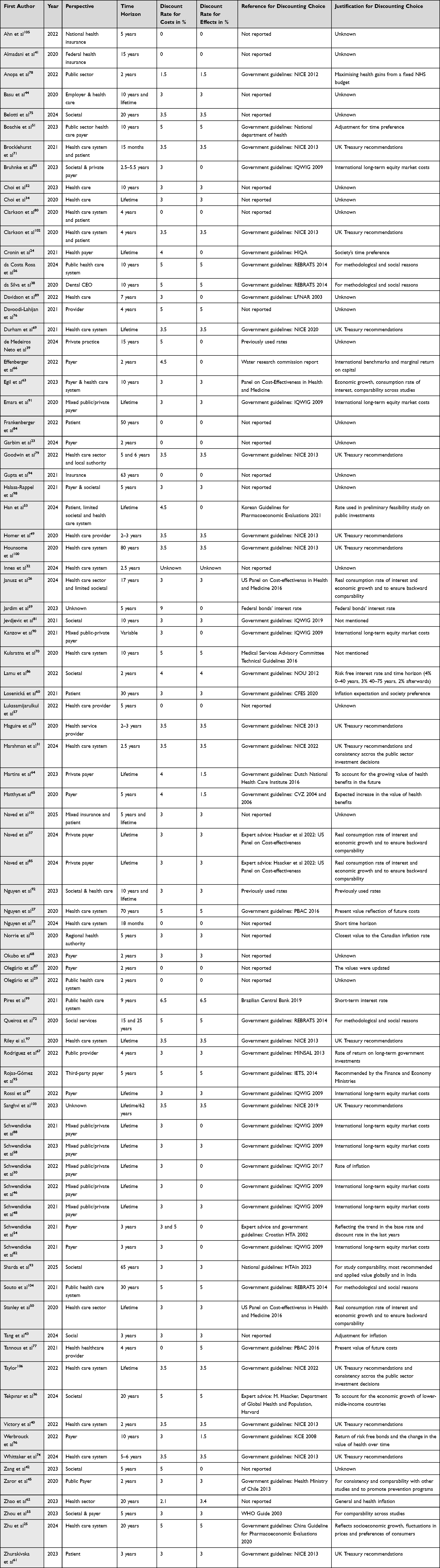 |
Table 1 Study Characteristics of the 83 Included Studies in This Systematic Review |
 |
Figure 1 PRISMA 2020 flow diagram. |
Regarding the perspectives adopted, 2 of the 83 studies did not specify a perspective, 21 (25%) used a mixed perspective, 7 (8%) used a societal perspective, 16 (19%) adopted a patient/payer perspective, and 37 (44%) reported a health-care perspective (Table 1). A detailed list of study characteristics, including year and country of publication, time horizon, and currency, is provided in Table S1 in the Appendix. With respect to the cost-effectiveness methodology used, 66% of the included articles used a Markov model, and almost half (47%) focused on various preventive dental interventions. The results of the CHEERS 2022 checklist are reported in Table S2 in the Appendix. An average reporting compliance of 80.4% was achieved according to the CHEERS 2022 criteria.
Discussion
Of the 83 articles included in this review, 13% did not report using a discount rate, and 27% did not provide any reference to justify their choice. The most frequently used value for discounting was 3%, applied in 41% of the studies, consistent with earlier findings.8,107 These studies were conducted predominantly in high-income countries and showed no consistent preference for a particular analytic perspective. This lack of consistency in economic evaluations regarding perspective choice has also been highlighted previously.108,109 Moreover, 24% of the studies using a 3% rate did not provide any reference for their choice, while the rest almost exclusively relied on government guidelines. In contrast, the 3.5% rate was used almost entirely in UK-based studies, all of which applied a health-care perspective. Studies adopting a 5% discount rate were largely conducted in middle-income countries and predominantly used a health care perspective. Higher discount rates, such as 6.5% and 9%, were observed only in Brazil, again aligned with a health care perspective. Finally, differential discounting was used in the Netherlands and Belgium, where outcomes were discounted at a lower rate than costs, consistently within a payer perspective.
The findings of this review are consistent with the broader landscape of oral health economic evaluation research, which shows a steady increase in the number of studies alongside ongoing methodological heterogeneity.4,5 Previous reviews have similarly documented a strong focus on dental caries, frequent omission of discounting in multi-year analyses, and variability in the application of discount rates.4,8,19–21 The predominance of the 3% rate aligns with traditional recommendations for comparability across studies.8 However, our post-2020 sample reveals persistent discussions around uniform rates, particularly in low- and middle-income countries where higher rates have been proposed to better reflect economic growth.8 Unlike earlier reviews that emphasized methodological shortcomings, our analysis indicates improved overall reporting quality, likely influenced by updated standards.110
The choice of discount rate is context-dependent.12 Under a fixed health care budget, it should reflect the opportunity cost of capital and expected growth in the cost-effectiveness threshold.11 In an unconstrained societal perspective, the discount rate for costs equals the social rate of time preference minus expected growth in the consumption value of health, potentially justifying different rates for costs and health effects.6,12 Differential discounting remains controversial: proponents argue for a lower rate for health outcomes if the consumption value of health rises over time (with some empirical support in high-income settings), while critics cite insufficient evidence, the consistency argument (constant value of a life-year), and paradoxes such as the Keeler-Cretin effect.13,15 Guidance remains heterogeneous, with many guidelines prescribing equal discounting without explicit justification.28,107,108 Recent discussions suggest reducing rates to 1.5–2% in high-income settings due to declining real interest rates and consumption growth.17 This is particularly relevant for dentistry, where upfront costs and decades-long benefits make discounting highly influential, often biasing against preventive strategies under uniform or high rates.4,9 Prior dentistry-specific reviews highlight persistent gaps in justification, underscoring the need for focused assessment.5,20
This review has several strengths. Its recency—limited to studies published after January 1, 2020, allows it to reflect contemporary practices in the context of the latest CHEERS guidance and PRISMA recommendations, providing timely insights amid rising global attention to oral health burdens.1,22,111 The inclusion of 83 studies exceeds the sample sizes of previous dentistry-specific reviews, ensuring greater comprehensiveness through systematic multi-database searching and rigorous assessment of reporting quality using the CHEERS 2022 statement.4,5 This approach identified high average reporting compliance (80.4%) and revealed policy-relevant patterns, such as potential bias against preventive interventions when uniform or high rates are applied without justification.9,19 This review builds on earlier work by emphasizing the role of discounting in long-term modelling, documenting guideline heterogeneity, and advocating consideration of context-specific rates. These elements enhance its relevance for improving resource allocation, particularly in preventive programs in low- and middle-income settings.8
The policy implications of inconsistent discounting practices are particularly consequential for preventive dental interventions. Programs such as fissure sealants, fluoride varnishes, and community water fluoridation incur costs almost entirely at the beginning of the treatment, while their benefits accrue over decades, similar to vaccination or screening programs. Applying a uniform or elevated discount rate in settings where a lower rate would be appropriate based on the social rate of time preference systematically disadvantages these interventions in cost-effectiveness rankings, potentially biasing resource allocation decisions against prevention. We therefore recommend that guideline-issuing bodies in dentistry explicitly require sensitivity analyses on the discount rate, particularly for preventive interventions with time horizons exceeding 10 years, and that researchers clearly align their rate selection with the stated analytic perspective and the economic context of the study country.
Limitations, while present, are addressed through the study design. The restriction to post-2020 publications may exclude historical patterns, although this was deliberate to reflect current methodological standards. Language restrictions (Latin alphabet only) may have under-represented studies from certain regions, particularly low- and middle-income countries. Although the primary aim of this review was to document and analyze discounting practices in relation to perspective selection, other methodological aspects such as the measurement and valuation of outcomes or the application of sensitivity analysis, were not examined in depth, as these have been addressed in previous publications.112 In addition, as this review was intentionally focused on dental medicine, the findings are specific to this field and may not directly generalize to other areas of health care.
Conclusions
Based on the findings of this study, we recommend that researchers in the dental field adhere more consistently to established reporting standards and, when selecting discount rates, carefully consider and explicitly document the rationale underlying the guidelines they choose to follow.22,107 Discounting decisions should be aligned with other core study parameters, including analytic perspective, time horizon, and outcome measure.6,12 Further work is needed to identify the main drivers of inconsistency in discounting practices and to support the development of more up-to-date, comprehensive guidelines that incorporate relevant methodological and contextual factors, thereby enhancing the comparability and policy relevance of economic evaluations in oral health. In particular, the persistent use of uniform discount rates across diverse country contexts, and the frequent absence of theoretical justification, risks introducing systematic bias against preventive dental interventions whose cost-effectiveness is highly sensitive to long-term discounting assumptions. Dental HTA bodies should therefore consider revisiting their discounting guidance in light of recent methodological developments and the updated CHEERS 2022 reporting standards, with explicit attention to the alignment between rate selection, analytic perspective, and country-specific economic parameters.
Data Sharing Statement
No new data were generated or analyzed in this study; therefore, data sharing is not applicable.
Author Contributions
All authors made a significant contribution to the work reported, whether that is in the conception, study design, execution, acquisition of data, analysis and interpretation, or in all these areas; took part in drafting, revising or critically reviewing the article; gave final approval of the version to be published; have agreed on the journal to which the article has been submitted; and agree to be accountable for all aspects of the work.
Funding
Open access funding provided by University of Basel.
Disclosure
The authors report no conflicts of interest in this work.
References
1. Jain N, Dutt U, Radenkov I, Jain S. WHO ‘s global oral health status report 2022: actions, discussion and implementation. Oral Dis. 2024;30(2):73–15. doi:10.1111/odi.14516
2. Mariño R, Zaror C. Introduction to Economic Evaluation in Oral Health Care. 2022:147–161. doi:10.1007/978-3-030-96289-0_10
3. Sendi P, Ramadani A, Bornstein MM. Prevalence of Missing Values and Protest Zeros in Contingent Valuation in Dental Medicine. Int J Environ Res Public Heal. 2021;18(14):7219. doi:10.3390/ijerph18147219
4. Rogers HJ, Rodd HD, Vermaire JH, et al. A systematic review of the quality and scope of economic evaluations in child oral health research. BMC Oral Heal. 2019;19(1):132. doi:10.1186/s12903-019-0825-2
5. Tonmukayakul U, Calache H, Clark R, Wasiak J, Faggion CM. Systematic Review and Quality Appraisal of Economic Evaluation Publications in Dentistry. J Dent Res. 2015;94(10):1348–1354. doi:10.1177/0022034515589958
6. Attema AE, Brouwer WBF, Claxton K. Discounting in Economic Evaluations. PharmacoEconomics. 2018;36(7):745–758. doi:10.1007/s40273-018-0672-z
7. Brouwer WBF, Niessen LW, Postma MJ, Rutten FFH. Need for differential discounting of costs and health effects in cost effectiveness analyses. BMJ. 2005;331(7514):446. doi:10.1136/bmj.331.7514.446
8. Haacker M, Hallett TB, Atun R. On discount rates for economic evaluations in global health. Heal Polic Plan. 2020;35(1):107–114. doi:10.1093/heapol/czz127
9. Paulden M, O’Mahony JF, McCabe C. Discounting the Recommendations of the Second Panel on Cost-Effectiveness in Health and Medicine. PharmacoEconomics. 2017;35(1):5–13. doi:10.1007/s40273-016-0482-0
10. Attema AE, Bleichrodt H, L’Haridon O, Peretti-Watel P, Seror V. Discounting health and money: new evidence using a more robust method. J Risk Uncertain. 2018;56(2):117–140. doi:10.1007/s11166-018-9279-1
11. Paulden M, Claxton K. Budget allocation and the revealed social rate of time preference for health. Heal Econ. 2012;21(5):612–618. doi:10.1002/hec.1730
12. Claxton K, Paulden M, Gravelle H, Brouwer W, Culyer AJ. Discounting and decision making in the economic evaluation of health-care technologies. Heal Econ. 2011;20(1):2–15. doi:10.1002/hec.1612
13. John J, Koerber F, Schad M. Differential discounting in the economic evaluation of healthcare programs. Cost Eff Resour Alloc. 2019;17(1):29. doi:10.1186/s12962-019-0196-1
14. Weinstein M, Zeckhauser R. Critical ratios and efficient allocation. J Public Econ. 1973;2(2):147–157. doi:10.1016/0047-2727(73)90002-9
15. Nord E. Discounting future health benefits: the poverty of consistency arguments. Heal Econ. 2011;20(1):16–26. doi:10.1002/hec.1687
16. Khorasani E, Davari M, Kebriaeezadeh A, Fatemi F, Sari AA, Varahrami V. A comprehensive review of official discount rates in guidelines of health economic evaluations over time: the trends and roots. Eur J Heal Econ. 2022;23(9):1577–1590. doi:10.1007/s10198-022-01445-x
17. Cohen JT. It Is Time to Reconsider the 3% Discount Rate. Value Heal. 2024;27(5):578–584. doi:10.1016/j.jval.2024.03.001
18. O’Mahony JF, Paulden M, McCabe C. NICE’s Discounting Review: clear Thinking on Rational Revision Meets Obstacle of Industrial Interests. PharmacoEconomics. 2021;39(2):139–146. doi:10.1007/s40273-020-00990-8
19. Nguyen TM, Tonmukayakul U, Lkd L, Calache H, Mihalopoulos C. Economic Evaluations of Preventive Interventions for Dental Caries and Periodontitis: a Systematic Review. Appl Heal Econ Heal Polic. 2023;21(1):53–70. doi:10.1007/s40258-022-00758-5
20. Hettiarachchi RM, Kularatna S, Downes MJ, et al. The cost-effectiveness of oral health interventions: a systematic review of cost-utility analyses. Community Dent Oral Epidemiol. 2018;46(2):118–124. doi:10.1111/cdoe.12336
21. Mariño R, Ravisankar G, Zaror C. Quality appraisal of economic evaluations done on oral health preventive programs-A systematic review. J Public Heal Dent. 2020;80(3):194–207. doi:10.1111/jphd.12368
22. Husereau D, Drummond M, Augustovski F, et al. Consolidated Health Economic Evaluation Reporting Standards 2022 (CHEERS 2022) Statement: updated Reporting Guidance for Health Economic Evaluations. PharmacoEconomics. 2022;40(6):601–609. doi:10.1007/s40273-021-01112-8
23. Garbim JR, Saihara CS, Olegário IC, et al. 2-year survival and cost analysis of occlusoproximal ART restorations using encapsulated glass ionomer cement in primary molars: a randomized controlled trial. BMC Oral Heal. 2024;24(1):647. doi:10.1186/s12903-024-04357-9
24. Cronin J, Moore S, Harding M, Whelton H, Woods N. A cost-effectiveness analysis of community water fluoridation for schoolchildren. BMC Oral Heal. 2021;21(1):158. doi:10.1186/s12903-021-01490-7
25. Zhu LW, Wang RX, Zhang Y, Zhan JY, Lu HX, Chen X. A cost-effectiveness analysis of fluoride varnish application in preventing Root caries in elderly persons: a Markov simulation study. BMC Oral Heal. 2024;24(1):483. doi:10.1186/s12903-024-04226-5
26. Janusz CB, Doan TT, Gebremariam A, et al. A Cost-Effectiveness Analysis of Population-Level Dental Caries Prevention Strategies in US Children. Acad Pediatr. 2024;24(5):765–775. doi:10.1016/j.acap.2024.02.006
27. Nguyen TM, Tonmukayakul U, Warren E, Cartwright S, Liew D. A Markov cost-effective analysis of biannual fluoride varnish for preventing dental caries in permanent teeth over a 70-year time horizon. Heal Promot J Aust. 2020;31(2):177–183. doi:10.1002/hpja.283
28. Lipman SA, Attema AE. A systematic review of unique methods for measuring discount rates. J Risk Uncertain. 2024;69(2):145–189. doi:10.1007/s11166-024-09439-1
29. Olegário IC, Furlan Al de BP, Laux CM, et al. ART restorations for occluso-proximal cavities in primary molars: a two-year survival and cost analysis of an RCT comparing two GIC brands. J Appl Oral Sci. 2022:30e20220148. doi:10.1590/1678-7757-2022-0148.
30. Schwendicke F, Oro JCG, Cantu AG, Meyer-Lueckel H, Chaurasia A, Krois J. Artificial Intelligence for Caries Detection: value of Data and Information. J Dent Res. 2022;101(11):1350–1356. doi:10.1177/00220345221113756
31. Marshman Z, Ainsworth H, Fairhurst C, et al. Behaviour change intervention (education and text) to prevent dental caries in secondary school pupils: BRIGHT RCT, process and economic evaluation. Heal Technol Assess. 2024;28(52):1–142. doi:10.3310/jqta2103
32. Innes N, Fairhurst C, Whiteside K, et al. Behaviour change intervention for toothbrushing (lesson and text messages) to prevent dental caries in secondary school pupils: the BRIGHT randomized control trial. Community Dent Oral Epidemiol. 2024;52(4):469–478. doi:10.1111/cdoe.12940
33. Maguire A, Clarkson JE, Douglas GV, et al. Best-practice prevention alone or with conventional or biological caries management for 3- to 7-year-olds: the FiCTION three-arm RCT. Heal Technol Assess. 2020;24(1):1–174. doi:10.3310/hta24010
34. Choi SE, Sima C, Pandya A. Impact of Treating Oral Disease on Preventing Vascular Diseases: a Model-Based Cost-effectiveness Analysis of Periodontal Treatment Among Patients With Type 2 Diabetes. Diabetes Care. 2020;43(3):563–571. doi:10.2337/dc19-1201
35. Norrie O, Pharand L. Cost effectiveness of a fluoride varnish daycare program versus usual care in central Winnipeg, Canada. JCHD. 2020;54(2):68–74.
36. Tekpınar L, Yiğit V. Cost-Effectiveness Analysis of Implant-Supported Single Crown and Tooth-Supported Fixed Dental Prostheses in Türkiye. Value Heal Reg Issues. 2024;42:11–17. doi:10.1016/j.vhri.2024.01.001
37. Naved N, Umer F, Khowaja AR. Cost-Effectiveness Analysis of Regenerative Endodontics versus MTA Apexification. JDR Clin Transl Res. 2024;9(3):231–238. doi:10.1177/23800844231191515
38. Silva RO, Gomes-Filho FN, Cavalcante DFB, et al. Cost-effectiveness analysis of rehabilitation interventions for teeth with extensive coronary destruction. Value Heal Reg Issues. 2020;23:122–130. doi:10.1016/j.vhri.2020.07.581
39. Medeiros de MH, Silva da RO, Almeida FD, et al. Cost-Effectiveness Analysis of Single-Tooth Rehabilitation Options. Pesqui Bras Em Odontopediatria e Clínica Integrada. 2024:24e230174. doi:10.1590/pboci.2024.070.
40. Victory E, Rhiannon ET, Girvan B, Pauline A, Cynthia PM. Cost-effectiveness Analysis of the Dental RECUR Pragmatic Randomized Controlled Trial: evaluating a Goal-oriented Talking Intervention to Prevent Reoccurrence of Dental Caries in Children. Appl Heal Econ Heal Polic. 2022;20(3):431–445. doi:10.1007/s40258-022-00720-5
41. Almadani YH, Gilardino MS. Cost-Effectiveness Analysis, Psychosocial, and Utility Outcomes of Early Mandibular Distraction in Craniofacial Microsomia. J Craniofacial Surg. 2020;31(7):1888–1894. doi:10.1097/scs.0000000000006622
42. Zang HL, Zhang Y, Hao XW, Yang L, Liang YH. Cost-effectiveness analysis: nonsurgical root canal treatment versus single-tooth implant. BMC Oral Heal. 2023;23(1):489. doi:10.1186/s12903-023-03173-x
43. Tang L, Nong S, Chen K, Liu Q, Yu X, Zeng X. Cost-effectiveness and cost–benefit analyses of fluoride varnish for caries prevention in Guangxi, China. BMC Oral Heal. 2024;24(1):534. doi:10.1186/s12903-024-04220-x
44. Basu S, Jacobs LM, Epel E, Schillinger D, Schmidt L. Cost-Effectiveness Of A Workplace Ban On Sugar-Sweetened Beverage Sales: a Microsimulation Model. Heal Aff. 2020;39(7):1140–1148. doi:10.1377/hlthaff.2019.01483
45. Zaror C, Muñoz-Millán P, Espinoza-Espinoza G, Vergara-González C, Martínez-Zapata MJ. Cost-effectiveness of adding fluoride varnish to a preventive protocol for early childhood caries in rural children with no access to fluoridated drinking water. J Dent. 2020;98:103374. doi:10.1016/j.jdent.2020.103374
46. Schwendicke F, Mertens S, Cantu AG, Chaurasia A, Meyer-Lueckel H, Krois J. Cost-effectiveness of AI for caries detection: randomized trial. J Dent. 2022;119:104080. doi:10.1016/j.jdent.2022.104080
47. Rossi JG, Rojas-Perilla N, Krois J, Schwendicke F. Cost-effectiveness of Artificial Intelligence as a Decision-Support System Applied to the Detection and Grading of Melanoma, Dental Caries, and Diabetic Retinopathy. JAMA Network Open. 2022;5(3):e220269. doi:10.1001/jamanetworkopen.2022.0269
48. Schwendicke F, Rossi JG, Göstemeyer G, et al. Cost-effectiveness of Artificial Intelligence for Proximal Caries Detection. J Dent Res. 2021;100(4):369–376. doi:10.1177/0022034520972335
49. Homer T, Maguire A, Douglas GVA, et al. Cost-effectiveness of child caries management: a randomised controlled trial (FiCTION trial). BMC Oral Heal. 2020;20(1):45. doi:10.1186/s12903-020-1020-1
50. Stanley EE, Trentadue TP, Smith KC, et al. Cost-effectiveness of dental antibiotic prophylaxis in total knee arthroplasty recipients with type II diabetes mellitus. Osteoarthr Cartil Open. 2020;2(4):100084. doi:10.1016/j.ocarto.2020.100084
51. Boachie MK, Molete M, Hofman K, Thsehla E. Cost-effectiveness of dental caries prevention strategies in South African schools. BMC Oral Heal. 2023;23(1):814. doi:10.1186/s12903-023-03474-1
52. Choi SE, Shen Y, Wright DR. Cost-effectiveness of Dental Workforce Expansion Through the National Health Service Corps and Its Association With Oral Health Outcomes Among US Children. JAMA Heal Forum. 2023;4(3):e230128. doi:10.1001/jamahealthforum.2023.0128
53. Han A, Park EG, Yoon JH, Choi JY, Park HK, Hahn S. Cost-effectiveness of expanding national health insurance coverage for composite resin restorations in cancer patients in South Korea. J Dent. 2024;150:105357. doi:10.1016/j.jdent.2024.105357
54. Schwendicke F, Rossi JG, Krois J, et al. Cost-effectiveness of glass hybrid versus composite in a multi-country randomized trial. J Dent. 2021;107:103614. doi:10.1016/j.jdent.2021.103614
55. Zhou L, Liu B, Li Y, et al. Cost-Effectiveness of Pit and Fissure Sealing at Schools for Caries Prevention in China: a Markov Modeling Analysis. Caries Res. 2023;57(4):516–523. doi:10.1159/000530377
56. Rosa TC, Cavalcanti YW, Costa MC, Neves AA. Cost-effectiveness of restorative treatments for permanent molars with severe molar incisor hypomineralization: perspectives for the Brazilian public health system. Clin Oral Investig. 2024;28(6):301. doi:10.1007/s00784-024-05652-z
57. Thailand D of CD Faculty of Dentistry, Mahidol University, Bangkok, Lukssamijarulkul N, Thailand C of PHS Chulalongkorn University, Bangkok, et al Cost-effectiveness of school oral health prevention program: a case study of community dentistry, Mahidol University. J Public Heal Dev. 2022;20(1). doi:10.55131/jphd/2022/200102
58. Schwendicke F, Bombeck L. Cost-effectiveness of school-based caries screening using transillumination. J Dent. 2023;137:104635. doi:10.1016/j.jdent.2023.104635
59. Jardim JJ, Alves LS, Decourt RF, Paula LM, Mestrinho HD, Maltz M. Cost-effectiveness of selective caries removal versus stepwise excavation for deep caries lesions. Braz Oral Res. 2023;37:e083. doi:10.1590/1807-3107bor-2023.vol37.0083
60. Losenická J, Gajdoš O, Kamenský V. Cost-utility analysis of an implant treatment in dentistry. BMC Oral Heal. 2021;21(1):433. doi:10.1186/s12903-021-01790-y
61. Zhurakivska K, Luciano R, Caponio VCA, et al. Cost/effectiveness analysis of treatment options for the rehabilitation of the total edentulous mandible. J Oral Rehabil. 2023;50(5):400–409. doi:10.1111/joor.13423
62. Zhao Y, Raymond K, Chondur R, et al. Costs and benefits of community water fluoridation in remote Aboriginal communities of the Northern Territory. Aust J Rural Heal. 2023;31(5):1017–1026. doi:10.1111/ajr.13037
63. Egil E, Yaylali E. Cost-effectiveness analysis of fissure sealants for caries prevention in children. J Public Heal Dent. 2023;83(1):43–50. doi:10.1111/jphd.12549
64. Martins JFB, Hagay S, Herbst SR, Falk S. Cost-effectiveness analysis of full versus selective root canal retreatment. Int Endod J. 2023;56(11):1319–1327. doi:10.1111/iej.13972
65. Matthys C, Vijlder WD, Besseler J, Glibert M, Bruyn HD. Cost-effectiveness analysis of two attachment systems for mandibular overdenture. Clin Oral Implant Res. 2020;31(7):615–624. doi:10.1111/clr.13599
66. Effenberger S, Greenwall L, Cebula M, et al. Cost-effectiveness and efficacy of fluoride varnish for caries prevention in South African children: a cluster-randomized controlled community trial. Community Dent Oral Epidemiol. 2022;50(5):453–460. doi:10.1111/cdoe.12702
67. Rodriguez GA, Cabello RA, Borroni CP, Palacio RA. Cost-effectiveness of probiotics and fluoride varnish in caries prevention in preschool children. J Public Heal Dent. 2022;82(3):280–288. doi:10.1111/jphd.12526
68. Okubo R, Hoshi S, Kondo M. Cost-effectiveness of professional and mechanical oral care for preventing pneumonia in nursing home residents. J Am Geriatr Soc. 2023;71(3):756–764. doi:10.1111/jgs.18122
69. Durham J, Breckons M, Vale L, Shen J. DEEP Study: modeling Outcomes and Costs of Persistent Orofacial Pain. JDR Clin Transl Res. 2023;8(1):16–26. doi:10.1177/23800844211063870
70. Kularatna S, Lalloo R, Kroon J, Tadakamadla SKK, Scuffham PA, Johnson NW. Demonstration of high value care to improve oral health of a remote Indigenous community in Australia. Heal Qual Life Outcomes. 2020;18(1):43. doi:10.1186/s12955-020-01300-8
71. Brocklehurst P, Hoare Z, Woods C, et al. Dental therapists compared with general dental practitioners for undertaking check-ups in low-risk patients: pilot RCT with realist evaluation. Heal Serv Deliv Res. 2021;9(3):1–118. doi:10.3310/hsdr09030
72. Queiroz FHV, Probst LF, Mota AHG, Fonseca VAO, Cavalcante DFB, Pereira AC. Economic evaluation in oral health: rehabilitation of a single prosthetic space. Res Soc Dev. 2020;9(12):e22591211076–e22591211076. doi:10.33448/rsd-v9i12.11076
73. Nguyen TM, Witton R, Withers L, Paisi M. Economic evaluation of a community dental care model for people experiencing homelessness. Br Dent J. 2024;1–6. doi:10.1038/s41415-024-8166-1
74. Whittaker W, Goodwin M, Bashir S, et al. Economic evaluation of a water fluoridation scheme in Cumbria, UK. Community Dent Oral Epidemiol. 2024;52(4):601–612. doi:10.1111/cdoe.12958
75. Belotti L, Frazão P. Economic Evaluation of Community Water Fluoridation in an Upper-Middle-Income Country. Braz Dent J. 2024;35:e24. doi:10.1590/0103-644020245994
76. Davoodi-Lahijan J, Farrokh-Eslamlou HR, Shariat-Torbaghan K, Nouraei-Motlagh S, Alinia C, Yusefzadeh H. Economic evaluation of fluoride varnish application in Iranian schools. J Oral Heal Oral Epidemiol. 2021;10(2):64–71. doi:10.22122/johoe.v10i2.1146
77. Tannous KW, George A, Ahmed MU, et al. Economic evaluation of the Midwifery Initiated Oral Health-Dental Service programme in Australia. BMJ Open. 2021;11(8):e047072. doi:10.1136/bmjopen-2020-047072
78. Anopa Y, Macpherson LMD, McMahon AD, Wright W, Conway DI, McIntosh E. Economic Evaluation of the Protecting Teeth @ 3 Randomized Controlled Trial. JDR Clin Transl Res. 2023;8(3):207–214. doi:10.1177/23800844221090444
79. Goodwin M, Emsley R, Kelly MP, et al. Evaluation of water fluoridation scheme in Cumbria: the CATFISH prospective longitudinal cohort study. Public Heal Res. 2022;10(11):1–186. doi:10.3310/shmx1584
80. Clarkson JE, Pitts NB, Fee PA, et al. Examining the effectiveness of different dental recall strategies on maintenance of optimum oral health: the INTERVAL dental recalls randomised controlled trial. Br Dent J. 2021;230(4):236–243. doi:10.1038/s41415-021-2612-0
81. Jevdjevic M, Wijn SRW, Trescher AL, Nair R, Rovers M, Listl S. Front-of-Package Food Labeling to Reduce Caries: economic Evaluation. J Dent Res. 2021;100(5):472–478. doi:10.1177/0022034520979147
82. Schwendicke F, Müller A, Seifert T, Jeggle-Engbert LM, Paris S, Göstemeyer G. Glass hybrid versus composite for non-carious cervical lesions: survival, restoration quality and costs in randomized controlled trial after 3 years. J Dent. 2021;110:103689. doi:10.1016/j.jdent.2021.103689
83. Bruhnke M, Naumann M, Böse MWH, Beuer F, Schwendicke F. Health economic evaluation of forced orthodontic extrusion of extensively damaged teeth: up to 6-year results from a clinical study. Clin Oral Investig. 2023;27(9):5587–5594. doi:10.1007/s00784-023-05178-w
84. Frankenberger R, Arweiler NB, Sorsa TA, et al. Health economic potential of oral aMMP-8 biomarker diagnostics for personalised prevention of periodontal and peri-implant diseases. J Pharm Heal Serv Res. 2022;13(2):52–60. doi:10.1093/jphsr/rmac008
85. Naved N, Umer F, Khowaja AR. Irreversible pulpitis in mature permanent teeth: a cost-effectiveness analysis of pulpotomy versus root canal treatment. BMC Oral Heal. 2024;24(1):285. doi:10.1186/s12903-024-04052-9
86. Lamu AN, Björkman L, Hamre HJ, Alræk T, Musial F, Robberstad B. Is amalgam removal in patients with medically unexplained physical symptoms cost-effective? A prospective cohort and decision modelling study in Norway. PLoS One. 2022;17(4):e0267236. doi:10.1371/journal.pone.0267236
87. Olegário IC, Ladewig NM, Hesse D, et al. Is it worth using low-cost glass ionomer cements for occlusal ART restorations in primary molars? 2-year survival and cost analysis of a Randomized clinical trial. J Dent. 2020;101:103446. doi:10.1016/j.jdent.2020.103446
88. Schwendicke F, Basso M, Markovic D, Turkun LS, Miletić I. Long-term cost-effectiveness of glass hybrid versus composite in permanent molars. J Dent. 2021;112:103751. doi:10.1016/j.jdent.2021.103751
89. Davidson T, Bergström EK, Husberg M, Sköld UM. Long-Term Cost-Effectiveness through the Dental-Health FRAMM Guideline for Caries Prevention. Int J Environ Res Public Heal. 2022;19(4):1954. doi:10.3390/ijerph19041954
90. Kanzow P, Krois J, Wiegand A, Schwendicke F. Long-term treatment costs and cost-effectiveness of restoration repair versus replacement. Dent Mater. 2021;37(6):e375–e381. doi:10.1016/j.dental.2021.02.008
91. Emara R, Krois J, Schwendicke F. Maintaining pulpal vitality: cost-effectiveness analysis on carious tissue removal and direct pulp capping. J Dent. 2020;96:103330. doi:10.1016/j.jdent.2020.103330
92. Nguyen TM, Tonmukayakul U, Le LK, et al. Modeled health economic and equity impact on dental caries and health outcomes from a 20% sugar sweetened beverages tax in Australia. Heal Econ. 2023;32(11):2568–2582. doi:10.1002/hec.4739
93. Sharda S, Gupta A, Jyani G, Prinja S, Goyal A. Modeling the cost-effectiveness of school-based supervised toothbrushing program in reducing the dental caries burden in India. Int J Paediatr Dent. 2025;35(1):136–144. doi:10.1111/ipd.13214
94. Gupta A, Sharda S, Jyani G, Prinja S, Goyal A, Gauba K. Modelling the impact of increase in sugar prices on dental caries in India. Community Dent Oral Epidemiol. 2022;50(5):430–436. doi:10.1111/cdoe.12694
95. Rojas-Gómez AM, Serrano JJ, Rosselli D. Nonsurgical periodontal treatment in type II diabetics in a middle-income country: a cost-effectiveness analysis. Int J Technol Assess Heal Care. 2022;38(1):e73. doi:10.1017/s0266462322000563
96. Werbrouck A, Schmidt M, Annemans L, et al. Oral healthcare delivery in institutionalised older people: a health-economic evaluation. Gerodontology. 2022;39(2):107–120. doi:10.1111/ger.12530
97. Riley P, Glenny AM, Worthington HV, et al. Oral splints for patients with temporomandibular disorders or bruxism: a systematic review and economic evaluation. Heal Technol Assess. 2020;24(7):1–224. doi:10.3310/hta24070
98. Halasa-Rappel Y, Archibald J, Miller P, et al. Pit-and-fissure sealants on primary molars are a cost savings. J Am Dent Assoc. 2021;152(10):832–841.e4. doi:10.1016/j.adaj.2021.05.005
99. Pires A, Poletto-Neto V, Chisini L, Schwendicke F, Pereira-Cenci T. Post-retained Restorations: a Cost-minimization Analysis Nested in a Randomized Clinical Trial. Oper Dent. 2021;46(3):255–262. doi:10.2341/20-056-c
100. Hounsome J, Pilkington G, Mahon J, et al. Prophylactic removal of impacted mandibular third molars: a systematic review and economic evaluation. Health Technology Assessment. 2020;24(30):1–116. doi:10.3310/hta24300
101. Naved N, Khowaja AR, Umer F. Restoration of endodontically treated teeth: a cost-effectiveness analysis of a one-piece endodontic crown versus a complete crown. J Prosthet Dent. 2025;134(4):1172–1178. doi:10.1016/j.prosdent.2024.02.013
102. Clarkson JE, Pitts NB, Goulao B, et al. Risk-based, 6-monthly and 24-monthly dental check-ups for adults: the INTERVAL three-arm RCT. Health Technology Assessment. 2020;24(60):1–138. doi:10.3310/hta24600
103. Sanghvi R, Cant A, Neves A, Hosey MT, Banerjee A, Pennington M. Should compromised first permanent molar teeth in children be routinely removed? A health economics analysis. Community Dentistry and Oral Epidemiology. 2023;51(5):755–766. doi:10.1111/cdoe.12751
104. Souto MLS, Carrer FCDA, Braga MM, Pannuti CM. Smoking Cessation therapy is a cost-effective intervention to avoid tooth loss in Brazilian subjects with periodontitis: an economic evaluation. BMC Oral Health. 2021;21(1):616. doi:10.1186/s12903-021-01932-2
105. Ahn E, Kim S-M, Garg CC. The cost- effectiveness of early dental visit in infants and toddlers focused on regional deprivation in South Korea: a retrospective cohort study. PLoS One. 2022;17(6):e0269770. doi:10.1371/journal.pone.0269770
106. Tylor GD. Dental Extraction Versus Filling of Adult Teeth in Children: An Economic Evaluation (DECIDE). Newcastle University; 2022.
107. Williams AO, Rojanasarot S, McGovern AM, Kumar A. A systematic review of discounting in national health economic evaluation guidelines: healthcare value implications. J Comp Eff Res. 2022;e220167. doi:10.2217/cer-2022-0167
108. Groom B, Drupp MA, Freeman MC, Nesje F. The Future, Now: a Review of Social Discounting. Annu Rev Resour Econ. 2022;14(1):467–491. doi:10.1146/annurev-resource-111920-020721
109. Sittimart M, Rattanavipapong W, Mirelman AJ, et al. An overview of the perspectives used in health economic evaluations. Cost Eff Resour Alloc. 2024;22(1):41. doi:10.1186/s12962-024-00552-1
110. Husereau D, Drummond M, Augustovski F, et al. Consolidated Health Economic Evaluation Reporting Standards 2022 (CHEERS 2022) statement: updated reporting guidance for health economic evaluations. BMC Med. 2022;20(1):23. doi:10.1186/s12916-021-02204-0
111. Page MJ, McKenzie JE, Bossuyt PM, et al. The PRISMA 2020 statement: an updated guideline for reporting systematic reviews. BMJ. 2021:
112. Sendi P, Walterscheidt M, Bornstein MM. Handling uncertainty in cost-effectiveness analysis in dental medicine: a systematic review with a focus on affordability and risk-aversion. Cost Eff Resour Alloc: CE. 2025;23(1):32. doi:10.1186/s12962-025-00641-9
 © 2026 The Author(s). This work is published by Dove Medical Press Limited, and licensed under a
Creative Commons Attribution License.
The full terms of the License are available at http://creativecommons.org/licenses/by/4.0/.
The license permits unrestricted use, distribution, and reproduction in any medium, provided the
original author and source are credited.
© 2026 The Author(s). This work is published by Dove Medical Press Limited, and licensed under a
Creative Commons Attribution License.
The full terms of the License are available at http://creativecommons.org/licenses/by/4.0/.
The license permits unrestricted use, distribution, and reproduction in any medium, provided the
original author and source are credited.