
Back to Journals » Psychology Research and Behavior Management » Volume 19
Mapping Severe Child Nomophobia with Hierarchical Clustering and ROC Analysis [Corrigendum]
Authors Jiménez-Jiménez V  , Chivite-Cebolla C , Jódar R, López EP, Conejo-Pérez MN , Sánchez-Martínez M
Received 26 June 2026
Accepted for publication 26 June 2026
Published 14 July 2026 Volume 2026:19 635944
Jiménez-Jiménez V, Chivite-Cebolla C, Jódar R, López EP, Conejo-Pérez MN, Sánchez-Martínez M. Psychol Res Behav Manag. 2025;18:1883–1892. https://doi.org/10.2147/PRBM.S532429
Page 1884, Dr Sánchez-Martínez affiliation was corrected to “Departmental Area of Medicine, Faculty of Health Sciences, Catholic University of Avila Santa Teresa de Jesus, Avila, Spain”, therefore the final author list will be as the following:
Victor Jiménez-Jiménez1, Carmen Chivite-Cebolla2, Rosalía Jódar3, Eva Pilar López2, María-Nélida Conejo-Pérez2, Mercedes Sánchez-Martínez4
Following publication, the authors identified a number of minor reporting errors in the published version. These errors arose from version-control inconsistencies during manuscript preparation, in which numerical values, summary statistics, and descriptive wording carried over from earlier analytical iterations were inadvertently retained in the final manuscript. Each correction listed below has been verified against the final SPSS dataset and the canonical reproducible R workflow that underlies the analyses.
The substantive findings of the article are unchanged. Hierarchical clustering reproducibly identifies a severe child nomophobia subgroup, and the Nomophobia Questionnaire for Children (NQC) shows excellent discrimination for this subgroup, with an optimal ROC-derived cutoff of 101.5 (AUC = 0.993, 95% CI 0.9881–0.9975; sensitivity = 0.889, specificity = 0.979).
The corrections concern the description of the analytical sample, the internal reliability of the STAIC, the clustering procedure, selected inferential statistics, the contents of Tables 1 to 4, sex-comparison wording in the Results and Discussion, the anxiety-associations paragraph, the funding statement, and a small number of typographical and production errors. None of these alter the analytical conclusions of the study.
Detailed summary of sources, specific changes, and potential impact
In summary, the corrections arise mainly from version-control inconsistencies during manuscript preparation, whereby values, labels, and descriptive wording from earlier analytical iterations were inadvertently retained in the published article. A smaller number of corrections concern production wording, author-affiliation metadata, and the funding acknowledgement. All corrected values have been verified against the final SPSS dataset and the canonical reproducible R workflow. These corrections refine the reporting of the sample, tables, statistical values, and wording, but they do not alter the final analytical sample, the two-cluster solution, the ROC-derived cutoff of 101.5, the identification of a small severe-nomophobia subgroup, or the study conclusions.
For readers’ clarity, Table A provides a detailed summary that indicates: (a) the source or nature of each error, (b) the specific change made, including the originally published and corrected numerical or statistical values where applicable, and (c) the potential impact of the change on the study findings and conclusions.
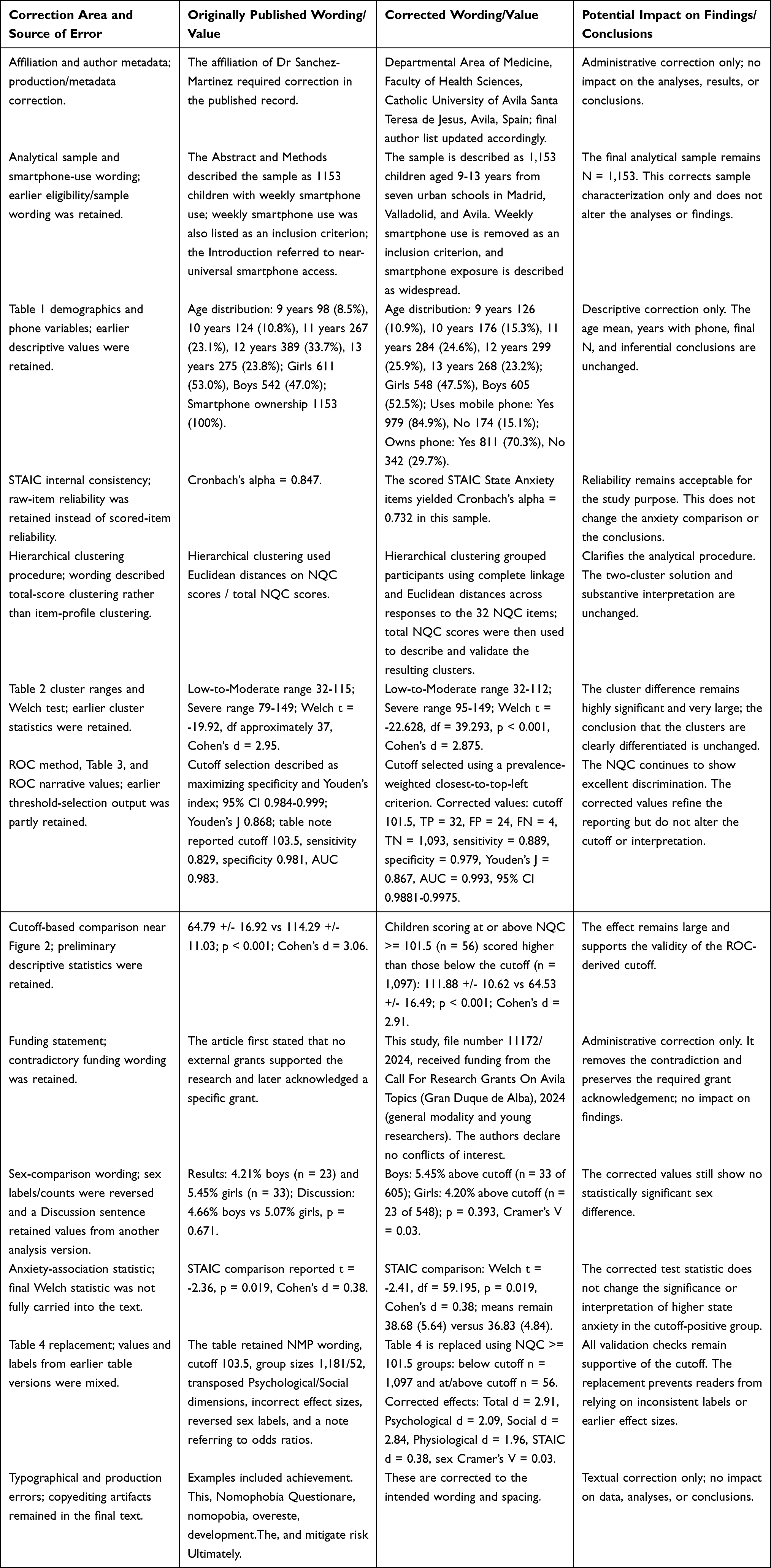 |
Table A Summary of Corrections, Original and Corrected Values, and Impact |
Page 1884, Abstract, Methods section, “A sample of 1153 children with weekly smartphone use from seven urban schools (populations >50,000) completed the 32-item Nomophobia Questionnaire for Children (NQC) and the STAIC State Anxiety measure”. should read “A sample of 1,153 children aged 9–13 years from seven urban schools in Madrid, Valladolid, and Avila (cities with populations >50,000) completed the 32-item Nomophobia Questionnaire for Children (NQC) and the STAIC State Anxiety measure”.
Page 1884, Introduction, “where smartphone access is near-universal” should read “where smartphone exposure is widespread”.
Page 1884, Methods, Setting and Participants section, “The study was conducted in seven urban primary schools (Madrid, Valladolid, Ávila, cities with populations >50,000), López et al, 2023) between February and April 2024”. should read “The study was conducted in seven urban primary schools in Madrid, Valladolid, and Avila (cities with populations >50,000) between February and April 2024”.
Page 1884, Methods, Inclusion Criteria section, “(1) Age 9–13 years, (2) weekly smartphone use, (3) ability to complete questionnaires in Spanish, and (4) parental consent”. should read “(1) Age 9–13 years, (2) ability to complete questionnaires in Spanish, and (3) parental consent”.
Page 1884, Methods, Final Sample section, “After excluding one participant with an invalid response pattern (all items scored ‘4’), the analytical sample comprised 1153 children”. should read “The final analytical sample comprised 1,153 children aged 9 to 13 years, after applying the age filter and excluding one invalid response pattern”.
Page 1885, the corrected demographic and use values for Table 1 are as follows.
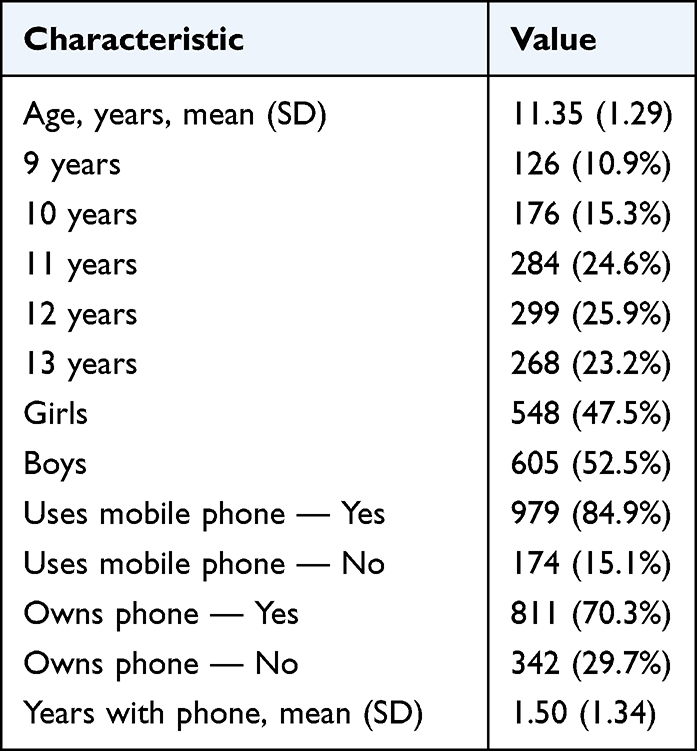 |
Table 1 Participant Demographics (N=1153) |
Page 1885, Measures, Anxiety Assessment section, “The STAIC showed good internal consistency in this study (Cronbach’s alpha = 0.847), confirming its adequacy for evaluating anxiety in this population”. should read “The scored STAIC State Anxiety items yielded Cronbach’s α = 0.732 in this sample”.
Page 1886, Statistical Analysis, ROC-Derived Cutoff Criterion section, “Multiple thresholds were examined, with the final cutoff chosen based on maximizing specificity and Youden’s index”. should read “Multiple thresholds were examined, and the final cutoff was selected using a prevalence-weighted closest-to-top-left criterion, prioritizing specificity given the low prevalence of the Severe cluster”.
Page 1886, Statistical Analysis, Cluster-Based Identification of Severe-Risk Nomophobia section, “Hierarchical clustering used the agnes algorithm (R package cluster) with complete linkage and Euclidean distances on NQC scores”. should read “Hierarchical clustering grouped participants using the agnes algorithm (R package cluster) with complete linkage and Euclidean distances across their responses to the 32 NQC items”.
Page 1887, Results, Hierarchical Clustering section, 1st sentence, “Using complete-linkage hierarchical clustering on total Nomophobia Questionnaire for Children (NQC) scores, a two cluster solution was visually identified from the dendrogram (Figure 1)”. should read “Using complete-linkage hierarchical clustering of participants based on their responses to the 32 NQC items, a two-cluster solution was identified from the dendrogram (Figure 1)”.
Page 1887, Figure 1 legend, “Hierarchical clustering dendrogram of total Nomophobia Questionnaire for Children (NQC) scores. Two distinct clusters are evident, with most participants in the low-to-moderate group (blue) and a smaller subset in the severe group (Orange)” should be “Hierarchical clustering dendrogram of participants based on their responses to the 32 Nomophobia Questionnaire for Children (NQC) items. Two distinct clusters are evident, with most participants in the Low-to-Moderate group (blue) and a smaller subset in the Severe group (orange)”.
Page 1888, Table 2, the two-cluster solution is unchanged; however, the table title, cluster score ranges, and inferential statistics require correction.
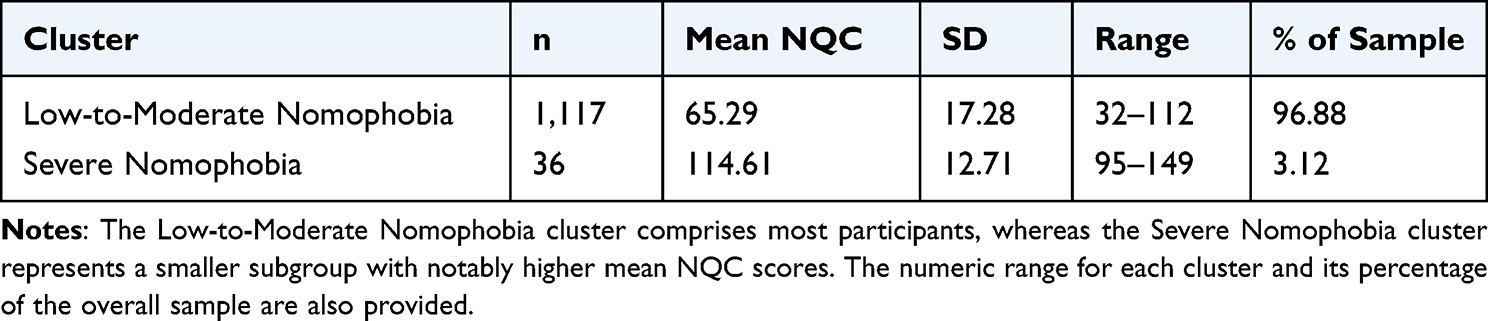 |
Table 2 Main Two Clusters Identified via Hierarchical Clustering of Participants Based on Responses to the 32 NQC Items |
Page 1887, Descriptive Statistics by Cluster section, 4th sentence, the values reported in the published text — t = −19.92, df ≈ 37, Cohen’s d = 2.95 — should be replaced by “A Welch’s t-test (t = −22.628, df = 39.293, p < .001) indicated the difference between these two groups was highly significant and represented a large effect size (Cohen’s d = 2.875)”.
Page 1887, Receiver Operating Characteristic (ROC) Analysis section, the AUC confidence interval and Youden’s index should read: “The NQC total score demonstrated excellent discriminative performance (AUC = 0.993, 95% CI 0.9881–0.9975; p < 0.001). The cutoff of 101.5 achieved a sensitivity of 0.889, a specificity of 0.979, and Youden’s J = 0.867”.
Page 1886 and 1887, Ethical Considerations and Funding section, 5th sentence and last sentence, the published funding statement contains an internal contradiction, first stating that no external grants supported the research and subsequently acknowledging a specific grant. The grant acknowledgement should be retained. The corrected wording is:
This study, file number 11172/2024, received funding from the Call For Research Grants On Avila Topics (Gran Duque de Alba), 2024 (general modality and young researchers). The authors declare no conflicts of interest.
Page 1888, Receiver Operating Characteristic (ROC) Analysis section, last sentence, the descriptive phrase “64.79 ± 16.92 vs 114.29 ± 11.03; Cohen’s d = 3.06” should likewise be replaced, as it corresponds to a preliminary version of the analysis. The corresponding cutoff-based comparison should read:
Children scoring at or above the ROC-derived cutoff (NQC ≥ 101.5, n = 56) showed substantially higher total NQC scores than those below the cutoff (n = 1,097) (111.88 ± 10.62 vs 64.53 ± 16.49; p < 0.001; Cohen’s d = 2.91), as illustrated in Figure 2.
Page 1888, Gender Differences section, 22nd sentence, the published Results paragraph reports 4.21% boys (n = 23) and 5.45% girls (n = 33), which reverses the sex labels. The corrected text reads:
Of the 56 children above the cutoff, 5.45% were boys (n = 33) and 4.20% were girls (n = 23), with no significant difference (p = 0.393, Cramer’s V = 0.03).
Page 1888, Anxiety Associations section, 1st sentence, the published t-statistic of −2.36 should be replaced with the final reproducible Welch statistic. The corrected wording is:
Children in the Severe group showed higher STAIC State Anxiety scores (M = 38.68, SD = 5.64) than those below the cutoff (M = 36.83, SD = 4.84; Welch’s t = −2.41, df = 59.195, p = 0.019, Cohen’s d = 0.38).
Page 1889, Table 3, the principal ROC result is unchanged, but the optimal cutoff and several derived metrics in Table 3 require correction.
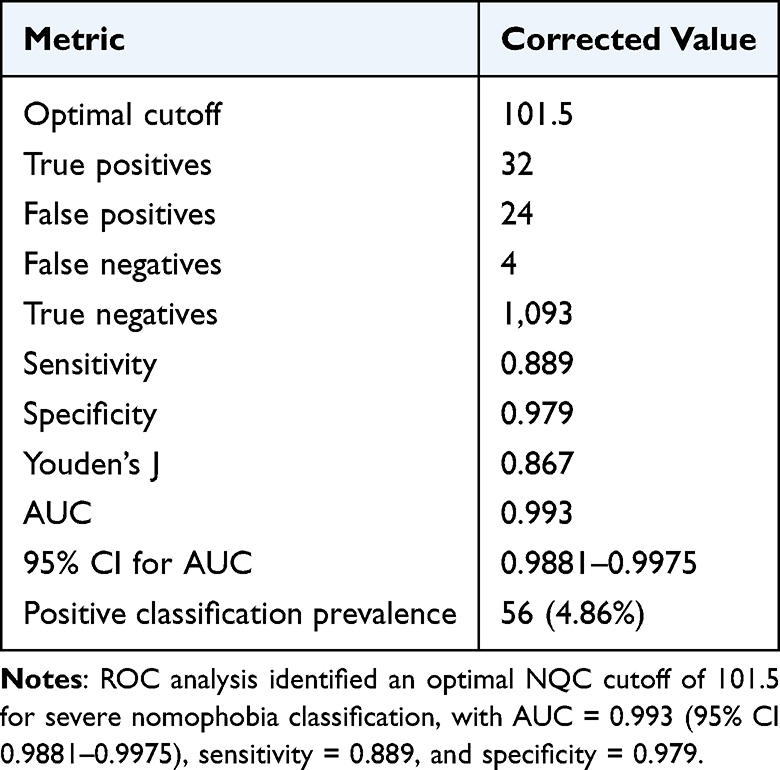 |
Table 3 Optimal Cutoff Value Identified for Classifying Participants into Severe vs Low-to-Moderate Nomophobia |
Page 1889, Table 4 contains several inconsistencies that, taken together, warrant a complete replacement rather than amendment cell by cell. In the published version, the table retains the earlier cutoff (103.5) and the earlier group sizes (1,181 / 52); uses NMP rather than NQC; labels the State Anxiety variable as “State-trait Anxiety Levels”; transposes the Psychological and Social dimensions of nomophobia; reports incorrect effect sizes for the Psychological, Social, and Physiological rows; reverses the sex labels; and refers to odds ratios in a note where Cramer’s V is reported. The table note should refer to Cramer’s V for categorical comparisons.
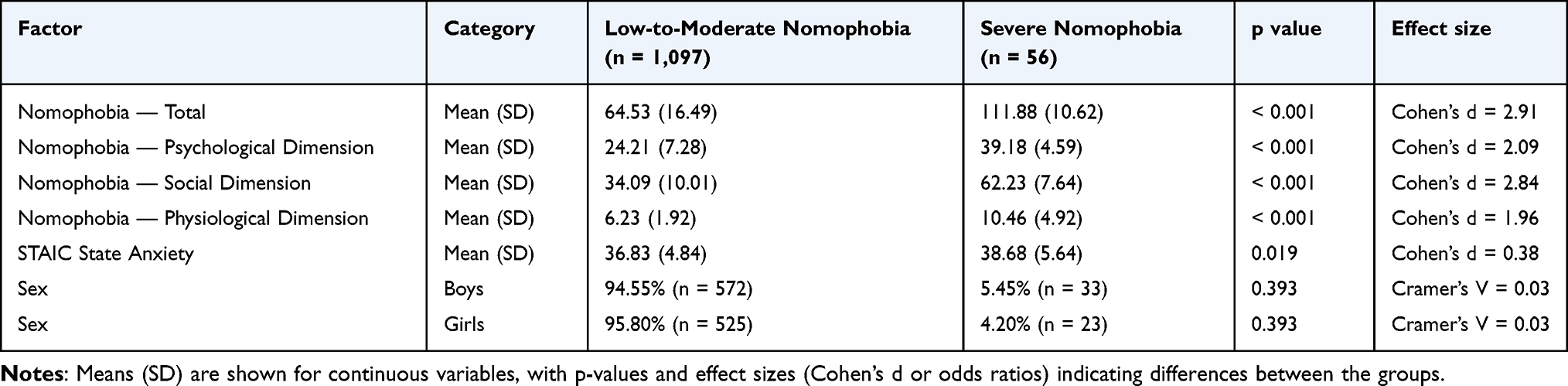 |
Table 4 Group Differences According to ROC-Derived Severe Nomophobia Classification (NQC ≥ 101.5) |
Page 1890, Discussion section, 3rd paragraph, 1st sentence (“4.66% boys vs 5.07% girls, p = 0.671”) does not match the reproducible output and should be replaced by:
The ROC-derived severe nomophobia classification did not differ significantly by sex (Boys: 5.45%, Girls: 4.20%; chi-square p = 0.393; Cramer’s V = 0.03).
The authors regret these reporting errors and apologise for any inconvenience to readers.
 © 2026 The Author(s). This work is published and licensed by Dove Medical Press Limited. The
full terms of this license are available at https://www.dovepress.com/terms
and incorporate the Creative Commons Attribution
- Non Commercial (unported, 4.0) License.
By accessing the work you hereby accept the Terms. Non-commercial uses of the work are permitted
without any further permission from Dove Medical Press Limited, provided the work is properly
attributed. For permission for commercial use of this work, please see paragraphs 4.2 and 5 of our Terms.
© 2026 The Author(s). This work is published and licensed by Dove Medical Press Limited. The
full terms of this license are available at https://www.dovepress.com/terms
and incorporate the Creative Commons Attribution
- Non Commercial (unported, 4.0) License.
By accessing the work you hereby accept the Terms. Non-commercial uses of the work are permitted
without any further permission from Dove Medical Press Limited, provided the work is properly
attributed. For permission for commercial use of this work, please see paragraphs 4.2 and 5 of our Terms.