
Back to Journals » Clinical Ophthalmology » Volume 20
Comparison of Seasonal Variation in Myopia Progression: Defocus Incorporated Multiple Segment Spectacle Lenses in Combination with 0.01% Atropine vs Orthokeratology
Authors Li X  , Zhao C, Yin M, Ji Y , Wang J, Zhang J, Leng L
Received 19 November 2025
Accepted for publication 12 February 2026
Published 20 February 2026 Volume 2026:20 582774
DOI https://doi.org/10.2147/OPTH.S582774
Checked for plagiarism Yes
Review by Single anonymous peer review
Peer reviewer comments 3
Editor who approved publication: Dr Scott Fraser
Xiaoxiao Li,1– 3,* Chenpei Zhao,2– 4,* Min Yin,2– 4 Yanan Ji,1– 3 Jungang Wang,1– 3 Ju Zhang,1– 3 Lin Leng2– 4
1Eye Institute of Shandong First Medical University, Eye Hospital of Shandong First Medical University (Shandong Eye Hospital), Jinan, Shandong, People’s Republic of China; 2State Key Laboratory Cultivation Base, Shandong Key Laboratory of Eye Diseases, Qingdao, Shandong, People’s Republic of China; 3School of Ophthalmology, Shandong First Medical University, Jinan, Shandong, People’s Republic of China; 4Eye Institute of Shandong First Medical University, Qingdao Eye Hospital of Shandong First Medical University, Qingdao, Shandong, People’s Republic of China
*These authors contributed equally to this work
Correspondence: Lin Leng, Eye Institute of Shandong First Medical University, Qingdao Eye Hospital of Shandong First Medical University, No. 5, Yanerdao Road, Qingdao, Shandong, 266071, People’s Republic of China, Tel +86-532-87610198, Email [email protected] Ju Zhang, Eye Institute of Shandong First Medical University, Eye Hospital of Shandong First Medical University (Shandong Eye Hospital), 372 Jingsi Road, Jinan, 250021, People’s Republic of China, Tel +86-531-81276025, Email [email protected]
Purpose: To investigate and compare seasonal variations in axial length (AL) in myopic children with defocus incorporated multiple segments (DIMS) spectacle lenses combined with 0.01% atropine (DIMSA) and orthokeratology (OK) lenses.
Methods: The present retrospective study involved 428 subjects, mean age 9.70 ± 1.94 years, categorized into two groups: DIMSA (203 cases), and OK lenses (225 cases). Data were classified as “summer” or “winter” based on the midpoint of the 6 months between visits. Initial clinical visit (baseline) and one-year follow-up data were collected, and only data from the right eye was retrieved for analysis. Axial elongation over time and between groups was analyzed.
Results: The mean change in AL at 1 year was 0.18 ± 0.19 mm in the DIMSA group and 0.19 ± 0.15 mm in the OK group, with no significance between the two groups (p> 0.05). In both groups, the change of AL in winter was significantly higher than that in summer (P< 0.01). A similar seasonal pattern was found among children 7– 8 years of age in the DIMSA group and 7– 12 years of age in the OK group, as well as for those with an initial AL < 26 mm.
Conclusion: DIMSA and OK lenses show similar reductions in myopia progression at different times of the year. Axial elongation decreased in summer, and this phenomenon disappears with increasing age and AL.
Keywords: axial length, myopia progression, defocus incorporated multiple segment spectacle lenses, orthokeratology, seasonal variations
Introduction
Myopia has become a significant medical and socioeconomic issue, as its prevalence has grown globally in recent decades.1 Globally, and especially in China, myopia is a serious public health issue.2 It is a complex disease that involves both inherited and learned environmental components.3 The progression of myopia causes incremental elongation of the axial length (AL) and related abnormalities in the vitreous, retina, choroid, and optic nerve, culminating in pathological myopia.4,5 Hence, it is important to prevent early-onset myopia from progressing to pathologically high myopia.
For the prevention of myopia, the simplest and most effective method is outdoor activities.6–8 Several approaches can be taken to control myopia with regard to optical correction. This encompasses multifocal design glasses, point diffusion design spectacles, soft lenses for peripheral myopic defocus, and orthokeratology (OK).9–13 The representative drug for controlling myopia is a muscarinic antagonist: atropine. The concentration of 0.01% was proven to be the most effective and least harmful atropine concentration over prolonged follow-up durations.14
Most academic studies agree that myopia progresses faster in the winter. Cui et al found that compared to children who received short exposure to light, myopic children with more outdoor activity had slower rates of myopia progression and AL growth.15 It was found that myopia progressed more slowly in the summer than in the winter, which may be due to increased outdoor activity and reduced near-eye use during the summer months, as well as to the intense rays of the sun in the summer months.16,17
Previous studies have found a 32% to 63% reduction in the progression of AL in the OK group compared to the single-vision spectacle group at the 2-year follow-up,18 which may be higher than the 34% reduction in the DIMS group.19 Huang et al further found a 46% reduction in myopic progression and a 54% reduction in axial growth in children treated with 0.01% atropine combined with DIMS lenses (DIMSA). This result indicated that DIMSA was effective in slowing myopic progression.20 In our previous study, a seasonal variation was found in the myopia control effect of OK lenses.21 This study was made to investigate whether winter and summer exhibit distinct differences in the efficacy of DIMSA and OK lenses for slowing myopia progression. The findings may guide clinical practice by suggesting that additional control measures should be considered during winter months, when myopia progression tends to accelerate.
Methods
Subjects and Examinations
This retrospective cohort study enrolled children who underwent myopia correction at the Eye Hospital of Shandong First Medical University between November 2022 and November 2023, with one-year minimum follow-up. Two groups of 428 children were identified: 203 children in the DIMSA group and 225 in the OK group. Figure 1 illustrates the overall study workflow. The study was approved by the Ethics Committee of the Eye Hospital of Shandong First Medical University (QYLS 2024 No. 38), and all procedures were conducted according to the principles outlined in the Declaration of Helsinki.
 |
Figure 1 Flow diagram of the subject enrollment process. Abbreviations: DIMSA, defocus incorporated multiple segment spectacle lenses combined with 0.01% atropine; OK, orthokeratology. |
Children aged 7–13 years were eligible if they met the following criteria: spherical equivalent refraction (SER) of −0.50 to −6.00 D, astigmatism ≤ −2.50 D, and best-corrected distance visual acuity of 20/20 or better. A stringent visual acuity criterion (better than 20/20) was applied to ensure all participants had excellent baseline optical quality, to reduce outcome variability, and to preclude any potential confounding effect of 0.01% atropine on accommodation and visual performance at baseline. Exclusion criteria included the presence of any ocular pathology, such as refractive error, amblyopia, strabismus, glaucoma, prior ocular surgery, or alternative myopia control therapies.
Routine ophthalmic examinations comprised measurements of refraction and intraocular pressure, slit-lamp microscopy, and direct ophthalmoscopy. Remove OK lenses before the exam. The AL and curvature were assessed six times using the IOL Master 700 (Carl Zeiss Meditec, Jena, Germany), and the mean value was ascertained. Cycloplegia was achieved by administering three drops of tropicamide 1%, each spaced 5 minutes apart. Refractive data for both eyes were recorded 30 minutes after administering the third tropicamide instillation. The Topcon auto refractometer (RM-800; Topcon Corporation, Tokyo, Japan) was used to collect the data, with the mean of five consecutive readings recorded.
The OK group all used Euclid’s lenses with an optical zone of 6.0mm. All OK lens fits are performed by the same practitioner. DIMSA group utilized a bespoke spectacle lens (Hoya Inc., Tokyo, Japan). The lens consists of a center optical zone (9 mm in diameter) designed to rectify distance refractive errors, and an annular multifocal zone with several segments (33 mm in diameter) possessing a relative positive power of +3.50 D.22 With the exception of strenuous activities, the study recommended: subjects should regularly wear lenses for no less than 12 hours per day. During the night, one drop of 0.01% atropine was instilled into each conjunctival sac, followed by applying pressure to the inner canthi for 5 minutes.
Follow-ups were performed at baseline, every 3 months until 1 year. Myopic progression was assessed by analyzing variations in axial length, with data classified as “summer” and “winter” according to the midpoint of the six-month interval between the two follow-ups. The interval between June and August was designated as summer, whereas the interval between December and February was designated as winter. Nevertheless, the varying timing of the two follow-up visits led to discrepancies in the actual duration of each “6-month” interval. To resolve this issue, we divided the axial and corresponding spherical lens findings by the actual number of days in the “6-month” period and multiplied the outcome by 182.5.
Sample Size Calculation
The sample size was calculated using the Tests for PASS (version 15; NCSS, LLC). The sample size was estimated based on previously reported mean and standard deviation of annual AL elongation in DIMSA and OK groups.9 With a significance level of 0.05 and 80% power, 153 participants per group were required. Allowing for a 20% dropout rate, a minimum of 184 subjects per group was targeted. Finally, the DIMSA group included 203 cases, and the OK group, 225 cases.
Statistical Analysis
This analysis focused exclusively on data from the right eye to eliminate any potential correlation issues between the two eyes. Statistical analyses were conducted with SPSS 26.0 (IBM SPSS Statistics 26). The Kolmogorov–Smirnov test was used to test the normality of the data. All characteristics were presented as count (percentages) for categorical variables, and means ± standard deviation (SD) or median (M) (P25, P75) for continuous variables. An independent-sample t-test or paired-sample t-test was conducted to compare differences in normally distributed parameters. The Mann–Whitney U-tests or the Wilcoxon Signed-Rank test was employed for non-normally distributed variables. To control for Type I error inflation due to multiple comparisons, Bonferroni corrections were applied in all subgroup and post hoc analyses. A P value of less than 0.05 was deemed statistically significant.
Results
As shown in Table 1, the total mean age was 9.70 ± 1.94 years, and the initial SER was −2.80 ± 1.54 D. No significant differences in age, gender, initial AL, and initial SER were noted between the DIMSA and OK groups (all P>0.05).
 |
Table 1 Baseline Data of All the Subjects |
Changes in AL and SER
Table 2 displays the modified mean alterations in AL and SER between the two groups. The changes in AL at 1 year were 0.18 ± 0.19 mm in the DIMSA group and 0.19 ± 0.15 mm in the OK group, with no significant difference between the two groups (P > 0.05). In the DIMSA group, the change in AL of 0.12 ± 0.11 mm in winter was significantly higher than that of 0.06 ± 0.11 mm in summer and was statistically different. Similarly, in the OK group, the change in AL was significantly lower in summer (0.06 ± 0.09 mm) than in winter (0.13 ± 0.09 mm) (P<0.01). The Cohen’s d for the OK lens group was 0.80, higher than the Cohen’s d of 0.55 for the DIMSA group. The change in AL revealed no significant difference between the DIMSA and OK groups at the summer or winter follow-up (P > 0.05).
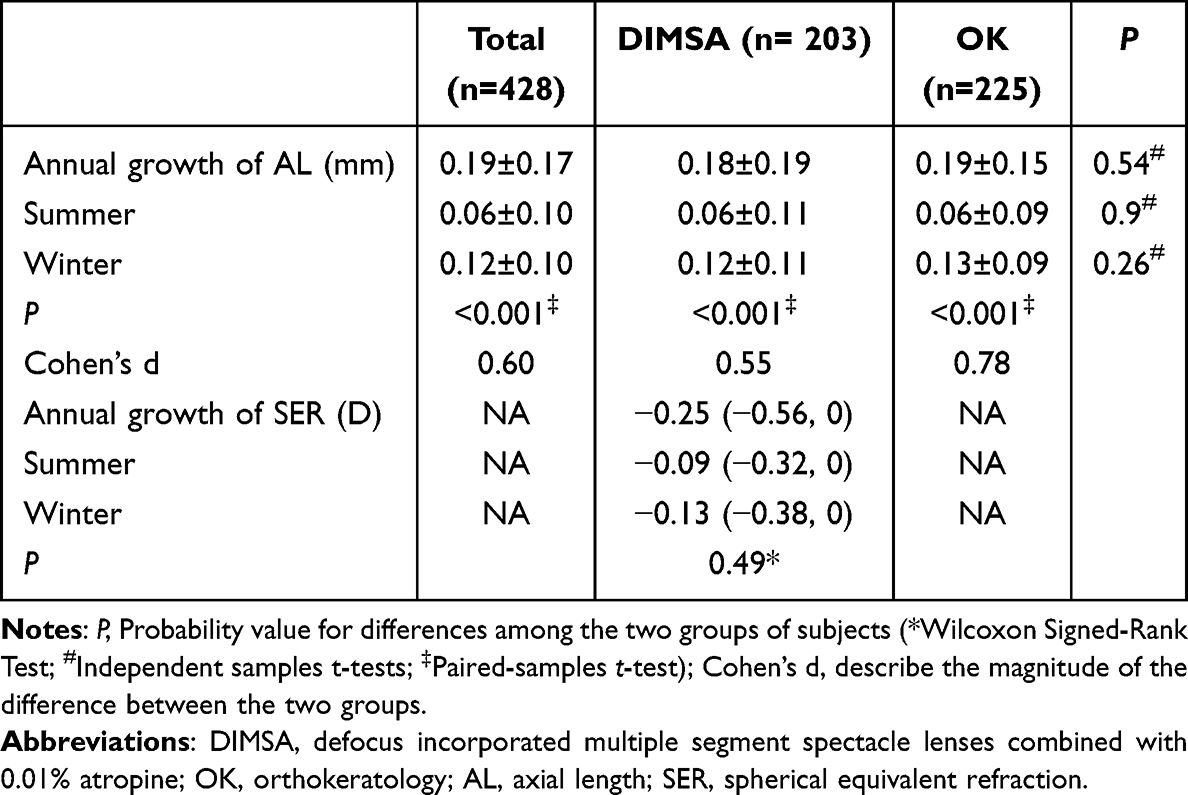 |
Table 2 Seasonal Differences Between the Two Groups in Axial Changes |
At the 1-year follow-up, the median change in SER was −0.25 (−0.56, 0) in the DIMSA group, and no statistically significant change in SER was observed between summer and winter.
Axial Seasonal Progression in Different Age Groups
A statistically significant increase in winter AL was observed in patients aged 7–13 years during winter compared to the summer months (P < 0.05, Table 3). In contrast, no substantial difference was observed in patients aged 13 (P > 0.05). In the DIMSA group, the AL change was significantly faster in winter than in summer among the 7–8-year-old age group (P < 0.05). No significant difference in change was observed in the 9–13-year-old age groups during the summer and winter (P > 0.05). In the OK group, the change in AL was found to be significantly faster in winter than in summer among the 7–12-year-old age group (P < 0.05). No significant change was observed in the 13-year-old age group during summer and winter (P > 0.05).
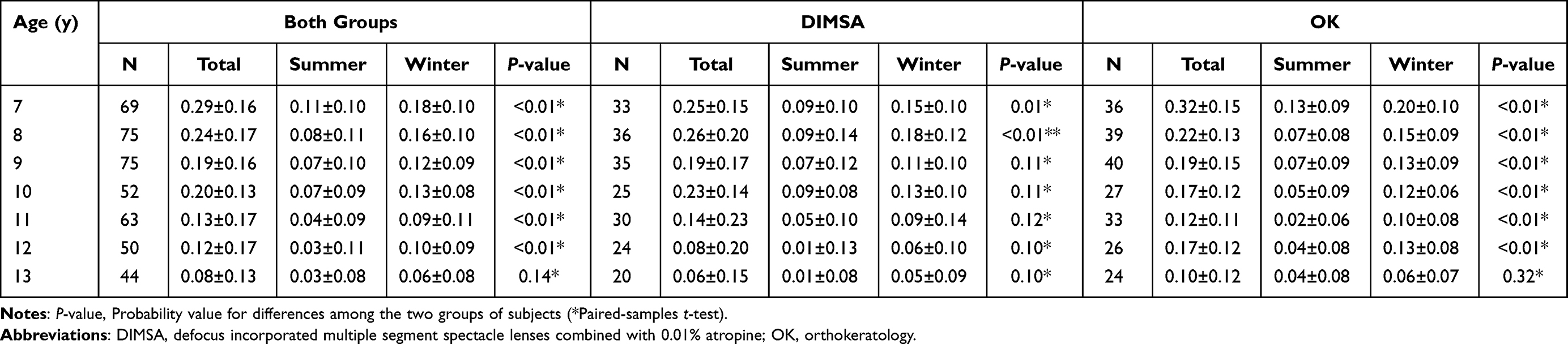 |
Table 3 Axial Seasonal Progression (mm) in the Different Age Groups |
Axial Seasonal Progression in Different Initial AL Groups
The subjects were divided into three groups according to their initial axial length (AL): short AL (SA, < 24 mm), medium AL (MA, ≥ 24 mm and < 26 mm), and long AL (LA, ≥ 26 mm). In the DIMSA group, as well as the OK group, the AL growth rate was significantly higher in winter than in summer when the initial AL was < 26 mm (p < 0.01, Table 4). In addition, seasonal differences in axial progression were no longer significant when the initial AL > 26 mm (P > 0.05, Table 4). Furthermore, in all AL subgroups, AL variation in summer was not statistically different between the DIMSA and OK groups, and likewise in winter. (P > 0.05, Table 4).
 |
Table 4 Axial Seasonal Progression in Different Initial Axial Length (AL) Groups |
Discussion
According to a large body of studies, the evolution of myopia exhibits significant seasonal variations. It has been demonstrated that myopia progresses more quickly in winter and more slowly in summer.23,24 Shandong Province in China is located in the northern hemisphere in latitudes 34°22.9′ and 38°24.01′ N. The four seasons are distinct, and winter and summer have incredibly different climates and daylight hours. This is the first study to examine seasonal variations in the use of DIMS lenses combined with atropine and OK lenses for myopia management in northern China.
The study revealed that the AL increased much more rapidly in winter than in summer, which is consistent with previous studies.25 Seasonal changes still have an impact on the effectiveness of myopia prevention and control, even with the use of prevention and control tools. In the summer, ample sunlight, an increase in the amount of time children spend outside, and an increase in dopamine release all help reduce myopia.26,27 Children in northern China typically attend school from early September of the current year to the winter holidays in January of the following year; however, during the frigid winter months, children’s outside activities are considerably curtailed. The school year then continues in February of the following year and lasts until July for the second term, with the summer holidays marking a considerable rise in outdoor activities and a significant drop in close-eye use. The time most children spend studying indoors and playing outdoors differs substantially between winter and summer. One study discovered that Chinese children living in Sydney (13.5 hours of outdoor activity per week) had a significantly lower prevalence of myopia than Chinese children living in Singapore (3.05 hours of outdoor activity per week), with the amount of time spent outside being the most significant factor associated with the difference in prevalence.27 Longer outdoor activities and less close work are beneficial in lowering myopia in children. These factors may also explain why myopia or axial elongation progresses more slowly in the summer.23,28,29
The present investigation discovered that in the OK group, children aged 7–12 years demonstrated considerably faster axial changes in winter than in summer, and at age 13 years, there was no significant difference in axial changes between winter and summer. With age, AL growth slowed, and myopia control improved. This finding is consistent with earlier research, which has shown a drop in the rate of axial growth with increasing age.21 Furthermore, a negative relationship was shown between beginning age and AL elongation in children who wore OK lenses.30
In the DIMSA group, children in the 7–8-year-old subgroup changed AL substantially faster in winter than in summer; however, there was no significant difference in children aged 9 to 13. This conclusion differed dramatically from that of the OK lenses. Seasonal effects on DIMSA were less pronounced than those in the OK lens group, which were thought to be connected to the use of atropine. The children’s original age was hypothesized to have influenced the 0.01% atropine effect on DIMS lens stacking. Atropine’s mechanism of action is not fully understood, but recent research suggests that it has multiple effects, including reducing AL, remodeling scleral connective tissue, and inhibiting GABA transfer protein (GAT-1) expression in the retina.31 A series of randomized controlled clinical trials in Asian populations (ATOM2)32 suggested that 0.01% atropine eye drops had a favorable delay in myopia progression with minimal adverse effects.9 According to a study conducted by Nickolai,33 choroidal changes between winter and summer are particularly prominent in youngsters aged 7–8 years. The study also discovered that choroidal thickness was linked to increased choroidal blood flow and improved oxygen and nutrient delivery. These modifications subsequently influenced scleral remodeling and growth, which influenced the progression of myopia. In the current study, the difference in AL between winter and summer at 7–8 years of age may be related to the change in choroidal thickness, whereas at 9–13 years of age, the change in choroidal thickness between winter and summer was relatively small and there was a difference in the eye axes but it was not statistically significant.
Tang et al compared the effects of DIMSA and OK lenses on ocular axial control and reported that the AL changes were 0.15 ± 0.15 mm and 0.20 ± 0.12 mm, respectively,34 comparable to the results of the current study (0.18 ± 0.19 and 0.19 ± 0.15 mm, respectively). Besides, there was no statistically significant difference in the control of myopia between the two groups. Huang et al reported that using 0.01% atropine eye drops in conjunction with DIMS treatment resulted in a 54% decrease in AL growth, considerably improving myopia prevention and management.20 Certain children treated with DIMS who were given 0.01% atropine experienced pupil dilatation, increasing the possibility of myopia defocusing entering the eye. This led to an increase in peripheral myopia defocusing and an enhanced peripheral defocusing impact.
In the DIMSA group, there was no statistically significant difference in SER variation between winter and summer −0.09 D (−0.32 D, 0 D) (median winter SER: −0.13D, median summer SER: −0.09 D; p = 0.49). The SER findings are consistent with those of a Japanese study in which children’s SER increased at a slower rate in the summer than in the winter but were not statistically different. Previous papers found that ∆SE/∆AL increased with age from 2.06 D/mm in the 6-year-olds to 2.59 D/mm in the 16-year-olds.35 Although the AL variation was statistically different, a difference of 0.06 mm was not sufficient to cause a change in the SER.29
Additionally, this study consistently revealed no seasonal variations between individuals in the AL ≥26 mm subgroup in both the DMISA and OK groups. This could be because children with long AL are easier to control with DMISA and OK treatments. Studies have consistently shown that highly myopic eyes tend to have a significantly thinner choroid and compromised choroidal circulation than normal eyes.36,37 In children with high myopia, the choroid thins38 and the elasticity of choroidal decreases, with reduced variations between winter and summer. The results were consistent in the DMISA and OK groups, with the possibility that OK lenses could provide more defocus to very myopic participants. In the DMISA group, atropine had an important effect despite the fixed defocus of +3.50D.
Limitations
As a retrospective study, the SER change could not be assessed when using OK lenses; hence, only AL was observed in the OK group. This study considered only the objective effects of the seasons and did not include a subjective questionnaire to investigate daily eye habits, such as time spent outdoors and time spent in close proximity to the eyes. Measurements were not taken at the same time of day, which may introduce potential diurnal variation. However, this random measurement error is unlikely to have systematically biased the comparison between intervention groups. This study collected data for only one year, which necessitates further investigation into long-term usefulness.
Conclusion
The study revealed that both OK lenses and DIMSA showed similar myopia control outcomes. Seasonal effects, better in summer and worse in winter, were observed for AL in both groups.
Data Confidentiality Statement
Participant data were de-identified, securely stored with restricted access, and used solely for research purposes. All published results are presented in aggregated form to ensure complete anonymity.
Data Sharing Statement
Data are available upon reasonable request. It is available from the corresponding author Dr. Leng.
Ethics Approval Statement
The study was approved by the Ethics Committee of the Qingdao Eye Hospital of Shandong First Medical University (QYLS 2024 No. 38) in accordance with the Declaration of Helsinki. The requirement for obtaining additional written informed consent from patients/parents for the retrospective review of medical records was specifically waived by the Ethics Committee.
Funding
There is no funding to report.
Disclosure
Xiaoxiao Li and Chenpei Zhao are co-first authors for this study. The authors declare no potential conflicts of interest with respect to the research, authorship, and/or publication of this article.
References
1. Modjtahedi BS, Ferris FL, Hunter DG, et al. Public health burden and potential interventions for myopia. Ophthalmology. 2018;125(5):628–10. doi:10.1016/j.ophtha.2018.01.033
2. Resnikoff S, Jonas JB, Friedman D, et al. Myopia - A 21st century public health issue. Invest Ophthalmol Vis Sci. 2019;60(3):Mi–Mii. doi:10.1167/iovs.18-25983
3. Morgan IG, French AN, Ashby RS, et al. The epidemics of myopia: aetiology and prevention. Prog Retin Eye Res. 2018;62:134–149. doi:10.1016/j.preteyeres.2017.09.004
4. Tideman JW, Snabel MC, Tedja MS, et al. Association of axial length with risk of uncorrectable visual impairment for europeans with myopia. JAMA Ophthalmol. 2016;134(12):1355–1363. doi:10.1001/jamaophthalmol.2016.4009
5. Morgan IG, Ohno-Matsui K, Saw SM. Myopia. Lancet. 2012;379(9827):1739–1748. doi:10.1016/S0140-6736(12)60272-4
6. French AN, Ashby RS, Morgan IG, et al. Time outdoors and the prevention of myopia. Exp Eye Res. 2013;114:58–68. doi:10.1016/j.exer.2013.04.018
7. Guggenheim JA, Northstone K, McMahon G, et al. Time outdoors and physical activity as predictors of incident myopia in childhood: a prospective cohort study. Invest Ophthalmol Vis Sci. 2012;53(6):2856–2865. doi:10.1167/iovs.11-9091
8. Wu PC, Tsai CL, Wu HL, et al. Outdoor activity during class recess reduces myopia onset and progression in school children. Ophthalmology. 2013;120(5):1080–1085. doi:10.1016/j.ophtha.2012.11.009
9. Song D, Chen Y, Yao J, Chen J. Effectiveness of DIMS combined with atropine and orthokeratology in a real-world setting in China. Cont Lens Anterior Eye. 2025;48(6):102473. doi:10.1016/j.clae.2025.102473
10. Fan Y, Chu H, Peng Z, et al. Real-world outcomes on myopia management efficacy of diverse segmented defocus optics (DSDO) and defocus incorporated multiple segments (DIMS) spectacle lenses in Chinese children: an initial 12-month prospective clinical study. J Optom. 2025;18(1):100533. doi:10.1016/j.optom.2024.100533
11. Lembo A, Schiavetti I, Serafino M, Caputo R, Nucci P. Comparison of the performance of myopia control in European children and adolescents with defocus incorporated multiple segments (DIMS) and highly aspherical lenslets (HAL) spectacles. BMJ Paediatr Open. 2024;8(1):e003187. doi:10.1136/bmjpo-2024-003187
12. Laughton D, Hill JS, McParland M, et al. Control of myopia using diffusion optics spectacle lenses: 4-year results of a multicentre randomised controlled, efficacy and safety study (CYPRESS). BMJ Open Ophthalmol. 2024;9(1):e001790. doi:10.1136/bmjophth-2024-001790
13. Ruiz-Pomeda A, Villa-Collar C. Slowing the progression of myopia in children with the MiSight contact lens: a narrative review of the evidence. Ophthalmol Ther. 2020;9(4):783–795. doi:10.1007/s40123-020-00298-y
14. Chia A, Lu QS, Tan D. Five-year clinical trial on atropine for the treatment of myopia 2: myopia control with atropine 0.01% eyedrops. Ophthalmology. 2016;123(2):391–399. doi:10.1016/j.ophtha.2015.07.004
15. Cui D, Trier K, Munk Ribel-Madsen S. Effect of day length on eye growth, myopia progression, and change of corneal power in myopic children. Ophthalmology. 2013;120(5):1074–1079. doi:10.1016/j.ophtha.2012.10.022
16. Deng L, Gwiazda J, Thorn F. Children’s refractions and visual activities in the school year and summer. Optom Vis Sci. 2010;87(6):406–413. doi:10.1097/OPX.0b013e3181da8a85
17. Thorne HC, Jones KH, Peters SP, et al. Daily and seasonal variation in the spectral composition of light exposure in humans. Chronobiol Int. 2009;26(5):854–866. doi:10.1080/07420520903044315
18. Hiraoka T. Myopia control with orthokeratology: a review. Eye Contact Lens. 2022;48(3):100–104. doi:10.1097/ICL.0000000000000867
19. Choi KY, Chun RKM, Tang WC, et al. Evaluation of an optical defocus treatment for myopia progression among schoolchildren during the COVID-19 pandemic. JAMA Network Open. 2022;5(1):e2143781. doi:10.1001/jamanetworkopen.2021.43781
20. Huang Z, Chen XF, He T, et al. Synergistic effects of defocus-incorporated multiple segments and atropine in slowing the progression of myopia. Sci Rep. 2022;12(1):22311. doi:10.1038/s41598-022-25599-z
21. Ding W, Zhao C, Li X, et al. Seasonal variation in axial elongation in children with orthokeratology treatment. Ophthalmic Physiol Opt. 2025;45(3):877–882. doi:10.1111/opo.13486
22. Lam CSY, Tang WC, Tse DY, et al. Defocus incorporated multiple segments (DIMS) spectacle lenses slow myopia progression: a 2-year randomised clinical trial. Br J Ophthalmol. 2020;104(3):363–368. doi:10.1136/bjophthalmol-2018-313739
23. Fulk GW, Cyert LA, Parker DA. Seasonal variation in myopia progression and ocular elongation. Optom Vis Sci. 2002;79(1):46–51. doi:10.1097/00006324-200201000-00012
24. Gwiazda J, Deng L, Manny R, et al. Seasonal variations in the progression of myopia in children enrolled in the correction of myopia evaluation trial. Invest Ophthalmol Vis Sci. 2014;55(2):752–758. doi:10.1167/iovs.13-13029
25. Tsai DC, Huang N, Fang SY, et al. Seasonal variation of refractive error change among young schoolchildren in a population-based cohort study in Taipei. Br J Ophthalmol. 2019;103(3):343–348. doi:10.1136/bjophthalmol-2017-311642
26. Feldkaemper M, Schaeffel F. An updated view on the role of dopamine in myopia. Exp Eye Res. 2013;114:106–119. doi:10.1016/j.exer.2013.02.007
27. Rose KA, Morgan IG, Smith W, et al. Myopia, lifestyle, and schooling in students of Chinese ethnicity in Singapore and Sydney. Arch Ophthalmol. 2008;126(4):527–530. doi:10.1001/archopht.126.4.527
28. Goss DA, Rainey BB. Relation of childhood myopia progression rates to time of year. J Am Optom Assoc. 1998;69(4):262–266.
29. Fujiwara M, Hasebe S, Nakanishi R, et al. Seasonal variation in myopia progression and axial elongation: an evaluation of Japanese children participating in a myopia control trial. Jpn J Ophthalmol. 2012;56(4):401–406. doi:10.1007/s10384-012-0148-1
30. Lin W, Li N, Lu K, et al. The relationship between baseline axial length and axial elongation in myopic children undergoing orthokeratology. Ophthalmic Physiol Opt. 2023;43(1):122–131. doi:10.1111/opo.13070
31. Upadhyay A, Beuerman RW. Biological mechanisms of atropine control of myopia. Eye Contact Lens. 2020;46(3):129–135. doi:10.1097/ICL.0000000000000677
32. Chia A, Chua WH, Cheung Y-B. Cheung YB, et al.Atropine for the treatment of childhood myopia: safety and efficacy of 0.5%, 0.1%, and 0.01% doses (Atropine for the Treatment of Myopia 2). Ophthalmology. 2012;119(2):347–354. doi:10.1016/j.ophtha.2011.07.031
33. Nilsen NG, Gilson SJ, Lindgren H, et al. Seasonal and annual change in physiological ocular growth of 7- to 11-year-old norwegian children. Invest Ophthalmol Vis Sci. 2023;64(15):10. doi:10.1167/iovs.64.15.10
34. Tang T, Lu Y, Li X, et al. Comparison of the long-term effects of atropine in combination with Orthokeratology and defocus incorporated multiple segment lenses for myopia control in Chinese children and adolescents. Eye. 2024;38(9):1660–1667. doi:10.1038/s41433-024-02987-5
35. Liu S, He X, Wang J, et al. Association between axial length elongation and spherical equivalent progression in Chinese children and adolescents. Ophthalmic Physiol Opt. 2022;42(5):1133–1140. doi:10.1111/opo.13023
36. Nishida Y, Fujiwara T, Imamura Y, Lima LH, Kurosaka D, Spaide RF. Choroidal thickness and visual acuity in highly myopic eyes. Retina. 2012;32(7):1229–1236. doi:10.1097/IAE.0b013e318242b990
37. Fujiwara T, Imamura Y, Margolis R, et al. Enhanced depth imaging optical coherence tomography of the choroid in highly myopic eyes. Am J Ophthalmol. 2009;148(3):445–450. doi:10.1016/j.ajo.2009.04.029
38. Xuan M, Wang D, Xiao O, et al. Choroidal vascularity and axial length elongation in highly myopic children: a 2-year longitudinal investigation. Invest Ophthalmol Vis Sci. 2024;65(10):7. doi:10.1167/iovs.65.10.7
 © 2026 The Author(s). This work is published and licensed by Dove Medical Press Limited. The
full terms of this license are available at https://www.dovepress.com/terms
and incorporate the Creative Commons Attribution
- Non Commercial (unported, 4.0) License.
By accessing the work you hereby accept the Terms. Non-commercial uses of the work are permitted
without any further permission from Dove Medical Press Limited, provided the work is properly
attributed. For permission for commercial use of this work, please see paragraphs 4.2 and 5 of our Terms.
© 2026 The Author(s). This work is published and licensed by Dove Medical Press Limited. The
full terms of this license are available at https://www.dovepress.com/terms
and incorporate the Creative Commons Attribution
- Non Commercial (unported, 4.0) License.
By accessing the work you hereby accept the Terms. Non-commercial uses of the work are permitted
without any further permission from Dove Medical Press Limited, provided the work is properly
attributed. For permission for commercial use of this work, please see paragraphs 4.2 and 5 of our Terms.