
Back to Journals » Clinical Optometry » Volume 18
Comfort and Ocular Surface Impact of Verofilcon A Daily Disposable Contact Lenses in Satisfied Senofilcon A Daily Disposable Lens Wearers: A Prospective Non-Interventional Study
Authors Petelet J, Chhuy E, Auger R, Ollier E, Trone MC
Received 13 December 2025
Accepted for publication 21 March 2026
Published 30 March 2026 Volume 2026:18 588438
DOI https://doi.org/10.2147/OPTO.S588438
Checked for plagiarism Yes
Review by Single anonymous peer review
Peer reviewer comments 2
Editor who approved publication: Prof. Dr. Chris Lievens
Jérémy Petelet,1 Emera Chhuy,1,2 Raphael Auger,1,2 Edouard Ollier,3,4 Marie-Caroline Trone1,5,6
1Ophthalmology Department, University Hospital, Saint-Etienne, France; 2Ophthalmology Department, Gier Hospital, Saint-Chamond, France; 3Clinical Research Unit, University Hospital, Saint-Etienne, France; 4Institut National de la Santé et de la Recherche Médicale (INSERM), Vascular Dysfunction and Hemostasis, Saint-Etienne, U1059, France; 5Corneal Graft Biology, Engineering and Imaging for Ophthalmology Biio, Health Innovation Campus, Faculty of Medicine, Jean Monnet University, Saint-Etienne, EA2521, France; 6Ethics Committee Terre D’éthique, University Hospital, Saint-Etienne, France
Correspondence: Marie-Caroline Trone, Ophthalmology Department, University Hospital, Avenue Albert Raimond Saint-Etienne Cedex1, Saint-Etienne, 42055, France, Tel +33477127793, Fax +33477120549, Email [email protected]
Purpose: To evaluate quality of life, comfort, and vision in long-term satisfied wearers of Senofilcon A daily disposable contact lens (SA) contact lenses after switching to Verofilcon A daily disposable contact lenses (VA), and to assess ocular surface parameters using an objective diagnostic platform C.DIAG (Quantel Medical, a brand of Lumibird, Clermont-Ferrand, France), a multimodal imaging platform for tear film assessment.
Methods: This was a prospective, single-center, non-interventional study including 30 participants aged 20– 40 years, all satisfied SA wearers. After 14 ± 2 days of vA wear, participants completed the CLDEQ-8 questionnaire and rated comfort and vision using a visual analog scale (VAS). Objective ocular surface assessments were performed using C.diag, including non-invasive tear break-up time (NIBUT), interferometry, blink analysis, and tear meniscus height. Statistical analysis was performed using paired Student’s t-tests to compare subjective outcomes before and after the lens switch. Statistical significance was defined as p < 0.05.
Results: The mean CLDEQ-8 score with va was 6.33 ± 2.82, with 56.7% of participants categorised as “excellent.” VAS scores for vision and comfort with va were 87.3 ± 9.4 and 86.6 ± 10.8, respectively. No statistically significant deterioration in tear film parameters was observed after switching lenses (p > 0.05). NIBUT measurements were 11.5 ± 4.4 seconds (od) and 11.8 ± 4.3 seconds (os), with stable interferometry scores and consistent tear meniscus height observed.
Conclusion: VA daily disposable contact lenses provided high levels of subjective comfort and stable objective ocular surface parameters in previously satisfied daily disposable lens wearers. The C.DIAG device enabled standardized and non-invasive tear film analysis during contact lens wear. Further randomized and long-term studies are warranted to confirm these findings.
Keywords: daily disposable contact lenses, verofilcon A, tear film stability, contact lens comfort, CLDEQ-8, objective dry eye assessment
A Letter to the Editor has been published for this article.
Introduction
Background and Literature
Daily contact lenses have gained widespread popularity among patients; however, discomfort remains one of the main reasons for discontinuation.1,2 Contact lens-related dry eye is a significant factor contributing to cessation of lens wear.3 To address this, professionals have a broad selection of materials and geometries available to fit lenses to individual needs. Recent advancements in contact lens technology aim to mitigate prolonged wear discomfort. Premium lenses incorporating innovative materials, such as those featuring a water-gradient design, have been developed to enhance comfort.4 These lenses combine a silicone hydrogel core that optimises oxygen transmission with a highly hydrated outer surface that mimics hydrogel properties. This structure enhances moisture retention and reduces friction on the ocular surface, improving comfort throughout the day particularly for individuals prone to dry eye symptoms. Verofilcon A (VA), the material used in the PRECISION1 contact lens, is a next-generation silicone hydrogel with water gradient technology designed to optimise both oxygen permeability and surface hydration. This material allows high oxygen transmissibility, ensuring adequate corneal oxygenation with excellent comfort even with extended wear.5 These features reduce dryness and irritation, making it particularly beneficial for individuals with sensitive eyes or those requiring prolonged lens wear. By combining high breathability with enhanced biocompatibility, VA represents a significant advancement in contact lens materials, supporting long-term comfort and ocular health.
Unmet Medical Need
There is limited data on the comfort and vision provided by VA among individuals who are satisfied with other daily contact lenses, especially senofilcon A (SA) water-gradient daily disposable contact lenses which are reported in the literature to be associated with high levels of both ocular comfort, relating to lens fit and sensation, and visual satisfaction scores.6 Additionally, slit-lamp ocular surface examinations, commonly used to assess contact lens wearers, remain subjective and prone to variability. In this context, C.DIAG technology may offer a reliable, objective alternative for assessing the ocular surface and tear film in contact lens users. Objective assessment of the tear film remains challenging in routine clinical practice. Conventional slit-lamp evaluation relies largely on subjective grading and may present considerable inter-observer variability. Automated multimodal imaging systems such as the C.DIAG platform provide quantitative measurements of tear film parameters including non-invasive break-up time, lipid layer interferometry and blink dynamics. Although the use of this device in contact lens wearers remains relatively limited in the literature, its automated and standardised measurements offer a promising approach for improving the objectivity and reproducibility of ocular surface evaluation.
Although many contact lens wearers report high levels of satisfaction with their current lenses, clinicians frequently consider switching lens materials to optimise ocular surface physiology or enhance long-term comfort. Evaluating alternative lens materials in already satisfied wearers may reveal subtle differences in tear film stability, ocular surface interaction, and wearer experience that are not always apparent in symptomatic populations. Such comparisons are clinically relevant because contact lens discomfort remains the leading cause of discontinuation despite technological advances in lens design.
Methods
Study Design and Population
This was a non-interventional study involving patients at Saint-Etienne University Hospital. Eligible participants were long-term (≥4 weeks prior to enrollment) users of SA who reported satisfaction with their current contact lenses, defined as a visual analogue scale (VAS) score ≥70/100 for both comfort and vision.7 Inclusion criteria required patients to be aged between 20 and 40 years, to wear contact lenses at least 6 days per week for a minimum of 12 hours per day, and have a best-corrected distance visual acuity (BCDVA) of 20/20 or better. Their spherical refractive error had to be between +4.00D and −6.00D. Exclusion criteria included: astigmatism exceeding ±0.50D (due to the spherical nature of the contact lenses), pregnancy, monocularity, unwillingness to discontinue previous contact lens wear for at least 2 weeks, pre-existing dry eye disease (OSDI ≥13, BUT <5s, Schirmer test <5 mm, corneal fluorescein staining >5 spots), high myopia (refractive error <-6.00D), any ocular condition affecting the ocular surface or contact lens comfort, long-term use of ocular medications, or a history of ocular surgery.
The study was conducted in accordance with the tenets of the Declaration of Helsinki. Patients were all informed of the use of their medical data for scientific and publication purposes by an information sheet. This work was approved by a local ethics committee Terre d’éthique, University Hospital, Saint-Etienne (reference number: IRBN1432024/CHUSTE).
Data Collection
Data were prospectively collected from December 2024 to March 2025. At Visits 1 and 2, baseline characteristics, responses to the OSDI (Ocular Surface Disease Index) and CLDEQ-8 questionnaires, and C.DIAG measurements were recorded by the same investigator for all patients. The Ocular Surface Disease Index (OSDI) questionnaire was used to assess the severity of dry eye symptoms. The OSDI score ranges from 0 to 100, with higher scores indicating greater symptom severity. Scores were classified according to standard categories: 0–12 (normal), 13–22 (mild dry eye), 23–32 (moderate dry eye), and 33–100 (severe dry eye). Quality of life related to contact lens wear was evaluated using the Contact Lens Dry Eye Questionnaire-8 (CLDEQ-8).8–10 This validated questionnaire assesses five symptom domains: ocular discomfort, ocular dryness, fluctuating or blurred vision, eye closure due to discomfort, and contact lens removal. Responses generate a total score ranging from 1 to 37, with lower scores indicating better comfort and quality of life. For the purpose of this study, CLDEQ-8 scores were categorized as follows: Excellent (1–6), Very good (6–9), Good (9–13), Fair (13–17), and Unsatisfied (>17). The questionnaire was completed after at least 2 weeks of wearing VA lenses. Tear film dynamics were assessed using the C.DIAG system, which provides an automated and non-invasive analysis of the tear film and ocular surface using high-resolution multimodal imaging. All measurements were performed in the same examination room under controlled environmental conditions (temperature 21–23°C and humidity 40–50%). To minimise diurnal variability of tear film parameters, examinations were conducted between 9:00 AM and 12:00 PM. The device was calibrated according to the manufacturer’s recommendations before each examination session. This platform offers real-time evaluation of tear film stability, lipid layer thickness, NIBUT, and other parameters critical for diagnosing dry eye disease (DED) and tear film disorders.
Patients attended two visits. The first visit involved verification of inclusion/exclusion criteria, explanation of the study protocol, informed consent, assessment of satisfaction with SA using the VAS, and fitting of VA with verification of proper fit (BCDVA ≥ 20/20). The second visit, occurring after at least 14 ± 2 days of wear, included completion of the CLDEQ-8 questionnaire, assessment of comfort and vision with VA using the VAS, and automated measurements of non-invasive break-up time (NIBUT), interferometry, blink analysis, and tear meniscus height using C.DIAG. Additionally, subjects were asked whether they would continue wearing VA (yes/no).
Objectives and Endpoints
The primary objective was to evaluate the CLDEQ-8 scores with VA after 2 weeks of wear. SA lenses had been worn for at least 4 weeks prior to switching to VA lenses for a further 2 weeks. Secondary endpoints included subjective ratings of comfort and vision using the VAS (0–100). Exploratory endpoints involved objective evaluation of the ocular surface using C.DIAG after 2 weeks of VA wear, including NIBUT, interferometry, blink analysis, and tear meniscus height.
Statistical Analysis
The sample size was calculated to ensure that a one-sided confidence interval width of 3 for the primary endpoint could be achieved with 27 participants. Allowing for a 10% dropout rate, the sample size was adjusted to 30 patients. Statistical analyses were conducted using R software (R Foundation for Statistical Computing, Vienna, Austria). Graphical representations were generated using the ggplot2 package. The study population is described using standard descriptive statistics. Continuous variables were expressed as mean ± standard deviation and categorical variables as percentages. Paired Student’s t-tests were used to compare subjective outcomes obtained before and after the lens switch. To avoid potential inter-eye correlation bias, statistical analyses were performed using data from one randomly selected eye per participant. Statistical significance was defined as p < 0.05. Descriptive statistics were used for exploratory ocular surface parameters.
Results
To avoid potential inter-eye correlation bias, statistical analyses were performed using data from a single randomly selected eye per participant. However, descriptive values for both eyes are reported for completeness.
Baseline Characteristics
Thirty participants were included in the analysis, with a mean age of 27.3 ± 3.2 years; 76.7% were female. Mean spherical correction was −1.88 ± 2.02 D in the right eye and −1.84 ± 2.05 D in the left eye. Visual acuity was 20/19.4 ± 1.5 (OD) and 20/19.2 ± 1.7 (OS). The mean OSDI score was 6.93 ± 3.77, indicating minimal symptoms of dry eye.
Primary Endpoint
The mean CLDEQ-8 score after wearing VA was 6.33 ± 2.82. Based on categorical evaluation, 10.0% of participants were classified as “Good”, 33.3% as “Very Good”, and 56.7% as “Excellent” in the context of VA lens use (Figure 1).
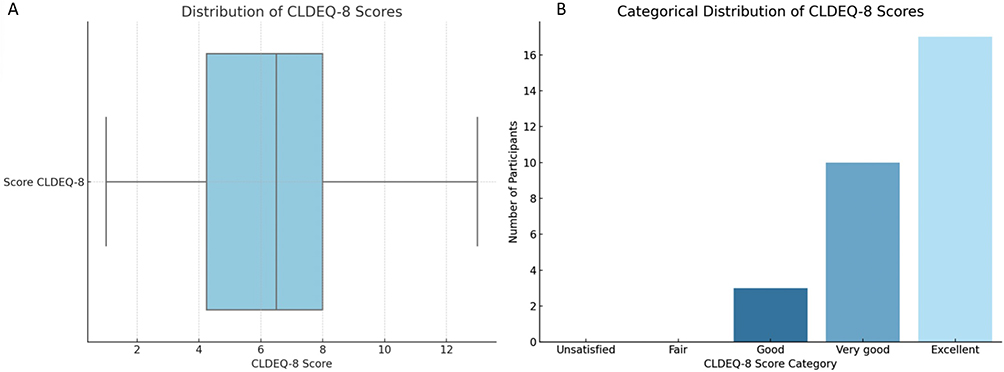 |
Figure 1 CLDEQ-8 scores. (A) numerical distribution. (B) categorial distribution. |
Secondary Endpoints
VAS
VAS scores for comfort and vision recorded with VA were 86.6 ± 10.8 and 87.3 ± 9.4, respectively (Figure 2).
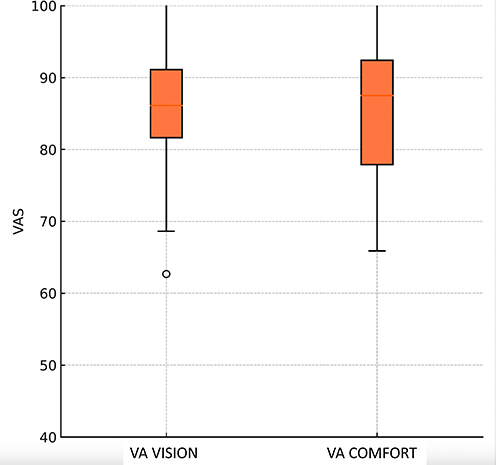 |
Figure 2 VAS scores for verofilcon A (VA) vision and comfort. |
Exploratory Endpoints
Regarding the C.DIAG direct analysis on VA surface, results were as follows: tear film stability, assessed via non-invasive tear break-up time (NIBUT), showed average values of 11.5 ± 4.4 seconds (OD) and 11.8 ± 4.3 seconds (OS). The frequency of blinking was 22.8 ± 14.2 blinks/min (OD) and 20.9 ± 13.1 blinks/min (OS). The uncovered ocular surface area averaged 29.9 ± 13.2 mm2 (OD) and 31.1 ± 15.0 mm2 (OS). Interferometry scores were 76.9 ± 7.1 (OD) and 74.2 ± 10.5 (OS), with corresponding interferometry grades of 4.0 ± 0.2 for both eyes (Figure 3).
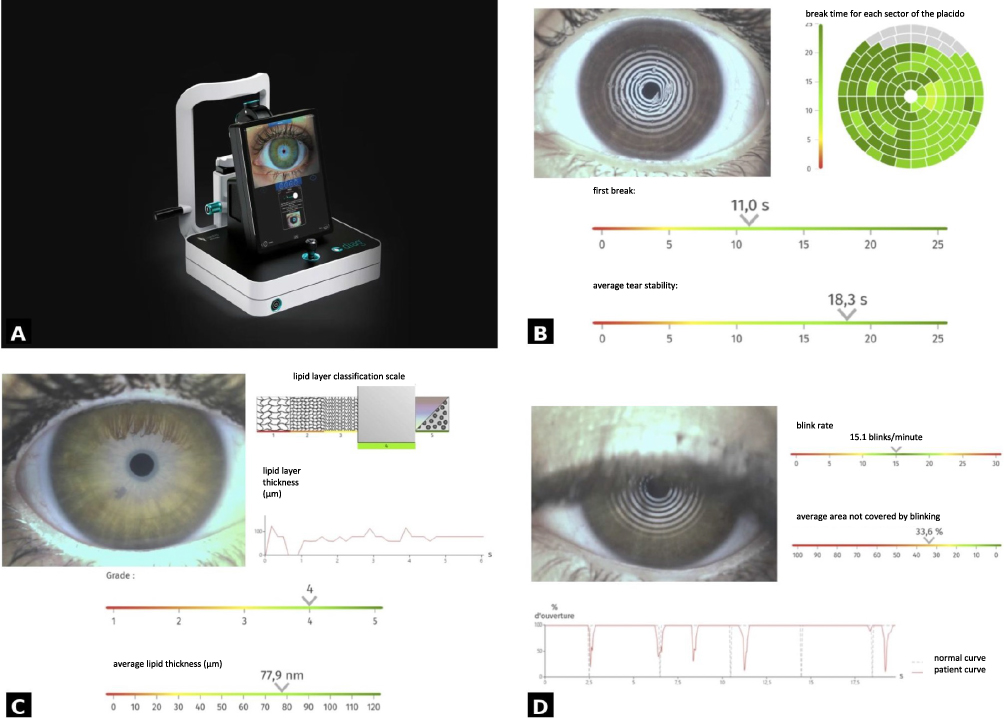 |
Figure 3 C.DIAG platform measurements. (A) The diag device. (B) NIBUT analysis. (C) interferometry. (D) blink analysis. |
Finally, when asked whether they would choose to continue wearing VA, 87% of participants (26/30) responded affirmatively, while 13% (4/30) indicated that they would not opt to continue with VA.
Discussion
The present study suggests that VA wearers reported excellent subjective outcomes, with favourable CLDEQ-8 scores indicating minimal dry eye symptoms. VAS scores for both vision quality and comfort recorded during VA wear indicated high levels of user satisfaction.
Objective ocular surface parameters measured with C.DIAG, including NIBUT, were considered within normal ranges, further supporting the hypothesis that these contact lenses do not exacerbate dry eye symptoms, likely due to their advanced material properties.
Our findings are consistent with existing literature on verofilcon A daily disposable contact lenses. Previous research has similarly reported high levels of wearer comfort, stable visual acuity, and minimal dry eye symptoms associated with this lens material, even under challenging conditions such as prolonged face mask usage11 or extended screen exposure.12 Notably, improvements in ocular surface comfort and tear film stability have been documented both subjectively and objectively, including enhanced NIBUT values.13–15 In our study, user satisfaction and tear film performance metrics closely aligned with prior data on smart-surface silicone hydrogel lenses.16 Collectively, these observations support the high biocompatibility of verofilcon A contact lenses, their ability to preserve tear film stability, and their protective role in maintaining ocular surface health.
This study is the first to investigate tear film analysis using C.DIAG directly on contact lenses, enabling a straightforward, automated, and reliable evaluation of lens wearers. By providing objective data on tear film stability and quality, C.DIAG emerges as a promising tool for clinical assessment in contact lens practice. Such objective measurements are essential, given that ocular discomfort remains the leading cause of contact lens discontinuation. The ability to monitor tear film behaviour in situ on the lens surface represents a significant advancement in improving patient outcomes and guiding lens selection and design. Although the C.DIAG platform has not yet been extensively validated specifically in contact lens wearers, automated tear film imaging systems have demonstrated good repeatability and reliability in ocular surface assessment. The automated nature of these measurements reduces operator-dependent variability and allows more objective monitoring of tear film dynamics. In this context, the use of C.DIAG in the present study should be considered exploratory but promising for future research applications.
A previous study17 evaluated the impact of three daily disposable contact lenses (nesofilcon A, delefilcon A, stenfilcon A) on tear film parameters, specifically tear meniscus height (TMH), tear osmolarity (TO), and non-invasive break-up time (NIBUT). Results demonstrated a significant decrease in TMH after at least eight hours of lens wear, as well as a significant reduction in NIBUT. No significant changes were observed in TO for any of the lenses. Another investigation18 explored contact lens-related discomfort and dry eye syndrome. While no statistically significant association was found between contact lens use and the diagnosis of dry eye, there was a trend towards higher OSDI scores among wearers, with a reported mean of 37.8.
Our study was non-interventional and conducted on a limited number of patients, which imposes several limitations. The study cohort consisted exclusively of young (aged 20 to 37), healthy participants without ocular comorbidities, which may limit the generalisability of the findings to the broader population of contact lens wearers, particularly those with pre-existing ocular surface disorders or adaptation challenges. Age-related changes in tear film quality and ocular anatomy may influence comfort and lens tolerance in older individuals. Furthermore, the predominance of female participants (76.7%) may introduce gender bias, as women may exhibit distinct patterns of contact lens discomfort due to hormonal influences19 or behavioral differences, including greater adherence to hygiene practices.20 The relatively short follow-up period (two weeks) allowed assessment of early comfort after switching lenses. This early period is clinically relevant, as the first days or weeks of lens wear are often decisive in determining whether patients continue or discontinue a new contact lens. Finally, the absence of longitudinal follow-up precludes evaluation of long-term comfort, vision stability, and tolerance in susceptible individuals. This study was supported by an investigator-initiated research grant from Alcon. The sponsor had no role in the study design, data analysis, or manuscript preparation.
Conclusion
Verofilcon A daily disposable contact lenses demonstrated high levels of wearer satisfaction and stable tear film parameters in previously satisfied senofilcon A daily disposable lens wearers. Objective tear film evaluation using the C.DIAG platform provided additional insight into tear film behaviour during contact lens wear. However, the non-randomised design, limited sample size and short follow-up period warrant cautious interpretation of the findings. Future randomised controlled studies with longer follow-up are needed to confirm the clinical relevance of these observations.
Funding
This research was supported by Alcon IIT #94207615.
Disclosure
The authors declare that they have no conflicts of interest related to this study. No financial or personal relationships could inappropriately influence or bias the content of this manuscript. The research was conducted independently, and the findings presented in this article reflect the objective analysis of the data.
References
1. Nichols KK, Redfern RL, Jacob JT, et al. The TFOS international workshop on contact lens discomfort: report of the definition and classification subcommittee. Invest Ophthalmol Vis Sci. 2013;54(11):TFOS14–7. doi:10.1167/iovs.13-13074
2. Alipour F, Khaheshi S, Soleimanzadeh M, Heidarzadeh S, Heydarzadeh S. Contact lens-related complications: a review. J Ophthalmic Vis Res. 2017;12(2):193–204. doi:10.4103/jovr.jovr_159_16
3. Stapleton F, Alves M, Bunya VY, et al. TFOS DEWS II Epidemiology Report. Ocul Surf. 2017;15(3):334–365. doi:10.1016/j.jtos.2017.05.003
4. Ponzini E, Recchioni A, Cheloni R, Zeri F, Tavazzi S. Physical properties and interaction with the ocular surface of water-gradient contact lenses. Eye Contact Lens. 2023;49(4):152–159. doi:10.1097/ICL.0000000000000974
5. Miller J, Giedd B, Subbaraman LN. Clinical comparison of a silicone hydrogel and a conventional hydrogel daily disposable contact lens. Clin Ophthalmol Auckl NZ. 2021;15:4339–4345. doi:10.2147/OPTH.S332651
6. Buch JR, Martin P, Xu J. Comfort advantages demonstrated with a novel soft contact lens: a randomized clinical trial. Heliyon. 2024;10(21):e39995. doi:10.1016/j.heliyon.2024.e39995
7. Diec J, Naduvilath T, Tilia D. Subjective ratings and satisfaction in contact lens wear. Optom Vis Sci off Publ Am Acad Optom. 2018;95(3):256–263. doi:10.1097/OPX.0000000000001187
8. Chalmers RL, Begley C, Moody K. Contact lens dry eye questionnaire-8 (CLDEQ-8): use of an 8-item habitual symptom score to reflect change in overall opinion on contact lens performance. Invest Ophthalmol Vis Sci. 2009;50(13):6337.
9. Chalmers RL, Begley CG, Moody K, Hickson-Curran SB. Contact lens dry eye questionnaire-8 (CLDEQ-8) and opinion of contact lens performance. Optom Vis Sci off Publ Am Acad Optom. 2012;89(10):1435–1442. doi:10.1097/OPX.0b013e318269c90d
10. Lortie-Milner É, Boily L, Michaud L, et al. Translation and validation of the contact lens dry eye questionnaire 8 (CLDEQ-8) in Canadian French. Contact Lens Anterior Eye J Br Contact Lens Assoc. 2023;46(2):101779. doi:10.1016/j.clae.2022.101779
11. Penbe A, Kanar HS, Donmez Gun R. Comparison of the pre-lens tear film stability and visual performance of a novel and two other daily disposable contact lenses in healthcare professionals wearing facial masks for prolonged time. Clin Optom. 2022;14:183–192. doi:10.2147/OPTO.S384246
12. Schulze MM, Fadel D, Luensmann D, et al. Evaluating the performance of verofilcon a daily disposable contact lenses in a group of heavy digital device users. Clin Ophthalmol Auckl NZ. 2023;17:3165–3176. doi:10.2147/OPTH.S429250
13. Fernández-Jimenez E, Diz-Arias E, Peral A. Improving ocular surface comfort in contact lens wearers. Contact Lens Anterior Eye J Br Contact Lens Assoc. 2022;45(3):101544. doi:10.1016/j.clae.2021.101544
14. Mimura T, Noma H, Yamaguchi M, Shinbo K. Comparison of comfort and tear stability with two novel silicone-hydrogel daily disposable contact lenses. Int Ophthalmol. 2024;44(1):136. doi:10.1007/s10792-024-03075-z
15. Misu N, Mimura T, Noma H, Shinbo K. Patient satisfaction and tear film break-up time after first-time wearing of silicone hydrogel contact lenses. Cureus. 2024;16(1):e52516. doi:10.7759/cureus.52516
16. Grant T, Tang A. A survey of contact lens wearers and eye care professionals on satisfaction with a new smart-surface silicone hydrogel daily disposable contact lens. Clin Optom. 2020;12:9–15. doi:10.2147/OPTO.S233328
17. Montani G, Martino M. Tear film characteristics during wear of daily disposable contact lenses. Clin Ophthalmol Auckl NZ. 2020;14:1521–1531. doi:10.2147/OPTH.S242422
18. Almutairi AH, Alalawi BS, Badr GH, Alawaz RA, Albarry M, Elbadawy HM. Prevalence of dry eye syndrome in association with the use of contact lenses in Saudi Arabia. BMC Ophthalmol. 2021;21(1):147. doi:10.1186/s12886-021-01912-8
19. The menstrual cycle and vision: the eye is a gender specific and hormonally sensitive target organ. JMVH. Available from: https://jmvh.org/article/the-menstrual-cycle-and-vision-the-eye-is-a-gender-specific-and-hormonally-sensitive-target-organ/.
20. Albasheer O, Gosadi IM, Abuallut I, et al. Awareness and hygiene practices among contact lens wearers: a population-based cross-sectional survey. Cureus. 2024;16(2):e54723. doi:10.7759/cureus.54723
 © 2026 The Author(s). This work is published and licensed by Dove Medical Press Limited. The
full terms of this license are available at https://www.dovepress.com/terms
and incorporate the Creative Commons Attribution
- Non Commercial (unported, 4.0) License.
By accessing the work you hereby accept the Terms. Non-commercial uses of the work are permitted
without any further permission from Dove Medical Press Limited, provided the work is properly
attributed. For permission for commercial use of this work, please see paragraphs 4.2 and 5 of our Terms.
© 2026 The Author(s). This work is published and licensed by Dove Medical Press Limited. The
full terms of this license are available at https://www.dovepress.com/terms
and incorporate the Creative Commons Attribution
- Non Commercial (unported, 4.0) License.
By accessing the work you hereby accept the Terms. Non-commercial uses of the work are permitted
without any further permission from Dove Medical Press Limited, provided the work is properly
attributed. For permission for commercial use of this work, please see paragraphs 4.2 and 5 of our Terms.