
Back to Journals » Clinical Ophthalmology » Volume 19

Clinical Outcomes of Selective Laser Trabeculoplasty in Thai Glaucoma Patients Across Initial, Adjunctive, and Replacement Therapy
Authors Rojananuangnit K  , Tavonvunchai F, Kreesang R
Received 18 September 2025
Accepted for publication 24 November 2025
Published 3 December 2025 Volume 2025:19 Pages 4397—4412
DOI https://doi.org/10.2147/OPTH.S568406
Checked for plagiarism Yes
Review by Single anonymous peer review
Peer reviewer comments 2
Editor who approved publication: Dr Scott Fraser
Kulawan Rojananuangnit, Fahsiri Tavonvunchai, Rinrada Kreesang
Department of Ophthalmology, Mettapracharak (Wat Rai Khing) Hospital, Nakhon Pathom, Thailand
Correspondence: Kulawan Rojananuangnit, Department of Ophthalmology, Mettapracharak (Wat Rai Khing) Hospital, 52 Moo 2 Rai Khing Sam Pran, Nakhon Pathom, 73210, Thailand, Email [email protected]
Purpose: To evaluate the outcomes of selective laser trabeculoplasty (SLT) in Thai glaucoma patients across three treatment groups–initial, adjunctive, and replacement therapy–and to identify predictors of treatment response and durability.
Methods: This retrospective study included glaucoma patients who underwent SLT and were classified into initial, adjunctive, and replacement therapy groups. Treatment durability was analyzed using Kaplan–Meier survival methods. Predictors of non-response and shortened effects were identified using multivariable logistic regression and Cox proportional hazards models.
Results: A total of 254 eyes from 123 patients were included: 76 eyes in the initial group, 117 in adjunctive therapy, and 61 in replacement therapy. Overall, 61.1% of eyes achieved a laser response, with significant variation among groups (initial 78.9%, replacement 68.9%, adjunctive 45.3%; p < 0.001). The mean effective duration of SLT was 1.5 years, with cumulative success of 67.2% at 1 year and 14.7% at 3 years, without significant intergroup differences (p = 0.448). Retreatment with SLT was associated with a reduced risk of non-response (adjusted OR = 0.328, p= 0.023). Independent predictors of non-response included higher baseline IOP (adjusted OR = 1.118, p = 0.004), greater number of medications (adjusted OR = 1.371, p = 0.013), and acetazolamide use (adjusted OR = 5.531, p = 0.033). Shortened treatment effect within 1 year was predicted by older age (adjusted HR = 1.029, p = 0.002), higher baseline IOP (adjusted HR = 1.070; p = 0.001), and greater number of medications (adjusted HR = 1.179, p= 0.036).
Conclusion: SLT is effective and repeatable in Thai patients, particularly as initial or replacement therapy. While adjunctive therapy provides some benefit, patients with higher baseline IOP, heavier medication burden are more likely to experience non-response or shortened efficacy. Individualized selection and timely retreatment may optimize outcomes.
Plain Language Summary: Glaucoma is a disease that can lead to vision loss if not treated. It is usually treated by lowering eye pressure using topical glaucoma eye drop, laser treatment, or surgery. Selective laser trabeculoplasty (SLT) is a laser treatment that helps reduce eye pressure by improving fluid drainage from the eye. It can be used as the first treatment, alongside medications, or as a replacement when medications are insufficient or intolerant.
This study looked at the effectiveness of SLT in Thai patients with glaucoma. We reviewed records from 123 patients (254 eyes). Overall, about 61.1% of eyes responded to the laser treatment, with the highest success in patients receiving SLT as their first treatment. On average, the treatment worked for around 1.5 years.
We also found factors that affected treatment success. Patients who received a second SLT treatment were more likely to respond successfully. Higher eye pressure, current use of more medications, and older age were linked to a lower chance of good response or shorter duration of effect.
In summary, SLT is a safe, effective, and repeatable treatment for Thai glaucoma patients, especially when used as the first or replacement therapy. Considering each patient’s age, eye pressure, and medication burden can help doctors choose the best timing for treatment and retreatment to achieve optimal results.
Keywords: retreatment, medication burden, asian, efficacy, predictive factor
Introduction
Glaucoma management includes medications, laser therapy, and surgery. Selective Laser Trabeculoplasty (SLT) has emerged as a primary treatment option comparable to topical medications.1–3 SLT is effective and safe, although its effects may not be permanent, the procedure can be repeated. Prior studies have demonstrated that patients undergoing SLT experience slower disease progression and are less likely to require glaucoma surgery compared with those managed with topical therapy.4,5 Beyond its use as initial therapy, SLT is indicated for patients intolerant to medications and as adjunctive therapy in progressive disease.6 However, response rates vary by etiology and ethnicity, with limited data available in Asian populations and in advanced-stage disease.4,5,7 Thus, evaluating the effectiveness of SLT in Thai patients is important to inform its role in clinical practice. This study assessed SLT outcomes in three treatment groups: (1) initial treatment, (2) adjunctive therapy, and (3) replacement therapy, aiming to clarify SLT’s role in glaucoma management among Asian patients.
Methods
This retrospective cohort study was conducted to evaluate the outcomes of SLT in glaucoma patients in accordance with the Declaration of Helsinki and approved by the Mettapracharak (Wat Rai Khing) Research Ethics Committee, following the International Conference on Harmonization of Good Clinical Practice (ICH-GCP) guidelines (COA019/2567). Informed consent was waived by the ethics committee, as all data were anonymized and maintained in strict confidentiality.
The study includes patients who received laser treatment by KR, a glaucoma specialist, during the period from January 1, 2020, to December 31, 2023. The SLT procedure was performed over 360° of the trabecular meshwork, with approximately 100 laser spots per eye, using titrated energy averaging 0.8 millijoule. Medical records of patients who underwent SLT were retrospectively reviewed and categorized into three groups according to their treatment history. SLT was offered as a treatment option in all three groups, and patients elected to proceed with the procedure following a shared decision-making process that reflected individualized clinical considerations.
Group 1 – initial treatment group: patients who have never received glaucoma treatment and will use SLT as their first therapy.
Group 2 – adjunctive therapy group: patients on medication requiring additional SLT.
Group 3 –replacement therapy group: patients unable to use eye drops and switch to SLT.
The outcome of laser treatment was evaluated at 8 weeks post laser treatment. Responder definitions were defined by group as follows: initial treatment: ≥20% IOP reduction or achievement of stage-specific target IOP and based on individual patient characteristics, adjunctive therapy: ≥20% IOP reduction or achievement of target IOP with same/fewer medications, replacement therapy: discontinuation of medications or IOP maintained within 2 mmHg of pre-laser medicated baseline, non-responders showed no change of IOP or number of medication.
The effect of laser treatment was evaluated every 6 months and classified as either a laser effect or non-effect, based on clinical judgment, which was defined as achieving target IOP and/or maintaining functional or structural stability. Retreatment with SLT was considered in laser responders whose IOP-lowering effect had waned over time and was performed over 360° of the trabecular meshwork.Data will be extracted from the patients’ medical records, included demographics, best-corrected visual acuity (BCVA), intraocular pressure (Corneal-Compensated Intraocular Pressure; IOPcc, Goldmann-correlated intraocular pressure; IOPg), corneal hysteresis (CH), visual field parameters (visual field index; VFI, mean deviation; MD), optical coherence tomography of retinal nerve fiber layer thickness (OCT RNFL), lens status, glaucoma staging (assessed by Hodapp–Parrish–Anderson criteria based on visual field loss), medication use, and comorbidities.
Statistical Analysis
Descriptive statistics were applied. Continuous variables were expressed as mean ± standard deviation (SD) and compared using ANOVA or Wilcoxon rank-sum tests, as appropriate. Categorical variables were analyzed using Chi-square or Fisher’s exact tests. Logistic regression was performed to identify predictors of SLT response. Kaplan–Meier survival analysis was used to estimate cumulative success rates over time, and Cox proportional hazards regression was employed to examine factors associated with treatment failure. Generalized estimating equations (GEE) were applied to account for within-subject correlation when both eyes from the same patient were included. Multivariate models were constructed using backward stepwise selection (Likelihood Ratio) for both the GEE analysis and Cox regression. All analyses were conducted using SPSS version 28, with statistical significance set at p < 0.05.
Results
Baseline Characteristics
A total of 123 participants (254 eyes) were included 34 patients in the initial treatment group (76 eyes), 58 in the adjunctive therapy group (117 eyes), and 31 in the replacement therapy group (61 eyes).
The mean age was 66.0 ± 12.6 years, with significant differences across groups (p < 0.001). The initial group was youngest (59.7 ± 12.6) and the adjunctive group oldest (69.8 ± 11.1). Gender distribution also varied (p = 0.020), with more females in the initial group (61.8%) and more males in the adjunctive group (65.5%).
Baseline BCVA was best in the initial group (0.13 ± 0.23 logMAR, p < 0.001). Mean baseline IOPcc was highest in the adjunctive group (20.85 ± 7.36 mmHg) and lowest in the replacement group (16.51 ± 3.85 mmHg, p < 0.001). CH was highest in the initial group (9.43 ± 2.00) and lowest in the adjunctive group (8.09 ± 2.07, p < 0.001).
Most patients had primary open-angle glaucoma (POAG, 75.0%), followed by ocular hypertension (OHT, 14.4%), primary angle closure glaucoma (PACG, who had previously undergone cataract extraction, 4.7%,), pseudoexfoliation glaucoma and pigmentary glaucoma (PXG/PDG, 4.3%) and secondary glaucoma (1.6%). OHT was most common in the initial group (35.9%), while severe glaucoma was most common in the adjunctive group (52.5%). Lens status, ocular surgery history, and medication burden differed significantly across groups (all p < 0.001). Essential hypertension (45.5%) and dyslipidemia (22.8%) were the most frequent co morbidities (Table 1).
 |
Table 1 Demographic and Baseline Ocular Characteristics of Study Participants Stratified by Selective Laser Trabeculoplasty Treatment Group (Initial, Adjunctive, and Replacement Therapy) |
SLT Treatment Outcome
Overall, 61.1% of patients achieved a laser response. The proportion of laser responders was highest in the initial treatment group (78.9%), followed by the replacement group (68.9%) and the adjunctive therapy group (45.3%) (p < 0.001). Among eyes receiving initial SLT treatment (76 eyes, 34 participants), 80.6% responded after the first session and 71.4% after the second session. The difference in response rates between the first and second treatments was not statistically significant, p = 0.476. For eyes receiving adjunctive therapy (117 eyes, 58 participants), the proportion of responders was 42.9% after the first treatment and 53.8% after the second treatment, with no significant difference, p = 0.375. Similarly, in the replacement therapy group (61 eyes, 31 participants), 69.1% responded after the first session and 66.7% after the second session, showing no statistically significant change, p = 1.0.
When stratified by etiology, within the initial treatment group, response rates were highest for a small number of patients with PXG/PDG (100%) and POAG (83.3%), and lowest for PACG (66.7%) and secondary glaucoma (50%). The within group difference was not statistically significant (p = 0.406). In the adjunctive therapy group, a small number of secondary glaucoma and PXG/PDG had a significantly poor laser response rate by 0% and 25.0%, respectively compared with other etiologies (p = 0.007). In the replacement group, POAG had the highest response at 74.0%, with no statistically significant difference among etiologies (p = 0.658).
The effect of post-laser medication on treatment response was also evaluated. Patients receiving topical corticosteroids (fluorometholone/fluorometholone acetate 0.1%/Dexametasone) showed significant variability, with the initial treatment group demonstrating the highest responder rate (87.5%), compared with adjunctive therapy (35.1%) and replacement therapy (67.9%) (p < 0.001), consistent with the overall treatment outcomes. In contrast, the use of topical corticosteroids combined with ripasudil hydrochloride hydrate, ripasudil hydrochloride hydrate alone, or Nepafenac did not demonstrate statistically significant differences among groups (p = 0.589, 0.251, and N/A, respectively). When comparing overall outcomes between treatment groups stratified by post-laser medications, no statistically significant differences were observed (p = 0.055, 0.299, and 0.946) (Table 2).
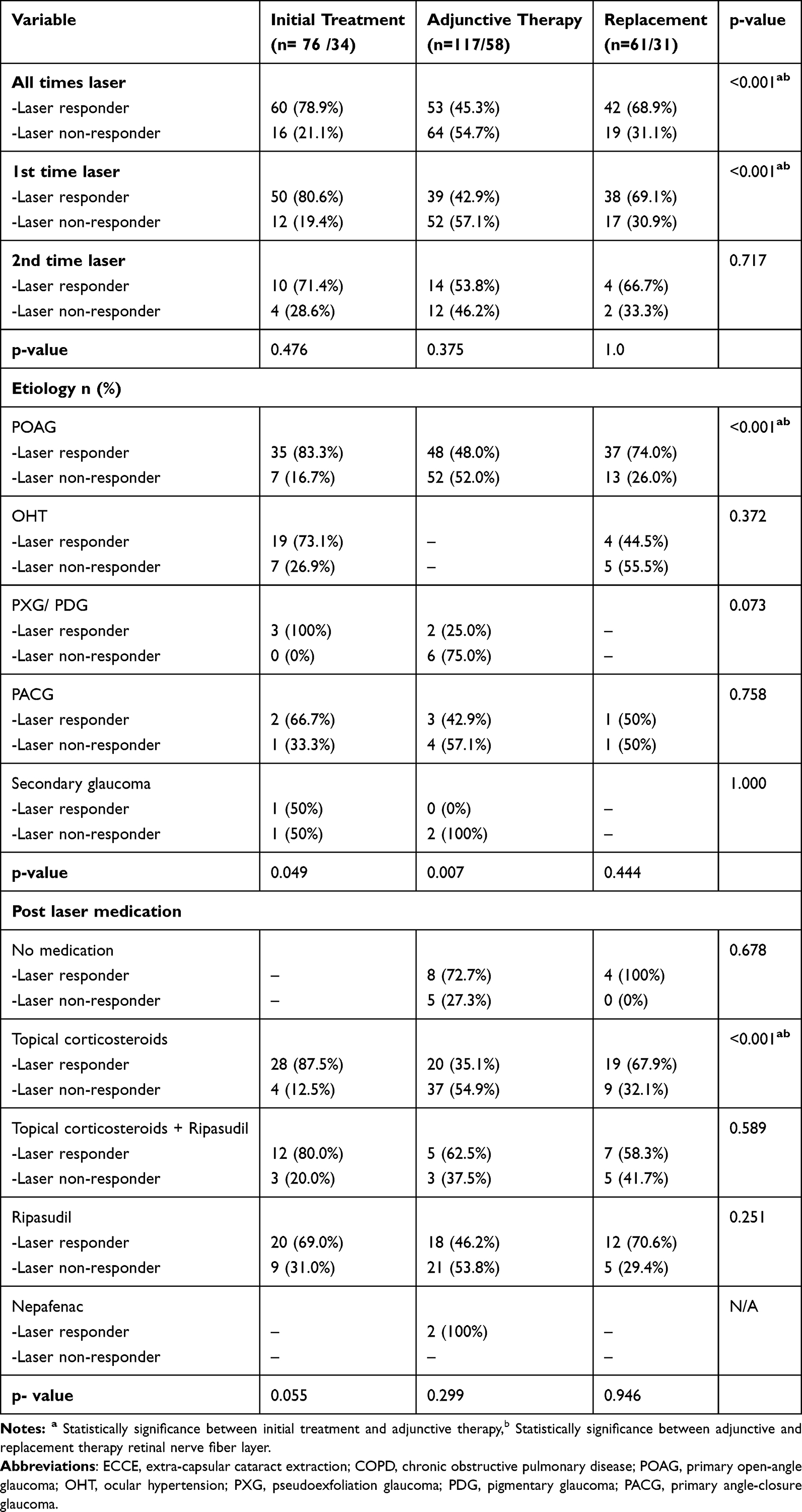 |
Table 2 Selective Laser Trabeculoplasty Treatment Outcome |
The impact of laser treatment on IOPg, IOPcc, corneal hysteresis, and glaucoma medication use at 8 weeks was stratified by treatment type and laser response. In the initial treatment group, laser responders demonstrated significant reductions in both IOPg (18.78 ± 4.65 to 16.03 ± 3.67 mmHg; mean change −2.75 ± 4.07, −14.6%; p < 0.001) and IOPcc (18.33 ± 4.60 to 15.47 ± 2.73 mmHg; mean change −2.86 ± 3.88, −15.6%; p < 0.001), accompanied by an increase in corneal hysteresis (9.65 ± 1.60 to 10.23 ± 1.46; mean change 0.58 ± 1.10, 6.0%; p = 0.003). In contrast, non-responders showed no significant changes in IOPg, IOPcc, or corneal hysteresis.
In the adjunctive therapy group, responders achieved significant reductions in IOPg (18.16 ± 5.12 to 14.12 ± 3.50 mmHg; mean change −4.04 ± 4.81, −19.1%; p < 0.001) and IOPcc (20.00 ± 5.81 to 15.96 ± 4.87 mmHg; mean change −4.03 ± 5.70, −17.6%; p = 0.002). Corneal hysteresis showed a nonsignificant upward trend (mean change 0.94 ± 2.55; p = 0.078). Medication use decreased from 2.49 ± 1.16 to 2.29 ± 1.25 (mean change −0.20 ± 0.90, −8.0%; p = 0.173). By contrast, non-responders experienced mild increases in IOPcc (10.4%, p = 0.049) with unchanged medication use.
In the replacement therapy group, responders achieved stable IOP (IOPg: 14.15 ± 3.77 to 14.62 ± 3.09; mean change 0.46 ± 3.06; p = 0.349 and IOPcc: 15.11 ± 3.05 to 15.25 ± 2.66; mean change 0.14 ± 3.37; p = 0.824) with a significant reduction in medications (−100%, p < 0.001). Non-responders had notable IOP elevation (mean change IOPg 19.1%, p = 0.011) with no meaningful change in corneal hysteresis and minimal reduction in medications.
Overall, responders in the initial and adjunctive groups achieved the most consistent IOP reductions, while those in the replacement group derived benefit primarily through medication reduction or discontinuation (Table 3).
 |
Table 3 Laser Outcome Among Initial, Adjunctive and Replacement Therapy Groups |
The cumulative success of SLT was analyzed using Kaplan–Meier survival curves for all treatment groups. The proportion of eyes maintaining treatment success was 76.2% at 0.5 year, 67.2% at 1.0 year, 53.4% at 1.5 years, 28.7% at 2.0 years, 19.6% at 2.5 years, and 14.7% at 3.0 years. When stratified by treatment type, initial treatment showed a cumulative success of 85.3% at 0.5 year, 76.0% at 1.0 year, 69.7% at 1.5 years, 29.4% at 2.0 years, 12.4% at 2.5 years, and 12.4% at 3.0 years. For adjunctive therapy, cumulative success was 68.6%, 62.2%, 49.2%, 25.5%, 21.2%, and 14.8% at the corresponding time points, while replacement therapy demonstrated 79.6%, 66.0%, 44.0%, 36.0%, 12.0%, and 12.0%. No statistically significant difference in cumulative success was observed among the three treatment groups (p = 0.448, Log rank test) (Figure 1).
 |
Figure 1 Cumulative success of selective laser trabeculoplasty in eyes receiving initial treatment, adjunctive therapy and replacement therapy. |
Structural and Functional Ocular Parameters
At baseline, there were no significant differences between the laser effect and non-effect groups across structural and functional ocular parameters, except for lower baseline BCVA and higher IOP in the non-effect group compared with laser effect. At 3 years, eyes with sustained SLT effect maintained significantly lower IOPg and IOPcc compared with non-effect eyes (p < 0.001), along with higher corneal hysteresis at several time points. Visual function was better preserved in the effect group. Medication burden was significantly reduced, whereas non-effect eyes required more agents during follow-up. OCT RNFL thickness remained relatively stable in the effect group but showed progressive thinning in non-effect eyes (Figure 2 and Table 4).
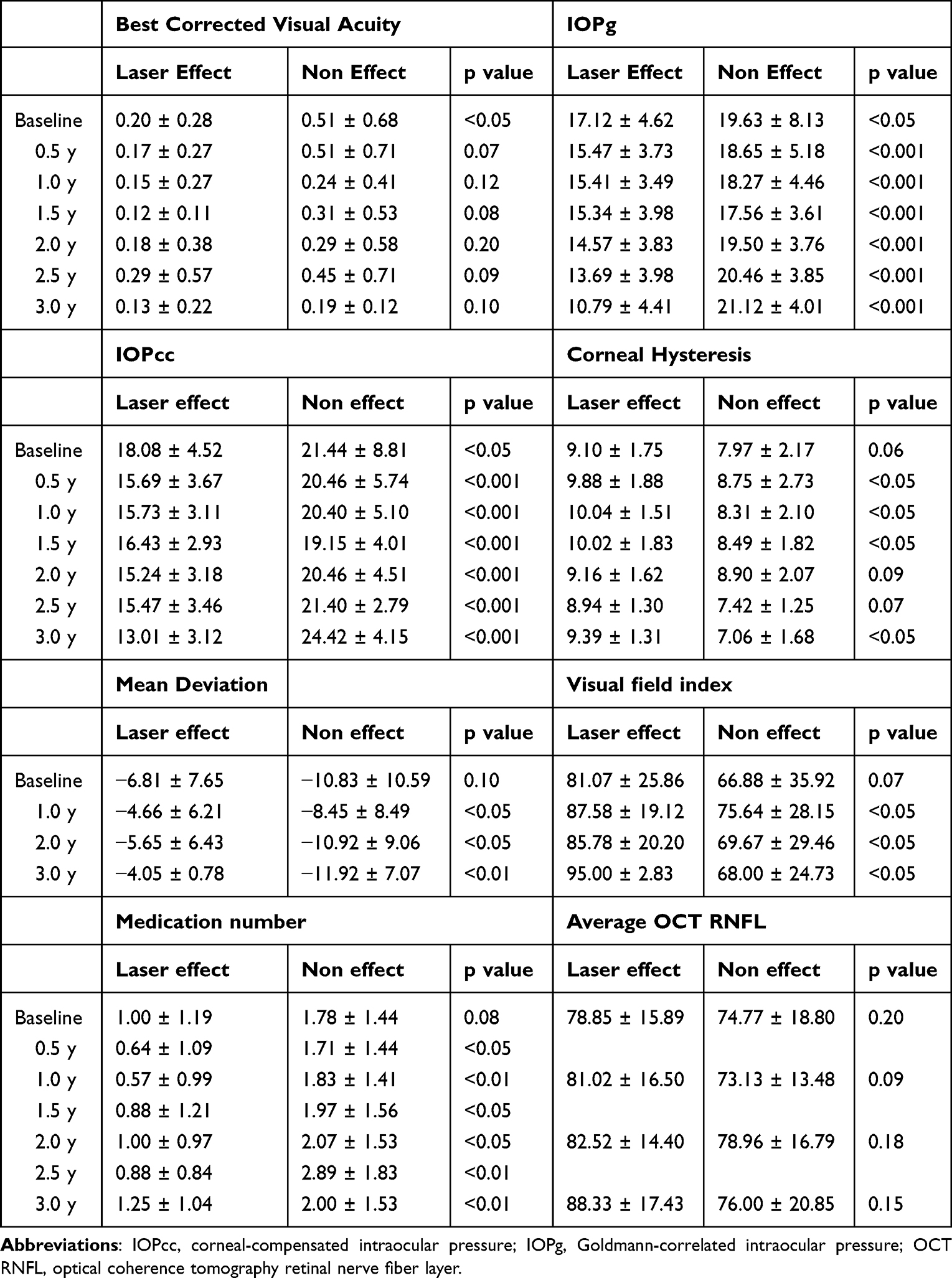 |
Table 4 Structural and Functional Ocular Parameters Comparison Between Laser Effect and Laser Non- Effect Groups |
 |
Figure 2 Comparison of intraocular pressure and number of glaucoma medications between eyes with sustained laser effect and those without. |
Predictors of Treatment Response and Durability
Univariable and multivariable analyses identified factors associated with laser non-response. Retreatment with SLT at the second session was associated with a reduced risk (adjusted OR = 0.328; 95% CI: 0.126–0.858; p = 0.023). In univariable analysis, adjunctive and replacement treatments showed higher risks compared with initial treatment (OR = 9.89; 95% CI: 2.409–40.61; p = 0.001 and OR = 8.52; 95% CI: 1.247–58.24; p = 0.029, respectively), but these associations were no longer significant after adjustment, suggesting potential confounding. Independent predictors of non-response in the multivariable model included higher IOPg (adjusted OR = 1.118; 95% CI: 1.037–1.206; p = 0.004), greater number of anti-glaucoma medications (adjusted OR = 1.371; 95% CI: 1.069–1.757; p = 0.013), and use of acetazolamide (adjusted OR = 5.531; 95% CI: 1.146–26.70; p = 0.033). Other variables, including sex, glaucoma stage, corneal hysteresis, lens status, and baseline visual acuity, were not significantly associated with treatment response. These findings suggest that clinical management factors, rather than demographic or baseline ocular characteristics, are the primary determinants of SLT non-response (Tables 5).
 |
Table 5 Univariate and Multivariate Analysis of Factors Associated with Laser Non-Responder |
In univariable analysis, several factors were significantly associated with shortened laser effect within 1 year, including adjunctive treatment, pseudo exfoliation and pigmentary glaucoma in etiology, prior phacoemulsification with pseudophakia lens status, cerebrovascular disease co morbidity, severe glaucoma stage, poor baseline BCVA, higher IOPg and IOPcc, lower corneal hysteresis, and use of timolol, carbonic anhydrase inhibitors, and brimonidine. However, in the multivariable model, only three variables remained independent predictors: advancing age (adjusted HR = 1.029; 95% CI: 1.011–1.047; p = 0.002), higher baseline IOPg (adjusted HR = 1.070; 95% CI: 1.028–1.113; p = 0.001), and greater number of anti-glaucoma medications (adjusted HR = 1.179; 95% CI: 1.011–1.376; p = 0.036) (Tables 6).
 |
Table 6 Univariate and Multivariate Analysis of Factors Associated with Shortened Laser Effect |
Discussion
This study evaluated the outcomes of SLT among Thai glaucoma patients across three treatment groups: initial, adjunctive, and replacement therapy. Overall, 61.1% of eyes achieved a laser response, with the highest efficacy observed in treatment-naïve eyes. These findings reinforce prior evidence that SLT is effective as a first-line therapy for controlling IOP and delaying the need for glaucoma medications.4,5,8
Treatment response was defined as the achievement of a stage-specific target IOP based on individual patient characteristics, reflecting real-world clinical practice. The target IOP reduction was determined according to disease severity—approximately 20% for ocular hypertension and 20–30% for early to severe stages of glaucoma—in accordance with guideline-based individualized management. This personalized approach is consistent with the concept highlighted in the Laser in Glaucoma and Ocular Hypertension (LiGHT) study, which demonstrated that achieving individualized, stage-specific IOP targets leads to better disease control.4,5
Retreatment with SLT preserved efficacy, with no significant reduction in response rates between the first and second sessions. This finding is consistent with previous reports by Hong BK et al and Garg A. et al,which demonstrated that SLT can be safely and effectively repeated, supporting its role in long-term glaucoma management.9,10 Importantly, our multivariable analysis found that retreatment was associated with a reduced risk of non-response, suggesting that repeated SLT remains a viable option for patients who initially respond but later experience diminished effect.11 These results highlight the importance of patient selection and treatment timing. For treatment-naïve patients, SLT may serve as an optimal initial strategy, while in patients already on medication, SLT remains a valuable adjunct or replacement option. Furthermore, the preserved efficacy with retreatment provides reassurance for its long-term utility, particularly in populations such as Thai patients, where adherence to medical therapy may be challenging due to accessibility barriers and healthcare system overcrowding.
The therapeutic effect of SLT generally emerges within 4–6 weeks following treatment. As postoperative medications were administered only during the first month, evaluating treatment outcomes at 8 weeks allowed for assessment of the laser effect while minimizing potential confounding from postoperative medication use.
In the initial treatment group, most patients presented with baseline IOP values below 21 mmHg, similar to the 56% reported by Yang et al, reflecting the glaucoma epidemiology in Asia.7,12,13 As a result, the mean IOP reduction in our study was lower than generally expected. This finding is consistent with the 15% reduction reported by Lee JW et al and Yang Y. et al, who also demonstrated a smaller IOP-lowering effect of SLT in eyes with relatively low baseline IOP.14–16 By contrast, in eyes with higher pre-treatment IOP, SLT more often achieved ≥20% reduction, reflecting the pressure-dependent effect of SLT.17 Importantly, in our result, initial responders also demonstrated a significant increase in corneal hysteresis (CH), supporting prior evidence that eyes with higher CH are less likely to experience glaucoma progression independent of IOP levels.18,19 This suggests that SLT may not only lower IOP but also enhance ocular biomechanical properties as Takagi K. reported in normal tension glaucomatous patients, providing additional protection to the optic nerve.20 Responders in this group maintained stable IOP, preserved visual function, and reduced medication burden, highlighting SLT’s role in early-stage disease.Responders maintained stable IOP, preserved visual function, and reduced medication burden, highlighting SLT’s role in early-stage disease.
In the adjunctive therapy group, laser response rate was lower than 87.1% reported by Zhu J. et al.21 Clinical management factors, rather than demographic or ocular structural parameters, were the main predictors of outcome. Specifically, higher baseline IOP, greater number of glaucoma medications, and oral acetazolamide use were independently associated with poorer response. These findings suggest that patients requiring multiple therapies may represent more advanced disease with reduced trabecular outflow reserve, limiting SLT efficacy. Although baseline CH did not predict treatment response in this group, responders exhibited a numerical increase in CH (+0.94 mmHg), indicating a possible trend toward improved biomechanical damping capacity despite limited statistical significance. This observation aligns with report by Takagi K. et al that increasing CH was found in SLT treatment in normal tension glaucoma.20 In contrast, other baseline ocular characteristics such as sex, lens status, and glaucoma stage were not predictive of response, underscoring that treatment burden and disease severity outweigh structural factors in determining outcomes.
Importantly, in the replacement therapy group, patients unable to use topical medications demonstrated clinically meaningful benefits, primarily through medication discontinuation while maintaining target IOP. Response rates were slightly lower than initial therapy but remained substantial, indicating SLT as a safe and repeatable alternative for patients with poor adherence or intolerance to topical therapy. CH changes in this group were minimal and paralleled the lack of significant IOP reduction. Nevertheless, the ability to maintain IOP control without medication supports SLT as an important treatment strategy in this challenging subgroup.
The Kaplan–Meier analysis showed progressive decline in cumulative success, with only 14.7% of eyes maintaining efficacy at 3 years. The mean effective duration of SLT was 1.5 years, consistent with previous reports.11,22,23 This finding supports the practical need for scheduling repeat SLT to sustain long-term IOP control. Patients who retained laser efficacy demonstrated durable benefits, including stable IOP, preserved visual function, and reduced medication requirements, underscoring the value of SLT in lowering treatment burden. Shortened laser effect was particularly evident in the adjunctive therapy group, consistent with the findings of Zhu J et al, who reported cumulative success rates under 50% at 1 year.21 In our result, advancing age, higher baseline IOP, and greater number of medications were associated with reduced durability.
When stratified by glaucoma subtype, outcomes were most favorable in primary open-angle glaucoma, while pseudoexfoliation and pigmentary glaucoma showed lower response rates, consistent with prior studies reporting variable efficacy by etiology.3,24–26 A small subset of PACG patients had previously undergone cataract extraction to restore angle opening, after which SLT was applied as a treatment option.27 Additionally, a limited number of secondary glaucoma cases following pars plana vitrectomy were included.
Similarly, the adjunctive group consistently had the poorest outcomes, reflecting the difficulty of achieving additional IOP lowering in eyes already on maximal topical therapy. Laser parameters, including power, degree, and cumulative dose, did not significantly affect outcomes, as also reported by Zhang H. et al.28
The role of post-laser medications in modulating SLT response remains uncertain. Our patients treated with topical corticosteroids demonstrated response patterns that mirrored their treatment context, with the highest responder rate observed in the initial treatment group and lower rates in adjunctive and replacement settings. By contrast, the addition of Ripasudil, either alone or in combination with topical corticosteroids, and the use of Nepafenac did not significantly influence treatment outcomes. Moreover, when outcomes were compared across treatment groups stratified by medication regimen, no significant differences were detected. These findings suggest that post-laser medications may not independently alter SLT efficacy, and variability in response likely reflects the underlying disease context rather than adjunctive pharmacologic modulation, similar with prior report by De Keyser et al.29 This contrasts with Miranda J et al, who reported higher survival rates at 12 months in patients receiving 1% prednisolone acetate, and Sylvia L et al, who found greater short-term IOP reduction at 12 weeks with post-laser topical corticosteroids or NSAIDs compared with placebo.30,31
Our findings have several implications for routine glaucoma care. First, SLT should be considered as an initial therapy in newly diagnosed glaucoma patients and replacement therapy, particularly those in the pre-glaucoma to early disease stage who require approximately 20% IOP reduction as their therapeutic target. Second, repeated SLT remains effective. Given that the durability of laser effect in our report lasted for an average of 1.5 years, incorporating scheduled retreatment may be a practical strategy to maintain long-term IOP control. Third, in the adjunctive group, patients already on a heavier medication burden or requiring systemic carbonic anhydrase inhibitors appear less likely to benefit from SLT. In these cases, earlier consideration of glaucoma surgery may be warranted.
This study has limitations. Its retrospective, single-center design may restrict generalizability, and follow-up beyond 3 years was limited. Additionally, medication adherence and subtle functional progression may not have been fully captured. Nonetheless, this represents one of the large SLT outcome studies in a Thai population across multiple treatment groups. Comprehensive multivariable analyses identified clinical predictors of both non-response and reduced durability.
Conclusion
In summary, SLT demonstrated favorable outcomes in Thai patients, particularly when applied as first-line therapy or replacement therapy, with efficacy preserved upon retreatment. As adjunctive therapy, patients with a high medication burden or acetazolamide use showed less benefit, suggesting surgical options may be more appropriate in this subgroup. Overall, these findings support SLT as an effective and repeatable treatment strategy in glaucoma care, emphasizing the need for individualized patient selection in glaucoma care.
Acknowledgments
The authors would like to thank Mr.Nattakun Nantiard and Mrs.Sathita Wimonchaijit for their valuable support and contributions to this study.
Disclosure
The authors report no conflicts of interest in this work.
References
1. Nitta K, Sugihara K, Narita A, et al. Efficacy and safety of first-line or second-line selective laser trabeculoplasty for normal-tension glaucoma: a multicentre cohort study. BMJ Open Ophthalmol. 2024;9(1). doi:10.1136/bmjophth-2023-001563
2. Glaucoma: diagnosis and management. London: National Institute for Health and Care Excellence (NICE). (NICE Guideline, No. 81.) Available from: https://www.ncbi.nlm.nih.gov/books/NBK579558/.
3. Ang M, Tham CC, Sng CCA. Selective laser trabeculoplasty as the primary treatment for open angle glaucoma: time for change?. Eye. 2020;34(5):789–791. doi:10.1038/s41433-019-0625-6
4. Gazzard G, Konstantakopoulou E, Garway-Heath D, et al. Selective laser trabeculoplasty versus eye drops for first-line treatment of ocular hypertension and glaucoma (LiGHT): a multicentre randomised controlled trial. Lancet. 2019;393(10180):1505–1516. doi:10.1016/S0140-6736(18)32213-X
5. Gazzard G, Konstantakopoulou E, Garway-Heath D, et al. Laser in Glaucoma and Ocular Hypertension (LiGHT) trial: six-year results of primary selective laser trabeculoplasty versus eye drops for the treatment of glaucoma and ocular hypertension. Ophthalmology. 2023;130(2):139–151. doi:10.1016/j.ophtha.2022.09.009
6. De Keyser M, De Belder M, De Belder J, De Groot V. Selective laser trabeculoplasty as replacement therapy in medically controlled glaucoma patients. Acta Ophthalmol. 2018;96(5):e577–e581. doi:10.1111/aos.13509
7. Yang Y, Zhang X, Chen Z, et al. Intraocular pressure and diurnal fluctuation of open-angle glaucoma and ocular hypertension: a baseline report from the LiGHT China trial cohort. Br J Ophthalmol. 2023;107(6):823–827. doi:10.1136/bjophthalmol-2021-320128
8. Chi SC, Kang YN, Hwang DK, Liu CJ. Selective laser trabeculoplasty versus medication for open-angle glaucoma: systematic review and meta-analysis of randomised clinical trials. Br J Ophthalmol. 2020;104(11):1500–1507. doi:10.1136/bjophthalmol-2019-315613
9. Hong BK, Winer JC, Martone JF, Wand M, Altman B, Shields B. Repeat selective laser trabeculoplasty. J Glaucoma. 2009;18(3):180–183. doi:10.1097/IJG.0b013e31817eee0b
10. Garg A, Vickerstaff V, Nathwani N, et al. Efficacy of repeat selective laser trabeculoplasty in medication-naive open-angle glaucoma and ocular hypertension during the light trial. Ophthalmology. 2020;127(4):467–476. doi:10.1016/j.ophtha.2019.10.023
11. Ayala M, Chen E. Long-Term Outcomes of Selective Laser Trabeculoplasty (SLT) Treatment. Open Ophthalmol J. 2011;5:32–34. doi:10.2174/1874364101105010032
12. Jenchitr W, Hanutsaha P, Iamsirithaworn S, Parnrat U, Choosri P. The national survey of blindness low vision and visual impairment in Thailand 2006--2007. Thai J Pub Hlth Ophthalmol. 2007;21(1):10.
13. H-k C, Kee C. Population-based glaucoma prevalence studies in Asians. Survey of Ophthalmol. 2014;59(4):434–447. doi:10.1016/j.survophthal.2013.09.003
14. Lee JWY, Shum JJW, Chan JCH, Lai JSM. Two-year clinical results after selective laser trabeculoplasty for normal tension glaucoma. Medicine. 2015;94(24):e984. doi:10.1097/md.0000000000000984
15. Lee JW, Ho WL, Chan JC, Lai JS. Efficacy of selective laser trabeculoplasty for normal tension glaucoma: 1 year results. BMC Ophthalmol. 15:1. doi:10.1186/1471-2415-15-1
16. Yang Y, Xu K, Chen Z, et al. Responsiveness to selective laser trabeculoplasty in open-angle glaucoma and ocular hypertension. JAMA Ophthalmol. 2024;142(10):918–924. doi:10.1001/jamaophthalmol.2024.3133
17. Fahy ET, Montesano G, Garg A, et al. The impact of baseline intraocular pressure on initial treatment response in the light trial: selective laser trabeculoplasty versus medication. Ophthalmology. 2024;131(12):1366–1376. doi:10.1016/j.ophtha.2024.06.022
18. Medeiros FA, Meira-Freitas D, Lisboa R, Kuang TM, Zangwill LM, Weinreb RN. Corneal hysteresis as a risk factor for glaucoma progression: a prospective longitudinal study. Ophthalmology. 2013;120(8):1533–1540. doi:10.1016/j.ophtha.2013.01.032
19. Sit AJ, Chen TC, Takusagawa HL, et al. Corneal hysteresis for the diagnosis of glaucoma and assessment of progression risk: a report by the american academy of ophthalmology. Ophthalmology. 2023;130(4):433–442. doi:10.1016/j.ophtha.2022.11.009
20. Takagi K, Nitta K, Katai M, Tanito M. Effect of first-line and second-line selective laser trabeculoplasty on corneal hysteresis in patients with normal tension glaucoma: a multicenter study. Graefes Arch Clin Exp Ophthalmol. 2025;263(6):1743–1745. doi:10.1007/s00417-024-06735-z
21. Zhu J, Guo J. Selective laser trabeculoplasty as adjunctive treatment for open-angle glaucoma vs following incisional glaucoma surgery in Chinese eyes. World J Clin Cases. 2023;11(4):780–787. doi:10.12998/wjcc.v11.i4.780
22. Khouri AS, Lari HB, Berezina TL, Maltzman B, Fechtner RD. Long term efficacy of repeat selective laser trabeculoplasty. J Ophthalmic Vis Res. 2014;9(4):444–448. doi:10.4103/2008-322x.150814
23. Funarunart P, Treesit I. Outcome after selective laser trabeculoplasty for glaucoma treatment in a Thai population. Clin Ophthalmol. 2021;15:1193–1200. doi:10.2147/opth.S300621
24. Kent SS, Hutnik CML, Birt CM, et al. A randomized clinical trial of selective laser trabeculoplasty versus argon laser trabeculoplasty in patients with pseudoexfoliation. J Glaucoma. 2015;24(5):344–347. doi:10.1097/IJG.0b013e31829e55e4
25. Wong MOM, Lee JWY, Choy BNK, Chan JCH, Lai JSM. Systematic review and meta-analysis on the efficacy of selective laser trabeculoplasty in open-angle glaucoma. Survey of Ophthalmol. 2015;60(1):36–50. doi:10.1016/j.survophthal.2014.06.006
26. Ang GS, Fenwick EK, Constantinou M, et al. Selective laser trabeculoplasty versus topical medication as initial glaucoma treatment: the glaucoma initial treatment study randomised clinical trial. Br J Ophthalmol. 2020;104(6):813. doi:10.1136/bjophthalmol-2018-313396
27. Wongwuticomjon T, Chansangpetch S, Inobhas A, Tantisevi V. Efficacy of selective laser trabeculoplasty in primary angle-closure glaucoma after peripheral iridotomy. J Curr Glaucoma Pract. 2022;16(2):124–127. doi:10.5005/jp-journals-10078-1377
28. Zhang H, Yang Y, Xu J, Yu M. prospective randomized study of selective laser trabeculoplasty (SLT) as a replacement for medical therapy in primary open-angle glaucoma]. Zhonghua Yan Ke Za Zhi. 2015;51(2):109–114.
29. De Keyser M, De Belder M, De Groot V. Randomized prospective study of the use of anti-inflammatory drops after selective laser trabeculoplasty. J Glaucoma. 2017;26(2):e22–e29. doi:10.1097/ijg.0000000000000522
30. Miranda JF, Maestrini HA, Barbosa CCP, et al. Effect of anti-inflammatory regimen on selective laser trabeculoplasty outcomes: a randomized controlled trial. J Glaucoma. 2025;34(6):421–427. doi:10.1097/IJG.0000000000002555
31. Groth SL, Albeiruti E, Nunez M, et al. SALT trial: steroids after laser trabeculoplasty: impact of short-term anti-inflammatory treatment on selective laser trabeculoplasty efficacy. Ophthalmology. 2019;126(11):1511–1516. doi:10.1016/j.ophtha.2019.05.032
 © 2025 The Author(s). This work is published and licensed by Dove Medical Press Limited. The
full terms of this license are available at https://www.dovepress.com/terms
and incorporate the Creative Commons Attribution
- Non Commercial (unported, 4.0) License.
By accessing the work you hereby accept the Terms. Non-commercial uses of the work are permitted
without any further permission from Dove Medical Press Limited, provided the work is properly
attributed. For permission for commercial use of this work, please see paragraphs 4.2 and 5 of our Terms.
© 2025 The Author(s). This work is published and licensed by Dove Medical Press Limited. The
full terms of this license are available at https://www.dovepress.com/terms
and incorporate the Creative Commons Attribution
- Non Commercial (unported, 4.0) License.
By accessing the work you hereby accept the Terms. Non-commercial uses of the work are permitted
without any further permission from Dove Medical Press Limited, provided the work is properly
attributed. For permission for commercial use of this work, please see paragraphs 4.2 and 5 of our Terms.