
Back to Journals » International Medical Case Reports Journal » Volume 18
Clinical Insights Into Ramsay Hunt Syndrome: A Case Report Highlighting Diagnostic Challenges and Management Considerations
Authors Osman HA, Deifa AA, Ali M
Received 13 August 2025
Accepted for publication 23 December 2025
Published 31 December 2025 Volume 2025:18 Pages 1709—1713
DOI https://doi.org/10.2147/IMCRJ.S558967
Checked for plagiarism Yes
Review by Single anonymous peer review
Peer reviewer comments 3
Editor who approved publication: Professor Thomas E Hutson
Hamza Abdiaziz Osman,1 Abdalla Ahmed Deifa,1 Mutaz Ali1,2
1Internal Medicine, Faculty of Clinical Medicine and Dentistry, Kampala International University, KIU Teaching and Research Hospital, Ishaka, Bushenyi, Uganda; 2Faculty of Medicine and Surgery, Salaam University, Mogadishu, Somalia
Correspondence: Hamza Abdiaziz Osman, Email [email protected]
Background: Ramsay Hunt syndrome is a form of acute herpes zoster caused by reactivation of the varicella-zoster virus in the geniculate ganglion. It presents with peripheral facial paralysis and characteristic vesicular lesions in the ear or oropharynx. This report highlights diagnostic challenges associated with delayed care.
Patient Information: We describe a 67-year-old woman who had no prior medical history. She first reported increasing right ear pain two weeks ago, which was followed by fever, headache, and left-sided facial paralysis. The facial weakness was manifested by her being unable to completely close her left eye and the drooping of the left side.
Clinical Findings: The patient has a healed right auricular rash (see Figures 1 and 2) and Grade IV right facial paralysis. After ruling out other possible causes by CT and lab tests, a clinical diagnosis of Ramsay Hunt syndrome was made.
Intervention: While the patient came two weeks after the onset of symptoms, the key window for effective antiviral and corticosteroid therapy (usually within 72 hours) had already passed. As a result, these known treatments were not administered. The patient was given supportive treatment, which included eye drops to prevent corneal problems from incomplete eye closure and analgesics to control pain.
Outcome: After a month, the patient demonstrated functional improvement, including improved mouth symmetry when smiling and full eye closure with little effort. Her facial nerve function was therefore classed as House–Brackmann Grade IV. This case highlights the long-term morbidity associated with RHS when immediate intervention is not possible.
Conclusion: Despite being uncommon, Ramsay Hunt Syndrome requires a high level of suspicion from healthcare providers, particularly among patients who present with facial palsy along with vesicular rash and ear pain. To ensure prompt intervention and avoid long-term neurological consequences, early and precise diagnosis is crucial.
Keywords: Ramsay Hunt Syndrome, RHS, herpes zoster oticus, corticosteroids, antivirals, Varicella-Zoster virus, VZV, LMN (lower motor neuron) palsy
Introduction
Ramsay Hunt Syndrome is a neurological condition caused by the reactivation of the varicella-zoster virus (VZV) in the facial nerve’s geniculate ganglion (cranial nerve VII).1 Vesicular eruptions in the mouth or ear, ear pain, and facial paralysis on the afflicted side are typical manifestations.2 Although the facial nerve is usually the most affected, other cranial nerves, such as the vestibulocochlear (VIII), glossopharyngeal (IX), trigeminal (V), and abducens (VI), may also be affected.3
According to estimates, there are approximately 5 cases of RHS per 100,000 people per year, including both immunocompetent and immunocompromised patients.4
Improving patient outcomes and reducing long-term consequences depend on early diagnosis and timely antiviral and corticosteroid therapy, ideally within 72 hours after symptom onset.4 Meanwhile, diagnostic difficulties might develop when the usual triad of symptoms does not appear concurrently, or when patients seek health care outside of this critical therapeutic window. This case report emphasizes the challenges faced in diagnosing RHS in an older woman who presented two weeks after the onset of symptoms. It also highlights the significant impact that delayed presentation has on treatment choices and patient outcomes.
By reporting this case, we hope to raise awareness among medical professionals about the significance of prompt detection and the difficulties faced when the ideal window for treatment is missed.
Case Presentation
A 67-year-old woman reported experiencing discomfort in her right ear that had been steadily worsening over the past two weeks. She denied significant past medical history or immune compromise. Initial symptoms included right ear tingling, progressing to left-sided facial asymmetry, inability to close the left eye, worsening otalgia, and vesicular eruptions. These symptoms were accompanied by a mild fever and headache.
The vital signs were normal. Upon examination, healed vesicular lesions were found throughout the tympanic membrane, external auditory canal, and right auricle (Figure 2).
 |
Figure 1 Revealed left-sided facial asymmetry with mouth drooping, flattened nasolabial fold, and incomplete left eye closure. |
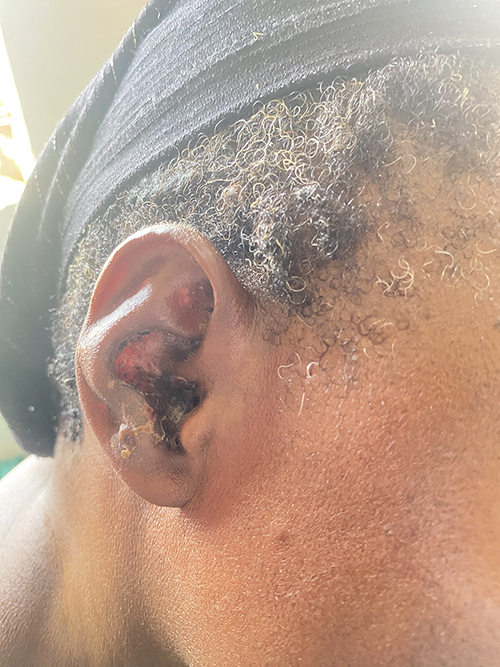 |
Figure 2 Revealed healed vesicular lesions on the tympanic membrane, external auditory canal, and right auricle. |
A neurological evaluation revealed House-Brackmann Grade IV, which is characterized by obvious weakness, including asymmetric lips, facial sagging, partial closure of the left eye, and a lack of forehead movement on the afflicted side (Figure 1). Laboratory testing, including complete blood count and inflammatory markers, was normal. A CT scan of the brain excluded intracranial pathology.
The diagnosis of Ramsay Hunt Syndrome was made based on the patient’s clinical presentation, which included ipsilateral ear discomfort, facial paralysis, and the distinctive vesicular rash of zoster oticus. To rule out any neurological disorders or systemic infections, regular blood tests (complete blood count, inflammatory markers) and brain CT scans were performed; all results were unremarkable. Bell’s palsy, auditory neuroma, and trigeminal neuralgia were among the differential diagnoses taken into consideration; however, they were ruled out due to the presence of the zoster oticus and the thorough clinical examination.
The preferred therapeutic window for starting corticosteroids (like prednisone) and antiviral drugs (like acyclovir, valacyclovir, or famciclovir), which is usually within 72 hours, had already passed due to the patient’s delayed presentation two weeks following the onset of symptoms. As a result, these particular pharmaceutical interventions were not used. The patient was given supportive treatment, which included eye drops to prevent corneal problems from incomplete eye closure and analgesics to control pain. After a month, the patient demonstrated functional improvement, including improved mouth symmetry when smiling and full eye closure with little effort. Her facial nerve function was therefore classed as House–Brackmann Grade IV.
Discussion
“Ramsay Hunt Syndrome is a rare but serious condition that accounts for roughly 16% of unilateral facial paralysis cases in children and 18% in adults.5 This case highlights the diagnostic difficulty and essential management issues that emerge when Ramsay Hunt Syndrome occurs after a substantial delay. The patient’s presentation two weeks post-symptom onset is particularly noteworthy, as it placed her outside the established timeframe for optimal antiviral and corticosteroid intervention, thereby highlighting a critical aspect often overlooked in standard clinical guidelines.
Ramsay Hunt Syndrome is an infectious cranial polyneuropathy that causes peripheral facial nerve paralysis and vesicular eruptions on the ear (zoster oticus) or oral cavity, as well as possible involvement of other cranial nerves.6 However, the presence of zoster oticus, as seen in our patient, is a key differentiating factor. The initial tingling sensation, followed by facial weakness and evolving rash, highlights the dynamic nature of the condition.
Early comprehensive treatment significantly improves facial nerve healing and lowers the risk of long-term complications Early comprehensive treatment significantly improves facial nerve healing and lowers the risk of long-term complications.7
Recent clinical studies suggest that initiating dual therapy with antivirals and corticosteroids within a 72-hour window of rash onset significantly improves herpes zoster outcomes and decreases the risk of post-herpetic neuralgia.”7
In our patient, the 2-week delay in seeking medical attention meant that this critical therapeutic window had elapsed. Consequently, the decision was made not to initiate antivirals or corticosteroids, as their efficacy significantly diminishes beyond this period, and potential side effects could outweigh the benefits. This decision reflects the real-world dilemma faced by clinicians in managing such delayed presentations, where the potential for disease modification is limited.
The prognosis of full recovery of facial nerve function in RHS is less favorable than in Bell’s palsy, with rates often falling below 50% despite appropriate therapy. For patients with delayed presentation, like ours, the prognosis for full recovery is even uncertain.
Post-treatment follow-up is essential for patients with RHS. It typically involves monitoring for facial nerve recovery, managing any persistent pain with gabapentin or tricyclic antidepressants for post-herpetic neuralgia), and addressing ocular complications arising from incomplete eye closure.8 For patients with late presentation, the focus shifts more towards rehabilitative therapies (eg, facial physical therapy) and symptomatic management, as the potential for pharmacological rescue diminishes. Our patient’s course will require ongoing supportive care and monitoring for any long-term sequelae.
Conclusion
This case report highlights the difficulties in diagnosing and treating delayed RHS manifestation. When a patient presents with acute facial palsy, ear pain, or vesicular lesions, clinicians should remain suspicious. To improve prognosis and lower long-term morbidity, early diagnosis and the start of corticosteroid and antiviral therapy remain crucial.
Ethical Approval
Ethical approval was not required for the publication of this case report, in accordance with the policies of KIU Teaching and Research Hospital.
Consent for Publication
Written informed consent was provided by the patient for publication.
Acknowledgment
We would like to thank the patient for providing informed consent for publication, as well as anyone who participated in this study.
Author Contributions
Hamza Abdiaziz Osman conceptualized the case report, collected patient data, and wrote the initial paper. Dr. Abdalla Ahmed Deifa provided clinical knowledge, critically evaluated and updated the text for intellectual substance, and validated the results. Dr. Mutaz Ali made a significant contribution to the literature review and assessed the manuscript thoroughly. All authors made a significant contribution to the work reported, whether that is in the conception, study design, execution, acquisition of data, analysis and interpretation, or in all these areas; took part in drafting, revising or critically reviewing the article; gave final approval of the version to be published; have agreed on the journal to which the article has been submitted; and agree to be accountable for all aspects of the work.
Funding
There was no external funding for this project.
Disclosure
The authors report no conflicts of interest in this work.
References
1. Bhupal HK. Ramsay Hunt syndrome presenting in primary care. Practitioner. 2010;254(1727):33–35.
2. Kleinschmidt-DeMasters BK, Gilden DH. The expanding spectrum of herpesvirus infections of the nervous system. Brain Pathol. 2001;11(4):440–451. doi:10.1111/j.1750-3639.2001.tb00413.x
3. Haginomori S, Ichihara T, Mori A, et al. Varicella-zoster virus-specific cell-mediated immunity in Ramsay Hunt syndrome. Laryngoscope. 2016;126(1):E35–9. doi:10.1002/lary.25441
4. Murakami S, Hato N, Horiuchi Y, et al. The prognosis of Ramsay Hunt syndrome is poorer than that of Bell’s palsy. Eur Arch Otorhinolaryngol. 2007;264(9):1021–1025.
5. Sandoval CC, Núñez FA, Lizama CM, Margarit SC, Abarca VK, Escobar HR. [Ramsay Hunt syndrome in children: four cases and review]. Rev Chilena Infectol. 2008;25(6):458–464.
6. Sweeney CJ, Gilden DH. Ramsay Hunt syndrome. J Neurol Neurosurg Psychiatry. 2001;71(2):149–154. PMID: 11459884; PMCID: PMC1737523. doi:10.1136/jnnp71.2.149
7. Koshy E, Mengting L, Kumar H, Jianbo W. Epidemiology, treatment, and prevention of herpes zoster: a comprehensive review. Indian J Dermatol Venereol Leprol. 2018;84:251–262. doi:10.4103/ijdvl.IJDVL_1021_16
8. Goldani LZ, Ferreira da Silva LF, Dora JM. Ramsay Hunt syndrome in patients infected with human immunodeficiency virus. Clin Exp Dermatol. 2009;34(4):e115–7. doi:10.1111/j.1365-2230.2009.03228.x
 © 2025 The Author(s). This work is published and licensed by Dove Medical Press Limited. The
full terms of this license are available at https://www.dovepress.com/terms
and incorporate the Creative Commons Attribution
- Non Commercial (unported, 4.0) License.
By accessing the work you hereby accept the Terms. Non-commercial uses of the work are permitted
without any further permission from Dove Medical Press Limited, provided the work is properly
attributed. For permission for commercial use of this work, please see paragraphs 4.2 and 5 of our Terms.
© 2025 The Author(s). This work is published and licensed by Dove Medical Press Limited. The
full terms of this license are available at https://www.dovepress.com/terms
and incorporate the Creative Commons Attribution
- Non Commercial (unported, 4.0) License.
By accessing the work you hereby accept the Terms. Non-commercial uses of the work are permitted
without any further permission from Dove Medical Press Limited, provided the work is properly
attributed. For permission for commercial use of this work, please see paragraphs 4.2 and 5 of our Terms.