
Back to Journals » Psychology Research and Behavior Management » Volume 19
Children’s Problem Behaviors and Maternal Parenting Psychological Flexibility: A Longitudinal Moderated Mediation Model
Authors Qiao T  , Gan L, Wang X, Ye P
Received 3 March 2026
Accepted for publication 3 June 2026
Published 17 June 2026 Volume 2026:19 606669
DOI https://doi.org/10.2147/PRBM.S606669
Checked for plagiarism Yes
Review by Single anonymous peer review
Peer reviewer comments 3
Editor who approved publication: Dr Igor Elman
Tianqi Qiao,1,* Linghong Gan,1,2,* Xinxin Wang,1 Pingzhi Ye1
1School of Education, Guangzhou University, Guangzhou, People’s Republic of China; 2Fengxin Kindergarten, Phoenix City, Guangzhou, People’s Republic of China
*These authors contributed equally to this work
Correspondence: Xinxin Wang, School of Education, Guangzhou University, Guangzhou, People’s Republic of China, Email [email protected]
Purpose: With rapid social change, mothers are increasingly facing emotional health crises during childrearing. Prior research has largely focused on how parents shape children’s development, while overlooking how children’s behaviors may, in turn, shape mothers’ psychological functioning. Therefore, this study examined the mechanism through which children’s problem behaviors influence maternal parenting psychological flexibility, with a particular focus on the mediating role of parenting stress and the moderating role of perceived coparenting quality.
Methods: A longitudinal design was adopted with three survey waves spaced six months apart. The final sample included 1,131 Chinese preschool children (660 boys, 651 girls) and their mothers. The performed measurements encompassed children’s problem behaviors (T1), maternal parenting stress (T2), perceived coparenting quality (T2), maternal parenting psychological flexibility (T1/T2/T3) and demographic information. Structural equation modeling was performed using Mplus 8.3.
Results: The mediation model showed that, after controlling for T1/T2 parenting psychological flexibility, children’s problem behaviors in T1 were negatively correlated longitudinally with T3 parenting psychological flexibility through T2 parenting stress. Moreover, T2 perceived coparenting quality significantly moderated the second stage of the mediation pathway: when mothers perceived higher-quality coparenting, the negative association between parenting stress and parenting psychological flexibility was substantially attenuated.
Discussion: This study elucidates the mechanism by which children’s problem behaviors shape maternal parenting psychological flexibility and highlights the protective role of high-quality coparenting in this process. The findings extend the explanatory depth of child-driven effects and stress-buffering theory within family contexts and provide empirical evidence for developing multilevel family interventions centered on maternal stress management and spousal coparenting support.
Keywords: children’s problem behaviors, maternal parenting psychological flexibility, parenting stress, perceived coparenting quality
Introduction
In contemporary parenting discourse, mothers’ emotional health crises have shifted from an “implicit predicament” to an “explicit social issue.” The China National Mental Health Development Report (2023–2024) indicates that among mothers aged 30–45, the prevalence of emotional exhaustion triggered by children’s behavioral problems reaches 38.7%, and 83% of these mothers exhibit subclinical features of “emotion regulation failure” (eg., persistent irritability and cognitive rigidity).1,2 These symptoms essentially reflect impairments in maternal parenting psychological flexibility—namely, the capacity to flexibly adjust cognition and behavior under stress to cope with children’s challenging behaviors.3,4 As a “psychological immune system” for coping with parenting stress, psychological flexibility directly determines parenting effectiveness and family system stability.3,4 However, traditional research has long followed a unidirectional “parent-driven” framework, emphasizing how parental characteristics and behaviors shape child development,5–7 while relatively neglecting the reverse shaping effects of children’s behaviors on parental psychological functioning—namely, the “child-driven effect”.8
Since Bell’s reinterpretation of direction-of-effects in parent–child socialization research,8 scholars have argued that children are not passive recipients of environmental influences; rather, they are active agents who shape their caregiving environment. This child-driven perspective is strongly supported by the transactional model9 and family systems theory,10 both of which emphasize that parent–child relationships involve continuous, bidirectional transactions. Much of the research on child-driven effects has focused on children’s problem behaviors. For instance, a longitudinal study showed that from 24 months to 7 years, children’s externalizing behaviors predicted increases in maternal intrusive parenting.11 A study of 168 mother–child dyads found that increases in children’s problem behaviors were associated with heightened parent–child conflict and greater maternal psychological control.12 A meta-analysis further confirmed that children’s externalizing behaviors significantly predict subsequent parental distress and maladaptive parenting, with an effect size comparable to parent-to-child effects.13 Collectively, these findings provide macro-level evidence for the ubiquity of child-driven effects. However, some researchers argue that parental personality traits or psychological states exhibit high cross-situational stability over the long term, rather than being solely driven by short-term situational fluctuations.14–16 Therefore, employing a longitudinal design and incorporating family moderating variables is crucial for exploring the unique relationship between child behavior and maternal psychological states.
Taken together, children’s problem behaviors are not only “outcomes” of development but also likely antecedent forces that reshape parenting environments and influence parental psychological functioning.13 In the cultural context of “intensive mothering” in China, mothers are often expected to take high responsibility for their children’s development.17,18 Such social norms may make mothers often bear greater parenting pressure when facing parenting challenges,19 which is more likely to lead to their low parenting psychological flexibility.20 Therefore, it is of significant local significance to explore the influencing mechanism under this background. Within contemporary Chinese family structures, although paternal involvement is on the rise, the heterogeneity in the quality of coparenting remains prominent.21 The quality of coparenting support perceived by mothers is not only a reflection of family system functioning but also serves as a critical resource for them to cope with child behavior challenges.22 While previous research has suggested the existence of child-driven effects,1,11,23,24 a key gap remains: the internal psychological pathways controlling these associations are not yet clearly understood. Therefore, this study constructs a longitudinal moderated mediation model. It aims to clarify how child behavior influences maternal parenting psychological flexibility and how this impact is dynamically moderated by coparenting support. This integrated perspective allows for a deeper exploration of the complex interactive logic within the Chinese family system, and provide critical evidence for protecting and restoring mothers’ psychological resources and improving family-level parenting quality.
Children’s Problem Behaviors and Maternal Parenting Psychological Flexibility
Parental psychological flexibility is a multidimensional and comprehensive construct rooted in Acceptance and Commitment Therapy.25 It goes beyond mere emotion regulation by representing a holistic psychological stance toward the challenges of child-rearing. Specifically, it refers to parents’ capacity, in the process of raising their children, to intentionally notice and accept negative thoughts, emotions, and impulses in the present moment while still engaging in effective parenting behaviors. It is typically reflected in three components: cognitive defusion, committed action, and acceptance.3 Cognitive defusion refers to parents’ ability to consciously separate their negative emotions and thoughts from parenting behaviors so that their parenting is not governed by emotional reactions or intrusive cognitions. Committed action refers to parents’ willingness to respect children’s ideas and autonomy and to allow children to assert independence in appropriate ways; although doing so may heighten parental worry and anxiety, parents can accept the resulting negative emotions and persist in effective parenting behaviors. Acceptance refers to parents’ capacity to accept distressing emotions and thoughts as part of parenting and to adopt an open and accepting stance toward them. Furthermore, the significance of parental psychological flexibility lies in its emphasis on values-based parenting.4 Unlike traditional behavioral strategies, it focuses on how parents can remain present and act according to their long-term parenting values (eg., being a supportive and patient parent) even when faced with intense, immediate child-related distress.4 This makes it a crucial resource for maintaining parenting quality in the face of persistent children’s problem behaviors.4,5
According to transactional perspectives, the parent–child relationship functions as a bidirectional system. While parenting behaviors influence children, children’s behaviors may also, through feedback loops, alter parents’ psychological and behavioral states. Children’s problem behaviors are generally categorized into internalized and externalized problems.26 Internalized problems primarily include syndromes associated with symptoms such as anxiety, depression, withdrawal, and physical discomfort, which are mainly related to the child’s subjective difficulties and problems. Externalized problems primarily involve conflicts with others, including symptoms consistent with attention problems and aggressive behaviors.27 Extensive evidence suggests that interactions with children’s problems behaviors can elicit heightened negative affect in parents, biased negative appraisals of children’s behaviors, and the adoption of less effective parenting strategies, including more direct control and coercive discipline.13,28–30 Specifically, such interactions may trigger two typical response patterns. On one hand, parents may show increased overcontrol and reduced committed action, such as restricting children’s autonomy and frequently employing directive interventions.13,28,29 Verhoeven et al further found that in early childhood, boys’ externalizing behaviors could predict increases in parental autonomy-restricting practices even over short time frames, reflecting a tendency toward rigid parenting.30 On the other hand, parents may display reduced positive affect31 as well as lower responsiveness and sensitivity.32 These behavioral and emotional changes collectively suggest that children’s problem behaviors may undermine maternal parenting psychological flexibility—namely, diminishing parents’ ability to flexibly adapt parenting strategies to situational demands and to sustain effective actions over time. Therefore, more serious behavioral problems in children are associated with lower maternal parenting psychological flexibility. Based on the above, this study proposes Hypothesis 1:
H1: Children’s problem behaviors are negatively associated with maternal parenting psychological flexibility.
Children’s Problem Behaviors, Parenting Stress, and Maternal Parenting Psychological Flexibility
Parenting stress refers to the perceived discrepancy between situational demands associated with the parenting role and the personal resources available to meet those demands.33,34 When parenting-related changes or challenges exceed parents’ capabilities and resources, parents experience stress.35 Evidence indicates a bidirectional association between children’s problem behaviors and parenting stress. For example, a cross-lagged model among children aged 3–9 showed that children’s problem behaviors and parents’ parenting stress mutually influenced each other over time.36 Further research suggests that children’s problem behaviors are a key predictor of parenting stress, explaining approximately 57% of variance in parenting stress; mothers of children with problem behaviors often encounter greater parenting difficulties and experience higher levels of stress.37 Meanwhile, higher parenting stress is closely associated with lower parenting psychological flexibility.6 Chronic stress can continuously deplete cognitive and emotional resources, leading mothers to rely more on avoidance and situational control strategies rather than acceptance and flexible responding, thereby undermining their psychological adaptation to the parenting role.6,38 Accordingly, higher parenting stress is expected to predict lower maternal parenting psychological flexibility.38 Based on these associations, parenting stress likely mediates the link between children’s problem behaviors and maternal parenting psychological flexibility. Therefore, this study proposes Hypothesis 2:
H2: Parenting stress will mediate the association between children’s problem behaviors and maternal parenting psychological flexibility.
The Moderating Role of Perceived Coparenting Quality
Coparenting refers to parents’ coordinated efforts in parenting attitudes and behaviors, shared responsibility for childrearing tasks, mutual affirmation of parenting competence, respect for each other’s contributions, and support for each other’s parenting decisions.39 The ecological model of coparenting highlights coparenting as a potential protective factor that can buffer the impact of family risk factors on parental adjustment.39 A longitudinal study indicated that high-quality interparental mutually responsive orientation (MRO; a form of positive coparenting) weakened the association between parenting stress and parenting psychological flexibility. Region-of-significance analyses further suggested that as MRO increased, the negative association between parenting stress and psychological flexibility tended to diminish.40 Additionally, this buffering role of coparenting has been supported in both Western and Eastern cultural contexts. For instance, among parents in Hong Kong, coparenting significantly buffered the negative impact of parenting stress on marital satisfaction. Although marital satisfaction was the outcome in that study, the findings provide cross-cultural evidence that coparenting, as a relational resource, can mitigate stress-related harm to psychosocial adjustment.41 Synthesizing these findings, it is reasonable to infer that mother’s perceived coparenting quality functions as a key family-system resource that moderates the transmission from parenting stress to parenting psychological flexibility. Notably, although coparenting is inherently a dyadic construct, the current study focuses on the mother’s individual perception. From a socio-cognitive perspective, an individual’s internal psychological adjustment is primarily driven by their subjective appraisal of the social environment rather than objective reality.42 Empirical evidence suggests that perceived support is a more consistent and robust predictor of individual mental health outcomes than the actual received or objective support.43 For a mother, her subjective experience of the coparenting alliance represents her functional reality, which directly dictates the cognitive and emotional resources she can mobilize when facing parenting challenges.39 Specifically, high perceived coparenting quality is expected to buffer, whereas low perceived coparenting quality is expected to exacerbate, the negative association between parenting stress and psychological flexibility. Therefore, this study proposes Hypothesis 3:
H3: Perceived coparenting quality will moderate the association between parenting stress and maternal parenting psychological flexibility.
The Current Study
To address the limitations of prior research, the present study integrates the child-driven perspective with family systems theory into a longitudinal framework. We move beyond documenting the scarcity of research by providing a clearer logical rationale for our moderated mediation model. First, we propose that the link between child-rearing challenges and psychological flexibility is mediated by parenting stress, representing the process by which external behavioral stressors are internalized into emotional strain. Second, rooted in family systems theory, we argue that the coparenting subsystem provides a critical systemic boundary condition. High-quality spousal collaboration is expected to provide the interpersonal resources necessary to buffer the association between internalized stress and psychological rigidity.22 By employing a three-wave longitudinal design, this study aims to clarify the mechanistic pathways and conditions through which children’s behavior relates to maternal parenting psychological flexibility (see Figure 1).
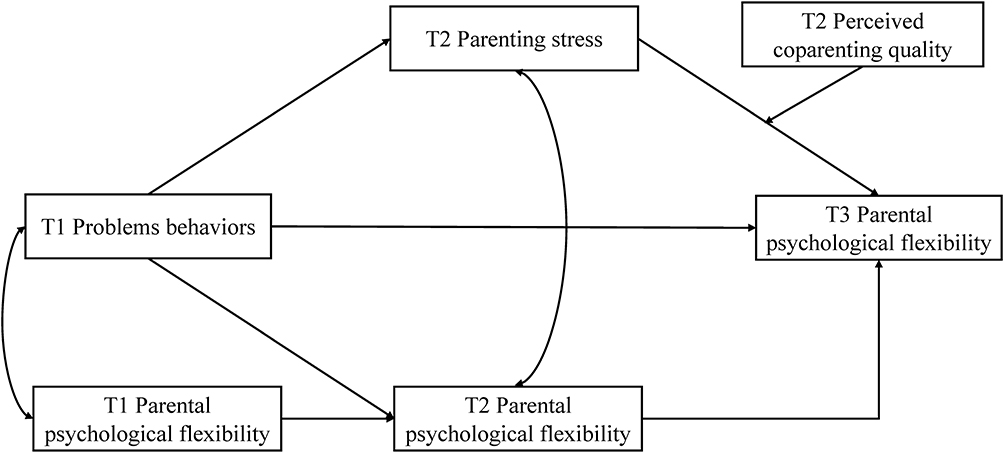 |
Figure 1 Theoretical hypothesis model. |
Methods
Participants and Procedure
This study adopted a longitudinal design and used convenience sampling to recruit participants. With support from kindergartens, mothers of children from approximately 10 kindergartens in Guangdong Province, China, were invited via WeChat groups to complete online questionnaires. Before each survey, mothers were asked about their willingness to participate. Those who selected “I agree to participate in this survey” proceeded to the questionnaire; those who selected “I do not want to participate in this survey” ended participation. Following ethical principles of voluntary participation, all parents provided informed consent. The study was approved by the Research Ethics Committee of Guangzhou University in accordance with the Declaration of Helsinki [No. GZHUSE2024027].
Sample size was estimated using a prevalence-based formula.44 With an allowable relative error of 15%, an absolute error of δ = 0.15π, and a 95% confidence interval, μa = 1.96. Based on prior evidence indicating a 17.6%45 detection rate of emotional and behavioral problems among Chinese children (π = 17.6%), the minimum required sample size was estimated as n = [1.962 × 17.6% × (1 − 17.6%)] / (0.15 × 17.6%)2 ≈ 799. Allowing for 10% invalid responses, the target minimum sample size was increased to n ≈ 879. The study utilized a longitudinal design across three waves. Specifically, children’s problem behaviors were assessed in October 2024 (T1), maternal parenting stress and perceived coparenting quality were assessed in April 2025 (T2), and maternal parenting psychological flexibility was assessed in T1, T2 and October 2025 (T3). Exclusion criteria were: (1) missing data; (2) identical responses for 85% of items; and (3) completion time <5 minutes. After screening, 1,590, 1,463, and 1,311 participants were retained at T1–T3, respectively (attrition rate = 17.5%). A total of 1,131 mothers completed all three waves and constituted the final analytic sample (Mage = 35.62±9.35). Little’s MCAR test indicated that missingness was completely at random (p = 0.974). In the final sample, child gender was distributed as 660 boys (50.3%) and 651 girls (49.7%). Detailed demographic information is shown in Table 1.
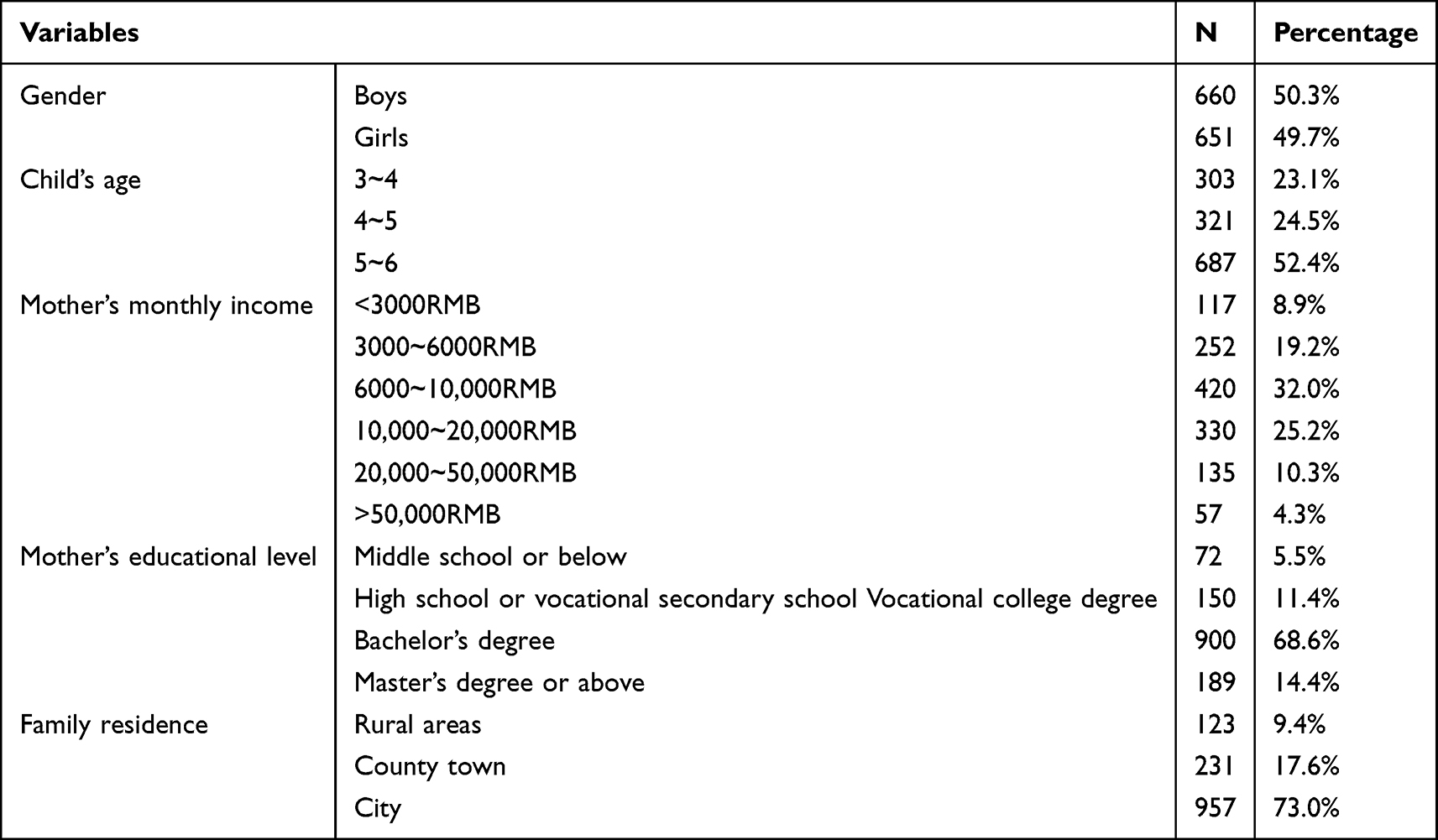 |
Table 1 Demographic Descriptive Statistics of the Sample |
Measures
Problem Behaviors
Children’s problem behaviors were assessed using the Chinese version of the Strengths and Difficulties Questionnaire (SDQ),46 originally developed by Goodman.47 The SDQ contains 25 items across five subscales: Emotional Symptoms (eg., “Frequently unhappy, depressed, or crying”), Conduct Problems (eg., “Frequently loses temper and is easily angered”), Hyperactivity–Inattention (eg., “Unstable, overactive, unable to remain still for long periods”), Peer Problems (eg., “Somewhat lonely, mostly plays by himself/herself”), and Prosocial Behavior. The sum of the first four subscales forms the “Difficulties” factor, whereas Prosocial Behavior reflects strengths. The present study used the Difficulties factor to index children’s problem behaviors. Items are rated on a 3-point scale from 0 (“Not true”) to 2 (“Certainly true”). Following Goodman’s recommendation for low-risk general populations,26 we adopted a three-factor structure in which difficulties were divided into externalizing problems (Conduct Problems and Hyperactivity–Inattention) and internalizing problems (Emotional Symptoms and Peer Problems), totaling 20 items. Higher scores indicate more severe problem behaviors. Prior research supports satisfactory reliability and validity of the SDQ in Chinese samples.46,48 In the present study, Cronbach’s α was 0.76 for externalizing problems, 0.77 for internalizing problems, and 0.78 for the total difficulties score. The confirmatory factor analysis results indicated good construct validity for the scale (χ2/df = 2.69, CFI = 0.92, TLI = 0.91, RMSEA = 0.06, p < 0.001).
Parenting Stress
Maternal parenting stress was measured using the Parenting Stress Index–Short Form (PSI-SF),49 originally developed by Abidin.50 The PSI-SF includes three subscales—Parental Distress Parent–Child Dysfunctional Interaction, and Difficult Child—comprising 36 items. Some example items include: “Since having this child, I have been unable to do new and different things”, “I often have the feeling that I cannot handle things very well”. Based on prior studies,51–53 and considering that our predictor was children’s problem behaviors, the latter two subscales contain many child-related components that may overlap with SDQ assessments and complicate interpretation. Moreover, the Parental Distress subscale more directly captures parents’ emotional and psychological health and includes factors directly and indirectly related to parenting stress. Therefore, only the Parental Distress subscale was used (12 items). Items are rated on a 5-point scale from 1 (“Strongly disagree”) to 5 (“Strongly agree”), with higher scores indicating greater parenting stress. The scale has demonstrated good psychometric properties in Chinese samples.53,54 In the present study, Cronbach’s α was 0.87. The confirmatory factor analysis results indicated good construct validity for the scale (χ2/df = 2.78, CFI = 0.91, TLI = 0.91, RMSEA = 0.06, p < 0.001).
Perceived Coparenting Quality
Perceived coparenting quality was assessed using the Chinese version of the Coparenting Relationship Scale,55 originally developed by Stright and Bales.56 The scale includes 14 items across two subscales: Supportive Coparenting (eg., “When I talk to my partner about the children, he/she listens attentively.”) and Undermining Coparenting (eg., “My partner uses parenting methods that I have explicitly asked not to use.”). Items are rated on a 5-point scale from 1 (“Never”) to 5 (“Always”). Each subscale contains 7 items. After reverse-scoring undermining coparenting items, scores were summed with supportive coparenting to form a total perceived coparenting quality score, with higher scores indicating higher perceived coparenting quality. Prior studies report satisfactory reliability and validity in Chinese samples.55 In this study, Cronbach’s α was 0.87. The confirmatory factor analysis results indicated good construct validity for the scale (χ2/df = 2.47, CFI = 0.93, TLI = 0.92, RMSEA = 0.05, p < 0.001).
Parental Psychological Flexibility
Maternal parenting psychological flexibility was measured using the Chinese version of the Parental Psychological Flexibility Questionnaire (PPFQ),57 originally developed by Burke and Moore.3 The PPFQ comprises 16 items across three subscales: Cognitive Defusion (eg., “My emotions get in the way of being the kind of parent I want to be”), Committed Action (eg., “I do not allow my child to do things that worry me”), and Acceptance (eg., “No matter what I am thinking or feeling, I can still have a good relationship with my child”). Items are rated on a 7-point scale from 1 (“Not at all true”) to 7 (“Very true”). Items 1–11 are reverse scored. Higher total scores indicate higher maternal parenting psychological flexibility. The scale shows satisfactory psychometric properties in Chinese samples.58 In this study, Cronbach’s α was 0.89. The confirmatory factor analysis results indicated good construct validity for the scale (χ2/df = 2.78, CFI = 0.96, TLI = 0.91, RMSEA = 0.06, p < 0.001).
Statistical Analyses
First, we performed descriptive statistics and bivariate correlation analysis on demographic and core variables using IBM SPSS 26.0. Second, considering the use of self-report measures, we tested whether common method bias was significant. Third, we performed structural equation modeling (SEM) analysis using Mplus 8.3. To test hypotheses 1 and 2, we included T1 problem behavior and T3 parenting psychological flexibility as independent and dependent variables, respectively, in the mediation model, with T2 parenting stress as the mediator. Then, we included the moderating variable (ie., T2 perceived coparenting quality) in the mediation model to test hypotheses 3. Based on prior research, child gender,59 maternal education, and maternal income60 were included as covariates because they may influence parenting behaviors. For the moderated mediation model, all variables were centered before generating interaction terms. When the interaction effect was significant, we further performed a simple slope analysis and tested the mediating effect of T2 parenting stress when the level of T2 perceived coparenting quality was one standard deviation above or below the mean. This allows us to examine the extent to which T2 perceived coparenting quality moderates the association between T2 parenting stress and T3 parenting psychological flexibility, and the extent to which T2 perceived coparenting quality moderates the mediating effect of parenting stress.
The goodness of fit of the model was evaluated using the following metrics: Comparative Fit Index (CFI; acceptable value: >0.90), Tucker-Lewis Index (TLI; acceptable value: >0.90),61 the Root Mean Square Error of Approximation (RMSEA; acceptable value: <0.08), and standardized root mean square residual (SRMR; acceptable value: <0.08).62 Considering the advantages of bootstrapping over conventional methods in testing mediation models,63 we used bootstrapping (N = 5000) and its 95% confidence interval (CI) to assess indirect and direct effects. The (moderated) mediation effect was considered reasonable when the 95% CI did not contain zero.
Results
Common Method Bias Test
In the present study, all variables were measured via maternal self-reports, which may introduce the risk of common method bias (CMB). To address this, we primarily employed procedural remedies as recommended by Podsakoff et al64 Specifically, the three-wave longitudinal design provided a substantial temporal separation (six-month intervals). This temporal distancing helps to minimize the influence of transient mood states and the consistency motif, thereby reducing the risk of artificially inflated associations. Additionally, Harman’s single-factor test was conducted as a post hoc statistical check.64 Results showed nine factors with eigenvalues >1 explaining 57.61% of the variance; the first factor accounted for 25.86%, which is below the 40% threshold,64 indicating that common method bias was not substantial. Furthermore, confirmatory factor analysis was used to examine the confirmatory nature of the factors. We conducted confirmatory factor analysis to compare the six-factor model (based on six key research variables) with the one-factor model (including all self-assessment items). The resulting six-factor model produced an acceptable fit index: χ2/df = 4.215, CFI = 0.92, TLI = 0.94, RMSEA = 0.07. Additionally, one-factor model had poor model fit: χ2/df = 27.761, CFI = 0.46, TLI = 0.48, RMSEA = 0.35. As a result, common method bias did not present to pose a threat in interpreting our results.
Descriptive and Correlational Analyses
Table 2 presents the means, standard deviations, and Pearson correlation matrix. T1 problem behaviors were significantly positively correlated with T2 parenting stress (p<0.001) and significantly negatively correlated with T2 perceived coparenting quality and T1/T2/T3 parenting psychological flexibility (p<0.001). T2 Parenting stress was significantly negatively correlated with T2 perceived coparenting quality and T1/T2/T3 parenting psychological flexibility (p<0.001). T2 perceived coparenting quality was significantly positively correlated with T1/T2/T3 parenting psychological flexibility (p<0.001).
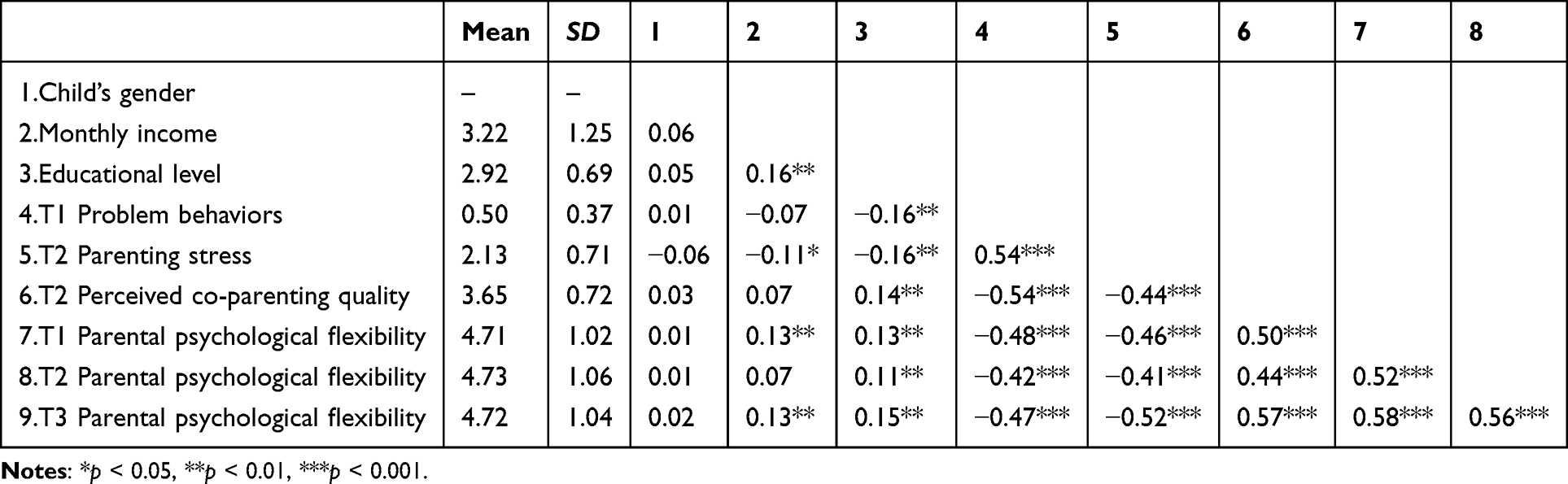 |
Table 2 Descriptive Analysis and Correlations |
Mediating Effects of Parenting Stress
The results of the mediation model fit test indicate good fit: χ2/df = 4.954, CFI = 0.961, TFI = 0.931, RMSEA = 0.061, SRMR = 0.034. After controlling for the covariates and T1/T2 maternal parenting psychological flexibility, T1 problem behaviors were significantly associated with T2 parenting stress (B=0.37, SE=0.04, p<0.001), but not with T3 parenting psychological flexibility (B=−0.05, SE=0.05, p=0.377). T2 parenting stress and T3 parenting psychological flexibility were significantly associated (B=−0.25, SE=0.03, p<0.001). Mediation analysis results showed that T2 parenting stress had a significant mediating effect on T1 problem behaviors and T3 parenting psychological flexibility (B=−0.09, SE=0.03, 95% CI= [−0.215, −0.011). Therefore, Hypothesis 2 is supported. See Table 3 and Figure 2.
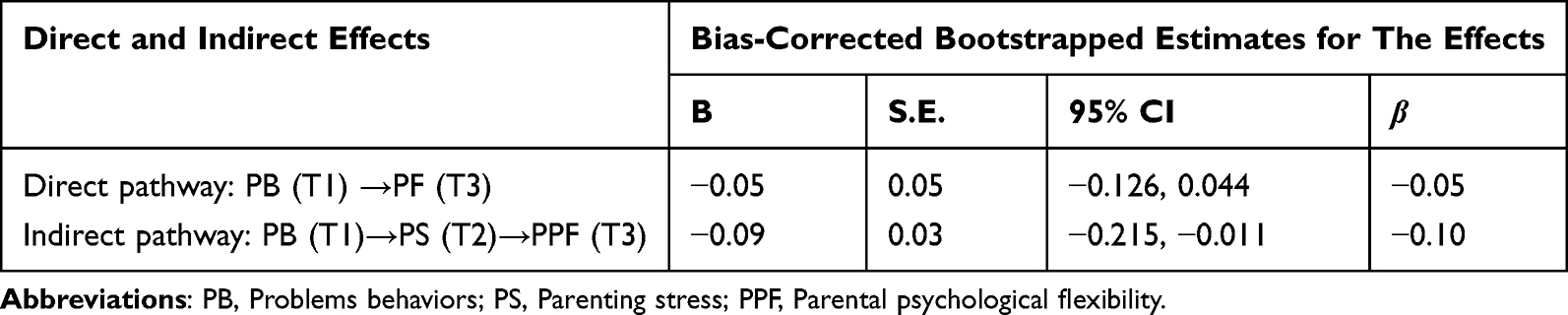 |
Table 3 Summary of Direct and Indirect Effects |
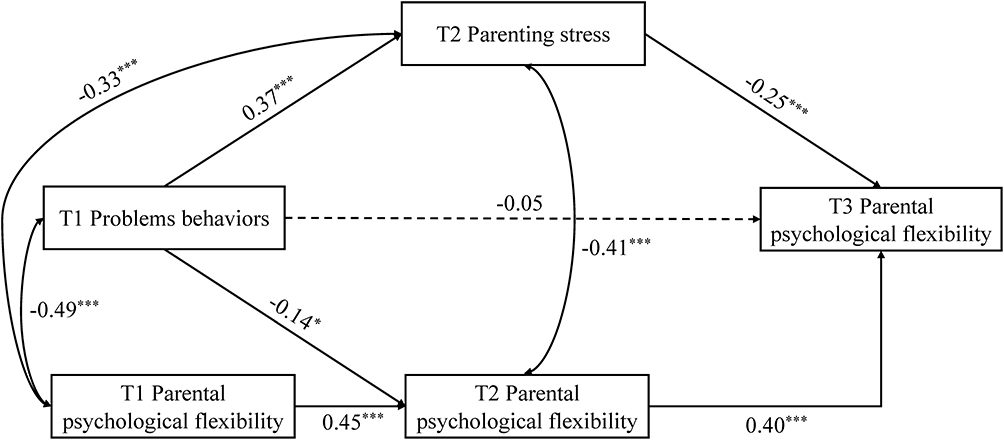 |
Figure 2 The mediating effect of T2 parenting stress in the relation between T1 problem behavior and T3 parental psychological flexibility. Unstandardized coefficients are reported; *p < 0.05, ***p < 0.001; T1 = Time 1, T2 = Time 2, T3 = Time 3; Dashed line indicates a non-significant coefficient. |
Moderating Effects of Perceived Coparenting Quality
According to the research hypotheses 3, this study constructed the moderated mediation model. The results of the model fit test indicate good fit: χ2/df = 3.378, CFI = 0.924, TFI = 0.912, RMSEA = 0.050, SRMR = 0.031. The results are shown in Table 4 and Figure 3, indicating that T2 perceived coparenting quality regulates T2 parenting stress and T3 parenting psychological flexibility (B=0.11, SE=0.03, p=0.009, β = 0.12). Subsequently, a simple slope analysis (Figure 4) showed that when T2 perceived coparenting quality was low, the relationship between T2 parenting stress and T3 parenting psychological flexibility was stronger than when T2 perceived coparenting quality was high (B = −0.27, SE = 0.03, p < 0.001; B = −0.11, SE = 0.03, p = 0.003).
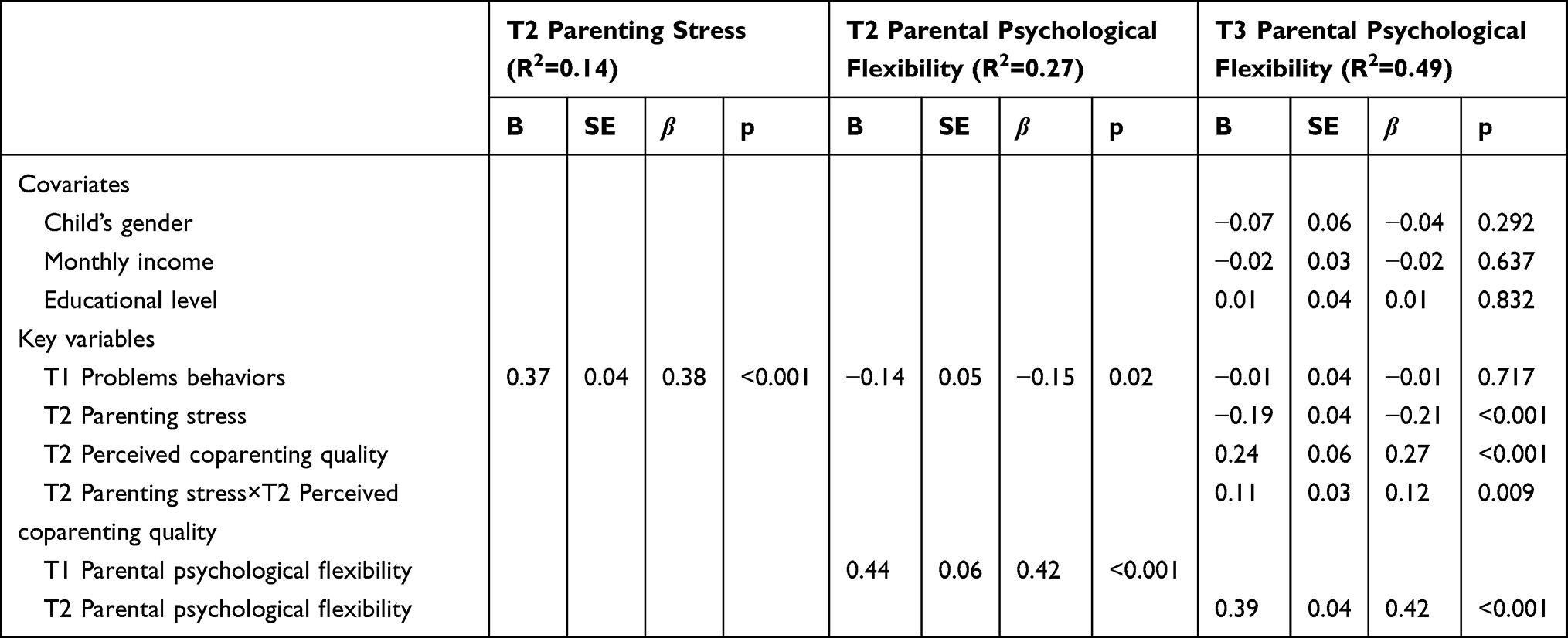 |
Table 4 Summary of the Moderated Mediation Model |
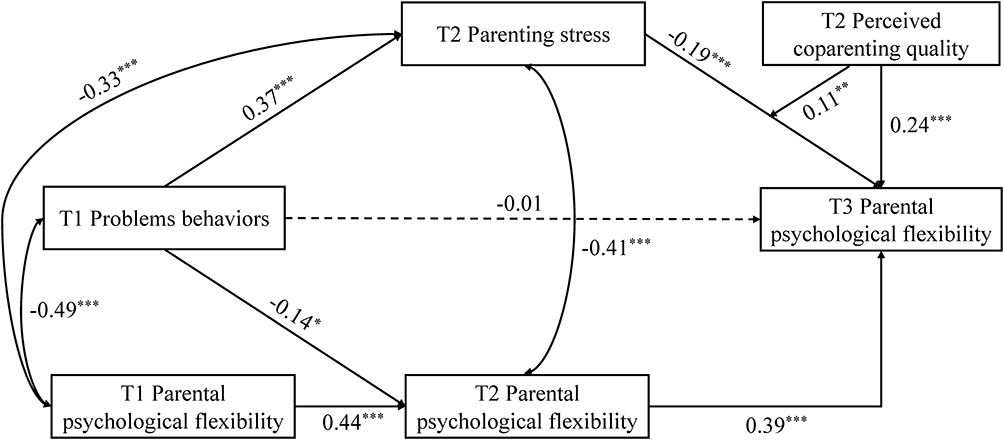 |
Figure 3 Moderated mediation model. Unstandardized coefficients are reported; *p < 0.05, **p < 0.01, ***p < 0.001; T1 = Time 1, T2 = Time 2, T3 = Time; Dashed line indicates a non-significant coefficient. |
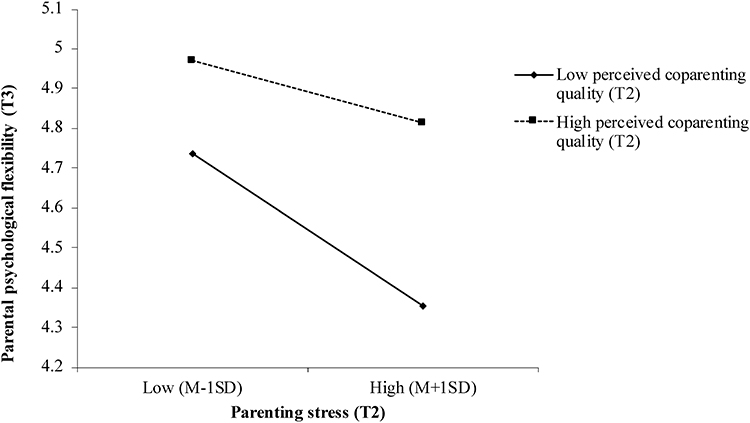 |
Figure 4 The relation between T2 parenting stress and T3 parental psychological flexibility by T2 perceived co-parenting quality. T2 = Time 2, T3 = Time 3. |
As shown in Figure 4 and Table 5, the moderated mediation model indicates that when T2 perceived coparenting quality is low (B = −0.11, SE = 0.02, 95% CI = [−0.149, −0.071]), the indirect effect of T2 parenting stress is significantly stronger than when T2 perceived coparenting quality is high (B = −0.03, SE = 0.01, 95% CI = [−0.049, −0.012]). In conclusion, we find that when T2 perceived coparenting quality is low, parenting stress has a stronger negative correlation with parental psychological flexibility.
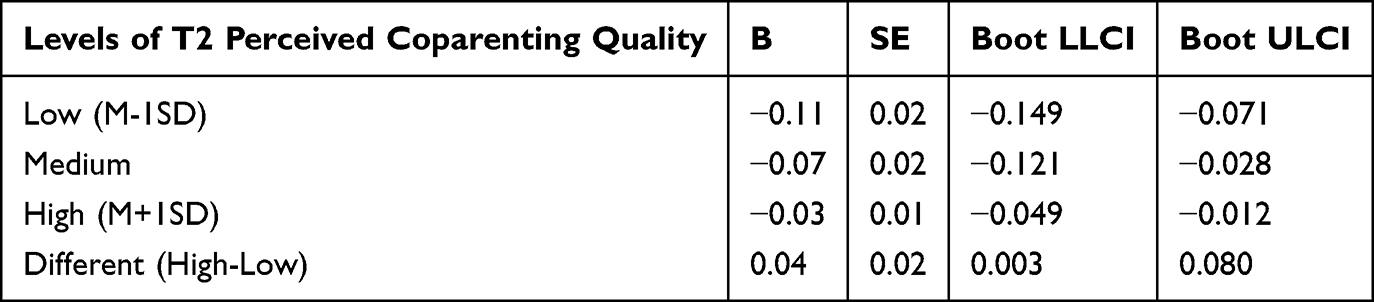 |
Table 5 The Conditional Indirect Effect by Different Levels of Perceived Co-Parenting Quality |
Discussion
This study employed a longitudinal design to examine the longitudinal associations between children’s problem behaviors and maternal parenting psychological flexibility, as well as the underlying mechanisms involved. The findings indicated that children’s problem behaviors did not exert a significant direct longitudinal association with maternal parenting psychological flexibility, meaning that the hypothesis 1 was not supported. While this differs from some previous findings conducted in Western contexts.30,32 On the one hand, many prior studies that identified associations between these variables were based on cross-sectional designs and may have included confounding factors (eg., concurrent family conflict, mothers’ emotional states at the time), making it difficult to isolate the direct predictive effect of children’s behaviors on maternal psychological traits.65,66 The nonsignificant direct effect observed in the present study may suggest that the temporal link between children’s behaviors and relatively stable maternal psychological traits (such as flexibility) is not immediate, but rather occurs as an indirect and cumulative process transmitted through intermediate states (eg., parenting stress).6,37 On the other hand, maternal parenting psychological flexibility, as an adaptive psychological capacity, may be more stable than momentary parenting behaviors or emotional reactions,4,5 and therefore less likely to be directly influenced by a single factor such as children’s behavior. Furthermore, in the Chinese cultural context, where intensive mothering and high expectations for children’s behavioral conformity are prevalent, children’s behaviors may not immediately erode a mother’s core psychological flexibility.4,5 This finding shifts the research perspective from a simple stimulus–response model to a more process-oriented approach that emphasizes the complex mediating and moderating roles of internal psychological processes (eg., parenting stress) and external contextual factors (eg., perceived coparenting quality), thereby providing an important theoretical foundation for the pathways identified in this study.
Although no direct longitudinal association between children’s problem behaviors and maternal parenting psychological flexibility was found, the results confirmed that children’s problem behaviors were indirectly linked to a decline in maternal parenting psychological flexibility through increased parenting stress, indicating a full mediation process, which supports Hypothesis 2. This finding has important theoretical implications. First, it reveals a key mechanism through which children’s problem behaviors relate to maternal internal psychological adaptation—children’s problem behaviors do not directly weaken maternal parenting psychological flexibility, but rather function as persistent external stressors that first erode mothers’ emotional resources and subjective stress experiences.37 This process is particularly salient in the Chinese cultural context, where children’s behavioral conformity is often tied to maternal competence and social “face”.67 Such cultural expectations may intensify the role of parenting stress as a primary engine for internalizing external challenges,68 a pattern that might be more pronounced than in some Western cultures where individual temperament is more prioritized.68,69 This activated and chronic stress state subsequently depletes cognitive and regulatory resources, ultimately reducing mothers’ ability to respond flexibly when facing parenting challenges.6,38 This finding deepens our understanding of the child-driven association by demonstrating that children’s role is not a simple stimulus–response process, but is realized through the prospective association between child behavior and the maintenance of mothers’ negative internal emotional states. This is consistent with the core propositions of family stress theory.70,71 According to the ABC-X model of family stress,70,71 stress outcomes (X) are not determined solely by the stressor (A, such as children’s problem behaviors), but depend on the cognitive appraisal of the stressor (C) and the available coping resources (B). Children’s problem behaviors, as objective stressors (A), exert negative longitudinal associations only when mothers appraise them as persistent and depleting challenges (ie., parenting stress, C), which ultimately leads to a decline in maternal parenting psychological flexibility (X). This finding confirms that mothers’ subjective stress experiences serve as a crucial cognitive–emotional link between external events and internal psychological outcomes. It also provides a direct theoretical basis and a precise intervention target for psychological interventions aimed at reducing maternal parenting stress.
In addition, consistent with the study’s objective and providing support for Hypothesis 3, this study found that perceived coparenting quality moderated the association between maternal parenting stress and parenting psychological flexibility. Specifically, higher perceived coparenting quality buffered the negative effect of parenting stress on psychological flexibility. This finding is highly consistent with empirical research emphasizing the protective function of coparenting. For example, Beck et al found that high-quality interactions between spouses reduced the negative association between parenting stress and parenting psychological flexibility.40 According to family systems theory, families consist of interdependent and mutually influential subsystems (eg., the coparenting subsystem and the parent–child subsystem), and the behaviors and emotions of each member are shaped by the functioning of these subsystems.10 When mothers perceive high-quality coparenting, the coparenting subsystem provides buffering resources to the parent–child subsystem. Even under high levels of parenting stress, adequate coparenting support can protect mothers’ cognitive and emotional resources, enabling them to maintain awareness and acceptance.72 As a result, the negative longitudinal link between stress and psychological flexibility is weakened. Conversely, when perceived coparenting quality is low, it becomes an additional stressor that interacts with parenting stress, further depleting mothers’ psychological resources and increasing the likelihood of rigid and avoidant coping patterns.73 Under such conditions, the damaging effect of stress on psychological flexibility is intensified. The stress-buffering theory further posits that social support resources primarily operate along the stress–adaptation pathway by influencing individuals’ appraisal of stress, coping strategies, and recovery processes, thereby mitigating the detrimental effects of stress on psychological well-being.74 The present study found that coparenting significantly moderated the pathway from parenting stress to parenting psychological flexibility, providing a concrete illustration of this model within the family context. Supportive involvement from a spouse may help mothers maintain cognitive openness and reduce emotional exhaustion in high-stress situations through shared parenting responsibilities, emotional validation, and collaborative problem-solving,72 thereby preserving their psychological flexibility. Notably, while Western models often emphasize individual-level coping strategies,75 these results underscore that in the Chinese cultural context—where collective family harmony and interdependence are highly prioritized—supportive involvement from a spouse is a vital systemic resource.76 Shared parenting responsibilities and emotional validation may be especially critical for Chinese mothers to maintain cognitive openness and lower levels of emotional exhaustion in high-stress situations,77 thereby facilitating the maintenance of their psychological flexibility.
Limitations and Future Directions
This study has several limitations. First, convenience sampling was used, and participants were recruited from a specific region. Given the challenges of data collection in three-wave longitudinal studies, this sampling strategy was initially intended to improve collection efficiency and minimize participant attrition by establishing closer recruitment channels. However, this approach may introduce selection bias (eg., the sample may be more concentrated in families with higher childcare focus or higher education levels), resulting in a more homogeneous demographic profile and limiting the general applicability of the research results. Future research should validate the model using more diverse and representative samples (eg., across different provinces or countries) to examine its cross-population stability.
Second, regarding the measurement tools, this study only used the Parenting Distress subscale of the PSI-SF. While this aligns with the study’s focus on maternal internal psychological adjustment, this approach somewhat narrows the concept of parenting stress and fails to encompass dimensions such as parent–child interaction dysfunction. Future research should attempt to use more comprehensive assessment tools to more fully characterize the multifaceted nature of parenting stress.
Third, all core variables were measured maternal self-report. Although parenting stress, perceived coparenting quality, and psychological flexibility are inherently subjective constructs, and the three-wave longitudinal design employed in this study helps mitigate common method bias by separating measurements over time, relying on a single data source may not fully eliminate common method bias. This limitation slightly weakens the interpretive strength of the longitudinal links identified. Furthermore, a single informant may not comprehensively capture the complexity of family interactions. Future studies should adopt multi-informant (eg., incorporating father-reports or objective observations) and multi-method measurement strategies to further validate the robustness of the proposed model.
Fourth, regarding the model structure, although we controlled for stability effects by including autoregressive paths for the outcome variable across three waves, our model remains a directional time-lagged regression rather than a reciprocal cross-lagged panel design. Consequently, while the longitudinal data supports the theoretical temporal ordering of the mediation chain, it cannot be interpreted as evidence of strict causality. We explicitly acknowledge that unmeasured confounding factors or reciprocal influences may exist, and future studies should utilize more complex longitudinal modeling (eg., Random Intercept Cross-Lagged Panel Models) to further parse out within-person effects.
Finally, future studies should extend this model to the broader family system, including fathers and grandparents. Integrating a motivational framework—such as the behavior classification system proposed by Ahmadi et al—could further clarify how psychological resources translate into specific motivational dynamics (eg., autonomy support vs. control).78 This direction will facilitate more comprehensive, process-oriented modeling of the complex interplay between stressors and psychological flexibility within the family ecology.
Theoretical and Practical Implications
Despite these limitations, this study offers important theoretical and practical implications. First, this study elucidates the underlying mechanism of the child-driven effect, moving beyond previous research that focused primarily on direct effects. Although earlier studies have identified associations between children’s problem behaviors and parental psychological states, the present longitudinal mediation model suggests that parenting stress is a key temporal mediator. This finding enriches the conceptualization of the child-driven effect by highlighting that children primarily influence mothers’ core psychological resources through the activation and maintenance of negative subjective stress experiences, rather than through direct impact. This provides a clear mechanistic explanation of how children’s characteristics shape parental psychological adaptation over time. Second, this study provides longitudinal empirical support for the core propositions of family systems theory. The significant moderating effect of perceived coparenting quality on the pathway from parenting stress to psychological flexibility confirms that the functioning of one family subsystem can influence another. This cross-temporal evidence strengthens the explanatory power of family systems theory in understanding dynamic family processes. Third, this study tests the stress-buffering theory within a family context. The observed moderation effect clearly suggests how a specific resource—perceived spousal support in parenting—functions as predicted by the theory. Perceived coparenting support reduces the negative impact of parenting stress on psychological flexibility and serves as a key buffering resource in the parental stress process.
The findings of this study may offer potential practical directions for supporting maternal mental health and family functioning. First, the results highlight the importance of early identification and systematic attention to children’s problem behaviors, which should be considered key indicators of overall family psychological health. Since children’s behaviors are longitudinally associated with maternal psychological adaptation through parenting stress, practitioners should assess parental stress levels—especially among mothers—when addressing children’s externalizing or internalizing problems. Improving children’s behaviors may not only be essential for their own development but could also be linked to protecting maternal psychological resources and maintaining healthy family functioning. In family counseling and parent–child interventions, efforts to improve children’s behavior could potentially be accompanied by timely stress management support and resource provision for mothers, which may help interrupt negative cycles within the family system and promoting the well-being of both children and mothers. Second, the findings suggest that parenting stress could be regarded as a potential intervention target. Compared with solely managing children’s behavior or directly training psychological flexibility, prevention and intervention efforts may be more effective when focused on helping mothers develop adaptive stress appraisal and coping strategies. For example, psychoeducation on stress management, mindfulness techniques to reduce emotional reactivity, and cognitive–behavioral strategies might contribute to mitigating the depletion of psychological flexibility. Finally, interventions could consider extending beyond the individual level to the family system level. The buffering role of perceived coparenting quality points to the potential benefit of strengthening the coparenting alliance. Clinical practice and parent support programs should actively involve fathers or partners and focus on cultivating cooperative parenting, constructive communication, joint problem-solving, and mutual affirmation. Strengthening the coparenting buffer can help mothers respond more resiliently to parenting stress.
Conclusions
This study employed a three-wave longitudinal design over one year to investigate the underlying longitudinal associations through which children’s problem behaviors relate to maternal parenting psychological flexibility. By re-evaluating the initial longitudinal framework, this research offers a synthesized perspective on the complex landscape of maternal parenting psychological flexibility. The lack of support for a direct prospective link (H1) suggests that children’s problem behaviors are not directly associated with maternal parenting psychological flexibility; instead, the findings reveal a process-oriented reality where children’s problem behaviors are internalized through parenting stress (H2) and significantly buffered by the strength of the relationship resulting from perceived coparenting quality (H3). This evidence elevates the understanding of maternal parenting psychological flexibility from an isolated individual trait to a dynamic capacity deeply embedded within the family ecology. Ultimately, these results suggest that the most effective way to safeguard maternal mental health is to move beyond child-centered symptomatic focus toward a systemic paradigm—one that prioritizes both cognitive-emotional appraisal and the collaborative parenting partnership as the critical pivot points for enduring family stability.
Data Sharing Statement
The data used to support the findings of this study are available from the first author upon request.
Author Contributions
Tianqi Qiao and Linghong Gan are co-first authors. All authors made a significant contribution to the work reported, whether that is in the conception, study design, execution, acquisition of data, analysis and interpretation, or in all these areas; took part in drafting, revising or critically reviewing the article; gave final approval of the version to be published; have agreed on the journal to which the article has been submitted; and agreed to be accountable for all aspects of the work.
Funding
This study was supported by the Guangdong Provincial Educational Science Planning Project (Grant No. 2025GXJK0129).
Disclosure
The authors of this article confirm that there are no conflicts of interest either among themselves or with their institution.
References
1. Wang M, Liu L. Reciprocal relations between harsh discipline and children’s externalizing behavior in China: a 5-year longitudinal study. Child Development. 2018;89(1):174–16. doi:10.1111/cdev.12724
2. Chen Z, Guo F, Fang Y, Liu S. National mental health status, influencing factors and service status in 2024. In: Report on the Development of National Mental Health in China (2023–2024). Social Sciences Academic Press; 2024:1–25.
3. Burke K, Moore S. Development of the Parental Psychological Flexibility Questionnaire. Child Psychiatry Human Dev. 2015;46(4):548–557. doi:10.1007/s10578-014-0495-x
4. Leeming E, Hayes SC. Parents are people too: the importance of parental psychological flexibility. Clin Psychol Sci Pract. 2016;23(2):158–160. doi:10.1111/cpsp.12147
5. Wang J, Liu R-D, Lin J. The effect of parental psychological flexibility on children’s behavioral problems: a moderated mediation model. Child Adolescent Psychiatry Mental Health. 2025;19(1):8. doi:10.1186/s13034-025-00863-y
6. Flujas-Contreras JM, Recio-Berlanga Á, Andrés MP, Fernández-Torres M, Sánchez-López P, Gómez I. The relationship between parental stress and psychological adjustment of the children: the role of parental psychological flexibility as a mediator. J Contextual Behav Sci. 2023;29:202–208. doi:10.1016/j.jcbs.2023.07.006
7. Brassell AA, Rosenberg E, Parent J, Rough JN, Fondacaro K, Seehuus M. Parent’s psychological flexibility: associations with parenting and child psychosocial well-being. J Contextual Behav Sci. 2016;5(2):111–120. doi:10.1016/j.jcbs.2016.03.001
8. Bell RQ. A reinterpretation of the direction of effects in studies of socialization. Psychol Rev. 1968;75(2):81–95. doi:10.1037/h0025583
9. Sameroff AJ, Mackenzie MJ. Research strategies for capturing transactional models of development: the limits of the possible. Dev Psychopathol. 2003;15(3):613–640. doi:10.1017/s0954579403000312
10. Cox MJ, Paley B. Understanding Families as Systems. Curr Directions Psychol Sci. 2003;12(5):193–196. doi:10.1111/1467-8721.01259
11. Yan N, Ansari A, Wang Y. Intrusive parenting and child externalizing behaviors across childhood: the antecedents and consequences of child-driven effects. J Family Psychol. 2019;33(6):661–670. doi:10.1037/fam0000551
12. Steeger CM, Gondoli DM. Mother–adolescent conflict as a mediator between adolescent problem behaviors and maternal psychological control. Developmental Psychol. 2013;49(4):804–814. doi:10.1037/a0028599
13. Yan N, Ansari A, Peng P. Reconsidering the relation between parental functioning and child externalizing behaviors: a meta-analysis on child-driven effects. J Family Psychol. 2021;35(2):225–235. doi:10.1037/fam0000805
14. Morales JC, Arbel R, Dunton GF, Mason TB. The temporal stability of maternal parenting style and child feeding practices: a six-wave longitudinal study. Appetite. 2024;195:107231. doi:doi:10.1016/j.appet.2024.107231
15. Metsapelto R-L, Pulkkinen L, Pikkeus A-M. A search for parenting style: a cross-situational analysis of parental behavior. Genetic Social General Psychol Monographs. 2001;127(2):169.
16. Bleidorn W, Schwaba T, Zheng A, et al. Personality stability and change: a meta-analysis of longitudinal studies. Psychol Bull. 2022;148(7–8):588. doi:10.1037/bul0000365
17. Li Y, Ren L, Dai W. Intensive Mothering Attitudes and Associations With Maternal Involvement Across Social Classes in Urban China. International J Psychol. 2026;61(1):e70139. doi:doi:10.1002/ijop.70139
18. Chen S, Hou Y. Digitally intensive mothering and unequal emotional work of Chinese mothers. Cambridge J Educat. 2024;54(5):663–679. doi:10.1080/0305764X.2024.2405669
19. Dubois-Comtois K, Moss E, Cyr C, Pascuzzo K. Behavior Problems in Middle Childhood: the Predictive Role of Maternal Distress, Child Attachment, and Mother-Child Interactions. J Abnormal Child Psychology. 2013;41(8):1311–1324. doi:10.1007/s10802-013-9764-6
20. Moyer DN, Sandoz EK. The Role of Psychological Flexibility in the Relationship Between Parent and Adolescent Distress. J Child Family Stud. 2015;24(5):1406–1418. doi:10.1007/s10826-014-9947-y
21. Li X. Fathers’ Involvement in Chinese Societies: increasing Presence, Uneven Progress. Child Development Perspectives. 2020;14(3):150–156. doi:10.1111/cdep.12375
22. Qiao T, Wang L, Chang J, Huang X, Wang X, Ye P. The Effect of Paternal Co-Parenting on Preschool Children’s Problem Behaviors: the Chain-Mediating Role of Maternal Parenting Burnout and Psychological Aggression. Psychol Res Behav Manage. 2024;17:187–200. doi:10.2147/PRBM.S451878
23. Blume J, Park S, Cox M, Mastergeorge AM. Explicating Child-Driven Patterns of Parent-Child Responsivity in Fragile Families: a Longitudinal Approach. Front Pediatrics. 2022;2022:10–2022. doi:10.3389/fped.2022.813486
24. Yan N, Ansari A. Child adjustment and parent functioning: considering the role of child-driven effects. J Family Psychol. 2016;30(3):297–308. doi:10.1037/fam0000180
25. Flujas-Contreras JM, García-Palacios A, Castilla D, Gómez I. Internet-based versus face-to-face Acceptance and Commitment Therapy for parental psychological flexibility. Curr Psychol. 2024;43(11):9854–9866. doi:10.1007/s12144-023-05052-8
26. Goodman A, Lamping DL, Ploubidis GB. When to use broader internalising and externalising subscales instead of the hypothesised five subscales on the Strengths and Difficulties Questionnaire (SDQ): data from British parents, teachers and children. J Abnorm Child Psychol. 2010;38(8):1179–1191. doi:10.1007/s10802-010-9434-x
27. Carneiro A, Dias P, Soares I. Risk Factors for Internalizing and Externalizing Problems in the Preschool Years: systematic Literature Review Based on the Child Behavior Checklist 1½–5. J Child Family Stud. 2016;25(10):2941–2953. doi:10.1007/s10826-016-0456-z
28. Gershoff ET, Lansford JE, Sexton HR, Davis-Kean P, Sameroff AJ. Longitudinal Links Between Spanking and Children’s Externalizing Behaviors in a National Sample of White, Black, Hispanic, and Asian American Families. Child Development. 2012;83(3):838–843. doi:10.1111/j.1467-8624.2011.01732.x
29. Albrecht AK, Galambos NL, Jansson SM. Adolescents’ internalizing and aggressive behaviors and perceptions of parents’ psychological control: a panel study examining direction of effects. J Youth Adolescence. 2007;36(5):673–684. doi:10.1007/s10964-007-9191-5
30. Verhoeven M, Junger M, van Aken C, Deković M, van Aken MAG. Parenting and children’s externalizing behavior: bidirectionality during toddlerhood. J Appl Develop Psychol. 2010;31(1):93–105. doi:10.1016/j.appdev.2009.09.002
31. Harvey EA, Metcalfe LA. The interplay among preschool child and family factors and the development of ODD symptoms. J Clin Child Adolesc Psychol. 2012;41(4):458–470. doi:10.1080/15374416.2012.673161
32. Reitz E, Deković M, Meijer AM, Engels RCME. Longitudinal Relations Among Parenting, Best Friends, and Early Adolescent Problem Behavior: testing Bidirectional Effects. J Early Adolescence. 2006;26(3):272–295. doi:10.1177/0272431606288591
33. Abidin RR. Parenting Stress Index: Professional Manual. Odessa, FL: Psychological Assessment Resources; 1995.
34. Deater-Deckard K. Parenting Stress. Vol. 2004. Yale University Press; 2004:208.
35. Cooper CE, McLanahan SS, Meadows SO, Brooks-Gunn J. Family structure transitions and maternal parenting stress. J Marr Family. 2009;71(3):558–574. doi:10.1111/j.1741-3737.2009.00619.x
36. Neece CL, Green SA, Baker BL. Parenting Stress and Child Behavior Problems: a Transactional Relationship Across Time. Am J Intellectual Develop Disab. 2012;117(1):48–66. doi:10.1352/1944-7558-117.1.48
37. Solem M-B, Christophersen K-A, Martinussen M. Predicting parenting stress: children’s behavioural problems and parents’ coping. Infant Child Develop. 2011;20(2):162–180. doi:doi:10.1002/icd.681
38. Fonseca A, Moreira H, Canavarro MC. Uncovering the links between parenting stress and parenting styles: the role of psychological flexibility within parenting and global psychological flexibility. J Contextual Behav Sci. 2020;18:59–67. doi:10.1016/j.jcbs.2020.08.004
39. Feinberg ME. The internal structure and ecological context of coparenting: a framework for research and intervention. Parenting: Science Pract. 2003;3(2):95–131. doi:10.1207/S15327922PAR0302_01
40. Beck RCB, Laifer LM, Ramsdell EL, Brock RL. Do psychological flexibility and interparental mutually responsive orientation reduce postpartum parenting stress and coparenting difficulties? J Family Psychol. 2025;39(7):942–953. doi:10.1037/fam0001385
41. Kwan RWH, Kwok SYCL, Ling CCY. The Moderating Roles of Parenting Self-Efficacy and Co-parenting Alliance on Marital Satisfaction Among Chinese Fathers and Mothers. J Child Family Stud. 2015;24(12):3506–3515. doi:10.1007/s10826-015-0152-4
42. Folkman S. Stress: Appraisal and Coping. Encyclopedia of Behavioral Medicine. Springer; 2020:2177–2179.
43. Haber MG, Cohen JL, Lucas T, Baltes BB. The relationship between self-reported received and perceived social support: a meta-analytic review. Am J Community Psychol. 2007;39(1):133–144. doi:10.1007/s10464-007-9100-9
44. Zhang C-H, Li G, Fan Z-Y, Tang X-J, Zhang F. Mobile Phone Addiction Mediates the Relationship Between Alexithymia and Learning Burnout in Chinese Medical Students: a Structural Equation Model Analysis. Psychol Res Behav Manage. 2021;14:455–465. doi:10.2147/PRBM.S304635
45. China Children’s Center YL. Annual Report On Chinese Children’s Development (2021). Social Sciences Literature Press; 2021. Available from: https://www.pishu.com.cn/skwx_ps/bookdetail?SiteID=14&ID=13432837#.
46. Du Y, Kou J, Coghill D. The validity, reliability and normative scores of the parent, teacher and self report versions of the Strengths and Difficulties Questionnaire in China. Child Adolescent Psychiatry Mental Health. 2008;2(1):8. doi:10.1186/1753-2000-2-8
47. Goodman R. The Strengths and Difficulties Questionnaire: a research note. Child Psychol Psychiatry Allied Disciplines. 1997;38(5):581–586. doi:10.1111/j.1469-7610.1997.tb01545.x
48. Zhu Y, Zhan S, Anme T, Zhang G. Maternal adverse childhood experiences and behavioral problems in Chinese preschool children: the moderated mediating role of emotional dysregulation and self-compassion. Child Abuse Negl. 2023;141:106226. doi:10.1016/j.chiabu.2023.106226
49. Yeh C-H, Chen M-L, Li W, Chuang H-L. The Chinese version of the Parenting Stress Index: a psychometric study. Acta Paediatrica. 2001;90(12):1470–1477. doi:10.1111/j.1651-2227.2001.tb01615.x
50. Abidin RR. Parenting Stress Index 3rd Edition: Professional Manual. Odessa, TX: Psychological Assessment Resources, Inc; 1995.
51. Chan N, Neece CL. Parenting stress and emotion dysregulation among children with developmental delays: the role of parenting behaviors. J Child Family Stud. 2018;27(12):4071–4082. doi:10.1007/s10826-018-1219-9
52. McKelvey LM, Whiteside-Mansell L, Faldowski RA, Shears J, Ayoub C, Hart AD. Validity of the short form of the parenting stress index for fathers of toddlers. J Child Family Stud. 2009;18(1):102–111. doi:10.1007/s10826-008-9211-4
53. Xie L, Zhang H, Ma Y, Zeng J. “Passive Avoidance” or “Active Participation”? Parenting Pressure and Children’s Self-regulation in the Digital Age. Psychological and Behavioral Studies. 2025;23(01):73–81. doi:10.12139/j.1672-0628.2025.01.010
54. Xuan X, Chen F, Yuan C, et al. The relationship between parental conflict and preschool children’s behavior problems: a moderated mediation model of parenting stress and child emotionality. Child Youth Services Rev. 2018;95:209–216. doi:10.1016/j.childyouth.2018.10.021
55. Fan J, Chen -B-B. Parenting styles and coparenting in China: the role of parents and children’s sibling status. Curr Psychol. 2020;39(5):1505–1512. doi:10.1007/s12144-019-00379-7
56. Stright AD, Bales SS. Coparenting quality: contributions of child and parent characteristics. Family Relations Interdisciplinary J Appl Family Stud. 2003;52(3):232–240. doi:10.1111/j.1741-3729.2003.00232.x
57. Li Z, Yang L, Zhu L, Zhu Z. A Preliminary study on the reliability and validity of the Chinese version of the Parenting Psychological Flexibility Questionnaire. Chin J Mental Health. 2018;32(02):166–173. doi:10.3969/j.issn.1000-6729.2018.02.014
58. Cao J, Gou M, Han X, Li D, Zhou G. Co-parenting, Parental Burnout, Child Internalizing and Externalizing Problems: moderation by Parental Psychological Flexibility. J Child Family Stud. 2024;33(8):2614–2623. doi:10.1007/s10826-024-02828-9
59. Barnett MA, Scaramella LV. Mothers’ parenting and child sex differences in behavior problems among African American preschoolers. J Family Psychol. 2013;27(5):773. doi:10.1037/a0033792
60. Xia X. Family Income, Parental Education and Chinese Preschoolers’ Cognitive School Readiness: authoritative Parenting and Parental Involvement as Chain Mediators. Front Psychol. 2022;2022:13–2022. doi:10.3389/fpsyg.2022.745093
61. Bagozzi RP, Yi Y. On the evaluation of structural equation models. J Academy Marketing Sci. 1988;16(1):74–94. doi:10.1007/BF02723327
62. Browne MW, Cudeck R. Alternative Ways of Assessing Model Fit. Sociol Methods Res. 1992;21(2):230–258. doi:10.1177/0049124192021002005
63. Preacher KJ, Hayes AF. Contemporary approaches to assessing mediation in communication research. In: Hayes AF, Slater MD, Snyder LB, editors. The Sage Sourcebook of Advanced Data Analysis Methods for Communication Research. Vol. 2008. Thousand Oaks, CA: Sage; 2008:13–54.
64. Podsakoff PM, MacKenzie SB, Lee J-Y, Podsakoff NP. Common method biases in behavioral research: a critical review of the literature and recommended remedies. J Appl Psychol. 2003;88(5):879. doi:10.1037/0021-9010.88.5.879
65. Najmi S, Bureau J-F, Chen D, Lyons-Ruth K. Maternal attitudinal inflexibility: longitudinal relations with mother-infant disrupted interaction and childhood hostile-aggressive behavior problems. Child Abuse Negl. 2009;33(12):924–932. doi:10.1016/j.chiabu.2009.04.007
66. Lowthian E, Bedston S, Kristensen SM, et al. Maternal Mental Health and Children’s Problem Behaviours: a Bi-directional Relationship? Res Child Adolescent Psychopathol. 2023;51(11):1611–1626. doi:10.1007/s10802-023-01086-5
67. FF-Y N, Pomerantz EM, Deng C. Why Are Chinese Mothers More Controlling Than American Mothers? “My Child Is My Report Card”. Child Development. 2014;85(1):355–369. doi:10.1111/cdev.12102
68. Chen X, Hastings PD, Rubin KH, Chen H, Cen G, Stewart SL. Child-rearing attitudes and behavioral inhibition in Chinese and Canadian toddlers: a cross-cultural study. Developmental Psychol. 1998;34(4):677–686. doi:10.1037/0012-1649.34.4.677
69. Bornstein MH. Cross-cultural perspectives on parenting. In: International Perspectives on Psychological Science, II: The State of the Art. Vol. 2013. Psychology Press; 2013:359–369.
70. McCubbin HI, Patterson JM. The Family Stress Process: the Double ABCX Model of adjustment and adaptation. Marriage Family Rev. 1983;6(1–2):7–37. doi:10.1300/J002v06n01_02
71. Rosino M. ABC-X Model of Family Stress and Coping. Wiley Blackwell Encyclopedia Family Stud. 2016;2016:1–6.
72. d’Orsi D, Veríssimo M, Diniz E. Father Involvement and Maternal Stress: the Mediating Role of Coparenting. Int J Environ Res Public Health. 2023;20(8):5457. doi:10.3390/ijerph20085457
73. Delvecchio E, Sciandra A, Finos L, Mazzeschi C, Riso DD. The role of co-parenting alliance as a mediator between trait anxiety, family system maladjustment, and parenting stress in a sample of non-clinical Italian parents. Front Psychol. 2015;6:1177. doi:10.3389/fpsyg.2015.01177
74. Cohen S, Wills TA. Stress, social support, and the buffering hypothesis. Psychol Bull. 1985;98(2):310–357. doi:10.1037/0033-2909.98.2.310
75. Markus HR, Kitayama S. Culture and the self: implications for cognition, emotion, and motivation. In: College Student Development and Academic Life. Vol. 2014. Routledge; 2014:264–293.
76. Liong M. Chinese Fatherhood, Gender and Family: Father Mission. Springer; 2017.
77. Zheng J, Ren L. Co-Parenting and Parental Involvement in Chinese Families: parenting Competence as a Mediator. J Family Issues. 2026;2026:0192513X261418741. doi:10.1177/0192513X261418741
78. Ahmadi A, Noetel M, Parker P, et al. A classification system for teachers’ motivational behaviors recommended in self-determination theory interventions. J Educ Psychol. 2023;115(8):1158–1176. doi:10.1037/edu0000783
 © 2026 The Author(s). This work is published and licensed by Dove Medical Press Limited. The
full terms of this license are available at https://www.dovepress.com/terms
and incorporate the Creative Commons Attribution
- Non Commercial (unported, 4.0) License.
By accessing the work you hereby accept the Terms. Non-commercial uses of the work are permitted
without any further permission from Dove Medical Press Limited, provided the work is properly
attributed. For permission for commercial use of this work, please see paragraphs 4.2 and 5 of our Terms.
© 2026 The Author(s). This work is published and licensed by Dove Medical Press Limited. The
full terms of this license are available at https://www.dovepress.com/terms
and incorporate the Creative Commons Attribution
- Non Commercial (unported, 4.0) License.
By accessing the work you hereby accept the Terms. Non-commercial uses of the work are permitted
without any further permission from Dove Medical Press Limited, provided the work is properly
attributed. For permission for commercial use of this work, please see paragraphs 4.2 and 5 of our Terms.