
Back to Journals » Open Access Emergency Medicine » Volume 18
Characteristics and Palliative Care Involvement in Patients Dying in Five UK Emergency Departments: A Retrospective Service Evaluation
Authors Wilson S  , Vince SC, Jarman H, Johnson G , Marquinez Vecchione NE, Leyland C, Salf J , Heer PS, Dainty J, Keating L
Received 24 October 2025
Accepted for publication 20 March 2026
Published 9 July 2026 Volume 2026:18 566284
DOI https://doi.org/10.2147/OAEM.S566284
Checked for plagiarism Yes
Review by Single anonymous peer review
Peer reviewer comments 4
Editor who approved publication: Professor Charles V Pollack
Sarah Wilson,1 Sarah C Vince,2 Heather Jarman,3 Graham Johnson,4– 6 Nicolas E Marquinez Vecchione,1 Cathy Leyland,2 Joseph Salf,7 Parampreet Singh Heer,1 Jack Dainty,8 Liza Keating7
1Emergency Department, Wexham Park Hospital Frimley Health NHS Foundation Trust, Berkshire, UK; 2Emergency Department, Northampton General Hospital NHS Trust, Northampton, Northamptonshire, UK; 3Emergency Department, St George’s University Hospital NHS Foundation Trust, London, UK; 4School of Social Sciences and Humanities, Loughborough University, Loughborough, UK; 5Emergency Department, Royal Derby Hospital, University Hospitals of Derby and Burton NHS Foundation Trust, Derby, Derbyshire, UK; 6School of Medicine, University of Nottingham, Nottingham, UK; 7Emergency Department, Royal Berkshire Hospital NHS Foundation Trust, Berkshire, UK; 8Norwich Medical School, University of East Anglia, Norwich, UK
Correspondence: Graham Johnson, School of Social Sciences and Humanities, Loughborough University, Epinal Way, Loughborough, LE11 3TU, UK, Email [email protected]
Introduction: Approximately 600,000 people die every year in the United Kingdom including 24,000 who die in the Emergency Department (ED). The National Audit of Care at the End of Life looks at the care of dying people during their last hospital admission. However, patients who die in the ED are excluded from this audit and therefore little is currently known about this population.
Purpose: This service evaluation aimed to describe the population who died in a 12-month period in five NHS EDs, including whether palliative care teams were involved.
Patients and methods:: Records from all eligible patients in the 12 months from 1st June 2022 were reviewed. Anonymised data from each site was collated and compared.
Results: There were 704,303 ED patient presentations across the 5 sites, and 852 deaths. The mean age of death was 74.04 with a slight male preponderance of 56.8%. Between sites there was a wide range (0.4%-25%) of involvement from palliative care with these patients whilst in ED. The overwhelming majority had a medical (rather than surgical or traumatic) cause of death.
Conclusion: Research is needed in order to ascertain how care can be improved for this group of patients. More UK-centric work is required to understand the characteristics of patients who die in EDs including their cause of death and ethnicity, as well as an exploration of whether greater palliative care collaboration in ED improves patient, family and staff experience.
Keywords: emergency service, hospital, palliative medicine, mortality, death rate
Introduction
It is estimated that approximately 600,000 people die every year in the United Kingdom (UK).1 The National Audit of Care at the End of Life (NACEL)2 is a comparative audit of the quality and outcomes of care experienced by the dying person and those important to them during their last admission leading to death, in acute hospitals, community hospitals and mental health inpatient providers in England, Wales and Jersey. NACEL has been collecting data since 2017. Patients dying in the Emergency Department (ED) are excluded from this audit and therefore little is currently known about this population.
This lack of knowledge is not unique to the UK. Gomes et al3 recently commented that of 35 countries, only three included ED as a place of death category on the death certificates The Irish Medical Times4 used Freedom of Information requests in 2024 to find out how many people died in Irish EDs with a quote that “High level data available on the number of deaths in EDs does not distinguish between those who were expected to die, those who suffered sudden catastrophic medical or surgical conditions, those who were victims of trauma or those who deteriorated unexpectedly in the ED”. Elmer et al5 identified that 11.3% of total US deaths were ED deaths through a retrospective cohort study to better characterise the epidemiology of end-of-life care in United States (US) EDs. Sweeny et al6 reviewed all deaths within 48 hours of an ED attendance during 2018 across Australia and New Zealand for people aged 65 years and older From over 10,000 people who died in their cohort, 28.1% died in the ED. In the 12 months from April 2022, 24,824 people died in EDs in England, representing 0.1% of all ED attendances in that time period.7
The Royal College of Emergency Medicine (RCEM) End-of-Life Care Toolkit8 describes the challenge of providing care in the ED for patients who are imminently dying. It highlights the role of Emergency Medicine in recognising those who are dying and the need to focus on timely delivery of compassionate end-of-life care. The RCEM End-of-Life Care Toolkit8 emphasizes liaison with palliative care teams, however palliative care service provision within EDs across the United Kingdom is inconsistent and non-standardised. RCEM, in collaboration with the James Lind Alliance Priority Setting Partnership, identified the delivery of end-of-life care in the ED as a research priority.9 The objective of this service evaluation was to therefore measure current practice, improve our understanding of patients who die in ED, the pathways for this group of patients and establish whether variation exists in the delivery of palliative care for patients dying in the ED.
Methods
Aim
This service evaluation aimed to describe the population who died in a 12-month period in five NHS EDs and establish a range of descriptive data, including whether palliative care teams were involved.
Design
Setting/Participants
Five NHS EDs in England were included. Each site was required to register the project according to their local Trust requirements. Records were reviewed from all patients who died in the 12 months from 1st June 2022. All EDs treat both adult and pediatric patients in an urban setting. One is a major trauma center. One department was only able to provide data on deaths of adults.
Palliative Care Provision to Sites
The palliative care service provision varied between the sites. As per NACEL 2024 key indicator six,10 all sites had face-to-face palliative care provision for the wider hospital 8 hours a day, 7 days a week (with the exception of one site which lost Sunday provision from January 2023). Two sites had a palliative care service that was specifically for urgent care services including ED.
Data Collection
Each site extracted anonymised patient data from the departmental electronic patient record into a standardised excel spreadsheet. The descriptive data collected included: patient demographics, admission details, index of multiple deprivation (IMD),11 presentation(s) to the ED in the preceding 3 months, the presence of an existing DNACPR (Do Not Attempt CardioPulmonary Resuscitation) or ReSPECT (Recommended summary plan for emergency care and treatment) form,12 the presence of family in the ED, the Charlson Co-morbidity Index (CCI)13 and involvement of the palliative care team with their care in the ED.
Missing Data
Where appropriate, dates and times were adjusted in the final dataset to align with other data, but some were marked as “missing” where a reasonable solution did not exist. Overall only 1% datapoints were missing, spread across all variables and sites. One patient was removed from site B due to missing data.
Results
In the 12-month period, there were 704,303 patient presentations to these five EDs and 852 deaths. Table 1 shows the site-based demographics of patients who died. The mean age and percentage of patients who were male was similar in all EDs. Only 19 (2.2%) patients (from four sites) were under the age of 18 years old. All IMDs were represented in the data and the CCI was comparable across sites.
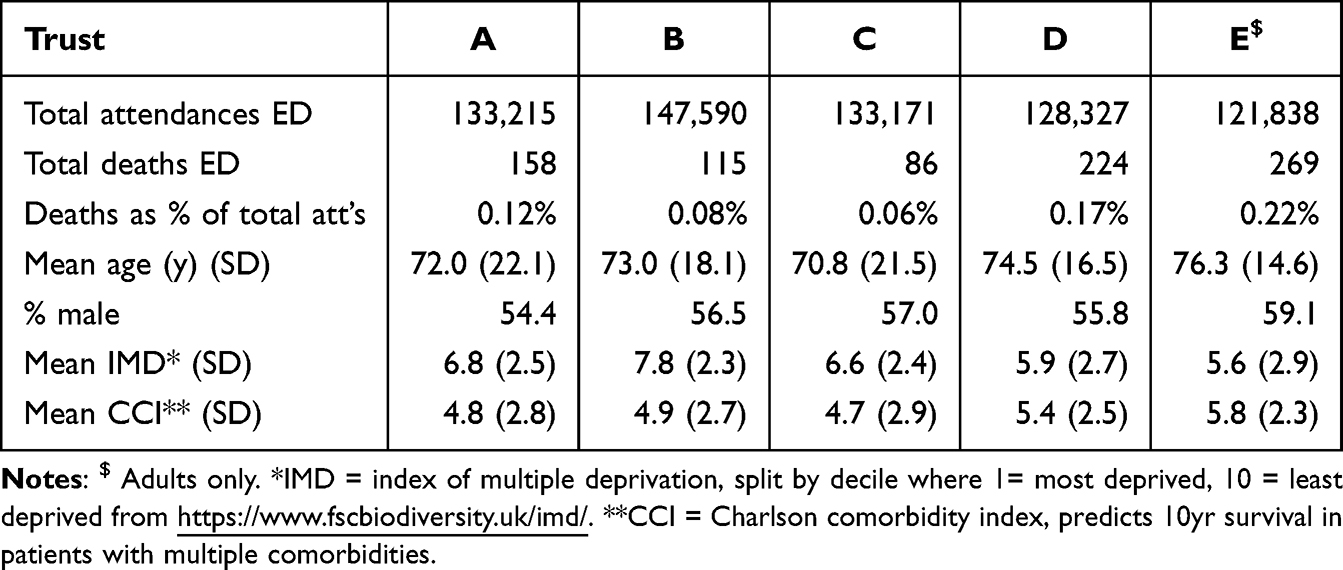 |
Table 1 Site-Based Patient Demographics |
Table 2 shows that in the 3 months prior to death, 25–36% of patients had at least one ED attendance and 22–35% had a hospital admission. There was a wide range between sites (0.4%-25%) of involvement of palliative care services with patients in the ED. There was also a wide range of length of stay in ED across all sites, with 3.5–34.4% spending longer than 12 hours in ED until they died. The overwhelming majority had a medical (rather than surgical or traumatic) cause of death. Between 25–50% arrived in cardiac arrest. A minority had a DNACPR or ReSPECT form prior to arriving in ED. Over two thirds of patients had family present in ED at some point.
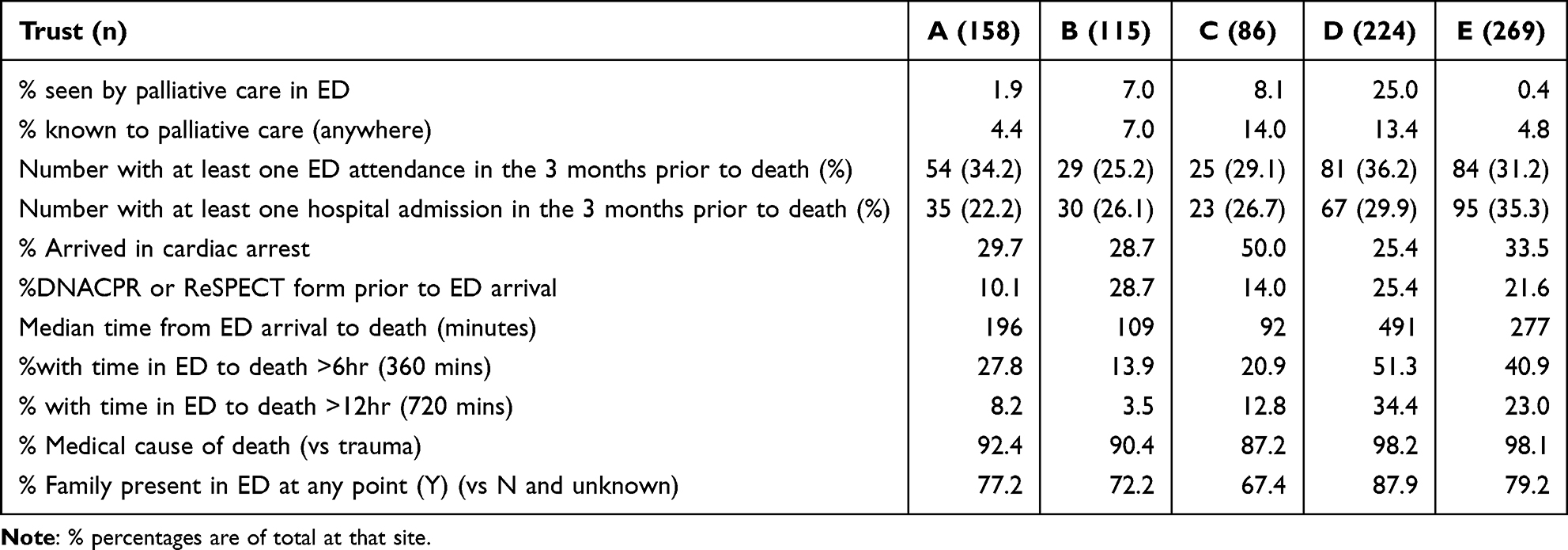 |
Table 2 Results by Site |
Discussion
The Patients
In 2022 43% of deaths in England were in hospital.7 Whilst the number of patients dying in the ED each year is a small proportion of the total number of ED attendances (0.1%) they are a relatively high proportion of the total number of deaths in England (4.4%) and very similar to the annual number of deaths that occur in hospices in England.14 Patients who die in the ED represent a population in need of support both for them and for those important to them, as well as the staff caring for them. Whilst there are many examples of excellence in this area, we suspect that very few patients would choose the ED as their desired location for the place of their death. Despite this, deaths in ED are not generally considered by the wider health system in the UK, as they are specifically excluded from NACEL. This is further compounded by the fact that although they are captured by the Emergency Care Data Set (ECDS) they are not reported as an entity for organisations to review and discuss.
The demographic data recorded demonstrates that the majority of patients who died in the ED were older adults, with a mean CCI associated with a 10-year survival of less than 50%. This suggests that many are not unexpected deaths, at least statistically. Although, in our experience, the likelihood of death for someone with multiple or serious comorbidities does not often appear to have been considered or discussed with patients and those important to them. The vast majority were medical deaths and not deaths from trauma or other causes. The population who died in these five EDs is comparable to that reported by Edwards15 who reviewed all adults who died in a UK major trauma center (a site not included in our service evaluation) over one year and reported that 56% were male with a mean age of 77years. It is also similar to those reported by Elmer et al5 in their retrospective 10-year review of ED deaths in the US where the median age was 72 years and 55.8% were male, and where ED death affected 0.20% of overall ED patients. ED deaths in the US were 11.3% of total deaths from 2010–2019, a greater proportion than in England. In a study of older persons who died within 48 hours of ED triage in Australia and New Zealand,6 of those who died in ED 52.7% were male and 21.1% had a diagnosis of cardiac arrest.
In the 3 months prior to their death, 25–36% of patients had at least one ED attendance or hospital admission. This contrasts with 61% of patients who died in England in 2022 who had at least one emergency admission in the 3 months preceding their death,16 but is similar to that reported by Elmer et al5 where 33.2% of all decedents in the US visited the ED within 1 calendar month of their death. The minority (10–29%) of those included in our dataset had evidence in the notes of a DNACPR or ReSPECT form prior to ED arrival. This suggests that there had been limited previous discussions about a patient’s wishes, expectations for their health, and for end-of-life care, despite potential opportunities for those discussions to occur during a recent hospital admission, ED attendance or in the community. This is echoed by Edwards,15 where 75% of DNACPR forms were written by ED clinicians during their last attendance. Considering only those with DNACPR prior to attendance (as in our data), Edwards found only 14% with prior DNACPR, comparable with the range that we identified. In our data, 25–50% of patients arrived in cardiac arrest, implying that they were receiving active resuscitation at the time of their arrival. Particularly for patients with multiple comorbidities where efficacy of CPR is unlikely there is a need for increased advance care planning discussions across the wider healthcare setting, including ED.
Palliative Care Involvement
We have shown that palliative care input and provision for patients needing end-of-life care in ED is highly variable. The 2022 NACEL data showed that 60% of hospitals had face-to-face specialist palliative care service available for at least 8 hours a day, 7 days a week.17 The proportion of our ED patients with direct palliative care involvement varied hugely (0% to 25%) reflecting the variation in the provision of palliative care across the five EDs but also that patients do not only seek healthcare when specialist services are available. The physical environment of the ED is also not necessarily well suited to palliative care consultations,18 with lack of space, crowding and noise serving to discourage engagement. Would including ED deaths in NACEL encourage collaborative working between palliative care and ED teams? EDs are experiencing ever-increasing pressure from crowding and some patients who died had a long length of stay in the ED. The site with most frequent input from palliative care also had patients with the longest mean length of stay in the ED. It is not possible to explain this from this evaluation nor to imply that there is a causal relationship. Edwards15 noted a long length of stay for some patients who died in ED and commented that “there are significant challenges to moving patients who you think are imminently dying”.
Strengths and Limitations
End-of-life care in ED has been identified as a research priority and this report describes the population affected and the disparity in care between sites. This was a service evaluation from five self-nominated sites and therefore represents a convenience sample that may not be representative beyond these locations. It is entirely reliant on retrospective data extraction from patient records, and any patients who were not usually local to the hospital site they died at would not have data available from previous attendances or admissions. Additionally, data were extracted by different personnel at each site; although a standardised spreadsheet was used by all sites, some variation in interpretation of clinical data is possible.
Our data only represents patients who died in the ED and does not include those who were identified as being at the end of life but who died elsewhere. At the time of this project, recording of ethnicity in the health records was incomplete and so limits the generalisability of this dataset. This has since changed nationally and is now more accurately captured for patients who die.
Conclusion
We have been able to outline the population who died in a convenience sample of five NHS EDs in one year. Palliative care service provision was variable across the EDs during the study period, with only a minority of deaths benefitting from their involvement. Research is needed to not only better understand the patients who die in EDs, but also the variations in care provision, prior DNACPR and ReSPECT form completion and to ascertain how care can be improved for this group of patients, and those important to them. A comparison of services with emergency medicine and palliative care collaboration and those without, in terms of patient, family and staff experience, is also recommended.
Patient and Public Involvement
No patients or public were involved in this service evaluation.
Data Sharing Statement
Data from this project was captured for service evaluation only and therefore is not available for wider use.
Ethics Approval
Service evaluations such as this do not require Research Ethics Committee approval in the UK, as per NHS Health Research Authority guidance. Local institutional approval was obtained for each site in accordance with local policy.
Acknowledgments
We would like to acknowledge the contribution of the following individuals to data collection. Mrs Karen Frost, Advanced Care Practitioner, Dr Fiona Poyner, Emergency Medicine Consultant, Dr Punhiru Udeshika, Emergency Medicine Senior Clinical Fellow, Dr Kanwaljit Dhande, Emergency Medicine Clinical Fellow.
Author Contributions
All authors made a significant contribution to the work reported, whether that is in the conception, study design, execution, acquisition of data, analysis and interpretation, or in all these areas; took part in drafting, revising or critically reviewing the article; gave final approval of the version to be published; have agreed on the journal to which the article has been submitted; and agree to be accountable for all aspects of the work.
Funding
No funding was received for this study.
Disclosure
JD was paid by RCEM for his time to conduct data analysis. The other authors declare no potential conflicts of interest with respect to the research, authorship, and/or publication of this article.
References
1. The national confidential enquiry into patient outcome and death. ‘Planning for the End’ 2024. London. Available from: https://www.ncepod.org.uk/2024eolc.html.
2. National audit of care at the end of life. Available from: https://www.nacel.nhs.uk.
3. Gomes B, Sanguedo B, Lopes S, et al. Dying in the emergency department cannot be ignored. Ann Emergency Med. 2025;86(4):447–6. doi:10.1016/j.annemergmed.2025.04.037
4. Irish medical times. Available from: https://www.imt.ie/news/more-than-5000-ed-deaths-in-past-five-years-07-08-2024/.
5. Elmer J, Mikati N, Arnold RM, et al. Death and end-of-life care in emergency departments in the US. JAMA Network Open. 2022;5(11):e2240399. doi:10.1001/jamanetworkopen.2022.40399
6. Sweeny AL, Alsaba N, Grealish L, et al. The epidemiology of dying within 48 hours of presentation to emergency departments: a retrospective cohort study of older people across Australia and New Zealand. Age Ageing. 2024;53(4):afae067. doi:10.1093/ageing/afae067
7. NHS England. Hospital accident & emergency activity 2022-23. Available from: https://digital.nhs.uk/data-and-information/publications/statistical/hospital-accident--emergency-activity/2022-23.
8. RCEM end of life care toolkit. Available from: https://rcem.ac.uk/wp-content/uploads/2021/10/RCEM_End_of_Life_Care_Toolkit_December_2020_v2.pdf.
9. Cottey L, Shanahan TAG, Gronlund T, et al. On behalf of the James Lind Alliance emergency medicine priority setting partnership refresh steering group. Refreshing the emergency medicine research priorities. Emerg Med J. 2023;40(9):666–670. doi:10.1136/emermed-2022-213019
10. Available from: https://www.nacel.nhs.uk/support-for-qi-old/nacel-2024-key-indicators?rq=2024%20key%20indicators.
11. Index of multiple deprivation. Available from: https://www.gov.uk/government/statistics/english-indices-of-deprivation-2019.
12. ReSPECT form. Available from: https://www.resus.org.uk/respect.
13. Charlson comorbidity index from. Available from: https://www.mdcalc.com/calc/3917/charlson-comorbidity-index-cci#use-cases.
14. Palliative and end of life care factsheet: place of death, England 2022. Available from: https://fingertips.phe.org.uk/profile/end-of-life/supporting-information/factsheets.
15. Edwards S, Ubayasiri N. End-of-life care in a major UK trauma centre. BMJ Support Palliative Care. 2025;16:1–4.
16. Palliative and end of life care factsheet: patterns of care, England 2022. Available from: https://fingertips.phe.org.uk/documents/peolc_patterns_of_care_factsheet_2022.html.
17. Healthcare Quality Improvement Partnership. National audit of care at the end of life, fourth round audit report (2022/23) England and Wales. Available from: https://www.hqip.org.uk/wp-content/uploads/2023/07/Ref.-380-NACEL-2022-Summary-Report-Final.pdf.
18. Foley J, Umana E, Saeed S, et al; on behalf of the Irish Trainee Emergency Research Network (ITERN) Collaborators. Emergency clinician perceptions of end-of-life care in Irish emergency departments: a cross-sectional survey. Emer Med J. 2025;42(5):292–299. doi:10.1136/emermed-2023-213534
 © 2026 The Author(s). This work is published and licensed by Dove Medical Press Limited. The
full terms of this license are available at https://www.dovepress.com/terms
and incorporate the Creative Commons Attribution
- Non Commercial (unported, 4.0) License.
By accessing the work you hereby accept the Terms. Non-commercial uses of the work are permitted
without any further permission from Dove Medical Press Limited, provided the work is properly
attributed. For permission for commercial use of this work, please see paragraphs 4.2 and 5 of our Terms.
© 2026 The Author(s). This work is published and licensed by Dove Medical Press Limited. The
full terms of this license are available at https://www.dovepress.com/terms
and incorporate the Creative Commons Attribution
- Non Commercial (unported, 4.0) License.
By accessing the work you hereby accept the Terms. Non-commercial uses of the work are permitted
without any further permission from Dove Medical Press Limited, provided the work is properly
attributed. For permission for commercial use of this work, please see paragraphs 4.2 and 5 of our Terms.