
Back to Journals » International Journal of Women's Health » Volume 17
Bidirectional Mendelian Randomization Analysis of Mood Disorders and Risk of Preeclampsia-Eclampsia
Authors Zhao C, Chen F, Li Q  , Peng L, Yue C
Received 8 May 2025
Accepted for publication 1 October 2025
Published 8 October 2025 Volume 2025:17 Pages 3557—3565
DOI https://doi.org/10.2147/IJWH.S539218
Checked for plagiarism Yes
Review by Single anonymous peer review
Peer reviewer comments 2
Editor who approved publication: Dr Everett Magann
Chenyang Zhao,1,2,* Fangjun Chen,3,* Qiong Li,1,2 Lixiu Peng,1 Chaoyan Yue4
1Department of Obstetrics and Gynecology, The First People’s Hospital of Chenzhou, Chenzhou, People’s Republic of China; 2Department of Obstetrics and Gynecology, Jinan University, Guangzhou, People’s Republic of China; 3Department of Laboratory Medicine, Zhongshan Hospital, Fudan University, Shanghai, People’s Republic of China; 4Obstetrics & Gynecology Hospital of Fudan University, Shanghai Key Laboratory of Reproduction and Development, Shanghai Key Laboratory of Female Reproductive Endocrine Related Diseases, Shanghai, People’s Republic of China
*These authors contributed equally to this work
Correspondence: Chaoyan Yue, Obstetrics & Gynecology Hospital of Fudan University, Shanghai Key Laboratory of Reproduction and Development, Shanghai Key Laboratory of Female Reproductive Endocrine Related Diseases, Fang Xie Road, No. 419, Shanghai, People’s Republic of China, Email [email protected]
Objective: Mood disorders and preeclampsia-eclampsia (PE) are two major public health problems. The genetic association of the two problems is unclear. We conducted a bidirectional Mendelian randomization (MR) analysis to explore the potential casual relationships between mood disorder subtypes (bipolar disorder, depression, manic/hyper symptoms) and PE.
Methods: Summary statistics for bipolar disorder (7481 cases and 9250 controls), depression (13,559 cases and 435,855 controls), manic/hyper symptoms (3177 cases and 28,140 controls) were derived from IEU open GWAS project. Summary data for PE were obtained from FinnGen consortium (7965 cases and 211,852 controls) and IEU open GWAS project (2355 cases and 264,887 controls). Four methods were applied in our MR analysis, including the inverse variance weighting (IVW), MR-Egger, weighted median and weighted mode. Meta-analysis method was used to assess the combined effect from two independent database. A series of sensitivity analyses were conducted to estimate the robustness of results.
Results: The combined effect from two data sources indicated that there were casual associations between bipolar disorder and PE (OR = 1.15, 95% CI: 1.08– 1.22, P < 0.001), depression and PE (OR = 1.07, 95% CI: 1.01– 1.13, P = 0.01). No significant association was observed between manic/hyper symptoms and PE. Reverse MR analysis demonstrated no casual effect of PE on bipolar disorder, depression or manic/hyper symptoms. Sensitivity analysis confirmed the robustness of the bidirectional MR results.
Conclusion: Our findings provided evidence that bipolar disorder and depression are causally associated with PE.
Keywords: mood disorder, preeclampsia-eclampsia, Mendelian randomization analysis
Introduction
Preeclampsia-eclampsia (PE) is a serious pregnancy complication characterized by new-onset hypertension after 20 weeks of gestation, accompanied by features such as proteinuria, acute kidney injury, and liver function abnormalities.1 PE, as a pregnancy-specific and progressive disorder, has a complex pathogenesis.2–6 So identifying the relative contributions of different risk factors is crucial for risk stratification and early prediction. Mood disorders during pregnancy often co-occur with PE and other complications, posing a significant threat to maternal and infant health.7,8
Mood disorders are a major global public health concern, encompassing a set of complex psychological syndromes that affect cognition, behavior, and emotional regulation.9 The subtypes of mood disorders include bipolar disorder, severe depression, and manic/hypomanic symptoms.10 While often grouped under bipolar disorder, manic/hyper symptoms represent a unique clinical phenotype with distinct neurobiological and physiological profiles.11 Mood disorders may lead to endocrine changes, affecting the secretion of vasoactive hormones, promoting endothelial dysfunction, exacerbating the risk of hypertension, and directly contributing to the occurrence and progression of PE.12–15 Mood disorders may also indirectly increase the risk of PE through unhealthy lifestyles and the avoidance of antenatal care behaviors,16 while increased stress is a significant trigger for hypertension.17 Despite variations in the existing research regarding the association between the two,18–20 the high prevalence of mood disorders and their impact on physiological health cannot be overlooked, as they are the second leading cause of global disability and premature death. Delving deeper into the causal relationship between mental states (such as bipolar disorder and depression) and pregnancy complications can lead to more accurate strategies for the prevention, early identification, and intervention of pregnancy complications, comprehensively protecting the physical and mental health of pregnant women and effectively reducing adverse pregnancy outcomes. However, previous observational studies have inherent limitations that cannot be fully overcome, including susceptibility to confounding, reverse causality, and influence of sample size, which may introduce bias into the results.
To address this issue, Mendelian randomization (MR) can be employed as a method of analysis. MR analysis investigates the cause-and-effect relationship between exposures and outcomes by utilizing genetic variants as instrumental variables (IVs).21 These genetic variations are randomly inherited and are not influenced by external factors, thus minimizing bias and reverse causality commonly found in observational studies.22 By using MR, we can gain a better understanding of the causal relationship between psychiatric disorders and PE.
Methods
Study Design
This study aimed to investigate the potential bidirectional causal relationship between three mood disorders, namely bipolar disorder, depression, manic/hyper symptoms, and the development of PE. To achieve this, a two-sample bidirectional MR analysis was conducted. The MR analysis applied the inverse variance weighted (IVW) method as the main statistical approach. Additionally, secondary methods, including MR-Egger, weighted median, and weighted mode, were utilized to assess the robustness of the results. To further validate the findings, a series of sensitivity analysis methods, such as weighted median, MR-Egger, and MR-PRESSO, were performed. It is important to note that all MR analyses relied on three key assumptions. Firstly, the instrumental variables used, representing genetic variants, needed to exhibit strong correlations with the exposures. Secondly, the genetic variants should be independent of any potential confounding factors. Lastly, it was assumed that the genetic variants influenced the outcomes solely through the exposures.23 The overview of this study design is showed in Figure 1.
 |
Figure 1 Study design of the bidirectional mendelian randomization between three subtypes of mood disorders and preeclampsia-eclampsia. All MR analyses relied on three key assumptions: ① Genetic instruments are associates with exposures; ② Genetic instruments are not related with any confounders; ③ Genetic instruments affect the outcomes only via exposures. “√” indicates that the assumption is satisfied, while “×” indicates that the assumption is not satisfied. The solid line represents an association between the exposure and the outcome, while the dashed line represents no association between the exposure and the outcome. Abbreviations: SNP, single-nucleotide polymorphism; MR, Mendelian randomization. |
Data Sources
Summary-level genetic data for bipolar disorder, depression, and manic/hyper symptoms were obtained from the IEU Open GWAS project (https://gwas.mrcieu.ac.uk/datasets/), which provides publicly available genome-wide association study summary statistics. Specifically, genome-wide association summary statistics for bipolar disorder was collected from a large-scale GWAS including 7481 cases and 9250 controls,24 the association statistics for depression came from a recent study which consisted of 13,559 cases and 435,855 controls,25 the association statistics for manic/hyper symptoms were derived from 3177 cases and 28,140 controls. All disorders were assessed using standard diagnostic criteria.26 Genetic predictors of PE were obtained from the most comprehensive GWAS in FinnGen (R10 version) (https://r10.finngen.fi/pheno/O15_PRE_OR_ECLAMPSIA) consortium including 7965 cases and 211,852 controls and IEU open GWAS project (https://gwas.mrcieu.ac.uk/datasets/) consisting of 2355 cases and 264,887 controls.25 All the PE cases met the criteria for clinical diagnosis. All participant samples in each GWAS were of European ancestry. All the summarized data used in this study are freely accessible and did not require ethical approval. The different traits of the data sources are summarized in Table S1.
Genetic Instrument Selection
First, we selected single-nucleotide polymorphisms (SNPs) associated with bipolar disorder to PE in FinnGen, depression to PE in FinnGen and IEU that reached the genetic-wide significant threshold (P < 5×10⁻⁷) as the preliminary result. But we obtained SNPs related with manic/hyper symptoms to PE in FinnGen at P < 5×10⁻⁵ and SNPs assocciated with bipolar disorder to PE in IEU, manic/hyper symptoms to PE in IEU at P < 5×10⁻⁷. We used SNPs associated with PE from FinnGen to bipolar disorder at P < 5 × 10⁻⁵, depression and manic/hyper symptoms at P < 5×10⁻⁷. But we chosed SNPs related with PE from IEU to bipolar disorder at P < 5 × 10⁻⁷, depression and manic/hyper symptoms at P < 5×10⁻⁶. These adjustments were implemented to ensure an adequate number of IVs for MR analysis, while consisting of the SNPs most significantly associated with the exposures.27 Then, we excluded SNPs in linkage disequilibrium using the PLINK algorithm (r2 threshold < 0.001, window size > 10,000kb).28 Furthermore, we conducted the harmonization of the effect direction to ensure that the effects of the SNPs on exposures and outcomes corresponding to the same effect allele.29 Lastly, we calculated the F statistic of the SNPs to determine their statistical value. SNPs with an F statistic > 10 were identified as robust enough to overcome weak instrument bias.30 All the SNPs applied in this MR analysis of each pair of exposure and outcome are presented in Table S2.
Statistical Analysis
We employed the IVW method as the primary statistical model.31 The IVW random effects method was applied to estimate the association between genetic predisposition for bipolar disorder, depression, manic/hyper symptoms and PE. Other three effective methods including MR-Egger, weighted median and weighted mode were also applied to evaluate the possible relationship comprehensively. To improve the power of statistical tests and refine the estimation of effect sizes, we incorporated outcome data from two distinct data sources (FinnGen and IEU) and conducted a combined meta-analysis using MR method, quantitatively combining the OR values from both data sources. The choice of model was based on prior assumptions about the underlying causal effects, rather than solely on the magnitude of heterogeneity. The random-effects model was selected a priori to account for potential heterogeneity across genetic instruments, as recommended in methodological guidelines.32
Three sensitivity analyses were conducted, including weighted median,33 MR-Egger intercept34 and MR-PRESSO globlal test35 approaches to valid the reliability of our results. Assuming that at least 50% of the SNPs are valid, the weighted median method can yield consistent causal estimates and detect potential heterogeneity.33 The Cochran’s Q value was used to assess the heterogeneity among genetic variations, and heterogeneity was considered when P < 0.05. The MR-Egger intercept were used to test for potential pleiotropy, and an intercept P-value < 0.05 indicated the presence of pleiotropy.34 The MR-PRESSO method was employed to detect outliers and provide causal estimate after the removal of corresponding outliers.35 All analyses were conducting using the TwoSampleMR36 and MR-PRESSO35 packages in R software (version 4.3.0).
Results
Mood Disorders on Risk of PE
Bipolar disorder and depression have been found to increase the risk of PE in the FinnGen consortium (bipolar disorder, IVW: OR = 1.16, 1.09–1.24, P < 0.001; depression, IVW: OR = 1.06, 1.00–1.13, P = 0.048), and the results were similar in the IEU (bipolar disorder, IVW: OR=1.11, 0.95–1.29, P = 0.207; depression, IVW: OR = 1.14, 0.98–1.32, P = 0.101), although the results were not statistically significant (P > 0.05). However, after meta-analysis of the two data sources, the odds ratio of PE was 1.15 (95% CI, 1.08–1.22, P < 0.001) for bipolar disorder and 1.07 (95% CI, 1.01–1.13, P = 0.01) for depression. Manic/hyper symptoms was not related with risk of PE neither in the FinnGen consortium (IVW: OR = 0.86, 0.51–1.46, P = 0.572) nor in the IEU study (IVW: OR = 0.69, 0.24–1.94, P = 0.479) (Figures 2, S1 and Table S3). For these causal estimations, sensitivity analyses suggested that mild heterogeneity existed in the analysis of bipolar disorder on the PE in FinGen, depression and manic/hyper symptoms on the PE in IEU by Cochran’s Q test and funnel plots (Figure S2). We detected pleiotropy in the analysis of depression and manic/hyper symptoms on PE by using MR-Egger intercept and MR-PRESSO (P < 0.05). However, there was no evidence of pleiotropy in the analysis of bipolar disorder and PE from two databases, depression and PE from FinnGen consortium, manic/hyper symptoms and PE from FinnGen consortium both by using MR-Egger intercept and MR-PRESSO (P > 0.05) (Table 1). Leave-one-out analyses suggested that none of the single SNP could drive these causal effects (Figure S3).
 |
Table 1 Sensitivity Analysis of Association of Mood Disorders with Preeclampsia-Eclampsia from Two Databases |
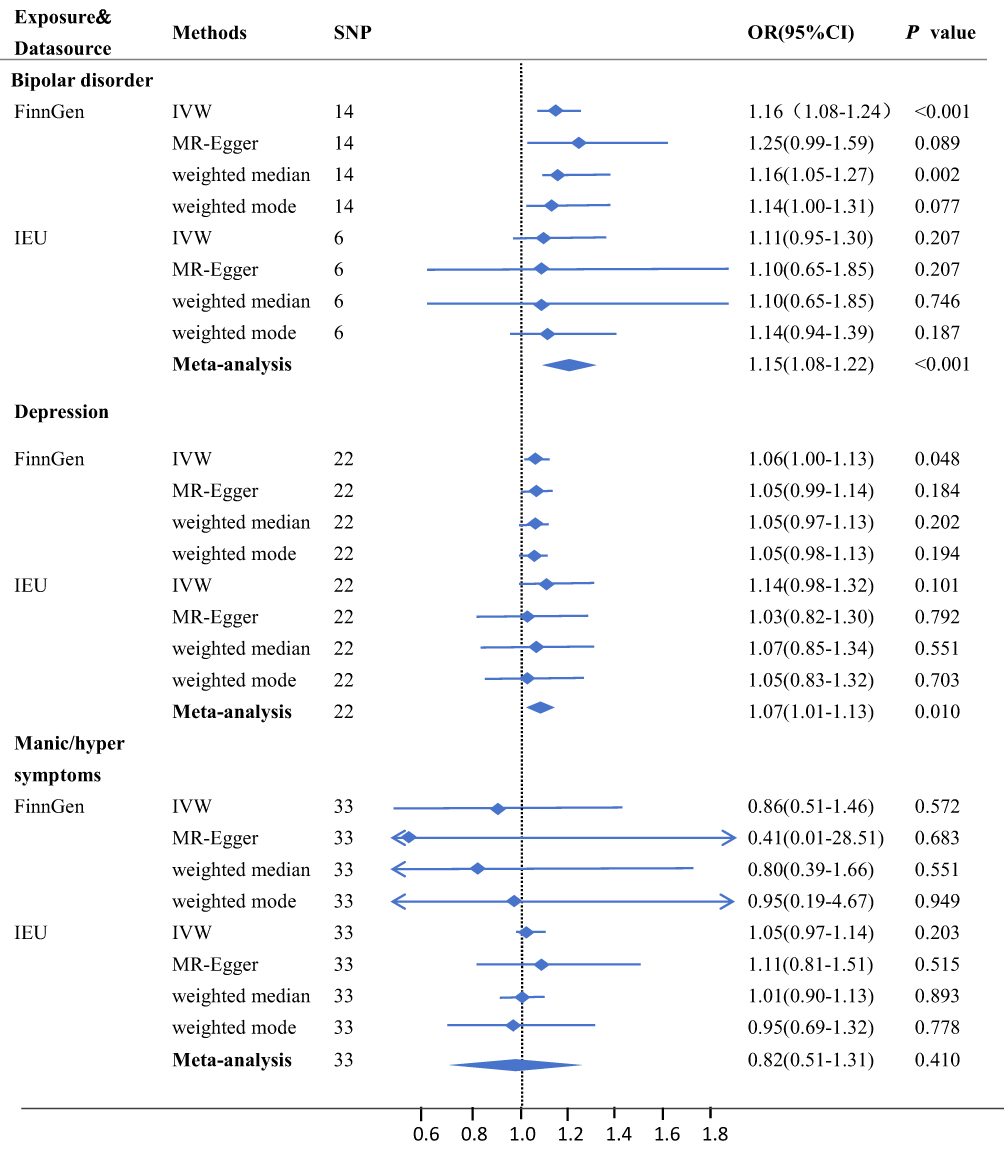 |
Figure 2 Association of three subtypes of mood disorders with risk of preeclampsia-eclampsia. Estimates were obtained from the IVW methods. The final effects were calculated by meta-analysis of the two data sources. Abbreviations: PE, preeclampsia-eclampsia; FinnGen, FinnGen Consortium; IEU, IEU open GWAS project; OR, odds ratio; CI, confidence interval; IVW, inverse variance weighting. |
PE on Risk of Mood Disorders
In reverse MR analysis, our results revealed no significant association between PE with bipolar disorder, depression or manic/hyper symptoms across all MR methods (Figures 3, S4 and Table S4). Cochran’s Q test and funnel plots (Figure S5) suggested minimal evidence of heterogeneity in the association between PE and the risk of psychiatric disorders. Moreover, MR-Egger intercept and MR-PRESSO indicated the absence of potential horizontal pleiotropy (Table 2). The leave-one-out analysis also demonstrated the stability of the results (Figure S6).
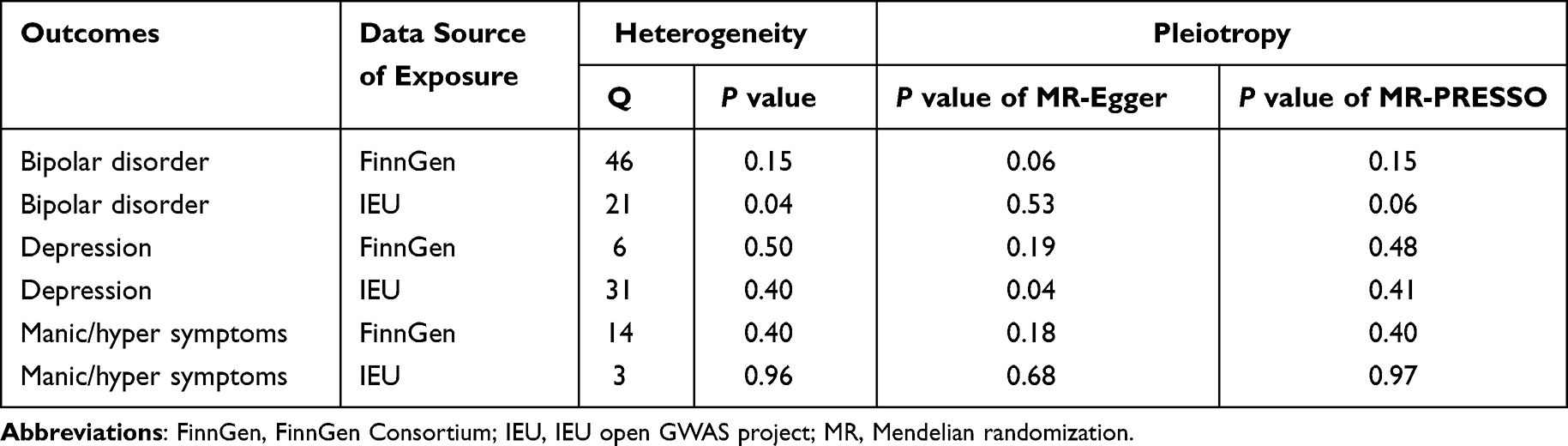 |
Table 2 Sensitivity Analysis of Association of Preeclampsia-Eclampsia from Two Databases with Three Subtypes of Mood Disorders |
 |
Figure 3 Association of preeclampsia-eclampsia with risk of three subtypes of mood disorders. Estimates were obtained from the IVW methods. The final effects were calculated by meta-analysis of the two data sources. Abbreviations: PE, preeclampsia-eclampsia; FinnGen, FinnGen Consortium; IEU, IEU open GWAS project; OR, odds ratio; CI, confidence interval; IVW, inverse variance weighting. |
Discussion
The current MR analysis investigated the causal effect of bipolar disorder, depression and manic/hyper symptoms on the risk of PE in a combined sample of 10,320 cases and 476,739 controls. Our study is the first to explore the causal association between bipolar disorder, depression or manic/hyper symptoms and PE. Bipolar disorder was found to increase the risk of PE, showing a 15% higher likelihood of PE occurrence (OR, 1.15, 95% CI, 1.08–1.22). Similarly, depression was also linked to an increased risk of PE, with a 7% higher chance of PE (OR, 1.07, 95% CI: 1.01–1.13). However, no causal effect was observed between manic/hyper symptoms and PE. Furthermore, reverse MR analysis showed that PE had no significant association with bipolar disorder, depression or manic/hyper symptoms.
The casual relationships between bipolar disorder, depression and PE may be explained by several underlying mechanisms. Firstly, bipolar disorder and depression during pregnancy may alter the excretion of vasoactive hormones or other neuroendocrine transmitters,12 which in turn increases the risk of hypertension and subsequently PE.13 It is also possible that depression may cause such vascular changes through dysregulated hormones and eventually lead to preeclampsia. Secondly, bipolar disorder and depression and PE share common risk factors. It is possible that bipolar disorder and depression lead to poor health behaviors such as smoking, poor sleep hygiene, physical inactivity, and unhealthy nutritional patterns, increasing the risk of adverse outcomes and making it less likely for individuals to seek prenatal care.16 These factors contribute to the occurrence and development of PE. Thirdly, biomarkers of endothelial dysfunction, including circulating endothelial cells, endothelial progenitor cells, and soluble vascular cell adhesion molecules are elevated in patients with depression.14 Biological markers of endothelial injury, such as urotensin-II and endocan are significantly higher in blood of bipolar disorder patients than in that of controls.15 Endothelial dysfunction is a major pathomechanism of preeclampsia. Lastly, bipolar disorder and depression may be caused by increased stress, which may in turn increase blood pressure, cause vasoconstriction, decrease uterine blood flow and fetal hypoxia, and increase the risk of PE.17
Our findings about the casual effects of bipolar disorder and depression on PE have clinical significance. Our study may open some discussion and the potential psychology-neurology-immunology-endocrinological approach in PE research. Some practical aspects can be taken on board. For example, assessment of the maternal mental health during pregnancy plays an important role in the management of the preconception stage and can help stratify the risk of PE and identify high-risk individuals. Healthcare professionals should pay more attention to the pregnant women who have bipolar disorder and depression, and take early medical intervention to prevent the development of PE. However, all of this will require further studies to confirm the findings.
This study has several strengths, including the MR design, which strengthens the causal inference in the associations between depression, bipolar disorder and the risk of PE. Additionally, we challenged the conventional view that gestational hypertension disorders increase risk of mood disorders. The study was conducted on two independent populations, and the consistent results confirmed the robustness of the results. However, there are limitations to consider. Firstly, although the studied population was limited to individuals of European ancestry to reduce population bias, this limits the generalizability of the findings to other populations. Secondly, the p-value threshold was set at different levels to include sufficient SNPs to maintain study power, but the study had no weak instrumental variables according to the F statistics > 10. Thirdly, to ensure sufficient instrumental variables for analysis, we did use less stringent p-value thresholds (including p < 5×10⁻⁷, p < 5×10⁻⁶, and p < 5×10⁻⁵) for SNP selection in certain exposure datasets where instrument availability was limited. We clarify that while these relaxed thresholds helped improve instrument strength and statistical power, they also carry a trade-off in terms of potential validity, and our results should be interpreted with this consideration in mind. Finally, MR analysis examines the impact of lifetime exposure on outcomes and the effect sizes observed in MR analyses may differ from those of short-term interventions evaluated in randomized controlled trials. Further researches are needed to address the limitations of this study, including larger and more diverse datasets, replication studies, and a multidisciplinary approach involving functional studies, genetic investigations, and clinical trials to investigate the mechanisms underlying the influence of mood disorders on PE. These efforts may provide insights into potential prevention and treatment strategies.
Conclusion
In conclusion, this MR study provides genetic evidence supporting a potential causal link between bipolar disorder, depression, and PE, offering new insights into the pathophysiological mechanisms underlying PE. While MR strengthens causal inference compared to observational studies, it suggests causality. These findings highlight the importance of assessing maternal mental health during pregnancy, which may help identify women at higher risk of PE and inform early preventive strategies. However, further research in more diverse populations is needed to confirm these associations and evaluate their generalizability across different ancestries and clinical settings.
Ethical Approval and Informed Consent
Our institution (Ethics Committee of Chenzhou First People’s Hospital) has determined that this research is exempt from review by the Institutional Review Board (IRB) or ethics committee in accordance with national guidelines, specifically Article 32, Items 1 and 2, of the Measures for Ethical Review of Life Science and Medical Research Involving Human Subjects (February 18, 2023, China), which state that studies using anonymized or publicly available data without personal identifiers are exempt from ethical review.
Acknowledgments
We also thank the FinnGen study, the IEU open GWAS project for sharing data.
Funding
The study is supported by the Public Data Pool of Medical Collaboration between the First People’s Hospital of Chenzhou and the Tenth People’s Hospital of Shanghai (2023-08) and Natural Science Foundation of Shanghai Basic Research Program (25ZR1402039).
Disclosure
The authors declared that they have no conflicts of interest in this work.
References
1. Brown MA, Magee LA, Kenny LC, et al. Hypertensive disorders of pregnancy: ISSHP classification, diagnosis, and management recommendations for international practice. Hypertension. 2018;72(1):24–43. doi:10.1161/HYPERTENSIONAHA.117.10803
2. Staff AC, Fjeldstad HE, Fosheim IK, et al. Failure of physiological transformation and spiral artery atherosis: their roles in preeclampsia. Am J Clin Exp Obstet Gynecol. 2022;226(2s):S895–s906. doi:10.1016/j.ajog.2020.09.026
3. Opichka MA, Rappelt MW, Gutterman DD, Grobe JL, McIntosh JJ. Vascular dysfunction in preeclampsia. Cells. 2021;10(11):3055. doi:10.3390/cells10113055
4. Guerby P, Tasta O, Swiader A, et al. Role of oxidative stress in the dysfunction of the placental endothelial nitric oxide synthase in preeclampsia. Redox Biol. 2021;40:101861. doi:10.1016/j.redox.2021.101861
5. Luo F, Yue J, Li L, Mei J, Liu X, Huang Y. Narrative review of the relationship between the maternal-fetal interface immune tolerance and the onset of preeclampsia. Ann Transl Med. 2022;10(12):713. doi:10.21037/atm-22-2287
6. Ying W. Phenomic studies on diseases: potential and challenges. Phenomics. 2023;3(3):285–299. doi:10.1007/s43657-022-00089-4
7. Pearlstein T. Depression during Pregnancy. Best Pract Res Clin Obstet Gynaecol. 2015;29(5):754–764. doi:10.1016/j.bpobgyn.2015.04.004
8. Jones I, Chandra PS, Dazzan P, Howard LM. Bipolar disorder, affective psychosis, and schizophrenia in pregnancy and the post-partum period. Lancet. 2014;384(9956):1789–1799. doi:10.1016/S0140-6736(14)61278-2
9. Charlson F, van Ommeren M, Flaxman A, Cornett J, Whiteford H, Saxena S. New WHO prevalence estimates of mental disorders in conflict settings: a systematic review and meta-analysis. Lancet. 2019;394(10194):240–248. doi:10.1016/S0140-6736(19)30934-1
10. Lommatzsch M, Brusselle GG, Levy ML, et al. A(2)BCD: a concise guide for asthma management. Lancet Respir Med. 2023;11(6):573–576. doi:10.1016/S2213-2600(22)00490-8
11. James SL, Abate D, Abate KH, et al. Global, regional, and national incidence, prevalence, and years lived with disability for 354 diseases and injuries for 195 countries and territories, 1990–2017: a systematic analysis for the Global Burden of Disease Study 2017. Lancet. 2018;392(10159):1789–1858. doi:10.1016/S0140-6736(18)32279-7
12. Paarlberg KM, Vingerhoets AJ, Passchier J, Dekker GA, Van Geijn HP. Psychosocial factors and pregnancy outcome: a review with emphasis on methodological issues. J Psychosom Res. 1995;39(5):563–595. doi:10.1016/0022-3999(95)00018-6
13. Sullivan P, Schoentgen S, DeQuattro V, et al. Anxiety, anger, and neurogenic tone at rest and in stress in patients with primary hypertension. Hypertension. 1981;3(6 Pt 2):Ii–119–123. doi:10.1161/01.HYP.3.6_Pt_2.II-119
14. Lopez-Vilchez I, Diaz-Ricart M, Navarro V, et al. Endothelial damage in major depression patients is modulated by SSRI treatment, as demonstrated by circulating biomarkers and an in vitro cell model. Transl Psychiatry. 2016;6(9):e886. doi:10.1038/tp.2016.156
15. Oral E, Halici Z, Cinar I, Ozcan E, Kutlu Z. Evaluation of endothelial dysfunction in bipolar affective disorders: serum endocan and Urotensin-II levels. Clin Psychopharmacol Neurosci. 2019;17(2):211–221. doi:10.9758/cpn.2019.17.2.211
16. Chen CH, Lin HC. Prenatal care and adverse pregnancy outcomes among women with depression: a nationwide population-based study. Can J Psychiatry. 2011;56(5):273–280. doi:10.1177/070674371105600506
17. Holzman C, Bullen B, Fisher R, Paneth N, Reuss L. Pregnancy outcomes and community health: the POUCH study of preterm delivery. Paediatr Perinat Epidemiol. 2001;15(Suppl 2):136–158. doi:10.1046/j.1365-3016.2001.00014.x
18. Kharaghani R, Geranmaye M, Janani L, et al. Preeclampsia and depression: a case-control study in Tehran. Arch Gynecol Obstet. 2012;286(1):249–253. doi:10.1007/s00404-012-2260-3
19. Vollebregt KC, van der Wal MF, Wolf H, Vrijkotte TG, Boer K, Bonsel GJ. Is psychosocial stress in first ongoing pregnancies associated with pre-eclampsia and gestational hypertension? BJOG. 2008;115(5):607–615. doi:10.1111/j.1471-0528.2008.01665.x
20. Mohamed MA, Elhelbawy A, Khalid M, AbdAllatif LA, Lialy HE. Effects of bipolar disorder on maternal and fetal health during pregnancy: a systematic review. BMC Pregnancy Childbirth. 2023;23(1):617. doi:10.1186/s12884-023-05924-8
21. Davey Smith G, Hemani G. Mendelian randomization: genetic anchors for causal inference in epidemiological studies. Hum Mol Genet. 2014;23(R1):R89–98. doi:10.1093/hmg/ddu328
22. Sleiman PM, Grant SF. Mendelian randomization in the era of genomewide association studies. Clin Chem. 2010;56(5):723–728. doi:10.1373/clinchem.2009.141564
23. Emdin CA, Khera AV, Kathiresan S. Mendelian Randomization. JAMA. 2017;318(19):1925–1926. doi:10.1001/jama.2017.17219
24. Sklar P, Ripke S, Scott LJ. Large-scale genome-wide association analysis of bipolar disorder identifies a new susceptibility locus near ODZ4. Nat Genet. 2011;43(10):977–983. doi:10.1038/ng.943
25. Sakaue S, Kanai M, Tanigawa Y, et al. A cross-population atlas of genetic associations for 220 human phenotypes. Nat Genet. 2021;53(10):1415–1424. doi:10.1038/s41588-021-00931-x
26. Janca A, Hiller W. ICD-10 checklists--a tool for clinicians’ use of the ICD-10 classification of mental and behavioral disorders. Compr Psychiatry. 1996;37(3):180–187. doi:10.1016/S0010-440X(96)90034-6
27. Swerdlow DI, Kuchenbaecker KB, Shah S, et al. Selecting instruments for Mendelian randomization in the wake of genome-wide association studies. Int J Epidemiol. 2016;45(5):1600–1616. doi:10.1093/ije/dyw088
28. Shim H, Chasman DI, Smith JD, et al. A multivariate genome-wide association analysis of 10 LDL subfractions, and their response to statin treatment, in 1868 Caucasians. PLoS One. 2015;10(4):e0120758. doi:10.1371/journal.pone.0120758
29. Chen X, Kong J, Pan J, et al. Kidney damage causally affects the brain cortical structure: a Mendelian randomization study. EBioMedicine. 2021;72:103592. doi:10.1016/j.ebiom.2021.103592
30. Lawlor DA, Harbord RM, Sterne JA, Timpson N, Davey Smith G. Mendelian randomization: using genes as instruments for making causal inferences in epidemiology. Stat Med. 2008;27(8):1133–1163. doi:10.1002/sim.3034
31. Burgess S, Butterworth A, Thompson SG. Mendelian randomization analysis with multiple genetic variants using summarized data. Genet Epidemiol. 2013;37(7):658–665. doi:10.1002/gepi.21758
32. Nikolakopoulou A, Mavridis D, Salanti G. How to interpret meta-analysis models: fixed effect and random effects meta-analyses. Evid Based Ment Health. 2014;17(2):64. doi:10.1136/eb-2014-101794
33. Bowden J, Davey Smith G, Haycock PC, Burgess S. Consistent estimation in Mendelian randomization with some invalid instruments using a weighted median estimator. Genet Epidemiol. 2016;40(4):304–314. doi:10.1002/gepi.21965
34. Bowden J, Davey Smith G, Burgess S. Mendelian randomization with invalid instruments: effect estimation and bias detection through Egger regression. Int J Epidemiol. 2015;44(2):512–525. doi:10.1093/ije/dyv080
35. Verbanck M, Chen CY, Neale B, Do R. Detection of widespread horizontal pleiotropy in causal relationships inferred from Mendelian randomization between complex traits and diseases. Nat Genet. 2018;50(5):693–698. doi:10.1038/s41588-018-0099-7
36. Hemani G, Zheng J, Elsworth B, et al. The MR-Base platform supports systematic causal inference across the human phenome. eLife. 2018;7. doi:10.7554/eLife.34408
 © 2025 The Author(s). This work is published and licensed by Dove Medical Press Limited. The
full terms of this license are available at https://www.dovepress.com/terms
and incorporate the Creative Commons Attribution
- Non Commercial (unported, 4.0) License.
By accessing the work you hereby accept the Terms. Non-commercial uses of the work are permitted
without any further permission from Dove Medical Press Limited, provided the work is properly
attributed. For permission for commercial use of this work, please see paragraphs 4.2 and 5 of our Terms.
© 2025 The Author(s). This work is published and licensed by Dove Medical Press Limited. The
full terms of this license are available at https://www.dovepress.com/terms
and incorporate the Creative Commons Attribution
- Non Commercial (unported, 4.0) License.
By accessing the work you hereby accept the Terms. Non-commercial uses of the work are permitted
without any further permission from Dove Medical Press Limited, provided the work is properly
attributed. For permission for commercial use of this work, please see paragraphs 4.2 and 5 of our Terms.