
Back to Journals » Psychology Research and Behavior Management » Volume 19
Bedtime Procrastination and Attention as Serial Mediators Between Premenstrual Syndrome and Test Anxiety in Nursing College Students: A Multicenter Cross-Sectional Study

Received 27 April 2026
Accepted for publication 15 June 2026
Published 21 July 2026 Volume 2026:19 620453
DOI https://doi.org/10.2147/PRBM.S620453
Checked for plagiarism Yes
Review by Single anonymous peer review
Peer reviewer comments 2
Editor who approved publication: Dr Gabriela Topa
Yanran Li,1 Min Liu,2 Cheng Ji3
1Nursing Department, College of Nursing and Rehabilitation, Nantong University, Nantong, Jiangsu, People’s Republic of China; 2Examinations and Academic Services Department, People’s Medical Publishing House Science and Technology Innovation Cultural Development (Beijing) Co., Ltd., Beijing, People’s Republic of China; 3Nursing Teaching and Research Office Department, Nantong Institute of Technology, Nantong, Jiangsu, People’s Republic of China
Correspondence: Cheng Ji, Email [email protected]
Objective: Based on the Theory of Unpleasant Symptoms (TOUS), this study aimed to examine the relationship between premenstrual syndrome (PMS) and test anxiety among nursing college students, and to explore the serial mediating roles of bedtime procrastination and attention in this association.
Methods: A multicenter cross-sectional survey was conducted among 791 female nursing students from eight medical and health vocational colleges in China. Participants completed the General Information Questionnaire, Premenstrual Syndrome Scale (PSS), Bedtime Procrastination Scale (BPS), Multi-Dimensional Attention Rating Scale (MARS), and Test Anxiety Scale (TAS). Pearson correlation analysis, multiple linear regression, and structural equation modeling with 5,000 bootstrap resamples were performed.
Results: Mean scores of PSS, BPS, MARS, and TAS were 6.26± 4.85, 27.38 ± 6.022, 35.91± 4.47, and 18.42± 7.96, respectively. PMS was positively associated with bedtime procrastination and test anxiety and negatively associated with attention (all P< 0.001). Multiple linear regression identified bottled drink intake frequency, menstrual cycle, thinking/feeling personality type, only-child status, PMS, bedtime procrastination, and attention as significant predictors of test anxiety (P< 0.05). Structural equation modeling showed that PMS had a significant direct effect on test anxiety (β=0.20, 95% CI: 0.12– 0.28). Bedtime procrastination and attention significantly mediated this association, including a serial mediation pathway (β=0.03, 95% CI: 0.01– 0.06). The total indirect effect accounted for 50% of the total effect.
Conclusion: PMS was associated with test anxiety among nursing students, both directly and indirectly through the serial mediating roles of bedtime procrastination and attention. Within the TOUS framework, these findings advance understanding of the physiological–behavioral–cognitive pathway underlying test anxiety and suggest potential intervention targets for improving mental health among nursing students.
Keywords: premenstrual syndrome, test anxiety, bedtime procrastination, attention, serial mediation, nursing students, theory of unpleasant symptoms
Introduction
The World Health Organization (WHO) Mental Health Action Plan 2013–2030 emphasizes that the promotion of mental health and the prevention of mental disorders have become core global public health priorities. Through multisectoral collaboration, including the education sector, mental health promotion and prevention strategies are being implemented in schools and higher education institutions to address risk factors such as examination pressure and academic burden. In the context of highly competitive higher vocational education, intensive clinical practice, and frequent examinations, test anxiety has become a common psychological stress response and is particularly prominent among nursing students. Previous reports indicate a relatively high prevalence of test anxiety among nursing college students in China, especially before clinical skill assessments, theoretical examinations, and the National Nurse Licensing Examination. Compared with students from many other academic disciplines, nursing students are exposed to a unique combination of academic, clinical, and professional demands. In addition to preparing for theoretical examinations, they must complete clinical placements, competency-based skill assessments, and licensure examination preparation while adapting to patient-care responsibilities. These concurrent demands may increase psychological stress, disrupt sleep patterns, and heighten vulnerability to examination-related anxiety.
Test anxiety is characterized by excessive worry, physiological arousal, and cognitive interference before or during examinations. It not only impairs academic performance and professional adaptation but may also lead to long-term mental health consequences such as chronic stress, sleep disturbances, and reduced quality of life. Among the multiple factors influencing test anxiety, the interaction between physiological processes and psychological mechanisms has received increasing attention. Hormonal fluctuations across the menstrual cycle in female individuals may alter emotional regulation and cognitive functioning, thereby modifying stress response patterns.
Previous studies have shown that nursing students with premenstrual syndrome (PMS) report significantly higher anxiety levels than those without PMS (OR = 1.094, p < 0.001), and that higher PMS severity is associated with increased anxiety risk.1 Although the direct association between PMS and test anxiety has been established, the underlying mechanisms remain unclear. Sleep, as a fundamental biological basis of emotional regulation, may play a key mediating role between PMS and anxiety. Multiple cross-sectional studies among nursing students have demonstrated a significant negative association between PMS symptom severity and sleep quality.2–4 Poor sleep quality may further weaken self-regulatory capacity and increase the likelihood of bedtime procrastination. As a typical form of sleep-related self-regulation failure, bedtime procrastination exacerbates insufficient sleep and negatively affects cognitive functioning, including attentional deficits and reduced working memory capacity.5
Impaired attentional function is considered a core cognitive mechanism underlying test anxiety. Individuals with high test anxiety tend to exhibit attentional bias toward threat-related information, showing a preference for negative cues associated with examination failure and difficulty disengaging from such information, which contributes to persistent worry cycles.6 In addition, bedtime procrastination may further amplify anxiety responses through cumulative sleep deprivation and impaired emotion regulation capacity. Longitudinal evidence also supports stable associations among procrastination, poor sleep quality, and test anxiety.7
The Theory of Unpleasant Symptoms (TOUS) provides the theoretical framework for this study. Developed by Lenz and colleagues, TOUS posits that unpleasant symptoms (e.g, physical discomfort and emotional distress) are jointly determined by physiological, psychological, and situational factors. These symptoms do not occur in isolation but influence functional performance—including physiological function, cognitive performance, and social role functioning—through multiple direct and indirect pathways.8 Specifically, within the symptom–performance framework of TOUS, PMS as a cluster of menstrual-related unpleasant symptoms—characterized by hormonal fluctuations leading to emotional irritability and fatigue—may interact with high-stress academic contexts such as examinations. This interaction may reduce behavioral self-regulation, increase bedtime procrastination, contribute to chronic sleep insufficiency, and subsequently impair attentional functioning, thereby forming a potential serial pathway associated with higher levels of test anxiety as a negative functional outcome.
Although previous research has confirmed the direct association between PMS and test anxiety as well as the single mediating role of sleep quality, most studies are limited to cross-sectional designs or single-variable analyses. Few have explored mechanisms specific to nursing students experiencing dual pressures from clinical practice and academic examinations. This study, therefore, innovatively applies the TOUS framework to examine the serial mediating roles of attention and bedtime procrastination in the relationship between PMS and test anxiety.
The theoretical contribution of this study lies in extending and validating the applicability of TOUS in explaining the interaction between physiological symptoms and psychological stress among nursing students. It systematically elucidates how physiological symptoms are transformed into academic stress outcomes through dual mediating pathways involving modifiable behavioral self-regulation and cognitive functioning, providing a novel theoretical perspective for the development of symptom management frameworks. From a practical perspective, the findings provide actionable implications for nursing education institutions. Targeted interventions focusing on attention training and improvement of sleep-related behaviors among students with PMS may effectively reduce test anxiety, improve sleep quality and academic performance, and enhance clinical adaptability and future occupational psychological resilience. Furthermore, such interventions may help reduce the risk of impaired clinical decision-making and burnout associated with examination-related anxiety, thereby mitigating the health burden caused by physiological–psychological interactions in nursing students at the source.
Materials and Methods
Study Design and Participants
This study was a multicenter cross-sectional survey. Data were collected using a questionnaire administered by trained researchers. A convenience sampling method was used to recruit nursing students from eight medical and health vocational colleges in China between March 2026 and April 2026. All participants were expected to graduate in June 2026. Inclusion criteria were as follows: full-time nursing junior college students; aged ≥18 years; female; able to understand and independently complete the questionnaire; and willing to participate and provide written informed consent. Exclusion criteria included: diagnosis of severe psychiatric disorders or cognitive impairment; current use of hormonal therapy or presence of severe gynecological organic diseases; and use of medications affecting mood, sleep, or attention within the past three months. Elimination criteria were defined as: completion time <5 minutes or >20 minutes; incomplete questionnaires; or responses with obvious logical inconsistencies.
This study was approved by the Ethics Review Committee of the Affiliated Hospital of Nantong University (Approval No. 2023-K164-01). A standardized instruction was provided to explain the study purpose, significance, procedures, and questionnaire completion requirements in detail. After providing written informed consent, participants completed the questionnaire independently in a quiet and isolated classroom environment to minimize external interference and ensure data authenticity. Upon completion, questionnaires were collected immediately by the researchers, and invalid responses were excluded after screening. Clinical trial number: not applicable.
Sample size was estimated using the rule proposed by Kendall,9 which suggests that the required sample size should be 5–10 times the number of independent variables, with an additional 20% allowance for non-response or invalid questionnaires. The sample size was calculated as: N = [number of independent variables × (5–10)] × (1 + 20%). Based on 23 independent variables, the required sample size ranged from 138 to 276 participants. Ultimately, a total of 791 nursing students were included in this study.
Research Tools
General Information Questionnaire
The General Information Questionnaire was developed by the researchers and included demographic information, menstrual-related factors, lifestyle factors, and internship-related characteristics. Demographic variables included body mass index (BMI), place of residence, and only-child status. Menstrual-related variables included age at menarche, menstrual cycle regularity, menstrual flow, menstrual duration, history of chronic disease, and dysmenorrhea history. Lifestyle-related variables included alcohol use frequency, exercise frequency, and smoking frequency. Internship-related variables included total duration of clinical internship and night shift frequency.
Premenstrual Syndrome Scale (PSS)
Premenstrual syndrome was assessed using the PSS. This is a unidimensional scale developed based on the diagnostic criteria of premenstrual syndrome proposed by John Bancroft. The scale consists of 12 items. Participants were asked to report whether they experienced related symptoms during the 14 days prior to their most recent menstruation, with responses scored on a 0–3 Likert scale according to symptom severity. The total score is calculated by summing all item scores, with a score >6 indicating the presence of premenstrual syndrome.10 Previous studies have demonstrated good reliability and validity of this scale among Chinese student populations.11 In the present study, Cronbach’s α was 0.902.
Bedtime Procrastination Scale (BPS)
Bedtime procrastination behavior was measured using the BPS, developed by Kroese et al in 2014 to assess the tendency to voluntarily delay bedtime without external constraints.12 The scale consists of a single-factor structure with 9 items, including 4 reverse-scored items, rated on a 5-point Likert scale. Total scores range from 9 to 45, with higher scores indicating more severe bedtime procrastination. The scale has demonstrated good reliability and validity in Chinese student populations.13 In this study, Cronbach’s α was 0.806.
Multi-Dimensional Attention Rating Scale (MARS)
Attention was assessed using the MARS, developed and preliminarily validated by Zhang X.Y. et al.14 This scale quantitatively evaluates attention across multiple dimensions in daily life and academic contexts and sensitively captures both overall attention level and domain-specific impairments. It contains 6 dimensions and 12 items, scored on a 5-point Likert scale, with total scores ranging from 12 to 60. Higher scores indicate better attentional function. Previous studies have shown good reliability and validity in highly educated populations.14 In the present study, Cronbach’s α was 0.640. To further evaluate its construct validity in the current sample, exploratory factor analysis was conducted after confirming sampling adequacy (KMO = 0.891) and Bartlett’s test of sphericity (χ2 = 4135.114, P < 0.001). The results showed that most items loaded strongly on a single factor (factor loadings: 0.520–0.764), supporting a unidimensional structure. Therefore, the total MARS score was used as a global indicator in subsequent analyses and included in the serial mediation model to improve measurement stability and interpretability.
Test Anxiety Scale (TAS)
Test anxiety was measured using the TAS, revised by Sarason in 1978. The scale assesses individuals’ anxiety responses in examination situations, including worry, tension, physiological arousal, and cognitive interference, and reflects anxiety across pre-exam, during-exam, and post-exam stages. The scale has a unidimensional structure and consists of 37 dichotomous items (yes/no), with total scores ranging from 0 to 37. Higher scores indicate more severe test anxiety.15 Previous research has demonstrated good reliability and validity in Chinese student populations.16 In this study, Cronbach’s α was 0.890.
Statistical Analysis
All data were analyzed using SPSS 29.0, RStudio, and AMOS 29.0. Normality tests were performed for demographic variables and all scale scores. Continuous variables that followed a normal distribution were presented as mean ± standard deviation, while categorical variables were described as frequencies and percentages. Independent-samples t-tests and one-way analysis of variance (one-way ANOVA) were used to compare differences in test anxiety scores across groups, and boxplots were used to visually display group differences. Pearson correlation analysis was conducted to examine the relationships among the total scores and dimensions of premenstrual syndrome, test anxiety, multidimensional attention, and sleep procrastination. Scatter plot matrices were used to visually present the correlation results. Variables that showed statistical significance in the univariate analysis were entered into a multiple linear regression model to identify factors influencing test anxiety. The results were visualized using a forest plot. Furthermore, bootstrap analysis was performed to examine the serial mediating effect of sleep procrastination and attention on the relationship between premenstrual syndrome and test anxiety. All statistical tests were two-tailed, with a significance level set at α = 0.05. A P value < 0.05 was considered statistically significant.
Results
Descriptive Statistics and Normality Assessment of the Main Study Variables
This study used SPSS software to perform descriptive statistics and normality testing for all scale scores. As shown in Table 1, the scores of PSS, MARS, TAS, and BPS were 6.26 ± 4.85, 35.91 ± 4.47, 18.42 ± 7.96, and 27.38 ± 6.022, respectively. The skewness values were 0.51, 0.23, 0.17, and 0.264, and the kurtosis values were −0.24, 0.69, −1.08, and 0.33, respectively. According to Kline’s criteria, when the absolute values of skewness are less than 3 and the absolute values of kurtosis are less than 10, the data can be considered approximately normally distributed in statistical terms.17 Therefore, all study variables satisfied the assumption of normality and could be directly used for subsequent statistical analyses and structural equation modeling.
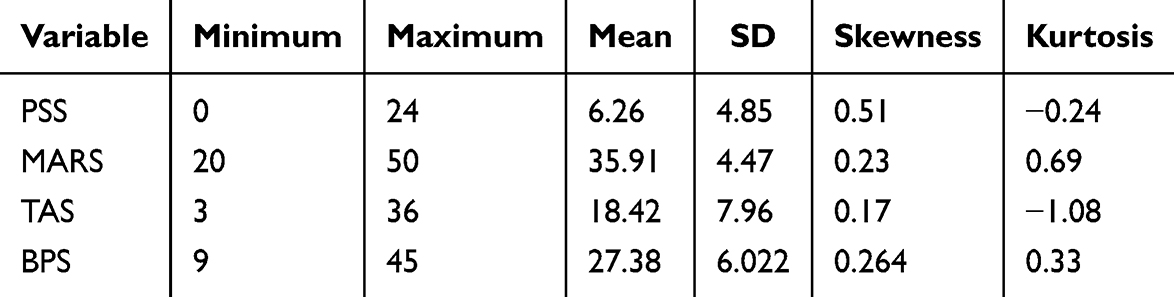 |
Table 1 Descriptive Statistics and Normality Assessment of the Main Study Variables |
Univariate Analysis of Test Anxiety
The univariate analysis results (Table 2) showed that, among demographic factors, only-child students had significantly higher test anxiety scores than non-only-child students (t = 2.646, P = 0.008). Regarding health-related factors, students with a history of chronic disease reported significantly higher test anxiety scores than those without such history (t = −2.032, P = 0.043). In terms of personality traits, introverted (I-type) students had significantly higher test anxiety scores than extroverted (E-type) students (t = −2.903, P = 0.004), while thinking-type (T-type) students had significantly lower TAS scores than feeling-type (F-type) students (t = −3.977, P < 0.001). For menstrual-related factors, significant differences in test anxiety scores were observed across menstrual cycle regularity groups (F = 4.242, P = 0.006), with the highest scores observed in students with irregular cycles. Significant group differences were also found in menstrual flow (F = 2.700, P = 0.045), with higher scores in those reporting heavier menstrual flow. Dysmenorrhea severity was also significantly associated with test anxiety (F = 4.486, P = 0.004), with the highest scores observed in the moderate pain group. Regarding lifestyle factors, alcohol use frequency was significantly associated with test anxiety (F = 2.812, P = 0.025). Exercise frequency also showed significant differences (F = 3.194, P = 0.013), with higher scores observed among students who rarely exercised or exercised 1–2 times per week, while the lowest scores were found in those exercising ≥5 times per week. Bottled drink intake frequency showed the strongest association with test anxiety scores (F = 8.098, P < 0.001), with daily consumers reporting significantly higher scores than those who rarely consumed bottled beverages. Overall, only-child status, history of chronic disease, introverted (I-type) personality, feeling-type (F-type) personality, irregular menstrual cycles, heavier menstrual flow, dysmenorrhea, higher alcohol use, lower physical activity, and higher beverage consumption were significantly associated with test anxiety (P < 0.05), and were therefore included as potential predictors in subsequent multiple linear regression analysis. Variables including place of residence, BMI, night shift frequency, total internship duration, age at menarche, duration of menstruation, smoking frequency, and other personality type were not significantly associated with test anxiety (P > 0.05). The above results are further visualized in Figures 1–4.
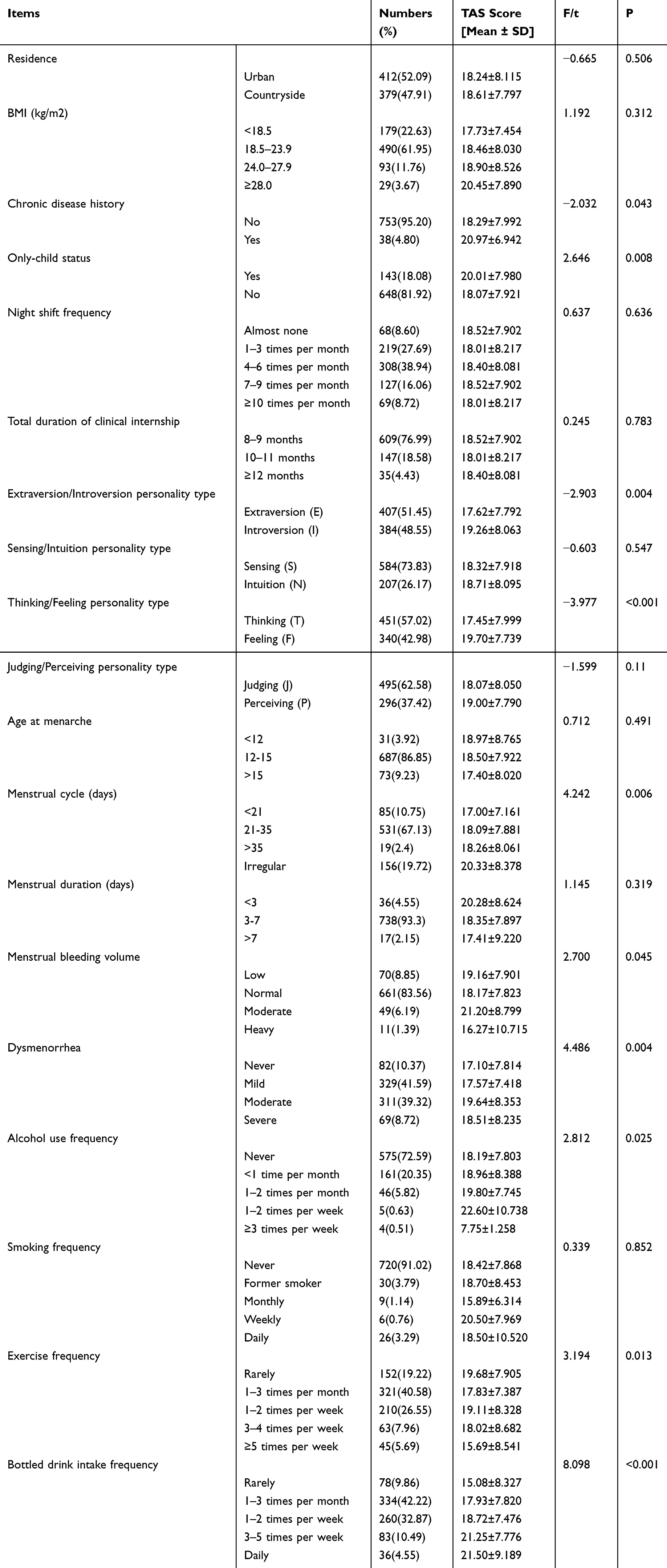 |
Table 2 Univariate Analysis of Test Anxiety |
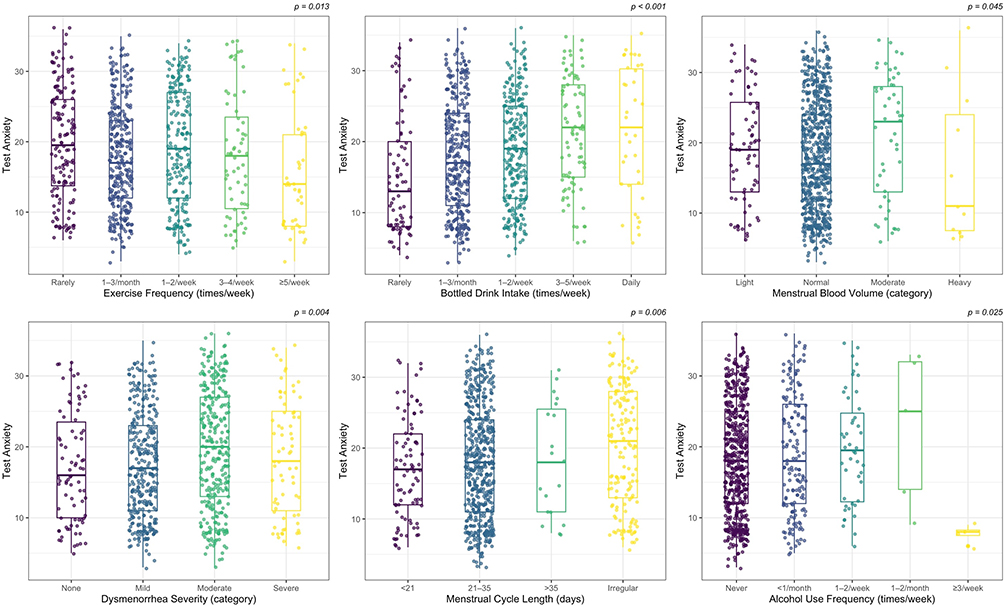 |
Figure 1 Boxplot of analysis of variance (ANOVA) for test anxiety. |
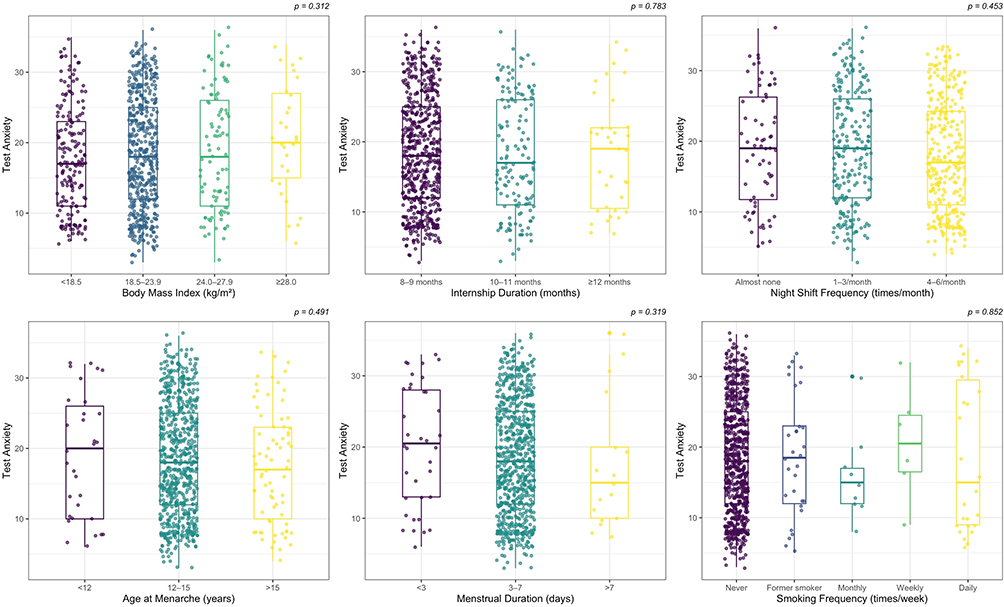 |
Figure 2 Boxplot of analysis of variance (ANOVA) for test anxiety (continued). |
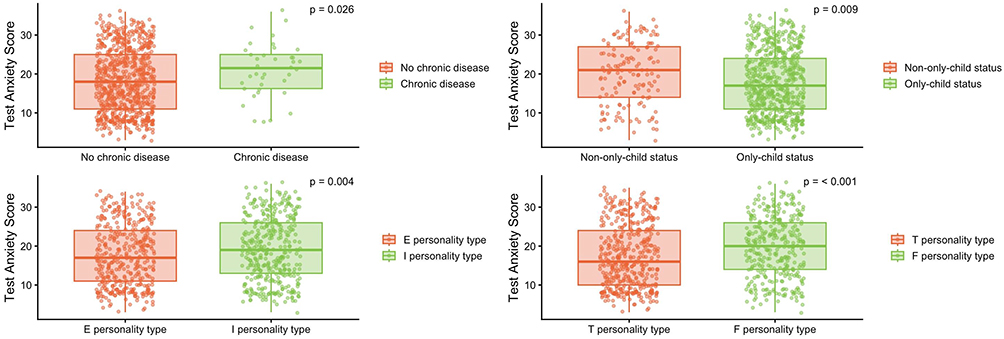 |
Figure 3 Boxplot of independent-samples t-test for test anxiety. |
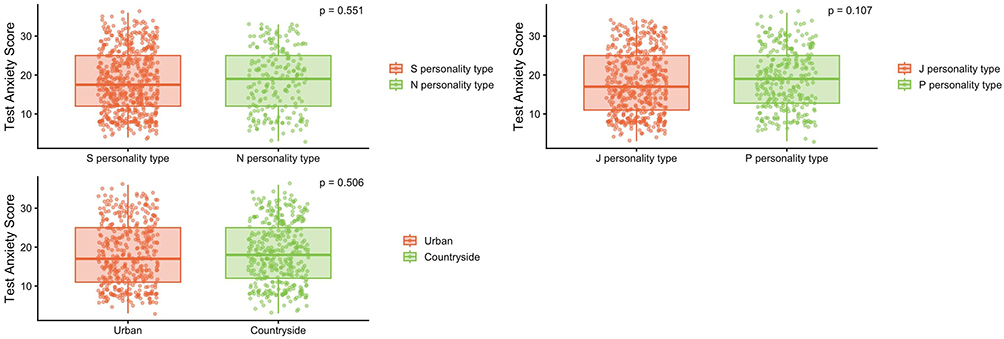 |
Figure 4 Boxplot of independent-samples t-test for test anxiety (continued). |
Pearson Correlation Analysis Among PSS, MARS, BPS, and TAS
Pearson correlation analysis showed that PSS was negatively correlated with MARS (r = −0.173, P < 0.001), and positively correlated with BPS (r = 0.351, P < 0.001) and TAS (r = 0.321, P < 0.001). MARS was negatively correlated with BPS (r = −0.226, P < 0.001) and TAS (r = −0.306, P < 0.001). BPS was positively correlated with TAS (r = 0.303, P < 0.001). These correlations are visually presented in Figure 5.
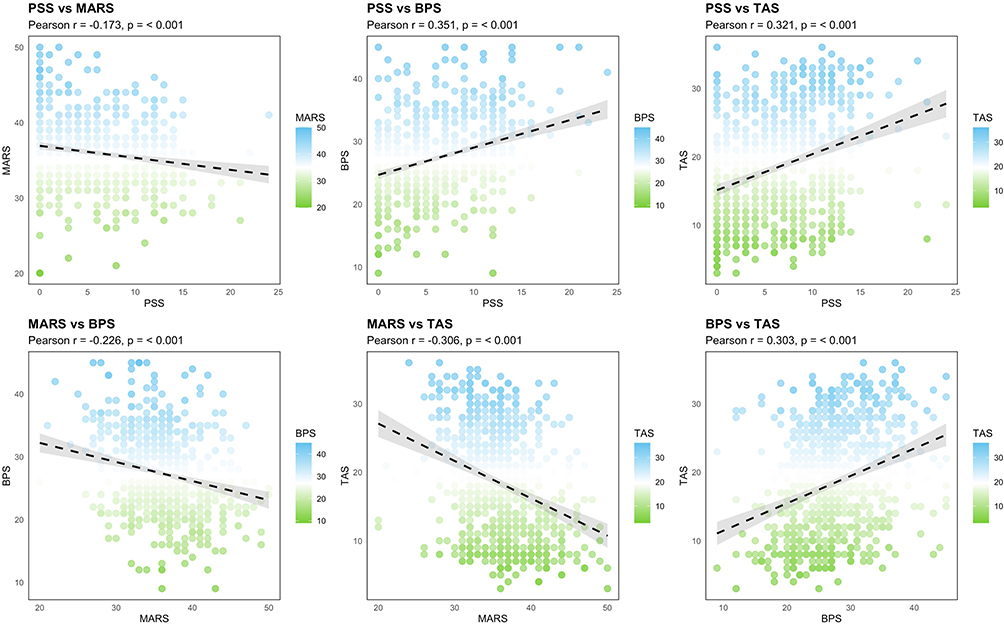 |
Figure 5 Scatter plots of Pearson correlations among PSS, Tas, BPS, and Mars. |
Multiple Linear Regression Analysis of Test Anxiety
Using the total score of test anxiety (TAS) as the dependent variable, variables with statistical significance (P < 0.05) identified in the univariate analysis, along with the primary study variables, were included as independent variables. A multiple linear regression analysis was conducted using a stepwise selection method. The results showed that the overall model was statistically significant (F = 17.486, P < 0.001), and the included independent variables jointly explained 21.3% of the variance in test anxiety among nursing students (R2 = 0.226, adjusted R2 = 0.213). The Durbin–Watson statistic was 1.992, indicating that the assumption of independent residuals was satisfied. Multicollinearity diagnostics showed that all variance inflation factor (VIF) values were below 5, suggesting no evidence of multicollinearity among the independent variables. Further analysis indicated that bottled drink intake frequency, menstrual cycle regularity, thinking/feeling personality type, only-child status, premenstrual syndrome, sleep procrastination, and attention were significant predictors of test anxiety among nursing students (Table 3). In addition, a forest plot (Figure 6) was constructed to visually display the regression coefficients and their 95% confidence intervals from the multiple linear regression analysis.
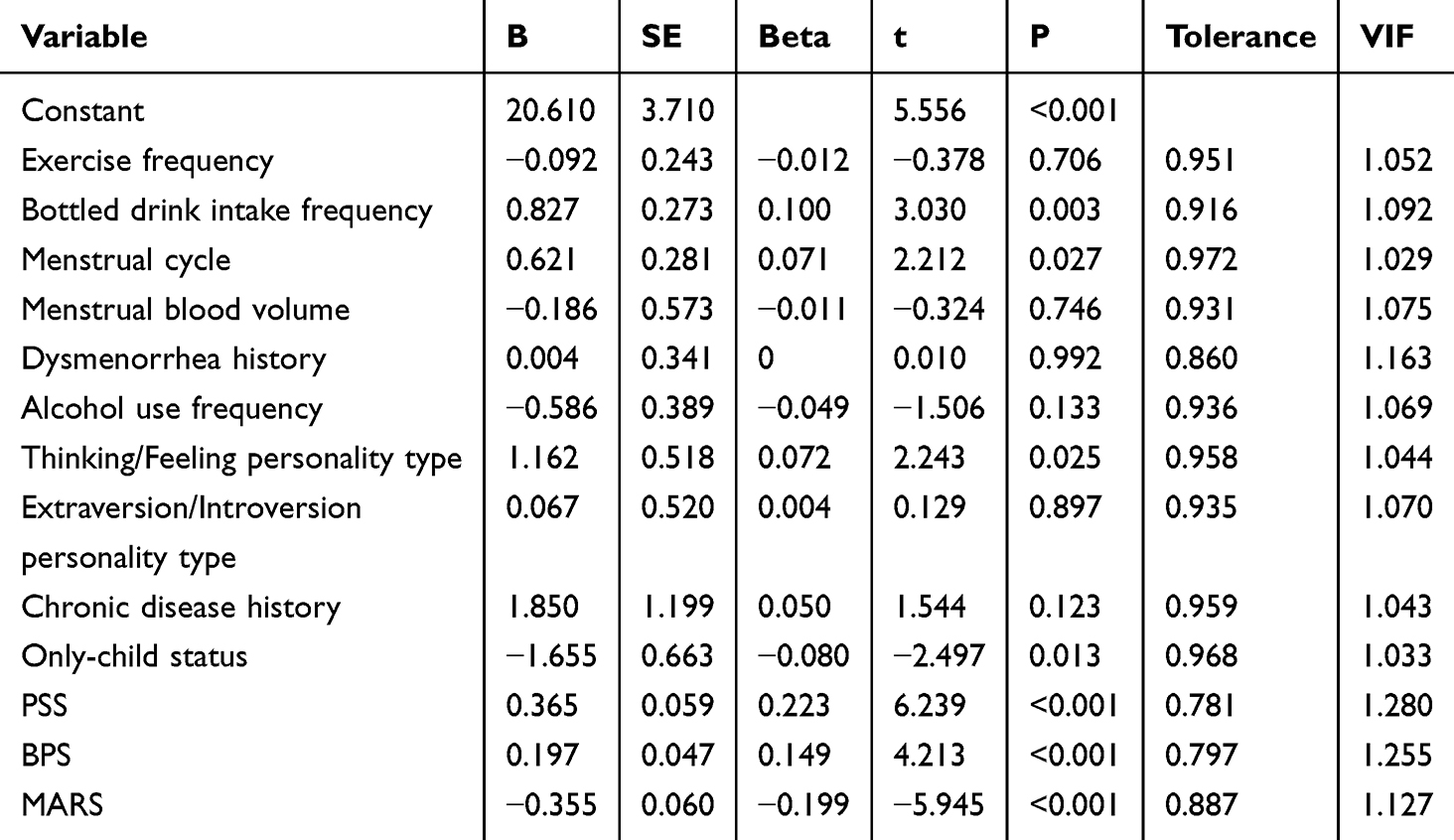 |
Table 3 Multiple Linear Regression Analysis of Test Anxiety |
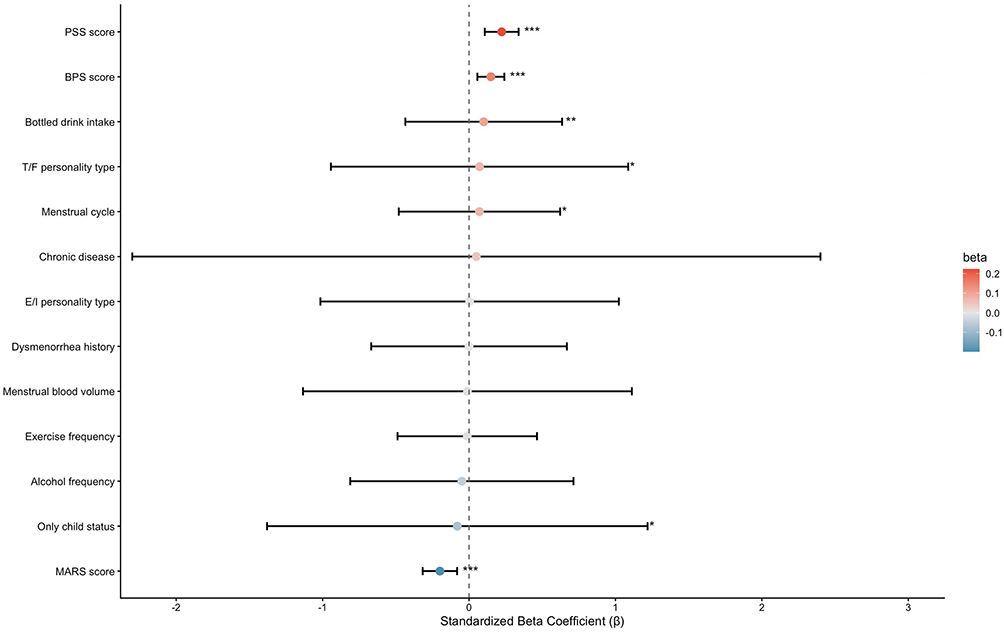 |
Figure 6 Forest plot of multiple linear regression analysis for test anxiety. * P < 0.05; ** P < 0.01; *** P < 0.001. |
Structural Equation Model of the Chain Mediation of Test Anxiety
A structural equation model was constructed with premenstrual syndrome as the independent variable, test anxiety as the dependent variable, and sleep procrastination and attention as mediating variables, as shown in Figure 7.
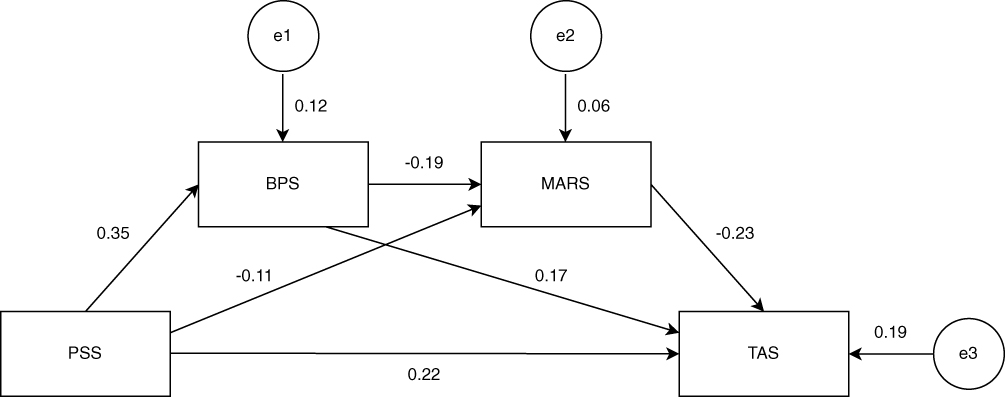 |
Figure 7 Structural equation model. |
Because the proposed mediation model was a just-identified model (df = 0), traditional global fit indices (e.g, χ2/df, CFI, TLI, IFI, and RMSEA) were not informative, as such models reproduce the observed covariance matrix perfectly by definition. Therefore, model evaluation was primarily based on the significance and direction of the estimated path coefficients and the bootstrap confidence intervals of the indirect effects.
Structural Equation Model Path Analysis
The results of the structural equation model path analysis are presented in Table 4. The findings indicated that premenstrual syndrome had a significant positive effect on bedtime procrastination (β = 0.435, P < 0.001). Bedtime procrastination was significantly negatively associated with attention (β = −0.140, P < 0.001). In addition, premenstrual syndrome was negatively associated with attention (β = −0.099, P = 0.004). Attention showed a significant negative effect on test anxiety (β = −0.408, P < 0.001). Meanwhile, premenstrual syndrome had a significant positive effect on test anxiety (β = 0.361, P < 0.001), and bedtime procrastination also showed a significant positive association with test anxiety (β = 0.230, P < 0.001). Overall, premenstrual syndrome, bedtime procrastination, and attention jointly contributed to explaining variations in test anxiety through direct and indirect pathways.
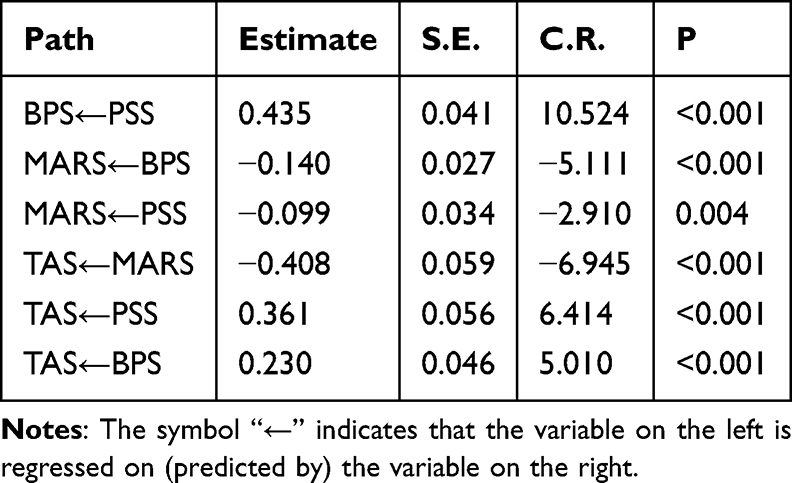 |
Table 4 Structural Equation Model Path Analysis |
Serial Mediation Effects in the Association Between Premenstrual Syndrome and Test Anxiety
The serial mediation analysis of bedtime procrastination and attention in the relationship between premenstrual syndrome and test anxiety is presented in Table 5. The results showed that premenstrual syndrome had a significant indirect effect on test anxiety through bedtime procrastination (β = 0.08, 95% Boot CI: 0.03-0.14, P < 0.05), accounting for 25.0% of the total effect. A significant indirect effect was also observed through attention (β = 0.05, 95% Boot CI: 0.01-0.10, P < 0.05), accounting for 15.6% of the total effect. In addition, a significant chain mediating effect was identified through bedtime procrastination and attention (β = 0.03, 95% Boot CI: 0.01-0.06, P < 0.05), accounting for 9.4% of the total effect. The total indirect effect was significant (β = 0.16, 95% Boot CI: 0.10-0.22, P < 0.05), accounting for 50.0% of the total effect, while the direct effect of premenstrual syndrome on test anxiety remained significant (β = 0.20, 95% Boot CI: 0.12-0.28, P < 0.05), accounting for the remaining 50.0%.
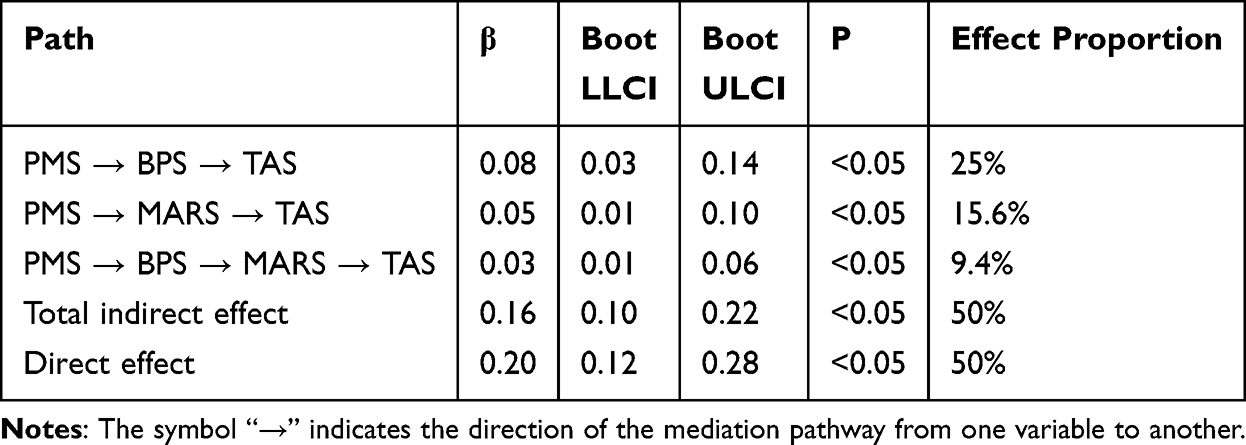 |
Table 5 Serial Mediation of Bedtime Procrastination and Attention in the Relationship Between Premenstrual Syndrome and Test Anxiety |
Discussion
Main Findings
This study, grounded in the TOUS, examined the relationship between PMS and test anxiety among nursing college students and explored the serial mediating roles of bedtime procrastination behavior and attention. The results showed that PMS was significantly associated with test anxiety. This association was not only explained by a direct effect but also partially mediated through behavioral and cognitive pathways. Specifically, bedtime procrastination and attention independently mediated the relationship between PMS and test anxiety and further formed a significant serial mediation pathway, suggesting that they serve as key bridging mechanisms linking physiological symptoms to emotional outcomes. In addition, regression analyses indicated that bottled drink intake frequency, menstrual cycle characteristics, thinking/feeling personality type, and only-child status were also significantly associated with test anxiety. Overall, this study elucidates a multi-level mechanism underlying the effect of PMS on test anxiety from both behavioral and cognitive perspectives, supporting a theoretical framework in which physiological symptoms influence emotional outcomes through a behavioral–cognitive cascade process.
Factors Influencing Test Anxiety
The study identified bottled drink intake frequency, menstrual cycle characteristics, thinking/feeling personality traits, and only-child status as independent factors associated with test anxiety.
From a behavioral perspective, higher frequency of bottled drink intake was significantly associated with increased test anxiety. Previous studies have shown that excessive intake of sugar-sweetened or caffeine-containing beverages is positively correlated with anxiety symptoms, with risk increasing alongside consumption frequency.18 Further evidence suggests that such beverages may indirectly influence anxiety by impairing sleep quality, and that beverage intake and sleep quality may interactively predict anxiety symptoms.19 In addition, systematic reviews have highlighted the broad association between sugar-sweetened beverage consumption and multiple mental health outcomes.20 The present findings are consistent with these results, suggesting that unhealthy dietary behaviors may exacerbate test anxiety by disrupting sleep regulation and emotional regulation processes.
From a physiological perspective, menstrual cycle irregularities were significantly associated with test anxiety. Prior research indicates that fluctuations in estrogen and progesterone during the luteal phase are associated with increased emotional instability and anxiety symptoms in women.21 Mechanistic evidence further suggests that hormonal changes may influence neurosteroid systems and emotion regulation pathways, thereby enhancing emotional reactivity.22 The present findings are consistent with these reports and further support the important role of menstrual-related physiological fluctuations in academic stress contexts. However, some studies have reported no significant association between menstrual cycle and anxiety levels.23 This discrepancy may be attributed to individual differences in sensitivity to hormonal fluctuations and contextual factors, with high-stress environments potentially amplifying the emotional effects of physiological changes.
From a personality trait perspective, thinking/feeling personality type were also significantly associated with test anxiety. Individuals with a feeling-oriented tendency are more likely to engage in emotion-based information processing and exhibit greater sensitivity to negative evaluation and failure outcomes, thereby increasing vulnerability to anxiety responses.24,25 In contrast, thinking-oriented individuals tend to rely more on logical analysis and problem-solving strategies, which may confer stronger cognitive regulation under exam-related stress. The present findings are consistent with this evidence, suggesting that personality traits may indirectly influence test anxiety through cognitive appraisal styles and emotion regulation strategies.
From a social background perspective, only-child status was also significantly associated with test anxiety. Previous research suggests that only children often experience more concentrated parental expectations and academic demands during development, which may intensify academic pressure and weaken coping and emotional regulation abilities, thereby increasing vulnerability to anxiety in examination contexts.26 The present findings are consistent with these results and suggest that only children may be more likely to closely link academic outcomes with self-worth, thereby amplifying psychological stress related to failure expectations. However, He J. et al found that after controlling for socioeconomic status and other background variables, the association between only-child status and mental health outcomes was substantially attenuated or became non-significant.27 Moreover, meta-analytic evidence suggests that differences in mental health between only children and non-only children are generally small and inconsistent.28 These inconsistencies may indicate that the association between only-child status and anxiety is context-dependent and may be amplified under specific family expectation structures and academic pressure environments.
Overall, this study highlights the multifactorial nature of test anxiety, emphasizing the interactive effects of behavioral habits, menstrual characteristics, personality traits, and social background. These findings suggest that interventions targeting test anxiety should not be limited to a single dimension but instead adopt a multi-level integrated approach to achieve more effective mental health promotion.
Mechanisms Linking Premenstrual Syndrome and Test Anxiety: A Serial Mediation of Bedtime Procrastination Behavior and Attention
This study was grounded in the TOUS and developed and tested a serial mediation model to examine the relationship between PMS and test anxiety. The results demonstrated a significant pathway from PMS to test anxiety through bedtime procrastination and attention, indicating that this mechanism is not a single psychological process but rather a sequential cascade spanning behavioral and cognitive domains. These findings are consistent with prior literature on the association between PMS and mental health outcomes. Previous studies have shown that PMS is closely associated with sleep-related problems, and that symptom severity can significantly predict levels of anxiety and depression.1 Similarly, evidence suggests a stable association between PMS and reduced sleep quality, with sleep disturbance serving as an important mediator linking physiological symptoms to psychological outcomes.2 However, most existing research has focused on sleep quality as a single mediator, with limited attention to the sequential pathway from behavioral self-regulation failure to cognitive impairment. The present study extends this framework by identifying bedtime procrastination as a key behavioral mediator. Prior evidence indicates that bedtime procrastination is significantly associated with increased perceived stress, insufficient sleep, and psychological distress.4,7 Mechanistically, bedtime procrastination reflects deficits in executive control and is characterized by voluntary delay of bedtime in the absence of external constraints, thereby reducing sleep duration and impairing sleep quality.29 Executive function, as a core cognitive foundation of attentional control, is typically manifested in reduced cognitive control capacity and inefficient allocation of attentional resources when impaired.30 Furthermore, accumulating evidence indicates that sleep insufficiency significantly impairs executive function and is associated with reduced sustained attention and decreased cognitive processing efficiency.31,32 On this basis, the present study further demonstrates that attentional impairment is not only a downstream consequence of sleep-related behavioral dysregulation but also a critical bridge linking behavioral dysfunction to emotional outcomes. Consistent with the Theory of Unpleasant Symptoms, the findings support a multi-level model of “physiological symptoms–behavioral dysregulation–cognitive impairment–emotional response,” whereby PMS may be associated with reduced behavioral self-regulation, which may be related to increased bedtime procrastination, which in turn disrupts sleep recovery and impairs attentional functioning. Subsequently, reduced attentional capacity weakens selective processing and cognitive control over exam-related information, increases vulnerability to threat-related bias, and promotes negative interpretations of failure, ultimately exacerbating test anxiety.
Innovativeness and Limitations
The innovations of this study are reflected in four main aspects. First, grounded in the TOUS, this study developed a novel multi-path integrated model to explain the relationship between PMS and test anxiety. This model systematically elucidates the underlying mechanisms from a multi-level “physiological–behavioral–cognitive–emotional” perspective. Second, unlike previous studies that predominantly relied on single mediation models, this study identified and validated a serial mediation pathway involving bedtime procrastination behavior and attention. This finding reveals a cascading mechanism in which physiological symptoms contribute to psychological stress by first disrupting behavioral self-regulation, subsequently impairing cognitive functioning, and ultimately amplifying emotional responses. Third, this study integrated bedtime procrastination (behavioral level) and attention (cognitive level) within a unified analytical framework, clarifying a continuous behavioral–cognitive pathway and addressing the fragmentation in previous research that separately examined behavioral and cognitive factors. Fourth, based on multicenter and large-sample data, this study focused on nursing college students as a specific high-stress population, extending the application of TOUS to an academic stress context. This provides new empirical evidence for the interaction between menstrual-related symptoms and educational psychological health and offers a solid foundation for future intervention research.
This study has several limitations. First, the cross-sectional design precludes the determination of causal relationships among variables. Future research should employ longitudinal follow-up or interventional studies to further validate the temporal sequence and causal directions among PMS, bedtime procrastination, attention, and test anxiety. Second, the use of convenience sampling may have introduced selection bias. In addition, some subgroup categories contained relatively small numbers of participants, which may have reduced the stability of certain subgroup comparisons and limited the generalizability of the findings. Future studies could adopt random sampling or multi-center stratified sampling methods to enhance the representativeness of the sample and the external validity of the findings. Third, the Cronbach’s α coefficient of the MARS used in this study was 0.640, indicating relatively low internal consistency. This may have affected the measurement stability of attention and the precision of the mediation effect estimates. Future research is recommended to use attention assessment tools with higher reliability or to combine them with objective cognitive neuropsychological tests for multi-method assessment, thereby improving the reliability of measurements and the robustness of the results. Fourth, this study did not include certain potentially important confounding factors, such as depressive symptoms, actual sleep duration, academic performance, and coping strategies. Future studies should incorporate more relevant confounding factors and adopt stricter sampling methods along with more reliable measurement instruments to further improve the internal and external validity of the research.
Conclusion
This study was grounded in the TOUS and developed a multi-path integrated model to explain the relationship between PMS and test anxiety. The findings demonstrated that PMS was positively associated with test anxiety and that bedtime procrastination and attention were significant mediators of this association. These results suggest a cascading mechanism whereby physiological symptoms may be associated with heightened psychological stress by first disrupting behavioral self-regulation and subsequently impairing cognitive functioning.
From a theoretical standpoint, this study extends the TOUS framework by embedding PMS within a dynamic “physiological–behavioral–cognitive–emotional” interaction system. This advances previous single-domain explanations and provides a more integrated account of the complex pathways linking menstrual-related symptoms to psychological outcomes in female populations.
From a practical perspective, the identification of bedtime procrastination behavior and attention as modifiable mediators highlights potential intervention targets beyond symptom management alone. Interventions focusing on sleep-related behavioral regulation and attentional control may therefore offer greater feasibility and sustained effectiveness. Future research should further explore multi-level intervention strategies aimed at improving sleep behaviors and attentional functioning, thereby mitigating the adverse impact of PMS on test anxiety and enhancing mental health outcomes among nursing students.
Data Availability Statement
The datasets used and/or analysed during the current study are available from the corresponding author on reasonable request.
Ethics Approval
The study was approved by the Ethics Review Committee of the Affiliated Hospital of Nantong University, Nantong, China (Approval No. 2023-K164-01). In accordance with the research governance regulations of Nantong University, ethical review for human-subject research conducted by postgraduate students is undertaken by the Ethics Review Committee of the Affiliated Hospital of Nantong University. The study was conducted in accordance with the principles of the Declaration of Helsinki.
Consent to Participate Declaration
All participants voluntarily participated in the study and provided written informed consent, confirming that their participation was voluntary and that they could withdraw from the study at any time.
Funding
The authors received no specific funding for this work.
Disclosure
The authors report no competing interests in this work.
References
1. Yamak ÖA, Şentürk Ş, Kağıtçı M, et al. The relationship between premenstrual syndrome and circadian rhythm, depressive mood, and anxiety. Sci Rep. 2025;15(1):38920. doi:10.1038/s41598-025-23040-9
2. Kook H. Factors associated with premenstrual syndrome among nursing students based on the theory of unpleasant symptoms. J Nurs Women’s Health. 2023;8(196):2577.
3. Erbil N, Yücesoy H. Relationship between premenstrual syndrome and sleep quality among nursing and medical students. Perspect Psychiatric Care. 2022;58(2):448–16. doi:10.1111/ppc.12628
4. Dimlievych A, Dębska G, Grzesik-Gąsior J, et al. Perceived menstrual irregularities and premenstrual syndrome in relation to insomnia: evidence from a cohort of student nurses. J Clin Med. 2025;14(21):7470. doi:10.3390/jcm14217470
5. Niermann HCM, Scheres A. The relation between procrastination and symptoms of attention-deficit hyperactivity disorder (ADHD) in undergraduate students. Int J Methods Psychiatric Res. 2014;23(4):411–421. doi:10.1002/mpr.1440
6. Zhang X, Dong Y, Zhou R. Examination stress results in attentional bias and altered neural reactivity in test-anxious individuals. Neural Plast. 2018;2018(1):3281040. doi:10.1155/2018/3281040
7. Van de Casteele M, Soenens B, Campbell R, et al. Too pressured to sleep? Exploring the role of study motivation, test anxiety and procrastination in university students’ sleep patterns during exam periods. Stress Health. 2025;41(3):e70040. doi:10.1002/smi.70040
8. Lenz ER, Pugh LC, Milligan RA, et al. The middle-range theory of unpleasant symptoms: an update. Adv Nurs Sci. 1997;19(3):14–27. doi:10.1097/00012272-199703000-00003
9. Bacchetti P, Leung JM. Sample size calculations in clinical research. Anesthesiology. 2002;97(4):1028–1029. doi:10.1097/00000542-200210000-00050
10. Ren J, Wang X, Li S, et al. Cross-cultural validation of the Chinese version of Disorder-Specific Intolerance of Uncertainty (DSIU): psychometric properties in female college students with premenstrual syndrome (PMS). BMC Psychiatry. 2025;25(1):1039. doi:10.1186/s12888-025-07522-8
11. Wang X, Ge Y, Liu Y, et al. The association between occupational stress, sleep quality and premenstrual syndrome among clinical nurses. BMC Nurs. 2024;23(1):661. doi:10.1186/s12912-024-02329-6
12. Kroese FM, De Ridder DTD, Evers C, et al. Bedtime procrastination: introducing a new area of procrastination. Fronti Psychol. 2014;5:89333. doi:10.3389/fpsyg.2014.00611
13. Chen D, Zhang Y, Lin J, et al. Factors influencing bedtime procrastination in junior college nursing students: a cross-sectional study. BMC Nurs. 2022;21(1):97. doi:10.1186/s12912-022-00881-7
14. Zhang XY, Spruyt K, Si JY, et al. Development and initial validation of the multi-dimensional attention rating scale in highly educated adults. Chin Med Sci J. 2025;40(2):100–110. doi:10.24920/004481
15. Jin Z, Long F, Wei H. The impact of test anxiety and cognitive stress on error-related brain activity. Behav Sci. 2025;16(1):25. doi:10.3390/bs16010025
16. Song L, Xiao R, Wang C, et al. Effect of group impromptu music therapy on improving test anxiety and emotional regulation ability in medical students. Fronti Psychol. 2024;15:1467830. doi:10.3389/fpsyg.2024.1467830
17. Kline RB. Principles and Practice of Structural Equation Modeling. Guilford Publications; 2023.
18. Zhang Y, Xu P, Song Y, et al. Association between sugar-sweetened beverage consumption frequency and muscle strength: results from a sample of Chinese adolescents. BMC Public Health. 2023;23(1):1010. doi:10.1186/s12889-023-15987-z
19. Qiu Q, Chai G, Xie S, et al. Association of sugar-sweetened beverage consumption and sleep quality with anxiety symptoms: a cross-sectional study of Tibetan college students at high altitude. Fronti Psychol. 2024;15:1383042. doi:10.3389/fpsyg.2024.1383042
20. Di Nucci A, Cardamone E, Rossi L, et al. How does sugar-sweetened beverage consumption relate to sleep and mental health in adolescents? A scoping review. Front Nutri. 2025;12:1718230. doi:10.3389/fnut.2025.1718230
21. Liu Q, Lin Y, Zhang W. Psychological stress dysfunction in women with premenstrual syndrome. Heliyon. 2024;10(22):e40233. doi:10.1016/j.heliyon.2024.e40233
22. Modzelewski S, Oracz A, Żukow X, et al. Premenstrual syndrome: new insights into etiology and review of treatment methods. Front Psychiatry. 2024;15:1363875. doi:10.3389/fpsyt.2024.1363875
23. Li SH, Denson TF, Graham BM. Women with generalized anxiety disorder show increased repetitive negative thinking during the luteal phase of the menstrual cycle. Clin Psychol Sci. 2020;8(6):1037–1045. doi:10.1177/2167702620929635
24. Aguirre P, Michelini Y, Bravo AJ, et al. Association between personality traits and symptoms of depression and anxiety via emotional regulation and distress tolerance. PLoS One. 2024;19(7):e0306146. doi:10.1371/journal.pone.0306146
25. Zhang B, Li X, Deng H, et al. The relationship of personality, alexithymia, anxiety symptoms, and odor awareness: a mediation analysis. Bmc Psychiatry. 2024;24(1):185. doi:10.1186/s12888-024-05653-y
26. Liu C, Yuan Y, Zhu J, et al. Association between Chinese only-child university students’ psychological symptoms and lifestyle behaviors. BMC Public Health. 2025;25(1):4407. doi:10.1186/s12889-025-25675-9
27. He J, Zhong Y, Song Y, et al. The impact of only-child status on adolescent mental health: a multi-center cross-sectional study using propensity score matching in Western China. BMC Public Health. 2025;25(1):2140. doi:10.1186/s12889-025-23383-y
28. Chen P, Rao SY, Zhang W, et al. Mental health status among children and adolescents in one-child and multichild families: a meta-analysis of comparative studies. Curr Opin Psychiatry. 2024;37(3):147–161. doi:10.1097/YCO.0000000000000935
29. Kroese FM, Nauts S, Kamphorst BA, et al. Bedtime procrastination: a behavioral perspective on sleep insufficiency. In: Procrastination, Health, and Well-Being. Academic Press; 2016:93–119.
30. Miyake A, Friedman NP. The nature and organization of individual differences in executive functions: four general conclusions. Curr Directions Psychol Sci. 2012;21(1):8–14. doi:10.1177/0963721411429458
31. Sen A, Tai XY. Sleep duration and executive function in adults. Curr Neurol Neurosci Rep. 2023;23(11):801–813. doi:10.1007/s11910-023-01309-8
32. Yang Z, Williams SD, Beldzik E, et al. Attentional failures after sleep deprivation are locked to joint neurovascular, pupil and cerebrospinal fluid flow dynamics. Nat Neurosci. 2025;1–11.
 © 2026 The Author(s). This work is published and licensed by Dove Medical Press Limited. The
full terms of this license are available at https://www.dovepress.com/terms
and incorporate the Creative Commons Attribution
- Non Commercial (unported, 4.0) License.
By accessing the work you hereby accept the Terms. Non-commercial uses of the work are permitted
without any further permission from Dove Medical Press Limited, provided the work is properly
attributed. For permission for commercial use of this work, please see paragraphs 4.2 and 5 of our Terms.
© 2026 The Author(s). This work is published and licensed by Dove Medical Press Limited. The
full terms of this license are available at https://www.dovepress.com/terms
and incorporate the Creative Commons Attribution
- Non Commercial (unported, 4.0) License.
By accessing the work you hereby accept the Terms. Non-commercial uses of the work are permitted
without any further permission from Dove Medical Press Limited, provided the work is properly
attributed. For permission for commercial use of this work, please see paragraphs 4.2 and 5 of our Terms.