
Back to Journals » Clinical, Cosmetic and Investigational Dermatology » Volume 19
Balanitis Xerotica Obliterans Successfully Treated with Topical Tacrolimus: A Case Report and Literature Review
Authors Dobrev H 
Received 24 January 2026
Accepted for publication 6 March 2026
Published 9 March 2026 Volume 2026:19 597493
DOI https://doi.org/10.2147/CCID.S597493
Checked for plagiarism Yes
Review by Single anonymous peer review
Peer reviewer comments 2
Editor who approved publication: Dr Anne-Claire Fougerousse
Hristo Dobrev
Department of Dermatology and Venereology, Medical University, Plovdiv, Bulgaria
Correspondence: Hristo Dobrev, Department of Dermatology and Venereology, Medical University, 15A Vasil Aprilov Blvd, Plovdiv, 4002, Bulgaria, Email [email protected]
Abstract: Balanitis xerotica obliterans (BXO) is a chronic, progressive, inflammatory, and sclerosing disease of the male genitalia. If left untreated, it can lead to urinary and sexual dysfunction and reduced quality of life. We describe a 15-year-old Caucasian male with a 3-month history of progressive thickening and whitening of the prepuce and penile glans. He reported mild pruritus, embarrassment of the prepuce retraction, painful cracking of the foreskin, and painful erection. Dermatological examination showed mild erythema and hypopigmentation of the foreskin and penile glans, a sclerotic white ring, and erosions at the distal portion of the prepuce. Based on history and clinical findings, a final diagnosis of balanitis xerotica obliterans was made. Topical treatment with miconazole nitrate/hydrocotison 20mg/10mg/g cream (Daktacort) - once a day for 3 months and topical tacrolimus 0.03% ointment (Protopic) - once a day for 3 months, twice daily for 9 months, and once a day for 4 months was applied, resulting in gradual and fully improvement of the subjective and objective manifestations of the disease. No side effects were observed. Our findings are consistent with published data and further support the recommendation for topical tacrolimus as a therapeutic option for BXO.
Keywords: lichen sclerosus, balanitis xerotica obliterans, treatment, topical tacrolimus
Introduction
Balanitis xerotica obliterans (Penile lichen sclerosus) (BXO) is a chronic, progressive, inflammatory, and sclerosing dermatosis of male genitalia with unclear etiology and pathogenesis.1,2 Left untreated, the disease can lead to phimosis, meatal stenosis, and urethral stricture, sexual and urinary dysfunction, and a deterioration in male quality of life. Potent topical corticosteroids, applied locally and intralesionally, are the recommended first-line therapy. The early application of clobetasol propionate 0.05% ointment or mometasone furoate 0.1% ointment for 3 months was successful in 35–60% of male patients. However, the long-term use of potent topical corticosteroids on the glans and penile shaft carries a higher risk of side effects such as skin atrophy, teleangiectasia, hypopigmentation, infection risk, accompanied by increased sensitivity or burning. This is an occasion to introduce treatment with topical calcineurin inhibitors. A three-month course of topical tacrolimus 0.1% or pimecrolimus 1% is a safe and effective alternative to topical corticosteroids. If both topical agents are ineffective, surgical techniques, mainly circumcision, are applied. Additionally, patients should be monitored for the development of penile carcinoma.1,2
This report presents a case of a 15-year old male with BXO successfully treated with topical tacrolimus, highlighting its potential role in disease management.
Case Report
A 15-year-old Caucasian male adolescent presented to the Clinic of Dermatology and Venereology because of a 3-month history of progressive thickening and whitening of the prepuce and penile glans. He reported mild pruritus, embarrassment of the prepuce retraction, painful cracking of the foreskin, and painful erection. Dermatological examination showed mild erythema and hypopigmentation of the foreskin and penile glans, a sclerotic white ring, and erosions at the distal portion of the prepuce (Figure 1). Routine laboratory investigations were normal. A skin biopsy was not performed due to refusal by the patient’s parents. Based on history and clinical findings, a final diagnosis of BXO was made. Topical treatment with miconazole nitrate/hydrocotison 20 mg/10 mg/g cream (Daktacort, Janssen-Cilag) – once a day for 3 months and topical tacrolimus 0.03% ointment (Protopic, Astellas) – once a day for 3 months, twice daily for 9 months, and once a day for 4 months was applied, resulting in gradual and complete improvement of the subjective and objective manifestations of the disease (Figure 2). No side effects were observed. No recurrence was observed after a one-year follow-up.
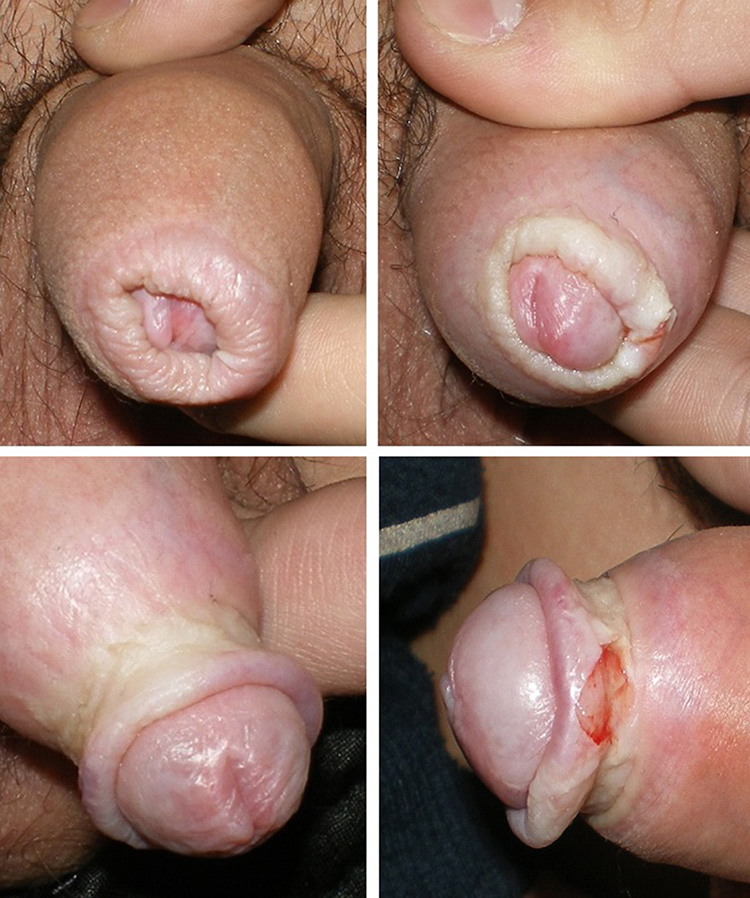 |
Figure 1 Balanitis xerotica obliterans before treatment. |
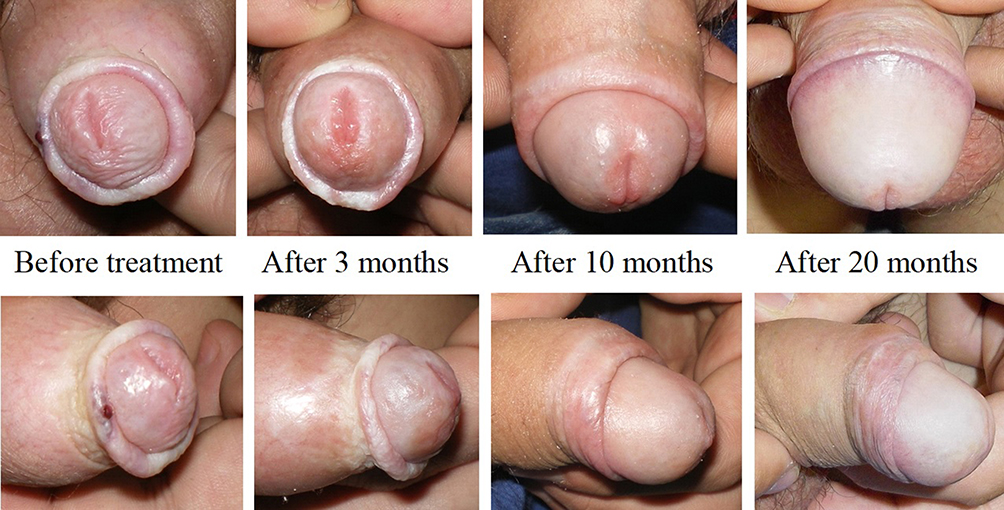 |
Figure 2 Balanitis xerotica obliterans before and after treatment. |
Discussion
The first case of treatment of BXO with topical tacrolimus was reported by Pandher et al3 in 2003. The same year, Bohm et al4 also reported two men who suffered from BXO for about 2 years and were treated with 0.1% tacrolimus ointment. In both men, complete clearing was observed after 10 months. There was no relapse during a follow-up period of 9, and 11 months. No side effects were observed.
Later, several publications confirmed this finding to varying degrees. Hengge et al5 conducted a multicenter study to assess the safety and efficacy of tacrolimus ointment 0.1% for the treatment of lichen sclerosus (LS) with a follow-up period of 18 months. Eighty-four patients, aged 5–85 years, among them 32 men, were treated twice daily for 16 weeks. Clearance of active LS was observed in 43% of patients, and partial resolution was observed in 34% of patients at 6 months of treatment. Only mild, transient burning and itching were reported. There were three (9%) recurrences during the follow-up period. Details about the response of male LS were not reported.
In a retrospective study of 13 children with BXO, Ebert et al6 reported a lower relapse rate following topical tacrolimus compared with standard anti-inflammatory treatment using betamethasone. Tacrolimus ointment was well tolerated, with no serious adverse effects.
Two studies in a large number of patients with BXO accompanied by urethral stricture have reported treatment with topical tacrolimus. Mallick et al7 treated 30 males, aged 14–71 years, with a local application of 0.03% tacrolimus twice daily for 3 weeks and then 0.1% tacrolimus for the next 3 weeks. They observed symptomatic relief in 16 cases (53.3%), evidenced by the subjective and objective (uroflowmetry) improvement of urinary flow. There was only a transient burning sensation and pruritus in 6 cases during the study period. Ahmad et al8 treated a total of 53 patients with 2 daily topical and intraurethral applications of 0.1% tacrolimus for 3 months. They observed significant improvement in urinary flow rate using uroflowmetry in 32 cases (60%). The application of tacrolimus was found to be ineffective in patients with strictures >2 cm in length. Mild erythema of the prepuce and glans skin was noted in a few patients.
Recently, Choudhury et al9 studied 67 male patients with meatal stenosis and urethral stricture related to BXO, divided into two comparable groups. Group 1 was treated with clobetasol 0.05% ointment whereas group 2 was treated with tacrolimus 0.03% ointment applied on the penis and urethra for 3 months. At 3 months, both groups showed similar improvement in International Prostate Symptom Score however the increase in maximum urine flow rate was higher in the first group.
Additionally, topical 0.1% tacrolimus ointment applied twice daily for 3–6 weeks was successfully used for the treatment of postoperative minimal residual penile lesions in 9 patients with BXO who underwent circumcision.10
In their study, Kim et al11 found that topical tacrolimus ointment twice daily was more effective for the treatment of genital LS compared to extragenital LS. Treatment was continued until the skin lesions completely disappeared or remained stable.
The etiology and pathogenesis of BXO are not yet fully understood. There is increasing evidence that it is an autoimmune disease. Circulating IgG autoantibodies targeting extracellular matrix 1 (ECM1) protein have been demonstrated in higher concentrations in men with BXO than in controls. Within the epidermis, ECM1 has a role in the control of keratinocyte differentiation whereas within the dermis, it has a role in the structural organization of the dermis. ECM1 helps to regulate basement membrane and interstitial collagen fibril macro-assembly and growth factor binding, as well as stimulates proliferation of endothelial cells and induces angiogenesis. The observation of T-cell infiltrate in the lesions is also in favor of autoimmune pathogenesis. The role of genetic factors, trauma, chronic irritation, infections, and hormonal influences in the development of BXO are also considered.5,12,13
Tacrolimus ointment became available in the early 1990s for the management of atopic dermatitis. It is a calcineurin inhibitor that suppresses T-cell activation and subsequent cytokine production (IL-2, IL-4, IL-5, IL-8, TNF-alpha). Thus, it can modulate the immune pathways involved in a wide range of inflammatory skin conditions. Tacrolimus also affects other immune cells, such as mast cells and Langerhans cells, reducing their activation and release of inflammatory mediators. Tacrolimus ointment has good skin penetration and minimal systemic absorption, allowing prolonged treatment.14 Regarding BXO, tacrolimus is considered to work by inhibiting T-cell activation and production of IL-2. This reduces or delays the inflammatory process and heals the balanitis.7,15
It is also considered that the topical application of 0.03% and 0.1% tacrolimus ointment is more effective in early inflammatory and erosive lesions because of better penetration. Advanced fibrosclerotic stage may require more time to respond.4,7
An important advantage of topical tacrolimus is that it does not cause skin atrophy and telangiectasia. This allows its longer use, especially when treatment is started late and the sclerotic stage is present. A possible disadvantage may be the assumption of a carcinogenic effect, which however, has not been confirmed with certainty. Except for rare and transitory burning and pruritus, topical tacrolimus is well tolerated.5
In our patient, the disease was of short duration. Due to the patient’s age, a 0.03% concentration of tacrolimus was chosen. During the first 3 months, the treatment was combined with the use of a combined preparation containing an antifungal ingredient, after which tacrolimus remained the sole application for another 13 months. The patient experienced complete recovery without any side effects despite the long-term treatment.
Conclusion
This report describes a case of balanitis xerotica obliterans successfully treated with topical tacrolimus, highlighting its potential as an effective and well-tolerated therapeutic option. Despite the lack of histological confirmation and validated outcome measures, the observed clinical response is consistent with published data in the literature and supports the use of topical tacrolimus as an alternative or adjunct to standard therapeutic approaches, particularly in patients for whom corticosteroid therapy is ineffective or contraindicated. Its use may help reduce the need for surgical intervention, such as circumcision. Awareness of this therapeutic option may be beneficial for dermatologists and urologists involved in managing balanitis xerotica obliterans.
Abbreviation
BXO, balanitis xerotica obliterans.
Ethics and Consent Statement
Institutional approval was not required for the publication of this case report according to our institutional policies. Written informed consent was obtained from the patient’s parents for the publication of the case details and accompanying images. Assent was also obtained from the minor patient.
This case report was conducted in accordance with the Declaration of Helsinki (as revised in 2013, Fortaleza, Brazil).
Funding
There is no funding to report.
Disclosure
The author reports no conflicts of interest in this work.
References
1. De Luca D, Papara C, Vorobyev A, et al. Lichen sclerosus: the 2023 update. Front Med. 2023;10:1106318. eCollection 2023. doi:10.3389/fmed.2023.1106318
2. Shieh C, Hakam N, Pearce R, et al. Conservative management of penile and urethral lichen sclerosus: a systematic review. J Urol. 2024;211(3):354–5. doi:10.1097/JU.0000000000003804
3. Pandher B, Rustin M, Kaisary A. Treatment of balanitis xerotica obliterans with topical tacrolimus. J Urol. 2003;170(3):923. doi:10.1097/01.ju.0000080958.11761.7b
4. Böhm M, Frieling U, Luger T, Bonsmann G. Successful treatment of anogenital lichen sclerosus with topical tacrolimus. Arch Dermatol. 2003;139(7):922–924. doi:10.1001/archderm.139.7.922
5. Hengge U, Krause W, Hofmann H, et al. Multicentre, Phase II trial on the safety and efficacy of topical tacrolimus ointment for the treatment of lichen sclerosus. Br J Dermatol. 2006;155(5):1021–1028. doi:10.1111/j.1365-2133.2006.07446.x
6. Ebert A-K, Vogt T, Rösch W. Topical therapy of balanitis xerotica obliterans inchildhood. Long-term clinical results and an overview. Urologe A. 2007;46(12):1682–1686. doi:10.1007/s00120-007-1577-1
7. Mallick A, Majhi T, Basu S, Pal D. Balanitis xerotica obliterans, the topical application of tacrolimus ointment, and the result: an institutional study. Uro Today Int J. 2013;6(2):art14.
8. Ahmad A, Imbisat M, Khatoon Q. Partially obstructed urethral strictures due to balanitis xerotica obliterans improved by the use of topical tacrolimus: experience at a tertiary care centre. Cureus. 2024;16:e76678. doi:10.7759/cureus.76678
9. Choudhury S, Khare E, Pal D. Comparative effect of intraurethral clobetasol and tacrolimus in lichen sclerosus-associated urethral stricture disease. Urol Ann. 2023;15(2):174–179. doi:10.4103/ua.ua_45_22
10. Ebert A, Rösch W, Vogt T. Safety and tolerability of adjuvant topical tacrolimus treatment in boys with lichen sclerosus: a prospective Phase 2 study. Eur Urol. 2008;54(4):932–937. doi:10.1016/j.eururo.2008.03.014
11. Kim G, Park H, Kim H, et al. Topical tacrolimus ointment for the treatment of lichen sclerosus, comparing genital and extragenital involvement. J Dermatol. 2012;39(2):145–150. doi:10.1111/j.1346-8138.2011.01384.x
12. Fistarol S, Itin P. Diagnosis and treatment of lichen sclerosus. An update. Am J Clin Dermatol. 2013;14(1):27–47. doi:10.1007/s40257-012-0006-4
13. Celis S, Reed F, Murphy F, et al. Balanitis xerotica obliterans in children and adolescents: a literature review and clinical series. J Pediatr Urol. 2014;10(1):34–39. doi:10.1016/j.jpurol.2013.09.027
14. Ruzicka T, Assmann T, Lebwohl M. Potential future dermatological indications for tacrolimus ointment. Eur J Dermatol. 2003;13:331–342.
15. Bubna A. Topical tacrolimus and pimecrolimus in dermatology: an overview. Clin Dermatol Rev. 2024;8(3):185–196. doi:10.4103/cdr.cdr_121_23
 © 2026 The Author(s). This work is published and licensed by Dove Medical Press Limited. The
full terms of this license are available at https://www.dovepress.com/terms
and incorporate the Creative Commons Attribution
- Non Commercial (unported, 4.0) License.
By accessing the work you hereby accept the Terms. Non-commercial uses of the work are permitted
without any further permission from Dove Medical Press Limited, provided the work is properly
attributed. For permission for commercial use of this work, please see paragraphs 4.2 and 5 of our Terms.
© 2026 The Author(s). This work is published and licensed by Dove Medical Press Limited. The
full terms of this license are available at https://www.dovepress.com/terms
and incorporate the Creative Commons Attribution
- Non Commercial (unported, 4.0) License.
By accessing the work you hereby accept the Terms. Non-commercial uses of the work are permitted
without any further permission from Dove Medical Press Limited, provided the work is properly
attributed. For permission for commercial use of this work, please see paragraphs 4.2 and 5 of our Terms.