
Back to Archived Journals » Chronic Wound Care Management and Research » Volume 11

Assessment of Organizational Commitment and Turnover Intention Among Wound Care Staff in Saudi Arabia
Authors Binkanan A  , Althobaiti RA , Alqassab HA
Received 17 May 2024
Accepted for publication 20 October 2024
Published 20 December 2024 Volume 2024:11 Pages 31—41
DOI https://doi.org/10.2147/CWCMR.S464380
Checked for plagiarism Yes
Review by Single anonymous peer review
Peer reviewer comments 2
Editor who approved publication: Prof. Dr. Marco Romanelli
Abdulaziz Binkanan,1 Reem Ayesh Althobaiti,2 Hawra Ali Alqassab3
1Nursing Administration, King Saud Medical City, Riyadh First Health Cluster, Riyadh, Saudi Arabia; 2Nursing Department, Al Hada Armed Force Hospital, Taif, Saudi Arabia; 3Nursing Department, Prince Saud Bin Jalawi Hospital, Al Ahsa, Saudi Arabia
Correspondence: Abdulaziz Binkanan, Nursing Administration, King Saud Medical City, Riyadh First Health Cluster, Riyadh, Saudi Arabia, Tel +966500012213, Email [email protected]
Introduction: Employee retention is critical in healthcare due to its impact on organizational effectiveness and patient care quality. This study investigates the relationship between organizational commitment, turnover intention, and sociodemographic characteristics among wound care staff in Riyadh, Saudi Arabia.
Methods: A cross-sectional survey was conducted using an online self-administered questionnaire, gathering data from 133 wound care professionals. The Organizational Commitment Questionnaire (OCQ) and the Turnover Intention Scale (TIS-6) were utilized to measure the variables of interest.
Results: The mean score for organizational commitment was 50± 7.2, with over half of the participants exhibiting low commitment levels (51.9%). The mean turnover intention score was 18.7± 3.3, with 51.9% of respondents likely to leave their current positions. Significant predictors of organizational commitment and turnover intention included gender, profession, and nationality. Non-Saudi employees demonstrated higher organizational commitment, while male staff and physicians were more likely to express intentions to leave.
Conclusion: The study highlights a moderate level of organizational commitment and a concerning level of turnover intention among wound care staff in Riyadh. These findings underscore the need for targeted strategies to enhance employee retention, such as fostering a supportive work environment and addressing specific concerns related to workload and professional development opportunities.
Keywords: organizational commitment, turnover intention, Saudi Arabia, wound care
Introduction
Considering the high cost of recruiting different employees, employee retention is viewed as a successful investment within various organizations.1 Employees have a strategic importance that motivates organizations to do their best to retain experts and talented workforce by studying the various factors that influence their job, attempting to provide them with a suitable working environment to eliminate the factors that increase the employee’s intentions to leave the organization.2,3
The global strategy on human resources for the health workforce projected a global shortage of 18 million health workers by 2030.4 A major contributing factor to the shortages seen in the health workforce is employee turnover,5 which can have significant consequences on the health of the population.6
Turnover intention is defined as “the conscious and deliberate willfulness to leave the organization”.7 In another definition, it is “the extent to which an employee plans to leave or stay with the organization”.8 According to these definitions, the intention to leave the organization is the final step in a series of withdrawal cognitions leading to actual turnover. It has been reported that the level of organizational commitment and turnover intentions were found to be precursors in the withdrawal process which predicts voluntary employee turnover.7,9 Organizational commitment is defined as “the psychological state that characterizes the employee’s relationship with the organization and has implications for the decision to continue or discontinue membership in the organization”.10
High employee turnover can lead to negative consequences for health organizations including decreased productivity, reduced quality of care, increased costs, and staff shortages.11 Thus organizations are stiving to eliminate factors that increase the employee’s intentions to leave the organization, which makes understanding the factors that influence employee intention to leave the organization is utmost importance for healthcare organizations to develop effective strategies for retention of health staff.12
The recruitment and retention of healthcare professionals are global challenges that significantly impact the quality and continuity of care.11 This issue is particularly pronounced in regions with rapidly expanding healthcare demands, such as Saudi Arabia and the broader West Asian context. The Saudi healthcare sector has experienced substantial growth, driven by population increases and the rising prevalence of chronic diseases, which has intensified the need for a stable and skilled healthcare workforce.13
Despite these demands, the Saudi Arabian healthcare system is heavily reliant on expatriate nurses, who constitute a significant portion of the workforce. This reliance presents unique challenges, including cultural and language barriers, job dissatisfaction, and high turnover rates among expatriate staff. The Saudization policy, aimed at increasing the number of Saudi nationals in the nursing profession, has not fully met its objectives, leading to ongoing recruitment and retention issues.14 Furthermore, the nursing work environment in Saudi Arabia, characterized by high workloads, inadequate support systems, and cultural constraints, exacerbates these challenges, contributing to job dissatisfaction and turnover intention.14,15
In this context, understanding the factors that influence organizational commitment and turnover intention among healthcare workers, particularly wound care staff, is crucial. Wound care professionals play a vital role in patient outcomes, especially in a region where the prevalence of chronic wounds is rising. However, there is limited research focusing on this specialized group, creating a significant gap in literature. While existing studies have explored organizational commitment and turnover intention in broader healthcare contexts,16,17 little have examined these factors specifically among wound care staff in Saudi Arabia.
Methods
Study Design
A descriptive cross-sectional survey was conducted among wound care professionals in Saudi Arabia using convenience sampling. The electronic survey was sent to wound care staff between 2 November and 12 December 2023. Initial contact was not made with respondents before commencing the study. Study information inviting individuals to contribute to a study that investigated the levels of organizational commitment and turnover intention among wound care professionals in Saudi Arabia was disseminated, including the Participant Information Sheet (PIS) and link to the survey. The PIS included information regarding the study’s aims, the protection of participants’ personal data, survey length, consent to participate, and their right to withdraw from the study at any time. Participants were informed that this was a voluntary survey without any monetary incentives. The target population is professionals affiliated with wound care departments at different healthcare facilities in Riyadh, Saudi Arabia.
Data Collection
Data were collected using an online self-administered questionnaire comprised of various domains, including sociodemographic characteristics and validated instruments for assessing organizational commitment and turnover intention. The questions were distributed with randomization to reduce the possibility of response bias and response validation (completeness check) for all the mandatory items was activated to prevent missed answers in the submitted responses and respondents were able to review and change their answers using a “back button” function. To ensure questionnaire clarity and relevance, a pilot study involving 30 wound care staff from diverse professions and academic backgrounds was conducted. Feedback was used to help improve the wording of the initial survey questions. However, it was only permitted one submission from the same IP address.
Organizational Commitment
It was measured using the validated version of the Organizational Commitment Questionnaire (OCQ).18 The OCQ is a 15-item questionnaire that measures three domains of employee organizational commitment. The response format employed a 7-point Likert scale ranging from strongly agree to strongly disagree.
Turnover Intention
It was measured using the shortened version of the turnover intention scale known as (TIS-6). The original unpublished scale was developed by Roodt, contained 14 items, and used a 5-point Likert scale for measurement. However, Jacobs and Roodt, in their study predicting the turnover intentions of professional nurses, listed an updated version of the turnover intention scale that included 15 items on a 5-point Likert scale. Bothma and Roodt later published a validated short version that included six items from the 15-item scale.8
Ethical Considerations
This study adhered to the ethical standards outlined in the 1964 Declaration of Helsinki and its subsequent amendments.19 It was approved by the Institutional Review Board of King Fahd Medical City in Riyadh, Saudi Arabia. The anonymity and confidentiality of the data were ensured. All participants provided consent to participate, which was included as the first question in the online data collection tool. Participants were informed before the study began that they had the right to withdraw from the study at any time.
Data Analysis
Data were extracted from an Excel sheet and analyzed using the Statistical Package for the Social Sciences software version 26. The OCQ answers were coded as follows: Strongly disagree = 1, disagree = 2, neutral = 3, agree = 4, strongly agree = 5, with items 3, 7, 9, 12, and 15 reversed scores. The answers were summed into a total score, and the mean was set as the cut-off point to categorize the level of the participant’s commitment (Score > the mean = high level of commitment) and (Score ≤ the mean = low level of commitment). A total score was calculated for the six items of the turnover intention scale. A score of 18 was set as a cut-off point for the participant’s intentions to leave (A score of> 18=, the employee is likely to leave the organization; a Score of ≤18= employee is likely to stay in the organization).20 Mann–Whitney test, the Kruskal–Wallis test, and Spearman Correlation Coefficient were used to assess the association between the turnover intention scale, the organizational commitment score, and the participant’s personal and professional background information. Further analysis was conducted using direct logistic regression.
Results
A total of 133 valid responses were included in the study. Half of the participants were Saudis (49.6%), and most were females (69.2%). The mean age of the participants was 33.8 ±7.3 years; 52.6% were between 25 and 35 years, and 49.6% were single. Nurses composed 73.7% of the respondents, and 63.2% of the study candidates had bachelor’s degrees. The mean years of working experience among them was 10±7.4 years, and the mean working hours per week was 46.9±11.9 hours per week. The mean monthly income of the participants was 12067±5190 Saudi Riyal (SAR). The sociodemographic characteristics of the participants are illustrated in Table 1.
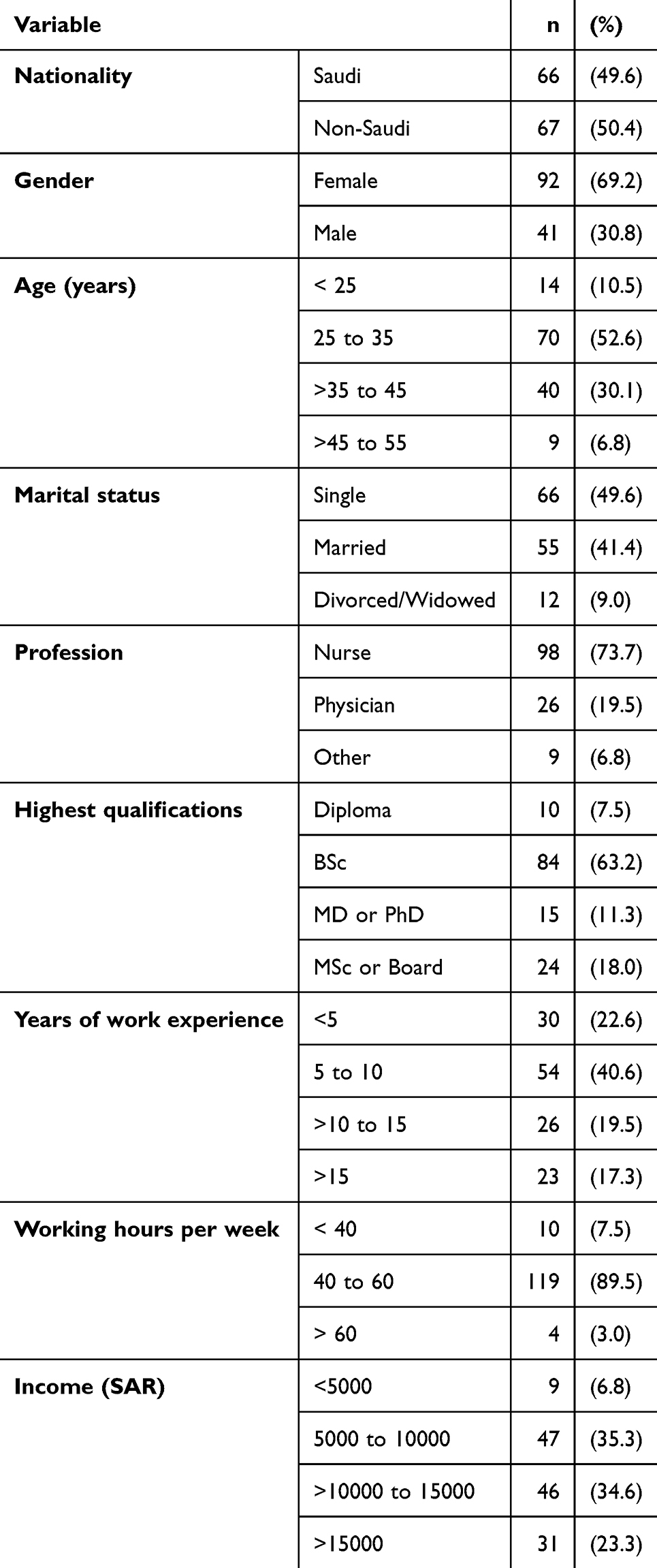 |
Table 1 Sociodemographic Characteristics Among Wound Care Staff in Riyadh, Saudi Arabia (n = 133) |
Organizational Commitment
The mean score of the organizational commitment questionnaire among the participants was 50±7.2. More than half of the study candidates had a low level of commitment (51.9%-n=69) (Figure 1). The main part of the participants was willing to put in a great deal of effort beyond what is usually expected to help this organization be successful, considered the organization’s values to be similar to their values, and were proud to tell others that they are part of this organization and cared about the fate of the organization (Table 2).
 |
Table 2 Wound Care Staff Organizational Commitment, Riyadh, Saudi Arabia (n = 133) |
 |
Figure 1 The wound care staff’s turnover intention and organizational commitment in Saudi Arabia (n = 133). |
Turnover Intention
The mean total score of the turnover intention scale among the participants was 18.7 ±3.3, and 51.9% (69) of the study participants are likely to leave the organization (Figure 1). Further, 13.5% of the participants had always considered leaving their jobs, and 29.3% had always dreamed about getting another job that would better suit their needs. Less than one-third of them thought their current job satisfied their personal needs, and 13.5% were highly likely to accept another job at the same compensation level (Table 3).
 |
Table 3 Wound Care Staff Response to the Turnover Intention Scale, Riyadh, Saudi Arabia (n = 133) |
The participants’ turnover intention had a negligible positive relation with their monthly income (rs=0.195, p=0.024) and a weak positive relation with their working hours per week (rs=0.222, p=0.010). Male staff, physicians, and those with MD or PhD degrees had significantly higher turnover intention scores (Higher intention to leave the organization likely) compared to other participants (p < 0.05) (Table 4). A direct logistic regression was carried out to assess the effect of gender, age, nationality, marital status, profession, highest qualification, years of experience, working hours, and income on the likelihood of an employee’s intention to leave the organization. However, the overall model did not yield statistically significant results (χ2(13) = 11.80, p= 0.544).
 |
Table 4 Factors Associated with the Participant’s Turnover Intentions and Their Organizational Commitment |
The participants’ organizational commitment score had a weak negative relation with their monthly income (rs= −0.247, p=0.004) and a moderate negative relation with their working hours per week (rs= −0.326, p= 0001. Non-Saudi nurses, those with diploma degree had significantly higher organizational commitment scores compared to others (p < 0.05). The turnover intention score had a strong negative relation with the organization commitment of the staff (rs= −0.470, p=0.000) (Table 4).
Logistic regression analysis was carried out to assess the effect of the independent factors on the likelihood of employees having a high level of commitment. The overall model was statistically significant (χ2(13) = 45.46, p<0.001) and then model explained 38.6% (Nagelkerke R squared) of the variation in employee commitment. As shown in Table 5, only three independent variables made a unique statistically significant contribution to the model (nationality, gender, and profession). Non-Saudi employees demonstrate a 3.8-fold higher likelihood of having high organizational commitment than Saudi employees. Female respondents exhibit a 0.187-fold lower likelihood of having high organizational commitment than male respondents. Also, physicians show a 0.023-fold lower likelihood of having high organizational commitment than nurses.
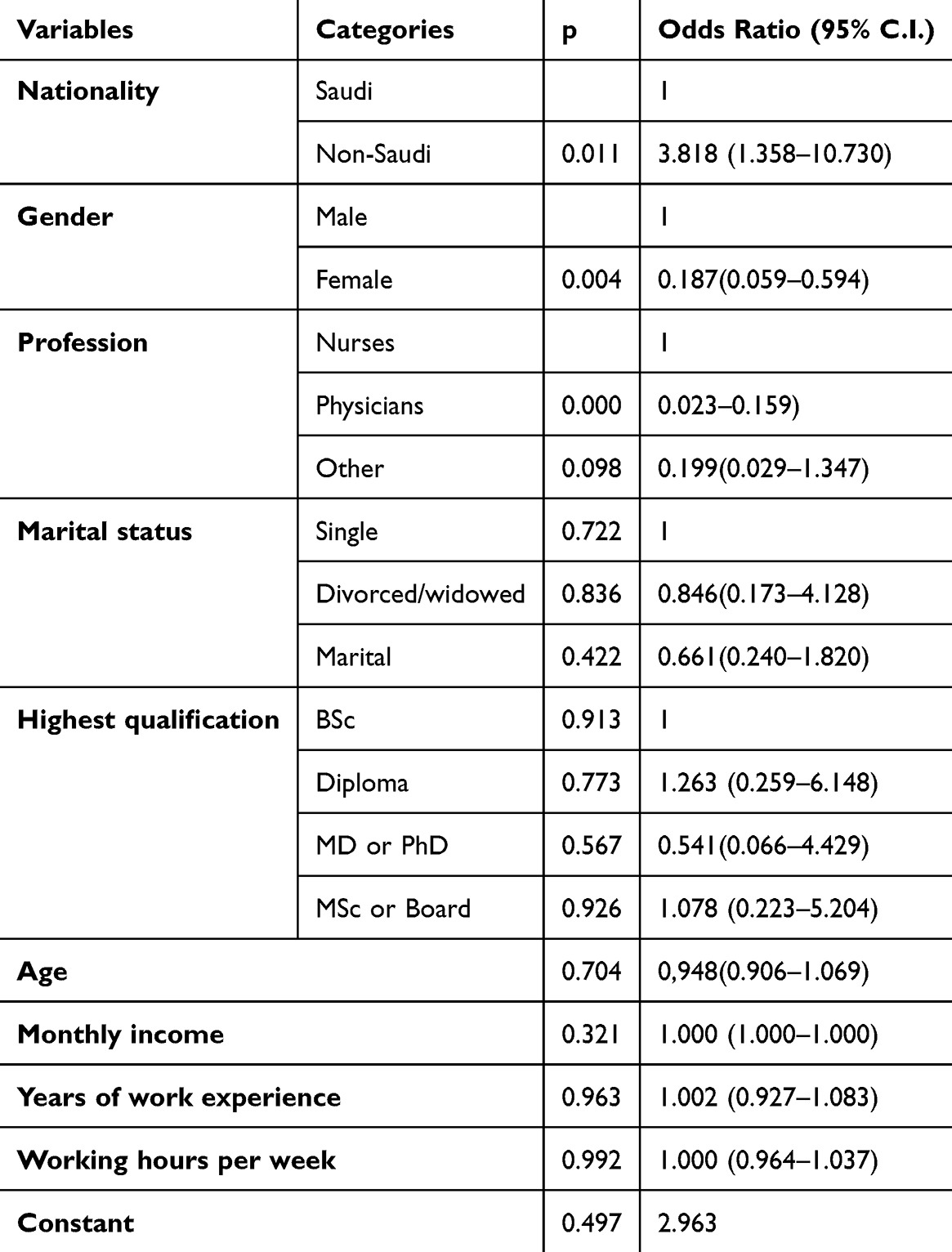 |
Table 5 Logistic Regression Predicting the Likelihood of Having High Organizational Commitment |
Discussion
The present study examined the relationship between organizational commitment, turnover intention, and sociodemographic characteristics among wound care staff in Saudi Arabia. The sociodemographic profile of the participants revealed several noteworthy findings. The majority of respondents were female, which aligns with the global trend of nursing being a dominated female profession.21 Additionally, a significant proportion of the participants were Saudi nationals, indicating a reliance on domestic workforce in the healthcare sector and progress in overcoming the challenges of nationalization of the health sector in the country.22
The findings from the current study indicate a moderate level of organizational commitment among the wound care staff.15 While a considerable proportion expressed willingness to exert extra effort for organizational success and felt proud to be part of the organization, a significant number also reported feeling little loyalty and being indifferent to organizational values. This result is similar in conducted in major public hospital in Saudi Arabia in 2020, where participants should have a moderate level of organizational commitment.23 Some employees may feel connected to the organization, others may not share the same level of dedication, this points to the complexity of employee perceptions within the healthcare sector, where various factors such as workload, job satisfaction, and organizational culture can influence individual attitudes towards their workplace.24
To address this ambivalence towards organizational commitment, healthcare administrators and managers should consider implementing strategies aimed at enhancing employee engagement and fostering a stronger sense of loyalty and alignment with organizational values. This may involve initiatives such as improving communication channels, providing opportunities for professional growth and development, recognizing and rewarding employee contributions, and creating a supportive work environment that values employee well-being. Additionally, conducting regular surveys or focus groups to gather feedback from employees can help identify specific areas of concern and inform targeted interventions to address them to cultivate a more positive and cohesive work culture, ultimately leading to improved employee satisfaction, retention, and the delivery of high-quality patient care.
The high turnover intention observed among the participants is concerning and warrants attention from healthcare administrators and policymakers.15 Factors such as dissatisfaction with job opportunities, personal needs not being met, and a lack of anticipation for workdays contribute to this intention to leave. The magnitude of turnover intention among healthcare workers is a concerning and complex issue that varies across healthcare systems and regions.5 It has been reported that the turnover intention among primary care staff has reached high levels in some Middle Eastern countries.25 For instance, a recent study among Egyptian physicians showed high rates of turnover intentions.26 While, a recent study in Brazil showed that the mean and median time until the occurrence of the physician leaving the service was 2.14 years and 1.17 years respectively, and the probability of contract interruption was 45% in the first year and 68% in the second year.27 Some recent studies have brought to light that a growing number of Chinese physicians in public hospitals are intending to leave from their organizations.28–30 Addressing these concerns is crucial to retaining skilled healthcare professionals and maintaining continuity of care.
Sociodemographic factors such as gender, profession, and nationality emerged as significant predictors of both organizational commitment and turnover intention. Non-Saudi employees exhibited higher organizational commitment, this was similarly reported in previous study of organizational commitment among health workers in Saudi Arabia.23 While the current study showed that male staff and physicians were more likely to express intention to leave the organization, a study showed that male physicians with a partner and children under the age of 16 were less likely to indicate turnover intention.31 However, recent evidence concluded that physicians generally have lower levels of organizational commitment than other healthcare workers and certain variables, particular age, professional experience, and job satisfaction, shape organizational commitment.32,33 These findings suggest that cultural and professional differences may influence employees’ perceptions of their workplace and their likelihood of staying in the organization.
Implications
The study findings have implications for healthcare organizations aiming to enhance employee retention and satisfaction. Strategies to improve organizational commitment could include fostering a supportive work environment, providing opportunities for professional development, and aligning organizational values with those of employees. Additionally, interventions targeted at addressing specific concerns identified by employees, such as workload management and career advancement opportunities, may help mitigate turnover intention.
Limitations
Several limitations should be considered when interpreting the results of this study. The cross-sectional design limits the ability to infer causality, self-report measures may introduce response bias and the use of convenience sampling technique and online data collection introduces risk of bias potentially limiting the generalizability of findings to all wound care professionals in Saudi Arabia. Future research could employ longitudinal designs to explore changes in organizational commitment and turnover intention over time. Moreover, qualitative approaches could provide deeper insights into the underlying factors driving these attitudes among healthcare professionals.
Conclusions
In conclusion, this study sheds light on the complex interplay between organizational commitment, turnover intention, and sociodemographic factors among wound care staff in Saudi Arabia. While participants demonstrate a moderate level of commitment to their organizations, the high prevalence of turnover intention signals potential challenges in retaining skilled healthcare professionals. Healthcare administrators and policymakers should prioritize interventions aimed at addressing employee concerns and improving workplace satisfaction. Strategies such as fostering a supportive work environment, providing opportunities for professional development, and aligning organizational values with those of employees may help mitigate turnover intention and enhance staff retention. By understanding the factors influencing employee attitudes and intentions, healthcare organizations can create a more resilient workforce and ensure the delivery of high-quality patient care.
Author Contributions
All authors made a significant contribution to the work reported, whether that is in the conception, study design, execution, acquisition of data, analysis and interpretation, or in all these areas; took part in drafting, revising or critically reviewing the article; gave final approval of the version to be published; have agreed on the journal to which the article has been submitted; and agree to be accountable for all aspects of the work.
Disclosure
The authors declare no conflicts of interest.
References
1. Pepe M. The impact of extrinsic motivational dissatisfiers on employee level of job satisfaction and commitment resulting in the intent to turnover. J Bus Econ Res. 2010;8(9). doi:10.19030/JBER.V8I9.762
2. Longo M, Mura M. A multidimensional measure of employees’ intangibles: a managerial implementation of the tool. Manag Res News. 2007;30(8):548–569. doi:10.1108/01409170710773698
3. Hughes JC, Rog E. Talent management: a strategy for improving employee recruitment, retention and engagement within hospitality organizations. Int J Contemp Hosp Manag. 2008;20(7):743–757. doi:10.1108/09596110810899086
4. Boniol M, Kunjumen T, Nair TS, Siyam A, Campbell J, Diallo K. The global health workforce stock and distribution in 2020 and 2030: a threat to equity and ‘universal’ health coverage? BMJ Glob Heal. 2022;7(6):e009316. doi:10.1136/BMJGH-2022-009316
5. Poon YSR, Lin YP, Griffiths P, Yong KK, Seah B, Liaw SY. A global overview of healthcare workers’ turnover intention amid COVID-19 pandemic: a systematic review with future directions. Hum Resour Health. 2022;20(1):1–18. doi:10.1186/S12960-022-00764-7
6. Frogner BK, Dill JS. Tracking turnover among health care workers during the COVID-19 pandemic: a cross-sectional study. JAMA Heal Forum. 2022;3(4):E220371. doi:10.1001/JAMAHEALTHFORUM.2022.0371
7. Tett RP, Meyer JP. Job satisfaction, organizational commitment, turnover intention, and turnover: path analyses based on meta-analytic findings. Pers Psychol. 1993;46(2):259–293. doi:10.1111/J.1744-6570.1993.TB00874.X
8. Bothma CFC, Roodt G. The validation of the turnover intention scale. SA J Hum Res Manag. 2013;11(1):1–12. doi:10.4102/SAJHRM.V11I1.507
9. Du Plooy J, Roodt G. Work engagement, burnout and related constructs as predictors of turnover intentions: original research. Sa J Ind Psychol. 2010;36(1). doi:10.4102/SAJIP.V36I1.910
10. Meyer JP, Alien NJ. A three-component conceptualization of organizational commitment. Hum Resour Manag Rev. 1991;1(1):61–89. doi:10.1016/1053-4822(91)90011-Z
11. Waldman JD, Kelly F, Arora S, Smith HL. The shocking cost of turnover in health care. Health Care Manage Rev. 2010;35(3):206–211. doi:10.1097/HMR.0B013E3181E3940E
12. Mohammadiaghdam N, Doshmangir L, Babaie J, Khabiri R, Ponnet K. Determining factors in the retention of physicians in rural and underdeveloped areas: a systematic review. BMC Fam Pract. 2020;21(1):1–23. doi:10.1186/S12875-020-01279-7/FIGURES/2
13. Al-Hanawi MK, Khan SA, Al-Borie HM. Healthcare human resource development in Saudi Arabia: emerging challenges and opportunities - A critical review. Public Health Rev. 2019;40(1):1–16. doi:10.1186/S40985-019-0112-4/TABLES/2
14. Alsadaan N, Jones LK, Kimpton A, Dacosta C. Challenges facing the nursing profession in Saudi Arabia: an integrative review. Nurs Rep. 2021;11(2):395. doi:10.3390/NURSREP11020038
15. Binkanan A. Burnout and job satisfaction among wound care staff in Saudi Arabia: implications for quality of care. Wound Practice and Research. 2024;32(4):192–199. doi:10.33235/wpr.32.4.192-199
16. Callado A, Teixeira G, Lucas P. Turnover intention and organizational commitment of primary healthcare nurses. Healthcare. 2023;11(4):1–11. doi:10.3390/HEALTHCARE11040521
17. Elrayah M, Mabkhot H. Organizational commitment and employees turnover intention in Saudi public sector: the mediating role of job satisfaction and work environemnt. Int J Prof Bus Rev. 2023;8(10):e03788. doi:10.26668/businessreview/2023.v8i10.3788
18. Mowday RT, Steers RM, Porter LW. Organizational commitment questionnaire. J Appl Psychol. 1997;77:511–514. doi:10.1037/T08840-000
19. Rose S. International ethical guidelines for epidemiological studies: by the Council for International Organizations of Medical Sciences (CIOMS). Am J Epidemiol. 2009;170(11):1451–1452. doi:10.1093/AJE/KWP334
20. Cruz LM, Teresa B, Sengco S, Gadin NP. Working to leave or living to work?: employees’ quality work life factors and its impact on turnover intention. Int Res J Sci. 2022;2(1):15–25. doi:10.5281/zenodo.6496738
21. Woo BFY, Goh YS, Zhou W. Understanding the gender gap in advanced practice nursing: a qualitative study. J Nurs Manag. 2022;30(8):4480. doi:10.1111/JONM.13886
22. Albejaidi F, Nair KS. Nationalisation of health workforce in Saudi Arabia’s public and private sectors: a review of issues and challenges. J Health Manag. 2021;23(3):482–497. doi:10.1177/09720634211035204
23. Al-Haroon HI, Al-Qahtani MF. Assessment of organizational commitment among nurses in a major public hospital in Saudi Arabia. J Multidiscip Healthc. 2020;13:519–526. doi:10.2147/JMDH.S256856
24. Fantahun B, Dellie E, Worku N, Debie A. Organizational commitment and associated factors among health professionals working in public hospitals of southwestern Oromia, Ethiopia. BMC Health Serv Res. 2023;23(1):1–9. doi:10.1186/S12913-023-09167-3/TABLES/5
25. El-Jardali F, Alameddine M, Jamal D, et al. A national study on nurses’ retention in healthcare facilities in underserved areas in Lebanon. Hum Resour Health. 2013;11(1):1–13. doi:10.1186/1478-4491-11-49
26. Abd-Ellatif EE, Anwar MM, AlJifri AA, El Dalatony MM. Fear of COVID-19 and its impact on job satisfaction and turnover intention among Egyptian physicians. Saf Health Work. 2021;12(4):490–495. doi:10.1016/j.shaw.2021.07.007
27. Bourget MMM, Cassenote AJF, Scheffer MC. Physician turnover in primary health care services in the East Zone of São Paulo City, Brazil: incidence and associated factors. BMC Health Serv Res. 2022;22(1):1–12. doi:10.1186/S12913-022-07517-1/TABLES/3
28. Ran L, Chen X, Peng S, Zheng F, Tan X, Duan R. Job burnout and turnover intention among Chinese primary healthcare staff: the mediating effect of satisfaction. BMJ Open. 2020;10(10):1–9. doi:10.1136/bmjopen-2019-036702
29. Li D, Yin W, Zhang X, Su M, Meng M, Wang Q. Investion on turnover intention of medical staff in public hospitals and research of early-warning system’s construction. Chin J Hosp Adm. 2010;218–221. doi:10.3760/CMA.J.ISSN.1000-6672.2010.03.021
30. Zhang Y, Feng X. The relationship between job satisfaction, burnout, and turnover intention among physicians from urban state-owned medical institutions in Hubei, China: a cross-sectional study. BMC Health Serv Res. 2011;11(1):1–13. doi:10.1186/1472-6963-11-235/TABLES/6
31. Ochsmann EB. Thinking about giving up clinical practice? A gender-stratified approach to understanding junior doctors’ choices. Acad Med. 2012;87(1):91–97. doi:10.1097/ACM.0B013E31823ABA03
32. Hoff T, Lee DR, Prout K. Organizational commitment among physicians: a systematic literature review. Heal Serv Manag Res. 2021;34(2):99–112. doi:10.1177/0951484820952307
33. Yağar F, Dökme S. The relationship between organizational commitment and demographic variables of physicians in public institutions. Int J Healthc Manag. 2017;12(1):81–86. doi:10.1080/20479700.2017.1406678
 © 2024 The Author(s). This work is published and licensed by Dove Medical Press Limited. The
full terms of this license are available at https://www.dovepress.com/terms
and incorporate the Creative Commons Attribution
- Non Commercial (unported, 3.0) License.
By accessing the work you hereby accept the Terms. Non-commercial uses of the work are permitted
without any further permission from Dove Medical Press Limited, provided the work is properly
attributed. For permission for commercial use of this work, please see paragraphs 4.2 and 5 of our Terms.
© 2024 The Author(s). This work is published and licensed by Dove Medical Press Limited. The
full terms of this license are available at https://www.dovepress.com/terms
and incorporate the Creative Commons Attribution
- Non Commercial (unported, 3.0) License.
By accessing the work you hereby accept the Terms. Non-commercial uses of the work are permitted
without any further permission from Dove Medical Press Limited, provided the work is properly
attributed. For permission for commercial use of this work, please see paragraphs 4.2 and 5 of our Terms.