
Back to Journals » Drug Design, Development and Therapy » Volume 19
Analytical Strategies for Natural Mono- and Disaccharide Isomer Differentiation: Techniques and Applications
Authors Yang R, Deng Z  , Liu J, Shi Z, Jiang Y
Received 15 August 2025
Accepted for publication 20 November 2025
Published 12 December 2025 Volume 2025:19 Pages 11073—11092
DOI https://doi.org/10.2147/DDDT.S561012
Checked for plagiarism Yes
Review by Single anonymous peer review
Peer reviewer comments 6
Editor who approved publication: Professor Anastasios Lymperopoulos
Rong Yang,1,2,* Ziwei Deng,3,* Jing Liu,1,2 Zhihua Shi,3 Yueping Jiang1– 3
1Department of Pharmacy, Xiangya Hospital, Central South University, Changsha, Hunan, 410008, People’s Republic of China; 2National Clinical Research Center for Geriatric Disorders, Xiangya Hospital, Central South University, Changsha, Hunan, 410008, People’s Republic of China; 3Department of Clinical Pharmacy, Hunan University of Medicine General Hospital, Huaihua, Hunan, 418000, People’s Republic of China
*These authors contributed equally to this work
Correspondence: Zhihua Shi; Yueping Jiang, Email [email protected]; [email protected]
Abstract: The precise structural differentiation of natural mono- and disaccharide isomers is fundamental for understanding carbohydrate bioactivity. However, this task remains challenging due to their minimal structural variances, high polarity, and lack of chromophores. This review traces the evolution of analytical technologies designed to overcome these hurdles. Early derivatization - GC-MS methods provided the foundation for isomer separation. Modern liquid chromatography-mass spectrometry (LC-MS), particularly with advanced chiral columns, now delivers high-resolution isomer profiling. Ion mobility spectrometry (IM-MS) further distinguishes conformers by their collision cross-section (CCS) values. Recent breakthroughs in non-derivatization strategies like UHPLC, coupled with the definitive structural validation offered by 2D-NMR, have revolutionized the field. We critically evaluate these methods’ detection limits and throughput for practical applications in food chemistry, clinical glycomics, and pharmaceutical analysis. Looking forward, emerging directions such as AI-assisted spectral interpretation and integrated microfluidic systems promise to propel glycan analysis toward rapid, precise, and intelligent diagnostics. This review provides a practical roadmap for selecting and advancing analytical techniques for real-world isomer characterization.
Keywords: monosaccharide, disaccharide, isomer, identification methods, derivatization, non-derivatization
Introduction
Carbohydrates, recognized as one of the four essential biomacromolecules, act as vital mediators in critical biological processes such as cellular recognition and signal transduction through their unique stereochemical features, playing an irreplaceable regulatory role in organismal growth and development including human-related glycobiology, plant and microbial systems.1 Their functions are encrypted in their unique stereochemical features, often termed the “sugar code.” However, deciphering this code has been a long-standing challenge in glycobiology. Monosaccharides, the fundamental units of all complex carbohydrates, exist in dynamic tautomeric equilibria (eg, α/β anomers, furanose/pyranose forms). This structural complexity has historically hindered precise analysis, creating a critical knowledge gap that limits their application in biomarker discovery, biopharmaceutical development, and functional food design.2,3 The development of high-throughput carbohydrate sequencing technologies lags significantly behind those for DNA and proteins, largely due to the profound stereochemical and structural complexity inherent to sugars.4 These analytical advancements are paving the way for transformative applications in healthcare, from early disease diagnosis through glycan biomarkers to the rational design of glycoconjugate vaccines and targeted therapeutics.
The discrimination of monosaccharide isomers presents a fundamental challenge in glycomics, arising from subtle stereochemical variations that underlie significantly distinct biological activities. While isomers share identical molecular formulas and molar masses, minimal structural differences—such as the axial versus equatorial orientation of a single hydroxyl group (eg, C4 in D-glucose vs D-galactose)—dictate their unique metabolic fates and receptor interactions. For instance, the C4 epimerization that distinguishes glucose from galactose is critical for cellular recognition processes, as demonstrated by their divergent roles in glycan-mediated cell adhesion and signaling pathways.5,6 Analytically, these compounds exhibit high polarity, which often leads to poor retention in conventional reversed-phase chromatography and excessive retention in normal-phase systems, complicating their separation. Furthermore, the general lack of intrinsic chromophores or fluorophores severely limits the sensitivity of optical detection methods, collectively creating a persistent bottleneck in glycomics research.6
To overcome these analytical hurdles, multidimensional frameworks have been developed. Chromatographic techniques remain central to these efforts. Gas chromatography (GC), for example, often requires pre-column derivatization (eg, trimethylsilylation) to confer sufficient volatility for analysis. In the liquid phase, non-derivatized approaches have gained prominence. High-performance anion-exchange chromatography with pulsed amperometric detection (HPAEC-PAD) leverages the inherent weak acidity of carbohydrates for highly sensitive separations, while hydrophilic interaction liquid chromatography (HILIC) and graphitized carbon chromatography offer orthogonal retention mechanisms tailored to polar analytes.7 Beyond chromatography, ion mobility spectrometry-mass spectrometry (IM-MS) has emerged as a powerful tool for separating isomeric species based on their distinct collision cross-section (CCS) values in the gas phase, providing insights into conformational differences that are inaccessible by mass alone.8 For definitive structural elucidation, nuclear magnetic resonance (NMR) spectroscopy remains the gold standard, enabling absolute configurational assignment through characteristic chemical shift fingerprints and coupling constants.9 The field is currently advancing along two complementary trajectories: derivatization strategies that enhance detectability by introducing chromophores or fluorophores, and non-derivatized approaches that leverage the superior resolution of ultra-high-performance liquid chromatography (UHPLC) and multidimensional separations.
Despite these technological advances, a critical gap persists between the established biological significance of oligosaccharide isomers and the practical capacity for their rapid, high-resolution characterization in complex matrices. Many existing methods represent a trade-off: while techniques like 2D-NMR provide unparalleled structural detail, they are low-throughput and require substantial sample amounts. Conversely, high-throughput LC-MS methods often struggle to resolve isomers without prior derivatization or extended run times, limiting their application in dynamic biological or biopharmaceutical contexts. Furthermore, the lack of integrated platforms that combine rapid separation, sensitive detection, and automated data interpretation hinders the transition from research tools to routine analytical or diagnostic workflows.
This review aims to bridge this gap by systematically evaluating the evolution of analytical technologies, with a focus on their real-world applicability in resolving mono- and disaccharide isomers. We critically assess how sequential breakthroughs—from hyphenated chromatography-mass spectrometry to emerging microfluidic chip systems—address the long-standing challenges in fields like biopharmaceutical development and clinical diagnostics. By benchmarking performance through key metrics such as detection limits, resolution, and analytical throughput, we provide a practical roadmap to guide method selection for specific applications. Our synthesis not only captures the historical progression of natural mono- and disaccharide isomers analysis but also aims to propel the field toward an intelligent, precision-driven future, offering actionable insights for both fundamental researches.
High Performance Liquid Chromatography (HPLC)
High-performance liquid chromatography (HPLC) has emerged as the cornerstone technique for oligosaccharide isomer analysis, distinguished by its exceptional separation efficiency and detection sensitivity,10 making it the preferred method for glycan structural elucidation. The commonly analytical technologies of natural monosaccharide and disaccharide isomers were listed in Table 1. The separation mechanism of HPLC separation mechanism relies on selective adsorption interactions between the stationary phase and organic solvent-based mobile phase. Optimization of column packing materials (eg, amino-modified, graphitized carbon phases) and gradient elution protocols enables precise resolution of polar oligosaccharide isomers with subtle structural differences. Detector technologies are categorized into derivatization and non-derivatization systems. Derivatization strategies, employing chromogenic/fluorogenic tags (eg, PMP, 2-AB), achieve pmol-level sensitivity in ultraviolet-visible spectroscopy/fluorescence detectors but may alter glycan ring conformations. Non-derivatized systems utilize universal detectors such as evaporative light scattering detector (ELSD) and refractive index detector (RID), while the hyphenated high-performance anion-exchange chromatography with pulsed amperometric detection (HPAEC-PAD) achieves 10 fmol-level sensitivity through pH-modulated charge-state manipulation and electrochemical detection.11,12
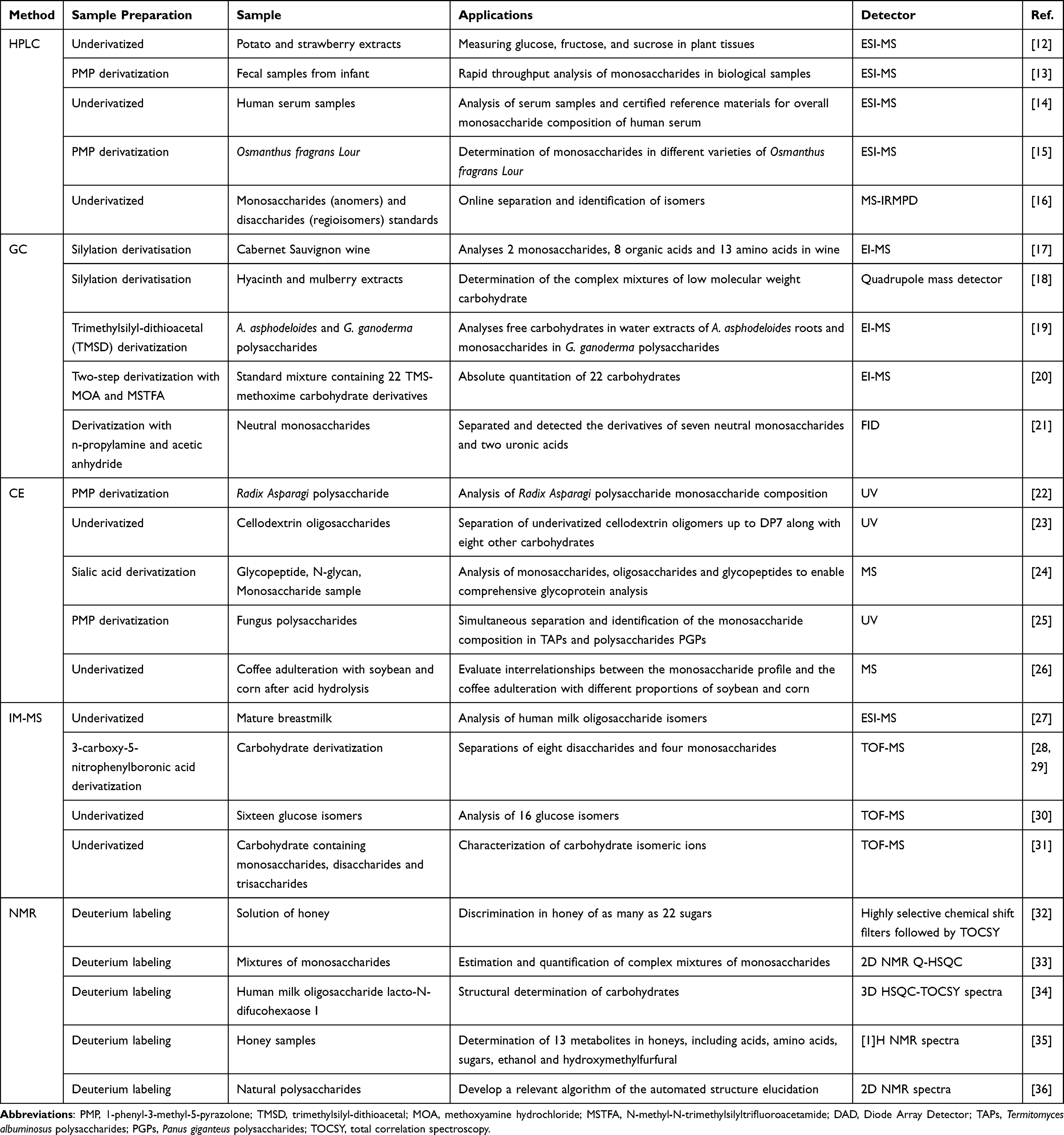 |
Table 1 Comparison of Different Structural Analytical Technologies of Natural Monosaccharide and Disaccharide Isomers |
The groundbreaking integration of HPLC with mass spectrometry (HPLC-MS/MS) has ushered glycomics into a high-throughput era. High-resolution mass spectrometry (HRMS) facilitates simultaneous acquisition of oligosaccharide molecular weights, monosaccharide compositions, and linkage positions via precise mass measurement (mass error < 5 ppm) and multistage fragmentation (eg, collision-induced dissociation [CID], electron transfer dissociation [ETD]). Detectable monosaccharides and disaccharides can not only be derived from plant extracts but also from biological samples.13,14 Representative applications include HILIC coupled with Q-TOF MS for resolving 72 serum IgG glycoform isomers and graphitized carbon column-based IM-MS for distinguishing sialic acid linkage isomers via CCS differences.15,37 Despite these advancements, challenges persist in ultra-trace sample analysis (eg, single-cell glycomics), integration of chromatographic-mass spectrometric with NMR data, and development of intelligent spectral annotation algorithms. Addressing these limitations requires innovative solutions such as miniaturized chromatographic columns and artificial intelligence-assisted data interpretation to propel glycoanalytical technologies toward enhanced precision and intelligence.
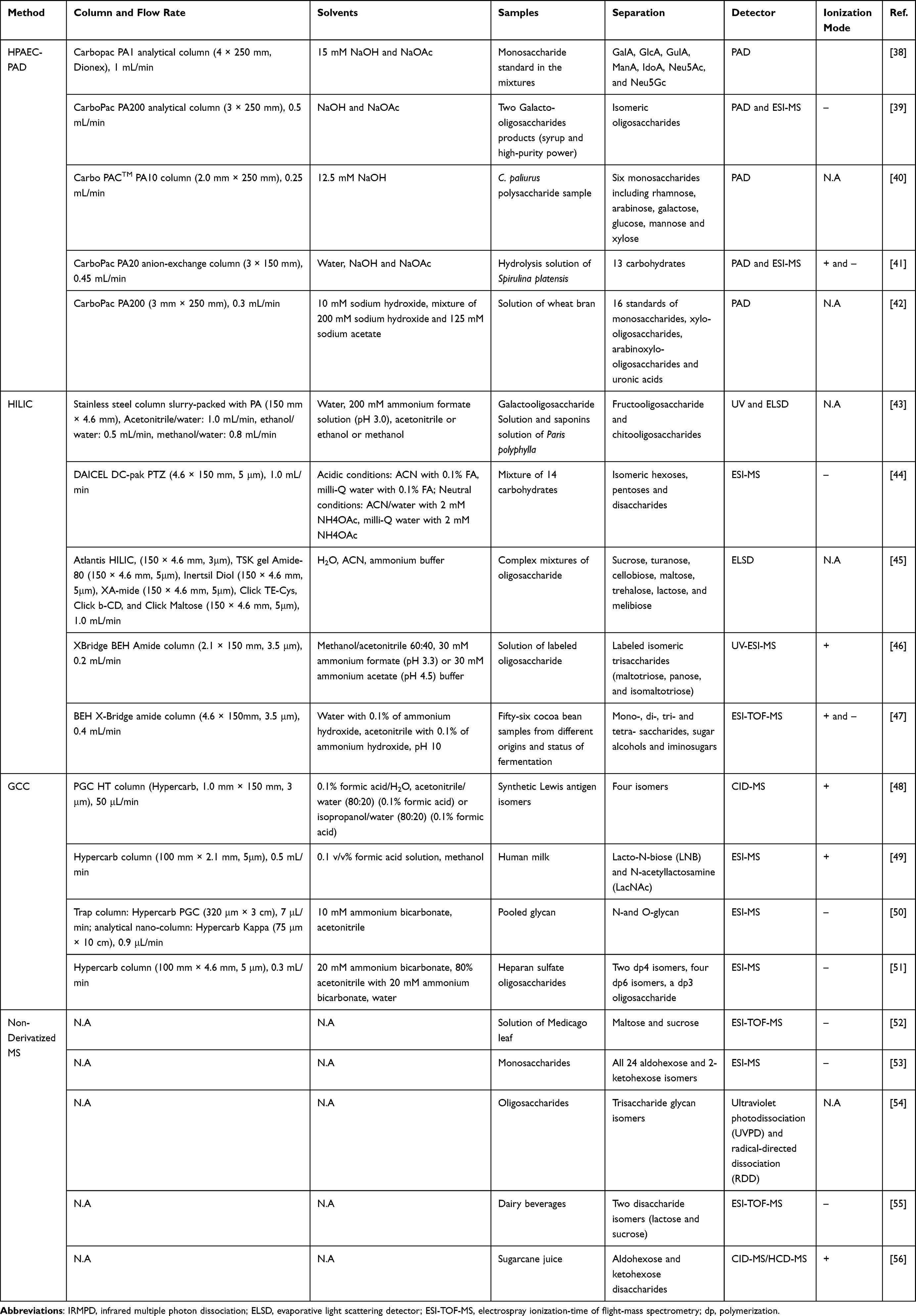 |
Table 2 Non-Derivatization Methods for Oligosaccharide Analysis |
Non-Derivatization Methods
Non-derivatized HPLC strategies for oligosaccharide separation and detection avoid the complexity of derivatization but present inherent challenges. Key non-derivatization approaches (Table 2) include high-performance anion-exchange chromatography with pulsed amperometric detection (HPAEC-PAD), HILIC, tandem mass spectrometry (MS/MS), and porous graphitized carbon (PGC) chromatography. For instance, Duarte-Delgado et al developed an HPLC-RID method for qualitative and quantitative analysis of sucrose, glucose, and fructose in potatoes.12 Emerging technologies, such as HPLC-MS coupled with infrared multiphoton dissociation spectroscopy, demonstrate promising applications in omics by enabling online separation and identification of disaccharide and monosaccharide isomers.16 The monosaccharides and disaccharides used in the literature were summarized, and their chemical structural formulas are shown in Figures 1 and 2.
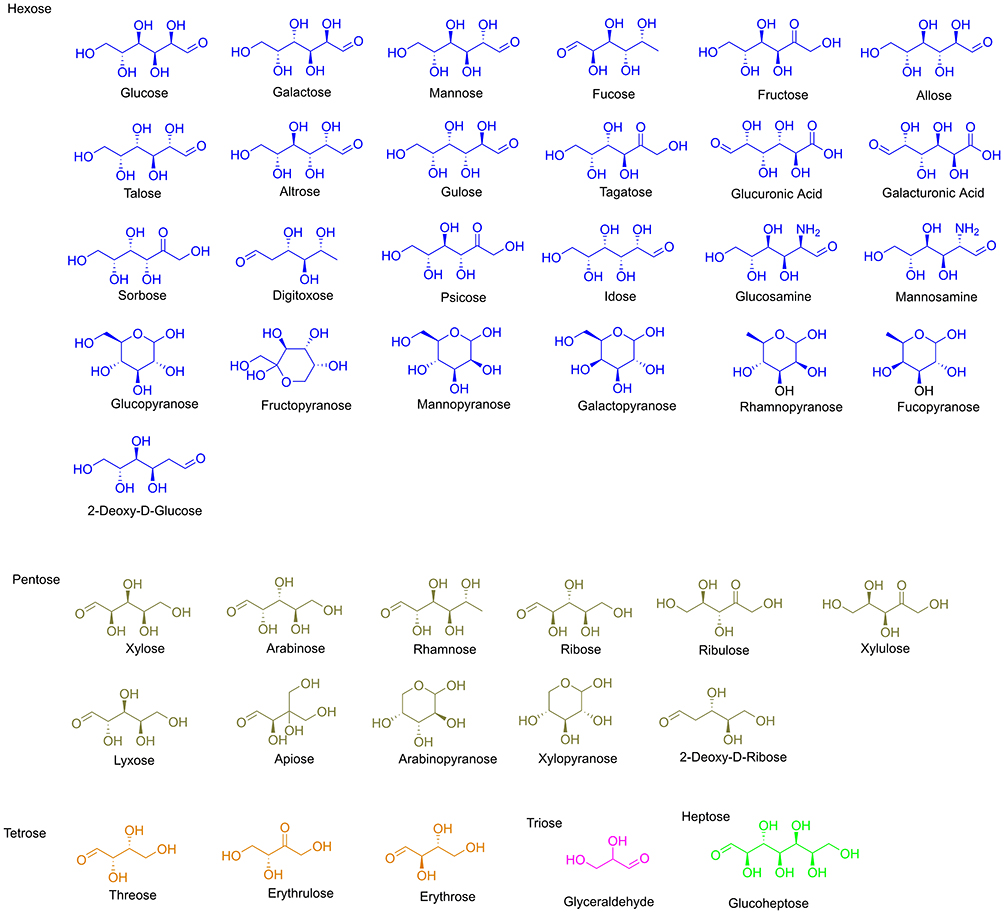 |
Figure 1 The structure of monosaccharide isomers. |
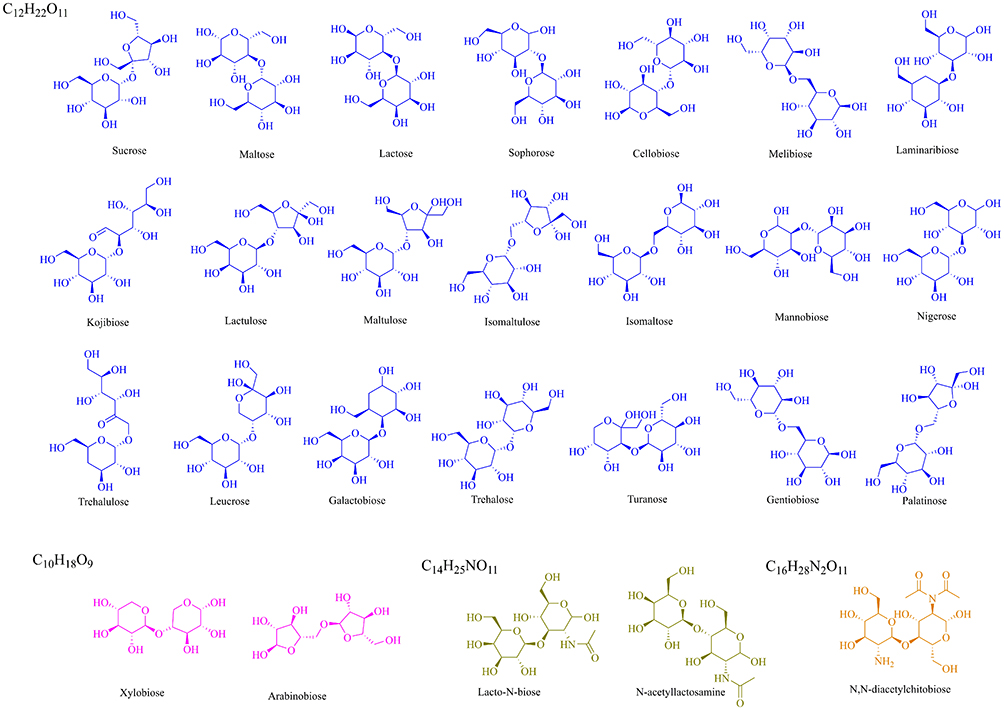 |
Figure 2 The structure of disaccharide isomers. |
High-Performance Anion-Exchange Chromatography with Pulsed Amperometric Detection (HPAEC-PAD)
Since its inception in the 1990s, HPAEC-PAD has become a vital tool for carbohydrate analysis due to its high sensitivity and non-derivatization advantages.38 This method exploits the deprotonation of hydroxyl groups under highly alkaline conditions to generate oxyanions, enabling anion-exchange separation via pKa differences (neutral monosaccharides: pKa 12–14) between hydroxyl groups and positively charged stationary phases. Uronic acids require higher NaOH concentrations for elution.39 The CarboPac PA10 column, with its narrow internal diameter, enhances separation efficiency, where hydroxyl group-dependent elution governs chromatographic optimization (eg, NaOH concentration, temperature, and elution mode).40 For example, Zhang et al utilized isocratic elution for acidic sugars and gradient elution for neutral/alkaline sugars.38,41 Alyassin M et al further validated that alkaline aqueous gradient elution improves oligosaccharide resolution.42 Polysaccharide monosaccharide composition analysis typically involves acid hydrolysis pretreatment, with microwave-assisted HCl hydrolysis widely adopted for rapid monosaccharide profiling.57
HPAEC-PAD has established a robust system for neutral monosaccharide analysis. Xie et al determined the molar ratio (1.00:1.85:3.26:3.12:0.85:0.29) of six neutral monosaccharides (eg, rhamnose, arabinose) in Cyclocarya paliurus polysaccharides, confirming the method’s high accuracy and precision.40 Concurrently, advancements in acidic monosaccharide analysis include Wang et al’s baseline separation of nine acidic/neutral monosaccharides (eg, arabinuronic acid, galacturonic acid) within 65 minutes.58 He et al expanded its applicability to simultaneous detection of neutral, acidic, and alkaline sugars.57 Despite its high resolution and sensitivity, limitations persist, including instrument corrosion under high alkalinity, nonlinear detector response-induced baseline drift, and quantification inaccuracies due to co-eluting components.59,60 To address these, HPAEC-MS hyphenation achieves mass spectrometry compatibility via online desalting (eg, suppressor-based desalting) and parallel PAD-MS detection, as demonstrated by Yi et al in dextran analysis.61 Coulier et al successfully applied this approach to lignocellulosic hydrolysate oligosaccharides.62 Technological innovations, such as Chen et al’s electrolytic eluent generation system (KMSA/KOH), enhance precision through gradient control, offering a streamlined solution for oligosaccharide analysis.63 In summary, HPAEC-PAD excels in complex polysaccharide monosaccharide profiling through high sensitivity, derivatization-free operation, and broad-spectrum separation of neutral/acidic/alkaline sugars. However, challenges like alkaline-induced instrument corrosion, baseline instability, and co-elution limitations necessitate complementary strategies such as MS hyphenation and advanced eluent systems to overcome current technical barriers.
Hydrophilic Interaction Liquid Chromatography (HILIC)
Since its introduction by Alpert in 1990, HILIC has continuously expanded its applications in carbohydrate analysis due to its exceptional separation performance for polar compounds.64 This technique operates via a partitioning mechanism between a water-enriched stationary phase and a high-organic mobile phase (primarily acetonitrile/water), effectively resolving oligosaccharide isomers while enhancing electrospray ionization (ESI) efficiency through MS-compatible mobile phases. HILIC has thus become indispensable in pharmaceutical analysis, metabolomics, and glycomics research.9,65,66 Early limitations of aminopropyl silica columns, such as poor mobile phase stability, have been mitigated by novel bonded stationary phases (eg, amide, zwitterionic, glycoside-modified phases).66 For instance, Cai et al fabricated silica columns via polyacrylamide immobilization, achieving eco-friendly separation using methanol as an acetonitrile alternative.43 Fu et al employed a poly-N-(1H-tetrazol-5-yl)-methacrylamide-bonded phase (DCPak PTZ column) to significantly enhance isomer resolution,44 while Guo et al developed an N-(3-aminopropyl)imidazole-bonded phase that strengthens monosaccharide retention through specific hydrophilic interactions.64
During HILIC separation, α/β anomeric isomers often exhibit dual peaks due to tautomeric rate disparities, which can be eliminated by elevating column temperature (accelerating equilibration) or adding buffer salts. Separation selectivity is governed by multiple factors, with Fu et al confirming the superior performance of amide columns for monosaccharide isomer resolution after systematic evaluation of seven stationary phases.45 Typical elution follows a polarity gradient: pentoses < hexoses < oligosaccharides, while glycans/glycopeptides exhibit stronger retention with increasing molecular weight.67,68 Although acetonitrile remains the dominant solvent due to its low viscosity and UV transparency, its toxicity and cost have spurred exploration of alternatives. Ethanol/isopropanol systems and subcritical MeOH:H2O:CO2 mixtures have demonstrated comparable separation efficiency with reduced analysis time.46,69,70
Advances in non-derivatized detection strategies further broaden HILIC applications. Yan et al established a HILIC-charged aerosol detector (CAD) method to resolve stachyose and Eclipta prostrata polysaccharide monosaccharides while eliminating chloride interference.9 Fu et al achieved baseline separation of three monosaccharides and seven disaccharide standards using an amide column-HILIC-CAD system.45 Hyphenated HILIC-MS platforms provide dual validation through retention time alignment and multistage MS fragmentation. For example, Megías-Pérez et al quantified cocoa bean carbohydrates via HILIC-ESI-TOF-MS,47 while Martín-Ortiz et al distinguished 23 disaccharide isomers by combining retention times with MS²fragmentation patterns.71
In summary, HILIC has solidified its position as a cornerstone technique in carbohydrate analysis, offering high-resolution separation of polar oligosaccharide isomers, enhanced ionization compatibility with MS detectors, and environmentally friendly stationary phases (eg, methanol substitution). However, its limitations include dependence on toxic/costly mobile phases (eg, acetonitrile), complex optimization requirements to address α/β anomer-induced peak splitting, and weak retention of low-molecular-weight sugars, necessitating multidimensional separation strategies to improve throughput.
Graphitized Carbon Chromatography (GCC)
Graphitized carbon chromatography (GCC) offers an innovative solution for analyzing strongly polar carbohydrate isomers, leveraging the unique properties of porous graphitized carbon (PGC) stationary phases. The uniform surface structure and broad pH tolerance of PGC facilitate efficient separation of polar glycans through induced dipole-dispersion interactions, with retention governed by molecular polarity and spatial configuration. This enables not only the discrimination of oligosaccharide isomers but also the resolution of α/β anomeric configurations, where glycan reduction strategies eliminate peak splitting caused by anomeric differences.48,49,72 Compared to conventional alkyl-based reversed-phase chromatography, GCC demonstrates superior performance in separating polar sugars and accommodates both derivatization (eg, methylation, fluorescent labeling) and non-derivatization analytical strategies.50,73 The compatibility of volatile mobile phases (eg, acetonitrile systems) with mass spectrometry further extends its utility. PGC-LC-MS hyphenation, integrating chromatographic separation with MS fragmentation, has successfully resolved polymerization degrees in heparan sulfate oligosaccharides.51,74 Additionally, GCC coupled with aerosol detectors (eg, charged aerosol detection) enables precise identification of complex components such as heparin oligosaccharides and amino sugars.75,76 However, challenges persist, including limited commercialization, incomplete understanding of separation mechanisms, and high costs, necessitating further optimization of stationary phase design and theoretical modeling of separation dynamics.
Non-Derivatized Mass Spectrometry
Mass spectrometry (MS) has become a cornerstone technique in glycan analysis, offering high sensitivity, rapid analysis, and rich structural insights through fragment ion characterization. Electrospray ionization (ESI) and matrix-assisted laser desorption/ionization (MALDI) dominate as primary ion sources, with atmospheric pressure chemical ionization (APCI) also proving effective.75 Tandem MS configurations—including triple quadrupole (QqQ), quadrupole-time-of-flight (QTOF), Fourier-transform ion cyclotron resonance (FT-ICR), and ion trap-Orbitrap systems—enable tailored qualitative and quantitative studies of oligosaccharides through optimized ionization sources and mass analyzers. Liquid chromatography-MS (LC-MS) exploits secondary or multistage fragment ion patterns for isomer discrimination: Zhu et al differentiated hexose and hexosamine isomers using APCI-QTOF-MS via diagnostic ions ([M+NH4]+ and [M–H]–) and intensity ratios,77 while Xia et al employed ESI-ion trap MS to resolve pentoses, hexoses, and deoxy sugars using [2M + Na–H2O]+ and [M+Na]+ adduct-specific fragmentation.78 Zhan et al achieved linkage-specific disaccharide characterization through MALDI-TOF/TOF-generated [M+Cl]– adducts and their fragmentation fingerprints.52 By leveraging chloride adduction on a novel LC-cESI-MS/MS platform, researchers achieved nanomolar-level sensitivity and orthogonal analysis for disaccharide isomers, revealing turanose as a major isomer in honey with superior performance over conventional sodium adduction methods.79 A novel CMTSES strategy based on LC-QQQ-MS was developed, which integrates composition-dependent MRM transitions with structure-indicative LC elution segments to comprehensively profile disaccharide units and effectively differentiate their linkage, composition, and configuration isomers in real samples.80
Innovative strategies further enhance isomer resolution: Fixed-ligand kinetic methods enabled chiral discrimination of all 24 hexose isomers via unique fragment ion ratios,53 while radical-directed dissociation (RDD) and ultraviolet photodissociation (UVPD) outperformed collision-based activation in distinguishing glycan isomers.54 The CMTSES-LC-QQQ-MS strategy integrated composition-dependent MRM transitions and elution profiles to resolve mixed homo-/heterogeneous disaccharide isomers.80 Copper-ligand complex ions (eg, [(Cu2+)(A)(L-His)-H]+), when mapped into 3D fragmentation vectors, enabled complete differentiation of 14 disaccharide isomers.55 Chiral recognition studies using protonated tryptophan and pentose enantiomers (ribose/arabinose) revealed UVPD-based S1-S0 transition intensity differences for enantiomer quantification.81 Glc-Fru isomers were successfully discriminated through PCA models based on ESI-MS/MS fragmentation patterns of lithium ([M+Li]+) and sodium ([M+Na]+) adducts under CID and HCD collision modes, with glycosidic bond decomposition mechanisms elucidated via deuterium-labeling experiments and DFT calculations, revealing that HCD-MS/MS was optimized for lithium adduct differentiation, while CID-MS/MS proved superior for sodium adducts.56 Fixed-ligand kinetic workflows were extended to 12 pentose isomers (including D/L enantiomers), enabling microgram-scale absolute configuration determination.82 Time-of-flight secondary ion mass spectrometry (TOF-SIMS) combined with PCA discriminated seven monosaccharide isomers via validated fragmentation pathways,83 while HILIC-Q/TOF-MS optimized retention times, fragment abundance ratios (RAR), and collision energy-dependent profiles for non-derivatized mono-/disaccharide analysis in complex matrices.6
MS excels in unparalleled sensitivity, multidimensional fragmentation data acquisition, and versatile ion source/analyzer configurations, enabling precise isomer discrimination through advanced adduct chemistry, radical-based dissociation, and AI-driven pattern recognition. However, challenges persist, including reliance on complex data interpretation algorithms, high instrumentation costs, and limited throughput in high-complexity samples. Rigorous optimization of adduct stability and matrix effects remains critical for robust analytical applications.
Derivatization Methods for Liquid Chromatography-Mass Spectrometry (LC-MS)
The inherent absence of chromophores/fluorophores and low ionization efficiency of monosaccharides impose sensitivity limitations on direct HPLC-MS/MS analysis, necessitating derivatization strategies—primarily pre-column approaches due to lower instrumental complexity compared to post-column methods. Widely adopted reagents include anthranilic acid (AA), 2-amino-5-bromopyridine (ABP), 4-aminobenzoic acid butyl ester (ABBE), 4-aminobenzoic acid methyl ester (ABME), 1-phenyl-3-methyl-5-pyrazolone (PMP), and phenylhydrazine, with PMP emerging as the gold standard for its mild reaction conditions (no acid catalysis required), preservation of acetyl groups/stereochemistry, and strong UV absorption at 245 nm.56 Optimized derivatization protocols enable rapid, accurate monosaccharide profiling in polysaccharides: Fan et al characterized Osmanthus polysaccharides via pre-column PMP-HPLC-MS/MS, identifying rhamnose, xylose, ribose, glucose, mannose, trehalose, galactose, and galacturonic acid,14 while Jiang et al quantified monosaccharides in Astragalus polysaccharides using retention time-based isomer discrimination and peak area calculations.84 LC-MS/MS leverages adduct-specific fragmentation for structural elucidation, exemplified by Wu et al’s ESI-MS analysis of Sargassum fusiforme monosaccharides53 and Guo et al’s quantitative profiling of Poria cocos polysaccharides.85 Sun et al further established PMP-HPLC fingerprinting for Ganoderma lucidum polysaccharide quality control.86 Despite these advances, conventional derivatization fails for ketoses (eg, fructose), driving innovations like PMP-labeled disaccharide isomer discrimination via ESI-MS/MS cross-ring/glycosidic bond cleavage patterns and statistical RIR (relative intensity ratio) analysis of three ion pairs (16 isomers resolved).87 Comparative derivatization workflows (HACl/BSTFA vs EtOx/BSTFA) enabled GC/LC separation of 15 aldoses and complex mixture deconvolution,88 while PMP-ESI-MSn achieved glycosidic linkage/anomer determination via diagnostic C–C bond cleavage ions.89 Trace sample analysis (<1 mg) was revolutionized by UPLC-DAD-Q-TOF/MS with one-pot derivatization, resolving eight aldose enantiomers and rare sugars via retention time/fragment abundance ratios.90 Derivatization significantly enhances sensitivity and enables isomer quantification, with PMP offering robust reproducibility and stereochemical integrity. Emerging strategies (eg, RIR-based MS/MS, enantioselective protocols) address ketose limitations and chiral discrimination. Multi-step derivatization increases workflow complexity; ketose incompatibility persists in conventional methods; matrix interference and adduct stability require stringent optimization.
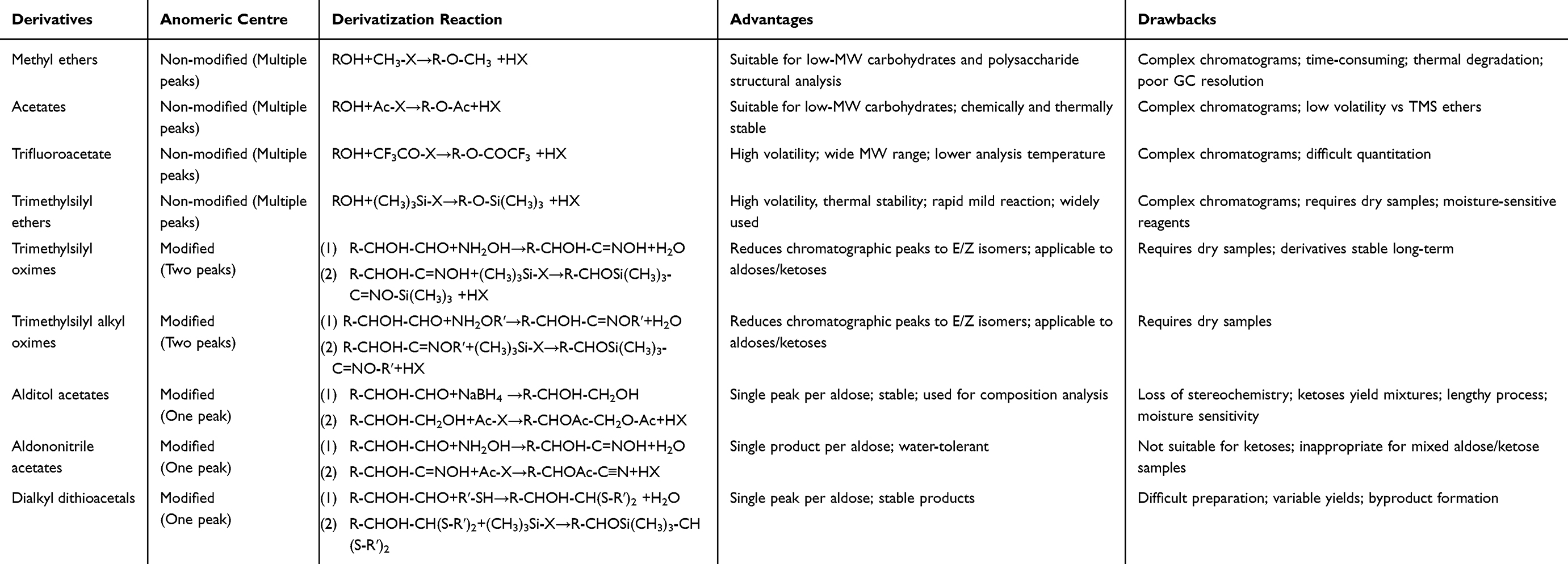 |
Table 3 Main Types of Derivatives Used for GC and GC–MS Analysis of Carbohydrates91 |
Gas Chromatography and Gas Chromatography-Mass Spectrometry Coupling Method
GC excels in separating volatile compounds with high resolution and sensitivity, yet requires derivatization to enhance volatility and stability for carbohydrate analysis due to their inherent polarity and high boiling points.17 Gas chromatography coupled with flame ionization detection (GC-FID) and GC-MS is widely adopted, with the latter dominating quantitative applications.18 Derivatization strategies encompass methyl ethers, acetates, oximation, sugar alcohol acetates, saccharide acetates, and dithioacetals.19,92 Main types of derivatives used for GC and GC-MS analysis of carbohydrates showed in Table 3.91 Single-step derivatization (eg, acetylation/silylation) substitutes polar groups to improve volatility, though silylation risks multi-peak formation and peak overlap.20 Two-step approaches (reduction/oximation followed by acetylation/silylation) minimize isomer complexity: reduction with NaBH4 converts aldoses to alditols but excludes ketoses, while oximation (hydroxylamine/methoxyamine HCl) eliminates furanose/pyranose isomerism, reducing chromatogram complexity via E/Z oxime formation applicable to both aldoses and ketoses.2 Common reagents include trimethylchlorosilane (TMCS), hexamethyl-disilazane (HMDS), trifluoroacetamide (BSTFA) (silylation), and acid anhydrides (acetylation).20 Method optimization focuses on simplifying workflows: Becker et al resolved 46 carbohydrates via ethoxyamination-silylation, enhancing peak identification;2 Wang et al achieved stable derivatives for seven neutral monosaccharides and two uronic acids using n-propylamine/acetic anhydride.21 Li et al developed a single-peak acetylated derivative method via Me2SO/1-MeIm-mediated acetylation, enabling GC-MS analysis of aldoses, ketoses, and alditols in plant/fruit samples.93 Acetal-trifluoroacetyl (Acetal-TFA) derivatives coupled with chiral/non-chiral columns enabled enantiomer resolution of C3-C6 aldoses.94 Ketose-compatible innovations include Faraco’s boronic acid derivatization (single-peak quantification of aldoses/ketoses)95 and Xia’s trimethylsilyl-dithioacetal (TSMD)-based GC-MS method for simultaneous analysis of aldoses, uronic acids, ketoses, and amino sugars.19 GC-MS offers unparalleled resolution and sensitivity for carbohydrate profiling, with advanced derivatization (eg, oxime/acetal-TFA) minimizing isomer complexity and enabling enantiomer discrimination. Multi-step derivatization increases procedural complexity; ketose analysis requires specialized protocols. Silylation-induced peak multiplicity may compromise quantification accuracy.
Capillary Electrophoresis
Capillary electrophoresis (CE) has emerged as a versatile analytical tool for carbohydrate separation, leveraging differences in charge-to-mass ratio, molecular size, and shape under electrophoretic migration.96 Capillary zone electrophoresis (CZE) stands out for its simplicity, rapid analysis, minimal sample consumption, and eco-friendliness (low organic solvent usage), making it ideal for carbohydrate profiling.22 Detection strategies include direct/indirect UV (eg, photo-oxidation at 270 nm,97 photochemical-induced UV for oligosaccharides23), contactless conductivity (C4D), and fluorescence-based methods. While native CE struggles with unmodified monosaccharide detection due to lacking chromophores/fluorophores, derivatization reagents like APTS (8-aminopyrene-1, 3, 6-trisulfonate) and PMP (1-phenyl-3-methyl-5-pyrazolone) enable pre-column labeling for laser-induced fluorescence (LIF) or UV detection. CE-MS hyphenation enhances specificity and sensitivity: Khatri integrated microfluidic CE-MS with TMT tagging for multiplexed glycan quantitation.24 For derivatization-based separations, Hu et al demonstrated PMP derivatization coupled with borate complexation under alkaline conditions to separate 10 aldoses/uronic acids,25 while Lu et al extended this to 11 aldoses in honey.97 Daniel et al further utilized CE-MS to identify coffee adulteration via monosaccharide profiling.26 Comparative studies highlight CE’s superior resolution and throughput over LC/GC methods, exemplified by Zhao et al’s CZE-MS analysis of plant-derived mono-/di-/trisaccharides96 and Oliver et al’s cellulose analysis without sample pretreatment.98 CE offers unmatched resolution, rapid analysis (<10 min), and minimal sample/reagent consumption, with derivatization-LIF achieving sub-picomolar sensitivity. Derivatization complexity (eg, APTS labeling), matrix-dependent migration reproducibility, and limited commercial CE-MS interfaces hinder routine adoption.
Ion Mobility Mass Spectrometry
IM-MS has emerged as a high-throughput structural elucidation tool for carbohydrate isomers, leveraging gas-phase ion separation based on CCS, charge, mass, and ion-neutral interactions.27,99 By resolving ions in weak electric fields with inert buffer gases (N2/He), IM-MS complements traditional MS by distinguishing isobaric isomers (eg, positional/stereoisomers) with lower sample requirements and faster analysis than NMR or LC.28 Key parameters include arrival time distributions (ATDs) and instrument-independent CCS values, which reflect ion conformation and drift gas effects.99 Torano et al pioneered conformer distribution (CD) fingerprinting via ATDs to identify glycan isomers,100 while Gaye et al differentiated 16 glucose isomers using CCS-guided diastereomer complexes with metals/ligands.30 Gas composition optimization (N2 for maximal CCS reproducibility101) and derivatization strategies (eg, PMP labeling,8 3C5NBA29) enhance CCS disparity, enabling monosaccharide/disaccharide isomer resolution. IM-MS/MS workflows (eg, IMS-CID-IMS-MS31) exploit precursor/fragment ion CCS correlations for structural confirmation. By employing 4-(3-methyl-5-oxo-pyrazolin-1-yl) benzoic acid (CPMP) derivatization coupled with IMS analysis, researchers successfully distinguished disaccharide isomers, achieving near-baseline separation with a high resolution of 1.484 for the [M+2CPMP+H]+ ion species.3
Integration with chromatographic systems expands applicability: Antonius et al coupled HILIC with traveling-wave IM-MS (3-AQ-HILIC-TWIMMS) for pectin oligomer isomer quantification,102 while Reymond et al implemented 2D-LC-IM-MS for lignocellulosic biomass analysis.103 CCS databases (eg, Glycobase 43104) accelerate isomer identification via standardized references. Technological advancements include collision-induced fingerprinting (CIF) for energy-resolved isomer differentiation,105 cyclic IM (cIM) separators for high-resolution MS/MS,106,107 and ambient ionization with in situ methylation for rapid glycosidic linkage analysis in complex matrices. Ion mobility methods on a cIMS instrument were used to build a database of HR-IMS fingerprints for various underivatized monosaccharide stereoisomers. The conditions were fully compatible with MS/MS fragmentation approaches, and verified that these fingerprints afford the identification of monosaccharidic fragments released upon collisional fragmentation of oligosaccharides.108 An ambient ionization tandem mass spectrometry approach coupled with in situ methylation using tetramethylammonium hydroxide was used to rapidly differentiate disaccharide isomers by generating characteristic methylated marker ions, enabling precise identification of glycosidic linkages, compositions, and configurations without chromatographic separation. The method’s practicality is demonstrated through direct analysis of disaccharide isomers in complex commercial products such as honey, wine, and milk, offering a high-throughput solution for real-world saccharide characterization with minimal sample pretreatment.109 Derivatization-enhanced strategies, such as CPMP-IMS for lactose/maltose quantification in beer/milk,3 demonstrate method versatility. IM-MS achieves rapid, high-resolution isomer discrimination with minimal sample consumption, complemented by CCS database interoperability and compatibility with hybrid chromatographic systems. The reproducibility of CCS measurements is influenced by drift gas and ionization settings, while the limited database coverage for rare isomers restricts identification capability, further compounded by the high cost of advanced systems like cIM-MS.
Nuclear Magnetic Resonance Spectroscopy
NMR spectroscopy serves as a cornerstone technique for carbohydrate structural elucidation, combining non-destructive analysis, high precision, and reproducibility. While 1D ¹H/¹³C NMR provides foundational monosaccharide composition data, peak overlap necessitates advanced 2D/multidimensional methods (eg, ¹H-¹H COSY, HSQC, HMBC) to resolve glycosidic linkages and stereoisomers.106,107 Innovative protocols enhance utility: Inagaki et al established L-cysteine methyl ester derivatization for absolute configuration determination (D/L) via ¹H NMR chemical shifts in ginsenoside monosaccharides,5 while Sassaki et al leveraged JC-H coupling (155 Hz) in Q-HSQC for α/β anomer discrimination.33 Multidimensional approaches (eg, Qi Shi’s 3D HSQC-TOCSY) streamline structural assignments without derivatization.34 High-throughput applications include Campo’s ¹H NMR quantification of honey carbohydrates35 and Schievano’s CSSF-TOCSY method for simultaneous identification/quantitation of 22 saccharides in aqueous honey extracts.110 Computational tools address spectral complexity: Florbela Pereira’s 1D ¹³C-NMR simulations predict oligosaccharide linkages,32 and Kapaev’s GODESS software models 2D NMR spectra for unresolved peaks.36 Sensitivity limitations (sample quantity/purity) are mitigated by cryoprobes, ultrahigh-field magnets, and hyperpolarization techniques, expanding NMR’s scope to nanoscale carbohydrate analysis. NMR offers non-destructive, absolute structural determination with atomic-level resolution, excelling in stereochemistry and linkage analysis without chromatographic separation. High sample purity/quantity requirements and spectral complexity demand advanced instrumentation/computational aids; throughput lags behind MS-based methods. Emerging hyperpolarization technologies promise enhanced sensitivity for trace analysis.
Other Methods
A hetero-octameric Mycobacterium smegmatis porin A (MspA) nanopore engineered with phenylboronic acid (PBA) adapters achieved precise disaccharide isomer discrimination (sucrose, lactose, maltose, and six α-D-glucopyranosyl-D-fructose variants) at 99% accuracy via machine learning-assisted current signature analysis, marking the first nanopore-based detection of glycosidic linkage diversity. Practical validation through direct identification of isomaltulose additives in commercial sugar-free yogurt underscores its potential for real-time saccharide monitoring and nanopore sequencing.111 Separately, a homochiral organic photoelectrochemical transistor (OPECT) integrated Au nanoparticle (AuNP)-decorated TiO2 nanotube arrays (TNT) with a chiral Cu(II)-MOF (c-CuMOF) gate electrode for enantioselective glucose sensing. Stereospecific catalytic oxidation of captured D/L-glucose to H2O2 triggered catalytic precipitation, amplifying drain current (ID) responses with ultra-low LODs (0.05 μM for D-Glu, 0.07 μM for L-Glu), while elucidating biomimetic stereoselectivity mechanisms.112 Both methods offer breakthrough sensitivity and specificity—nanopores enable label-free, real-time isomer discrimination; OPECT achieves enantiomer detection at sub-μM levels with mechanistic insights. Nanopore accuracy depends on adapter stability and machine learning training data scope; OPECT requires complex photoelectrode fabrication and lacks multiplexing capability for complex matrices. By achieving rapid cryogenic IR spectral acquisition within 10 seconds, researchers have successfully directly coupled LC with IR spectroscopy, providing a real-time, orthogonal dimension for molecular fingerprinting that identifies oligosaccharide isomers and impurities simultaneously during a standard analytical run.113 Recently, a novel label-free oligosaccharide sensing platform based on the OmpF nanopore was developed, which leverages intrinsic electroosmotic flow to detect neutral oligosaccharides at concentrations as low as 6.4 μM and, combined with machine learning, achieves 99.9% accuracy in distinguishing tetrasaccharide isomers based on glycosidic linkage differences directly in complex biological matrices.114 By employing a synthesized reactive matrix (TMNTA) and an internal standard, a MALDI-TOF/TOF MS/MS method achieves absolute quantification of glucose and fructose isomers through diagnostic ion ratios, offering a simple and rapid solution for complex sample analysis.115 A novel computational technique that combines quantum tunneling with artificial intelligence has been reported, demonstrating excellent sensitivity in distinguishing carbohydrate anomers and stereoisomers and opening a route for integration with next-generation sequencing.4 A hetero-octameric Mycobacterium smegmatis porin A nanopore equipped with a phenylboronic acid adapter has been demonstrated to directly discriminate disaccharide isomers, successfully differentiating not only common disaccharides like sucrose and lactose but also resolving six α-D-glucopyranosyl-D-fructose linkage isomers with 99% accuracy when assisted by machine learning.111
Conclusions and Perspectives
This review has charted the technological evolution in carbohydrate analysis, moving from conventional separations to intelligent, multi-dimensional platforms. Our contribution lies in synthesizing this progress into a practical evaluation framework that directly discusses the historic trade-offs between resolution, throughput, and structural certainty, thereby empowering researchers to select optimal strategies for discriminating natural monosaccharide and disaccharide isomers in applications such as biologics quality control, clinical biomarker discovery, or food authentication.
The shift toward streamlined, non-derivatization workflows and hyphenated systems like HILIC-IM-MS represents more than a technical advance. It fundamentally enhances our ability to probe structure–function relationships in glycans, thereby translating analytical precision into meaningful biological insight. Looking ahead, emerging technologies such as functionalized nanopores, biomimetic sensors, and chip-integrated platforms hold transformative potential. When integrated with advances in machine learning and quantum-assisted modeling, these tools are poised to enable real-time, mono- and disaccharide isomers profiling. This convergence will pave the way for a new era of precision glycobiology, one that seamlessly connects molecular structure to biological mechanism and function.
Author Contributions
All authors made a significant contribution to the work reported, whether that is in the conception, study design, execution, acquisition of data, analysis and interpretation, or in all these areas; took part in drafting, revising or critically reviewing the article; gave final approval of the version to be published; have agreed on the journal to which the article has been submitted; and agree to be accountable for all aspects of the work.
Funding
This work was supported by the Natural Science Foundation of China (No. 82574698), Natural Science Foundation of Hunan Province (No. 2023JJ60523), Natural Science Foundation of Changsha City (No. kq2403043), Shandong Provincial Natural Science Foundation of China (No.ZR2023LZY011), and China’s Foundation for Youth Entrepreneurship and Employment (No.17, fifth phase).
Disclosure
The authors declare that there are no conflicts of interest regarding the publication of this paper.
References
1. Nagy G, Pohl NLB. Complete hexose isomer identification with mass spectrometry. J Am Soc Mass Spectrometry. 2015;26(4):677–685. doi:10.1007/s13361-014-1072-z
2. Becker M, Liebner F, Rosenau T, et al. Ethoximation-silylation approach for mono- and disaccharide analysis and characterization of their identification parameters by GC/MS. Talanta. 2013;115:642–651. doi:10.1016/j.talanta.2013.05.052
3. Ye K, Ye J, Yan Y, et al. Rapid quantification of disaccharide isomers by derivatization in combination with ion mobility spectrometry in beer and milk. Analyst. 2024;149(21):5298–5305. doi:10.1039/D4AN00995A
4. Mittal S, Jena MK, Pathak B. Integration of Artificial Intelligence and Quantum Transport toward Stereoselective Identification of Carbohydrate Isomers. ACS Cent Sci. 2024;10(9):1689–1702. doi:10.1021/acscentsci.4c00630
5. Inagaki M, Iwakuma R, Kawakami S, et al. Detecting and Differentiating Monosaccharide Enantiomers by 1 H NMR Spectroscopy. J Natural Prod. 2021;84(7):1863–1869. doi:10.1021/acs.jnatprod.0c01120
6. Liu J, Li J, Yi D, et al. Non-derivatization strategy for the comprehensive characterization of neutral monosaccharide isomers and neutral disaccharide isomers using hydrophilic interaction liquid chromatography coupled to quadrupole/time-of-flight mass spectrometry. J Chromatogr B. 2021;1185:122972. doi:10.1016/j.jchromb.2021.122972
7. Yan J, Shi S, Wang H, et al. Neutral monosaccharide composition analysis of plant-derived oligo- and polysaccharides by high performance liquid chromatography. Carbohydr Polym. 2016;136:1273–1280. doi:10.1016/j.carbpol.2015.10.028
8. Li Y, Liang J, Shen Y, et al. A new application of acetylation for analysis of acidic heteropolysaccharides by liquid chromatography-electrospray mass spectrometry. Carbohydr Polym. 2020;245:116439. doi:10.1016/j.carbpol.2020.116439
9. Yang H, Shi L, Zhuang X, et al. Identification of structurally closely related monosaccharide and disaccharide isomers by PMP labeling in conjunction with IM-MS/MS. Sci Rep. 2016;6(1):1.
10. Duarte-Delgado D, Narváez-Cuenca C, Restrepo-Sánchez L, et al. Development and validation of a liquid chromatographic method to quantify sucrose, glucose, and fructose in tubers of Solanum tuberosum Group Phureja. J Chromatogr B. 2015;975:18–23. doi:10.1016/j.jchromb.2014.10.039
11. Yin D, Sun X, Guo Y, et al. Development of qualitative and quantitative chromatographic analysis of monosaccharides. Food and Technology of Food Industry. 2020;41(24):321–329.
12. Georgelis N, Fencil K, Richael CM. Validation of a rapid and sensitive HPLC/MS method for measuring sucrose, fructose and glucose in plant tissues. Food Chem. 2018;262:191–198. doi:10.1016/j.foodchem.2018.04.051
13. Xu G, Amicucci MJ, Cheng Z, et al. Revisiting monosaccharide analysis – quantitation of a comprehensive set of monosaccharides using dynamic multiple reaction monitoring. Analyst. 2017;143(1):200–207. doi:10.1039/C7AN01530E
14. Han B, Park JW, Kang M, et al. Simultaneous analysis of monosaccharides using ultra high-performance liquid chromatography-high resolution mass spectrometry without derivatization for validation of certified reference materials. J Chromatogr B. 2020;1160:122370. doi:10.1016/j.jchromb.2020.122370
15. Fan B, Li T, Song X, et al. A rapid, accurate and sensitive method for determination of monosaccharides in different varieties of Osmanthus fragrans Lour by pre-column derivatization with HPLC-MS/MS. Int J Biol Macromol. 2019;125:221–231. doi:10.1016/j.ijbiomac.2018.12.033
16. Schindler B, Laloy-Borgna G, Barnes L, et al. Online separation and identification of isomers using infrared multiple photon dissociation ion spectroscopy coupled to liquid chromatography: application to the analysis of disaccharides regio-isomers and monosaccharide anomers. Anal Chem. 2018;90(20):11741–11745. doi:10.1021/acs.analchem.8b02801
17. Zhang X, Lan Y, Zhu B, et al. Changes in monosaccharides, organic acids and amino acids during Cabernet Sauvignon wine ageing based on a simultaneous analysis using gas chromatography-mass spectrometry. J Sci Food Agric. 2018;98(1):104–112. doi:10.1002/jsfa.8444
18. Rodríguez-Sánchez S, Soria AC, Lebrón-Aguilar R, et al. Evaluation of different ionic liquid stationary phases for the analysis of carbohydrates by gas chromatography-mass spectrometry. Anal Bioanal Chem. 2019;411(28):7461–7472. doi:10.1007/s00216-019-02118-0
19. Xia Y, Sun H, Wang T, et al. A Modified GC-MS Analytical procedure for separation and detection of multiple classes of carbohydrates. Molecules. 2018;23(6):1284. doi:10.3390/molecules23061284
20. Milkovska-Stamenova S, Schmidt R, Frolov A, et al. GC-MS Method for the Quantitation of Carbohydrate Intermediates in Glycation Systems[J]. Journal of Agricultural and Food Chemistry. 2015;63(25):5911–5919. doi:10.1021/jf505757m
21. Wang X, Zhang L, Wu J, et al. Improvement of simultaneous determination of neutral monosaccharides and uronic acids by gas chromatography. Food Chem. 2017;220:198–207. doi:10.1016/j.foodchem.2016.10.008
22. Chen J, Yang F, Guo H, et al. Optimized hydrolysis and analysis of Radix Asparagi polysaccharide monosaccharide composition by capillary zone electrophoresis. J Separat Sci. 2015;38(13):2327–2331. doi:10.1002/jssc.201500120
23. Alinat E, Jemmali S, Delaunay N, et al. Analysis of underivatized cellodextrin oligosaccharides by capillary electrophoresis with direct photochemically induced UV-detection. Electrophoresis. 2015;36(14):1555–1563. doi:10.1002/elps.201400605
24. Khatri K, Klein JA, Haserick JR, et al. Microfluidic capillary electrophoresis-mass spectrometry for analysis of monosaccharides, oligosaccharides, and glycopeptides. Anal Chem. 2017;89(12):6645–6655. doi:10.1021/acs.analchem.7b00875
25. Hu Y, Wang T, Yang X, et al. Analysis of compositional monosaccharides in fungus polysaccharides by capillary zone electrophoresis. Carbohydr Polym. 2014;102:481–488. doi:10.1016/j.carbpol.2013.11.054
26. Daniel D, Lopes FS, Santos VBD, et al. Detection of coffee adulteration with soybean and corn by capillary electrophoresis-tandem mass spectrometry. Food Chem. 2018;2018:305–310.
27. Delvaux A, Rathahao-Paris E, Guillon B, et al. Trapped ion mobility spectrometry time-of-flight mass spectrometry for high throughput and high resolution characterization of human milk oligosaccharide isomers. Anal Chim Acta. 2021;1180:338878. doi:10.1016/j.aca.2021.338878
28. Li L, Mckenna KR, Li Z, et al. Rapid resolution of carbohydrate isomers via multi-site derivatization ion mobility-mass spectrometry. Analyst. 2018;143(4):949–955. doi:10.1039/C7AN01796K
29. Mckenna KR, Li L, Baker AG, et al. Carbohydrate isomer resolution via multi-site derivatization cyclic ion mobility-mass spectrometry. Analyst. 2019;144(24):7220–7226. doi:10.1039/C9AN01584A
30. Gaye MM, Nagy G, Clemmer DE, et al. Multidimensional analysis of 16 glucose isomers by ion mobility spectrometry. Anal Chem. 2016;88(4):2335–2344.
31. Gaye MM, Kurulugama R, Clemmer DE. Investigating carbohydrate isomers by IMS-CID-IMS-MS: precursor and fragment ion cross-sections. Analyst. 2015;140(20):6922–6932. doi:10.1039/C5AN00840A
32. Florbela P 1D 13C-NMR data as molecular descriptors in spectra-structure relationship analysis of oligosaccharides. Molecules. 2012(17):3818–3833. doi:10.3390/molecules17043818
33. Sassaki GL, Guerrini M, Serrato RV, et al. Monosaccharide composition of glycans based on Q-HSQC NMR. Carbohydr Polym. 2014;104:34–41. doi:10.1016/j.carbpol.2013.12.046
34. Shi Q, Yan J, Jiang B, et al. A general strategy for the structural determination of carbohydrates by multi-dimensional NMR spectroscopies. Carbohydr Polym. 2021;267:118218. doi:10.1016/j.carbpol.2021.118218
35. Del Campo G, Zuriarrain J, Zuriarrain A, et al. Quantitative determination of carboxylic acids, amino acids, carbohydrates, ethanol and hydroxymethylfurfural in honey by 1 H NMR. Food Chem. 2016;196:1031–1039. doi:10.1016/j.foodchem.2015.10.036
36. Kapaev RR, Toukach PV. Simulation of 2D NMR spectra of carbohydrates using GODESS software. J Chem Inf Model. 2016;56(6):1100–1104. doi:10.1021/acs.jcim.6b00083
37. Nagy G, Peng T, Pohl NLB. Recent liquid chromatographic approaches and developments for the separation and purification of carbohydrates. Anal Methods. 2017;9(24):3579–3593. doi:10.1039/C7AY01094J
38. Zhang Z, Khan NM, M NK, et al. Complete monosaccharide analysis by high-performance anion-exchange chromatography with pulsed amperometric detection. Anal Chem. 2012;84(9):4104–4110. doi:10.1021/ac300176z
39. Chen Y, Liu Y. Characterization of galacto-oligosaccharides using high-performance anion exchange chromatography-tandem mass spectrometry. J Separat Sci. 2021;44(11):2221–2233. doi:10.1002/jssc.202100064
40. Xie J, Shen M, Nie S, et al. Analysis of monosaccharide composition of Cyclocarya paliurus polysaccharide with anion exchange chromatography. Carbohydr Polym. 2013;98(1):976–981. doi:10.1016/j.carbpol.2013.07.011
41. Zhao D, Feng F, Yuan F, et al. Simultaneous determination of 13 carbohydrates using high-performance anion-exchange chromatography coupled with pulsed amperometric detection and mass spectrometry. J Separation Science. 2017;40(8):1843–1854. doi:10.1002/jssc.201601269
42. Alyassin M, Campbell GM, Masey OH, et al. Simultaneous determination of cereal monosaccharides, xylo- and arabinoxylo -oligosaccharides and uronic acids using HPAEC-PAD. Food Chem. 2020;315:126221. doi:10.1016/j.foodchem.2020.126221
43. Cai J, Cheng L, Zhao J, et al. A polyacrylamide-based silica stationary phase for the separation of carbohydrates using alcohols as the weak eluent in hydrophilic interaction liquid chromatography. J Chromatogr A. 2017;1524:153–159. doi:10.1016/j.chroma.2017.10.005
44. Fu X, Cebo M, Ikegami T, et al. Separation of carbohydrate isomers and anomers on poly-N-(1H-tetrazole-5-yl)-methacrylamide-bonded stationary phase by hydrophilic interaction chromatography as well as determination of anomer interconversion energy barriers. J Chromatogr A. 2020;1620:460981. doi:10.1016/j.chroma.2020.460981
45. Fu Q, Liang T, Li Z, et al. Separation of carbohydrates using hydrophilic interaction liquid chromatography. Carbohydr Res. 2013;379:13–17. doi:10.1016/j.carres.2013.06.006
46. Moravcová D, Čmelík R, Křenková J. Separation of labeled isomeric oligosaccharides by hydrophilic interaction liquid chromatography – the role of organic solvent in manipulating separation selectivity of the amide stationary phase. J Chromatogr A. 2021;1651:462303. doi:10.1016/j.chroma.2021.462303
47. Megías-Pérez R, Grimbs S, D’souza RN, et al. Profiling, quantification and classification of cocoa beans based on chemometric analysis of carbohydrates using hydrophilic interaction liquid chromatography coupled to mass spectrometry. Food Chem. 2018;258:284–294. doi:10.1016/j.foodchem.2018.03.026
48. Chen C, Lin Y, Ren C, et al. Enhancement of fucosylated N-glycan isomer separation with an ultrahigh column temperature in porous graphitic carbon liquid chromatography-mass spectrometry. J Chromatogr A. 2020;1632:461610. doi:10.1016/j.chroma.2020.461610
49. Balogh R, Jankovics P, Béni S. Qualitative and quantitative analysis of N-acetyllactosamine and lacto-N-biose, the two major building blocks of human milk oligosaccharides in human milk samples by high-performance liquid chromatography–tandem mass spectrometry using a porous graphitic carbon column. J Chromatogr A. 2015;1422:140–146. doi:10.1016/j.chroma.2015.10.006
50. Nguyen-Khuong T, Pralow A, Reichl U, et al. Improvement of electrospray stability in negative ion mode for nano-PGC-LC-MS glycoanalysis via post-column make-up flow. Glycoconjugate J. 2018;35(6):499–509. doi:10.1007/s10719-018-9848-1
51. Miller RL, Guimond SE, Prescott M, et al. Versatile separation and analysis of heparan sulfate oligosaccharides using graphitized carbon liquid chromatography and electrospray mass spectrometry. Anal Chem. 2017;89(17):8942–8950. doi:10.1021/acs.analchem.7b01417
52. Zhan L, Xie X, Li Y, et al. Differentiation and relative quantitation of disaccharide isomers by MALDI-TOF/TOF mass spectrometry. Anal Chem. 2018;90(3):1525–1530. doi:10.1021/acs.analchem.7b03735
53. Nagy G, Pohl NL. Complete hexose isomer identification with mass spectrometry. J Am Soc Mass Spectrom. 2015;26(4):677–685.
54. Riggs DL, Hofmann J, Hahm HS, et al. Glycan Isomer Identification Using Ultraviolet Photodissociation Initiated Radical Chemistry. Anal Chem. 2018;90(19):11581–11588. doi:10.1021/acs.analchem.8b02958
55. Gao Z, He Y, He Q, et al. Multidimensional identification of disaccharide isomers based on non-covalent complexes and tandem mass spectrometry. Talanta. 2022;249:123674. doi:10.1016/j.talanta.2022.123674
56. Yuan H, Liu L, Gu J, et al. Distinguishing isomeric aldohexose-ketohexose disaccharides by electrospray ionization mass spectrometry in positive mode. Rapid Commun Mass Spectrom. 2015;29(22):2167–2174. doi:10.1002/rcm.7294
57. He Y, Zhang M, Shan M, et al. Optimizing microwave-assisted hydrolysis conditions for monosaccharide composition analyses of different polysaccharides. Int J Biol Macromol. 2018;118:327–332. doi:10.1016/j.ijbiomac.2018.06.077
58. Wang X, Xu Y, Lian Z, et al. A one-step method for the simultaneous determination of five wood monosaccharides and the corresponding aldonic acids in fermentation broth using high-performance anion-exchange chromatography coupled with a pulsed amperometric detector. J Wood Chem Technol. 2014;34(1):67–76. doi:10.1080/02773813.2013.838268
59. Feil R, Lunn JE. Quantification of soluble sugars and sugar alcohols by LC-MS/MS. Methods Mol Biol. 2018;1778:87–100.
60. Quero A, Bethencourt L, Pilard S, et al. Trehalose determination in linseed subjected to osmotic stress. HPAEC-PAD analysis: an inappropriate method. Physiol Plant. 2013;147(3):261–269. doi:10.1111/j.1399-3054.2012.01677.x
61. Yi L, Ouyang Y, Sun X, et al. Qualitative and quantitative analysis of branches in dextran using high-performance anion exchange chromatography coupled to quadrupole time-of-flight mass spectrometry. J Chromatogr A. 2015;1423:79–85. doi:10.1016/j.chroma.2015.10.064
62. Coulier L, Zha Y, Bas R, et al. Analysis of oligosaccharides in lignocellulosic biomass hydrolysates by high-performance anion-exchange chromatography coupled with mass spectrometry (HPAEC–MS). Bioresour Technol. 2013;133:221–231. doi:10.1016/j.biortech.2013.01.085
63. Chen Y, Barreto V, Woodruff A, et al. Dual electrolytic eluent generation for oligosaccharides analysis using high-performance anion-exchange chromatography. Anal Chem. 2018;90(18):10910–10916. doi:10.1021/acs.analchem.8b02436
64. Guo D, Yang C, Qiu R, et al. A novel imidazolium bonding stationary phase derived from N-(3-aminopropyl)-imidazole for hydrophilic interaction liquid chromatography. J Chromatogr A. 2020;1625:461331. doi:10.1016/j.chroma.2020.461331
65. Hernández-Hernández O, Calvillo I, Lebrón-Aguilar R, et al. Hydrophilic interaction liquid chromatography coupled to mass spectrometry for the characterization of prebiotic galactooligosaccharides. J Chromatogr A. 2012;1220:57–67. doi:10.1016/j.chroma.2011.11.047
66. Wan H, Sheng Q, Zhong H, et al. Evaluation of a silicon oxynitride hydrophilic interaction liquid chromatography column in saccharide and glycoside separations. J Separation Science. 2015;38(8):1271–1276. doi:10.1002/jssc.201401413
67. Oliver JD, Gaborieau M, Hilder EF, et al. Simple and robust determination of monosaccharides in plant fibers in complex mixtures by capillary electrophoresis and high performance liquid chromatography. J Chromatogr A. 2013;1291:179–186. doi:10.1016/j.chroma.2013.03.041
68. Tengattini S, Domínguez-Vega E, Temporini C, et al. Hydrophilic interaction liquid chromatography-mass spectrometry as a new tool for the characterization of intact semi-synthetic glycoproteins. Anal Chim Acta. 2017;981:94–105. doi:10.1016/j.aca.2017.05.020
69. Hutchinson JP, Remenyi T, Nesterenko P, et al. Investigation of polar organic solvents compatible with Corona Charged Aerosol Detection and their use for the determination of sugars by hydrophilic interaction liquid chromatography. Anal Chim Acta. 2012;750:199–206. doi:10.1016/j.aca.2012.04.002
70. Bennett R, Olesik SV. Gradient separation of oligosaccharides and suppressing anomeric mutarotation with enhanced-fluidity liquid hydrophilic interaction chromatography. Anal Chim Acta. 2017;960:151–159. doi:10.1016/j.aca.2017.01.006
71. Martín-Ortiz A, Carrero-Carralero C, Hernández O, et al. Advances in structure elucidation of low molecular weight carbohydrates by liquid chromatography-multiple-stage mass spectrometry analysis. J Chromatogr A. 2020;1612:460664. doi:10.1016/j.chroma.2019.460664
72. Alagesan K, Everest-Dass A, Kolarich D. Isomeric Separation and Characterisation of Glycoconjugates[M]. Singapore: Springer Singapore; 2018:77–99.
73. Michael C, Rizzi AM. Quantitative isomer-specific N-glycan fingerprinting using isotope coded labeling and high performance liquid chromatography–electrospray ionization-mass spectrometry with graphitic carbon stationary phase. J Chromatogr A. 2015;1383:88–95. doi:10.1016/j.chroma.2015.01.028
74. Jin C, Harvey DJ, Struwe WB, et al. Separation of isomericO- glycans by ion mobility and liquid chromatography–mass spectrometry. Anal Chem. 2019;91(16):10604–10613. doi:10.1021/acs.analchem.9b01772
75. Ji X, Hu G, Zhang Q, et al. Simultaneous analysis of heparosan oligosaccharides by isocratic liquid chromatography with charged aerosol detection/mass spectrometry. Carbohydr Polym. 2016;152:337–342. doi:10.1016/j.carbpol.2016.07.034
76. Lie A, Pedersen LH. Resolution and signal-to-noise in analysis of carbohydrate isomers by graphitised carbon chromatography with charged aerosol detection. J Chromatogr A. 2018;1567:147–154. doi:10.1016/j.chroma.2018.06.068
77. Zhu Z, Song L, Bartmess JE. Differentiation of underivatized monosaccharides by atmospheric pressure chemical ionization quadrupole time-of-flight mass spectrometry. Rapid Commun Mass Spectrom. 2012;26(11):1320–1328. doi:10.1002/rcm.6229
78. Xia B, Zhou Y, Liu X, et al. Use of electrospray ionization ion-trap tandem mass spectrometry and principal component analysis to directly distinguish monosaccharides. Rapid Commun Mass Spectrom. 2012;26(11):1259–1264. doi:10.1002/rcm.6219
79. Amoah E, Acharya SR, Seth A, et al. Liquid chromatography-mass spectrometry approach for characterizing sucrose isomers in complex mono-floral honey. Anal Bioanal Chem. 2025;417(20):4709–4722. doi:10.1007/s00216-025-05988-9
80. Miao W, Li N, Chen JQ, et al. Composition-dependent MRM transitions and structure-indicative elution segments (CMTSES)-based LC-MS strategy for disaccharide profiling and isomer differentiation. Anal Chim Acta. 2025;1(1337):343562. doi:10.1016/j.aca.2024.343562
81. Murashima H, Fujihara A. Quantification of monosaccharide enantiomers using optical properties of hydrogen-bonded tryptophan. Anal Biochem. 2021;619:114151. doi:10.1016/j.ab.2021.114151
82. Nagy G, Pohl NL. Monosaccharide identification as a first step toward de novo carbohydrate sequencing: mass spectrometry strategy for the identification and differentiation of diastereomeric and enantiomeric pentose isomers. Anal Chem. 2015;87(8):4566–4571. doi:10.1021/acs.analchem.5b00760
83. Berman ES, Kulp KS, Knize MG, et al. Distinguishing monosaccharide stereo- and structural isomers with TOF-SIMS and multivariate statistical analysis. Anal Chem. 2006;78(18):6497–6503. doi:10.1021/ac060865g
84. Jiang Y, Qi X, Gao K, et al. Relationship between molecular weight, monosaccharide composition and immunobiologic activity of Astragalus polysaccharides. Glycoconjugate J. 2016;33(5):755–761. doi:10.1007/s10719-016-9669-z
85. Guo N, Bai Z, Jia W, et al. Quantitative analysis of polysaccharide composition in polyporus umbellatus by HPLC–ESI–TOF–MS. Molecules. 2019;24(14):2526. doi:10.3390/molecules24142526
86. Sun X, Wang H, Han X, et al. Fingerprint analysis of polysaccharides from different Ganoderma by HPLC combined with chemometrics methods. Carbohydr Polym. 2014;114:432–439. doi:10.1016/j.carbpol.2014.08.048
87. Yuan H, Chen F, Zhang M, et al. Rapid identification and relative quantification of disaccharide isomers by three fragment ion pairs using ESI-MS/MS and its application in yellow rice wine. Food Chem. 2023;409:135340. doi:10.1016/j.foodchem.2022.135340
88. Haas M, Lamour S, Trapp O. Development of an advanced derivatization protocol for the unambiguous identification of monosaccharides in complex mixtures by gas and liquid chromatography. J Chromatogr A. 2018;1568:160–167.
89. Wan D, Yang H, Song F, et al. Identification of isomeric disaccharides in mixture by the 1-phenyl-3-methyl-5-pyrazolone labeling technique in conjunction with electrospray ionization tandem mass spectrometry. Anal Chim Acta. 2013;780:36–45.
90. Liu J, Ye Q, Liu R, et al. Identification and differentiation of aldose enantiomers in trace natural glycosides by ultra-performance liquid chromatography with diode array detector coupled to quadrupole/time-of-flight mass spectrometry combined with one-pot derivatized protocol. J Chromatogr A. 2022;1683:463521. doi:10.1016/j.chroma.2022.463521
91. Ruiz-Matute AI, Hernández-Hernández O, Rodríguez-Sánchez S, et al. Derivatization of carbohydrates for GC and GC–MS analyses. J Chromatogr B. 2011;879(17–18):1226–1240.
92. Söderholm SL, Damm M, Kappe CO. Microwave-assisted derivatization procedures for gas chromatography/mass spectrometry analysis. Molecular Diversity. 2010;14(4):869–888.
93. Li K, Liu S, Tan Y, et al. Optimized GC-MS method to simultaneously quantify acetylated aldose, ketose, and alditol for plant tissues based on derivatization in a methyl sulfoxide/1-Methylimidazole system. Journal of Agricultural and Food Chemistry. 2013;61(17):4011–4018. doi:10.1021/jf3053862
94. Cooper G, Yim S, Lanoiselée J, et al. The baseline resolution of Aldo-monosaccharide enantiomers: simplified GC-MS analyses using acetal-trifluoroacetyl derivatives for complex samples. J Chromatogr B. 2019;1126–1127:121761. doi:10.1016/j.jchromb.2019.121761
95. Faraco M, Fico D, Pennetta A, et al. New evidences on efficacy of boronic acid-based derivatization method to identify sugars in plant material by gas chromatography–mass spectrometry. Talanta. 2016;159:40–46. doi:10.1016/j.talanta.2016.06.004
96. Zhao L, Chanon AM, Chattopadhyay N, et al. Quantification of carbohydrates in grape tissues using capillary zone electrophoresis. Front Plant Sci. 2016;2016:1.
97. Lu Y, Hu Y, Wang T, et al. Rapid determination and quantitation of compositional carbohydrates to identify honey by capillary zone electrophoresis. CyTA J Food. 2017;15(4):531–537.
98. Oliver JD, Sutton AT, Karu N, et al. Simple and robust monitoring of ethanol fermentations by capillary electrophoresis. Biotechnol Appl Biochem. 2015;62(3):329–342. doi:10.1002/bab.1269
99. Hofmann J, Struwe WB, Scarff CA, et al. Estimating collision cross sections of negatively charged N-glycans using traveling wave ion mobility-mass spectrometry. Anal Chem. 2014;86(21):10789–10795. doi:10.1021/ac5028353
100. Sastre Toraño J, Aizpurua Olaizola O, Wei N, et al. Identification of isomericN‐glycans by conformer distribution fingerprinting using ion mobility mass spectrometry. Chemistry. 2021;27(6):2149–2154.
101. Morris CB, May JC, Leaptrot KL, et al. Evaluating separation selectivity and collision cross section measurement reproducibility in helium, nitrogen, argon, and carbon dioxide drift gases for drift tube ion mobility–mass spectrometry. J Am Soc Mass Spectrometry. 2019;30(6):1059–1068. doi:10.1007/s13361-019-02151-4
102. Leijdekkers AGM, Huang J, Bakx EJ, et al. Identification of novel isomeric pectic oligosaccharides using hydrophilic interaction chromatography coupled to traveling-wave ion mobility mass spectrometry. Carbohydr Res. 2015;404:1–8.
103. Reymond C, Masle AL, Colas C, et al. On-line two-dimensional liquid chromatography hyphenated to mass spectrometry and ion mobility-mass spectrometry for the separation of carbohydrates from lignocellulosic biomass. J Chromatogr A. 2021;1636:461716.
104. Pagel K, Harvey DJ. Ion mobility–mass spectrometry of complex carbohydrates: collision cross sections of sodiated N-linked glycans. Anal Chem. 2013;85(10):5138–5145. doi:10.1021/ac400403d
105. Wu X, Zhang Y, Qin R, et al. Discrimination of isomeric monosaccharide derivatives using collision-induced fingerprinting coupled to ion mobility mass spectrometry. Talanta. 2021;224:121901. doi:10.1016/j.talanta.2020.121901
106. Ropartz D, Fanuel M, Ujma J, et al. Structure determination of large isomeric oligosaccharides of natural origin through multipass and multistage cyclic traveling-wave ion mobility mass spectrometry. Anal Chem. 2019;91(18):12030–12037. doi:10.1021/acs.analchem.9b03036
107. Ujma J, Ropartz D, Giles K, et al. Cyclic Ion mobility mass spectrometry distinguishes anomers and open-ring forms of pentasaccharides. J Am Soc Mass Spectrometry. 2019;30(6):1028–1037. doi:10.1007/s13361-019-02168-9
108. Ollivier S, Ropartz D, Fanuel M, et al. Fingerprinting of Underivatized Monosaccharide Stereoisomers Using High-Resolution Ion Mobility Spectrometry and Its Implications for Carbohydrate Sequencing. Anal Chem. 2023;95(26):10087–10095. doi:10.1021/acs.analchem.3c01531
109. Ren R, Yuan M, Li H, et al. Direct Identification of Disaccharide Structural Isomers Using Ambient Ionization Tandem Mass Spectrometry with In Situ Methylation. Anal Chem. 2023;95(4):2213–2220.
110. Schievano E, Tonoli M, Rastrelli F. NMR quantification of carbohydrates in complex mixtures. A challenge on honey. Analytical Chemistry. 2017(89):13405–13414. doi:10.1021/acs.analchem.7b03656
111. Zhang S, Cao Z, Fan P, et al. Discrimination of Disaccharide Isomers of Different Glycosidic Linkages Using a Modified MspA Nanopore. Angew Chem Int Ed Engl. 2024;63(8):e202316766. doi:10.1002/anie.202316766
112. Zhu JH, Wang H, Guo J, et al. Homochiral light-sensitive metal-organic framework photoelectrochemical gated transistor for enantioselective discrimination of monosaccharides. Biosens Bioelectron. 2024;258:116336. doi:10.1016/j.bios.2024.116336
113. Abikhodr AH, Warnke S, Ben Faleh A, et al. Combining Liquid Chromatography and Cryogenic IR Spectroscopy in Real Time for the Analysis of Oligosaccharides. Anal Chem. 2024;96(4):1462–1467. doi:10.1021/acs.analchem.3c03578
114. Gao F, Wang JH, Ma H, et al. Identification of Oligosaccharide Isomers Using Electrostatically Asymmetric OmpF Nanopore. Angew Chem Int Ed Engl. 2025;64(9):e202422118. doi:10.1002/anie.202422118
115. Qin ZN, Chen JM, Li JW, et al. Rapid absolute quantification of glucose and fructose isomers in honey using a boronic acid-based reactive matrix by MALDI-TOF/TOF tandem mass spectrometry. Food Chem. 2025;477:143623. doi:10.1016/j.foodchem.2025.143623
 © 2025 The Author(s). This work is published and licensed by Dove Medical Press Limited. The
full terms of this license are available at https://www.dovepress.com/terms
and incorporate the Creative Commons Attribution
- Non Commercial (unported, 4.0) License.
By accessing the work you hereby accept the Terms. Non-commercial uses of the work are permitted
without any further permission from Dove Medical Press Limited, provided the work is properly
attributed. For permission for commercial use of this work, please see paragraphs 4.2 and 5 of our Terms.
© 2025 The Author(s). This work is published and licensed by Dove Medical Press Limited. The
full terms of this license are available at https://www.dovepress.com/terms
and incorporate the Creative Commons Attribution
- Non Commercial (unported, 4.0) License.
By accessing the work you hereby accept the Terms. Non-commercial uses of the work are permitted
without any further permission from Dove Medical Press Limited, provided the work is properly
attributed. For permission for commercial use of this work, please see paragraphs 4.2 and 5 of our Terms.